What if the most expensive mistake you make this year isn’t paying too much for your next house, but asking too much for the one you’re selling? It’s a valid worry. When you take the reins and look at how to price your home for sale by owner, the weight of protecting your family’s legacy can feel immense, especially with Sydney and Melbourne markets showing a 2.1 to 3.2 percent dip from their recent peaks. You want to honour your home’s value without scaring off the very buyers you need to attract.
We understand this isn’t just a transaction; it’s the start of your next chapter. Determining your property’s worth doesn’t have to be a source of late-night stress. By using a data-driven approach, you can avoid the overpricing trap, secure a price that reflects your home’s true worth, and keep the median national commission of 2.65 percent; often A$20,000 or more; exactly where it belongs: in your bank account.
This 2026 guide provides the steady hand you need to navigate conflicting online valuations and new AML/CTF regulations. You will discover how to build a defensible asking price, choose between Auction and Private Treaty strategies, and walk into negotiations with the quiet confidence of a seasoned local expert.
Key Takeaways
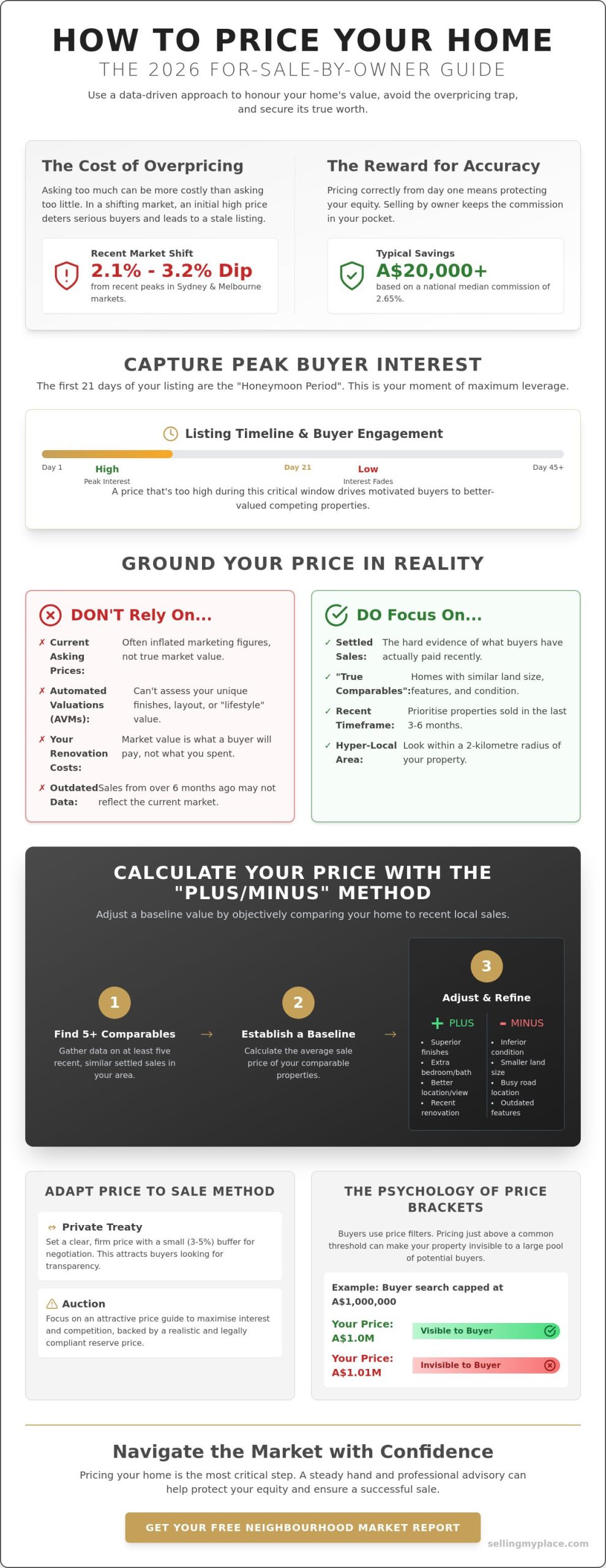
- Understand why the first 21 days of your listing represent the “Honeymoon Period” and how to set a price that captures premium buyer interest before the momentum fades.
- Learn why relying on current portal asking prices can be a trap and how to use settled sales from the last six months to ground your valuation in market reality.
- Master the “Plus/Minus” method for how to price your home for sale by owner by adjusting for unique property features against at least five recent local sales.
- Discover the strategic differences between setting a negotiation buffer for a private treaty sale and choosing an effective auction reserve that avoids illegal underquoting.
- Recognise the value of a “steady hand” and how professional advisory services can help you protect your equity and navigate the complexities of 2026 property regulations.
The Strategy of Pricing: Why Your Opening Figure Defines Your Sale
Market value isn’t a figure based on your mortgage balance or the total cost of the renovations you’ve lovingly completed over the years. It is, quite simply, what a willing buyer is prepared to pay in the current Australian climate. When you’re researching understanding real estate appraisal, you’ll find that professional valuations rely on hard evidence and recent transactions rather than sentiment or hope. For those learning how to price your home for sale by owner, this distinction is your strongest shield. Your opening figure acts as a digital handshake; it’s the very first impression you make on your local community.
The first 21 days of your campaign represent the “Honeymoon Period”. This is when buyer excitement is at its absolute peak. New listings trigger immediate alerts for thousands of active house-hunters who are ready to act. If your price is too high during this window, you aren’t just “testing the market”; you’re actively driving motivated buyers into the arms of your competitors. They’ll use your overpriced home as a benchmark to justify buying the better-valued property just a few streets away. Positioning your home as the best value in your suburb doesn’t mean underselling; it means pricing with a steady hand to generate the competition that ultimately drives a record result.
The Psychology of the Australian Buyer
Australian buyers are savvy and time-poor. They use digital filters on major portals to scan specific price brackets. If you price your home at A$1,005,000, you’ll vanish from the searches of every buyer who has capped their limit at a round A$1,000,000. While “Offers Over” might seem like a clever way to spark interest, it can sometimes feel evasive to a buyer looking for transparency. A clear, grounded price invites an honest conversation and builds the trust necessary for a high-stakes negotiation.
The Cost of Getting it Wrong
When a listing sits on the market for too long, it becomes “stale” in the eyes of the public. Buyers start to wonder if there’s a hidden structural issue or perhaps a difficult settlement condition. This suspicion leads to low-ball offers that wouldn’t have dared surface during your first week. A price reduction often results in a lower final result than a correct initial price. By pricing accurately from the start, you protect your equity and avoid the exhausting cycle of chasing a cooling market downward. You deserve a sale that feels like a victory, not a compromise.
Data Over Guesswork: Using Comparative Market Analysis (CMA)
When you’re trying to figure out how to price your home for sale by owner, it’s tempting to scroll through Realestate.com.au and see what the neighbours are asking. This is a common trap. Asking prices are merely marketing signals, often inflated by hope or agent promises. Instead, you need to look at “Settled Sales”. These are the cold, hard figures of what has actually changed hands in the last six months. In a 2026 market where Sydney and Melbourne have seen values dip by over 2 percent, using data from a year ago could leave your property sitting idle while the market moves away from you.
Finding “True Comparables” is an art. It’s not enough to find a three-bedroom house in the same postcode. You must look for properties on similar land sizes, with comparable finishes, and ideally within a two-kilometre radius. For those in New South Wales, the NSW Government’s guide to selling property offers a helpful framework for the legal steps involved in these transactions. Identifying whether your specific pocket is rising, flat, or softening allows you to position your price with surgical precision. If you feel overwhelmed by the data, a quick Neighborhood Market Report can clarify the local landscape for you.
Beyond the Free Online Valuation
Automated valuation models, or AVMs, are helpful starting points, but they are limited by their algorithms. They can’t see the premium stone in your kitchen or the way the afternoon sun hits your deck. They miss “lifestyle” value; the emotional pull that makes a buyer pay a premium. Obtaining a Neighborhood Market Report provides the granular detail that a standard online estimate simply cannot reach. This helps you identify “outlier” sales, such as a property sold under duress or a family transfer, which might otherwise skew your data and lead to a pricing mistake.
Professional Appraisal vs. Agent Estimates
Mastering how to price your home for sale by owner requires moving past the “agent appraisal”. Some agents may “buy the listing” by quoting an unrealistically high price just to secure your signature. An independent advisory service offers a more objective view, focusing on your family’s needs rather than a commission. While a bank valuation is often conservative to protect the lender, a professional market appraisal considers the emotional appeal of your home. Investing in professional floorplans and photography further justifies a top-of-range price, showing buyers exactly why your property is worth their investment.
Auction vs. Private Treaty: Adapting Your Price to the Method
Choosing between an auction and a private treaty isn’t just about the date on the calendar. It’s about how you invite people into your home’s story. When you’re deciding how to price your home for sale by owner, the method you choose changes the psychology of every interaction with a potential buyer. A private treaty sale is often a thoughtful, one-on-one conversation, while an auction is a public display of competitive desire. Both require a different approach to your figures to ensure you don’t leave money on the table.
For unique or high-end Australian properties, you might even consider an “Expressions of Interest” (EOI) campaign. This approach keeps the price hidden and asks buyers to put forward their best offer by a certain date. It’s a sophisticated way to let the market define the value without the pressure of a public auction. Regardless of the method, your reserve price must reflect current market reality. With national home values showing zero growth in May 2026, setting a reserve based on last year’s records could see your property passed in, which is a stressful outcome for any family.
Pricing for Private Treaty
In a private treaty sale, setting a “buffer” is a standard part of the negotiation dance. We often recommend the “5% Rule”: your asking price should rarely be more than 5 percent above your target price. If you go higher, you risk scaring off the very people who would have fallen in love with your home. If a buyer asks, “What is your bottom line?”, you don’t need to give away your position. Instead, focus on the value you’ve built. A “steady hand” response might be: “We’re looking for a fair market result based on recent local sales; we’re happy to consider any serious offer you’d like to put in writing.”
The Auction Price Guide
Auctions rely on competitive tension. This is where the price guide strategy comes in, but you must be incredibly careful to avoid illegal underquoting. In Victoria, 2026 regulations now require reserve prices to be published earlier to increase transparency. A lower, attractive guide can lead to a higher finish by bringing more people to the front lawn on the day. However, your price guide must be a genuine representation of what you would actually accept. The reserve is your ultimate safety net. While it stays confidential until the auctioneer calls the property “on the market”, it should be grounded in the data we discussed in the previous section.
Step-by-Step: How to Calculate Your Final Listing Price
Now that we’ve moved past the theory, it’s time to get down to the actual arithmetic of how to price your home for sale by owner. Start by collating at least five settled sales from the last 180 days within a two-kilometre radius of your front door. These aren’t just addresses on a map. They’re the benchmarks for your success. Once you have these figures, look at what’s currently “active” on the market. Buyers are comparing your home to these listings right now, so you need to know exactly what they’re seeing at Saturday open homes to ensure your property stands out as the superior choice.
Applying the “Plus/Minus” method helps you account for the unique soul of your property compared to those recent sales. If a comparable house had a pool and yours doesn’t, you might subtract A$20,000 from their sale price to find your baseline. Conversely, if your home is on a quiet cul-de-sac while the neighbour’s is on a busy road, you might add A$10,000 to your estimate. This process ensures your figure isn’t a guess but a calculated reflection of the local landscape. Before you commit to a number, sense-check your findings with an independent Agent Advisory Service to ensure your logic holds up under scrutiny.
The Plus/Minus Adjustment Framework
Valuing an extra bedroom or a renovated kitchen requires a steady hand and an eye for current buyer trends. In 2026, a dedicated home office or a high-end kitchen renovation can significantly sway a buyer’s emotional needle. High-quality curb appeal and professional photography can add 2 to 3 percent to your perceived value by creating a powerful first impression before a buyer even steps inside. Don’t forget to distinguish between the land value; which is often the primary driver in capital cities; and the improvement value of the dwelling itself.
Finalising the “Sweet Spot”
Choosing your final listing price requires a bit of search engine savvy. While “charm pricing” like A$899,000 works in retail, real estate portals often use A$50,000 increments. Selecting a round number like A$900,000 ensures you appear in searches for both people looking up to that limit and those starting from it. We recommend preparing an “Evidence File” containing your research to show buyers exactly why your price is fair and defensible. For more on how to maximise your home’s appeal before you list, see our guide on Pre-Sale Property Consulting.
Ready to lock in a price that protects your family’s future? Our Real Estate Advisory Services provide the professional oversight you need to launch your campaign with total confidence.
The Expert Edge: Why Professional Advisory Beats a Generic Valuation
Selling your family home is one of the most emotional transitions you’ll ever undertake. It represents years of memories and a significant portion of your financial legacy. While you’ve now learned the mechanics of how to price your home for sale by owner, taking this journey alone can still feel daunting. Choosing a “sale by owner” path doesn’t mean you have to be isolated. In fact, the most successful sellers are those who pair their local knowledge with a professional support system. The Kincade Agent Advisory Service provides that essential “steady hand”, offering the calm confidence needed to navigate high-stakes pricing in a shifting 2026 market.
Accuracy in your initial figure does more than just attract buyers; it streamlines the entire back-end process. When your price is grounded in reality, the conveyance process often moves faster because bank valuations are more likely to align with the contract price. This reduces the risk of a sale falling through due to finance issues. Additionally, using professional floorplans and photography is vital for communicating value to the increasing number of interstate and overseas buyers looking at Australian property. These tools allow a buyer in Perth or London to walk through your home virtually, giving them the confidence to make a premium offer without a physical inspection.
Leveraging a Global Marketing Network
Many sellers worry that they’ll miss out on “premium” buyers by not using a traditional agency. The reality is that international exposure often finds the very buyers local agents overlook. By listing on major portals until your property is sold, you remove the artificial time pressure of a standard 90-day agency agreement. You can hold out for the price your home truly deserves. Best of all, the flat-fee advantage means you could keep A$20,000 or more in your pocket at settlement. Before committing to any selling arrangement, it’s worth reviewing a detailed flat fee vs commission real estate Australia comparison to understand exactly how much of your equity you stand to protect. That is a significant sum that can be better spent on your next chapter or your family’s future stability.
Your Next Steps to a Successful Sale
The path to a record-breaking result starts with preparation. Your first step is to gather the most current data available for your specific pocket of Australia. Don’t rely on guesswork when the stakes are this high. You can organise your Neighborhood Market Report today to see exactly how your property compares to recent settled sales. Once you have your data, booking professional photography will ensure your home’s true worth is showcased to the world from day one. Ready to take the lead? You can get started with a flat-fee marketing package right now and take full control of your sale with our expert guidance by your side.
Your Path to a Record Result Starts Today
You now have the clarity needed to navigate the shifting 2026 property landscape with total confidence. By prioritising settled sales over hopeful asking prices and aligning your figure with digital search brackets, you’ve mastered the most critical lessons on how to price your home for sale by owner. This data-driven approach protects your hard-earned equity and ensures your home stands out during that vital “Honeymoon Period” of the listing.
You deserve a sale process that respects your time and your family’s financial legacy. Our partnership model provides the professional tools and the steady hand of an expert advisor without the burden of traditional agency costs. Save thousands and sell smarter with our Flat-Fee Marketing Packages. You’ll benefit from an average saving of A$20,000 in commissions, a listing that stays active until sold with no time limits, and our comprehensive Agent Advisory Service included in every package.
Take the lead on your property journey today. We’re here to help you achieve the exceptional result your home deserves and your family’s future requires.
Frequently Asked Questions
Is a free online property valuation accurate enough to set my price?
Free online valuations use algorithms that often miss the specific lifestyle features and unique soul of your home. While they provide a helpful starting point, they can’t account for your recent high-end kitchen renovation or the quietness of your particular cul-de-sac. For a reliable result on how to price your home for sale by owner, you must combine these digital estimates with a deep dive into recent settled sales data from your immediate area.
What is the difference between a bank valuation and a market appraisal?
A bank valuation is a conservative assessment designed to protect a lender’s risk; it’s often significantly lower than what you’d expect. A market appraisal considers current buyer demand, emotional appeal, and the competitive nature of the local landscape. It reflects what a person is actually willing to pay on the open market today rather than just the asset’s “safe” value for a mortgage.
How do I avoid “underquoting” when selling my own home in Australia?
Underquoting occurs when a property is advertised for less than the seller’s true asking price or the estimated market value. To stay compliant with Australian state laws, ensure your advertised price guide is a genuine reflection of what you would accept at settlement. Keep a clear file of recent comparable sales to justify your figure if authorities or buyers ever query your pricing strategy during the campaign.
Should I price my home higher to leave room for negotiation?
While it’s tempting to add a large buffer, pricing too high often backfires by scaring off your best buyers during the vital first three weeks. We recommend the “5% Rule”, where your asking price is no more than 5 percent above your target. This leaves enough room for a healthy conversation without making your home look like poor value compared to other active listings in your suburb.
How often should I review my price if the property hasn’t sold?
You should review your price every 14 to 21 days if you aren’t seeing consistent enquiry or inspection numbers. The market speaks quickly. If the “Honeymoon Period” passes without a serious offer, it’s a clear signal that your initial figure might be slightly out of step with current buyer expectations. A quick adjustment can often reignite interest before the listing becomes stale.
Can I change my price once the property is listed on realestate.com.au?
Yes, you have the flexibility to update your price at any time through your listing dashboard. These changes typically flow through to major portals like realestate.com.au almost immediately. It’s often a smart move to adjust your figure if you notice you’re sitting just outside a popular search bracket, such as A$1,005,000 versus a round A$1,000,000, to capture a wider audience of house-hunters.
What is a CMA and why do I need one for a sale by owner?
A CMA stands for Comparative Market Analysis. It’s a detailed report that compares your property to similar homes that have actually changed hands nearby in the last six months. This is an essential tool for anyone learning how to price your home for sale by owner because it provides the hard evidence you need to negotiate firmly and confidently with potential buyers during the final stages of a sale.
How do I handle a buyer who says my home is overpriced?
When a buyer claims your home is overpriced, stay calm and ask them which recent settled sales they are using as a comparison. Often, buyers use “asking prices” of other homes rather than actual sale results. By presenting your own Evidence File of recent local transactions, you can steer the conversation back to the facts and protect your equity with a steady hand and quiet confidence.