Average conveyancing fees in Australia and what fixed-fee quotes include
A fixed-fee quote can make conveyancing costs easier to understand, but it may not include every expense. Conveyancing is the legal and administrative work involved in transferring property ownership. The total depends on whether you’re buying or selling, the property and the searches required.
It’s understandable to want a clear figure before making a major property decision. Buyers and sellers need different work, and government charges or third-party search costs may sit outside a quoted professional fee.
This guide explains what conveyancing covers, why costs vary for buyers and sellers, and how to compare fixed-fee quotes without overlooking possible extras. It also outlines what to look for in a quote to understand the costs before settlement.
Key Takeaways
- Separate the professional fee from disbursements and government charges to understand the full conveyancing cost.
- Compare the work required for a purchase with a sale, as the searches, documents and settlement tasks can differ.
- Look beyond the “fixed fee” label: identify which services are included and which third-party costs may be additional.
- Match your quote to the transaction, including whether the property is a house, unit or more complex sale.
- If you’re preparing to sell or buy, Kincade International Direct Sales offers residential property listing services, buyer representation and pre-sale property consulting.
Why Do Buyers and Sellers Pay Different Conveyancing Fees?
Buyers and sellers need different legal work, searches and settlement documents, so their quotes can differ. Separate the professional fee from third-party disbursements to see what each quote covers.
Professional Fees and Disbursements
The professional fee pays for the conveyancer’s or solicitor’s work; disbursements are costs paid to third parties during the transaction. This distinction matters because a fixed professional fee may not include searches, certificates or electronic settlement charges.
The work varies depending on your role. A buyer’s conveyancer reviews the contract, coordinates title and property searches, works with the lender where relevant, and prepares for settlement. A seller’s conveyancer prepares sale documents, responds to enquiries and arranges discharge of existing mortgages.
Property type can change the workload. A house sale may require different council or building information. The quote should distinguish the conveyancer’s work from external charges, rather than presenting everything as one unexplained base fee.
Property Certificates and Search Fees
Property certificates and search fees are third-party disbursements that provide records about a property, its title or associated charges. Required searches depend on the property’s location and type, and their costs may sit outside the professional fee.
These charges help explain why apartments may involve different search costs from houses.
Are conveyancing fees tax deductible or included in the property’s cost base in Australia? Tax treatment depends on the property’s use and whether each cost is capital or relates to earning income. Keep the itemised statement, separating professional work, searches and settlement charges, so each amount can be assessed in the right context.
At settlement, conveyancing fees and disbursements are commonly paid and accounted for through the electronic settlement process. Compare the itemised estimate with the final statement to identify professional fees and third-party charges, such as certificates, searches or platform fees.
Services included in conveyancing fees
A conveyancer coordinates the legal and administrative work required to transfer property ownership. For a buyer, this can mean reviewing the contract and organising settlement; for a seller, it includes preparing sale documents and responding to enquiries.
Typical inclusions depend on the transaction and the quote’s scope. Read the service description alongside its exclusions, especially for searches, lender-related work and third-party charges. Similar fixed-fee quotes may cover different tasks, so check the listed services against whether you’re buying or selling.
What a Buyer’s Quote May Cover
For a purchase, conveyancing often starts with contract review. The conveyancer checks key terms, explains obligations and helps identify issues that need attention before signing. Once the contract is agreed, they coordinate searches and certificates, communicate with the seller’s representative and prepare transfer documents.
If a buyer has a home loan, the conveyancer also coordinates settlement details with the lender. They calculate the funds required, prepare settlement figures and arrange the electronic transfer of money and title. Stamp duty is a separate government charge, not the conveyancer’s professional fee, so the quote should distinguish legal work from the buyer’s wider purchase costs.
When reviewing a buyer’s quote, separate contract work from settlement coordination. Check whether the scope includes correspondence with the lender and preparation of transfer documents, or whether those tasks are charged separately. Property type can also affect which searches or certificates are needed.
What a Seller’s Quote May Cover
A seller’s conveyancer prepares the contract documents, provides property information and responds to questions from the buyer’s representative. They also coordinate mortgage discharge details where a loan is secured against the property, then prepare settlement figures showing adjustments and amounts payable.
In Queensland, sellers must provide a seller disclosure statement and prescribed certificates before the buyer signs the contract, under requirements effective from 1 August 2025. That work can affect what a seller’s quote includes. A Queensland seller can compare whether preparing those documents appears in the professional fee or as a separate item.
Third-Party and Settlement Charges
Some charges relate to the platform used to complete the transaction, rather than the conveyancer’s professional work. Check whether this amount is included in the quoted fee or listed separately as a disbursement, so it’s accounted for in your expected settlement costs.
Ask how the final statement separates professional work, certificates, searches and electronic settlement charges. This breakdown helps explain changes between the initial estimate and settlement, particularly if a lender, property type or required document adds work. Keep the quote and final statement together to make the transaction costs easier to review later.
If you’re preparing a property sale and need guidance alongside the legal process, conveyance advice for your sale can help you understand the roles involved.
Choosing a conveyancer or solicitor
The right professional depends on your state, transaction type and the legal work involved. Compare the service scope and total conveyancing costs, not just the headline charge.
Choosing a Conveyancer
A conveyancer focuses on the legal and administrative tasks involved in property transfers. Their experience with your state’s contracts, searches and settlement process matters because requirements and costs vary across Australia.
These figures are professional fees, not necessarily the total cost, which may also include searches, certificates and other disbursements.
Queensland has no separate licence for non-lawyer conveyancers, so conveyancing is handled by solicitors and law practices. Consider the professional’s legal practice and relevant property experience. In NSW, conveyancers must disclose costs upfront and transparently, helping you understand the stated scope and charges.
Compare quotes by checking the transaction covered, the work included and any exclusions. A straightforward house transfer may require different searches and documents from an apartment purchase. Where relevant, check whether the quote accounts for lender coordination, contract review, certificates and electronic settlement.
Online conveyancers in Australia typically charge professional fees 10-20% less than traditional practices. A lower fee alone doesn’t explain which services are included, so compare the scope alongside the price. The useful comparison is the work being done for your particular property and transaction.
Choosing a Solicitor
A solicitor can handle conveyancing as part of a broader legal practice. This may suit a transaction with additional legal issues, such as a complex contract or company involvement, where advice beyond routine transfer work is relevant.
Professional fees differ by state and practice.
These ranges help put quotes in context, but the transaction’s requirements influence the fee. A property with multiple titles, unusual contract terms or additional parties may need more review and coordination. Council and title searches also affect disbursements, which should be distinguished from the solicitor’s professional charge.
Read the quote for its named services, exclusions and likely third-party costs. Check whether it covers contract advice, lender communications, document preparation and settlement coordination. An itemised quote makes it easier to compare professional work with external charges, rather than judging conveyancing costs by one figure.
Choose a professional whose experience and quoted scope suit your transaction. A routine sale and a complex purchase require different work, so look for a clear outline of the legal tasks involved in your matter.
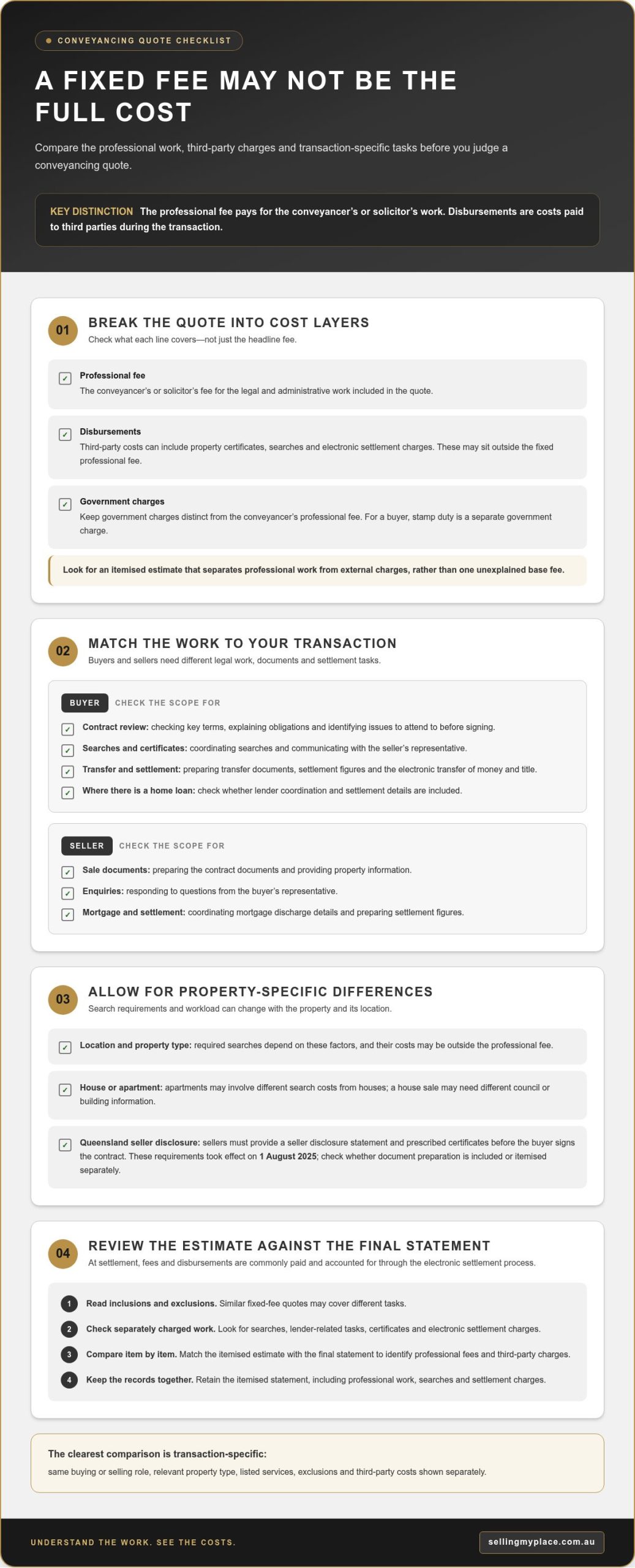
Comparing fixed-fee conveyancing quotes
A fixed fee sets out a defined professional charge, but the transaction’s full cost may include separate disbursements. Compare quotes for the same property type and service scope to see what each figure covers.
Factors Affecting Quotes
A conveyancing quote reflects the transaction’s complexity, required documents, property type and included work. A seller’s matter differs from a purchase, while an apartment may need strata information that a standard house does not. Multiple titles or lender coordination can add tasks, which is why similar-looking quotes may cover different work.
State-based charges affect the overall amount, even when the professional fee is fixed. In Victoria, transfer registration costs A$104.30 plus A$2.34 for every A$1,000 of the purchase price, capped at A$3,614. These government charges are separate from professional fees, so check whether a quote includes them or lists them separately.
Transaction timing and structure matter, too. Off-the-plan conveyancing can take months or years, depending on when construction is completed.
Comparing Quotes and Saving on Fees
Compare like with like: use the same transaction type, property details and requested services for each quote. Then separate the professional fee from searches, certificates, electronic settlement charges and government costs. This gives you a clearer estimate than comparing headline totals alone.
Check each inclusions list against the work your transaction needs. For a purchase, look for contract review, title searches, settlement coordination and lender communication where relevant. For a sale, check whether document preparation and mortgage discharge coordination are covered. A missing item can make a low initial fee difficult to compare.
Use an itemised quote to identify optional tasks and third-party charges. A search is not the same as professional work, and transfer registration is not the conveyancer’s fee. Comparing these categories separately helps you see where quotes differ and avoid paying for services your transaction doesn’t require.
Low-Cost Conveyancing Quotes
A low-cost quote may offer a narrower service scope or use an online process. Online conveyancers in Australia typically charge professional fees 10-20% less than traditional practices. That difference makes the listed services and exclusions especially important to compare, rather than assuming each quote covers the same work.
Check whether the quoted amount covers your actual transaction, including searches, titles and settlement tasks. If a seller’s quote excludes a required document, or a buyer’s leaves out lender coordination, the final total may differ from the initial fee. A clear breakdown shows what is included and charged separately.
Choose the quote that matches the work required, not simply the lowest amount. A standard purchase and an off-the-plan purchase involve different timeframes and coordination. Comparing quotes for the same transaction lets you assess professional fees and disbursements fairly.
Fixed conveyancing fees for buying and selling
Fixed-fee quotes can make the professional charge predictable, but buyers and sellers need different work. The quoted fee is only one part of the transaction’s total cost.
The total can include searches and statutory disbursements, while transfer registration, stamp duty and other government charges may sit outside the conveyancer’s fee. Check the quote’s inclusions before treating its fixed professional fee as the full amount required for settlement.
Why Buyer and Seller Quotes Differ
Buyers need contract review, title searches, transfer documents and coordination with their lender where a loan applies. A unit purchase may also require strata information. These tasks shape the quote, along with the property’s location and the number of titles involved.
Sellers have different responsibilities. Their conveyancer prepares sale documents, responds to buyer enquiries and coordinates discharge of an existing mortgage.
The difference between buying and selling estimates reflects different work and disbursements, not simply a different label on the quote. Sellers should check which documents and settlement tasks are included; buyers should look for searches and lender coordination where relevant.
What a Fixed Fee Covers
“Fixed fee” usually describes the professional charge for the work listed in the quote, rather than every cost associated with buying or selling. Search fees, certificates, registration charges and electronic settlement costs may be listed separately. For a fair comparison, match quotes for the same transaction type and property details.
Government charges can materially affect a buyer’s final budget. In Victoria, transfer registration costs A$104.30 plus A$2.34 for every A$1,000 of the purchase price, capped at A$3,614. Queensland transfer registration costs A$248.04 plus A$46.56 for every A$10,000 above A$180,000. These charges are distinct from professional fees.
For sellers, the fixed-fee scope may depend on the sale documents and settlement work required.
Before comparing totals, separate professional fees, disbursements and government charges in each quote. If you’re preparing to sell, get guidance on preparing your property sale alongside your conveyancing arrangements.
Kincade International Direct Sales: Residential Property Listing Services
Kincade International Direct Sales can help if you’re preparing to sell and want property marketing support alongside your conveyancing arrangements. Its Residential Property Listing Services use a flat-fee model and include professional photography. The packages also offer features such as floorplans and neighbourhood market reports to help owners present their home to buyers.
The service provides residential listings through a global marketing network, with no time limits and a 0% commission structure. Pre-Sale Property Consulting can help you plan the sale, while Buyer Representation supports people looking for guidance on a purchase. These services address marketing and property decisions, while legal transfer work remains part of conveyancing.
If you’re weighing up your next property move, you’re welcome to contact Kincade International Direct Sales or visit sellingmyplace.com.au.
Make your next property move with a clear plan
Use the average conveyancing fees in Australia in 2026 as a planning reference, then shape your next steps around your own property goals. A move is more than a transaction: it can mean choosing a home that fits your life or preparing a place that holds years of memories. Clarity about responsibilities and costs gives you more room to make those decisions thoughtfully.
If you’re preparing to sell, Kincade International Direct Sales offers Residential Property Listing Services and Pre-Sale Property Consulting to support your marketing decisions. Buyer Representation can help buyers approach their search with a clearer sense of what matters to them. These services complement, but do not replace, the legal work involved in conveyancing.
Take the next step at your pace. Contact Kincade International Direct Sales to discuss your property plans and find a considered way forward.
Frequently Asked Questions
What is conveyancing?
Conveyancing is the legal process of transferring property ownership from seller to buyer. It covers tasks such as reviewing the contract, preparing transfer documents and coordinating settlement. For example, a buyer’s conveyancer helps arrange registration of the transfer, while the seller’s representative handles documents needed to complete the sale. This work connects the contract, payment and title transfer so the change in ownership can be completed.
Are conveyancing fees paid upfront?
Conveyancing fees and disbursements are commonly paid at settlement and accounted for through the electronic settlement process. They’re often included in the settlement figures rather than paid as one upfront bill. Search costs or other arrangements may have different payment timing, so read the payment terms in the engagement documents. Keep the final statement with your property records for reference.
How do I get an accurate quote?
Give the conveyancer the details that shape the work: whether you’re buying or selling, the state, property type and transaction structure. Include relevant information about a loan, multiple titles or an owners corporation, as these can affect searches and settlement tasks. Ask for an itemised estimate that separates professional work from disbursements and government charges. A quote based on the actual contract is more useful than a generic estimate.
What goes wrong if I just pick the cheapest option?
The lowest headline fee may cover a narrower scope than another quote. Search fees, lender coordination or additional title work could be charged separately, making the final bill different from the initial comparison. A missing service can also leave you unsure who handles a task before settlement. Compare itemised inclusions and exclusions, not just the professional fee, and match each quote to the same transaction details.
What government fees do you pay on top in QLD?
Queensland buyers may pay transfer duty and Titles Queensland registration charges, separate from professional fees. Transfer registration is A$248.04 plus A$46.56 for every A$10,000 of the purchase price above A$180,000. From 1 July 2026, registering a new mortgage or releasing an existing mortgage costs A$248.04 each.
What are the average conveyancing fees in Australia in 2026 for sellers?
These Australia-wide estimates depend on the sale’s documents, searches and settlement work.
How much do conveyancers and property solicitors charge in each Australian state and territory?
Indicative professional-fee ranges vary by location and practitioner. These are professional fees, not total costs.
What is included in a fixed conveyancing fee, and what costs extra?
A fixed conveyancing fee generally covers the professional tasks listed in the quote, such as contract work, document preparation and settlement coordination. Search costs, certificates, government registration charges and electronic settlement platform fees may be additional. Check the itemised scope against your transaction, including whether lender-related work or property-specific searches are included or charged separately.
Stamp Duty for Sellers in Australia: 2026 Guide
Could a tax you usually don’t owe still affect how you plan your sale? For anyone searching “stamp duty for sellers australia”, the usual answer is reassuring: transfer duty, commonly called stamp duty, is generally the buyer’s responsibility, not a tax charged to the seller simply for selling a home. Still, settlement can involve other costs, and the details of your transaction matter.
It’s understandable to worry that an unexpected bill could reduce your sale proceeds, especially when stamp duty is easily confused with capital gains tax, land tax, GST or conveyancing costs. These are separate charges and obligations, and whether they apply to you depends on your circumstances.
This 2026 guide explains who usually pays transfer duty and when, which sale-related costs sellers may still face, and what to check before settlement, including rates adjustments. You’ll also learn where to confirm the rules for your state or territory and when to ask a conveyancer or qualified tax professional about your specific sale, so you can plan with greater clarity.
Key Takeaways
- For stamp duty for sellers australia, the usual starting point is that the buyer pays transfer duty when ownership changes.
- Transfer duty is separate from capital gains tax and other sale-related costs, which may depend on your circumstances.
- Check the transaction details carefully if your sale isn’t a standard residential property transfer.
- Use the relevant state or territory revenue authority to confirm current duty guidance for the property and transaction.
- A written sale-cost checklist can help you prepare for tax questions, professional fees, loan matters and marketing decisions before settlement.
Stamp duty for sellers in Australia: what the term means
“Stamp duty” is the familiar name Australians often use for property transfer duty. The precise terminology and rules depend on the state or territory, because the duty is imposed under state or territory arrangements rather than as a single federal property tax. The general Stamp duty overview explains the term’s wider use, but your local revenue authority is the place to confirm how it applies to a particular transaction.
For sellers, the usual position is reassuring: the buyer generally pays transfer duty when property ownership transfers. It’s separate from the amount the buyer agrees to pay you under the sale contract, so the buyer’s duty isn’t automatically deducted from your sale proceeds as a seller’s stamp-duty charge. Treat this as a starting point, though, not a substitute for checking the contract, property type and jurisdiction.
Is stamp duty normally paid by the buyer or seller?
In an ordinary property sale, the buyer is generally responsible for the duty associated with acquiring the property. The sale price is paid to the seller under the contract; transfer duty is a separate obligation assessed under the relevant jurisdiction’s rules. Settlement can also involve other payments and adjustments, so ask your conveyancer to explain the figures and responsibilities shown for your transaction.
As a general rule, the buyer pays transfer duty on a property purchase, but the applicable jurisdiction, transaction details and contract should always be checked.
What does transfer duty apply to?
Transfer duty is commonly associated with acquiring or transferring certain interests in property. The exact transactions covered, how duty is assessed and who is responsible are determined by each state or territory’s legislation and official guidance. A straightforward residential sale may therefore raise different questions from a transfer involving another property type or arrangement.
If ownership is changing in a way that doesn’t follow a standard sale, don’t assume the usual buyer-pays explanation settles every duty question. Check the contract and ask a conveyancer to identify the relevant revenue authority’s guidance for the property and transfer involved.
If you’re looking up stamp duty for sellers australia, focus on separating the buyer’s transfer-duty obligation from your own sale proceeds and obligations. A clear explanation of the contract and settlement figures can help you understand what is being paid, by whom and why.
Do sellers pay stamp duty, or other taxes and selling costs?
Understanding stamp duty for sellers australia starts with separating the buyer’s transfer duty from the costs and tax questions that may belong to you as the seller. They aren’t interchangeable, and not every seller faces the same obligations. The Australian Government’s Stamp duty rules page explains the general framework and links to state and territory guidance.
| Item | How it may relate to a sale | What to check |
|---|---|---|
| Transfer duty | Generally payable by the buyer when they acquire property, subject to the relevant rules. | Confirm the jurisdiction’s guidance and the transaction arrangements. |
| Capital gains tax (CGT) | A possible seller tax issue relating to an assessable capital gain. A sale doesn’t automatically mean CGT is payable. | Ask the ATO or a qualified tax adviser how your ownership, use and circumstances affect the outcome. |
| Land tax or GST | Separate tax questions that may be relevant depending on the property and transaction. | Check with the relevant revenue authority, the ATO or a qualified adviser. |
| Sale and settlement expenses | May include conveyancing, marketing, loan discharge or payout expenses, and adjustments to outgoings at settlement. | Review your contract, loan details and settlement statement with the relevant professional. |
How is transfer duty different from capital gains tax?
Transfer duty is generally connected to acquiring or transferring a property interest. CGT, by contrast, concerns a capital gain that may be assessable for tax purposes. Whether CGT applies, and how it’s treated, depends on individual circumstances. Don’t assume that selling a home or investment property automatically creates a tax bill. The Australian Taxation Office (ATO) provides current CGT guidance. For advice tailored to you, speak with a tax professional who can consider ownership, how the property was used and your wider circumstances.
Could land tax or GST affect a property seller?
Possibly, but neither is another name for transfer duty, and their application isn’t identical for every seller. Property use, ownership structure and the type of transaction can all be relevant factors to verify. Check land-tax questions with the relevant state or territory revenue authority, and GST questions with the ATO or a qualified tax adviser. Your conveyancer can help identify transaction details to raise, but shouldn’t replace tax advice.
A written cost checklist can help keep confirmed taxes separate from professional fees, marketing decisions and loan matters. If you’re considering how to prepare and market your home, property sale support information is available here. Kincade International Direct Sales provides flat-fee property marketing and advisory services. Marketing support is separate from stamp-duty advice and doesn’t determine your tax obligations.
When can an Australian property sale need a closer duty check?
The usual buyer-pays approach is a useful starting point, but it won’t answer every question about a particular transfer. If the arrangement differs from a straightforward residential sale, pause before assuming the standard explanation applies. The relevant rules depend on the state or territory where the property is located and on the details of the transaction.
Which transaction details should sellers flag?
Before settlement, tell your conveyancer if the transfer involves anything out of the ordinary, such as:
- a transfer between related parties rather than an ordinary sale to an unrelated buyer
- a partial interest in the property, rather than the whole interest
- unusual consideration, or an arrangement where the agreed payment isn’t straightforward
- a property type or transaction structure that isn’t a standard residential sale.
These are prompts for a closer review, not claims that duty will necessarily apply or that a particular party must pay it. Terminology and treatment can differ across jurisdictions. Ask your conveyancer to check the current guidance from the revenue authority for the state or territory where the property sits, and to seek qualified tax advice if the transaction raises broader tax questions.
Can a contract change who pays a duty?
There’s an important distinction between who may be legally liable under duty rules and what the parties agree about payments between themselves. A contract may set out payment or reimbursement arrangements, but that wording shouldn’t be treated as a substitute for confirming the statutory position. The effect of any clause depends on the transaction and applicable law, so have a conveyancer explain it before you rely on an assumption.
Contract terms may allocate costs between the parties, but they don’t replace checking who is liable under the relevant duty rules.
Read the sale contract closely and ask how any duty-related wording flows through to the settlement statement. Check which party is expected to make each payment, whether an agreed contribution or adjustment is recorded, and whether those arrangements match the advice you’ve received. If something is unclear, raise it before settlement rather than relying on a verbal understanding.
For sellers researching stamp duty for sellers australia, the practical safeguard is to match three things: the property’s jurisdiction, the nature of the transfer and the contract’s payment terms. A conveyancer can help interpret the settlement documents and identify questions for the relevant authority. That way, the general rule remains a guide while the actual transaction gets the careful review it needs.
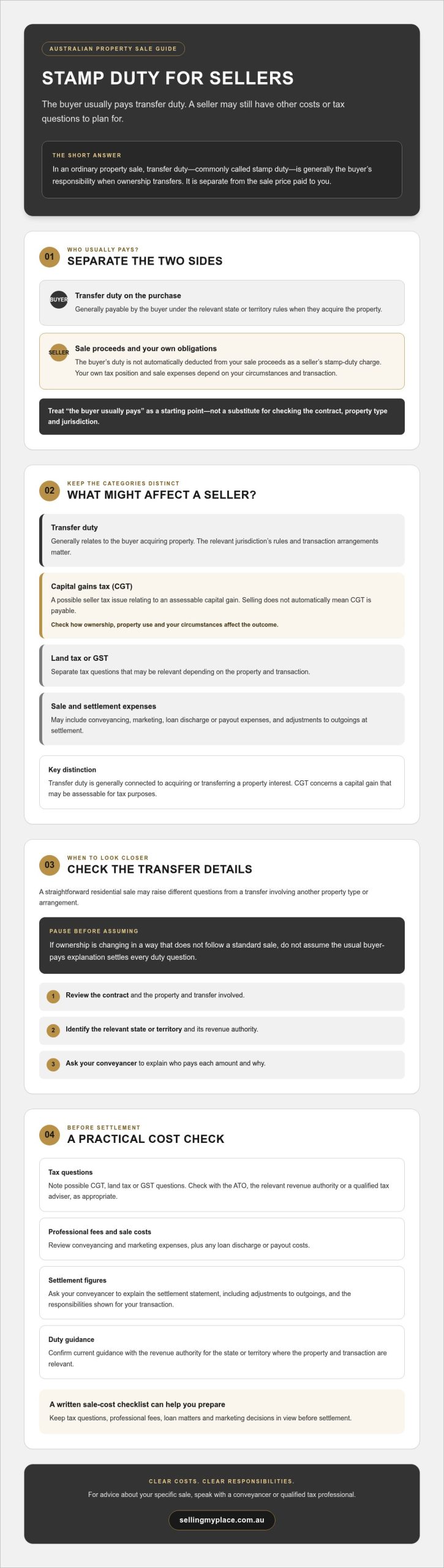
How sellers can check stamp duty before settlement
A few well-organised checks can help you separate the buyer’s duty question from your own contract and settlement responsibilities. If you’re researching stamp duty for sellers australia, use this process to find the right official guidance and know which questions to put to your conveyancer.
What information should sellers gather first?
Start with the details that help an adviser identify the rules for your transaction. You don’t need to gather more personal or financial information than is relevant.
- Identify the property’s jurisdiction. Note the state or territory where the property is located. The applicable duty guidance comes from that jurisdiction’s revenue authority.
- Describe the transaction. Clarify whether it’s an ordinary residential sale or has features such as a transfer of part of an interest, related parties or unusual consideration. These details are prompts for review, not proof that duty applies.
- Review the contract. Have the signed or proposed contract available, including any wording about duty, contributions or adjustments. Ask your conveyancer to explain clauses you’re unsure about.
- Check settlement arrangements. Gather the proposed settlement date and relevant settlement information, then ask how payments and adjustments are expected to appear in the settlement statement.
Share only what’s needed with the professionals helping with the transaction. Take care not to circulate unnecessary identifying, banking or other sensitive personal information.
Who can confirm the answer for your transaction?
For the current official position, check the revenue authority for the state or territory where the property sits. Its guidance is the appropriate starting point for duty rules and any relevant forms, calculators or updates. Don’t rely on a general online estimate unless you’ve confirmed that its inputs and assumptions match your transaction.
Your conveyancer or solicitor can help interpret the contract and settlement implications. Ask them to clarify who is legally liable, how any agreed payment arrangement is recorded, and whether unclear contract wording needs attention before settlement. If the answer depends on unusual transaction details, ask what further professional advice is appropriate.
Keep tax questions in their own lane. For income-tax or GST guidance, consult the Australian Taxation Office (ATO) or a qualified tax professional. Duty checks shouldn’t be replaced by decisions about how to market the property.
For information about preparing and marketing your residential property, see the property sale support options. This support can help you plan the sale process, while duty and tax questions remain with the relevant authority and qualified advisers.
Plan the sale with clear costs and the right support
A clear cost picture can make a major sale feel more manageable. Buyers generally pay transfer duty, while sellers should separately check their own tax position and the expenses involved in preparing and completing the sale. Keep those categories distinct: the buyer’s duty isn’t a substitute for checking your own obligations, and a marketing decision doesn’t determine your tax liability.
How should sellers build a reliable sale-cost picture?
Start a written checklist and label each item as confirmed, estimated or awaiting professional advice. That simple step helps prevent an assumption from being mistaken for a settled cost. You might organise it under these headings:
- Taxes: note any advice or official guidance you’ve received about your own tax position. Keep buyer transfer duty separate.
- Professional fees: record conveyancing and any tax advice you’re seeking, based on information provided by the relevant professional.
- Loan matters: ask your lender and conveyancer what needs to be checked about your loan and its handling at settlement.
- Marketing and preparation: list the services and sale-preparation choices you’re considering, and confirm their terms directly.
Update the checklist as the contract and settlement details become clearer. For a practical overview of the owner-led sale process, read this guide on how to sell your own home. It can help you think through the steps involved without mixing them up with duty or tax advice.
Where does property-selling support fit in?
Marketing support can help organise how your home is presented and listed, but it can’t determine who owes tax or how duty rules apply. Kincade International Direct Sales offers flat-fee property marketing and advisory packages, including professional photography and floorplans. Its commission-free model is separate from tax, conveyancing and loan-related questions. Find out more about professional residential property listing services.
For anyone weighing up stamp duty for sellers australia, the steady approach is to verify duty with the relevant revenue authority, get transaction-specific advice where needed, and plan the rest of the sale costs in their own categories. A marketing service can support the sale process, but it doesn’t change your duty or tax position.
Move ahead with a clearer sale plan
For stamp duty for sellers australia, the key takeaway is that buyers generally pay transfer duty, while sellers should check their own tax position and sale costs separately. The contract, transaction details and state or territory rules matter, so confirm what applies with the relevant revenue authority and a conveyancer before settlement.
A written checklist can help you keep confirmed obligations, professional advice, loan matters and marketing decisions organised. Kincade International Direct Sales is a commission-free property marketing and advisory service with a flat-fee model. Its services include professional photography and floorplans, separate from tax advice or duty obligations.
With clear information and the right support, you can take the next step with greater confidence.
Frequently Asked Questions
Do sellers pay stamp duty when selling a house in Australia?
Generally, no. In an ordinary Australian residential sale, the buyer usually pays transfer duty, commonly called stamp duty, when acquiring the property. It’s separate from the sale price and isn’t automatically deducted from your proceeds as a seller’s duty payment. Check the contract and settlement arrangements for your specific transaction, particularly if the transfer is unusual or involves more than a standard sale.
Is stamp duty the same as capital gains tax?
No. Transfer duty is generally associated with acquiring or transferring certain property interests, while capital gains tax (CGT) concerns a capital gain that may be assessable for tax purposes. Selling a property doesn’t automatically mean you’ll owe CGT. The outcome can depend on factors such as ownership and how the property was used. Check current Australian Taxation Office (ATO) guidance and seek advice for your circumstances.
Can a seller be responsible for transfer duty in Australia?
The buyer generally pays transfer duty in an ordinary property purchase, but don’t assume that rule answers every transaction. The applicable legislation and transaction details determine legal liability, while a contract may separately describe how the parties arrange or share a payment. If your sale involves a partial interest, related parties or another non-standard feature, ask your conveyancer to check the relevant state or territory rules.
How much stamp duty does a seller pay?
For a typical residential sale, the seller generally doesn’t pay the buyer’s transfer duty, so there usually isn’t a seller stamp-duty amount to calculate. That doesn’t mean the seller has no sale costs or tax questions: conveyancing, loan-related matters and a possible CGT liability are separate considerations. Don’t rely on a generic calculator for an unusual transfer. Confirm the transaction details with the relevant revenue authority and your adviser.
What happens if the sale contract says the seller pays stamp duty?
Ask your conveyancer to explain the clause before relying on it. Contract wording may set out an agreed payment or reimbursement arrangement between the parties, but it doesn’t necessarily change who is legally liable under the relevant duty legislation. Have the clause read alongside the transaction details and settlement statement, and clarify who is expected to pay what before settlement. If needed, seek advice from a qualified professional.
Do sellers pay stamp duty on an investment property sale?
In an ordinary sale, the buyer generally pays transfer duty, whether the property is an investment or a home. For the seller, an investment property may raise separate tax questions, including whether a capital gain is assessable. The result depends on the owner’s circumstances and the property’s history. Check the ATO’s current CGT guidance and speak with a qualified tax professional rather than assuming duty and CGT are the same.
Does every Australian state and territory have the same stamp-duty rules?
No. Transfer duty is governed by state and territory rules, so terminology, processes and the way a particular transaction is treated can vary. The property’s location determines which revenue authority’s guidance to check. For a current answer, use that authority’s official information and ask your conveyancer how it applies to your contract and settlement. Avoid relying on a rule or calculator intended for a different jurisdiction.
Should I check stamp duty before settlement?
Yes, especially if the transaction isn’t a straightforward residential sale or the contract includes unclear payment wording. Identify the property’s state or territory, review the transaction type and contract, then check the relevant revenue authority’s current guidance. Ask your conveyancer to clarify liability and settlement arrangements before you rely on an assumption. For sellers researching stamp duty for sellers australia, this helps keep the buyer’s duty distinct from your own sale costs and tax questions.
