Property Marketing Plan Australia: A Comprehensive Guide for 2026 Home Sellers
What if the key to unlocking your home’s true value isn’t hidden behind hefty commission fees, but lies in a strategy you can lead yourself? We know that saying goodbye to a family home is one of life’s most significant transitions. It’s a time filled with memories and, quite naturally, a fair bit of stress about getting the result you deserve. You likely feel that a property marketing plan australia should be more than just a list of expensive portal ads. It should be a thoughtful reflection of your home’s unique story and its place in the community.
We agree that watching your hard-earned profits disappear into traditional agency pockets feels unsettling, especially when you’re the one who knows your local streets best. This guide is designed to empower you with the exact roadmap needed to achieve a professional-grade listing and maximise your sale price while keeping your equity where it belongs. We’ll explore how to organise high-impact photography, navigate the 2026 digital landscape, and present your home with a level of polish that rivals any traditional agency.
Key Takeaways
- Understand why a structured plan serves as the engine room of your sale, protecting your peace of mind and preventing expensive, ad-hoc mistakes.
- Learn to identify the non-negotiables for a professional listing, including the lifestyle-focused storytelling found in quality photography and floorplans.
- Discover how to design a high-impact property marketing plan australia that reaches the right buyers while bypassing traditional agency commissions.
- Explore the significant financial advantages of flat-fee solutions, allowing you to retain more of your home’s equity for your next chapter.
- Follow a practical, step-by-step roadmap to prepare your property, from researching local market reports to leveraging expert pre-sale consulting.
What is a Property Marketing Plan and Why Does Your Sale Depend on It?
Think of your marketing strategy as the engine room of your entire sale. It’s the central force that transforms a simple listing into a competitive event that draws people in. When you’re preparing to move on from a place filled with years of memories, the last thing you need is the uncertainty of ad-hoc decisions. A structured property marketing plan australia provides a sense of calm during what can be a whirlwind time. It ensures you aren’t just throwing money at advertisements and hoping for the best. Instead, you’re making calculated moves that protect your equity. Without a clear plan, it’s far too easy to fall into the trap of expensive, last-minute mistakes that quickly eat into your final profit.
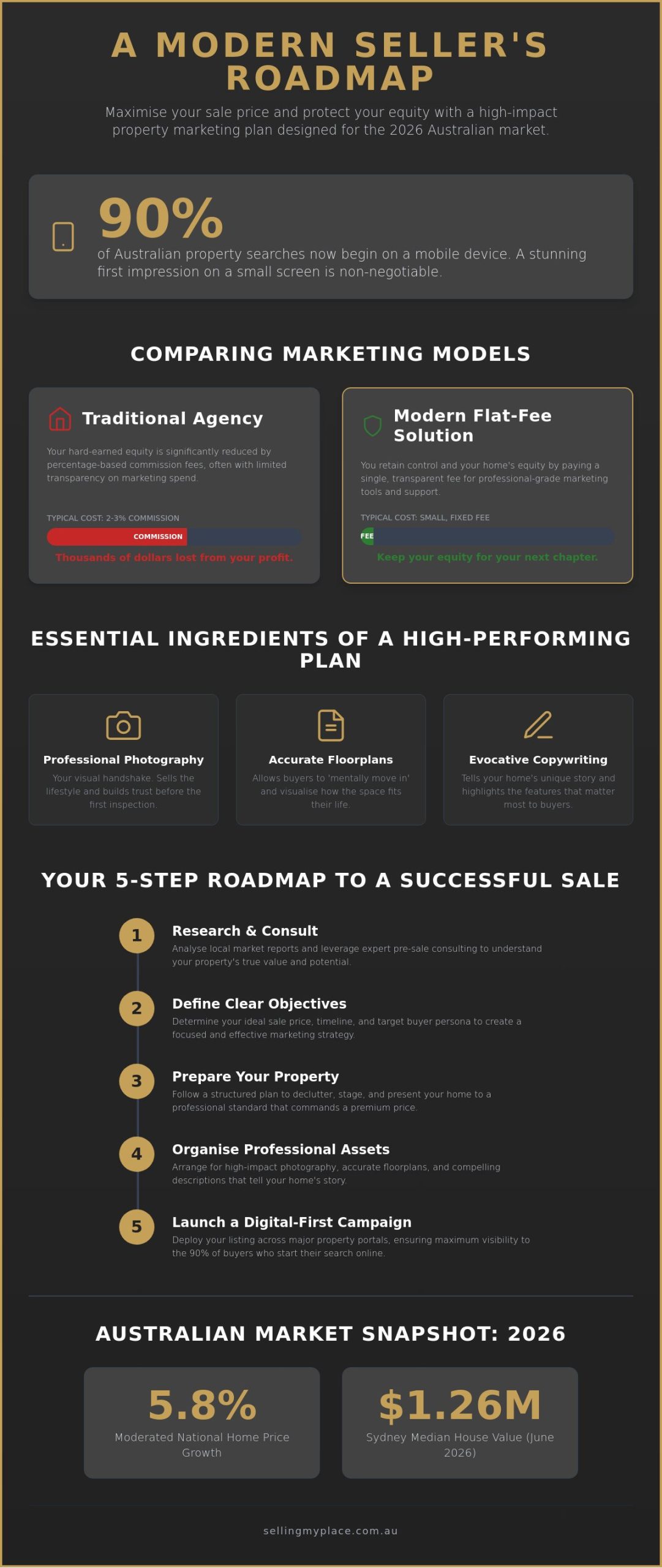
The broader real estate business has evolved far beyond the days of just placing a grainy photo in a local office window. With the cooling market of 2026, where national home price growth has moderated to 5.8%, buyers are being much more selective. They aren’t just looking for a house; they’re looking for a lifestyle and a sense of security. A professional first impression isn’t just about looking “fancy.” It’s about psychology. When a listing looks polished and intentional, buyers subconsciously feel the home itself has been well-maintained. This builds the essential trust necessary for them to feel confident making a high-value offer.
The Shift from Traditional to Digital-First Selling
Success in 2026 requires digital precision. Industry data shows that roughly 90% of Australian property searches now begin on a mobile device. If your home doesn’t look stunning on a five-inch screen, you’ve lost most of your audience before they’ve even read the first sentence of your description. Moving beyond the “local agent window” means tapping into a national and even global buyer network. By prioritising digital infrastructure, you ensure your home is visible to the growing number of interstate buyers looking for value outside of the major capital city hubs.
Setting Your Marketing Objectives
Defining what success looks like goes much deeper than just the final sale price. Are you looking for a quick settlement to fund a sea-change, or is your priority squeezed into every last dollar of equity? Your property marketing plan australia should reflect these personal goals. You also need to identify your target buyer persona. A first-home buyer looking for a low-maintenance unit will respond to very different language and imagery than an investor or a growing family. By setting a clear timeline and specific goals, you can organise your preparations to align perfectly with your next big life transition.
The Essential Ingredients of a High-Performing Marketing Plan
Building on the strategic foundation we’ve established, it’s time to look at the specific tools that bring your home to life. A high-performing property marketing plan australia isn’t about doing everything; it’s about doing the right things with absolute precision. In a market where Sydney median values sit at $1,265,608 as of June 2026, the stakes are far too high for amateur snapshots or rushed descriptions. You need a suite of assets that project confidence and care, showing buyers that your home is a premium opportunity worth their attention.
Photography and Floorplans: Your Visual Handshake
First impressions are almost always digital. High-quality Photography is the single most effective investment you can make in your campaign. It acts as a visual handshake, welcoming potential buyers into your space before they even step through the front door. Coupled with accurate floorplans, these tools allow buyers to “move in” mentally. They start imagining where the sofa will go or how the morning light hits the kitchen bench. The Real Estate Institute of Australia often highlights that professional standards in presentation are vital for maintaining consumer trust in the property sector. By choosing professional-grade visuals, you aren’t just selling a building; you’re selling the future lifestyle that exists within its walls.
The words you choose are just as vital as the images. Rather than a dry list of features, your property copy should tell a story. Does the backyard host legendary summer barbecues? Is the study a quiet sanctuary for a home business? Focus on evocative, lifestyle-oriented language that highlights the stability and community your neighbourhood offers. If you find yourself stuck on how to frame your home’s best bits, our friendly advisors are always here to help you find the right words.
Digital Reach and Listing Portals
Visibility is the lifeblood of your sale. Your property marketing plan australia must ensure your home appears where buyers are actually looking. This means securing placement on the nation’s leading property portals. In 2026, these platforms use sophisticated algorithms to match your home with the right people. It’s also important to look for “listed until sold” options. These provide a safety net, ensuring you never feel pressured by a ticking clock or expiring ad. By leveraging global marketing networks, you can also reach international buyers and expats who are increasingly looking for a slice of the Australian dream, ensuring no stone is left unturned in your search for the perfect buyer.
Comparing Marketing Models: Traditional Agency vs. Flat-Fee Solutions
When you stand in your kitchen, picturing the next family who will share meals there, the financial reality of the sale is often at the back of your mind. However, choosing how to execute your property marketing plan australia is one of the most significant financial decisions you’ll make. Historically, the only path to a professional result was through a traditional agency, but that often comes with a heavy “commission tax” that can feel quite personal when you see the final numbers. In 2026, many homeowners are questioning why they should hand over a significant portion of their equity when they are the ones who have cared for the property for years.
The True Cost of a Commission-Based Sale
In Australia, the national median real estate commission sits at approximately 2.65%. On a national median dwelling value of $922,838, that represents a payment of over $24,455. This isn’t just a number on a page; it’s a deposit for your next home, a renovation fund, or a boost to your retirement savings. Beyond the cost, traditional models can sometimes create a conflict of interest. Because agents are often driven by volume, there is a natural pressure to close a deal within the standard 90-day agreement, even if waiting another week might have secured a better price. You can learn more about how the industry is changing in our guide on Understanding the Flat-Fee Real Estate Model.
The Benefits of the Flat-Fee Marketing Model
The flat-fee revolution is built on the belief that you should keep 100% of your sale profit. By paying a single upfront cost for professional tools, you remove the financial fog of commissions. This model offers a level of transparency that traditional agencies often struggle to match. You get the same high-end photography and accurate floorplans we discussed earlier, but you maintain full control over the process. There’s no pressure to accept a low offer just because an agent’s contract is nearing its end. Instead, you have the freedom to sell on your own terms, backed by the same digital reach used by the biggest firms in the country. Choosing a “Sale by Owner” approach no longer means selling alone; it means selling with professional support while keeping your hard-earned equity in your own pocket.
Designing Your Strategy: A Step-by-Step Guide for Australian Sellers
Moving from the “why” to the “how” is where the excitement really begins. Creating a tailored property marketing plan australia involves more than just ticking boxes; it’s about layering professional insights onto your intimate knowledge of your home. In a cooling market where buyer confidence can be fragile, a methodical approach ensures you don’t leave your result to chance. By following a clear, five-step roadmap, you can present a listing that feels both polished and deeply authentic.
- Step 1: Market Research. Start by grounding your expectations in reality. Use detailed reports to understand what similar homes in your street have actually sold for, rather than just looking at optimistic asking prices.
- Step 2: Pre-Sale Consulting. Identify high-value improvements that offer the best return. Sometimes, a simple garden tidy or a fresh coat of paint does more for your sale price than a major kitchen renovation.
- Step 3: Professional Visuals. As we’ve explored, high-end photography and floorplans are the foundations of your digital presence.
- Step 4: Global Launch. Push your listing across a digital infrastructure that reaches buyers across leading national property portals and overseas networks.
- Step 5: Expert Support. Manage enquiries and negotiations with the steady hand of an advisor to guide your decisions.
Researching Your Market Position
Setting the right price is a delicate balance of data and intuition. We recommend using Neighborhood Market Reports to see the full picture of your local area. In 2026, we’re seeing a distinct shift toward units due to affordability constraints, so understanding how your specific property category is performing is vital. Analysing recent sales helps you find your competitive edge. Are you the only four-bedroom home in the suburb with a north-facing backyard? Highlighting these specific strengths allows you to tap into the “buyer’s mindset” and justify a premium price point.
The Launch and Beyond
Timing your launch for maximum impact often means going live when buyer activity is highest, typically mid-week to build anticipation for weekend inspections. When the initial surge of enquiries begins, responding with professional warmth and clear information sets a positive tone for the entire negotiation. Once you’ve found the right buyer, the focus shifts to the paperwork. Securing early Conveyance Advice ensures your contract is ready to go, preventing any delays that could unsettle a nervous purchaser. Many sellers at this stage are also navigating the challenge of selling and buying a house at the same time in Australia, and having a clear strategy for both transactions is essential to avoiding costly settlement gaps. If you’re ready to start mapping out your specific timeline, get in touch with our team for a personalised consultation.
The Kincade Advantage: Professional Results Without the Commission
At Kincade, we believe the emotional significance of selling your home should be met with a partnership that values your legacy as much as you do. Our Kincade International Direct Sales (KIDS) model isn’t just a service; it’s a way to empower you to take the lead while we provide the professional-grade tools. You’ve already seen how a robust property marketing plan australia can be the difference between a good result and a great one. By removing the traditional agency commission from the equation, we ensure that the rewards of your hard work stay exactly where they belong: with your family.
What truly sets us apart is our “Steady Hand” approach. Through our Real Estate Advisory Services, you gain access to seasoned experts who act as your nurturing guides throughout the process. We don’t believe in the ticking clock of a standard 90-day agreement. Our “listed until sold” promise means we’re in this with you for the long haul, providing a sense of calm confidence that reduces the stress of high-stakes decision-making. You’re never just a number to us; you’re a partner in a shared mission to achieve the best possible outcome for your next life transition.
More Than Just a Listing
We provide a comprehensive ecosystem that goes far beyond a simple portal upload. From Pre-Sale Property Consulting that helps you polish your home’s presentation to vital Conveyance Advice that secures your legal standing, every piece of our service is designed to be protective and personal. Our global marketing network reaches across borders, finding buyers that a local shopfront agent might never encounter. This isn’t just about saving money; it’s about the emotional peace of mind that comes from being in total control of your story and your equity.
Join the Future of Australian Real Estate
Thousands of Australians are already realising that the old way of selling isn’t the only way. You can have the polished photography, the accurate floorplans, and the massive digital reach without the $20,000 commission bill. It’s about selling smarter, not harder. We’re here to provide the expert backing you need to step into this new chapter with clarity and pride. If you’re ready to see what’s possible, you can Start your commission-free sale journey with Kincade today and take the first step toward a more rewarding property experience.
Embrace a Smarter Path to Your Next Chapter
Selling your home is more than just a financial transaction; it’s the closing of one beautiful chapter and the start of another. By now, you understand that a high-impact property marketing plan australia doesn’t require you to sacrifice your hard-earned equity to traditional agency commissions. You have the power to combine professional-grade visuals and global digital reach with your own local expertise. Whether it’s through detailed market reports or the steady hand of our Agent Advisory Service, you are fully equipped to manage your sale with confidence and poise.
Our partners save an average of $20,000 per sale while remaining listed until sold with 0% commission. This isn’t just about the numbers; it’s about the freedom those savings provide for your family’s future. If you’re ready to embrace a smarter way to sell, we’re here to guide you every step of the way.
Discover how to save $20,000 on your home sale with Kincade
Your home has been a sanctuary for years, and you deserve a sale process that respects that legacy. We look forward to helping you move forward with clarity, support, and the best possible result for your family.
Frequently Asked Questions
How much does a professional property marketing plan cost in Australia?
The cost of a professional property marketing plan australia depends on the specific digital tools and visual assets you choose to prioritise. While traditional agency campaigns in 2026 often involve significant mark-ups on advertising, a flat-fee approach focuses on high-impact essentials. This allows you to invest in professional photography and premier portal listings without the added burden of agency overheads or unnecessary commission-based expenses.
Can I really sell my own home without a traditional real estate agent?
You can absolutely sell your own home successfully by using the same professional digital infrastructure that traditional agencies use. In the current 2026 market, the vast majority of buyers begin their search on mobile devices, meaning your listing can reach a national audience regardless of who is hosting the inspection. By taking control, you maintain a personal connection with potential buyers and ensure your home’s unique story is told with genuine warmth.
What is included in a flat-fee property marketing package?
A comprehensive flat-fee package typically includes the essential non-negotiables: professional photography, accurate floorplans, and listings on major Australian property portals. Beyond these visual assets, you also gain access to expert advisory services and neighbourhood market data. This ensures you have a professional-grade presentation and the strategic backing needed to manage enquiries and negotiations with total confidence from start to finish.
How do I get my property listed on major real estate portals if I sell privately?
Private sellers can access the country’s most frequented real estate portals by partnering with a licensed residential property listing service. These platforms generally restrict direct individual uploads, so a professional service acts as your essential gateway to the digital market. This ensures your home appears alongside every other listing in the marketplace, providing the visibility needed to attract serious buyers without the traditional gatekeeper fees.
Is professional photography really necessary for selling a home?
Professional photography is the single most important investment in your property marketing plan australia. With the majority of property searches now starting online, your home needs to stand out instantly on a screen. High-quality images build immediate trust and an emotional connection, whereas amateur photos can often lead buyers to overlook a property entirely, regardless of its actual value or local charm.
What happens if my property doesn’t sell within 90 days?
Unlike traditional agency agreements that often expire after 90 days, a “listed until sold” model provides you with ongoing support until the right buyer is found. This removes the artificial pressure to accept a lower offer just because a contract is nearing its end. It allows you to wait for the market to meet your expectations, providing peace of mind during the cooling market conditions seen across many capital cities in 2026.
Do I need a lawyer or conveyancer if I am selling the property myself?
You will still need a qualified conveyancer or solicitor to handle the legal aspects of the sale, such as preparing the contract of sale and managing the transfer of title. While you can manage the marketing and inspections yourself, these legal professionals ensure the transaction is compliant with state-specific regulations. It’s a vital step that protects your interests and ensures a smooth, secure settlement for both parties.
How do Neighborhood Market Reports help with my marketing plan?
Neighborhood Market Reports provide the objective data you need to set a realistic and competitive asking price. By looking at recent sales of similar properties in your specific street or suburb, you can identify your home’s unique competitive edge. This prevents the common mistake of overpricing, which can cause a listing to go stale, or underpricing, which leaves your hard-earned equity on the table during your life transition.
Private Property Sale Contract Australia: A Guide for Independent Sellers
What if the only thing standing between you and a successful, commission-free sale isn’t a lack of expertise, but a simple stack of paperwork? Selling your family home is a deeply personal milestone, and it’s completely natural to feel a flutter of nerves when navigating a private property sale contract australia for the first time. You might worry that without a traditional agent, you’re leaving yourself open to legal pitfalls or that the state-specific terminology is just too dense to untangle. We understand that this isn’t just a transaction; it’s the start of your next chapter, and you want to ensure every detail is handled with care and precision.
The good news is that you don’t need to pay a premium for professional protection. You can take full control of your journey while staying firmly on the right side of the law. This guide will walk you through the essential components of a valid agreement, from the latest 2026 NSW cooling-off notices to the mandatory Queensland disclosure statements. We’ll preview exactly how to organise your documentation and understand your local obligations, so you can move forward with the calm confidence of a seasoned pro and keep your hard-earned equity where it belongs.
Key Takeaways
- Learn why the timing of your paperwork is vital, particularly in states like NSW where you must have your contract ready before you even list the property for sale.
- Master the essential components of a private property sale contract australia to ensure your legal names and Title References are documented correctly from the start.
- Navigate complex state-specific disclosure rules, such as Victoria’s Section 32, to protect your interests and provide complete transparency to your buyer.
- Gain the confidence to manage initial offers and holding deposits independently, allowing you to negotiate special conditions without a middleman.
- Discover how expert advisory support can bridge the gap between signing the contract and reaching a successful settlement day.
What is a Private Property Sale Contract in Australia?
Think of your sales contract as the legal roadmap for your entire selling journey. It is far more than just a formal piece of paper; it is the foundation of your legacy and the document that ensures your home’s transition is handled with the respect it deserves. In the Australian property market, this agreement establishes the ground rules between the Vendor (that’s you, the seller) and the Purchaser (the buyer). While it might feel like a final step, a private property sale contract australia is actually your very first priority. In states like New South Wales, it’s a legal requirement to have this document prepared before you even put your home on the market. Having it ready to go gives you a “steady hand” during negotiations, projecting a sense of professional authority that puts buyers at ease and reduces your own stress levels.
This document initiates the formal conveyancing process, which is the legal transfer of land title from one person to another. By preparing early, you aren’t just ticking a box; you’re taking control of the narrative. You’ll know exactly what you’re offering, what stays with the property, and what the timeline looks like, long before the first viewer walks through your front door.
Private Treaty vs. Auction Contracts
Most independent sellers choose a Private Treaty sale because it offers a more personal, measured pace. Unlike an auction where the hammer falls and the deal is final, a private treaty allows you to invite offers and negotiate on your own terms. This method provides a wonderful emotional benefit: you maintain control over who buys your home and under what conditions. It’s a partnership-based approach that feels less like a high-stakes gamble and more like a thoughtful consultation. You have the flexibility to adjust settlement dates or include specific clauses that an auction simply wouldn’t permit.
The Cooling-Off Period Explained
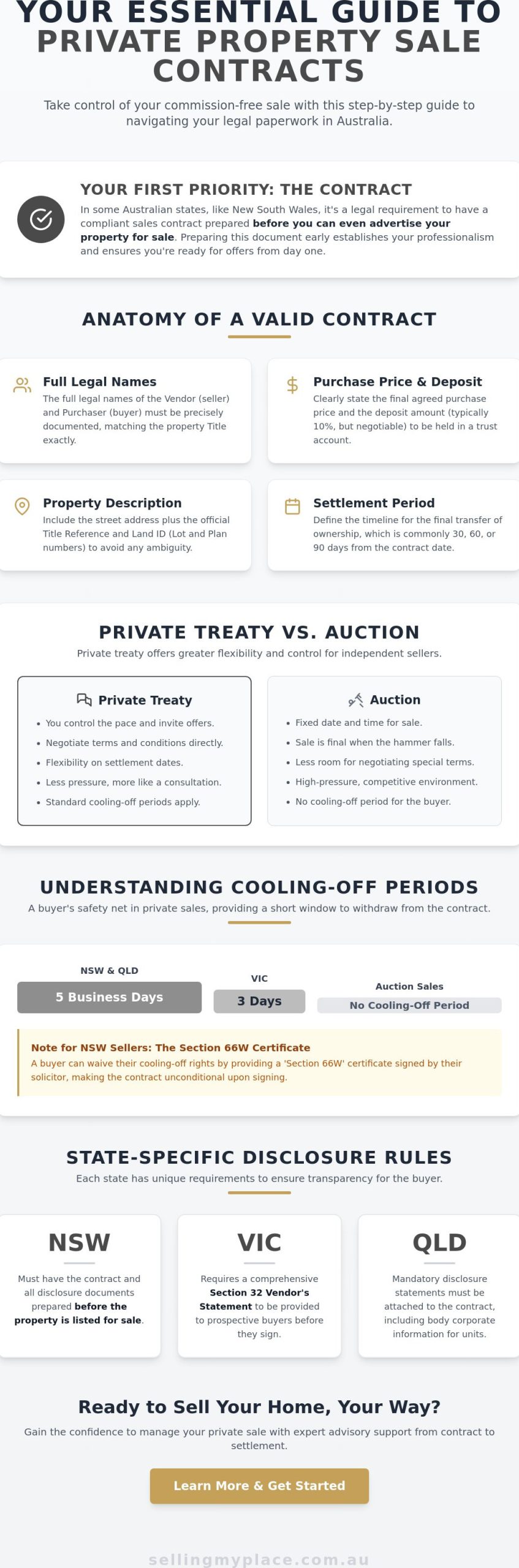
The cooling-off period is a standard feature of most private sales across Australia, acting as a short safety net for the buyer. Typically, this lasts between 3 and 5 business days, depending on your state. For instance, buyers in New South Wales and Queensland generally enjoy 5 business days, while those in Victoria have 3. It’s vital to remember that these rights don’t apply at auctions or if a property is passed in but sold on the same day. In some cases, particularly in NSW, a buyer might provide a “Section 66W” certificate. This document, signed by their solicitor, waives the cooling-off period entirely, making the contract unconditional from the moment it’s signed. Understanding these nuances helps you manage your expectations and stay grounded during the final stages of the deal.
Essential Components of a Valid Sales Contract
Precision is your best friend when drafting a private property sale contract australia. While the document marks the financial end of your time in a home, it’s also the legal shield that protects your interests until the keys change hands. To ensure the agreement is binding and robust, you must start with the basics: the full legal names of all parties. It sounds simple, but ensuring these match the Title exactly is crucial. If you’re selling as a couple or through a trust, every detail must be mirrored in the contract. You’ll also need to clearly state the agreed purchase price and the deposit requirements, which is typically 10% of the sale price held in a trust account, though this can be negotiated to suit both you and your buyer.
The property itself needs a flawless description. This goes beyond the street address. You must include the Title Reference and Land ID (Lot and Plan numbers) to ensure there’s no ambiguity about what’s being sold. Finally, the settlement timeframe, whether it’s 30, 60, or 90 days, provides the heartbeat of the transaction, giving both parties a clear date to work toward. Gaining a deep understanding of the nuances of the private sale process ensures you don’t miss these critical details, allowing the transition to feel like a shared success rather than a legal hurdle.
Mandatory Disclosure Documents
Transparency is the cornerstone of a stress-free sale. In Australia, you’re legally required to provide specific documents that prove you have the right to sell and inform the buyer about the land’s status. A current Title Search is non-negotiable; it’s the proof of your ownership. You’ll also need Zoning Certificates, such as a Section 10.7 in NSW, which tells the buyer what the land can actually be used for. Don’t forget to highlight any easements or covenants. If there’s a shared driveway or a restriction on building heights, disclosing this early prevents a buyer from pulling out later. These documents aren’t just red tape. They’re tools that build trust and protect you from future claims of non-disclosure.
Chattels and Fixtures: What Stays and What Goes?
The backbone of a solid private property sale contract australia is accuracy, especially regarding the physical items in the home. Disputes often arise over “grey area” items like dishwashers, custom-made curtains, or that heirloom light fitting in the dining room. As a rule of thumb, fixtures are items “fixed” to the property (like a built-in oven), while chattels are moveable (like a fridge). To avoid settlement day surprises, be explicit. If you plan to take the designer pendant lights with you, list them as exclusions. If the garden shed stays, list it as an inclusion. If you’re feeling unsure about how to categorise your belongings, you can always reach out for a guiding hand to clarify these final details.
State-Specific Requirements and Disclosure Rules
Navigating a private property sale contract australia requires an understanding that our states don’t always play by the same rules. It’s like a neighbourly chat where the dialect changes just slightly as you cross the border. While the heart of the transaction remains the same, the legal requirements for disclosure vary significantly depending on where your property is located. In New South Wales, the law is quite firm: you must have a draft contract prepared before you even put up a “For Sale” sign or share a photo online. This isn’t just about red tape; it’s about ensuring every potential buyer has the full story from the very first minute, protecting you from claims that you’ve withheld vital information.
Down in Victoria, the Section 32 Vendor Statement is your most important companion. This document discloses everything from land tax and rates to building permits and encumbrances. Failure to include a complete and accurate Section 32 can be a deal-breaker. Checking the latest private sale contract requirements will help you stay on top of these local nuances and ensure your paperwork is beyond reproach. Queensland sellers typically use standard REIQ contracts, but these must include a specific “Warning Statement” to be valid. Meanwhile, in Western Australia, the process revolves around the “Offer and Acceptance” (O&A) system, where the contract is formed when you formally accept a buyer’s written offer on a prescribed form.
The Consequences of Non-Disclosure
What happens if a document is missing or a detail is incorrect? It’s not just a minor hiccup. A missing disclosure can give a buyer the legal right to rescind the contract, meaning they can walk away and take their deposit with them, often right up until the day of settlement. You could also face legal penalties for providing misleading information, even if it was an honest mistake. Essentially, vendor disclosure serves as a vital legal safeguard that protects the seller from future disputes by ensuring total transparency from the outset.
Navigating Regional Variations
Because these rules are so specific to each state, hiring a local expert is a wise move even if you are managing the marketing yourself. State laws even impact how you can handle an “off-market” listing or a pre-sale consultation. Seeking professional Conveyance Advice is the best way to ensure your specific sale is compliant with local regulations. This regional expertise provides the steady hand you need to manage the complexities of the private property sale contract australia, giving you the freedom to focus on finding the right buyer for your home’s next chapter.
Managing the Contract Process Without a Traditional Agent
Taking the reins of your home sale is an empowering choice. You don’t need a middleman to facilitate a genuine conversation between two parties who both want the same thing: a fair and transparent transition. When an offer comes in, it is often accompanied by a small holding deposit. This isn’t a legal requirement, but it is a lovely way for a buyer to say, “We are serious about your home.” Because you have already prepared your private property sale contract australia, you can respond with speed and clarity. This is particularly effective for off-market property buyers who appreciate a streamlined, professional approach without the usual fanfare. It shows you’re ready to do business.
Today, the process is smoother than ever thanks to eConveyancing platforms and digital signature tools. You can exchange documents in minutes, keeping the momentum high while you and the buyer are still in that “celebratory” mindset. If the technical side feels like a lot to juggle, you can always book a consultation with a property advisor to ensure your digital exchange is as secure as a traditional handshake. This modern approach doesn’t just save time; it provides a clear, digital audit trail that protects everyone involved.
Common Special Conditions to Consider
Negotiation is really just a series of “what ifs” that help both parties feel secure. Most buyers will request a “Subject to Finance” clause, giving them a window; typically 14 days; to finalise their mortgage approval. You will also frequently see “Subject to Building and Pest Inspection.” These aren’t hurdles to be feared. They are simply steps that give the buyer the peace of mind they need to commit. For your own protection, you might consider a sunset clause. This ensures that if the buyer doesn’t meet their conditions by a specific date, you are free to return the property to the market without delay.
The Exchange of Contracts
The term “exchange” is exactly what it sounds like. Two identical copies of the private property sale contract australia are signed; one by you and one by the purchaser; and then physically or digitally swapped. This is the pivotal moment when your home moves from being “Under Offer” to “Sold.” It is also when the full deposit, usually 10%, is paid. This money isn’t paid directly to your bank account just yet. Instead, it is held safely in a regulated trust account by a solicitor or conveyancer, acting as a stakeholder until the final settlement day arrives.
Moving from Contract to Settlement with Expert Support
Once the ink is dry on your private property sale contract australia, you enter the home stretch. This period, typically spanning 30 to 90 days, is a time of transition and preparation. You’ll likely host a building and pest inspector; remember, they are simply doing their job to ensure the buyer feels as secure in their decision as you do. Then comes the final pre-settlement walkthrough, usually occurring 24 to 48 hours before the keys change hands. It’s a final chance for the buyer to see that the home is in the same condition as when they signed. Approach this with a spirit of hospitality; it’s the final handover of your property’s legacy to its new keepers.
You don’t have to walk this path entirely alone. While you’ve chosen the independent route, our Real Estate Advisory Services act as a vital bridge, providing the expertise of a seasoned guide without the intrusive pressure of traditional commissions. This “steady hand” approach ensures that if a minor hiccup arises during the settlement period, you have a professional partner to consult. It’s about having the best of both worlds: the freedom of a private sale and the security of expert backing. This Agent Advisory Service ensures you stay grounded and confident until the final cent is transferred.
The financial benefit of a commission-free sale is often the difference between a good result and a life-changing one. By managing your own private property sale contract australia, you retain tens of thousands of dollars that would otherwise disappear into high marketing costs and agency fees. It’s a celebratory moment when you realise that your personal effort has directly contributed to your family’s next chapter. There is a deep sense of pride in navigating this process yourself, knowing you’ve protected your equity through a successful, self-managed outcome.
Professional Advisory vs. High Commissions
Why pay 2% or 3% of your home’s value when a flat-fee model offers a much better return on investment? By opting for Pre-Sale Property Consulting and professional Floorplans, you present your home in its best light while keeping your hard-earned equity. It’s a strategic choice that values your financial future over an agent’s overheads. Our philosophy is simple: we provide the professional backing you need without the hefty price tag, ensuring you feel supported but always in the driver’s seat.
Your Next Steps to a Successful Sale
Preparation is the key to a calm and efficient settlement. Start by organising your paperwork early to avoid last-minute dashes to the solicitor. Combining savvy Sale by owner strategies with high-quality photography and professional listing services ensures you attract the right buyers from the start. You’ve got the tools, the knowledge, and the heart to make this happen. Ready to take the lead? Start your commission-free journey today and see how rewarding a self-managed sale can truly be.
Your Path to a Confident and Profitable Sale
Taking the lead on your home sale is a powerful way to honour the life you’ve built within its walls. You’ve now gained a clear understanding of how to navigate state-specific disclosure rules, identify the essential components of a valid agreement, and manage the transition from offer to settlement. Successfully handling a private property sale contract australia is the final piece of the puzzle that allows you to step into your next chapter with your equity fully intact. It’s about more than just paperwork; it’s about the pride that comes from a job well done.
You don’t have to navigate the final steps alone. With average seller savings of $20,000 and our Expert Agent Advisory Service included in every package, you can bypass hidden commissions and restrictive time limits entirely. We’re here to provide the steady hand and professional support you need to ensure your journey is as smooth and rewarding as possible. Sell your home smarter and keep 100% of your profit with our flat-fee packages. You have the knowledge and the heart to make this a success, and we’re excited to see you flourish in your next adventure.
Frequently Asked Questions
Can I write my own property sale contract in Australia?
You can technically draft your own agreement, but it’s a bit like performing surgery on yourself. A private property sale contract australia must adhere to strict state legislation, such as the 2026 Law Society edition in NSW, to be legally binding. Most independent sellers use a solicitor or conveyancer to ensure all prescribed documents are included. This professional touch protects you from a buyer rescinding the deal later due to a technicality.
How much does it cost to have a contract of sale prepared?
The cost of preparing your documentation depends on the complexity of your land and the required disbursements. Disbursements are the fees paid to government agencies for title searches, zoning certificates, and drainage diagrams. While we don’t quote specific legal fees, you’ll find that investing in professional contract preparation is a small fraction of the cost you’d save by avoiding traditional agent commissions. It’s an investment in your peace of mind.
What is the difference between a contract of sale and a vendor statement?
Think of the contract as the “how” and the vendor statement as the “what.” The contract outlines the agreed price, names, and the timeline for the transition. The vendor statement, known as a Section 32 in Victoria, discloses the property’s history; things like rates, building permits, and any easements. Both documents are essential for a transparent transaction, ensuring the buyer has all the facts before they commit to the purchase.
Does a private sale contract need to be witnessed by a lawyer?
A lawyer doesn’t need to witness your signature, but an independent adult usually must. This person should be someone who isn’t a party to the sale. With the recent shift toward digital platforms, many contracts are now signed electronically using secure verification methods. This modern approach makes the process much more accessible for families managing their own sale, allowing you to sign from the comfort of your own living room.
What happens if a buyer pulls out of a private sale contract?
If a buyer pulls out during the cooling-off period, they’ll typically forfeit a small penalty, such as 0.25% of the purchase price in NSW or Queensland. However, once the contract becomes unconditional, the consequences are much more serious. They would likely lose their entire 10% deposit. You may also have the legal right to seek further compensation if the property eventually sells for a lower price than the original agreed amount.
Can I sell my house privately if I still have a mortgage?
Yes, selling with an existing mortgage is a very common part of the Australian property landscape. Your conveyancer or solicitor will coordinate a “discharge of mortgage” with your bank. On settlement day, the bank is paid the outstanding balance directly from the sale proceeds. The remaining equity is then transferred to your account. It’s a seamless process that your legal team manages behind the scenes while you focus on your move.
Is a verbal offer legally binding in Australian real estate?
No, a verbal offer is never legally binding in any Australian state or territory. Even if you’ve agreed on a price and shaken hands, nothing is final until a written private property sale contract australia is signed by both parties and formally exchanged. This requirement for a written agreement is a vital protection for you, ensuring there’s no confusion about the terms or conditions before the deal becomes official.
What is the standard settlement period for a private property sale?
There is no single “standard” timeframe, but 30, 60, or 90 days are the most frequent choices. In New South Wales, a 42-day settlement is quite traditional, but the beauty of a private sale is the flexibility it offers. You can choose a date that aligns with your family’s needs, whether you want a quick 21-day turnaround or a longer period to organise your next home. It’s all about what works best for your transition.
