Selling a Townhouse Privately in Australia: A 2026 Guide
When selling a townhouse privately, buyers may ask about more than the home itself. Your title, owners corporation or body corporate arrangements, shared facilities and strata records can all shape their questions. Knowing what to gather, how to present the property and how to manage buyer interest can make the process clearer and help you avoid confusion.
You can stay in control of your sale and still use practical listing support. This guide covers townhouse-specific records, pricing and presentation, marketing, enquiries, inspections and offers. It also explains how a fixed-fee listing service can help with portal exposure while you manage listing edits, buyer enquiries and inspections.
Use the steps below to prepare a workable plan, understand which details buyers may want to know about shared areas and ownership arrangements, and identify where a qualified conveyancer or solicitor can help with sale documents. You can then choose the level of listing support that suits your needs.
Key Takeaways
- Selling a townhouse privately means you lead the sale, with fixed-fee listing support available.
- Check your title and organise relevant owners corporation records so you can explain shared areas and property details clearly.
- Plan pricing, presentation and marketing around your townhouse’s layout, outdoor space, parking and shared facilities.
- Set a consistent process for responding to enquiries, arranging respectful inspections and recording offers.
- Compare listing packages by their included features and price, while keeping control of listing edits, enquiries and inspections.
Selling a townhouse privately: what makes it different?
A private sale is owner-led: you decide how the property is presented, respond to buyers, arrange inspections and consider offers. You can manage these tasks yourself and use listing support to reach buyers online. Kincade International Direct Sales (KIDS) acts as a licensed intermediary for listing purposes, while you remain in control of listing edits, access and sale decisions.
Townhouse is a style of home, not a single ownership arrangement. Depending on the title, a property may have shared access, common property or an owners corporation, also called a body corporate in some contexts. Buyers may want to know which areas belong to the individual lot, which are shared and how shared areas are maintained.
These details sit alongside the home’s condition and likely buyer expectations. A private courtyard, shared driveway or common garden can affect how you describe the property and plan inspections. Clear, accurate information helps buyers picture day-to-day living and reduces the chance of confusion later. Private selling is legal across Australia, but sale, disclosure and contract requirements differ between states and territories.
How title and shared areas can affect a townhouse sale
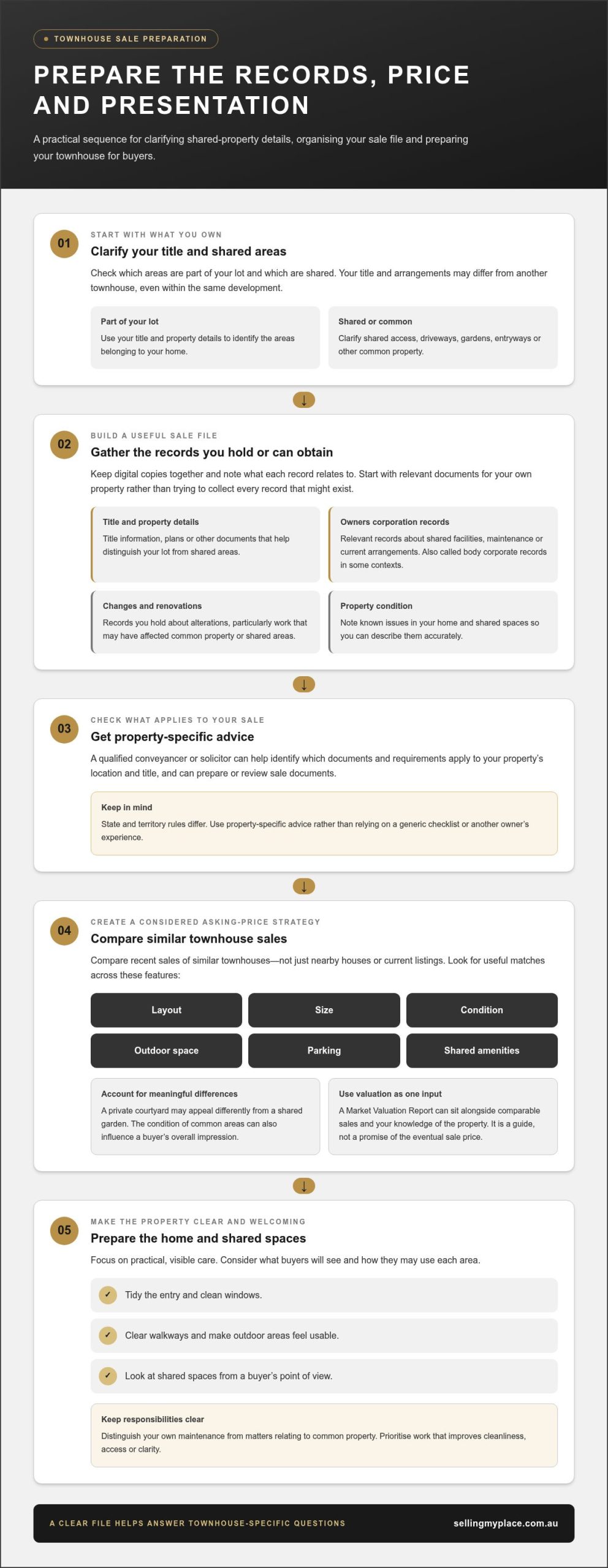
Start with the title and the documents available for your property. Don’t assume a neighbouring townhouse has the same arrangement: ownership and shared-area responsibilities can differ within the same development. Buyers may ask about shared entryways, driveways, gardens or other common property, as well as owners corporation records that explain arrangements affecting the lot.
- Identify which areas are part of your lot and which are shared.
- Gather relevant title and owners corporation or body corporate records you hold or can obtain.
- Note known condition issues in both private and shared areas.
A qualified conveyancer or solicitor can help you understand the property-specific documents and which requirements apply to your sale. State and territory rules vary, so use property-specific advice rather than relying on a general checklist or another owner’s experience.
What private selling means for the owner
Selling a townhouse privately means you lead the sale without handing the whole process to an agent. You decide how to manage access, host inspections and assess offers. While many vendors choose private negotiation for flexibility over timing and price, comparing different transaction methods—such as property auctions run by Auction Property Ltd—can offer helpful insight into how competitive bidding structures work in practice. A listing intermediary has a different role: it can provide portal and marketing support, but it doesn’t take over your decisions or replace your responsibility to understand the sale process.
Private selling doesn’t remove the need for professional legal advice. Engage a qualified conveyancer or solicitor to advise on the applicable requirements and prepare or review sale documents. KIDS provides listing support as a licensed intermediary, not as a real estate agent or conveyancer. With the right documents and a clear understanding of your title, you can prepare to answer townhouse-specific questions with confidence.
Prepare a townhouse sale: records, condition and pricing
A well-organised preparation file makes it easier to answer buyer questions and decide what needs attention before your townhouse is listed. You don’t need to collect every document that might exist. Start by understanding your property’s title, organising records you already hold and getting advice on what applies to your specific sale.
Gather townhouse records and clarify shared-property details
Townhouse titles and shared-property arrangements vary, so build your checklist around your own documents rather than assuming another property in the complex works the same way. Keep digital copies together and note what each record relates to.
- Title and property details: gather your title information and any plans or property documents that help distinguish your lot from shared areas.
- Owners corporation or body corporate records: collect relevant records available to you, such as information about shared facilities, maintenance or current arrangements.
- Changes and renovations: keep records you hold about alterations, particularly where work may have affected common property or shared areas.
- Property condition: note known issues in your home and shared spaces, so you can describe them accurately and plan presentation accordingly.
A qualified conveyancer or solicitor can help identify which documents and requirements apply to your property’s location and title. State and territory rules differ, so don’t rely on a generic checklist as a substitute for property-specific advice.
Set a considered price and prepare the property
For a considered asking-price strategy, compare recent sales of similar townhouses, not just nearby houses or current listings. Look for useful matches in layout, size, condition, outdoor space, parking and shared amenities. Then account for meaningful differences: a private courtyard may appeal differently from a shared garden, while the condition of common areas can influence a buyer’s overall impression.
A Market Valuation Report can be one input alongside comparable sales and your knowledge of the property. Treat it as a guide for your decisions, not a promise of the eventual sale price. For more on the factors that inform a pricing view, see this guide to determining a home’s market value.
Presentation starts with practical, visible care. Tidy the entry, clean windows, clear walkways and make outdoor areas feel usable. Look at shared spaces from a buyer’s point of view, but distinguish your own maintenance from matters relating to common property. Prioritise work that improves cleanliness, access or clarity, and weigh each repair on its own merits rather than assuming it will deliver a particular return.
If you’d value support as you organise records and pricing inputs, discuss your townhouse sale preparation.
Market your townhouse privately and present its strongest features
A strong listing helps buyers picture both the home and how it fits into its surroundings. For a townhouse, explain the layout and practical features while being precise about what’s private and what’s shared. Clear details build confidence; broad claims can leave buyers unsure what they’re viewing.
Present layout, outdoor space and shared amenities clearly
Describe the home in the order a buyer might experience it: entry, living areas, bedrooms and outdoor space. Be specific about features such as stairs between levels, built-in storage, a study nook, courtyard access or allocated parking. If an outdoor area is part of your lot, call it a private courtyard. If it’s communal, describe it as a shared garden or facility instead.
Photography and a floorplan work together. Photographs show condition, natural light and the feel of rooms. A clear floorplan helps buyers understand room flow, proportions and how levels connect. Include shared amenities only when the description and images make their status clear. Avoid wording or images that could suggest a communal area belongs exclusively to your townhouse.
Choose listing reach and marketing assets
Plan your marketing around three things: the facts buyers need, visuals that help them assess the property, and channels that put the listing in front of them. This simple checklist can keep your message consistent:
- Property facts: layout, bedrooms, bathrooms, parking, storage, outdoor areas and which facilities are shared.
- Visual assets: accurate photographs and a floorplan that reflects the home’s layout.
- Distribution: online property portal listings, a dedicated property website where included, and a signboard if suitable for the property and its arrangements.
Property portals help buyers discover listings, while a dedicated property website gives your townhouse its own space for the description and visual material. A signboard can offer another way for people nearby to notice the sale, but it complements, rather than replaces, accurate online information.
Every Kincade International Direct Sales package includes a listing on major property portals and local platforms such as Homely and Soho, professional photography, enquiry forwarding by SMS and email, and access to a 24/7 seller dashboard. Signature and Prestige also include a dedicated property website and URL. You retain control of listing edits, while Kincade International Direct Sales acts as a licensed intermediary for listing purposes. Keep the wording consistent across each channel, and check that the photos, floorplan and description all tell the same story.
For owners selling a townhouse privately, a focused set of accurate facts and visuals can help buyers assess whether the home suits their needs before arranging a visit. If you’d like support planning your listing, explore townhouse marketing support.
Manage townhouse enquiries, inspections and offers with care
A steady process helps buyers get timely answers and makes it easier to track who has viewed the property and what they’ve asked. Townhouses can add practical considerations: shared entryways, common areas and building arrangements may affect how you coordinate access. Set expectations early, then keep a clear record as interest develops.
Organise enquiries and townhouse inspections
Use a spreadsheet or notebook to record each buyer’s name, contact details, questions, inspection request and any follow-up. Reply consistently, even if you’re simply acknowledging an enquiry and letting the buyer know when you’ll provide an answer. KIDS forwards enquiries by SMS and email and provides a seller dashboard, helping you keep track while you remain responsible for responses and inspection arrangements.
For each inspection, plan a simple sequence:
- Respond: note the buyer’s questions and answer accurately, or record what you need to clarify.
- Arrange access: agree on a suitable time and explain where to meet, how to enter and which areas are shared.
- Host the viewing: make the route through the home clear and respect neighbours’ privacy and access to common areas.
- Follow up: record feedback and any next steps so you can respond consistently.
If access involves a shared entrance, driveway or building procedure, explain the arrangement before the buyer arrives. Don’t suggest that a communal space is part of your private lot, and avoid obstructing shared paths during a viewing. These small courtesies help inspections run smoothly for buyers and neighbours alike.
Consider offers and handle contract steps appropriately
Look beyond the headline price when comparing offers. Record the proposed deposit, any conditions, the buyer’s requested timing and other terms in writing. A clear comparison makes it easier to weigh what matters to you and discuss the details with your conveyancer or solicitor. For a framework on reaching and assessing terms, use this property sale negotiation guide.
Contract and disclosure processes differ across Australia. Before listing or responding to an offer, ask a qualified conveyancer or solicitor which documents and steps apply to your property and state or territory. State-specific documents may include a Contract of Sale or vendor statement. Don’t rely on a general online checklist to decide when documents must be prepared or provided.
KIDS forwards enquiries and provides sellers with dashboard access, while you retain control of buyer communications, inspections and offer decisions. KIDS does not provide legal advice, contracts or conveyancing. Engage a qualified conveyancer or solicitor for legal matters and contract preparation. For listing support that leaves you in charge of managing buyer interest, get in touch about your townhouse sale.
Use fixed-fee listing support while keeping control of your townhouse sale
Selling a townhouse privately doesn’t mean you have to manage every part of getting your listing online alone. Kincade International Direct Sales (KIDS), a service of Kincade International Realty, provides fixed-fee marketing packages and acts as a licensed intermediary for listing purposes. It isn’t a real estate agent or conveyancer, and you remain in charge of your sale’s day-to-day decisions.
Every package includes a Market Valuation Report, enquiry forwarding by SMS and email, access to a 24/7 seller dashboard, professional photography, and listings on Realestate.com.au and local portals such as Homely and Soho. You can use the report as one input to pricing decisions, review forwarded buyer enquiries and keep track of your listing while deciding how to respond and arrange inspections.
Match listing support to the marketing you need
The packages differ in price and included marketing assets. Choose based on the presentation materials and level of support that suit your townhouse, rather than assuming any option will achieve a particular sale result. Prices below are ex GST.
- Classic: $799 ex GST. Includes the features in every package and a 600 × 900 mm For Sale signboard.
- Signature: $999 ex GST. Includes everything in Classic, plus a 1200 × 1800 mm For Sale signboard, a dedicated property website and URL, and email and phone expert support.
- Prestige: $1,999 ex GST. Includes everything in Signature, plus 15-20 professional photographs, a floorplan redraw, a Facebook and Instagram ad campaign, 50 premium A4 brochures, a 1-on-1 dedicated specialist, a James Edition listing and a 1200 × 1800 mm Photo signboard.
Signature and Prestige include a dedicated web address for the property; Prestige adds a broader set of visual and promotional materials. For a townhouse, photographs and a floorplan can help buyers understand the levels, room flow and relationship between indoor and outdoor spaces. Keep each asset accurate, especially when showing shared facilities.
Keep ownership of decisions while using listing support
With KIDS, you retain control of listing edits, enquiries and inspections. The service supports portal listings and forwards enquiries, but you decide how to communicate with buyers, schedule access and consider offers. That distinction matters if you want practical marketing support without handing over the choices that shape your sale.
Kincade International Network exposure extends across Australia, the United Kingdom and the United States. Listings remain active until sold, withdrawn or two years from the commencement date, whichever occurs first. Each package has a fixed fee and 0% commission. Package prices are ex GST.
KIDS doesn’t provide legal advice, contracts or conveyancing. Engage a qualified conveyancer or solicitor for contract preparation and legal questions, including requirements that apply to your state or territory. To compare the packages and get started, discuss your townhouse sale with KIDS.
Take the next step with confidence
Selling a townhouse privately is a series of considered decisions, not a test of how much you can do alone. Start by writing down what you want to manage yourself, where you’d value practical listing support, and which property-specific questions need professional legal advice. This gives you a clear starting point without committing to a process that doesn’t suit your circumstances.
A townhouse sale also marks a change in the place you’ve called home. Give yourself room to prepare carefully, ask questions and choose the level of support that fits your plans. KIDS offers fixed-fee listing packages with 0% commission, while you remain in control of the sale decisions. Explore the packages and get started with KIDS.
With a thoughtful plan and a qualified conveyancer or solicitor for legal matters, you can move forward at your own pace and stay in control of the decisions that matter. If your townhouse sale is the first step towards relocating or investing overseas, boutique agencies like King Estates offer helpful insight into luxury properties and coastal lifestyle living abroad.
Frequently Asked Questions
Is selling a townhouse privately legal in Australia?
Yes. It is legal for Australian property owners to sell privately in every state and territory, provided the sale meets the requirements that apply to the property and its location. For a townhouse, the title may affect which records or disclosures are relevant. This is general information, not legal advice. Before listing or signing documents, engage a qualified conveyancer or solicitor to explain the requirements for your circumstances and help you understand the documents involved.
Do all townhouses have an owners corporation or body corporate?
No. Arrangements depend on the title and the rules applying in the relevant state or territory. Some townhouse communities have shared property and a formal owners corporation or body corporate, while others are structured differently. Check the title and property records rather than relying on what applies next door. A qualified conveyancer or solicitor can explain which records and obligations relate to the townhouse you’re selling.
Can I sell a townhouse with a tenant living in it?
A sale with a tenant in place may be possible, but tenancy conditions and applicable rules can affect inspections, access and what buyers need to know. Review the tenancy documents before planning viewings, and don’t assume you can enter or change arrangements without the required notice. Make the occupancy situation clear in buyer communications, and seek qualified advice about the rules that apply to your property.
Can a buyer make an offer subject to finance on a townhouse?
Yes, a buyer may propose a finance condition as part of an offer. Its effect depends on the exact wording and the contract, so don’t treat a general explanation as advice about your legal position. Keep the proposed terms in writing and ask your qualified conveyancer or solicitor to review the documents. Consider conditions and proposed timing alongside the price when weighing an offer.
What happens if a townhouse buyer withdraws their offer?
It depends on whether the buyer has made an offer only or the parties have entered into a binding contract, as well as the contract terms and applicable rules. Don’t assume a withdrawal has no consequences or that a sale is assured. Contact your qualified conveyancer or solicitor promptly, share the relevant communications and documents, and get advice on what to do next. Keep other buyer enquiries organised in the meantime.
Should I disclose townhouse renovations that affect shared areas?
Records of work affecting shared property may be relevant, particularly if approval was involved. What needs to be disclosed depends on the property documents and applicable law, so avoid guessing whether approval was required or obtained. Gather plans, approvals and correspondence you hold, then ask a qualified conveyancer or solicitor what matters for your sale. Describe the work accurately and distinguish documented facts from anything you’re unsure about.
Do townhouse buyers usually ask for owners corporation records?
Buyers may ask about shared facilities, levies, rules or available records if the townhouse has an owners corporation or similar arrangement. What’s relevant depends on the title and jurisdiction. Before responding, sort the records you hold by topic, such as shared-area maintenance or building rules, and get advice from a qualified conveyancer or solicitor about which information applies. Don’t assume another townhouse’s records or arrangements are the same as yours.
Common Mistakes Selling Property by Owner: An Australian Checklist
A private sale rarely falters because of one dramatic mistake. More often, it’s a series of small oversights: an asking price that isn’t supported by comparable sales, a listing that misses important details, or an enquiry that slips through the cracks. If you’re looking up the common mistakes selling property by owner, the reassuring news is that many can be avoided with a clear plan.
Selling your own home gives you control, but it also means managing the tasks that help a sale progress. You’ll need to prepare the property, present it accurately, respond to buyers and consider offers carefully, while keeping legal matters with a qualified conveyancer or solicitor.
This checklist covers preventable pricing, marketing, communication and preparation mistakes. It also explains how listing support can help with online exposure and enquiry follow-up while you remain in control of buyer communication and inspections. Requirements vary across Australia, so treat the sale as a managed process, not simply a listing.
Key Takeaways
- The common mistakes selling property by owner are easier to prevent when you treat the sale as a planned process, not a one-off listing.
- Use relevant market evidence to sense-check your asking price, and review presentation details that could affect buyer confidence.
- Make your listing clear and useful, with accurate descriptions, helpful photographs and an easy way for buyers to enquire.
- Keep a simple record of enquiries, inspection arrangements and buyer feedback so follow-up stays organised.
- KIDS listing support includes portal exposure, enquiry forwarding and a 24/7 seller dashboard, while you remain in control of buyer communication and inspections.
Common mistakes selling property by owner starts with treating the sale as a one-off task
Selling privately is manageable when you prepare and follow a clear process. A property sale isn’t just a listing going live: it involves decisions, information and follow-up at each stage. This checklist offers general guidance, not a promise of a particular sale outcome.
Small oversights can leave buyers unsure, make a listing easier to scroll past or cause an enquiry to go unanswered. A little organisation before launch helps you present information consistently and handle each next step with more confidence.
Preparation before launch gives you time to catch preventable mistakes before buyers encounter them.
For context, For sale by owner (FSBO) is the process of selling real estate without the representation of a broker or agent. An owner-led sale still needs a plan for the work around the listing.
Mistake: starting before the property and sale plan are ready
Before advertising, decide what matters most to you. Consider your preferred timing, how you’ll manage buyer enquiries and inspections, and who will take responsibility for each task. If others in your household are involved, agree on roles early so buyers receive clear, consistent communication.
Make a room-by-room list of preparation tasks, then separate essentials from optional styling. Checking that lights work, clearing walkways and tidying outdoor areas may be practical priorities. Buying new furniture or undertaking cosmetic changes may be optional. Focus first on a clean, safe and accessible presentation rather than assuming every room needs a full makeover.
- List the rooms, outdoor areas and features buyers are likely to ask about.
- Note straightforward maintenance or presentation jobs to complete before photography and inspections.
- Set aside optional styling ideas so they don’t distract from essential preparation.
This plan makes the workload easier to see and helps you avoid launching while key details or practical arrangements are unsettled.
Mistake: relying on assumptions instead of checking details
It’s easy to overlook a detail you’ve lived with for years, or describe a feature from memory and later discover the wording is inaccurate. Before including a claim in marketing or an answer to a buyer, verify it using reliable records and information you can substantiate. If you’re unsure, don’t guess. Check the detail before responding.
Map out how to sell your own home from preparation through to buyer follow-up. A step-by-step plan shows what needs attention before advertising, rather than leaving you to resolve every question under pressure once enquiries begin. These are common mistakes selling property by owner that preparation can help you recognise early.
Avoid pricing and presentation mistakes that weaken buyer confidence
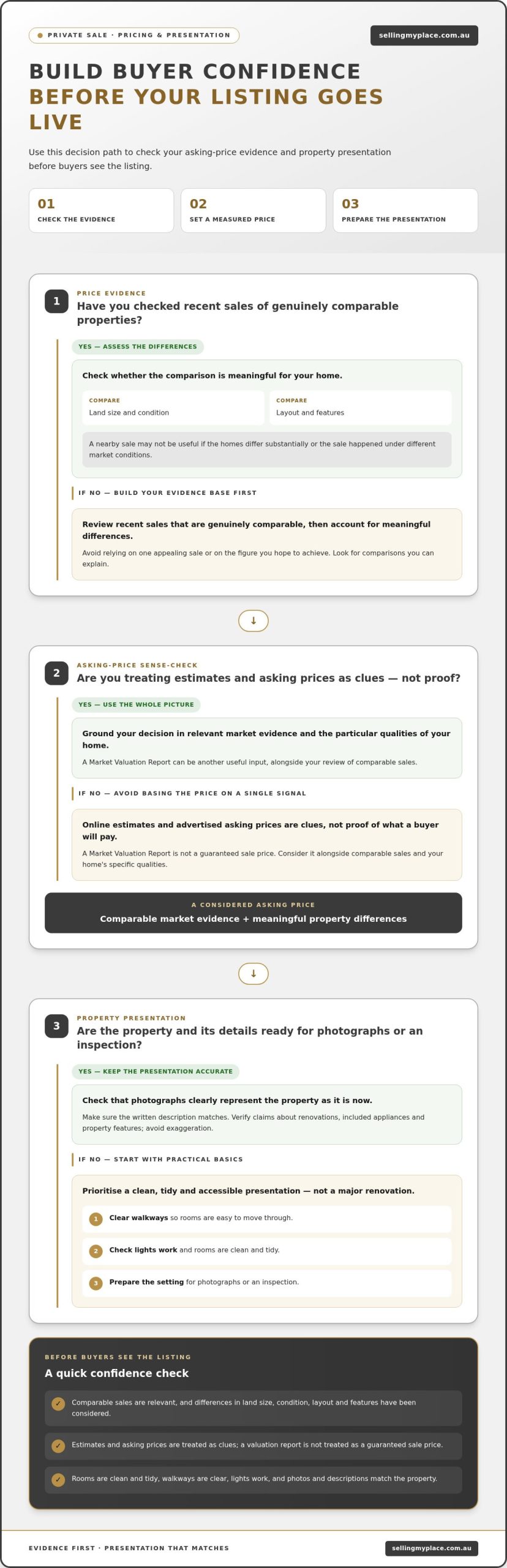
A considered asking price starts with evidence, not the figure you hope to achieve or the value you feel the home holds for your family. Those expectations are understandable, but buyers assess the options available to them now. A price that doesn’t reflect relevant market conditions can make them hesitate before they’ve even inspected.
A considered asking price is grounded in comparable market evidence. A personal expectation alone can’t show how buyers may assess the property.
Mistake: choosing an asking price without checking comparable evidence
Look at recent sales of genuinely comparable properties, then account for meaningful differences such as land size, condition, layout and features. A sale nearby may not be a useful comparison if the homes differ substantially or the sale took place under different market conditions. Treat online estimates and asking prices as clues, not proof of what a buyer will pay.
A Market Valuation Report can provide another useful input, but it isn’t a guaranteed sale price. Use it alongside your review of comparable sales and the particular qualities of your home. For a fuller explanation of the factors to consider, consult the separate 2026 guide to determine your home’s market value.
Don’t build expectations around one appealing sale or an untested hope. If you can explain why a comparison is relevant, you’ll have a clearer basis for your asking-price decision and a more measured way to respond to buyer feedback. This is one of the common mistakes selling property by owner that an evidence check can help you avoid.
Mistake: presenting the property or its details carelessly
Presentation doesn’t have to mean a major renovation or a complete styling project. Start with the basics: clean and tidy rooms, clear walkways, working lights and a setting that’s ready for photographs or an inspection. A bright, uncluttered space makes it easier for buyers to see the room and consider how they might use it.
Check each photograph against the property as it is now. Images should be clear and representative, not framed to conceal a feature buyers will encounter at an inspection. The written description should match too. Verify claims about renovations, included appliances and property features. Avoid exaggeration; a mismatch between the listing and the home can create doubt and lead to avoidable questions.
- Check that descriptions, photographs and inclusions agree.
- Describe features clearly without overstating them.
- Keep a record of the information behind details you include in the listing.
An accurate listing gives buyers a more straightforward first impression. If you’d like support with listing your property and a Market Valuation Report, explore KIDS listing support.
Prevent listing and marketing mistakes that make buyers scroll past
A listing has little time to make its purpose clear. If key details are missing, the wording is hard to follow or there’s no obvious way to enquire, a potential buyer may move on. Think of the listing as a first conversation: it should answer basic questions and make the next step clear.
Accurate details help buyers understand the property, and clear contact instructions make it easier to take the next step.
Include the information a buyer needs to decide whether to learn more, such as the property’s features, inclusions and inspection arrangements. Keep the description easy to scan with useful headings or short paragraphs rather than a long block of text. Avoid unexplained abbreviations and broad claims that could mean different things to different readers. If a detail needs clarification, improve the wording rather than leaving buyers to guess.
Mistake: treating a listing as a single upload
Publishing is the start of the listing’s life, not the end of the task. Once it’s live, read it as a buyer would. Check that the title and description display properly, the photographs appear in a sensible order and important information is easy to find. Review the page on a phone and a computer; a paragraph that looks tidy on a larger screen may be harder to read on mobile.
Where the property appears in more than one place, keep details aligned. An inconsistency about an inclusion or property feature can create confusion and prompt buyers to ask which version is correct. Keep a current copy of the approved description and key details as your reference for updates.
Check enquiries regularly after the listing goes live. If a verified detail changes, update the listing promptly and correct any other versions too. A brief review routine can catch a typing error, broken contact instruction or outdated inspection detail before it causes friction.
Mistake: overlooking who sees the listing and how enquiries arrive
Reach matters, but so does the path from seeing a listing to contacting the seller. Make your preferred contact method and inspection instructions easy to spot. Check the channels you’ve provided consistently, and decide who will track messages if more than one person is involved. Otherwise, an interested buyer might receive a delayed reply or have to repeat a question.
Every Kincade International Direct Sales (KIDS) package includes widespread property portal distribution and local platforms such as Homely and Soho, plus enquiry forwarding by SMS and email and access to a 24/7 seller dashboard. These tools help keep buyer messages visible and organised while you remain in control of replies and inspections.
Use a simple follow-up habit: review incoming messages, record who contacted you and what they asked, then note when you responded or arranged an inspection. Treating online marketing as “set and forget” is one of the common mistakes selling property by owner that you can avoid. A clear listing and steady attention to enquiries help keep the buyer journey straightforward.
Avoid owner-sale mistakes when handling enquiries, inspections and offers
Buyer communication can gather pace once a listing is live. A simple, repeatable system helps you stay courteous and organised without feeling that every message needs an immediate decision. Keep your responses factual: if you don’t know the answer, say you’ll check rather than guess.
A useful sequence is straightforward:
- Record the buyer’s name, contact details, enquiry and any question they’ve raised.
- Reply clearly, then note any agreed follow-up.
- Confirm inspection arrangements, including the time and any practical details the buyer needs.
- After the inspection, record relevant feedback and any next steps discussed.
This routine gives you a reliable record to refer to, especially if several buyers are asking similar questions or more than one person is helping with the sale.
Mistake: responding late or losing track of buyer conversations
Enquiries can arrive through different channels, so decide how you’ll check them and keep track of replies. A simple spreadsheet or notebook can capture the buyer’s details, what they asked and when you agreed to follow up. Respond promptly and courteously, even if only to acknowledge the question while you verify an answer. Confirm inspection arrangements in writing so both sides have the same details.
Every KIDS package includes enquiry forwarding by SMS and email, as well as 24/7 seller dashboard access. These tools help keep messages visible and organised, while you remain in control of buyer conversations and inspections.
Mistake: improvising inspections, offers or legal steps
Set clear inspection arrangements rather than deciding the details afresh with each buyer. After an inspection, note useful feedback in neutral terms, such as a question about storage or a feature the buyer wanted to understand. Don’t treat one person’s reaction as a verdict on the whole sale. Records help you consider comments thoughtfully and identify questions that may need a clearer answer in your listing.
When an offer arrives, take time to understand what the buyer has proposed and keep your response calm, accurate and professional. Negotiation can involve more than the stated offer, so avoid assumptions or agreeing to terms you don’t understand. For broader guidance on this part of the process, refer to the dedicated Australian property sale negotiation guide.
Contracts and legal questions are separate from listing and buyer communication. Engage a qualified conveyancer or solicitor for legal matters, and direct questions outside your knowledge to them rather than trying to interpret documents yourself. Keeping that boundary clear helps prevent common mistakes selling property by owner.
A steady follow-up routine helps you keep conversations clear and make considered decisions. If listing support and organised enquiry forwarding would help, explore KIDS support for private sellers.
Use a final checklist and the right listing support to keep the sale organised
Before your listing goes live, check the whole process, not just the advertisement. A final review can catch small gaps while they’re still easy to address. Once the listing is active, keep checking messages, preparing for inspections and recording what you’ve agreed with buyers.
A practical final check before and after launch
Use this checklist as a final sense-check, then revisit it as details change:
- Confirm the description is clear, accurate and consistent with verified property information.
- Check that photographs and stated inclusions represent the property as it is being offered.
- Make sure inspection arrangements are clear and the property is ready to show.
- Check that enquiry notifications are accessible and someone is responsible for responding.
- Keep a record of buyer questions, replies, inspection notes and agreed next steps.
After publication, view the live listing on a phone and a computer. Check that key details are easy to find and contact instructions make sense. If you update information, keep the changes consistent wherever the listing appears. A quick review after an inspection can also help you spot a detail that needs clarification, without relying on memory later.
This routine turns common mistakes selling property by owner into practical points you can check and manage. It doesn’t guarantee a particular outcome, but it can make the work more orderly and help buyers receive clear, consistent information.
Where listing support fits into an owner-managed sale
Listing support can help with online exposure and incoming enquiries while you remain responsible for buyer communication and inspections. Kincade International Direct Sales (KIDS) is a licensed intermediary for listing purposes, not a real-estate agent. Every package includes listings on Realestate.com.au and local portals such as Homely and Soho, enquiry forwarding by SMS and email, 24/7 seller dashboard access and a Market Valuation Report.
KIDS offers three fixed-fee packages, all priced ex GST: Classic is $799, Signature is $999 and Prestige is $1,999. Every package includes professional photography and a For Sale signboard. Classic includes a 600 × 900 mm signboard; Signature and Prestige include a 1200 × 1800 mm signboard. Signature and Prestige also include a dedicated property website and URL. Prestige adds 15-20 professional photographs, a floorplan redraw, a Facebook and Instagram ad campaign, 50 premium A4 brochures, a 1-on-1 dedicated specialist and a James Edition listing. All listed features are bundled into the package price.
Listings remain active until sold, withdrawn or two years from the commencement date, whichever occurs first. The dashboard and enquiry forwarding help you keep track of buyer messages, but you decide how to respond and arrange inspections. KIDS provides listing support, while you stay involved in the sale.
Legal work is separate. Engage a qualified conveyancer or solicitor for contracts, conveyancing and legal questions, rather than relying on listing support for those matters. Clear boundaries help prevent confusion about who is responsible for each step.
If you’d like listing support while staying in control of your sale, explore KIDS listing options.
Take your next step with a clear plan
A private sale can feel more manageable when the next action is clear. Choose one practical task to complete: check your listing details, organise your sale records or map out how you’ll manage buyer conversations. Small, deliberate steps can replace last-minute scrambling with a steadier routine.
Common mistakes selling property by owner often begin when responsibilities are vague or decisions are rushed. You don’t need to resolve every detail at once. Decide which parts you want to manage yourself and where listing support could help you organise the process. That balance lets you stay involved in important decisions while giving the sale a more considered foundation.
Ready to explore support for your private sale? Explore KIDS listing support and choose the package that suits your needs.
Frequently Asked Questions
Is it legal to sell a property by owner in Australia?
Yes, Australian property owners can legally sell privately in every state and territory. That general position doesn’t replace advice about your own transaction: required documents and sale processes can differ depending on where the property is located and its circumstances. Speak with a qualified conveyancer or solicitor about the requirements that apply to you.
Can I list my property on Realestate.com.au without an intermediary?
No. Individuals can’t list directly on major property portals such as Realestate.com.au and Domain. Kincade International Direct Sales (KIDS) acts as a licensed intermediary for listing purposes, enabling private sellers to access portal listings without KIDS acting as a real-estate agent or broker. This relates to listing access only; it doesn’t determine how much interest a property will receive or whether it will sell.
What happens if my property does not sell straight away?
An unsold property isn’t automatically proof that you’ve made a mistake. Review the listing: check that the details remain accurate, consider the questions buyers have asked and review feedback from inspections. Look for patterns before making changes, and verify information before updating the advertisement. A KIDS listing remains active until sold, withdrawn or two years from the commencement date, whichever occurs first.
Do I need a conveyancer or solicitor when selling privately?
Engage a qualified conveyancer or solicitor for legal matters, contracts and conveyancing. They can advise on the documents and process relevant to your circumstances. KIDS provides listing support, not legal advice, contract preparation or conveyancing services. Keep those responsibilities distinct: questions about listing information differ from questions about contract wording or legal obligations, which belong with your qualified professional.
How can I avoid missing buyer enquiries when selling by owner?
Choose a regular time to check each channel you’ve provided, then record the buyer’s contact details, question and any agreed follow-up in one place. For example, note whether you need to confirm an inclusion or arrange an inspection, then mark it off once done. Every KIDS package includes enquiry forwarding by SMS and email, plus 24/7 seller dashboard access to help keep messages organised.
Should I change my asking price if buyers are not making offers?
Not automatically. A lack of offers can have several possible explanations, so review the listing’s accuracy, questions or feedback you’ve received and relevant recent sales before deciding what to do. Avoid a rushed change based on one response. For a structured overview of the evidence to consider, consult the separate guide on how to determine your home’s market value. It can inform your thinking, but it can’t guarantee a sale price.
Does selling by owner mean I have to manage every part of the sale alone?
No. You keep control of decisions and inspections, while listing and marketing support can help with the online side. KIDS packages include portal listings, enquiry forwarding and seller dashboard access. This support is separate from legal work: engage a qualified conveyancer or solicitor for contracts, conveyancing and advice about your transaction. Knowing which tasks you’ll manage and which support you’ll use can make responsibilities clearer from the outset.
How to Sell a Duplex Privately in Australia: A Practical Guide
What if the first step in how to sell a duplex privately isn’t choosing an asking price, but finding out exactly what you own? A duplex may look like two homes, yet its title could treat it as one property or as separately titled residences. That distinction affects what you can offer buyers and how you should describe the sale.
Selling privately gives you control of the process and can avoid traditional agency commission, but it still calls for careful preparation. You’ll need to understand the title, organise property information, present the duplex clearly and manage buyer enquiries. Professional marketing and advisory support can help with specific tasks while you retain control of the sale.
This guide explains how to clarify your duplex’s title before advertising, prepare a credible listing and approach buyer enquiries with confidence. You’ll also learn how state and territory requirements can affect sale documents, and how photography, floorplans, market information and advisory support can help you choose a private-sale approach that suits your needs.
Key Takeaways
- Before deciding how to sell a duplex privately, establish whether its residences share one title or are separately titled. This affects what you can offer buyers.
- Gather ownership documents, plans, approvals and property records, then confirm which sale and disclosure requirements apply in your state or territory.
- Compare similar properties carefully, considering title structure, condition and layout when setting a price and describing what’s for sale.
- Use a consistent process for buyer enquiries, inspections and offers, and arrange appropriate legal support for contracts and settlement.
- Choose the level of support that suits you, from managing the sale yourself to commission-free, flat-fee marketing and advisory support.
Selling a duplex privately: first confirm what you legally own
In a private sale, you manage the sale yourself, from presenting the property and handling buyer enquiries to considering offers. You can still get professional help with specific tasks such as marketing, pre-sale advice or conveyancing. For a duplex, the first step isn’t setting an asking price. It’s establishing what the title says you can sell.
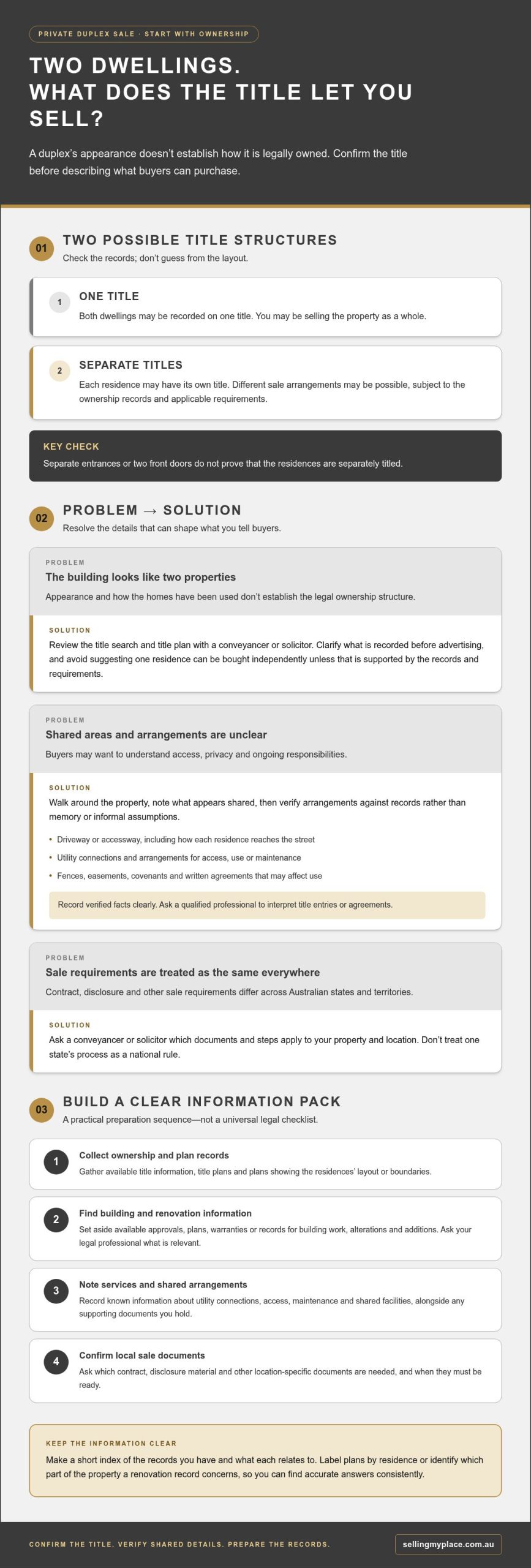
A duplex describes a building or arrangement with two dwellings, but its physical layout doesn’t tell you how the property is legally owned. As general background, What is a duplex? A title configuration is the legal structure recorded for the land and residences. It determines what’s being sold and whether the homes may be marketed separately, subject to applicable requirements. Two front doors don’t necessarily mean two separate properties.
That distinction is central to how to sell a duplex privately with confidence. Requirements for contracts, disclosure and other sale steps differ across Australian states and territories, so don’t treat one state’s process as a national rule. Confirm the property’s structure before describing the offer to buyers.
Is your duplex on one title or separately titled?
A duplex may sit on one title or have separate titles for each residence. Don’t infer the answer from the building’s appearance, separate entrances or the way the homes have been used. Review the title search and title plan with a conveyancer or solicitor. They can help interpret what’s recorded and identify questions to resolve before you advertise.
If both dwellings are on one title, you may be selling the property as a whole. Separate titles may allow different sale arrangements, but separate marketing or sale still depends on the ownership records and applicable requirements. Get clarity before writing a listing that suggests buyers can purchase one residence independently.
What shared features could affect the sale?
Look beyond the title boundaries to the practical details buyers are likely to ask about. Walk around the property, note anything that appears shared, then verify the arrangements against records rather than relying on memory or informal assumptions.
- Check whether the driveway or accessway is shared, and note how each residence reaches the street.
- Identify utility connections and any arrangements for access, use or maintenance.
- Review fences, easements, covenants and written agreements that may affect how parts of the property can be used.
These details can shape a buyer’s understanding of privacy, access and ongoing responsibilities. A shared driveway, for example, may prompt questions about who can use it and how maintenance is handled. Record verified facts clearly, but leave legal interpretation to a qualified professional. A conveyancer or solicitor can explain how relevant title entries or agreements apply to your property and what information should be reflected in the sale documents.
Prepare a duplex for private sale with the right documents and details
Once you’ve established what’s being offered, build a clear information pack before drafting the listing. Duplex details can be easy to blur together: which kitchen belongs to which residence, what parking is included, and whether an outdoor area is shared. Keeping the facts in one place helps you answer buyer questions consistently and spot gaps before they become last-minute concerns.
Use this preparation sequence as a starting point, not a universal legal checklist. Sale and disclosure requirements vary by state and territory, so have a conveyancer or solicitor identify the documents and steps that apply to your property and location.
- Collect ownership and plan records. Gather available title information, title plans and any plans showing the layout or boundaries of the residences.
- Find building and renovation information. Set aside available approvals, plans, warranties or records relating to building work, alterations and additions. Ask your conveyancer or solicitor what’s relevant.
- Note services and shared arrangements. Record known information about utility connections, access, maintenance and shared facilities, along with any supporting documents you hold.
- Confirm local sale documents. Ask your legal professional which contract, disclosure material and other jurisdiction-specific documents are needed, and when they must be ready.
Which duplex records should you gather before listing?
Keep the file practical rather than trying to assemble every record that might exist. Include relevant documents you already hold, such as title and plan records, building or renovation paperwork, and information about services or shared areas. Don’t assume the same documents apply to every Australian duplex. A conveyancer or solicitor can explain what’s required locally and how any available records should be handled.
Make a short index of what you have and what each item relates to. For example, label plans by residence or identify which renovation record concerns a particular part of the property. This makes it easier to find accurate answers during an inspection or follow-up. For a broader overview of the sale-by-owner process, see this guide to how to sell your own home.
How can you make the property straightforward to assess?
Prepare a separate fact sheet for each residence, even if you’re offering the duplex as one property. Note its layout, condition, inclusions and access, then describe shared spaces and services clearly. Check that the written description, floorplans and photographs show the same features and don’t imply exclusive use where an area is shared.
- Describe parking, outdoor areas and entrances accurately for each residence.
- List inclusions clearly, such as fixtures or appliances being offered with the property.
- Keep known property information together so inspection follow-ups are consistent.
Professional photography and floorplans can help buyers understand how the homes relate to each other. A prepared information pack also supports clear, measured answers. If you’d value guidance as you organise the sale, explore private-sale advice and marketing support that can complement the work you want to manage yourself.
Price and market a duplex privately to reach the right buyers
Pricing and presentation work best when they tell the same clear story: exactly what’s for sale, how it’s configured and what a buyer can expect. A whole duplex on one title isn’t automatically comparable with two separately titled residences, even if the buildings look alike. Before choosing comparable sales, establish the title structure and whether your listing is for one residence or both.
How should you assess a duplex’s market value?
Start with properties that genuinely resemble the offering. Compare land, layout, condition and title structure, as well as whether each sale involved one dwelling or the whole duplex. How to determine a home’s market value offers a useful framework for considering comparable sales and factors that can influence an estimate.
An online estimate can help orient your research, but treat it as a starting point, not a promised sale price. A neighbourhood market report or professional advice can add context to the sales you’re reviewing. Note where a comparable differs from yours rather than relying on a headline figure that may reflect a different title, condition or buyer proposition.
| Sale arrangement | What to consider when comparing |
|---|---|
| One title, whole duplex offered | Compare with properties sold as a whole, considering both residences, the land and any shared features. |
| Separately titled residences | Assess each residence against relevant individual sales, including its layout, condition and title details. |
This is a guide to comparison, not a legal determination. Confirm what can be sold and how it should be described against the title and applicable requirements.
What should a duplex listing show buyers?
Make the offer unmistakable from the first lines: is it the whole duplex, or a specific titled residence? Describe each home and its features separately where useful, and use accurate floorplans and professional photography to show the layout, access and shared areas. A clear listing helps interested buyers picture how the property works day to day.
- Identify the residence or residences included in the sale.
- Describe parking, outdoor areas, access and shared features accurately.
- Set out inclusions consistently across the listing, floorplan and inspection information.
Don’t imply that a shared driveway, yard or service is exclusive to one residence unless that’s accurate. Plain, consistent wording helps buyers assess the offer and gives you a reliable reference when answering enquiries. This is a practical part of how to sell a duplex privately: match the pricing evidence to the legal configuration, then make that configuration easy to understand in your marketing.
Professional photography, floorplans and neighbourhood market reports can support a considered presentation while leaving you in control of the sale. Explore private-sale marketing and advisory support if you’d like help shaping your plan.
Manage duplex inspections, offers and contracts without an agent
Selling privately doesn’t mean handling every detail without help. A steady process for inspections and buyer communication, paired with appropriate legal support, can make the work more manageable. Duplexes can prompt extra questions about access, shared services and which spaces are included, so keep your answers consistent and grounded in verified property information.
How can you handle duplex inspections and buyer questions?
Plan each inspection around the property’s layout. If both residences are included, make sure buyers can understand each one and any shared areas. If occupants live in either residence, organise access considerately and explain which areas can be viewed. Before inspections begin, prepare concise answers about title, services, access, inclusions and known shared arrangements.
Keep a simple enquiry record so details don’t get lost between conversations. For each buyer, note:
- their name and preferred contact details
- questions asked and the information you provided
- inspection arrangements and any follow-up requested
- offers received, your response and the next agreed step
This record helps you respond consistently, especially if different buyers ask similar questions about a shared driveway or outdoor space. If you don’t know an answer, note it and verify the information rather than guessing. Clear communication builds confidence without overstating what the title or shared arrangements allow.
What happens when a buyer makes an offer?
Consider the complete offer, not just the headline price. Compare any conditions, proposed timing and the buyer’s stated readiness to proceed. For example, a higher offer may include conditions or timing that differ from a lower offer. Weigh each on its terms and decide whether to accept, negotiate or decline; don’t assume one factor settles the decision.
Before agreeing to terms, have a solicitor or licensed conveyancer explain the contract and requirements that apply in your state or territory. Contract preparation, deposit arrangements, cooling-off rights and settlement processes can vary by jurisdiction and transaction. Don’t describe an offer as binding or the sale as complete until your legal professional has explained the applicable steps and status.
Once discussions progress, keep written records of the offer, any changes and what each party has agreed to do next. Avoid relying on a verbal summary when formal documents need to reflect the arrangement. This helps you stay organised while leaving legal interpretation and contract guidance to the right professional.
If you’d like practical guidance while retaining control of your sale, explore private-sale advisory support for your duplex.
Choose the right support to sell your duplex privately
Private selling doesn’t have to mean doing every task alone. You can decide how much of the marketing and preparation to manage while retaining control of key decisions, such as how to present the property and respond to offers. The right fit depends on your time, confidence and the complexity of the sale.
For owners weighing how to sell a duplex privately, three broad approaches can help clarify the choice:
- Fully self-managed: You organise the marketing, buyer enquiries and inspections, and coordinate the sale process with appropriate legal support.
- Traditional agency representation: An agent manages more of the sales process on your behalf, under the arrangement you agree with them.
- Flat-fee marketing with advisory support: You retain control of the private sale while accessing professional marketing and practical guidance, without agency commission.
What can professional marketing and advice take off your plate?
A well-presented duplex needs to make its layout and offer easy to understand. Professional photography and floorplans can show how the residences relate to one another, while neighbourhood market reports give you information to consider as you shape your marketing plan. Residential listing support can help with exposure while you remain in control of decisions about the sale.
Pre-sale consulting and the Agent Advisory Service can provide guidance as you prepare and work through the process, including conveyance advice. This can suit owners who are comfortable speaking with buyers but would value support with presenting the property or understanding the steps ahead. The flat-fee model is commission-free, and listings remain active until sold, with no time limit.
How can you decide what level of help suits you?
Think honestly about the tasks you’re ready to take on. Do you have time to respond to enquiries, arrange inspections and keep buyer discussions organised? Are you comfortable coordinating marketing and seeking legal guidance when needed? A clear view of your capacity helps you choose support that adds value without taking away the involvement you want.
Then match the support to your duplex and sale plan. A whole-property offering may need different presentation from a plan involving separately titled residences. Consider which tasks you want to manage, where advice would help, and what information buyers will need to understand the property. Support can help organise the process, but no marketing or advice can promise a particular sale price or timeframe.
A private sale can be personal and practical at the same time. If you’d like to talk through an approach that fits your duplex and the role you want to play, Talk through your duplex sale.
Take your next step with a plan that feels right
A duplex sale doesn’t need to follow a one-size-fits-all path. As you decide how to sell a duplex privately, focus on the level of involvement that gives you confidence and keeps your decisions aligned with your goals and circumstances. You can manage the process yourself or draw on professional support where it would make the next step clearer.
A commission-free, flat-fee approach can bring together marketing and guidance while you retain control of the sale. Professional photography, floorplans and neighbourhood market reports can support your presentation, alongside the Agent Advisory Service for pre-sale consulting and conveyance advice. The aim is to help you make informed choices, not to promise a particular sale price or outcome.
Start with a conversation about your duplex, your preferred role and the support that would be useful. A considered plan can make a major property decision feel more manageable, one step at a time. Discuss a private-sale plan with our team, and move forward with confidence.
Frequently Asked Questions
Can I sell a duplex privately in Australia?
Yes, private property sales are legal in every Australian state and territory. You can advertise the duplex, communicate with prospective buyers and consider offers yourself, while arranging professional help for tasks such as marketing or conveyancing. Before you begin, establish who owns the property and how it’s titled, then identify the sale and disclosure requirements that apply in your jurisdiction. These local details can influence the steps and documents involved.
Can I sell one side of a duplex separately from the other?
Possibly, but a building’s two-residence layout alone doesn’t mean each side can be sold independently. The title and any relevant ownership arrangements determine what you own, while local requirements may also affect whether separate sales are possible. For example, if both dwellings form one titled property, you may not be able to offer one residence as a standalone sale without addressing the legal structure. Get advice based on the actual records.
Does every duplex have separate titles?
No. Some duplexes have one title covering the property, while others have separate titles for each residence. You can’t reliably identify the arrangement just by looking at the building, its entrances or its fences. A title search and plan provide a more dependable starting point. If the records are difficult to interpret, a conveyancer or solicitor can explain what they mean for ownership and the proposed sale.
Do I need a conveyancer or solicitor to sell my duplex privately?
Legal support is strongly relevant, particularly because the sale contract and required documents depend on the property’s jurisdiction and title. A solicitor or licensed conveyancer can prepare or advise on the contract, explain obligations and help you understand the formal steps towards settlement. Their guidance is also useful if the title includes easements or other entries you don’t understand. Arrange advice early enough to inform your sale plan and advertising.
What happens if my duplex has shared utilities or access?
Shared services or access don’t automatically prevent a sale, but they can affect how buyers understand the property and its practical arrangements. A common driveway, for example, may raise questions about who can use it or how upkeep is handled. Gather relevant written agreements and service information, and distinguish documented arrangements from assumptions. A conveyancer or solicitor can explain the legal effect of any easement, covenant or agreement affecting the property.
Can I sell a duplex privately if it is tenanted?
A tenant living in one or both residences doesn’t automatically rule out a private sale, but the tenancy can affect access, inspections and what a buyer needs to understand about the property. Review the tenancy documents and get jurisdiction-specific advice about applicable notice, access and disclosure requirements before arranging viewings or advertising vacant possession. Be clear with prospective buyers about the occupancy situation, and don’t promise a move-out date unless it’s properly established.
How do buyers assess the value of a duplex?
Buyers may compare recent sales, land, layout, condition and title structure, as well as what’s included in the offer. Their assessment can differ depending on whether they’re considering the whole duplex or one separately titled residence. Shared access, services and outdoor areas may also shape their view of how the property works. Comparable sales and market information can help frame expectations, but an estimate can’t guarantee the eventual sale price.
Pricing Your Home for Private Sale in Australia: 2026 Guide
What if the right asking price isn’t one perfect figure, but a defensible range you can refine as buyers respond? Working out how to price your home for private sale can feel daunting when comparable sales are hard to find, online estimates disagree and the stakes are personal.
In 2026, market conditions are shifting: Australian home prices had fallen for six consecutive months by September, according to atRealty. That makes current, relevant evidence especially important. Price too high and buyers may look elsewhere; price too low and you could leave value on the table. An online estimate alone won’t resolve either risk.
This guide explains how to build an asking-price range from comparable sales, choose a pricing and negotiation strategy, and decide when buyer feedback calls for a review. It also covers how neighbourhood market reports and pre-sale advice can support an evidence-led approach throughout your private-sale campaign.
Key Takeaways
- Learn how to price your home for private sale by building a realistic asking-price range from relevant evidence, not guesswork.
- Use settled sales to assess what buyers have paid, then account for the differences between those homes and yours.
- Compare firm, range-based and competitive asking-price strategies, and weigh the risks before choosing an approach.
- Set review points before your campaign begins, then assess patterns in enquiry, inspections, feedback and comparable sales before adjusting.
- Bring pricing evidence together with pre-sale planning and marketing support, including neighbourhood market reports and a flat-fee model without agency commissions.
How to price your home for private sale: start with a defensible range
Choosing a price is a balance: you want to protect the value of your home while giving suitable buyers a reason to take a closer look. The asking price is your public starting point for attracting interest and negotiating. It isn’t a guaranteed sale result. Your decision should reflect both the evidence and your circumstances.
A defensible asking-price range is an evidence-based guide, not a promise. It gives you reasoned boundaries for pricing and negotiation, while recognising that the eventual result depends on the buyer, the property and the terms you agree.
What does an asking price mean in a private sale?
In a private sale, you negotiate the price and terms directly with a prospective buyer, or with support you’ve engaged. The advertised figure starts that conversation; it isn’t automatically the amount a buyer will pay. The final agreed sale price is the amount recorded in the sale contract once you and the buyer reach agreement.
Market value is different. It’s an informed view of what a property could reasonably sell for, based on relevant evidence and its characteristics. It helps guide your decision, but it isn’t the same as an advertised price or a guaranteed outcome. The private sale process describes the broad approach of selling without a traditional agent. Within that process, supported by Kincade International Direct Sales, you choose how to present and negotiate your price.
Your strategy should reflect the evidence and your priorities, including how much flexibility you want in negotiations. There’s no single approach that suits every home or seller.
Why a range is more useful than one unsupported figure
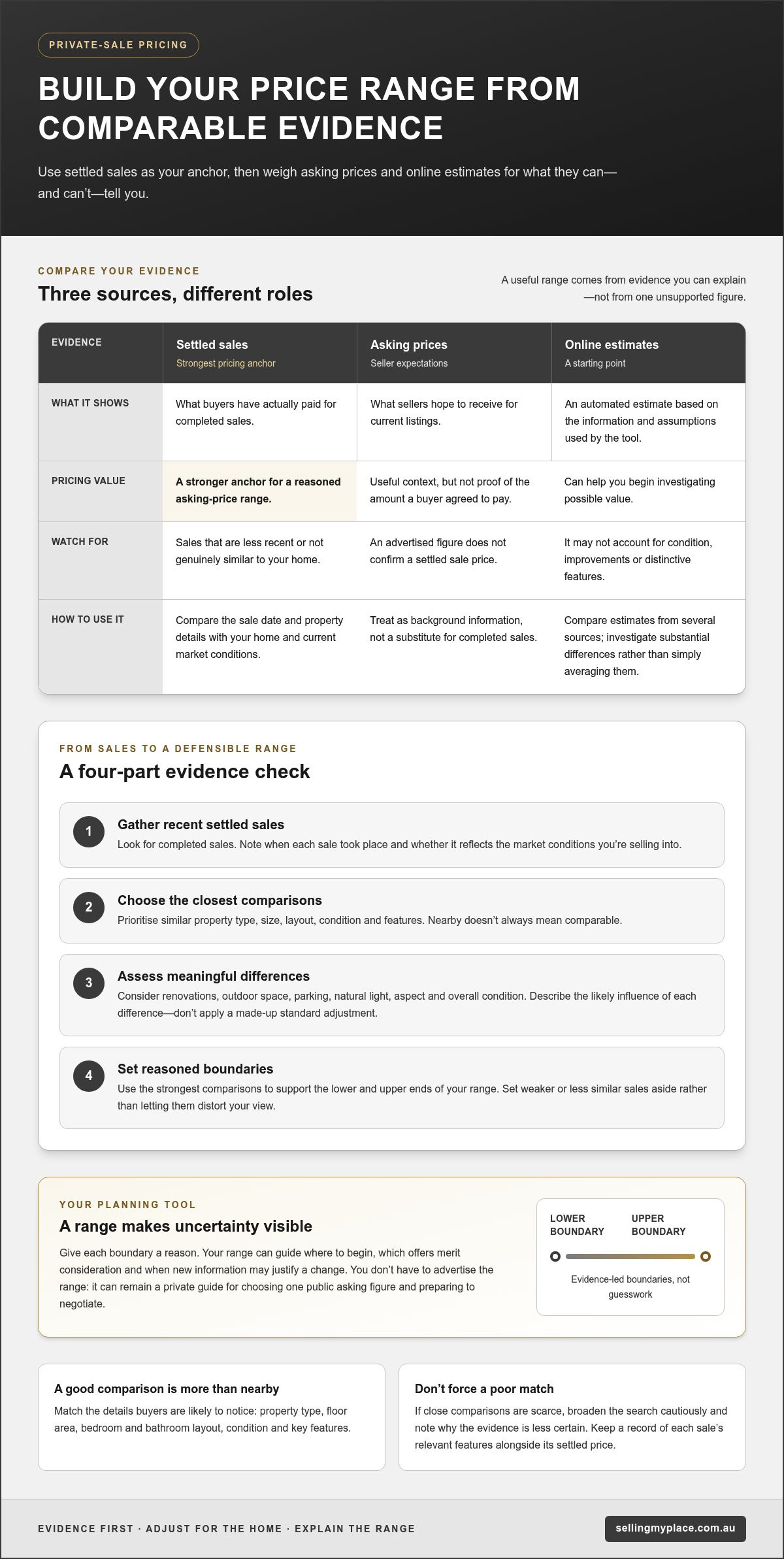
A single figure can suggest more certainty than the evidence supports. A range makes that uncertainty visible and helps you decide where to begin, which offers merit consideration and when new information might justify a change. Each boundary should have a reason behind it, rather than being chosen simply because it feels comfortable.
For example, if a home has a feature that makes comparisons difficult, a range can acknowledge that uncertainty while keeping the decision grounded in evidence. You don’t have to advertise a range: it can be a private planning tool to help you choose one public asking figure and prepare for negotiation.
To make the range useful, connect it to comparable settled sales, your property’s features and condition, and the circumstances of your sale. Asking prices show what sellers hope to achieve, not what buyers have agreed to pay. In the next section, you’ll build your range from comparable evidence. For a deeper look at valuation principles, consult a guide to determining your home’s market value, then weigh that context alongside property-specific sales evidence.
Build your private-sale price range from comparable evidence
A sound price range starts with what buyers have actually paid for homes like yours, not simply what other sellers hope to receive. Recent, genuinely comparable settled sales provide a stronger pricing anchor than asking prices alone. Advertised prices reveal a seller’s expectations; they don’t confirm that a buyer agreed to pay that amount.
Use this process to turn market information into a reasoned range:
- Gather recent settled sales. Look for completed sales rather than relying on current listings. Note the sale date and check that the evidence reflects the market conditions you’re selling into.
- Select the closest comparisons. Prioritise homes with a similar property type, size, layout, condition and features. A nearby property isn’t automatically a useful comparison if its design or presentation differs substantially.
- Assess the differences. Consider how renovations, outdoor space, parking, natural light, aspect and overall condition may affect buyer appeal. Describe each difference and its likely direction of influence instead of applying a made-up standard percentage or dollar adjustment.
- Form a supported range. Use the strongest comparisons to establish sensible lower and upper boundaries. Give each end a clear rationale, and set weaker or less similar sales aside rather than letting them distort your view.
Choose comparable sales that genuinely help
Start with homes that match yours in the ways buyers are likely to notice: property type, floor area, bedroom and bathroom layout, condition and key features. Then consider whether they sold in a similar market context. If close comparisons are scarce, broaden your search cautiously, perhaps to a different property type or a less recent sale, and note why that evidence is less certain. Don’t force a poor match just to fill a list.
Keep a simple record of each sale’s relevant features alongside its settled price. This makes it easier to see whether your range is supported by a consistent group of homes or rests on one unusual result. For wider context, the Real Estate Institute of Australia market insights can help you follow broader residential market information. National or state trends, however, can’t replace property-level comparisons.
Use online estimates and professional input with care
Automated estimates are useful starting points, but an online tool may not account for your home’s condition, recent improvements or distinctive features. Compare estimates from several sources. If they differ substantially, investigate what information or assumptions may explain the gap. Don’t simply average the figures and treat the result as a valuation.
Neighbourhood market reports and pre-sale consulting can add context as you assess sales and property differences. A fuller guide to neighbourhood market reports can help explain how broader local data fits alongside comparable sales. Kincade International Direct Sales also provides pricing and private-sale advice as part of its advisory support.
Choose an asking-price strategy without overpricing or underpricing
Once you have a supported range, decide how to present your price to buyers. The right approach depends on your evidence, how much flexibility you have and the conditions of your campaign. A figure below your estimate isn’t automatically a smarter move: it may attract attention, but it can also expose you to offers that don’t meet your acceptable outcome.
When deciding how to price your home for private sale, consider three common approaches:
- Firm asking price: State one figure grounded in your sales evidence. This gives buyers a clear reference point, while still leaving room to negotiate if you choose.
- Price range: Where appropriate, a range can signal flexibility and acknowledge uncertainty. Its boundaries should be meaningful, and you should be prepared to explain the basis for them.
- Competitive asking price: Set an attractive, evidence-supported figure to encourage enquiries from qualified buyers. Pricing below your estimate is a deliberate tactic with trade-offs, not a requirement for every private sale.
Think about your priorities before choosing. If you have room to negotiate, a firm figure may give you a useful opening position. If you need a particular outcome or have limited flexibility, make sure your advertised approach doesn’t invite offers you’re unwilling to consider. Campaign conditions matter too: buyer interest and relevant settled sales may shift, so keep your decision anchored to evidence rather than assumptions about how buyers will react.
When a competitive asking price may help
A compelling price can prompt suitable buyers to enquire, especially when it aligns with comparable evidence and the home’s presentation. But a figure chosen solely to generate attention can create pressure to consider offers below your acceptable level. Decide your boundaries in advance. Strong enquiry or interest from more than one buyer may affect negotiations, but it doesn’t guarantee competing offers or a particular sale result.
How to avoid an asking price that stalls interest
Limited qualified enquiries or repeated buyer comments that the price feels too high may point to a mismatch, particularly if your campaign is reaching its intended audience. First check the presentation: unclear photos, incomplete property details or difficulty arranging an inspection can also weaken interest. Look for patterns across feedback and activity rather than treating one person’s reaction as proof that the price is wrong.
If the evidence suggests a change is warranted, review your comparable sales and campaign response before revising the figure. A considered adjustment can be more effective than a rushed reduction after a quiet viewing or a single low offer.
Before advertising, check the current price-advertising requirements for your state or territory. Rules and guidance can differ, including how prices or ranges may be presented. Use the relevant government or consumer regulator’s current guidance to make sure your chosen strategy is appropriate for the property’s location.
Review and adjust your private-sale price using campaign evidence
Before your listing goes live, decide when you’ll review its performance. A planned check-in helps you avoid changing the price in response to one buyer’s comment or a quiet inspection. You might review after a set period or once you’ve gathered enough enquiry and viewing feedback to spot patterns. Choose a schedule that suits your campaign, then stick to it unless genuinely new evidence calls for an earlier review.
At each check-in, assess the whole picture: the number and quality of enquiries, inspection attendance, recurring feedback and any new comparable sales. One signal on its own rarely tells the full story. A listing might attract plenty of casual questions but few serious inspections, or have steady attendance alongside repeated concerns about price. Those patterns point to different things to investigate.
Read buyer responses without overreacting
Separate general interest from serious engagement. A buyer who asks about availability is at an earlier stage than someone who inspects, asks detailed questions and discusses terms. Record what people say and do, including whether they return for another look or make an offer. One person’s view is useful feedback, not a verdict on your home’s value.
Look for repeated, specific comments. If several prospective buyers independently raise the same concern about price, compare that pattern with your original sales evidence and any new settled sales. If their comments focus on a feature or presentation issue instead, a price change may not address the real obstacle.
Make a measured price review
Before revisiting the figure, check that the listing is accurate and the marketing materials show the property clearly. Confirm that key details are complete, photographs and floorplans represent the home well, and inspection arrangements are straightforward. If those basics need attention, improve them before deciding that the asking price is the problem.
When sustained campaign evidence conflicts with your initial assumptions, return to your price range. Ask whether the comparable sales still support it and whether buyer feedback consistently sits outside your expectations. A revised asking price should recognise what the evidence suggests while respecting your priorities and acceptable terms. If you keep the price unchanged, record why. If you adjust it, note what information supports the decision.
Keep a simple review log with the date, enquiry and inspection patterns, recurring comments, comparable sales considered, presentation checks and your decision. This creates a clear record of how your view developed, rather than leaving you to rely on memory during a stressful campaign. Once interest turns into an offer, a guide to property sale negotiation can help you consider the proposed price alongside conditions and timing.
Kincade International Direct Sales provides private-sale campaign and pricing advice to help you review buyer feedback and your approach.
Set your private-sale price with Selling My Place support
Pricing evidence is most useful when it informs the whole sale plan. Bring your comparable sales, proposed asking-price range and preferred negotiation approach together with a clear plan for presenting the home and reviewing buyer response. Pre-sale consulting and neighbourhood market reports can help you examine your assumptions and form a considered view before your property is advertised.
Kincade International Direct Sales supports Australian homeowners with flat-fee property marketing and advisory packages, without agency commissions. The service combines listing support with practical advice, while keeping the asking price grounded in evidence rather than presenting any figure as a guaranteed result.
What professional private-sale support can contribute
Pre-sale consulting and the Agent Advisory Service can help you review pricing assumptions alongside your sale preparation. Professional photography and floorplans give buyers a clearer picture of the home and its layout, while neighbourhood market reports provide relevant context for weighing your comparisons. Conveyance advice is also available as part of the advisory support, helping you consider the transaction process without treating this article as legal advice.
As you prepare to list, keep the key decisions connected. A price supported by sales evidence still needs marketing that accurately represents the property, and a well-presented listing is more useful when you’ve decided how you’ll assess enquiries and offers. Organise your plan around these practical elements:
- Evidence: Keep a record of the settled sales and property features that inform your pricing view.
- Range: Set reasoned lower and upper boundaries, and decide which figure or format to advertise.
- Strategy: Be clear about your flexibility, priorities and approach to negotiating with interested buyers.
- Review points: Choose when you’ll assess enquiry quality, inspections, feedback and any new comparable sales.
Take the next step with a clear pricing plan
Knowing how to price your home for private sale doesn’t mean predicting the final agreed price. It means making a considered starting decision, understanding the evidence behind it and being ready to review the plan as the campaign unfolds. A flat-fee model gives sellers access to listing and professional services without agency commissions, while keeping the sale decision in their hands. Residential listings remain active until sold, with no time limits.
Kincade International Direct Sales brings the pricing plan together with flat-fee marketing and advisory support, so you can make informed decisions without agency commissions or a promised sale price.
Move forward with a pricing plan you can stand behind
Deciding how to price your home for private sale is an important step, but it doesn’t mean you have to predict the future. Treat your asking price as a considered starting point, then let credible evidence and buyer response inform your next decisions. A written plan can help you stay steady: note what supports your price, what you’re willing to negotiate and what campaign signals would prompt a review.
That clarity can make the next stage feel more manageable. Kincade International Direct Sales brings flat-fee marketing and advisory support together, from professional photography and floorplans to neighbourhood market reports, pre-sale consulting and conveyance advice. There’s no agency commission, and the focus is on helping you make informed choices without promising a particular sale price.
Ready to turn your sales evidence into a practical private-sale pricing plan? Talk with Kincade International Direct Sales about the flat-fee marketing and advisory support available for your campaign.
Frequently Asked Questions
Can I change my asking price after listing my home privately?
Yes, you can generally revise your asking price during a private-sale campaign, but check any applicable state or territory requirements before updating your advertising. Make the change consistently wherever the property is promoted, and note the date and reasoning. For instance, a fresh settled sale or a clear pattern in buyer feedback may support a review. A change is a pricing decision, not a guarantee of increased interest or a particular offer.
Should I price my home above market value to leave room for negotiation?
Not automatically. A higher asking price may give you negotiating room, but if buyers see it as out of step with comparable properties, some may not enquire. Decide first what terms and outcome you could accept, then consider whether your starting figure is supported by the evidence and leaves realistic scope to negotiate. If you choose a higher figure, be prepared to explain its basis and review the response rather than assuming buyers will bargain it down.
Is an online property estimate accurate enough to set my asking price?
Use an online estimate as a prompt for further research, not as your only pricing basis. Automated tools may rely on recorded property details and sales data that don’t reflect renovations, condition, layout or features that make your home distinctive. If two estimates differ, check whether their property information or comparable sales differ too. When working out how to price your home for private sale, test any estimate against relevant settled sales and the specific characteristics buyers will see.
How do I price a home when there are few comparable recent sales?
Start with the closest settled sales you can find, even if the matches aren’t exact. Note where each comparison differs, such as property type, size, condition or sale date. You can widen the search to less recent or less similar sales, but treat those as supporting context rather than equal evidence. If your property is unusual, a market report or pre-sale advice can help you build a reasoned range from the available information.
Can a buyer offer less than the advertised price in a private sale?
Yes. An advertised price is an invitation for buyers to consider the property, not a requirement that they offer that amount. A buyer can propose a lower figure or different terms, and you can accept, decline or make a counteroffer. Consider the complete offer, including conditions and proposed timing, rather than focusing on price alone. Keep your preferred terms and minimum acceptable outcome clear before responding, and have the agreed details documented appropriately.
Do Australian states and territories have different rules for property price advertising?
Yes, requirements can differ between states and territories, and some rules apply to agents rather than private sellers. Don’t assume a rule described for an agent applies to your own listing. Before publishing or changing a price, check current guidance from the relevant state or territory consumer affairs or fair trading authority, especially if you plan to advertise a price range.
How to List on realestate.com.au Without an Agent in Australia
Want your home to reach a major property portal without appointing a traditional selling agent to manage the sale? If you want to list your property without an agent, note that private sellers can’t submit a for-sale property directly: a licensed real estate agency must handle the portal listing. A flat-fee platform like Kincade International Direct Sales may provide a route through an agency while you manage much of the sale yourself, rather than appointing a traditional commission-based agent.
It’s understandable to wonder whether a private listing will reach enough buyers and whether you’re ready to field enquiries and present your property accurately. Portal access is only the first step. Clear details, strong photography and a floorplan can help create a credible advertisement. You’ll also need to understand which parts of the selling process remain your responsibility.
This guide explains the available routes to a major portal listing, what information to prepare and how to weigh a fully self-managed sale against a supported private-sale service or traditional agency. Before choosing a package, check whether it currently provides portal access and what marketing or advisory support is included. With the right preparation, you can make a considered choice about control, exposure and support.
Key Takeaways
- Private sellers can’t submit a sale listing directly to the major property portal, but may be able to use an eligible provider.
- Compare self-managed and supported private-sale routes by checking who handles the listing, marketing and owner responsibilities.
- Prepare accurate property details, quality images and a floorplan, and make sure every advertised feature can be substantiated.
- Before proceeding, confirm portal placement, package inclusions, fees and listing duration in writing.
- Choose your level of support based on the time, confidence and control you want throughout the sale.
Can you list on a major property portal without an agent? Understand the available routes
Yes, you may be able to sell without appointing a traditional selling agent to manage the sale, but private owners can’t submit a for-sale property directly to the major Australian property portal discussed in this guide. Under current submission arrangements, a licensed real estate agency must handle the portal listing. A private-sale or flat-fee marketing provider may offer a route through an agency, but confirm the provider’s eligibility and the package’s portal access before committing.
This distinction matters because portal rules determine who can submit sale advertisements. A provider that helps prepare or promote an advertisement doesn’t automatically mean it can be published on your preferred portal. Check the current submission requirements and get clear confirmation from the provider rather than relying on a general claim of online exposure.
What does “without an agent” mean when listing a property?
Usually, it means not appointing a traditional selling agent to take charge of the sale. With a private-sale arrangement, you may manage buyer enquiries, organise inspections and lead negotiations yourself. A flat-fee marketing service can provide listing or marketing support, but that support is separate from managing the sale on your behalf. Check exactly what the provider handles and what remains yours to organise.
Can owners submit directly to the portal?
For a property offered for sale, private owners can’t submit an advertisement directly under current arrangements. The listing must be submitted through a licensed real estate agency, which may be arranged through a private-sale platform. As portal requirements and provider eligibility can change, check the portal’s current seller information and ask the provider to confirm it can place your sale listing. Get the answer in writing, including any conditions that apply.
At a glance: possible routes to a sale listing
- Traditional selling agent: The agent manages the sale and submits the listing.
- Private-sale platform: A licensed agency may submit the listing, while you manage agreed parts of the sale.
- Direct private submission: Not currently available for sale listings on the major portal discussed here.
These routes describe the general distinction, not a promise that any particular provider or package is eligible. Confirm current access, inclusions and your responsibilities before proceeding.
Whichever route you consider, a private sale still takes active work. You’ll need to prepare accurate property information, promote the home, respond to buyers and keep the sale moving. Choosing not to use a traditional agent doesn’t remove the need for an eligible submission pathway or a clear plan for managing the listing.
Compare direct, self-managed and flat-fee routes to a realestate.com.au listing
Portal access is only one part of the decision. An advertisement can be prepared and a sale managed in different ways, so consider separately who submits the listing and who handles the work once it’s live. The comparison below outlines the broad distinctions. Confirm current portal access and exactly what any provider will do before you choose.
| Route | Portal access | Owner responsibilities | Support and questions to check |
|---|---|---|---|
| Direct owner submission | Private owners can’t currently submit a sale listing directly to realestate.com.au. | You’d prepare and manage the sale, but need to establish an eligible submission pathway first. | Check the portal’s latest requirements. Don’t assume an owner account allows you to publish a sale ad. |
| Self-managed sale through an eligible pathway | Access depends on the agency or provider submitting the listing and its current eligibility. | You may prepare the advertisement, respond to enquiries, coordinate viewings and discuss offers. | Confirm who submits the ad, what support is included and which sale tasks remain yours. |
| Flat-fee marketing service | Placement depends on the service’s current portal access and package terms. | You may still manage buyer communications, inspections and negotiations, depending on the arrangement. | Ask in writing whether realestate.com.au placement is included, along with the specific marketing and advisory inclusions. |
What does a fully self-managed listing involve?
Self-management gives you greater control, but it also puts the practical work in your hands. You’ll need to prepare the property information and advertisement, respond to prospective buyers, organise viewings and handle offer discussions. It may suit sellers with the time and confidence to take on those tasks. First, confirm how the listing can reach the portal. Don’t rely on direct submission being available.
How can a flat-fee property marketing service help?
A marketing service can support parts of the preparation without necessarily taking over sale management. Kincade International Direct Sales describes services including professional photography, floorplans, neighbourhood market reports and advisory support. Its flat-fee model is an alternative to agency commission, not a promise of a particular sale result. Check which inclusions apply and whether the current package enables realestate.com.au placement.
Think about the tasks you’re comfortable owning. If you’re confident managing enquiries but want help presenting the home, marketing support may be worth exploring. If you’d prefer someone else to lead the sale, assess that responsibility separately from the cost structure. To compare the available support, review flat-fee property marketing and advisory options and confirm portal access and package details before deciding.
Prepare a credible realestate.com.au listing before you publish
A clear, well-prepared advertisement helps buyers understand the home before deciding whether to arrange an inspection. Reviewing it before publication also gives you a chance to catch mistakes while there’s still time to correct them. Gather the key details, check every claim and decide how prospective buyers will contact you.
Gather property details, photography and a floorplan
Build your listing from information you can check, rather than memory or assumptions. Use this pre-publication checklist:
- Property details: Confirm the address, property type, room count and features. Check dimensions and inclusions against reliable records where available.
- Features and condition: Describe fixtures, renovations and other selling points precisely. Don’t present an upgrade as new or recently completed unless you can support that description.
- Photography: Review each image to ensure it shows the property fairly and represents its current condition. Check that the photos match the written description.
- Floorplan: Use a clear floorplan and verify that its labels and dimensions are correct. Buyers use it to understand the layout, so errors can lead to confusion.
- Enquiries: Decide which contact details to publish, who will respond and how you’ll arrange viewing requests. A simple plan helps you keep track of buyer conversations.
Professional photography and floorplans can help present the home clearly. If you’re using a marketing provider, confirm which materials are included and review the final advertisement yourself before it goes live.
Check advertising claims and seller obligations
Accuracy matters. Avoid unsupported statements about renovations, included fixtures, boundaries or potential future development. If a detail is uncertain, check it or leave it out rather than asking buyers to rely on a guess. Keep relevant records available so you can substantiate information in the advertisement if questions arise.
Disclosure, advertising and sale requirements can differ between Australian states and territories. Check current guidance from the relevant official state or territory consumer affairs or fair trading authority, and seek conveyancing advice about documents and transaction responsibilities. A conveyancer or solicitor can help clarify what applies to your circumstances. Don’t assume the requirements in one state apply everywhere.
Before you list on realestate.com.au without an agent, read the completed advertisement from a buyer’s point of view. Are the features easy to understand? Do the photos and floorplan match the claims? This final check can help you publish a more credible listing and begin buyer conversations on a sound footing.
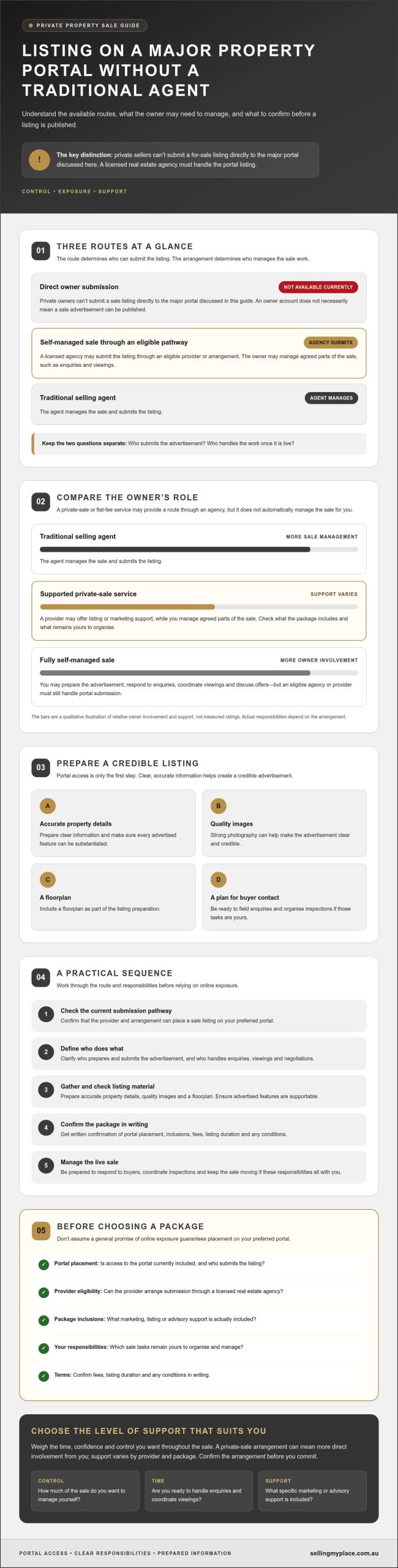
Follow these steps to publish and manage your private property listing
A smooth sale starts with confirming the listing pathway, then keeping the advertisement and buyer communication organised. Use this workflow before and after publication. If you plan to list on realestate.com.au without an agent managing the sale, be clear about which tasks you’ll handle and what your chosen provider will do.
- Confirm the submission route. Check realestate.com.au’s current requirements and ask the service provider to confirm in writing that it can submit your sale listing. Don’t assume portal access is included just because a service offers online marketing.
- Review the service scope. Ask which platforms the package covers, what marketing materials and advisory support are included, and what you’ll need to manage yourself. Confirm any applicable fees, listing duration, renewal or extension conditions, and other terms in writing.
- Prepare the final advertisement. Gather the property details, images and floorplan, then check that every material claim is accurate. Decide how prospective buyers will contact you and who will receive their enquiries.
- Approve before publication. Read the complete advertisement as it will appear to buyers. Verify the address, features, inclusions, room details and contact arrangements. Ask the provider how to request corrections and who is responsible for submitting them.
- Set up an enquiry routine. Choose a reliable way to monitor messages and respond consistently. Keep a record of questions, your answers and inspection requests so you can follow up and give prospective buyers the same accurate information.
- Check the live listing. Once published, confirm it appears on the agreed platform and review the displayed details. Check it regularly and promptly request corrections if information changes or an error appears. Keep track of the agreed listing period so you know what happens as it approaches its end.
Clear written terms make it easier to spot gaps before they become frustrating. If a provider offers marketing or pre-sale advice, clarify precisely what that assistance covers. It doesn’t necessarily mean the provider will manage enquiries, inspections or negotiations for you.
To compare the support available for a private sale, ask about property marketing and advisory options, including current portal access and package conditions.
Choose the right support for listing on realestate.com.au without an agent
The right level of support depends on how much time you can give the sale, how comfortable you feel speaking with buyers and how much control you want to retain. If you’re confident handling enquiries, viewings and offer discussions, an owner-managed approach may suit you. If you’d like help presenting the property or getting advice before sale, a flat-fee service may offer a middle ground between doing everything yourself and appointing a traditional selling agent.
Kincade International Direct Sales describes a flat-fee model without agency commission, with services including professional photography, floorplans, neighbourhood market reports and an Agent Advisory Service. These inclusions may help with marketing preparation and advice, but they don’t automatically mean the provider manages the sale or can place your property on realestate.com.au. Treat it as an option to investigate, and confirm current portal access and package terms directly before deciding.
When a flat-fee supported sale may suit your plans
This route may appeal if you want to stay closely involved while getting help with selected parts of the process. For example, you might be happy to speak with prospective buyers but prefer professional photography and a floorplan to support the presentation. Check which inclusions apply to the package you’re considering, and ask what tasks, such as enquiries and negotiations, remain yours.
Questions to ask before choosing a listing service
Get clear, written answers before you commit. Cover portal access as well as the work involved in preparing and managing the listing.
- Portal access: Can the service currently arrange a sale listing on realestate.com.au? Who submits it, and what eligibility conditions apply?
- Platforms and duration: Which websites are included, how long will the listing remain active, and what happens if the agreed period ends?
- Inclusions and terms: Are photography, floorplans, market reports or advisory support included? Confirm applicable fees and any other package conditions in writing.
- Your responsibilities: Who prepares or approves the advertisement, responds to buyer enquiries, coordinates viewings and handles offer discussions?
- Advice and conveyancing: What does the advisory support cover, who provides it, and what conveyance advice is available? Clarify the scope and whether separate professional advice may be needed.
Choose the arrangement that fits the way you want to sell, not just the way the listing is submitted. Before committing, compare the support you’ll receive with the time and responsibility you’re prepared to take on yourself.
Take your next step with clarity and confidence
You can list on realestate.com.au without an agent managing your sale, but confirm the current portal pathway and provider eligibility before relying on a listing. Prepare accurate property details, then weigh the time and responsibility of managing buyers yourself against the marketing and advice a supported private-sale service may include.
Kincade International Direct Sales describes a flat-fee marketing model without agency commission, with professional photography, floorplans and an Agent Advisory Service offering pre-sale consulting and conveyance advice. Confirm current portal access, package inclusions and your responsibilities directly before making a decision.
If you’re considering a supported sale, discuss a supported, commission-free sale and ask what applies to your circumstances. With the right information and level of support, you can choose a way forward that suits your plans.
Frequently Asked Questions
Can I list on realestate.com.au without an agent?
Not by submitting a for-sale advertisement directly as a private owner. Current submission arrangements require a licensed real estate agency to lodge sale listings, although you may be able to manage the sale yourself through a private-sale pathway. Portal rules and provider eligibility can change. Check realestate.com.au’s current seller information and ask any provider to confirm in writing that it can arrange placement before you pay or rely on that exposure.
How do I get my property on realestate.com.au without a traditional agent?
You may be able to use a private-sale service that arranges submission through a licensed agency, rather than appointing a traditional agent to manage the sale. If you want to list on realestate.com.au without an agent overseeing the process, first confirm the provider’s current access and eligibility. Then agree who prepares the advertisement, fields enquiries, arranges inspections and handles offers. Get the portal placement and your responsibilities confirmed in writing.
Can a flat-fee service list my home on realestate.com.au?
A flat-fee service may be able to arrange a listing, but don’t assume portal access is included or currently available with every provider or package. Ask who submits the advertisement, whether the service can currently place sale listings on realestate.com.au, and what conditions apply. Confirm the platforms, listing period, inclusions and fees in writing. Marketing support and portal submission are distinct, and neither guarantees a sale or a particular result.
What information do I need to list a property on realestate.com.au?
Prepare the property address, type, room details, features, inclusions and any dimensions you plan to advertise. Gather clear, current photographs and a floorplan, then check that they match the home and written description. Have relevant property records available to support claims about renovations, fixtures or boundaries. You’ll also need seller contact arrangements for buyer enquiries. Check applicable state or territory disclosure and advertising requirements through official sources before publication.
Do I still have to manage buyer enquiries if I sell without an agent?
Often, yes. In a self-managed sale, the owner may need to monitor and respond to enquiries, arrange inspections, answer questions consistently and discuss offers. A marketing provider may assist with advertising without managing those parts of the sale. Before engaging a service, ask which communications it handles and what remains your responsibility. Set up a reliable way to record enquiries and follow up so interested buyers receive accurate information.
Is selling privately the same as selling without any professional help?
No. Selling privately usually means retaining control of key sale tasks, not necessarily doing every part alone. You can seek separate marketing or advisory support while managing buyer communications and negotiations yourself. For example, Kincade International Direct Sales describes a flat-fee model without agency commission, with photography, floorplans, neighbourhood market reports and an Agent Advisory Service for pre-sale consulting and conveyance advice. Confirm which services apply and what professional guidance you may still need.
What should I check before paying for a private property listing service?
Ask whether realestate.com.au placement is currently available, who submits the listing and what eligibility conditions apply. Confirm the platforms, marketing materials, advisory inclusions, listing duration, fees and any renewal terms in writing. Clarify whether you or the provider will prepare the advertisement, respond to buyers, arrange inspections and manage offers. Check the provider’s current terms and verify relevant state or territory selling and disclosure requirements through official sources before committing.
How to Sell a Townhouse Privately: The 2026 Australian Seller’s Guide
Handing over A$20,000 of your hard-earned equity to an agent just to sell a property you know better than anyone isn’t a necessity; it’s a choice you no longer have to make. We understand that the thought of managing your own sale feels like a mountain to climb, especially when you’re balancing the complexities of strata records and legal disclosures. You’ve likely spent years making your townhouse a home, and the idea of losing a chunk of that legacy to commission feels inherently wrong. Learning how to sell a townhouse privately is about reclaiming that value while ensuring every legal requirement is met with total precision.
This guide is designed to be your steady hand through the 2026 Australian market, offering a clear roadmap to navigate strata-specific requirements and contract exchanges with confidence. We’ll walk you through the essential steps to create a professional-grade listing, manage your own inspections, and master the legal settlement process without the usual stress. By the end of this article, you’ll have the tools to manage your sale like a seasoned expert, keeping 100% of your profit exactly where it belongs: in your pocket.
Key Takeaways
- Protect your family’s legacy by bypassing the commission trap, potentially keeping upwards of A$20,000 in your pocket for your next home.
- Master the legal nuances of townhouse sales, including the vital role of strata inspection reports and organising a robust Section 32 with a licensed conveyancer.
- Discover how to sell a townhouse privately by leveraging professional visual assets that showcase your property’s unique layout and lifestyle appeal.
- Gain the confidence to lead your own open homes, using your insider knowledge to build trust and answer buyer queries with authentic warmth.
- Embrace a partnership-based approach that provides the security of expert pre-sale consulting without the burden of high marketing costs.
Why Selling a Townhouse Privately is Your Best Financial Move
Selling your home is one of the most significant life transitions you’ll ever experience. It is the culmination of years of hard work, careful maintenance, and family memories. Choosing how to sell a townhouse privately isn’t just a way to save on costs; it’s about stepping into the driver’s seat of your financial future. We define the private sale as a professional partnership where your intimate knowledge of the property meets a structured, digital advisory framework. By removing the traditional intermediary, you ensure that every dollar of equity stays within your family’s reach, providing a much larger deposit for your next chapter.
Calculating the Real Cost of Traditional Agents
Many sellers are shocked when they see the final settlement statement at the end of a traditional campaign. In Australia, a typical agent might charge between 2% and 3% in commission. For a townhouse valued at A$800,000, that is a staggering A$16,000 to A$24,000 gone in an instant. This “commission trap” is often compounded by high marketing costs. Agents frequently mark up advertising fees or suggest expensive print packages that don’t always serve your specific needs. A flat-fee model offers the transparency you deserve. It allows you to invest in high-quality visual assets without the hidden overheads that erode your profit.
The Townhouse Advantage in Private Sales
In the 2026 Australian property market, townhouses occupy a unique “sweet spot” for buyers. They offer the space of a house with the convenience of an apartment, making them incredibly attractive to first-home buyers and downsizers. Because these properties often involve strata title ownership, many maintenance concerns are managed by a body corporate. This structure simplifies the due diligence process for potential buyers, making townhouses much more straightforward to sell privately than large, complex estates.
Buyers in this segment value direct, honest communication. You can speak to the lifestyle benefits, like the morning sun in the courtyard or the quiet neighbours, with an authenticity no agent can replicate. Managing your own sale allows you to handle the transition with a steady, professional hand. It reduces the stress of high-pressure sales tactics and keeps the focus where it should be: on a smooth, successful settlement that respects your legacy.
Navigating Strata and Legal Requirements for Townhouses
Building trust through documentation is the cornerstone of a successful private sale. Unlike a traditional house, a townhouse involves shared responsibilities that must be clearly articulated to any prospective owner. This means documenting common property areas, such as shared driveways or gardens, and ensuring all shared-wall agreements are legally sound. When you understand how to sell a townhouse privately, you realise that providing a comprehensive paper trail isn’t a chore; it’s a professional courtesy that sets you apart from less prepared sellers. Transparency about body corporate fees and any upcoming special levies ensures there are no “nasty surprises” that could derail a deal late in the piece.
Buyers aren’t just looking at your four walls; they’re looking at the health of the entire complex. The Strata Inspection Report is your most persuasive sales tool because it provides a window into the building’s history, from past repairs to the financial robustness of the owners corporation. By providing this upfront, you eliminate the fear of the unknown that often stalls private negotiations. It shows you’ve managed your home with a steady, professional hand, which gives buyers the confidence to move forward without an agent acting as a buffer.
Strata Documentation 101
A “clear” strata report is one that shows a well-managed administrative fund for daily expenses and a healthy capital works fund for future major projects. If there’s a special levy planned for a new roof or balcony repairs, disclose it early. Honesty builds a bridge of trust that agents often struggle to maintain. You’ll want to have copies of the last few years of meeting minutes ready to show that the community is harmonious and proactive. You can find more details on general preparation in our How to Sell Your Own Home: A Step-by-Step Guide.
Legal Compliance Without the Stress
Legal requirements vary slightly across states and territories, but the core legal requirements for selling property in Australia always mandate a valid Contract of Sale before you hit the market. Depending on your state or territory, this contract may be accompanied by a vendor’s statement or a series of prescribed disclosures, but the obligation to inform the buyer remains consistent nationwide. This document must outline everything from zoning to encumbrances. Engaging a licensed conveyancer early ensures these details are watertight, protecting you during the cooling-off period and leading to a smooth exchange of contracts. If you need a hand organising these documents, our experts at Kincade International Direct Sales can offer the conveyance advice necessary to keep your sale on track and your equity protected.
Professional Marketing: Making Your Townhouse Stand Out
First impressions happen in milliseconds on a smartphone screen. Your digital listing is the virtual front door to your home, and it needs to feel as welcoming and polished as the property itself. Professional photography captures the warmth and space of your townhouse, ensuring it stands out against cluttered, low-quality competition. Mastering how to sell a townhouse privately means becoming the curator of your property’s best features, from the way the afternoon light hits the balcony to the quiet community atmosphere of your complex. By leveraging global marketing networks, you aren’t just waiting for a local buyer to walk past a sign; you’re actively reaching families and professionals who are looking to move into your specific community from across the country or even overseas.
Visual Assets That Convert Clicks to Inspections
Townhouses often feature unique multi-level designs that can be difficult to interpret through photos alone. This is where professional floorplans become your secret weapon. They allow buyers to mentally place their furniture and understand the flow between living zones and private retreats. High-quality wide-angle shots, taken with professional lighting, can reveal the true scale of your rooms without the distortion common in DIY photos. These assets provide the clarity buyers need to feel confident enough to book an inspection. For a deeper look at what makes a listing successful, explore our Professional Residential Property Listing Services Guide.
Strategic Pricing and Market Reports
Pricing is an art backed by data, and getting it right from day one is essential. An overpriced listing becomes “stale” quickly, losing that initial surge of interest that occurs when a new property hits the market. Understanding how to sell a townhouse privately involves using tools like Neighbourhood Market Reports to see what similar properties in your area actually sold for, rather than just their aspirational asking prices. This grounded approach helps you set a competitive figure that attracts serious interest while protecting your hard-earned equity. We recommend setting a realistic, data-driven price to ensure your sale remains on a smooth, predictable timeline. You can learn more about setting the right figure in our guide on How to Determine the Market Value of a Home in Australia.
When you write your listing description, focus on the lifestyle your townhouse offers. Mention the local coffee shops, the proximity to transport, and the ease of low-maintenance living. This personal touch, combined with professional-grade visuals, creates a compelling narrative that resonates with buyers on an emotional level.
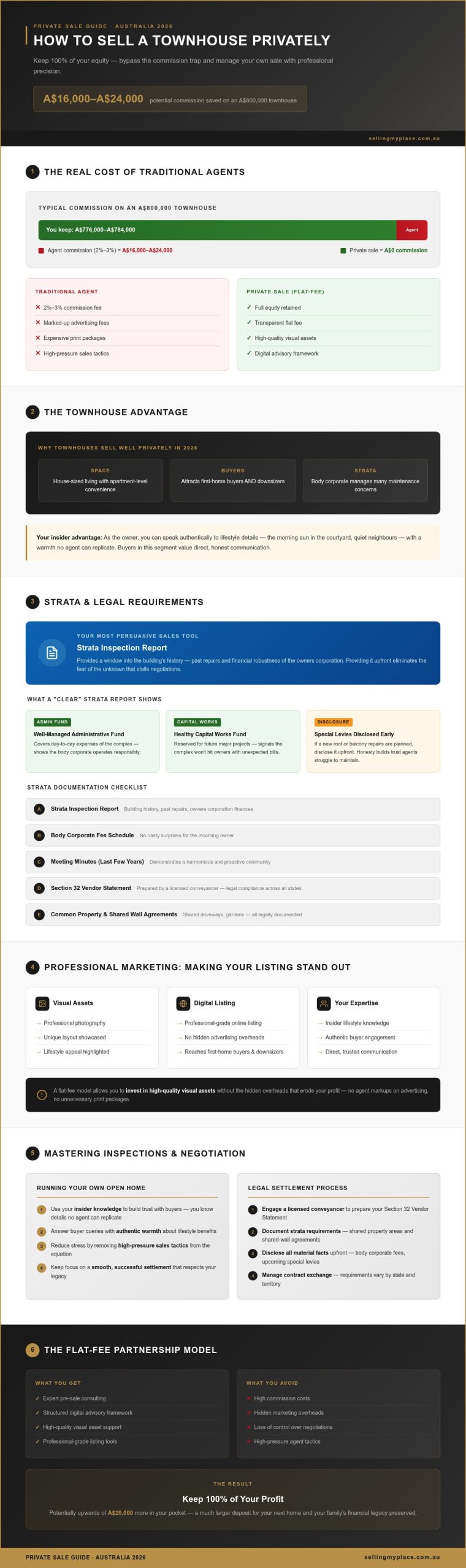
Mastering Inspections and the Art of Negotiation
Moving from the digital listing to the physical inspection is where your connection with a buyer truly begins. When you learn how to sell a townhouse privately, you discover that you are your property’s greatest asset. No one else can explain how the morning light perfectly illuminates the kitchen or where the best local coffee is found with quite the same heart. It is about being a welcoming guide rather than a high-pressure salesperson. This personal touch builds trust far more effectively than a generic agent script, allowing buyers to see the home through your eyes.
Setting the Scene for a Successful Inspection
Inside, decluttering is essential to maximise the sense of space and flow. To help clear out personal items and bulky furniture, you might consider a secure solution like SafeHouse Storage to make each room feel more expansive. Open every blind to invite natural light and use neutral, fresh scents to create a calm, grounded atmosphere. Don’t forget to highlight shared amenities like pools, gyms, or BBQ areas during the walk-through. These are valuable extensions of your own living space that add significant lifestyle weight to your asking price.
Negotiation doesn’t have to be a battle of wits. In the Australian property market, a “Fair Go” approach often yields the best results for everyone involved. This means building genuine rapport with buyers and understanding their needs as much as your own. When an offer arrives, take a breath. You aren’t just looking at a number; you’re looking at terms, settlement dates, and the buyer’s level of finance approval. Handle counter-offers with professional courtesy and calm confidence, keeping the lines of communication open and respectful.
If a conversation feels particularly high-stakes, our Expert Agent Advisory Service is here to provide the steady hand you need to navigate the final hurdles. For more detailed strategies on reaching a win-win, check out these Expert Property Sale Negotiation Tips. Managing buyer follow-ups without appearing desperate is simply a matter of timing; a warm, short message a day after the inspection is usually perfect. It allows you to answer any lingering questions about the strata title or local schools while the property is still fresh in their minds. This direct line of communication is exactly what modern buyers crave. If you’re ready to start showing your home to the right buyers, contact our advisory team today for a pre-sale consultation.
The Flat-Fee Partnership: Selling Smarter with Kincade International Direct Sales
Choosing to manage your own sale doesn’t mean you have to walk the path alone. We believe that the most successful property transitions happen when your personal passion for your home is backed by professional-grade infrastructure and expert guidance. Our commission-free model is built on this very principle. It empowers you to keep 100% of your sale price, which, for many Australian families, means an average saving of A$20,000. That is a life-changing amount of money that stays in your bank account rather than being handed over as an agency commission. When you understand how to sell a townhouse privately with the right support, the process becomes a rewarding journey rather than a source of stress.
Our Agent Advisory Service: Your Secret Weapon
Our Agent Advisory Service is the bridge between a traditional DIY approach and the polished results of a top-tier agency. We provide the “steady hand” you need, offering pre-sale property consulting and conveyance advice to ensure every legal requirement is met with precision. If you hit a roadblock during negotiations or feel unsure about a specific strata disclosure, our seasoned experts are just a phone call away. You get the benefit of a global marketing network and professional visual assets, like photography and floorplans, without the high marketing costs typically associated with big franchises. This partnership allows you to present a professional face to the market while maintaining the authentic, neighbourly connection that buyers value.
Ready to Keep Your Profit?
One of the greatest benefits of this partnership is the freedom from traditional agency pressure. Traditional agents often push for quick results or expensive auctions to meet their own monthly targets. With our “listed until sold” approach, you maintain total control over the timeline. You can wait for the right buyer who truly appreciates the value of your townhouse. This methodical, patient pace allows for a smoother settlement and a more celebratory outcome for your family. It’s about protecting your financial legacy and ensuring your hard-earned equity supports your future aspirations. Taking control of your sale is a powerful way to honour the time you’ve spent in your home. Are you ready to take the first step? Get started with our commission-free selling package today and see how simple it can be to sell smarter.
Step Into Your Future with Confidence
Taking control of your property sale is a powerful way to honour the years you’ve spent building a life in your home. By mastering the nuances of strata disclosures and presenting your property with professional photography and floorplans, you position yourself for a result that reflects the true value of your townhouse. You’ve seen that understanding how to sell a townhouse privately is about more than just a transaction; it’s about protecting your financial legacy and ensuring your family’s equity remains intact.
With our Expert Agent Advisory Service by your side, you never have to navigate the complex legal or negotiation stages alone. You can move forward knowing you’re set to save an average of A$20,000 in commissions, keeping that hard-earned profit for your next move. This is your journey, and we’re here to provide the steady hand and professional infrastructure you need to make it a success. Book a consultation with our expert advisory team today to start your next chapter with clarity. Your future self will thank you for making the choice to sell smarter.
Frequently Asked Questions
Is it legal to sell my townhouse privately in Australia?
Yes, it’s entirely legal for homeowners to sell their own property in every Australian state and territory. You aren’t required by law to use a real estate agent. By taking the vendor role yourself, you maintain full control over the process. We support this transition by providing the professional digital infrastructure and advisory services needed to ensure your sale meets all regulatory standards while you keep 100% of your profit.
Do I need a special strata report to sell my townhouse privately?
While the law doesn’t mandate a special report for private sales, providing a current Strata Inspection Report is a critical step in building buyer trust. This document outlines the financial health of the owners corporation and any upcoming capital works. When learning how to sell a townhouse privately, you’ll find that transparency regarding sinking funds and administrative levies helps buyers feel secure, often leading to a smoother and faster negotiation process.
How do I handle the deposit when selling without an agent?
The deposit is typically held in the trust account of your solicitor or licensed conveyancer until the settlement date. Since you aren’t using a traditional agency, you don’t use an agent’s trust account. This arrangement provides legal security for both you and the buyer. It’s a standard part of the settlement process that ensures funds are handled professionally and safely, allowing you to focus on the emotional transition of moving.
Can I list my townhouse on major real estate websites myself?
Most major Australian property portals don’t allow direct listings from private individuals. However, our service bridges this gap by providing access to these essential platforms through our established digital infrastructure. This ensures your townhouse receives maximum exposure alongside traditional agency listings. You get the benefit of a global marketing network while avoiding the high commissions and restrictive timelines often associated with traditional real estate franchises. It’s about reaching the right buyer on your terms.
What happens if I struggle to negotiate with a difficult buyer?
Negotiation can feel high-stakes, but you don’t have to manage it alone. Our Expert Agent Advisory Service is specifically designed to help whenever you hit a roadblock. We provide a steady hand and professional guidance to help you navigate difficult conversations or complex offers. This partnership approach ensures you reach a Fair Go outcome that respects your property’s value without the stress of going it entirely alone. Your peace of mind is our priority.
How much can I realistically save by selling my townhouse privately?
Australian homeowners save an average of A$20,000 by choosing to sell without a traditional agent. This saving comes from bypassing the standard 2% to 3% commission fees and avoiding inflated marketing markups. By using a flat-fee model, every dollar of your home’s equity stays in your pocket. It’s a significant financial boost that can provide a much larger deposit for your next home or help secure your family’s future stability and long-term legacy.
Do I still need a solicitor if I am selling the property myself?
Yes, engaging a solicitor or licensed conveyancer is essential for a safe and legal sale. They are responsible for preparing the Contract of Sale and managing the formal exchange and settlement. While you handle the marketing and inspections, your legal representative ensures all disclosures are accurate and the transfer of title is seamless. We provide conveyance advice to help you integrate these legal steps into your broader strategy for how to sell a townhouse privately.
How long does the private sale process usually take for a townhouse?
The timeline for a private sale often mirrors the broader market conditions in your area. However, a major advantage of our model is that your property is listed until sold. There are no restrictive 90-day agency agreements that pressure you to lower your price or rush into an auction. This allows you to wait for a buyer who truly values your home’s unique features, ensuring a celebratory result rather than a rushed transaction.
Navigating Australian Property: 2026 Home Owner’s Guide to Private Sales
What if the biggest hurdle to your family’s next chapter isn’t the market itself, but the A$20,000 or more you’re expected to hand over in commissions? For many, the traditional path to selling a home feels like a lopsided arrangement where you provide the asset and someone else takes a significant slice of the reward. If you’ve ever felt that the current model of private real estate sales australia puts the agent’s interests ahead of your own equity, you aren’t alone. It’s a common frustration to feel like a passenger in your own life transition, especially when hidden marketing fees and rigid contracts start to pile up.
We believe you deserve a more empowering way to move forward, one that treats your home as the hard-earned legacy it is. This guide will show you how to find the best available properties or list your own for a premium price while retaining your full profit. You’ll discover how to access professional photography, expert negotiation support, and global listing reach without the burden of traditional commissions. From legal essentials to mastering open homes, we’re here to provide the steady hand you need to manage your 2026 property journey with absolute confidence.
Key Takeaways
- Understand how the market environment for private real estate sales australia has evolved in 2026 to empower owners through digital-first marketing and total transparency.
- Learn how to bypass traditional 2-3% commission structures and keep an average of A$20,000 more of your hard-earned equity by choosing a professional flat-fee model.
- Discover the psychological power of professional visual marketing and how pre-sale consulting identifies high-ROI improvements that make your property stand out.
- Gain the confidence to manage your own enquiries and open houses, acting as the most passionate and knowledgeable advocate for your home’s unique story.
- Master the art of reading between the lines of property listings to spot genuine value and opportunity in a competitive digital landscape.
Understanding the Landscape of Private Real Estate Sales in Australia
The Australian property market in 2026 is no longer a closed book held only by traditional agencies. We’ve entered an era where transparency and digital-first marketing have become the standard, shifting the focus back to the person who matters most: you. Choosing private real estate sales australia isn’t just a way to avoid fees; it’s a sophisticated strategy that places control of your family’s future firmly in your hands. While the features of your home, like a sun-drenched deck or a renovated kitchen, are vital, the method you use to list them is what determines how much of the final price stays in your pocket. Direct sales offer a professional middle ground, blending the support of experts with the financial freedom of a commission-free model.
The Evolution of the Australian Property Market
Our digital world has completely rebalanced the scales. Today, homeowners have the same tools at their fingertips that were once exclusive to big offices. In a market where interest rates and living costs are top of mind, the demand for commission-free alternatives has never been stronger. Modern sellers aren’t just looking for a quick result; they’re prioritising equity preservation. They’ve realised that handing over a large percentage of their home’s value to an agent doesn’t always translate to a better outcome. This evolution in private real estate sales australia means you can access high-tier marketing once reserved for luxury agencies. It’s a shift toward stability and common sense where you’re a partner in a professional process rather than just a number in a database.
Public vs. Private Listings: What is the Difference?
Visibility is the heartbeat of any sale. While major portals offer a broad view, private listings through global marketing networks reach specific, motivated buyers without the competitive noise. One of the greatest advantages of this approach is the “listed until sold” philosophy. You don’t have the ticking clock of a 90-day agency agreement hanging over your head, which reduces stress and allows for a more grounded decision-making process. Keeping your listing fresh for a national audience is simple when you have professional floorplans and photography that speak directly to a buyer’s aspirations. It’s about presenting a lifestyle, not just a structure. This method ensures your home remains a premium offering for as long as it takes to find the right buyer.
Decoding Property Listings: How to Spot Value and Opportunity
Buying or selling a home is deeply personal. A listing is more than a list of features; it’s a window into a potential future. For those exploring private real estate sales australia, understanding how to interpret these listings is a superpower. Serious buyers look for clarity and honesty. If a listing feels vague or lacks essential data, it’s often a sign of a missed opportunity for the seller or a red flag for the buyer. You want to see the “soul” of the home, not just the square metres.
The Hidden Market: Finding Off-Market Properties
Off-market properties are the industry’s quiet achievers. These homes aren’t splashed across public portals; instead, they move through discreet networks. Sellers often choose this path to maintain privacy or test the market without the public pressure of “days on market” counters. To find these gems, you need to be part of the right circles. Engaging professional buyer representation can give you that crucial head start, ensuring you see the home before the rest of the country does. It’s about being proactive rather than reactive in your search.
Evaluating Professional Marketing: Photography and Floorplans
High-end photography isn’t a luxury; it’s a non-negotiable tool for establishing a premium feel. It creates an emotional anchor, helping a buyer imagine their morning coffee in that specific kitchen. Accurate floorplans are equally vital because they allow buyers to mentally arrange their furniture. This transparency reduces “tyre-kickers” and attracts serious enquiries from people who already know the layout suits their lifestyle. Professional visuals act as a silent negotiator, setting a high perceived value before anyone even steps through the front door.
Watch out for listings with poor lighting or missing details. Sometimes, these “diamonds in the rough” are actually fantastic properties simply held back by a lack of professional presentation. If you’re selling, don’t let your hard-earned equity be undermined by a dark photo or a blurry floorplan. The standard for private real estate sales australia is rising; buyers expect high-quality information. If you’re buying, these poorly marketed listings might be where the real value hides, as they often attract fewer eyes and less competition. Taking the time to look past the presentation can lead to a spectacular deal.
The True Cost of Selling: Commissions vs. Flat-Fee Models
Traditional agencies in Australia typically charge between 2% and 3% in commission. For a family selling a home worth A$1 million, that’s a cheque for A$20,000 to A$30,000 handed over at settlement. It’s a significant amount of equity that could otherwise fund a renovation, pay down a mortgage, or secure a retirement. When you choose Sale by owner, you’re not just taking a DIY approach; you’re opting for a sophisticated, expert-backed strategy. Modern private real estate sales australia allow you to bypass these exorbitant fees while still having a “steady hand” to guide you. Our Expert Agent Advisory Service acts as your personal consultant, ensuring you never feel alone during the negotiation phase. We help you handle the paperwork and the psychological dance of the deal with calm confidence, turning a stressful transaction into a manageable partnership.
Calculating Your Potential Equity Savings
Kincade International Direct Sales users save an average of A$20,000 per sale compared to traditional agency models. This isn’t just a one-off saving; it’s the preservation of your 100% sale profit, which can have a massive impact on your long-term financial stability. Imagine what that A$20,000 could do for your next deposit or your family’s future. Choosing a commission-free path doesn’t mean you’re sacrificing quality or professional oversight. It simply means you’re paying for the services you actually use rather than a percentage of your home’s total value. It’s a logical shift toward a more equitable way of doing business in the current property market, where every dollar of equity counts toward your next chapter.
The Flat-Fee Advantage: Professionalism Without the Price Tag
A truly professional marketing package should include high-end photography, detailed floorplans, and comprehensive neighbourhood market reports to ensure your property stands out. Unlike traditional agencies that might push for a quick sale to meet their monthly targets, a flat-fee model offers the peace of mind of a “no time limit” listing policy. This means you’re listed until sold, removing the anxiety of a 90-day expiry date. You can access Residential Property Listing Services that rival any major agency, providing global reach and premium presentation. This partnership ensures you have the tools to succeed in private real estate sales australia without the pressure of mounting marketing costs or ticking clocks. You maintain the authority over your sale while we provide the infrastructure and support to make it happen.
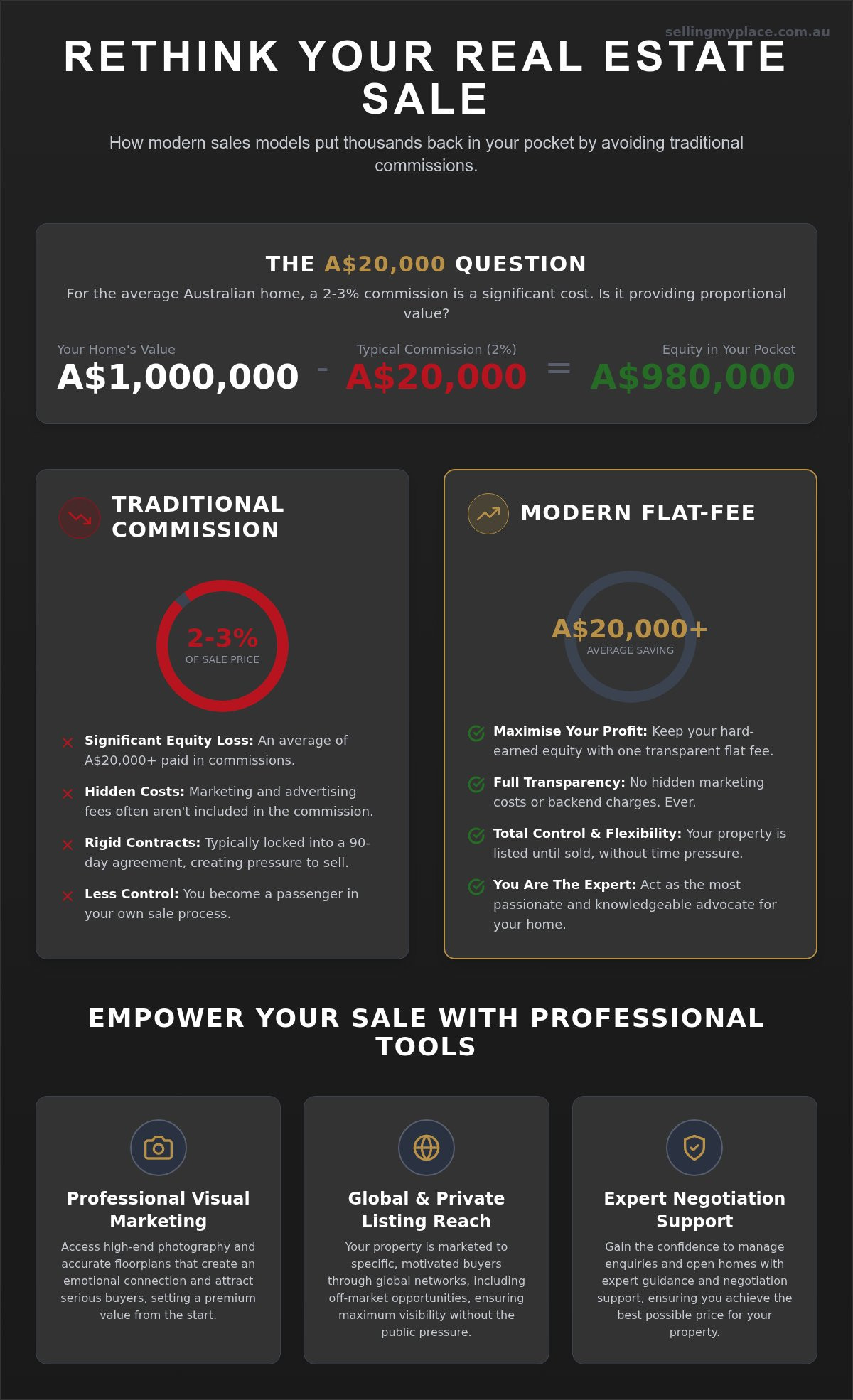
Preparing Your Property for Sale to Maximise Profit
Your home is more than bricks and mortar; it’s where your children grew up or where you’ve built your sanctuary. This emotional connection is a strength, but it can also cloud your judgement when preparing for the market. In the digital-first environment of 2026, the first ten seconds a buyer spends looking at your listing are the most critical. If the visuals don’t spark a sense of “this is the one,” they’ll keep scrolling. Success in private real estate sales australia depends on presenting a polished, aspirational lifestyle that invites buyers to see themselves in your space. This means moving beyond generic cleaning and focusing on the strategic presentation of your home’s unique story.
Expert Pre-Sale Consulting: Small Changes, Big Impact
Identifying “deal breakers” early is essential. These are the small things, like a leaky tap or a scuffed skirting board, that signal a lack of care to a potential buyer during their first inspection. Pre-sale consulting helps you focus on high-ROI improvements, ensuring you don’t over-capitalise on renovations that won’t move the needle. By centring your home’s best features through professional staging and a thoughtful layout, you create a neutral yet warm environment. Having an unbiased advisory service by your side provides the calm confidence needed to make these practical decisions without the weight of sentimentality holding you back.
Pricing Strategy: How to Determine Market Value of a Home in Australia
Setting the right price is a delicate balance of ambition and reality. In 2026, buyers are more informed than ever, and overpricing remains the most common reason properties linger on the market. To avoid this, you must use hard data rather than guesswork. We provide detailed neighbourhood market reports that show exactly what similar homes have sold for recently. This transparency allows you to justify your asking price to savvy buyers, whether you choose a “Fixed Price” or a “Price Guide” strategy. Understanding the psychology of these options helps you position your home as a fair and attractive opportunity in a competitive landscape.
Don’t forget the power of a well-crafted story. While data secures the mind, storytelling captures the heart. Your property description should highlight the “un-seeables,” like the way the morning light hits the breakfast nook or the quiet community feel of the street. This blend of professional data and personal warmth is what makes private real estate sales australia so effective. If you’re ready to see how your home measures up in the current market, our team is here to provide a tailored market report to get you started on your journey.
Taking Control: Your Journey from Listing to Settlement
Stepping into the role of your own advocate is a powerful moment. While traditional agents often claim that only they can handle the pressure of an open house, the truth is that nobody knows the heartbeat of your home better than you do. When you manage private real estate sales australia, you aren’t just showing a house; you’re sharing a lifestyle. You can point out where the kids did their homework or how the garden changes with the seasons. Handling enquiries with professional confidence comes naturally when you realise you’re simply having a conversation with another family looking for their next chapter. It’s about being prepared, being honest, and maintaining that sense of calm authority we’ve discussed throughout this guide.
Negotiation Tips for the Modern Australian Seller
Negotiation can feel like the most daunting part of the process, but it doesn’t have to be. The key is to remain objective and grounded. Remember, a buyer’s offer isn’t a critique of your home’s worth; it’s a starting point for a professional agreement. By understanding the buyer’s motivations, such as their desired settlement date or their need for a stable neighbourhood, you can close the deal more effectively. If the technical side of the conversation feels heavy, you can always lean on our Real Estate Advisory Services. Having that expert support in your corner ensures you’re never negotiating in the dark, allowing you to secure a premium price while keeping your equity intact.
The Legal Finish Line: Conveyancing and Settlement
As you approach the finish line, the focus shifts to the finer details of Australian property law. This is where professional conveyance advice becomes your most valuable asset. Ensuring all paperwork is organised and compliant is vital for a stress-free transition. During the final weeks, you’ll coordinate with your legal representative to manage the bank’s requirements and prepare for the settlement date. It’s a time of reflection and excitement. Celebrating a successful sale is even sweeter when you know you’ve navigated the process with dignity and saved upwards of A$20,000 in unnecessary fees. Once the keys are handed over, our Buyer Representation services can help you find your next sanctuary with the same level of care and expertise.
Embracing Your Future with Confidence and Equity
Choosing to take the lead in your property journey is a decision that honours both your home’s legacy and your family’s financial future. We’ve explored how private real estate sales australia have evolved into a sophisticated, professional path where you no longer have to choose between expert support and keeping your hard-earned equity. By leveraging professional photography, detailed floorplans, and a “listed until sold” approach, you place your property in the best possible light without the burden of traditional commissions. It’s about ensuring that the value you’ve built over years stays exactly where it belongs: with you.
You’ve seen that success comes from a blend of data-driven pricing and heartfelt storytelling. With a steady hand to guide you through negotiations and settlement, the process becomes a rewarding transition rather than a source of stress. It’s time to step into this new era of home ownership where you remain the primary beneficiary of your asset’s value. We’re ready to stand beside you as you move toward your next sanctuary.
Start your commission-free selling journey with Kincade International Direct Sales today and keep 100% of your sale profit while enjoying expert advisory support every step of the way. Your next chapter is waiting, and we’re here to help you reach it with absolute peace of mind.
Frequently Asked Questions
How do I list properties for sale without paying a traditional commission?
You can list your property by choosing a flat-fee marketing service like Kincade International Direct Sales. This modern approach allows you to access major property portals and global networks for a single upfront fee rather than a percentage of your final sale price. By removing the commission-based agent from the equation, you retain 100% of your equity. You’ll manage the inspections yourself while we provide the professional infrastructure to ensure your listing reaches a national audience.
What is included in a flat-fee property marketing package?
A comprehensive package provides everything you need to rival a traditional agency’s presentation. You’ll receive high-end professional photography, detailed floorplans, and neighbourhood market reports to help you price your home accurately. We also include global listing reach and a professional signpost for your property. The goal is to provide a steady hand through our Agent Advisory Service, ensuring you have expert guidance from the moment you list until the keys are handed over.
Can I really sell my own home as professionally as an agent?
You absolutely can, especially when you have the right tools and support. Most buyers today find properties online, so as long as your marketing looks professional, they don’t mind dealing with the owner directly. In fact, many buyers prefer it because you can answer specific questions about the home’s history and neighbourhood that an agent might not know. We provide the professional polish and advisory support to ensure your property stands out as a premium offering.
How much can I save by using a direct sales model in Australia?
On average, homeowners utilising the private real estate sales australia model save approximately A$20,000 per transaction. This figure is based on avoiding the standard 2% to 3% commission typically charged by traditional agencies. When you consider that you also avoid high marketing mark-ups and hidden fees, the total amount of equity you keep can be life-changing. It’s a sensible way to protect your profit and your family’s future during a major life transition.
What are off-market properties and how do I find them?
Off-market properties are homes for sale that aren’t advertised on major public portals. Sellers often choose this path for privacy or to test the market quietly. To find these opportunities, you can use our buyer representation services, which tap into private networks and direct sales databases. Accessing these listings gives you a competitive edge, allowing you to view homes and negotiate deals before the general public even knows they’re available, often leading to a more grounded transaction.
Is professional photography and a floorplan really necessary for my listing?
They are absolutely vital for securing a premium price in 2026. High-quality visuals are the first thing a buyer sees, and they set the tone for the entire sale. A clear floorplan allows buyers to mentally move into the space, which reduces tyre-kickers and attracts more serious enquiries. Without these professional elements, your property might be overlooked, even if it’s the best value in the street. First impressions are everything in a digital-first market.
How does the Agent Advisory Service support me during the sale?
Think of our Agent Advisory Service as your personal property consultant. We provide expert backing during the most complex parts of the sale, including pre-sale consulting to identify high-ROI improvements and guidance during negotiations. If you’re unsure how to handle an offer or need help with contract details, we’re here to provide a calm, grounded perspective. We ensure you feel empowered and supported from your initial listing right through to the final settlement phase.
What happens if my property doesn’t sell within a few months?
One of the biggest benefits of our model is the listed until sold policy. Unlike traditional agency agreements that often expire after 90 days, we have no time limits on your listing. This removes the pressure to accept a low offer just because a contract is ending. You can keep your property on the market for as long as it takes to find the right buyer, maintaining total control over your sale and your equity.
How Much Do You Save Selling Your Own Home? The 2026 Australian Net Profit Guide
If you sell a $900,000 property in Australia this year, you could be handing over more than $22,500 plus GST in commission alone. When you consider how much do you save selling your own home, that is a staggering amount of your family’s wealth to part with, particularly when the rising cost of living is already tightening relocation budgets. It is completely natural to feel a bit locked in by traditional agency contracts and those opaque marketing markups that seem to add up so quickly. You have worked hard to build equity in your home, and we believe you deserve to keep as much of it as possible.
The actual financial impact of shifting away from a commission-based model is often life-changing; homeowners are keeping an average of $20,000 more of their sale proceeds. This guide provides a clear financial breakdown of commission-free selling in 2026, showing you how to maintain total control over the process while still accessing professional-quality marketing. We will walk through the practical steps of reclaiming your profit, from professional photography to expert advisory support, ensuring you feel confident and protected every step of the way. Reclaiming your equity starts with understanding the real numbers behind the sale.
Key Takeaways
- Uncover the true cost of selling in 2026 and learn how to avoid the “success fee” trap that penalises you as your property value increases.
- Calculate exactly how much do you save selling your own home by exploring the dual-pronged financial benefit of cutting both commissions and marketing markups.
- Overcome the fear of achieving a lower sale price with data-driven insights into why private sales frequently match or outperform traditional agent-led outcomes.
- Learn how to access professional-grade marketing tools, including photography and floorplans, to ensure your home presents beautifully without the premium agency price tag.
- Discover the peace of mind that comes from a commission-free partnership, allowing you to maintain total control and wait for the perfect offer without pressure.
The Financial Reality: Commission vs. Flat-Fee Selling
Understanding the numbers is the first step toward feeling empowered during your property journey. In 2026, the national median commission sits at roughly 2.65% plus GST. While that might sound like a small slice of the pie, it is actually a significant tax on your equity. For a home sold at $900,000, a 2.5% commission equates to $22,500. Once you add the mandatory 10% GST, you are looking at $24,750 before you even consider marketing costs. This is where many families start asking how much do you save selling your own home, because that amount could easily fund a renovation, a new car, or a significant portion of a deposit for your next move.
We often see what we call the “Success Fee” trap. As the Australian property market grows, your commission increases even if the agent’s workload remains identical. If your property value goes up by $100,000 due to market trends, you pay thousands more in fees for the same amount of effort. It feels counterintuitive; you are effectively being penalised for the growth of your own asset. By choosing a flat-fee model, you decouple the cost of the service from the value of your legacy, ensuring the rewards of your investment stay with your family.
How Traditional Commissions Work in 2026
The alternative is a model built on transparency and partnership. Instead of a percentage-based fee that fluctuates, you pay a single upfront cost for professional results. This approach, often referred to as For Sale By Owner (FSBO), allows you to keep the lion’s share of your equity. You receive the same high-quality tools, such as professional photography and floorplans, without the variable “success fee” attached. When you are calculating how much do you save selling your own home, the clarity of this model becomes its greatest strength.
When you choose a Sale by owner strategy, you gain total clarity. You know your exact costs from day one, which reduces the stress of the unknown and lets you focus on the excitement of your next chapter. This isn’t just about cutting costs; it’s about reclaiming control over your most valuable asset with a steady hand to guide you.
Calculating the True Costs of a Property Sale
When you sit down to calculate how much do you save selling your own home, it is easy to focus solely on the commission. However, the true costs of a sale often hide within the fine print of a traditional agency’s marketing schedule. Many homeowners are surprised to learn that traditional agencies sometimes profit twice: once from the commission and again through markups on advertising spend. When you pay for a premium listing on major property portals, that cost might include an agency “service fee” or admin surcharge that doesn’t actually go toward your home’s exposure.
There are also the “hidden” extras that can quietly erode your net profit. Auctioneer fees, which typically range from $400 to $1,000, are often billed as an additional expense on top of your commission. Then come the administrative charges for “file preparation” or “compliance,” which can feel like a transactional burden during an already emotional life transition. We believe in a more grounded approach where every dollar you spend is a direct investment in your property’s future, not a contribution to an agency’s office overhead.
Marketing: Investment vs. Expense
High-quality visual storytelling is the engine that drives a premium result. In the 2026 market, professional floorplans are non-negotiable; they allow serious buyers to mentally move into your home before they even attend an inspection. By choosing a model that includes professional photography and Residential Property Listing Services without the agency markup, you ensure your marketing budget works harder for you. It’s about creating that “love at first sight” feeling for buyers while keeping your costs transparent and predictable.
The Value of Expert Advisory
Expert guidance should feel like a protective shield, not an added expense. Pre-sale property consulting can actually save you thousands by preventing costly presentation mistakes, such as over-capitalising on a kitchen refresh that won’t return its value. Similarly, having access to professional conveyance advice helps you navigate the legalities of the sale with total confidence, removing the need for a traditional agent middleman to interpret the process for you. This “steady hand” partnership reduces stress and ensures you remain in the driver’s seat of your own sale.
If you are trying to figure out the best way to balance professional quality with cost-effective results, it might be time to connect with a local expert who can help you map out your specific marketing needs.
The Net Profit Myth: Do You Really Get a Lower Price?
When considering how much do you save selling your own home, the conversation often shifts from commission savings to the final sale price. There is a persistent myth that traditional agents possess a “magic touch” that automatically translates to a higher figure. However, the reality is that a property’s value is determined by the market, not the person holding the contract. When you remove the pressure of an agent needing to meet monthly targets or “churn” a listing to move to the next commission, you regain the power to wait for the right buyer who truly values your home’s unique story.
Data from the Australian market suggests that private sales frequently match or exceed agent-led results. This is largely because owners are more invested in the outcome than any third party could ever be. You aren’t just selling bricks and mortar; you are selling a lifestyle you have lived and breathed. This passion, combined with professional-grade market data, creates a formidable advantage at the negotiating table. Protecting your equity means trusting that your intimate knowledge of the property is a tool far more powerful than a standard sales pitch.
Who is the Best Advocate for Your Home?
Buyers today are looking for more than just a floorplan. They want to know which local cafe makes the best flat white, where the quietest walking tracks are, and which neighbours have lived on the street for decades. As a “local insider,” you provide a level of authentic detail that a traditional agent simply cannot replicate. By using property sale negotiation tips, you can channel this local knowledge into a structured, professional dialogue that protects your bottom line. Armed with neighbourhood market reports, you can speak with authority on recent sales while maintaining the heartfelt warmth that makes a house feel like a home.
Strategic Pricing for Maximum Interest
Setting the right price is a delicate balance between ambition and reality. Traditional agencies sometimes fall into the trap of “overquoting” to win a listing, only to pressure the owner into a price reduction weeks later. Alternatively, they might “underquote” to create an artificial auction frenzy that doesn’t always serve the seller’s best interest. By learning how to determine market value of a home in australia, you can set a price based on hard data and local trends. This transparency builds trust with buyers and ensures that when you calculate how much do you save selling your own home, the answer includes a top-market result achieved on your own terms on your own timeline.
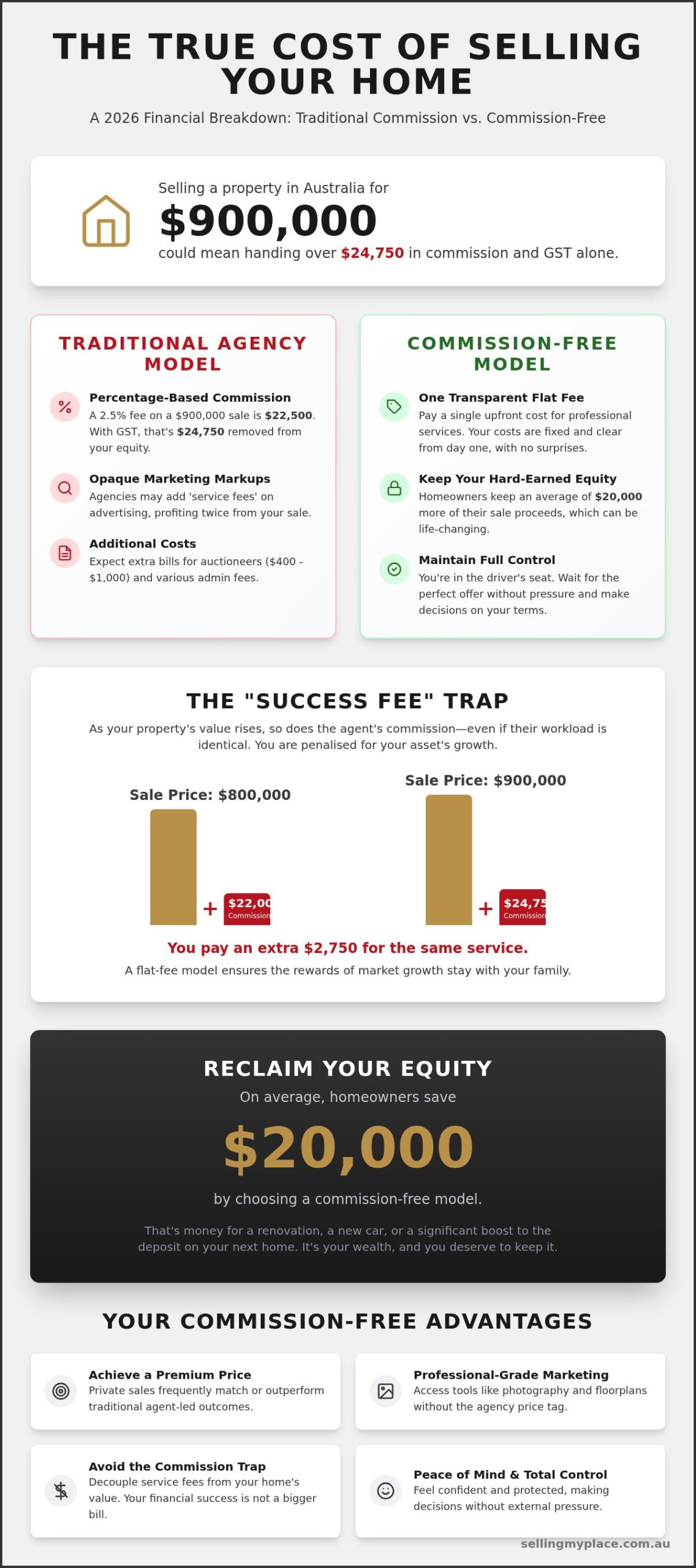
The $20,000 Saving: A Practical Breakdown
An average saving of $20,000 represents much more than just a line item on a settlement statement. It is a tangible asset that belongs in your bank account, not an agency’s revenue stream. Many Australian families ask how much do you save selling your own home because they want to know if the effort truly pays off in the long run. This saving is achieved through a dual-pronged approach: you reclaim the percentage-based commission while also avoiding the hidden markups on marketing that we explored earlier. Imagine what that $20,000 could do for your family’s transition. It might be the deposit for a new car, a significant lump sum off your next mortgage, or the budget for a high-end kitchen renovation in your new place.
One of the most overlooked advantages of this model is what we call the “No Time Limit” benefit. Traditional agents are often under pressure to “churn” listings to meet their own monthly targets, which can lead to subtle pressure on you to accept a lower offer just to get the deal done. By selling your own home, you remove that urgency. You have the luxury of waiting for the right buyer who sees the true value of your property, protecting you from the “panic discounting” that often happens when a traditional agency contract is nearing its expiry date.
Scenario Comparison: Traditional vs. KIDS Model
Applying the math to a $800,000 home sale, which is a common benchmark for many Australian suburbs, makes the benefit clear. Under a traditional model, a 2.5% commission alone takes $20,000 from your pocket before GST is even added. When you factor in the “Agent Advisory” benefit, you aren’t just saving on fees; you are often achieving a higher sale price through better pre-sale preparation and more authentic buyer engagement. The average $20,000 saving is the standard benchmark for flat-fee sellers in 2026.
Protecting Your Equity in a Shifting Market
In a fluctuating market, your “walk-away” profit is the only number that truly matters. Saving on fees is the most reliable way to boost this figure because it is a guaranteed saving, regardless of market sentiment. This $20,000 has a compounding effect on your next purchase, potentially reducing your future loan-to-value ratio and saving you thousands more in interest over the life of your next mortgage. It is about a fair go for sellers and ensuring the profit from your years of hard work remains with your family where it belongs. This “steady hand” approach ensures you are never forced into a decision that doesn’t serve your long-term legacy.
If you are ready to see how these numbers apply to your specific property and suburb, it is worth having a quiet chat about your options. Request a personalised market report to start your journey with a trusted advisor by your side.
Selling Smarter with Kincade International Direct Sales
When you look at the total financial picture and see exactly how much do you save selling your own home, the decision often becomes clear. However, we know that the emotional weight of a property sale is about more than just the numbers. It is about the memories built within those walls and the dreams you have for your next chapter. That is where our Kincade International Direct Sales (KIDS) philosophy comes in. We don’t just provide a listing tool; we offer a partnership based on professional authority and heartfelt warmth. Our “Steady Hand” approach is designed to reduce the stress of the process, giving you the confidence to lead your own sale while knowing you have a seasoned expert standing right behind you.
By leveraging our global network, we help you reach buyers far beyond your local area. This is particularly important in 2026, as buyer demographics shift and people look further afield for their next lifestyle move. Reaching these interstate or international prospects shouldn’t cost you a premium. When you calculate how much do you save selling your own home, you should also consider the value of this broader reach and the expert advisory that ensures your property is presented in its best possible light. This isn’t just about a transaction; it’s about your legacy and your family’s future stability.
Expert Backing Every Step of the Way
Our Agent Advisory Service acts as your secret weapon. It bridges the gap between a traditional agency and a purely solo endeavour, providing the professional support you need without the high marketing costs. You get the benefit of professional photography and floorplans that make your home stand out on the major portals, ensuring you capture that vital first impression. Coupled with our detailed neighbourhood market reports, you will have the hard data needed to win every negotiation. It is about empowering you with the same tools the professionals use, but without the percentage-based tax on your equity.
Start Your Commission-Free Journey Today
Moving from “thinking about it” to “listing with confidence” is a significant step. We aim to make that transition as smooth as possible. There are no dramas and no hidden fees; just a professional, transparent path to a successful sale. Our team acts as a nurturing guide through the complexities of the Australian market, ensuring you feel protected throughout the journey. Ready to keep your equity where it belongs? Contact our expert advisory team today to request your personalised neighbourhood market report and discover how simple it is to reclaim your profit.
Reclaim Your Equity and Step into Your Next Chapter
Selling a home is one of life’s most significant transitions. It is a moment that should be celebrated, not overshadowed by the stress of eroding profits or opaque agency contracts. You have seen the clear financial breakdown of how much do you save selling your own home; an average of $20,000 that stays exactly where it belongs: in your pocket. This isn’t just about cutting costs. It is about choosing a partnership that provides a professional Agent Advisory Service and high-quality marketing tools while allowing you to list until sold with no time limits or commissions.
You have the local knowledge and the passion to be your home’s best advocate. With a steady hand to guide you, you can navigate this process with total confidence and a clear focus on your family’s future stability. We’re here to ensure your hard-earned equity supports your next big move rather than someone else’s bottom line. Book your free pre-sale consultation and keep 100% of your profit today. Your legacy deserves a fair go.
Frequently Asked Questions
How much do you actually save by selling your own home in Australia?
You save an average of $20,000 on your sale proceeds by removing the traditional agent commission. When calculating how much do you save selling your own home, it is important to look at the 2.5% to 3.5% national average commission plus GST that you would otherwise pay. By choosing a flat-fee model, you keep your equity for your next move. It is a significant financial gain that allows you to reinvest in your family’s future.
Do I still need a solicitor if I sell my home privately?
Yes, you definitely still need a solicitor or conveyancer to handle the legal transfer of the property. While you manage the marketing and buyer engagement, a legal professional ensures the contract of sale and settlement are handled correctly. We provide expert conveyance advice as part of our service to help you navigate these requirements with total confidence. Having this “steady hand” support ensures the technical side of your journey is just as smooth as the marketing.
Will my property still appear on major real estate websites?
Absolutely, your property will be featured on the major real estate websites that Australian buyers use every day. We provide the digital infrastructure and global marketing network to ensure your home gets maximum exposure. This ensures you reach the widest possible audience, from local families to interstate investors, without the high marketing costs traditional agents often add. It is all about giving you the same professional reach while maintaining 100% of your sale profit.
Is it harder to negotiate with buyers without a traditional agent?
Negotiation does not have to be daunting when you are armed with the right data. Many owners find it easier to negotiate because they know the property’s value better than anyone else. By using our neighbourhood market reports and Real Estate Advisory Services, you can speak with authority on local trends. You are the best advocate for your home’s lifestyle, and having expert backing ensures you stay grounded and focused on protecting your bottom line.
What are the main risks of selling a home without an agent?
The primary risks usually involve underpricing the property or failing to present it professionally. We mitigate these risks by providing professional photography, floorplans, and comprehensive market data to ensure your home stands out. When you wonder how much do you save selling your own home, you must also factor in the value of expert advisory. Having access to pre-sale consulting prevents common mistakes, ensuring you don’t leave money on the table or encounter legal hurdles during settlement.
How do I handle property inspections and open homes myself?
Handling your own inspections is actually a great opportunity to share your home’s unique story. You can point out the best spots for a morning coffee or the quietest rooms in the house, which builds authentic trust with buyers. We suggest keeping the atmosphere welcoming and grounded. Since there are no time limits on our service, you can schedule viewings that suit your family’s lifestyle, reducing the usual stress of the selling process.
What happens if my property doesn’t sell within the first month?
If your property does not sell immediately, there is no need to panic or discount the price. Our “list until sold” philosophy means you are not pressured by the expiring contracts or monthly targets that traditional agents face. You have the freedom to wait for the right buyer who truly appreciates your home’s value. This patience often leads to a better financial result, as you are not forced into a rushed decision that does not serve your long-term goals.
Can I still get professional photography and floorplans if I sell privately?
Yes, professional photography and floorplans are essential components of our flat-fee packages. We believe that professional-quality marketing should not be a premium add-on; it is a fundamental part of achieving a top-tier price. These visual tools help you tell a compelling story and capture a buyer’s imagination from the first click. You get the same high-standard presentation as a traditional agency, ensuring your home looks beautiful while you keep your equity where it belongs.
Maximise Profit: For Sale By Owner Marketing Packages
Did you know the average homeowner can tuck an extra $20,000 back into their pocket simply by choosing to sell their property themselves? It’s a significant sum of money, especially when you consider how much heart and hard work you’ve poured into your home over the years. We understand that the thought of “going it alone” can feel a bit daunting, particularly when you’re looking at various for sale by owner marketing packages and wondering if they provide enough grunt to find the right buyer. You might even feel a natural hesitation towards traditional real estate tactics that seem to prioritise a quick commission over your family’s financial legacy.
The good news is that you don’t have to be a marketing guru to achieve a professional-grade result. This guide will show you how to leverage the right tools to secure a premium price while keeping 100% of your hard-earned equity. We’ll explore how to choose the best services, from professional photography to our signature “Sold Smarter” advisory support, ensuring you feel guided at every step. By the end of this article, you’ll know exactly how to present your home to the world with confidence and walk away from the settlement table with your full profit intact.
Key Takeaways
- Learn how the shift towards transparent, flat-fee models allows you to keep an average of $20,000 in equity that would otherwise go to agent commissions.
- Discover the essential components of high-performance for sale by owner marketing packages, including professional photography that captures a buyer’s heart at the first digital glance.
- Understand why professional floorplans are a non-negotiable tool for helping prospective buyers mentally place their own furniture and future within your home’s walls.
- Explore how a dedicated advisory service acts as your professional safety net, providing the expert guidance you need to navigate the sale with total confidence.
- Recognise how a “list until sold” philosophy removes the stress of arbitrary time limits, giving you the peace of mind to wait for the right offer.
The Evolution of Selling: Why FSBO Marketing Packages are Trending
The way we trade property in Australia has undergone a quiet revolution. For years, the traditional agency model was the only path, but today’s homeowners are looking for something more transparent. We’re seeing a massive shift toward flat-fee models that prioritise the seller’s equity over an agent’s commission. It’s about taking back the reins. Modern buyers are equally ready for this change. They’re comfortable browsing digital portals and dealing directly with the people who know the home best: you.
This transition isn’t just about saving money; it’s about the emotional significance of your property’s legacy. By using For Sale By Owner (FSBO) strategies, you’re not just a seller; you’re a steward of your own financial future. Digital platforms have levelled the playing field, allowing everyday Australians to access the same high-traffic portals as the big franchises. The key is finding that balance between maximising your profit and maintaining a professional, welcoming touch that makes a buyer feel at home.
The Problem with Traditional Commissions
A standard commission of 2% or 3% represents a massive slice of your family’s future. On a typical Australian home, that can easily equate to $20,000. Beyond the direct cost, there’s often a subtle conflict of interest. An agent might push for a quick sale to clear their books, while you want the best price. A flat-fee model provides budget certainty and ensures your equity stays with you, right where it belongs.
Empowered Selling vs. Traditional DIY
In 2026, simply popping a “For Sale” sign on the fence isn’t enough to capture a premium buyer. You need a professional framework to stand out. This is where for sale by owner marketing packages become your greatest asset. They provide the structure and high-end tools required to compete with agency listings. Having a structured plan reduces the stress of the unknown, giving you a clear roadmap from the first photo to the final handshake. Using comprehensive for sale by owner marketing packages ensures you are empowered, not overwhelmed.
What’s Inside? Deconstructing a High-Performance Marketing Bundle
Choosing to sell your own home is a brave and rewarding step, but you don’t have to do it with empty hands. High-performance for sale by owner marketing packages aren’t just a collection of digital tools; they’re a carefully curated toolkit designed to give your property the same competitive grunt as any agency listing. When you strip away the flashy suits and high commissions, what remains is the need for a professional presentation that speaks directly to a buyer’s heart. This starts with how your home appears on the screen of a smartphone, which is where almost every modern property journey begins.
Visual Storytelling for Your Property
In the digital age, your first inspection doesn’t happen at the front gate; it happens on a glass screen during a lunch break. Professional photography is your silent salesperson. By using specialised wide-angle lenses and expert lighting techniques, a professional photographer can capture the true essence of your living spaces, making them feel both spacious and inviting. High-quality professional imagery is the visual handshake that compels a buyer to stop their scroll and step inside your property’s story.
While photos grab the attention, floorplans provide the logic. They are often cited as the second most important feature of a listing. An accurate, easy-to-read floorplan allows a buyer to mentally move in, figuring out if their oversized modular sofa will fit in the lounge or if the third bedroom is right for a home office. This level of detail builds trust and reduces the “unknowns” that can stall a sale.
Strategic Intelligence and Pricing
Pricing your home correctly is perhaps the most delicate part of the process. While the legal definition of For Sale By Owner is quite simple, the market dynamics are anything but. This is why neighbourhood market reports are vital. They provide a clear, data-driven picture of what similar homes are actually selling for in your street, helping you avoid the common trap of overpricing and sitting on the market for too long.
We also believe in looking beyond the data to the physical reality of your home. This is where pre-sale property consulting adds immense value. Sometimes, a simple weekend of gardening or a fresh coat of neutral paint can add thousands to your final sale price. By identifying these high-ROI repairs early, you ensure you aren’t leaving money on the table. If you’re feeling unsure about where to start with your presentation, you might find it helpful to reach out for a quick chat about your property’s unique needs. Combining these for sale by owner marketing packages with expert advice ensures you’re not just listing a house; you’re launching a strategic campaign.
Evaluating ROI: Flat-Fee Marketing vs. Agency Commissions
When you sit down to calculate the potential return on your property sale, the “commission gap” in the Australian market is impossible to ignore. On average, homeowners who choose to sell privately are tucking an extra $20,000 back into their own pockets. This isn’t just a bit of spare change; it’s a significant sum that could fund a renovation on your next home, boost your retirement savings, or provide a head start for your children. Traditional agency agreements often feel like a one-sided deal, locking you into 90-day exclusive periods and charging a percentage of your home’s total value regardless of how much work the agent actually performs.
By contrast, professional for sale by owner marketing packages operate on a transparent, flat-fee basis. You aren’t paying for a flashy office or a branded car; you’re investing in the high-grade tools that actually drive buyer interest. One of the most significant advantages of this model is the “List Until Sold” philosophy. Unlike traditional agents who might lose interest if a property doesn’t move within their initial 90-day window, a flat-fee partnership ensures your listing remains active and supported until the right buyer walks through the door. This removes the ticking-clock pressure that often leads to underselling.
Calculating Your Net Profit
It’s a common misconception that a higher sale price always equals a better result. In reality, the only number that truly matters is what you have “net in pocket” after all costs are settled. If an agent sells your home for slightly more but takes a $25,000 commission plus $5,000 in high marketing costs, you might actually end up worse off than if you had sold it yourself. High-quality for sale by owner marketing packages should be viewed as a strategic investment. For instance, data shows that professional photography can increase online interest by 30%, which directly translates to more inspections and better offers.
The Safety Net of Expert Advisory
We know that many people worry about the challenges of selling a home without an agent, such as handling tricky negotiations or navigating complex contracts. This is why a modern marketing bundle must include more than just a digital ad. Having access to a dedicated Agent Advisory Service provides a professional safety net that protects your interests. These experts act as a steady hand, guiding you through the procedural pitfalls and legal requirements of a private sale. You get the benefit of professional authority and heartfelt support without the heavy price tag of a commission-based agent.
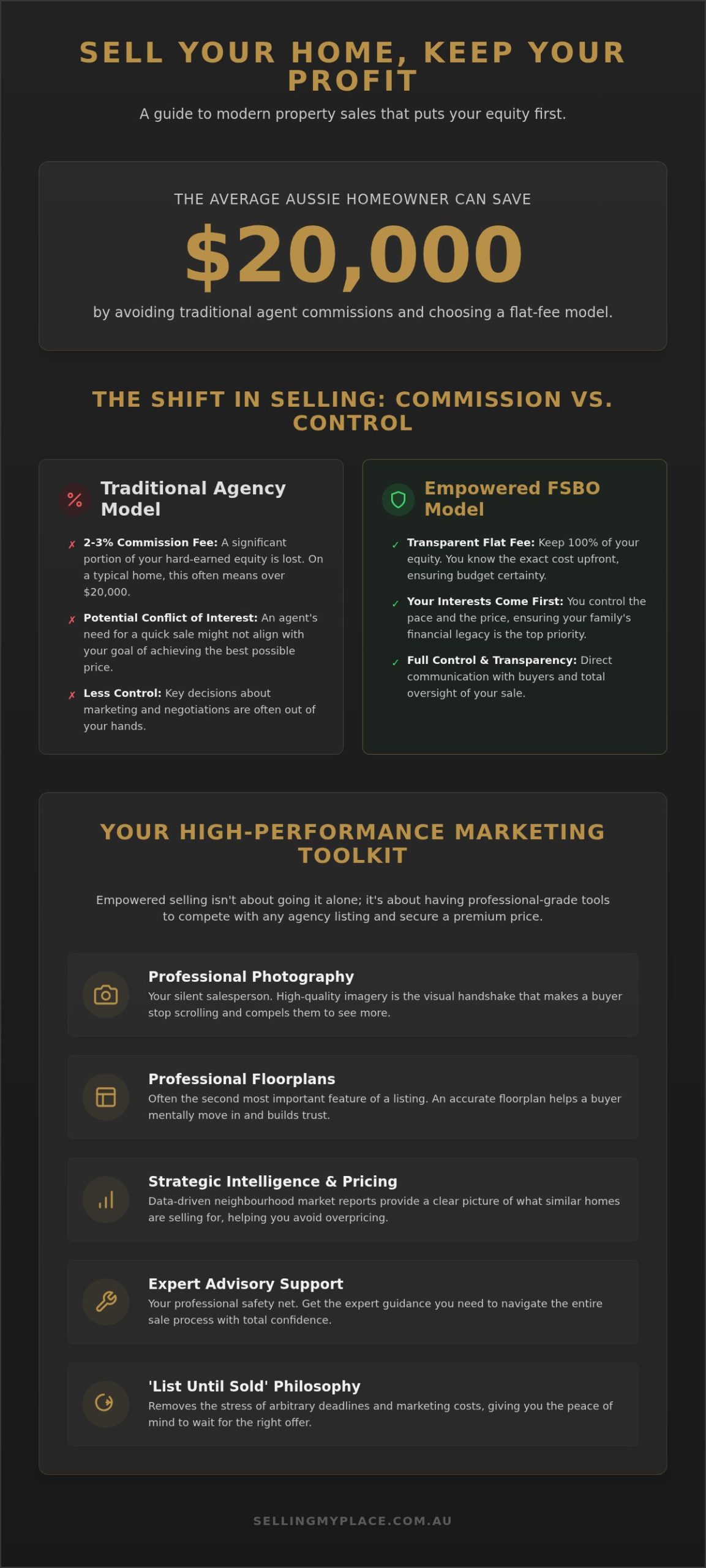
How to Choose the Perfect Marketing Package for Your Home
Selecting the right tools for your property sale isn’t a one-size-fits-all decision. A cozy unit in a quiet suburban street requires a different strategy than a sprawling rural lifestyle block. When evaluating for sale by owner marketing packages, you need to look past the flashy website and focus on the specific needs of your property. Does the package give you access to Australia’s leading property portals? Without these major websites, you’re fishing in a much smaller pond, and you risk missing out on the perfect buyer who is currently scrolling through their morning property alerts.
Matching Features to Your Selling Style
If you’re selling a standard residential home, a basic listing might be enough to get the job done. However, if your property has unique features or sits at a higher price point, a more comprehensive advisory package becomes essential. You’ll want a partner who offers global network reach to capture interest from beyond your local area. It’s also vital to find a package that includes pathways for conveyance and legal guidance. This ensures that once you’ve found your buyer, the paperwork flows as smoothly as the initial inspection.
- Verify the quality: Ensure the photography and floorplans are industry-standard and high-resolution.
- Check for longevity: Look for a “List Until Sold” guarantee to avoid annoying re-listing fees if the market takes a breath.
- Human connection: Confirm there’s a real person, a dedicated expert advisor, you can call for a chat when things get technical.
Red Flags to Avoid in FSBO Packages
While many for sale by owner marketing packages look similar on the surface, the devil is in the detail. Beware of services that try to lock you into monthly fees or set arbitrary time limits on your listing. These hidden costs can quickly erode the savings you’re trying to protect. Low-quality, non-professional photos are another major warning sign. As we’ve discussed, your digital presentation is your visual handshake; if it looks amateur, buyers will assume the sale process will be too. Finally, avoid any service that doesn’t offer a dedicated advisory point of contact. You don’t want to be left talking to a chatbot when you’re trying to navigate a complex negotiation.
Choosing the right support is about feeling empowered and protected throughout one of life’s biggest transitions. If you’re ready to see how a tailored approach can work for your specific home, contact our team for a friendly consultation today. We’re here to help you sell smarter and keep your equity where it belongs.
Selling Smarter: The Kincade International Partnership
At Kincade International Direct Sales (KIDS), we don’t believe that selling your own home should mean settling for less. While many view private sales as a budget DIY option, our for sale by owner marketing packages are built on a different premise entirely. We provide the professional authority and heartfelt support needed to achieve a result that rivals, or even surpasses, traditional agency outcomes. It’s a “steady hand” approach designed to reduce the stress of major life transitions while keeping your profit exactly where it belongs: in your own pocket. By removing the 0% commission structure, we ensure your hard-earned equity stays with your family.
This partnership is about more than just visibility; it’s about giving you the same competitive grunt as the big franchises without the high marketing costs. Our global marketing network gives you an unfair advantage by reaching buyers far beyond your local suburb. Whether they are across the country or overseas, we ensure your property is seen by those who truly value it. This expansive reach, combined with our professional-casual register, makes the process feel both personal and powerful.
Beyond the Listing: Our Agent Advisory Service
Our Agent Advisory Service is the heartbeat of this partnership. It goes well beyond simply ticking boxes on a website. Our pre-sale consulting helps you see your home through the eyes of a buyer, identifying the small touches that create a lasting emotional connection. Regarding the representation of your interests, our advisors act as your professional backbone, ensuring you have the confidence to negotiate from a position of strength. Our partnership model is a far cry from a simple listing site; it’s a collaborative journey where we provide the expert scaffolding for your personal success.
Getting Started with Confidence
Taking the first step is surprisingly simple. Our onboarding process is designed to be methodical and inviting, mirroring a thoughtful consultation rather than a rushed transaction. You’ll be guided through the setup of your property on our global platform, knowing that our “List Until Sold” policy has your back. This guarantee means you can breathe easy, knowing there are no arbitrary deadlines or mounting re-listing fees to worry about. For a deeper look at how this fits into the broader market, you might enjoy reading our Professional Residential Property Listing Services: The Modern Australian Seller’s Guide. We’re here to ensure you feel understood, supported, and ultimately, celebrated as you move into your next chapter. Using our for sale by owner marketing packages means you are never alone in the process.
Your Path to a Profitable Private Sale
Selling your home is more than a transaction; it’s the start of your next big adventure. We’ve explored how the right for sale by owner marketing packages do more than just list a property; they empower you with professional photography, accurate floorplans, and the strategic intelligence needed to find the perfect buyer. By stepping away from traditional commissions, you aren’t just saving money; you’re actively protecting your family’s financial legacy and ensuring your equity stays right where it belongs.
With an average saving of $20,000 in commissions, the choice to sell privately is a powerful financial decision. You don’t have to navigate the technical side alone, either. Our expert Agent Advisory Service acts as your professional safety net, while our “listed until sold” policy ensures there’s never a ticking clock hanging over your head. You have the time, the tools, and the expert backing to achieve a professional-grade result on your own terms. Ready to take the next step towards your future? Discover the Sold Smarter difference with our flat-fee marketing packages and see how we can support your journey. You’ve worked hard for your home; now it’s time to make sure that hard work pays off for you.
Frequently Asked Questions
Are for sale by owner marketing packages really as effective as using an agent?
Absolutely. When you use high-quality for sale by owner marketing packages, you gain access to the same digital infrastructure and global networks as traditional agencies. The difference is that you control the narrative and keep the profit. With professional photography and our Agent Advisory Service, your listing carries the same weight and authority as any franchise, often attracting more genuine interest because you know the home’s unique history best.
Do I need professional photography if I have a high-end smartphone?
While modern phones are impressive, they can’t replicate the impact of professional property photography. Expert photographers use wide-angle lenses and specialised lighting to make rooms feel spacious and inviting. Data from the National Association of Realtors (NAR) shows that professional photos can increase online interest by 30%. In a digital-first market, these images are the essential hook that stops a buyer from scrolling past your home.
What happens if my property doesn’t sell within three months?
Unlike traditional agency agreements that often expire after 90 days, we provide a “List Until Sold” guarantee. This means there are no arbitrary time limits or stressful deadlines hanging over your head. Your property remains active on all major portals until the right buyer is found. This policy gives you the peace of mind to wait for an offer that truly reflects your home’s value without the fear of mounting re-listing fees.
Can I list my home on Australia’s major property portals without a traditional agent?
Yes, you certainly can. Our digital infrastructure provides the necessary bridge to list your property on the nation’s leading real estate websites. These platforms are typically restricted to licensed entities, but by partnering with us, you gain full access to their massive audience. This ensures your home is seen by millions of active buyers while you maintain 100% control over the sale process and your hard-earned equity.
How do I handle the legal contracts and conveyance when selling privately?
Navigating the legal side is often the biggest concern for private sellers, which is why we include dedicated conveyance advice and real estate advisory services. We act as your professional safety net, guiding you through the contract requirements and procedural steps. You’ll have access to expert advisors who understand the national legal landscape, ensuring that your paperwork is handled correctly and your transition to a new home is as smooth as possible.
Is it possible to include buyer representation in my marketing package?
Yes, buyer representation is a core part of our service offering. Selling your home is often just one half of the journey; finding your next property is the other. We can assist you in identifying and securing your next residence, ensuring you have professional support on both sides of the settlement. This holistic approach reduces the stress of moving and helps you transition into your new lifestyle with total confidence.
What is the average saving when using a flat-fee marketing service in Australia?
Australian homeowners save an average of $20,000 by choosing a flat-fee model over traditional commission-based agents. This significant sum is reclaimed from what would otherwise be spent on agency commissions and high marketing costs. By opting for a transparent fee structure, you protect your hard-earned equity, allowing you to put those funds towards your next mortgage, a well-deserved renovation, or your family’s future financial security and stability.
How do neighbourhood market reports help me set the right price?
Setting an accurate price is vital for a successful sale, and neighbourhood market reports provide the data-driven clarity you need. These reports show you exactly what similar properties in your area have actually sold for, rather than just their listing prices. By understanding local demand and buyer signals, you can avoid the trap of overpricing and ensure your home attracts serious offers from the very first day it goes live on the market.
List Your Home for Private Sale: 2026 Australian Guide
What if you could hand over the keys to your family home without handing over a $20,000 cheque to an agent at the same time? With the national median dwelling value sitting at $912,885 in late 2026, that’s a massive amount of hard-earned equity to lose just for a few weekend inspections. Learning how to list your home for sale by owner isn’t about cutting corners; it’s about taking the driver’s seat in one of your life’s most significant transitions. We know the traditional sales process often feels like a bit of a black box where transparency is thin and the fees are thick. It’s completely natural to feel protective of your profit, especially when you’ve spent years building a legacy within those four walls.
This guide is designed to give you the calm confidence you need to manage your own sale successfully while ensuring you maintain a professional market presence. We’ll walk you through the essential 2026 legal requirements, show you how to craft a high-impact marketing campaign, and explain the exact steps to secure a premium price without the commission sting. You’ll discover that with the right partnership and a steady hand, keeping 100% of your sale price is not only possible but remarkably rewarding.
Key Takeaways
- Protect your hard-earned equity by bypassing traditional agent commissions, ensuring you keep 100% of the profit from your sale.
- Learn why professional-grade photography and floorplans are essential for creating a polished, trustworthy market presence that attracts premium buyers.
- Remove the guesswork from your asking price by using detailed Neighbourhood Market Reports to make informed, data-driven decisions.
- Follow clear, step-by-step instructions on how to list your home for sale by owner to gain maximum exposure on Australia’s major property portals.
- Discover how a partnership-based advisory service provides the professional guidance you need to navigate contracts and negotiations with total confidence.
The Rise of Commission-Free Selling in Australia
The Australian property market in late 2026 has entered a more contemplative phase. As we move through a broader national correction, homeowners are becoming increasingly protective of their hard-earned equity. It’s no longer just about the final sale price; it’s about what you actually walk away with once the dust settles. Many families are realising that the traditional 1.8% to 3% commission model, plus GST, often feels out of step with the effort required in a digital-first world. When you consider that a standard commission on a median-priced home can easily exceed $20,000, it’s easy to see why the For Sale By Owner (FSBO) movement has gained such significant momentum across the country.
This shift isn’t just about the bottom line, though that’s a massive part of the appeal. It’s about empowerment. Modern technology has democratised the selling process, allowing you to reach the same massive audience as a high-street agency without the high-street price tag. If you’ve been wondering how to list your home for sale by owner, you’re part of a growing group of Australians choosing a smarter, more transparent path that puts you in control of your own transition.
Why Homeowners are Choosing the Flat-Fee Model
Selling a home is a deeply personal journey. Many owners now prefer to hold the reins themselves. By choosing a flat-fee approach, you gain complete control over your home’s narrative. You know your property better than anyone; you know where the light hits the floorboards in winter and which local park has the best coffee cart. This model replaces high-pressure tactics with a calm, expert-supported framework. It’s a partnership that values your local knowledge while providing the professional infrastructure needed to succeed. You aren’t doing this alone; you’re simply doing it without the unnecessary middleman.
The Real Cost of Traditional Real Estate Commissions
The financial impact of a traditional commission is often more substantial than it appears on a single-page agreement. In regional areas or certain states, commissions frequently climb toward 3%. Once you add the mandatory 10% GST, that figure becomes a significant hurdle. This is money that could be your next deposit, a retirement nest egg, or a renovation fund for your new place. Preserving this equity is vital in a fluctuating market. A flat-fee model is a fixed-cost professional service that provides all the essential marketing tools for one clear, upfront price. By removing the variable commission, you ensure that every extra dollar a buyer offers goes straight into your pocket. Understanding how to list your home for sale by owner effectively means you can bypass these drains on your profit while still appearing just as professional as any other listing on the market.
Preparing Your Property for a Professional Listing
Your home is likely your most valuable asset. It is also a collection of memories. When you decide to sell privately, the first step is shifting your perspective from homeowner to seller. This transition requires a level of presentation that matches the high standards buyers expect from premium agencies. When considering how to list your home for sale by owner, remember that your online listing is often the only chance you get to make a first impression. In the digital-first market of 2026, your property needs to stand out instantly against a sea of competing tiles on a smartphone screen.
The Importance of High-End Visual Marketing
Professional photography is no longer an optional extra; it is a baseline requirement for a successful sale. High-quality, wide-angle images captured during the “golden hour” can significantly increase the number of clicks your listing receives compared to amateur snapshots. These images tell a story of light, space, and lifestyle that draws buyers in emotionally. Alongside photos, professional floorplans are a vital psychological tool. They allow a potential buyer to walk through the house in their mind, measuring where their furniture might sit or how the kitchen flows into the outdoor entertaining area. This level of detail helps filter out tyre-kickers, ensuring that the people who book an inspection are already seriously considering your property as their future home.
Staging and Presentation Tips for Australian Homes
Staging your home isn’t about hiding its character, it is about highlighting its potential. You want to create a blank canvas that allows buyers to visualise their own lives unfolding within your walls. Start with a thorough decluttering and depersonalising process. Removing excess furniture and family photos makes rooms feel larger and more inviting. Don’t forget the power of kerb appeal; a freshly painted front fence, a tidy garden, and a clean driveway set a positive tone before a buyer even steps inside.
Maximising natural light is perhaps the simplest way to enhance your professional photos. Open every blind, trim back any overgrown bushes near windows, and use neutral colours to make spaces feel airy and bright. If you find yourself feeling a little stuck on where to start, a quick chat about pre-sale property consulting can provide the professional eye needed to prioritise the right improvements. By focusing on these high-impact areas, you ensure your property is market-ready and capable of attracting a premium price.
Pricing Your Property: Data-Driven Decisions
Pricing a home is often the most emotionally charged part of the entire sales process. It’s where the years of memories, weekend renovations, and late-night gardening sessions meet the cold reality of a spreadsheet. While it’s tempting to set a price based on what you need for your next deposit, the market in late 2026 is driven by data rather than sentiment. With the national median dwelling value sitting at $912,885, buyers are more cautious and informed than ever. Understanding how to list your home for sale by owner effectively starts with a grounded, realistic assessment of what a buyer is actually willing to pay in the current climate.
We are currently seeing a significant divergence in performance across different Australian markets. While some capital city areas have entered a correction phase, other high-demand pockets and regional hubs continue to test record highs. This means you cannot rely on national headlines to price your specific property. You need to look at what has sold within a two-kilometre radius of your front door in the last ninety days. These “comparables” are the same figures a bank valuer will use when your buyer applies for finance, so aligning with them early ensures a smoother path to settlement.
Utilising Professional Market Reports
A Neighbourhood Market Report is your most powerful tool for removing guesswork. These reports provide a comprehensive property value estimate by analysing recent sales, current listings, and local demand. It’s vital to distinguish between a basic automated valuation, which might miss your brand-new kitchen or solar array, and a professional appraisal that considers the unique features of your home. If you want to dive deeper into the mechanics of pricing, you can learn more about how to determine market value of a home in australia to ensure your starting point is rock solid.
Adjusting Your Strategy Based on Buyer Feedback
In the three months leading up to July 2026, the national median time a property spent on the market was 35 days. This timeframe is your barometer for success. The first two weeks of your listing are the most critical; this is when “new listing” alerts hit thousands of phones. If you aren’t receiving enquiries or seeing foot traffic at your inspections during this window, the market is sending you a clear signal. Recognising the need for a subtle price tweak early is a sign of strength, not defeat. It shows you’re a proactive seller who is in tune with buyer demand, allowing you to maintain momentum rather than letting your listing go stale. When you know how to list your home for sale by owner with a flexible, data-backed strategy, you remain the one in control of the negotiation.
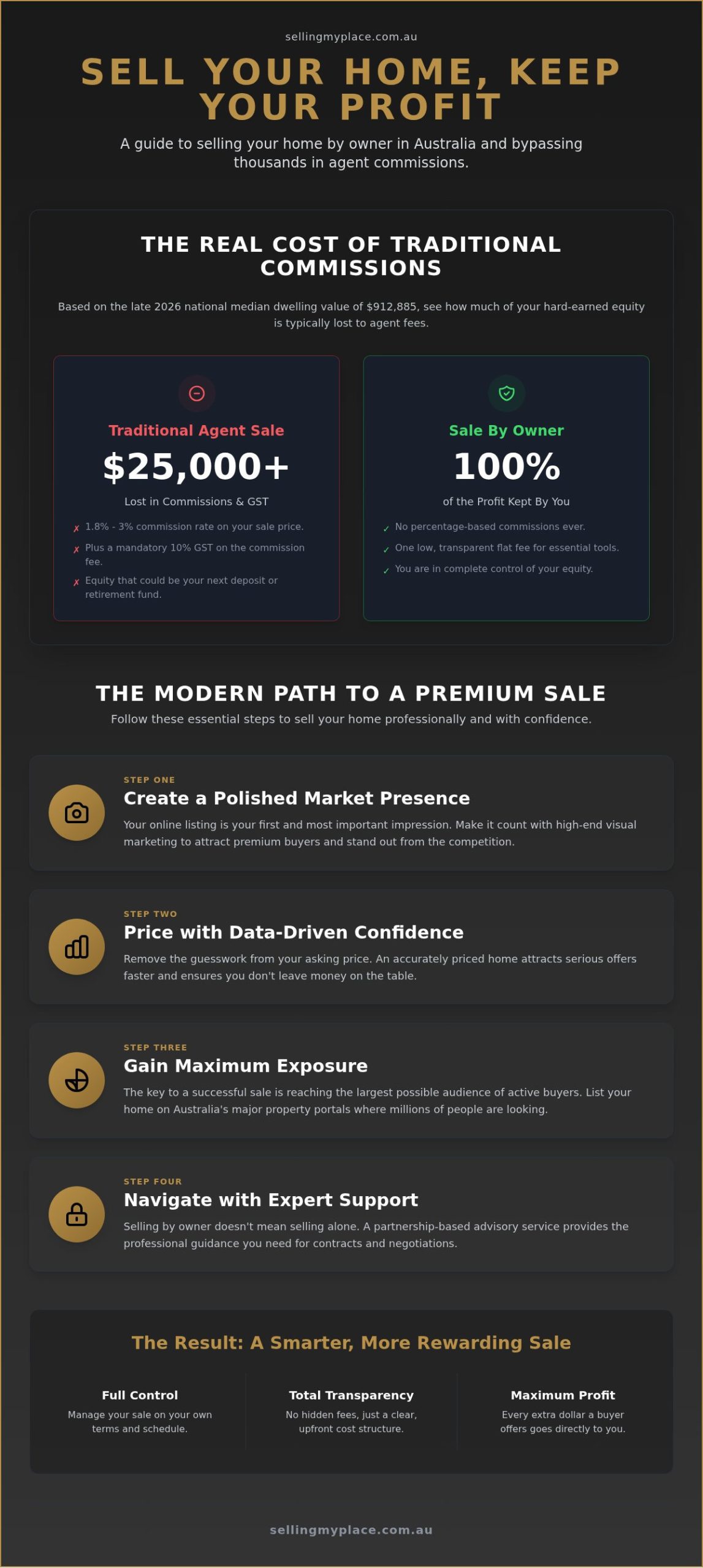
The Listing Process: Getting Onto Major Portals
Once your home is staged and your price point is backed by solid data, the technical phase of your journey begins. While social media groups can offer a bit of local buzz, they simply don’t have the reach needed to find a premium buyer. To get the best result, your property must appear where 90% of buyers start their search: on the national property portals. Learning how to list your home for sale by owner effectively means understanding that these major sites don’t actually allow private individuals to list directly; you need a licensed partner to bridge that gap and provide the professional visibility your home deserves.
Accessing National Marketing Infrastructure
Flat-fee services provide the digital bridge you need to get your property in front of millions of active searchers. This isn’t just about a single upload. It’s about a professional ecosystem that supports your listing until the “Sold” sticker is finally applied. One of the greatest benefits of this modern approach is the “List Until Sold” feature, which removes the ticking-clock pressure often felt with traditional 90-day agency agreements. When you discover how to list your home for sale by owner with the right technical support, you realise that the exposure sells the house, not the commission. If you want a deeper look at the logistics, our guide on Sale by owner breaks down the timeline from your first photo to the final handshake.
Managing the enquiries that follow is often the most rewarding part of the process. You’ll receive emails and calls directly, allowing you to speak with genuine passion about your home’s history and the local community. Organising inspections becomes a simple matter of checking your own calendar, ensuring you aren’t rushing to tidy up for a last-minute agent walkthrough. You are the expert on your own lifestyle, and buyers often find this direct honesty incredibly refreshing.
Legal Steps and Conveyance Advice
While the marketing is your domain, the legal framework is where you need a steady, professional hand. Every state and territory has its own specific rules regarding documentation; some regions require a vendor statement to be ready immediately, while others mandate a formal Contract for Sale before any advertising begins. Engaging a solicitor or conveyancer early is a non-negotiable step for a smooth settlement. This ensures that when the right offer arrives, you are legally prepared to move forward without delay. If you feel uncertain about the finer points of the contract or how to handle a complex negotiation, you can always contact our advisory team for expert support. Having professional Real Estate Advisory Services tucked in your back pocket gives you the calm confidence to navigate the final stages of your sale with ease.
Selling Smarter with Kincade International Direct Sales
Kincade International Direct Sales (KIDS) represents a thoughtful evolution in the Australian property market. We believe that the equity you’ve built in your home belongs to you, not an agency. Discovering how to list your home for sale by owner shouldn’t feel like a lonely endeavour; it should feel like a supported professional transition. Our model is built on a simple partnership: you remain the boss of your sale, while we provide the high-end tools and global marketing network usually reserved for traditional agencies. It’s a “steady hand” approach that balances the seriousness of a high-stakes transaction with the warmth of a neighborly guide who truly understands your local area.
The KIDS advantage starts with a digital infrastructure that places your local home on a global stage. We ensure your listing doesn’t just exist online but thrives there. By including professional photography and floorplans in our packages, we make your property look like a million-dollar listing from the moment it goes live. These aren’t just pretty pictures; they are essential assets that build trust with buyers and justify your premium asking price. When you choose how to list your home for sale by owner through our tiered packages, you’re investing in a sophisticated marketing campaign that preserves your profit while maintaining a polished, authoritative market presence.
Expert Backing Every Step of the Way
While you handle the inspections and the heart-to-heart conversations with buyers, our Agent Advisory Service acts as your secret weapon in the background. Our pre-sale consulting helps you identify the small, high-impact changes that maximise your final sale price before you even take the first photo. This professional real estate advisory provides a grounded sense of calm, especially when it comes to the complexities of contracts and negotiations. We also offer buyer representation to help you transition smoothly into your next chapter, ensuring your entire journey, from selling the old home to finding the new one, is handled with care and competence.
Taking the Next Step Toward a Commission-Free Sale
As we move through 2026, there has never been a better time to take control of your property legacy. By choosing a flat-fee model, you aren’t just saving an average of $20,000 in commissions; you’re choosing a more transparent and empowering way to move house. You get to keep 100% of your hard-earned profit while enjoying the peace of mind that comes with expert support and a global reach. It is a smarter, more modern way to sell that puts your family’s needs first. Ready to save your commission? Explore our professional listing packages today.
Your Path to a Successful, Commission-Free Sale
Taking the reins of your property sale is a significant step toward securing your financial future. By focusing on professional presentation and data-driven pricing, you ensure your home stands out for all the right reasons. You’ve now seen that learning how to list your home for sale by owner isn’t just about avoiding fees; it’s about being the most passionate advocate for your own property while backed by expert tools. With average seller savings of $20,000, that extra equity can make a world of difference as you transition to your next chapter.
You don’t have to navigate the technicalities alone. Our partnership-based approach provides everything from professional photography and floorplans to a dedicated Agent Advisory Service, giving you the calm confidence of a seasoned expert. It’s time to move forward with a sale that values your legacy as much as you do. Start your commission-free journey with Kincade International Direct Sales and discover how rewarding a private sale can be when you have a steady hand to guide you.
Frequently Asked Questions
Can I really list my home on major websites without a traditional agent?
Yes, you can certainly reach the same massive audience as any traditional agency. While major portals like realestate.com.au don’t allow direct individual uploads, Kincade International Direct Sales acts as your licensed partner to bridge this gap. This ensures your property appears alongside every other listing in the country, providing the professional visibility you need to attract serious buyers while you remain in total control of the process.
How much can I actually save by listing my home for sale by owner?
On average, homeowners save approximately $20,000 by choosing to sell privately rather than paying a traditional commission. With capital city commissions in late 2026 often ranging between 1.8% and 3% plus GST, the financial impact of skipping the middleman is substantial. By utilising a flat-fee model, you preserve your hard-earned equity, allowing those funds to go toward your next deposit or retirement instead of an agent’s pocket.
Do I need a lawyer or conveyancer if I sell the house myself?
Engaging a solicitor or conveyancer is a legal requirement for all property sales in Australia. While you handle the marketing and inspections, these professionals manage the critical legal documents, including the Contract of Sale and state-specific disclosure statements. Having your paperwork ready before you learn how to list your home for sale by owner ensures a smooth, legally sound settlement that protects both you and the buyer during the transition.
Will buyers be put off by a private sale listing?
No, buyers are primarily interested in the property itself rather than who is holding the open house. In fact, many people find it refreshing to speak directly with the owner, who can provide authentic insights into the home’s history and the local community. As long as your listing features professional photography and floorplans, it will be indistinguishable from an agency listing, projecting the same level of authority and trust.
What happens if my home doesn’t sell within the first month?
One of the greatest benefits of our model is the “List Until Sold” guarantee, which removes the ticking-clock pressure of a standard 90-day agreement. If your home hasn’t sold within the first month, it simply stays live on the major portals at no extra cost. This gives you the breathing room to review your strategy or adjust your price point based on buyer feedback without the fear of your listing expiring.
How do I handle the negotiation process without an agent?
Negotiating directly with buyers is often more straightforward than people expect. It’s about having a clear, data-backed understanding of your home’s value and staying grounded during the discussion. You can use our Neighbourhood Market Reports to justify your price and rely on our Agent Advisory Service for expert guidance if things get complex. Remember, you aren’t alone; you have professional support to help you secure a premium result with confidence.
Is professional photography really worth the extra effort for a private sale?
High-end visual marketing is absolutely essential if you want to achieve a premium sale price. Professional photography captures your home in its best light, highlighting space and character in a way that smartphone snapshots simply can’t match. When you’re figuring out how to list your home for sale by owner, remember that these images are your primary tool for generating enquiries and filtering out tyre-kickers before they even arrive.
What is an Agent Advisory Service and how does it help me?
Our Agent Advisory Service is a dedicated support system designed to give you the confidence of a seasoned professional. It provides expert pre-sale consulting, helping you maximise your profit through strategic improvements and market insights. Whether you need advice on handling an offer or navigating the contract phase, our advisors act as a steady hand, ensuring you feel empowered and protected throughout the entire sales journey while you remain the boss.
Private House Sales Australia: Maximise 2026 Profit
What if the $20,000 you’re planning to pay in agent commissions stayed exactly where it belongs, in your own bank account? As we move through 2026, many Aussie homeowners are realising that the traditional way of selling isn’t the only path to a premium result. While the national median commission rate currently sits at 2.65%, choosing private house sales australia allows you to bypass those hefty fees without sacrificing the professional polish your property deserves. It’s about taking back control of your equity while ensuring your home stands out on the major portals alongside the biggest agencies.
We understand that the thought of managing legal paperwork or negotiating a high-stakes sale can feel a bit daunting, especially when your family’s legacy is on the line. It’s completely natural to feel a flutter of anxiety about the technical side of listing or whether you’ll attract the right price. This guide shows you how to sell your property privately with total confidence, providing the expert advisory support and professional marketing tools you need to compete. You’ll discover how to navigate the settlement process smoothly and ensure you retain every cent of your hard-earned profit.
Key Takeaways
- Learn how transitioning to a flat-fee model can save you an average of $20,000 by removing traditional agent commissions from the equation.
- Discover how private house sales australia have evolved into a sophisticated “Direct Sale” strategy that empowers you to retain 100% of your property’s equity.
- Understand the essential steps for professional preparation, from high-quality photography to global marketing, ensuring your home competes with agency listings.
- Gain confidence in navigating the legal landscape with expert conveyance advice and advisory support that acts as your safety net throughout the sale.
- Explore the “listed until sold” advantage, which offers you the peace of mind to wait for the right buyer without the stress of arbitrary time limits.
The Evolution of Private House Sales in Australia
The landscape of property in Australia is changing. It’s no longer just about the “sold” sticker; it’s about how you get there. In 2026, private house sales australia have transitioned into a sophisticated “Direct Sale” model. This isn’t just a way to save a few dollars; it’s an evolution in how we value our homes and our time. Selling a family home carries immense emotional weight. It’s the place where memories were made and futures were planned. Naturally, you want more control over that transition and the equity you have built over the years.
The traditional high-commission agency model is facing a quiet revolution. Homeowners are realising that “selling smarter” doesn’t mean “selling cheaper” or cutting corners. By adopting a modern approach to the For Sale By Owner process, you can maintain professional standards while keeping your hard-earned profit intact. It’s a partnership where you lead the way, supported by expert advisory services that provide a steady hand during the negotiation and settlement phases. You aren’t just bypassing a middleman; you’re taking charge of your financial legacy.
Why Australian Homeowners are Choosing Direct Sales
Rising property values have inadvertently inflated traditional commission costs to eye-watering levels. With the national median commission rate sitting around 2.65% in 2026, a percentage-based fee feels less like a service charge and more like a tax on your home’s growth. Digital marketing tools that were once tucked away in agent-only portals are now accessible to everyone. This transparency allows for a direct, honest connection between you and the buyer. You know your home’s story better than anyone else, so why not be the one to tell it? Many families find that this direct interaction builds genuine trust and leads to a smoother, more personal exchange.
Debunking the “Agent-Only” Myth
When considering private house sales australia, there’s a common misconception that only traditional agents hold the keys to major buyer pools. That simply isn’t the case in today’s market. Professional marketing packages, including high-end photography and detailed floorplans, ensure your listing looks indistinguishable from agency-led properties on the major portals. This levels the playing field, allowing your home’s unique charm to shine through without the filter of a third party.
- Global Reach: Your property isn’t just seen by locals; it’s visible to international buyers searching for Australian lifestyle investments through global marketing networks.
- Professional Polish: High-quality visuals and professional-grade floorplans remove any “DIY” feel, projecting confidence and reliability to potential buyers.
- Expert Safety Net: Specialist advisory services replace the traditional agent’s role, guiding you through complex paperwork and negotiation tactics with calm authority.
By choosing this path, you aren’t going it alone. You’re simply choosing a more efficient, respectful way to move on to your next adventure. It’s about ensuring your hard-earned equity stays where it can best support your family’s future, rather than being lost to high marketing costs and commissions.
How to Organise a Successful Private Sale
Successful private house sales australia are built on a foundation of meticulous planning rather than a rushed weekend listing. The journey from valuation to settlement is a series of purposeful steps that require both a logical mind and a warm heart. Pricing your home correctly is the single most important decision you’ll make. It’s about finding that “sweet spot” where your property’s value meets the market’s appetite. To do this effectively, you should rely on detailed Neighborhood Market Reports rather than guesswork. Data from the Real Estate Institute of Australia suggests that buyers in 2026 are more informed than ever, making transparency and accuracy your best tools for a swift result.
Preparing Your Property for the Market
A “DIY” label can be a hurdle for a premium price, which is why professional preparation is your greatest ally. Think of your home as a product that needs a polished launch. Pre-sale property consulting is a wise first step; it helps you identify which small repairs will offer the highest return on investment and which ones you can safely skip. Professional photography and high-quality floorplans are absolutely non-negotiable. In the digital age, these assets serve as your home’s “first inspection” for thousands of potential buyers. You aren’t just selling bricks and mortar; you’re inviting someone to envision their own future within your walls. Creating an inviting, neutral atmosphere allows buyers to see the sanctuary your home provides rather than just a list of features.
Managing Enquiries and Inspections
Once your listing is live, managing the influx of interest requires a steady hand and a welcoming demeanour. You’ll need a digital infrastructure to track enquiries and vet potential buyers before they step through your front door. Hosting an open home is your chance to shine as a local expert. Be prepared to answer questions about the neighbourhood, the local schools, and the best coffee spots with a personal touch that a traditional agent might lack. If a question feels a bit technical or a negotiation becomes intense, having access to a dedicated advisory service provides the safety net you need. They can guide you through the “tough talk” with professional authority, ensuring you don’t feel overwhelmed by the process. If you’re feeling ready to take that first step, you can always reach out for a chat about your property’s potential.
The final phase, from contract exchange to settlement, is where the technical details really matter. This is the time to lean on expert conveyance advice to ensure every legal requirement is met and your interests are protected. By maintaining a professional standard from day one, you ensure that the transition to the new owners is as smooth and respectful as the years you spent in the home yourself.
The Financial Logic: Commission-Free vs. Traditional Fees
Selling your home is a major life milestone, but the financial side can often feel like a series of subtractions from your hard-earned equity. When you look at the numbers, the traditional commission model can be quite staggering. With the national median commission rate sitting at 2.65% in 2026, a homeowner selling a property for $1,000,000 is looking at a fee of $26,500 plus GST. That’s a significant amount of money that could be funding your next move, a renovation, or your retirement. Choosing private house sales australia allows you to keep that profit where it belongs, in your own pocket.
Transitioning to a flat-fee model isn’t just about cutting costs; it’s about financial empowerment. Instead of paying a percentage of your home’s value, you pay one transparent fee for the professional services required to reach a premium buyer. This shift in logic means you aren’t penalised for your home’s growth or the strength of the local market. It’s a fairer way to do business that respects the years of hard work you’ve put into your property.
Protecting Your Equity During the Sale
Traditional agency agreements often come with hidden strings. You might find yourself facing high marketing costs upfront or re-listing fees if the property doesn’t sell within a standard 90-day window. A modern fee real estate model removes this pressure entirely. With a “Listed Until Sold” commitment, you have the peace of mind to wait for the right buyer without the ticking clock of an expiring contract. This stability is vital for a calm, successful transition to your next property.
The Value of Professional Inclusions
Don’t mistake a commission-free sale for a budget service. Professional photography and floorplans are essential tools that pay for themselves by attracting higher-quality enquiries. While a local agent might focus on a small geographic radius, global marketing networks cast a much wider net. These platforms reach international buyers who see the unique value in the Australian lifestyle. Think of the Agent Advisory service as your financial insurance policy. It provides the expert guidance needed to navigate complex negotiations and secure the best possible outcome for your family’s future.
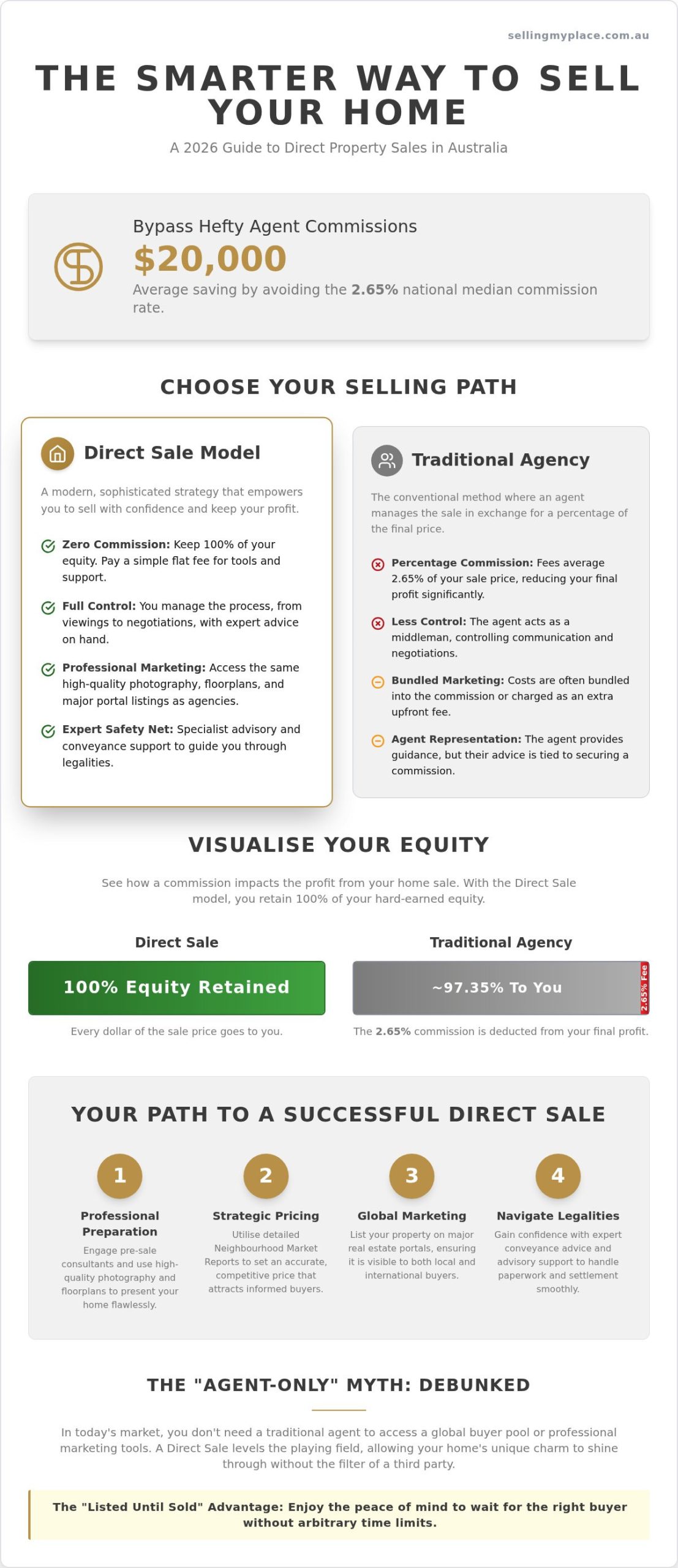
Navigating Legalities and Conveyance Advice
The legal side of selling a home is often where the most anxiety lives. It’s the “what if” that keeps many homeowners awake at night. What if a document is missing? What if the contract isn’t binding? It’s important to realise that the legal requirements for private house sales australia are structured to protect both parties, and you don’t have to navigate them in isolation. Think of conveyance advice as your professional shield; it ensures every “i” is dotted and every “t” is crossed before you ever sign on the dotted line. You are the heart of the sale, but you don’t have to be the legal expert.
While traditional agents often act as a conduit for paperwork, they aren’t legal professionals. By engaging directly with expert advisory services, you’re actually getting a more direct line to the expertise you need. This is where pre-sale property consulting adds immense value that many competitors overlook. By identifying potential legal hurdles, such as unapproved structures or complex easements, well before the first open home, you can address them calmly. It’s about being proactive rather than reacting under the pressure of a ticking settlement clock.
Understanding the Contract of Sale
Every Australian property contract must contain specific essential elements to be legally sound. Depending on your state, this might include a Section 32 or a similar disclosure statement that outlines the property’s history, rates, and zoning. Managing these documents without a traditional agent is straightforward when you have a clear roadmap. You can find a detailed breakdown of these legal requirements in our Sale by owner guide. Having an expert advisor review buyer offers is a vital safety net. They’ll look beyond the purchase price to ensure the terms, such as the deposit amount and settlement duration, align perfectly with your family’s needs.
The Settlement Process Simplified
The period between going “Under Contract” and reaching “Settled” is a time of transition. It’s when the financial obligations are cleared, titles are transferred, and the practicalities of moving house take centre stage. It can be an emotional time as you prepare to hand over the keys to a place that has been your sanctuary. Your conveyance advisor handles the heavy lifting of coordinating with banks and the buyer’s legal team, ensuring the financial exchange is flawless and titles are cleared correctly. This allows you to focus on the heart of the move, saying goodbye to your old neighbourhood and preparing for your next chapter.
If you’re feeling a bit overwhelmed by the technicalities of the paperwork, book a consultation with our advisory team to discuss your specific legal requirements and gain total peace of mind.
Why Kincade International is the Smarter Way to Sell
Choosing Kincade International Direct Sales (KIDS) means you aren’t just opting for a listing service; you’re entering a partnership. Most platforms for private house sales australia leave you to figure things out on your own, which can feel a bit like being left at sea without a compass. We believe the emotional weight of moving house requires more than just a digital portal. Our model combines global marketing reach with a deeply personal Agent Advisory Service. It’s a “steady hand” approach that balances professional decorum with a genuine understanding of your family’s needs and aspirations.
One of the most reassuring parts of our service is the “Listed Until Sold” commitment. Traditional agencies often trap you in 90-day cycles, creating a sense of urgency that can lead to undervalued sales or the stress of a looming deadline. We remove that ticking clock entirely. You have the freedom to wait for the buyer who truly appreciates your home’s value, without the anxiety of expiring contracts or the frustration of re-listing fees. This allows you to stay focused on your next chapter while we handle the technical heavy lifting.
Global Reach for Your Local Property
While local agents often focus on their immediate database or a small geographic radius, our network casts a much wider net. Our digital infrastructure is designed specifically for international visibility, ensuring your property is seen by expats and global investors looking for the stability and lifestyle of the Australian market. These buyers often see value that local-only advertising might miss. This global perspective is frequently the key to achieving a premium sale price, as it introduces your home to a much larger pool of motivated, high-intent purchasers.
A Steady Hand through Negotiation
Negotiation is the stage where many private sellers feel most exposed. Our Agent Advisory Service acts as your professional buffer, providing the authority needed to manage high-stakes conversations. You can utilise our property sale negotiation tips to prepare your strategy, but you’ll also have an expert by your side to handle the complex back-and-forth. Whether it’s managing multiple offers or vetting a buyer’s financial readiness, we provide the calm confidence needed to secure a result you’ll be proud of. It’s about ensuring you feel protected and supported until the moment the keys are handed over.
By blending professional authority with heartfelt warmth, we help you navigate the complexities of the sale with ease. You retain 100% of your equity while benefiting from the same high-end tools and global exposure used by the world’s leading agencies. It’s a smarter, more respectful way to honour the home you’ve built while preparing for the future.
Securing Your Property’s Future with Confidence
The journey of moving house is about more than just a transaction; it’s the start of your next chapter. By embracing the modern approach to private house sales australia, you’re choosing to protect the equity you’ve worked so hard to build over the years. You’ve seen how the combination of professional photography, global marketing reach, and expert conveyance advice ensures your home competes at the highest level without the weight of traditional commissions.
Retaining your profit doesn’t mean you have to go it alone. With a dedicated Agent Advisory Service by your side, you have a steady hand to guide you through every negotiation and legal hurdle. On average, our homeowners save $20,000 in commissions; a sum that can make a world of difference as you settle into your new neighbourhood. It’s about selling with heart, authority, and the calm confidence that your family’s financial legacy is secure. Ready to keep 100% of your equity? Explore our commission-free marketing packages today.
We’re here to help you make this transition as smooth and rewarding as it can possibly be.
Frequently Asked Questions
Is it legal to sell my own house privately in Australia?
Yes, it’s completely legal to sell your own property across every Australian state and territory. You don’t need a special licence to sell your own home; you simply need the right tools to handle the marketing and legal disclosures correctly. Many homeowners feel a sense of empowerment when managing private house sales australia. We provide the professional framework and conveyance advice required to ensure your contract is solid and your interests are fully protected.
How much can I actually save by choosing a private sale over a traditional agent?
Homeowners save an average of $20,000 in commissions by opting for a flat-fee model instead of a percentage-based charge. Traditional agents often take a significant slice of your home’s value, but private house sales australia allow you to keep that profit where it belongs. By replacing high commissions with a single, transparent fee, you retain 100% of your equity. This provides a much stronger financial foundation as you transition into your next family home.
Will my property appear on major property portals if I sell privately?
Your property will appear on Australia’s leading property websites and most prominent national portals, ensuring it stands side-by-side with agency listings. Our digital infrastructure provides high visibility, including access to our global marketing network for international reach. We provide professional photography and floorplans to ensure your listing looks polished and attracts high-quality enquiries. You’ll reach the same pool of motivated buyers while maintaining direct, personal control over the enquiries and inspections yourself.
How do I determine the right asking price without an agent?
You can set a realistic asking price by utilising our detailed Neighborhood Market Reports. These reports provide concrete data on recent sales and current market trends in your area, removing the guesswork from your decision. It’s about finding a balance between your property’s unique value and the current buyer appetite. Having this data at your fingertips gives you the confidence to stand firm during negotiations and achieve the premium result your family deserves.
What happens if my property doesn’t sell within a few months?
We offer a “Listed Until Sold” commitment, which means there are no arbitrary time limits or expiring contracts to worry about. This removes the immense pressure many sellers feel when a traditional 90-day agency agreement is coming to an end. You have the peace of mind to wait for the right buyer who truly values your home’s story. It’s a patient, respectful approach that ensures you never feel rushed into accepting a lower offer.
Do I still need a solicitor or conveyancer for a private sale?
You still need a legal professional, such as a solicitor or conveyancer, to handle the formal transfer of title. While you manage the marketing and inspections, they ensure the legalities are handled correctly during the settlement phase. We provide expert conveyance advice and pre-sale consulting as part of our service to act as your safety net. This ensures every document, from the Section 32 to the final contract, meets all Australian legal standards.
How does the Kincade International Advisory Service help with negotiations?
Our Real Estate Advisory Services provide a “steady hand” to guide you through the complexities of buyer talk and multiple offers. We act as your professional buffer, helping you vet potential buyers and interpret their feedback with total clarity. Whether you need specific negotiation tips or a second opinion on a contract term, our experts are there to ensure you feel supported. It’s a partnership that combines your local knowledge with our professional authority.
Can I sell my property privately if it is currently tenanted?
You can certainly sell a tenanted property privately, provided you follow the specific residential tenancy laws regarding notice periods for inspections. You’ll need to coordinate with your tenants for photography and open homes, which is often best handled with an open, respectful dialogue. We find that clear communication makes the process much smoother for everyone involved. Our pre-sale property consulting can help you navigate these requirements while ensuring your property is presented in the best light.
The Best Alternatives to Real Estate Agents in Australia for 2026
What if the most valuable person in your property sale wasn’t a high-commission agent, but you? You’ve likely spent years pouring love and hard work into your home, so the thought of handing over a massive chunk of your profit to a traditional agency feels quite unsettling. Many homeowners are now seeking professional alternatives to real estate agents in Australia to protect their equity from being eroded by fees. It’s natural to feel protective of your hard-earned wealth; the usual process often involves a lack of transparency or pressure to lower your price just to get a deal done quickly.
We’re here to help you discover how to take control of your sale without the stress of going it alone. You can bypass those heavy commissions and still achieve a successful result at full market value by using a strategic partnership approach. This guide will explore how modern flat-fee services and expert advisory models can save you tens of thousands of dollars while providing the safety net you need. We’ll show you how to blend professional marketing with your own local knowledge to create a selling experience that feels both empowering and deeply rewarding.
Key Takeaways
- Understand why the traditional commission model is losing its shine in a high-value market and how digital tools are putting power back into your hands.
- Explore the most effective alternatives to real estate agents in Australia, from purely independent sales to strategic flat-fee listing services that get you on the major portals.
- Learn how to manage the transition safely by using pre-sale consulting and data-driven market reports to ensure you don’t under-price your family’s biggest asset.
- Discover the financial impact of choosing a commission-free path, potentially saving an average of $20,000 while maintaining total control over your sale.
- Realise that selling without a traditional agent doesn’t mean selling alone; it’s about choosing a professional partnership that prioritises your equity over an agency’s profit.
Why Australian Homeowners are Ditching Traditional Agents
There is a quiet revolution happening in Australian driveways lately. As we move through 2026, the way we perceive property sales is changing, moving away from the old-fashioned “agent-as-gatekeeper” model toward a more transparent, partnership-based approach. With the average dwelling value in Australia hitting a record high of $1,111,100 in the early part of this year, the stakes have never been higher for families looking to move. When your home is your greatest financial asset, the thought of handing over a significant portion of its value to a third party can feel quite daunting. It’s this very feeling that’s driving a surge in interest regarding alternatives to real estate agents australia.
The desire for control is at the heart of this shift. Many homeowners have felt the sting of a “quick sale” where an agent pushed for a lower price just to clear their books, or they’ve grown tired of the lack of transparency in closed-door negotiations. By stepping into the driver’s seat, you’re not just saving money; you’re ensuring that the story of your home is told with the warmth and detail only an owner can provide. After all, who knows the afternoon sun in the kitchen or the quietness of the street better than you do?
The Real Cost of a 2.5% Commission
In 2026, the national average real estate commission is approximately 2.3% of the sale price plus GST, which effectively totals over 2.5% for most sellers. While that percentage might sound small in isolation, the reality on a million-dollar property is a staggering $25,000 or more. When you add marketing costs, which typically range from $2,000 to over $8,500, the total bill can easily exceed $30,000. This is money that could be funding your next renovation, boosting your retirement nest egg, or helping your children with a deposit of their own. These “hidden” costs of the traditional model often represent years of hard work and mortgage repayments that vanish in a single transaction.
The Transparency Gap in Modern Real Estate
In an era of open data, the traditional role of the agent as the sole source of market information has dissolved. Buyers are increasingly savvy and often prefer the directness of a conversation with the owner. Engaging in the For Sale By Owner (FSBO) process allows for a level of honesty and clarity that is sometimes lost when a third party is involved. To feel truly confident in these interactions, homeowners are turning to professional tools like Neighborhood Market Reports to ensure their pricing is backed by solid, local evidence. By using alternatives to real estate agents australia, you remove the “gatekeeper” and replace them with a direct line of communication, leading to outcomes that feel fair and transparent for everyone involved.
3 Main Alternatives to Real Estate Agents in Australia
Deciding how to navigate your property sale is a deeply personal choice that depends on your confidence, your schedule, and your financial goals. It’s not just about the transaction; it’s about finding a path that feels right for your family’s future. Fortunately, the landscape has shifted significantly, and there are now several professional alternatives to real estate agents australia that allow you to bypass traditional commissions. Whether you want to handle every detail yourself or prefer a guided experience, there’s a model that can help you protect your equity while achieving a successful result.
Pure Private Sales (FSBO)
The most independent route is the pure For Sale By Owner approach. This model gives you total autonomy over the entire process, from the initial photography to the final handshake. You are the sole voice for your home, which allows you to share those intimate details that an agent might overlook. While the independence is liberating, it does require a significant time commitment and a high level of organisation. Historically, around 70% of purely private sales can encounter hurdles, often because the property lacks the professional marketing reach needed to attract a wide pool of buyers. This path is typically best suited for those with prior experience in property or a ready-made buyer within their local community.
Flat-Fee Listing Services
Flat-fee listing services offer a practical step up from the purely DIY method. Because the major national property portals generally don’t allow private individuals to list directly, these services act as a licensed bridge to get your home in front of active buyers. You pay a set upfront fee to have your ad placed on Australia’s leading real estate websites, giving you the visibility of a big agency without the commission. It’s a functional choice, though it’s important to remember these services are often quite transactional. They provide the “billboard,” but the quality of the listing and the weight of the negotiations remain your responsibility.
The Assisted Direct Sales Model
For many Australian homeowners, the assisted direct sales model provides the most balanced and secure experience. This hybrid approach combines the savings of a commission-free sale with the professional tools and advisory support of a top-tier agency. It’s widely considered the most reliable Sale by owner method because it includes a dedicated Agent Advisory Service. Having a “steady hand” to guide you through the nuances of offers and contracts ensures you never have to guess your way through the critical moments. If you’re looking for a way to sell smarter while keeping your hard-earned profit, you might like to discuss your specific needs with our team.
Comparing the Costs, Risks, and Rewards
Deciding to move away from the traditional path requires a clear-eyed look at the numbers and the responsibilities involved. It’s a balance between the incredible financial reward of protecting your equity and the practicalities of managing the sale process. While the savings are often life-changing, we always encourage our clients to consider the full picture. Success isn’t just about avoiding a fee; it’s about achieving a result that leaves you feeling secure and satisfied with your family’s future.
Calculating Your Potential Equity Savings
Let’s look at a practical example. On a property selling for $1,000,000, a traditional agent’s commission of 2.3% plus GST effectively removes over $25,000 from your pocket. When you add marketing packages and potential auctioneer fees, your total outlay often climbs toward $35,000. By choosing alternatives to real estate agents australia, you replace that variable commission with a fixed investment. Our data shows that the average owner saves approximately $20,000 by using a flat-fee model. This isn’t just a number on a page; it’s the difference between a basic relocation and a move that sets you up with a significant financial head start.
Mitigating the Risks of Selling Privately
The primary concern for many is the risk of “getting it wrong.” Common fears include under-pricing the home or missing out on the right buyer because the property wasn’t visible enough. This is where professional Residential Property Listing Services become your greatest asset. High-quality photography and accurate floorplans are non-negotiable in 2026; they ensure your home isn’t just another listing, but a standout destination for the global market. To manage the risks effectively, consider these key areas:
- Legal Compliance: New Anti-Money Laundering laws mean you must ensure buyer identity checks are handled by your solicitor or conveyancer.
- Negotiation: Having an advisory service behind you means you aren’t guessing when an offer lands on the table.
- Time Management: You’ll need to be available for enquiries and open homes, which allows you to vet buyers personally and share your home’s unique story.
By using professional alternatives to real estate agents australia, you gain the expertise needed to navigate complex negotiations without the high-stakes pressure of a commission-driven environment. It’s about selling with a steady hand and a full heart, knowing you have the right tools to protect your legacy.
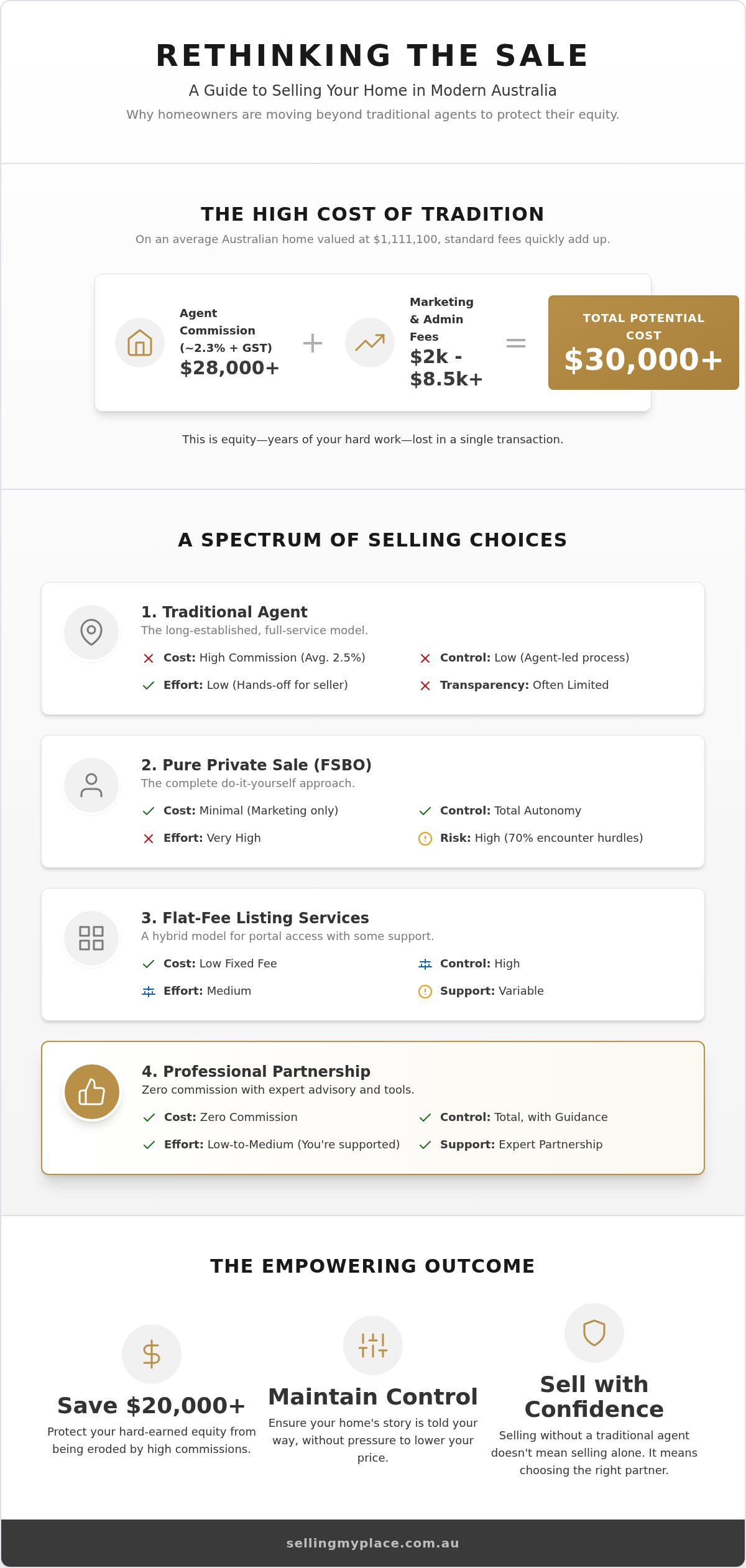
Steps to Successfully Sell Your Home Without an Agent
Taking the leap into a commission-free sale is an exciting moment, but it’s the practical, step-by-step execution that turns a plan into a successful result. Think of this process not as a solo climb, but as a guided walk where you hold the map. By leveraging professional alternatives to real estate agents australia, you can move through each phase with the confidence of a seasoned pro. The journey begins long before the first open home, starting with a thoughtful approach to presentation and a clear understanding of your property’s place in the current market.
Start with pre-sale property consulting to identify the small, high-impact improvements that add the most value to your home. Once your property is looking its best, use data-driven neighborhood market reports to anchor your expectations in reality. There’s no need to guess or rely on an agent’s “appraisal” that might be inflated just to win your business; the data tells the honest story of what buyers are actually paying in your street. This grounded approach ensures you enter the market with a price that attracts genuine interest from day one.
Marketing Your Property Like a Pro
In the digital age, your home’s first inspection happens on a smartphone screen. A successful sale relies on a “Listing Until Sold” strategy, ensuring you aren’t pressured by arbitrary agency timelines or expiring contracts. By using professional photography and floorplans, you create a narrative that resonates with both local families and international buyers. It’s about more than just a house; it’s about the lifestyle your neighbourhood offers, from the best local coffee spot to the quietest parks. This digital infrastructure allows you to reach a global audience while you maintain total control over who visits your home.
When the enquiries start rolling in, managing open homes becomes a chance to meet your future buyers face-to-face. You’ll find that being the owner often breaks down barriers, allowing for more honest and relaxed conversations. When an offer arrives, keep our property sale negotiation tips close at hand to ensure you’re securing the best possible terms. Remember, you’re the expert on your home, and that passion is your greatest asset during the negotiation phase.
The Legal and Settlement Process
While you’re handling the marketing, your legal team handles the fine print. It’s vital to secure professional conveyance advice early to prepare your contract of sale; this is a legal requirement in all Australian states and territories. This document, such as a Section 32, is the legal bedrock of your transaction. Once a price is agreed upon and the contract is signed, you’ll enter the settlement period. This is the time when final identity checks and financial transfers occur, leading to that wonderful moment when the keys change hands and your equity is safely in your bank account.
Ready to start your journey with a steady hand by your side? Reach out to our advisory team to discuss your sale.
The Kincade Approach: Professional Partnership, Zero Commission
Selling your home is about so much more than a contract; it’s about the memories you’ve built and the future you’re funding. At Kincade International Direct Sales (KIDS), we believe that choosing alternatives to real estate agents australia shouldn’t mean sacrificing professional quality or peace of mind. Our approach is built on a simple, honest truth: you deserve to keep your equity while having a steady hand to guide you through the complexities of the modern market. We don’t just provide a platform; we offer a partnership that values your family’s legacy as much as you do. It’s a way to sell that feels personal, protective, and entirely transparent.
The traditional agency model often feels purely transactional, but we know that moving house is one of life’s major transitions. By removing the 0% commission structure and replacing it with a flat-fee model, we align our goals with yours. We aren’t rushing you toward a sale just to collect a cheque; we’re providing the tools and advisory support you need to achieve the best possible market value. This is the most honest way to handle real estate, ensuring that the average owner saving of $20,000 stays in your bank account to fund your next chapter.
Expert Backing Every Step of the Way
The heart of our service is the Agent Advisory Service. Think of it as having a seasoned, multi-generational expert in your corner who isn’t motivated by a commission. Whether you’re navigating the identity checks required by the 2026 anti-money laundering laws or weighing up the nuances of a multi-offer situation, our advisors provide the calm confidence you need. We provide the same top-tier tools used by the country’s most expensive agencies, including professional photography and detailed floorplans, but at a fraction of the cost. It’s a partnership that provides a safety net, ensuring you never feel like you’re “going it alone” during such a significant life event.
Selling Smarter, Not Harder
One of the biggest stressors in a traditional sale is the ticking clock of an agency agreement. These time limits often create a sense of artificial pressure, which can lead to rushed decisions and compromised prices. Our “No Time Limit” policy removes that burden entirely, allowing you to wait for the buyer who truly recognises the value of your home. We leverage a sophisticated digital infrastructure and a global marketing network to ensure your property reaches the right audience, regardless of where they are. By choosing alternatives to real estate agents australia that focus on quality marketing and expert advice, you’re joining a growing community of savvy homeowners who value stability and smart financial management. It’s about taking control of your sale with a professional team that treats your home with the respect it deserves.
Take Control of Your Property Legacy Today
Choosing to move away from the traditional model is a powerful step toward securing your family’s financial future. By exploring modern alternatives to real estate agents australia, you’ve seen that it’s entirely possible to achieve a premium market result without the burden of heavy commissions. You don’t have to choose between going it alone or paying for services you don’t need; instead, you can embrace a professional partnership that puts you in the driver’s seat. It’s about selling with a steady hand and protecting your hard-earned equity through every stage of the process, ensuring your transition is as smooth as it is rewarding.
With professional photography, expert advisory services, and the peace of mind that comes from being listed until sold with no time limits, you’re perfectly positioned to succeed. On average, our clients save $20,000 on commissions, ensuring those funds remain available for your next life transition. We’re here to provide the tools and support you need to sell with confidence and warmth. Keep 100% of your profit and sell smarter with Kincade International Direct Sales today. Your home’s story is yours to tell, and we’re honoured to help you share it with the world.
Frequently Asked Questions
Is it legal to sell my own house in Australia without an agent?
Yes, it is completely legal to sell your own property in every Australian state and territory. While you handle the marketing and inspections, you are still required by law to engage a solicitor or conveyancer to manage the legal transfer. Many homeowners find that professional alternatives to real estate agents australia provide the perfect balance of legal security and financial freedom, allowing you to bypass commissions while staying fully compliant.
How much can I actually save by using a flat-fee real estate service?
Homeowners typically save an average of $20,000 by moving away from traditional commission structures. Since the average national commission is around 2.3% plus GST, a flat-fee model allows you to keep that equity for your next home or retirement fund. This approach replaces variable percentages with a single upfront investment that covers your marketing, photography, and advisory support, ensuring your profit stays exactly where it belongs.
Will my property still appear on the major Australian real estate portals?
Yes, your property will be visible on the most prominent Australian real estate portals. While these platforms generally don’t allow private individuals to list directly, flat-fee services use their professional licenses to place your ad where buyers are looking. This ensures your home receives the same level of exposure as any agency-listed property. Using such alternatives to real estate agents australia ensures you reach local families and international buyers through a global marketing network.
Who handles the legal paperwork if I don’t have a traditional agent?
You will need to engage a qualified solicitor or conveyancer to handle the legal complexities of the transaction. They are responsible for preparing the contract of sale and ensuring all identity checks comply with the 2026 anti-money laundering laws. Our service includes expert conveyance advice to help you navigate this phase, ensuring your paperwork is robust and your settlement process remains smooth and secure for all parties involved in the sale.
Can I still have an auction if I choose an alternative to an agent?
You can certainly choose to sell your home via auction even if you aren’t using a traditional agent. You simply need to hire a professional, licensed auctioneer to conduct the proceedings on the day. This allows you to benefit from the competitive atmosphere of an auction while still avoiding the high commission fees usually associated with the process. It is a strategic way to maintain control over the selling method and your final profit.
How do I know if I am setting the right price for my property?
Setting the correct price is achieved through detailed, data-driven research rather than guesswork. We provide comprehensive Neighborhood Market Reports that show exactly what similar properties in your street have sold for recently. By looking at actual settlement data rather than just asking prices, you can set a realistic figure that attracts genuine interest while protecting your equity. This ensures you don’t under-price your family’s most significant asset in a fragmented market.
What happens if my property doesn’t sell within the first month?
If your property doesn’t sell immediately, there is no need to feel pressured or stressed. Unlike traditional agency agreements that often expire after 90 days, our policy means your property is listed until sold with no time limits. This allows you to wait for the right buyer who truly values your home’s unique features, rather than feeling forced by an agent to lower your price just to meet an internal sales target or monthly quota.
Do I need a buyer representative if I am selling privately?
While you don’t need a buyer representative for yourself as the seller, you may encounter buyers who use their own professional representation. In these cases, having access to real estate advisory services can be incredibly helpful. An advisor acts as a steady hand during negotiations, helping you vet offers and communicate effectively with professional buyer’s agents. This ensures you remain on an equal footing throughout the entire negotiation process and secure a fair deal.
Negotiating House Price with Buyer Directly: An Australian Seller’s Guide
What if the most effective person to sell your home isn’t a high-pressure agent, but actually you? It’s a question that challenges the traditional Australian real estate model, especially when you consider that the average seller hands over $20,000 or more in commissions just for someone else to lead the conversation. We understand that the idea of negotiating house price with buyer directly can feel a bit daunting at first. You might worry about being lowballed or feel a natural discomfort when discussing large sums of money face-to-face. It’s perfectly normal to want to protect your family’s legacy while avoiding the typical stress of a financial tug-of-war.
This guide is designed to transform that uncertainty into a sense of grounded, professional confidence. We’ll show you how to master the art of direct negotiation to secure the best possible price for your property while keeping 100% of your hard-earned profit. You’ll learn how to use professional market data as your silent partner, how to handle offers with a steady hand, and how to ensure the entire transaction remains smooth and respectful from the first viewing to the final settlement. We’re here to help you talk price with authority, empathy, and a clear focus on your next chapter.
Key Takeaways
- Learn the “steady hand” philosophy to maintain calm confidence and professional decorum when talking to prospective buyers.
- Discover how negotiating house price with buyer directly allows you to secure the best market value while keeping an average of $20,000 in your own pocket.
- Use professional market reports and high-quality floorplans as the essential evidence needed to justify your asking price and anchor the conversation.
- Identify valuable non-monetary terms, such as settlement periods and deposit amounts, that can be just as significant as the final sale figure.
- Understand how an Agent Advisory Service provides the expert guidance you need during high-pressure moments without the cost of a traditional commission.
Mastering the Art of Direct Negotiation: Why Selling Your Own Place Works
Many people view the sale of a home as a high-stakes battle, but it’s actually a professional dialogue between two parties looking for a fair outcome. When you choose the path of negotiating house price with buyer directly, you’re stepping into a role of empowerment. You aren’t just a vendor; you’re the person who has lived within these walls and understands their true value. By adopting a “steady hand” philosophy, you maintain a calm, grounded presence that reduces the stress for everyone involved.
There is also a significant financial advantage to this approach. In Australia, the average seller might spend $20,000 or more on agency commissions. By removing that middleman, you’ve already “won” back a substantial portion of your equity. This provides you with more flexibility during the conversation. You can choose to pass some of those savings on to secure a faster sale, or simply keep that hard-earned profit to fund your next big move. It’s a position of strength that traditional models simply can’t offer.
The Psychology of the Direct Deal
Buyers often find it refreshing to speak directly with the homeowner. It cuts through the typical industry noise and offers a level of transparency that’s hard to find elsewhere. You can build genuine rapport by discussing the practicalities of the home, like which window catches the best winter sun or the friendly nature of the neighbours. While it’s great to be welcoming, it’s vital to stay authoritative. Understanding various negotiation tactics helps you remain friendly without oversharing details that might compromise your financial position. Think of it as a professional-casual partnership; you’re being a good neighbour while protecting your family’s interests.
Setting Your Negotiation Goals
Success starts long before the first offer arrives. You need to identify your “walk-away” price, which is the absolute minimum you’ll accept to make your next move viable. Knowing this number prevents you from making emotional decisions in the heat of the moment. Beyond the dollar sign, consider your ideal settlement timeline. Sometimes, a buyer who can move in quickly or wait an extra month is worth more than a slightly higher offer with rigid dates. In a private treaty context, the reserve price is the minimum figure you are willing to accept before you’ll commit to signing a contract. Having these goals organised in advance ensures you lead the process with clarity and confidence.
Preparation is Your Best Defence: Using Market Data to Anchor Your Price
Confidence in negotiating house price with buyer directly isn’t just about having a gift for gab; it’s about having the right evidence. When a buyer questions your asking price, having a stack of objective data turns a potential argument into a professional discussion. You aren’t just “guessing” what your home is worth. You’re basing your position on hard facts. This data acts as a shield against lowball offers, allowing you to stay calm and respectful while firmly pointing to recent sales that support your figure.
Knowing your competition is just as vital as knowing your own home. While the national median dwelling value was approximately $937,722 in June 2026, your local street value is what matters most to your buyer. Take the time to visit a few open houses nearby. See how they compare in terms of land size, finish quality, and layout. Understanding what else is available helps you articulate why your property holds a specific value. It’s much easier to hold your ground when you can say, “I’ve seen the other three-bedroom homes in the area, and our extra living space justifies the difference.”
Leveraging Neighbourhood Market Reports
To negotiate like a seasoned expert, you need to look beyond the “asking price” of other homes and focus on actual “sold” prices. These figures are the only true measure of market value. You can find detailed advice in our guide on how to determine market value of a home in Australia. Look for trends such as the average number of days on market or price growth over the last quarter. If you’re feeling unsure about the data, it’s often worth a moment to chat with our advisory team to ensure your pricing strategy is airtight.
The Power of Professional Presentation
First impressions dictate the entire rhythm of a negotiation. If your listing looks amateur, buyers will assume you’re an amateur negotiator. Professional photography and floorplans are non-negotiable tools. They establish a high “perceived value” before the buyer even walks through the front door. A clear floorplan helps buyers visualise their life in the space, reducing the likelihood of them haggling over minor layout “flaws” later.
When you organise your home for inspections, focus on light, space, and cleanliness. Removing clutter allows the buyer to focus on the home’s bones rather than your belongings. By presenting a polished, well-maintained environment, you signal that the property has been cared for, which naturally supports a premium price. You can find more property negotiation tips from experts who emphasise that emotional detachment starts with a professional presentation.
The Negotiation Table: How to Handle Offers with Confidence
When the phone rings or an email lands with those first few numbers, it’s natural to feel a rush of adrenaline. This is the moment where negotiating house price with buyer directly moves from theory into reality. Your primary goal is to remain the “steady hand” who leads with heart and logic. You don’t need to answer immediately. In fact, the “Silence is Golden” rule is one of your most potent tools. By taking 24 hours to consider a proposal, you signal that you are a serious, methodical vendor who isn’t acting out of desperation. This brief pause gives you the space to consult your data and respond from a position of calm authority.
Most offers in Australia come with strings attached, known as “subject to” clauses. These typically cover finance approval, building inspections, and pest reports. Don’t view these as hurdles; view them as standard steps toward a secure settlement. A buyer who asks for a building inspection is a buyer who is genuinely planning to move in. Your job is to ensure the timeframes for these clauses are reasonable, usually 7 to 14 days, to keep the momentum of the sale moving forward. When you are negotiating house price with buyer directly, your response to these conditions sets the tone for the entire transaction.
Responding to Your First Offer
Always acknowledge an offer in writing, even if it’s just a quick text or email to say you’ve received it and will respond by a certain time. This maintains a professional trail and sets clear expectations. If an offer feels complex or you’re unsure of the buyer’s motivations, this is where our Real Estate Advisory Services become your secret weapon. We can help you vet the proposal and phrase a counter-offer that invites a collaborative response rather than creating a standoff. The goal is to keep the buyer engaged, perhaps by meeting them in the middle on price while asking for a shorter settlement period that suits your lifestyle.
Managing Lowball Offers with Grace
It’s easy to feel insulted by a lowball offer, but try to see it as a compliment. They like your house enough to want to buy it. A low offer is simply the start of a dialogue. Instead of a flat “no”, use a script that acknowledges their interest while firmly pointing back to your evidence. You might say, “I appreciate your offer, however, based on recent sales in the street, we aren’t quite there yet.” You can find more specific phrasing in our guide on expert property sale negotiation tips to help you keep the door open without compromising your value. Remember, the first person to mention a number often sets the anchor, but the person who stays the calmest usually wins the deal.
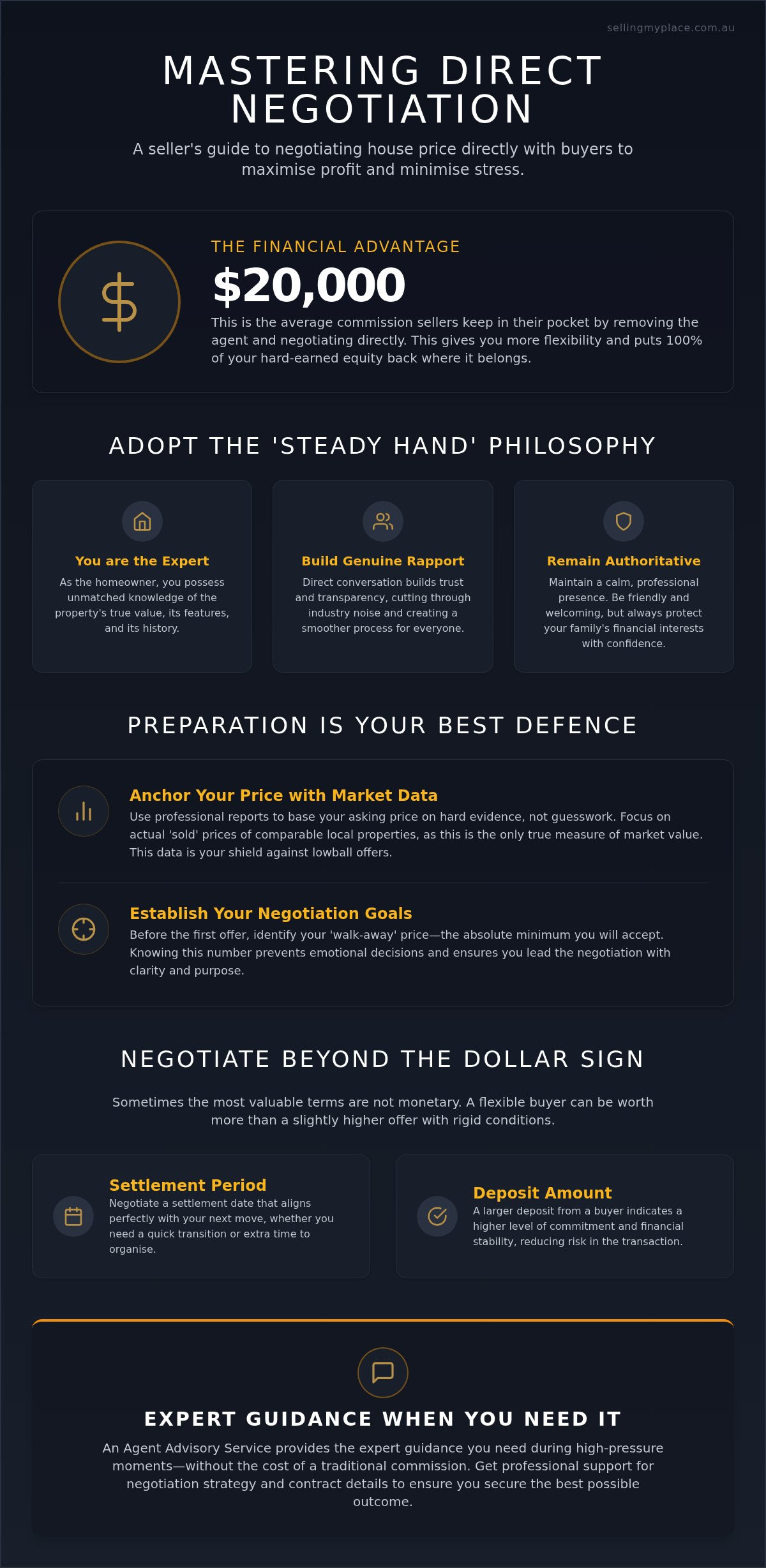
Looking Beyond the Dollar Sign: Negotiating Terms That Suit Your Lifestyle
While the final figure is what most people focus on, the terms of your contract are often where the real value lies. When you’re negotiating house price with buyer directly, you can prioritise what actually matters for your next chapter. Is it a quick exit, or do you need time to find your next home? By looking beyond the dollar sign, you can create a win-win scenario that feels respectful and grounded. You have the unique opportunity to discuss these lifestyle factors without them being filtered through an intermediary, which often leads to a more harmonious result for both parties.
The deposit is a crucial sign of buyer commitment. While a 10% deposit is traditional in Australia, some buyers may offer less. A larger deposit provides you with peace of mind that the buyer is financially stable and fully committed to the purchase. It’s an often-overlooked lever in the negotiation process. If a buyer is pushing for a lower price, you might counter by asking for a higher deposit or a shorter cooling-off period to secure the deal. These non-monetary wins can be just as significant as the sale price itself.
Settlement Periods and Possession Dates
Most Australian property sales involve a 30, 60, or 90-day settlement. If you’re still looking for your next home, a longer 90-day period gives you much-needed breathing room. Alternatively, you might negotiate a “rent-back” agreement, where you stay in the property as a tenant for a short period after settlement. This flexibility can be a powerful tool; sometimes, being accommodating on dates can help you hold firm on your asking price. It turns the transaction into a partnership rather than a battle of numbers.
Conditions and Inclusions
Clarity is your best friend here. Be specific about what stays with the home. Are those custom-made curtains included? Is the premium dishwasher part of the deal? Listing these inclusions early prevents awkward conversations later. If a building report identifies minor issues, don’t panic. You can negotiate a small price reduction or agree to fix the items before settlement. This is where having professional conveyance advice ensures that every agreement is legally binding and watertight. If you’re unsure how to phrase these specific terms in your contract, reach out to our advisory team for a chat about your unique situation.
Your Steady Hand in the Sale: How Expert Advisory Maximises Your Profit
Choosing to sell your home yourself is a rewarding decision, but it doesn’t mean you have to carry the weight of the entire process on your own shoulders. When you are negotiating house price with buyer directly, having a “professional in your pocket” can be the difference between a stressful stalemate and a celebratory success. The KIDS flat-fee model is designed to provide you with the professional infrastructure of a traditional agency—including our dedicated Agent Advisory Service—without the heavy burden of commissions. You get to keep the driver’s seat while we provide the map and the compass.
This partnership approach ensures you never feel isolated during high-pressure moments. Whether you’re unsure how to counter a complex offer or simply need a neutral second opinion on a buyer’s feedback, our advisors are here to help you stay grounded. We believe that a commission-free sale should be synonymous with a high-quality, professional experience. By removing the $20,000 average agency commission from the equation, you aren’t just saving money; you’re reclaiming the value of your most significant asset and ensuring your family’s future is as secure as possible.
The Partnership Approach to Selling
Our involvement begins long before the first offer arrives. Through pre-sale property consulting, we help you identify small, cost-effective changes that can deliver a significant return on investment. Sometimes, a fresh coat of paint in a neutral tone or a simple garden tidy-up can add thousands to your final sale price. Our advisory service acts as a steady, neutral party, helping you separate the emotional significance of your home from the practicalities of a market transaction. If you’re ready to start this journey, our step-by-step guide to sale by owner in Australia provides a clear roadmap for every stage of the process.
Securing Your Legacy and Profit
Take a moment to visualise what that $20,000 saving truly means for your lifestyle. It might be the deposit for your next investment, a complete renovation of your new kitchen, or a well-deserved family holiday to celebrate your next chapter. As you move toward closing the deal, keeping a final checklist ensures a smooth transition to settlement:
- Review all “subject to” clauses with a calm and methodical eye.
- Confirm the deposit has been received and held in a secure trust account.
- Coordinate closely with your legal representative to finalise the contract of sale.
- Prepare the home for the final inspection with the same care you used for the first open house.
Selling your home is a major life transition, and we are honoured to act as your nurturing guide through the complexities of the Australian property market. You have the local knowledge and the heart; we provide the professional tools to make it happen. Enquire about our flat-fee listing and advisory packages today and discover how simple and profitable direct selling can be.
Taking the Next Step Toward Your Successful Sale
Selling your home is far more than a simple transaction; it’s the bridge to your next big adventure. By mastering the process of negotiating house price with buyer directly, you’ve taken a significant step toward protecting your family’s financial future. We’ve explored how objective market data and professional presentation act as your silent partners, allowing you to anchor your price with confidence. You now understand that a successful deal isn’t just about the numbers, but also about finding the settlement terms and deposit conditions that respect your lifestyle and timeline.
You have the local heart and the personal stories that make your property special, and we provide the professional infrastructure to ensure those stories reach the right people. With our Agent Advisory Service by your side, you’ll have the expert guidance needed to handle every offer with a steady hand. Most sellers save an average of $20,000 in commissions by choosing this path, all while benefiting from professional marketing that truly rivals traditional agencies. It’s time to secure the profit you’ve worked so hard to build. Discover how to sell your home and keep 100% of the profit with Kincade International and let’s make your next move your best one yet.
Frequently Asked Questions
Do I have to accept the highest offer when negotiating house price with buyer directly?
No, you aren’t legally or morally obligated to accept the highest offer. When you’re negotiating house price with buyer directly, you should look at the “cleanliness” of the contract. A slightly lower offer with no finance or building conditions and a settlement date that aligns perfectly with your next move might be more valuable than a higher, riskier bid. It’s about finding the balance between the final dollar and your family’s peace of mind.
How do I handle a buyer who wants to negotiate face-to-face during an inspection?
It’s best to keep the inspection focused on the home’s features and handle financial discussions later. If a buyer tries to talk numbers on the spot, politely let them know that you’d prefer to receive all offers in writing so you can give them proper consideration. This avoids high-pressure snap decisions. You might say, “I’m glad you’re interested; please send through your proposal via email so I can discuss it with my family tonight.”
What is the best way to reject an offer without offending the buyer?
Start by thanking the buyer for their interest and acknowledging the effort they’ve put into their offer. You can then explain that the figure doesn’t quite meet your expectations based on recent local sales data. By referencing objective evidence rather than personal feelings, you keep the conversation professional. Always encourage them to come back with a revised offer if their circumstances change. This keeps the door open while maintaining your home’s value.
Can I negotiate the deposit amount in a private sale?
Yes, the deposit is a flexible term that can be negotiated just like the sale price. While 10% is the standard in Australia, you might ask for a larger amount to ensure the buyer is fully committed, especially if they’ve requested a long settlement. Conversely, you might accept a smaller deposit to help a first-home buyer get across the line. It’s a powerful tool to use when negotiating house price with buyer directly to gauge seriousness.
What happens if the buyer asks for a price reduction after the building inspection?
You should first ask to see the specific section of the building report that mentions the defect. If the issue is a genuine structural problem you weren’t aware of, a small price reduction or an agreement to fix the issue before settlement is a reasonable response. However, don’t feel pressured to lower the price for minor “wear and tear” items that are common in older homes. Stay grounded and focus on the major findings only.
How does the Agent Advisory Service help me during a negotiation?
Think of the Agent Advisory Service as your secret weapon for staying calm during the “crunch” moments. We provide you with professional scripts, help you vet the financial stability of a buyer, and offer a neutral second opinion on complex proposals. This ensures you don’t make emotional decisions under pressure. You get the benefit of years of industry experience to guide your direct negotiation, helping you secure a result that reflects the true market value.
Is a verbal agreement on price legally binding in Australia?
No, a verbal agreement is not legally binding for property sales in any Australian state or territory. For a sale to be official, both parties must sign a written Contract of Sale, and in some cases, the deposit must be paid. Until the contracts are exchanged and the cooling-off period has passed, the deal isn’t final. This is why it’s vital to move from a verbal “yes” to a signed document as quickly as possible.
What documents should I have ready before I start negotiating with a buyer?
You’ll need a valid Contract of Sale prepared by your solicitor or conveyancer, along with any state-specific disclosure documents like a Section 32. It’s also helpful to have your Neighbourhood Market Reports and professional floorplans handy to justify your price. Having these documents organised and ready to send electronically shows buyers that you’re a serious, professional vendor. This preparation reduces delays and builds a sense of trust from the very first conversation.
Mistakes to Avoid When Selling Your Own Home: The 2026 Australian Seller’s Guide
What if the most expensive part of selling your home wasn’t the fresh coat of paint or the professional photography, but the signature you put on a standard agency contract? In a 2026 market where the national median house price sits at $989,000, handing over a massive chunk of your equity to an agent can feel like a step backwards for your family’s future. It’s a significant life transition, and we understand the pressure to get everything right while identifying the common mistakes to avoid when selling your own home. You might be worried about underpricing your sanctuary or feeling overwhelmed by the logistics of legal paperwork and buyer enquiries.
We believe you shouldn’t have to choose between professional results and your bank balance. This guide serves as your steady hand, helping you master the art of commission-free selling with total confidence. By sidestepping these costly errors, you can save upwards of $20,000 in commissions and achieve a professional-grade result independently. We’re going to explore everything from understanding the current 4.35% cash rate environment to managing a smooth, stress-free settlement process that keeps your family’s future secure.
Key Takeaways
- Learn how to separate your heart from your house to make the objective, professional decisions that today’s buyers expect.
- Identify the critical mistakes to avoid when selling your own home, particularly the pricing traps that can stall your progress in the first fortnight.
- Discover why professional photography and floorplans are essential investments that protect your equity rather than just additional costs.
- Understand the fundamentals of Australian contract requirements and negotiation strategies to ensure a secure and legally sound settlement.
- Find out how a flat-fee advisory service provides a protective safety net, giving you agency-level tools without the high commissions.
The Professional Mindset: Why Most Private Sales Fail Before They Start
Success in the current market isn’t about doing things on the cheap; it’s about doing things professionally without the weight of an unnecessary commission. One of the primary mistakes to avoid when selling your own home is confusing “saving money” with “cutting corners.” When you decide to sell independently, you aren’t just a homeowner anymore. You are a project manager overseeing a high-stakes transaction. This requires a mental shift from seeing your house as a sanctuary filled with memories to viewing it as a product on a shelf. In a cooling market where national prices saw a slight decline of 0.3% in July 2026, this objectivity is your greatest asset.
Many Australians fall into the “Emotional Attachment Trap.” It’s natural to value your home based on the years of life lived within its walls, but buyers only see the square metres and the school catchment. If you can’t look at your property through the eyes of a stranger, you risk making defensive decisions during negotiations. Professionalism means being prepared for honest, sometimes blunt, feedback from potential buyers and using it to refine your strategy rather than taking it personally.
The Myth of the “Magic” Real Estate Agent
There is a persistent belief that agents possess a “secret database” of buyers that private sellers simply cannot access. The truth is much simpler. Modern buyers follow properties, not people. The real drivers of the Australian market are the major national property portals and digital search engines. When your home is listed on these platforms with professional-grade photography and clear floorplans, you are visible to every active buyer in the country. Choosing a For Sale By Owner (FSBO) model allows you to tap into these same networks. By using professional advisory services, you gain the infrastructure of a global agency without the transactional feel of a traditional commission-based relationship.
Setting Your “Sale by Owner” Strategy
One of your biggest advantages is time. Traditional agencies often demand 90-day exclusive contracts to create artificial urgency, but selling independently allows you to “list until sold.” With the Reserve Bank holding the cash rate at 4.35% as of August 2026, buyers are more cautious and may take longer to secure finance. You can afford to wait for the right offer that respects your property’s value. To make this work, you must be organised from day one. This includes:
- Documentation: Have your Contract of Sale and disclosure documents ready before the first open home.
- Communication: Set up a professional email or phone line specifically for enquiries to keep your personal life separate.
- Market Knowledge: Study local results so you can address the common mistakes to avoid when selling your own home before they impact your bottom line.
Pricing Pitfalls: Avoiding the “Hope and Pray” Valuation
Setting the price for your home is often the most emotional hurdle you’ll face. It’s easy to fall into the trap of “sentiment pricing,” where you value the property based on what you need for your next deposit or the memory of your renovations. However, the market is indifferent to your goals. One of the most critical mistakes to avoid when selling your own home is ignoring the market reality of 2026. With the national median house price sitting at $989,000 and the cash rate holding at 4.35%, buyers are incredibly discerning. They aren’t just looking for a home; they’re looking for value that aligns with their specific borrowing capacity.
If you set your price too high initially, you trigger the “anchor effect.” This creates a psychological barrier that scares off motivated buyers during the first fortnight, which is typically your most active period. Many sellers rely on automated valuation models (AVMs) found on bank websites, but these are often outdated or lack the nuance of your specific street. To establish a credible price floor, you need deep, localised data. Utilising comprehensive Neighborhood Market Reports ensures you’re making decisions based on actual local sales rather than computer-generated guesses.
Interpreting Comparative Market Analysis (CMA)
A true comparative analysis goes beyond looking at what the house next door sold for last year. You must account for land size, block orientation, and the quality of recent finishes. In August 2026, you also need to factor in local supply levels. If three similar houses just hit the market in your suburb, your pricing strategy must adapt. Aim for the “sweet spot”: a price that invites competition. When multiple buyers see genuine value, they’ll compete; this often pushes the final result higher than a static, over-optimistic listing price ever could.
The Hidden Cost of Underpricing
The fear of leaving money on the table keeps many private sellers awake at night. While overpricing kills momentum, underpricing can feel like a loss of hard-earned equity. Using professional appraisals helps validate your listing price and provides a shield against low-ball offers. If a buyer comes in with an offer that feels disrespectful, don’t take it personally. Use your data to justify your position and stay firm. If you’re feeling unsure about your property’s current worth, you might find it helpful to chat with a property advisor who can provide a grounded perspective on your local market.
Marketing Blunders: When “DIY” Visuals Devalue Your Equity
In the digital-first market of 2026, your property’s first open home doesn’t happen on a Saturday morning. It happens on a smartphone screen at 10 pm. One of the most damaging mistakes to avoid when selling your own home is assuming that a modern smartphone camera is “good enough” for your listing. While the latest iPhone takes great family snaps, it cannot replicate the wide-angle lenses, professional lighting, and post-production expertise required to capture a room’s true dimensions. This “iPhone Effect” often leads to dark, cramped, or distorted images that devalue your equity instantly. Industry observations suggest that poor visuals can result in a final sale price that is $50,000 lower than a property with high-quality marketing.
Viewing professional photography as an investment rather than a cost is a hallmark of a successful private seller. You have roughly two seconds to capture a buyer’s attention before they scroll past your home. If that hero image doesn’t spark an emotional connection, the buyer is gone. You aren’t just selling bricks and mortar; you are selling a future lifestyle. Professional imagery highlights the warmth of the sun in the living room and the flow of the kitchen, inviting that “first click” that leads to a physical inspection.
The Power of Professional Floorplans
A high-definition floorplan is no longer optional. It allows buyers to “mentally move in” by understanding the spatial logic of your home before they even step through the door. Does the master bedroom have enough space for a king-sized bed? Is the home office tucked away from the noise of the kitchen? A floorplan answers these questions immediately. In 2026, buyers also expect to see site plans and orientation to judge natural light. This transparency filters out “tyre-kickers” whose needs don’t match your layout, ensuring that every person who walks through your door is a genuine contender.
Staging and Presentation: Beyond the Declutter
Presentation is about depersonalisation. You want buyers to see their own lives in the space, not yours. Remove the family photos and the collection of fridge magnets to create a blank canvas. Focus on high-ROI cosmetic repairs, like a fresh coat of neutral paint or updated cabinet handles, rather than overcapitalised renovations that you won’t recoup. Finally, think about the lifestyle narrative. On inspection day, ensure the temperature is perfect, the lighting is soft, and there’s a subtle, welcoming scent. You’re creating a feeling of stability and home that resonates on a deep, emotional level.
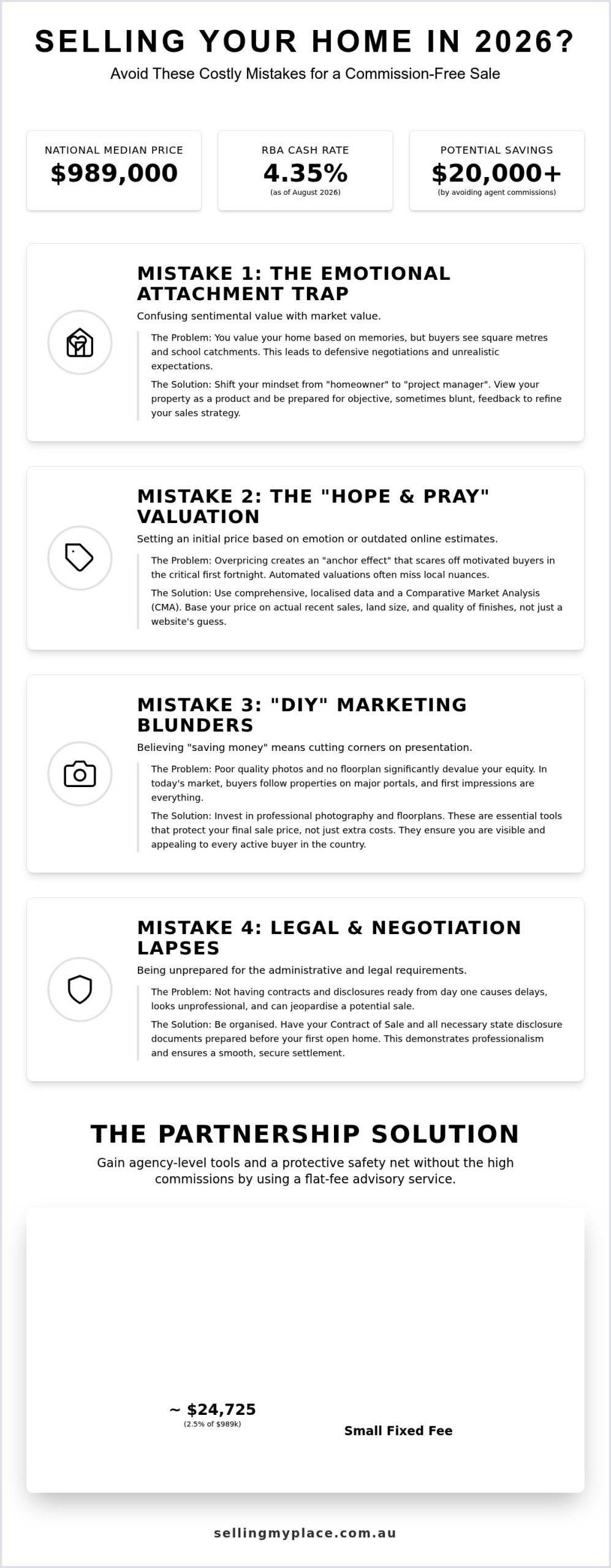
Negotiation and Legal Lapses: Protecting Your Settlement
Once your marketing has successfully drawn in the right crowd, the journey moves from presentation to persuasion. One of the most frequent mistakes to avoid when selling your own home is the urge to fill the silence during a negotiation. It is a natural human reaction to keep talking when we feel nervous, but in real estate, the first person to speak often reveals their position too early. Instead of rushing to justify your price, let the buyer’s offer hang in the air for a moment. This grounded, calm approach demonstrates that you are confident in your property’s value and aren’t pressured by the clock.
Legal paperwork often feels like the most daunting part of the process, yet it is simply the framework that keeps your equity safe. Your Contract of Sale is the foundation of the entire deal. In 2026, compliance is stricter than ever; for instance, the Seller Disclosure Scheme requires absolute transparency to prevent a buyer from terminating the contract later. This is where professional guidance becomes your safety net. To ensure your paperwork is water-tight before the first offer arrives, it is wise to reach out for professional conveyance advice that protects your family’s interests.
Mastering the Private Treaty Negotiation
- Qualify the buyer: Before you spend hours negotiating, ask for a letter of pre-approval. With the cash rate at 4.35%, you need to know their lender is actually ready to move.
- Handle the “Building and Pest” hurdle: If a report identifies a minor issue, don’t get defensive. Use it as a tool for transparency; sometimes a small price adjustment is better than losing a motivated buyer during the cooling-off period.
- Close the gap: Use professional counter-offers. Instead of a flat “no,” try “I can’t accept that price, but I can meet you halfway if we settle in 30 days.”
A “Subject to Finance” clause is a contractual condition that grants the buyer a specific timeframe, usually 14 days, to secure formal mortgage approval, which effectively puts your settlement timeline on hold until the bank gives the final green light.
The Legal Roadmap to Settlement
In the 2026 landscape, the exchange of contracts has become a streamlined, digital experience. Ensuring your Section 32 or relevant state disclosure documents are current is non-negotiable; an out-of-date certificate can stall a settlement for weeks or even provide a legal loophole for a buyer to exit. Most Australian settlements now occur through PEXA, a secure digital platform that allows for the simultaneous exchange of funds and property titles. This technology removes the old-fashioned stress of bank cheques and physical meetings, providing you with real-time confirmation that your sale is officially complete.
The Partnership Solution: Selling Smarter with Kincade
Selling your home independently doesn’t mean you have to walk the path alone. The Direct Sales model represents the future of the Australian property market because it empowers you to maintain total control while utilising the sophisticated infrastructure of a global agency. Many homeowners believe they must choose between a high-commission agent or a cheap DIY approach. We offer a Goldilocks solution that provides professional-grade results without the transactional feel of traditional real estate. By choosing this partnership, you sidestep the most common mistakes to avoid when selling your own home while keeping 100% of your hard-earned profit.
The flat-fee advantage is simple: you gain access to the same tools the big agencies use, but you don’t pay for their high overheads or franchise fees. We’ve seen that the average owner can retain a significant portion of their equity that would otherwise be lost to commission. This is money that stays in your pocket, where it belongs, to fund your next move or secure your family’s future. Our Agent Advisory Service acts as your steady hand, providing the calm confidence you need when faced with complex decisions or high-stakes negotiations.
Pre-Sale Consulting: Your Competitive Edge
Success starts long before the first open home. Our pre-sale property consulting provides customised advice on how to present your home to the 2026 market. We help you identify which features will resonate with local buyers and which specific aspects of your property deserve the spotlight. By leveraging deep neighbourhood data, you can justify a premium price with hard evidence rather than guesswork. You also benefit from a global marketing network that ensures your listing remains active and visible until the right buyer is found, reaching far beyond the limits of a traditional local agency office.
Next Steps: From Listing to Sold
Getting started is a straightforward, supportive process. You can begin with a professional marketing package today, which includes the high-definition photography and floorplans we discussed earlier. We understand that life transitions don’t always follow a 90-day schedule. That’s why we offer a No Time Limit guarantee; your listing stays active until it’s sold, giving you peace of mind in a shifting market. It’s about protecting your equity and your sanity. Take a moment to consider the impact of those significant savings on your lifestyle. When you’re ready to move forward with a professional, heart-led approach, Kincade International Direct Sales is here to guide you every step of the way.
Your Path to a Confident, Commission-Free Sale
Stepping away from the traditional agency model is more than just a financial decision; it’s about taking ownership of your family’s legacy. By prioritising objective data over sentiment and professional marketing over DIY efforts, you ensure your property stands out in the 2026 market. We’ve walked through the essential mistakes to avoid when selling your own home, giving you a roadmap to navigate everything from the first enquiry to the final digital settlement with PEXA.
You don’t have to choose between saving money and receiving expert support. With Kincade, you keep the entirety of your sale price because there is no commission, ever. You’ll benefit from being listed until sold with no time limits, supported by our expert Agent Advisory Service every step of the way. This partnership gives you the professional infrastructure of a global agency while keeping you firmly in the driver’s seat. It’s a grounded, calm approach to one of life’s biggest transitions.
Save $20,000 in commissions—start your professional listing today with Kincade International. We’re ready to act as your steady hand and help you achieve the result your home deserves.
Frequently Asked Questions
Is it legal to sell my own home in Australia without an agent?
It is perfectly legal in every Australian state and territory to sell your own residential property. You have the right to represent yourself and manage the transaction from listing to settlement. While you must follow specific state-based disclosure laws, there is no requirement to engage a commission-based agent. Many owners find that acting as their own advocate provides a more transparent and rewarding experience during this major life transition.
How much can I actually save by selling my own home?
By choosing a commission-free model, the average Australian seller can save approximately $20,000. This calculation is based on standard agency commission rates applied to current national property values. Because you aren’t paying for an agent’s overheads or franchise fees, you retain 100% of the equity you’ve built in your home. This substantial sum can then be used for your next deposit, renovations, or family savings.
What is the biggest mistake people make when pricing their own home?
The most common error is setting a price based on personal sentiment or the memory of your renovations rather than current market data. This is one of the primary mistakes to avoid when selling your own home, as an inflated anchor price can stall your campaign in the first fortnight. Relying on accurate neighbourhood market reports allows you to set a credible price floor that invites competition and protects your equity.
Do I still need a solicitor if I am selling the property myself?
Yes, while you are managing the marketing and enquiries, you still require a qualified solicitor or conveyancer to handle the legal transfer of title. They prepare the Contract of Sale and ensure your disclosure documents comply with state laws, such as the Seller Disclosure Scheme. This professional oversight ensures your settlement through digital platforms like PEXA is secure, legal, and stress-free for both you and the buyer.
How do I handle open homes and inspections as a private seller?
Managing inspections is about creating a welcoming, professional atmosphere that allows buyers to imagine their own life in your home. You can choose between scheduled open homes or private viewings, which often attract more qualified buyers. It is helpful to use a digital sign-in process to capture attendee details for follow-up. This direct interaction allows you to share your local knowledge and answer questions with genuine heart and authority.
Will my property appear on the major real estate websites if I sell privately?
Yes, your property will appear on the most prominent national real estate portals and search engines used by millions of Australians daily. These digital platforms are the primary destination for active buyers, and our listing service ensures you have a professional presence there. By appearing alongside every other home on the market, you capture the same high-intent audience as a traditional agent, without the associated commission costs.
What happens if I can’t find a buyer right away?
If a buyer isn’t found immediately, we offer a listed until sold guarantee with no time limits. This provides a significant advantage in the 2026 market, where the 4.35% cash rate means buyers are often more cautious and may take longer to secure finance. Unlike traditional 90-day agency contracts, our model allows you to remain patient and wait for an offer that truly reflects your property’s value.
Can I still get professional photography if I don’t use a commission-based agent?
Absolutely, and it is a non-negotiable step for a successful sale. High-quality imagery and floorplans are included in our marketing services because they help you sidestep common mistakes to avoid when selling your own home. Professional photography captures the true dimensions and light of your property in a way a smartphone cannot. This ensures your home makes a powerful first impression on those crucial digital portals where most buyer journeys begin.
How to Handle Offers When Selling Privately: An Australian Homeowner’s Guide
What if the most daunting part of your property journey wasn’t the cleaning or the “for sale” sign, but the simple ping of an email notification? It’s the moment you’ve worked toward, yet many homeowners find themselves frozen when the first buyer makes a move. Learning how to handle offers when selling privately shouldn’t feel like a high-stakes gamble against a seasoned professional. You’ve likely felt that familiar prickle of anxiety about being low-balled or the confusion that comes with “subject to finance” clauses. It’s perfectly natural to worry about losing a buyer during the back-and-forth of a negotiation.
We understand that this transition is about more than just bricks and mortar; it’s about your legacy and your next chapter. This guide is designed to hand you the keys to the negotiation table, showing you how to evaluate, counter, and accept offers with total confidence. We’ll explore how to distinguish a serious buyer from a tyre-kicker and how to secure a clean, unconditional contract. By the end, you’ll be ready to achieve a premium sale price while keeping that $20,000 commission exactly where it belongs: in your pocket.
Key Takeaways
- Understand why verbal offers are merely expressions of interest and how to transition a buyer toward a formal, written contract that sticks.
- Learn how to handle offers when selling privately by weighing up the “Offer Certainty” of an unconditional bid against a higher price with complex conditions.
- Discover the art of the counter-offer and why keeping the conversation moving is the best way to secure a clean, high-value result for your family home.
- Recognise the importance of having your conveyancing advice ready early to navigate state-specific cooling-off periods with calm confidence.
- Explore how professional support and 0% commission models allow you to negotiate like an expert while saving an average of $20,000 in traditional fees.
Receiving Your First Property Offer: The Non-Binding Reality
That first notification that someone wants to buy your home is a milestone moment. It’s the culmination of your hard work, from decluttering the spare room to hosting open inspections. However, it’s vital to ground this excitement in the practicalities of the Australian property market overview. In our local landscape, an offer isn’t a final destination; it’s the start of a structured legal process. Understanding how to handle offers when selling privately begins with recognising that until ink meets paper, everything remains fluid.
A formal offer in the Australian residential market typically consists of four key pillars: the proposed purchase price, the deposit amount (usually 10%), the preferred settlement period, and any specific conditions such as “subject to finance” or a satisfactory building and pest inspection. Verbal offers, while exciting, are technically just “expressions of interest”. They carry no legal weight. You aren’t locked in, and neither are they. This non-binding reality is actually your best friend, as it gives you the breathing room to step back and evaluate the proposal without the pressure of an immediate deadline.
Verbal vs. Written Offers
Always ask a buyer to follow up a verbal offer in writing. This simple request acts as a natural filter, separating the casual browsers from the serious contenders who are ready to commit. A written “Letter of Offer” establishes buyer seriousness and provides a clear paper trail for your records. When you receive one, acknowledge it with professional warmth but maintain your boundaries. A simple, “Thank you for your offer, we’ll give it due consideration and get back to you shortly,” keeps you in the driver’s seat. Learning how to handle offers when selling privately means staying calm and professional, even when an offer is exactly what you were hoping for.
The Rule of Exchange
In Australia, the sale only becomes binding when both the buyer and the seller have signed the contract of sale and these documents have been physically or digitally swapped. This “Rule of Exchange” protects you from being pressured into a low price or a rushed decision. You have the right to change your mind or hold out for a better offer right up until that moment. It’s often helpful to have your Conveyance Advice ready early so you can move quickly once you find the right buyer. Exchange of contracts is the definitive point of sale where the agreement becomes legally binding for both the buyer and the seller.
Evaluating the Total Offer: Why Price is Only Half the Story
When that first written offer lands on the kitchen table, the big, bold number at the top naturally grabs your attention. It’s the figure you’ve likely been dreaming about since you first decided to list. However, masterfully knowing how to handle offers when selling privately requires looking past the price tag to evaluate “Offer Certainty”. A sky-high offer laden with complex conditions can sometimes be less valuable than a slightly lower, “clean” offer that guarantees a smooth path to settlement. You’re looking for a package that respects the value of your home while offering the peace of mind that the deal won’t fall over at the eleventh hour.
To benchmark these proposals effectively, many savvy sellers use Neighborhood Market Reports to see how similar properties have recently performed. This data provides the backbone for your decision-making, helping you weigh up whether a buyer’s terms are in line with current market standards. The private sale negotiation process often involves a delicate dance between these terms and the final price. A substantial deposit, usually 10%, is another critical indicator; it shows the buyer has “skin in the game” and is less likely to walk away for trivial reasons.
Common “Subject To” Conditions
Most offers come with strings attached. A “Subject to Finance” clause is standard, usually giving the buyer 7 to 14 days to secure formal bank approval. Building and pest inspections typically require a 7-day window. Be mindful that these inspections can sometimes lead to post-offer price chipping if minor issues are discovered. The most challenging condition is “Subject to Sale”, where the buyer needs to sell their own home before buying yours. These require extra caution for private sellers, as they can tie up your property for weeks without a guaranteed result.
Settlement Periods and Flexibility
The standard settlement in Australia is often 30, 60, or 90 days. While a 30-day settlement gets you your funds faster, a 90-day window might give you the breathing room you need to find your next home without the stress of moving twice. If you can be flexible with your dates, use it as a bargaining chip. You might accept a slightly lower price in exchange for a settlement date that aligns perfectly with your next move. If you’re currently staring at a complex offer and need a steady hand to help decode the fine print, you might like to speak with a property advisor who can guide you through the specifics.
The Art of the Counter-Offer: Professional Negotiation Strategies
Entering a negotiation can feel like a high-stakes chess match, but it’s really just a conversation about value and legacy. When you decide to issue a counter-offer, you are technically rejecting the buyer’s original proposal and presenting a new one. This is a critical step in mastering how to handle offers when selling privately. You aren’t saying “no” to the person; you’re saying “not yet” to the terms. By adopting a “Steady Hand” approach, you can remain firm on your property’s worth while staying warm and empathetic toward the buyer’s aspirations.
To keep the momentum, you might apply some property sale negotiation tips that help bridge the gap between their opening bid and your expectations. It’s about finding that sweet spot where both parties feel they’ve achieved a win. If a buyer seems hesitant or offers a price that is clearly disconnected from reality, you need to be prepared to walk away. Recognising a “tyre kicker” early saves you emotional energy and keeps your home available for a serious buyer who truly values what you’ve built.
Structuring the Conversation
Never simply reject an offer with a flat “no”. Always provide a “because”. Use your market data to justify your position. For example, you might mention how your home compares to recent sales mentioned in the Victorian government’s guide to private property sales or local market reports. Don’t be afraid of the power of silence. After you’ve made your counter-offer, give the buyer space to think. Rushing them often signals desperation, while a calm pause projects professional confidence and gives them room to visualise their future in the home.
Handling Multiple Offers
If you’re lucky enough to have multiple interested parties, transparency is your best tool. You don’t need to reveal the exact dollar amounts of other bids, but letting buyers know they are in a competitive situation is only fair. A “Best and Final” strategy can be very effective here. Ask all parties to submit their absolute highest offer and best terms by a set time. This avoids the messy practice of “gazumping” and ensures you maintain your reputation as a fair and honest seller. Mastering the skill of how to handle offers when selling privately involves knowing exactly when to stand your ground and when to invite everyone to put their best foot forward.
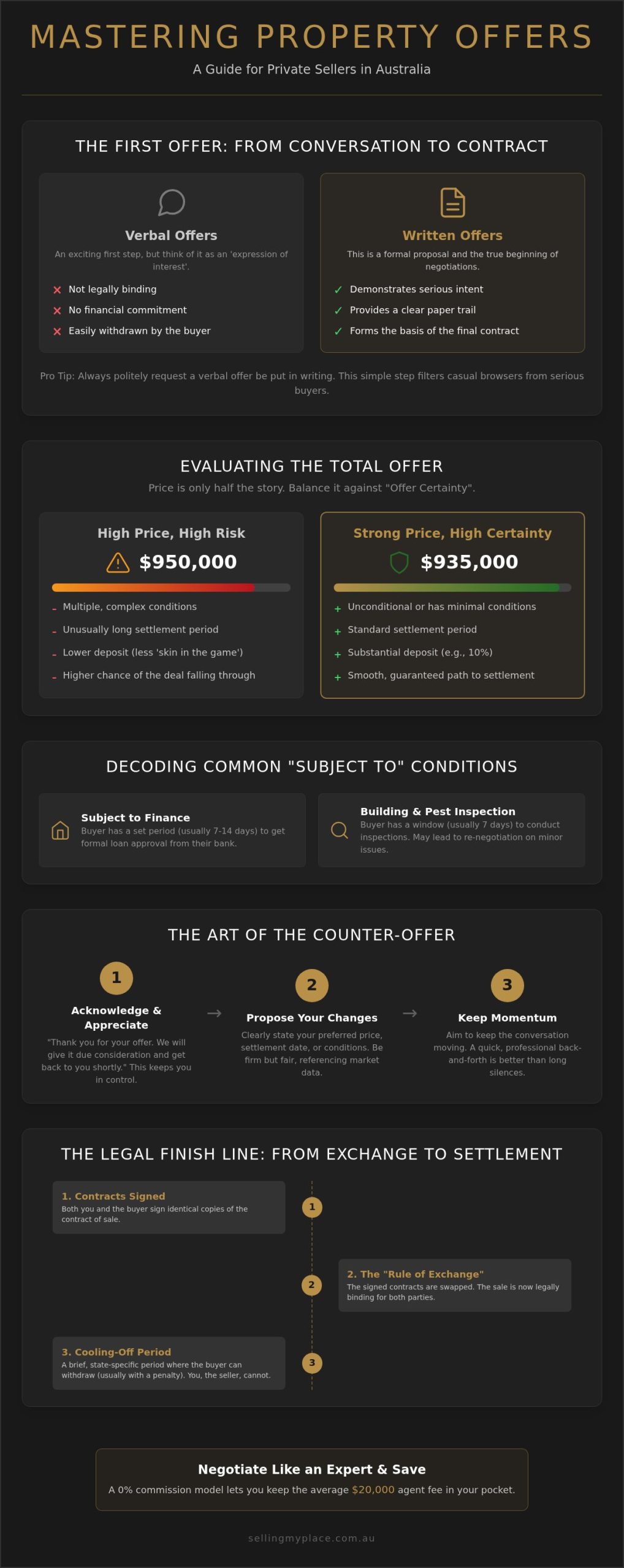
The Legal Finish Line: Contracts, Cooling-Off, and Conveyancing
The handshake is done, the price is agreed, and the emotional weight of the negotiation begins to lift. Now, the focus shifts to the technicalities of the legal finish line. Knowing how to handle offers when selling privately requires a clear understanding of the cooling-off period, which acts as a short safety net for buyers. In New South Wales, Queensland, and the ACT, buyers generally have five business days to change their minds; though this incurs a small penalty, typically 0.25% of the purchase price. In Victoria, it is three clear business days, while South Australia offers just two. Western Australia and Tasmania have no statutory cooling-off period at all.
Having your Conveyance Advice ready before you even open your first inspection ensures you aren’t scrambling when these timelines start ticking. If a buyer does decide to pull out during this window, the applicable penalty fee is usually deducted from their deposit and paid to you. It’s a protection measure that compensates you for the time the property was off the market. Once the cooling-off period expires, or if the sale was unconditional from the start, you can finally update your Residential Property Listing from “Under Offer” to “Sold”. This is a moment to celebrate. It signals to the community that your home has found its next custodian.
Finalising the Contract of Sale
Your solicitor or conveyancer will be your primary partner during this final phase. They ensure every detail you negotiated, from the final price to the inclusion of specific window furnishings, is accurately reflected in the paperwork. They will handle the formal exchange, which is the physical or digital swapping of signed contracts between parties. Once signed and exchanged, the contract is legally binding. This provides the ultimate security for both parties as you move toward the final handover of the keys.
The Settlement Process
The weeks leading up to settlement involve a flurry of administrative tasks, usually managed via digital platforms like PEXA or Sympli. You’ll need to organise your move while the buyer performs a final inspection, typically a few days before the keys change hands. This is their chance to ensure the property is in the same condition as when they first signed. Because you’ve chosen a flat-fee model, the most rewarding part of this process is seeing the final settlement statement. Without a hefty commission eating into your result, you keep every cent of the equity you’ve built over the years. If you’re ready to secure your legal paperwork and start the process, you can book a pre-sale consultation today.
Selling Smarter with the Kincade Agent Advisory Service
Selling your family home is one of life’s most significant transitions. It’s about more than just a transaction; it’s about the memories you’ve built and the future you’re creating. While the process can feel overwhelming, you don’t have to do it alone. The Kincade Agent Advisory Service acts as your professional partner, providing the expertise you need to understand exactly how to handle offers when selling privately. By combining professional Photography and detailed floorplans, we ensure your property makes a stunning first impression. This high-quality presentation doesn’t just attract more eyes; it attracts the right kind of serious buyers who are ready to make competitive offers from day one.
Professional Support Without the Commission
You deserve to keep the equity you’ve worked so hard to build. In a traditional sale, a significant portion of your profit disappears into agency commissions. By choosing a 0% commission model, our clients save an average of $20,000 per sale. That’s a life-changing amount of money that stays in your pocket. Our advisors provide the “steady hand” you need during the negotiation phase, helping you decode complex “subject to” clauses and evaluate the true certainty of every proposal. This partnership approach means you’re always in the driver’s seat, but you have a seasoned expert in the passenger seat to help navigate the tricky turns. It’s the most transparent and empowering way to sell your home in 2026, combining the savings of a private sale with the security of professional backing.
Your Next Steps to a Successful Sale
Ready to take the next step? Getting started is a straightforward and supportive process. Your journey begins with a KIDS marketing package, designed to give your home the professional edge it needs in a competitive market. You’ll gain access to a comprehensive neighbourhood market report, which is essential for setting a price that reflects your home’s true value. We’ve shown you how to handle offers when selling privately, from the first expression of interest to the final exchange of contracts. Now, it’s time to put that knowledge into action. You can move forward with the confidence that your legacy is protected and your financial future is secure. Organise your commission-free listing today and discover how a partnership-based approach can transform your selling experience.
Take Control of Your Property Legacy
Mastering how to handle offers when selling privately is about balancing the technicalities of a contract with the emotional significance of moving on. You now know that a “clean” offer often outweighs a higher, conditional bid and that staying firm but empathetic is the secret to a successful negotiation. By focusing on offer certainty and keeping your legal advice ready, you’ve turned a complex process into a manageable path toward settlement.
You don’t have to navigate this final hurdle alone. Our flat-fee model includes professional photography and floorplans to showcase your home’s true value, alongside an expert Agent Advisory Service to guide your decisions. Best of all, you’ll save an average of $20,000 in commissions, ensuring your hard-earned equity stays with your family. This is about more than just a sale; it’s about starting your next chapter on the best possible footing.
Ready to take the lead? Start your commission-free sale journey with Kincade International Direct Sales and move toward your future with total peace of mind. Your successful sale is just a conversation away.
Frequently Asked Questions
Is a verbal offer legally binding when selling a house privately in Australia?
No, a verbal offer is not legally binding in the Australian property market. It is simply an expression of interest. For a sale to be legally enforceable, both parties must sign a written contract of sale and a formal exchange must occur. This protects you from being locked into a deal before you’ve had the chance to review the terms with your legal advisor. Always ask for offers in writing to confirm the buyer’s seriousness.
What does “subject to finance” actually mean for a seller?
“Subject to finance” is a common condition where the buyer’s obligation to purchase depends on their bank formally approving their home loan. This clause usually specifies a timeframe, often 7 to 14 days. If the bank declines the loan within this period, the buyer can typically withdraw without penalty. Understanding these conditions is a key part of learning how to handle offers when selling privately so you can manage your timeline effectively.
How much deposit should I ask for in a private sale?
A standard deposit in Australia is typically 10% of the total purchase price. While you can negotiate a smaller amount, such as 5%, a higher deposit serves as a strong sign of buyer commitment. This money is usually held in a solicitor’s or conveyancer’s trust account until settlement. A healthy deposit provides you with security, ensuring the buyer has a significant financial stake in seeing the transaction through to completion.
Can I accept a higher offer after I have already said “yes” to someone else?
Legally, you can accept a higher offer until the contracts have been formally signed and exchanged by both parties. However, once you’ve verbally accepted an offer, the buyer will likely start spending money on inspections and legal fees. While “gazumping” is legal in most states, it can damage your reputation as a fair seller. It’s often better to use a “Best and Final” strategy to resolve interest from multiple parties before committing.
How long does the cooling-off period last for the buyer?
The cooling-off period varies significantly across Australia. In New South Wales, Queensland, and the ACT, it is five business days. Victoria offers three clear business days, while South Australia provides two. Notably, Western Australia and Tasmania have no statutory cooling-off period unless specifically written into the contract. Remember, these periods do not apply if a property is sold at auction, where the contract becomes binding immediately upon the fall of the hammer.
Do I need a solicitor if I am selling my home privately?
Yes, you will almost certainly need a solicitor or a licensed conveyancer to handle the legal transfer of title. While you can manage the marketing and negotiation yourself, the legal paperwork and settlement through platforms like PEXA require professional oversight. A legal expert ensures the contract of sale is drafted correctly and that all state-specific requirements are met. This protects your interests and ensures the final handover of your property is legally sound.
What is the best way to reject a low-ball offer without offending the buyer?
The best way to handle a low-ball offer is to remain professional and provide data-backed reasons for your rejection. Instead of a flat “no”, try saying, “We appreciate your interest, but based on recent local sales, we’re looking for an offer closer to our guide.” Providing a counter-offer keeps the conversation moving. This “Steady Hand” approach shows you’re serious about the value of your home while remaining open to a fair negotiation.
How does the Kincade Agent Advisory Service help with negotiations?
The Kincade Agent Advisory Service acts as your professional partner when you are learning how to handle offers when selling privately. Our advisors help you evaluate the “Offer Certainty” of every proposal, looking beyond just the price to the fine print of the conditions. We provide the expert backing you need to negotiate with confidence, ensuring you secure a clean contract while saving an average of $20,000 in traditional agency commissions.
Legal Requirements for Selling a House Privately in Australia: The 2026 Guide
You don’t need a middleman to sign away $20,000 of your hard-earned equity just to move onto your next life chapter. While many feel pressured to hire a traditional agent, selling your own home is a protected legal right in every corner of Australia. We understand that the weight of responsibility can feel heavy; nobody wants to risk a lawsuit or a failed settlement because they missed a state-specific disclosure. Understanding the legal requirements for selling a house privately is the first step toward a confident, successful sale that keeps your profit where it belongs: in your pocket.
It’s natural to feel a bit cautious as property laws become more digital and complex. Whether you’re worried about the mandatory 2026 Edition Contract in NSW or the strict new Seller Disclosure Statements in Queensland, you’re not alone in this journey. This guide provides a clear, professional roadmap to help you handle the 2026 legal landscape with ease. We will preview the essential documents required for each state, explain the updated 15% national withholding tax rules, and show you how to organise a legally sound settlement that protects your family’s future and your legacy.
Key Takeaways
- Confirm your legal right to sell property without an agent in any Australian state, allowing you to take full control of your home’s transition.
- Understand the essential legal requirements for selling a house privately, from preparing the Contract of Sale to providing mandatory vendor disclosures.
- Stay ahead of 2026 regulatory changes, including the new digital-first contract standards in NSW and updated identity verification rules across the country.
- Learn how to manage the exchange and settlement process safely by partnering with professional conveyancing and advisory experts.
- Discover how pre-sale consulting helps you identify and resolve legal or structural issues before they impact your sale price or settlement timeline.
Understanding Your Legal Right to Sell Property Privately in Australia
The idea that you need a real estate agent to sell your home is one of the most persistent myths in the Australian property market. In reality, no state or territory law requires you to use a middleman. You have the absolute right to represent yourself; choosing the “Sale by Owner” path is a legitimate, well-trodden route for thousands of Australians every year. By taking the reins, you’re not just saving on commission. You’re taking full ownership of your family’s transition and financial future.
While you have the freedom to sell, you also carry the weight of professional responsibility. The legal requirements for selling a house privately include a strict duty of care under the Australian Consumer Law (ACL). Essentially, you must avoid any “misleading or deceptive conduct” during your marketing and negotiations. If there’s a structural issue, a boundary dispute, or a known defect, honesty isn’t just the best policy; it’s a legal necessity that protects you from future litigation. We like to think of our role as the “steady hand” beside you. You stay in control of the heart and soul of the sale while we provide the expert advisory infrastructure to ensure every legal detail is handled with precision.
The Role of State Legislation in Property Sales
Property law in Australia is governed at the state and territory level rather than by a single federal body. This means the rules for a sale in one state will differ slightly from those in another. Understanding Your Legal Right to Sell Property Privately requires a look at your local jurisdiction, such as the Sale of Land Act or the Conveyancing Act applicable to your specific region. While the specific forms and certificates change, the core principles of transparency and full disclosure remain the same across the country. Following these local Property Acts ensures your sale stands on firm ground and remains valid from the first inspection through to the final handover.
Why Legal Compliance is Your Best Marketing Tool
Many sellers view legal paperwork as a dry, administrative hurdle to be cleared. We see it differently. A legally robust contract is actually one of your most powerful marketing assets. When potential buyers see a comprehensive disclosure package ready to go, it builds immediate, grounded trust. It shows you’ve been a diligent steward of the property and that you have nothing to hide.
Professional documentation also protects your settlement timeline. By being upfront with all mandatory reports and certificates, you significantly reduce the risk of a buyer “getting cold feet” or finding a reason to withdraw during the cooling-off period. In a 2026 market where buyers are increasingly cautious about high-stakes decisions, providing a smooth, legally sound path to purchase makes your home stand out as a low-risk, high-quality opportunity.
Essential Documents: The Contract of Sale and Vendor Disclosures
The Contract of Sale is the primary legal instrument of your transaction. It’s the document that formally binds you and your buyer together. While it might look like a stack of intimidating fine print, it’s actually a protective shield for both parties. In 2026, many states have moved toward digital-first contracts, such as the mandatory 2026 Edition in NSW, which is designed to streamline the exchange process. Meeting the legal requirements for selling a house privately starts with ensuring this document is current, accurate, and reflects the true state of your property.
Beyond the contract itself, most states require a Vendor’s Statement. A Vendor Statement is a legally binding disclosure of a property’s history and restrictions. In Victoria, this is famously known as a Section 32, while Queensland sellers must now provide a signed Form 2 Disclosure Statement and all prescribed certificates before a contract is signed. These documents ensure the buyer enters the deal with their eyes wide open, which is a vital part of managing legal obligations during a sale.
What Must Be Disclosed to the Buyer?
Transparency is your greatest ally here. You’re legally required to reveal any factors that might affect the property’s value or the buyer’s enjoyment of it. This includes:
- Encumbrances: Any easements, such as a water pipe running through the backyard, covenants, or restrictions on how the land can be used.
- Zoning: Whether the land is residential, commercial, or subject to specific overlays.
- Building Works: Any permits or structural works completed in the last seven years, ensuring they were properly certified.
- Financial Outgoings: A clear breakdown of council rates, water charges, and the 2026 land tax thresholds.
Using professional photography and Residential Property Listing Services ensures your floorplans and property details are perfectly aligned with the physical reality of the home, preventing any claims of misleading conduct.
The Consequences of Non-Disclosure
Cutting corners on disclosures is a risk that simply isn’t worth taking. If a buyer discovers a material fact was hidden or misrepresented, they often have the legal right to rescind the contract immediately. This means they can walk away with their full deposit, even just days before settlement, leaving you back at square one. Beyond a lost sale, you could face significant legal penalties for deceptive conduct. If you’re feeling unsure about which certificates apply to your specific block, it’s always worth reaching out for a bit of expert guidance to keep your sale on the right track.
Navigating State-Specific Regulations and Cooling-Off Periods
While your right to sell is a national constant, the specific legal requirements for selling a house privately change the moment you cross state lines. It’s a bit like local weather; the climate is similar, but you need to know when to pack an umbrella. One of the most significant variations involves the cooling-off period, which acts as a safety net for buyers. In NSW and Queensland, the standard period is 5 business days, whereas Victorian buyers typically have 3 business days to reconsider. If a buyer chooses to withdraw during this time, they forfeit a small portion of the deposit, usually 0.25% in NSW and QLD, or 0.2% in Victoria. In Western Australia, things are a little different, as there’s no mandatory cooling-off period unless you specifically agree to include one in the contract.
Another critical detail often overlooked is the “Warning Statement.” Many jurisdictions require specific, verbatim legal text to be physically present on the front page of the contract. If this statement is missing or obscured, the buyer might gain the legal right to walk away from the deal entirely. Additionally, if your home features a pool or spa, you must ensure a valid safety certificate is attached to the contract. In states like NSW and QLD, selling without a compliant pool fence or the correct certification isn’t just a safety risk; it’s a breach of your legal requirements for selling a house privately that can stall your settlement indefinitely.
Understanding the Cooling-Off Period
Think of the cooling-off period as a statutory “change of heart” clause. It gives the buyer time to finalise their finance or conduct one last building inspection. However, it’s not always set in stone. In NSW, a buyer can waive their right to a cooling-off period by providing a “66W certificate” signed by their solicitor. This is often used in fast-moving markets to make an offer more attractive to a seller. Understanding these nuances helps you manage expectations and ensures you don’t celebrate a “sold” sign before the legal window has officially closed.
The Auction Exception
The rules of engagement shift significantly when you move from a private treaty to an auction. Generally, properties sold under the hammer, or even within a few days on either side of a scheduled auction, carry no cooling-off period at all. This creates a “done deal” the moment the hammer falls, but it also requires stricter compliance with “Bidders Records” and public auction rules. Choosing to move forward with selling your own home via private treaty often allows for more heartfelt, flexible negotiations that auctions sometimes lack. You can take the time to find a buyer who truly values the legacy of your home, rather than just the highest bidder in a high-pressure environment.
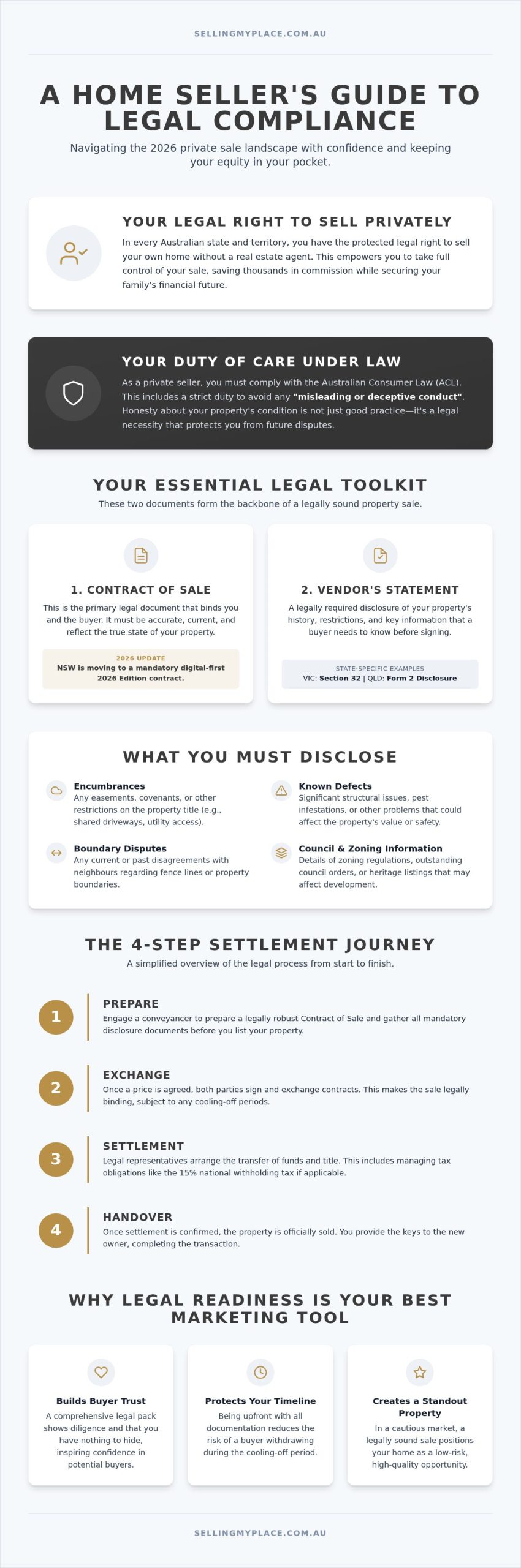
The Settlement Journey: Managing Legal Obligations from Exchange to Handover
Once you’ve accepted an offer and the handshakes are finished, you enter the “exchange of contracts” phase. This is the pivotal moment when your agreement becomes a binding legal reality. The buyer pays their deposit, which is typically 10% of the purchase price. In a private sale, this money must be held in a solicitor’s or licensed agent’s trust account for safekeeping until the deal is finalised. Meeting the legal requirements for selling a house privately means ensuring these funds are handled with total transparency, protecting both your interests and those of the buyer as you move toward the finish line.
The period between exchange and settlement is the home stretch of your sale. It’s a time for finalising paperwork and preparing for the physical move. While the initial marketing and negotiation are in your hands, the final legal transfer requires a specialist touch. This stage is about precision. It’s about ensuring every “i” is dotted and every “t” is crossed so that the ownership transition is as smooth as a quiet Sunday morning. If you’re feeling the weight of these final steps, reach out to our advisory team for expert guidance on managing your settlement timeline.
The Role of Your Conveyancer or Solicitor
While you can market your home, a licensed conveyancer must legally perform the transfer of title. They act as your legal representative in the digital sphere, handling the electronic lodgement through platforms like PEXA. This is mandatory in most Australian states in 2026. Your conveyancer also calculates the final “adjustments.” They work out the pro-rata split for council rates, water charges, and land tax, ensuring you aren’t paying for services after you’ve handed over the keys. This mathematical accuracy is essential for a clean, undisputed settlement.
Preparing for the Handover
The final week of a sale is often filled with a mix of packing and nostalgia. Legally, you’re required to provide “vacant possession” on the settlement date unless your contract specifically includes an existing tenancy. This means the property must be empty, tidy, and all rubbish removed. It’s also the time for the buyer’s final inspection. They have a statutory right to visit the property, usually within a few days of settlement, to ensure it’s in the same condition as when they signed the contract. They’ll check that the inclusions you agreed upon, like that specific chandelier or the dishwasher, are still in place. Managing this transition with a sense of calm and professional decorum ensures the legacy of your home is passed on with grace and goodwill.
How Kincade International Direct Sales Simplifies the Legal Process
Selling your home is a deeply personal transition, and while the legal side can feel a bit daunting, you don’t have to walk that path alone. We believe that every Australian should have the right to sell their own property with the confidence of a seasoned professional. Our Real Estate Advisory Services act as a vital bridge; they give you the autonomy of a private sale with the expert backing typically reserved for high-end agencies. By partnering with us, you’re ensuring that the legal requirements for selling a house privately are met with a steady hand and a meticulous eye for detail.
Our Pre-Sale Property Consulting is designed to catch potential legal or structural hiccups before they ever reach a buyer’s solicitor. We help you look at your home through a regulatory lens, identifying things like uncertified works or boundary questions that could otherwise derail a settlement. When we provide professional photography and detailed floorplans, we aren’t just making your listing look beautiful. We’re providing the visual proof that supports your mandatory disclosures, ensuring your marketing is as honest as it is inviting. This proactive approach reduces the stress of high-stakes decision-making and allows you to focus on the emotional significance of your move.
The most rewarding part of this partnership is the financial freedom it creates. By removing the traditional agency commission, our sellers save an average of $20,000. This is a significant sum that stays where it belongs: in your pocket, ready to fund your next chapter or secure your family’s legacy. We provide the professional infrastructure, you keep the profit.
Expert Backing for Every Private Seller
You’ll have access to comprehensive neighbourhood market reports, giving you a price point that is both realistic and legally defensible during negotiations. Our global marketing network ensures your property is “Listed Until Sold,” providing a sense of security that doesn’t come with a ticking clock. Having a “Steady Hand” advisor by your side means you can navigate the emotional highs and lows of negotiation with a grounded, calm perspective. We’re here to ensure you feel understood and protected throughout the entire journey.
Starting Your Commission-Free Journey
Taking control of your sale is a powerful way to honour the legacy of your home while embracing a new future. We invite you to look through our flat-fee packages, which incorporate essential conveyance advice to keep your journey legally sound from start to finish. You deserve a sale process that is as respectful and rewarding as the time you’ve spent in your home. It’s time to move forward with confidence and clarity. Explore our commission-free marketing and advisory packages today.
Step Into Your Next Chapter with Confidence
You’ve now seen that the legal requirements for selling a house privately are entirely manageable when you have the right roadmap in place. By taking charge of your own sale, you’re choosing a path that respects both your property’s legacy and your financial future. Remember, while the paperwork requires precision, you don’t have to navigate the 2026 landscape alone. From preparing the mandatory disclosures to finalising the digital settlement, the process is designed to protect your interests just as much as the buyer’s.
Why hand over a massive chunk of your equity when you can keep it? Our sellers save an average of $20,000 per sale by opting for our commission-free, flat-fee model. With our Expert Agent Advisory Service included, you get the professional safety net you need without the high marketing costs. Save thousands in commission—sell your home with Kincade International Direct Sales today.
You’ve built a life in your home; now it’s time to reap the full rewards of that hard work. We’re here to be the steady hand that guides you home.
Frequently Asked Questions
Do I legally need a real estate agent to sell my house in Australia?
No, you don’t need a real estate agent to sell your home in any Australian state or territory. The law protects your right to represent yourself as a private vendor. While you must still meet the same legal requirements for selling a house privately as an agency would, you have total control over the marketing and negotiation. Many families find this path more rewarding, both emotionally and financially, as they move toward their next chapter.
What is a Section 32 and is it required for a private sale?
A Section 32, also known as a Vendor Statement, is a mandatory legal document in Victoria that must be provided to a buyer before they sign the contract. It doesn’t matter if you’re selling with an agent or doing it yourself; the requirement remains the same. This statement discloses vital information like land use, outgoings, and easements. It’s a key part of ensuring your sale is transparent and legally binding under Victorian law.
Can I write my own Contract of Sale for a property?
While you could technically draft a document, it’s highly recommended to use a legally compliant template or have a professional prepare it. In states like NSW, the mandatory 2026 Edition Contract for Sale is the required standard for all transactions. Using a professionally drafted contract ensures you’re meeting the legal requirements for selling a house privately without leaving yourself open to technical errors that could allow a buyer to walk away from the deal.
How long is the cooling-off period for a private house sale?
The length of the cooling-off period depends entirely on your property’s location. In NSW and Queensland, buyers generally have 5 business days to change their minds, while in Victoria, the period is 3 business days. It’s important to remember that these periods only apply to private treaty sales, not auctions. Knowing these timelines helps you manage the emotional transition of the sale with a clear, grounded perspective on when the deal is final.
What happens if I make a mistake in the legal disclosures?
If you provide incorrect information or fail to disclose a material fact, the buyer may have the legal right to rescind the contract. This often means they can exit the sale and have their full deposit returned, even shortly before the settlement date. In some cases, you could also face legal penalties for misleading conduct. This is why having a steady hand and expert advisory backing is so valuable for private sellers who want to avoid these high-stakes risks.
Is the process of settlement different when selling without an agent?
The settlement process itself remains exactly the same whether you use an agent or sell privately. Your solicitor or conveyancer will still use the PEXA platform to handle the electronic transfer of title and the distribution of funds. The only difference is that you’ve managed the marketing and negotiation yourself. You still get the same professional security during the final handover, ensuring the legal transition of your home is smooth, certain, and celebratory.
Can a buyer waive their cooling-off rights in a private sale?
Yes, a buyer can choose to waive their cooling-off rights, which is often done to make their offer more competitive in a fast-moving market. In NSW, this is achieved through a 66W certificate signed by the buyer’s solicitor. In other states, specific forms or contract conditions may be used to achieve the same result. This can provide you with more certainty earlier in the process, though it’s a decision the buyer must make with their own legal advice.
Who holds the deposit when I sell my house privately?
The deposit must be held in a secure trust account, usually managed by your solicitor or conveyancer. Legally, you cannot hold the deposit in your personal bank account. This ensures the funds are protected for both parties until the settlement is successfully completed. Once the handover is finished, the trust account manager will release the funds to you, minus any agreed adjustments for rates or taxes. It’s a simple, secure way to handle the final financial exchange.
For Sale By Owner: 2026 Australian Seller’s Guide
Did you know that the average Australian seller now saves roughly $20,000 in commissions by stepping away from the traditional agency model? It is a life-changing amount of equity that belongs in your pocket, not someone else’s bank account. However, the secret to achieving a record-breaking result without an agent isn’t just about sticking a sign in the front garden. It’s about leveraging professional for sale by owner marketing packages that put your home in front of the same high-quality buyers the big franchises target.
Selling your family home is an emotional journey, and it’s completely normal to feel a bit of a flutter when thinking about the legal paperwork or the technical side of digital listings. You want the world to see your property in its best light while ensuring every detail is handled with care. This guide will show you how to select a marketing strategy that provides the professional polish of a top-tier agent with the expert support you need to feel confident at every step. We will explore the essential components of a successful 2026 campaign, from high-end photography to managing the latest market shifts, ensuring you keep every cent of your hard-earned profit.
Key Takeaways
- Learn why the shift toward “Direct Sales” allows you to lead your own campaign with the same professional tools and global reach as elite agencies.
- Identify the non-negotiable visual assets in for sale by owner marketing packages, like professional floorplans, that are essential for capturing buyer attention in 2026.
- Understand how expert advisory services provide a vital safety net, offering the guidance you need for complex negotiations without the burden of commissions.
- Discover the “listed until sold” advantage, which removes the ticking clock of traditional agency agreements and lets you wait for the perfect offer.
- Realise the long-term financial benefits of a flat-fee model and how keeping your full sale profit can significantly accelerate your next property goal.
The Evolution of For Sale By Owner Marketing Packages in 2026
The concept of For Sale By Owner has matured into a sophisticated “Direct Sales” model. It’s no longer just about putting a sign in the front yard and hoping for the best. In 2026, homeowners are reclaiming their equity by moving away from traditional 2% or 3% commission structures that often feel transactional and disconnected. Instead, they’re choosing a partnership that values their home’s story. With the leading property portals in Australia seeing over 37 million visits monthly, the market is purely digital-first. This shift means that modern for sale by owner marketing packages are designed as a professional infrastructure, providing you with everything from global reach to high-end visual assets.
Why 2026 is the Year of the Direct Seller
Information is the great equaliser. Today, sellers have unprecedented access to property data and market trends, making them the most informed participants in the transaction. You don’t need a middleman to tell you what your suburb is doing; you can see it for yourself. This transparency, combined with the availability of professional-grade tools like high-end floorplans and photography, has made 2026 the year of the empowered seller. By opting for a flat-fee model, you protect your hard-earned equity against economic shifts. It’s a grounded, practical way to ensure your family’s financial legacy remains intact while you transition to your next chapter.
The Difference Between a Listing and a Marketing Strategy
There’s a common misconception that simply being “on the portals” is enough to secure a record price. While visibility is crucial, a true marketing strategy goes much deeper. It involves crafting a narrative that resonates with the right buyer, whether they’re just around the corner or searching from overseas. High-quality for sale by owner marketing packages now incorporate global marketing networks to capture international interest, which is a significant factor in the current Australian landscape. Kincade International Direct Sales bridges this gap, offering a “steady hand” through our Agent Advisory Service. We provide the professional polish of a traditional agency but with a heartfelt, partnership-based approach that keeps you in control. It’s about having the expert support to handle complex moments while you focus on the emotional significance of your move.
What’s Inside a High-Performance Marketing Package?
Selecting the right tools for your sale is about more than just ticking boxes. It is about creating a professional presence that commands respect from savvy buyers. While some basic options might offer a simple listing, premium for sale by owner marketing packages are designed to provide a comprehensive infrastructure. This includes a global marketing network that reaches far beyond local portals, capturing the attention of international investors who are increasingly active in the Australian market. By casting a wider net, you increase the competition for your home, which is the most reliable way to drive up the final sale price.
One of the most reassuring aspects of this modern approach is the “Listed Until Sold” advantage. Traditional agency agreements often come with a 90-day expiry, which can create a sense of panic as the deadline approaches. We believe your home deserves better than a rushed decision. Without the pressure of a ticking clock, you can maintain a sense of calm confidence, knowing your property will remain visible until the perfect buyer arrives with the right offer.
Visual Storytelling: Photography and Floorplans
In a digital-first market, your property’s first “open home” happens on a smartphone screen. Professional photography is non-negotiable because it translates the emotional warmth of your living spaces into a compelling visual narrative. Equally important are accurate floorplans, which provide the structural clarity buyers need to feel confident. They help a family visualise their life within your walls, turning a casual browser into a serious lead. High-quality visuals act as a silent salesperson, significantly reducing the time a property spends on the market by filtering for highly motivated buyers before they even step through the door.
Data-Driven Pricing: Neighbourhood Market Reports
Setting the right price is often the most stressful part of the process. It’s easy to fall into the “emotional pricing” trap, where your memories and hard work inflate the figure beyond what the current market will support. To avoid this, we provide detailed Neighbourhood Market Reports that ground your expectations in reality. By analysing recent sale data for similar properties in your immediate area, you can learn how to determine market value of a home in Australia with clinical accuracy. This data-driven approach allows you to be ambitious yet realistic, ensuring you don’t scare off buyers with an inflated starting point or leave money on the table. If you feel you need a second pair of eyes on your strategy, you can always reach out to our advisory team for a steady hand during this critical phase. Choosing between for sale by owner marketing packages should ultimately feel like choosing a partner who provides the clarity and support your family needs.
Beyond the Listing: Why Expert Advisory is the Missing Link
While the digital listing gets your property in front of buyers, the real magic happens in the quiet moments of negotiation and strategy. Many homeowners feel a flicker of anxiety when they think about the technical side of a transaction. It’s the “what if” that often holds people back. This is why the most effective for sale by owner marketing packages in 2026 are no longer just about software; they are about providing a safety net. Our Agent Advisory Service acts as that steady hand, ensuring you have professional backing when things get complex. You aren’t just using a platform; you’re entering a partnership that values your peace of mind as much as your profit.
Having an expert to lean on changes the entire dynamic of a sale. It transforms the process from a stressful DIY project into a managed professional campaign. With 86% of sellers using a dedicated private sale platform achieving their asking price or higher, the data shows that the right support leads to superior outcomes. It’s about having the confidence to stand your ground during negotiations, knowing you have a seasoned advisor in your corner to help you navigate the nuances of buyer representation and offer management.
The Power of Pre-Sale Property Consulting
Success is often decided before the first photo is even taken. Pre-sale property consulting helps you identify high-ROI minor renovations that can significantly increase your final sale price. Should you refresh the kitchen cabinetry or focus on the street appeal? An expert advisor helps you make these decisions with clarity, preventing you from over-capitalising on the wrong projects. We focus on creating an inviting atmosphere that resonates with the hearts of buyers from the moment they walk through the door. This strategic preparation ensures you don’t make costly mistakes in those vital first two weeks of the listing, when buyer interest is at its absolute peak.
Navigating Legalities: Conveyance and Advisory
Contracts and settlement are often viewed as the “scary” parts of a property transaction. However, with the right guidance, these steps become manageable milestones rather than hurdles. Expert conveyance advice is essential for ensuring every T is crossed and every I is dotted, protecting your interests throughout the legal journey. This professional oversight provides the reassurance you need for a smooth sale by owner experience. By simplifying the paperwork and providing a clear roadmap to settlement, we help you focus on the excitement of your next move while we handle the technical heavy lifting.
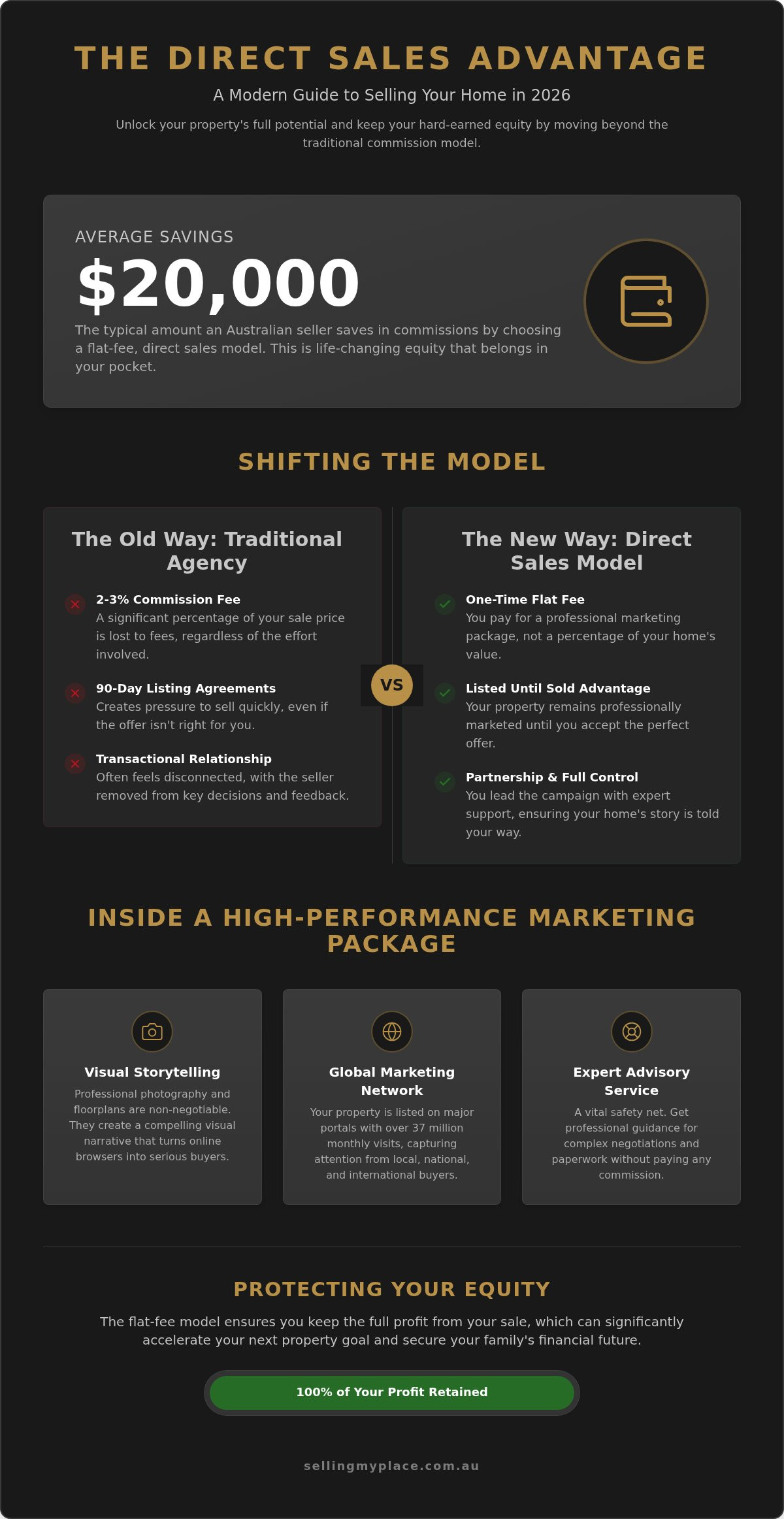
The Financial Logic: Protecting Your Equity with a Flat-Fee Model
The decision to sell your home is often the largest financial transaction of your life. It’s a moment where every dollar counts toward your future stability and your family’s goals. When you look at the ROI of high-quality for sale by owner marketing packages, the logic becomes clear. While a traditional agent might ask for a 2.5% commission, that percentage translates to a significant chunk of your hard-earned equity. On a typical Australian home, this often means walking away with $20,000 less than you deserve. Why should a stranger receive such a large portion of your life’s work?
Traditional agencies frequently layer on hidden costs that catch sellers off guard. You might find yourself paying extra marketing levies, auctioneer fees, or administration charges on top of that hefty commission. By contrast, a flat-fee model offers complete transparency. It allows for genuine wealth preservation through a 0% commission guarantee. You keep the full sale profit, ensuring your family’s financial legacy remains exactly where it belongs. This is about more than just numbers; it’s about the freedom to choose your next step without compromise.
The $20,000 Advantage: Where the Savings Go
Imagine what an extra $20,000 could do for your next chapter. It might mean a substantial mortgage reduction on your new property or the ability to fund those lifestyle upgrades you’ve always dreamed of. Keeping this equity safe also provides a vital buffer if market conditions shift during your transition. When comparing the flat-fee real estate model to percentage-based fees, the difference isn’t just a number. It’s a tangible boost to your purchasing power. This financial breathing room allows you to move forward with a sense of calm and security, knowing you haven’t overpaid for a service you can manage yourself with the right support.
Avoiding Marketing “Add-on” Traps
It’s tempting to look for the cheapest entry point, but “budget” options often lead to frustrating gaps. Some platforms offer low headline prices only to charge extra for the very things that make a listing successful. A truly professional package should be all-inclusive. You want a strategy that covers high-end photography and floorplans without a ticking clock. Our “listed until sold” promise ensures your budget is spent on assets that actually drive clicks and enquiries, rather than just keeping a listing active for a few weeks. If you’re ready to see how much equity you can protect, book a consultation with our advisory team today to discuss your custom strategy. We believe your hard work should pay off for you, not your agent.
Launching Your Sale: How to Organise Your Direct Sales Strategy
Launching your property is a moment of immense pride. It marks the culmination of your preparation and the start of a journey toward your next home. To ensure the process feels like a steady progression rather than a frantic race, we follow a methodical four-step strategy designed for maximum impact. Choosing the right for sale by owner marketing packages is just the beginning; the real success lies in the execution of your launch strategy.
- Step 1: Conduct a thorough property audit with an expert advisor to identify your home’s unique selling points.
- Step 2: Execute professional photography and floorplans to capture the home’s essence and create a digital gateway for buyers.
- Step 3: Go live on major Australian portals and our global marketing network simultaneously for maximum reach.
- Step 4: Manage enquiries and inspections with the ongoing support of a dedicated advisory service.
This structured approach ensures that no detail is overlooked. By the time your listing goes live, you’ll feel prepared, informed, and ready to welcome potential buyers into your home’s story.
Setting the Stage for Success
The 48 hours before your listing goes live are critical. We provide a checklist to ensure your home is “camera ready,” focusing on small details like fresh flowers and clear surfaces that make a big difference in person. When that first influx of buyer enquiries arrives, you’ll be ready to handle them with confidence. Remember, you’re the world’s leading expert on your own home. Positioning your property as a “must-see” in its category isn’t about sales talk; it’s about sharing the lifestyle your home offers with genuine warmth and local knowledge.
The Partnership Approach to Closing the Deal
When it comes to the negotiation phase, data is your strongest ally. You can use your Neighbourhood Market Reports to justify your asking price with clinical accuracy, showing buyers exactly how your home compares to recent local sales. It’s a grounded way to handle tough questions without getting caught in an emotional tug-of-war. If you hit a particularly tricky patch, you can always lean on your Agent Advisory Service for final contract tweaks or strategic advice. Once the offer is accepted, we’ll guide you through finalising the settlement, leaving you free to celebrate your commission-free success and focus on the exciting move ahead.
Reclaim Your Equity and Start Your Next Chapter
Selling your family home is a significant life transition that deserves both professional precision and heartfelt care. Throughout this guide, we’ve seen how modern for sale by owner marketing packages provide the elite infrastructure needed to compete with traditional agencies while keeping you in the driver’s seat. By leveraging a global marketing network and professional visual assets, you ensure your property stands out to the right buyers, whether they’re searching from just around the corner or from overseas.
You don’t have to navigate the complexities of negotiation or contracts alone. With an Expert Agent Advisory Service included, you gain the confidence of a seasoned partner without the burden of high commissions. Saving an average of $20,000 per sale isn’t just a number; it’s a deposit on your next dream or a boost to your retirement nest egg. It is about moving forward with clarity, security, and the peace of mind that comes from a job well done.
Keep 100% of your profit and sell smarter with Kincade International Direct Sales. You’ve worked hard for your home, and we’re here to help you protect every cent of its value as you step into your future.
Frequently Asked Questions
What exactly is included in for sale by owner marketing packages?
These packages provide a professional infrastructure for your sale. They include professional photography and floorplans to capture your home’s essence, along with listings on leading property portals. Beyond the visuals, you receive a Neighbourhood Market Report for accurate pricing and access to a global marketing network. Most importantly, an expert advisory service is included to guide you through the technical and emotional stages of the transaction.
Will my property appear on the major Australian property portals with these packages?
Yes, your property will be showcased on Australia’s leading real estate websites and search platforms. These sites are the primary destination for millions of monthly visitors, and our packages ensure your listing occupies prime digital real estate. By appearing where the vast majority of buyers are searching, you gain maximum exposure while keeping 100% of your hard-earned profit. It is about being seen by the right people at the right time.
How much can I actually save by selling my own home in Australia?
Sellers typically retain an average of $20,000 in equity that would otherwise be lost to commissions. This saving is based on the typical commission rates currently found across the Australian market. By opting for a flat-fee service, you protect your hard-earned profit, allowing those funds to be redirected toward your next property purchase or lifestyle goals. It is a practical and empowering way to preserve your family’s wealth.
Is professional photography really necessary for a private sale?
High-quality photography is the most critical element of your digital presence. Since most buyers find their next home online, your images act as the first “open home.” Professional shots capture the emotional appeal and light of your property, which significantly increases enquiry rates. When paired with detailed floorplans, these visuals build immediate trust and help filter for the most serious and motivated buyers before they even arrive for an inspection.
What happens if my property doesn’t sell within 90 days?
Our “listed until sold” promise ensures your property remains active on the leading portals for as long as it takes. Unlike traditional 90-day agency agreements that can create unnecessary pressure, we provide a stress-free environment for our partners. You can wait for the perfect buyer who truly understands the value of your home, ensuring you never feel forced to accept a lower offer just because a clock is ticking in the background.
Do I need a lawyer or conveyancer if I use a marketing package?
Yes, a licensed legal professional is required to manage the formal transfer of title and settlement. While for sale by owner marketing packages handle the strategic and promotional side of the sale, the legal work must be performed by a conveyancer or solicitor. We provide expert conveyance advice to help you select the right professional and ensure the contract stage proceeds smoothly and securely for all parties involved in the transition.
Can I still get help with negotiations if I am selling privately?
Absolutely, and this is where our Agent Advisory Service becomes your greatest asset. We provide expert guidance during the offer stage, helping you interpret buyer feedback and stand firm on your price. Having a “steady hand” to consult during these high-stakes moments ensures you achieve the best possible outcome. You retain full control of the sale while benefiting from professional, authoritative strategic support that reduces the typical stress of closing a deal.
How does the global marketing network help sell my Australian home?
The network broadens your reach to international buyers and Australian expats who may not be searching local portals daily. This global visibility creates a more competitive environment for your home, which is essential for driving a premium result. By presenting your property to a worldwide audience, you tap into a diverse pool of motivated buyers who are actively seeking quality Australian residential opportunities for their future stability and lifestyle.
Floor Plan Costs: A Guide for Australian Sellers
Would you buy a car without looking under the bonnet, or a book with half the pages missing? For many Australian buyers, a property listing without a floor plan feels just as incomplete. When you’re weighing up the cost of floor plan for selling house, it’s easy to view it as just another line item in a mounting list of marketing expenses. We know it’s stressful to manage a sale on your own; you want to look professional and attract the right people without feeling like you’re being overcharged at every turn.
It’s a common worry, but providing a clear layout is actually one of the kindest things you can do for a potential buyer. You’ll learn how these drawings serve as a vital spatial narrative that helps high-value families “move in” mentally before they ever step through your front door. This guide explores current market expectations, the psychological impact of layout on buyer confidence, and why a professional floor plan is a non-negotiable part of keeping more of your hard-earned equity during a smart, commission-free sale.
Key Takeaways
- Learn why a floor plan acts as the essential spatial bridge for buyers, correcting the visual distortions often found in wide-angle real estate photography.
- Identify which layout style-2D, 3D, or a full site plan-best suits your property’s unique features and appeals most to your target demographic.
- Understand the legal and financial risks of DIY drawings and how the cost of floor plan for selling house is a minor investment compared to protecting your professional reputation.
- Master the art of listing placement to ensure your layout appears exactly when a buyer needs to see it, turning casual scrollers into highly qualified leads.
- Explore how leveraging a flat-fee service provides you with top-tier marketing assets and expert guidance without the burden of traditional agency commissions.
Beyond the Photos: Why Floor Plans are Essential for a Successful Sale
A marketing floor plan is a scaled, simplified diagram of a residential property’s layout and spatial flow. It serves as the essential spatial map that turns a house into a relatable home for a prospective buyer. While professional photography captures the emotion and light of your home, it can sometimes be misleading. Wide-angle lenses, while great for showing off a renovated kitchen or a spacious alfresco area, often distort the actual distance between rooms. The floor plan provides the spatial narrative that anchors these images in reality, giving buyers the context they crave. It bridges the gap between simply seeing a house and truly understanding how it functions as a home.
When you’re calculating the cost of floor plan for selling house, it’s helpful to view it as a tool for efficiency. It significantly reduces inspection fatigue by allowing buyers to qualify the property before they commit to a physical visit. This means the people who attend your open home aren’t just tyre-kickers; they are individuals who already know the layout suits their lifestyle, making your sale process much more streamlined.
The Buyer’s Mental Move-In
Australian families use floor plans to begin the emotional process of moving in. They look at the dimensions to see if their heirloom dining table fits or if the work-from-home nook is sufficiently separated from the noise of the living area. This is particularly crucial for multi-generational households where privacy and flow are top priorities. Statistics suggest that roughly 1 in 5 buyers will skip a listing entirely if it doesn’t include a clear layout. Providing this information is a gesture of transparency that builds immediate trust with your audience. It allows them to measure the distance between bedrooms in metres and plan their daily routines before they’ve even picked up the keys.
The Statistics of Spatial Marketing
To truly understand What is a Floor Plan? in the context of a modern sale, we have to look at how buyers behave online. Listings with floor plans receive significantly higher engagement on major Australian property portals. There is a documented correlation between high-quality spatial marketing and a reduction in “days on market.” For interstate buyers or those moving across the country, a professional layout is the primary tool that gives them the confidence to make a serious offer. When you consider the cost of floor plan for selling house, the value lies in attracting those high-quality, decisive buyers who are ready to act quickly. By removing the guesswork, you’re not just selling a structure; you’re offering a clear vision of a future lifestyle. This clarity is what drives higher offers and leads to a more certain result.
The Anatomy of a High-Impact Floor Plan: 2D, 3D, and Site Plans
Choosing the right visual format is about understanding who your buyer is and what they value most in a home. For a compact apartment, a clean 2D plan might be all you need to show the flow. For a sprawling family estate, you likely need a site plan to explain the garden’s relationship to the house. When you’re weighing up the cost of floor plan for selling house, remember that these assets are foundational marketing investments that establish the professional standard of your listing. Transparency is your greatest ally here. Every plan should include clear room dimensions, total square meterage, and a North-facing indicator. In Australia, solar orientation is a massive selling point for energy efficiency and natural light. It’s also vital that the aesthetic of your plan complements your professional photography to maintain a cohesive, premium brand for your listing.
Standard 2D Plans: The Non-Negotiable Foundation
A high-quality 2D plan is the bread and butter of property marketing. You can choose between the stark clarity of black-and-white lines or the inviting warmth of textured colour plans. For Australian homes, it’s essential to clearly mark the “Great Australian Dream” features. This includes decks, pergolas, and alfresco areas where buyers imagine spending their summer evenings. If you’re selling to an investor, highlighting the Net Lettable Area (NLA) helps them calculate potential returns immediately. It’s about providing the data they need to say “yes” faster without any ambiguity.
3D Renders and Virtual Walkthroughs
As we move through 2026, technology like Matterport has become a standard expectation for premium listings. 3D renders are perfect for properties with complex layouts, such as mezzanine levels or high-pitched ceilings that a flat drawing just can’t capture. These interactive tools allow buyers to “walk through” the home on their smartphones, which is a game-changer for qualifying leads before they ever book an inspection. If you’re unsure which tech fits your specific property, you can always reach out to our advisory team for a quick chat about your marketing strategy.
The Site Plan: Context is Everything
A site plan shows the home in relation to its boundaries, driveways, and easements. This context is vital for larger suburban blocks or regional properties where land use is a primary concern. It allows buyers to see the room for a future pool or perhaps a secondary dwelling (Subject to Council Approval). Showing the “bones” of the land helps a buyer justify the price and see the long-term potential of the legacy they’re buying into. When you provide this level of detail, you aren’t just selling a house; you’re selling the future possibilities of the entire block.
Professional Drafting vs DIY: Protecting Your Equity and Reputation
While it’s tempting to try and trim the upfront cost of floor plan for selling house by sketching it yourself, the risks to your reputation and equity are substantial. A floor plan isn’t just a drawing; it’s a legal representation of your property’s dimensions. Misleading spatial information can lead to disputes or even legal challenges if a buyer feels they’ve been misinformed about the total living area. By aligning your marketing materials with expert Conveyance Advice, you ensure that every detail of your listing is transparent and defensible. Laser measurements provided by professionals build immediate trust, eliminating those nagging doubts that can stall a sale during an open home. It’s about providing a clear, honest foundation that allows buyers to commit with their hearts and their heads.
The Pitfalls of DIY Measurement
Most homeowners don’t account for wall thicknesses, chimney breasts, or the exact depth of built-in alcoves. These small errors add up, resulting in a total square metreage that doesn’t match reality. Beyond the numbers, hand-drawn sketches often use non-standard symbols for wet areas, windows, and doors. This “unprofessional” look can subtly signal to a buyer that the entire sale process might be amateurish. When a buyer arrives and finds the master suite is significantly smaller than your sketch suggested, trust is lost instantly. It’s much harder to negotiate a premium price once a prospect feels they have to double-check your claims. We want your buyers to feel they’re in safe hands from the very first click.
The Value of CAD Precision
Computer-Aided Design (CAD) ensures every centimetre is accounted for with mathematical precision. This level of detail allows you to compete directly with top-tier boutique agencies that never settle for “near enough.” Digital plans are also incredibly flexible. If you decide to perform a minor pre-sale renovation, such as removing a non-load-bearing wall to create an open-plan kitchen, a digital file is easily updated without needing a full redraw. This precision is a vital part of the cost of floor plan for selling house because it prevents the “valuation gap” that occurs when buyers perceive a property as smaller than advertised. Investing in professional drafting means your listing looks polished and reliable, reflecting the care you’ve put into your home over the years.
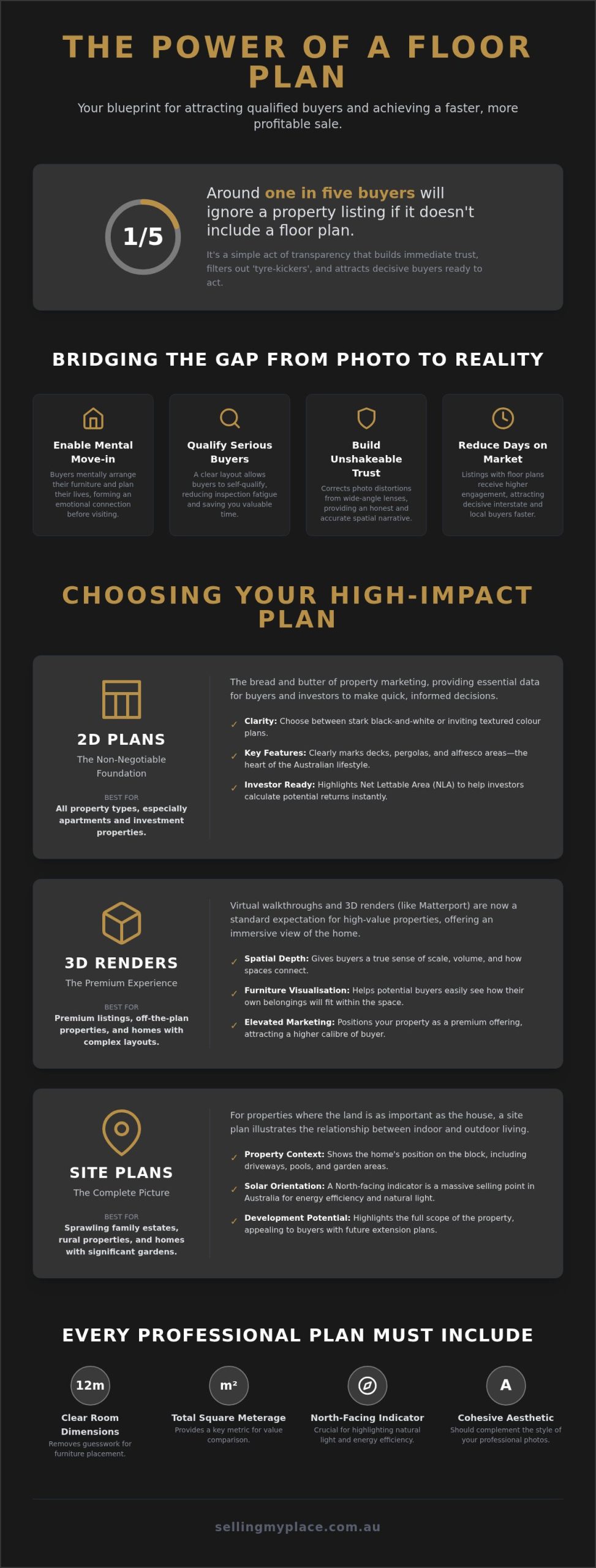
Strategic Marketing: Floor Plans for Higher Offers
How do you transform a casual scroller into a committed buyer? It’s often about where you place the map. While your hero image captures the heart, the floor plan captures the logic, and in the digital carousel, timing is everything. We recommend making your floor plan the second or third image in your online gallery. This allows a buyer to orient themselves immediately after seeing the facade or the main living area. When assessing the cost of floor plan for selling house, it’s vital to look at it through the lens of strategic asset placement. If you’re managing a Sale by owner, this professional touch is exactly what signals to buyers that they’re dealing with a serious, well-prepared seller.
Social media offers another brilliant stage for your layout. You can use cropped sections of your plan to highlight specific lifestyle features, such as a secluded “parent’s retreat” or an integrated home office. It turns a flat drawing into a story about how your home supports a modern life. The modest cost of floor plan for selling house pays dividends when your listing achieves a higher quality score on property portals, keeping you at the top of the search results for longer.
Digital Integration and Mobile Optimisation
With 80% of property searches now occurring on smartphones, your floor plan must be legible on a small screen. A cluttered or low-resolution DIY sketch will simply be ignored. Professional plans ensure that room names and dimensions remain clear even when pinched and zoomed. By linking these interactive plans to your Neighborhood Market Reports, you provide a data-rich experience that helps buyers justify their offer based on both the home’s layout and the local area’s value. It’s about building a narrative of stability and worth.
Physical Marketing and Signboards
Including a floor plan on your street-front signboard is a clever way to filter out “tyre-kickers” before they even ring your doorbell. It ensures that those who do request an inspection are already satisfied with the basic flow of the home. Inside the house, provide high-quality “printable” floor plans for buyers to take away. After a long day of looking at half a dozen properties, your home can easily blur into the next. A clear, physical layout acts as a memory anchor, helping your property stand out when the family sits down at their kitchen table to discuss their options. If you’re ready to elevate your property’s presence, you can start planning your marketing strategy with our team today.
Selling Smarter: Professional Floor Plans in a Commission-Free Model
Many sellers worry that by stepping away from a traditional real estate agent, they’ll lose access to the high-end marketing tools that drive premium results. That simply isn’t the case. In fact, a flat-fee model allows you to secure the exact same world-class collateral, including professional photography and laser-accurate drafting, without sacrificing a massive chunk of your home’s value to a commission. When you look at the cost of floor plan for selling house through this lens, it’s not just a marketing expense; it’s a strategic investment in your financial independence. We’ve seen that Australians can save an average of $20,000 by taking this path, keeping 100% of their sale profit while still presenting a listing that competes with the country’s top-tier agencies.
The “Kincade International Direct Sales” approach is built on a partnership. We combine these professional floor plans with our expert advisory services to ensure you’re never navigating the process alone. You get the steady hand of a seasoned expert who understands the local landscape, paired with the practical tools needed to attract high-value buyers. It’s a way to sell with heart and intelligence, focusing on your family’s future rather than a transactional fee. You don’t need a traditional agent to access premium marketing; you just need the right support system to help you tell your home’s story.
Protecting Your Equity through Strategic Marketing
Calculating your return on investment is a powerful way to reduce the stress of selling. A small upfront cost of floor plan for selling house is a minor fraction of the typical 2% to 3% commission an agent might charge. By investing in superior marketing yourself, you often attract more competitive offers because your property is presented with total transparency and professional polish. This empowered sale process gives you peace of mind, knowing you’ve done everything possible to showcase your home’s legacy while protecting your hard-earned equity. It turns a complex life transition into a celebratory milestone where you remain in control of the outcome.
Next Steps for Your Empowered Sale
Getting started is simpler than you might think. You can easily organise your professional photography and floor plan session through our established network of experts. To prepare your home, we recommend ensuring all rooms are accessible so the drafting accurately reflects your property’s best features, from the sun-drenched alfresco area to the quiet study nook. Once your floor plan is ready, our advisory support helps you transition from a prepared seller to a successful closer. Professional floor plans are a cornerstone of modern Residential Property Listing Services, providing the clarity buyers need to make their move with confidence.
Your Path to a Successful, Empowered Sale
Selling your home is a significant life transition, and we believe you deserve to feel supported every step of the way. We’ve seen how a professional layout serves as the vital spatial bridge for your buyers, helping them visualise their future within your walls. By opting for a high-impact 2D or 3D plan, you don’t just provide data; you build the trust and clarity that leads to higher offers. While the upfront cost of floor plan for selling house is a minor investment, its role in protecting your equity and professional reputation is truly immense.
You don’t have to sacrifice your hard-earned profit to traditional commissions to get world-class results. Our flat-fee bundles include professional floor plans and photography, paired with our Expert Agent Advisory Service, helping Australians save an average of $20,000. You have the power to present a premium listing while keeping your legacy intact. We’re here to provide the steady hand and expert tools you need to move forward with confidence and peace of mind.
Start Selling Smarter with a Professional Marketing Package
Frequently Asked Questions
Do I really need a floor plan if my house has a very simple layout?
Yes, you definitely do. Even a simple layout needs a professional drawing to confirm exact room dimensions and the relationship between spaces. Buyers use these plans to determine if their existing furniture will fit, which is a major part of the mental “move-in” process. When you consider the cost of floor plan for selling house, remember that providing this clarity reduces inspection fatigue and attracts more qualified leads to your door.
What is the difference between an architectural blueprint and a marketing floor plan?
Architectural blueprints are complex technical documents used for construction, showing structural elements, plumbing, and electrical wiring. In contrast, a marketing floor plan is a simplified, scaled diagram designed for buyers. It focuses on the lifestyle flow, room names, and key features like alfresco decks or sunrooms. It’s meant to be easily readable on a smartphone screen while still providing accurate measurements for potential residents who want to understand the home’s daily function.
Can I draw my own floor plan to save on marketing costs when selling my home?
While you could draw your own, it’s generally not recommended for a premium sale. DIY sketches often lack laser precision, which can lead to awkward questions if a buyer finds a room is smaller than you claimed. Professional drafting provides the polished, authoritative look that buyers expect from a high-value listing. It’s a small investment that protects your reputation and ensures you don’t undermine the perceived value of your home during negotiations.
How long does it typically take to get a professional floor plan drafted for a listing?
You can usually expect your final digital files within 24 to 48 hours of the site visit. A professional technician will typically spend 30 to 60 minutes onsite using laser measuring tools to capture every nook and cranny. The data is then processed through CAD software to create a clean, accurate layout. This quick turnaround ensures your marketing campaign can launch without unnecessary delays, keeping your sale momentum high and your stress levels low.
Will a floor plan help sell a property that is in need of major renovations?
Yes, a floor plan is arguably more important for a “fixer-upper.” It allows builders and renovators to see the structural potential without being distracted by cosmetic issues. While they consider the cost of floor plan for selling house, they are actually looking for the layout’s potential for future growth. It turns a daunting renovation into a manageable project with a clear, logical starting point for their vision of a dream home.
Should I include furniture in my floor plan or keep it as a clean “blank canvas”?
We generally suggest a clean, “blank canvas” approach for most Australian listings. This allows buyers to visualise their own lives and furniture within the space without distraction. If you do include furniture, keep it minimal and use it only to demonstrate the scale of particularly large or unusually shaped rooms. The goal is to provide enough detail to be helpful without cluttering the spatial narrative you’re trying to tell to your potential buyers.
Are floor plans a legal requirement for real estate listings in Australia?
Floor plans aren’t a strict legal requirement in Australia, but they are effectively a standard industry expectation. Providing one is a proactive step toward total transparency. It helps protect you from potential disputes regarding room sizes or property features later in the settlement process. In a competitive market, omitting a plan can make buyers suspicious or lead them to skip your listing in favour of one that provides more detail about the home’s layout.
What is the most popular floor plan format for Australian buyers in 2026?
In 2026, the 2D full-colour plan remains the gold standard for most Australian residential sales. It offers a warm, inviting aesthetic while maintaining the mathematical clarity of a black-and-white drawing. Many sellers are now pairing these with a basic site plan to show the home’s position on the block. This combination provides the “full picture” that today’s energy-conscious and lifestyle-focused buyers are looking for during their initial property search on major portals.
Free Online Property Valuation: How Accurate Are They in 2026?
What if the number you just saw on a free online property valuation is actually $28,800 away from your home’s true worth? It’s a common scenario in 2026, where a 7.2% error rate on off-market properties can lead to significant confusion and the very real fear of underselling your most valuable asset. We understand the anxiety that comes with conflicting estimates; it’s hard to feel confident about your future when the digital data seems to change depending on which website you’re visiting.
You deserve to move forward with total clarity and a sense of calm. This guide will help you discover the truth behind automated property estimates and show you how to use that digital data to secure the best possible sale price for your Australian home. We’ll explore the latest 2026 accuracy benchmarks, explain why on-market data is more reliable than off-market guesses, and provide you with the tools to establish a realistic price range. By the end, you’ll have the confidence to manage your own sale and keep your hard-earned equity where it belongs.
Key Takeaways
- Learn how to treat a free online property valuation as a helpful data-driven compass rather than a definitive final sale price.
- Discover the specific “invisible factors” that algorithms often overlook, ensuring you don’t undervalue your home’s unique features or recent improvements.
- Master the technique of cross-referencing multiple digital tools to establish a realistic price floor and gain the confidence to lead your own sale journey.
- Understand how accurate market data allows you to sidestep traditional agent commissions and protect your family’s hard-earned equity.
- Explore how upgrading to a Neighborhood Market Report provides the professional-grade insights needed to secure a premium result with total peace of mind.
What is a Free Online Property Valuation?
When you’re standing in your kitchen, perhaps enjoying a morning flat white and thinking about the next chapter of your life, a free online property valuation is often the very first place your journey begins. It’s a digital starting line that offers a glimpse into your home’s potential without needing to tidy up for an unannounced visitor. While it feels like a simple search result, you’re actually interacting with a complex Automated Valuation Model (AVM). An AVM is a statistical tool that processes millions of data points to predict market value with mathematical precision.
It’s helpful to distinguish these estimates from other figures you might encounter. A bank valuation is typically conservative, focused on lender risk rather than your profit. A real estate appraisal is a human-led estimate, often influenced by the desire to secure a listing. An online estimate, however, acts as a neutral data-driven snapshot based on recent local sales and your property’s core characteristics. It provides a grounded starting point, helping you move from uncertainty toward a structured plan for your lifestyle transition.
The Role of Big Data in Australian Real Estate
Algorithms don’t just look at what happened yesterday; they analyse a decade of historical sales to identify long-term patterns in your suburb. In the Australian market, “Comparable Sales” (or “Comps”) are the lifeblood of these systems. The computer identifies properties similar to yours in land size, internal floor area, and bedroom count that have recently changed hands nearby. By weighing these “comps” against current market velocity, the algorithm calculates a price range. It’s a purely mathematical approach to a very personal asset, stripping away the noise to look at the cold, hard numbers.
Why Sellers Start with Online Estimates
The primary appeal of a free online property valuation is the lack of pressure. You can explore your options privately, without the intensity of a formal listing presentation or the feeling that you’re being pushed into a quick sale. Many homeowners use these tools to assess their equity, which is a vital step when deciding if you’re ready for a sea change or an investment upgrade. It’s about finding an objective figure to balance the deep emotional attachment we all have to our family homes. Having a realistic number in hand provides a sense of calm, allowing you to visualise your future state with confidence rather than guesswork.
The Science Behind the Screen: How Estimates are Calculated
Peering behind the digital curtain reveals a sophisticated engine room of data. When you request a free online property valuation, the algorithm begins by pulling the structural basics of your home: land size, internal floor area, and the all-important bedroom and bathroom count. These are the fixed variables, but the real intelligence lies in how the software weights recency. In our fast-moving 2026 market, a sale that settled yesterday carries significantly more weight than a similar property sold six months ago. This is because algorithms are programmed to track suburb-wide growth trends and “days on market” averages in real-time to sense the current heat of the local area.
However, these systems have a distinct blind spot. They see the box, but they don’t always see the beauty. While these models are highly advanced, research from the Brookings Institution highlights that automated systems can sometimes miss the mark when local nuances or unique architectural features aren’t perfectly captured in the raw data. If your home boasts a bespoke jarrah deck or a high-end kitchen renovation, the algorithm might categorise you simply as “renovated” without understanding the premium quality of the materials used.
Weighting Factors in the Algorithm
Software quantifies location proximity with ruthless efficiency. It measures the exact distance to amenities like train stations, parks, and schools, assigning a mathematical value to convenience. There’s often a tug-of-war between “Street Appeal” and “Land Value” in these calculations. While we might fall in love with a charming facade, the algorithm often prioritises the raw land size and zoning potential. Many tools now provide a “Confidence Score” alongside the estimate. This score is actually more important than the price itself; it tells you how much comparable data is available. A low score suggests the algorithm is guessing, while a high score means it has plenty of recent evidence to back its claim.
Data Sources: Where the Information Comes From
Most free online property valuation tools draw their power from government land registries and historical listing portals. This provides a solid foundation, but it’s not always instantaneous. There is often a lag time of several weeks between a sale occurring at auction and the official settlement data being processed by the state registry. To bridge this gap, some models incorporate user-submitted data. If you’ve recently updated your home, you can often “claim” your property on these portals to update the facts. If you’re feeling unsure about how your home’s specific upgrades are being weighed by the data, reaching out for a friendly chat can help provide the clarity you need to move forward.
Algorithm vs. Reality: Why Online Estimates Can Miss the Mark
While a free online property valuation provides a helpful ballpark, it fundamentally lacks the human eye required to judge quality. Algorithms are excellent at counting bricks and measuring land, but they’re terrible at feeling the atmosphere of a home. An Urban Institute study highlights how data-driven models can struggle with qualitative nuances, sometimes reinforcing local disparities because they cannot account for the tangible love and care poured into a property. We know your home is more than just a set of coordinates on a map; it’s a collection of memories and carefully chosen finishes that a computer simply cannot process.
Then there’s the “Outlier Effect.” If a neighbour sells their home in a desperate hurry, or if two emotional buyers get into a bidding war over a specific view, that single data point can skew the entire suburb average. A computer sees the price tag but doesn’t know the story behind it. Relying solely on a screen when setting your reserve price is a risky move. It doesn’t account for current buyer heat or the specific market sentiment on auction day. Without that human context, you might find yourself anchored to a number that doesn’t reflect the true competitive nature of the local market.
The Five Things an Algorithm Cannot See
The software often misses the sensory details that drive a buyer’s heart and ultimately their budget. These invisible factors often dictate whether a home sells for a standard price or a suburb record. They include:
- The specific orientation of the home and how natural light floods the living areas during a winter afternoon.
- Nuisance factors such as proximity to main roads or power lines which can dampen an otherwise strong valuation.
- The “wow factor” of high-end internal finishes and the quality of a professional renovation.
- The psychological pull created by expert Photography in attracting premium buyers to your listing.
- The functional flow and spatial clarity provided by accurate floorplans.
When Online Valuations are Most (and Least) Accurate
Accuracy is usually highest in “cookie-cutter” estates where every house is similar in age and style. In these areas, the algorithm has plenty of identical data points to work with. However, accuracy drops significantly for unique heritage homes or properties in rural areas with low transaction volumes. If the data is thin, the algorithm might “hallucinate,” generating a number that has completely lost touch with the ground reality. Recognising when the data is unreliable is the first step in protecting your equity and ensuring you don’t leave money on the table during your sale.
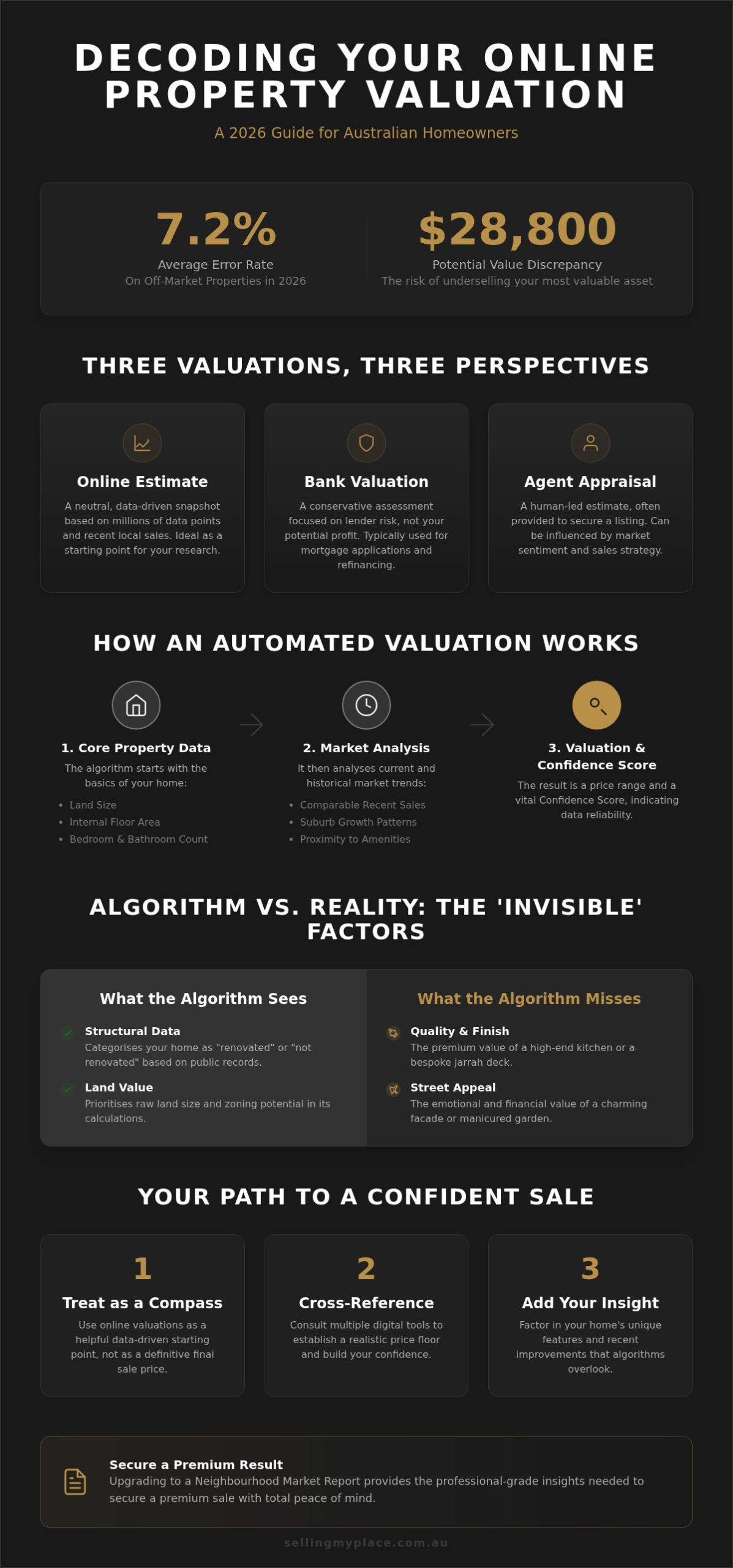
Using Your Valuation to Maximise Your Sale Price
Once you’ve received your free online property valuation, the real strategy begins. It’s helpful to view this number as your “floor” rather than your “ceiling.” It represents the minimum value the market expects based on raw data, but your goal is to build upon that foundation through smart presentation and timing. By cross-referencing estimates from three or four different digital tools, you can find a reliable median that filters out any single algorithm’s quirks. This balanced approach is a core part of how to determine the market value of a home in Australia, blending digital efficiency with a sensible reality check.
When you’re ready to list, consider whether a “Price Guide” or a “Fixed Price” better suits your suburb’s current energy. A guide often invites more conversation and competition, while a fixed price offers clarity for buyers who want to move quickly. The choice often depends on how much “buyer heat” is currently present in your specific street.
Bridging the Gap with a Neighborhood Market Report
A basic web search only tells you what has happened in the past. A Neighborhood Market Report acts as the “pro version” of a free online property valuation, telling you what is happening right now. It allows you to look closely at active competitor listings to see exactly what features buyers are prioritising this week. By identifying these “sweet spots” where demand is high but supply is low, you can position your home to stand out as the obvious choice for a premium buyer.
Pre-Sale Consulting: The Human Advantage
Data can’t tell you that a $500 tin of paint and a weekend of garden mulching might add $5,000 to your final result. Our Pre-Sale Property Consulting focuses on these high-return minor repairs that often yield a 10x return on investment. De-cluttering and staging also play a huge role in the psychological “buy-in” for visitors, making the space feel like their future home rather than someone else’s history. Professional advice transforms a static data point into a dynamic, profitable sale strategy.
Ready to see how your digital data stacks up against a professional sale strategy? Get in touch with our team today to start your commission-free journey with confidence.
The KIDS Approach: From Valuation to Commission-Free Success
Most websites treat a free online property valuation as a digital hook, designed to reel you in and hand you over to a traditional real estate agent. These agents then ask for a 2-3% commission, which can feel like a heavy price to pay for a service you’re increasingly equipped to handle yourself. We believe that once you have the data, you have the power. By choosing Residential Property Listing Services, you’re opting for a modern, commission-free alternative that puts you back in the driver’s seat of your own sale. It’s a partnership where we provide the tools and you keep the reward.
On average, our clients save $20,000 in commissions. That’s a significant sum that stays in your pocket, perhaps to fund your next deposit or simply to secure your family’s future. We also remove the ticking clock often associated with real estate listings. Our “Listed Until Sold” promise means you can test the market and wait for the right buyer without the stress of expiring contracts or mounting marketing fees. It’s a calmer, more methodical way to achieve a premium result. You shouldn’t feel rushed when making such a major life transition.
Keeping Your Equity Safe
The maths of a sale by owner is refreshingly simple: 0% commission equals 100% of the profit for you. While the idea of managing your own sale might seem daunting at first, you aren’t doing it alone. You’ll have access to professional advisory services to help you navigate the legalities, including essential Conveyance Advice to ensure the settlement process is smooth and secure. There’s a deep sense of peace that comes from being in total control of your financial legacy. You know your home better than anyone, so why not be the one to tell its story? It’s about protecting your equity and your family’s future with a steady hand.
Taking the Next Step
If you’ve spent time researching your free online property valuation and feel ready for something more substantial, it’s time to request a Neighborhood Market Report. This report moves you beyond the “just curious” phase and makes you truly market-ready. It provides the granular, local insights that algorithms often miss, giving you the professional edge needed to negotiate with confidence. We’re here to act as your seasoned guides, helping you translate data into a successful sale. Don’t just settle for a generic online number. Take the lead, secure your profit, and start your next chapter with the financial freedom you deserve.
Take Control of Your Next Chapter
Your home is likely your greatest financial asset, and moving on to your next adventure should be a time of excitement rather than anxiety. While a free online property valuation provides a useful digital compass, it’s the refined strategy and local expertise that ultimately lead you home. By combining the latest market data with professional pre-sale consulting, you ensure that no dollar of your hard-earned equity is left on the table. You’ve worked hard for your home; you deserve to keep the reward.
Choosing a commission-free path doesn’t mean going it alone. With our global marketing network and Expert Agent Advisory included in every package, you have a steady hand guiding you through every step of the process. Owners who partner with us save an average of $20,000 in commissions; money that belongs in your pocket for your future. It’s about more than just a sale; it’s about honouring your legacy and transitioning with total peace of mind. Are you ready to see what’s truly possible for your property?
Secure your equity and sell commission-free with Kincade International Direct Sales today and move forward with the confidence you deserve.
Frequently Asked Questions
How accurate are free online property valuations in Australia?
Accuracy depends on whether your home is currently listed. For properties on the market in 2026, the median error rate is often under 2%. However, for off-market homes, the discrepancy can climb significantly higher. These tools rely on “comparable sales” and public data, meaning they work best in suburbs with high turnover and many similar houses. In rural areas or for unique builds, the accuracy naturally starts to drop.
Why is there such a big difference between different online estimates?
Discrepancies exist because every platform uses a unique algorithm that weights data points differently. One website might prioritise government land registry data, while another focuses more on recent listing prices from real estate portals. These varied “recipes” for calculation mean you’ll often see a range of prices. It’s best to look at multiple sources to find a realistic median for your home’s potential value.
Can a bank valuation be lower than an online property estimate?
It’s very common for a bank valuation to come in lower than a digital estimate. This happens because banks are focused on risk mitigation rather than achieving a premium sale price. They want to know what the property would sell for in a forced sale scenario. An online estimate, by contrast, is trying to predict what a motivated buyer might pay in an open, competitive market.
How do I update the information used in my online property valuation?
You can usually update your property’s details by “claiming” the home on the specific website providing the estimate. This allows you to correct the number of bedrooms or bathrooms and add details about recent renovations. Updating these facts helps the free online property valuation tool refine its calculation. It ensures the algorithm isn’t working with outdated information from ten years ago when you first bought the place.
Do I still need a professional appraisal if I have an online estimate?
Yes, you should still seek expert advice before making a final decision on your sale price. An online tool can’t see the quality of your new stone benchtops or feel the natural light in your living room. A professional appraisal provides the human context that data misses. It helps you understand the “buyer heat” in your street and how to position your home for a premium result.
Will a free online valuation affect my credit score?
No, checking your property’s estimated value online will not affect your credit score in any way. These searches are considered “soft” enquiries that don’t involve a credit application. You can check as many different sites as you like without worrying about your financial standing. Only “hard” enquiries, which happen when a lender reviews your credit file for a loan, will show up on your report.
How often should I check my property value estimate?
Checking your estimate once every three months is usually enough to keep an eye on your equity. Property is a long-term asset, so watching the numbers too closely can be stressful. Suburb trends often take months to show up clearly in the data. A quarterly check-in gives you a grounded view of how your local market is performing without getting caught up in minor weekly fluctuations.
What is the best way to get a formal property valuation for a sale?
The most effective way to get a formal, actionable valuation for a sale is to request a Neighborhood Market Report. This provides a much deeper level of insight than a basic free online property valuation. It combines digital data with a detailed analysis of active competitors in your area. This professional approach gives you the confidence to manage your own sale and keep your hard-earned equity for yourself.
Private House Sales Australia: The Comprehensive 2026 Seller’s Guide
What if the most expensive mistake you make this year isn’t the price you set for your home, but the $20,000 you hand over to someone else just for selling it? In 2026, the traditional path of paying a 2.65% commission is no longer the only way to achieve a premium result. More homeowners are taking the reins through private house sales australia, discovering that they can maintain total control without sacrificing that polished, professional edge. It’s a shift towards keeping your hard-earned equity where it belongs, right in your own pocket.
We understand that your home is more than just an asset; it’s the heart of your family’s story. It’s natural to feel a bit of trepidation about managing the process yourself or worrying that a private listing might look less than stellar. You deserve the savings without having to compromise on quality or legal security. This guide will show you how to master the private sale process, keeping 100% of your commission while achieving a result that rivals any traditional agency. We’ll walk you through the latest 2026 identity verification laws, professional marketing strategies, and the expert advisory steps that ensure a smooth, confident settlement.
Key Takeaways
- Learn how a commission-free, flat-fee model can save you an average of $20,000 while maintaining a professional-grade property listing.
- Discover how private house sales australia leverage high-calibre marketing assets, like professional photography and floorplans, to attract premium buyers without high agency costs.
- Understand the value of a data-driven Neighborhood Market Report to ensure your home is priced competitively for the 2026 landscape.
- Explore the “steady hand” approach of Agent Advisory Services, providing you with expert support throughout the settlement process to reduce stress.
- Identify high-ROI home improvements through pre-sale consulting to ensure your property stands out in an increasingly crowded market.
Private House Sales Australia: The 2026 Landscape
Selling a family home is a significant life transition, often filled with decades of memories and hopes for the future. In 2026, the way we approach this milestone has shifted. Private house sales australia have evolved from a niche alternative into a mainstream choice for homeowners who value both their equity and their autonomy. At its core, a private sale is a direct exchange between the seller and the buyer, facilitated by professional-grade marketing rather than a traditional commission-based agent. It is about reclaiming the narrative of your move.
Why are so many Australians moving away from the standard 2% to 3% commission model? It often comes down to a desire for transparency and a refusal to lose $20,000 or more in fees that could otherwise fund a retirement or a child’s education. By utilising modern digital infrastructure, you can now access the same buyer networks once reserved for large franchises, ensuring your home is seen by the right people at the right time. The Australian property market has matured, and with that maturity comes the empowerment of the individual seller.
Why Direct Sales are Surpassing Traditional Agency
The shift toward owner-led negotiations is driven by a simple truth: no one knows the unique charm of your home better than you do. You can speak to the afternoon sun in the kitchen or the quietness of the street with a level of sincerity an agent simply can’t match. Technology has levelled the playing field, providing professional tools that make your listing indistinguishable from an agency-managed one. This rise in direct sales infrastructure means you’re no longer “going it alone”; you’re simply choosing a more efficient, modern partnership that prioritises your profit over an agent’s commission.
The Legal Framework for Private Sales in Australia
It’s a common misconception that you need an agent to sell residential property. In reality, every Australian homeowner has the legal right to sell their own home privately. While the process is straightforward, it must be grounded in sound legal practice. Engaging professional Conveyance Advice is essential to ensure all vendor disclosure requirements are met. Selling privately doesn’t mean you’re operating without a safety net. It simply means you’re the one in the driver’s seat, supported by the right experts at the right moments to ensure a secure, compliant transaction.
The Mechanics of a Successful Commission-Free Sale
Success in private house sales australia relies on a transparent, flat-fee structure that puts you back in control of your finances. Unlike the traditional commission model, where you’re essentially penalised for having a higher property value, this modern approach treats the sale as a professional service. You pay once for the high-calibre marketing and advisory tools you need, and you keep every cent of the final sale price. This clarity removes the guesswork and the hidden costs that often cloud the selling experience.
One of the most reassuring aspects of this model is the “List Until Sold” philosophy. Traditional agency agreements often come with a stressful 90-day ticking clock, creating a sense of urgency that might not serve your family’s best interests. By removing these arbitrary deadlines, you can wait for the right buyer who truly values your home’s unique story. It’s about selling with a sense of calm confidence rather than under the pressure of an expiring contract. If you’re ready to see how this partnership works, you can speak with our team about your specific goals.
Professional Marketing vs. DIY Listings
There’s a significant difference between “selling it yourself” and utilising a professional infrastructure. In 2026, a listing that looks amateur is a listing that gets overlooked. High-quality Photography acts as the digital front door to your property, creating that vital first emotional spark. When you pair those evocative images with accurate floorplans, you provide serious buyers with the spatial logic they need to fall in love with the layout. This level of polish ensures your home is presented with the dignity it deserves, avoiding the “cheap” look of low-quality, owner-taken photos.
Leveraging Global Reach
The private sale process in Australia has expanded far beyond the local neighbourhood. Our property remains a highly desirable asset on the international stage, attracting significant interest from ex-pats and overseas investors. By plugging into a global marketing network, your home is visible to buyers in London, Singapore, and beyond who are searching for the stability and lifestyle our country offers. This global digital infrastructure ensures you aren’t just waiting for a local buyer; you’re inviting the world to appreciate your home’s value.
Flat-Fee vs. Percentage Commission: The True Cost
When you sit down to calculate the potential return on your property, the numbers often tell a startling story. In the world of traditional real estate, a 2.5% commission on a $1 million home equates to $25,000. Once you add GST, that figure climbs to $27,500. This is money that effectively vanishes from your family’s balance sheet the moment the contract is signed. For those exploring private house sales australia, this realisation is often the catalyst for change. Why should the cost of selling your home increase simply because your property’s value has grown?
Traditional agencies frequently layer additional costs on top of this commission, often referred to as a “marketing levy” or advertising fee. This means you aren’t just paying for the agent’s time; you’re also footing the bill for their brand’s visibility. In contrast, a transparent flat-fee model provides a single, clear payment for professional listing services. You receive the high-calibre photography and floorplans needed to attract premium buyers, but you retain 100% of the final sale price. It’s a straightforward partnership where you pay for the work performed, not a percentage of your home’s legacy.
Calculating Your Potential Equity Savings
Visualising your net profit is about more than just digits on a screen. It’s about what that $20,000 or $30,000 saving represents for your next chapter. It could be the budget for a high-end kitchen renovation in your new place, a significant reduction in your next mortgage, or a well-deserved boost to your retirement nest egg. For families planning for future support, Aged Care Made Easy offers a comprehensive directory to explore care options. The Commission Gap is the unnecessary cost of traditional middle-management that often fails to provide proportional value in a modern, digitally-connected market. Keeping this equity gives you a stronger foothold for whatever comes next.
Beyond the financial gain, there’s a profound psychological benefit to the flat-fee approach. You’ll never feel the subtle pressure to “drop the price” just so an agent can secure a quick turnover and move on to their next listing. Since you’ve already covered the service fee, the timeline is entirely yours to command. This model offers complete transparency in all marketing expenditure, ensuring you know exactly where every dollar goes. There’s a grounded sense of calm that comes from knowing you’re in total control of the process, supported by experts who respect your bottom line as much as you do.
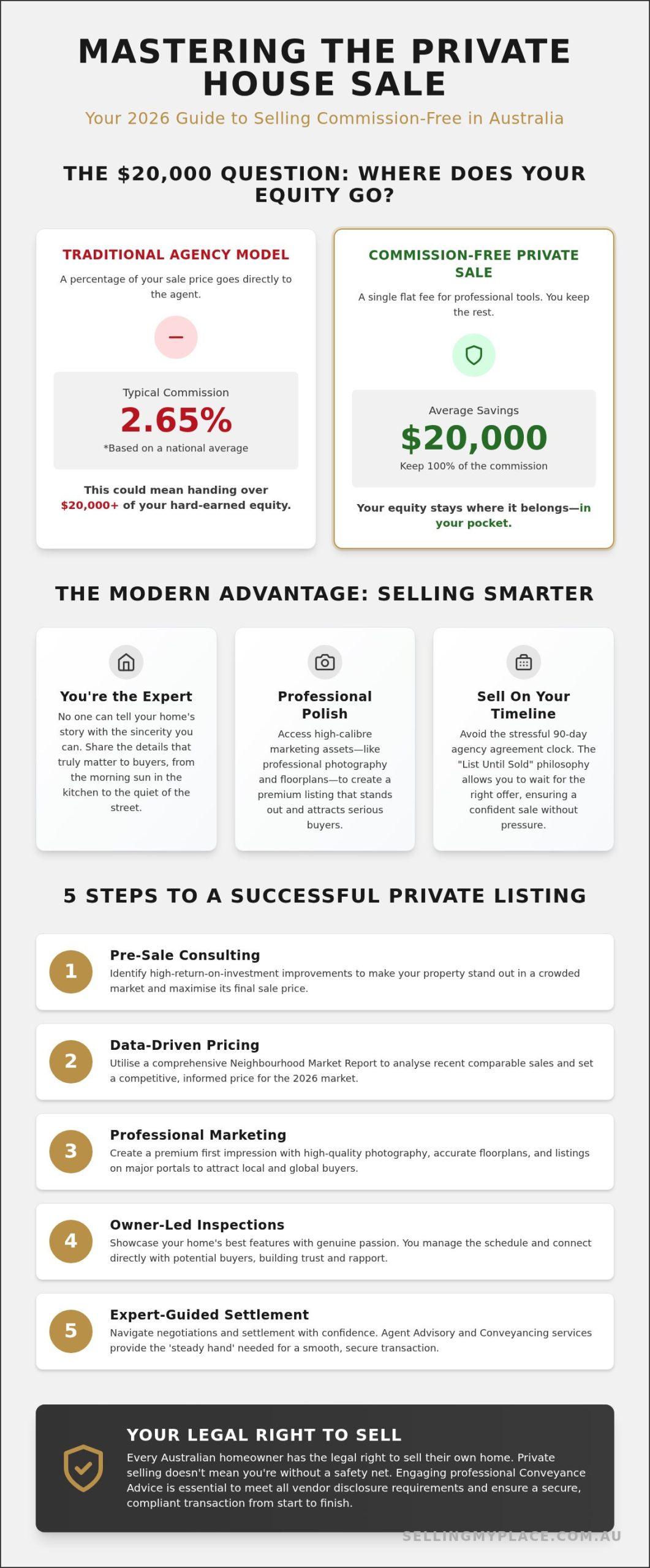
5 Essential Steps to Organise Your Private Listing
Approaching your sale with a methodical plan transforms the process from a daunting task into a series of manageable, rewarding milestones. Success in private house sales australia isn’t about luck; it’s about preparation. By following a structured path, you ensure that every detail of your home’s legacy is respected while maximising your financial return. It’s about being proactive rather than reactive.
- Step 1: Start with a data-driven Neighborhood Market Report. This removes the guesswork and helps you understand exactly where your property sits in the current local landscape.
- Step 2: Engage Pre-Sale Property Consulting. A fresh set of expert eyes can identify high-ROI improvements, such as minor repairs or styling tweaks, that significantly boost buyer appeal.
- Step 3: Arrange professional photography and floorplans. As we discussed earlier, these are your digital front door; they must be flawless to capture serious interest.
- Step 4: Write a compelling narrative. Don’t just list features; tell the story of the lifestyle your home offers, from the quiet morning coffee spot to the garden perfect for family gatherings.
- Step 5: Launch on major property portals. Use a dedicated dashboard to manage enquiries, ensuring you never miss a potential buyer while maintaining total control over your schedule.
If you’re feeling unsure about where to begin your journey, you can contact our advisory team for a personalised starting point.
Pricing for Success in the 2026 Market
Setting the right price from day one is the most critical factor in a smooth sale. You might feel tempted to “test the market” with a higher figure, but in 2026, buyers are more informed than ever. Overpricing can lead to your listing becoming “stale,” causing savvy buyers to wonder what’s wrong with the property. Using a guide on how to determine market value of a home in Australia allows you to set a price grounded in reality. When buyers ask about the price, you can confidently point to recent comparable data, showing them you’re a serious and fair seller.
Managing Inspections and Negotiations
Conducting your own open homes is a wonderful opportunity to share your genuine passion for the property. Keep the atmosphere welcoming and professional; offer a simple brochure and allow visitors the space to imagine their own lives in the rooms. When it comes to the business side, applying property sale negotiation tips ensures you remain the “steady hand” in the room. You don’t have to be a shark to get a great result. If a negotiation feels complex or emotional, that’s the perfect time to lean on your Agent Advisory Service for professional backing without the commission-based pressure.
The Kincade Advantage: Selling Smarter, Together
Entering the market without a traditional agent shouldn’t mean you’re left to figure it out on your own. At Kincade International Direct Sales (KIDS), we view ourselves as the steady hand in your journey, offering a partnership that respects the emotional weight of moving on from a family home. We’ve built a model for private house sales australia that replaces high-pressure tactics with professional support, ensuring your legacy is protected while your equity stays with you. It’s about moving forward with a sense of security and a clear path to your next chapter.
Expert Backing for Every Australian Seller
Our Agent Advisory Service is the cornerstone of this approach. It provides you with a professional safety net, giving you access to the same level of expertise you’d expect from a top-tier agency, but without the commission-based conflicts of interest. We believe that professional guidance should be a supportive resource, not a financial burden. By integrating conveyance advice and pre-sale property consulting into one cohesive experience, we reduce the stress of complex legal and marketing decisions. You don’t have to be an expert in property law or digital advertising to get a great result; you just need the right people in your corner.
Think of us as a nurturing guide who understands your community roots and family needs. We’re here to help you move through the settlement phase with absolute calm and confidence, providing answers when you need them and stepping back when you’re ready to lead. This balance ensures that while you’re in total control of the sale, you’re never truly alone in the process. It’s a professional-casual relationship built on trust, local knowledge, and a shared goal of maximising your profit.
A Global Network for a Local Sale
While your home is local, your potential buyer could be anywhere. The KIDS digital infrastructure provides a global marketing network that ensures your property is seen by a vast audience of motivated buyers, from those in your own neighbourhood to ex-pats looking to return home. This reach is a vital part of private house sales australia in 2026, allowing you to bypass the limitations of traditional local franchises. You get the best of both worlds: the personal touch of an owner-led sale and the massive visibility of an international marketing powerhouse.
This isn’t just about listing a house; it’s about taking control of your financial future and the stability of your next chapter. When you choose to sell smarter, you aren’t just saving money; you’re investing in your own family’s legacy. It’s time to embrace a more transparent, respectful way of selling that puts your needs first. To begin your journey with the right tools and a steady hand to guide you, explore our Professional Residential Property Listing Services and see how we can help you achieve a professional result on your own terms.
Secure Your Equity and Your Next Chapter
Choosing to sell your own home is a decision rooted in both financial wisdom and a deep respect for your property’s legacy. We’ve explored how the 2026 property landscape has evolved, making private house sales australia a sophisticated and secure option for those who value transparency. By bypassing the traditional commission model, you aren’t just saving an average of $20,000; you’re ensuring that the full value of your hard work remains with your family where it belongs.
Success comes down to pairing your local knowledge with professional-grade tools. With our expert Agent Advisory Service acting as your safety net and high-calibre assets like professional floorplans and photography at your disposal, you have everything needed to achieve a premium result. You don’t have to navigate this transition alone. Our team is here to provide the steady hand and nurturing guidance that makes the process feel calm, clear, and celebratory. It’s time to step into your future with confidence and total control over your move.
Start Your Commission-Free Sale Journey with SellingMyPlace.com.au today and discover how rewarding it feels to lead your own success story.
Frequently Asked Questions
Is it legal to sell my own house privately in Australia?
Yes, it’s completely legal across all Australian states and territories. Every homeowner has the right to manage their own residential sale without appointing a traditional commission-based agent. To stay protected, you simply need to ensure you’ve prepared a valid Contract of Sale and met all vendor disclosure requirements before you begin. Following the 2026 identity verification laws ensures your transaction is secure and professionally handled from start to finish.
How much commission will I save with a private house sale?
You’ll save the entire percentage-based fee typically charged by agents, which averages $20,000 per sale nationally. In 2026, with median commission rates often exceeding 2.5%, the financial benefit of a flat-fee model is significant. By retaining this equity, you’re able to put that money directly toward your next property purchase or retirement nest egg. It’s a practical way to ensure your home’s value stays in your own pocket.
Will my property appear on major national search portals?
Yes, your home will be featured on the leading property search platforms that buyers use every day. While these portals generally restrict direct access for individuals, our professional residential listing services provide the gateway you need for private house sales australia. This ensures your property maintains the same high digital visibility as any agency-managed listing, allowing you to capture the attention of motivated buyers across the country and overseas.
What happens if I need help with negotiations or contracts?
You’re never left to navigate the difficult moments alone. Our Agent Advisory Service acts as your professional safety net, offering the “steady hand” you need during complex discussions. Whether you’re unsure about a buyer’s terms or need guidance on handling multiple offers, we provide expert support to help you secure a fair result. This partnership ensures you have professional backing without the high cost of a traditional agency commission.
How do I handle the legal paperwork without a traditional real estate agent?
You manage the legal requirements by partnering with a qualified solicitor or conveyancer, which is standard practice for any property transfer. We provide integrated conveyance advice to help you understand the necessary steps for a smooth settlement. Your legal representative will handle the exchange of contracts and the final transfer of funds through the PEXA platform, ensuring the entire process is legally compliant and your family’s interests are fully protected.
Can I still get professional photography and floorplans if I sell privately?
Absolutely, as these high-calibre marketing assets are a standard part of our flat-fee model. We understand that your home’s “digital front door” must look impeccable to attract premium buyers in 2026. By providing professional photography and accurate floorplans, we ensure your listing has the polished, sophisticated feel required to stand out. You don’t have to sacrifice quality to save on commission; your home will always be presented with dignity.
Is there a time limit on how long my property can be listed?
There are no stressful time limits or 90-day expiry dates with our “List Until Sold” philosophy. We believe you should have the freedom to wait for the buyer who truly understands your home’s worth. This removes the artificial pressure often felt in traditional agency agreements, allowing you to manage the sale at a pace that suits your family’s needs. You maintain total control over your timeline and your moving plans.
What is the “Direct Sale” model compared to “For Sale By Owner”?
The Direct Sale model is a professional evolution of private house sales australia that moves beyond the basic “DIY” approach. While traditional “For Sale By Owner” methods often leave you to figure things out alone, Direct Sales provides a comprehensive professional infrastructure. You get the autonomy of an owner-led sale combined with expert advisory support, high-end marketing tools, and a global reach. It’s a smarter, more supported way to sell together.
How to Sell a Townhouse Privately in Australia: The 2026 Seller’s Guide
With the national median dwelling value reaching $922,838 in early 2026, handing over a significant slice of your equity to an agent can feel more like a sacrifice than a service. You’ve worked hard to maintain your home and navigate the unique quirks of strata life, so it’s only natural to want to protect your profit. We understand that the thought of managing contracts and marketing might feel daunting, but you don’t have to do it alone. Learning how to sell a townhouse privately is about more than just saving $20,000 in commissions; it’s about taking control of your property’s legacy with confidence and professional support.
This guide provides a clear, step-by-step roadmap to mastering the private sale process in the current Australian market. We’ll show you how to outshine traditional listings by using professional-grade visuals and transparent strata reporting to attract premium buyers. From organising your vendor statements to positioning your home in a shifting market, you’ll discover how to achieve a legally compliant, high-value result. It’s time to trade the stress of high fees for a sophisticated, partnership-based approach that puts your family’s future first.
Key Takeaways
- Retain more of your home’s equity by eliminating traditional agent commissions in favour of a transparent flat-fee model.
- Simplify the legal side of the sale by organising strata records and vendor statements well before your first inspection.
- Capture premium attention with professional-grade photography and floorplans that showcase your townhouse’s unique lifestyle appeal.
- Master how to sell a townhouse privately with the support of a dedicated Agent Advisory Service to guide your decision-making.
- Learn to manage inspections like a pro, ensuring your home feels like a welcoming display suite for every potential buyer.
The Benefits of Selling Your Townhouse Privately
Selling a home is often the culmination of years of memories, hard work, and careful planning. When you choose to explore For Sale By Owner (FSBO) methods, you’re stepping into a role that allows you to honour that history personally. By understanding how to sell a townhouse privately, you remove the barriers between your property and the right buyer, creating a transaction built on genuine connection rather than just a signature on a contract. It’s a path that offers both financial liberation and a sense of empowerment that traditional agency models often overlook. You aren’t just selling a building; you’re handing over a lifestyle you’ve nurtured to someone who will truly appreciate it.
Retaining Your Home Equity
The most immediate advantage is the preservation of your hard-earned wealth. In Australia, traditional real estate commissions often hover between 2% and 3%, which can take a massive bite out of your final sale price. On a property valued at the national median, this equates to an average saving of $20,000 kept in your pocket. Instead of watching that equity disappear into agency overheads, a flat-fee model provides the certainty of a fixed cost. This allows you to plan your next chapter with precision. Whether that means a more comfortable retirement or a larger deposit on your next family home, you deserve to keep the rewards of your property’s growth.
The Power of Direct Negotiation
Think about who truly knows the best spot for a morning coffee in your street or the way the afternoon sun hits the courtyard. It’s you. No agent, regardless of their experience, can match your intimate knowledge of the townhouse complex or the local community. When you speak directly with buyers, you provide an authentic perspective that builds trust instantly. This transparency often accelerates the process. Without a middleman filtering every question, you can provide immediate answers that help a buyer feel secure in their decision. You also gain full control over your inspection schedule, ensuring your home is shown only when it looks its absolute best, without the pressure of an agency’s rigid timeline. This level of transparency leads to a more respectful and efficient sale for everyone involved.
Preparing Your Townhouse for Sale: Strata and Legal Essentials
Selling a townhouse involves more than just tidying the courtyard and polishing the floorboards. Because your home is part of a shared community, there are extra layers of transparency required to make a buyer feel secure. Engaging a conveyancer or solicitor early in the piece is one of the smartest moves you can make. They’ll help you prepare the contract of sale and ensure all the necessary legal disclosures are in place before your first visitor arrives. This proactive approach shows potential buyers that you’re a prepared and serious seller, which naturally builds the trust needed to close a deal privately.
Navigating Strata and Body Corporate
Buyers in the 2026 market are savvier than ever, especially regarding shared costs. They’ll be hyper-focused on the health of the sinking fund and whether any special levies are planned for major capital works. To get ahead of these questions, organise a comprehensive strata inspection report and prepare a “strata pack” for interested parties. This pack should include recent meeting minutes and financial statements. It’s also vital to review your body corporate bylaws. Some complexes have strict rules about where you can place “For Sale” signage or where visitors can park during inspections. By documenting these details and addressing any communal maintenance issues early, you remove the “strata anxiety” that often holds buyers back.
Legal Compliance and Documentation
Transparency is the cornerstone of how to sell a townhouse privately with success. In most Australian states, you’re legally required to provide a vendor statement, often known as a Section 32. This document discloses essential information about the building’s history, safety compliance, and any easements. It’s your opportunity to show that the property is as solid as it looks. Your legal representative will guide you through the exchange of contracts, ensuring every “i” is dotted and every “t” is crossed. If you’re feeling a little overwhelmed by the paperwork, seeking expert conveyance advice can provide the steady hand you need to ensure a smooth, legally compliant transition for your family. Don’t forget to account for mortgage discharge fees, which typically range from $150 to $600, so there are no surprises at settlement.
Marketing Your Townhouse to a Global Audience
Presentation is everything. When you decide to learn how to sell a townhouse privately, you’re competing with thousands of other listings for a buyer’s attention. To stand out, your home needs to tell a story that resonates with a buyer’s aspirations. It isn’t just about listing a property; it’s about showcasing a lifestyle that feels both modern and attainable. We believe that every home has a unique soul, and our goal is to help you share that narrative with the world through sophisticated, professional marketing.
Visual Storytelling: Photography and Floorplans
In a digital-first market, the first “viewing” happens on a smartphone screen. DIY smartphone photos often fail to capture the depth and light that make a townhouse special, which can inadvertently devalue your property before a buyer even steps inside. Professional visuals highlight essential features like dedicated work-from-home nooks and private outdoor courtyards, both of which are high on the priority list for 2026 buyers. Accurate floorplans are equally critical. They help buyers visualise the flow and layout of the space, allowing them to place their own furniture in the rooms before they’ve even visited. For a deeper look at this, explore our guide on Visual Marketing: Photography and Floorplans That Sell to see how the right imagery can transform your listing’s performance.
Expanding Your Reach Beyond Local Portals
While local portals are a great start, your ideal buyer might be an expat returning home or an international investor looking for stability in the Australian market. By leveraging a global marketing network, you place your townhouse in front of a much wider pool of qualified buyers than a standard local listing ever could. This broader exposure is particularly valuable given that unit prices are expected to rise by 2.2% in 2026. Understanding how to sell a townhouse privately with a global reach means you aren’t limited by geography. Another advantage of this approach is the “until sold” listing feature. It removes the ticking clock often used by agencies to pressure sellers into lowering their price. To back your asking price with data, utilise neighbourhood market reports that provide concrete evidence of recent sales in your area. This combination of global visibility and local data ensures you’re selling from a position of strength.
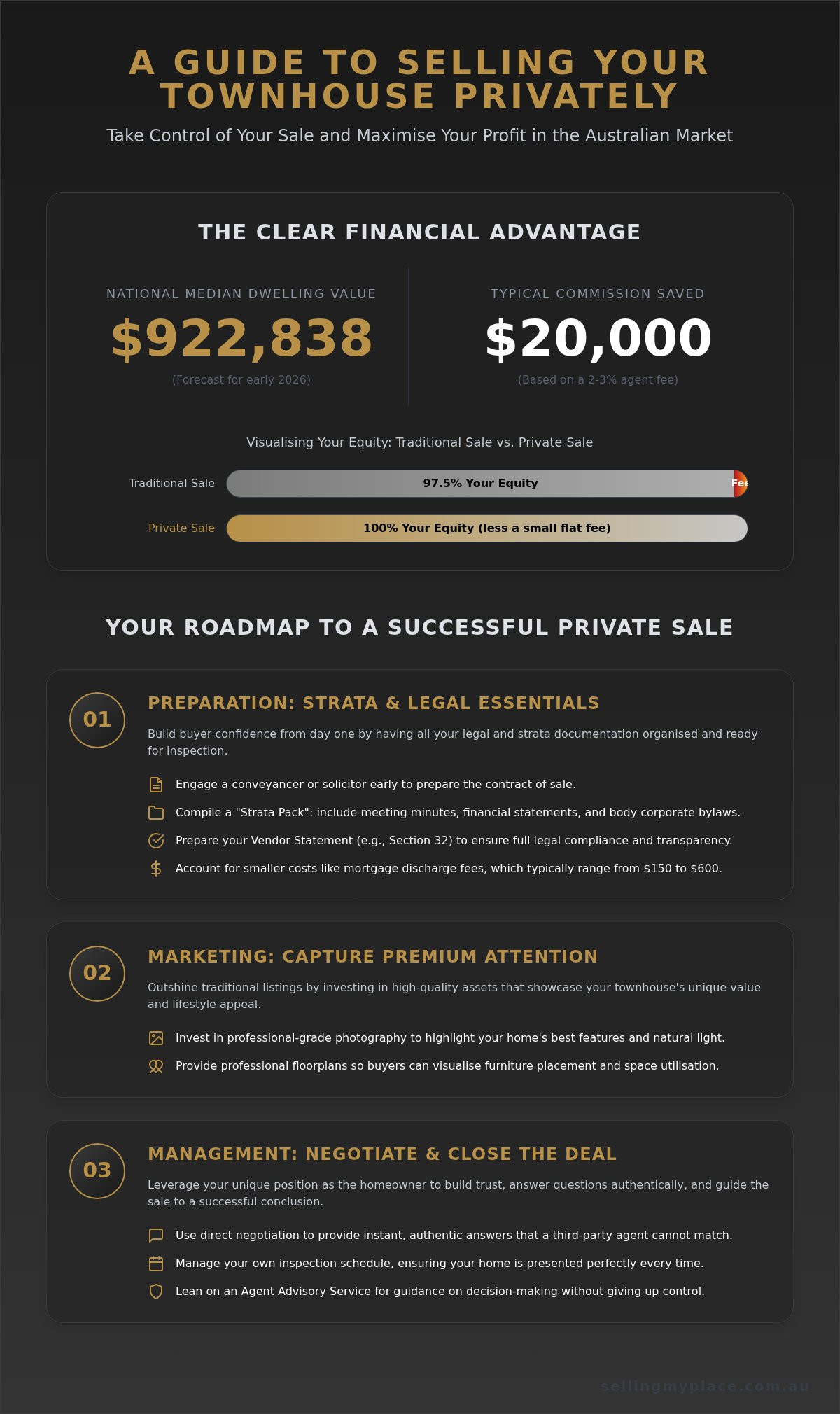
Managing Inspections and Closing the Deal
Once your marketing has sparked interest, it’s time to open your doors. Managing this stage of how to sell a townhouse privately is about creating a sensory experience that helps a buyer feel “at home” the moment they cross the threshold. Unlike a standard agency viewing, you have the freedom to schedule inspections that highlight your property’s best features, like the way the morning light hits the kitchen or the quietness of the street after work. You’re the best person to tell the story of the home, so embrace the opportunity to connect with potential buyers on a personal level.
The Art of the Private Inspection
Transforming your home into a “display suite” doesn’t require a total renovation. It’s often the small, thoughtful touches that make the difference. Ensure the temperature is perfect, the lighting is warm, and every surface is decluttered. We often recommend pre-sale property consulting to help you identify those high-impact tweaks that attract premium offers. During the tour, provide “take-home” brochures and the strata summaries we discussed earlier. This gives buyers something tangible to review over coffee later. When following up, a quick, professional-casual message to gauge interest is all that’s needed. You’re acting as a neighborly guide, not a high-pressure salesperson, which buyers find incredibly refreshing.
Negotiation and Settlement
Negotiation is where many sellers feel the most pressure, but data is your best ally. Before you enter any discussion, set a firm “walk-away” price. You can justify this figure by referencing current Neighborhood Market Reports, which provide a clear picture of what similar townhouses are actually achieving in the 2026 market. When an offer arrives, pay close attention to the conditions. Whether it’s “subject to finance” or a building inspection clause, your legal representative will help you navigate these nuances. Once the price is agreed and the contract is signed, you’ll move toward the exchange and settlement. It’s a methodical process, but with a steady hand and the right information, it’s one you can navigate with total confidence.
If you’re ready to start showing your home to qualified buyers, our team can help you prepare every detail for a successful open home. Feel free to reach out for professional pre-sale consulting to ensure your townhouse is presented at its absolute best.
Selling Smarter with Kincade International Direct Sales
Choosing to manage your own home sale shouldn’t mean sacrificing the professional standards that attract premium buyers. At Kincade, we’ve developed a model that bridges the gap between traditional agency services and independent selling. Our flat-fee approach ensures you retain your equity while still benefiting from the sophisticated tools usually reserved for high-commission firms. It’s a partnership where you’re the decision-maker, but you’re never without a steady hand to guide you through the complexities of the 2026 property market. We’ve seen first-hand how this balance of independence and expert backing can reduce the stress of a high-stakes transition while delivering a result that feels both fair and rewarding.
The Kincade Advantage: More Than Just a Listing
With over 25 years of industry experience, we understand that selling a home is as much an emotional transition as it is a financial one. We don’t just upload your property to a portal and leave you to it. Our Professional Residential Property Listing Services are designed to empower you with the same resources used by the country’s top agents. This includes access to our dedicated Agent Advisory Service, providing you with a seasoned expert to discuss strategy, review offers, or simply offer reassurance when things feel intense. We believe this collaborative model is the future of real estate, offering a more respectful and transparent way to move from one chapter of your life to the next.
Your Next Steps to a Commission-Free Sale
Ready to see what’s possible? The journey of how to sell a townhouse privately begins with clarity. Your first step is to request a comprehensive neighbourhood market report. This data provides the grounded confidence you need to set a competitive price that reflects your home’s true value in the current climate. From there, we’ll help you organise your professional photography and floorplan preparation, ensuring your townhouse makes a stunning first impression on a global stage. Taking that initial step toward a smarter, more profitable Sale by owner is about more than just saving money. It’s about taking ownership of your future and ensuring your hard-earned equity stays where it belongs: with you and your family.
Secure Your Future with a Smarter Sale
You’ve spent years building equity in your home, and now it’s time to reap the rewards. By focusing on strata transparency and professional-grade visuals, you can attract the premium buyers your property deserves. Mastering how to sell a townhouse privately isn’t just about avoiding fees; it’s about taking charge of your own story with the right support behind you. You can save an average of $20,000 in commissions while still accessing a global marketing network that reaches far beyond your local street. It’s a sophisticated way to sell that respects both your time and your bank balance.
Our Agent Advisory Service ensures you have an expert partner for every negotiation and legal hurdle, providing the calm confidence you need during this major life transition. Don’t let high agency costs eat into your hard-earned profit. It’s your home, your legacy, and your choice. Start your commission-free townhouse sale with Kincade today. We’re here to help you move forward with a sense of pride and a significantly healthier bank balance. You’ve got this.
Frequently Asked Questions
Is it legal to sell a townhouse privately in Australia?
Yes, it’s entirely legal in every Australian state and territory. No special licence is required for a homeowner to manage their own sale. While the legality is national, the specific paperwork and disclosure rules do vary by state. This is why we advocate for a partnership approach. It ensures you meet all local requirements while retaining your hard-earned equity and staying in total control of the process.
How do I handle strata documents when selling without an agent?
You should contact your strata manager or body corporate secretary to request a current strata information certificate and the last two years of meeting minutes. These documents are essential for your legal disclosures. Providing a clear strata pack to potential buyers helps build trust and transparency from the start. Having a professional review these records ensures everything is in order before you welcome your first visitor.
Do I need a solicitor if I am selling my own home privately?
Yes, engaging a solicitor or licensed conveyancer is a vital step in the process. They’ll handle the legal transfer of the property, prepare the contract of sale, and ensure the necessary vendor statements are accurate. While you manage the marketing and inspections, your legal representative ensures the transaction is compliant. They also handle the final exchange of contracts and the complexities of settlement day to protect your interests. This move toward personal empowerment is part of a global trend; for instance, those in the UK navigating legal proceedings without a solicitor often use Find a McKenzie Friend to access vetted support and guidance in court.
No, the country’s major property portals generally don’t allow private individuals to list properties directly. You typically need to go through a licensed service provider like Kincade that offers professional residential property listing services. Our model allows you to bypass traditional commissions while still gaining the massive exposure these high-traffic platforms provide. This ensures your townhouse is seen by the widest possible audience of qualified buyers in the 2026 market.
What happens if I can’t find a buyer for my townhouse?
If a buyer isn’t found immediately, we’ll work with you to review your marketing strategy and asking price based on live market feedback. Because our listings have no time limit, you won’t feel pressured to rush into a lower-than-fair offer. We can refresh your professional photography or adjust the listing description to highlight different lifestyle features. This ensures your property remains competitive and appealing in a shifting property landscape.
How do I determine the right asking price for my townhouse?
The most reliable method is to use a neighbourhood market report. This provides concrete data on recent comparable sales in your specific complex and street. Avoid relying solely on automated online estimates, as they often miss townhouse-specific nuances. Instead, look at properties with similar floorplans and strata fees that sold recently. This data-driven approach gives you the grounded confidence to stand firm during any price negotiations.
What are the common mistakes to avoid when selling privately?
One common pitfall is using low-quality DIY photography, which can devalue your home’s online presence. Another mistake is failing to disclose strata issues early, which can cause deals to fall through during the cooling-off period. When learning how to sell a townhouse privately, it’s also vital to avoid being overly emotional. Keeping a professional-casual tone helps maintain a positive rapport with potential buyers and leads to smoother results.
How does Kincade support me during the negotiation process?
We provide a dedicated Agent Advisory Service that acts as your professional sounding board. When an offer arrives, you can discuss the terms and conditions with a seasoned expert who understands the nuances of how to sell a townhouse privately. We help you evaluate the strength of the buyer’s position and suggest strategies to achieve your target price. This ensures you feel supported and empowered until the contract is signed and the sale is finalised.
How to Avoid Real Estate Agent Commission in Australia: The 2026 Seller’s Guide
What if the most expensive part of selling your family home wasn’t the preparation or the marketing, but a percentage-based fee that costs you the equivalent of a luxury SUV? In 2026, with the national median dwelling value sitting at $922,838, many Australians are questioning why they should hand over a massive slice of their equity just for a “sold” sticker. If you’re wondering how to avoid real estate agent commission while still achieving a premium result, you aren’t alone. It’s about moving away from a transactional mindset and toward an empowered, professional partnership.
We understand the weight of this decision. It’s common to feel a sense of anxiety about handling legal paperwork or a distrust of traditional “real estate speak” that often clouds the process. You deserve to feel protected and in control during such a significant life transition. This guide reveals the proven strategies to sidestep traditional commissions, potentially keeping an average of $20,000 more of your home’s equity. We’ll walk through how to access professional marketing tools, manage the sale with confidence, and use expert advisory services to ensure every legal detail is handled with a steady, experienced hand.
Key Takeaways
- Understand the “Equity Gap” and how a standard 2.5% commission can unnecessarily consume over $25,000 of your hard-earned profit on a million-dollar home.
- Learn how to avoid real estate agent commission by choosing between independent selling and modern flat-fee marketing models that provide professional support without the percentage-based cost.
- Discover the truth behind the negotiation myth and why traditional agents are often incentivised for a quick sale rather than securing the highest possible price for your family’s future.
- Master a five-step roadmap for a successful sale, from investing in high-quality photography to securing comprehensive neighbourhood market reports that put you in the driver’s seat.
- Explore a partnership-based approach where you maintain control of your sale process while accessing expert advisory services and global listing reach until your property is sold.
Why Australian Homeowners are Moving Away from Traditional Commissions
Selling your home is often the culmination of years of hard work, weekend renovations, and disciplined mortgage repayments. Yet, when the time comes to move on, many Australians find a significant portion of their hard-earned equity disappearing into a “success fee.” On a $1,000,000 home, a 2.5% commission equates to $25,000 plus GST, totalling $27,500. This is what we call the Equity Gap. It represents money that could have funded a renovation on your next property, paid for a child’s education, or bolstered a retirement nest egg. With the national median dwelling value reaching $922,838 in early 2026, these percentages are no longer just small fees; they are life-changing sums of money.
The traditional model relies on the myth of the “Super Agent” who possesses a secret database of buyers. In reality, the digital age has shifted the power. Most buyers find their next home through major online portals while scrolling on their phones during their morning commute. While it’s helpful to understand what a real estate agent does in a conventional sense, the modern seller is beginning to realise that the portal does the heavy lifting of finding the buyer, not the individual agent. For many, learning how to avoid real estate agent commission is less about cutting corners and more about protecting a family legacy.
The True Cost of a Traditional Sale in 2026
Commission is a success-based percentage that often exceeds the value of the labour provided. In a traditional sale, you aren’t just paying for a few open homes; you’re often subsidising the agent’s office rent, flashy car leases, and assistant salaries. This cost scales upward with your property’s value, which feels inherently unfair. Does it really take twice as much effort to sell a $2 million home compared to a $1 million home? Probably not. When you add auctioneer costs and high-margin marketing markups, the total bill becomes even harder to swallow. It feels less like a service and more like a tax on your success.
The Shift Toward Seller Empowerment
We’re seeing a beautiful shift in the Australian market toward transparency and seller control. Digital platforms have democratised the search process, allowing buyers to connect directly with the heartbeat of the home: the owner. By embracing how to avoid real estate agent commission through a direct sale model, you effectively become the CEO of your sale. You know the local schools, the best coffee spots, and the way the afternoon sun hits the deck better than any third party ever could. This movement is about reclaiming that narrative and ensuring every dollar of your home’s value stays where it belongs: with you.
Strategies to Avoid Real Estate Agent Commission
Most traditional advice suggests that the only way to save money on your sale is to interview three different agents and try to haggle their percentage down. We believe that’s missing the point. Even a “discounted” 1.8% commission on a median-priced home in 2026 still takes a massive bite out of your profit. If you want to know how to avoid real estate agent commission entirely, you need to look beyond negotiation and toward structural change. It’s about moving from a model where you pay for a person’s time to one where you pay for professional tools and results.
The FSBO Path: Pros and Cons
For Sale By Owner (FSBO) is the purest form of independent selling. It gives you total control over the narrative and every interaction with potential buyers. You are the one who knows the history of the home, the quietness of the street, and the way the morning light fills the kitchen. However, the biggest hurdle in the Australian market is that the major property portals don’t usually allow private individuals to list directly. This often leads to listings that look amateur or lack the reach needed to create genuine competition. Most sellers find that while they save on fees, they risk losing out on the “buzz” that drives a premium price. It’s the reason many eventually look for a professional marketing partner to bridge that gap.
The Fixed-Fee Revolution
This is where the landscape has truly changed for Australian families. Instead of a percentage, you pay for specific, high-quality services. A flat fee provides budget certainty from day one, ensuring there are no nasty surprises at settlement. You get the same professional photography, floorplans, and, crucially, access to the major portals that traditional agents use. The “Listed Until Sold” model is a particular favourite because it removes the artificial pressure of 90-day expiry dates. You sell when the right buyer arrives, not when an agent’s contract runs out. It’s a reassuring, grounded way to manage a high-stakes transition.
By decoupling services, you choose exactly what to outsource. You might want a professional photographer and a comprehensive neighbourhood market report, but you don’t need a middleman to open the front door for you. This partnership model allows you to act as the CEO of your sale while having a dedicated marketing department at your back. It’s a sophisticated way to maintain your equity while ensuring your property is presented with the polish it deserves. If you’re ready to take the next step, you can discuss a tailored approach for your property that keeps your profit in your pocket.
The ‘Negotiation’ Myth vs. The Flat-Fee Reality
A common narrative in the industry is that a traditional agent’s negotiation skills are so specialised that they effectively pay for themselves. They’ll suggest that an owner is too emotionally attached to stay objective during a deal. However, we need to look at who is actually motivated by the final result. If you’re researching how to avoid real estate agent commission, you’ve likely sensed the inherent conflict of interest in the traditional model. A quick sale at a lower price is often more profitable for an agent’s turnover than a patient sale at the highest possible price for your family.
If an agent is working on a 2.5% commission, the difference between a $950,000 sale and a $980,000 sale is only $750 for them. For you, that’s $30,000. Who is more motivated to hold out for that extra $30,000? The answer is simple. It’s you.
Who Really Negotiates the Best Price?
The truth is that nobody knows your home’s value or its unique story better than you do. You’re the one who can explain the craftsmanship of the kitchen joinery or the peace of the neighbourhood at dusk. When you act as the primary contact, you remove the “middleman whisper” where messages can be diluted or rushed. By using professional Neighborhood Market Reports, you gain the same data-driven confidence as any agency. You aren’t just hoping for a price; you’re justifying it with concrete evidence. Handling a “low-ball” offer becomes much easier when you can calmly point to recent comparable sales and local demand. It’s about being prepared, not being a salesperson.
Protecting Your Profit Margin
It’s vital to shift your focus from the gross sale price to your net bankable equity. Let’s look at the logic. If a traditional agent sells your home for $1,000,000 but takes a $25,000 commission, you walk away with $975,000. If you manage the sale yourself and achieve a price of $985,000, you actually end up with $10,000 more in your pocket. Modern Residential Property Listing Services provide the marketing reach of an agency without the equity-draining percentage. There’s also a significant psychological advantage to this approach. You won’t feel the mounting pressure to just sign so the agent can collect their fee and move to their next listing. You have the luxury of time and the security of knowing your profit is protected. Learning how to avoid real estate agent commission isn’t about doing everything alone; it’s about choosing a partnership that respects your bottom line.
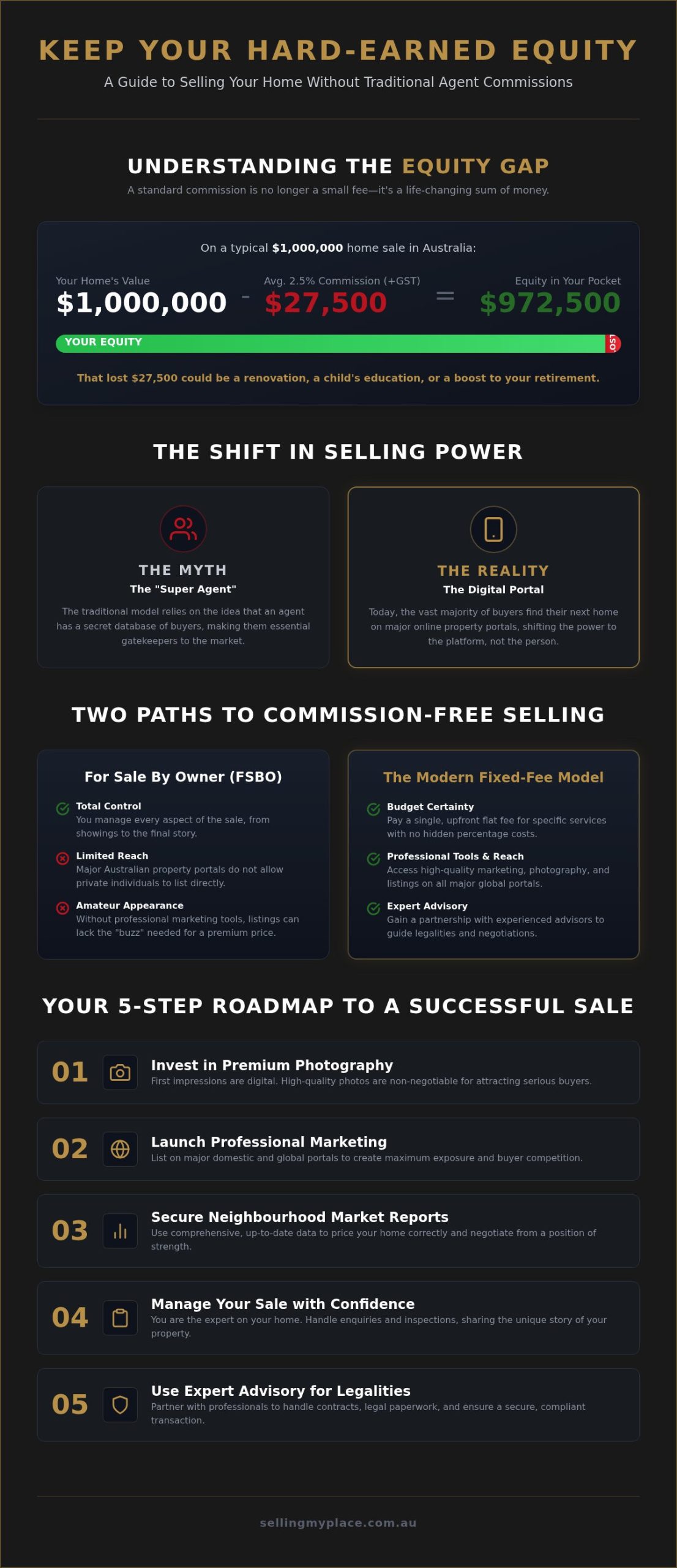
A 5-Step Roadmap to Selling Without a Traditional Agent
Deciding how to avoid real estate agent commission is a bold step toward financial freedom, but it requires a clear plan of action. Taking the reins of your sale doesn’t mean doing it all alone; it’s about being the CEO of an efficient marketing department. By following a structured roadmap, you can maintain the professional standards buyers expect while keeping your equity where it belongs. This process is about replacing a middleman with a proven system that empowers you to succeed.
If you’re ready to learn how to avoid real estate agent commission, the path forward is surprisingly structured. It begins with professional preparation, where you invest in high-quality photography that captures the emotional heart of your home. Next, you need market intelligence. Securing a comprehensive neighbourhood valuation report ensures you are pricing for the current market, not yesterday’s news. Strategic marketing follows, placing your listing on major portals and global networks to cast the widest possible net. When the enquiries start, you take the lead on inspections. This dialogue allows you to share the lifestyle benefits only an owner truly understands. Finally, legal finalisation brings everything together, using expert support to ensure the contract of sale is handled with precision.
Presenting Your Home Like a Pro
Presenting your home like a pro is about more than just a tidy lounge room. 90% of buyers decide to inspect based on the first three photos they see online. If those images don’t sing, you’ve lost them before they even read your description. High-quality imagery is non-negotiable for achieving a premium result. Accurate floorplans are equally vital; they help filter out tyre-kickers who might find the layout unsuitable for their needs, saving you time and energy on unnecessary inspections. This level of professionalisation shows buyers that you are serious and that the property has been cared for with pride.
Navigating the Legal Landscape
Navigating the legal landscape is often the part that gives sellers the most pause. Understanding the Section 32 or your specific state’s contract requirements is essential for a smooth settlement. This is where professional Conveyance Advice becomes your greatest asset. An advisory service bridges the gap between doing it yourself and doing it right, providing the peace of mind that every detail is legally sound. It’s about having a steady hand to guide you through the paperwork while you focus on the move. If you want to ensure your sale is legally watertight while maintaining your profit, you can book a consultation with our advisory team to discuss your specific needs.
The Partnership Model: How Kincade International Empowers Sellers
Kincade International Direct Sales (KIDS) represents a fundamental shift in the Australian property market. We don’t see ourselves as a traditional agency, but rather as a dedicated marketing department for your home. By choosing this partnership, you’re learning how to avoid real estate agent commission while still accessing the same high-tier marketing tools used by the country’s top firms. Our 0% commission structure is designed to keep your equity where it belongs: in your bank account. On average, our sellers save $20,000 per sale, which is a significant sum that can change the trajectory of a family’s next chapter.
We understand that selling a home is often accompanied by a ticking clock. Traditional agents often push for a quick result to meet their monthly quotas, but our “Listed Until Sold” promise removes that artificial pressure. Your property remains live across major local and international portals until the right buyer is found. This global reach ensures that whether your buyer is just around the corner or looking to relocate from overseas, your home is presented with professional authority. It’s a grounded, calm approach that respects the emotional significance of your transition.
Expert Backing Without the Price Tag
Our model provides comprehensive support that covers every practical need. You’ll have access to our Agent Advisory Service for pre-sale consulting, ensuring your home is positioned perfectly before the first enquiry arrives. This isn’t a DIY project where you’re left to figure it out alone. The flat fee includes professional photography and floorplans, ensuring your digital storefront looks impeccable. We also provide conveyance advice to ensure your legal obligations are met with total precision. It’s about having a steady hand to guide you, providing the reliability of a seasoned expert without the percentage-based sting.
Taking the Next Step Toward a Smarter Sale
Stepping into the driver’s seat of your sale is an empowering experience. When you choose a Sale by owner package, you’re choosing a future where your hard-earned profit remains your own. You get the peace of mind that comes from knowing you have professional support at every turn, from the first photo to the final settlement. It’s time to reclaim your equity and sell with confidence. Start your commission-free journey with Selling My Place today.
Reclaiming Your Equity for the Next Chapter
Selling your family home is a deeply personal milestone, and you deserve to walk away with every dollar of your hard-earned profit. We’ve looked at how the digital shift has placed the power back in your hands, allowing you to tell your property’s story with an authenticity no third party can match. By moving away from outdated percentage-based fees, you’re choosing to value your own labour and protect your family’s financial legacy.
Learning how to avoid real estate agent commission is about more than just numbers; it’s about confidence and control. With an average saving of $20,000 and a 0% commission structure, you can achieve a premium result while enjoying 100% support. From professional photography and floorplans to expert advisory services, the tools for success are already within your reach. You don’t have to sacrifice quality to maintain your equity. A steady, experienced partner is here to ensure every detail is handled with care. It’s time to take the next step and keep 100% of your profit with Kincade International Direct Sales. Your future self will thank you for making the smarter choice today.
Frequently Asked Questions
Is it legal to sell my own home without a real estate agent in Australia?
It is entirely legal to sell your property independently in every Australian state and territory. There is no legislation requiring you to hire a third-party representative to manage your sale. While the process involves specific legal obligations regarding disclosures, many owners find that managing the sale themselves is a straightforward and deeply rewarding experience. With the right professional advisory support, you can navigate the entire journey with total legal security and confidence.
How much can I actually save by avoiding real estate agent commission?
The savings depend on your property’s final sale price, but most Australian families retain a significant portion of their equity that would otherwise be lost to fees. By understanding how to avoid real estate agent commission, you can keep tens of thousands of dollars in your bank account. These funds can then be redirected toward your next mortgage, a well-deserved holiday, or your family’s long-term financial goals, ensuring your hard work benefits you, not an agency.
Will my property be listed on the major Australian property portals?
Yes, your home will be visible on the nation’s leading property search platforms. While these sites typically restrict direct private listings, our service acts as the professional bridge required to get you online. This ensures your property is seen by the widest possible audience of active buyers, providing the same high-level exposure as any traditional agency without the associated commission fees. You get the reach you need to find the perfect buyer.
What happens if I can’t find a buyer on my own?
One of the greatest advantages of a modern partnership model is the absence of artificial time constraints. You aren’t pressured by a standard 90-day agency agreement that might force a rushed decision. If a buyer isn’t found immediately, your listing remains active and supported until the right person walks through your door. This patient approach allows the market to work in your favour, ensuring you don’t have to compromise on your property’s true value.
How do I handle the legal paperwork and contract of sale?
Managing the legal side of a sale is a methodical process that is best handled with expert guidance. While you take care of showing the home and talking to buyers, professional conveyance advice ensures your Contract of Sale and necessary disclosure documents are prepared correctly. This ensures your transaction is legally watertight and compliant with your specific state’s regulations. It is about having a steady, professional hand to guide you through the technical details.
Do buyers trust homes that are ‘For Sale By Owner’ or Direct Sale?
Modern buyers are increasingly comfortable dealing directly with homeowners because they value transparency and first-hand information. When a property is presented with high-quality marketing and professional photography, it carries an immediate sense of reliability. Buyers often find it refreshing to ask questions of the person who actually lives in the home, as you can provide detailed insights into the local community and the property’s unique history that an agent simply couldn’t offer.
What is a flat-fee real estate model and how does it work?
A flat-fee model is a transparent alternative to the traditional percentage-based commission. Instead of losing a slice of your home’s value, you pay a set price for the specific professional services you need, such as portal access and marketing tools. This is a highly effective way of how to avoid real estate agent commission because it provides absolute budget certainty. You know exactly what your costs are from the outset, allowing you to calculate your net profit with precision.
Can I still have an auction if I don’t use a traditional commission-based agent?
You can absolutely choose an auction as your preferred sale method without being tied to a commission-based contract. You simply engage a professional, licensed auctioneer to conduct the proceedings on the day for a fixed fee. This allows you to create that vital sense of urgency and competition among buyers while ensuring that every dollar of the final hammer price stays in your pocket. It is a sophisticated way to achieve a premium result on your own terms.
Best Private Sale Sites in Australia: 2026 Guide
Why would you hand over A$20,000 or more of your hard-earned equity to a traditional agent when the tools to sell your home are already at your fingertips? It’s a question more Australian homeowners are asking as commissions climb and the cost of living bites. We understand that your home is more than just a title deed; it’s your sanctuary and your legacy. It’s completely natural to feel a bit protective of that value while worrying if you’re truly prepared to handle the complex legal paperwork or the new identity verification checks that became mandatory in July 2026 (it’s a lot to take in, we know).
The good news is that finding the best websites for private property sales australia is the first step toward a much more rewarding journey. You don’t have to choose between saving money and looking professional. This guide will show you how to list on the major portals to reach every potential buyer while keeping 100% of the sale profit for your family. We’ll walk through the top platforms for 2026, explain the latest tax changes for established properties, and show you how expert advisory support can give you the confidence of a seasoned pro without the high commission price tag.
Key Takeaways
- Retain every cent of your home’s equity by bypassing traditional agent commissions, allowing you to reinvest that average A$20,000 saving back into your family’s next chapter.
- Identify the best websites for private property sales australia to ensure your listing gains maximum exposure on major portals while maintaining a polished, professional appearance.
- Understand why high-quality visual assets like professional photography and floorplans are essential for capturing buyer attention and driving meaningful enquiries.
- Navigate the complexities of the 2026 property market with confidence by leveraging expert advisory support for negotiations and legal compliance.
- Use detailed neighbourhood market reports and pre-sale consulting to price your property strategically, ensuring you attract serious buyers from the very first day.
The Landscape of Private Property Sales in Australia
Selling your home is one of the most significant transitions you’ll ever experience. It’s about moving on to a new chapter, perhaps downsizing to a coastal retreat or finding more space for a growing family. For many, The Great Australian Dream is evolving. It’s no longer just about owning a home; it’s about owning the process of selling it too. A “Sale by owner” approach simply means you, the homeowner, take charge of the marketing and negotiations rather than hiring a traditional real estate agent.
In 2026, this isn’t just a niche choice for the tech-savvy. It’s a mainstream strategy. Why? Because the financial stakes are higher than ever. Saving a 2% or 3% commission on a million-dollar property keeps tens of thousands of dollars in your pocket. On average, our clients see a saving of A$20,000 per sale. That’s money for your next deposit, a well-deserved renovation, or your retirement fund. We call this “Empowered Selling.” It’s the shift from doing everything yourself to having the right professional tools and expert support behind you.
Why Private Sales are Booming Across Australia
Homeowners now have access to the same data that agents used to guard closely. With a few clicks, you can see every recent sale in your street and understand exactly what buyers are paying. This transparency has removed the mystery of pricing. Digital platforms have also levelled the playing field. You don’t need a local agency’s window display when you can reach millions of people through their smartphones. It’s about keeping a steady hand on the tiller of your most valuable asset while ensuring you aren’t paying for expertise you can now access yourself.
The Role of Major Portals in Your Marketing Strategy
To sell successfully, you must be where the buyers are. In Australia, that means being visible on the nation’s most-visited property search sites. With the leading portal seeing 37.9 million monthly visits as of May 2026, these platforms are non-negotiable. However, these major sites generally don’t allow private individuals to list directly. This is why finding the best websites for private property sales australia is crucial. These platforms act as your bridge, getting your listing onto the major sites. When your home sits alongside agency listings with high-quality photography and floorplans, you create the competition needed to drive up your final sale price. More eyes on your property inevitably equals more competition and a better result for your family.
Comparison of the Top Websites for Private Sellers
Choosing between the best websites for private property sales australia isn’t just about finding the cheapest entry point. It’s about deciding how much of the heavy lifting you’re willing to do yourself. Most traditional “For Sale By Owner” (FSBO) portals act as simple aggregators. They take your data, push it to the major sites, and then step back. While this saves you from traditional commissions, it often leaves you as a “lone wolf” when it comes to the complex parts of the journey, such as managing legal compliance or handling tricky buyer objections.
One of the most critical factors to consider is the “listing until sold” promise. Some platforms offer lower upfront costs but hit you with renewal fees every 30 or 90 days. This creates an underlying pressure that can lead to rushed decisions. We believe selling your home should be a calm, methodical process. By choosing a platform that offers a “list until sold” guarantee with 0% commission, you remove the ticking clock and can wait for the buyer who truly values what your home represents.
Evaluating Traditional FSBO Portals
Standard portals typically provide the basics: a listing on the major Australian property search sites, a generic “For Sale” sign, and an automated system that forwards email enquiries to your inbox. While these features get you on the map, the “DIY” burden remains high. You’re responsible for your own photography, which, if not done professionally, can make even a stunning home look uninviting. These platforms are software tools, not partners. They provide the stage, but you have to write the script, direct the play, and manage the box office yourself.
The Premium Alternative: Integrated Marketing & Advisory
The modern Australian seller is looking for more than just a digital billboard. They want a sophisticated partnership. This is where professional residential property listing services provide a significant edge. Instead of just a listing, you receive a full suite of marketing assets including professional photography and detailed floorplans as standard. These aren’t “extras”; they are the primary drivers of buyer interest.
An integrated approach also connects you to a global marketing network. Your ideal buyer might not be browsing from the next suburb over; they could be an expat or an investor looking from overseas. Having the backing of an Agent Advisory Service means you have a steady hand to guide you through the settlement process, ensuring you feel protected and supported every step of the way. If you’re curious about how this level of support could work for your home, you might consider reaching out for a chat about your property.
Essential Features of a High-Performing Sales Platform
When you’re searching for the best websites for private property sales australia, it’s easy to get distracted by the lowest price tag. However, your home represents years of memories and significant equity. It deserves more than a “bare bones” listing. A high-performing platform should feel like a supportive partner, providing the professional tools that turn a casual browser into a serious bidder. It’s about creating an experience that reflects the true value of your property.
The Power of Professional Presentation
First impressions happen in milliseconds. In the digital age, your property’s “curb appeal” is actually its online gallery. Listings featuring professional photography and floorplans often see engagement levels jump by 40% compared to those without. Quality builds trust. When a buyer sees crisp, well-lit images and a clear floorplan, they see a seller who is serious and a home that has been cared for. Using grainy iPhone photos can inadvertently signal that you’re cutting corners. This might lead buyers to wonder what else has been neglected, potentially devaluing your home in their eyes before they even step through the front door.
Pricing is the other half of the equation. You shouldn’t have to guess what your property is worth or rely on an agent’s “gut feeling.” Accessing detailed neighbourhood market reports allows you to look at cold, hard data. When you know exactly what the house three doors down sold for last month, you can set a price with total confidence. It removes the guesswork and the anxiety that often accompanies such a big decision, allowing you to stand firm during negotiations.
Navigating the Legalities with Confidence
Many homeowners hesitate to sell privately because they fear the paperwork. It’s a valid concern. The legal requirements in Australia, including the 2026 identity verification rules, are strict and necessary for everyone’s protection. This is where a “steady hand” makes all the difference. A quality platform doesn’t just list your home; it provides access to professional conveyance advice to ensure your contract of sale is watertight and compliant with current regulations.
Having expert support during the settlement phase reduces the stress of complex processes. It’s about having a guide who values your peace of mind as much as the final result. Learning how to organise your sale properly means you can focus on your move while the technical details are handled with care. You aren’t just selling a house; you’re transitioning your life, and you deserve a service that respects that significance while keeping your profit where it belongs: with you.
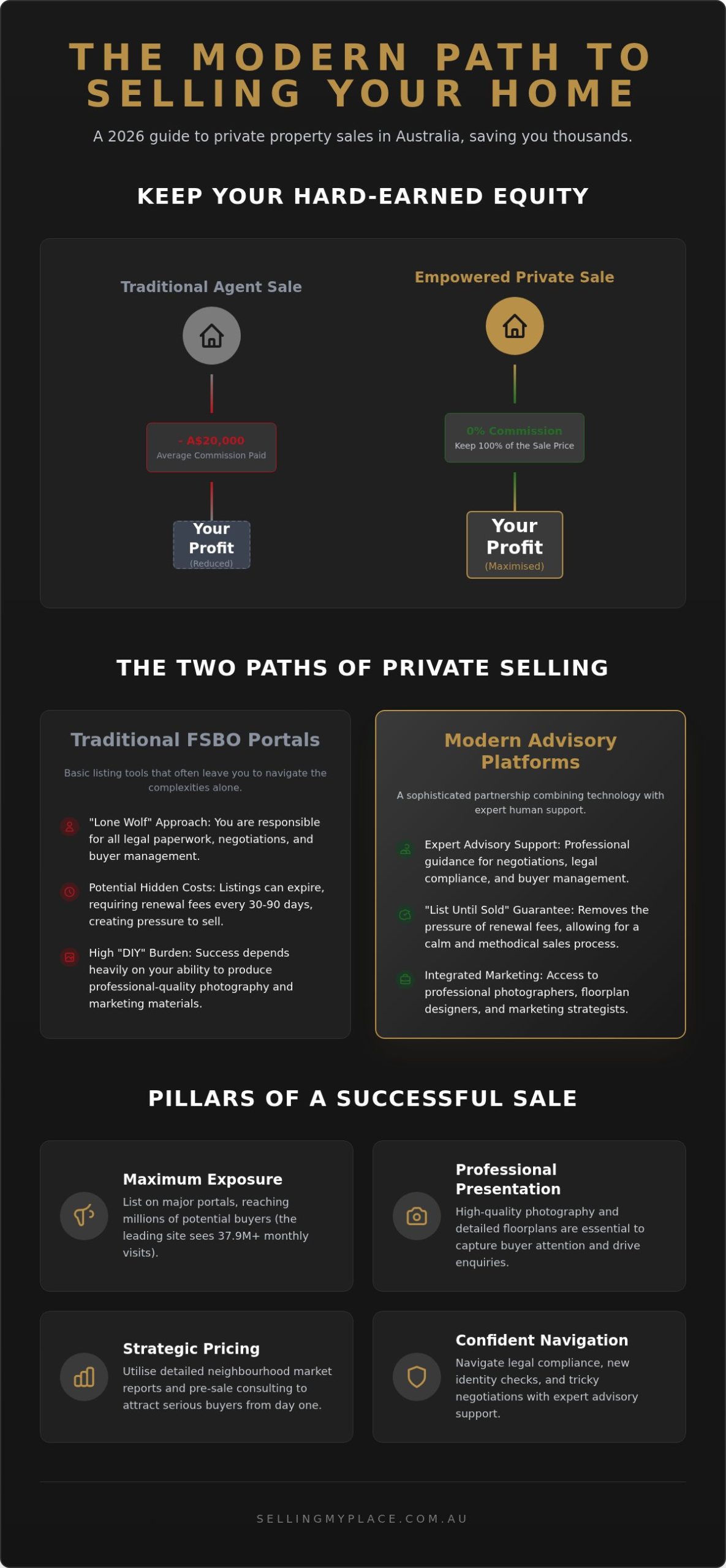
Maximising Your Profit: Beyond Just a Listing
Securing a spot on the best websites for private property sales australia is a brilliant first step, but it’s only the beginning of your journey. To truly honour the value of your home, you need to think beyond the digital billboard. It’s about how you present the property and, perhaps more importantly, how you handle the conversations that follow. Many homeowners worry they’ll be outmatched by experienced buyers or aggressive agents; however, with the right preparation, you can hold your own with absolute confidence. It’s your home, and nobody knows its value better than you do.
Winning the Negotiation
Negotiating isn’t about being confrontational or “tough.” It’s about understanding the emotional drivers of your buyers and using clear data to back up your price. When you’re negotiating your property sale, remember that you are the expert on your home’s unique story. If you’re lucky enough to have multiple interested parties, you can create a healthy sense of competition. This natural sense of urgency often leads to a better final result for your family.
Sometimes, buyers will bring their own representation to the table. This can feel intimidating, but it shouldn’t. Having access to an Agent Advisory Service means you have a professional backing you up, ensuring you never feel pressured into a decision that doesn’t serve your long-term goals. It’s about having a “steady hand” to guide you through the back-and-forth until the contract is signed. You keep 100% of the profit, but you’re never actually alone in the room.
Strategic Pre-Sale Consulting
Before you even take those professional photos, a little bit of pre-sale consulting can go a long way. You don’t need a massive renovation budget to see a significant return. Often, it’s the small, “neighbourly” touches that make a house feel like a home. Decluttering and styling are high-ROI improvements that help buyers visualise their own lives unfolding in your space. It’s about creating a lifestyle they want to buy into, not just a set of rooms.
Timing also plays a huge role. By using neighbourhood market reports, you can identify the best window to launch your listing for maximum impact. When you combine local market timing with a global marketing network, you’re no longer just selling to the people in your suburb. You’re reaching international buyers who might be looking for exactly what your home offers. By avoiding high marketing costs and traditional commissions, you protect your equity and ensure that every cent of the sale price stays where it belongs. If you’d like to see how we can help you prepare your home for the market, contact our team for a personal consultation.
Why Kincade International Direct Sales is the Smarter Choice
What truly sets the KIDS approach apart is our global marketing network. Local agents are often limited to their immediate postcode, but your ideal buyer might be an expat in London or an investor in Singapore. We bridge that gap, giving your property international visibility that traditional models simply can’t match. We include professional photography and detailed floorplans as standard because we know these are the primary drivers of buyer interest. You get the polished, high-end presentation of a boutique agency without the “High Marketing Costs” that often eat into a seller’s profit.
The KIDS Difference: A Partnership Approach
We’ve combined the independent spirit of “Sale by Owner” with the sophisticated results of an expert agent. It’s a partnership where you remain in the driver’s seat, but you have a dedicated advisor just a phone call away. This “steady hand” is there to help you navigate the settlement process and the new 2026 identity verification requirements with total calm. Our “list until sold” guarantee removes the ticking clock, allowing you to wait for the right offer without the pressure of expiring packages or renewal fees. You’re never selling alone; you’re selling with the backing of a seasoned, multi-generational expert who values your legacy as much as you do.
Take Control of Your Sale Today
Transitioning from “thinking of selling” to “sold” doesn’t have to be a stressful ordeal. It starts with a simple, professional marketing package that puts your home in front of millions of buyers across Australia and the world. By taking control of the process, you’re not just saving money; you’re ensuring that every decision made is in the best interest of your household. The steps are straightforward, and the support is comprehensive, from the first market report to the final contract of sale. If you’re ready to see how an empowered sale can change your financial future, it’s time to take the next step. We invite you to Book your pre-sale consultation with the KIDS team and discover a more rewarding way to move home.
Your Future, Your Equity: Taking the Next Step with Confidence
Your home is likely your greatest financial asset, but it’s also the place where your family’s most precious memories were made. Transitioning to your next chapter should be a time of excitement rather than stress over lost equity. By identifying the best websites for private property sales australia, you’ve already taken a significant stride toward a smarter, more rewarding sale. You now know that professional presentation and global reach don’t have to come at the cost of a traditional agent’s commission.
Remember, it’s possible to save an average of A$20,000 while still enjoying the peace of mind that comes with expert advisory support and professional photography as standard. This journey isn’t just about a digital listing; it’s about a partnership that protects your legacy and secures your family’s financial future. You have the tools. You have the data. Most importantly, you have the steady hand of a seasoned guide ready to support you. It’s time to stop worrying about high marketing costs and start looking forward to what comes next.
Secure your equity and sell smarter with a commission-free listing today. We’re here to help you make your move with absolute confidence.
Frequently Asked Questions
Can I list my home on the major Australian property portals without an agent?
Yes, you can, provided you use a licensed platform that acts as your bridge to the market. While the nation’s leading search portals don’t accept direct listings from private individuals, the best websites for private property sales australia hold the necessary corporate licenses to place your home there. This ensures your property sits alongside agency listings, giving you the same visibility while you manage the enquiries and keep the profit.
How much can I actually save by selling my property privately?
The financial impact is substantial, with most homeowners saving an average of A$20,000 in commissions per sale. Traditional agents typically charge between 2% and 3% of your home’s value, which can equate to a massive chunk of your equity. By choosing a commission-free model, that money stays in your bank account, allowing you to fund your next move or invest in your family’s future without the burden of high agency fees.
Is it legal to sell your own home in Australia without a license?
It is perfectly legal to sell your own residential property in any Australian state or territory without holding a real estate license. Licensing is only required for third parties who sell property on behalf of others for a commission. You simply need to ensure you comply with standard legal requirements, such as providing a contract of sale and meeting the latest 2026 identity verification standards, which apply to all property transactions across the country.
What happens if I don’t sell my house within three months?
With our “list until sold” guarantee, you aren’t bound by stressful time limits or hidden renewal fees. Unlike some platforms that charge you every 90 days to keep your listing active, we believe in a calm, methodical approach. Your property remains live on the major portals until the right buyer is found and the contract is signed, ensuring you never feel pressured to accept a lower offer just because a package is expiring.
Do I need to hire a professional photographer for a private sale?
While you aren’t legally required to, professional photography is the single most important factor for online engagement. Listings on the best websites for private property sales australia that feature high-quality imagery and floorplans see significantly more interest than those with amateur photos. We include these assets as standard because a polished presentation builds immediate trust with buyers and helps you justify a premium price for your home.
How do I handle the legal paperwork and conveyance for a private sale?
You handle the legal process by engaging a qualified conveyancer or solicitor, just as you would in a traditional sale. They are responsible for preparing the contract of sale and managing the final settlement. While you take care of the marketing and viewings, these legal experts ensure the transaction is compliant with Australian law. We also provide expert advisory support to help you navigate these steps with total confidence.
Can I still get my home featured in “Premium” or “Highlight” sections on major sites?
You can certainly access “Premium” and “Highlight” listing tiers to boost your property’s visibility. These upgrades are available through your listing platform and ensure your home appears at the top of search results in your suburb. It is a strategic way to generate more competition among buyers, often leading to a faster result, while still allowing you to bypass the thousands of dollars typically spent on agency commissions.
What is the “Agent Advisory Service” and how does it help me?
The Agent Advisory Service provides you with a dedicated “steady hand” to guide you through the complexities of the sale. Whether you need advice on handling a difficult negotiation or help understanding the latest identity verification rules, our experts are available to support you. It bridges the gap between a DIY sale and a traditional agency, giving you professional backing and peace of mind while you maintain 100% of the sale profit.
Choosing the Best For Sale By Owner Marketing Packages in Australia (2026)
Why should the final chapter of your home-selling journey involve handing over A$20,000 or more in commissions that could stay in your own pocket? It’s a daunting thought, isn’t it? You want a premium result and a glossy professional presence, but the idea of losing a significant chunk of your hard-earned equity feels like a sting you’d rather avoid. Many homeowners worry that choosing for sale by owner marketing packages means sacrificing quality or risking legal slip-ups, especially with the ongoing updates to property disclosure requirements across Australia.
We’re here to show you that you don’t have to choose between professional excellence and keeping 100% of your profit. You can have the global portal exposure, the high-end photography, and the expert guidance you need to navigate contracts with total confidence. This guide explores how to select a private sale marketing package that protects your legacy and ensures your property shines on the world stage, all while keeping you firmly in the driver’s seat.
Key Takeaways
- Protect your hard-earned equity by moving away from traditional percentage-based commissions and embracing a transparent, flat-fee model.
- Identify the non-negotiable features in premium for sale by owner marketing packages, including professional-grade photography and global portal exposure.
- Utilise detailed neighbourhood market reports and pre-sale consulting to accurately price and position your home for a top-tier result.
- Eliminate the pressure of arbitrary deadlines with a “listed until sold” promise that keeps your property in front of buyers for as long as it takes.
- Gain peace of mind with access to expert advisory services that help you navigate complex legal disclosures and final contract negotiations.
Why For Sale By Owner Marketing Packages are the Modern Australian Standard
The Australian property market has undergone a quiet revolution. Gone are the days when real estate agents held all the keys to market data and buyer access. Today, digital transparency means you have the same information at your fingertips as any high-street office. Understanding what For Sale By Owner means in this modern context is about more than just avoiding a fee; it’s about taking ownership of a major life transition. By using professional for sale by owner marketing packages, you’re not just “giving it a go” yourself. You’re deploying the same high-impact tools the big agencies use, but you’re doing it with the heart and personal insight only a homeowner can provide.
There’s a unique power in being the primary narrator of your home’s story. You know the exact spot where the afternoon sun hits the deck and which local cafe makes the best flat white. When you combine this intimate knowledge with professional-grade marketing, you level the playing field entirely. You’re no longer at a disadvantage compared to traditional agencies; instead, you’re offering something they can’t: a genuine, lived-in perspective that resonates deeply with prospective buyers.
The true cost of traditional real estate commissions
Let’s talk about the “commission sting.” In Australia, agents typically charge between 1.8% and 3.5% of your sale price. On a million-dollar home, that’s a massive A$20,000 to A$35,000 that simply disappears from your bank account at settlement. It’s often the difference between being able to afford that extra bedroom in your next home or having a comfortable buffer for your retirement. What’s more, many traditional agencies charge marketing “levies” on top of this commission. When you choose for sale by owner marketing packages, you’re choosing financial clarity. You pay a transparent flat fee, keep your equity intact, and ensure every dollar of your home’s value stays where it belongs: with your family.
The shift in buyer psychology
There’s a common myth that buyers are wary of private sellers. In reality, the opposite is becoming true. Modern buyers often find it refreshing to speak directly with the person who knows the property best. This authentic, first-hand knowledge builds a level of trust that a third-party agent simply can’t replicate. When negotiations happen directly between a buyer and a seller, the process often feels more human and less transactional. It’s a partnership based on transparency, allowing both parties to reach a fair agreement without the pressure sometimes associated with commission-driven sales.
Essential Components of a Premium Private Sale Marketing Package
Choosing between different for sale by owner marketing packages requires a keen eye for detail. It isn’t just about ticking a box to get onto a website; it’s about building a digital storefront that rivals the most expensive agencies in the country. To truly maximise your equity, your package must combine high-end visual storytelling with a reach that extends far beyond your local suburb. When you have the right tools, you aren’t just listing a property; you’re presenting a lifestyle that buyers can’t ignore.
One of the most significant advantages of a premium approach is the “Listed Until Sold” promise. Traditional agreements often come with a ticking clock, creating a pressure-cooker environment where you might feel forced to accept a lower offer before your contract expires. Removing this time limit restores a sense of calm to the process, allowing you to wait for the buyer who truly sees the value in your home.
Visual assets that drive enquiries
Quality matters. While smartphone cameras have come a long way, they often fail to capture the true depth and light of a room, which can inadvertently devalue your property in a competitive market. Professional photography is the first handshake you have with a buyer. Following closely behind is the floorplan. A 2D or 3D floorplan is the second most clicked item on a property listing because it allows buyers to mentally move their furniture into the space and understand the flow of the home before they even book an inspection. This visual storytelling shifts the focus from simple bricks and mortar to the future memories a family will create there.
Global reach and digital infrastructure
The modern buyer isn’t always living around the corner. They might be an Aussie expat in London looking for a way back home or an interstate investor seeking a stable return. A premium package ensures your home is synchronised across all major Australian portals while also tapping into international networks. This global visibility is a crucial component that many basic services overlook. When you consider the high cost of traditional agent commissions, having access to this level of digital infrastructure for a flat fee becomes a powerful financial strategy.
Managing these enquiries shouldn’t be a 24/7 burden for you, either. Sophisticated systems now handle the initial digital brochures and enquiry routing, ensuring no lead is lost while you’re at work or spending time with family. If you’re curious about how these digital tools can work for your specific suburb, you might like to reach out for a friendly chat about your goals.
Finally, never underestimate the power of data. Using detailed neighbourhood market reports allows you to find the pricing “sweet spot” based on actual recent sales rather than guesswork. This evidence-based approach gives you the confidence to stand firm during negotiations, knowing exactly what your property is worth in the current climate.
Comparing the Value: Flat-Fee Packages vs. Traditional Commissions
Choosing how to sell your home is ultimately a choice about who keeps the reward for years of mortgage payments and weekend renovations. The difference between a traditional commission and a flat-fee model isn’t just a few dollars; it’s often the equivalent of a year’s salary. While a traditional agent might quote a percentage that sounds small, the reality hits home at settlement. When you consider that the average owner saving is A$20,000, the financial impact on your next property purchase or your retirement fund is undeniable. Using for sale by owner marketing packages allows you to bypass this “equity tax” while still accessing high-tier marketing tools.
Financial transparency is the cornerstone of a modern sale. With a flat-fee approach, you aren’t left wondering what the final bill will look like. There’s a grounded, reassuring certainty in knowing your costs upfront. This model removes the conflict of interest often found in traditional real estate, where an agent might feel pressured to close a quick sale to secure their commission. Instead, you maintain total control over the final figure, supported by professional resources that protect your interests from start to finish.
The flat-fee financial model explained
A professional residential property listing service should be all-inclusive. It’s a common trap to be lured by “ultra-cheap” packages that eventually rack up costs with hidden advertising extras or fees for every minor listing update. A premium package provides everything you need, from portal synchronisation to signage, for one clear price. This creates peace of mind, allowing you to focus on presenting your home beautifully rather than worrying about a mounting marketing bill. It’s about value, not just the lowest price point, ensuring you have a “steady hand” guiding the process without the sting of a percentage-based fee.
Control vs. Convenience
Many homeowners worry that selling privately means sacrificing convenience. However, most buyers actually prefer speaking with the owner. You’re the one who can describe the quietness of the street or the reliability of the local school bus. Handling your own inspections isn’t a burden; it’s a strategic advantage. You aren’t just a face in a crowd to an agent; you’re the primary advocate for your home’s value.
To bridge the gap between DIY and a full agency, Real Estate Advisory Services provide the expert support you need when things get complex. Whether it’s interpreting market data or having a professional on hand when a contract is on the table, this advisory-led approach offers the convenience of an agent’s expertise without the high cost. You get the best of both worlds: the personal touch of a private sale and the professional safety net of a seasoned expert.
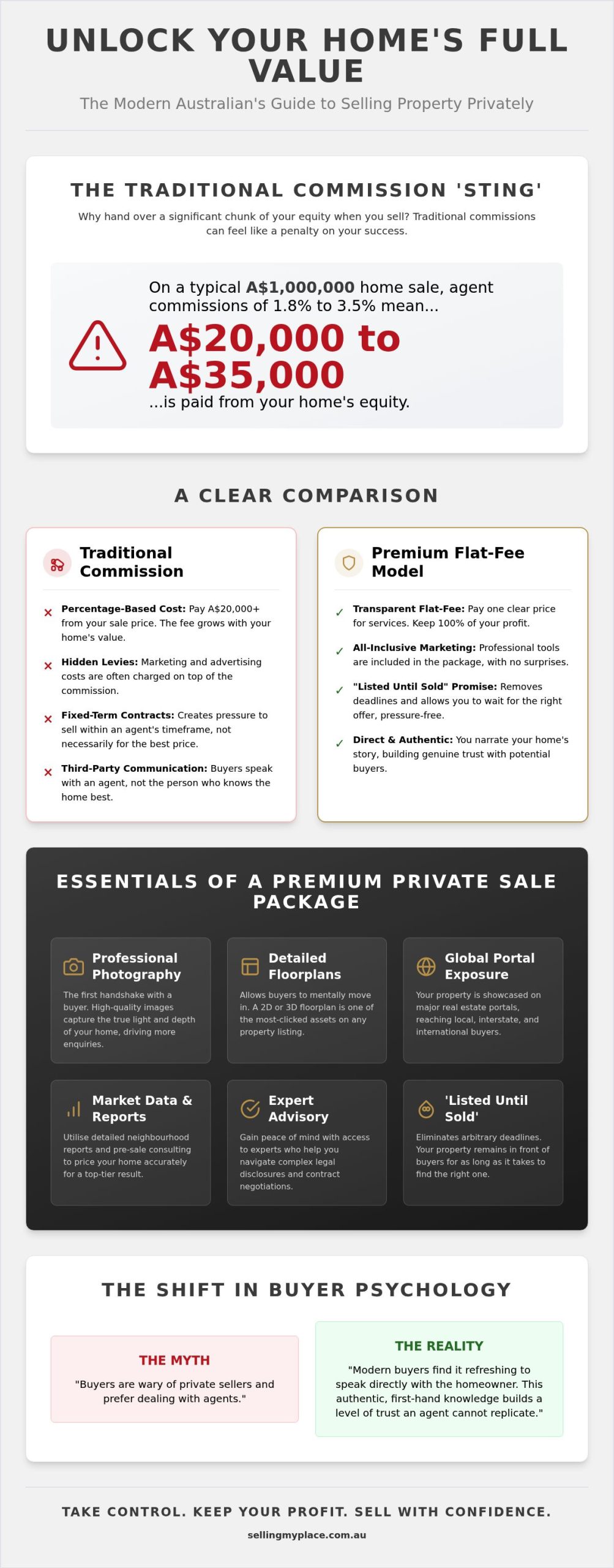
Maximising Sale Price with Professional Advisory and Market Data
Many people think for sale by owner marketing packages are just about getting a listing on a website. While visibility is vital, the real magic happens in the preparation and the strategic advisory that happens before the first buyer walks through the door. It’s about having a seasoned expert in your corner to help you see your home through a buyer’s eyes, identifying those small details that make a huge difference. This is where Pre-Sale Property Consulting becomes your secret weapon. By pinpointing high-impact changes that yield a strong return on investment, you ensure your home isn’t just another listing, but a must-have property.
Presentation is about more than just a fresh coat of paint or some new cushions. It involves using detailed Neighbourhood Market Reports to understand exactly where your property sits in the current landscape. When a prospective buyer questions your asking price, you don’t have to rely on a vague gut feel. Instead, you can present concrete data from recent local sales to justify your position with confidence. This evidence-based approach removes the friction from the transaction and builds professional credibility. Our Real Estate Advisory Services bridge the gap between a basic DIY listing and a high-performance sale, ensuring every detail is polished and every question has an answer.
Pre-sale strategy and property presentation
The goal of pre-sale strategy is to out-position the competition. By analysing local trends, we can help you decide which upgrades are worth the effort and which ones won’t add to your bottom line. This level of professional residential property listing support ensures you aren’t wasting time on renovations that don’t appeal to your specific target market. It’s a methodical way to build value, ensuring that when the “for sale” sign goes up, your home is the most attractive option in the street.
The closing phase: Negotiation and Settlement
Negotiating can often feel like the most intimidating part of the entire process for many homeowners. How do you handle multiple offers at once? What’s the best way to counter a low-ball bid without losing the lead? This is where Mastering the deal with expert property sale negotiation tips becomes essential reading. Having a steady hand to guide you through these high-stakes conversations ensures you stay focused on your goal. You want to keep 100% of your profit without leaving money on the table, and that requires a calm, calculated approach to every offer.
Once the deal is struck, the focus shifts to the legalities. Navigating conveyance and legal requirements is a critical final step that demands precision. For instance, sellers in Queensland must be particularly mindful of the new disclosure requirements introduced in August 2025. Missing a single required form can delay a settlement or, in the worst cases, jeopardise the entire sale. Having access to professional Conveyance Advice means you aren’t walking this technical path alone. It’s about protecting your hard-earned equity and ensuring a smooth transition to your next chapter. If you’re ready to start preparing your home for a record result, book a pre-sale consultation with our team today to explore your options.
Selecting Your Partner: Why Selling My Place is the Steady Hand You Need
Deciding to sell your home is a profound moment. It’s the culmination of years of memories, and choosing the right partner to help you move forward is about more than just finding a digital platform. At Selling My Place, we operate under the Kincade International Direct Sales (KIDS) philosophy. This isn’t just a business acronym; it represents a unique blend of empathy and expertise. We understand the emotional weight of major life transitions. Our goal is to provide a steady hand that guides you through the process, ensuring you feel protected rather than overwhelmed.
When you explore our for sale by owner marketing packages, you’re tapping into a global network that retains a warm, neighbourly accessibility. We believe that professional authority and heartfelt warmth can coexist. You aren’t just another listing on a server. You’re a partner in a shared mission to protect your hard-earned equity while securing a bright financial future for your family. This multi-generational expertise means we’ve seen the market’s cycles, giving us the perspective needed to keep you grounded and confident when things get complex.
A partnership-based approach to selling
We treat your sale as a shared mission. This means our relationship goes far beyond a simple transaction. By providing a 0% commission model with a flat fee and no time limits, we remove the traditional pressures of the real estate industry. Our multi-generational expert advisory service acts as your personal safety net, offering the type of seasoned wisdom usually reserved for high-end boutique agencies. It’s about protecting your legacy. We’re here to ensure the transition to your next chapter is as smooth and rewarding as possible, keeping you in total control of your property’s story.
Your next steps to a commission-free sale
Getting started is a straightforward, methodical process designed to put you in the driver’s seat immediately. You don’t need to wait for an agent’s permission to begin your journey. By taking these practical steps, you can start building your listing today:
- Access your neighbourhood market report to see exactly where your property sits in the current 2026 landscape.
- Organise your professional photography and floorplan session to capture your home’s best light.
- Synchronise your listing across all major Australian and global portals for maximum exposure.
- Leverage our Pre-Sale Property Consulting to ensure your presentation is polished and ready for inspections.
The path to keeping 100% of your sale profit starts with a single conversation. If you’re ready to bypass the high costs of traditional agencies and take charge of your equity, speak with our expert advisory team today to see how we can support your goals.
Your Path to a Successful, Commission-Free Future
You’ve seen how the Australian real estate landscape has evolved to put more power back into your hands. By choosing the right for sale by owner marketing packages, you aren’t just opting for a listing; you’re investing in a strategic partnership that values your home’s story as much as you do. You now understand that high-impact visual storytelling and global digital reach are the keys to out-positioning the competition without the burden of traditional agency costs. It’s about combining your local heart with our professional expertise to secure a result that truly reflects your property’s worth.
With an average saving of A$20,000 in commissions, the impact on your financial legacy is significant. You can move forward with total confidence, supported by our Expert Agent Advisory Service and premium marketing assets like professional photography and floorplans as standard. This is your opportunity to lead the sale of your home with a steady hand and a clear vision. Are you ready to take the next step toward a more rewarding settlement? Start your commission-free journey and protect your equity today. Your next chapter is waiting, and we’re here to help you begin it with peace of mind and your full profit intact.
Frequently Asked Questions
Is it legal to sell my own home in Australia without an agent?
Yes, it’s perfectly legal for any homeowner in Australia to sell their own property. You don’t need a real estate licence to sell your primary residence, though you must still comply with your specific state’s disclosure laws and contract requirements. While you manage the marketing and inspections, it’s essential to engage a qualified solicitor or conveyancer to handle the legal transfer of title and ensure everything is documented correctly.
Will my property appear on Australia’s leading property portals with a private sale package?
Yes, premium for sale by owner marketing packages provide the bridge you need to access these major platforms. Because individuals can’t list directly on these sites, a licensed provider facilitates the listing for you. This ensures your property receives the same high-level visibility as any home listed by a traditional agency, reaching millions of potential buyers across Australia and the globe every single month.
How much can I realistically save on commissions by using a flat-fee marketing package?
Australian homeowners save an average of A$20,000 in commissions by choosing a private sale model. Traditional agents typically charge between 1.8% and 3.5% of the final sale price. On a home sold for A$1,000,000, that’s a minimum of A$20,000 that stays in your pocket. These substantial savings can be used to pay down your next mortgage or bolster your retirement fund, protecting your family’s hard-earned equity.
What happens if my property doesn’t sell within the first three months?
Your property remains listed until it’s sold. Unlike traditional agency agreements that often expire after 90 days, our approach offers a “no time limit” promise. This removes the artificial pressure to accept a lower offer just because a contract is nearing its end. You have the freedom and peace of mind to wait for the right buyer who truly understands the value of your home, no matter how long it takes.
Do I need to handle the legal contracts and conveyancing myself?
No, we always recommend that you leave the legal heavy lifting to the professionals. While you act as the primary advocate for your home’s story, a solicitor or conveyancer handles the formal Contract of Sale and the settlement process. This is particularly vital given recent changes, such as the 2025 Queensland seller disclosure requirements, ensuring your transition is legally compliant and your interests are fully protected at every step.
Can a for sale by owner marketing package help with property valuation?
Yes, a quality package provides you with detailed Neighbourhood Market Reports to ensure your pricing is grounded in reality. These reports offer concrete data on recent local sales, helping you identify the “sweet spot” for your asking price. Instead of relying on a gut feel, you’ll have the same evidence-based tools as professional appraisers, giving you the confidence to justify your price to prospective buyers during negotiations.
How do I handle buyer enquiries and inspections?
You speak directly with buyers, which many people find is a significant advantage. Digital enquiries are routed to you, allowing you to arrange inspection times that fit your personal schedule. Modern buyers often appreciate the authentic, first-hand knowledge only an owner can provide about the home and the local community. It builds a level of trust and transparency that is often missing in third-party real estate transactions.
What is the difference between a basic listing and a professional marketing package?
A basic listing might only get you onto a website, but a premium for sale by owner marketing package offers a complete digital storefront. These professional packages include high-end photography, 2D or 3D floorplans, and expert advisory services. These high-quality assets are proven to drive much higher engagement, ensuring your home stands out in a competitive digital marketplace and helps you achieve a premium sale price without the commission sting.
2026 Guide: Writing Private Sale Property Descriptions
Could the difference between a “sold” sticker and a stagnant listing really come down to the way you describe your morning coffee? When you’re managing your own sale, the pressure to get the words right can feel overwhelming. You know your home better than anyone, yet staring at a blank screen makes it easy to fall into the trap of listing cold facts or sounding a bit too clinical. Learning how to write a compelling property description for private sale isn’t about using fancy industry jargon; it is about capturing the lifestyle your home offers while maintaining a professional edge that builds trust with premium buyers.
We understand that this isn’t just a transaction. It is a major life transition, and you want to ensure your hard-earned equity stays in your pocket. With properties taking longer to sell in 2026 and national home prices showing slight softening, your listing needs to work harder than ever to stand out online. This guide will show you how to balance practical features with emotional benefits, helping you secure a successful sale and save upwards of A$20,000 in agent commissions. We will walk through the exact structure you need to move from writer’s block to a scroll-stopping advertisement that attracts high-quality enquiries from genuine buyers.
Key Takeaways
- Discover why your listing serves as your digital front door and the primary way to build trust with premium buyers before they even step through the gate.
- Learn how to write a compelling property description for private sale by balancing technical features with the emotional lifestyle benefits that drive buying decisions.
- Master the “Owner’s Advantage” by highlighting intimate home details that traditional agents often miss, such as the perfect morning sun spot or the local street culture.
- Optimise your copy for mobile users on platforms like Domain and realestate.com.au by focusing on the critical first 200 characters and using a skim-friendly structure.
- Understand how to pair your refined copywriting with professional photography and expert advisory services to secure a successful, commission-free sale.
The Power of the Pen: Why Your Private Sale Description is Your Digital Front Door
Selling your home is rarely just a financial transaction. It is a significant life transition that involves closing one chapter and opening another. Beyond simply understanding real property and its legal boundaries, a great listing captures the soul of the house. In 2026, with the Australian market showing signs of softening and properties staying on the market longer, your listing description acts as your “Digital Front Door.” This is the initial point of buyer contact that determines whether a prospect will step inside for an inspection or keep scrolling through their feed.
Many owners feel a sense of hesitation when they begin typing. There is often an “Authority Gap” where sellers fear they won’t be taken seriously without a traditional agent’s gloss. However, learning how to write a compelling property description for private sale actually gives you a unique advantage. You can honour the home’s legacy with an authenticity that no third party can replicate. By pairing your heart and local knowledge with our professional advisory tools, you create a partnership that sells smarter, not harder.
The Financial Value of a Great Hook
A brilliant opening line does more than just sound nice; it protects your bottom line. With the national median dwelling value sitting at A$922,838 as of early 2026, every day your property sits idle costs you in momentum. A compelling hook increases enquiry rates by speaking directly to the buyer’s aspirations. When you capture the right audience immediately, you reduce your “days on market” and strengthen your negotiating position. This professional approach is the key to successfully managing your own sale and protecting that significant A$20,000 or more you are saving in commissions.
Avoiding the “Amateur” Trap
Trust is the most valuable currency in a private sale. To build it, you must avoid the common mistakes that signal a lack of professionalism. Shouting at buyers in ALL CAPS or cluttering your text with excessive exclamation marks often has the opposite effect of what you intend. It can make a seller look desperate or disorganized. Instead, focus on these elements of professional-grade copy:
- Radical Transparency: Honest descriptions build more trust than traditional real estate fluff.
- Clarity Over Cleverness: Use simple, evocative language that describes the lifestyle clearly.
- Clean Formatting: Avoid the “wall of text” by using short paragraphs and logical flow.
By focusing on how to write a compelling property description for private sale, you bridge the gap between owner and expert. You aren’t just listing a house; you are inviting someone to envision their future within your walls. This grounded, calm confidence is exactly what premium buyers are looking for in today’s competitive landscape.
The Anatomy of a High-Converting Listing: A 4-Part Framework
A successful listing follows a deliberate rhythm. It isn’t enough to simply dump features into a text box; you need a framework that guides a buyer from curiosity to conviction. Think of it as a four-part journey: the headline stops them, the lead hooks them, the body informs them, and the call to action moves them. When you understand how to write a compelling property description for private sale, you are essentially building a narrative that makes the reader feel like they already belong in the space. This structure ensures that your home stands out among the 278,984 dwellings currently listed across Australia.
Crafting the Killer Headline
Your headline is your first impression. With only about 80 characters to work with on major portals, every word must earn its place. A “Benefit-First” headline like “Private North-Facing Oasis with Chef’s Kitchen” is far more effective than a “Feature-First” title like “4 Bedroom House for Sale.” By choosing the right words, you highlight your unique selling point (USP) immediately. Avoid generic terms; instead, focus on what makes your property special. If you’re unsure which angle to take, our Agent Advisory Service can help you polish your headline to ensure it resonates with the current 2026 market dynamics.
Writing to the Floorplan
Buyers often struggle to visualise how a home feels just from photos. This is where your professional floorplans become your best writing tool. Use a “Mental Walkthrough” technique to describe the flow of the home. Start at the entryway and lead the reader through to the “Entertainer’s Hub” or the “Private Retreat.” This approach allows you to point out hidden value that a camera might miss, such as the thermal orientation of the living area or the clever storage tucked under the stairs. It connects the dots between the 2D drawing and the 3D experience of living there.
The lead paragraph should immediately follow the headline with a lifestyle promise. Don’t start with the bedroom count. Start with the feeling of the morning sun in the breakfast nook or the quiet peace of the cul-de-sac location. The body of your listing should then group features logically into themes. Finally, never leave a buyer wondering what to do next. A clear call to action is vital. Tell them exactly how to book a private inspection or register for an upcoming viewing. If you feel stuck on the structure, you might want to speak with a property advisor to ensure your listing is ready for prime time.
Lifestyle vs. Features: Selling the “Sizzle” of Your Home
Buying a home is rarely a purely logical decision. While a buyer might start their search with a checklist of four bedrooms and a double garage, the final choice is almost always driven by emotion. They are looking for a sanctuary, a place for their children to grow, or a space to host Sunday lunches with friends. Your job is to provide the “sizzle” that ignites that emotional connection while offering enough “steak” (the hard facts) to help them justify the purchase with logic. When you master how to write a compelling property description for private sale, you bridge the gap between a simple building and a dream lifestyle.
As the owner, you possess a unique “Owner’s Advantage” that no real estate agent can match. You know exactly where the morning sun hits the kitchen bench for that first cup of coffee. You understand the quiet rhythm of the street and which neighbours have the best citrus trees to swap fruit with. These intimate details are what truly sell a home. In a market where 97.4% of house resales in the first half of 2026 resulted in a profit, highlighting these authentic lifestyle elements can be the difference between a standard result and a premium one.
However, the “sizzle” must always be balanced with the “steak.” Buyers still need to know the practicalities to move forward. Ensure you clearly state the land size, school catchments, and any recent sustainable upgrades like solar panels or greywater systems. This combination of heart and data creates a sense of reliability and grounded confidence that reduces the stress for potential buyers.
The “Owner Loves” Section
Including a dedicated “What we love about this home” paragraph is a powerful way to humanise your listing. It allows you to share memories, like the way the backyard becomes a private oasis in summer or the convenience of the local hidden cafe just three minutes away. To keep it professional, focus on the benefits these memories provide to a new owner rather than just the nostalgia itself. This section often uncovers unique selling points that agents typically overlook, such as the specific thermal orientation that keeps the lounge cool without air conditioning.
Choosing Your Words Wisely
The vocabulary you choose can significantly impact the perceived value of your property. In 2026, buyers are looking for resilience, community, and versatility. Using evocative, Australian-centric adjectives like “sun-drenched,” “seamless indoor-outdoor flow,” or “tranquil retreat” helps them visualise their future life. Conversely, certain cliches have become white noise and should be banished from your draft to maintain a sophisticated tone.
- Power Words: Sanctuary, versatile, bespoke, integrated, sustainable, resilient.
- Words to Banish: “Location, location, location,” “Renovator’s Delight,” “Hidden Gem,” “Must see.”
- Describing Potential: Instead of “needs work,” try “a blank canvas for your creative vision” or “scope to add significant value.”
By focusing on how to write a compelling property description for private sale that leads with lifestyle, you position your home as more than just another entry on a search results page. You are offering a future that a buyer can see, feel, and ultimately, want to own.
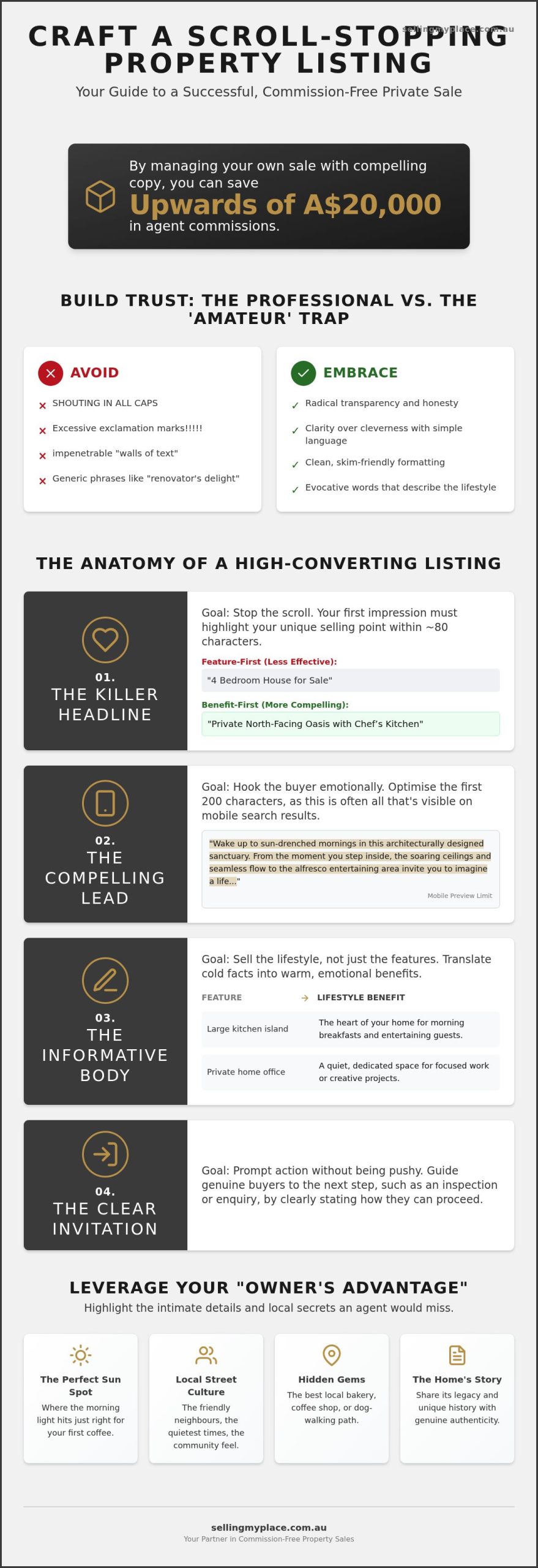
Technical Formatting for realestate.com.au and Domain
While the emotional narrative is the heart of your listing, the technical execution is the skeleton that holds it up. In 2026, the way you present your text is just as critical as the words themselves. If your formatting is clunky, buyers will simply bounce to the next property. Learning how to write a compelling property description for private sale requires a shift toward mobile-first thinking. Most Australians now hunt for homes on their smartphones, meaning your most vital information must appear before the “Read More” line.
The first 200 characters are your golden window. This snippet is what appears in search results and at the top of the mobile app. Use it to state your biggest unique selling point clearly. Beyond the hook, you must ensure your description aligns perfectly with the legal details in your Contract of Sale. Discrepancies between your marketing and the legal paperwork can create unnecessary friction or even legal hurdles during the settlement process.
Mastering the Mobile Scroll
Readability is the cornerstone of engagement. On a small screen, a “wall of text” is intimidating and often ignored. When you are refining how to write a compelling property description for private sale, remember that white space is your friend. Aim for paragraph breaks every two to three lines to keep the reader’s momentum going.
Utilising feature bullets is a brilliant way to provide quick-fire facts. Buyers in 2026 are specifically filtering for lifestyle upgrades that offer resilience and comfort. Consider a list like this:
- Energy Efficiency: 6.6kW solar system and double-glazed windows for year-round comfort.
- Working from Home: Dedicated executive study with custom built-in cabinetry.
- Outdoor Living: Saltwater pool and integrated alfresco kitchen for summer entertaining.
Bolding key terms and using sub-headings within the portal text box helps guide the eye to the information that matters most to that specific buyer. It allows them to find what they need without having to dig through paragraphs of fluff.
Portal-Specific Tips
Realestate.com.au and Domain have different character limits and display styles. While you might write a long-form story for your main advertisement, you may need to edit a punchier version for social media or secondary portals. Accurate data entry in the backend is equally important. If you forget to tick the “Pool” or “Solar” box in the features list, your property won’t show up when buyers use those specific filters.
Ensuring your listing is technically sound is a major step in the journey. For a broader look at the overall process, you can refer to our How to Sell Your Own Home: A Step-by-Step Guide. If you want to ensure your technical formatting is flawless before you hit publish, book a consultation with our advisory team for a final listing review.
Beyond the Words: The Partnership for a Successful Sale
Even the most evocative prose needs a professional stage to perform on. While you now understand how to write a compelling property description for private sale, those words must work in harmony with high-impact visuals. Think of it as a partnership where your words provide the emotional context and professional photography provides the immediate proof. When your authentic story is backed by gallery-quality imagery, you create a listing that doesn’t just inform buyers; it inspires them.
Our Agent Advisory Service is designed to bridge the gap between your intimate knowledge of the home and the professional polish required by the 2026 market. We don’t want to rewrite your experience. We want to refine it. By “peer-reviewing” your draft, our experts help you ensure that your unique insights are framed in a way that resonates with premium buyers. This collaborative approach allows you to maintain control of your narrative while benefiting from the “steady hand” of a seasoned expert.
The financial logic of this approach is compelling. By opting for a flat-fee model, you are choosing to reinvest in the quality of your marketing rather than paying for an agency’s overhead. Most of our clients find that saving upwards of A$20,000 in commissions allows them to present their home in the best possible light while still walking away with a significantly higher net return at settlement. You are the best person to tell your home’s story. We simply provide the platform and the tools to make sure that story is heard.
The Kincade Advantage
Kincade International Direct Sales (KIDS) combines your authentic voice with a marketing reach that rivals traditional agencies. Through our pre-sale property consulting, we help you identify the specific “lifestyle triggers” that will drive the most enquiry in your local area. Whether it is a sun-drenched reading nook or a resilient, sustainable garden, we know how to make those features shine. Plus, our “Until Sold” guarantee means you can move at a pace that suits your family, without the artificial pressure of a standard 90-day agency agreement.
Taking the Next Step
Before you hit the “Publish” button, take a final moment to read your listing aloud. Does it sound like the home you love? Does it clearly guide the buyer on how to take the next step? Ensure your contact details are correct and your professional floorplan is attached. Visualise the successful, commission-free settlement that awaits you. You have the knowledge and the tools to manage this transition with calm confidence.
Ready to write your success story? Contact our advisory team for a listing consultation to ensure your property hits the market with the professional edge it deserves.
Your Future Settlement Starts with the Right Words
Your journey from listing to a successful settlement is built on a foundation of trust and clear communication. By moving beyond a simple list of features and embracing the emotional narrative of your home, you’ve already done the heavy work that most agents overlook. Mastering how to write a compelling property description for private sale is the final piece of the puzzle, ensuring your digital front door is as welcoming as the real one. It is about showing buyers not just where they will live, but how they will feel when they arrive.
You don’t have to navigate this high-stakes transition alone. Our partnership approach gives you the professional tools to stand out, including high-end photography and floorplans that do the heavy lifting while your words capture the heart. With our expert Agent Advisory Service to review your draft and an “until sold” guarantee with no time limits, you can proceed with calm confidence knowing you are protecting an average of A$20,000 in equity. Start your commission-free selling journey today with our expert-backed marketing packages. We look forward to helping you turn the page to your next chapter with ease and success.
Frequently Asked Questions
How long should a property description be for a private sale?
The ideal length for a property description is typically between 300 and 500 words. This range provides enough space to cover the lifestyle narrative and the “Owner Loves” section without overwhelming a mobile user. Since the first 200 characters are the most critical for smartphone scrollers, ensure your most evocative hook is front-loaded to capture interest immediately before the “read more” break.
Do I need to mention the price in the description if it is already in the price field?
It is generally unnecessary to repeat the price within your main text if it is already clearly displayed in the portal’s dedicated field. Using that character count to focus on the home’s unique selling points is a better use of space. However, if you are using a strategy like “Offers Above” or a specific auction date, mentioning this toward the end can help clarify your expectations for the buyer.
Should I be honest about the property’s flaws in the description?
Radical transparency is one of the best ways to build trust in a private sale. While you don’t need to lead with a list of repairs, acknowledging a home’s “potential for improvement” or “original character” helps manage buyer expectations before they arrive for an inspection. This honesty ensures you are dealing with genuine enquiries from people who understand the property’s current state and see the value in its future.
Can I use AI to write my property description?
You can certainly use AI as a tool to overcome writer’s block or to help structure your initial draft. However, an AI cannot replicate your “Owner’s Advantage” or the heartfelt memories that make a house a home. Learning how to write a compelling property description for private sale involves adding those authentic, local details that only you know, which is why we recommend using our Agent Advisory Service to polish your final version.
How do I write a description for a property with “development potential”?
Focus on the technical “steak” of the property by leading with zoning, land dimensions, and street frontage. Mentioning ease of access or proximity to local infrastructure is vital for attracting investors and builders. While the potential is the main draw, briefly noting the current dwelling’s rental viability can provide a complete picture for those looking to land-bank or develop in the future.
What is the most important feature to highlight for Australian buyers in 2026?
Energy resilience and sustainable living have become the top priorities for Australian buyers in 2026. Highlighting features like high-capacity solar systems, double glazing, or thermal orientation speaks directly to the desire for lower running costs and year-round comfort. With national home prices falling slightly in July 2026, these value-add features help your property stand out as a smart, future-proof investment for families.
How often should I update my property description if it hasn’t sold?
Consider refreshing your listing every 21 to 30 days if you haven’t yet secured a successful sale. A new headline or a different lead photograph can often “reset” the listing in a buyer’s mind. Since national property listings increased by 12.4% in July 2026, staying fresh is essential to remain competitive. Use this update to respond to buyer feedback or to highlight a different seasonal lifestyle benefit.
Does the description affect my search ranking on realestate.com.au?
Your description affects your visibility through keyword optimisation rather than direct portal ranking algorithms. When you understand how to write a compelling property description for private sale, you include terms like “Home Office,” “Solar,” or “Pool” that buyers use in their filtered searches. While your listing tier determines your overall position, your copy is what ensures you appear in specific, high-intent search results.
Private House Sales Australia: The 2026 Guide to Commission-Free Selling
Why would you hand over $20,000 or more of your hard-earned home equity to a third party when the tools to succeed are already in your hands? Selling a family home is a deeply personal milestone, and it’s completely natural to feel protective of the legacy you’ve built over the years. Most homeowners agree that traditional real estate commissions, which now average roughly 2.65 percent across the country, feel like an unnecessary hurdle in your next chapter. Exploring the potential of private house sales australia is a smart move once you’ve realised that the old way of doing things doesn’t always serve your family’s best interests or your bottom line.
We’re here to show you that taking the lead on your property journey doesn’t mean you have to sacrifice professional quality or peace of mind. This guide provides a clear path to saving thousands in fees while maintaining a polished, high-end presence in the market. You’ll learn how to navigate the latest July 2026 identity verification laws, master the art of professional-grade listings, and access the expert support needed to handle negotiations with total confidence. It’s about moving forward with a steady hand and a full bank account.
Key Takeaways
- Learn how to keep $20,000 or more of your home equity by switching to a 0% commission model that prioritises your family’s financial future.
- Discover why the modern approach to private house sales australia has evolved into a professional partnership that rivals traditional high-end agencies.
- Master the art of the digital first impression by using professional photography and floorplans to capture buyers where they shop most: on their smartphones.
- Gain the confidence to handle your own sale with expert advisory support that guides you through 2026 legal requirements and buyer negotiations.
- Find out how to take back control of your property’s narrative and timeline with a “list until sold” promise that removes unnecessary pressure.
What are Private House Sales in Australia?
At its heart, a private house sale is a property transaction where you, the owner, take the lead instead of hiring a traditional commission-based agent. It’s a move toward transparency and personal control. While the concept isn’t new, the way we approach private house sales australia has undergone a massive transformation. We’ve moved far beyond the old “DIY” days of hand-drawn signs and crossing your fingers. Today, it’s about “Professional Direct Sales,” a partnership where you retain the decision-making power while leaning on professional-grade tools and advisory services to ensure a seamless result.
In 2026, we’re seeing a record shift toward this model. With national median commission rates sitting around 2.65 percent, many families are choosing to protect their hard-earned equity. This trend is a response to the evolving Australian property market, where savvy sellers realise that they don’t need a middleman to tell their home’s story. Instead, they use flat-fee models that provide the same high-end marketing and reach as a traditional agency, but without the staggering “success fee” at the end. It’s a grounded, sensible way to manage one of life’s biggest transitions.
The Legal Framework for Private Sales
You might wonder if it’s actually legal to sell your own home. The answer is a resounding yes. In every Australian state and territory, you have the right to sell your property privately. However, staying on the right side of the law requires a steady hand and the right team. Since July 1, 2026, new Anti-Money Laundering and Counter-Terrorism Financing laws require strict identity verification for both buyers and sellers. You’ll need a qualified solicitor or conveyancer from day one to prepare your contract of sale and manage the legal transfer. A professional flat-fee service doesn’t replace these legal experts; it works alongside them to ensure every “i” is dotted and “t” is crossed.
Commission vs. Flat-Fee: The Real Cost
The traditional agency model often feels like a “success fee” trap. It’s easy to overlook a small percentage until you do the maths on your actual home value. If you sell a home for $1,000,000 at a 2.5 percent commission rate, you’re essentially writing a cheque for $25,000 to an agent for work you could have guided yourself. That’s a significant amount of money that could be better spent on your next deposit or your retirement. By choosing a flat-fee model, you’re opting for price certainty. You pay for the services you actually use, such as professional photography and market reports, ensuring your home equity stays right where it belongs: with you.
Why Savvy Sellers are Choosing Commission-Free Models
Choosing a different path for your property sale is often sparked by a desire for clarity. When exploring private house sales australia, transparency isn’t just a buzzword; it’s the foundation of the entire process. Removing the middleman also removes the filter that often colours buyer feedback or negotiation details. You’re the one opening the door, sharing the history of the veggie garden, and hearing the genuine excitement in a buyer’s voice. This direct connection builds trust. It ensures you’re never left wondering what’s happening behind closed doors or if a lead is being “managed” for the agent’s benefit rather than yours.
Financial Empowerment and Equity Protection
It’s hard to ignore the numbers. With the national median commission rate currently at 2.65 percent, the savings on a typical Australian home can easily exceed $20,000. That’s not just a figure on a spreadsheet. It’s the deposit for your next adventure, a complete kitchen renovation, or a significant boost to your retirement nest egg. Traditional agencies often tack on “marketing administrative fees” that can quietly eat into your profit. By opting for a flat-fee model, you protect 100 percent of your sale profit. You become the best advocate for your home because nobody understands its value, its quirks, or its soul better than you do.
Control Over the Selling Timeline
We’ve all felt that artificial pressure of an “auction day” countdown or an expiring agency agreement. It creates a sense of frantic urgency that doesn’t always lead to the best outcome for your family. A professional direct sale approach replaces that stress with a “list until sold” promise. If your property is a unique heritage gem or a high-end coastal retreat, it might need a little more time to find the right custodian. You can learn more about managing this journey in our guide on How to Sell Your Own Home: A Step-by-Step Guide to Sale by Owner in Australia. Taking the lead means you decide when to accept an offer and when to hold out for the price your home truly deserves. If you’re feeling ready to explore how this partnership works, you can always reach out for a quiet chat about your specific needs.
Mastering the Private Sale: A Step-by-Step Framework
Success in the world of private house sales australia isn’t about luck; it’s about following a methodical process that mirrors the best agencies while keeping your family’s interests at the centre. You begin with a grounded understanding of your local area. By using detailed neighbourhood market reports, you can strip away the guesswork and set a price that reflects true market value. This ensures you don’t leave money on the table or scare off genuine buyers with an unrealistic figure. It’s about being informed and confident from the very first enquiry.
Once your price is set, the focus shifts to the visual narrative. In 2026, your home’s first “open house” happens on a smartphone screen before a buyer even thinks about driving past your front gate. Launching your campaign across multiple channels ensures maximum visibility. As enquiries start rolling in, you’ll find that managing inspections is often the most rewarding part. You get to meet the people who might become the next custodians of your home. It’s a personal exchange that a busy agent simply cannot replicate.
Preparation and Presentation
Professional floorplans and photography are no longer optional extras; they are the non-negotiable standard for a successful sale. You want to present a “magazine-ready” lifestyle that invites buyers to dream. This usually involves a bit of elbow grease. Clear away the daily clutter, depersonalise your spaces, and consider small styling touches like fresh flowers or new linens to elevate the mood. When your marketing materials look polished and professional, you signal to the market that you are a serious seller who values their property.
Negotiation Strategies for Private Sellers
Negotiation is where many owners feel the most trepidation, but it’s also where you have the most power. When a low-ball offer arrives, don’t take it personally. Treat it as the start of a conversation rather than a slight. By having an Expert Agent Advisory Service in your corner, you can lean on seasoned professionals to help you structure your counter-offers and maintain your poise. For deeper insights into this phase, take a look at our guide on Mastering the Deal: Expert Property Sale Negotiation Tips for Australian Homeowners. Finally, once you’ve reached an agreement, your solicitor or conveyancer steps in to finalise the contract, ensuring the legal transition is as smooth as the sale itself.
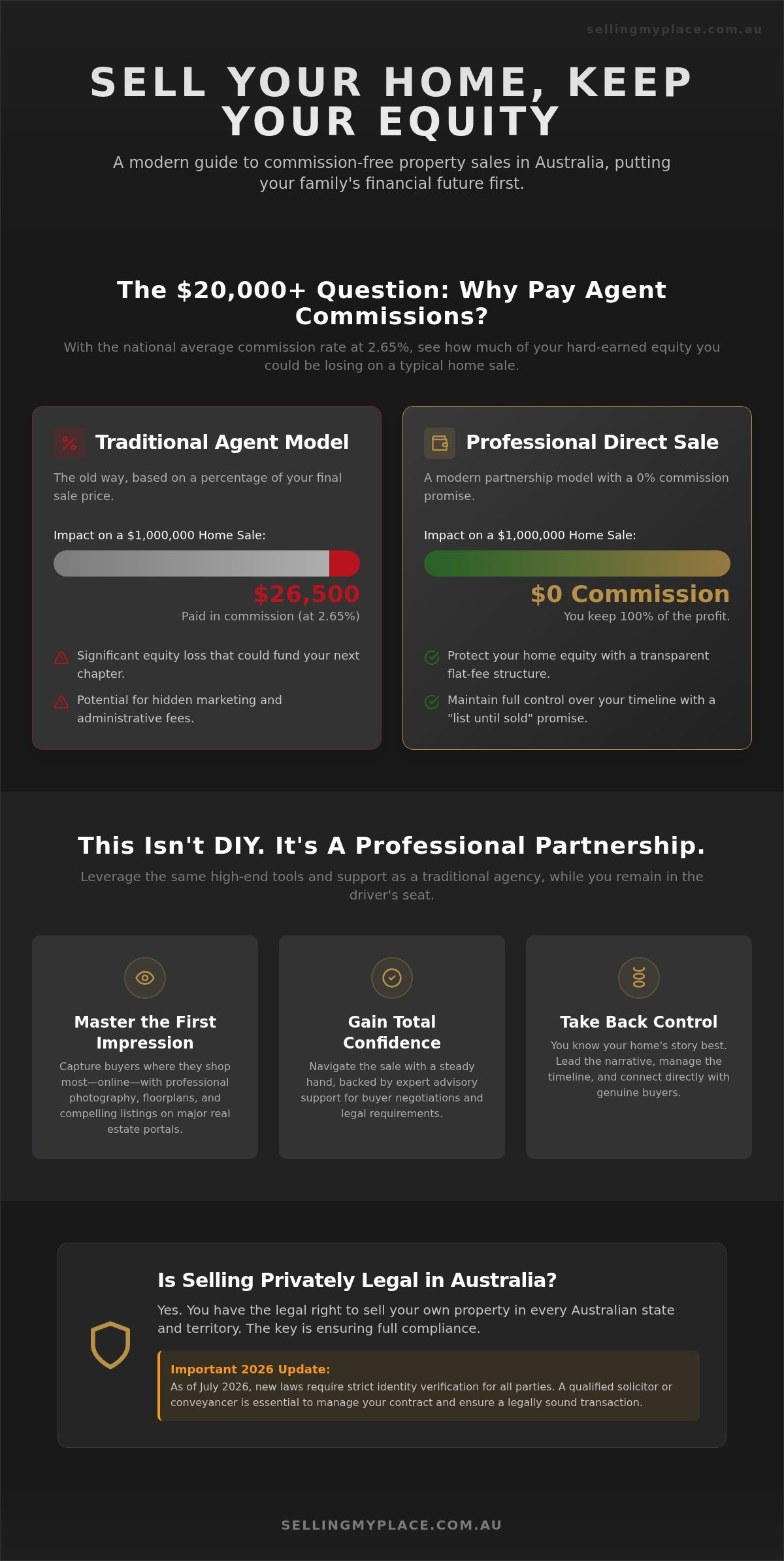
Professional Marketing: The Secret to a Record-Breaking Price
Smartphone screens have become the new front gate for Australian property. In a fast-paced digital environment, your home’s first impression happens in the palm of a buyer’s hand, often while they’re scrolling through listings late at night or during a lunch break. For those undertaking private house sales australia, this visual narrative is the single most powerful tool in your arsenal. Moving away from the “DIY” tag means embracing high-calibre marketing that invites a potential buyer to step into a new lifestyle. It’s about capturing the heart and the head simultaneously, ensuring your listing stands out with the same polish as any high-end agency.
Our approach also taps into a global network reach, attracting expats and international buyers who are looking to secure their piece of the Australian dream. This broad visibility, combined with professional-grade materials, ensures you aren’t just reaching “anyone,” but the “right” person for your home. When you present your property with authority and warmth, you build an immediate bridge of trust with buyers that carries through to the final handshake.
The Power of High-End Visuals
We’ve all seen listings with grainy, poorly lit photos taken on a mobile phone. These images can devalue a property in an instant, signalling a lack of care that might make a buyer wonder what else has been overlooked. Professional photography uses expert lighting and editing to highlight your home’s best features, which significantly increases click-through rates on major portals. Pairing these visuals with a detailed floorplan is equally vital. Detailed floorplans allow buyers to pre-qualify themselves by understanding the home’s flow and layout before they visit, which effectively reduces the number of “time-waster” enquiries you receive. It’s a respectful way to manage both your time and theirs.
Strategic Market Reports
Data is the bridge between an asking price and a signed contract. When a skeptical buyer questions your valuation, having a professional neighbourhood market report allows you to justify your position with cold, hard facts. These reports help you understand local trends, such as what features buyers in your specific suburb are currently prioritising. Whether it’s a dedicated home office or a sustainable garden, knowing what resonates allows you to tailor your message. To help you get this right, we’ve put together a comprehensive guide on How to Determine the Market Value of a Home in Australia: The 2026 Seller’s Guide. This level of preparation turns a simple sale into a strategic success. If you’re ready to see how high-end marketing can elevate your property’s potential, we invite you to book a pre-sale consultation with our team.
Launching Your Private Sale with Selling My Place
Choosing a partner for your property journey is a significant decision that impacts both your financial outcome and your peace of mind. The Kincade International Direct Sales (KIDS) model is built on the belief that you shouldn’t have to choose between saving money and receiving professional support. We offer a sophisticated partnership approach to private house sales australia, providing you with high-end photography, detailed floorplans, and neighbourhood market reports. This ensures your home is presented with the authority it deserves while you retain the equity you’ve worked so hard to build.
Our global reach provides a distinct advantage that basic DIY platforms simply cannot match. We actively tap into an international network of residential buyers and expats who are often searching for the stability and lifestyle found in the Australian market. By combining this wide-reaching visibility with expert pre-sale property consulting and conveyance advice, we ensure your property is seen by the right people, whether they are just around the corner or on the other side of the world.
The Agent Advisory Service
Even with the most beautiful marketing, the process of selling can feel complex and occasionally overwhelming. That’s why our Agent Advisory Service is the cornerstone of our partnership. Our experts act as a nurturing guide, helping you navigate the intricacies of the sale with calm confidence. We are here to reduce the stress of the process by providing grounded, professional support whenever you need it. Whether you’re unsure how to respond to a specific buyer enquiry or simply want a steady hand to lean on during negotiations, you’ll never feel like you’re managing this transition alone.
Starting Your Journey Today
Beginning your sale is a straightforward and inviting process designed to put you at ease. Our simple onboarding takes you from package selection to a live listing with minimal fuss. You can easily book your professional photography and floorplan session through our platform, ensuring your home is ready for its digital debut in its best possible light. If you’re ready to take the lead on your property’s future, we invite you to view our professional residential property listing services and see how our modern approach can work for your family.
Your Future, Your Equity, Your Choice
Embarking on a property sale is about more than just a transaction; it’s about honouring the life you’ve built and protecting your financial legacy. We’ve explored how professional-grade marketing and a strategic framework can turn the dream of a commission-free sale into a reality. By reclaiming control, you ensure that every decision aligns with your family’s needs rather than an agent’s quota. It’s a move toward transparency that rewards your hard work.
When you choose to lead your own journey with private house sales australia, you aren’t doing it alone. You’ll have the backing of an Expert Agent Advisory Service and high-end tools, including professional photography and floorplans, to make your listing shine. Most importantly, you stand to save an average of $20,000 in commissions, a sum that belongs in your pocket for your next big adventure. You have the local knowledge and the heart; we have the tools and the steady hand to help you succeed.
Ready to keep your equity? Explore our commission-free selling packages today.
Step forward with confidence, knowing your property’s potential is in the best possible hands: your own.
Frequently Asked Questions
Is it legal to sell my own house privately in Australia?
Yes, it is completely legal to sell your own home in every Australian state and territory without a traditional real estate agent. While you manage the marketing and inspections, you must still engage a qualified solicitor or conveyancer to handle the legal transfer of title. This ensures your property journey remains compliant with local laws while you retain full control over the transaction and your home equity.
How do I list my property on Australia’s leading real estate websites without an agent?
You can secure a presence on the major national property portals by partnering with a licensed flat-fee service provider like ours. Since these high-traffic websites typically don’t allow direct listings from individuals, we act as your professional gateway to ensure your home reaches the widest possible audience. This strategy gives you the same elite visibility as a traditional agency while keeping your hard-earned profit exactly where it belongs: with you.
Will buyers be put off by a private house sale?
Buyers are generally very receptive to private house sales australia, provided the property is presented with professional-grade photography and clear documentation. Many buyers actually prefer the direct communication and transparency that comes from dealing with the owner directly. When you use high-quality visuals and provide honest answers about the home’s history, you build a level of trust that traditional agents often struggle to replicate.
How much can I actually save by selling my home privately?
Most Australian sellers can expect to save an average of $20,000 by opting for a commission-free model. This figure is based on national median commission rates which currently hover around 2.65 percent of the sale price. By removing the agent’s “success fee” and avoiding the hidden marketing administrative costs often tacked onto traditional agreements, you protect your profit and gain significant financial flexibility for your next move.
Do I still need a solicitor if I am selling the house myself?
Yes, engaging a solicitor or conveyancer is a non-negotiable part of the selling process in Australia. They are responsible for preparing the Section 32 or Contract of Sale and managing the legal complexities of the settlement. While you take the lead on marketing and negotiations, your legal representative ensures that the paperwork is handled correctly and that the title transfer is legally binding and secure.
What happens if my property doesn’t sell within three months?
Unlike traditional agency agreements that often expire after 90 days, our partnership includes a “list until sold” promise with no time limits. This removes the artificial pressure of a ticking clock, allowing you to wait for the right buyer and the price your home deserves. If your property is unique or in a niche market, you have the peace of mind knowing your listing stays active without extra fees.
How do I handle the contract and settlement process in a private sale?
You handle the initial negotiation and price agreement, while your solicitor or conveyancer manages the technical settlement process. Once you’ve agreed on a price with a buyer, you simply pass their details to your legal representative to formalise the contract. This division of labour allows you to focus on the human side of the sale while experts handle the high-stakes legal requirements and identity verification checks.
Can I sell my property privately if it is currently tenanted?
You can certainly sell a tenanted property privately, provided you follow your state’s specific residential tenancy laws regarding notice periods for inspections. It’s often helpful to have an open conversation with your tenants to ensure they feel respected during the process. Many owners find that offering a small incentive, such as a temporary rent reduction, encourages cooperation for professional photography and scheduled viewings during the campaign.
Mistakes to Avoid When Selling Your Own Home: The 2026 Australian Guide
Would you willingly hand over A$24,000 of your home’s equity to a stranger just for the sake of tradition? With the national median dwelling value now sitting at A$922,838, that is exactly what many Australians are doing through standard 2.65% commissions. Choosing to sell privately is a brilliant way to reclaim that legacy for your family, but the path is often littered with expensive traps. Understanding the critical mistakes to avoid when selling your own home is the difference between a record-breaking result and a property that languishes on the market for months.
We understand that your home is more than just a floorplan; it is the backdrop to your life’s best memories, and the thought of managing the legalities and negotiations yourself can feel a little overwhelming. This guide is here to act as your steady hand, showing you how to protect your equity while avoiding the massive cost of traditional commissions. You will discover how to price your property accurately for the 2026 market, ensure your contract of sale is legally sound, and create a professional-grade listing that attracts the highest possible offers while keeping 100% of the profit.
Key Takeaways
- Protect your hard-earned equity by bypassing traditional 2.65% commissions, potentially saving you over A$20,000 in unnecessary fees.
- Learn the critical mistakes to avoid when selling your own home, such as allowing emotional attachment to cloud your pricing strategy and market positioning.
- Expand your reach far beyond the local street corner by utilising global marketing networks and professional photography to attract high-value buyers.
- Secure your sale with professional conveyance advice and documented agreements, ensuring you navigate building inspections and finance hurdles with confidence.
- Shift from a solo effort to a supported sale by integrating expert advisory services that offer the steady hand needed for a successful settlement.
The Financial Impact: Is Commission Your Biggest Avoidable Mistake?
The Australian property market in 2026 is a different beast than it was even five years ago. With the national median dwelling value reaching A$922,838, the standard 2.65% commission is no longer just a small fee; it is a significant portion of your hard-earned wealth. For many families, paying over A$24,000 in agency fees feels like an outdated tax on their lifestyle. One of the most significant mistakes to avoid when selling your own home is falling for the “commission trap”, which is the belief that you must sacrifice a slice of your equity to secure a buyer. In reality, the “secret Rolodex” of buyers that agents once touted has been replaced by digital portals that everyone can access.
Today, buyers don’t wait for a phone call from an agent to hear about a new listing. They have alerts set on their phones, and they are browsing digital platforms the moment a property goes live. When you understand the modern For Sale By Owner (FSBO) process, you realise that the digital infrastructure does the heavy lifting for you. Choosing to sell privately isn’t about “going it alone” or doing more work; it is about choosing a smarter partnership that keeps your profit where it belongs, which is in your bank account. It is a shift from a transactional expense to a strategic investment in your family’s future.
Understanding the Flat-Fee Revolution
The rise of the Agency Flat Fee model has changed the game for Australian sellers. Instead of a percentage-based commission that grows as your home’s value increases, a flat fee provides a transparent, upfront cost for the essential tools you need. This includes high-end Residential Property Listing Services that put your home in front of the same audience as the big traditional agencies. You get the professional photography and floorplans that are non-negotiable for a premium price, but without the lingering stress of a massive bill at settlement. It is about professional authority meeting common sense, ensuring you have the same digital reach as any high-street office while maintaining 100% of your equity.
Opportunity Cost and Your Next Move
Think about what an extra A$20,000 could do for your next transition. It might be the deposit for an investment property, a complete kitchen renovation in your new place, or simply a year’s worth of mortgage repayments. The emotional relief of a commission-free settlement day is profound. Protecting your equity is the first vital step in a successful move, providing you with a “steady hand” as you close one chapter and begin the next. When you avoid the mistake of overpaying for services that the internet now provides for free, you aren’t just saving money; you are securing your legacy and ensuring your family’s stability for years to come.
Presentation and Pricing: Avoiding the ‘Market-Cold’ Reception
It’s easy to look at your living room and see the first steps your children took or the laughter shared over birthday dinners. However, one of the most common mistakes to avoid when selling your own home is allowing this deep emotional attachment to dictate your asking price. Sentiment doesn’t show up on a bank valuation. In a market where national house prices are forecast to grow by 7.7% through 2026, buyers are more analytical than ever. They aren’t just looking at your home; they are comparing it against every other data point available on their screens.
To avoid the trap of overpricing and subsequent stagnation, you must lead with logic. Utilising Neighborhood Market Reports allows you to set a price grounded in current local sales evidence rather than memories. This data-driven approach protects you from the “market-cold” reception that happens when a property sits for months without an offer. Remember the ‘First 48’ rule: your listing receives the highest volume of digital traffic in the first two days. If the price is wrong or the presentation is lacking, you’ve missed your best window to capture a premium buyer.
The Psychology of the Australian Buyer
Modern buyers in 2026 are looking for a lifestyle, not just a postcode. They often “swipe left” on listings featuring amateur smartphone photos that feel dark, cluttered, or lived-in. To attract high-value interest, you must neutralise your space. This means removing personal photos and bold decor to create a blank canvas where a stranger can visualise their own future. Highlight lifestyle features that resonate with today’s trends, such as dedicated home offices or seamless indoor-outdoor entertaining areas, rather than just listing room counts. If you’re unsure where to start with your home’s presentation, you might like to chat with us about your property’s unique potential.
Professional Photography vs. DIY Snapshots
High-end visual storytelling is the foundation of a successful private sale. Professional lighting and wide-angle lenses aren’t just luxuries; they are essential tools that justify a premium asking price by making spaces feel bright and aspirational. Alongside stunning imagery, providing detailed floorplans is a non-negotiable requirement for 2026. A floorplan keeps a buyer engaged with your listing for longer, allowing them to mentally arrange their furniture and plan their life in the home before they even step through the front door. This level of professionalism signals to the market that you are a serious seller with a high-quality offering.
Marketing Reach: Why a ‘For Sale’ Sign Isn’t Enough
Placing a sign in the front yard is a lovely tradition, but it is no longer the primary way to find a buyer in a connected market. One of the most common mistakes to avoid when selling your own home is relying solely on local visibility. In 2026, the buyer for your home might currently be sitting in a cafe in Sydney or an office in London, browsing listings on their lunch break. If your marketing doesn’t reach them where they are, your property remains invisible to the biggest pool of potential offers. The digital world has removed geographical barriers, meaning your competition isn’t just the house down the street; it’s every property on a buyer’s filtered search results.
To attract the maximum sale price, you need to be where the eyeballs are. This means moving beyond social media groups and community boards. You need to tap into a global marketing network that treats your home with the same prestige as a multi-million dollar estate. Digital portals have become the modern town square, and visibility here is non-negotiable. However, simply being present isn’t enough; you must avoid “marketing fatigue”. This happens when a listing becomes stale after a few weeks. Keeping your content fresh with new insights about the local community or updated seasonal photos ensures your home stays at the top of search results. It is about maintaining momentum until the right person falls in love with the space.
Digital Infrastructure Checklist
Professional Residential Property Listing Services level the playing field, giving you the same digital “push” as the largest agencies. This infrastructure ensures you aren’t just an “owner-seller” but a sophisticated market participant. Consider these essentials for your 2026 campaign:
- Listing on all leading national property portals to ensure maximum exposure to active buyers across the country.
- Utilising retargeting ads that gently follow interested buyers as they browse the web, keeping your home top-of-mind during their search.
- Leveraging automated push notifications that alert registered buyers the second your property hits the market or has a status update.
Attracting the Right Demographic
Selling a house is a transaction, but selling a lifestyle is an invitation to a new future. Your marketing materials should include specific neighbourhood data that speaks directly to your likely buyer’s aspirations. Are you near the best schools, the quietest parks, or the most vibrant coffee strips? Tailor your description to tell a story. Instead of just saying “three bedrooms”, describe the morning sun hitting the breakfast nook or the peace of a quiet cul-de-sac. This emotional connection is what drives high-value offers. Buyers in 2026 want to know about the community they are joining, not just the bricks and mortar they are buying. Providing this context makes your listing feel grounded and authentic.
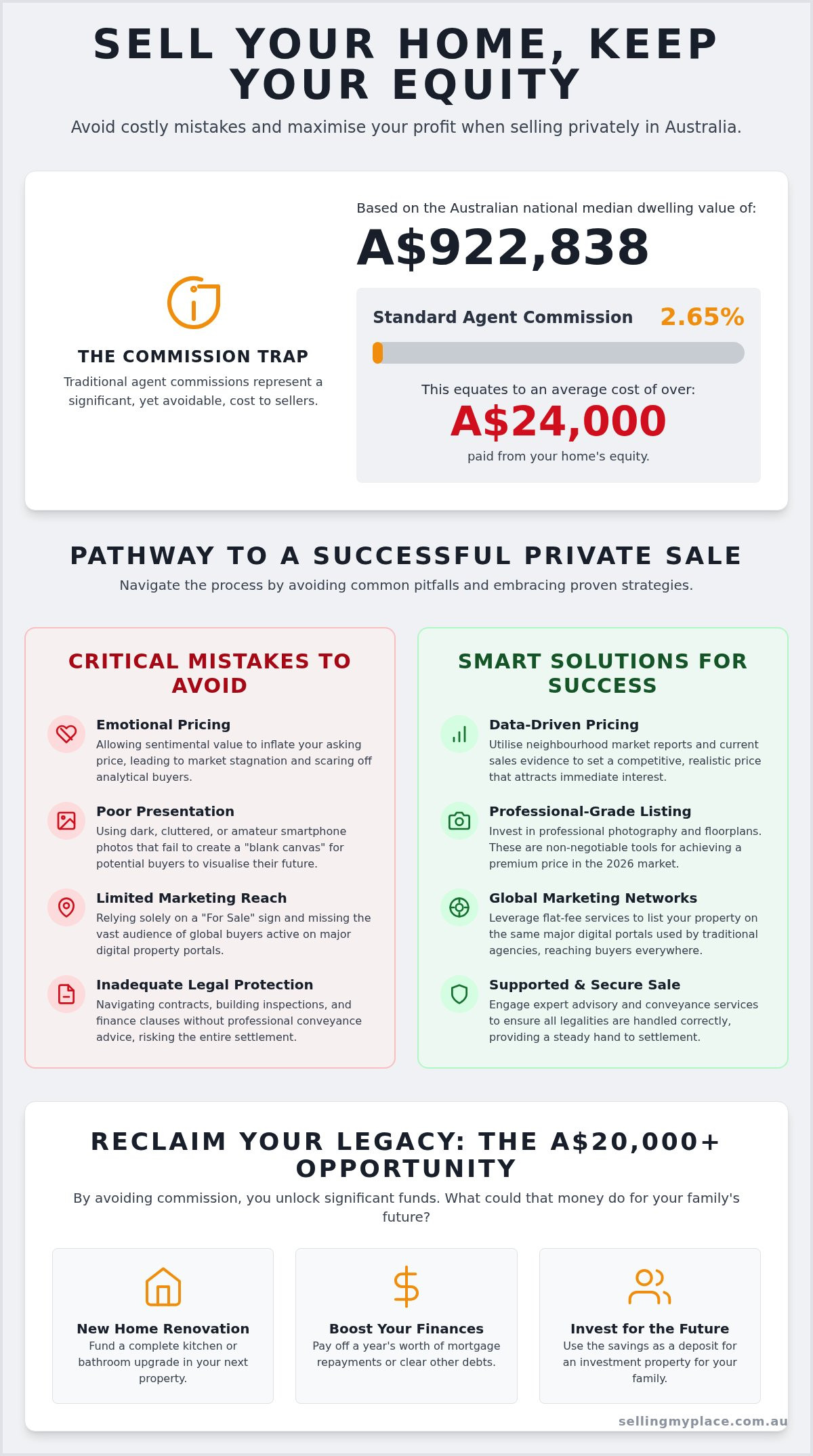
Legal and Negotiation Pitfalls: Protecting Your Settlement
The moment a potential buyer expresses interest, the process shifts from a marketing campaign to a high-stakes legal dance. One of the most significant mistakes to avoid when selling your own home is relying on a “handshake deal” or a verbal promise. In the fast-paced Australian market of 2026, every agreement must be documented and legally sound from the very first interaction. Whether it is a cooling-off period or a specific settlement date, having a clear paper trail protects your interests and ensures that your property’s legacy is handled with the respect it deserves.
Managing the common hurdles of “subject to finance” and “building and pest inspections” requires a calm, steady hand. These clauses are standard in most Australian contracts; however, they can feel like roadblocks if you aren’t prepared. By securing professional Conveyance Advice early in the piece, you ensure that your paperwork is “PEXA-ready”. PEXA is now the non-negotiable standard for digital settlements in Australia, allowing for a seamless, secure transfer of funds and title on settlement day. This digital infrastructure reduces the risk of manual errors and provides the transparency you need during such a major life transition.
Mastering the Negotiation
Some traditional agents claim that only a middleman can negotiate effectively. However, as the person who knows your home’s story best, you are often its most passionate and informed advocate. The key is to remove the emotion and treat the sale like a professional transaction. Using proven property sale negotiation tips will help you hold your ground on price while identifying serious, qualified buyers versus “tyre kickers” who aren’t ready to commit. Focus on the facts of the market and the value of your property’s unique features to guide the conversation toward a successful result.
The Vendor Statement and Disclosure
Honesty is not just the best policy; it is a legal requirement. Avoiding the mistake of “hiding” property flaws is crucial, as modern building inspections will inevitably find them. In states like Victoria, the Section 32 (or your local equivalent Vendor Statement) must be accurate and comprehensive. Pre-Sale Property Consulting can help identify potential legal red flags before they have the chance to kill a deal. If you’re feeling a little overwhelmed by the legal requirements of your state, you might like to contact our advisory team for a friendly chat about your specific needs. This proactive approach ensures that once you find the right buyer, the path to settlement remains clear and stress-free.
Selling Smarter: The Partnership Approach to FSBO
Perhaps the most restrictive mindset in the Australian property market is the belief that you only have two choices: pay a high-commission agent or struggle through a lonely, complex DIY process. This “all or nothing” mentality is one of the primary mistakes to avoid when selling your own home. When you try to do everything in isolation, you risk missing the fine details that professional buyers and their solicitors look for. Integrating professional advisory into your sale by owner journey creates a powerful middle ground, giving you the expertise of a seasoned professional without the heavy financial burden of a percentage-based commission.
The Kincade method is designed to be that “steady hand” you need during a major life transition. By combining high-end Residential Property Listing Services with a 0% commission structure, we ensure your equity remains yours. You shouldn’t have to choose between professional marketing and your family’s profit. This partnership approach provides you with the same global reach and digital infrastructure used by traditional agencies, but with the transparency of a flat fee. It is a more respectful, modern way to sell that acknowledges your role as the best advocate for your property while providing the expert backup required to close the deal with confidence.
Your 2026 Action Plan
Success in the current market requires a methodical approach. Start by organising your legal documents and professional marketing materials well before your preferred launch date. One of the benefits of our model is that we offer listing longevity with no time limits; you can take the time to find the right buyer without the pressure of an expiring agency contract. Your final checklist for a smooth settlement should include:
- A completed and verified Vendor Statement (Section 32).
- Professional photography and a detailed floorplan to anchor your digital listing.
- Current Neighborhood Market Reports to justify your asking price during negotiations.
- A clear understanding of the PEXA digital settlement process.
Ready to Sell Smarter?
Stepping away from the traditional agency model doesn’t mean stepping into the unknown. It means taking control of your financial future with the backing of a team that values your legacy as much as you do. The confidence that comes from professional support allows you to enjoy the process of showing your home, knowing that the technical and legal details are being handled correctly. You have worked hard to build equity in your property; now is the time to protect it. If you are ready to experience a more personal, profitable way to move, we are here to guide you every step of the way. Get started today and keep 100% of your profit.
Securing Your Family’s Financial Legacy
Your home is likely your most significant asset, and the decisions you make today will echo through your family’s future for years to come. By identifying the critical mistakes to avoid when selling your own home, you have already taken the first step toward a more profitable and peaceful transition. You now recognise that protecting your equity doesn’t mean sacrificing professional quality. In fact, with the right partnership, you can save an average of A$20,000 in commissions while still presenting your property with the high-end photography and floorplans that modern buyers expect.
Selling privately in 2026 is about blending your passion for your property with our expert Agent Advisory Service to ensure every legal and digital detail is perfect. You don’t have to navigate the complexities of contracts and negotiations alone. We are here to act as your steady hand, providing the infrastructure and confidence you need to achieve a record-breaking result. If you are ready to reclaim your profit and move forward on your own terms, we would love to help you get started today.
Book a consultation to avoid costly mistakes and keep 100% of your profit
Frequently Asked Questions
What is the most common mistake when selling your own home in Australia?
The most common mistake is incorrectly pricing the property based on sentimental value rather than current market data. This often leads to the home sitting on the market for months, which is one of the primary mistakes to avoid when selling your own home in 2026. Using objective local sales evidence ensures your starting point is both realistic and attractive to the most qualified buyers in your area.
Do I really need professional photography if I have a great smartphone?
Yes, professional photography is essential because buyers in 2026 make decisions based on high-quality digital listings. While modern smartphones are impressive, they cannot replicate the lighting, wide-angle perspectives, and professional editing required to make a space feel truly aspirational. Premium imagery combined with detailed floorplans is what keeps potential buyers engaged with your listing for longer and justifies a higher asking price.
How do I handle negotiations without an agent involved?
Approach negotiations with a professional mindset by focusing on the data rather than personal feelings. It helps to have a clear bottom line and to understand the specific needs of the buyer before the conversation begins. Having an expert advisory service in your corner provides a steady hand, ensuring you remain confident and firm on your property’s true value during the high-stakes negotiation process.
Is it legal to sell my own house without a real estate licence?
It is perfectly legal for an Australian homeowner to sell their own residential property without a real estate licence. While agents must be licensed to sell on behalf of others, you have the right to represent your own interests. You simply need to ensure all legal disclosures, such as the Section 32, are correctly prepared by a qualified legal professional to meet state regulations.
How do I price my home accurately without an agent’s appraisal?
You can achieve an accurate price by researching recent comparable sales in your immediate area through Neighborhood Market Reports. Focus on properties with similar land sizes and features that have sold within the last six months. This objective data provides a much more reliable foundation than a traditional agent’s appraisal, which can sometimes be inflated to win your business rather than reflecting the true market value.
What happens if a buyer asks for a building and pest inspection?
A building and pest inspection is a standard part of the Australian property journey and should be viewed as a step toward a secure settlement. Being honest about any known issues from the start prevents the deal from falling through later. Pre-sale consulting can help you identify and address these concerns before the property even hits the market, ensuring the final inspection is stress-free.
How much can I actually save by avoiding traditional commissions?
Most Australian sellers save an average of A$20,000 by bypassing traditional 2.65% commissions. With the national median dwelling value now at A$922,838, these savings are substantial and can significantly boost your budget for your next move or renovation. Avoiding these unnecessary fees is one of the most effective ways to protect your hard-earned equity during a major life transition while keeping 100% of the profit.
Is PEXA mandatory for private sellers in Australia?
PEXA is the industry standard for digital settlements across Australia and is effectively mandatory for a secure, modern property transfer. It allows for the instantaneous exchange of funds and title, reducing the stress of settlement day. While you are selling privately, your conveyance advisor will use PEXA to ensure the legal transfer is handled with professional authority and the security that your family deserves.
High-Impact Real Estate Marketing Strategies for Sellers in 2026
What if you could command a premium sale price and professional-grade exposure without handing over a single cent of your hard-earned equity in commissions? It’s natural to feel a bit of anxiety when looking at the 2026 property market, especially when trying to implement effective real estate marketing strategies for sellers on your own. Between navigating the latest digital portal requirements and the stress of organising high-end photography, the weight of selling your own home can feel overwhelming. You want your property to stand out. However, the thought of high upfront costs or underselling your family’s biggest asset is enough to keep anyone awake at night.
This guide will show you how to master professional-grade tactics that rival any traditional agency, ensuring you keep 100% of your commission while achieving a top-tier result. We will explore everything from leveraging global digital networks to managing professional suppliers with ease, so you can transition to your next chapter with confidence and a much healthier bank balance. By the end of this article, you’ll have a clear roadmap to a stress-free, professional-looking listing that protects your profit and honours the value of your home.
Key Takeaways
- Discover how the shift toward property-centric marketing in 2026 allows you to reach global buyers without relying on traditional agency models.
- Learn why professional-grade photography and floorplans are essential to capturing interest within the critical first three seconds of a listing.
- Master effective real estate marketing strategies for sellers by utilising Australia’s major property portals and targeted social media to find passive buyers.
- Follow a clear, step-by-step playbook to prepare your property for a premium sale while retaining 100% of your commission.
- Explore how a sophisticated flat-fee approach can save you an average of A$20,000 while still providing expert advisory support and global exposure.
The Evolution of Property Marketing: Why 2026 Favours the Seller
The Australian property market has undergone a profound transformation. For decades, the focus was firmly on the agent, with their portrait dominating the billboard and their personal brand taking centre stage. However, the evolution of property marketing has shifted the spotlight back to where it belongs: on your home. In 2026, buyers don’t care about an agent’s career highlights; they care about the lifestyle your property promises. This move toward property-centric marketing means that the right real estate marketing strategies for sellers are now more accessible than ever, allowing you to present your home with the same polish as a high-end agency.
Digital globalisation has played a massive part in this shift. Your buyer is no longer just the person driving past your “For Sale” sign on a Saturday morning. They could be a professional relocating from Melbourne, an expat in London, or an investor in Singapore. Because the search process has moved entirely online, a property in a quiet Australian suburb can now achieve global visibility instantly. This transparency has empowered sellers, but it has also raised the bar for quality. A professional listing isn’t just a luxury; it’s a fundamental requirement for building trust with a buyer who may be viewing your home from thousands of kilometres away.
Breaking the Commission Cycle
Traditional real estate models often demand a 2% to 3% commission, which can feel like a heavy tax on your hard-earned equity. On a typical Australian home, this can easily amount to tens of thousands of dollars. Many savvy homeowners are joining the “Direct Sale” movement, realising that they can achieve a premium result without the sting of a commission. It’s a common misconception that choosing a no-commission path means going it alone. By using modern real estate marketing strategies for sellers, you can access professional listing services and global reach while keeping your profit in your own pocket. In fact, sellers using a flat-fee model often save an average of A$20,000, which is a significant boost to their next deposit or retirement fund.
The Role of Expert Advisory in Marketing
Effective marketing begins long before the first shutter click of a camera. It starts with pre-sale property consulting to identify the high-value improvements that actually move the needle for buyers. Whether it’s a fresh coat of paint in the right neutral tone or minor landscaping, these choices are informed by detailed neighbourhood market reports. Having a steady hand to guide you through the complexities of the settlement process and conveyance advice ensures that the professional image you’ve built is matched by a seamless transaction. This advisory-led approach provides the confidence of an expert partnership without the traditional agency price tag.
Visual Storytelling: Professional Photography and Floorplans
In the digital age, your first open house doesn’t happen on a Saturday morning at your front door. It happens on a smartphone screen, often late at night while a potential buyer is scrolling through property portals. You have roughly three seconds to capture their attention before they move on to the next listing. This is why visual assets are the cornerstone of effective real estate marketing strategies for sellers. It isn’t just about showing the rooms; it’s about telling the story of a life well-lived and inviting someone else to imagine their future within your walls.
Professional wide-angle photography is a non-negotiable element of this process. These specialized lenses capture the true volume of a room, creating a sense of space and light that a standard phone camera simply cannot replicate. While modern phones are impressive, they often struggle with “barrel distortion” or poor light balancing, which can make even the most beautiful home look cramped or gloomy. To ensure your shoot is a success, follow this simple preparation checklist:
- Declutter every surface, including kitchen benches and bathroom vanities.
- Open all curtains and blinds to flood the home with natural Australian sunlight.
- Turn on every light in the house, including bedside lamps, to create a warm glow.
- Remove personal items like family photos, fridge magnets, and pet bowls.
- Ensure the exterior is tidy, with bins tucked away and cars moved out of the driveway.
Capturing the Heart of the Home
Buyers generally buy on emotion and then justify the purchase with logic. Using natural light and “lifestyle” shots, such as a sun-drenched reading nook or a beautifully set alfresco dining area, helps create that vital emotional pull. Your “hero shot,” which is usually the front of the house or the primary living area, must be impeccable. DIY photos can actually devalue your property in the eyes of a buyer, as they suggest a lack of care or professional oversight. If you’re feeling unsure about how to present your home’s best side, reaching out for a bit of expert advice can ensure your visual presentation is flawless.
Floorplans: The Blueprint of a Sale
Research suggests that approximately one in three buyers will completely ignore a listing if it lacks a floorplan. It’s a critical tool that allows people to “move in” mentally before they’ve even stepped foot on the property. They can measure where their favourite sofa will go or see exactly how the master bedroom relates to the nursery. A professional floorplan adds a layer of agent-grade legitimacy to your listing, reassuring buyers that the information is accurate and professional. It provides the spatial context that static photos sometimes lack, making the entire marketing package feel comprehensive and trustworthy.
Maximising Digital Reach: Portals, Socials, and Global Networks
Getting your home in front of the right eyes requires more than just a “For Sale” sign and a prayer. In the Australian market, visibility is dominated by the leading property portals that attract millions of monthly visitors. While these platforms are often seen as the exclusive playground of traditional agencies, modern real estate marketing strategies for sellers now provide a direct pathway to these high-traffic platforms. By listing your home where the buyers already are, you ensure your property is seen alongside every other professional listing in your suburb. It’s about creating a level playing field where the quality of your home, and the professional visual storytelling we discussed earlier, can truly shine.
Beyond the major portals, successful sellers use data-driven neighbourhood market reports to understand exactly who their buyer is. Is it a young family looking for a backyard, or an investor seeking a high-yield unit? Knowing this allows you to tailor your digital reach. If your property is a high-value residence, a global marketing network becomes essential. In 2026, capital is incredibly mobile. An Australian lifestyle property is an attractive asset for international buyers, and your marketing should reflect that global appeal by appearing on international syndication networks that reach expats and investors worldwide.
Beyond the Local Suburb
Your property’s discoverability shouldn’t end at the suburb boundary. Sophisticated SEO ensures that when someone searches for a lifestyle change in your specific region, your home appears in the results. This is particularly vital for attracting international interest. Global listing syndication pushes your property to dozens of countries, reaching buyers who might never visit a local Australian portal. Even “off-market” strategies have evolved. You can build momentum through private networks and digital infrastructure before the public launch, creating a sense of exclusivity that can drive up the final sale price without the stress of a public deadline.
The Social Media Strategy
Social media is a powerhouse for finding “passive” buyers, making it one of the most effective real estate marketing strategies for sellers in a competitive market. These are people who aren’t actively checking portals every day but would move for the right opportunity. Targeted social media ads allow you to place your home directly into the feeds of people based on their lifestyle interests and browsing habits. A short, engaging video walkthrough can stop a thumb mid-scroll far more effectively than a static image. Don’t underestimate the power of community, either. Sharing your listing in local suburb groups can spark word-of-mouth interest that leads to a genuine enquiry. It’s a personal, neighbourly way to find a buyer who will love your home as much as you have.
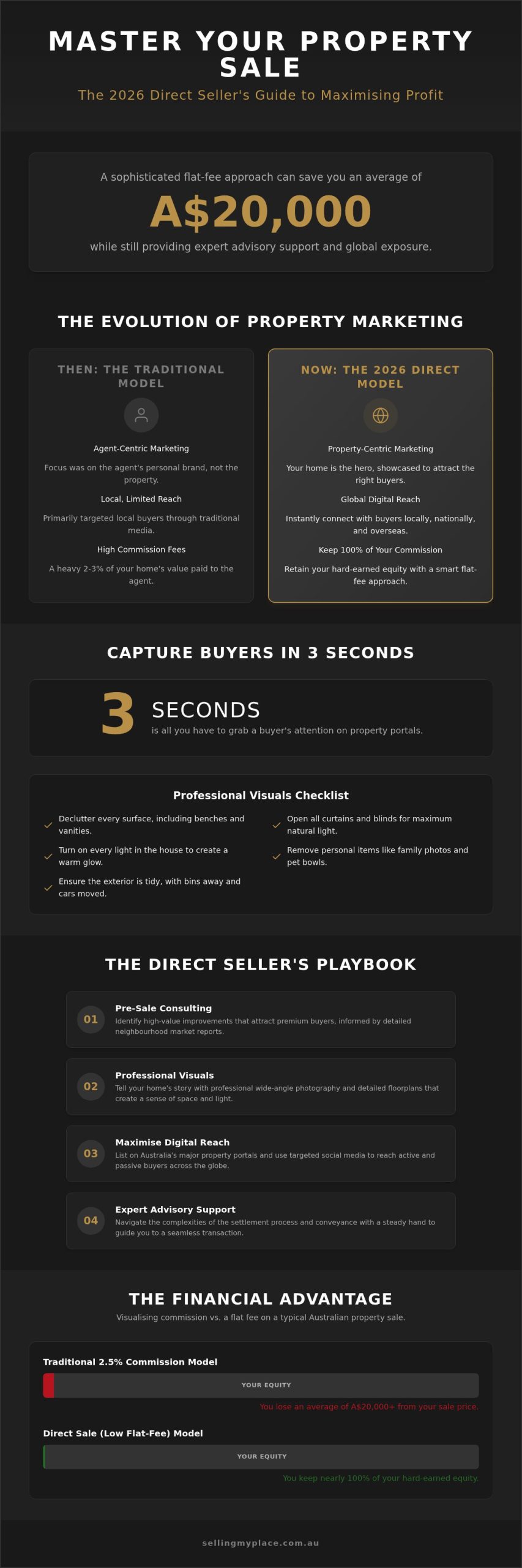
The Direct Seller’s Playbook: A Step-by-Step Marketing Plan
Many traditional agencies like to keep their marketing processes shrouded in mystery, suggesting that only they possess the “secret tools” for a successful sale. In reality, the most effective real estate marketing strategies for sellers are quite straightforward when you have a structured plan to follow. This playbook demystifies the process, putting the power back into your hands while ensuring you don’t sacrifice an ounce of professionalism. By following these five steps, you can transition from a homeowner to a successful seller with total confidence.
- Step 1: Pre-Sale Consultation. Before you even think about a camera, you need to identify high-value improvements. A professional pre-sale property consulting session helps you decide which minor repairs or styling choices will actually increase your sale price.
- Step 2: Professional Assets. Secure your professional photography and floorplans. As we’ve discussed, these are the primary drivers of digital engagement.
- Step 3: Compelling Copywriting. Draft benefit-driven copy that highlights the lifestyle your home offers. Instead of just listing “three bedrooms,” describe the “sun-drenched morning coffee spot” or the “short, leafy walk to the local primary school.”
- Step 4: The Global Launch. Go live across the “Big Three” Australian portals and global networks simultaneously. This creates an immediate surge of interest and competition.
- Step 5: Advisory Support. Utilise expert real estate advisory services to manage enquiries, negotiate offers, and guide you through the conveyance process.
Timing Your Launch
The “Golden Window” for a property listing is typically the first 14 days. This is when your home is “new” to the market and receives the highest volume of views. To make the most of this period, you must coordinate your professional photography, signage, and online listing so they all hit the market at once. One of the greatest benefits of a modern flat-fee model is the “no time limit” listing. This removes the stress of a ticking clock, allowing you to wait for the right buyer without the fear of your listing becoming “stale” or being forced into a price reduction by a looming agency contract expiry.
Negotiating Like a Pro
Negotiation doesn’t have to be a high-stress confrontation. When you’re armed with detailed neighbourhood market reports, you have the data needed to defend your asking price with calm authority. If you receive multiple offers, you can manage them transparently without the pressure of a public auction. This methodical approach ensures the marketing success you’ve built translates into a premium final settlement. If you’re ready to take the first step toward a commission-free sale, get in touch with us to discuss your property’s potential.
The Kincade Advantage: Professional Results Without the Sting
Selling My Place (Kincade International Direct Sales) isn’t just about listing a property; it’s about redefining how Australians approach the biggest transaction of their lives. By combining global digital infrastructure with a personal, advisory-led model, we ensure you don’t have to choose between professional exposure and financial sense. Implementing high-impact real estate marketing strategies for sellers shouldn’t come with a hidden “success tax” that drains your profit. Instead, our model prioritises your equity, allowing you to deploy sophisticated tactics while retaining 100% of your commission. It’s a smarter, more transparent way to move forward.
The financial reality of this approach is quite remarkable. On average, our sellers save approximately A$20,000 by avoiding traditional percentage-based fees. When you consider that this saving comes while still receiving professional photography, detailed floorplans, and reach into global networks, the decision becomes a matter of logic rather than tradition. We view this as a genuine partnership. Our goal is your success, not a quick transaction to meet an agency quota. By removing the pressure of commission, we create an environment where the focus remains entirely on your needs and your property’s potential.
A Partnership Approach
We believe selling a home is an emotional transition that deserves more than a purely transactional service. Our Agent Advisory Service acts as your “steady hand,” providing the calm confidence needed to navigate complex negotiations and buyer enquiries. You aren’t left to figure out the legalities alone, either. With professional conveyance advice available, you have a clear, supported path from the first enquiry to the final settlement. This supportive experience aims to reduce the typical stress of selling, replacing it with a sense of shared purpose and expert local knowledge that feels both personal and protective.
Your Equity, Your Future
Take a moment to visualise what that A$20,000 saving could mean for your future. Perhaps it’s a significant boost to the deposit for your next family home, a contribution to your children’s education, or the security of a more comfortable retirement. This is your legacy. Keeping that profit where it belongs is a powerful way to honour the years of hard work you’ve put into your property. Selling smarter isn’t just about the final price on the contract; it’s about the financial freedom you carry into your next chapter. Are you ready to take control? Contact our expert advisors today to start your commission-free journey.
Your Path to a Successful, Commission-Free Sale
The shift toward property-centric marketing in 2026 has opened doors that were once locked behind agency gates. By mastering professional real estate marketing strategies for sellers, you’ve seen how simple it is to combine global reach with high-end visual storytelling. You don’t need to sacrifice your equity to achieve a premium result. Instead, you can rely on a model that includes professional photography and floorplans as standard, ensuring your home looks impeccable on every major portal from day one.
Choosing to sell your own home is an empowering step toward protecting your family’s financial legacy. With an average saving of A$20,000 in commissions and the peace of mind that comes from being listed until sold with no time limits, you’re firmly in the driver’s seat. We’re here to act as your steady hand, providing the advisory support you need to navigate this transition with total confidence and warmth. It’s about more than just a transaction; it’s about honouring the home you’ve built.
Start your commission-free sale today with our expert marketing advisory. It’s time to celebrate your home’s true value and keep your hard-earned profit exactly where it belongs.
Frequently Asked Questions
Can I really list my home on Australia’s major property portals without a traditional agent?
Yes, you can list on the nation’s premier property search platforms through a licensed listing service. While the largest portals typically don’t allow private individuals to list directly, a flat-fee service provides the professional bridge required. This ensures your home appears alongside every other agency listing, maintaining a level playing field for your property’s visibility and reach.
How much can I actually save by using a flat-fee real estate marketing strategy?
Australian homeowners save an average of A$20,000 in commissions by opting for a flat-fee model. This figure represents the equity you would otherwise pay to a traditional agent based on a percentage of the final sale price. By implementing these real estate marketing strategies for sellers, you retain more of your property’s value while still accessing professional-grade exposure and support.
Is professional photography included in the flat-fee marketing packages?
High-quality wide-angle photography and professional floorplans are standard inclusions in our marketing packages. We understand that visual storytelling is the most critical factor in capturing a buyer’s interest within the first few seconds of their search. Providing these assets as part of a fixed fee ensures your property presents with the same polish and authority as any high-end agency listing.
What happens if my property doesn’t sell within the first few months?
Your property remains listed until it’s sold, as there are no time limits on your listing. Traditional agency contracts often expire after 90 days, which can lead to stressful price reductions or the need to re-list. Our approach removes this pressure, allowing you to wait for the right buyer and the right price without worrying about additional fees or contract renewals.
How do I handle the legal side of the sale without an agent?
You can manage the legal requirements by utilising professional conveyance advice and advisory services. While you are the primary point of contact for buyers, experts guide you through the documentation and settlement process. This partnership ensures all Australian legal standards are met, providing a secure and compliant path from the initial offer to the final exchange of keys.
Will buyers take my listing seriously if I am selling it myself?
Buyers focus on the property’s quality and the professionalism of the listing rather than the name of the agency. When your home is presented with professional photography, accurate floorplans, and clear descriptions, it carries a high level of legitimacy. Many buyers actually prefer the direct transparency and local knowledge that only a homeowner can provide during an inspection.
What is pre-sale property consulting and do I really need it?
Pre-sale property consulting is a strategic review that identifies which minor improvements will yield the highest return on investment. It’s an essential step for those using real estate marketing strategies for sellers to ensure they aren’t over-capitalising on renovations. By focusing on high-impact changes like styling or landscaping, you can significantly boost your home’s appeal and final sale price.
How does a global marketing network help sell a local Australian home?
A global marketing network exposes your property to international investors and Australian expats living abroad. In a mobile world, your buyer might be searching from London or Singapore. Global syndication ensures your listing appears on international platforms, increasing the pool of potential buyers and creating more competition; this often leads to a more favourable sale price for your local residence.
Best For Sale By Owner Sites Australia: 2026 Guide
If you could keep an extra A$20,000 from your home sale simply by changing who hits the ‘publish’ button, why wouldn’t you? Selling a family home is a deeply personal transition, and it’s only natural to feel protective of the equity you’ve spent years building. You likely want to avoid hefty agent commissions, but the fear of underselling or getting tangled in complex legal paperwork is enough to make anyone feel a little unsettled. It’s a significant life event, and you deserve to feel supported rather than just processed through a system.
The good news is that selling privately in 2026 has evolved into a sophisticated partnership. This guide will help you identify the best for sale by owner websites australia currently offers, ensuring you find a platform that provides professional-quality listings and genuine expert advisory. We’ll explore how to secure a premium presence on major portals while maintaining the “steady hand” support needed for a stress-free settlement. By the end of this article, you’ll know exactly how to maximise your profit while keeping the heart of your home’s legacy intact.
Key Takeaways
- Understand how the best for sale by owner websites australia have evolved from simple DIY tools into professional platforms that empower you to sell with total confidence.
- Identify why “Listed Until Sold” guarantees and global marketing reach are non-negotiable features for any private seller in the current market.
- Learn how a pre-sale property consultation can uncover small, high-impact improvements that help you secure a much higher price for your home.
- Discover the importance of using a Neighbourhood Market Report to price your home with precision, protecting your equity from the risk of underselling.
- Gain insights into the partnership-based model that offers 0% commission while providing the “steady hand” guidance needed for a smooth settlement.
What are For Sale By Owner (FSBO) Websites?
For many Australian families, the home is more than just bricks and mortar; it’s a sanctuary and a significant part of their financial legacy. Traditionally, selling that legacy meant handing over a substantial slice of equity to a real estate agent in the form of commissions. However, the rise of For Sale By Owner (FSBO) platforms has completely changed the conversation. These websites act as a vital bridge, allowing you to list your property directly on major property portals. This isn’t just a basic ‘do it yourself’ project anymore. It represents a shift toward ’empowered selling’ where you maintain the lead role while being supported by professional-grade tools and infrastructure.
Choosing to use for sale by owner websites australia means you’re prioritising transparency and personal connection. In 2026, the movement toward direct transactions has reached a significant tipping point. Homeowners are increasingly savvy, recognising that they are often the best advocates for their own properties. They know the local coffee spots, the friendly neighbours, and the way the afternoon sun hits the back deck. The core promise of this model is simple. You maintain total control over every decision and keep 100% of the sale profit, which frequently results in savings of A$20,000 or more compared to traditional agency fees.
How the FSBO Model Works in Australia
Under Australian law, individuals generally cannot list directly on the biggest real estate portals without a real estate license. FSBO websites solve this hurdle by acting as the licensed entity that facilitates your listing on your behalf. You pay a transparent flat fee rather than a percentage-based commission; this shift significantly reduces your upfront risk and long-term costs. Instead of wondering if an agent’s high marketing expenses will eventually pay off, you invest in a platform that enables direct communication with buyers. You’re the one telling the story of your home, which often resonates much more deeply with potential new owners who value a genuine, personal touch.
Why 2026 is the Year to Sell Smarter
The digital infrastructure available today has made professional marketing accessible to everyone. High-quality photography and detailed floorplans are no longer exclusive to traditional agencies. As Sale by owner becomes a mainstream choice, buyers have also become more comfortable dealing directly with the person who knows the property best. This direct connection fosters trust and often speeds up the transaction process. By using for sale by owner websites australia, you’re joining a community of homeowners who value stability, legacy, and the financial freedom that comes from a commission-free sale.
Evaluating the Best FSBO Platforms: Key Features to Look For
When you start comparing for sale by owner websites australia, it’s easy to get overwhelmed by flashy packages and tech-heavy dashboards. However, selling a home is a deeply human experience, not just a digital transaction. A platform should feel like a partner, providing a steady hand to guide you through the process rather than just a software interface. The most reliable services offer a ‘Listed Until Sold’ guarantee. This is essential because it removes the pressure of a ticking clock. You shouldn’t have to worry about recurring monthly fees or your listing disappearing before you’ve found the perfect buyer for your family’s legacy.
There is also a significant difference between a basic listing site and a full-service marketing partner. A basic site might get you onto a portal, but it leaves you to manage the complexities of negotiation and settlement alone. A true partner provides human advisory services. Having an expert to call when a negotiation gets tricky or when you’re unsure about a contract clause can save you thousands of dollars and hours of stress. It’s about finding a balance between the autonomy of a private sale and the security of professional expertise.
Portal Access: Beyond the Big Two
While appearing on realestate.com.au and Domain is the baseline, the best platforms look further afield. Australia’s property market is increasingly interconnected with the rest of the world. High-value residential properties often attract interest from expats and international investors. Why limit your reach to a local audience when you can tap into a global marketing network? Ensuring your property has high-tier placement on these portals is just as vital. A listing buried on page ten is a listing that isn’t working for you. Visibility is the currency of a successful sale, and your platform choice should guarantee you’re seen by the right people at the right time.
Professional Marketing Assets
First impressions happen in a heartbeat. In 2026, buyers are more visually driven than ever, making professional Photography and floorplans non-negotiable. A professional floorplan allows a buyer to mentally move their furniture into your home before they’ve even stepped through the front door. It provides a sense of scale and flow that photos alone cannot capture. Look for packages that include these assets as standard. When your listing looks like a high-end agency production, you command more respect and, ultimately, a higher price. If you’re feeling unsure about which marketing tools will best highlight your home’s unique character, you can always reach out for a quick chat about your specific needs.
The Gap Between ‘Listed’ and ‘Sold’: The Advisory Advantage
While clicking ‘publish’ on a digital portal is a significant milestone, it’s rarely the finish line. Many for sale by owner websites australia provide the technical keys to the digital front door, but they often leave you standing on the doorstep when it comes to the complex human interactions that follow. A professional listing attracts interest; however, an expert advisory service is what turns that interest into a successful settlement. This is the ‘Advisory Advantage.’ It bridges the gap between simply being visible and actually being sold. Think of it as having a seasoned mentor by your side, someone who understands that this isn’t just a transaction. It’s a major life transition that deserves a steady hand.
Navigating the emotional landscape of selling a family home requires more than just a software dashboard. It’s easy to feel overwhelmed by the volume of enquiries or the pressure of a fast-moving market. Pre-sale property consulting helps you identify small but vital value-add opportunities before you even launch. Whether it’s a minor repair or a styling tweak, these insights ensure you aren’t leaving money on the table. This partnership approach reduces the stress of complex property transitions, giving you the confidence to move forward with your next chapter while feeling completely protected.
Agent Advisory Services: Your Secret Weapon
An Agent Advisory Service acts as your professional backbone in a competitive market. It provides the support you need to manage tricky enquiries and vet potential buyers effectively, ensuring your time is spent on genuine leads. One of the most critical steps is learning how to determine the market value of a home in Australia using real-time expert data. Without this grounded perspective, you might risk pricing yourself out of the market or, worse, underselling your most valuable asset. The right for sale by owner websites australia will offer this human-led guidance as a standard part of their partnership.
Negotiation and Closing the Deal
When it comes to the final stages, mastering the art of negotiating your property sale is what secures your hard-earned equity. Advisory services help you separate the serious offers from the casual browsers, ensuring you remain in the driver’s seat without feeling alone. You’ll have access to strategies that protect your interests during the high-stakes closing phase. By having an expert to bounce ideas off, you can approach the negotiating table with calm confidence. You’ll know exactly when to hold firm and when to move, ensuring a smooth path to a stress-free settlement.
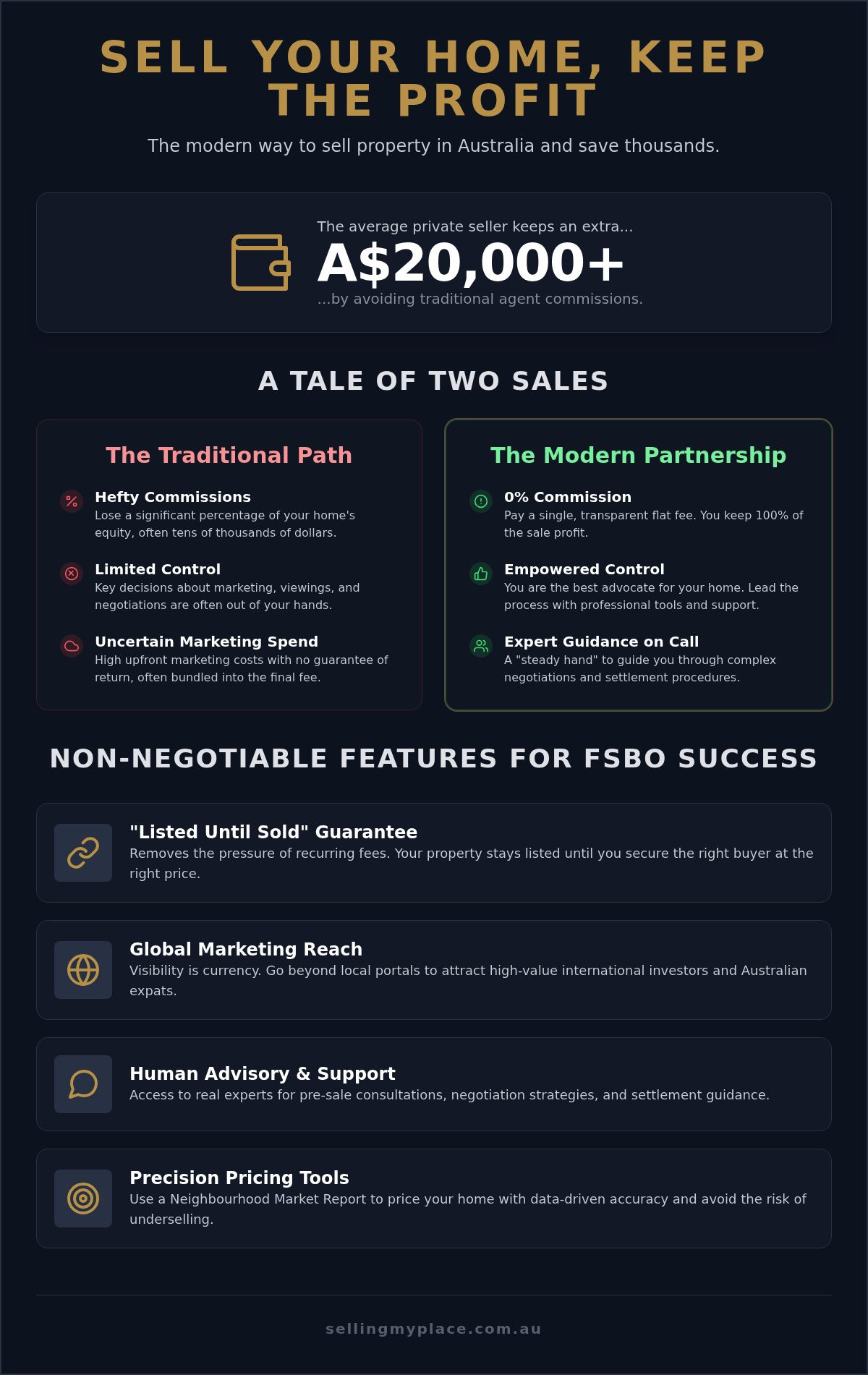
Preparing Your Property for a Private Sale Success
Success in the private sale market isn’t just about being seen; it’s about being ready. When you use for sale by owner websites australia, the quality of your preparation directly correlates to the speed and profit of your sale. Think of this phase as a deliberate, five-step launch sequence designed to protect your equity and ensure a smooth transition for your family. It begins with a thorough Pre-Sale Property Consultation. This isn’t just a casual walk-through. It’s a strategic assessment to identify minor repairs or styling adjustments that could significantly boost your property’s appeal. By addressing these early, you remove potential hurdles that buyers might use to negotiate your price down later.
- Step 1: Conduct a Pre-Sale Property Consultation to identify high-impact, low-cost repairs.
- Step 2: Secure a detailed Neighbourhood Market Report to pin down an accurate, data-backed price.
- Step 3: Organise professional photography and floorplans to ensure your home stands out against agency listings.
- Step 4: Prepare your legal documentation and seek early conveyance advice to avoid settlement delays.
- Step 5: Launch your listing simultaneously across national and global networks for maximum impact.
Pricing Strategy and Market Data
One of the biggest challenges for private sellers is justifying their asking price to skeptical buyers. In 2026, buyers are more informed than ever, and they’ll challenge you if your price feels like a “guess.” This is where a Neighbourhood Market Report becomes your most powerful tool. It provides specific, local data that allows you to stand your ground with confidence. Avoiding the overpricing trap is vital; a listing that sits on the market for too long becomes stale, leading buyers to wonder what’s wrong with the home. By using for sale by owner websites australia that provide real-time market data, you can set a price that is both ambitious and defensible.
The Legal Essentials: Conveyance and Contracts
The legal side of property can feel daunting, but it doesn’t have to be. Seeking professional Conveyance Advice before your first open home is a wise move. Each Australian state has its own specific regulations regarding private sales, and being prepared ensures you don’t hit a wall during the final stages. Having your contract of sale ready to go shows buyers that you’re a serious, professional seller. It fosters trust and keeps the momentum going once you’ve found the right person for your home. If you’re feeling unsure about the legal requirements in your specific area, get in touch for a supportive chat to help clarify your next steps.
Selling Smarter with Kincade International Direct Sales
Kincade International Direct Sales (KIDS) redefines what’s possible for the modern seller by moving beyond the limitations of traditional for sale by owner websites australia. We don’t just provide a platform; we offer a sophisticated partnership that prioritises your family’s financial legacy. By combining a 0% commission model with professional agency-grade tools, we empower you to take the lead while we provide the infrastructure. This approach results in an average saving of A$20,000, a significant sum that can fundamentally change the trajectory of your next move. Whether that means a larger deposit for your next home or extra security for your retirement, that equity belongs in your pocket.
Our philosophy is built on the idea of being a “steady hand” throughout your transition. We understand that selling a home is often tied to major life changes, and the process should feel supportive rather than stressful. You shouldn’t have to choose between saving money and receiving professional guidance. By bridging this gap, we’ve become the preferred choice for Australian families who value transparency, stability, and the respect their property deserves. It’s about selling smarter, not just selling alone.
Our Comprehensive Marketing Package
Your home’s first impression should be nothing short of exceptional. Our marketing package ensures this by including professional photography and detailed floorplans as standard features. These assets don’t just make your listing look better; they build immediate credibility with serious buyers. Your property will be launched across both national and global networks, ensuring you reach the widest possible audience, including international investors looking for a slice of the Australian lifestyle. With our ‘Listed Until Sold’ promise, you’ll never feel the pressure of a looming deadline or recurring fees. Plus, our dedicated Agent Advisory Service is always available to help you navigate the nuances of buyer enquiries and market fluctuations.
Take the First Step Toward an Empowered Sale
If you’re ready to step away from high marketing costs and reclaim your equity, the path forward is clear. Preparing for your property’s debut on the national stage is a collaborative process that starts with understanding your unique goals. We invite you to begin with a personalised consultation, where we can discuss how to best highlight your home’s character and value. You have the local knowledge and the heart; we provide the professional reach and the expert backing. Together, we can ensure your sale is a successful, celebratory milestone for your family. Enquire about our professional listing and advisory packages today and discover the difference of an empowered sale.
Your Path to a Successful Private Sale
Choosing to sell your home privately is a powerful decision that puts your family’s financial future first. The landscape of for sale by owner websites australia has transformed into a professional ecosystem where you no longer have to sacrifice expert support to save on costs. By combining high-end marketing assets like professional photography and floorplans with a dedicated Agent Advisory Service, you can navigate the complexities of the 2026 market with total confidence. It’s about having that steady hand to guide you through negotiations while ensuring you keep every cent of your hard-earned equity.
The transition to your next chapter should be celebratory rather than stressful. With an average saving of A$20,000 per sale and a 0% commission structure, you’re not just selling a property; you’re protecting your legacy. Our team is here to ensure you feel supported at every turn, from the first listing to the final settlement. Secure your commission-free sale with our expert advisory team and take the first step toward a more rewarding selling experience. You’ve built the home; now it’s time to reap the full rewards of your investment.
Frequently Asked Questions
Are for sale by owner websites legal in Australia?
Yes, selling your own property is completely legal in every Australian state and territory. While traditional agents often suggest otherwise, you have the right to represent yourself in the sale of your own asset. The best for sale by owner websites australia act as a licensed bridge, allowing you to access professional marketing tools while you remain the primary point of contact for all potential buyers.
Can I list my property on realestate.com.au and Domain without an agent?
You cannot list directly on these major portals as a private individual, but you can certainly do so through a dedicated FSBO platform. These services hold the required corporate real estate licenses to place your property alongside agency listings. This ensures your home receives the same visibility as any other property on the market, allowing you to reach millions of active buyers across the country.
How much can I actually save by selling my own home privately?
Most Australian homeowners save an average of A$20,000 by choosing a commission-free model. This figure is based on avoiding the typical 2% to 3% commission that traditional agents charge on the final sale price. When you factor in the removal of high upfront marketing fees, the total amount of equity you keep for your family’s next move becomes a significant financial advantage.
What happens if my property doesn’t sell within a few months?
If you choose a platform with a “Listed Until Sold” guarantee, your listing remains active without any additional time limits or recurring monthly fees. This provides a sense of calm confidence, as you aren’t pressured by a ticking clock or mounting costs. You can wait for the right buyer who truly values your home’s legacy, rather than feeling forced to accept a lower offer just to close a deal.
Do I need a lawyer or conveyancer if I use an FSBO website?
Yes, professional conveyance advice is a vital part of a successful settlement. While you handle the marketing and buyer enquiries, a legal expert ensures the contract of sale is prepared correctly and the transfer of title is handled according to state regulations. Integrating professional legal support with the right for sale by owner websites australia ensures your transaction is both profitable and legally secure.
How do I handle property inspections and open homes myself?
Managing inspections is quite straightforward and allows you to set times that actually suit your family’s schedule. You are the best person to answer specific questions about the local community, the friendly neighbours, or the best nearby schools. Most buyers actually find it refreshing to speak directly with the owner, as it fosters a more transparent and honest conversation about the property’s history.
Will buyers take me seriously if I am not using a traditional real estate agent?
Buyers will absolutely take you seriously if your property is presented with professional-grade marketing. When your listing includes high-quality photography and detailed floorplans, it looks identical to an agency production on the major portals. In the 2026 market, savvy buyers value direct communication and often prefer the lack of “agent speak” when negotiating their future home.
What is the difference between a listing service and a property advisory service?
A basic listing service simply puts your property on the internet and leaves the rest to you. In contrast, a property advisory service provides a “steady hand” throughout the entire journey. This includes expert guidance on pricing strategy, help with vetting potential buyers, and support during the negotiation phase. It turns a solo DIY project into a professional partnership that prioritises your peace of mind.
DIY Home Sale Checklist Australia: Sell Your Property Smarter in 2026
What if the secret to keeping an extra $20,000 or more from your property sale wasn’t finding a better agent, but simply becoming your own best advocate? It’s a bold thought, particularly when the national median dwelling value has climbed toward $922,838 in 2026. You likely feel a bit protective of your home’s equity, yet the idea of managing the legalities and marketing yourself can feel incredibly daunting. It’s completely natural to worry about pricing your sanctuary correctly or getting tangled in the logistics of a property market that feels increasingly complex. We understand that this isn’t just a transaction; it’s a significant life transition that deserves a steady, expert hand.
We’ve designed this DIY home sale checklist australia to give you the exact roadmap you need to sell smarter and stay empowered. You’ll learn how to bypass traditional commission structures while maintaining a professional-grade presence that attracts the right buyers. From mastering your initial listing to navigating the final settlement with total peace of mind, this guide ensures you have the tools to achieve a premium result on your own terms.
Key Takeaways
- Master the art of “soulful” presentation by using professional photography and floorplans to help buyers visualise their future in your home.
- Secure your legal interests by identifying state-specific disclosure requirements early, ensuring your Contract of Sale is robust and ready for settlement.
- Follow our comprehensive DIY home sale checklist australia to navigate the property market independently while maintaining a polished, professional-grade listing.
- Maximise your profit by comparing the traditional commission model against a transparent flat-fee approach that lets you keep 100% of your sale’s upside.
- Build buyer confidence through a welcoming, low-pressure inspection process and a methodical, “steady hand” approach to managing leads and negotiations.
Pre-Sale Preparation: Laying the Foundation for a Profitable Sale
Selling your home is more than just a financial transaction; it’s the closing of one chapter and the hopeful beginning of another. To ensure this transition is as rewarding as possible, you need to start with a clear-eyed assessment of your property. This is the first, vital step on any DIY home sale checklist australia. Instead of seeing your home through the lens of your own memories, try to view it through the objective, sometimes critical, eyes of a stranger. Walk through every room with a notepad in hand. Is there a leaky tap you’ve ignored for months? Does the hallway feel cramped because of that bulky sideboard?
Decluttering isn’t just about tidying; it’s about creating space for someone else’s dreams. When you depersonalise by removing family photos or niche collectibles, you’re inviting a potential buyer to visualise their own legacy within these walls. You don’t need a full renovation to see a boost in your sale price, either. Focus on high-impact, low-cost “quick wins.” A fresh coat of neutral paint can make a tired room feel modern and airy, while spreading fresh mulch in the garden beds suggests a well-maintained home. Before you set a price, secure a comprehensive neighbourhood market report to see how these small improvements align with current local buyer expectations.
Determining Your Realistic Market Value
Setting the right price is a delicate balance. While automated online estimates are a handy starting point, they often miss the nuances of your specific street or recent local infrastructure upgrades, like a new school or transport hub. A thorough Australian property market overview reveals that regional variations and buyer sentiment play huge roles in final outcomes. Look closely at the “sold” prices of comparable properties from the last three months rather than just the “asking” prices of current listings. Ultimately, Market Value is the quiet intersection where hard data meets the emotional appeal of a well-presented home.
The “First Impression” Exterior Checklist
Buyers often make up their minds before they even step through the front door. Kerb appeal is the primary engine that drives inspection bookings, so your exterior must look cared for and secure. Use this quick guide to ensure your home’s “face” is ready for its close-up:
- Ensure the entrance is welcoming with scrubbed paths and a clear, inviting doorway.
- Check the condition of the roof and gutters; buyers look for signs of neglect that might lead to future costs.
- Repair any leaning or broken fencing to reinforce the sense of security and privacy.
- Mow the lawns and trim any overgrown hedges to let the property’s natural light shine through.
By ticking these items off your DIY home sale checklist australia, you’re building a foundation of trust before the first “open for inspection” sign even goes up. It’s about showing the community that this home has been loved and is ready for its next family.
Legal Essentials and Compliance: Navigating the Australian Landscape
Once you’ve polished the kerb appeal, it’s time to look under the hood. The legal side of selling your own home might feel like a maze, but it’s really about creating a transparent, secure bridge between your family and the next. A critical item on your DIY home sale checklist australia is identifying the specific disclosure requirements for your state. In Victoria, for instance, you’ll need a comprehensive Section 32 statement. In other parts of the country, the terminology changes, but the spirit remains the same: you must be upfront about everything from zoning to land tax. Honesty isn’t just a virtue here; it’s your best legal defence.
Appointing a qualified conveyancer or solicitor early in the piece is one of the smartest moves you can make. They’ll act as your steady hand, ensuring that every building permit for that 2022 kitchen renovation is accounted for. Have you checked your smoke alarms lately? What about your swimming pool safety certification? These aren’t just boxes to tick; they’re essential protections for your legacy and the buyer’s peace of mind. While you’re busy with real estate photography preparation tips to make the home look its best, don’t let the paperwork fall behind. Having your certificates of occupancy and compliance ready to go shows buyers that you’re a serious, organised seller.
Preparing the Contract of Sale
Your Contract of Sale is the heart of the transaction. It needs to be watertight to prevent a buyer from finding a reason to rescind the deal later. Be incredibly specific about what’s staying and what’s going. If that heirloom chandelier in the dining room is coming with you, list it as an exclusion. It’s these small details that prevent heart-wrenching misunderstandings on settlement day. Seeking professional conveyance advice early ensures that your documentation is ready the moment a serious buyer shows interest. It’s about being proactive rather than reactive.
Understanding Your State Regulations
Every state has its own rhythm when it comes to cooling-off periods and digital protocols. By 2026, digital signatures and remote settlements have become the standard across Australia, making the process faster and more accessible than ever. You should also prepare a “due diligence” pack for prospective buyers. This pack, filled with your certificates, permits, and even recent utility bills, builds immediate trust. If you’re feeling a bit overwhelmed by the fine print, you can always reach out for a chat with our advisory team to help clear the air and keep your sale on track.
High-Impact Marketing: Presenting Your Home to the Global Market
Once the legal framework is secure, it’s time to invite the world into your home. In the digital-first property market of 2026, your online listing isn’t just a noticeboard; it’s a carefully curated experience that needs to resonate with buyers across the street and across the globe. A high-impact marketing strategy is a non-negotiable item on any DIY home sale checklist australia. You aren’t just selling three bedrooms and a backyard; you’re offering a slice of stability and a place for a new family to build their own legacy. This emotional connection starts with how you present the property’s “soul” to potential buyers who may be viewing from a different time zone.
In today’s market, expatriates and interstate investors are more active than ever, often making decisions based entirely on digital assets. Leveraging a global marketing network allows you to reach these high-intent buyers who value the security of the Australian property market. Your listing description should reflect this by highlighting the local community, nearby schools, and the long-term stability of the area. It’s about painting a picture of a lifestyle, not just listing a set of features.
The Visual Power of Professional Assets
While modern smartphones take lovely family photos, they often fail to capture the true scale and light of a room, which can inadvertently devalue your property in the eyes of serious buyers. Investing in professional photography ensures your home looks its absolute best, highlighting the architectural details that make it unique. Pair these images with accurate floorplans to help buyers plan their daily lives within your walls before they even visit. Professional visuals act as a 24/7 digital open house, allowing people to explore the flow of the home at their own pace. This transparency builds trust and significantly increases the time spent on your digital listing.
Choosing the Right Listing Platform
The traditional agency model often involves high marketing costs and restrictive time limits that put unnecessary pressure on your sale. A smarter alternative is a flat-fee listing service that keeps your property active until it’s sold, giving you the breathing room to find the perfect buyer. When you follow a DIY home sale checklist australia, you can bypass heavy commissions and instead focus your budget on targeted social media campaigns. Neighbourhood-specific targeting ensures your home appears in the feeds of people already looking to move into your specific area. By combining professional infrastructure with your own local knowledge, you create a listing that feels both authoritative and deeply personal.
The Sales Process: Managing Inspections and Mastering Negotiations
You’ve polished the gardens and launched a global marketing campaign; now comes the moment where the digital interest turns into a physical presence. Meeting potential buyers is often the most nerve-wracking stage for any owner-seller, but you hold a distinct advantage that no agent can replicate. Nobody knows the story of your home, the way the morning sun hits the kitchen bench, or the quietest spot in the garden better than you do. As a key part of your DIY home sale checklist australia, organising inspections should feel less like a high-stakes interrogation and more like welcoming a future neighbour. This low-pressure atmosphere allows buyers to relax and truly see themselves living in the space.
When the front door closes and the last visitor leaves, the “steady hand” approach becomes your greatest asset. Follow up with every lead within 24 hours using a professional yet personal touch. A simple phone call to ask for their honest feedback is often far more effective than a scripted sales pitch. When those conversations turn into serious interest, insist that all offers be submitted in writing. Always ask for a pre-approval letter or proof of finance to accompany the offer. This ensures you’re focusing your energy on qualified buyers who are ready to make a commitment to your property’s future.
Conducting Stress-Free Open Homes
Creating a welcoming environment is about engaging the senses without overwhelming them. Buyers are looking for a sanctuary, so your goal is to provide a calm, inviting experience. Consider these practical steps for your next open home:
- Maximise natural light by opening all curtains and blinds to showcase the home’s best angles.
- Ensure a flow of fresh air through the house, perhaps using subtle, natural scents like fresh eucalyptus or citrus.
- Prepare a “frequently asked questions” sheet that covers local school catchments, the best nearby parks, and average utility costs.
- Focus on building a partnership with visitors by answering questions honestly rather than using a “hard sell” tactic.
Closing the Deal with Confidence
Negotiation is where many sellers feel most vulnerable, but it’s simply a dialogue about value and legacy. Don’t take a low-ball offer personally; it’s often just a starting point for a buyer testing the waters. You can utilise these property sale negotiation tips to help you stay firm on your home’s true worth. Remember, our Agent Advisory Service is always available as a sounding board during these final talks to ensure you feel supported. Once you accept an offer, confirm the deposit is paid into a secure trust account immediately. If you need a hand navigating the final hurdles of the contract, reach out for expert guidance to ensure your settlement stays on track.
The Modern Alternative: Why a Flat-Fee Partnership Wins
Choosing to sell your property independently doesn’t mean you have to walk the path alone. Many homeowners feel they must choose between a high-commission agent or a stressful solo journey, but the modern reality is far more supportive. By following a DIY home sale checklist australia, you can embrace a partnership that gives you the best of both worlds: professional-grade infrastructure and the freedom to manage your own sale. This “Expert Backing” model means you keep the control while we provide the photography, floorplans, and global reach discussed earlier. It’s about having a steady hand beside you while you remain in the driver’s seat.
When you calculate the real cost of a 2% commission on a $1,000,000 property, you’re looking at giving away $20,000 of your hard-earned equity. Choosing a sale by owner approach with a transparent flat fee allows you to protect that profit entirely. It’s a smarter way to move forward, especially when you consider that your listing remains active until it’s sold. You won’t face the ticking clock or the aggressive pressure of a traditional agency campaign that might push you to accept a lower offer just to clear a monthly target. You set the pace, and you keep the reward.
Protecting Your Equity
Visualise that $20,000 for a moment. It could be the deposit for your next adventure, a significant boost to your retirement fund, or even the budget for a stunning new kitchen in your next home. Beyond the numbers, there’s a profound psychological benefit to dealing directly with buyers. You’re the one who knows the neighbourhood’s heartbeat and the house’s history. This personal connection, supported by a polished and professional image, builds a level of trust that a third party simply can’t manufacture. You’re protecting your legacy while ensuring your costs stay grounded.
Next Steps: Getting Started
Transitioning from “thinking about it” to seeing your home live on the major portals can happen in as little as 48 hours. The first step is often a pre-sale consultation to fine-tune your strategy and ensure every box on your DIY home sale checklist australia is ticked. This isn’t just about saving money; it’s about feeling empowered and in control of one of life’s biggest transitions. You have the local knowledge, and we have the tools to make it shine. Start your commission-free journey with Kincade International Direct Sales today.
Your Journey Toward a Smarter Sale Starts Now
Selling your home on your own terms is about more than just a transaction; it’s about honouring the life you’ve built while securing your financial future. By following this DIY home sale checklist australia, you’ve seen how professional marketing and legal clarity can turn a complex process into a manageable, rewarding journey. You don’t have to sacrifice a polished image to save on costs. With the right support, you can present a listing that rivals any traditional agency, ensuring your home’s unique story is told with authority and heart.
Imagine keeping an average of $20,000 in commissions while still benefiting from professional photography, accurate floorplans, and our expert Agent Advisory Service. You have the local heart and the neighbourhood knowledge; we simply provide the steady hand and digital infrastructure to help you succeed. It’s time to step into your sale with total confidence and a clear path forward. You’ve done the hard work of building a home, and now you’re ready to reap the full rewards.
Download Your Free Flat-Fee Selling Guide and Save Thousands
Your home deserves a champion who knows it best. We’re here to help you every step of the way, ensuring your next big move is your most successful and empowering one yet.
Frequently Asked Questions
Is it legal to sell my own home in Australia without a real estate agent?
Yes, it is completely legal to sell your own property in every Australian state and territory. You aren’t required by law to hire a real estate agent; however, you must still comply with state-specific disclosure laws and property regulations. By taking the “sale by owner” route, you maintain full control over the process while ensuring all legal obligations, such as providing a Section 32 in Victoria, are met through your solicitor or conveyancer.
How much can I actually save by using a DIY home sale checklist?
Homeowners typically save an average of $20,000 in commission fees by managing the sale themselves. When you follow a structured DIY home sale checklist australia, you bypass the traditional 2% to 3% agent commission entirely. This significant saving stays in your pocket, allowing you to invest more into your next home or retirement fund while still achieving a professional-grade result through our flat-fee infrastructure.
Will my property still appear on major real estate websites if I sell DIY?
Yes, your property will appear on Australia’s leading real estate portals when you use a residential property listing service. While these major sites generally don’t allow private individual listings directly, a flat-fee partner acts as the bridge to get your home in front of millions of active buyers. This ensures you receive the same digital exposure as any agency-listed property without the high marketing costs or commissions.
What happens if I struggle to negotiate with a buyer on my own?
You don’t have to navigate tough conversations alone; our Agent Advisory Service acts as your professional sounding board. If a negotiation feels stuck or you’re unsure how to handle a specific offer, you can lean on our expert advice to find the right way forward. This partnership ensures you have the “steady hand” of an expert guide to help you stay firm on your property’s true value and reach a successful agreement.
Do I still need a lawyer or conveyancer if I am selling the house myself?
Yes, you still need a qualified conveyancer or solicitor to handle the legal transfer of the property. While you manage the marketing and inspections, your legal representative ensures the Contract of Sale is watertight and handles the actual settlement process. This is a vital safeguard that protects both you and the buyer, ensuring all state-specific disclosure requirements and financial settlements are completed correctly and securely.
Can I sell my home DIY if I have an existing mortgage?
Absolutely, having an existing mortgage doesn’t prevent you from selling your home independently. During the settlement process, your conveyancer will coordinate with your bank to “discharge” the mortgage using the proceeds from the sale. You’ll just need to factor in your lender’s standard discharge fees, which typically range between $300 and $700, and ensure your bank is notified once a contract is signed and the settlement date is set.
How do I handle the deposit and legal paperwork without a traditional agent?
The deposit is typically held in the trust account of your chosen solicitor or conveyancer rather than an agent’s account. This provides a secure, legally regulated environment for the buyer’s funds until the settlement is finalised. Your legal representative will also manage the exchange of contracts and ensure all paperwork is filed with the relevant state authorities, giving you peace of mind that the transaction is handled with professional decorum.
What is the most important item on a DIY home sale checklist for a fast sale?
The most critical item on any DIY home sale checklist australia for a swift result is professional presentation. High-quality photography and accurate floorplans are non-negotiable in 2026, as they form the first impression for every digital buyer. When paired with a realistic price based on a neighbourhood market report, these professional assets build immediate trust and encourage serious buyers to book an inspection much sooner.
