Neighbourhood Market Reports: The Australian Seller’s Guide to Pricing with Confidence
What if the “expert” appraisal sitting on your kitchen bench is more about winning your signature than actually securing your family’s financial future? It is a daunting thought, especially as you try to make sense of neighborhood market reports while national house values have dipped by 1.1% throughout 2026. You likely feel the weight of this transition, perhaps even a bit of frustration at the conflicting data landing in your inbox. It is completely natural to worry about underpricing your most valuable asset or feeling pressured by agents who might be over-promising just to secure a listing.
We believe that local data is the ultimate equaliser for Australian homeowners. In this guide, you will learn how to interpret property data with the calm confidence of a seasoned pro. We are going to show you how to strip away agent bias, value your home accurately, and negotiate like an expert; all while keeping your hard-earned equity instead of paying it away in commissions. We will walk through the specific metrics that matter most in today’s market, giving you the tools to move toward your next chapter with total peace of mind.
Key Takeaways
- Learn why real-time data is more reliable than historical ‘gut feelings’ or outdated anecdotes in the shifting 2026 property market.
- Discover how neutral neighborhood market reports provide an objective truth, helping you avoid the common trap of over-inflated appraisals used to ‘buy’ your listing.
- Identify your property’s pricing ‘sweet spot’ by analysing actual sold prices rather than just the aspirational asking prices of your local competition.
- Master the art of timing your sale by using seasonal trend data to choose a listing date that maximises buyer interest and competition.
- Understand how a flat-fee model combined with professional advisory keeps your equity where it belongs, ensuring your strategy is always focused on your family’s bottom line.
Decoding Neighbourhood Market Reports: Why Data is Your Best Friend in 2026
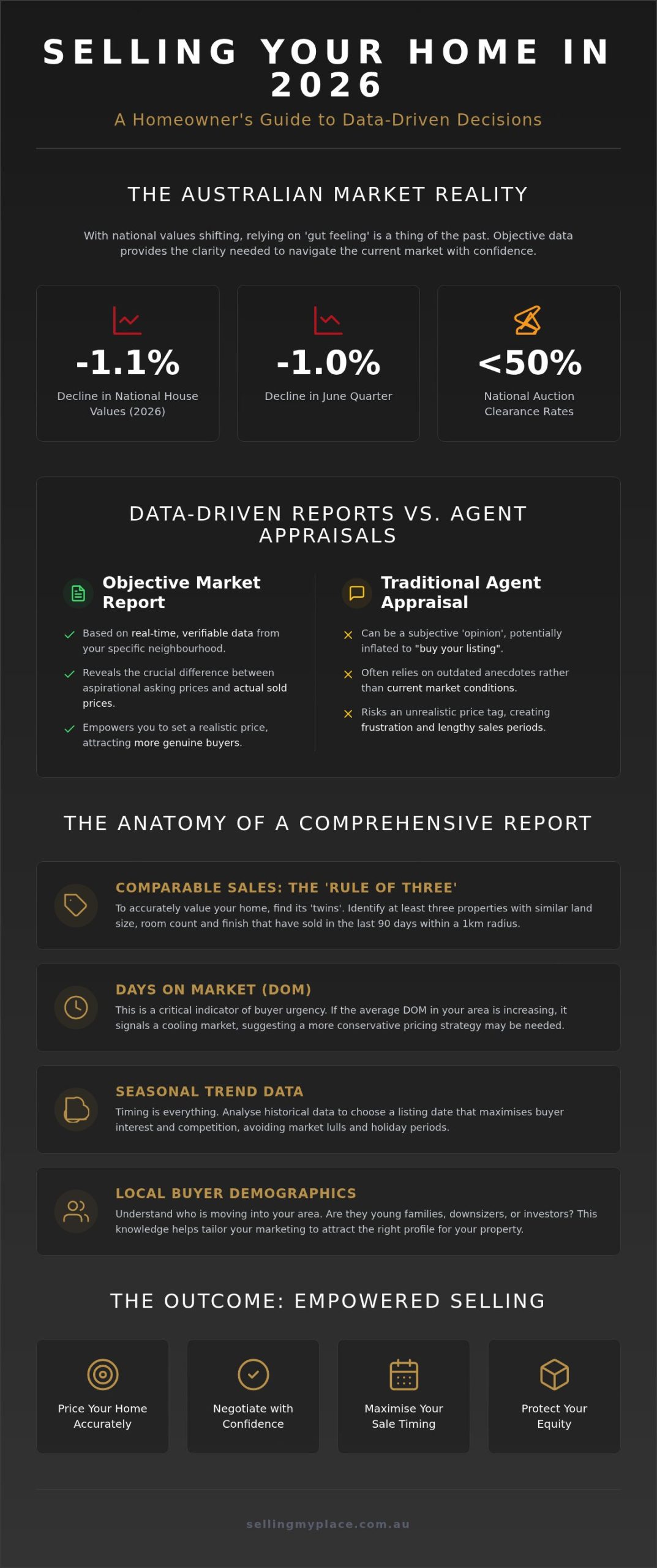
The Australian property landscape in 2026 feels remarkably different than the post-COVID boom years. With national house values falling by 1.1% over the calendar year and the June quarter recording a 1.0% decline, the “gut feeling” approach to pricing is officially a thing of the past. This is where neighborhood market reports become your most valuable asset. They offer a data-driven snapshot of local performance that cuts through the noise of conflicting news headlines and dinner party anecdotes. Think of it as a clinical pulse check for your specific street, providing the clarity you need to make big decisions with a calm heart.
It’s vital to distinguish these from the simple Automated Valuation Models (AVMs) you might find on a bank’s website or a quick online estimator. While an AVM provides a rough guess based on broad suburb trends, a comprehensive market activity report dives into the specific nuances of your exact pocket. For anyone embarking on a sale by owner journey, this data acts as your foundational “steady hand.” It ensures you aren’t leaving money on the table or scaring off genuine buyers with an unrealistic figure that doesn’t align with current market conditions.
The Shift from Agent ‘Opinions’ to Hard Data
For decades, real estate agents held the “black box” of property data, leaving owners to rely entirely on their professional word. Today, digital transparency has shifted that power back into your hands. Buyers in 2026 are incredibly savvy; they’ve done their homework and they expect you to have done yours. Relying on an objective report rather than a traditional real estate appraisal helps remove the emotional attachment we all naturally feel toward our family homes. It’s much easier to negotiate when you can point to hard evidence rather than just an agent’s optimistic opinion, which might be inflated to secure your listing.
Key Metrics Every Australian Seller Should Track
To price with confidence, you need to look beyond the broad suburb median. Street-level performance often tells a very different story, especially in suburbs with diverse housing styles. Keep a close eye on Days on Market (DOM). If the average DOM is creeping up, it signals that buyer urgency is cooling. Similarly, with national auction clearance rates dropping below 50% in June 2026 for the first time since the 2020 lockdowns, you need to understand how this affects private treaty expectations. High-quality neighborhood market reports track these shifts in real-time, allowing you to pivot your strategy before the first open home even begins.
The Anatomy of a Comprehensive Property Report: What Really Matters
A truly effective property report is far more than a simple list of addresses and numbers. It’s a narrative of your local community’s recent history and a roadmap for your financial future. While broad Australian Bureau of Statistics data provides a high-level view of national trends, your success depends on understanding the specific heartbeat of your street. In a market where national house prices have recently dipped, distinguishing between an aspirational “asking price” and the cold, hard reality of a “sold price” is the difference between a successful settlement and a listing that languishes for months.
Comprehensive neighborhood market reports should also shed light on who is actually moving into your area. Are young families snapping up unrenovated post-war homes, or are downsizers looking for low-maintenance units? Knowing these demographic shifts allows you to tailor your presentation and marketing to the exact buyer profile most likely to fall in love with your home. It’s about working smarter, not harder, to protect your family’s legacy.
Comparables (Comps): Finding Your Home’s ‘Twins’
To value your home accurately, you must find its “twins” in the local area. This process involves looking at properties with similar land size, room counts, and level of finish. We suggest following the “Rule of Three”: identify at least three homes within a one-kilometre radius that have sold in the last ninety days. This provides a statistically significant baseline. Of course, no two homes are identical. You’ll need to make honest adjustments for your own property’s unique features. A sparkling new magnesium pool or a high-end kitchen renovation might add a specific premium, while a lack of off-street parking could require a slight downward adjustment to stay competitive.
Market Velocity and Inventory Levels
Understanding market velocity helps you gauge your negotiation leverage. If the “Stock on Market” is low, you’re in a position of strength, as buyers have fewer choices and may be willing to pay a premium to secure a stable home. Conversely, when inventory is high, your pricing must be razor-sharp to stand out. The absorption rate determines how many months it would take to sell all current listings at the current rate of sales, providing a clear window into buyer demand. If the data feels a bit overwhelming, you can always reach out for local property guidance to help interpret these shifting numbers with total clarity.
Market Reports vs. Real Estate Agent Appraisals: Cutting Through the Noise
It’s a scenario many Australian families face: three different agents walk through your front door, and you receive three wildly different numbers. One might be exactly what you hoped for, while another feels like a bit of a low-ball. This is where the “Buying the Listing” trap often catches well-meaning sellers. Some agents intentionally over-inflate their initial appraisal to win your business, knowing full well they will need to “condition” you to accept a lower price a few weeks into the campaign. It’s a stressful cycle that can be avoided by looking at the objective facts found in neighborhood market reports.
When you rely on a neutral data source, you’re choosing to determine the market value of a home in Australia without the polished sales pitch. The cost of a wrong appraisal isn’t just a bruised ego; it’s a tangible financial hit. Overpricing often leads to a “stale” listing that sits on the market for months. Buyers begin to wonder what’s wrong with the property, eventually leading to low-ball offers that fall far below what you might have achieved with a sharp, data-backed opening price. By checking the latest Australian Bureau of Statistics property values, you can see how your local expectations align with the broader state-level shifts, keeping your strategy grounded in reality.
The Psychology of the ‘Appraisal’ Process
Agents are often masters of persuasion, focusing on the highest possible price during their initial presentation. However, their primary goal is to get your signature on a listing agreement. Once the property is on the market, the conversation often shifts toward “the market is speaking” as they push you to lower your expectations. Using a market report allows you to cross-examine these claims. If an agent suggests a price significantly above recent local sales, you can ask for the data to back it up. A flat-fee model removes this conflict of interest entirely, as the advisor has no incentive to misrepresent the data just to secure a higher commission later.
Objectivity: Your Secret Weapon in Negotiation
Staying grounded in the numbers is your best defence against the emotional roller coaster of selling a home. When a buyer makes an offer, you can present the data from your report to justify your price point. This builds a bridge of trust that a verbal estimate from an agent simply can’t match. Buyers respect a seller who has done their homework and can point to neighborhood market reports as the basis for their decision. It transforms the negotiation from a battle of wills into a professional conversation about value, helping you stand your ground with calm confidence.
How to Leverage Local Data to Maximise Your Sale Price
Having the data at your fingertips is one thing; knowing how to wield it is what separates a standard sale from a result that truly changes your family’s future. Once you have digested your neighborhood market reports, the focus shifts to execution. It is about more than just a number on a screen; it is about how you present that value to the world. By aligning your Residential Property Listing Services strategy with the hard facts of your suburb, you can command attention and justify a premium price point with total confidence.
Strategic timing is another lever you can pull. Your report might reveal that four-bedroom family homes in your specific pocket sell for a notable premium in the spring, or perhaps that buyer activity peaks just after the school holidays. Beyond timing, you should highlight local strengths that data-savvy buyers crave. If your home sits within a coveted school catchment or boasts a high “Walk Score” to local cafes, these are non-negotiable features for your listing description. These details transform a house into a lifestyle opportunity, making it much easier for a buyer to see the long-term value of the investment.
Strategic Pricing Brackets
Most Australian buyers start their journey on major property portals, using specific price filters to narrow their search. These engines typically operate in $50,000 or $100,000 increments. If you price your home at $1,005,000, you will completely disappear from the search results of anyone with a $1M cap. This is why the “Sweet Spot” is so vital. Pricing at $995,000 ensures you appear in the maximum number of relevant searches while remaining just below a significant psychological barrier. It is the “Goldilocks” price; high enough to reflect your home’s worth, yet accessible enough to ignite a competitive bidding environment.
Using Reports for Pre-Sale Improvements
Before you pick up a paintbrush or call a landscaper, look at the “sold” comps in your report. You might find that in your area, a modernised kitchen adds far more value than a new deck. This allows you to invest your pre-sale budget where it will actually move the needle on your final sale price. Value-Add potential is identified through comparative market analysis by isolating specific features in recently sold local homes that commanded a clear price premium over unrenovated counterparts. If you are ready to see how this data applies to your specific street, reach out for a tailored market breakdown today.
Empowered Selling: How Kincade International Direct Sales Backs Your Strategy
Selling your home is a major life transition, and we don’t think you should have to sacrifice your hard-earned equity just to get professional support. The Kincade International Direct Sales (KIDS) approach is built on a foundation of transparency and partnership. We provide the exact same professional-grade neighborhood market reports that the “big” franchise agencies use, but we do it without the traditional commission structure. This means you can keep more of your profit, often saving an average of $20,000, while still having access to the highest quality data available in 2026. It is about giving you the same tools as the experts, without the high marketing costs or the pressure of a percentage-based fee.
Integration is key to a successful sale. Once you have your data, we help you weave those findings into a comprehensive marketing package. This isn’t just about putting a price on a website; it’s about building a compelling case for your home’s value. By combining your report insights with professional photography and floorplans, you create a listing that reflects the true worth of your property. This professional presentation attracts serious buyers who respect your informed position, allowing you to move through the process with a sense of calm confidence. We believe that when you are better informed, you are better protected.
Beyond the Data: The Agent Advisory Service
While data is powerful, interpreting it correctly is what makes mastering the deal second nature. Our Real Estate Advisory Services act as the “steady hand” you need when the numbers feel complex or the market feels volatile. Our advisors provide personalised pre-sale consulting to bridge the gap between a PDF report and a “Sold” sticker on your front gate. You aren’t just getting a document; you’re getting a partnership that aims to reduce the stress of the negotiation process. This guidance ensures that every decision you make is grounded in reality and focused on your family’s long-term stability.
Your Next Steps to a Commission-Free Sale
Taking control of your sale starts with a single, informed step. You can access your comprehensive neighborhood market reports today to begin your journey toward a commission-free settlement. From there, we help you prepare a professional listing with high-end photography and accurate floorplans, ensuring your home is presented in its best possible light. It is your home, your legacy, and your equity; we are simply here to ensure you have the tools to protect it all while selling on your own terms. We invite you to step into this process with us, knowing you have the support of a seasoned team that values your results as much as you do.
Step Into Your Next Chapter with Confidence
The journey of selling a family home is about more than just a transaction; it’s about honouring your hard work and protecting your future. You now have the knowledge to look past the noise of inflated appraisals and trust the objective truth found in neighborhood market reports. By focusing on actual sold data and strategic pricing brackets, you can navigate the shifts of the 2026 market with the calm authority of a seasoned pro. It’s about being informed, staying grounded, and making decisions that truly serve your family’s best interests.
At Kincade International Direct Sales, we are here to ensure you don’t have to walk this path alone. Our approach combines professional-grade data with an expert Agent Advisory Service, allowing you to keep 100% of your sale profit. You can access high-end professional marketing and street-level insights without the burden of a traditional commission. Are you ready to take the lead in your property sale? Get Your Professional Neighbourhood Market Report and Save Thousands today. We look forward to being the steady hand that helps you secure the result your family deserves.
Frequently Asked Questions
What is the difference between a market report and a bank valuation?
A bank valuation is a conservative assessment focused on lender risk, whereas a market report identifies the price a willing buyer is likely to pay in the open market. Banks often value properties lower to protect themselves against potential market shifts. A market report provides a more optimistic yet realistic range based on actual buyer competition and recent local momentum.
How often should I update my neighbourhood market report before listing?
In the shifting landscape of 2026, we suggest updating your data every 30 days. With national house values experiencing a correction, prices can move quickly. Staying current ensures your strategy remains aligned with the latest settled sales rather than outdated figures from months ago. It’s about maintaining that steady hand throughout your campaign so you don’t miss a beat.
Can I get a neighbourhood market report for free in Australia?
You can find basic summaries for free through bank apps or property portals, but they often lack the street-level nuance of a professional report. Free versions usually provide a broad suburb median which can be misleading for specific pockets. For a high-stakes sale, a comprehensive report ensures you aren’t missing the specific details that justify a premium price for your unique home.
Are online property value estimates actually accurate in 2026?
Online estimates are helpful starting points but often miss the heart of a home. They can’t see your high-end kitchen renovation or the quietness of your specific cul-de-sac. This is why neighborhood market reports are superior; they allow for a human-led interpretation of the data that accounts for the unique lifestyle features an algorithm might overlook during a market correction.
Does a neighbourhood market report include ‘off-market’ sales data?
Most reports focus on settled sales data, which is the most reliable truth in property. While off-market sales are common, they aren’t always publicly recorded with the same level of detail immediately. A professional report will focus on the most transparent and verifiable data to ensure your pricing strategy is defensible during a tough negotiation with a savvy buyer.
How do I use a market report if there haven’t been any sales in my street recently?
If your specific street is quiet, we expand the search to comparable pockets within your suburb. We look for areas with similar land sizes, school catchments, and proximity to local centres. This broader view provides a statistically significant baseline, allowing you to price your home accurately even when immediate street-level data is sparse or outdated.
Will a market report help me decide between an auction or a private treaty sale?
Absolutely. By analysing local auction clearance rates, which fell below 50% nationally in mid-2026, neighborhood market reports help you gauge the current appetite for public bidding. If your area shows a high percentage of properties passing in, a private treaty sale with a clear price might be the more reassuring and effective path for your family.
How do I explain my data-driven price to a buyer who thinks it’s too high?
Lead with the data rather than emotion. When a buyer questions your price, you can physically show them the recent comparable sales of “twin” properties in the area. This shifts the conversation from a personal disagreement to an objective discussion about market reality. It builds trust, as the buyer can see you’ve based your expectations on verifiable facts rather than guesswork.
Free Property Valuation Australia: The 2026 Seller’s Guide to Accuracy and Profit
What if the “flattery pricing” you’re hearing from local agents is actually the biggest risk to your family’s financial future? It is a stressful position to be in, standing at the crossroads of a major life transition while staring at three different online estimates that don’t seem to agree. You want a realistic figure, not a sales pitch, because underpricing your home could mean waving goodbye to years of hard-earned equity. We understand that a home is more than just a title deed; it’s your sanctuary and your legacy.
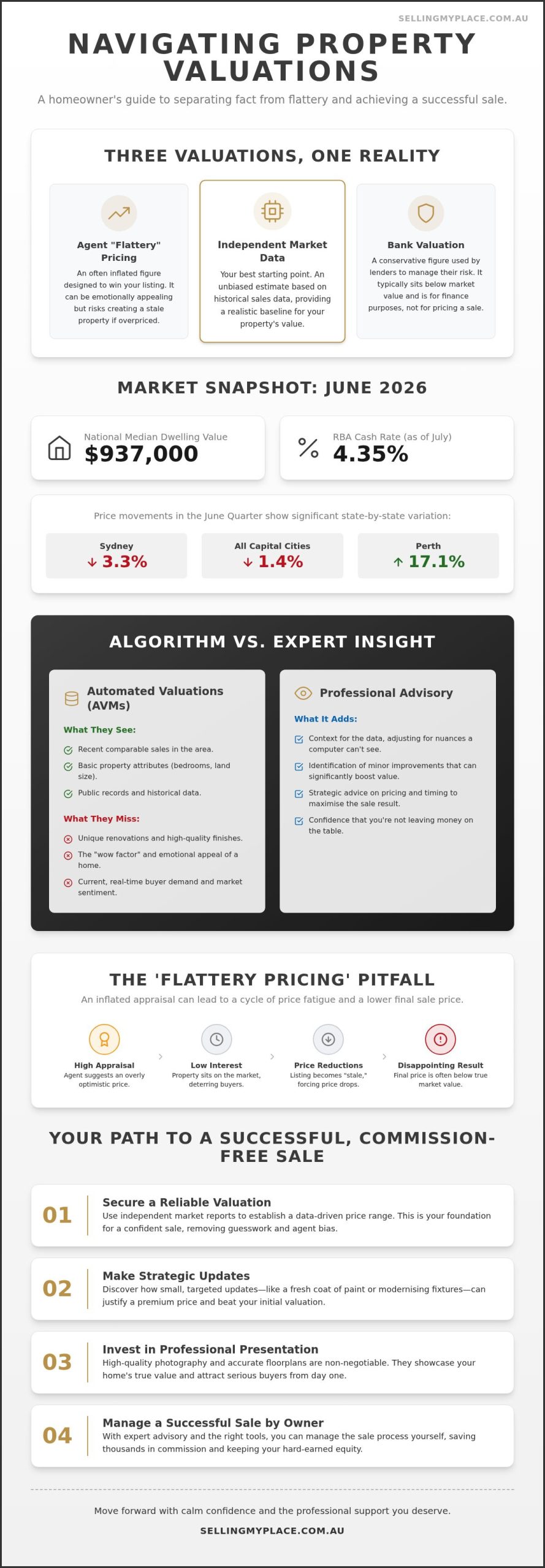
This guide is designed to help you secure a reliable free property valuation and transform that raw data into a strategic, commission-free sale. With the national median dwelling value sitting at $937,000 as of June 2026, and major cities like Sydney seeing recent price corrections, having a steady hand to guide you is more important than ever. We’ll walk you through how to identify a truly accurate price range, ways to boost your property’s appeal before listing, and the steps to keep your full profit without losing a cent to traditional agency fees. It’s about moving forward with calm confidence and the professional support you deserve.
Key Takeaways
- Understand why a free property valuation serves as a vital health check for your home’s equity, helping you separate a bank’s lending figures from your actual selling potential.
- Learn to distinguish between automated data and professional insights so you don’t leave money on the table when your unique home improvements aren’t captured by an algorithm.
- Guard yourself against “flattery pricing” and the common agent trap that often leads to price fatigue and disappointing final results.
- Discover how small, strategic updates and professional photography can help you justify a premium price and beat your initial valuation.
- Master the transition from data to dollars by using independent market reports and expert advisory to manage your own successful, commission-free sale.
What is a Free Property Valuation and Why is it Your Best Starting Point?
Think of a free property valuation as a vital health check for your most significant asset. It isn’t just a random figure on a screen; it’s the foundation of your future financial security. To move forward with clarity, you first need a solid grasp of what property valuation is and how it differs from the conservative estimates your bank might provide. While a bank’s report is designed to protect their lending risk, a market-focused valuation looks at the heartbeat of local demand. It’s about what a real person is willing to pay to call your house “home.”
The 2026 Australian property market has been a tale of two stories. With the RBA cash rate holding at 4.35% as of July, we’ve seen Sydney house prices dip by 3.3% in the June quarter while Perth has surged by a staggering 17.1%. This volatility means that an estimate from even six months ago is likely out of date. Regular check-ins via a free property valuation are no longer just a curiosity; they’re a necessity for any homeowner who wants to make an informed choice. It helps you answer the big questions. Should you invest in that kitchen renovation now, or is the market appetite strong enough to sell immediately and move on?
The Benefits of Knowing Your Home’s Worth Early
Getting an early handle on your property’s value allows you to plan your next move with a clear head. Whether you’re looking to downsize to a quiet suburb or upgrade for more space, you need to know your “walk-away” figure. This is the actual cash you’ll have left in your pocket after all costs are settled. It stops the guesswork and the midnight worrying. When you understand the specific trends in your street, you can spot opportunities that broader city-wide reports might miss.
How Kincade Supports Your Discovery Phase
We believe in empowering you with data that isn’t tied to a high-pressure sales pitch. Our Neighbourhood Market Reports provide a transparent look at what homes in your area are actually fetching, focusing on settled sale prices rather than ambitious listing figures. This independent perspective is vital. It’s about providing a steady hand and professional backing without the weight of a traditional agency commission. By using our Pre-Sale Property Consulting, you can prepare for a successful “sale by owner” experience. You’ll have the floorplans, photography, and advisory support needed to showcase your home’s true value while keeping your equity where it belongs: with your family.
AVMs vs. Professional Appraisals: Which One Should You Trust?
Most homeowners start their journey with a free property valuation generated by a computer. It’s incredibly convenient; you type in your address and get a number in seconds. This is what we call an Automated Valuation Model, or AVM. While these tools are a fantastic starting point for understanding your general equity, they operate by looking through a rear-view mirror. They rely on historical data and public records to provide a snapshot, which can sometimes lag behind the actual pulse of your neighbourhood.
An AVM is often spot on for suburban blocks where every house is similar. However, it can miss the mark significantly if you’ve recently added a third bathroom or spent your weekends perfecting a native garden. A computer simply cannot see the “soul” of a home. Relying solely on an algorithm in a shifting market, like we’ve seen in the June quarter of 2026 with capital city prices falling by 1.4% overall, can be risky. You need a steady hand to interpret those numbers and adjust for the nuances of your specific property.
Understanding Automated Valuation Models (AVMs)
AVMs pull data from three main pillars: recent sales of similar properties, land size, and basic property features like bedroom count. It is a helpful way to estimate the market value of your home quickly. But remember, these models don’t know if a house two doors down sold for less because it was in original 1970s condition. In rapidly changing cycles, such as the current 2026 downturn in Sydney and Melbourne, using multiple digital sources is the best way to find a realistic consensus value before you take the next step.
The Human Element: Professional Advisory Appraisals
A computer doesn’t feel the “wow factor” of a light-filled living room or a perfectly positioned deck. A professional advisor does. This human oversight is what separates a generic estimate from a strategic price point. This is where Kincade’s Advisory Service adds genuine value. We look at the emotional pull of your home and consider current buyer sentiment, which is vital given that auction clearance rates have dipped to 52.4% recently.
Don’t be seduced by the highest number you see on a screen or hear from a pushy agent. An inflated figure might feel good for a day, but it can lead to “price fatigue” if the market doesn’t agree, eventually forcing a lower final result. Accuracy is what protects your profit and your family’s legacy. If you’re feeling unsure about the conflicting numbers you’ve seen online, you might find it helpful to chat with a local expert who can help you make sense of the data without the pressure of a commission-based sales pitch.
Avoiding the “Agent Trap”: Why Free Appraisals Can Be Costly
It’s a lovely feeling when an agent walks through your front door and suggests a figure that exceeds your wildest expectations. However, this is often the moment where many Australian sellers unknowingly fall into the “agent trap.” In the industry, we call this “buying the listing.” It happens when an agent provides an inflated estimate simply to win your business, knowing full well the property will likely sell for less. While it feels good in the lounge room, it can be a costly mistake once the campaign begins.
When a home is launched at an unrealistic price, it often sits on the market for weeks without a serious offer. In the current 2026 climate, where buyers are increasingly selective and properties are taking longer to sell, this lead to “price fatigue.” Potential buyers start to wonder what is wrong with the home because it hasn’t sold yet. Eventually, the seller is forced to make significant price reductions, often ending up with a lower final result than if they had priced it accurately from the start. The psychological stress of adjusting your expectations mid-campaign is immense, especially when your family’s future plans are hanging in the balance.
The Conflict of Interest in Traditional Appraisals
The core of the problem lies in the traditional commission-based model. An agent who is chasing a percentage-based fee is naturally incentivised to tell you what you want to hear to secure your signature. That “free” agent appraisal isn’t truly free if it costs you $50,000 in lost equity due to a botched pricing strategy. To spot a realistic appraisal, look for an advisor who backs their claims with hard data from recent settled sales in your street, rather than just pointing to ambitious asking prices of homes that are still sitting on the market.
The Kincade Alternative: Data Without the Pressure
We take a different path. Because Kincade operates on a 0% commission structure, our advice is never clouded by the need to “win” a listing at any cost. Our focus is entirely on your success and helping you keep 100% of your profit. We believe in empowering you with factual strength. By using a professional market value determination, you can set a strategy based on reality. This independent free property valuation approach allows you to negotiate with buyers from a position of confidence. You aren’t just guessing a number; you are presenting a case for your home’s value that is supported by professional photography, floorplans, and a deep understanding of the local landscape. It’s about being a “steady hand” in your own sale, ensuring your hard-earned equity stays exactly where it belongs.
Maximising Your Result: How to Beat Your Current Valuation
Once you’ve received your free property valuation, it’s natural to feel either a sense of relief or a slight twinge of disappointment. However, that number is simply a starting point based on current market conditions and historical data. It isn’t a fixed destiny. You have the power to influence how buyers perceive your home’s worth. By focusing on both the visible and invisible elements of your property, you can push your final sale price toward the top end of your valuation range, or even beyond it. It’s about taking a proactive approach to your family’s equity.
Start with a “kerb appeal” audit. Buyers in 2026 are looking for stability and pride of ownership. Simple acts like pressure-cleaning the driveway, refreshing the mulch in your garden beds, or painting a tired front fence can add thousands to the perceived value. These aren’t just cosmetic changes; they signal to a buyer that the home has been loved and maintained. When a property looks cared for from the street, it sets a positive emotional tone before the front door even opens.
Pre-Sale Consulting and Presentation
In a digital-first market, your home’s first “showing” happens on a smartphone screen. This is why professional photography is non-negotiable. High-quality images captured with a steady hand can highlight the lifestyle your home offers, rather than just the dimensions of the rooms. Similarly, a clear floorplan is essential for the “mental move-in” process. It allows buyers to visualise where their favourite sofa will sit or how the kids’ rooms connect to the main living area. Addressing small DIY fixes, such as leaky taps or cracked tiles, prevents buyers from mentally “discounting” your valuation before they’ve even stepped inside.
Don’t overlook the “invisible” value. In 2026, energy efficiency is a high priority for Australian families facing rising living costs. If you have solar panels, double-glazed windows, or a high-star energy rating, make sure these are documented. Having a tidy folder of maintenance logs and appliance certificates gives buyers the calm confidence they need to make a premium offer. It shows you’ve been a diligent steward of the property, which reduces their perceived risk.
Strategic Marketing to the Right Audience
Your free property valuation also helps you identify the most likely buyer for your home. If your property sits in a price bracket favoured by first-home buyers, your marketing should focus on lifestyle, proximity to parks, and community roots. If it’s an executive residence, highlight the luxury finishes and proximity to business hubs. At Kincade, we use a global marketing network to reach buyers that local agents often miss. This broader reach, combined with highlighting lifestyle features that an algorithm cannot measure, ensures your home is presented to those who will value it most.
If you want to ensure you aren’t leaving money on the table, you can book a pre-sale consultation with our team to create a tailored plan that maximises your profit and protects your legacy.
Taking the Next Step: From Valuation to a Successful Sale
Once you’ve secured your free property valuation, the path forward often feels like the most daunting part of the journey. You have the data, but how do you translate those numbers into a successful result? It’s about moving from curiosity to a clear, actionable strategy. We view this transition not as a series of transactions, but as a partnership designed to protect your family’s financial legacy. By following a structured roadmap, you can replace the typical stress of selling with a sense of grounded control.
- Step 1: Secure your independent Neighbourhood Market Report. This document provides the factual bedrock for your sale, showing you exactly what buyers are paying for homes like yours without any agent-driven bias.
- Step 2: Consult with a Kincade advisor. Data is only half the story; the other half is interpretation. Our advisors help you read between the lines of your report to plan a “sale by owner” strategy that fits your specific timeline and goals.
- Step 3: Organise professional marketing assets. This is where you justify your price. High-quality photography and detailed floorplans ensure your home’s true worth is visible to every potential buyer from the first click.
- Step 4: List with confidence. Armed with facts and professional support, you can launch your property knowing you are keeping 100% of the sale profit. On average, our clients save $20,000 in commissions, which is a significant boost to any future plans.
Your Partnership with Kincade International
We pride ourselves on being the “steady hand” throughout your entire step-by-step selling process. Selling a home involves complex moving parts, from initial pricing to final settlement. This is why we facilitate access to conveyance advice, ensuring the legal transition is as smooth as the marketing campaign. By removing the traditional agent commission, we empower you to fund your next chapter, whether that’s a coastal downsize or a larger family sanctuary. You deserve to realise the full value of your hard-earned equity.
Ready to See What Your Place is Worth?
The Australian property market in 2026 requires a more sophisticated approach than simply putting a sign in the front yard. You have the expertise, the data, and the professional support of a global network at your fingertips. It is time to step away from the “agent trap” and take back control of your sale. Our flat-fee packages are designed to put the owner back in the driver’s seat, providing all the tools of a high-end agency without the high-end costs. You’ve worked hard for your home; now, let’s make sure that hard work pays off for you. Get your professional property advice today.
Secure Your Financial Legacy Today
Navigating the 2026 property market doesn’t have to be a source of stress. You now have the tools to distinguish between a basic free property valuation and the strategic advisory needed to secure a premium result. By moving past the “agent trap” and focusing on factual data, you’re not just selling a house; you’re protecting your family’s future. Whether it’s through a “kerb appeal” audit or leveraging global marketing exposure, you have the power to command the price your home truly deserves.
At Kincade, we’re here to act as your steady hand. Our 0% commission model means you keep 100% of your profit, allowing you to save an average of $20,000 in fees. With our Expert Advisory Service included, you’ll have professional guidance at every turn, from the first market report to the final settlement. It’s time to move forward with calm confidence and the support of a partner who values your legacy as much as you do.
Start your commission-free selling journey with Kincade today and take the first step toward a more profitable, stress-free move. We can’t wait to help you write your next chapter.
Common Questions About Property Valuation
Is a free online property valuation really accurate?
A digital estimate is a solid starting point, but it isn’t a definitive final price. These tools use Automated Valuation Models that look at historical data and public records. They often miss unique features, such as a bespoke native garden or a high-end kitchen renovation, which can add significant appeal. For a more precise figure, it’s best to pair digital data with professional advisory to account for the current “soul” of your home and buyer sentiment.
How often should I check my home’s estimated market value?
Checking your value every three to six months is a wise habit in the 2026 market. With national house prices showing quarterly shifts and interest rates holding steady, staying updated helps you make better decisions about when to sell or renovate. Regular digital check-ins ensure you aren’t basing your family’s financial future on outdated figures from 2025.
Do I need a real estate agent to get a property appraisal in Australia?
No, you don’t need a commission-based agent to understand what your home is worth. You can access independent Neighbourhood Market Reports and professional advisory services that provide factual, data-driven insights. This allows you to avoid the “flattery pricing” often used by agents to secure a listing, giving you a clearer, more honest view of your equity.
What is the difference between a bank valuation and a market appraisal?
A bank valuation is a conservative estimate used to manage lending risk, while a market appraisal focuses on what a buyer is likely to pay. Banks often value properties lower to protect their interests. A market-focused free property valuation considers lifestyle appeal and local demand, giving you a more realistic selling range for your next chapter.
Can I use a free valuation to set my reserve price at auction?
It isn’t recommended to use a basic online estimate as your sole guide for a reserve price. While it gives you a ballpark figure, a reserve should be based on recent settled sales and current auction clearance rates, which were around 52.4% in late July 2026. Professional advisory helps you set a strategic reserve that reflects real-time market conditions rather than just historical averages.
How much can I save by selling my own home after getting a valuation?
Australian homeowners typically save an average of $20,000 in commissions by managing their own sale. By using a free property valuation as your foundation and opting for a flat-fee advisory model, you keep 100% of your equity. This significant saving provides a much-needed boost when you’re looking to fund a downsize or upgrade to a new area.
Does solar or energy efficiency really increase my home value in 2026?
Yes, energy efficiency is a major drawcard for 2026 buyers who are increasingly conscious of rising living costs. Features like high-star energy ratings, solar panels, and double-glazing add tangible value that standard algorithms often overlook. Highlighting these “invisible” benefits in your marketing can help you justify a higher price point than a standard valuation suggests.
What documents do I need to prepare for a professional property advisory session?
Having your most recent rates notice, a list of major renovations, and any building or pest reports ready is very helpful. If you have warranties for appliances or solar installation certificates, include those as well. This information allows an advisor to provide a more nuanced and accurate assessment of your home’s true market potential, ensuring every detail is accounted for.
How to Determine the Market Value of a Home in Australia: The 2026 Seller’s Guide
Did you know that national auction clearance rates have dipped to just 45 per cent as of June 2026? It’s a sobering figure that confirms we’ve moved into a buyer’s market, where the “set and forget” pricing of previous years simply won’t cut it anymore. We understand that selling your family home is far more than a transaction; it’s an emotional milestone that deserves a steady hand and a clear head. You might be wondering how to determine market value of a home in australia when the headlines are full of talk about interest rates and cooling prices. It’s completely natural to feel a bit of doubt when looking at free online estimates or to worry about leaving money on the table in this changing landscape.
You deserve to feel certain about your property’s worth, and we’re here to help you find that clarity. In this guide, you’ll master the data and expert strategies needed to accurately value your property and secure the best possible sale price without paying traditional commissions. We’ll walk you through decoding current market trends, understanding the “multi-speed” landscape across our capital cities, and building a defensible price range that gives you total confidence when it’s time to negotiate with buyers. Let’s work together to ensure your next chapter starts on the best possible footing.
Key Takeaways
- Understand the “Golden Triangle” of valuation to see why current buyer demand often outweighs historical data in a cooling property market.
- Learn how to use the “Rule of Three” to select accurate comparable properties that justify your asking price to both banks and savvy buyers.
- Discover how to determine market value of a home in Australia by identifying the unique lifestyle features that automated online estimates simply can’t capture.
- Gain the confidence to set a strategic price range that drives competition and protects your equity without the burden of high agency commissions.
What Exactly is ‘Market Value’ in the 2026 Australian Property Market?
At its heart, market value is a meeting of minds. It’s the price a willing buyer is prepared to pay, and a willing seller is prepared to accept, in an open and competitive market. In the 2026 climate, where the RBA cash rate remains steady at 4.35 per cent, this definition is more than academic; it’s the foundation of your financial legacy. Understanding how to determine market value of a home in australia requires looking past the four walls and into the psychology of the current buyer.
We often talk about the “Golden Triangle” of valuation: Location, Condition, and Current Demand. While you can’t change your street address, you can certainly influence how your home’s condition meets the specific demands of today’s cautious buyers. It’s vital to remember that not all figures are created equal. A council rating is for tax purposes and often lags behind reality. An Appraised value from a bank is usually conservative because they’re managing lending risk. An agent’s appraisal, meanwhile, is often just an estimate of what they think will get you to sign a contract.
The Difference Between Price and Value
There’s an old saying in property circles: price is what you pay, but value is what you get. Price is the hard number on the final contract, but value is the lifestyle the buyer envisions. Emotional triggers, like a sun-drenched breakfast nook or a quiet home office, can push a price well above a bank’s spreadsheet. However, with tighter lending criteria in 2026, those emotional ceilings are often capped by a buyer’s borrowing capacity. You need to find the sweet spot where a buyer’s heart and their bank’s valuation overlap.
Why Traditional Appraisals Can Be Biased
Many sellers unfortunately fall for the “buying the listing” trap. This happens when an agent quotes an inflated price just to secure your business, only to suggest a “price adjustment” three weeks later when the property fails to sell. It’s a stressful cycle that leaves money on the table. Taking a commission-free approach allows for a more objective view of your equity. This is why seeking expert real estate advisory early in the process is so beneficial. It provides a steady, unbiased hand to help you navigate the multi-speed market of 2026 without the pressure of a looming commission check.
Using Neighbourhood Market Reports to Build a Data-Driven Foundation
To get a real handle on how to determine market value of a home in australia today, you have to look beyond the ‘for sale’ signs on your street. You need a data-driven foundation. We start by looking at three vital signs: the median house price, average days on market (DOM), and current clearance rates. In July 2026, the national auction clearance rate has settled around 45 per cent. This tells us we are firmly in a buyer’s market. If properties in your suburb are sitting on the market for 45 days or more, it’s a signal that buyers are being cautious and selective. Understanding these numbers helps you set a price that attracts interest rather than one that causes your listing to go stale.
Neighbourhood Market Reports offer a level of detail that generic apps simply can’t match. They help you establish a baseline by looking at your specific property type. For instance, while Sydney’s overall clearance rate is 43.1 per cent, the rate for renovated family homes in your specific pocket might be much higher. It’s about finding the truth in the numbers. This methodical approach reduces the stress of the unknown, giving you a clear path forward.
Decoding Suburb Trends
Prices don’t exist in a vacuum. We often see a “ripple effect” where price growth in a central hub eventually pushes buyers into neighbouring suburbs. In 2026, we’re also seeing a huge impact from local infrastructure. New transport centres or school catchment changes can add significant value almost overnight. However, broad postcode data can be misleading. A home on a quiet cul-de-sac will always command a premium over one on a main road; even if they share the same suburb name. These micro-markets are where the real value is found.
The Limitations of Free Online Property Estimates
It’s tempting to rely on Automated Valuation Models (AVMs) that pop up on your phone. While these algorithms are a handy starting point, they have significant blind spots. They rely on historical data, which creates a “data lag” problem. In a cooling market like we’re seeing in mid-2026, six-month-old sales data might be completely irrelevant to today’s pricing strategy. This is why a free online property valuation is often more myth than reality. A computer can’t see your brand-new kitchen or feel the peace of your backyard. If you want a truly accurate picture of your equity, you might consider requesting a tailored report for your specific street to see what’s really happening on the ground.
The Comparative Method: Identifying and Analysing ‘Comps’ Like a Professional
While the broad suburb data we discussed earlier sets the stage, the real magic happens when you get down to the “comps” or comparable sales. This is where you move from generalities to the specific reality of your street. Understanding how to determine market value of a home in australia often boils down to a simple but effective strategy we call the “Rule of Three.” It’s a methodical way to ensure you aren’t just guessing based on a lucky sale from last year.
To use this rule, you need to identify three properties that have sold in the last 90 days, three that are currently listed, and three that failed to sell, such as those withdrawn or passed in at auction. The sold properties represent the “floor” of the market; the price buyers are actually paying. The active listings are your direct competition, showing you what buyers are seeing right now. Most importantly, the failed sales serve as a warning. In a market where national clearance rates are hovering around 45 per cent, these properties often reveal the exact price point where buyers simply walk away.
When selecting your comps, be honest about the criteria. A true comparable should share a similar land area, age, and level of renovation. If a neighbour’s house sold for a premium but features a brand-new swimming pool and a double garage while yours has a carport and an original kitchen, you must adjust your expectations. We recommend “adding” or “subtracting” value based on these features. For example, if a comp has an extra bathroom, you might subtract a nominal amount from their sale price to find a realistic baseline for your own home.
Where to Find Reliable Sales Data
Don’t rely solely on commercial property portals, as their data can sometimes be delayed or incomplete. Official government land registries provide the most accurate “sold” figures. Focus your search on a 1km radius from your front door and stick to sales within the last 90 days. To compare internal living spaces accurately, look for professional floorplans in the archived listings. This allows you to see if a “four-bedroom” home actually has a similar footprint to yours or if the rooms are significantly smaller.
Analysing the Competition
There is no substitute for getting out and visiting open homes in your area. This isn’t just about being a “nosy neighbour”; it’s about seeing exactly what a buyer experiences. Compare the “curb appeal” and the quality of the visual marketing. You’ll quickly start to notice why some properties in your street feel “stale” after a month on the market while others sell in a week. Often, it’s a combination of realistic pricing and a presentation that makes an emotional connection from the moment a buyer pulls up to the kerb.

Beyond the Algorithm: Expert Advisory and Property Nuance
Data provides the skeleton of your valuation, but the soul of your home’s worth often lies in details a computer simply cannot see. While we’ve discussed how to use suburb metrics and comparable sales, understanding how to determine market value of a home in australia also requires a seasoned eye for nuance. A property algorithm can’t see the way the afternoon sun hits your deck, the peace of a cul-de-sac location, or the high-end finish of a bespoke kitchen renovation. These intangibles are often what bridge the gap between a standard bank valuation and a premium sale price.
This is where Pre-Sale Property Consulting becomes invaluable. It’s about identifying value-add opportunities before you ever hit the market. Perhaps a minor cosmetic update or a professional styling session could shift the perceived value by tens of thousands of dollars. We believe that presentation, supported by high-quality photography, tells a story that data alone cannot. It creates an emotional connection, and in a multi-speed market, emotion is frequently the catalyst for a higher offer. Our Agent Advisory Service acts as that steady hand, providing the expert guidance you’d expect from a traditional agent but without the heavy commission-based pressure.
The Value of an Independent Perspective
Selling your home is a major life transition, and it’s okay to feel the weight of that responsibility. Getting professional guidance shouldn’t mean you’re locked into a traditional listing contract. Independent real estate advisory services are particularly vital for complex properties, such as those with strata titles, rural acreage, or unique architectural builds. Having an expert back your pricing strategy gives you the confidence to stand firm during negotiations, knowing your range is based on both hard data and professional insight. If you’re ready to see how these nuances apply to your specific property, reach out for a tailored consultation today.
Identifying “Hidden” Value Drivers
In 2026, buyer preferences have shifted significantly toward sustainability. We’re seeing that energy efficiency and clever solar orientation are no longer just nice-to-haves; they are major value drivers that can set your home apart. Similarly, being within a coveted school catchment zone remains a powerful lever, often adding a 10-15 per cent premium compared to a similar home just outside the boundary. Don’t overlook the scarcity factor either. If your home has a unique architectural heritage or a view that can’t be built out, its value isn’t just a number. It’s a reflection of its rarity in the local landscape.
From Valuation to Listing: Finalising Your Strategy to Maximise Profit
Once you’ve gathered your data and considered the unique charm of your home, it’s time to move from theory to reality. Setting the right listing price is the final, crucial step in how to determine market value of a home in australia. In the 2026 market, we find that a “Price Range” often performs better than a single “Fixed Price.” By offering a range, you invite a broader pool of buyers through the door. More feet on the carpet usually leads to more competitive offers, which is exactly what you need when national clearance rates are sitting below 50 per cent.
The psychology of pricing plays a massive role in your success. You might wonder why a property is listed at $995,000 instead of a round $1,000,000. It isn’t just an old retail trick; it’s about how buyers search online. Most property portals use price brackets. Pricing just under a major milestone ensures your home appears in more search results, capturing buyers at both the top of one bracket and the bottom of the next. It’s a small tweak that can significantly increase your listing’s visibility.
As you finalise your figure, remember to factor in your savings. Choosing flat-fee real estate models allows you to protect your equity from being eroded by high commissions. To back up your price during negotiations, prepare an “Evidence File.” This is a simple folder containing the comparable sales you identified earlier. When a buyer tries to lowball your price, you can calmly present the data that justifies your range. It shifts the conversation from opinion to fact.
The “Sale by Owner” Pricing Advantage
When you aren’t paying a 2 or 3 per cent commission, you gain a significant strategic edge. You can afford to be more competitive with your asking price to generate multiple offers quickly, or you can hold firm to maximise your final take-home profit. Learning how to price your home for sale by owner involves a high level of transparency. Don’t be afraid to share your Neighbourhood Market Report with serious buyers. It builds trust and shows them you’ve done your homework.
When to Adjust Your Price
The market will always give you feedback. We recommend the “21-Day Rule.” If you’ve had plenty of online views but no one is booking an inspection, you likely have a “marketing problem” related to your photos or description. However, if people are visiting the home but no offers are coming in, you likely have a “pricing problem.” In a multi-speed market, being prepared to refine your valuation based on real-time feedback is vital. Our Agent Advisory team can help you pivot your strategy if the local landscape shifts, ensuring you never stay stagnant on the market.
Step Into the Market with Absolute Confidence
Navigating a cooling market in 2026 doesn’t have to be a source of stress. By now, you’ve seen that understanding how to determine market value of a home in australia is a deliberate blend of hard data and the subtle, lifestyle-driven details that make your property unique. Whether it’s applying the “Rule of Three” to find accurate comps or setting a psychological price range that triggers buyer interest, you now have the tools to protect your equity and sell on your own terms.
You don’t have to walk this path alone. Our approach combines the precision of professional photography and floorplans with the “steady hand” of expert Agent Advisory, ensuring your listing looks and performs its best. By avoiding traditional agency commissions, our sellers save an average of $20,000; money that stays in your pocket for your next big move. Ready to take the next step? Get Your Professional Neighbourhood Market Report & Start Selling Smarter today. We’re here to support your transition with the care and expertise your family deserves.
Frequently Asked Questions
What is the most accurate way to value my home in Australia?
The most accurate way to value your home involves combining recent comparable sales data with professional independent advisory. While algorithms provide a helpful baseline, they can’t account for the unique features or the emotional appeal of your property. By looking at properties sold within a 1km radius in the last 90 days and adjusting for differences in condition and land size, you create a realistic price range that reflects what buyers are actually paying.
Is a bank valuation the same as market value?
A bank valuation is typically lower than the actual market value because it’s a conservative assessment designed to manage lending risk. Banks look at what they could recoup in a forced sale, whereas market value represents what a willing buyer would pay in an open, competitive environment. It’s common to see a gap between these two figures, especially for unique or highly desirable homes that attract emotional bidding from motivated families.
How much does a professional property appraisal cost?
Most real estate agents offer free appraisals as a way to win your listing, but these can sometimes be inflated to secure your business. If you require a sworn valuation from a certified practising valuer for legal or official purposes, you should expect to pay a fixed fee based on the property’s complexity. For sellers looking for objective guidance without the commission pressure, independent advisory services offer a balanced and cost-effective alternative to traditional models.
Can I determine my home’s value without a real estate agent?
You can absolutely learn how to determine market value of a home in australia without relying on a traditional real estate agent. By accessing professional Neighbourhood Market Reports and official land registry data, you can build a data-driven foundation yourself. Combining this data with independent pre-sale consulting allows you to set a price with confidence while maintaining total control over your sale and protecting your equity from high commissions.
How do recent sales in my street affect my property’s value?
Recent sales in your street are the strongest indicator of your property’s value because they represent the most relevant micro-market data. Buyers often compare your home directly with those nearby, so a high sale price next door can lift your property’s perceived value. Conversely, if several homes nearby have struggled to sell or were passed in at auction, it’s a signal that local demand might be cooling or price expectations are currently too high.
Does a renovation always increase my home’s market value?
A renovation doesn’t always guarantee an increase in market value, particularly if the cost of the work exceeds the added value. In 2026, buyers are specifically looking for functional improvements like energy efficiency or modernised kitchens rather than purely cosmetic changes. It’s wise to consult with an advisor before starting major works to ensure your investment aligns with what local buyers are actually prepared to pay a premium for in your specific suburb.
What should I do if my home valuation is lower than expected?
If your valuation comes in lower than expected, it’s a good time to objectively re-examine your comparable sales and current market feedback. Sometimes a lower figure is the result of temporary market cooling or a specific feature that buyers are currently avoiding. You might consider small, high-impact improvements to presentation or adjusting your timing to wait for a more favourable period in the multi-speed market cycle to ensure you don’t undersell your asset.
How often should I update my property’s market value estimate?
You should update your property’s market value estimate every 30 to 90 days, especially in a cooling climate like we’re seeing in mid-2026. Market conditions can shift quickly based on interest rate changes or local supply levels. Keeping your data fresh ensures your pricing strategy remains competitive and helps you avoid the trap of chasing the market down if prices in your suburb begin to soften during your listing period.
Free Online Property Valuation: Myth vs. Reality for Australian Sellers
What if that glowing number on your smartphone screen is actually the reason you miss out on a life-changing sum of money? It is a common dilemma for many Australian families today. You want a quick answer, so you jump onto a site for a free online property valuation, only to find three different platforms giving you three vastly different figures. It is enough to make anyone feel a bit unsettled, especially when you are trying to plan your next big move while the RBA cash rate remains at 4.35%.
We know that the fear of underselling is heavy, and the thought of high agent commissions eating into your hard-earned profit only adds to the pressure. You deserve a price range that feels grounded in reality, not just an algorithm’s best guess. In this guide, we will show you how to use these digital estimates as a helpful conversation starter rather than the final word. You will learn how to decode the data to find a realistic price range and see why expert-backed insights are the secret to saving A$20,000 in commissions. We are going to give you the confidence to sell on your own terms, with a clear understanding of the “why” behind your home’s true value.
Key Takeaways
- Understand how a free online property valuation uses automated algorithms to pull data, and why it is just the start of your pricing journey.
- Discover why digital estimates often miss the mark by failing to account for your home’s unique features, like that stunning new kitchen or solar system.
- Learn how to bridge the “accuracy gap” using professional Neighborhood Market Reports that combine deep suburb analytics with real-time data.
- Master a simple two-step process to price your home accurately for a successful sale without needing a traditional commission-based agent.
- Find out how a flat-fee model can protect your equity, potentially keeping an extra A$20,000 in your pocket when you settle.
What is a Free Online Property Valuation and How Does it Work?
It is 9:00 PM on a Tuesday, and you are sitting on the sofa, curious about what your biggest asset might be worth in the current market. Within seconds of typing your address into a search bar, a digital number appears. This is the convenience of a free online property valuation, a tool that has become the first port of call for thousands of Australian homeowners. While it feels like a personalised calculation, it is actually powered by an Automated Valuation Model, or AVM.
Think of an AVM as a very fast, data-hungry mathematician. It does not walk through your front door or admire your garden; instead, it crunches massive amounts of information from public records, recent sales in your street, and broader suburb trends. It is important to clarify a legal distinction here: what you see on a screen is technically an “estimate” or a “market appraisal.” To understand the deeper principles of how professional assessments differ from these digital guesses, it helps to ask, What is property valuation? In a formal sense, a true valuation is a legally binding document prepared by a qualified professional, often for a bank or a court. Online tools are simply a helpful ballpark figure to get your head around the possibilities without the pressure of a knock on the door.
The Data Behind the Screen
Major property portals and Australian banks do not just guess these numbers. They pay for access to massive databases that track every “sold” sticker in the country. They look at the median price points of your suburb and the specific growth rates over the last quarter. However, there is a catch. The algorithm sees that your neighbour’s house sold for a lower price last month, but it does not know that house was a “renovator’s delight” with a leaking roof. If your home is a “modern masterpiece” with high-end finishes, the online tool might accidentally drag your estimate down based on the poor condition of the house next door.
Why Banks and Portals Offer These for Free
You might wonder why these large companies provide this service at no cost. The reality is that your interest is the currency. By providing a free online property valuation, portals and banks can identify who is thinking about selling or refinancing. It is a sophisticated form of lead generation that helps them offer you a mortgage or connect you with a commission-based agent. Additionally, a bank’s estimate is often quite conservative. They are looking at your home through the lens of risk, ensuring they do not lend more than the property is worth. This figure is frequently lower than the actual “selling” price you could achieve with the right marketing and a bit of heart.
The Accuracy Gap: Why Online Estimates Often Miss the Mark
Have you ever noticed that a free online property valuation often gives you a range so wide you could drive a road train through it? It is not uncommon to see a gap of A$200,000 or more between the “low” and “high” estimates. This happens because algorithms are excellent at math but terrible at nuance. They rely on historical data that is often six to twelve weeks old. In a fast-moving market where the RBA cash rate or new government grants are shifting buyer demand by the week, relying on three-month-old “sold” data is like trying to drive while looking only in the rearview mirror.
Then there is the issue of “outlier” sales. If a neighbour down the street had to sell urgently due to a personal crisis, that lower price point gets sucked into the database. The computer does not know it was a distressed sale; it simply sees a three-bedroom house in your postcode selling for less, which then drags your estimate down. It also cannot distinguish between the peace of a quiet, leafy cul-de-sac and a house three doors down that sits right on a noisy main road or directly under a flight path. These local details matter immensely to your final result.
The “Ghost in the Machine”: What AVMs Can’t See
A computer program has never walked across your polished spotted gum floorboards or felt the quality of your new Caesarstone benchtops. It does not know you have invested in a high-spec solar system or a council-approved granny flat that could fetch a premium. These “invisible” assets are often where the real value lies. Unique features like a heritage facade or a North-facing backyard that captures the winter sun are the emotional triggers that drive up prices, yet they remain invisible to a standard algorithm. If you want to see how your home’s specific features stack up against others, exploring real estate advisory services can provide the clarity a machine simply cannot.
Market Sentiment vs. Historical Data
Real estate is as much about psychology as it is about bricks and mortar. While portals focus on “settled” sales, the most accurate price indicators are often the “active” listings and the number of people attending open homes this weekend. Market Sentiment is the emotional pulse of buyers at a specific moment. A computer cannot feel the energy of a “hot” market where three buyers are fighting over one property. It only sees the final number months after the emotional dust has settled. This lag is why your “on the ground” reality might be far more lucrative than a free online property valuation suggests.
Online Estimates vs. Neighborhood Market Reports
While a free online property valuation is a fantastic starting point for your research, it is essentially a snapshot taken from a distance. It gives you a general idea of where you stand, but when you are preparing to list your family home, a snapshot isn’t enough. You need a high-definition map. This is where a professional Neighborhood Market Report changes the game. Unlike an instant algorithm, these reports are built to bridge the gap between raw data and a winning selling strategy. They don’t just tell you what happened three months ago; they tell you what is happening right now in your specific street.
At Kincade International Direct Sales (KIDS), our reports are designed to be a protective shield for your equity. We take the “raw data” that everyone else sees and add a layer of strategic insight. This means looking at your home through the eyes of a buyer. We don’t just provide a number; we provide a narrative that explains your property’s unique position in the local landscape. It is the difference between having a rough guess and having a professional “selling” document that commands respect from potential buyers.
What a Professional Report Includes
A truly comprehensive report goes far beyond a simple median price graph. It provides a detailed comparison of properties currently for sale, which are your direct competition for buyer attention this weekend. We look at historical growth patterns and, crucially, any future suburb infrastructure plans that might boost your property’s appeal. If the local council has just approved a new parkland or transport hub nearby, that adds tangible value that an algorithm simply misses. Additionally, we include accurate floorplans and professional photography to define the true scale and lifestyle potential of your home, ensuring that every square metre is accounted for.
The Value of Human Interpretation
Data is powerful, but it can also be overwhelming without a guide. A report is just paper until an expert advisor sits down with you to review what the numbers actually mean for your specific situation. This is the “steady hand” approach we pride ourselves on. Having a professional interpret the analytics gives you the ammunition you need to justify your asking price to potential buyers. When you can point to hard evidence of local trends and infrastructure, you gain the confidence to stand firm on your price during a commission-free sale. It is about turning information into empowerment. You can Learn more about our Neighborhood Market Reports to see how we help you move from a guess to a certainty.

How to Price Your Home for a Commission-Free Sale
Pricing your home is one of the most significant decisions you will make for your family’s future. It is not just about a number; it is about protecting the equity you have built over years of hard work. To get this right, you need to move beyond a single free online property valuation and become a temporary expert in your own backyard. If you are considering taking the reins yourself, understanding how to price your home for sale by owner with a data-driven approach is the critical foundation for protecting your family’s equity. We recommend a methodical five-step approach to find your “sweet spot.”
- Step 1: Gather at least three different online estimates to find a broad baseline range for your suburb.
- Step 2: Spend a Saturday morning attending three local “Open for Inspections” to see your competition in the flesh and compare their finishes to yours.
- Step 3: Use the “Add-Back” method to factor in your unique upgrades, like that high-spec kitchen or the council-approved deck.
- Step 4: Consult a professional for Pre-Sale Property Consulting to finalise your strategy with an objective eye.
- Step 5: Set a listing price that is competitive enough to invite multiple offers without leaving a cent on the table.
Be the Local Expert
Success in a private sale comes down to knowing the numbers better than the buyers do. Tracking “Days on Market” for your specific postcode is vital; it tells you exactly how fast the current pulse is moving. When you see “Price Withheld” on a recent sale, don’t worry. You can usually find the actual figure in the “Sold” section of major portals once the settlement period ends, or by asking an advisor who has access to the latest data. Aiming too high at the start often causes your listing to go stale, ultimately forcing a price drop that makes buyers wonder what is wrong with the property.
Using Data to Negotiate
When a buyer tries to “low-ball” you, it can feel like a personal affront to your home’s history. Stay grounded. This is where your Neighborhood Market Report becomes your best friend. By showing a buyer the hard evidence of similar sales and suburb growth, you move the conversation from emotion to logic. It is much harder for a buyer to argue with a free online property valuation when it is backed up by professional photography and detailed floorplans that prove your home’s true scale. Having these assets ready shows you are serious, prepared, and fully aware of your property’s worth in the current Australian market.
Maximise Your Profit with KIDS: Beyond the Valuation
A free online property valuation is a useful spark for your imagination, but it doesn’t provide the fuel needed to reach your financial destination. Once you have a sense of the numbers, the real work begins. At Kincade International Direct Sales (KIDS), we act as your seasoned partner, ensuring you don’t just find a buyer, but that you secure the best possible result for your family. We believe your home’s legacy belongs to you, not an agency’s bottom line. By moving away from the traditional model, you can keep your hard-earned equity exactly where it belongs: in your bank account.
The traditional agency commission model often feels like an invisible tax on your success. In many Australian suburbs, a standard commission can easily reach A$20,000 or more. That is money that could pay for your next move, a well-deserved holiday, or your children’s education. Before committing to any selling arrangement, it is worth reviewing a detailed flat fee vs commission real estate Australia comparison checklist so you can see exactly where your money goes under each model. With our Agency Flat Fee approach, that era of high costs is a thing of the past. We provide a Real Estate Advisory Service that acts as your secret weapon, offering professional guidance on strategy and conveyance advice without the predatory price tag. You get the expertise of a seasoned professional without the heavy financial burden.
Professional Tools, Personal Control
Selling your own home doesn’t mean you have to do it alone or settle for amateur results. Our flat-fee packages include high-end professional photography and detailed floorplans, ensuring your property stands out against the competition on every major portal. You maintain total control over the process, with the peace of mind that your home is “listed until sold.” There are no arbitrary time limits or high-pressure tactics to lower your price just to get a quick result for an agent. We also provide guidance through the legal journey with a steady, experienced hand, making the complex feel simple and safe. Our global marketing network further ensures that your place is seen by the right buyers, no matter where they are searching from.
Taking the Next Step
While a digital estimate is a great first step, it is merely the beginning of your A$20,000 saving journey. Transitioning from a free online property valuation to a successful sale requires more than just a ballpark figure; it requires a strategy. We invite you to have a heartfelt, no-obligation consultation with one of our seasoned experts to discuss your aspirations and your home’s unique story. It is time to move beyond the algorithm and start your selling journey with confidence and clarity. Get your professional Neighborhood Market Report and start selling smarter today.
Step Into Your Next Chapter with Confidence
Your home is more than just a set of coordinates on a map; it is the backdrop to your family’s history and the foundation of your future. While a free online property valuation provides a helpful ballpark figure to spark your interest, it cannot capture the heart of your property or the true value of your recent renovations. As we have explored, the real secret to a successful sale lies in combining that raw data with professional insight and a clear, commission-free strategy.
You deserve to keep your hard-earned equity. By choosing a smarter path, you can save an average of A$20,000 in commissions while still benefiting from an expert Agent Advisory Service. We ensure your home shines with professional photography and floorplans as standard, giving you the tools of a top-tier agency without the high costs. It is about having a steady hand to guide you through the complex legal and marketing steps, so you can focus on your next move. Empower your sale with a professional Neighborhood Market Report. You have worked hard for your home, and we are here to help you protect its value with warmth, honesty, and professional care.
Frequently Asked Questions
How accurate are free online property valuations in Australia?
Accuracy is a spectrum that depends heavily on your location and property type. In suburbs with high turnover and many similar homes, a free online property valuation is often quite close to the mark. However, for unique properties or those in areas with fewer sales, the margin for error increases. These tools rely on historical data, which means they can lag behind the real-time impact of the current 4.35% cash rate or sudden shifts in buyer demand.
Will an online valuation be the same as a bank appraisal?
No, they often tell different stories because they serve different masters. A bank’s assessment is typically more conservative because it is designed to protect the lender from risk. Online portals, on the other hand, aim to provide a “market” range to help you start your selling journey. For a definitive figure, a bank will often require a physical inspection by a certified valuer to verify the home’s condition and unique features in person.
Can I use an online property estimate to set my asking price?
Using an online estimate as your sole pricing strategy is a risky move. It provides a helpful baseline, but it doesn’t account for the “active” competition you will face at open homes this weekend. To set a price that invites competition without underselling, you need to combine digital data with a physical inspection of similar properties and a deep dive into the current emotional pulse of local buyers.
Do online valuations take renovations into account?
Algorithms are unfortunately blind to your beautiful new Caesarstone benchtops or that fresh coat of neutral paint. Most online tools only see the “bones” of the property found in public records, such as land size and the number of bedrooms. This is why your home may be worth significantly more than the computer suggests, especially if you have invested in high-quality internal upgrades, solar systems, or council-approved extensions.
Why is there such a big difference between different online valuation tools?
Variations occur because every platform uses a different proprietary algorithm and varying data sources. Some portals may have more recent “sold” data from their own listings, while others rely on government records that can take up to twelve weeks to update. This is why we recommend gathering a few different estimates to find a realistic “middle ground” before seeking professional advice to narrow the range and find your true “sweet spot.”
How often should I check my home’s online property value?
Checking your property’s value every three to six months is usually sufficient for most Australian homeowners. However, if the market is moving rapidly or if there have been significant changes to local infrastructure, a quarterly check-in helps you stay informed. It is a bit like tending to a garden; you don’t need to watch it every day, but regular attention ensures you are ready when the time comes to move on.
What is the difference between a valuation and a market report?
A formal valuation is a legally binding document often required for bank loans, whereas a Neighborhood Market Report is a strategic selling guide. Our reports bridge the gap by providing floorplans, professional photography, and deep suburb analytics that help you justify your price to potential buyers. It is about moving from a digital guess to a professional strategy that protects your hard-earned equity during a commission-free sale.
How can I increase my property’s value before selling?
You can boost your property’s appeal without spending a fortune on major construction. Simple cosmetic updates like tidy gardens, fresh paint, and professional photography that captures the lifestyle of the home make a massive difference. Providing clear floorplans is also vital; it ensures buyers understand the true scale of your home before they even walk through the door, building the confidence they need to make a strong offer.
