Average conveyancing fees in Australia and what fixed-fee quotes include
A fixed-fee quote can make conveyancing costs easier to understand, but it may not include every expense. Conveyancing is the legal and administrative work involved in transferring property ownership. The total depends on whether you’re buying or selling, the property and the searches required.
It’s understandable to want a clear figure before making a major property decision. Buyers and sellers need different work, and government charges or third-party search costs may sit outside a quoted professional fee.
This guide explains what conveyancing covers, why costs vary for buyers and sellers, and how to compare fixed-fee quotes without overlooking possible extras. It also outlines what to look for in a quote to understand the costs before settlement.
Key Takeaways
- Separate the professional fee from disbursements and government charges to understand the full conveyancing cost.
- Compare the work required for a purchase with a sale, as the searches, documents and settlement tasks can differ.
- Look beyond the “fixed fee” label: identify which services are included and which third-party costs may be additional.
- Match your quote to the transaction, including whether the property is a house, unit or more complex sale.
- If you’re preparing to sell or buy, Kincade International Direct Sales offers residential property listing services, buyer representation and pre-sale property consulting.
Why Do Buyers and Sellers Pay Different Conveyancing Fees?
Buyers and sellers need different legal work, searches and settlement documents, so their quotes can differ. Separate the professional fee from third-party disbursements to see what each quote covers.
Professional Fees and Disbursements
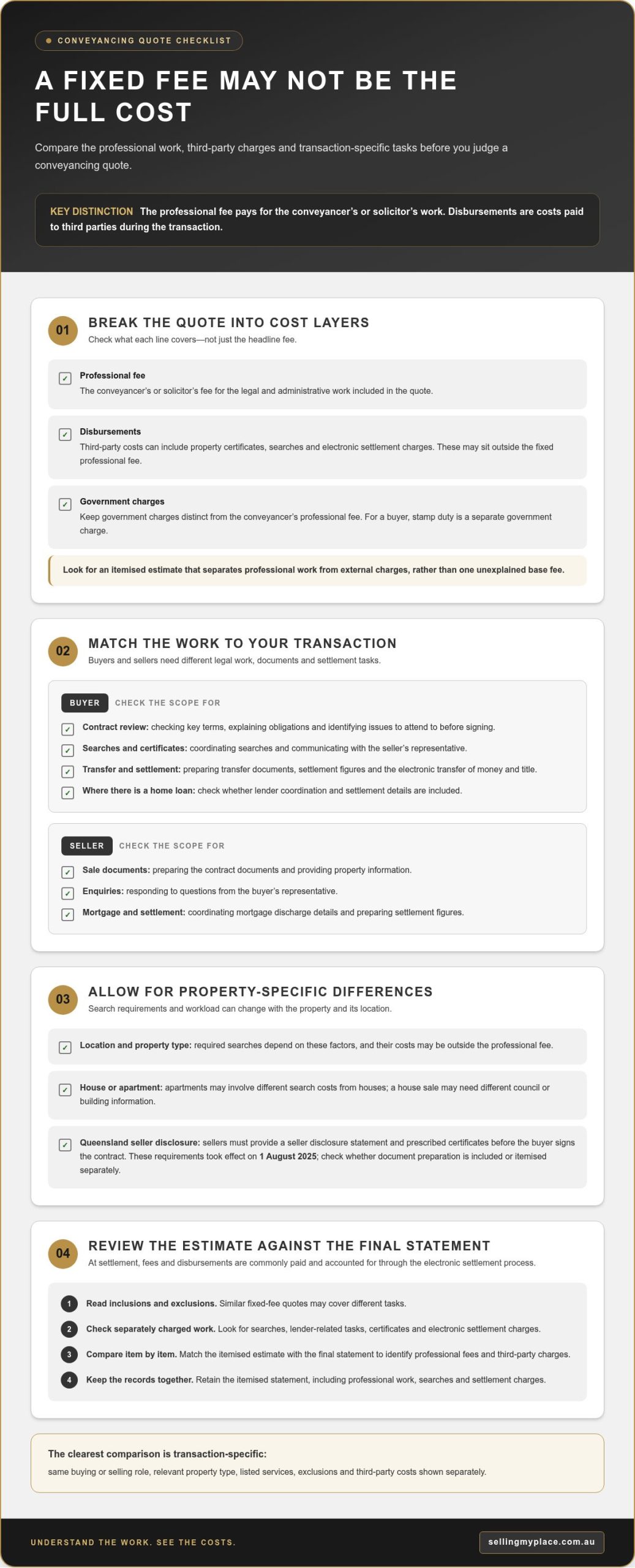
The professional fee pays for the conveyancer’s or solicitor’s work; disbursements are costs paid to third parties during the transaction. This distinction matters because a fixed professional fee may not include searches, certificates or electronic settlement charges.
The work varies depending on your role. A buyer’s conveyancer reviews the contract, coordinates title and property searches, works with the lender where relevant, and prepares for settlement. A seller’s conveyancer prepares sale documents, responds to enquiries and arranges discharge of existing mortgages.
Property type can change the workload. A house sale may require different council or building information. The quote should distinguish the conveyancer’s work from external charges, rather than presenting everything as one unexplained base fee.
Property Certificates and Search Fees
Property certificates and search fees are third-party disbursements that provide records about a property, its title or associated charges. Required searches depend on the property’s location and type, and their costs may sit outside the professional fee.
These charges help explain why apartments may involve different search costs from houses.
Are conveyancing fees tax deductible or included in the property’s cost base in Australia? Tax treatment depends on the property’s use and whether each cost is capital or relates to earning income. Keep the itemised statement, separating professional work, searches and settlement charges, so each amount can be assessed in the right context.
At settlement, conveyancing fees and disbursements are commonly paid and accounted for through the electronic settlement process. Compare the itemised estimate with the final statement to identify professional fees and third-party charges, such as certificates, searches or platform fees.
Services included in conveyancing fees
A conveyancer coordinates the legal and administrative work required to transfer property ownership. For a buyer, this can mean reviewing the contract and organising settlement; for a seller, it includes preparing sale documents and responding to enquiries.
Typical inclusions depend on the transaction and the quote’s scope. Read the service description alongside its exclusions, especially for searches, lender-related work and third-party charges. Similar fixed-fee quotes may cover different tasks, so check the listed services against whether you’re buying or selling.
What a Buyer’s Quote May Cover
For a purchase, conveyancing often starts with contract review. The conveyancer checks key terms, explains obligations and helps identify issues that need attention before signing. Once the contract is agreed, they coordinate searches and certificates, communicate with the seller’s representative and prepare transfer documents.
If a buyer has a home loan, the conveyancer also coordinates settlement details with the lender. They calculate the funds required, prepare settlement figures and arrange the electronic transfer of money and title. Stamp duty is a separate government charge, not the conveyancer’s professional fee, so the quote should distinguish legal work from the buyer’s wider purchase costs.
When reviewing a buyer’s quote, separate contract work from settlement coordination. Check whether the scope includes correspondence with the lender and preparation of transfer documents, or whether those tasks are charged separately. Property type can also affect which searches or certificates are needed.
What a Seller’s Quote May Cover
A seller’s conveyancer prepares the contract documents, provides property information and responds to questions from the buyer’s representative. They also coordinate mortgage discharge details where a loan is secured against the property, then prepare settlement figures showing adjustments and amounts payable.
In Queensland, sellers must provide a seller disclosure statement and prescribed certificates before the buyer signs the contract, under requirements effective from 1 August 2025. That work can affect what a seller’s quote includes. A Queensland seller can compare whether preparing those documents appears in the professional fee or as a separate item.
Third-Party and Settlement Charges
Some charges relate to the platform used to complete the transaction, rather than the conveyancer’s professional work. Check whether this amount is included in the quoted fee or listed separately as a disbursement, so it’s accounted for in your expected settlement costs.
Ask how the final statement separates professional work, certificates, searches and electronic settlement charges. This breakdown helps explain changes between the initial estimate and settlement, particularly if a lender, property type or required document adds work. Keep the quote and final statement together to make the transaction costs easier to review later.
If you’re preparing a property sale and need guidance alongside the legal process, conveyance advice for your sale can help you understand the roles involved.
Choosing a conveyancer or solicitor
The right professional depends on your state, transaction type and the legal work involved. Compare the service scope and total conveyancing costs, not just the headline charge.
Choosing a Conveyancer
A conveyancer focuses on the legal and administrative tasks involved in property transfers. Their experience with your state’s contracts, searches and settlement process matters because requirements and costs vary across Australia.
These figures are professional fees, not necessarily the total cost, which may also include searches, certificates and other disbursements.
Queensland has no separate licence for non-lawyer conveyancers, so conveyancing is handled by solicitors and law practices. Consider the professional’s legal practice and relevant property experience. In NSW, conveyancers must disclose costs upfront and transparently, helping you understand the stated scope and charges.
Compare quotes by checking the transaction covered, the work included and any exclusions. A straightforward house transfer may require different searches and documents from an apartment purchase. Where relevant, check whether the quote accounts for lender coordination, contract review, certificates and electronic settlement.
Online conveyancers in Australia typically charge professional fees 10-20% less than traditional practices. A lower fee alone doesn’t explain which services are included, so compare the scope alongside the price. The useful comparison is the work being done for your particular property and transaction.
Choosing a Solicitor
A solicitor can handle conveyancing as part of a broader legal practice. This may suit a transaction with additional legal issues, such as a complex contract or company involvement, where advice beyond routine transfer work is relevant.
Professional fees differ by state and practice.
These ranges help put quotes in context, but the transaction’s requirements influence the fee. A property with multiple titles, unusual contract terms or additional parties may need more review and coordination. Council and title searches also affect disbursements, which should be distinguished from the solicitor’s professional charge.
Read the quote for its named services, exclusions and likely third-party costs. Check whether it covers contract advice, lender communications, document preparation and settlement coordination. An itemised quote makes it easier to compare professional work with external charges, rather than judging conveyancing costs by one figure.
Choose a professional whose experience and quoted scope suit your transaction. A routine sale and a complex purchase require different work, so look for a clear outline of the legal tasks involved in your matter.
Comparing fixed-fee conveyancing quotes
A fixed fee sets out a defined professional charge, but the transaction’s full cost may include separate disbursements. Compare quotes for the same property type and service scope to see what each figure covers.
Factors Affecting Quotes
A conveyancing quote reflects the transaction’s complexity, required documents, property type and included work. A seller’s matter differs from a purchase, while an apartment may need strata information that a standard house does not. Multiple titles or lender coordination can add tasks, which is why similar-looking quotes may cover different work.
State-based charges affect the overall amount, even when the professional fee is fixed. In Victoria, transfer registration costs A$104.30 plus A$2.34 for every A$1,000 of the purchase price, capped at A$3,614. These government charges are separate from professional fees, so check whether a quote includes them or lists them separately.
Transaction timing and structure matter, too. Off-the-plan conveyancing can take months or years, depending on when construction is completed.
Comparing Quotes and Saving on Fees
Compare like with like: use the same transaction type, property details and requested services for each quote. Then separate the professional fee from searches, certificates, electronic settlement charges and government costs. This gives you a clearer estimate than comparing headline totals alone.
Check each inclusions list against the work your transaction needs. For a purchase, look for contract review, title searches, settlement coordination and lender communication where relevant. For a sale, check whether document preparation and mortgage discharge coordination are covered. A missing item can make a low initial fee difficult to compare.
Use an itemised quote to identify optional tasks and third-party charges. A search is not the same as professional work, and transfer registration is not the conveyancer’s fee. Comparing these categories separately helps you see where quotes differ and avoid paying for services your transaction doesn’t require.
Low-Cost Conveyancing Quotes
A low-cost quote may offer a narrower service scope or use an online process. Online conveyancers in Australia typically charge professional fees 10-20% less than traditional practices. That difference makes the listed services and exclusions especially important to compare, rather than assuming each quote covers the same work.
Check whether the quoted amount covers your actual transaction, including searches, titles and settlement tasks. If a seller’s quote excludes a required document, or a buyer’s leaves out lender coordination, the final total may differ from the initial fee. A clear breakdown shows what is included and charged separately.
Choose the quote that matches the work required, not simply the lowest amount. A standard purchase and an off-the-plan purchase involve different timeframes and coordination. Comparing quotes for the same transaction lets you assess professional fees and disbursements fairly.
Fixed conveyancing fees for buying and selling
Fixed-fee quotes can make the professional charge predictable, but buyers and sellers need different work. The quoted fee is only one part of the transaction’s total cost.
The total can include searches and statutory disbursements, while transfer registration, stamp duty and other government charges may sit outside the conveyancer’s fee. Check the quote’s inclusions before treating its fixed professional fee as the full amount required for settlement.
Why Buyer and Seller Quotes Differ
Buyers need contract review, title searches, transfer documents and coordination with their lender where a loan applies. A unit purchase may also require strata information. These tasks shape the quote, along with the property’s location and the number of titles involved.
Sellers have different responsibilities. Their conveyancer prepares sale documents, responds to buyer enquiries and coordinates discharge of an existing mortgage.
The difference between buying and selling estimates reflects different work and disbursements, not simply a different label on the quote. Sellers should check which documents and settlement tasks are included; buyers should look for searches and lender coordination where relevant.
What a Fixed Fee Covers
“Fixed fee” usually describes the professional charge for the work listed in the quote, rather than every cost associated with buying or selling. Search fees, certificates, registration charges and electronic settlement costs may be listed separately. For a fair comparison, match quotes for the same transaction type and property details.
Government charges can materially affect a buyer’s final budget. In Victoria, transfer registration costs A$104.30 plus A$2.34 for every A$1,000 of the purchase price, capped at A$3,614. Queensland transfer registration costs A$248.04 plus A$46.56 for every A$10,000 above A$180,000. These charges are distinct from professional fees.
For sellers, the fixed-fee scope may depend on the sale documents and settlement work required.
Before comparing totals, separate professional fees, disbursements and government charges in each quote. If you’re preparing to sell, get guidance on preparing your property sale alongside your conveyancing arrangements.
Kincade International Direct Sales: Residential Property Listing Services
Kincade International Direct Sales can help if you’re preparing to sell and want property marketing support alongside your conveyancing arrangements. Its Residential Property Listing Services use a flat-fee model and include professional photography. The packages also offer features such as floorplans and neighbourhood market reports to help owners present their home to buyers.
The service provides residential listings through a global marketing network, with no time limits and a 0% commission structure. Pre-Sale Property Consulting can help you plan the sale, while Buyer Representation supports people looking for guidance on a purchase. These services address marketing and property decisions, while legal transfer work remains part of conveyancing.
If you’re weighing up your next property move, you’re welcome to contact Kincade International Direct Sales or visit sellingmyplace.com.au.
Make your next property move with a clear plan
Use the average conveyancing fees in Australia in 2026 as a planning reference, then shape your next steps around your own property goals. A move is more than a transaction: it can mean choosing a home that fits your life or preparing a place that holds years of memories. Clarity about responsibilities and costs gives you more room to make those decisions thoughtfully.
If you’re preparing to sell, Kincade International Direct Sales offers Residential Property Listing Services and Pre-Sale Property Consulting to support your marketing decisions. Buyer Representation can help buyers approach their search with a clearer sense of what matters to them. These services complement, but do not replace, the legal work involved in conveyancing.
Take the next step at your pace. Contact Kincade International Direct Sales to discuss your property plans and find a considered way forward.
Frequently Asked Questions
What is conveyancing?
Conveyancing is the legal process of transferring property ownership from seller to buyer. It covers tasks such as reviewing the contract, preparing transfer documents and coordinating settlement. For example, a buyer’s conveyancer helps arrange registration of the transfer, while the seller’s representative handles documents needed to complete the sale. This work connects the contract, payment and title transfer so the change in ownership can be completed.
Are conveyancing fees paid upfront?
Conveyancing fees and disbursements are commonly paid at settlement and accounted for through the electronic settlement process. They’re often included in the settlement figures rather than paid as one upfront bill. Search costs or other arrangements may have different payment timing, so read the payment terms in the engagement documents. Keep the final statement with your property records for reference.
How do I get an accurate quote?
Give the conveyancer the details that shape the work: whether you’re buying or selling, the state, property type and transaction structure. Include relevant information about a loan, multiple titles or an owners corporation, as these can affect searches and settlement tasks. Ask for an itemised estimate that separates professional work from disbursements and government charges. A quote based on the actual contract is more useful than a generic estimate.
What goes wrong if I just pick the cheapest option?
The lowest headline fee may cover a narrower scope than another quote. Search fees, lender coordination or additional title work could be charged separately, making the final bill different from the initial comparison. A missing service can also leave you unsure who handles a task before settlement. Compare itemised inclusions and exclusions, not just the professional fee, and match each quote to the same transaction details.
What government fees do you pay on top in QLD?
Queensland buyers may pay transfer duty and Titles Queensland registration charges, separate from professional fees. Transfer registration is A$248.04 plus A$46.56 for every A$10,000 of the purchase price above A$180,000. From 1 July 2026, registering a new mortgage or releasing an existing mortgage costs A$248.04 each.
What are the average conveyancing fees in Australia in 2026 for sellers?
These Australia-wide estimates depend on the sale’s documents, searches and settlement work.
How much do conveyancers and property solicitors charge in each Australian state and territory?
Indicative professional-fee ranges vary by location and practitioner. These are professional fees, not total costs.
What is included in a fixed conveyancing fee, and what costs extra?
A fixed conveyancing fee generally covers the professional tasks listed in the quote, such as contract work, document preparation and settlement coordination. Search costs, certificates, government registration charges and electronic settlement platform fees may be additional. Check the itemised scope against your transaction, including whether lender-related work or property-specific searches are included or charged separately.
What a Conveyancer Does for a Seller and What It Costs
A property sale isn’t finished when an offer is accepted. The seller’s conveyancer manages the legal work needed to transfer ownership, from preparing the contract to coordinating settlement and finalising the handover. Understanding what a conveyancer does for a seller also means knowing how their work fits across the pre-contract, pre-completion and post-completion stages.
Selling a home involves plenty to organise, and the legal details matter as much as the practical ones. A conveyancer helps manage contracts and disclosure requirements, handle buyer enquiries, coordinate with the seller’s lender and arrange settlement. Their fees and other transaction costs are also worth understanding early.
A conveyancer’s role has limits. Building inspections, for instance, are handled separately, and conveyancing requirements vary across Australian states and territories. Internationally, closing procedures also differ by region; for instance, US sellers often turn to dedicated agencies like County Properties for personalised transaction guidance. Understanding the process and its costs can help you approach a sale with more confidence and fewer surprises.
Key Takeaways
- A seller’s conveyancer manages the legal transfer, from preparing sale documents to completing post-settlement notifications.
- Disclosure and contract requirements vary between states, so getting the paperwork right can help prevent delays and disputes.
- Settlement involves coordinating with the buyer’s conveyancer and, where relevant, the seller’s lender to finalise funds and transfer ownership.
- Conveyancing fees and disbursements depend on the work involved; an itemised cost breakdown helps clarify what you’ll pay.
- Separate legal support from sale preparation with property marketing and pre-sale advice tailored to your selling plans.
Conveyancer and solicitor roles in property sales
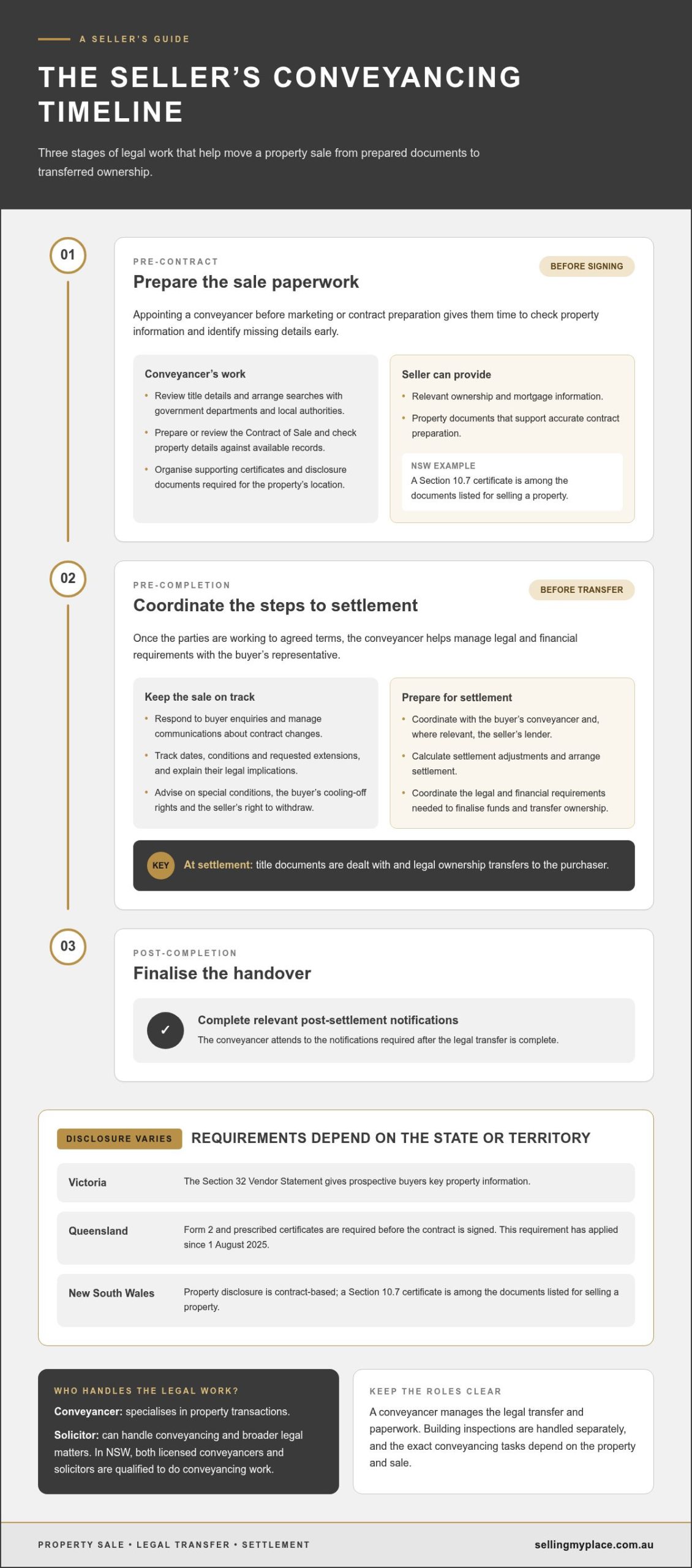
A seller’s conveyancer manages the legal work that transfers a property to its buyer. In Australia, conveyancing generally has three stages: pre-contract, pre-completion and post-completion.
Conveyancer and solicitor responsibilities
A conveyancer specialises in property transactions, while a solicitor can handle conveyancing and broader legal matters. In NSW, licensed conveyancers and solicitors are both qualified to do conveyancing work. A solicitor’s broader legal knowledge may help if a sale raises issues beyond the transfer itself. For a seller, understanding what a conveyancer does means knowing who prepares the sale documents, checks details and coordinates the legal steps with the other parties.
Property information and supporting certificates
Property information and certificates help describe the land and identify matters that could affect a sale. In NSW, a Section 10.7 certificate is among the documents listed for selling a property under the Conveyancing Act 1919. A seller’s conveyancer can review title details and arrange searches with government departments and local authorities. For example, information in a certificate or search may need to be considered when preparing the Contract of Sale, so the buyer receives relevant details before proceeding.
Sale documents and seller-provided information
Sale documents set out the property, agreed terms and information required for the transaction. In NSW, the Contract of Sale is a central document, and the Conveyancing Act 1919 specifies documents required to sell a property, including a Section 10.7 certificate. The conveyancer prepares or reviews the contract and checks that property details align with available records. The seller can help by providing relevant ownership and mortgage information, along with documents about the property that support accurate contract preparation.
Ownership transfer and appointment timing
Legal ownership transfers through the conveyancing process at settlement, when the title documents are dealt with. The seller’s conveyancer handles the legal work needed to transfer the property to the purchaser, then completes relevant post-settlement notifications. Appointing a conveyancer before marketing or contract preparation gives them time to review property information and prepare documents. This can help identify missing details before a buyer is ready to sign, rather than during a time-sensitive exchange.
The three stages provide a useful map of the work. Before the contract, the conveyancer prepares documents and checks property details. Before completion, they coordinate outstanding legal and financial requirements with the buyer’s representative. After completion, they attend to relevant notifications. In NSW, this work can include checking the contract, arranging searches, calculating settlement adjustments and attending settlement. The exact tasks depend on the property and sale, but each stage supports the same outcome: transferring ownership with the legal paperwork in order.
Risks of incomplete contracts and missed disclosure obligations
An incomplete contract or missed disclosure can complicate a sale and lead to disputes between buyers and sellers. Documents and disclosure rules vary across Australia, so the conveyancing process must reflect the property’s state or territory.
Preparing the contract and vendor’s statement
The seller’s conveyancer prepares or reviews the contract and the disclosure documents required for the property’s location. In Victoria, the Section 32 Vendor Statement gives prospective buyers key property information. In Queensland, the seller disclosure statement is Form 2, with prescribed certificates.
These documents help buyers understand the property before signing. Since 1 August 2025, Queensland sellers must give buyers Form 2 and prescribed certificates before the contract is signed. A conveyancer helps organise the required material and prepare the contract so the sale terms and disclosure documents are consistent.
Contract review and seller disclosures
Contract review means checking the proposed terms and disclosure material for accuracy, completeness and potential issues. In Victoria, the seller must provide prospective buyers with a Section 32 legal document containing key property information. Queensland’s Property Law Act 2023 introduced mandatory seller disclosure and stricter compliance obligations.
NSW property disclosure is contract-based, unlike the named disclosure documents used in Victoria and Queensland. A conveyancer reviews the contract and relevant information, then advises the seller about their obligations and any points needing attention. This review matters because buyers rely on the documents to understand what they are agreeing to purchase.
Contract terms, conditions and deadlines
Contract advice explains what each term requires and how a proposed condition could affect the sale. A conveyancer can advise on special conditions, the buyer’s cooling-off rights and the seller’s right to withdraw. A lawyer may also help if questions extend beyond conveyancing or involve broader legal issues.
Once the parties agree on terms, dates and conditions need to be tracked throughout the sale. For example, a requested extension changes the timing the parties are working towards, while a condition may require a particular action before proceeding. The conveyancer manages these communications and explains the legal implications before the seller responds.
Buyer enquiries, inspections and contract changes
The seller’s conveyancer handles legal communication with the buyer, including questions about title and requests to extend dates. If the buyer proposes a contract change, the conveyancer explains its effect and helps the seller consider a response before the revised terms are documented.
Building inspections are separate: conveyancers don’t arrange or carry out structural, pest or drug residue testing. A buyer may seek a building and pest condition in the contract, and a conveyancer can help ensure suitable wording is included. For support with the broader sale plan, explore property sale advice.
Arranging settlement and coordinating with the seller’s financial institution
Settlement is when the sale funds and ownership transfer are completed. The seller’s conveyancer coordinates the financial and title steps with the buyer’s conveyancer and, if the property has a mortgage, with the lender.
Settlement adjustments for rates and levies
Settlement adjustments divide property charges between the seller and buyer according to their agreed responsibilities at settlement. Using the relevant account details and settlement date, the conveyancer calculates adjustments for council rates, water usage and body corporate levies.
For example, if council rates cover a period beyond settlement, the settlement statement accounts for the buyer’s share after ownership changes. Water charges and body corporate levies may also need adjustments. These calculations account for ongoing property expenses alongside the purchase funds, rather than leaving an amount unresolved after the transfer.
The conveyancer prepares a settlement statement showing the payments needed to complete the sale and tells the buyer’s conveyancer which amounts are due at settlement. Reviewing the statement against the contract of sale and available rates or levy information can help identify an incorrect charge before funds are transferred.
Financial institution coordination
If the property is mortgaged, the seller’s conveyancer liaises with the existing mortgagee to arrange discharge of the mortgage. They can request a loan payout figure from the lender, establishing the amount needed to repay the debt from the sale proceeds.
This coordination connects the lender’s payout process with settlement and the title transfer. The conveyancer checks the payout information and includes the relevant payment in the settlement arrangements. This addresses the lender’s interest in the property as part of completing the sale, rather than leaving it as a separate task after ownership has transferred.
The conveyancer also checks the buyer’s deposit and coordinates with the buyer’s representative about payments needed for settlement. The contract of sale sets the agreed terms, while the settlement statement brings together the financial amounts due. If the seller has a mortgage, the payout figure is an important part of working out how the sale funds will be allocated.
Electronic settlement and title registration
Electronic settlement uses an electronic conveyancing workspace to coordinate funds and title documents between the parties. The seller’s conveyancer can facilitate settlement in the workspace and advise the seller when completion occurs.
At settlement, funds are exchanged and the legal title transfer proceeds. In Victoria, the change of ownership is registered with Land Use Victoria. The conveyancer prepares or coordinates the title transfer documents and checks that the settlement arrangements reflect the agreed transaction.
After completion, the seller’s conveyancer can notify relevant authorities of the change of ownership and pay outstanding rates and taxes. These final checks close out the seller’s responsibilities connected with the property. The buyer receives legal ownership, while the seller can see how the sale proceeds were applied, including any mortgage payout and settlement adjustments.
How does a conveyancer handle buyer enquiries, inspections and contract changes?
The seller’s conveyancer manages legal communication with the buyer and their representative during the sale. They respond to questions about title, consider requests to change dates and explain how proposed contract changes affect the seller’s position.
Buyer enquiries may concern the title, contract wording or details that need clarification before the transaction proceeds. The conveyancer checks each question against the sale documents, then communicates the response to the buyer’s conveyancer. For example, if the buyer asks about a title detail, the seller’s conveyancer can review the relevant information and explain what it means for the transaction. This keeps legal questions in the right channel and gives the seller a clearer basis for deciding how to respond.
Date changes need careful attention because a requested extension can affect the timing agreed by the parties. The conveyancer assesses the request, explains its effect and relays the seller’s response. If the seller agrees, the conveyancer helps document the variation so both parties have a clear record of the updated arrangement. A casual conversation should not be treated as a settled contract change; the conveyancer can clarify what has been agreed and what needs formal documentation.
Inspections are separate from legal enquiries. Conveyancers don’t organise or carry out building inspections, including structural, pest or drug residue testing. Those inspections concern the property’s physical condition, while conveyancing concerns the legal transaction. A buyer may ask for a building and pest inspection condition in the contract. The conveyancer can help ensure the contract wording is suitable, so the parties understand how the condition relates to the sale.
Contract changes may follow a buyer’s request, a question about a condition or a change to a proposed date. The conveyancer explains the legal effect before the seller responds. For instance, a buyer might seek more time to meet a condition or ask to change the wording. The seller can then consider the request with a clear view of its impact, rather than relying on an informal summary or assuming the change has no practical consequence.
Throughout these exchanges, the conveyancer acts for the seller, not as a neutral negotiator for both parties. Their role is to communicate the seller’s position, explain the contract’s implications and help document agreed changes. This distinction matters when a buyer’s request could alter a condition, deadline or obligation. The seller makes the commercial decision; the conveyancer provides legal guidance and helps ensure the response is accurately reflected in the transaction documents.
Keep relevant messages and documents together for the conveyancer, including buyer requests, inspection-related conditions and proposed date changes. A clear record helps them compare each request with the current contract and respond consistently. If a buyer raises several points at once, the conveyancer can separate legal questions from inspection arrangements and contract negotiations, then address each through the appropriate channel.
When should a seller appoint a conveyancer, and what should they provide?
Appointing a conveyancer before preparing the sale contract gives them time to organise the legal work and review property information. Sellers in Australia aren’t legally required to use one, but professional conveyancing is recommended because the transfer involves detailed documents and deadlines.
Early involvement is especially useful when the property needs searches, disclosure documents or mortgage discharge arrangements. In NSW, a conveyancer must be licensed with NSW Fair Trading, or the work must be done by a practising legal practitioner. In Queensland, paid conveyancing work must be carried out by a solicitor with a current practising certificate, or by supervised support staff in a law firm.
When you engage a conveyancer, provide details that help establish who owns the property and what may affect its sale. Useful records include:
- Ownership and title information, including the names of all registered owners.
- Mortgage details and the lender’s contact information, if the property has a loan.
- Available council rates, water charges and body corporate levy notices.
- Existing property documents and information relevant to buyer disclosure.
- Your contact details and identification for identity and authority checks.
For example, if two people appear on the title, the conveyancer needs to account for both when preparing sale documents. Mortgage details help them coordinate with the lender, while current rates or levy notices support settlement calculations.
Share information promptly, even if you’re unsure whether a document matters. The conveyancer can assess how it relates to the contract, searches or disclosure requirements in your state. In NSW, property disclosure is contract-based; in Victoria, the seller provides a Section 32 Vendor Statement. Queensland sellers provide Form 2 and prescribed certificates before the buyer signs.
Ask for an itemised estimate before work begins. In NSW, conveyancers and solicitors generally disclose certain conveyancing costs before or when retained. Request an itemised statement of likely costs before work starts. Disbursements may include title searches and authority certificate fees, so ask which professional fees and property-related charges are included in the estimate.
Understanding what a conveyancer does for a seller helps you appoint them at a useful point: before contract preparation, not after a buyer is waiting. For help planning your sale and organising the next steps, discuss your property sale plans.
Kincade International Direct Sales: Residential Property Listing Services
Kincade International Direct Sales helps Australian homeowners prepare and market a residential property through its Residential Property Listing Services. While your conveyancer manages the legal transfer, Kincade supports the separate task of presenting your home to buyers.
Its flat-fee marketing model includes professional photography, floorplans and neighbourhood market reports, with listings remaining active until sold and no time limits. Pre-Sale Property Consulting can help you plan the sale before launch, while Buyer Representation supports people looking to purchase. These services complement conveyancing; they don’t replace the legal work of preparing contracts or transferring ownership.
If you’re planning a sale, explore Kincade International Direct Sales’ fixed-fee packages at sellingmyplace.com.au.
Take the next step towards your property plans
Knowing what a conveyancer does for a seller helps you distinguish the legal transfer from the decisions that shape your sale. Next, clarify the outcome you want, the support you need and how you’ll present the property to potential buyers. Keeping those choices aligned can make the move from planning to market more considered.
Kincade International Direct Sales offers Residential Property Listing Services and Pre-Sale Property Consulting for owners preparing to sell. If your plans also include buying another home, its Buyer Representation can support that part of your next move. The right focus depends on where you are in the process, whether you’re weighing up your sale approach or getting the property ready for market.
For a considered conversation about your plans, contact Kincade International Direct Sales. Take the next step at your own pace, with a clearer path ahead.
Frequently Asked Questions
What is conveyancing and how does it work?
Conveyancing is the legal process of transferring land ownership from one party to another. A sale involves coordinating legal documents and transaction details between the parties. The work spans preparing the sale, managing contract and settlement arrangements, and finalising the transfer. For example, details agreed in the contract inform the checks and payments needed to complete the transaction.
How long is the conveyancing process?
Most conveyancing processes in NSW take 42 days, or around six weeks. The timeline depends on the contract’s settlement date and how quickly required documents, searches and lender arrangements are completed. A title issue or late information can affect the sequence of work, so the agreed dates in the contract provide the practical reference point. Conveyancing timeframes differ across Australia and between individual sales.
What is a conveyancer and why are they essential in 2026?
A conveyancer is a licensed professional who specialises in property transaction advice and information; they may or may not be a solicitor. Using one is not legally required in Australia, but professional help is recommended because contracts, disclosure material and settlement require careful coordination. In 2026, sellers also need to account for state-specific disclosure rules, such as Queensland’s Form 2 process, when preparing a sale.
What does a conveyancer do for a seller in Australia?
A seller’s conveyancer handles the legal work needed to transfer the property and supports the seller through the transaction. Understanding what a conveyancer does for a seller means looking beyond paperwork: they also communicate with the buyer’s representative, explain the legal implications of requests and coordinate relevant checks. For instance, if a buyer asks to change a contract date, the conveyancer explains the effect before the seller decides.
What documents does a seller’s conveyancer prepare and review?
A seller’s conveyancer prepares or reviews the Contract of Sale and checks property records and disclosure material relevant to the state. The particular documents differ: NSW sales include a Section 10.7 certificate among required documents, while Victoria uses a Section 32 Vendor Statement. In Queensland, Form 2 and prescribed certificates form part of seller disclosure. Sellers can help by sharing ownership, mortgage and property records early.
How does a conveyancer prepare the contract of sale for an Australian property?
A conveyancer prepares the contract using information about the property, its ownership and the proposed sale terms. They review title details and relevant searches, then consider whether the contract accurately describes the property and records the parties’ agreement. For example, the seller’s proposed settlement date or a buyer-requested condition needs clear wording. State requirements also shape the supporting material, so a NSW contract differs from disclosure documents used in Victoria or Queensland.
What are the steps in the conveyancing process for a property seller in Australia?
The process generally moves through pre-contract, pre-completion and post-completion stages. First, the seller’s representative gathers property information and prepares sale documents. After the buyer and seller enter the contract, the parties deal with enquiries, required checks and settlement arrangements. At settlement, funds and the title transfer are coordinated. Afterwards, the seller’s representative can manage relevant ownership notifications. State rules and the agreed contract shape the details at each stage.
What does a seller’s conveyancer do at settlement, including calculating adjustments and paying out the mortgage?
At settlement, the conveyancer coordinates the seller’s financial and title requirements with the buyer’s representative. They calculate adjustments for council rates, water usage and body corporate levies, then include those amounts in the settlement statement. If there is a mortgage, they obtain the lender’s payout figure and arrange for the loan to be paid from the sale proceeds. The remaining funds are distributed according to the settlement arrangements.
