Off market property in Melbourne and Sydney: how to find one
An off-market property isn’t automatically a bargain. In Melbourne, buyers can uncover these homes through relationships with local selling agents, a wider personal network and professional buyer representation, with finance pre-approval helping them act when a suitable property appears.
It’s easy to assume “off market” and “pre-market” mean the same thing, or that a private sale must come with a lower price. The distinction matters: an off-market home is sold without public advertising, while a pre-market home is usually shown to a small group before an expected public launch.
This guide explains how buyers can find off-market homes in Melbourne and Sydney, what separates off-market from pre-market listings, and why a seller might prefer a private sale. You’ll also see how privacy, personal circumstances and the prospect of avoiding a public campaign can shape a seller’s decision, so you can approach the search with clearer expectations.
Key Takeaways
- A buyer’s agent can use relationships with selling agents and broader networks to hear about homes before they reach public listings.
- Pre-market usually means a short first opportunity to buy before a public launch; a private off-market campaign may remain private.
- Privacy, personal circumstances and a preference for a less public sale can influence a seller’s choice of approach.
- In Sydney, a private sale doesn’t automatically mean a lower price: competition and the seller’s expectations still matter.
- Neighbourhood Market Reports can help put local property choices in context, while Buyer Representation can support a more focused search.
How can a buyer’s agent help you find off-market properties in Melbourne?
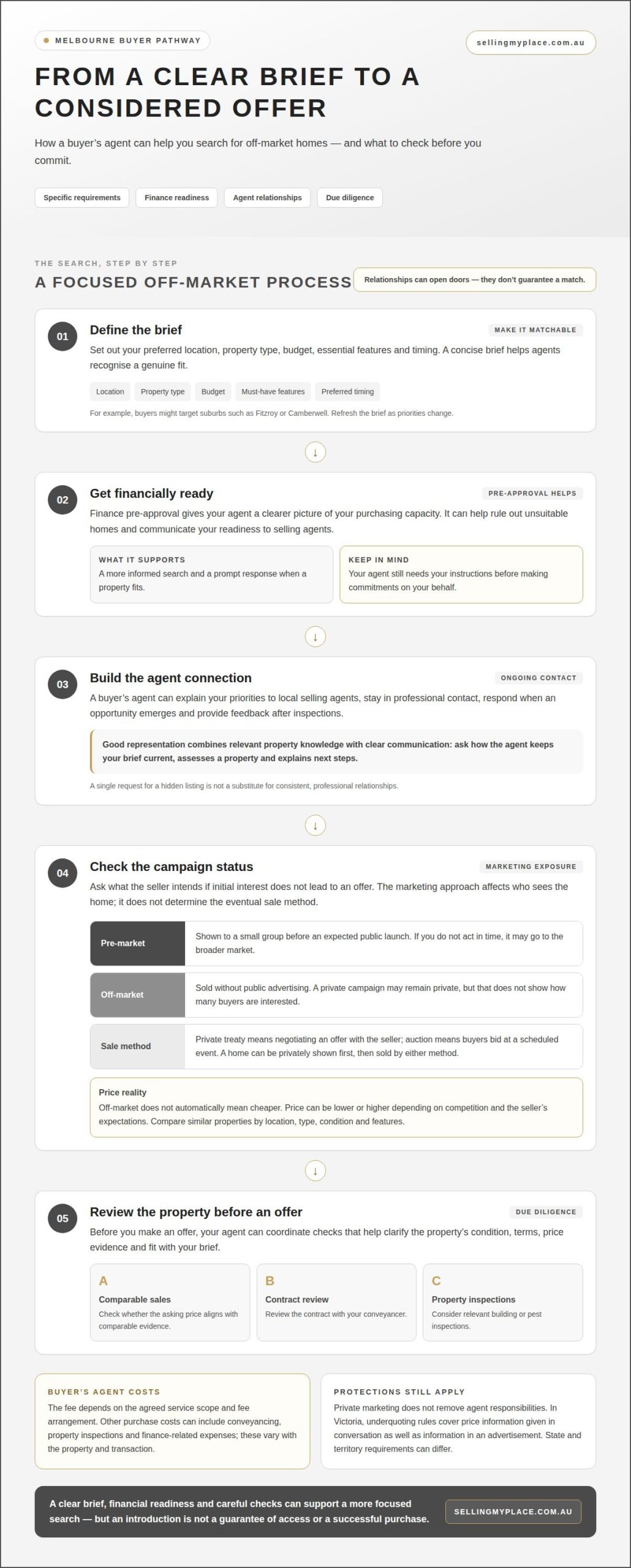
A buyer’s agent searches through selling-agent relationships and professional networks, then assesses whether each property suits your brief. For buyers targeting suburbs such as Fitzroy or Camberwell, that means sharing clear requirements, financial readiness and preferred timing with an advocate who can speak directly with local estate agents. An off-market property search is most useful when the brief is specific enough for agents to recognise a genuine match.
Relationships are built through regular, professional contact, not a single request for a hidden listing. A buyer’s agent can explain your priorities to selling agents, respond promptly when an opportunity emerges and give useful feedback after inspections. A concise brief covering location, property type, budget and essential features helps agents match a home to your needs. The agent can also refresh that brief as your priorities change.
When choosing representation, look for relevant property knowledge and clear communication with selling agents. Ask how the agent keeps your brief current, assesses a property and explains next steps. Strong relationships can lead to introductions, but they don’t guarantee access to a suitable home or a successful purchase. A sound process matters just as much as an introduction.
Finance pre-approval gives your buyer’s agent a clearer picture of your purchasing capacity. It can help them rule out unsuitable opportunities, communicate your readiness to selling agents and respond decisively when a property fits. Your agent still needs your instructions before making commitments on your behalf. Being prepared can help avoid delays when a seller is considering interest privately.
Consumer protections still apply when a home isn’t advertised. Australian state consumer laws apply to property agents whether or not a home is advertised. In Victoria, rules against underquoting cover price information given to a buyer in conversation, not just information in an advertisement. Private marketing doesn’t remove these responsibilities.
What fees and costs apply? A buyer’s agent’s fee depends on the agreed service scope and fee arrangement. Other purchase costs can include conveyancing, property inspections and finance-related expenses, which vary with the property and transaction.
What due diligence should the agent help complete? Before you make an offer, the agent can coordinate a review of comparable sales, the contract with your conveyancer, and relevant building or pest inspections. These checks help clarify the property’s condition, terms and fit with your brief, including whether the asking price aligns with comparable evidence.
Do practices differ between states and territories? Yes. Consumer laws apply across Australian states and territories, but specific requirements can differ. In Victoria, the rules also cover verbal price information. An agent working across state borders needs to understand the rules applying where each property is located. This matters when an off-market property search spans more than one jurisdiction.
Pre-market versus off-market properties
The difference is what happens after selected buyers see the home: a pre-market property is expected to reach public listings, while a private campaign stays off the public market. That distinction affects how buyers judge the time available and the likely audience for a sale.
Off-market and on-market sales
An on-market sale is publicly advertised, while an off-market sale proceeds without public advertising. Buyers can find public listings online, but private opportunities are introduced through agents or networks. The marketing method shapes who sees the property, not the legal form of the eventual sale.
A pre-market home is shown to a small group before an expected public launch. If a buyer doesn’t act in time, the property may go to the broader market. In a private campaign, the seller may keep marketing without moving to public listings. Ask what the seller intends if initial interest doesn’t lead to an offer.
This distinction can affect your decision. A pre-market viewing may provide an early opportunity, but waiting could mean competing with more buyers after launch. A private sale may have a smaller initial audience, but that doesn’t tell you how many buyers are interested or what the seller will accept.
Comparing sale methods
Off-market and on-market describe marketing exposure; private treaty and auction describe how the sale is conducted. In a private treaty, the buyer negotiates an offer with the seller. At auction, buyers bid against one another at a scheduled event.
These choices can occur at different stages. A seller may first show a home privately, then advertise it and proceed by private treaty or auction. The early marketing approach doesn’t determine the eventual sale method, so understand both before deciding how to proceed.
For example, if an advertised home is going to auction, your approach differs from negotiating directly with a seller. The sale method affects how an offer is made and when the seller considers it. Marketing status alone doesn’t answer those questions.
Prices of off-market properties
Privately marketed homes aren’t necessarily cheaper than publicly listed properties. Their prices can be lower or higher, depending on competition and the seller’s expectations. Limited exposure doesn’t automatically create a discount, and a pre-market price may not be the seller’s final position.
Compare similar properties by location, type, condition and features. A renovated home and one needing substantial work may be poor comparisons, even in the same area. Treat an asking price as a starting point for assessment, not proof of value.
For buyers and sellers weighing different approaches, discussing property sale options can help clarify which campaign suits their circumstances.
Why do sellers sell off-market?
For a seller, a private sale can offer more control over who sees the home and how it is presented. The reasons often reflect practical pressures or personal circumstances, rather than one preferred way to sell.
Reasons for choosing an off-market sale
An off-market sale lets a vendor test interest without starting with a public campaign. That can suit someone facing financial pressure, a change in personal circumstances or a preference to avoid the attention of a public sale.
Marketing costs can also influence the decision. A seller may weigh campaign spending against the chance of attracting more buyers through public advertising. A private approach may appeal if the vendor already has a likely buyer in mind or discretion matters more than broad exposure.
There’s no universal reason. One seller might want to manage a sale alongside a family change; another might prefer to avoid auction preparations and public competition. The choice reflects the vendor’s priorities, the property and the circumstances around the sale.
Reasons for choosing a quiet sale
A quiet sale limits public attention and can give a seller more control over access to the home. For example, a vendor who values privacy may prefer selected buyer enquiries over a publicly promoted campaign.
It can also reduce the disruption of preparing for open inspections. A public campaign may involve open inspections twice a week for six weeks, requiring the seller to keep the home ready for visitors. A private sale may help avoid that routine, which can matter for a busy household, family commitments or a home that’s difficult to prepare repeatedly.
Some sellers feel anxious about auctions, crowds or having neighbours and passers-by view their home. A quieter process can feel more manageable, particularly when the vendor wants conversations to focus on serious interest rather than public attention.
The trade-off is reach. A seller choosing privacy may expose the property to fewer buyers than a public campaign, which can affect competition. For a buyer, a quiet sale isn’t automatically a sign of urgency, a bargain or a seller willing to accept any asking price.
Seller circumstances can change. A vendor may begin privately, then decide to advertise if initial interest doesn’t lead to an acceptable offer. That possibility matters when buyers weigh whether to act promptly or wait for wider exposure. Each approach brings different considerations around privacy, preparation and buyer reach.
Ultimately, the vendor balances discretion and convenience against the potential benefits of a broader campaign. Understanding whether privacy, financial pressure or inspection demands are driving the choice helps buyers read the situation more clearly, without assuming the seller’s motivation or expected price.
Off-market and pre-market property listings in Sydney
Sydney buyers may encounter a home before its public launch or through a private campaign. Knowing how listings, price ranges and search bands work can help you judge opportunities without treating an early price as a final measure of value.
A selling agent may list a property before it’s ready to appear on public property websites. The period between listing and readiness can be about a week. During that window, an agent may speak with selected buyers. If the home is pre-market, it is expected to go to the broader market if a buyer doesn’t act in time. That timing gives interested buyers an early look, but doesn’t necessarily mean the seller will keep the sale private.
Sydney listings show how much prices vary by location and property type. These figures describe different sale contexts, so compare like with like rather than assuming every displayed range has the same meaning.
Search bands also appear across a mix of homes and apartments. Property type, location, size and condition all shape which comparisons are useful.
One concern is overpricing, sometimes associated with “buying the listing”: a seller chooses an agent based on an ambitious price estimate. A displayed range alone can’t establish that a home is fairly priced. The comparison matters more than the label attached to its marketing.
How can a buyer’s agent help estimate value? They can assess comparable sales, location, property type, size and condition, then weigh those against the seller’s asking price. For Sydney examples, that means treating a search band as a guide, not a substitute for property-specific analysis.
An off-market listing isn’t necessarily cheaper than a public listing. Its price may be lower or higher, depending on competition and the seller’s expectations. Whether considering a house in The Ponds or an apartment in Coogee, assess the evidence behind the asking price before deciding what the opportunity is worth. Beyond the property itself, researching neighbourhood amenities and local activities, such as pinnaclemartialarts.com.au, can help families determine whether a particular Sydney suburb suits their everyday lifestyle.
What an off-market property sale is
The phrase describes a marketing choice, not a separate kind of property ownership. For buyers, that distinction separates what an agent is doing to find an audience from the decisions involved in making an offer.
A private introduction can begin a conversation, but it doesn’t itself create an agreement to buy. The buyer and seller still need to settle the terms and proceed through the usual sale process. Treat an agent’s message as an invitation to consider the home, not as a substitute for written sale documents.
For example, a buyer may hear that a home could be available and ask to inspect it. That enquiry doesn’t mean the seller has accepted an offer or agreed to stop considering other interest. Clarify whether the seller is inviting offers, discussing a possible sale or simply gauging interest.
Marketing status can change. A seller who begins with private conversations may later choose broader advertising. Understand what the seller is currently considering and whether the opportunity remains private, rather than assuming an early approach guarantees exclusive access.
The label says nothing by itself about price, condition or competition. A buyer still needs to judge the home against relevant evidence and their own requirements. A quiet introduction may feel personal, but it shouldn’t replace a careful decision about the property and proposed terms.
For sellers, the choice is about how to introduce the home to potential buyers and how much public exposure to seek. Consider those priorities alongside the intended campaign to clarify which marketing approach fits the sale.
Sellers considering their next move can discuss property sale options before choosing how to present their home.
Kincade International Direct Sales: Neighborhood Market Reports
Kincade International Direct Sales offers Buyer Representation to support buyers searching for a home. Its Neighborhood Market Reports can help you put property choices in context when weighing a privately presented home against comparable properties.
For sellers, Pre-Sale Property Consulting can help clarify sale considerations before choosing an approach, while Residential Property Listing Services support owners preparing to market a home. The right next step depends on whether you’re buying, selling or still shaping your plans.
If you’d like to discuss your property goals, contact Kincade International Direct Sales.
Take the next step with a clear property plan
Before pursuing an off-market property, decide what matters most: the location, the features you can’t compromise on and the terms you’re prepared to consider. A clear brief gives a property professional a practical basis for assessing opportunities and keeping your search aligned with your plans.
If you’re buying, Kincade International Direct Sales offers Buyer Representation to support your search. If you’re preparing to sell, its Residential Property Listing Services and Pre-Sale Property Consulting can help you consider your options and plan the next stage. The right support depends on where you are in the property journey, whether you’re finding a home or preparing for a move.
You don’t need every detail settled before taking a first step. A conversation can help you clarify your priorities and decide what support would be useful.
Contact Kincade International Direct Sales to discuss your property goals and take the next step with confidence.
Frequently Asked Questions
What Does Off-Market Mean in Real Estate?
In real estate, off-market means a home is offered for sale without public advertising. A buyer might hear about it through a selling agent or buyer’s agent rather than an online listing. The term describes the marketing approach, not the property’s condition, contract or likely price. For example, a home discussed privately with selected buyers can still attract competing offers.
Do consumer protections still apply to off-market sales?
Yes. Australian state consumer laws apply to property agents whether or not a home is advertised. In Victoria, rules against underquoting cover price information given to a buyer in conversation, not just information in an advertisement. A private introduction doesn’t remove agent responsibilities. Buyers should still consider the price information, sale documents and property details carefully before deciding whether to proceed.
How can a buyer’s agent help you find off-market homes?
A buyer’s agent can share your property brief with selling agents and relevant professional contacts, then assess homes that match your requirements. A clear brief can distinguish a genuine fit from a property that misses an essential feature. The agent can also help coordinate inspections and discussions about an offer, so you can focus on whether the home suits your plans.
Off-Market vs On-Market: What’s the Difference?
An off-market home is offered without public advertising, while an on-market home is promoted to the broader public. That changes how buyers encounter the listing: one may come through an agent’s direct contact, while the other can be found through public advertisements. Neither approach establishes the home’s value or guarantees a particular level of buyer competition, so assess each property on its merits.
What Is an Off-Market Sale?
An off-market sale is a property sale conducted without publicly advertising the home. Private marketing does not by itself make a property purchase informal; buyers should review the sale documents and check who they are dealing with. For a buyer, the practical distinction is how the opportunity is introduced, not whether the transaction is informal. Review the property information and proposed contract terms as you would for any significant purchase.
What does off-market property mean in Australia?
In Australia, an off-market property is a home offered for sale without public advertising. It may be introduced directly to selected buyers, but “off market” doesn’t mean the property is unavailable to others or priced below market value. A seller can consider private interest while retaining the option of wider exposure. The phrase describes marketing status, not a special property category.
How do off-market property sales work in Australia?
A seller can authorise private marketing, and an agent may introduce the home to buyers who appear to fit. An interested buyer can arrange a viewing and discuss an offer with the seller. If they agree to proceed, the sale uses a normal contract of sale. Private marketing doesn’t remove the need to understand the property’s condition, price and contract terms.
Where can a buyer’s agent find off-market properties in Australia?
A buyer’s agent may hear about private opportunities through relationships with selling agents and wider professional networks. A buyer’s own connections can also surface a potential introduction, though the agent can help assess whether the property matches the search brief. In practice, a focused brief covering preferred locations, property type and essential features makes it easier to identify relevant opportunities across Australia.
Sell Property Zero Commission: A Smarter Australian Selling Guide
What if avoiding percentage-based agent commission didn’t mean managing every part of your sale alone? If you’re exploring how to sell property zero commission, it’s worth understanding what “zero” covers, whether a flat fee includes the marketing you need and how much support is available when buyers have questions.
Zero commission doesn’t mean selling is free. It usually means paying a set fee for an agreed service instead of a percentage of the sale price. The useful comparison isn’t just the fee structure: look at what’s included and how comfortable you are handling buyer conversations, negotiations and practical sale tasks.
A flat-fee approach can offer a middle ground between traditional commission-based representation and managing everything yourself. Kincade International Direct Sales combines professional photography, floorplans and neighbourhood market reports with Agent Advisory Service support, pre-sale consulting and conveyance advice. This gives sellers professional resources while retaining control over key decisions.
In this guide, you’ll learn how zero-commission selling works, what to look for in a flat-fee service and how to weigh marketing and support against the tasks you’re prepared to manage. You can then choose an approach that fits your priorities, not just its fee structure.
Key Takeaways
- To sell property zero commission, understand that a flat fee replaces percentage-based agency commission, but other sale costs may still apply.
- Compare the service scope, marketing materials, advisory support and listing duration, not just the fee structure.
- Professional photography and floorplans can help present your home clearly, while a digital listing network can provide exposure without guaranteeing a sale.
- Decide how involved you want to be and how much time you can give to buyer communication and sale tasks.
- Consider whether photography, floorplans, neighbourhood market reports and advisory support offer the balance of control and assistance you want.
What does sell property zero commission actually mean?
In plain English, zero commission means no percentage-based agency commission is charged on the property’s sale price. Instead of paying an agent a share of the final amount, a seller may use a service with an agreed flat fee for defined marketing or advisory support. The phrase describes how the service is charged, not whether selling a home is entirely cost-free.
Zero-commission property selling means marketing a home without a percentage-based agency commission, usually through a fixed-fee service with a defined scope. It doesn’t guarantee a sale or a particular sale price. The service can help you promote the property and access advice, but the outcome still depends on factors such as buyer interest, the property and your sale decisions. For context on how agent compensation can differ, see Real estate broker commissions and flat-fee services.
If you’re working out how to sell property zero commission, separate the marketing and advisory arrangement from the legal work involved in transferring a home. Property marketing can cover materials and listing support; conveyancing concerns the legal sale process and is a distinct part of the transaction. The two may happen alongside each other, but don’t assume one service fee covers both.
How is zero commission different from no-cost selling?
“Zero commission” refers to the absence of a sale-price percentage charged as agency commission. A marketing or advisory service may still charge a flat fee for agreed work. Sellers may also have separate expenses connected with preparing, marketing or legally transferring a property. The useful question is not whether a service sounds free, but what its fee covers and what remains separate.
Compare the written inclusions and fee terms rather than relying on labels. Look for details on the marketing materials, advisory support and listing period covered, as well as work or expenses outside the service scope. This gives you a clearer view of the arrangement before deciding how you want to sell.
What does a flat-fee property service change?
A percentage commission changes with the final sale price; a flat fee is set for defined services rather than calculated as a share of the result. This can make the service charge easier to understand in advance, but the fee structure alone doesn’t tell you how much practical help you’ll receive. Scope matters just as much as price: listing support, photography, floorplans and advice can all differ between services.
The model can also change how involved you are. With a commission-based agent, the arrangement may include representation across parts of the sale; with a flat-fee service, you may retain more control and take a more active role. Neither structure suits every seller. Consider the tasks you’re comfortable handling and the support you value before weighing the options.
Keep the legal conveyancing process in view, too. A marketing or advisory fee doesn’t automatically include the preparation or handling of sale documents. Conveyance advice can help you understand that part of the journey, while the legal work itself remains distinct. Knowing where one service ends and another begins helps you budget and plan with fewer surprises.
What can a zero-commission property marketing service include?
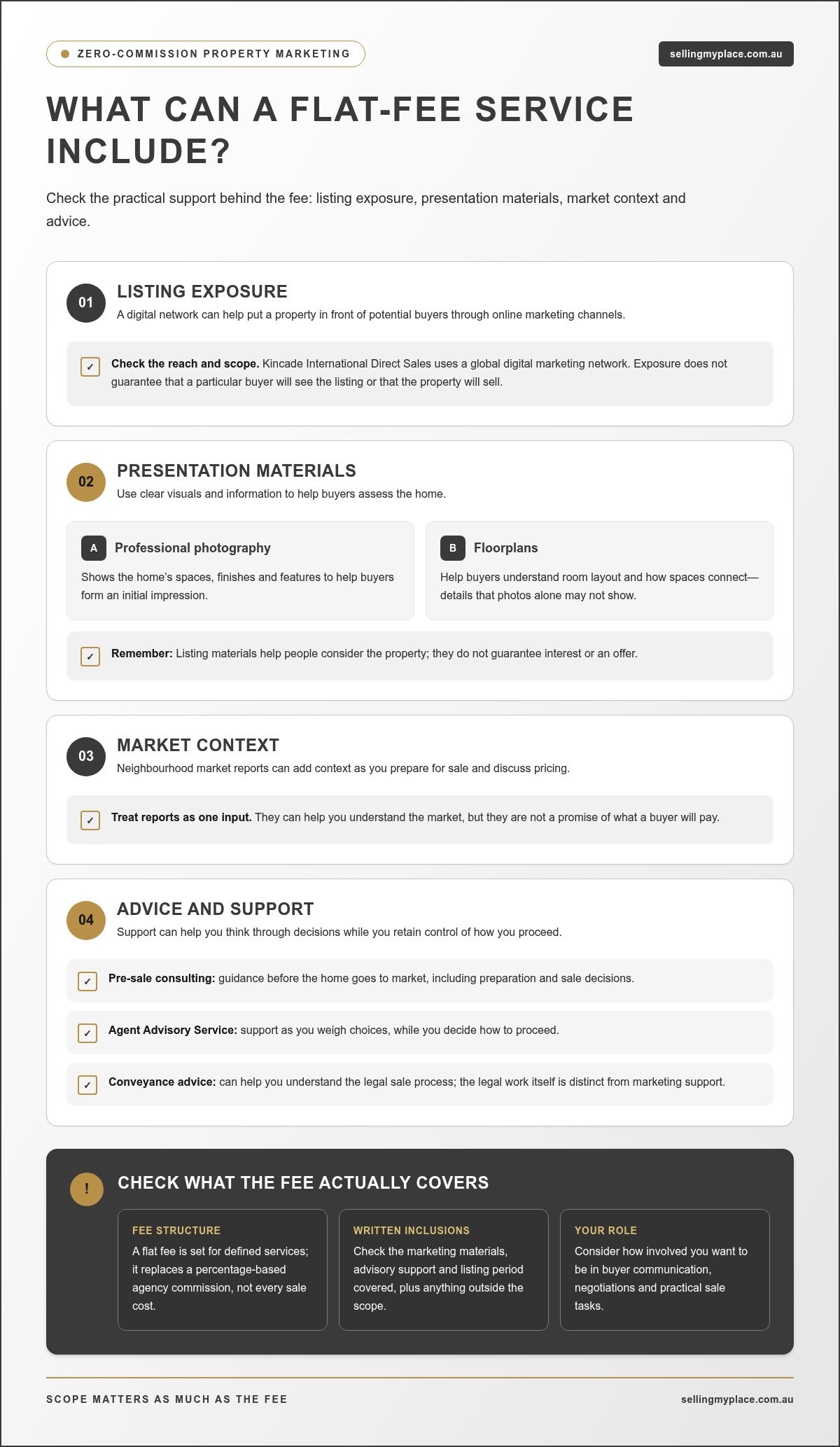
A flat-fee arrangement describes how the service is charged, but its inclusions determine what practical help you receive. A commission-free marketing service can bring together listing exposure, presentation materials and advice, allowing you to retain a role in decisions while getting professional support. The right mix depends on what you want help with and which selling tasks you’re comfortable managing yourself.
A digital listing network can put a property in front of potential buyers through online marketing channels. Kincade International Direct Sales uses a global digital marketing network, but exposure isn’t a promise that a particular buyer will see the listing or that the property will sell. Professional photography and floorplans add useful context: images show the home’s presentation, while a plan helps people understand room layout and flow.
How do listing materials support a property sale?
Photos help prospective buyers form an initial impression of spaces, finishes and features. A floorplan adds another layer by showing how rooms connect, which can be difficult to judge from images alone. Clear listing information helps people assess whether the home’s layout and features may suit their needs before arranging a closer look. These materials support informed consideration; they don’t guarantee interest or an offer.
Neighbourhood market reports can add context as you prepare for sale and discuss pricing. They’re one input for understanding the market, not a promise of what a buyer will pay. For wider industry context, Real Estate Institute of Australia (REIA) insights can help readers explore information about Australia’s property sector and market.
What role does professional advice play?
Pre-sale consulting provides guidance before a home goes to market, helping you think through preparation and sale decisions. The Agent Advisory Service offers support as you weigh choices, while leaving you in control of how you proceed. Buyer representation has a different focus: it relates to representing a buyer, rather than marketing a seller’s property.
Conveyance advice is also distinct from listing and buyer-facing activity. It relates to the legal side of a property transfer, while marketing services focus on presenting and promoting the home. Advice can help clarify the process, but it isn’t the conveyancing work itself.
Use this table to compare what each feature can contribute and the questions it may help you answer:
| Service feature | Potential seller benefit | Question it helps answer |
|---|---|---|
| Digital listing network | Online exposure across a marketing network | Where may buyers encounter the listing? |
| Photography and floorplans | Visual detail and a clearer sense of layout | How can buyers understand the home’s presentation and flow? |
| Neighbourhood market reports | Context for preparation and pricing discussions | What market information can inform my decisions? |
| Pre-sale consulting and Agent Advisory Service | Guidance for planning and decisions | Where would professional input be useful? |
| Conveyance advice | Guidance distinct from marketing activity | What legal-transfer questions should I understand? |
If you’re considering how to sell property zero commission, compare the actual support and deliverables with the tasks you’ll take on. Commission-free property marketing support brings together marketing resources and advisory assistance for sellers who want to retain control.
Zero commission versus traditional commission: how should you compare?
A percentage-based commission ties the agency fee to the property’s sale price. A flat-fee model uses an agreed charge for defined services instead. Neither structure tells the whole story: services with different fee models may also differ in marketing, advice and how much of the sale you manage yourself.
The fee structure alone can’t tell you which selling service is right; compare the support, deliverables and seller responsibilities that come with it. This matters because a lower or more predictable fee may still leave you with tasks you’d rather have help handling. Equally, paying a percentage doesn’t automatically mean every service or level of support is included.
Which selling model fits your preferred level of involvement?
Start with an honest assessment of your time and confidence. If you’re comfortable coordinating parts of the sale and making direct decisions, a flat-fee service may suit your preference for control, especially when paired with defined marketing and advisory support. If you want someone to take a more hands-on role, clarify what that representation involves. Traditional agents’ services can vary, so don’t assume every commission arrangement includes the same tasks or support.
More control can mean more participation. Depending on the service structure, you may have a greater role in responding to enquiries, communicating with interested buyers or making decisions during negotiations. Think about when you’d welcome professional guidance and when you’d rather manage things directly. The best fit should reflect your comfort level, not just how the fee is calculated.
What should you compare beyond the fee structure?
Set the service details side by side. Compare the included marketing deliverables, the reach of the listing network, access to advice and how long the property remains listed. Then clarify how buyer enquiries, negotiations and sale decisions are handled. These practical details show what you’re paying for and where your own time may be needed. For more context on listing support, see Professional Residential Property Listing Services: The Modern Australian Seller’s Guide.
A useful comparison separates the fee basis from the working arrangement:
| Model | Fee basis | Seller role | Support structure |
|---|---|---|---|
| Traditional commission | Percentage linked to the sale price | Depends on the agreed representation and service scope | Can involve agent support, but inclusions and responsibilities vary |
| Flat-fee marketing and advisory | Agreed fee for defined services | May retain more direct control and take an active role | Can combine marketing materials with advisory support; clarify how enquiries and decisions are handled |
For a like-for-like comparison, write down the service inclusions and responsibilities before weighing the fee. A service may, for example, include professional photography, floorplans, advisory access and a listing that remains active until sold without time limits. Match each inclusion against what matters to you, then note any tasks you’d handle yourself. That gives you a clearer picture of the trade-off between hands-on assistance, seller control and the practical work of bringing a property to market.
How can you decide whether selling property zero commission suits you?
The right selling approach should fit your time, confidence and appetite for direct involvement. Before deciding whether to sell property zero commission, map out the tasks you’re happy to manage and where professional guidance would make the process more manageable.
- Start with your involvement and available time. Consider how much time you can set aside for preparing the property, responding to buyer enquiries and keeping sale tasks moving. Greater control can be appealing, but it often comes with more direct participation.
- List the support you value most. Write down the marketing materials, advice and communication support you want. You might prioritise photography and floorplans, guidance before launch, help thinking through buyer conversations or advice as you weigh sale decisions.
- Compare the arrangements in writing. Set out each option’s fee basis, included services, listing terms and any responsibilities you’ll take on. A written comparison makes differences easier to spot than a headline label alone.
- Separate the stages of the sale. Preparation, marketing, negotiation and conveyancing each need attention, but they aren’t the same task. Decide where you’ll lead, where advisory support would help and how you’ll handle the legal transfer process.
What should you clarify before choosing a service?
Look for clear descriptions of which marketing materials and advisory services the flat fee covers, how long the listing stays active and what ongoing support means in practice. Then consider your own capacity: would you feel comfortable handling buyer communication and making sale decisions, or would guidance at key moments help you feel more assured?
For a service that keeps a listing active until sold without time limits, that duration can be an important part of your comparison. Listing duration alone doesn’t tell you how buyer enquiries or negotiations are managed. Add those responsibilities to your written notes so you understand the working arrangement as well as its timeline.
How can you prepare for the sale without taking on every task alone?
Divide your plan into seller-led decisions and tasks supported by marketing or advisory services. You might lead on presentation choices and decisions about an offer, while using professional photography, floorplans and pre-sale consulting to support preparation. The Agent Advisory Service can also provide input as you consider your next steps.
Plan how you’ll respond to buyer enquiries and approach negotiations before the first conversation arises. A step-by-step guide to sale by owner in Australia can help you map the process, while a guide to property sale negotiation can help you think through buyer discussions. Conveyancing remains a distinct part of the transaction, so include it in your planning rather than treating marketing support as a substitute.
Commission-free property marketing and advisory support combines marketing resources with guidance for sellers who want to stay involved in the sale.
How Selling My Place supports a zero-commission property sale
Selling a home involves more than choosing a fee model. You need a clear way to present the property, reach prospective buyers and make considered decisions as the sale progresses. Kincade International Direct Sales’ flat-fee marketing and advisory service offers a middle ground: you retain control of key choices while accessing professional marketing materials and guidance.
The service brings together professional photography, floorplans, neighbourhood market reports and a global digital marketing network. Each supports a different part of the sale: photography and plans help present the home, market reports provide context for preparation and pricing discussions, and the network supports digital marketing exposure. Exposure can’t guarantee buyer interest or a sale, but these resources give you practical tools for putting your property forward.
What support can sellers access through the service?
Listings can remain active until sold without time limits, giving sellers an ongoing listing rather than a set end date. This doesn’t guarantee a sale or a particular timeframe. Agent Advisory Service support, including pre-sale consulting, can help you consider decisions before the property goes to market and as you work through the sale. Conveyance advice relates to the transfer process, distinct from marketing and buyer-facing activity.
The balance is intentional: you stay involved in decisions, with professional resources to support the work around them. For example, use photography and floorplans to present the property clearly, then draw on neighbourhood market information as you prepare for pricing discussions. Advisory support can help you think through your approach while you remain responsible for the choices that matter to you.
As you consider the support, think about which parts of the sale you want to lead and where guidance would be useful:
- Property presentation: professional photography and floorplans help show the home’s features and layout.
- Market context: neighbourhood market reports offer information to consider during sale preparation and pricing discussions.
- Digital marketing: a global digital marketing network supports the listing’s exposure without promising a specific audience or result.
- Sale guidance: Agent Advisory Service support, pre-sale consulting and conveyance advice address different decisions and stages.
What is a sensible next step for an interested seller?
Before discussing your options, jot down a few details: the property you’re selling, your preferred timing and how involved you want to be. Note the marketing and advice you value most, too. This gives the conversation a useful starting point and helps you focus on whether the service scope and flat-fee structure fit your priorities, rather than judging by the fee label alone.
For sellers considering how to sell property zero commission, a practical discussion can help clarify the model and the support available. Talk through your property sale with our team.
Choose a selling approach that feels right for you
A property sale is a significant transition, and the process should feel workable for your circumstances, not simply appealing on paper. Before you decide how to sell property zero commission, think about what would help you feel informed and in control: a clear view of the service scope, room to make your own decisions and professional guidance where you’d value it.
Your next step can be a practical conversation about your property, timing and preferred level of involvement. Talk through how the flat-fee model works, what support it includes and whether the balance suits the way you want to sell. Arriving with a few priorities in mind can make that discussion more useful, whether you’re ready to move ahead or still weighing your options.
Talk through your property sale with our team to discuss a sale plan that fits your priorities. You don’t need every detail settled before you begin; a clear conversation can help you identify your next steps.
Frequently Asked Questions
Is selling property with zero commission really free?
No, not necessarily. Zero commission means no percentage-based agency commission is charged, not that selling has no costs. A flat-fee service may charge for defined marketing and advisory work, while other sale-related expenses can remain separate. If you plan to sell property zero commission, compare written inclusions, fee terms and your responsibilities before deciding. This helps you understand what the arrangement covers rather than relying on the label alone.
Can I sell my property without an agent and still get professional support?
Yes. You can take a more active role in the sale while using a property marketing and advisory service for professional assistance. For example, photography and floorplans can help present your home, while pre-sale consulting can support decisions before launch. You’ll still have responsibilities, such as making sale decisions and handling agreed tasks. This differs from traditional full-service representation, and the support offered varies between arrangements.
How much can I save by selling property with zero commission?
There’s no single saving that applies to every seller. The difference depends on your sale price, the fee structure and which services are included in each arrangement. Compare the full written scope and fee terms with the commission-based option you’re considering, including any tasks you’ll manage yourself. A lower fee alone doesn’t show which model is the better fit; the value of the support and your preferred involvement matter too.
What happens if my property does not sell straight away?
What happens next depends on the listing duration and ongoing service terms. With Kincade International Direct Sales, a property can remain listed until sold without time limits. That means there’s no set time limit on the listing, not a guarantee that a sale will occur. Review the service terms to understand how continued listing and support work if the sale takes longer than expected.
Do zero-commission property services include photography and floorplans?
Inclusions vary, so look at the stated deliverables rather than assuming every service provides the same materials. Kincade International Direct Sales provides professional photography and floorplans. Photos give prospective buyers a visual impression of the home, while a floorplan helps them understand how rooms connect and how the layout works. These tools can make property information clearer, but they don’t guarantee more enquiries, a higher sale price or a faster result.
Is a flat-fee service better than paying a traditional property commission?
It depends on your priorities, how involved you want to be and the support you need. A flat fee changes how the service charge is structured compared with percentage-based commission, but it doesn’t determine the service scope or your responsibilities. Compare marketing deliverables, advisory access, listing duration and the tasks you’ll handle yourself. The better fit is the arrangement that aligns with your comfort level and sale priorities, not simply the fee label.
Can I negotiate the sale price when using a zero-commission service?
Yes. As the seller, you make decisions about offers and the sale outcome you’re prepared to accept. The support available during buyer discussions depends on the service arrangement. Kincade International Direct Sales offers advisory support and buyer representation, which is a distinct service for buyers. Before negotiations begin, consider your priorities and how you’ll communicate them clearly. Preparing in advance can help you approach offer discussions thoughtfully, without guaranteeing a particular result.
