Common Mistakes Selling Property by Owner: An Australian Checklist
A private sale rarely falters because of one dramatic mistake. More often, it’s a series of small oversights: an asking price that isn’t supported by comparable sales, a listing that misses important details, or an enquiry that slips through the cracks. If you’re looking up the common mistakes selling property by owner, the reassuring news is that many can be avoided with a clear plan.
Selling your own home gives you control, but it also means managing the tasks that help a sale progress. You’ll need to prepare the property, present it accurately, respond to buyers and consider offers carefully, while keeping legal matters with a qualified conveyancer or solicitor.
This checklist covers preventable pricing, marketing, communication and preparation mistakes. It also explains how listing support can help with online exposure and enquiry follow-up while you remain in control of buyer communication and inspections. Requirements vary across Australia, so treat the sale as a managed process, not simply a listing.
Key Takeaways
- The common mistakes selling property by owner are easier to prevent when you treat the sale as a planned process, not a one-off listing.
- Use relevant market evidence to sense-check your asking price, and review presentation details that could affect buyer confidence.
- Make your listing clear and useful, with accurate descriptions, helpful photographs and an easy way for buyers to enquire.
- Keep a simple record of enquiries, inspection arrangements and buyer feedback so follow-up stays organised.
- KIDS listing support includes portal exposure, enquiry forwarding and a 24/7 seller dashboard, while you remain in control of buyer communication and inspections.
Common mistakes selling property by owner starts with treating the sale as a one-off task
Selling privately is manageable when you prepare and follow a clear process. A property sale isn’t just a listing going live: it involves decisions, information and follow-up at each stage. This checklist offers general guidance, not a promise of a particular sale outcome.
Small oversights can leave buyers unsure, make a listing easier to scroll past or cause an enquiry to go unanswered. A little organisation before launch helps you present information consistently and handle each next step with more confidence.
Preparation before launch gives you time to catch preventable mistakes before buyers encounter them.
For context, For sale by owner (FSBO) is the process of selling real estate without the representation of a broker or agent. An owner-led sale still needs a plan for the work around the listing.
Mistake: starting before the property and sale plan are ready
Before advertising, decide what matters most to you. Consider your preferred timing, how you’ll manage buyer enquiries and inspections, and who will take responsibility for each task. If others in your household are involved, agree on roles early so buyers receive clear, consistent communication.
Make a room-by-room list of preparation tasks, then separate essentials from optional styling. Checking that lights work, clearing walkways and tidying outdoor areas may be practical priorities. Buying new furniture or undertaking cosmetic changes may be optional. Focus first on a clean, safe and accessible presentation rather than assuming every room needs a full makeover.
- List the rooms, outdoor areas and features buyers are likely to ask about.
- Note straightforward maintenance or presentation jobs to complete before photography and inspections.
- Set aside optional styling ideas so they don’t distract from essential preparation.
This plan makes the workload easier to see and helps you avoid launching while key details or practical arrangements are unsettled.
Mistake: relying on assumptions instead of checking details
It’s easy to overlook a detail you’ve lived with for years, or describe a feature from memory and later discover the wording is inaccurate. Before including a claim in marketing or an answer to a buyer, verify it using reliable records and information you can substantiate. If you’re unsure, don’t guess. Check the detail before responding.
Map out how to sell your own home from preparation through to buyer follow-up. A step-by-step plan shows what needs attention before advertising, rather than leaving you to resolve every question under pressure once enquiries begin. These are common mistakes selling property by owner that preparation can help you recognise early.
Avoid pricing and presentation mistakes that weaken buyer confidence
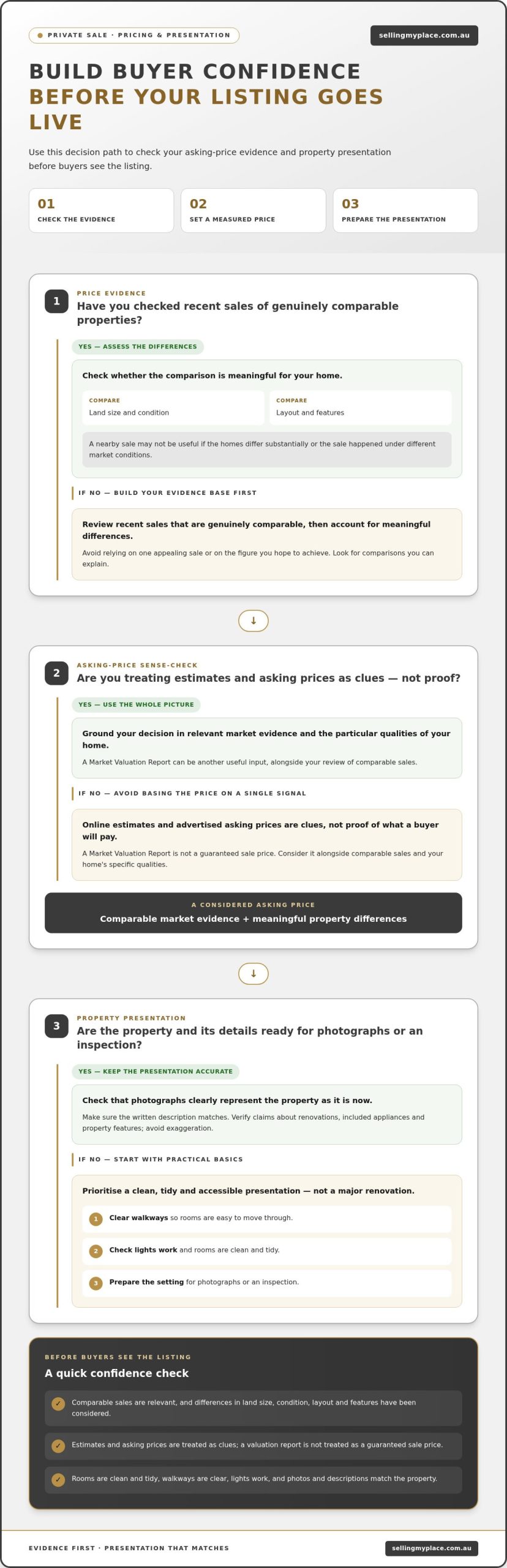
A considered asking price starts with evidence, not the figure you hope to achieve or the value you feel the home holds for your family. Those expectations are understandable, but buyers assess the options available to them now. A price that doesn’t reflect relevant market conditions can make them hesitate before they’ve even inspected.
A considered asking price is grounded in comparable market evidence. A personal expectation alone can’t show how buyers may assess the property.
Mistake: choosing an asking price without checking comparable evidence
Look at recent sales of genuinely comparable properties, then account for meaningful differences such as land size, condition, layout and features. A sale nearby may not be a useful comparison if the homes differ substantially or the sale took place under different market conditions. Treat online estimates and asking prices as clues, not proof of what a buyer will pay.
A Market Valuation Report can provide another useful input, but it isn’t a guaranteed sale price. Use it alongside your review of comparable sales and the particular qualities of your home. For a fuller explanation of the factors to consider, consult the separate 2026 guide to determine your home’s market value.
Don’t build expectations around one appealing sale or an untested hope. If you can explain why a comparison is relevant, you’ll have a clearer basis for your asking-price decision and a more measured way to respond to buyer feedback. This is one of the common mistakes selling property by owner that an evidence check can help you avoid.
Mistake: presenting the property or its details carelessly
Presentation doesn’t have to mean a major renovation or a complete styling project. Start with the basics: clean and tidy rooms, clear walkways, working lights and a setting that’s ready for photographs or an inspection. A bright, uncluttered space makes it easier for buyers to see the room and consider how they might use it.
Check each photograph against the property as it is now. Images should be clear and representative, not framed to conceal a feature buyers will encounter at an inspection. The written description should match too. Verify claims about renovations, included appliances and property features. Avoid exaggeration; a mismatch between the listing and the home can create doubt and lead to avoidable questions.
- Check that descriptions, photographs and inclusions agree.
- Describe features clearly without overstating them.
- Keep a record of the information behind details you include in the listing.
An accurate listing gives buyers a more straightforward first impression. If you’d like support with listing your property and a Market Valuation Report, explore KIDS listing support.
Prevent listing and marketing mistakes that make buyers scroll past
A listing has little time to make its purpose clear. If key details are missing, the wording is hard to follow or there’s no obvious way to enquire, a potential buyer may move on. Think of the listing as a first conversation: it should answer basic questions and make the next step clear.
Accurate details help buyers understand the property, and clear contact instructions make it easier to take the next step.
Include the information a buyer needs to decide whether to learn more, such as the property’s features, inclusions and inspection arrangements. Keep the description easy to scan with useful headings or short paragraphs rather than a long block of text. Avoid unexplained abbreviations and broad claims that could mean different things to different readers. If a detail needs clarification, improve the wording rather than leaving buyers to guess.
Mistake: treating a listing as a single upload
Publishing is the start of the listing’s life, not the end of the task. Once it’s live, read it as a buyer would. Check that the title and description display properly, the photographs appear in a sensible order and important information is easy to find. Review the page on a phone and a computer; a paragraph that looks tidy on a larger screen may be harder to read on mobile.
Where the property appears in more than one place, keep details aligned. An inconsistency about an inclusion or property feature can create confusion and prompt buyers to ask which version is correct. Keep a current copy of the approved description and key details as your reference for updates.
Check enquiries regularly after the listing goes live. If a verified detail changes, update the listing promptly and correct any other versions too. A brief review routine can catch a typing error, broken contact instruction or outdated inspection detail before it causes friction.
Mistake: overlooking who sees the listing and how enquiries arrive
Reach matters, but so does the path from seeing a listing to contacting the seller. Make your preferred contact method and inspection instructions easy to spot. Check the channels you’ve provided consistently, and decide who will track messages if more than one person is involved. Otherwise, an interested buyer might receive a delayed reply or have to repeat a question.
Every Kincade International Direct Sales (KIDS) package includes widespread property portal distribution and local platforms such as Homely and Soho, plus enquiry forwarding by SMS and email and access to a 24/7 seller dashboard. These tools help keep buyer messages visible and organised while you remain in control of replies and inspections.
Use a simple follow-up habit: review incoming messages, record who contacted you and what they asked, then note when you responded or arranged an inspection. Treating online marketing as “set and forget” is one of the common mistakes selling property by owner that you can avoid. A clear listing and steady attention to enquiries help keep the buyer journey straightforward.
Avoid owner-sale mistakes when handling enquiries, inspections and offers
Buyer communication can gather pace once a listing is live. A simple, repeatable system helps you stay courteous and organised without feeling that every message needs an immediate decision. Keep your responses factual: if you don’t know the answer, say you’ll check rather than guess.
A useful sequence is straightforward:
- Record the buyer’s name, contact details, enquiry and any question they’ve raised.
- Reply clearly, then note any agreed follow-up.
- Confirm inspection arrangements, including the time and any practical details the buyer needs.
- After the inspection, record relevant feedback and any next steps discussed.
This routine gives you a reliable record to refer to, especially if several buyers are asking similar questions or more than one person is helping with the sale.
Mistake: responding late or losing track of buyer conversations
Enquiries can arrive through different channels, so decide how you’ll check them and keep track of replies. A simple spreadsheet or notebook can capture the buyer’s details, what they asked and when you agreed to follow up. Respond promptly and courteously, even if only to acknowledge the question while you verify an answer. Confirm inspection arrangements in writing so both sides have the same details.
Every KIDS package includes enquiry forwarding by SMS and email, as well as 24/7 seller dashboard access. These tools help keep messages visible and organised, while you remain in control of buyer conversations and inspections.
Mistake: improvising inspections, offers or legal steps
Set clear inspection arrangements rather than deciding the details afresh with each buyer. After an inspection, note useful feedback in neutral terms, such as a question about storage or a feature the buyer wanted to understand. Don’t treat one person’s reaction as a verdict on the whole sale. Records help you consider comments thoughtfully and identify questions that may need a clearer answer in your listing.
When an offer arrives, take time to understand what the buyer has proposed and keep your response calm, accurate and professional. Negotiation can involve more than the stated offer, so avoid assumptions or agreeing to terms you don’t understand. For broader guidance on this part of the process, refer to the dedicated Australian property sale negotiation guide.
Contracts and legal questions are separate from listing and buyer communication. Engage a qualified conveyancer or solicitor for legal matters, and direct questions outside your knowledge to them rather than trying to interpret documents yourself. Keeping that boundary clear helps prevent common mistakes selling property by owner.
A steady follow-up routine helps you keep conversations clear and make considered decisions. If listing support and organised enquiry forwarding would help, explore KIDS support for private sellers.
Use a final checklist and the right listing support to keep the sale organised
Before your listing goes live, check the whole process, not just the advertisement. A final review can catch small gaps while they’re still easy to address. Once the listing is active, keep checking messages, preparing for inspections and recording what you’ve agreed with buyers.
A practical final check before and after launch
Use this checklist as a final sense-check, then revisit it as details change:
- Confirm the description is clear, accurate and consistent with verified property information.
- Check that photographs and stated inclusions represent the property as it is being offered.
- Make sure inspection arrangements are clear and the property is ready to show.
- Check that enquiry notifications are accessible and someone is responsible for responding.
- Keep a record of buyer questions, replies, inspection notes and agreed next steps.
After publication, view the live listing on a phone and a computer. Check that key details are easy to find and contact instructions make sense. If you update information, keep the changes consistent wherever the listing appears. A quick review after an inspection can also help you spot a detail that needs clarification, without relying on memory later.
This routine turns common mistakes selling property by owner into practical points you can check and manage. It doesn’t guarantee a particular outcome, but it can make the work more orderly and help buyers receive clear, consistent information.
Where listing support fits into an owner-managed sale
Listing support can help with online exposure and incoming enquiries while you remain responsible for buyer communication and inspections. Kincade International Direct Sales (KIDS) is a licensed intermediary for listing purposes, not a real-estate agent. Every package includes listings on Realestate.com.au and local portals such as Homely and Soho, enquiry forwarding by SMS and email, 24/7 seller dashboard access and a Market Valuation Report.
KIDS offers three fixed-fee packages, all priced ex GST: Classic is $799, Signature is $999 and Prestige is $1,999. Every package includes professional photography and a For Sale signboard. Classic includes a 600 × 900 mm signboard; Signature and Prestige include a 1200 × 1800 mm signboard. Signature and Prestige also include a dedicated property website and URL. Prestige adds 15-20 professional photographs, a floorplan redraw, a Facebook and Instagram ad campaign, 50 premium A4 brochures, a 1-on-1 dedicated specialist and a James Edition listing. All listed features are bundled into the package price.
Listings remain active until sold, withdrawn or two years from the commencement date, whichever occurs first. The dashboard and enquiry forwarding help you keep track of buyer messages, but you decide how to respond and arrange inspections. KIDS provides listing support, while you stay involved in the sale.
Legal work is separate. Engage a qualified conveyancer or solicitor for contracts, conveyancing and legal questions, rather than relying on listing support for those matters. Clear boundaries help prevent confusion about who is responsible for each step.
If you’d like listing support while staying in control of your sale, explore KIDS listing options.
Take your next step with a clear plan
A private sale can feel more manageable when the next action is clear. Choose one practical task to complete: check your listing details, organise your sale records or map out how you’ll manage buyer conversations. Small, deliberate steps can replace last-minute scrambling with a steadier routine.
Common mistakes selling property by owner often begin when responsibilities are vague or decisions are rushed. You don’t need to resolve every detail at once. Decide which parts you want to manage yourself and where listing support could help you organise the process. That balance lets you stay involved in important decisions while giving the sale a more considered foundation.
Ready to explore support for your private sale? Explore KIDS listing support and choose the package that suits your needs.
Frequently Asked Questions
Is it legal to sell a property by owner in Australia?
Yes, Australian property owners can legally sell privately in every state and territory. That general position doesn’t replace advice about your own transaction: required documents and sale processes can differ depending on where the property is located and its circumstances. Speak with a qualified conveyancer or solicitor about the requirements that apply to you.
Can I list my property on Realestate.com.au without an intermediary?
No. Individuals can’t list directly on major property portals such as Realestate.com.au and Domain. Kincade International Direct Sales (KIDS) acts as a licensed intermediary for listing purposes, enabling private sellers to access portal listings without KIDS acting as a real-estate agent or broker. This relates to listing access only; it doesn’t determine how much interest a property will receive or whether it will sell.
What happens if my property does not sell straight away?
An unsold property isn’t automatically proof that you’ve made a mistake. Review the listing: check that the details remain accurate, consider the questions buyers have asked and review feedback from inspections. Look for patterns before making changes, and verify information before updating the advertisement. A KIDS listing remains active until sold, withdrawn or two years from the commencement date, whichever occurs first.
Do I need a conveyancer or solicitor when selling privately?
Engage a qualified conveyancer or solicitor for legal matters, contracts and conveyancing. They can advise on the documents and process relevant to your circumstances. KIDS provides listing support, not legal advice, contract preparation or conveyancing services. Keep those responsibilities distinct: questions about listing information differ from questions about contract wording or legal obligations, which belong with your qualified professional.
How can I avoid missing buyer enquiries when selling by owner?
Choose a regular time to check each channel you’ve provided, then record the buyer’s contact details, question and any agreed follow-up in one place. For example, note whether you need to confirm an inclusion or arrange an inspection, then mark it off once done. Every KIDS package includes enquiry forwarding by SMS and email, plus 24/7 seller dashboard access to help keep messages organised.
Should I change my asking price if buyers are not making offers?
Not automatically. A lack of offers can have several possible explanations, so review the listing’s accuracy, questions or feedback you’ve received and relevant recent sales before deciding what to do. Avoid a rushed change based on one response. For a structured overview of the evidence to consider, consult the separate guide on how to determine your home’s market value. It can inform your thinking, but it can’t guarantee a sale price.
Does selling by owner mean I have to manage every part of the sale alone?
No. You keep control of decisions and inspections, while listing and marketing support can help with the online side. KIDS packages include portal listings, enquiry forwarding and seller dashboard access. This support is separate from legal work: engage a qualified conveyancer or solicitor for contracts, conveyancing and advice about your transaction. Knowing which tasks you’ll manage and which support you’ll use can make responsibilities clearer from the outset.
Pre-Sale Property Consulting: The Ultimate Checklist to Maximise Your Sale Price
What if the biggest threat to your property profit isn’t the cooling market, but the tens of thousands of dollars you’re expected to hand over in commissions before you’ve even packed a box? Selling a family home is a deeply personal transition, and it’s completely normal to feel a weight of anxiety about the endless “to-do” list. You might be wondering how to prepare your house for sale in Australia while protecting your equity from high fees and the nagging fear of underselling. It’s a lot to manage, especially with the recent 2026 market shifts and upcoming tax reforms weighing on many homeowners’ minds.
We’re here to tell you that you don’t have to do this alone or lose your hard-earned profit to traditional agency models. This guide will show you how strategic pre-sale consulting can add significant value to your final result, allowing you to keep 100% of your sale profit. We’ll provide a clear, professional roadmap that covers everything from high-impact styling secrets to robust pricing strategies. By the end, you’ll feel grounded and confident as you move toward your next chapter with your financial legacy intact.
Key Takeaways
- Learn why a professional pre-sale consultant acts as a strategic partner, identifying high-impact improvements that go far beyond basic home staging.
- Discover a data-backed roadmap on how to prepare your house for sale australia by using local market reports to set a pricing strategy that attracts serious buyers.
- Master the “Three-Second Rule” of digital presentation to ensure your property stands out instantly through professional photography and thoughtful floorplans.
- Streamline your path to settlement by organising early conveyance advice and compliance certificates to prevent avoidable delays at the finish line.
- Understand how moving away from high agency commissions to a flat-fee model allows you to protect your equity and reinvest in premium marketing.
What is Pre-Sale Property Consulting and Why Does it Matter?
Selling your home is often the most significant financial event of your life. It’s a time filled with deep memories and, quite frankly, a fair bit of stress. A pre-sale property consultant isn’t just another service provider; they are a dedicated partner who stands in your corner to ensure your equity is protected. While a traditional agent might focus on the quick transaction, a consultant focuses on the long-term value. They help you understand how to prepare your house for sale australia by looking at the property through a lens of market intelligence and buyer psychology.
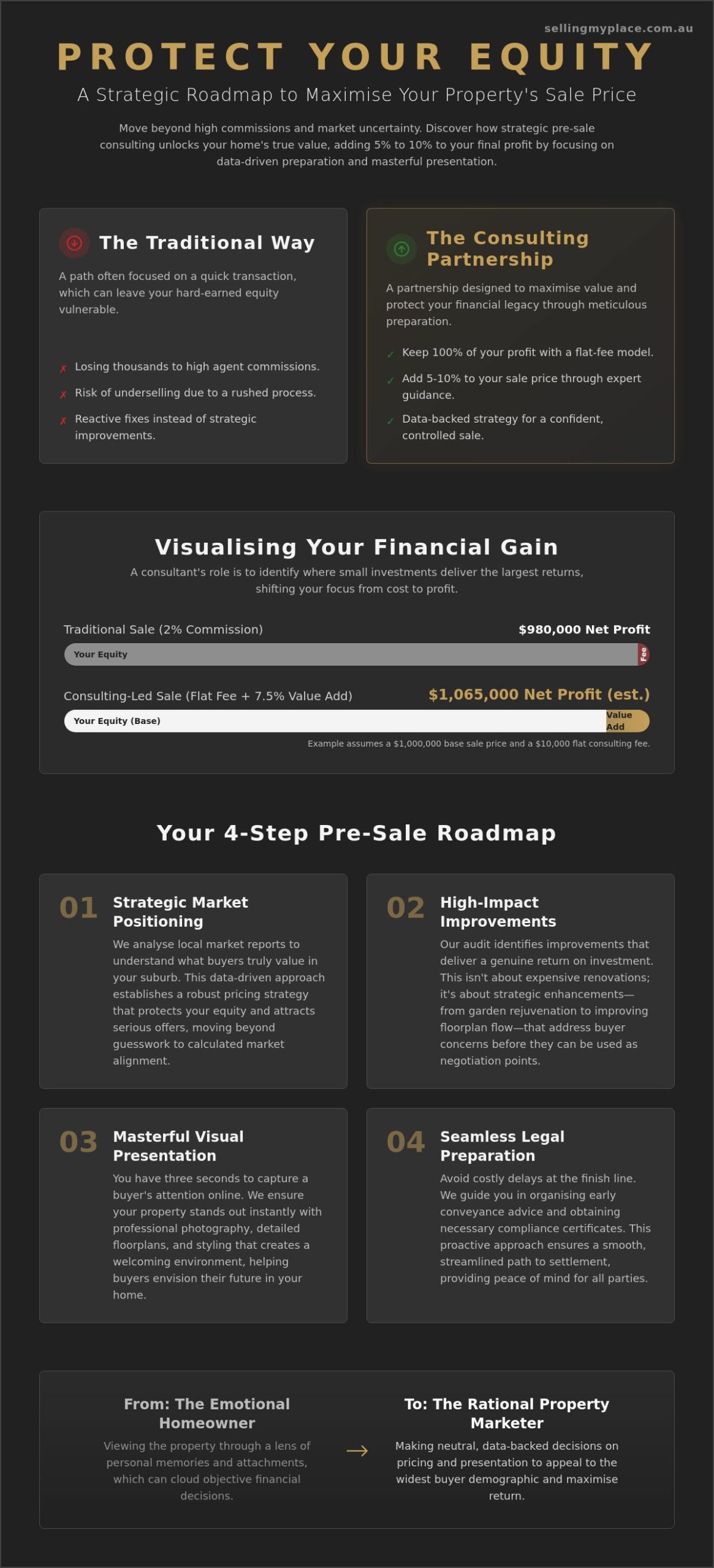
Many people confuse this high-level advisory with simple home staging techniques. While making a room look pretty is certainly part of the process, consulting is far more comprehensive and data-backed. It involves auditing the entire property to find hidden value and potential red flags. Professional guidance helps you see your home through the eyes of a sceptical buyer who is actively looking for reasons to negotiate the price down. By addressing these concerns before the first open home, you can often add between 5% and 10% to your final sale price. That’s a significant boost to your financial legacy as you move into your next chapter.
Beyond the Fresh Coat of Paint
Strategic consulting doesn’t start a week before the auction. It ideally begins months in advance. This lead time allows for identifying high-impact improvements that drive a genuine return on investment, rather than just spending money for the sake of it. When you are figuring out how to prepare your house for sale australia, focus on the “why” behind every repair. We aren’t just talking about aesthetic tweaks. It might involve addressing structural maintenance, garden rejuvenation, or improving the floorplan flow. Pre-sale property consulting is a holistic strategy designed to maximise your final sale price through meticulous preparation and market alignment.
The Emotional vs. Rational Sale
It’s hard to be objective about a place where you’ve raised a family or spent a decade of your life. We understand the emotional weight of these transitions. However, a consultant helps you make the vital shift from “homeowner” to “property marketer” with a neutral perspective. By removing emotional bias, you can make rational decisions about pricing and presentation. This isn’t about stripping the soul from your home; it’s about creating a welcoming environment that appeals to the broadest possible buyer demographic. When a buyer can see their own future starting in your space, you’ve already won half the battle.
Strategic Market Positioning: The Consultant’s Audit
While the physical work of cleaning and repairs is vital, the mental heavy lifting of how to prepare your house for sale australia starts with market intelligence. You need to know exactly who you’re up against before the first “for sale” sign hits the lawn. We use detailed Neighborhood Market Reports to peel back the layers of your local suburb. It’s about more than just a list of recent sales; it’s about understanding the “why” behind the prices. Why did the house three doors down sell for $50,000 more than the one across the street? Was it the north-facing backyard or the dedicated home office? Identifying these nuances allows us to set a price floor that is both realistic for the current 2026 market and ambitious enough to protect your equity.
Data-Driven Decision Making
When considering how to prepare your house for sale australia, data should be your best friend. It informs everything from your marketing headlines to the specific features you highlight in your listing. For instance, with national home prices showing a 5.8% annual increase to June 2026, buyers are becoming more discerning about where they place their value. If local demand shows a surge in young families, we focus on the safety of the cul-de-sac or the proximity to parks. Utilising an Agent Advisory Service can be a game-changer here. It provides an extra layer of professional scrutiny, ensuring your strategy isn’t just a guess, but a calculated move to capture the right eyes.
The Competitive Landscape
Your home doesn’t exist in a vacuum. It’s competing with every other listing on a buyer’s “saved” list across the country. This is why finding your Unique Selling Proposition (USP) is so critical. Are you the only four-bedroom home in the area with a pool under the median price? Or perhaps your property offers a rare heritage charm that newer builds lack. Consulting this expert guide to selling property from the REIQ can help you understand the broader steps, but a consultant zooms in on your specific block. We also look at current trends to decide the best method of sale. While auctions remain popular in Sydney and Melbourne, private treaties might offer more stability in cooling regional markets. Timing your launch to coincide with low local inventory can create a sense of urgency that drives your final result higher. If you’re feeling overwhelmed by these moving parts, reaching out for a chat can help clear the fog and give you a steady path forward.
The Visual Presentation Checklist: First Impressions That Sell
In 2026, the first inspection of your property doesn’t happen at the front gate; it happens on a smartphone screen. The “Three-Second Rule” is a very real phenomenon in the Australian property market. Buyers scroll through hundreds of listings with a discerning eye, often making a split-second decision to click or move on based on a single lead image. Understanding how to prepare your house for sale australia involves mastering this digital first impression to ensure your home stands out in a crowded marketplace. It’s about more than just a tidy lounge room. It’s about creating a visual narrative that invites a buyer to imagine their own life unfolding within your walls.
Digital Asset Mastery
High-resolution photography is the non-negotiable core of a successful commission-free real estate strategy. When you’re bypassing traditional agency models, your digital presentation must be professional and polished to build immediate trust. A professional photographer understands how to work with natural light to highlight the flow and space of your home. For lifestyle properties or larger blocks, drone photography adds a layer of prestige by showcasing the home’s position within the community. Equally important is an accurate floorplan. This simple tool allows buyers to mentally “move in” before they’ve even stepped foot on the property, helping them understand the practical layout and furniture placement.
The Physical Walkthrough
Once the digital hook has worked, the physical walkthrough must live up to the promise. Curb appeal is your starting point. This includes simple but effective tasks like pressure-cleaning the driveway, refreshing the garden mulch, and ensuring the front door is clean and welcoming. Inside, the goal is to declutter and depersonalise without stripping the home of its essential warmth. You want the space to feel like a sanctuary, not a sterile showroom. Small details make a significant difference during inspections:
- Lighting: Open all blinds and turn on soft lamps to create a bright, airy feel.
- Scent: Avoid heavy artificial fragrances; opt for fresh air or subtle, natural scents like eucalyptus.
- Temperature: Ensure the home is at a comfortable temperature to encourage buyers to linger.
- Minor Repairs: Fix leaking taps, squeaky doors, or chipped paint. These small flaws can signal a lack of general maintenance to a sceptical buyer.
By focusing on these visual and physical touchpoints, you are not just cleaning a house. You are carefully curating an experience. This level of attention to detail shows buyers that the property has been loved and well-maintained, which provides the emotional security they need to make a confident offer. When you’re learning how to prepare your house for sale australia, remember that presentation is the bridge between a buyer’s rational budget and their emotional aspirations.
Administrative and Legal Prep: Smoothing the Path to Settlement
While painting the fence and styling the lounge room are the visible parts of how to prepare your house for sale australia, the administrative heavy lifting happens behind the scenes. Think of legal preparation as the foundation of your sale. Without it, even the most beautiful home can face a collapsed settlement or frustrating delays. Seeking early conveyance advice is one of the smartest moves you can make. It ensures your contract is robust and your interests are protected long before a buyer makes an offer. In New South Wales, metro conveyancing fees typically range from A$1,000 to A$3,000, while in Victoria, you might expect to pay between A$600 and A$1,400. Knowing these costs upfront helps you budget effectively for the transition.
Transparency is your greatest ally. We recommend preparing a comprehensive Property Information Pack for serious bidders. This should include all building approvals, compliance certificates, and pool safety reports. If there are minor issues with the property, disclose them early. By being open about the property’s history, you reduce the risk of a buyer “chipping” at your price during the building and pest inspection phase. It’s about providing peace of mind so they can bid with confidence and heart.
Removing Buyer Objections
Having a contract of sale ready on day one creates a sense of urgency. It tells buyers you are serious and ready to move. If a sceptical buyer asks a complex question about a boundary line or an easement, having the answer ready prevents the momentum from stalling. This is where real estate advisory services become invaluable. They act as a steady hand, helping you navigate the legalities without the stress of the unknown. We’ve seen many sales falter because a simple question about a pergola approval took three days to answer. Don’t let that happen to you.
Protecting Your Equity
Your financial legacy depends on more than just the final number. It’s about the terms. You need to ensure your deposit requirements and settlement dates align perfectly with your next life transition. Whether you are downsizing or moving to a new suburb, these dates are critical for a stress-free move. This level of legal readiness is a core pillar of a successful sale by owner experience. Organising your conveyance prep early prevents common heartaches like gazumping or failed settlements that can occur when paperwork isn’t in order. If you’re feeling unsure about the legal requirements in your state, book a consultation with our advisory team to ensure your path to settlement is as smooth as possible.
Partnering for Profit: Why Expert Advisory Trumps Traditional Commissions
There is a common misconception in the property world that a high commission is the only path to a premium price. In reality, when you follow a strategic roadmap for how to prepare your house for sale australia, the property itself does the heavy lifting. By positioning your home correctly through market data and visual storytelling, you create an environment where buyers compete for the lifestyle you’ve curated. Choosing an expert advisory model over a traditional commission structure doesn’t mean you’re doing it alone; it means you’re choosing a partnership that prioritises your equity over a transaction fee.
Reinvesting in your own success is a core pillar of the flat-fee model. It provides the financial breathing room to focus on what actually matters: premium presentation and a broad marketing reach. Instead of watching a significant percentage of your sale price disappear into an agent’s pocket, you can direct those funds toward high-impact photography and professional floorplans. This ensures your home isn’t just another listing, but a standout digital asset that captures attention across global networks while still benefiting from seasoned, local advice.
The Kincade International Direct Sales Difference
We believe in providing access to professional-grade tools without the typical agency markups that often eat into a seller’s profit. Our Real Estate Advisory Services act as your steady hand, providing calm confidence during the high-stakes negotiation phase. You won’t feel pressured by an agent’s need for a quick commission to meet their own monthly targets. Instead, you enjoy the freedom of no time limits on your listing; you sell when the price is right and when the terms align perfectly with your family’s needs. This keeps you in total control of your financial future.
Your Next Move Starts Here
Think about what an extra A$20,000 or even A$3
Your Path to a Profitable New Beginning
The journey from being a homeowner to a successful seller doesn’t have to be a path paved with stress and high fees. By focusing on strategic market positioning and professional digital assets, you’ve already mastered the most complex parts of how to prepare your house for sale australia. Your property’s value is best protected when you combine high-impact presentation with a robust legal foundation; this ensures you aren’t just selling a building, but a lifestyle that resonates deeply with the right buyers.
Choosing a partnership that prioritises your equity allows you to navigate the 2026 market with a steady hand and a clear heart. Our clients save an average of A$20,000 in commissions while still receiving professional photography, floorplans, and the guidance of an expert Agent Advisory Service. You deserve to move into your next chapter with your financial legacy fully intact. We are here to support you every step of the way as you turn the page to your next adventure.
Maximise Your Equity – Get Started with Selling My Place Today
Frequently Asked Questions
What is the difference between property styling and pre-sale property consulting?
Property styling focuses on the aesthetic “look” of a home through furniture hire and decor; however, pre-sale property consulting is a strategic partnership covering market positioning, legal readiness, and ROI-focused improvements. While a stylist makes a room look beautiful, a consultant ensures the entire sale process is optimised to protect your equity. It’s the difference between a pretty picture and a comprehensive profit strategy.
How much can pre-sale property consulting actually add to my sale price?
While every property is unique, the right pre-sale advice can add between 5% and 10% to your final result by removing buyer objections before they arise. When you understand how to prepare your house for sale australia using data rather than guesswork, you create a competitive environment that drives prices upward. This strategic positioning often results in tens of thousands of dollars in additional profit for the seller.
Do I really need professional photography if I am selling the home myself?
Professional photography is the most critical tool in your marketing kit, regardless of whether you are selling privately or through an agency. In 2026, buyers decide to view a home based on a split-second scroll through digital listings. High-quality images paired with a professional floorplan build immediate trust and ensure your property isn’t overlooked in a crowded market.
Can pre-sale consulting help if my property is already on the market but not selling?
Yes, a pre-sale audit is often the best way to breathe new life into a “stale” listing that hasn’t found its buyer. We look at everything from the digital presentation to the pricing floor and the feedback from previous inspections. Often, a few strategic tweaks to the visual narrative or a shift in market positioning can be the catalyst that finally secures a successful offer.
Is conveyance advice included in pre-sale property consulting?
We offer conveyance advice as a core part of our property services to ensure your path to settlement is as smooth as possible. Having your legal paperwork organised early prevents contract delays and builds confidence with potential buyers. It’s about providing a complete, professional package that protects your interests from the first inspection right through to the final handover.
How far in advance should I start the pre-sale consulting process?
Starting the process two to three months before your launch date is ideal; it gives you ample time to complete high-impact repairs without feeling rushed. This lead time allows for thoughtful decluttering, garden rejuvenation, and the gathering of all necessary compliance certificates. However, even a shorter lead time of a few weeks can still provide significant benefits through strategic market positioning.
What are the most important repairs to make before selling my home?
Focus on repairs that signal a well-maintained home, such as fixing leaking taps, refreshing tired paint, and ensuring all lighting is functional. First impressions are often formed at the front gate, so don’t overlook curb appeal tasks like pressure-cleaning driveways or tidying the garden. These small but visible wins reassure sceptical buyers that the property has been loved and cared for over the years.
Does pre-sale consulting work for apartments as well as houses?
Pre-sale consulting is highly effective for apartments, with a specific focus on maximising a sense of space, natural light, and urban lifestyle. When learning how to prepare your house for sale australia, apartment owners should pay close attention to decluttering balconies and ensuring common areas are presented well. We help you highlight the unique benefits of strata living while making your individual unit stand out from others in the block.
