Can I Do My Own Conveyancing in Australia? Weigh the Risks
You can legally do your own conveyancing in Australia, but the rules and practical requirements differ between states and territories. If you’re weighing up whether to do your own conveyancing in Australia, the short answer is yes. However, you remain responsible for any error that delays settlement, leads to default interest or gives the other party grounds to terminate the contract.
It’s understandable to consider handling the work yourself. Buying or selling a home already involves plenty to organise, and conveyancing can look like a set of forms and deadlines. But the details matter: contracts, disclosures, searches and settlement requirements vary across Australia, and a missed obligation can have serious consequences.
This guide explains what DIY conveyancing involves, how requirements differ across states, and when professional help from a conveyancer or lawyer may be the steadier choice. You’ll also learn how to weigh potential savings against the time, responsibility and risk involved, so you can make a considered decision about your property transaction.
Key Takeaways
- DIY conveyancing is allowed, but the work and your responsibility for mistakes can vary by state.
- In Victoria, weigh the requirements under the Sale of Land Act 1962 and the Transfer of Land Act 1958 against the risks of handling contracts and disclosures yourself.
- Understand how mandatory electronic settlement affects your role, particularly in New South Wales, where the final stages require an authorised settlement agent.
- Consider whether a conveyancer’s transaction-focused support or a lawyer’s broader legal services better fit your property matter.
- Before deciding, balance the work involved and potential consequences of errors against the support and protections available when you use a professional.
Can I do the conveyancing work myself?
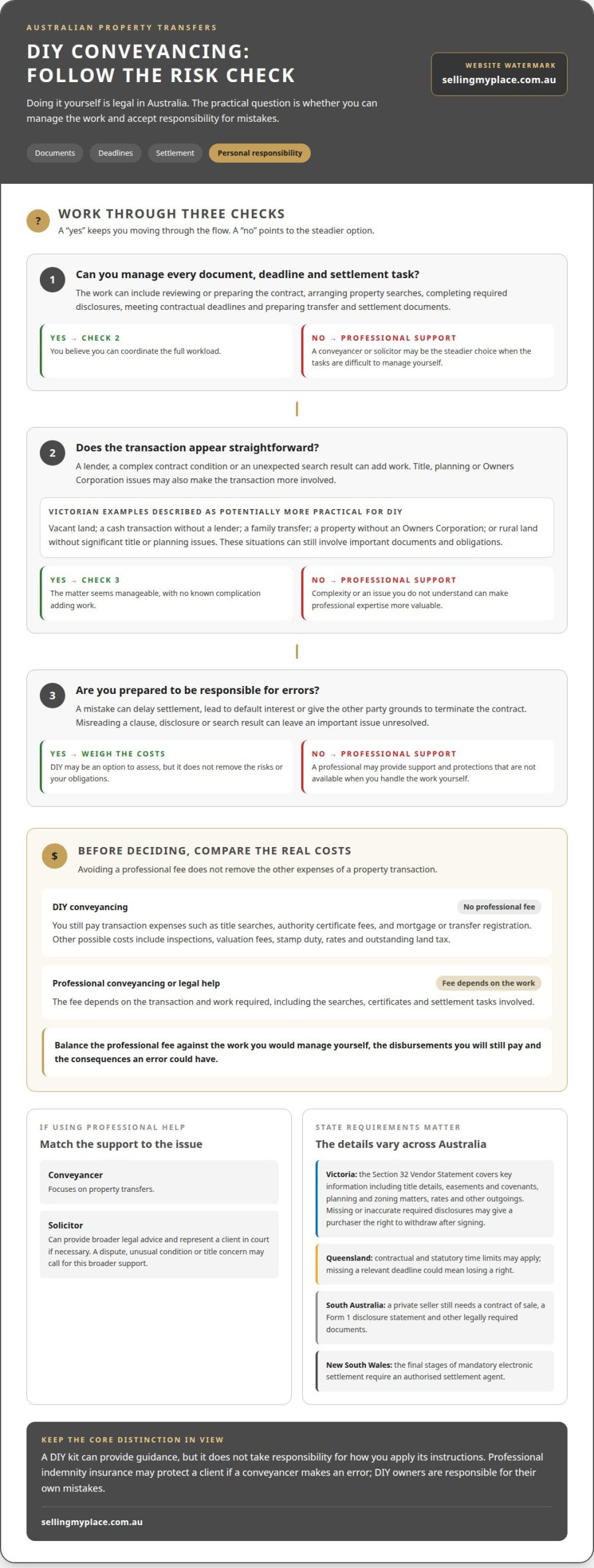
Yes, you can handle your own conveyancing in Australia, but requirements differ by state. The key question is whether you can manage each document, deadline and settlement task while accepting responsibility for errors.
Legal permission for DIY conveyancing
DIY conveyancing means managing the legal and administrative work of transferring property without engaging a conveyancer or solicitor. It isn’t against the law to do your own conveyancing in Australia, but permission doesn’t remove your obligations under the contract or state rules.
That distinction matters to buyers and sellers: a DIY kit can provide guidance, but following it doesn’t transfer responsibility to its author. In Queensland, contractual and statutory time limits may apply, and you could lose a right if you miss the relevant deadline.
DIY conveyancing steps and paperwork
DIY conveyancing involves coordinating the contract, property checks, required disclosures and settlement documents. For a purchase, this generally means reviewing the contract, arranging relevant searches, meeting contractual deadlines and preparing for transfer and settlement.
For a sale, you’ll need to prepare or arrange the contract and required disclosure documents, then manage signing, settlement and title transfer. The documents vary by state and transaction. For example, a South Australian private seller still needs a contract of sale, a Form 1 disclosure statement and other legally required documents.
Before committing, list each document, who is responsible for completing it and its due date. A missed search or incomplete disclosure can affect the transaction, not just add paperwork. Buyers also need to understand how search results relate to both the contract and the property being transferred.
Risks, errors and personal liability
The main risk is that you remain personally responsible for mistakes while handling the transaction. An error can delay settlement, lead to default interest or give the other party grounds to terminate the contract.
Misreading a clause, disclosure or search result can also leave an important issue unresolved. In Queensland, misunderstanding conveyancing documents or search results can lead to unnecessary litigation and loss. A kit may explain common tasks, but it cannot take responsibility for how you apply its instructions to your contract.
Professional indemnity insurance may protect a client if a conveyancer makes an error; DIY owners are responsible for their own mistakes. Licensed conveyancers and solicitors in NSW must hold this insurance. Consider the consequences of a missed deadline or incorrect document, not just the time needed to complete each step.
Professional fees compared with DIY
A conveyancer or solicitor’s fee depends on the transaction and work required, and is provided after a quote request. The cost can reflect the property matter’s complexity and the searches, certificates and settlement tasks involved.
DIY avoids a professional fee, but it doesn’t remove transaction expenses. Disbursements can include title searches, authority certificate fees, and mortgage or transfer registration. Other costs may include inspections, valuation fees, stamp duty, rates and outstanding land tax.
Compare the professional fee with the tasks you would manage yourself, the disbursements you’ll still pay and the consequences of an error. This gives you a clearer basis for deciding whether DIY is worth the responsibility.
DIY Conveyancing Victoria | Is It Legal & Worth the Risk?
According to the Victorian Government, DIY conveyancing is legal in Victoria under the Sale of Land Act 1962 and the Transfer of Land Act 1958. That permission doesn’t make every transaction straightforward. A vacant block or family transfer may involve fewer complications than a property with planning, title or Owners Corporation issues. The decision turns on what you need to understand and manage.
DIY may be more practical for vacant land, cash transactions without a lender, family transfers, properties without an Owners Corporation, or rural land without significant title or planning issues. These situations can still involve important documents and obligations. A lender, complex contract condition or unexpected search result can add work and make professional expertise more valuable.
A Victorian Section 32 Vendor Statement must disclose key property information, including title details, easements and covenants, planning and zoning matters, rates and other outgoings. If required disclosures are missing or inaccurate, a purchaser may have the right to withdraw after signing. That makes careful preparation and review important for sellers and buyers alike.
A licensed conveyancer or solicitor can prepare a compliant contract with relevant disclosure documents, check title details and explain contract conditions. They can also conduct searches and enquiries, help calculate stamp duty, and tailor special conditions to the transaction. Ask for an itemised statement of likely costs before work starts; legal practitioners and conveyancers generally disclose costs before or when retained.
Choose professional support that matches the issue. A conveyancer focuses on property transfers, while a solicitor can provide broader legal advice and represent a client in court if necessary. If a contract dispute, unusual condition or title concern goes beyond conveyancing, a solicitor may be the more appropriate choice. Both conveyancers and lawyers complete specific training.
Professional indemnity insurance may provide protection if a professional makes an error. Before engaging a conveyancer or solicitor, understand what work they’ll handle, their itemised costs and how they’ll communicate about deadlines or problems. If you’re dissatisfied, keep the contract, emails and a dated record of events. Describe the specific issue in writing and ask for a clear response before deciding what to do next.
DIY can suit a straightforward Victorian transaction when you can manage the documents, disclosures and deadlines. For a complicated Section 32, an unclear contract condition or a search result you can’t interpret, professional review can help you understand the issue before it affects the sale. If you’re considering selling privately, contact Kincade International Direct Sales for guidance on your sale options.
Should I Choose a Conveyancer or a Lawyer?
In Australia, the choice depends on the transaction’s complexity and the legal support you need. Electronic settlement also shapes the process: in Victoria, property settlements are conducted online using PEXA.
Electronic conveyancing became mandatory for most transactions in New South Wales, and the online settlement mandate was introduced in August 2020. Victoria’s framework includes the Electronic Transactions (Victoria) Act 2000. These rules make settlement a digital process, rather than a paper exchange completed entirely in person.
For a Victorian purchase, PEXA is the platform used for electronic settlement. The buyer’s representative coordinates settlement tasks with the seller’s representative and relevant lender. The platform supports the transfer and financial settlement, but doesn’t remove the need to meet contract deadlines or resolve issues with title, searches or documents beforehand.
A licensed conveyancer focuses on property transactions, including searches, contract requirements and settlement arrangements. A solicitor can also handle conveyancing, while providing broader legal advice and representing a client in court if necessary. If a dispute or unusual legal issue arises, that wider scope may matter. Both conveyancers and lawyers complete specific training.
State deadlines and settlement processes differ because contracts, statutory time limits and electronic settlement requirements vary by jurisdiction. In Queensland, contractual and statutory time limits may apply, and rights can be lost if they aren’t exercised on time. A buyer there has a five-business-day cooling-off period after signing a residential property contract. Keep track of the dates that apply to your contract.
Settlement is when the purchase money and transfer documents are dealt with to complete the sale. If there’s a mortgage, the lender’s requirements and timing become part of the coordination. In Queensland, the buyer or solicitor investigates title and relevant departments before completion; after completion, the buyer or lender attends to registration. The buyer becomes the legal owner upon registration.
Government charges and transaction expenses can include stamp duty, title searches, authority certificate fees, and mortgage or transfer registration. Requirements depend on the state, property and transaction. Other expenses may include building and pest inspections, survey reports, rates, scheme levies and outstanding land tax. A professional can identify the relevant searches and charges for the matter.
Choose a conveyancer for a property-focused transaction with clear requirements. Consider a solicitor if a contract dispute, complex condition or broader legal concern needs attention. Either way, understanding who will coordinate the platform, lender communication, deadlines and registration helps you judge the support needed for a smooth transfer.
Doing your own conveyancing in NSW
DIY conveyancing rules differ between Australian states and territories, so there isn’t one national process. In NSW, buyers and sellers can handle their own conveyancing, but electronic conveyancing is mandatory for most transactions. The final stages must be completed by a registered settlement agent authorised to use the online settlement platform.
That means doing your own conveyancing in NSW doesn’t mean completing every task alone. You can manage much of the preparation, but the final electronic settlement requires an authorised professional. Plan for this early, alongside the contract dates and responsibilities shared with the other party.
A NSW conveyancing transaction can involve examining the sale contract, arranging inspections and finance, and exchanging the contract. It may also include paying the deposit, arranging stamp duty, checking property obligations and disclosures, adjusting rates, changing title and attending settlement. Each task connects to the next: contract terms inform deadlines, while searches and disclosures help reveal obligations tied to the property.
For a buyer, the work may include reviewing the contract, arranging building and pest inspections, organising finance and conducting searches. A seller may need to provide accurate disclosure information and coordinate documents for the transfer. Both parties must meet the contract’s requirements, even when real estate agents help coordinate communication.
Search results and contract conditions need to be understood together. A title search, for example, may identify property interests that affect what the buyer receives. Checking property obligations and disclosures also helps clarify responsibilities such as rates adjustments. If an inspection, search or finance arrangement raises an issue, it may affect what happens before settlement.
NSW conveyancers must be licensed with NSW Fair Trading and complete an accredited course. Solicitors also handle conveyancing, and solicitors and conveyancers are equally qualified to do conveyancing in NSW. A conveyancer focuses on property transfers; a solicitor can advise on other areas of law that may arise during a transaction.
Compare the work you can manage with the tasks that require professional involvement. DIY still means organising documents, searches, inspections, finance, disclosures and deadlines, then arranging an authorised settlement agent for completion. A seller who is coordinating a sale with real estate agents may also need to manage contract and settlement requirements at the same time.
NSW’s licensed conveyancers are regulated by NSW Fair Trading. If a conveyancer is dishonest with money entrusted to them, a client may have access to the Property Services Compensation Fund administered by NSW Fair Trading. These protections don’t remove the need to understand your transaction, but they are part of the difference between using a licensed professional and doing the work yourself.
Rules differ across Australian states and territories. In NSW, buyers and sellers can manage their own conveyancing, but most transactions require electronic conveyancing, and a registered settlement agent authorised to use the online settlement platform must handle the final stages.
Whether you can do your own conveyancing in Australia
Yes, you can do your own conveyancing in Australia. The practical question is whether you can manage the legal documents, deadlines and settlement requirements for your particular property transaction. Requirements differ between states, so a process that works for one property may not suit another.
Think of conveyancing as a chain of connected tasks, not just signing a contract. A buyer may need to review contract terms, arrange searches and inspections, coordinate finance, meet disclosure requirements and prepare for settlement. A seller may need to prepare required documents and ensure the transaction proceeds according to the contract. An error at one stage can affect what follows.
State procedures show why location matters. Electronic settlement procedures can mean DIY owners need support with the final stages. In Victoria, property settlements are conducted online through PEXA. These arrangements mean DIY doesn’t necessarily involve handling every part of settlement personally.
Queensland provides another example of the work involved. Before completion, the buyer or their solicitor investigates title and searches relevant departments; a survey may also be conducted. At completion, the buyer pays the balance if search results are satisfactory, and the seller hands over documents needed for registration and the keys. Legal ownership follows registration of the transfer.
South Australian private sellers still need to prepare a contract of sale, a Form 1 statutory disclosure statement and other legally required documents. Settlements are conducted electronically, with the vast majority processed through PEXA. So a private sale does not remove the seller’s documentation responsibilities or the need to complete the transfer properly.
DIY may be more manageable when the transaction is straightforward and you can organise each task, interpret the documents and keep every deadline in view. It becomes harder when a search raises an issue, a contract clause is unclear or an unexpected dispute develops. In Queensland, anyone out of their depth during a dispute should seek a solicitor’s help promptly.
To decide, map the work against your own knowledge and available time. Include searches, disclosures, contract obligations, settlement arrangements and registration, then identify where errors could affect the other party or completion. Real estate agents can assist with sale communications, but they don’t replace the conveyancing work. If you’re planning a property sale, discuss support for your sale alongside the legal work the transaction requires.
Kincade International Direct Sales
Kincade International Direct Sales supports the property decisions around your transaction, whether you’re preparing to sell or looking to buy. Its residential listing services, buyer representation and pre-sale property consulting address the market-facing parts of that journey, while neighbourhood market reports can help inform your plans.
Keep the roles clear: conveyancing covers legal documents, deadlines and settlement, while property advice and representation focus on your sale or purchase. If you’re weighing up DIY conveyancing, consider these needs separately and arrange appropriate support for each part of the transaction.
For guidance on your property plans, contact Kincade International Direct Sales.
Plan your next property move with clarity
A property move involves more than completing a transfer. The legal work and decisions around selling or buying need to fit together, especially when timing, preparation and your preferred level of involvement matter. Give each part of the move a clear place in your plans before making commitments.
If you’re still weighing up whether to do your own conveyancing in Australia, use that decision to set boundaries around the work. Identify what you’ll manage yourself, what requires legal expertise, and how property decisions will be handled alongside the transfer. A clear division can help you move forward without confusing sales support with legal advice.
Kincade International Direct Sales can assist with the property side of that planning, including preparing to sell or making decisions as a buyer. For a considered conversation about your next move, contact Kincade International Direct Sales. Take the next step when you’re ready, with a plan that feels clear and right for you.
Frequently Asked Questions
Should the buyer and seller use the same conveyancer?
Don’t assume one conveyancer can act for both parties throughout a transaction. A shared representative may face a conflict if the buyer’s and seller’s interests differ; in South Australia, a conveyancer may need to stop acting for both parties if a conflict arises. Separate representation helps each party receive advice focused on their own position, particularly if negotiations or a dispute develop.
What happens on Settlement Day?
Settlement is when the agreed payment and transfer arrangements are completed so ownership can move to the buyer. In an electronic settlement, the parties’ representatives coordinate the transaction through the platform, including the funds and documents required for transfer. Before the scheduled day, confirm that outstanding contract requirements and funds are ready. After settlement, registration records the transfer of title.
What are the risks and common mistakes of doing your own conveyancing?
Common risks include misunderstanding a contract clause, overlooking a disclosure or search result, and missing a deadline. For example, failing to exercise a contractual right within its required timeframe may mean losing that right. An error can delay settlement, lead to default interest or give the other party grounds to terminate. A DIY kit provides guidance, but doesn’t take responsibility for your decisions or mistakes.
Can you use an online conveyancing platform or PEXA without a conveyancer?
Using an online platform doesn’t remove the need to meet your state’s settlement requirements. In NSW, electronic conveyancing is mandatory for most transactions, and anyone handling their own matter must arrange for a registered settlement agent authorised to use the platform to complete the final stages. PEXA is used for Victorian electronic settlements, but the platform itself doesn’t interpret contract terms or resolve legal issues.
When should you hire a conveyancer or property lawyer instead of doing it yourself?
Get professional help if a title search raises an issue, a contract condition is unclear or a dispute emerges. A conveyancer focuses on the property transfer; a solicitor can also address broader legal issues and represent a client in court if needed. For example, a Queensland DIY conveyancer who is out of their depth in a dispute should seek a solicitor’s help promptly.
Solicitor or conveyancer to sell: which should you choose
A solicitor isn’t automatically the only option when you sell a home. If you’re wondering whether you need a solicitor or conveyancer to sell, both can handle the legal work involved in transferring ownership; DIY conveyancing may also be an option. The right path depends on the legal work your sale involves and how comfortable you are managing it.
When selling a home in Australia, you can manage the conveyancing yourself, but you remain responsible for the legal paperwork and steps. A solicitor or conveyancer can handle that work. A solicitor may suit a sale involving broader legal issues, while a conveyancer focuses on property transfers.
This guide explains the differences, what to consider when comparing services and how costs depend on the work involved. It also covers DIY conveyancing, so you can decide what support suits your sale and circumstances.
Key Takeaways
- A solicitor, conveyancer or DIY approach may suit a sale, depending on the legal work involved and how much you’re comfortable managing yourself.
- Understand the roles each legal professional can perform, then choose support that fits the complexity of your sale.
- When comparing quotes, look beyond the headline fee and consider what work and disbursements are included.
- Getting key property information and documents organised before listing can help prepare you for the sale process.
- Conveyance advice can help you understand the legal side of selling, while pre-sale consulting and listing services support other parts of your sale.
DIY conveyancing: Is it an option?
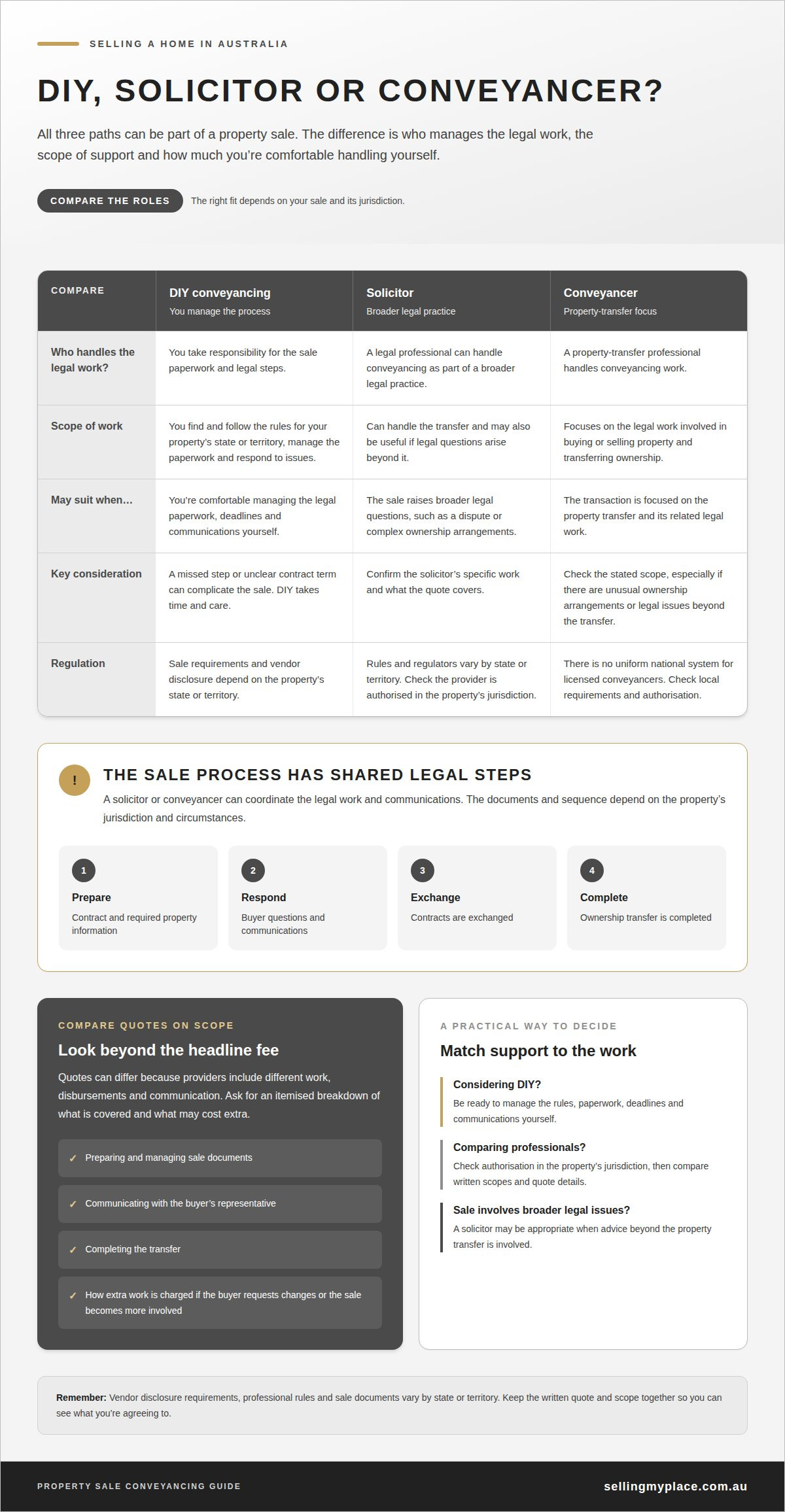
Australian sellers can handle their own conveyancing, but must take responsibility for the legal steps and paperwork. Alternatively, engage a solicitor or conveyancer. The right choice depends on your property, its state or territory, and how comfortable you are managing the process.
DIY conveyancing risks
With DIY conveyancing, you are responsible for the transaction’s legal paperwork, deadlines and communications. A missed step or unclear contract term can complicate the sale, particularly if questions arise about the property or the buyer requests changes. A legal professional can manage those details and explain what needs attention. DIY avoids professional involvement but takes time and care.
Qualifications and regulation
Solicitors and conveyancers have different professional roles and qualification pathways. Rules and regulators vary by state or territory, so don’t assume one national system applies. Before engaging a legal professional, identify the relevant regulatory body and check that the provider is authorised in the property’s jurisdiction. Compare the written scope and quote, not just the job title.
Quotes can differ because providers include different work, disbursements and communication in their fees. Ask for an itemised breakdown showing what is covered, what may cost extra and how changes to the transaction are handled. This is more useful than comparing headline figures alone.
| Option | Who manages the legal work | What to consider |
|---|---|---|
| DIY conveyancing | You handle the sale paperwork and process | Time, confidence and responsibility for each step |
| Solicitor | A legal professional handles conveyancing work | Scope of service, relevant regulation and quote detail |
| Conveyancer | A property-transfer professional handles conveyancing work | Scope of service, relevant regulation and quote detail |
For each quote, clarify whether it covers preparing and managing sale documents, communicating with the buyer’s representative and completing the transfer. Ask how extra work is charged, including if the buyer requests changes or the sale becomes more involved. Keep the written quote and scope together so you can see exactly what you’re agreeing to.
State-specific sale requirements
Vendor disclosure requirements are not the same across Australia. The required information and sale documents depend on the state or territory where the property is located, so understand the local process before listing. A solicitor or conveyancer can explain the requirements for your transaction and help organise the relevant paperwork.
Choose DIY only if you’re ready to find and follow the rules for your property’s jurisdiction, manage the paperwork and respond to issues as they arise. If you’d prefer support with the legal steps, compare regulated providers’ written scopes and choose the assistance that suits your sale.
Conveyancer vs solicitor: What’s the difference and which should you choose?
Solicitors and conveyancers can both handle legal work involved in transferring property ownership. Their training and professional scope differ, while the rules for a sale depend on its state or territory.
Solicitor roles and authority
A solicitor is a legal professional who can handle conveyancing as part of a broader legal practice. That wider scope may be useful if the sale raises legal questions beyond the transfer, such as a dispute or complex ownership arrangements. Ask what work the solicitor will do and what the quote covers.
For a straightforward sale, compare the work offered, not just the title. Check whether the solicitor will prepare and review sale documents, communicate with the buyer’s representative and guide you through the transfer. A clear written scope shows who is responsible for each task.
Licensed conveyancer roles and authority
A conveyancer focuses on the legal work involved in buying or selling property. This can include coordinating transaction documents and communications through to the ownership transfer. Unlike a solicitor, a conveyancer’s practice centres on property transfers rather than a wider range of legal matters.
“Licensed conveyancer” does not describe one uniform national system. Each state or territory has its own rules and professional arrangements, so requirements depend on where the property is located. Compare the conveyancer’s stated scope with your sale’s needs, especially if it involves unusual ownership arrangements or a legal issue beyond the transfer.
Sale process and appointment timing
A sale generally involves preparing the contract and required property information, responding to the buyer’s questions, exchanging contracts and completing the transfer. The legal professional coordinates these steps and communications on your behalf. The documents and sequence depend on the property’s jurisdiction and circumstances.
Appoint a solicitor or conveyancer before the legal work needs to begin, ideally while preparing your property for market. Early involvement gives them time to identify documents to organise and explain the local sale process before a contract is ready. You don’t have to wait until you receive an offer to discuss the transaction.
Choose based on the work your sale calls for. A conveyancer may suit a transaction focused on transferring ownership; a solicitor may be more appropriate when wider legal advice is involved. In either case, compare the proposed scope, communication and responsibility for each stage. For practical support planning your sale, discuss your sale requirements.
Benefits and drawbacks of solicitors
A solicitor may suit a sale that raises legal questions beyond transferring ownership. For example, an ownership dispute or a complicated contract may need advice beyond routine conveyancing. A legal professional can also advise you before the property goes to market, helping identify issues before they interrupt the sale.
A solicitor’s broader legal perspective can help when connected issues affect the transaction. If a buyer raises a contract concern or an ownership detail needs attention, a solicitor may be able to advise on both the legal question and the sale process. This can be a practical fit when the matter involves more than preparing documents and progressing the transfer.
Solicitor support can also reduce the legal administration you manage yourself. The solicitor can communicate with the buyer’s legal representative and explain the effect of proposed contract changes. You still need to provide accurate property information and respond to requests promptly. Agreeing responsibilities clearly helps avoid uncertainty about who is handling each task.
There are trade-offs. A solicitor’s broader legal expertise may exceed what a straightforward sale requires if the work is mainly about the property transfer. The scope matters: a solicitor’s title alone doesn’t tell you which tasks are included, who will manage day-to-day updates or what happens if an issue arises. Ask for these details in writing before engaging them.
Use these questions to assess whether a solicitor suits your sale:
- What needs advice? Identify whether the sale involves a legal question beyond the transfer.
- What work is included? Confirm who prepares documents, handles communications and explains contract changes.
- Who will be your contact? Establish how updates and requests will be handled throughout the transaction.
- How is additional work treated? Ask how the scope changes if a dispute or unexpected legal issue emerges.
A solicitor may be particularly useful if you need advice before listing, rather than support only after an offer. For instance, an ownership question could affect the information prepared for the sale. Raising it early gives you time to understand the issue before the contract process begins. Choose advice that addresses your legal concern, not simply the broadest service.
For a sale involving standard transfer work, compare the solicitor’s proposed role with the help you need. A detailed scope lets you weigh legal guidance against the practical tasks involved. If you’re comfortable coordinating straightforward administration, a broader advisory role may not be essential. If a legal complication could affect the contract or ownership, that wider perspective may be worth considering.
Conveyancing costs for buying and selling
Conveyancing costs in Australia depend on the work included, the property and the transaction. A sale quote and a purchase quote aren’t automatically comparable: each may cover different documents, communications and transfer tasks. Ask for the scope in writing before comparing providers. This shows what the professional fee covers and which costs relate to separate transaction services.
For a sale, ask whether the quote includes preparing the contract, handling buyer enquiries and coordinating the transfer. A disbursement is an outlay paid to a third party for a transaction-related service. Ask which outlays are anticipated, which are included in the quoted total and how additional work is charged. This helps ensure the headline fee reflects the full scope.
A purchase quote may cover different tasks, such as reviewing the contract and progressing the buyer’s transfer. If you’re selling one property and buying another, request a breakdown for each transaction. This shows whether a combined quote fully covers both matters or assumes some tasks can be shared across the sale and purchase.
The work may also change as the transaction progresses. Complicated ownership details, for example, may require further enquiries or document handling. A buyer’s request to amend contract terms may mean extra communication. Ask how these situations affect the quoted fee and whether the provider will explain proposed charges before doing extra work.
Use this process to compare quotes:
- Separate professional fees from disbursements. Ask for each category to be itemised.
- Match the scope. Compare quotes covering the same sale or purchase tasks.
- Ask about extra work. Clarify how amendments and unexpected enquiries affect charges.
- Confirm payment timing. Find out when fees and third-party outlays are payable.
Don’t compare a low headline fee with a broader service until you’ve checked the details. One quote may include a task that another charges for separately. A written breakdown makes it easier to compare equivalent work and understand which costs may arise as the transaction progresses.
For an Australian sale or purchase, ask for costs in Australian dollars. Overseas conveyancing figures reflect a different legal and property system, so they aren’t a sound basis for judging an Australian quote. Instead, focus on the work, disbursements and terms stated in your local quote.
A useful quote describes the work, exclusions and possible extra charges in plain language. If a line item is unclear, ask which task it covers and when it may apply. This gives you a clearer basis for choosing the support that suits your transaction, rather than relying on the first figure presented.
What legal documents does a seller need to prepare before listing a property?
The documents involved in an Australian property sale depend on its state or territory and the property itself. Before listing, gather records that help establish ownership, describe the property and explain relevant changes. Your solicitor or conveyancer can identify which documents apply and prepare the sale contract for your circumstances.
Start with paperwork that identifies the property and its owners. Title details and purchase records can help clarify ownership, while a mortgage statement may identify a lender whose interest needs to be addressed during the sale. If more than one person owns the home—or if you are dealing with a property passed down through generations—give your conveyancing professional the correct names and ownership information. For families managing inherited estates and wanting to keep their ancestral documentation well-structured, digital lineage platforms like kyucsovn.com highlight how family histories and genealogical records can be preserved and managed online.
Next, gather records about the home’s features and history. These might include plans, approvals or certificates for renovations, along with warranties or invoices for significant work. A renovated kitchen, added room or altered outdoor structure may prompt buyer questions. Keeping supporting paperwork together makes it easier to provide accurate details.
For a unit or townhouse, gather the owners corporation or strata records you hold. These may include correspondence, meeting materials or information about levies and building works. Sale documents and disclosure requirements vary by jurisdiction and property type, so your legal professional can explain which records are needed.
Other useful information may include current service details, insurance records and documents about leases or occupancy arrangements, if relevant. A tenanted property, for example, has different practical details from a home that will be vacant at settlement. Share relevant records early so the sale paperwork reflects the arrangement accurately.
Prepare a folder with these categories:
- Ownership: title and purchase records, plus details of each owner.
- Property changes: renovation plans, approvals, invoices and warranties you hold.
- Strata or owners corporation: available levy, meeting and building-work information.
- Occupancy and services: lease or occupancy details and relevant service records.
- Existing finance: mortgage information and lender contact details.
Not every example is required in every state. The documents depend on the property’s location, type and sale circumstances. A solicitor or conveyancer can review what you’ve gathered, identify relevant gaps and explain how the information fits into the contract and any applicable disclosure material.
Getting organised before listing can also help you answer buyer questions consistently. Keep copies together and tell your legal professional if a document is missing, a renovation lacks paperwork or ownership details have changed. For support preparing your property for sale and organising the next steps, discuss your pre-sale requirements.
Vendor disclosure requirements depend on the property’s location and type. A solicitor or conveyancer can identify the applicable requirements and explain which records to provide.
Kincade International Direct Sales: Conveyance Advice
Kincade International Direct Sales offers Conveyance Advice to help you understand how conveyancing fits into your sale. This can help when you’re weighing your next steps, organising sale plans or clarifying questions about the property transfer. For legal work such as preparing sale documents or managing the transfer, engage a qualified solicitor or conveyancer. Conveyance advice can inform your selling decisions, but it does not replace engaging a legal professional to carry out the conveyancing.
If you’re planning a sale and would like guidance on the conveyancing side, contact Kincade International Direct Sales.
Set your sale up for a confident next step
Before deciding, consider what support would make the sale manageable. If you’re asking, “Do I need a solicitor or conveyancer to sell?”, think about the legal work involved and where you want professional guidance. A clear plan can help you move from preparation to market with fewer unanswered questions.
The legal transfer is one part of a property sale. Kincade International Direct Sales also offers Residential Property Listing Services, Pre-Sale Property Consulting and Buyer Representation, helping sellers consider marketing and their next move alongside the sale. These services complement, but don’t replace, legal conveyancing support.
When you’re ready to talk through the practical side of your property plans, contact Kincade International Direct Sales. A thoughtful next step can make the transition feel clearer and more manageable.
Frequently Asked Questions
Who is allowed to do conveyancing?
Property transfers can be handled by solicitors and conveyancers, or by sellers who manage their own conveyancing. Professional titles, qualification requirements and regulatory arrangements depend on the Australian state or territory. If you engage a conveyancer, establish that they are authorised to provide conveyancing services in the property’s jurisdiction. Conveyancing generally focuses on the legal work involved in transferring ownership.
Do you need a solicitor or conveyancer to sell a property in Australia?
No. Sellers may manage their own conveyancing, so hiring a solicitor or conveyancer isn’t the only option. However, legal documents and disclosure requirements vary between states and territories, and the ownership transfer still needs to be completed correctly. Consider professional support if you’re unsure how to handle a contract issue, property disclosure or buyer request. The tasks depend on the property’s location and circumstances.
Can a property seller do their own conveyancing in Australia?
Yes. A property seller can choose DIY conveyancing and take responsibility for the transaction’s legal administration. You would need to manage the relevant paperwork and communications and keep track of each step through to transfer. The process can be demanding if the buyer raises questions or requests contract changes. If you choose this approach, understand the requirements for the property’s state or territory.
What is the difference between a solicitor and a conveyancer when selling a home?
A solicitor can provide broader legal services, while a conveyancer focuses on property transfers. A sale involving a legal dispute, for example, may call for advice beyond routine conveyancing. A straightforward transfer may centre on preparing and progressing the property transaction. Since the title alone doesn’t show what’s included, compare the professional’s scope with the legal issues in your sale.
How much does a conveyancer or solicitor cost to sell a house in Australia?
Costs depend on the work required and what the quoted service includes. A quote may separate professional fees from transaction-related outlays or treat particular tasks differently. For a useful comparison, request itemised quotes for the same work and note how each handles extra enquiries or contract changes. The property type, sale circumstances and legal support required can affect the overall cost.
When should a property seller choose a solicitor rather than a conveyancer?
Consider a solicitor if your sale raises legal questions beyond the property transfer. An ownership dispute or contract concern, for example, may require broader legal advice. If the work centres on progressing the transfer, a conveyancer’s specialist focus may suit the task. Identify the legal issues you need help with and compare each professional’s stated scope against those needs.
Contract of sale clauses, price and settlement explained
In NSW, residential property can’t be offered for sale until a contract of sale has been prepared. To understand how to prepare a contract of sale, start with the essentials: the buyer and seller, property address, price, deposit, settlement date, conditions, possession arrangements, and what’s included or excluded. The required documents and who prepares the contract depend on the state and sale.
Getting the details right matters: a contract sets out the terms both parties agree to, and uncertainty about an inclusion, condition or date can cause problems later. This guide explains what the contract should cover, how cooling-off periods work, when settlement usually takes place and who prepares the paperwork.
It also covers state-specific requirements that can affect a sale, so you can see what needs attention before the contract is signed and exchanged.
Key Takeaways
- Check the state-specific disclosure documents before a property is offered for sale; NSW contracts have prescribed attachments and requirements.
- Most NSW residential buyers have five working days after exchange to cool off, but different rules apply at auction and across Australia.
- Settlement timing is set by the contract. In NSW, it usually takes place 42 days after exchange unless the parties agree otherwise in writing.
- Make the price, deposit, settlement date, conditions, possession arrangements and inclusions or exclusions clear in the contract.
- In NSW, a proposed residential sale contract must be prepared by an Australian legal practitioner or licensed conveyancer.
What do I need to include in the contract for sale?
In Australia, a contract should identify the parties, property, purchase price, deposit, settlement date, conditions, possession arrangements, and inclusions or exclusions. NSW residential sales have prescribed disclosure requirements, so gather the relevant documents before the property is offered for sale.
Documents to Gather Before Drafting
Gather title and planning records, property details, and documents needed to disclose the land’s condition or legal status. In NSW, a residential property cannot be offered for sale until its contract is prepared.
Complete the necessary searches, then make the contract and vendor statement available promptly so prospective buyers can review the terms and attachments together. If it is unclear whether an item, such as a removable appliance, is included, state this explicitly.
Residential Sale Contract Documents
NSW residential sale contracts must include documents prescribed by section 52A of the Conveyancing Act 1919 and Schedule 1 of the Conveyancing (Sale of Land) Regulation 2022. A section 10.7(2) planning certificate should show zoning, development controls and planning constraints; additional section 10.7(5) information may also be attached.
Strata sales need the lot and common property certificate, strata plan and applicable by-laws. Pool documentation generally applies, except for lots in strata or community schemes with more than two lots and off-the-plan contracts. Off-the-plan contracts require a Disclosure Statement and specified draft documents. The contract also includes the section 66X statement, cooling-off information and any exclusions. For homes built before 1985, it advises purchasers to consider possible loose-fill asbestos insulation.
Transfer Paperwork and Settlement Coordination
Transfer paperwork records the change of ownership and helps the parties’ representatives coordinate settlement. The settlement date in the contract gives them a shared deadline for arranging the transfer and meeting the agreed obligations.
Check that names, property details and possession terms match across the contract and transfer documents. State whether the buyer receives vacant possession or takes the property subject to a lease. For an Australian-resident seller in NSW, provide an ATO clearance certificate when the property price is $750,000 or more.
Preparing Contracts for Different Sale Types
Residential, commercial and private sales require different preparation because disclosure rules and sale terms depend on the property and transaction. NSW residential contracts have prescribed attachments. Commercial transactions and private sales should reflect the specific property, agreed conditions and applicable requirements.
To prepare a contract step by step, identify the parties and property, agree on the price and deposit terms, specify conditions and possession, gather required disclosures, then arrange review and signing. In South Australia, land sale agreements must be in writing, whether the property is sold at auction or by private treaty.
Missing a required NSW document can have serious consequences: a purchaser may rescind within 14 days of exchange if a required document wasn’t attached before signing. Preparing the paperwork carefully helps buyers understand the agreement, including its cooling-off terms, before they commit.
How does a ‘cooling off’ period work?
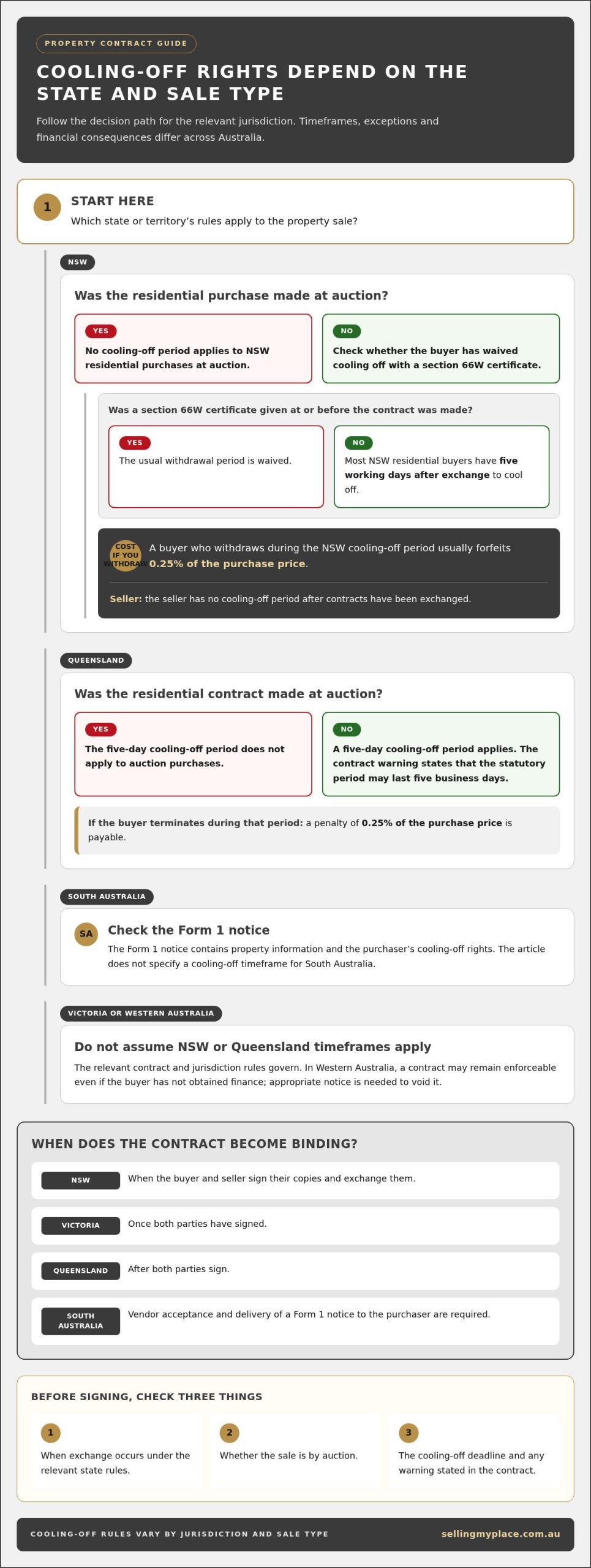
A cooling-off period gives a buyer a limited time to withdraw after a property contract is exchanged. The timeframe, exceptions and financial consequences depend on the state and sale type, so pay attention to the contract’s warning and the applicable state rules.
Across Australia, signing and exchange requirements vary by jurisdiction. In NSW, a contract becomes binding when the buyer and seller sign their copies and exchange them; in Victoria, the property is sold once both parties have signed. Queensland contracts become binding after both parties sign, while South Australian contracts require vendor acceptance and delivery of a Form 1 notice to the purchaser.
For most NSW residential purchases, the buyer has five working days following exchange to cool off. A buyer who withdraws during this period usually forfeits 0.25% of the purchase price. The seller has no cooling-off period after contracts have been exchanged, so the buyer’s decision window doesn’t give the seller an equivalent right to reconsider.
A NSW buyer can waive cooling off by giving the required section 66W certificate at or before the contract is made. This removes the usual withdrawal period, so it’s a significant decision rather than a routine signing step. The contract should clearly state the cooling-off terms, and the buyer should understand the consequences before signing or agreeing to waive them.
Auction rules differ. NSW residential purchases at auction have no cooling-off period. Queensland residential contracts have a five-day cooling-off period, except for auction purchases; the contract warning states that the statutory period may last five business days. A Queensland buyer who terminates during that period must pay a penalty of 0.25% of the purchase price.
In South Australia, the Form 1 notice contains property information and the purchaser’s cooling-off rights. For Victoria and Western Australia, don’t assume NSW or Queensland timeframes apply: the relevant contract and jurisdiction rules govern. In WA, a contract may remain enforceable even if the buyer hasn’t obtained finance, and appropriate notice is needed to void it.
Before signing, note when the exchange occurs, whether the sale is by auction, and any deadline stated in the contract. If you’re preparing a sale and want help considering contract timing, property sale guidance can help you understand the process.
Standard contract clauses and settlement timing
A property contract sets out the agreed terms, including price, deposit, conditions, possession and settlement date. These clauses work together: a finance condition, for example, should specify a clear deadline and what happens if finance isn’t approved. The settlement date gives both parties and their conveyancing representatives a target for completing the transfer.
Australian settlement periods can range from 30 to 90 days, depending on the state and agreement. In NSW, settlement usually takes place 42 days after exchange unless both parties agree otherwise in writing. The contract’s stated date is the practical guide, so check it against any agreed conditions and arrangements before signing.
Settlement adjustments account for agreed property expenses up to handover. Rates and other outgoings may be apportioned between seller and buyer so the figures reflect each party’s period of ownership. The conveyancing representatives coordinate these calculations. Before settlement, check the settlement statement against the contract and supporting figures.
If the property has a mortgage, the seller’s conveyancing representative coordinates its discharge as part of settlement. The lender’s requirements and the amount needed to clear the mortgage affect the arrangements. Keep the lender and conveyancer informed of the settlement date, and coordinate the discharge with the transfer.
A pre-settlement inspection lets the buyer check the property before handover. Arrange it close to settlement and compare the property with the contract’s inclusions and agreed condition. For example, check that listed appliances remain and agreed repairs are complete. Raise discrepancies with the representatives before settlement proceeds.
State clearly whether the buyer will receive vacant possession or take the property subject to a lease. In NSW, a seller shouldn’t let a buyer take possession before settlement without consulting their solicitor, because the seller retains the risk. Early occupation can affect access, responsibility and handover, so put any arrangement in writing rather than relying on an informal understanding.
Contract conditions also shape the timeline. A building and pest inspection, finance approval or sale of the buyer’s existing property can affect whether the transaction proceeds, so the relevant condition needs to say what must happen and by when. In Queensland, such conditions must be included in the contract to be legally binding. A 48-hour clause in Western Australia can allow the seller to continue marketing when an existing contract depends on the buyer selling another property.
Once the parties agree to a change in Western Australia, all parties should initial each amendment, and special conditions should be signed and dated. This creates a clear record of the agreed terms and helps the conveyancing process follow the same instructions through settlement.
Vendor and purchaser details, property description and sale price
Clear details about the parties, property and price define the agreement each side is making. State-specific disclosure rules also affect when prospective buyers can receive an offer for the property.
Vendor and Purchaser Details
The contract names the vendor and purchaser, identifying the parties to the property transaction. Accurate names link the agreement, signatures and transfer paperwork to the people or entities involved.
Check each party’s details against the documents they’ll use to sign and complete the sale. If more than one person is buying or selling, include each party in the contract. Confirm the purchaser’s details before signing, because changing a party later can affect the transaction and settlement arrangements.
Property Description and Title Information
The property description identifies exactly what the vendor is selling, using the address and relevant title information. This distinguishes the land from neighbouring properties and connects the contract’s disclosures to the correct property.
Review the title information for restrictions, easements and other interests affecting the property. In Victoria, the vendor statement, also called a section 32, discloses matters including title restrictions and easement locations. It also covers rates and outgoings, giving prospective buyers information that may shape their decision and the terms they agree to.
Sale Price and Offer Status
The contract records the agreed sale price and should also state the deposit amount and due date. Set out any conditions affecting the offer, the settlement date, and whether the buyer receives vacant possession or takes the property subject to a lease.
In Victoria, the contract must clearly state whether the purchase price includes or excludes GST and, if included, how it will be calculated. List other property included in the deal, along with exclusions such as a light fitting the vendor intends to remove. If an item’s inclusion is uncertain, identify it expressly rather than leaving buyers to assume.
In NSW, a residential property cannot be offered for sale until its contract of sale has been prepared. Having the contract and vendor disclosure ready lets prospective buyers consider the actual terms before making an agreement. It also helps them understand any cooling-off provisions relevant to the purchase.
Before the vendor accepts an offer, compare the proposed price, deposit, conditions and included items with the written contract. A verbal discussion about a special condition or an item left behind doesn’t replace clear wording. Record agreed changes in the contract so the final document reflects the transaction both parties intend.
Who prepares the contract of sale
Who prepares a property contract depends on the state, sale method and transaction. In NSW, a proposed residential sale contract must be prepared by an Australian legal practitioner or licensed conveyancer, then be available for inspection at the agent’s office.
Elsewhere in Australia, a solicitor, conveyancer or real estate agent may prepare the contract, depending on the sale and its requirements. For a private sale, an agent generally drafts the contract presented to a prospective purchaser making an offer. A legal practitioner or conveyancer can also prepare or review legal documents, including the contract and vendor statement.
Understanding how to prepare a contract of sale starts with knowing who is responsible for the legal paperwork in your state. Government legislation and regulations set requirements that vary between states. In NSW, for example, the contract needs prescribed disclosure documents before residential property can be offered for sale. For a Victorian sale, a legal practitioner can prepare or review both the contract and Section 32 vendor statement.
For an auction, the contract should be ready for prospective buyers to consider before bidding. In NSW, the proposed residential contract must be available for inspection at the agent’s office. Auction purchases also have different cooling-off rules from private treaty sales, so review the contract and its conditions before auction day. In South Australia, land sale agreements must be in writing whether the property is sold at auction or by private treaty.
Responsibility can also depend on who represents the seller. In NSW, if the seller has told the agent that a solicitor or conveyancer will act, or the proposed contract says so, the agent generally can’t participate in making or exchanging the contract without express authorisation from the seller or their legal representative. If an agent arranges exchange in NSW, they must provide signed contract copies to each party or their solicitor or conveyancer within two business days.
When learning how to prepare a contract of sale, involve a solicitor or conveyancer to help ensure the documents and terms meet the relevant requirements. The cost depends on the matter and is provided after a quote request; factors include the property, required searches, disclosure documents and contract amendments. Buyers should also arrange their own review before committing to a signed contract.
Preparing to sell? Discuss your property sale preparation and the practical steps involved in getting the contract ready.
Kincade International Direct Sales: Residential Property Listing Services
Kincade International Direct Sales helps Australian owners prepare to sell through Residential Property Listing Services and Pre-Sale Property Consulting. These services can help you plan your sale presentation and approach before prospective buyers view the property. Neighborhood Market Reports provide market context as you prepare your listing.
The contract still needs to be prepared by the appropriate legal practitioner or conveyancer where required, with state disclosure documents and sale terms addressed. Kincade International Direct Sales supports the listing and marketing side of the sale, while the legal paperwork follows the applicable process.
If you’re planning a sale, explore Kincade International Direct Sales’ flat-fee packages at sellingmyplace.com.au.
Take your next step with a clear plan
Knowing how to prepare a contract of sale is one part of planning a property move. Next, decide how you want the sale to unfold, what support would help and which decisions need your attention first. A clear plan lets you focus on the transition as well as the paperwork. For buyers also exploring coastal retreats or lifestyle markets abroad, real estate teams like Steve Adams & Associates offer valuable perspective on local lifestyle, community transport, and coastal living.
Kincade International Direct Sales offers Residential Property Listing Services, Buyer Representation and Pre-Sale Property Consulting. These services support owners preparing to bring a home to market and buyers seeking representation. The right starting point depends on where you are in your property journey. For buyers coordinating an overseas relocation or browsing residential homes in the UK, agencies such as Let’s Get You Moving offer search tools to explore available listings.
Take the time to choose a path that suits your plans and priorities. Contact Kincade International Direct Sales to discuss your next property step and move forward with confidence.
Frequently Asked Questions
What happens if the contract doesn’t comply?
The outcome depends on the state, the missing requirement and when the issue is raised. In NSW, a purchaser may rescind within 14 days of exchange if a required document wasn’t attached before signing. In Queensland, a buyer may be able to terminate for a seller disclosure failure up to settlement, subject to requirements. For inaccurate or incomplete disclosure, the issue must be material, unknown to the buyer, and significant enough that they wouldn’t have signed.
Should I use standard or tailored terms in the contract?
Use the applicable standard form as a starting point, then add tailored terms for matters it doesn’t cover. For example, a special condition could set out an agreed repair, a sale condition or how a particular inclusion will be handled. Each added or changed term should be clear and consistent with the rest of the contract. In Western Australia, all parties should initial agreed changes, and special conditions should be signed and dated.
What if I am selling a strata title property?
For a NSW strata property, include the lot and common property certificate, the strata plan showing the lot, and applicable scheme by-laws. These documents help buyers understand the lot’s boundaries and the rules affecting shared areas and use. A sale of a strata lot may be exempt from specified pool documentation requirements where the scheme has more than two lots. Off-the-plan contracts have separate disclosure requirements, so distinguish them from a sale of an existing strata lot.
What is exchange?
Exchange is the formal exchange of signed contract copies between buyer and seller, making the agreement binding under the applicable process. In NSW, the contract becomes binding when both parties sign their copies and exchange them. Record the exchange date clearly because it can start the buyer’s cooling-off period and count towards the settlement timetable. Signing a draft or discussing terms alone does not complete exchange.
What warranties am I deemed to have made about the property?
There isn’t one Australia-wide list of warranties that applies identically to every property sale. The contract’s express terms and the state’s disclosure requirements determine what the seller represents. For example, a clause about an included appliance should match what will remain at the property. Avoid broad statements about condition unless they’re accurate, and ensure known information and agreed exclusions are addressed consistently in the contract documents.
What information must a contract of sale include in Australia?
The contract should identify the vendor and purchaser, property address, purchase price, deposit amount and due date, settlement date, conditions, possession status, and inclusions or exclusions. Clarify whether the buyer receives vacant possession or takes the property subject to a lease. State-specific disclosure documents and special conditions add detail. For instance, a finance condition should explain what the buyer must do and the relevant deadline.
Who can prepare a contract of sale in Australia: a solicitor, conveyancer, or the parties?
Depending on the state and sale, a solicitor, conveyancer or real estate agent may prepare the contract. In NSW, a proposed residential sale contract must be prepared by an Australian legal practitioner or licensed conveyancer. The parties provide accurate details and agree the terms, but they shouldn’t assume an unsigned template meets local requirements. A buyer can arrange an independent review before signing, especially where special conditions or amendments are involved.
What documents must be attached to a residential property contract of sale in each Australian state and territory?
Attachment rules differ by jurisdiction and property type. NSW requires prescribed disclosure documents, including relevant planning and strata records; Victoria uses a vendor statement, with owners corporation documents where applicable. Queensland’s seller disclosure scheme applies from 1 August 2025. South Australia uses a Form 1 notice, while Western Australian safety requirements include specified alarms and RCDs before sale. Attachment requirements for ACT and NT sales should be assessed under their local rules.
How to Choose a Good Conveyancer in Australia: 2026 Property Guide
A conveyancer who treats your property transaction as mere administrative paperwork is one of the quietest financial risks you can take. Knowing how to choose a good conveyancer in Australia isn’t just about ticking a legal compliance box; it’s about partnering with a proactive safeguard who protects your hard-earned equity before contracts are signed.
It’s completely natural to feel uneasy about the fine print. Between tightening statutory disclosure obligations, confusing differences between conveyancers and solicitors, and the dread of surprise settlement disbursements, the legal side of moving can easily become overwhelming. You deserve a steady hand, upfront fee transparency, and the calm reassurance that your settlement will finish on time without expensive delays or penalty interest.
This 2026 guide gives you a clear framework to evaluate professional qualifications, assess digital settlement readiness, and demand complete cost certainty. Ahead, you’ll discover the exact questions to ask so your upcoming property transition unfolds with total legal confidence.
Key Takeaways
- Understand the practical distinctions between a licensed conveyancer and a property solicitor to ensure your transaction receives the exact level of legal oversight it requires.
- Apply a structured framework on how to choose a good conveyancer in Australia, verifying active state credentials, comprehensive insurance coverage, and modern electronic settlement readiness.
- Protect your budget against surprise settlement charges by learning how to assess fee transparency, distinguishing professional service costs from mandatory administrative disbursements.
- Arm yourself with essential vetting questions to confirm who manages your file directly, standard contract review timeframes, and robust cybersecurity safeguards.
- Discover why preparing your contract of sale and statutory disclosure documents before going to market prevents costly negotiation delays and safeguards your equity.
What Does a Property Conveyancer Do in Australia?
A conveyancer acts as your legal guardian during one of life’s most significant milestones. At its core, the legal process of conveyancing involves transferring legal property ownership from one party to another. Yet, reducing this work to simple paperwork overlooks the protective wall a practitioner builds around your interests. When learning how to choose a good conveyancer in Australia, your primary goal is finding someone who catches fine-print liabilities before they jeopardise your settlement.
Core Responsibilities During a Residential Property Transaction
Your conveyancer manages the complex statutory steps that safeguard property title transfers from listing through to final financial completion:
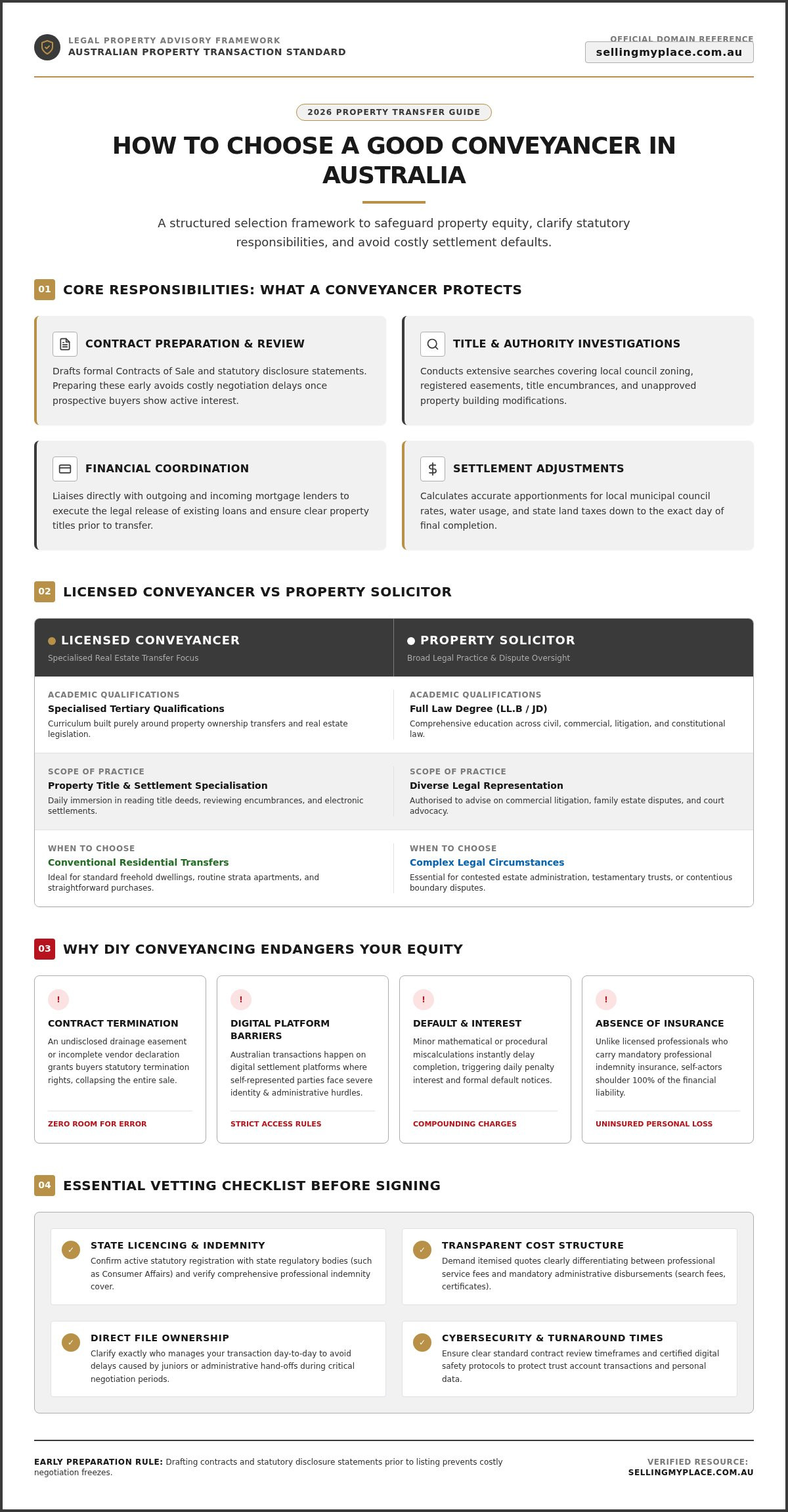
- Contract preparation and review: Drafting the formal Contract of Sale and statutory disclosure statements; preparing these documents early prevents costly negotiation delays once prospective buyers show interest.
- Title and authority investigations: Conducting searches covering local council zoning, registered easements, title encumbrances, and unapproved building modifications.
- Financial coordination: Liaising directly with outgoing and incoming lenders to release existing mortgages and clear property titles.
- Settlement adjustments: Calculating precise apportionments for local council rates, water usage, and land taxes up to the settlement day.
Why DIY Conveyancing Puts Your Property Equity at Risk
Handling your own property legalities might sound like an easy way to trim expenses, but property transfers leave zero room for error. A single undisclosed drainage easement or an incomplete vendor declaration can grant buyers statutory termination rights, collapsing your sale right before completion.
Beyond disclosure pitfalls, independent buyers and sellers face substantial technical barriers. Australian property transfers take place almost exclusively across digital settlement platforms where self-represented parties face cumbersome verification hurdles. A minor administrative miscalculation can delay settlement, instantly triggering daily penalty interest or formal default notices. Licensed conveyancers carry mandatory professional indemnity insurance, ensuring your transaction is shielded against costly oversight. Understanding how to choose a good conveyancer in Australia guarantees your family’s equity remains backed by dedicated legal expertise and genuine accountability.
Licensed Conveyancer vs Solicitor: Which Professional Do You Need?
Deciding between a licensed conveyancer and a property solicitor is often the first hurdle homeowners face when reviewing their transaction. Both professionals hold statutory approval to manage legal settlements and prepare statutory paperwork. However, their day-to-day focus, academic qualifications, and scope of practice differ substantially. Understanding these distinctions helps clarify how to choose a good conveyancer in Australia who matches the specific legal profile of your property.
Key Differences in Qualifications, Scope, and Focus
Licensed conveyancers complete specialised tertiary qualifications built entirely around real estate transfers. They spend every day interpreting title deeds, reviewing encumbrances, and coordinating electronic settlements. Solicitors hold general law degrees, allowing them to practise across diverse legal fields including commercial litigation, family disputes, and estate law. As highlighted in Consumer Affairs Victoria’s guide to conveyancers and legal practitioners, both professions operate under strict regulatory oversight and compulsory professional indemnity schemes. For conventional freehold homes or straightforward strata apartments, conveyancers often deliver exceptionally focused, communicative care.
When Your Sale Requires a Qualified Property Solicitor
Certain property transfers step outside standard statutory procedures, demanding legal counsel that can address formal disputes or complex contract restructuring. You will likely require an admitted solicitor rather than a conveyancer if your transaction involves:
- Contested estate administration, complex testamentary trusts, or unresolved probate orders
- Contentious boundary alignments, formal adverse possession claims, or disputed heritage covenants
- Custom vendor finance terms, long-term options deeds, or off-the-plan developments with bespoke leaseholds
- Active disputes where a counterparty threatens contract rescission or Supreme Court proceedings
State legislation can also dictate this decision. For instance, independent conveyancers are not licensed in Queensland or the Australian Capital Territory, where conveyancing work must occur within an admitted law practice. For standard residential property transfers nationwide, partnering with an agile, title-focused professional keeps your sale moving smoothly without unnecessary overheads. If you are preparing to list your home and want clarity around the right legal pathway, you can reach out for bespoke conveyance advice to protect your hard-earned equity right from day one.
How to Choose a Good Conveyancer in Australia: 5-Step Selection Framework
Selecting the right property legal partner requires looking past generic promises of smooth service. A brilliant conveyancer does not simply process files; they act as a proactive shield against contractual bottlenecks, missed deadlines, and unexpected expenses. Knowing how to choose a good conveyancer in Australia comes down to applying a methodical vetting system before signing a letter of engagement.
Step 1 & 2: Verifying Licences and Experience in Your Property Type
Your first move is checking official government registers to ensure your representative holds an active, unrestricted licence. Inquire about current professional indemnity insurance coverage, which typically mandates protection of at least $1.5 million to $2 million per claim. Seeking an active member of the Australian Institute of Conveyancers (AIC) offers instant assurance of ongoing professional development and strict ethical standards.
Equally, match their daily workload to your property type. A practitioner who primarily handles standard Torrens title suburban homes may stumble when interpreting complex strata by-laws, community title levies, rural water licences, or local heritage overlays. For homeowners coordinating their own campaign, our comprehensive guide on how to sell your own home details how early legal preparation pairs with direct vendor marketing.
Step 3 & 4: Assessing Digital Settlement Readiness and Cybersecurity
Electronic conveyancing dominates the Australian property landscape. Over 88% of national property transfers execute via PEXA, making digital fluency an absolute prerequisite. When evaluating candidates, ask about their electronic settlement track record:
- PEXA workspace efficiency: Ensuring their team proactively pre-populates financial workspaces well ahead of the scheduled settlement hour.
- Verification of Identity (VOI): Confirming they adhere strictly to ARNECC safe harbour standards using secure biometric digital apps or in-person verification.
- Anti-fraud protocols: Validating that trust account details are shared via encrypted client portals or confirmed through verbal phone callbacks, never vulnerable plain-text emails.
Step 5: Understanding Fee Structures and Uncovering Hidden Disbursements
True cost transparency separates exceptional conveyancers from budget operators. A quote should clearly delineate between the conveyancer’s professional service fee and third-party statutory disbursements billed at cost. Disbursements commonly represent 20% to 35% of overall conveyancing expenses, covering council zoning certificates, title registry searches, water drainage plans, and PEXA platform fees. Be cautious of ultra-low quotes that quietly tack on surprise administrative charges for file opening, phone calls, or electronic document storage. Mastering how to choose a good conveyancer in Australia ensures total budget certainty from exchange through to financial completion.
Essential Questions to Ask Before Engaging a Conveyancing Professional
An initial telephone consultation reveals far more than a polished promotional website ever could. Understanding how to choose a good conveyancer in Australia requires asking targeted questions that probe daily operational habits, not just headline promises. Treat this preliminary conversation as an empowering interview for the custodian of your property settlement.
Probing Turnaround Times and Contract Review Protocols
Momentum matters immensely during property transactions, especially when keen buyers are eager to exchange contracts. A proactive practitioner should review or draft standard residential contracts within two to three business days. Ask these precise questions before committing:
- File ownership: Will a qualified practitioner manage my file personally, or will daily correspondence be delegated to junior administrative staff?
- Contract review billing: Are pre-signing contract evaluations charged individually per document, or do they fold into the final settlement invoice?
- Negotiation responsiveness: How quickly can your office approve customized special conditions or finance clauses when an offer arrives?
Quick turnaround times keep interested buyers engaged before enthusiasm cools. Coupling swift legal reviews with proven property sale negotiation tips ensures you never lose a compelling offer to procedural delays.
Clarifying Settlement Day Protocol and Contingency Planning
Settlement day ought to bring relief, not unexpected panic. Establishing how a firm handles sudden hiccups before they occur protects both your timeline and your sanity:
- Colleague coverage: If your dedicated conveyancer is suddenly unwell or away, does a fully briefed peer step in immediately without disrupting the settlement schedule?
- Lender friction: What protocols exist to resolve last-minute banking document discrepancies on the electronic settlement platform before deadline windows close?
- Inspection disputes: If a buyer’s final pre-settlement inspection uncovers damaged fixtures or missing inclusions, how aggressively does the firm negotiate financial holdbacks or prompt resolutions?
A dependable professional remains calm, accessible, and thoroughly organized when pressure mounts. If you are preparing your home for listing and want total assurance throughout the settlement process, contact our advisory team today to secure experienced conveyance advice tailored to your sale.
Streamlining Your Property Sale: Integrating Legal Advice with Smart Marketing
Selling a home is far more than hosting weekend inspections and waiting for offers. Real transaction momentum happens when sharp presentation connects directly with rigorous legal preparation. When exploring how to choose a good conveyancer in Australia, sellers often focus exclusively on the final settlement exchange. However, establishing proactive legal groundwork must start well before the first prospective buyer walks through your front door.
Preparing Your Contract of Sale Before Listing on the Market
Across Australian property markets, presenting a legally compliant contract of sale up front isn’t merely good practice; in many jurisdictions, it’s a strict statutory obligation. Having your contract and mandatory vendor disclosures prepared early prevents costly negotiation delays once serious buyers emerge. Incomplete disclosure paperwork can cause sudden buyer cancellations or statutory contract rescissions, derailing your campaign just as offers peak. Aligning your legal preparation alongside our comprehensive residential property listing services ensures your campaign launches with complete buyer clarity and legal compliance.
Taking Control of Your Sale with Dedicated Advisory Support
More Australian homeowners are choosing direct sales models to protect their hard-earned equity, avoiding traditional percentage-based agency commissions in favour of transparent flat fees. Independent property sales should never mean sacrificing professional standardisation or legal protection. You can achieve an exceptional outcome by harmonising legal precision with high-impact visual marketing:
- Professional visual assets: Pairing sound conveyance advice with high-calibre photography and precise floorplans ensures strong emotional appeal across digital listings.
- Direct vendor empowerment: Engaging directly with interested buyers establishes trust and transparency while you maintain full control of contract negotiations.
- Comprehensive advisory backing: Accessing real estate advisory services gives you seasoned guidance across every milestone, from pre-sale preparation to settlement day.
Mastering how to choose a good conveyancer in Australia gives you the legal confidence needed to run an independent sale smoothly. When legal diligence and smart property marketing operate hand in hand, you secure the best possible financial result for your property. Ready to take charge of your sale with genuine confidence? Connect with our team for expert advice and discover how empowering flat-fee property support can be.
Secure Your Property Settlement with Total Peace of Mind
Navigating a property transaction marks the beginning of an exciting new lifestyle chapter. When you master how to choose a good conveyancer in Australia, you replace procedural anxiety with calm confidence. You ensure that every title search, statutory disclosure statement, and digital settlement workspace is managed with meticulous precision. Protecting your hard-earned equity ultimately comes down to demanding transparent fee structures, early contract preparation, and proactive communication.
You don’t have to navigate this milestone in isolation. Backed by national Australian coverage, our dedicated Agent Advisory Service pairs independent vendor marketing with trusted conveyance advice and pre-sale consulting. By choosing transparent flat-fee structures over percentage commissions, you retain your rightful equity while enjoying complete legal reassurance from listing through to final handover. Connect with our expert property advisors today to protect your sale and move forward with absolute peace of mind.
Frequently Asked Questions
How much does a conveyancer cost in Australia?
Conveyancing expenses comprise two distinct parts: the practitioner’s professional service fee and statutory out-of-pocket disbursements. Disbursements cover essential administrative searches such as local council zoning certificates, water drainage diagrams, land tax clearances, and electronic settlement platform lodgement fees. Because disbursement charges reflect the exact search costs billed by government authorities, your total investment depends heavily on your property type and state jurisdiction.
When should I hire a conveyancer when selling a property?
You should engage a conveyancer before advertising your home or hosting prospective buyers. In several Australian states, marketing a residential dwelling without a complete, compliant contract is unlawful. Learning how to choose a good conveyancer in Australia well before your marketing launch ensures your vendor disclosure paperwork is legally airtight, eliminating unnecessary negotiation hold-ups and preventing buyers from withdrawing during initial contract reviews.
Can I do my own conveyancing in Australia?
While self-representation is legally permissible in most jurisdictions, managing your own property transfer creates enormous financial vulnerabilities. Self-represented individuals face strict administrative hurdles accessing national electronic settlement networks. Furthermore, laypeople lack professional indemnity insurance. A single missed easement disclosure, incorrectly calculated rates adjustment, or delayed lodgement can collapse your transaction and leave you personally liable for substantial penalty interest.
What is the difference between a conveyancer and a solicitor?
A licensed conveyancer specialises entirely in property transfers, whereas a solicitor holds comprehensive legal qualifications to practise across civil litigation, estate management, and family law. When evaluating how to choose a good conveyancer in Australia, a dedicated conveyancer is ideal for straightforward residential titles. However, an admitted solicitor is necessary if your sale involves disputed probate trusts, contentious boundary litigation, or commercial lease conditions.
How long does the conveyancing process take from contract to settlement?
The standard conveyancing timeline typically spans between 30 and 90 days following the formal exchange of contracts. Common contractual timeframes sit at 42 days in New South Wales and between 30 to 60 days in Victoria and Queensland. Both parties can mutually negotiate shorter or extended settlement dates to align with mortgage approvals, lease endings, or planned removalist bookings.
What happens if settlement is delayed by the other party?
When one party fails to settle on the agreed date, the non-defaulting party can serve a formal Notice to Complete and charge daily penalty interest as outlined in the contract. If the defaulting party fails to complete within the notice period (typically 14 days), the innocent party usually retains the right to terminate the agreement, forfeit the deposit, and seek damages for breach.
Do conveyancers check the physical condition of the property?
No, conveyancers examine the legal status and registered documentation of a property rather than its physical building defects. They confirm boundaries, easements, and local council planning certificates, but they do not assess structural integrity or pest activity. Buyers must commission independent building, timber pest, and strata inspectors to evaluate the physical state of the building before committing unconditionally.
Expert Conveyance Advice: Navigating the Legal Side of Selling Your Home
What if the biggest threat to your home sale profit isn’t a low offer, but a single missing tick on a Section 32? Selling your property is a significant emotional milestone, yet it’s often clouded by the stress of legal jargon and the fear of a settlement snagging at the finish line. It’s completely normal to feel overwhelmed by the technicalities of PEXA or the shifting nuances of state-based disclosure laws. Seeking expert conveyance advice early in the piece ensures you’re prepared for these hurdles, protecting your equity from the very start.
This professional guidance acts as a protective shield for your hard-earned profit, ensuring every legal requirement is met with precision so you can enjoy a seamless transfer without the burden of traditional commissions. In this guide, we’ll walk you through the essential legal timeline and explain how a steady hand at the closing stage guarantees your sale is rock-solid. You’ll gain the confidence to navigate the process with ease, knowing your legacy is protected and your transition to the next chapter is as smooth as possible.
Key Takeaways
- Discover why expert conveyance advice is more than just paperwork, acting as a vital shield that interprets complex clauses to protect your financial interests.
- Navigate the Australian property sale timeline with confidence, from preparing essential disclosure documents to managing the high-stakes exchange of contracts.
- Evaluate the true cost of DIY kits versus professional legal guidance to avoid the pitfalls of expensive litigation or unexpected settlement delays.
- Learn how to reinvest a fraction of your commission-sized savings into a steady legal hand that secures your 100% profit at the finish line.
- Understand how our Agent Advisory Service provides the professional bridge needed to ensure your sale is legally binding and entirely stress-free.
What is Conveyance Advice and Why Does Every Seller Need It?
When the time comes to pass on the keys to your family home, you’re doing much more than just offloading an asset. You’re closing a significant chapter of your life. While many people ask, “What is conveyancing?“, the answer is more than just the legal transfer of a title from one person to another. It’s the framework that ensures your hard-earned equity moves safely from the property into your next adventure. In the current Australian property market, simply “processing” a sale isn’t enough. You need genuine conveyance advice to navigate the nuances of the 2026 regulations and the mandatory digital settlement environment.
Professional advice differs from mere administrative work because it focuses on protection and interpretation. It involves understanding how a specific clause might affect your bottom line or your settlement timeline. Are you clear on the latest disclosure requirements? Are you prepared for the updated Anti-Money Laundering checks that now apply to all property professionals as of July 2026? Having an expert in your corner reduces the anxiety that often accompanies these high-stakes decisions. It turns a potentially overwhelming process into a series of clear, manageable steps.
The Difference Between a Solicitor and a Conveyancer
It’s a question we hear often: do I need a solicitor or a conveyancer? Both are qualified to help you, but their scope varies. A licensed conveyancer is a dedicated specialist in property law. They live and breathe property transfers. A solicitor is a lawyer who can handle property but also offers broader legal expertise. If your sale involves complex family law issues, probate, or unique easements, the extra legal weight of a solicitor might be wise. Selling My Place helps you understand these choices, ensuring you have the right expertise for your specific situation without the burden of agency commissions.
Securing Your Legacy Through Legal Clarity
We view the sale of your home as a partnership. This isn’t just about a transaction; it’s about your legacy and the stability of your future. Professional conveyance advice is a non-negotiable component of a “Selling Smarter” strategy. It ensures that when you save an average of $20,000 in commission, that profit stays firmly in your pocket. Our Agent Advisory Service provides that essential steady hand, acting as the bridge between your independent listing and a professional, legally binding result. We’re here to make sure the finish line is as rewarding as the first day you decided to sell.
Decoding the Australian Property Sale Process
Selling a home is a journey of many moving parts. From the moment you decide to list your property to the final second when funds hit your bank account, each phase requires a steady hand. Understanding the conveyancing process in Australia is about more than just checking boxes; it’s about gaining the clarity needed to make confident decisions for your family’s future. While the legalities can feel like a maze of jargon, the path is actually quite logical when broken down into four key stages.
- Preparation: This is where your contract of sale and disclosure documents are drafted. It’s the foundation of your sale.
- Exchange: Once a buyer is found, contracts are signed and swapped. This is the moment the deal becomes official, often followed by a short cooling-off period.
- Management: During this “in-between” phase, you’ll manage building inspections and wait for the buyer’s finance approval. It’s a time for patience and precise communication.
- Settlement: The finish line. This is the legal finalisation where the title transfers and you receive your profit.
Vendor Disclosure: What You Must Tell the Buyer
Transparency is your best friend when selling property. In the Australian landscape, failing to disclose certain information can lead to messy contract terminations or legal disputes. You’ll need to provide title searches, plan diagrams, and council certificates to give the buyer a clear picture of what they’re purchasing. Seeking professional conveyance advice early ensures no stone is left unturned, protecting you from the stress of last-minute legal hurdles. It’s about starting the relationship with your buyer on a footing of honesty and mutual respect.
Digital Settlements and the Role of PEXA
Gone are the days of physical bank cheques and manual paper filing at a central registry. In 2026, electronic conveyancing via platforms like PEXA is the mandatory standard across most of the country. This modernisation is a win for sellers. It means fund transfers are near-instantaneous on settlement day, and the risk of manual errors is significantly reduced. Your legal representative acts as your gateway to these secure systems, ensuring the digital handshake is flawless. It’s a sophisticated way to secure your legacy with minimal fuss.
As you move through these steps, having a partner who understands the local landscape makes all the difference. If you’re feeling a bit unsure about the paperwork, you can always reach out for a chat to see how our Agent Advisory Service can simplify the legal side of your sale. With the right conveyance advice, you can focus on the excitement of your next move while we help you keep the legal details on track.
DIY Conveyancing vs. Professional Legal Advice: Is it Worth the Risk?
It’s tempting to think that once you’ve successfully marketed your home and found the perfect buyer, the rest is just a bit of paperwork. After all, if you’re already saving an average of $20,000 in agency commissions, why not try to trim the legal costs too? DIY conveyancing kits are readily available and often promise a way to settle your sale for a fraction of the price. However, this is often where the ‘false economy’ begins. Property law in Australia is notoriously precise, and a single misunderstood clause can lead to expensive litigation that dwarfs any initial savings. Professional conveyance advice isn’t just an expense; it’s an insurance policy for your hard-earned equity.
The #1 objection we hear from savvy sellers is, “I can do the paperwork myself.” While it’s true that you can fill out the forms, the value lies in knowing why you are filling them out and what the legal implications are. Professionals are trained to spot the red flags that a standard kit might miss. By securing expert guidance, you ensure that the profit you’ve worked so hard to keep stays firmly in your pocket. It’s about having a steady hand to guide you through the complexities while you focus on the excitement of your next chapter.
Common Pitfalls in Self-Managed Property Transfers
Self-managed sales often run into trouble not because of a lack of effort, but because of strict statutory time limits. Missing a deadline by even a few hours can sometimes give a buyer the legal right to void a sale. Other frequent issues include inaccurate descriptions of easements or encumbrances on the title, and failing to provide the most current council certificates. These mistakes often lead to settlement delays, which can cause a stressful domino effect if you’re trying to coordinate the purchase of your next home at the same time.
The Value of a Professional Buffer
Beyond the technical documents, a legal expert provides an emotional and professional buffer. They act as the primary intermediary between you and the buyer’s legal team, ensuring that communication remains calm and focused on the result. This is particularly vital during the final stages of a deal. Maintaining a professional atmosphere can prevent small disagreements from escalating into deal-breakers. This level of poise is a perfect companion to expert property sale negotiation tips, as it ensures the terms you’ve fought for are legally airtight. Organisations like the Australian Institute of Conveyancers set the high standards our advisors follow, providing you with a reliable partner through every twist and turn of the legal process.
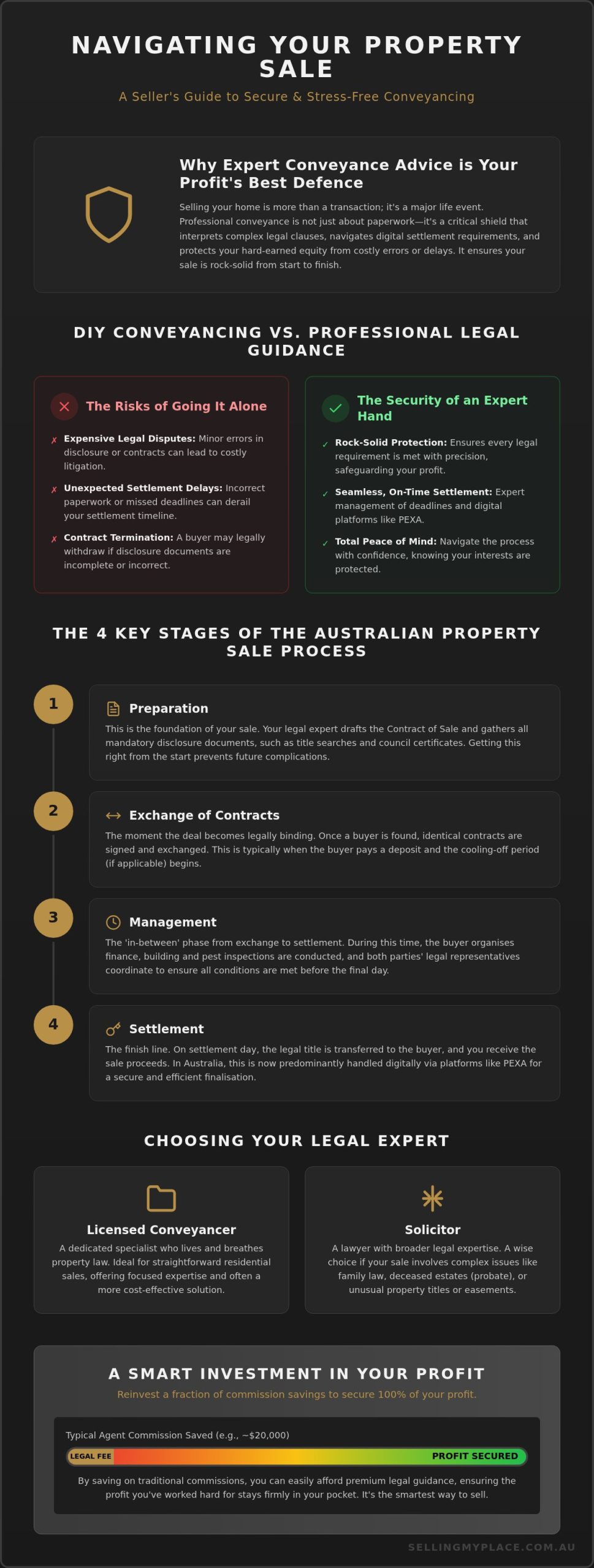
Protecting Your Equity: Legal Guidance for Commission-Free Sellers
When you choose to sell your home without a traditional agent, you’re making a bold decision to prioritise your family’s financial future. Saving an average of $20,000 in commission is a significant win. It changes the way you look at every other part of the process. Suddenly, investing a small fraction of those savings into premium conveyance advice doesn’t feel like a burden; it feels like a strategic reinvestment in your own success. You aren’t just saving money; you’re buying peace of mind. (And let’s be honest, that’s worth every cent.)
This approach gives you a distinct psychological advantage. You become an empowered seller, standing on equal footing with any professional agency. By choosing to lead the sale yourself, you’re taking ownership of your legacy. However, being an independent seller doesn’t mean you have to be a lonely one. Having expert legal backing ensures that your “Sale by owner” journey is perceived by buyers as a sophisticated, professional transaction. It removes the “amateur” stigma and replaces it with a sense of grounded, calm confidence.
Integrating Legal Strategy with Your Marketing Plan
Many sellers wait until they have a buyer to think about the legalities. That’s a mistake. Having your contract of sale ready the moment your listing goes live is a genuine power move. It signals to every person who walks through your door that you are a serious, well-prepared vendor. This level of organisation often translates into faster offers and smoother negotiations because there’s no delay in getting the paperwork to a keen buyer. For a deeper look at how to align your legal prep with your listing, our Modern Australian Seller’s Guide offers a comprehensive roadmap for the contemporary market.
Keeping Your Equity Safe Until the Final Cent is Paid
The legal side of selling isn’t just about the transfer of title; it’s about the math of the final payout. Your advisor ensures that the buyer’s deposit is held securely in a trust account, protecting you from the risk of a deal falling through without recourse. As settlement approaches, they’ll handle the intricate adjustments for council rates, water levies, and land taxes. These small details can add up to thousands of dollars if not managed correctly. Expert conveyance advice ensures that every cent is accounted for, so the profit you calculated on day one is exactly what arrives in your account on settlement day.
If you’re ready to secure your profit and ensure a flawless legal finish, book a consultation with our advisory team today. We’ll help you cross the finish line with the professional support you deserve.
The Kincade Approach: Expert Advisory for a Smooth Settlement
Selling your home independently doesn’t mean you have to wander through the legal wilderness alone. At Selling My Place, we’ve designed a bridge between the traditional agent model and the “For Sale by Owner” experience. This is where our Agent Advisory Service truly shines. We understand that while you’re more than capable of showing your own home and sharing its story, the legal finish line requires a different kind of expertise. Our approach is built on a flat-fee model that prioritises your profit, giving you access to the same professional results as a high-commission agency without the unnecessary overheads.
By facilitating expert conveyance advice through our broader advisory ecosystem, we ensure you have a “steady hand” guiding you through the settlement process. It’s about ensuring that the $20,000 you’ve saved in commission isn’t put at risk by a technicality early in the piece. We’re here to help you navigate the final exchange with the poise of a seasoned professional, ensuring your legacy is protected and your profit is secured. It’s a sophisticated way to sell that keeps you in the driver’s seat while providing a professional safety net.
Beyond the Listing: A Partnership Until Sold
We don’t reckon a “set and forget” approach works for something as important as your family home. Our relationship doesn’t end the moment your listing goes live on the major portals. We view this as a partnership that lasts until the keys are handed over and the funds are in your account. Having a dedicated advisor means you always have someone to turn to when a legal query pops up or when the settlement process starts to feel a bit heavy. This support is designed to facilitate a stress-free transition, allowing you to focus on the emotional significance of your next move rather than the fine print.
Getting Started with Selling My Place
Preparing for a successful transfer starts long before the “Sold” sticker goes on the board. You can tap into our extensive network of professional contacts to find the right legal representative for your specific needs, ensuring they understand the “Selling Smarter” philosophy. When you combine this legal readiness with our Step-by-Step Sale by Owner Guide, you’re setting yourself up for a flawless result. We empower you to take the lead while we provide the professional guidance to back you up. It’s your home, your profit, and your future. We’re just here to make sure the legal side of your journey is as celebratory and smooth as possible.
Step Into Your Next Chapter with Confidence
The sale of your home marks a significant milestone, representing years of memories and hard-earned equity. Ensuring this transition is legally seamless is the final piece of your “Selling Smarter” puzzle. By prioritising expert conveyance advice, you protect your financial interests and gain the peace of mind that comes from a professional, binding settlement. You’ve worked hard to prepare your property for the market; now it’s time to ensure the legal finish line is just as rewarding.
Selling My Place has been trusted by Australians for over 25 years to bridge the gap between independent selling and professional results. Our dedicated Agent Advisory Service provides the steady hand you need to navigate modern digital settlements while you keep 100% of your sale profit. We believe in a partnership approach that values your family’s needs as much as the technicalities of the law.
Ready to finalise your sale with total clarity? Secure your profit and get expert conveyance advice with Selling My Place. We are here to support you every step of the way, ensuring your move is celebratory and entirely stress-free.
Frequently Asked Questions
What exactly does conveyance advice cover for a seller?
This guidance covers the legal preparation of your contract of sale and the mandatory vendor disclosure documents required by law. Your advisor reviews your property title for easements or encumbrances, manages the formal exchange of contracts, and oversees the electronic settlement. Professional conveyance advice ensures you meet all statutory obligations, including the updated 2026 regulations and mandatory identity checks, which are now required for all property professionals to help prevent financial crime.
Can I really do my own conveyancing in Australia?
You can legally manage your own property transfer, but it is a path that carries significant risk. Self-managed sellers often struggle with strict statutory deadlines and the technical complexities of mandatory digital settlement systems like PEXA. If a document is misunderstood or a disclosure is missing, you could face expensive litigation or a voided contract. Most homeowners find that reinvesting a small portion of their commission savings into professional guidance is a much safer way to protect their equity.
How much does professional conveyance advice typically cost in 2026?
For a standard residential sale in late 2026, professional fees generally range between $500 and $3,000 for a licensed conveyancer, while solicitors typically charge from $1,500 upwards. You should also budget between $300 and $800 for disbursements, which cover essential searches and registration fees. While these costs vary depending on the complexity of your title, they represent a tiny fraction of the average $20,000 you save by avoiding traditional agency commissions and high marketing costs.
What is a Section 32 or Vendor Statement, and why is it vital?
This is a mandatory legal document that discloses essential information about your property to potential buyers before they sign a contract. It includes details on zoning, easements, rates, and any building permits issued in the last seven years. It is vital because failing to provide an accurate statement can give the buyer the legal right to withdraw from the sale at any time before settlement, potentially costing you months of progress and your hard-earned profit.
How long does the settlement process usually take from exchange?
A standard settlement period in Australia typically spans 30, 60, or 90 days from the date of exchange. However, the exact timeframe is negotiable and must be agreed upon by both parties before the contracts are finalised. With the mandatory shift to eConveyancing in 2026, the final day of settlement is now much more efficient. Funds are often transferred near-instantaneously once the digital handshake is completed in the secure settlement workspace, reducing the stress of waiting for cheques to clear.
What happens if the buyer pulls out during the cooling-off period?
If a buyer exercises their right to withdraw during the cooling-off period, the contract is cancelled and they usually forfeit a small percentage of the purchase price to you. The exact percentage and the length of the cooling-off period vary between different states and territories. This phase is designed to give buyers a short window for due diligence, so it is helpful to have your advisor ready to restart marketing efforts immediately if a deal doesn’t proceed as planned.
How does Selling My Place support me during the legal process?
We act as your steady hand by providing a dedicated Agent Advisory Service that bridges the gap between listing and settlement. Our team offers pre-sale consulting and expert conveyance advice to ensure your contract is rock-solid before you even find a buyer. We help you navigate the nuances of the 2026 regulations and connect you with our trusted network of professionals, ensuring your “Sale by owner” journey remains professional, legally binding, and completely stress-free for your family.
Do I need a different conveyancer if I am selling commission-free?
No, you don’t need a specialised type of conveyancer, but you do need one who respects your choice to sell independently. Some traditional professionals are accustomed to working only with high-commission agents and may not understand the “Selling Smarter” philosophy. At Selling My Place, we ensure you’re partnered with experts who understand our flat-fee model and are committed to helping you keep 100% of your profit. Our goal is to provide the professional backing you deserve at every stage.
Legal Requirements for Selling a House Privately in Australia: The 2026 Guide
You don’t need a middleman to sign away $20,000 of your hard-earned equity just to move onto your next life chapter. While many feel pressured to hire a traditional agent, selling your own home is a protected legal right in every corner of Australia. We understand that the weight of responsibility can feel heavy; nobody wants to risk a lawsuit or a failed settlement because they missed a state-specific disclosure. Understanding the legal requirements for selling a house privately is the first step toward a confident, successful sale that keeps your profit where it belongs: in your pocket.
It’s natural to feel a bit cautious as property laws become more digital and complex. Whether you’re worried about the mandatory 2026 Edition Contract in NSW or the strict new Seller Disclosure Statements in Queensland, you’re not alone in this journey. This guide provides a clear, professional roadmap to help you handle the 2026 legal landscape with ease. We will preview the essential documents required for each state, explain the updated 15% national withholding tax rules, and show you how to organise a legally sound settlement that protects your family’s future and your legacy.
Key Takeaways
- Confirm your legal right to sell property without an agent in any Australian state, allowing you to take full control of your home’s transition.
- Understand the essential legal requirements for selling a house privately, from preparing the Contract of Sale to providing mandatory vendor disclosures.
- Stay ahead of 2026 regulatory changes, including the new digital-first contract standards in NSW and updated identity verification rules across the country.
- Learn how to manage the exchange and settlement process safely by partnering with professional conveyancing and advisory experts.
- Discover how pre-sale consulting helps you identify and resolve legal or structural issues before they impact your sale price or settlement timeline.
Understanding Your Legal Right to Sell Property Privately in Australia
The idea that you need a real estate agent to sell your home is one of the most persistent myths in the Australian property market. In reality, no state or territory law requires you to use a middleman. You have the absolute right to represent yourself; choosing the “Sale by Owner” path is a legitimate, well-trodden route for thousands of Australians every year. By taking the reins, you’re not just saving on commission. You’re taking full ownership of your family’s transition and financial future.
While you have the freedom to sell, you also carry the weight of professional responsibility. The legal requirements for selling a house privately include a strict duty of care under the Australian Consumer Law (ACL). Essentially, you must avoid any “misleading or deceptive conduct” during your marketing and negotiations. If there’s a structural issue, a boundary dispute, or a known defect, honesty isn’t just the best policy; it’s a legal necessity that protects you from future litigation. We like to think of our role as the “steady hand” beside you. You stay in control of the heart and soul of the sale while we provide the expert advisory infrastructure to ensure every legal detail is handled with precision.
The Role of State Legislation in Property Sales
Property law in Australia is governed at the state and territory level rather than by a single federal body. This means the rules for a sale in one state will differ slightly from those in another. Understanding Your Legal Right to Sell Property Privately requires a look at your local jurisdiction, such as the Sale of Land Act or the Conveyancing Act applicable to your specific region. While the specific forms and certificates change, the core principles of transparency and full disclosure remain the same across the country. Following these local Property Acts ensures your sale stands on firm ground and remains valid from the first inspection through to the final handover.
Why Legal Compliance is Your Best Marketing Tool
Many sellers view legal paperwork as a dry, administrative hurdle to be cleared. We see it differently. A legally robust contract is actually one of your most powerful marketing assets. When potential buyers see a comprehensive disclosure package ready to go, it builds immediate, grounded trust. It shows you’ve been a diligent steward of the property and that you have nothing to hide.
Professional documentation also protects your settlement timeline. By being upfront with all mandatory reports and certificates, you significantly reduce the risk of a buyer “getting cold feet” or finding a reason to withdraw during the cooling-off period. In a 2026 market where buyers are increasingly cautious about high-stakes decisions, providing a smooth, legally sound path to purchase makes your home stand out as a low-risk, high-quality opportunity.
Essential Documents: The Contract of Sale and Vendor Disclosures
The Contract of Sale is the primary legal instrument of your transaction. It’s the document that formally binds you and your buyer together. While it might look like a stack of intimidating fine print, it’s actually a protective shield for both parties. In 2026, many states have moved toward digital-first contracts, such as the mandatory 2026 Edition in NSW, which is designed to streamline the exchange process. Meeting the legal requirements for selling a house privately starts with ensuring this document is current, accurate, and reflects the true state of your property.
Beyond the contract itself, most states require a Vendor’s Statement. A Vendor Statement is a legally binding disclosure of a property’s history and restrictions. In Victoria, this is famously known as a Section 32, while Queensland sellers must now provide a signed Form 2 Disclosure Statement and all prescribed certificates before a contract is signed. These documents ensure the buyer enters the deal with their eyes wide open, which is a vital part of managing legal obligations during a sale.
What Must Be Disclosed to the Buyer?
Transparency is your greatest ally here. You’re legally required to reveal any factors that might affect the property’s value or the buyer’s enjoyment of it. This includes:
- Encumbrances: Any easements, such as a water pipe running through the backyard, covenants, or restrictions on how the land can be used.
- Zoning: Whether the land is residential, commercial, or subject to specific overlays.
- Building Works: Any permits or structural works completed in the last seven years, ensuring they were properly certified.
- Financial Outgoings: A clear breakdown of council rates, water charges, and the 2026 land tax thresholds.
Using professional photography and Residential Property Listing Services ensures your floorplans and property details are perfectly aligned with the physical reality of the home, preventing any claims of misleading conduct.
The Consequences of Non-Disclosure
Cutting corners on disclosures is a risk that simply isn’t worth taking. If a buyer discovers a material fact was hidden or misrepresented, they often have the legal right to rescind the contract immediately. This means they can walk away with their full deposit, even just days before settlement, leaving you back at square one. Beyond a lost sale, you could face significant legal penalties for deceptive conduct. If you’re feeling unsure about which certificates apply to your specific block, it’s always worth reaching out for a bit of expert guidance to keep your sale on the right track.
Navigating State-Specific Regulations and Cooling-Off Periods
While your right to sell is a national constant, the specific legal requirements for selling a house privately change the moment you cross state lines. It’s a bit like local weather; the climate is similar, but you need to know when to pack an umbrella. One of the most significant variations involves the cooling-off period, which acts as a safety net for buyers. In NSW and Queensland, the standard period is 5 business days, whereas Victorian buyers typically have 3 business days to reconsider. If a buyer chooses to withdraw during this time, they forfeit a small portion of the deposit, usually 0.25% in NSW and QLD, or 0.2% in Victoria. In Western Australia, things are a little different, as there’s no mandatory cooling-off period unless you specifically agree to include one in the contract.
Another critical detail often overlooked is the “Warning Statement.” Many jurisdictions require specific, verbatim legal text to be physically present on the front page of the contract. If this statement is missing or obscured, the buyer might gain the legal right to walk away from the deal entirely. Additionally, if your home features a pool or spa, you must ensure a valid safety certificate is attached to the contract. In states like NSW and QLD, selling without a compliant pool fence or the correct certification isn’t just a safety risk; it’s a breach of your legal requirements for selling a house privately that can stall your settlement indefinitely.
Understanding the Cooling-Off Period
Think of the cooling-off period as a statutory “change of heart” clause. It gives the buyer time to finalise their finance or conduct one last building inspection. However, it’s not always set in stone. In NSW, a buyer can waive their right to a cooling-off period by providing a “66W certificate” signed by their solicitor. This is often used in fast-moving markets to make an offer more attractive to a seller. Understanding these nuances helps you manage expectations and ensures you don’t celebrate a “sold” sign before the legal window has officially closed.
The Auction Exception
The rules of engagement shift significantly when you move from a private treaty to an auction. Generally, properties sold under the hammer, or even within a few days on either side of a scheduled auction, carry no cooling-off period at all. This creates a “done deal” the moment the hammer falls, but it also requires stricter compliance with “Bidders Records” and public auction rules. Choosing to move forward with selling your own home via private treaty often allows for more heartfelt, flexible negotiations that auctions sometimes lack. You can take the time to find a buyer who truly values the legacy of your home, rather than just the highest bidder in a high-pressure environment.
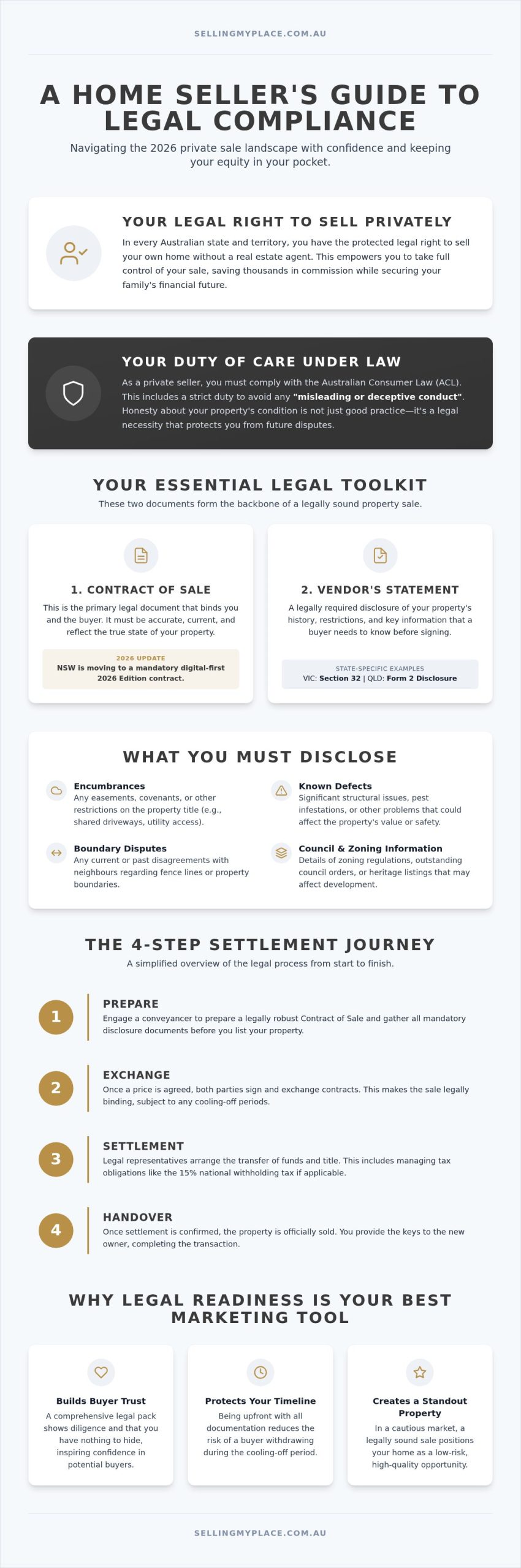
The Settlement Journey: Managing Legal Obligations from Exchange to Handover
Once you’ve accepted an offer and the handshakes are finished, you enter the “exchange of contracts” phase. This is the pivotal moment when your agreement becomes a binding legal reality. The buyer pays their deposit, which is typically 10% of the purchase price. In a private sale, this money must be held in a solicitor’s or licensed agent’s trust account for safekeeping until the deal is finalised. Meeting the legal requirements for selling a house privately means ensuring these funds are handled with total transparency, protecting both your interests and those of the buyer as you move toward the finish line.
The period between exchange and settlement is the home stretch of your sale. It’s a time for finalising paperwork and preparing for the physical move. While the initial marketing and negotiation are in your hands, the final legal transfer requires a specialist touch. This stage is about precision. It’s about ensuring every “i” is dotted and every “t” is crossed so that the ownership transition is as smooth as a quiet Sunday morning. If you’re feeling the weight of these final steps, reach out to our advisory team for expert guidance on managing your settlement timeline.
The Role of Your Conveyancer or Solicitor
While you can market your home, a licensed conveyancer must legally perform the transfer of title. They act as your legal representative in the digital sphere, handling the electronic lodgement through platforms like PEXA. This is mandatory in most Australian states in 2026. Your conveyancer also calculates the final “adjustments.” They work out the pro-rata split for council rates, water charges, and land tax, ensuring you aren’t paying for services after you’ve handed over the keys. This mathematical accuracy is essential for a clean, undisputed settlement.
Preparing for the Handover
The final week of a sale is often filled with a mix of packing and nostalgia. Legally, you’re required to provide “vacant possession” on the settlement date unless your contract specifically includes an existing tenancy. This means the property must be empty, tidy, and all rubbish removed. It’s also the time for the buyer’s final inspection. They have a statutory right to visit the property, usually within a few days of settlement, to ensure it’s in the same condition as when they signed the contract. They’ll check that the inclusions you agreed upon, like that specific chandelier or the dishwasher, are still in place. Managing this transition with a sense of calm and professional decorum ensures the legacy of your home is passed on with grace and goodwill.
How Kincade International Direct Sales Simplifies the Legal Process
Selling your home is a deeply personal transition, and while the legal side can feel a bit daunting, you don’t have to walk that path alone. We believe that every Australian should have the right to sell their own property with the confidence of a seasoned professional. Our Real Estate Advisory Services act as a vital bridge; they give you the autonomy of a private sale with the expert backing typically reserved for high-end agencies. By partnering with us, you’re ensuring that the legal requirements for selling a house privately are met with a steady hand and a meticulous eye for detail.
Our Pre-Sale Property Consulting is designed to catch potential legal or structural hiccups before they ever reach a buyer’s solicitor. We help you look at your home through a regulatory lens, identifying things like uncertified works or boundary questions that could otherwise derail a settlement. When we provide professional photography and detailed floorplans, we aren’t just making your listing look beautiful. We’re providing the visual proof that supports your mandatory disclosures, ensuring your marketing is as honest as it is inviting. This proactive approach reduces the stress of high-stakes decision-making and allows you to focus on the emotional significance of your move.
The most rewarding part of this partnership is the financial freedom it creates. By removing the traditional agency commission, our sellers save an average of $20,000. This is a significant sum that stays where it belongs: in your pocket, ready to fund your next chapter or secure your family’s legacy. We provide the professional infrastructure, you keep the profit.
Expert Backing for Every Private Seller
You’ll have access to comprehensive neighbourhood market reports, giving you a price point that is both realistic and legally defensible during negotiations. Our global marketing network ensures your property is “Listed Until Sold,” providing a sense of security that doesn’t come with a ticking clock. Having a “Steady Hand” advisor by your side means you can navigate the emotional highs and lows of negotiation with a grounded, calm perspective. We’re here to ensure you feel understood and protected throughout the entire journey.
Starting Your Commission-Free Journey
Taking control of your sale is a powerful way to honour the legacy of your home while embracing a new future. We invite you to look through our flat-fee packages, which incorporate essential conveyance advice to keep your journey legally sound from start to finish. You deserve a sale process that is as respectful and rewarding as the time you’ve spent in your home. It’s time to move forward with confidence and clarity. Explore our commission-free marketing and advisory packages today.
Step Into Your Next Chapter with Confidence
You’ve now seen that the legal requirements for selling a house privately are entirely manageable when you have the right roadmap in place. By taking charge of your own sale, you’re choosing a path that respects both your property’s legacy and your financial future. Remember, while the paperwork requires precision, you don’t have to navigate the 2026 landscape alone. From preparing the mandatory disclosures to finalising the digital settlement, the process is designed to protect your interests just as much as the buyer’s.
Why hand over a massive chunk of your equity when you can keep it? Our sellers save an average of $20,000 per sale by opting for our commission-free, flat-fee model. With our Expert Agent Advisory Service included, you get the professional safety net you need without the high marketing costs. Save thousands in commission—sell your home with Kincade International Direct Sales today.
You’ve built a life in your home; now it’s time to reap the full rewards of that hard work. We’re here to be the steady hand that guides you home.
Frequently Asked Questions
Do I legally need a real estate agent to sell my house in Australia?
No, you don’t need a real estate agent to sell your home in any Australian state or territory. The law protects your right to represent yourself as a private vendor. While you must still meet the same legal requirements for selling a house privately as an agency would, you have total control over the marketing and negotiation. Many families find this path more rewarding, both emotionally and financially, as they move toward their next chapter.
What is a Section 32 and is it required for a private sale?
A Section 32, also known as a Vendor Statement, is a mandatory legal document in Victoria that must be provided to a buyer before they sign the contract. It doesn’t matter if you’re selling with an agent or doing it yourself; the requirement remains the same. This statement discloses vital information like land use, outgoings, and easements. It’s a key part of ensuring your sale is transparent and legally binding under Victorian law.
Can I write my own Contract of Sale for a property?
While you could technically draft a document, it’s highly recommended to use a legally compliant template or have a professional prepare it. In states like NSW, the mandatory 2026 Edition Contract for Sale is the required standard for all transactions. Using a professionally drafted contract ensures you’re meeting the legal requirements for selling a house privately without leaving yourself open to technical errors that could allow a buyer to walk away from the deal.
How long is the cooling-off period for a private house sale?
The length of the cooling-off period depends entirely on your property’s location. In NSW and Queensland, buyers generally have 5 business days to change their minds, while in Victoria, the period is 3 business days. It’s important to remember that these periods only apply to private treaty sales, not auctions. Knowing these timelines helps you manage the emotional transition of the sale with a clear, grounded perspective on when the deal is final.
What happens if I make a mistake in the legal disclosures?
If you provide incorrect information or fail to disclose a material fact, the buyer may have the legal right to rescind the contract. This often means they can exit the sale and have their full deposit returned, even shortly before the settlement date. In some cases, you could also face legal penalties for misleading conduct. This is why having a steady hand and expert advisory backing is so valuable for private sellers who want to avoid these high-stakes risks.
Is the process of settlement different when selling without an agent?
The settlement process itself remains exactly the same whether you use an agent or sell privately. Your solicitor or conveyancer will still use the PEXA platform to handle the electronic transfer of title and the distribution of funds. The only difference is that you’ve managed the marketing and negotiation yourself. You still get the same professional security during the final handover, ensuring the legal transition of your home is smooth, certain, and celebratory.
Can a buyer waive their cooling-off rights in a private sale?
Yes, a buyer can choose to waive their cooling-off rights, which is often done to make their offer more competitive in a fast-moving market. In NSW, this is achieved through a 66W certificate signed by the buyer’s solicitor. In other states, specific forms or contract conditions may be used to achieve the same result. This can provide you with more certainty earlier in the process, though it’s a decision the buyer must make with their own legal advice.
Who holds the deposit when I sell my house privately?
The deposit must be held in a secure trust account, usually managed by your solicitor or conveyancer. Legally, you cannot hold the deposit in your personal bank account. This ensures the funds are protected for both parties until the settlement is successfully completed. Once the handover is finished, the trust account manager will release the funds to you, minus any agreed adjustments for rates or taxes. It’s a simple, secure way to handle the final financial exchange.
Private Property Sale Contract Australia: A Guide for Independent Sellers
What if the only thing standing between you and a successful, commission-free sale isn’t a lack of expertise, but a simple stack of paperwork? Selling your family home is a deeply personal milestone, and it’s completely natural to feel a flutter of nerves when navigating a private property sale contract australia for the first time. You might worry that without a traditional agent, you’re leaving yourself open to legal pitfalls or that the state-specific terminology is just too dense to untangle. We understand that this isn’t just a transaction; it’s the start of your next chapter, and you want to ensure every detail is handled with care and precision.
The good news is that you don’t need to pay a premium for professional protection. You can take full control of your journey while staying firmly on the right side of the law. This guide will walk you through the essential components of a valid agreement, from the latest 2026 NSW cooling-off notices to the mandatory Queensland disclosure statements. We’ll preview exactly how to organise your documentation and understand your local obligations, so you can move forward with the calm confidence of a seasoned pro and keep your hard-earned equity where it belongs.
Key Takeaways
- Learn why the timing of your paperwork is vital, particularly in states like NSW where you must have your contract ready before you even list the property for sale.
- Master the essential components of a private property sale contract australia to ensure your legal names and Title References are documented correctly from the start.
- Navigate complex state-specific disclosure rules, such as Victoria’s Section 32, to protect your interests and provide complete transparency to your buyer.
- Gain the confidence to manage initial offers and holding deposits independently, allowing you to negotiate special conditions without a middleman.
- Discover how expert advisory support can bridge the gap between signing the contract and reaching a successful settlement day.
What is a Private Property Sale Contract in Australia?
Think of your sales contract as the legal roadmap for your entire selling journey. It is far more than just a formal piece of paper; it is the foundation of your legacy and the document that ensures your home’s transition is handled with the respect it deserves. In the Australian property market, this agreement establishes the ground rules between the Vendor (that’s you, the seller) and the Purchaser (the buyer). While it might feel like a final step, a private property sale contract australia is actually your very first priority. In states like New South Wales, it’s a legal requirement to have this document prepared before you even put your home on the market. Having it ready to go gives you a “steady hand” during negotiations, projecting a sense of professional authority that puts buyers at ease and reduces your own stress levels.
This document initiates the formal conveyancing process, which is the legal transfer of land title from one person to another. By preparing early, you aren’t just ticking a box; you’re taking control of the narrative. You’ll know exactly what you’re offering, what stays with the property, and what the timeline looks like, long before the first viewer walks through your front door.
Private Treaty vs. Auction Contracts
Most independent sellers choose a Private Treaty sale because it offers a more personal, measured pace. Unlike an auction where the hammer falls and the deal is final, a private treaty allows you to invite offers and negotiate on your own terms. This method provides a wonderful emotional benefit: you maintain control over who buys your home and under what conditions. It’s a partnership-based approach that feels less like a high-stakes gamble and more like a thoughtful consultation. You have the flexibility to adjust settlement dates or include specific clauses that an auction simply wouldn’t permit.
The Cooling-Off Period Explained
The cooling-off period is a standard feature of most private sales across Australia, acting as a short safety net for the buyer. Typically, this lasts between 3 and 5 business days, depending on your state. For instance, buyers in New South Wales and Queensland generally enjoy 5 business days, while those in Victoria have 3. It’s vital to remember that these rights don’t apply at auctions or if a property is passed in but sold on the same day. In some cases, particularly in NSW, a buyer might provide a “Section 66W” certificate. This document, signed by their solicitor, waives the cooling-off period entirely, making the contract unconditional from the moment it’s signed. Understanding these nuances helps you manage your expectations and stay grounded during the final stages of the deal.
Essential Components of a Valid Sales Contract
Precision is your best friend when drafting a private property sale contract australia. While the document marks the financial end of your time in a home, it’s also the legal shield that protects your interests until the keys change hands. To ensure the agreement is binding and robust, you must start with the basics: the full legal names of all parties. It sounds simple, but ensuring these match the Title exactly is crucial. If you’re selling as a couple or through a trust, every detail must be mirrored in the contract. You’ll also need to clearly state the agreed purchase price and the deposit requirements, which is typically 10% of the sale price held in a trust account, though this can be negotiated to suit both you and your buyer.
The property itself needs a flawless description. This goes beyond the street address. You must include the Title Reference and Land ID (Lot and Plan numbers) to ensure there’s no ambiguity about what’s being sold. Finally, the settlement timeframe, whether it’s 30, 60, or 90 days, provides the heartbeat of the transaction, giving both parties a clear date to work toward. Gaining a deep understanding of the nuances of the private sale process ensures you don’t miss these critical details, allowing the transition to feel like a shared success rather than a legal hurdle.
Mandatory Disclosure Documents
Transparency is the cornerstone of a stress-free sale. In Australia, you’re legally required to provide specific documents that prove you have the right to sell and inform the buyer about the land’s status. A current Title Search is non-negotiable; it’s the proof of your ownership. You’ll also need Zoning Certificates, such as a Section 10.7 in NSW, which tells the buyer what the land can actually be used for. Don’t forget to highlight any easements or covenants. If there’s a shared driveway or a restriction on building heights, disclosing this early prevents a buyer from pulling out later. These documents aren’t just red tape. They’re tools that build trust and protect you from future claims of non-disclosure.
Chattels and Fixtures: What Stays and What Goes?
The backbone of a solid private property sale contract australia is accuracy, especially regarding the physical items in the home. Disputes often arise over “grey area” items like dishwashers, custom-made curtains, or that heirloom light fitting in the dining room. As a rule of thumb, fixtures are items “fixed” to the property (like a built-in oven), while chattels are moveable (like a fridge). To avoid settlement day surprises, be explicit. If you plan to take the designer pendant lights with you, list them as exclusions. If the garden shed stays, list it as an inclusion. If you’re feeling unsure about how to categorise your belongings, you can always reach out for a guiding hand to clarify these final details.
State-Specific Requirements and Disclosure Rules
Navigating a private property sale contract australia requires an understanding that our states don’t always play by the same rules. It’s like a neighbourly chat where the dialect changes just slightly as you cross the border. While the heart of the transaction remains the same, the legal requirements for disclosure vary significantly depending on where your property is located. In New South Wales, the law is quite firm: you must have a draft contract prepared before you even put up a “For Sale” sign or share a photo online. This isn’t just about red tape; it’s about ensuring every potential buyer has the full story from the very first minute, protecting you from claims that you’ve withheld vital information.
Down in Victoria, the Section 32 Vendor Statement is your most important companion. This document discloses everything from land tax and rates to building permits and encumbrances. Failure to include a complete and accurate Section 32 can be a deal-breaker. Checking the latest private sale contract requirements will help you stay on top of these local nuances and ensure your paperwork is beyond reproach. Queensland sellers typically use standard REIQ contracts, but these must include a specific “Warning Statement” to be valid. Meanwhile, in Western Australia, the process revolves around the “Offer and Acceptance” (O&A) system, where the contract is formed when you formally accept a buyer’s written offer on a prescribed form.
The Consequences of Non-Disclosure
What happens if a document is missing or a detail is incorrect? It’s not just a minor hiccup. A missing disclosure can give a buyer the legal right to rescind the contract, meaning they can walk away and take their deposit with them, often right up until the day of settlement. You could also face legal penalties for providing misleading information, even if it was an honest mistake. Essentially, vendor disclosure serves as a vital legal safeguard that protects the seller from future disputes by ensuring total transparency from the outset.
Navigating Regional Variations
Because these rules are so specific to each state, hiring a local expert is a wise move even if you are managing the marketing yourself. State laws even impact how you can handle an “off-market” listing or a pre-sale consultation. Seeking professional Conveyance Advice is the best way to ensure your specific sale is compliant with local regulations. This regional expertise provides the steady hand you need to manage the complexities of the private property sale contract australia, giving you the freedom to focus on finding the right buyer for your home’s next chapter.
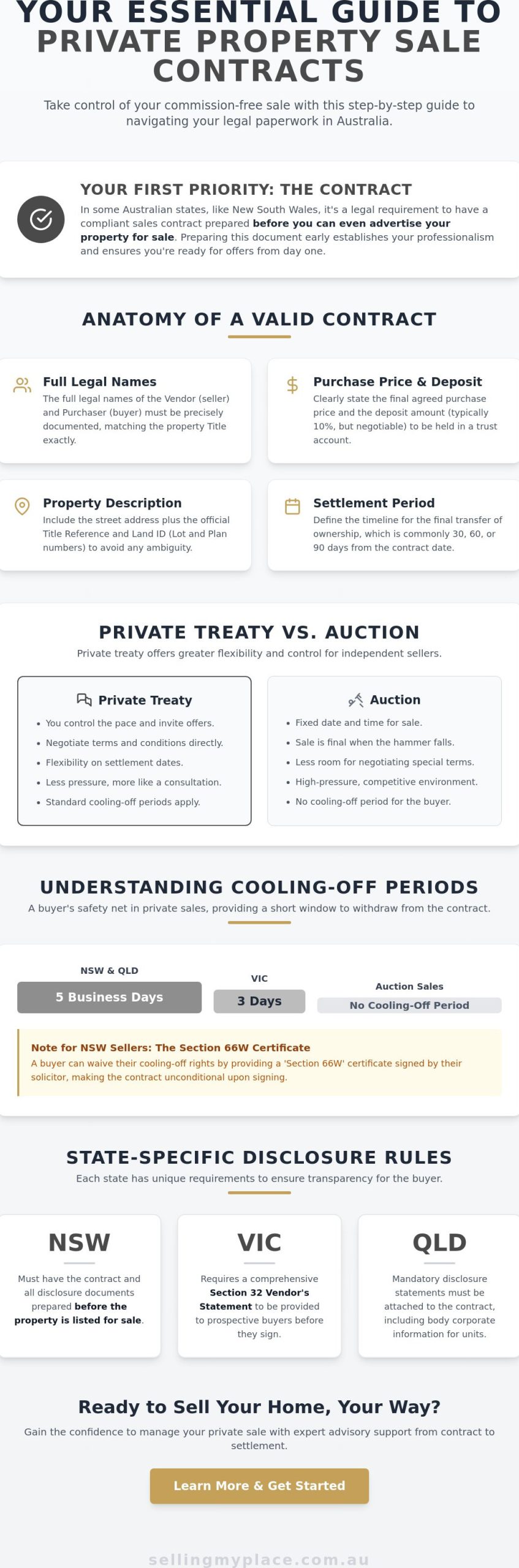
Managing the Contract Process Without a Traditional Agent
Taking the reins of your home sale is an empowering choice. You don’t need a middleman to facilitate a genuine conversation between two parties who both want the same thing: a fair and transparent transition. When an offer comes in, it is often accompanied by a small holding deposit. This isn’t a legal requirement, but it is a lovely way for a buyer to say, “We are serious about your home.” Because you have already prepared your private property sale contract australia, you can respond with speed and clarity. This is particularly effective for off-market property buyers who appreciate a streamlined, professional approach without the usual fanfare. It shows you’re ready to do business.
Today, the process is smoother than ever thanks to eConveyancing platforms and digital signature tools. You can exchange documents in minutes, keeping the momentum high while you and the buyer are still in that “celebratory” mindset. If the technical side feels like a lot to juggle, you can always book a consultation with a property advisor to ensure your digital exchange is as secure as a traditional handshake. This modern approach doesn’t just save time; it provides a clear, digital audit trail that protects everyone involved.
Common Special Conditions to Consider
Negotiation is really just a series of “what ifs” that help both parties feel secure. Most buyers will request a “Subject to Finance” clause, giving them a window; typically 14 days; to finalise their mortgage approval. You will also frequently see “Subject to Building and Pest Inspection.” These aren’t hurdles to be feared. They are simply steps that give the buyer the peace of mind they need to commit. For your own protection, you might consider a sunset clause. This ensures that if the buyer doesn’t meet their conditions by a specific date, you are free to return the property to the market without delay.
The Exchange of Contracts
The term “exchange” is exactly what it sounds like. Two identical copies of the private property sale contract australia are signed; one by you and one by the purchaser; and then physically or digitally swapped. This is the pivotal moment when your home moves from being “Under Offer” to “Sold.” It is also when the full deposit, usually 10%, is paid. This money isn’t paid directly to your bank account just yet. Instead, it is held safely in a regulated trust account by a solicitor or conveyancer, acting as a stakeholder until the final settlement day arrives.
Moving from Contract to Settlement with Expert Support
Once the ink is dry on your private property sale contract australia, you enter the home stretch. This period, typically spanning 30 to 90 days, is a time of transition and preparation. You’ll likely host a building and pest inspector; remember, they are simply doing their job to ensure the buyer feels as secure in their decision as you do. Then comes the final pre-settlement walkthrough, usually occurring 24 to 48 hours before the keys change hands. It’s a final chance for the buyer to see that the home is in the same condition as when they signed. Approach this with a spirit of hospitality; it’s the final handover of your property’s legacy to its new keepers.
You don’t have to walk this path entirely alone. While you’ve chosen the independent route, our Real Estate Advisory Services act as a vital bridge, providing the expertise of a seasoned guide without the intrusive pressure of traditional commissions. This “steady hand” approach ensures that if a minor hiccup arises during the settlement period, you have a professional partner to consult. It’s about having the best of both worlds: the freedom of a private sale and the security of expert backing. This Agent Advisory Service ensures you stay grounded and confident until the final cent is transferred.
The financial benefit of a commission-free sale is often the difference between a good result and a life-changing one. By managing your own private property sale contract australia, you retain tens of thousands of dollars that would otherwise disappear into high marketing costs and agency fees. It’s a celebratory moment when you realise that your personal effort has directly contributed to your family’s next chapter. There is a deep sense of pride in navigating this process yourself, knowing you’ve protected your equity through a successful, self-managed outcome.
Professional Advisory vs. High Commissions
Why pay 2% or 3% of your home’s value when a flat-fee model offers a much better return on investment? By opting for Pre-Sale Property Consulting and professional Floorplans, you present your home in its best light while keeping your hard-earned equity. It’s a strategic choice that values your financial future over an agent’s overheads. Our philosophy is simple: we provide the professional backing you need without the hefty price tag, ensuring you feel supported but always in the driver’s seat.
Your Next Steps to a Successful Sale
Preparation is the key to a calm and efficient settlement. Start by organising your paperwork early to avoid last-minute dashes to the solicitor. Combining savvy Sale by owner strategies with high-quality photography and professional listing services ensures you attract the right buyers from the start. You’ve got the tools, the knowledge, and the heart to make this happen. Ready to take the lead? Start your commission-free journey today and see how rewarding a self-managed sale can truly be.
Your Path to a Confident and Profitable Sale
Taking the lead on your home sale is a powerful way to honour the life you’ve built within its walls. You’ve now gained a clear understanding of how to navigate state-specific disclosure rules, identify the essential components of a valid agreement, and manage the transition from offer to settlement. Successfully handling a private property sale contract australia is the final piece of the puzzle that allows you to step into your next chapter with your equity fully intact. It’s about more than just paperwork; it’s about the pride that comes from a job well done.
You don’t have to navigate the final steps alone. With average seller savings of $20,000 and our Expert Agent Advisory Service included in every package, you can bypass hidden commissions and restrictive time limits entirely. We’re here to provide the steady hand and professional support you need to ensure your journey is as smooth and rewarding as possible. Sell your home smarter and keep 100% of your profit with our flat-fee packages. You have the knowledge and the heart to make this a success, and we’re excited to see you flourish in your next adventure.
Frequently Asked Questions
Can I write my own property sale contract in Australia?
You can technically draft your own agreement, but it’s a bit like performing surgery on yourself. A private property sale contract australia must adhere to strict state legislation, such as the 2026 Law Society edition in NSW, to be legally binding. Most independent sellers use a solicitor or conveyancer to ensure all prescribed documents are included. This professional touch protects you from a buyer rescinding the deal later due to a technicality.
How much does it cost to have a contract of sale prepared?
The cost of preparing your documentation depends on the complexity of your land and the required disbursements. Disbursements are the fees paid to government agencies for title searches, zoning certificates, and drainage diagrams. While we don’t quote specific legal fees, you’ll find that investing in professional contract preparation is a small fraction of the cost you’d save by avoiding traditional agent commissions. It’s an investment in your peace of mind.
What is the difference between a contract of sale and a vendor statement?
Think of the contract as the “how” and the vendor statement as the “what.” The contract outlines the agreed price, names, and the timeline for the transition. The vendor statement, known as a Section 32 in Victoria, discloses the property’s history; things like rates, building permits, and any easements. Both documents are essential for a transparent transaction, ensuring the buyer has all the facts before they commit to the purchase.
Does a private sale contract need to be witnessed by a lawyer?
A lawyer doesn’t need to witness your signature, but an independent adult usually must. This person should be someone who isn’t a party to the sale. With the recent shift toward digital platforms, many contracts are now signed electronically using secure verification methods. This modern approach makes the process much more accessible for families managing their own sale, allowing you to sign from the comfort of your own living room.
What happens if a buyer pulls out of a private sale contract?
If a buyer pulls out during the cooling-off period, they’ll typically forfeit a small penalty, such as 0.25% of the purchase price in NSW or Queensland. However, once the contract becomes unconditional, the consequences are much more serious. They would likely lose their entire 10% deposit. You may also have the legal right to seek further compensation if the property eventually sells for a lower price than the original agreed amount.
Can I sell my house privately if I still have a mortgage?
Yes, selling with an existing mortgage is a very common part of the Australian property landscape. Your conveyancer or solicitor will coordinate a “discharge of mortgage” with your bank. On settlement day, the bank is paid the outstanding balance directly from the sale proceeds. The remaining equity is then transferred to your account. It’s a seamless process that your legal team manages behind the scenes while you focus on your move.
Is a verbal offer legally binding in Australian real estate?
No, a verbal offer is never legally binding in any Australian state or territory. Even if you’ve agreed on a price and shaken hands, nothing is final until a written private property sale contract australia is signed by both parties and formally exchanged. This requirement for a written agreement is a vital protection for you, ensuring there’s no confusion about the terms or conditions before the deal becomes official.
What is the standard settlement period for a private property sale?
There is no single “standard” timeframe, but 30, 60, or 90 days are the most frequent choices. In New South Wales, a 42-day settlement is quite traditional, but the beauty of a private sale is the flexibility it offers. You can choose a date that aligns with your family’s needs, whether you want a quick 21-day turnaround or a longer period to organise your next home. It’s all about what works best for your transition.
