Online Property Appraisal Tools and How Accurate Their Price Estimates Are
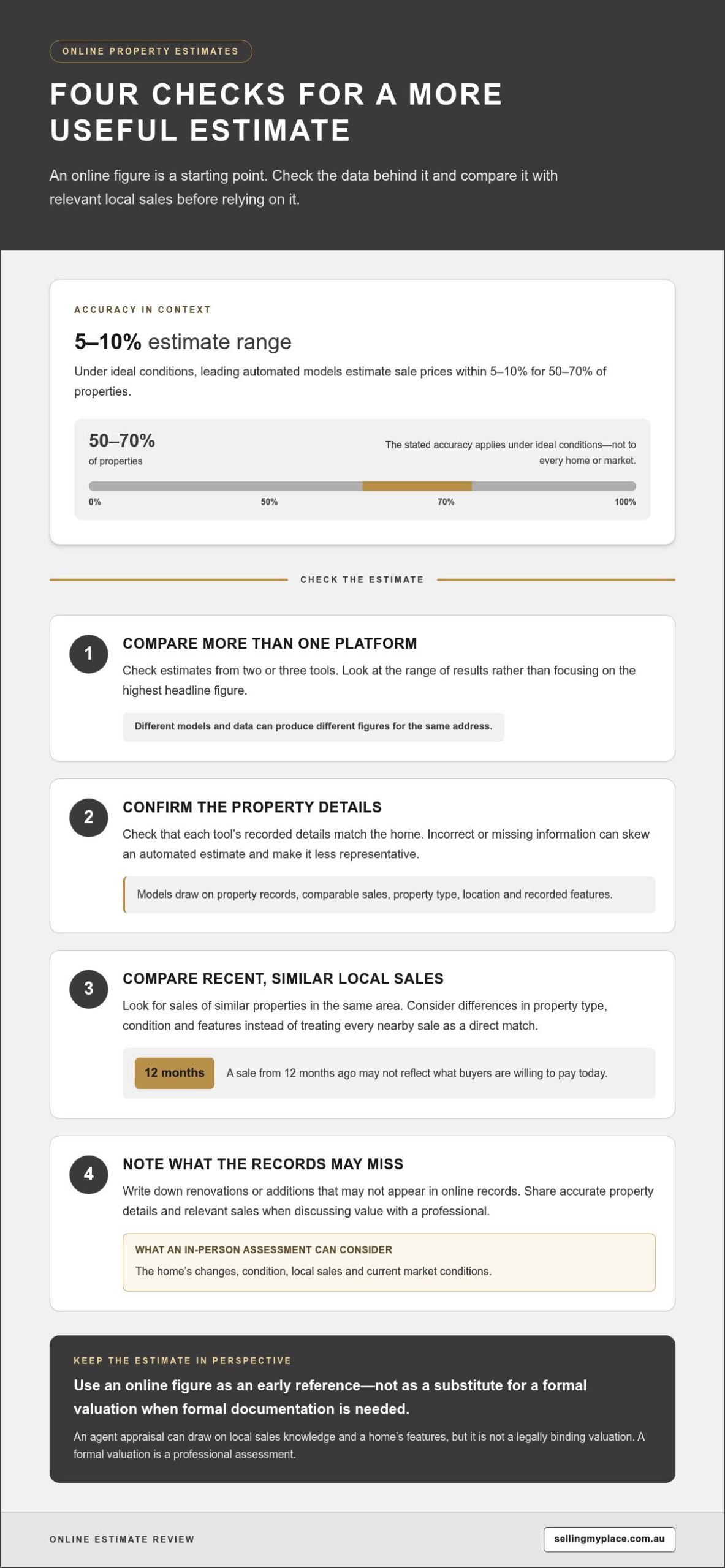
A quick online estimate is a starting point, not a definitive price. Under ideal conditions, leading automated models estimate sale prices within 5-10% for 50-70% of properties. That’s the practical limit of the accuracy of online property appraisal tools: useful for a first indication, but not a substitute for an assessment that accounts for a home’s individual features and current local conditions.
It makes sense to want a clear figure before making a major property decision. Online calculators are quick and convenient, but their accuracy depends on the property data and comparable sales available. The right option depends on how precise and formal the answer needs to be.
This guide explains how Australian online property calculators produce estimates, why their results can differ, and when those figures are useful. You’ll also learn how online estimates compare with paid valuation options, so you can choose the right next step.
Key Takeaways
- Use an online estimate as an initial guide: under ideal conditions, leading automated models estimate sale prices within 5-10% for 50-70% of properties.
- Compare estimates from more than one tool and look at the range, not just the highest figure.
- Understand what a formal valuation adds: an assessment can account for a home’s condition, renovations and features that automated data may miss.
- Compare costs with the purpose of the valuation: paid desktop reports and certified valuations serve different needs and have different price ranges.
- Allow for less reliable estimates when comparable sales are scarce or a home is an apartment, prestige property or otherwise unusual.
How accurate are online property valuations?
Online valuations offer a fast indication, but their accuracy depends on the available property data and comparable sales. Under ideal conditions, leading automated models estimate sale prices within 5-10% for 50-70% of properties.
For Australian homeowners, the key is knowing what each estimate can support. An online figure can help you start planning a sale, but it is not a substitute for a formal valuation when you need one.
Comparing Estimates and Professional Valuations
An online estimate is an automated guide, an agent appraisal draws on local sales knowledge, and a formal valuation is a professional assessment of a property’s value. Knowing the difference helps you use the right figure for the decision ahead.
Online platforms return instant estimates; agent appraisals can reflect recent local sales and a home’s particular features. However, an agent appraisal is not a legally binding valuation. A formal valuation may include an in-person assessment, considering condition, renovations, location and nearby amenities. It can take 7-14 days, rather than arriving instantly.
A seller, for example, can use an online figure as an early reference, then discuss comparable sales with an agent. If a buyer needs a formal valuation, they should engage a registered valuer. A quick estimate may not be suitable for decisions that require formal documentation.
How Automated Models Estimate Property Values
Automated valuation models use property records, recent sales and market trends to estimate value. In Australia, a model looks for comparable properties, then uses their sale prices alongside details such as property type, location and recorded features.
The result depends on the quality and relevance of those inputs. A standard home in an active market may have plenty of recent comparable sales. An estimate based on incorrect property details or older sales may be less representative. Different platforms can also use different models and data, producing different estimates for the same address.
One tool might give more weight to nearby sales, while another focuses more on broader market trends. Neither instant result captures every detail a person could assess during an inspection. Online property appraisal tools are only as useful as the data they can access and the way their models interpret it.
Checking and Improving an Estimate
Check an online estimate by comparing results from two or three platforms and reviewing the range, rather than focusing on one headline figure. Confirm that the property details shown by each tool match the home, as incorrect records can skew an estimate.
Then compare the estimate with recent sales of similar properties in the same area. Look for meaningful differences in property type, condition and features, rather than treating every nearby sale as a direct match. A sale from 12 months ago may not reflect what buyers are willing to pay today.
To prepare for professional advice, note renovations or additions that may not appear in online records. An in-person assessment can consider those changes alongside local sales and current market conditions. The online figures remain useful context, but presenting accurate property details and relevant examples gives a professional a clearer starting point for discussing value.
What is an online property value calculator?
An online property value calculator uses recorded property details and sales data to generate an automated estimate. Australian homeowners can use one for a quick indication, but formal valuations serve a different purpose and involve a more detailed assessment.
Automated Models and Professional Appraisals
An automated model calculates an estimate from property records and comparable sales, while a professional appraisal applies human assessment to the property and its local market. A quick estimate and a formal report are not interchangeable.
Australian banks use automated valuation models and recent market data, including comparable sales, property features and location trends. For refinancing, a professional bank valuation is necessary. For some Australian home loan applications, a valuer may inspect the property in person before preparing a formal valuation.
Most mortgage lending, estate settlements, divorce proceedings and court cases require valuation reports from licensed professional appraisers. These reports must meet documentation and credibility standards. A calculator can help homeowners understand an indicative figure, but it doesn’t provide that formal report. For property owners managing overseas assets or UK investments that require formal documentation, professional valuation firms such as Winfields Surveyors London offer the certified, on-site assessments needed to satisfy legal and financial requirements.
Generating Online Valuations in Australia
Online property valuation algorithms analyse recent sales, property characteristics, location and market trends to estimate value. They compare the home with properties that share relevant features, then process the available information through an automated model.
For example, a calculator may use recorded land and building details alongside recent sales in the area. If the records accurately describe the home and comparable sales reflect current conditions, the model has more relevant inputs. Missing or incorrect details can make its estimate less representative of the property as it stands.
Some platforms combine automated valuation models with comparative market analysis and, at times, input from real estate professionals. The mix varies between tools, so homeowners may see different results for the same address. An online figure remains an estimate, not a formal property valuation.
Free Online Valuation Tools
Free online tools are typically calculators on property portals that return an instant automated estimate. They offer an accessible starting point without requiring a formal report.
That convenience is useful when exploring a possible sale or tracking broad market trends. A calculator may show a range or a single figure, based on the property information and sales data available to its model. Treat the result as a guide, not as a documented valuation for lending or legal matters.
For a practical comparison, enter the same address and property details into more than one platform. Review the estimates together and note differences in the data shown. A spread between results can signal that the tools rely on different records or methods.
How Often Valuations Are Updated
Australian online valuations are refreshed as platforms add property records and sales data, but update timing varies between tools. There is no single schedule shared by every calculator.
Check when an estimate was generated and consider whether its comparable sales reflect current market conditions. A sale from 12 months ago may not represent what buyers would pay today, particularly if local trends have shifted.
Before a sale decision, use the online figure as context alongside recent comparable sales and property details. For guidance on how estimates fit into a selling decision, discuss your property sale plans.
Limitations of automated valuation algorithms
An instant estimate reflects the records and comparable sales available to a model, not a physical inspection. Missing property details, market movement and distinctive features can all affect the result.
Accuracy Limits of Automated Algorithms
Automated algorithms find patterns in recorded sales and property information, but they cannot assess every factor that influences buyers. Incorrect details in property databases can skew an automated valuation or comparative market analysis. A home’s condition, visual appeal and recent maintenance may also be difficult to capture in records.
Renovations are a clear example. An algorithm may not know about a $100,000 kitchen renovation if the improvement isn’t recorded, so its estimate may not reflect the home as it stands. Models also don’t physically inspect properties or capture buyers’ emotions and impulses, which can influence what they’re willing to pay.
Market timing presents another limitation. A sale from 12 months ago may not reflect what buyers would pay today, and an online estimate may not immediately respond to market shifts or location-specific changes. Treat the output as a data-based guide, not a complete answer to the question of what a particular buyer might offer.
Comparative market analysis has its own blind spots. A comparison may miss differences in site size, garage size, outbuildings, accessory dwelling units or property condition. For example, two homes with similar recorded floor areas may have different outdoor spaces or upkeep needs, which can affect their estimated values.
Estimates for Regional and Unusual Properties
Estimates are generally more useful for standard homes in active markets, where abundant comparable sales give a model relevant examples. In a regional area with fewer recent sales, an algorithm may have less closely matched evidence, making its comparison less specific to that home and location.
Apartments can also differ in ways that headline records do not capture. Condition, layout and features may affect value, while a sale from another apartment nearby may not be a close match. The model can only weigh distinctions represented in its data.
Prestige and unique homes are harder to value online because distinctive attributes may have no close comparable. Unusual design, extensive grounds or special additions may not fit patterns drawn from standard property sales. A human assessment can consider characteristics an algorithm may not recognise.
Use the estimate as a prompt for closer comparison: review the recorded property details, then consider whether the sales used resemble the home in condition, features and setting. This helps show where the model’s evidence is strong and where it may leave important differences out.
Costs of professional appraisals and online tools
Online calculators provide instant property estimates, while paid valuation services offer different levels of detail. In Australia, the cost depends on the assessment type and its purpose. Weigh the fee against what the valuation needs to establish, such as a sale guide or formal report.
It uses available property information and sales evidence without an in-person inspection, making it a lower-cost option than a detailed report. The trade-off is scope: a desktop assessment may not capture physical features or condition that become clear during an inspection.
These can provide more analysis than a basic desktop assessment, but paid desktop valuations are not legally binding. This matters if you need a valuation for a formal lending or legal purpose, rather than a more informed estimate of value.
These ranges describe different categories of professional work, so they should not be treated as interchangeable quotes. A formal assessment may involve an inspection and a more detailed report than a desktop estimate.
Timing also forms part of the comparison. Automated property appraisal systems return instant results, while professional appraisals typically take 7-14 days. For an owner weighing a sale, an instant figure can help with early planning; a professional report takes longer but can consider property details beyond a calculator’s records.
For example, a homeowner could begin with online estimates to understand the broad range, then decide whether a paid desktop report or formal valuation fits the next step. If refinancing, an estate settlement, divorce proceedings or a court case is involved, the required documentation can make a professional report more suitable than an instant calculator result.
A real estate agent can also use recent local sales and past sale prices to estimate a property’s value. That appraisal offers market context for selling, but it is not a legally binding valuation. Its usefulness depends on the current market, comparable properties and the home’s features. For sellers managing residential assets overseas, such as in the UK, regional specialists like Taylors Estate Agency show how local expertise captures nuances that automated systems often miss.
Compare each option by asking what evidence it includes, whether it involves an inspection, and what the report is intended to support.
In short, online estimates suit quick orientation, while paid reports provide more analysis. Match the cost and turnaround time to the decision: an initial selling plan may need market context, while formal lending or legal matters can require a professional valuation report.
How accurate are online property estimates in regional areas and for apartments or unusual homes?
Online estimates are most useful when a property has close comparables and the market has regular sales. Homes with fewer direct matches, including apartments and distinctive properties, may have less relevant evidence behind their estimates. Judge the figure against the type of property and sales data the model uses.
When nearby sales are scarce, a calculator may draw on sales from a wider area. But properties in different localities can vary in access to services, infrastructure and buyer demand. A sale elsewhere may offer context without reflecting the appeal or setting of the specific property.
Consider two houses with similar recorded floor areas. One might be near local amenities, while the other has a larger site or different condition. An automated model can only account for details in its records, so a broad comparison may be less meaningful. Recent sales of similar property types in the same locality are a more relevant reference.
Apartments bring another comparison challenge. A nearby sale may be in the same building but differ in layout, condition or outlook. Comparative market analysis can also miss differences in site size, garage size, outbuildings, accessory dwelling units and property condition. Compare like with like, including the features and condition recorded for each sale.
Unusual and prestige homes are harder to value with automated tools because standard sales may not capture their distinctive attributes. Extensive grounds, unusual design or a unique layout can set a property apart from the model’s usual comparisons. A professional inspection can add context, particularly where renovations or additions have changed the home beyond what property records show.
Some improvements need careful interpretation. Solar panels can positively affect property value, but the effect varies with system size, age and location. A calculator without those details cannot distinguish between installations. Likewise, an unrecorded extension may make a property appear more comparable to smaller homes than it really is.
For a regional, apartment or unusual property, treat the online figure as one reference point. Compare it with recent sales that share the property’s type, location and meaningful features. Then note which differences could explain a gap between the estimate and those sales. That gives a real estate professional more useful context for an appraisal.
If you’re preparing to sell a distinctive or regional home, get guidance on your property sale using local sales and property-specific details.
Kincade International Direct Sales: Residential Property Listing Services
Kincade International Direct Sales can help you turn an online estimate into a considered selling plan. Its Residential Property Listing Services support Australian homeowners preparing to bring a property to market, while Neighborhood Market Reports add sales context to an automated figure.
For owners weighing renovations, timing or how to present a home, Pre-Sale Property Consulting can help shape decisions before listing. Buyer Representation is available for people assessing a purchase and comparing an asking price with relevant property information.
An online calculator is a starting point, not a selling strategy. Pairing its estimate with local market context can help you approach the next decision with a clearer view of your property and plans. To discuss your next steps, contact Kincade International Direct Sales or visit sellingmyplace.com.au.
Turn your estimate into a considered next step
A property estimate becomes more useful when it helps you make a decision that fits your plans. Rather than chasing a single perfect figure, consider what you need to decide next: preparing to sell, assessing a purchase or understanding which improvements matter before going to market. That context gives the accuracy of online property appraisal tools a practical role, without asking an automated figure to make the decision for you.
Kincade International Direct Sales offers Residential Property Listing Services, Buyer Representation and Pre-Sale Property Consulting to support different stages. The right next step depends on whether you’re planning a sale, weighing a purchase or preparing your home. A conversation can connect the property information you’ve gathered with the decision ahead.
Contact Kincade International Direct Sales to discuss your property plans. Take the next step with a clearer sense of what matters to you.
Frequently Asked Questions
What should I do if I need a more detailed valuation than what is provided by the online tool?
Choose the next assessment based on why you need the figure. For a sale discussion, an agent can consider local sales and the features buyers may notice. If you need formal documentation for lending, legal proceedings or an estate matter, engage a registered valuer. Before arranging an assessment, gather details of renovations, property features and comparable sales to provide useful context.
Where does the property data and insights come from?
Online calculators generally draw on property records, recent sales and market trends. Government records and property databases can supply details such as location, property type and recorded features. Some platforms combine automated calculations with comparative market analysis or input from real estate professionals. If a property record omits an extension, for example, the estimate may not reflect the home’s current layout or size.
How accurate are online property appraisal tools in Australia?
Accuracy depends on the property and the quality of its comparable sales data. Under ideal conditions, leading automated models estimate actual sale prices within 5-10% for 50-70% of properties. That result applies to a portion of properties, not every home. A standard property in an active market has more relevant comparisons than a distinctive home with few similar recent sales.
What is the average error rate of Australian online property valuations?
There isn’t one average error rate that describes every Australian calculator or property. Under ideal conditions, top-performing automated valuation models estimate sale prices within 5-10% for 50-70% of properties. This is a performance range, not a promised margin for an individual home. Compare the estimate with recent, similar sales and consider whether the tool has accurate property details before interpreting its gap from a sale price.
Which Australian property appraisal websites and tools are most accurate?
No single ranking establishes one Australian platform as the most accurate for every home. Compare two or three tools using the same address, then check whether each shows the correct property features and recent comparable sales. A wide spread between estimates signals uncertainty in the available data or methods. For a sale decision, use the results as context alongside professional advice.
How do online appraisals compare with a real estate agent’s appraisal and a professional valuation?
An online appraisal produces an automated estimate; an agent’s appraisal adds local sales knowledge, while a professional valuation provides a formal assessment. An agent’s appraisal is not legally binding. A seller exploring an asking price may find an agent’s view useful, while a lender or court matter may require a professional valuation report. Match the assessment to the decision and documentation required.
What data do Australian online property appraisal tools use?
Australian tools commonly analyse recent sales, property characteristics, location and market trends. Their records may include property type and features that help identify comparable homes. Some platforms also draw on comparative market analysis or professional input. Check the address and recorded details shown in the estimate: a missing pool, incorrect bedroom count or unrecorded addition can lead the model to compare the home with properties that aren’t close matches.
What factors can make an online property appraisal inaccurate?
Incorrect records, limited comparable sales and market changes can all distort an online estimate. A model may miss renovations, maintenance, condition or features absent from its data. A recent kitchen upgrade, for instance, may not appear in property records, while an older sale may no longer reflect current buyer demand. Unique layouts, large sites and differences between nearby homes can also weaken the comparison behind the estimate.
Real Estate Agent Fees to Sell a House in Australia (2026)
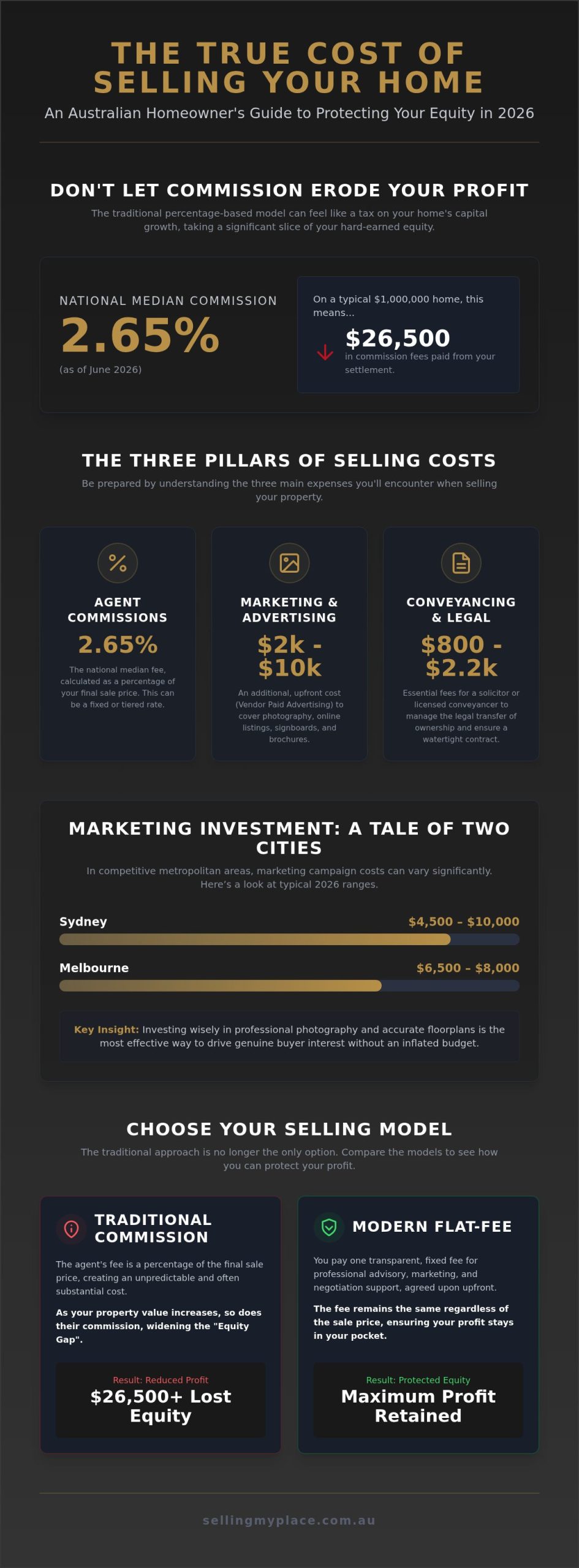
Why should your hard-earned home equity be treated like a communal pot of gold for everyone but your family? With the national median commission sitting at 2.65 per cent as of June 2026, many Australian homeowners are shocked to find that a standard sale can easily strip $20,000 or more from their final settlement. When you ask how much do real estate agents charge to sell a house, the answer is often a complex web of percentage-based fees, upfront marketing costs, and hidden expenses that can feel like an unnecessary tax on your legacy.
It’s completely understandable to feel protective of the value you’ve built over years of weekend renovations and mortgage repayments. This guide will peel back the layers of the 2026 property market to reveal the true cost of selling, from state-by-state commission averages to the latest anti-money laundering regulations. You’ll discover exactly how to navigate these expenses and, more importantly, how to secure a professional, premium result while keeping every cent of your profit where it belongs; in your pocket. We’ll explore the breakdown of marketing versus commission and introduce a more sophisticated, heart-led approach to selling that honours your home’s true worth.
Key Takeaways
- Identify the three main pillars of selling costs so you aren’t caught off guard by hidden legal or property preparation expenses.
- Get a clear breakdown of how much do real estate agents charge to sell a house in 2026 compared to more modern, commission-free alternatives.
- Learn why investing in professional photography and accurate floorplans is the most effective way to drive buyer interest without overspending on bloated marketing campaigns.
- Discover how to protect your hard-earned home equity by closing the “Equity Gap” typically created by traditional percentage-based models.
- Master the art of the deal with expert negotiation strategies that allow you to sell your property confidently while maintaining full control of your profit.
The True Cost of Selling a House: Understanding the 2026 Landscape
Selling a home is rarely just a financial transaction; it’s a major life transition that carries deep emotional weight. Whether you’re downsizing from the family nest or moving toward your next big adventure, the process involves a complex jigsaw of costs that can quickly add up. When you start tallying the figures, you’ll find the total cost of sale includes the agent’s commission, professional marketing, legal fees, and the necessary preparation to make your property shine. It’s a significant undertaking that requires a steady hand and a clear head to manage effectively.
Many homeowners find themselves asking how much do real estate agents charge to sell a house only to be met with a figure that represents years of mortgage repayments. In 2026, the national median commission rate has settled at approximately 2.65 per cent. On a million-dollar home, that is over $26,000 gone before you’ve even considered the cost of signage or photography. This loss of equity can feel like a penalty for your property’s capital growth, making it harder to fund your next chapter. While this percentage-based model has been the standard for decades, modern alternatives now allow for professional, high-end results without the predatory price tag.
The Breakdown of Traditional Agent Commissions
Most agencies calculate their fee as a slice of your final sale price, which means as the market grows, so does their payday. You will likely encounter two main structures: fixed and tiered. A fixed commission is a set percentage regardless of the final price, while a tiered structure might charge a higher percentage on any amount achieved above a certain threshold. While this is often framed as an incentive for the Real estate agent to work harder, it often just widens the gap between the service provided and the fee paid. In competitive Australian markets where property values remain high, these percentage-based fees have become an increasingly expensive “tax” on your hard-earned equity.
Conveyancing and Legal Costs
Beyond the agent, you will need a solicitor or licensed conveyancer to handle the legal transfer of ownership. This role is vital for protecting your interests and ensuring the contract is watertight. In 2026, typical fees for professional conveyance advice range between $800 and $2,200, depending on the complexity of the sale. This cost covers the preparation of the Contract of Sale and the navigation of the settlement process. Local knowledge is essential here; a seasoned expert can spot special conditions or zoning issues that could derail a sale. It’s one of the few areas where professional support is non-negotiable for a smooth, stress-free settlement.
Understanding these costs is the first step toward taking back control of your sale. You don’t have to follow the traditional path just because it’s the most common one. By looking closely at how much do real estate agents charge to sell a house and comparing it to modern, flat-fee advisory models, you can protect your equity while still achieving a premium result. The landscape has changed, and today’s sellers are more empowered than ever to choose a partnership that values their profit as much as they do.
Marketing Your Property: Where Your Money Actually Goes
While the commission covers the agent’s professional time and expertise, the marketing budget is the engine that actually brings potential buyers through your front door. It’s often the most visible part of the cost to sell a house, yet many vendors are surprised to learn it’s typically an additional, upfront expense. In the industry, this is known as Vendor Paid Advertising (VPA). It represents a critical investment in your home’s legacy, ensuring that the years of care you’ve poured into your property are reflected in how it’s presented to the world.
When you’re weighing up how much do real estate agents charge to sell a house, you must account for these separate promotional costs. In 2026, a standard marketing campaign in Australia generally ranges from $2,000 to $10,000. For those in competitive metro areas, the numbers are often more specific; Sydney campaigns typically sit between $4,500 and $10,000, while Melbourne averages between $6,500 and $8,000. These funds cover everything from the digital “town square” of online portals to the physical presence of a signboard on your nature strip.
The Power of Professional Visuals
Your property’s first showing doesn’t happen at a scheduled open house; it happens on a smartphone screen, often late at night. This makes professional photography a non-negotiable requirement for capturing those crucial initial clicks. It isn’t just about lighting or high-resolution lenses; it’s about evocative storytelling that helps a buyer visualise their future life in your home. Alongside imagery, a professional floorplan is the second most vital feature of any listing. It allows buyers to mentally arrange their furniture and understand the flow of the space before they’ve even arrived. While some might suggest a modern phone camera is sufficient, in a sophisticated market, “good enough” often leads to being overlooked by the most serious buyers.
Digital Reach and Global Exposure
A significant portion of your marketing budget is dedicated to premium listings on major Australian property portals. These platforms provide the essential visibility needed to attract local interest. However, a truly effective strategy in 2026 looks beyond the local suburb to target interstate investors and global buyers. By using advanced social media targeting and a global marketing network, your home can find its way to the right person, regardless of where they currently live. This digital infrastructure ensures your property stays listed until it’s sold, providing a sense of calm and security that you won’t be hit with unexpected “re-listing” fees if the perfect buyer takes a little longer to appear. If you’re feeling a bit overwhelmed by these choices, you can reach out for a friendly chat about a tailored marketing plan that suits your home’s unique needs.
Flat Fee vs. Commission: Comparing the Two Models
When you start investigating how much do real estate agents charge to sell a house, the standard 2 per cent or 2.5 per cent commission can seem like an unavoidable cost of doing business. However, it’s vital to remember that this fee is essentially a tax on the wealth you’ve built through years of hard work. The “Equity Gap” is the difference between what you walk away with after a traditional sale versus a modern, commission-free approach. For most Australian families, this gap represents a significant sum that could be better used to secure their next chapter.
There’s a persistent myth that agents are only motivated to get the best price if they have a percentage-based incentive. In reality, a professional advisor’s reputation and duty of care are far more reliable drivers of success. Savvy sellers are increasingly turning to flat-fee real estate because it provides the same professional support and market reach without the predatory cost structure. It’s a partnership built on transparency rather than a transactional slice of your home’s value.
Calculating Your Potential Savings
The numbers speak for themselves when you look at the impact on your bank balance. On a typical $1M home sale, choosing a flat-fee model over a 2 per cent commission can save you more than $20,000 in pure equity. This isn’t just “extra money”; it’s a deposit for a child’s first home, a significant boost to your retirement fund, or the freedom to renovate your next property. When homeowners ask how much do real estate agents charge to sell a house, they’re often looking for a way to justify the expense, but the math rarely favours the seller in a high-value market. Knowing your costs upfront before the campaign even begins removes the stress of the unknown and lets you plan your move with a sense of calm confidence.
What’s Included in a Professional Flat-Fee Package?
Choosing a flat fee doesn’t mean you’re on your own. A comprehensive package through the KIDS model provides all the professional tools you need to achieve a premium result:
- Professional Assets: High-end photography and floorplans that make your listing stand out in digital searches.
- Expert Advisory: Access to seasoned professionals who guide you through pricing, presentation, and legal requirements.
- Market Intelligence: Detailed neighbourhood reports to help you understand your property’s true value and local competition.
- Freedom of Time: Unlike traditional agents who may push for a quick sale to move on to the next commission, a flat-fee listing often has no time limits, letting you wait for the perfect offer.
By shifting the focus from commission to professional advisory, you’re not just saving money; you’re taking an empowered stance in the property market. It’s about ensuring that the reward for your years of homeownership stays exactly where it belongs; with you and your family.
The ‘Negotiation Myth’: Do You Really Need a Traditional Agent?
One of the most common hurdles for homeowners considering a commission-free sale is the nagging fear of underselling. Traditional agencies often lean into this worry, suggesting that their specific “negotiation magic” is the only way to achieve a premium price. But is that true? When you reflect on how much do real estate agents charge to sell a house, it becomes clear that the value they provide must be weighed against the actual net profit you receive. Buyers in 2026 are savvy; they often find dealing directly with an owner refreshing and more transparent. You know the property’s soul, the best time of day for light in the kitchen, and the friendly nature of the neighbours better than any third party ever could.
The reality is that most buyers feel more at ease talking to the person who has actually lived in the home. This direct connection builds trust, which is the foundation of any successful negotiation. By removing the middleman, you eliminate the “transactional” feel that often accompanies traditional sales. When you combine your personal passion for the home with professional advisory support, you create a powerful environment for a successful sale.
Professional Backing for the Modern Seller
You don’t have to be a professional salesperson to achieve a professional result. By utilising detailed Neighbourhood Market Reports, you can price your home with the same precision as any local agency. Our Agent Advisory Service acts as your “steady hand,” ensuring you’re never navigating contract queries or conveyance hurdles alone. This support allows you to handle buyer enquiries with poise and confidence. Applying expert property sale negotiation tips ensures you maintain control of the conversation while keeping your family’s financial future at the heart of every decision.
Maximising Your Final Sale Price
True success isn’t measured by the “gross” sale price on a contract; it’s measured by the “net” result that lands in your bank account. If a traditional agent manages to squeeze an extra $5,000 out of a buyer but charges you $25,000 in commission, you haven’t won; you’ve lost $20,000 in hard-earned equity. Our pre-sale property consulting provides the styling and presentation insights needed to add genuine value before the first viewing. You can create a competitive environment among buyers by being transparent and responsive, often achieving a result that matches or exceeds traditional methods without the need for an expensive auctioneer.
Get expert advisory support for your sale today.
Selling Smarter: Protecting Your Equity with Kincade
Choosing how to sell your home is one of the most significant financial decisions you’ll ever make. In a 2026 market where every dollar of equity counts toward your future stability, the traditional commission model often feels like an outdated relic. When you look closely at how much do real estate agents charge to sell a house, it becomes clear that the value often doesn’t align with the cost. The Kincade International Direct Sales (KIDS) model offers a logical, sophisticated alternative. It’s a partnership designed for those who want to keep their profit while still benefiting from the “steady hand” of a seasoned expert. You aren’t just saving money; you’re choosing a more transparent, respectful way to handle a major life transition.
Many people start with a simple sale by owner mindset, focusing primarily on avoiding fees. However, the reality of being an empowered seller is much broader. It’s about having the confidence to lead the process, backed by the same high-end tools used by the country’s top agencies. This approach allows you to remain the primary advocate for your home, the person who understands its story best, while we provide the professional framework to ensure that story reaches the right audience. It’s a shift from being a “do-it-yourself” seller to a “professionally supported” owner who values legacy and community over quick, expensive transactions.
The Kincade Partnership Advantage
Our approach is built on providing a comprehensive suite of services that levels the playing field for every homeowner. You gain access to a global marketing network, ensuring your property is seen by investors and families across Australia and beyond. Professional photography and floorplans come as standard, because we know that high-quality visual storytelling is the most effective way to drive digital engagement. Throughout the journey, our dedicated advisory support remains by your side from the initial listing through to the final settlement, providing the calm confidence needed to navigate complex negotiations and legal requirements without the sting of a percentage-based commission.
Next Steps for Your Property Sale
Taking control of your sale is simpler than you might think. You can have a professional, high-impact listing live and attracting buyers in a matter of minutes. To get a clear picture of your starting point, we recommend requesting a neighbourhood market report to see exactly where your property stands in the current landscape. This data-driven insight, combined with our pre-sale consulting, ensures you price and present your home for maximum impact. When you’re ready to stop wondering how much do real estate agents charge to sell a house and start protecting your hard-earned equity, we’re here to help you take that next step. Start your commission-free selling journey with Kincade today.
Secure Your Legacy and Your Next Chapter
Deciding how to move forward with your property sale is about more than just finding a buyer; it’s about protecting the life you’ve built. We’ve explored the reality of how much do real estate agents charge to sell a house in 2026, from the national median commission of 2.65 per cent to the often hidden costs of premium marketing. You now know that while high-quality photography and floorplans are non-negotiable for a premium price, losing a massive slice of your equity to a percentage-based fee is entirely optional.
By choosing a partnership-based approach, you can keep your profit while still enjoying the security of a dedicated Agent Advisory Service. With professional visual assets included as standard, the average owner saves $20,000 per sale. This is money that stays in your pocket for your next deposit, your retirement, or your family’s future. You have the local knowledge and the passion for your home; we simply provide the professional tools and global reach to help you succeed.
Save an average of $20,000 and sell your home commission-free with Kincade.
It’s time to take the lead in your property journey with a steady hand by your side. You deserve a sale process that is as rewarding as it is professional. We look forward to helping you achieve the result your hard work deserves.
Frequently Asked Questions
How much is the average real estate commission in Australia in 2026?
The national median real estate commission in Australia is approximately 2.65 per cent of the final sale price as of June 2026. This figure varies significantly across the country; for instance, Tasmania often sees the highest median rates at around 3.25 per cent, while metropolitan areas in New South Wales and Victoria typically average closer to 2.1 per cent. These rates are fully negotiable and usually exclude GST and marketing costs.
Can I really sell my house without a traditional real estate agent?
Yes, you can absolutely sell your home without a traditional agent by choosing an empowered seller model. Modern platforms provide you with the same professional infrastructure used by high-end agencies, such as listings on major portals and expert floorplans, while allowing you to host your own inspections. This approach puts you in the driver’s seat, ensuring you retain the full value of your home’s equity without sacrificing professional standards.
What are the hidden costs of selling a house I should look out for?
When you’re trying to figure out how much do real estate agents charge to sell a house, don’t forget the separate marketing budget. These upfront advertising costs can range from $2,000 to $10,000 and are usually paid by the vendor regardless of the sale outcome. Other hidden expenses include conveyancing legal fees, auctioneer charges, and administrative costs related to 2026 anti-money laundering compliance checks for both buyers and sellers.
Is it worth paying for professional property styling?
Investing in professional property styling is often one of the most effective ways to increase your home’s perceived value. A well-presented home creates an immediate emotional connection with buyers, which can lead to a faster sale and a higher final price. Our pre-sale property consulting can help you decide whether a full furniture package or strategic decluttering is the right path to showcase your home’s unique character and legacy.
How do I negotiate the sale price if I sell the house myself?
Negotiating a sale requires a balance of firm market data and calm confidence. You should start with a clear understanding of your property’s value by using neighbourhood market reports to set a realistic expectation. When an offer arrives, focus on the buyer’s settlement terms as much as the price. Having access to a dedicated Agent Advisory Service ensures you have a professional sounding board to help you evaluate offers and counter-offer with poise.
What is the difference between a real estate agent and a property advisor?
A traditional real estate agent typically works on a commission basis and manages the entire sales transaction, often focusing on a quick result to move to their next listing. In contrast, a property advisor provides expert guidance and professional tools for a flat fee, acting as a “steady hand” to support your sale. This partnership model empowers you to handle the personal side of the sale while receiving high-level strategic support and market intelligence.
Does a flat-fee service include listing on major property portals?
A professional flat-fee service ensures your home is listed on Australia’s leading property portals, such as realestate.com.au and Domain. This digital visibility is the most critical element of any modern campaign, as it reaches the vast majority of active buyers nationally and globally. By using a professional listing service, you get the same premium exposure as a traditional agency but without the ongoing percentage-based commission costs that strip away your equity.
What happens if my property doesn’t sell within three months?
Unlike traditional agency agreements that often expire or require expensive renewals after 90 days, our model provides the freedom of no time limits on your listing. If your property hasn’t sold within three months, you can maintain your presence in the market without the pressure to drop your price prematurely. This allows you to wait for the right buyer who truly values your home, providing a sense of calm and security throughout the process.
Real Estate Advisory Services: Debunking the Myths for Australian Home Sellers
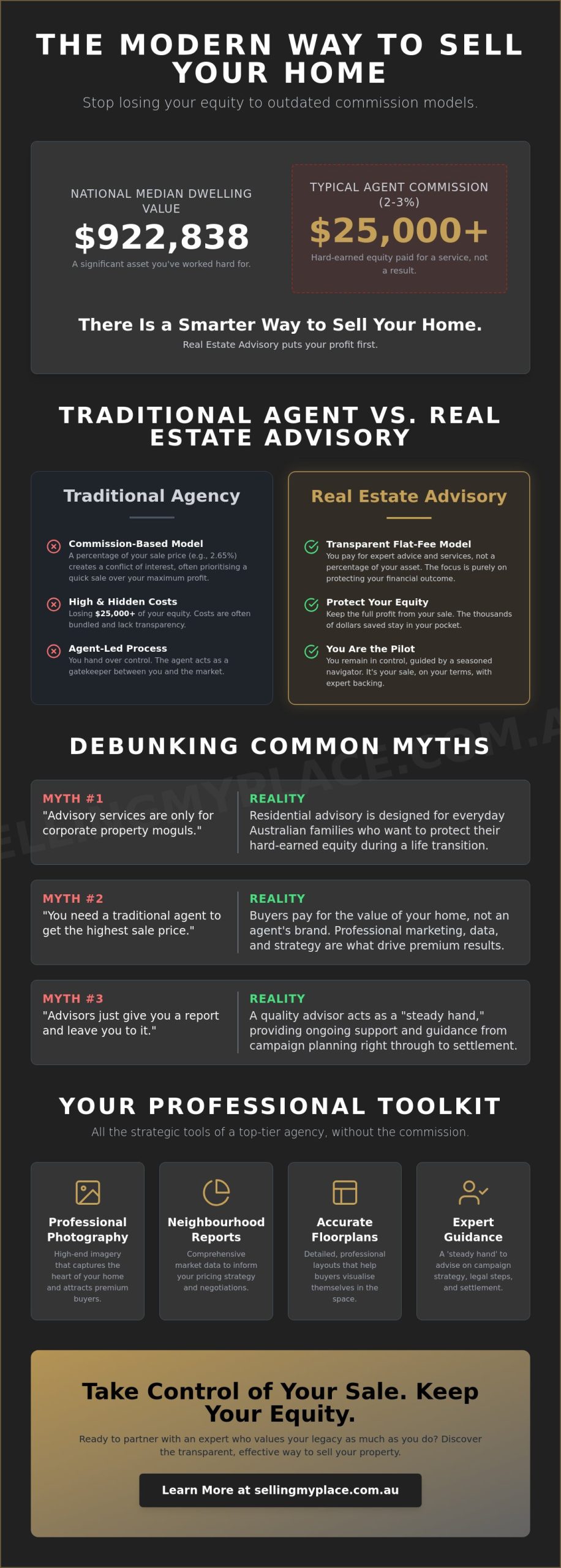
Why are Australian families still handing over $25,000 or more in commissions when the national median dwelling value has climbed to $922,838? It’s a staggering amount of money to part with, especially when you’re already managing the emotional transition of moving and the complex legalities of a property settlement. Most sellers feel caught between a rock and a hard place. You want the professional edge of a top-tier campaign, but the “slick” tactics and high costs of traditional agencies often feel more like a burden than a benefit. This is exactly why real estate advisory services are becoming the preferred choice for savvy homeowners who value their equity.
We understand that your home is likely your greatest financial asset and a place filled with years of memories. You deserve to keep the full profit of your sale without feeling overwhelmed by marketing jargon or complex contracts. This article will show you how to bypass the traditional commission trap while still securing expert results through professional photography, accurate floorplans, and strategic advice. We’re going to debunk the common myths about selling and explain how a partnership-based approach gives you the confidence to lead your own sale with a steady, expert hand by your side.
Key Takeaways
- Understand how real estate advisory services provide the strategic expertise of a traditional agency while letting you retain the “commission” as your own profit.
- Debunk the common myth that only “corporate moguls” or traditional agents can secure a premium sale price for a residential family home.
- Identify the hidden costs within the standard 2-3% commission model and how a transparent flat-fee approach protects your hard-earned equity.
- Learn to use professional-grade neighbourhood market reports and pre-sale consulting to organise a high-impact campaign that resonates with local buyers.
- Discover a “steady hand” method for selling that balances professional authority with the personal care and empathy your family’s legacy deserves.
What are Residential Real Estate Advisory Services?
Think of it as having a seasoned mentor by your side, someone who knows exactly how to position a property to attract the right buyers but doesn’t take a massive slice of your sale price at the end. This is the heart of real estate advisory services. While the name might sound like something reserved for high-rise developers or corporate moguls, it is actually a deeply personal partnership designed for everyday Australian homeowners. It provides the strategic “brains” of a traditional agency, offering professional photography, detailed floorplans, and expert conveyance advice without the heavy burden of a salesperson’s commission.
Don’t let the term “advisory” intimidate you. It’s a grounded, practical way to sell. Most traditional models are built on a transactional foundation where the agent is the gatekeeper. In an advisory model, you are the pilot and we are the navigator. We provide the tools you need, such as comprehensive Neighborhood Market Reports and bespoke Pre-Sale Property Consulting, to ensure your home stands out. This shift in perspective is vital in a market where the national median dwelling value is $922,838. A standard commission could easily swallow $25,000 of your hard-earned equity. We believe that money belongs in your pocket, not ours.
Unlike a traditional model where the focus can sometimes shift toward a quick turnover to meet monthly targets, an advisor’s priority is your net profit. By focusing on core components like robust market data and a polished marketing strategy, these services put the power back into your hands. You get the professional edge of a high-end listing with the financial freedom of a private sale.
Advisory vs. Traditional Agency: The Fundamental Difference
The primary distinction lies in how the professional is compensated. Most people understand what is an estate agent and how they typically operate on a 2.65% commission basis. In contrast, an advisor works for a transparent flat fee. This removes the conflict of interest and ensures the advice you receive is purely about protecting your equity. Think of it as a “steady hand” guiding you through the settlement process. You remain the decision-maker while the advisor provides the map and the compass. For the modern Australian property ladder, this model is a logical choice for those who want professional results without the archaic cost structure of a traditional agency.
Who is Residential Advisory For?
This approach isn’t just for the tech-savvy. It’s for first-time sellers who feel overwhelmed by the legal complexity of a sale and want professional backing without a massive price tag. It’s for experienced investors looking to optimise their portfolio costs as interest rates and holding costs rise. Most importantly, it’s for families transitioning to a new life stage. Whether you’re downsizing or moving for a growing family, you need a guide who leads with heart and respects the emotional weight of the transition. Choosing real estate advisory services means choosing a partner who values your legacy as much as you do.
Debunking 5 Common Myths About Professional Property Advice
It is natural to feel a bit skeptical when you first hear about a different way to sell. For decades, the Australian property market has been dominated by a specific, high-commission formula that many homeowners assume is the only path to success. These long-held beliefs often create a sense of fear, making people feel they must choose between a “slick” traditional agent or going it completely alone. However, most of these fears are based on outdated myths that don’t reflect how modern real estate advisory services actually operate.
- Myth 1: “Advisory services are only for corporate property moguls.” While big developers use advisors, residential advisory is designed for everyday families. It’s for anyone who wants to protect their hard-earned equity while navigating a life transition.
- Myth 2: “You need a traditional agent to get the highest sale price.” Buyers don’t pay more because an agent has a fancy car; they pay for the value of your home. Professional marketing and market data are what drive premium results.
- Myth 3: “Advisors just give you a report and leave you to it.” This couldn’t be further from the truth. A quality advisor acts as a “steady hand,” providing ongoing support from the initial listing through to the final settlement.
- Myth 4: “It’s too expensive for a standard residential sale.” When you compare a transparent flat fee to the national average commission of 2.65%, the savings are usually substantial. On a median-priced home of $922,838, those savings can be life-changing.
- Myth 5: “Selling your own home means you lose out on professional marketing.” Modern advisory packages include the same high-end photography and floorplans used by top-tier agencies.
The Truth About “Sale by Owner” with Expert Backing
Many people worry that a Sale by owner approach looks amateurish. In reality, when paired with an advisory service, your listing is indistinguishable from a traditional agency’s. You receive professional photography and floorplans that highlight your home’s best features. Interestingly, many buyers actually prefer dealing directly with the owner. They appreciate the authentic, local knowledge only you can provide, as long as the initial marketing has that professional “polish” to build trust from the first click.
Why “Consulting” is More Active Than You Think
Residential advisory isn’t a passive service. It involves active pre-sale property consulting to identify small, high-impact improvements that can boost your sale price. You also receive essential conveyance advice to ensure the legal paperwork is handled correctly, reducing the stress of the settlement process. By using professional Neighbourhood Market Reports, you gain the upper hand in negotiations because you have the same data as the professionals. If you’re feeling overwhelmed by the complexity of the market, you might find it helpful to chat with a friendly advisor about your specific needs.
Advisory vs. Traditional Agents: The Commission Trap
Selling your home is one of life’s biggest transitions, yet the traditional model often feels like it’s designed to benefit the agency more than the family moving out. In 2026, the national average real estate agent commission sits at approximately 2.65%. While that might sound like a small percentage on paper, it’s a significant sum when applied to Australian property values. For a home at the national median of $922,838, you’re looking at a commission bill of roughly $24,450. This is the “commission trap” that many sellers fall into simply because they aren’t aware that real estate advisory services offer a more equitable path forward.
Traditional agencies often layer hidden costs on top of that percentage. You might be asked to pay for premium marketing packages, auctioneer fees, and administrative costs, all while the agent’s primary motivation is a quick turnover. A 0% commission, flat-fee structure changes the dynamic entirely. It allows you to be more flexible with your listing price if needed, or simply ensures that every extra dollar a buyer offers goes directly into your bank account. There’s also the myth of the “time limit.” Many traditional contracts bind you to a short exclusive period, creating a sense of urgency that can lead to underselling. An advisory partnership is different; we stay with you until your property is sold, providing a steady hand through every negotiation.
Calculating the Real Cost of a Sale
Let’s look at the numbers for a property in Sydney or Melbourne, where median values often exceed $1 million. A 2.5% commission on a $1M sale is $25,000. Compare that to a single flat-fee marketing package that covers your photography, floorplans, and listing. The difference is often $20,000 or more. What could your family do with that saving? It could be the deposit for your next home, a much-needed renovation, or a significant boost to your retirement fund. Beyond the money, there’s a profound psychological benefit. Knowing your advisor isn’t rushing for a commission check means you can wait for the right buyer, not just the first one.
Buyer Representation and the Advisory Edge
The support doesn’t have to stop when the “Sold” sticker goes up. One of the greatest advantages of real estate advisory services is the ability to access buyer representation for your next chapter. Most sellers are also buyers, and navigating the current market requires a different set of skills. Advisors can often provide access to off-market properties through their networks, giving you a head start before a home even hits the major portals. By linking your sale and purchase strategies, you create a seamless transition that reduces the stress of moving and ensures your next investment is as sound as the one you just sold.
How to Use Real Estate Advisory Services to Sell Smarter
Selling your home shouldn’t feel like a high-stakes gamble or a confusing maze of paperwork. It is a methodical process that, when handled with the right tools, becomes a rewarding journey toward your next chapter. By using real estate advisory services, you aren’t just “listing” a property; you’re executing a sophisticated strategy designed to maximise your equity. This approach allows you to take the lead while we provide the professional scaffolding to support your every move. It’s about being empowered, not overwhelmed.
- Step 1: Secure a Neighbourhood Market Report. Pricing your home “on the money” is critical. With the national median dwelling value reaching $922,838 in February 2026, even a 2% error in pricing can cost you nearly $20,000.
- Step 2: Engage Pre-Sale Property Consulting. Before the first buyer walks through, we help you identify high-impact, low-cost improvements. Often, a fresh coat of paint or some basic landscaping can add far more to the sale price than the cost of the work itself.
- Step 3: Deploy Professional Photography and Floorplans. Your home needs to shine on global real estate portals. High-end visuals ensure your property isn’t just seen; it’s remembered.
- Step 4: Utilise Expert Conveyance Advice. The legal side of a settlement can be daunting. Having a steady hand to guide you through the contracts and disclosures reduces the stress of the final exchange.
- Step 5: Manage Enquiries Directly. Armed with data and professional marketing, you can talk to buyers with total confidence. You know your home better than any agent ever could.
The Power of Market Data
In the 2026 Australian property market, “gut feel” is a risky strategy. With KPMG forecasting national house price growth of 7.7% this year, the landscape is shifting quickly. A comprehensive market report helps you understand local buyer demand and recent comparable sales in your specific suburb. When a potential buyer tries to negotiate, you don’t have to rely on emotion. You can use hard data to justify your asking price, showing them exactly why your home represents a sound investment for their future. Pairing this data with proven property sale negotiation tips gives you a powerful edge when offers start coming in.
Professional Marketing Without the Agency Price
Many sellers fear that going without a traditional agent means a “DIY” look that turns buyers away. This is where Residential Property Listing Services bridge the gap. By including professional photography and detailed floorplans, your listing carries the same authority as any major agency. Buyers today are savvy; they want to see the layout and the quality of the finish before they commit to an inspection. Providing these professional touches ensures you are taken seriously by serious buyers. Ready to take the first step toward a smarter sale? Reach out to our team today to see how we can support your journey.
The Kincade Approach: Your Steady Hand in the Property Market
At Kincade International Direct Sales (KIDS), we believe the traditional way of selling property is long overdue for a change. For too many Australian families, the excitement of a successful sale is often dampened by the arrival of a massive commission bill. Our real estate advisory services were born from a desire to do things differently. By operating on a 0% commission, flat-fee model, we put the owner back where they belong: at the centre of the transaction. We provide the digital infrastructure and global marketing networks usually reserved for high-end agencies, ensuring your home reaches the right buyers without the high-end price tag.
This isn’t just about saving money, though that is a significant part of the appeal. It is about a fundamental shift in the relationship between seller and advisor. We don’t see our clients as just another settlement date on a calendar. We see families who are often navigating emotional transitions, whether that is moving into a first home, downsizing after decades in a family residence, or managing a deceased estate. Our approach combines professional authority with a heartfelt warmth that acknowledges the significance of your legacy. We’re here to ensure you feel supported, not just processed.
A Partnership Built on Trust and Empathy
Our “Steady Hand” philosophy is the cornerstone of everything we do. We aim to be proactive and competent, providing a sense of calm confidence that reduces the stress of complex processes. We understand that while you want to lead your own sale, you still need a guide who is always in your corner. Our Agent Advisory Service provides that expert backing, offering a safety net of knowledge that covers everything from initial market positioning to the final exchange of contracts. We focus on your long-term family needs because we value relationships over quick results. It’s about more than just a house; it’s about your future stability and peace of mind. When it comes to fielding offers, our advisors also equip you with essential property sale negotiation tips so you can handle every conversation with calm authority.
Start Your Commission-Free Journey Today
You have worked hard to build the equity in your home. Why should a significant portion of that hard work be handed over to an agency? Taking control of your sale is an empowering experience, especially when you have professional-grade tools and a seasoned expert by your side. With the average saving sitting at around $20,000, choosing an advisory model is a fair dinkum way to protect your profit and set yourself up for your next chapter. We invite you to step away from the commission trap and experience a more respectful, transparent way to move. Discover how Kincade empowers you to sell smarter and keep your profit.
Take the Reins of Your Property Future
Choosing a different path for your home sale is a powerful way to honour the hard work you’ve put into your property. You’ve seen how the traditional commission model often takes more than it gives, especially when the national median dwelling value is climbing. By embracing real estate advisory services, you’re reclaiming the right to manage your family’s biggest asset on your own terms while securing the professional edge you need. You’ll gain access to our global marketing network reach and the “polish” of high-end photography, but without the $20,000 commission bill typically seen in Australian sales.
Our Expert Agent Advisory Service ensures you never walk this path alone, providing a steady hand from the first market report to the final settlement. It’s about keeping your hard-earned equity where it belongs, in your pocket, to fund your next adventure or secure your family’s future. Don’t let outdated myths hold you back from a smarter, more profitable sale that respects both your time and your profit. Keep 100% of your profit—explore our flat-fee advisory packages today. Your home is a legacy you’ve built with care; we are here to help you protect it with the expert guidance you deserve.
Frequently Asked Questions
What exactly is included in a real estate advisory service for homeowners?
Our service provides a complete suite of professional tools to help you manage your own sale with total authority. This includes high-end photography and detailed floorplans to ensure your listing looks spectacular on every major portal. You also receive pre-sale property consulting to identify value-add improvements and a comprehensive market report to help you price accurately. It is about giving you the “brains” of a traditional agency without the heavy burden of a commission bill.
Can I really sell my own home without an agent and still get a top price?
You absolutely can achieve a premium price by selling independently, provided your marketing is of a professional standard. Buyers are attracted to the inherent value of your home and the data-driven pricing you present, rather than the brand of a traditional agency. In fact, many buyers find dealing directly with the owner more authentic and transparent. With the right real estate advisory services backing you, your listing will have the same authoritative reach and “polish” as any major firm.
How does a flat-fee model differ from traditional real estate commission?
The primary difference is transparency and the protection of your hard-earned equity. While traditional agents take a percentage of your final sale price, usually around 2.65% in the current market, a flat-fee model involves a single payment for specific services. This means if your home sells for more than expected, every extra dollar stays in your pocket. It removes the conflict of interest and allows for a more relaxed, partnership-focused experience where the goal is your net profit.
What happens if my property doesn’t sell within a few months?
Unlike traditional exclusive agency agreements that often expire after a fixed period, our approach is to support you until the “Sold” sticker is up. We understand that finding the right buyer for your family home might take a little longer in some market cycles. You won’t be pressured into a quick, low-value sale just to meet a salesperson’s monthly target. We remain your steady hand throughout the entire journey, regardless of the timeframe required to find the perfect buyer.
Do I still need a solicitor if I use an advisory service with conveyance advice?
Yes, you will still need a qualified legal professional to handle the final transfer of title and legal settlement. While we provide expert conveyance advice to help you understand the process and prepare your documents correctly, a solicitor or licensed conveyancer is required to perform the final legal exchange. Our advice acts as a bridge, ensuring you are well-prepared and confident before you hand over the paperwork to your legal team, making the final process much smoother.
Is real estate advisory legal in all Australian states and territories?
Real estate advisory services are a legitimate and growing part of the national property landscape in every state and territory. We operate within the legal frameworks that allow homeowners to represent themselves in a sale while receiving professional consulting and marketing support. Whether you are in a bustling capital city or a quiet regional centre, you have the right to choose a service that prioritises your equity over traditional commission structures.
How do I handle negotiations with buyers if I don’t have a traditional agent?
Negotiating directly is often simpler than people think, especially when you have a comprehensive market report to back up your asking price with hard data. We provide you with the information needed to justify your position and handle objections with calm confidence. You know the unique history and “soul” of your home better than anyone else. Sharing that authentic connection while using our strategic advice often leads to a more respectful and successful negotiation for both parties.
Will my property be listed on the major Australian real estate portals?
Your property receives maximum exposure by being listed on the leading Australian real estate websites where buyers are already looking. We ensure your home is visible to a global audience, using the professional photography and floorplans included in your package to grab attention instantly. You get the same digital infrastructure and reach as a high-priced agency, ensuring your home is seen by the widest possible pool of potential buyers across the country.
