Sell Property Zero Commission: A Smarter Australian Selling Guide
What if avoiding percentage-based agent commission didn’t mean managing every part of your sale alone? If you’re exploring how to sell property zero commission, it’s worth understanding what “zero” covers, whether a flat fee includes the marketing you need and how much support is available when buyers have questions.
Zero commission doesn’t mean selling is free. It usually means paying a set fee for an agreed service instead of a percentage of the sale price. The useful comparison isn’t just the fee structure: look at what’s included and how comfortable you are handling buyer conversations, negotiations and practical sale tasks.
A flat-fee approach can offer a middle ground between traditional commission-based representation and managing everything yourself. Kincade International Direct Sales combines professional photography, floorplans and neighbourhood market reports with Agent Advisory Service support, pre-sale consulting and conveyance advice. This gives sellers professional resources while retaining control over key decisions.
In this guide, you’ll learn how zero-commission selling works, what to look for in a flat-fee service and how to weigh marketing and support against the tasks you’re prepared to manage. You can then choose an approach that fits your priorities, not just its fee structure.
Key Takeaways
- To sell property zero commission, understand that a flat fee replaces percentage-based agency commission, but other sale costs may still apply.
- Compare the service scope, marketing materials, advisory support and listing duration, not just the fee structure.
- Professional photography and floorplans can help present your home clearly, while a digital listing network can provide exposure without guaranteeing a sale.
- Decide how involved you want to be and how much time you can give to buyer communication and sale tasks.
- Consider whether photography, floorplans, neighbourhood market reports and advisory support offer the balance of control and assistance you want.
What does sell property zero commission actually mean?
In plain English, zero commission means no percentage-based agency commission is charged on the property’s sale price. Instead of paying an agent a share of the final amount, a seller may use a service with an agreed flat fee for defined marketing or advisory support. The phrase describes how the service is charged, not whether selling a home is entirely cost-free.
Zero-commission property selling means marketing a home without a percentage-based agency commission, usually through a fixed-fee service with a defined scope. It doesn’t guarantee a sale or a particular sale price. The service can help you promote the property and access advice, but the outcome still depends on factors such as buyer interest, the property and your sale decisions. For context on how agent compensation can differ, see Real estate broker commissions and flat-fee services.
If you’re working out how to sell property zero commission, separate the marketing and advisory arrangement from the legal work involved in transferring a home. Property marketing can cover materials and listing support; conveyancing concerns the legal sale process and is a distinct part of the transaction. The two may happen alongside each other, but don’t assume one service fee covers both.
How is zero commission different from no-cost selling?
“Zero commission” refers to the absence of a sale-price percentage charged as agency commission. A marketing or advisory service may still charge a flat fee for agreed work. Sellers may also have separate expenses connected with preparing, marketing or legally transferring a property. The useful question is not whether a service sounds free, but what its fee covers and what remains separate.
Compare the written inclusions and fee terms rather than relying on labels. Look for details on the marketing materials, advisory support and listing period covered, as well as work or expenses outside the service scope. This gives you a clearer view of the arrangement before deciding how you want to sell.
What does a flat-fee property service change?
A percentage commission changes with the final sale price; a flat fee is set for defined services rather than calculated as a share of the result. This can make the service charge easier to understand in advance, but the fee structure alone doesn’t tell you how much practical help you’ll receive. Scope matters just as much as price: listing support, photography, floorplans and advice can all differ between services.
The model can also change how involved you are. With a commission-based agent, the arrangement may include representation across parts of the sale; with a flat-fee service, you may retain more control and take a more active role. Neither structure suits every seller. Consider the tasks you’re comfortable handling and the support you value before weighing the options.
Keep the legal conveyancing process in view, too. A marketing or advisory fee doesn’t automatically include the preparation or handling of sale documents. Conveyance advice can help you understand that part of the journey, while the legal work itself remains distinct. Knowing where one service ends and another begins helps you budget and plan with fewer surprises.
What can a zero-commission property marketing service include?
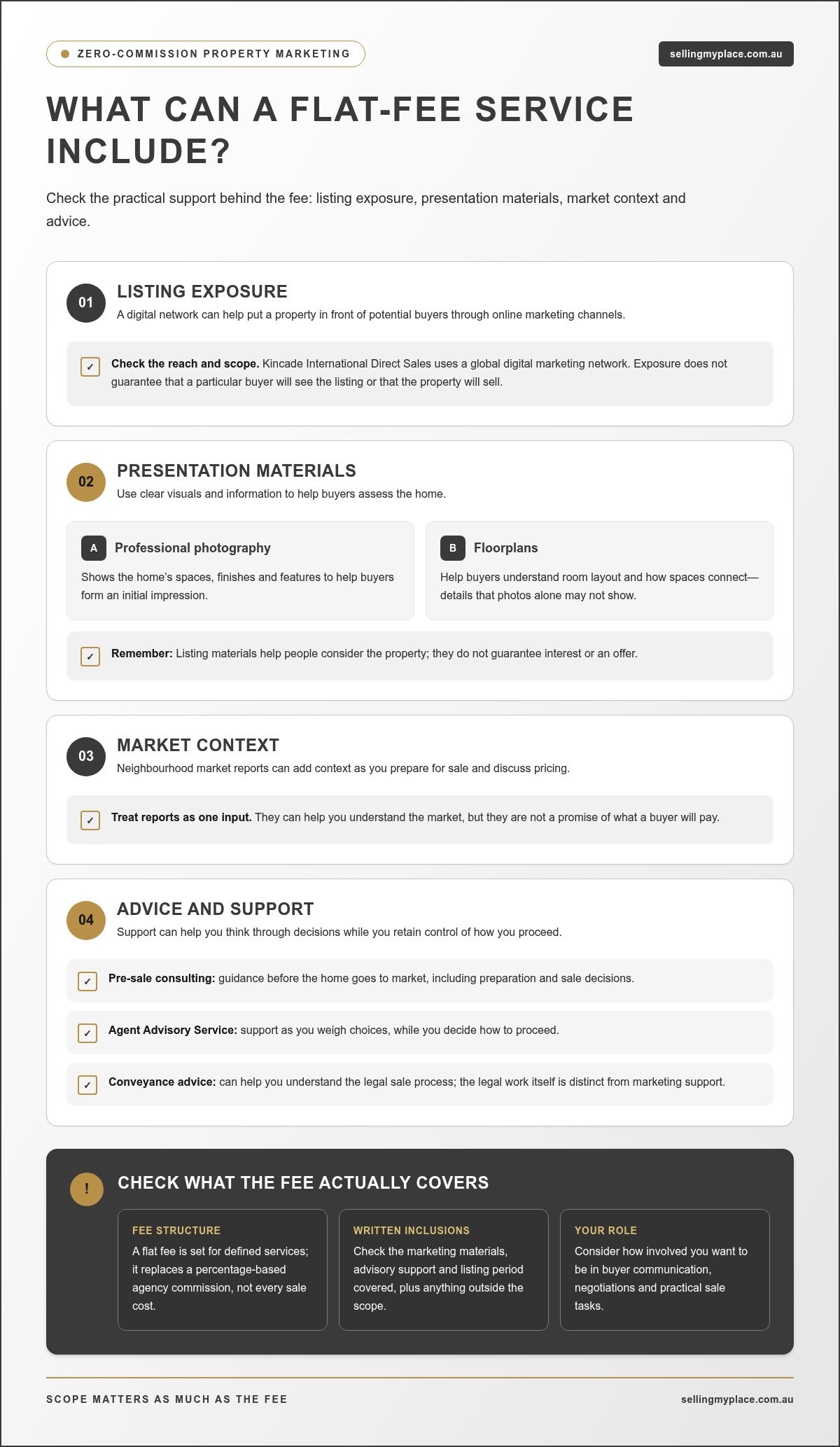
A flat-fee arrangement describes how the service is charged, but its inclusions determine what practical help you receive. A commission-free marketing service can bring together listing exposure, presentation materials and advice, allowing you to retain a role in decisions while getting professional support. The right mix depends on what you want help with and which selling tasks you’re comfortable managing yourself.
A digital listing network can put a property in front of potential buyers through online marketing channels. Kincade International Direct Sales uses a global digital marketing network, but exposure isn’t a promise that a particular buyer will see the listing or that the property will sell. Professional photography and floorplans add useful context: images show the home’s presentation, while a plan helps people understand room layout and flow.
How do listing materials support a property sale?
Photos help prospective buyers form an initial impression of spaces, finishes and features. A floorplan adds another layer by showing how rooms connect, which can be difficult to judge from images alone. Clear listing information helps people assess whether the home’s layout and features may suit their needs before arranging a closer look. These materials support informed consideration; they don’t guarantee interest or an offer.
Neighbourhood market reports can add context as you prepare for sale and discuss pricing. They’re one input for understanding the market, not a promise of what a buyer will pay. For wider industry context, Real Estate Institute of Australia (REIA) insights can help readers explore information about Australia’s property sector and market.
What role does professional advice play?
Pre-sale consulting provides guidance before a home goes to market, helping you think through preparation and sale decisions. The Agent Advisory Service offers support as you weigh choices, while leaving you in control of how you proceed. Buyer representation has a different focus: it relates to representing a buyer, rather than marketing a seller’s property.
Conveyance advice is also distinct from listing and buyer-facing activity. It relates to the legal side of a property transfer, while marketing services focus on presenting and promoting the home. Advice can help clarify the process, but it isn’t the conveyancing work itself.
Use this table to compare what each feature can contribute and the questions it may help you answer:
| Service feature | Potential seller benefit | Question it helps answer |
|---|---|---|
| Digital listing network | Online exposure across a marketing network | Where may buyers encounter the listing? |
| Photography and floorplans | Visual detail and a clearer sense of layout | How can buyers understand the home’s presentation and flow? |
| Neighbourhood market reports | Context for preparation and pricing discussions | What market information can inform my decisions? |
| Pre-sale consulting and Agent Advisory Service | Guidance for planning and decisions | Where would professional input be useful? |
| Conveyance advice | Guidance distinct from marketing activity | What legal-transfer questions should I understand? |
If you’re considering how to sell property zero commission, compare the actual support and deliverables with the tasks you’ll take on. Commission-free property marketing support brings together marketing resources and advisory assistance for sellers who want to retain control.
Zero commission versus traditional commission: how should you compare?
A percentage-based commission ties the agency fee to the property’s sale price. A flat-fee model uses an agreed charge for defined services instead. Neither structure tells the whole story: services with different fee models may also differ in marketing, advice and how much of the sale you manage yourself.
The fee structure alone can’t tell you which selling service is right; compare the support, deliverables and seller responsibilities that come with it. This matters because a lower or more predictable fee may still leave you with tasks you’d rather have help handling. Equally, paying a percentage doesn’t automatically mean every service or level of support is included.
Which selling model fits your preferred level of involvement?
Start with an honest assessment of your time and confidence. If you’re comfortable coordinating parts of the sale and making direct decisions, a flat-fee service may suit your preference for control, especially when paired with defined marketing and advisory support. If you want someone to take a more hands-on role, clarify what that representation involves. Traditional agents’ services can vary, so don’t assume every commission arrangement includes the same tasks or support.
More control can mean more participation. Depending on the service structure, you may have a greater role in responding to enquiries, communicating with interested buyers or making decisions during negotiations. Think about when you’d welcome professional guidance and when you’d rather manage things directly. The best fit should reflect your comfort level, not just how the fee is calculated.
What should you compare beyond the fee structure?
Set the service details side by side. Compare the included marketing deliverables, the reach of the listing network, access to advice and how long the property remains listed. Then clarify how buyer enquiries, negotiations and sale decisions are handled. These practical details show what you’re paying for and where your own time may be needed. For more context on listing support, see Professional Residential Property Listing Services: The Modern Australian Seller’s Guide.
A useful comparison separates the fee basis from the working arrangement:
| Model | Fee basis | Seller role | Support structure |
|---|---|---|---|
| Traditional commission | Percentage linked to the sale price | Depends on the agreed representation and service scope | Can involve agent support, but inclusions and responsibilities vary |
| Flat-fee marketing and advisory | Agreed fee for defined services | May retain more direct control and take an active role | Can combine marketing materials with advisory support; clarify how enquiries and decisions are handled |
For a like-for-like comparison, write down the service inclusions and responsibilities before weighing the fee. A service may, for example, include professional photography, floorplans, advisory access and a listing that remains active until sold without time limits. Match each inclusion against what matters to you, then note any tasks you’d handle yourself. That gives you a clearer picture of the trade-off between hands-on assistance, seller control and the practical work of bringing a property to market.
How can you decide whether selling property zero commission suits you?
The right selling approach should fit your time, confidence and appetite for direct involvement. Before deciding whether to sell property zero commission, map out the tasks you’re happy to manage and where professional guidance would make the process more manageable.
- Start with your involvement and available time. Consider how much time you can set aside for preparing the property, responding to buyer enquiries and keeping sale tasks moving. Greater control can be appealing, but it often comes with more direct participation.
- List the support you value most. Write down the marketing materials, advice and communication support you want. You might prioritise photography and floorplans, guidance before launch, help thinking through buyer conversations or advice as you weigh sale decisions.
- Compare the arrangements in writing. Set out each option’s fee basis, included services, listing terms and any responsibilities you’ll take on. A written comparison makes differences easier to spot than a headline label alone.
- Separate the stages of the sale. Preparation, marketing, negotiation and conveyancing each need attention, but they aren’t the same task. Decide where you’ll lead, where advisory support would help and how you’ll handle the legal transfer process.
What should you clarify before choosing a service?
Look for clear descriptions of which marketing materials and advisory services the flat fee covers, how long the listing stays active and what ongoing support means in practice. Then consider your own capacity: would you feel comfortable handling buyer communication and making sale decisions, or would guidance at key moments help you feel more assured?
For a service that keeps a listing active until sold without time limits, that duration can be an important part of your comparison. Listing duration alone doesn’t tell you how buyer enquiries or negotiations are managed. Add those responsibilities to your written notes so you understand the working arrangement as well as its timeline.
How can you prepare for the sale without taking on every task alone?
Divide your plan into seller-led decisions and tasks supported by marketing or advisory services. You might lead on presentation choices and decisions about an offer, while using professional photography, floorplans and pre-sale consulting to support preparation. The Agent Advisory Service can also provide input as you consider your next steps.
Plan how you’ll respond to buyer enquiries and approach negotiations before the first conversation arises. A step-by-step guide to sale by owner in Australia can help you map the process, while a guide to property sale negotiation can help you think through buyer discussions. Conveyancing remains a distinct part of the transaction, so include it in your planning rather than treating marketing support as a substitute.
Commission-free property marketing and advisory support combines marketing resources with guidance for sellers who want to stay involved in the sale.
How Selling My Place supports a zero-commission property sale
Selling a home involves more than choosing a fee model. You need a clear way to present the property, reach prospective buyers and make considered decisions as the sale progresses. Kincade International Direct Sales’ flat-fee marketing and advisory service offers a middle ground: you retain control of key choices while accessing professional marketing materials and guidance.
The service brings together professional photography, floorplans, neighbourhood market reports and a global digital marketing network. Each supports a different part of the sale: photography and plans help present the home, market reports provide context for preparation and pricing discussions, and the network supports digital marketing exposure. Exposure can’t guarantee buyer interest or a sale, but these resources give you practical tools for putting your property forward.
What support can sellers access through the service?
Listings can remain active until sold without time limits, giving sellers an ongoing listing rather than a set end date. This doesn’t guarantee a sale or a particular timeframe. Agent Advisory Service support, including pre-sale consulting, can help you consider decisions before the property goes to market and as you work through the sale. Conveyance advice relates to the transfer process, distinct from marketing and buyer-facing activity.
The balance is intentional: you stay involved in decisions, with professional resources to support the work around them. For example, use photography and floorplans to present the property clearly, then draw on neighbourhood market information as you prepare for pricing discussions. Advisory support can help you think through your approach while you remain responsible for the choices that matter to you.
As you consider the support, think about which parts of the sale you want to lead and where guidance would be useful:
- Property presentation: professional photography and floorplans help show the home’s features and layout.
- Market context: neighbourhood market reports offer information to consider during sale preparation and pricing discussions.
- Digital marketing: a global digital marketing network supports the listing’s exposure without promising a specific audience or result.
- Sale guidance: Agent Advisory Service support, pre-sale consulting and conveyance advice address different decisions and stages.
What is a sensible next step for an interested seller?
Before discussing your options, jot down a few details: the property you’re selling, your preferred timing and how involved you want to be. Note the marketing and advice you value most, too. This gives the conversation a useful starting point and helps you focus on whether the service scope and flat-fee structure fit your priorities, rather than judging by the fee label alone.
For sellers considering how to sell property zero commission, a practical discussion can help clarify the model and the support available. Talk through your property sale with our team.
Choose a selling approach that feels right for you
A property sale is a significant transition, and the process should feel workable for your circumstances, not simply appealing on paper. Before you decide how to sell property zero commission, think about what would help you feel informed and in control: a clear view of the service scope, room to make your own decisions and professional guidance where you’d value it.
Your next step can be a practical conversation about your property, timing and preferred level of involvement. Talk through how the flat-fee model works, what support it includes and whether the balance suits the way you want to sell. Arriving with a few priorities in mind can make that discussion more useful, whether you’re ready to move ahead or still weighing your options.
Talk through your property sale with our team to discuss a sale plan that fits your priorities. You don’t need every detail settled before you begin; a clear conversation can help you identify your next steps.
Frequently Asked Questions
Is selling property with zero commission really free?
No, not necessarily. Zero commission means no percentage-based agency commission is charged, not that selling has no costs. A flat-fee service may charge for defined marketing and advisory work, while other sale-related expenses can remain separate. If you plan to sell property zero commission, compare written inclusions, fee terms and your responsibilities before deciding. This helps you understand what the arrangement covers rather than relying on the label alone.
Can I sell my property without an agent and still get professional support?
Yes. You can take a more active role in the sale while using a property marketing and advisory service for professional assistance. For example, photography and floorplans can help present your home, while pre-sale consulting can support decisions before launch. You’ll still have responsibilities, such as making sale decisions and handling agreed tasks. This differs from traditional full-service representation, and the support offered varies between arrangements.
How much can I save by selling property with zero commission?
There’s no single saving that applies to every seller. The difference depends on your sale price, the fee structure and which services are included in each arrangement. Compare the full written scope and fee terms with the commission-based option you’re considering, including any tasks you’ll manage yourself. A lower fee alone doesn’t show which model is the better fit; the value of the support and your preferred involvement matter too.
What happens if my property does not sell straight away?
What happens next depends on the listing duration and ongoing service terms. With Kincade International Direct Sales, a property can remain listed until sold without time limits. That means there’s no set time limit on the listing, not a guarantee that a sale will occur. Review the service terms to understand how continued listing and support work if the sale takes longer than expected.
Do zero-commission property services include photography and floorplans?
Inclusions vary, so look at the stated deliverables rather than assuming every service provides the same materials. Kincade International Direct Sales provides professional photography and floorplans. Photos give prospective buyers a visual impression of the home, while a floorplan helps them understand how rooms connect and how the layout works. These tools can make property information clearer, but they don’t guarantee more enquiries, a higher sale price or a faster result.
Is a flat-fee service better than paying a traditional property commission?
It depends on your priorities, how involved you want to be and the support you need. A flat fee changes how the service charge is structured compared with percentage-based commission, but it doesn’t determine the service scope or your responsibilities. Compare marketing deliverables, advisory access, listing duration and the tasks you’ll handle yourself. The better fit is the arrangement that aligns with your comfort level and sale priorities, not simply the fee label.
Can I negotiate the sale price when using a zero-commission service?
Yes. As the seller, you make decisions about offers and the sale outcome you’re prepared to accept. The support available during buyer discussions depends on the service arrangement. Kincade International Direct Sales offers advisory support and buyer representation, which is a distinct service for buyers. Before negotiations begin, consider your priorities and how you’ll communicate them clearly. Preparing in advance can help you approach offer discussions thoughtfully, without guaranteeing a particular result.
Pre-Sale Property Consulting: Prepare Your Home for a Smarter Sale
What if the smartest pre-sale improvement is the one you decide not to make? Preparing a home can quickly become a long list of repairs, updates and styling ideas, but not every project will suit your property or sale goals. Pre-sale property consulting helps you sort through the options before you commit time and money.
If you’re unsure where to begin, you’re not alone. It’s natural to want your home looking its best while questioning whether each change will make a meaningful difference to its presentation or sale readiness. A considered plan can replace that uncertainty with clear priorities.
In this article, you’ll learn how pre-sale advice can help you assess your property, choose improvements and organise the steps towards going to market. We’ll also look at how preparation connects with the wider sale process, from market insights to photography and floorplans. With the right guidance, you can make decisions that fit your circumstances and move from preparation into marketing with greater confidence.
Key Takeaways
- Use pre-sale property consulting to shape a preparation plan around your home’s condition, your circumstances and your sale goals.
- Consider maintenance and presentation separately from optional renovations or styling, so you can weigh priorities before committing.
- Work through a simple sequence: clarify your goals, review the property, identify priorities and agree on practical next steps.
- Gather relevant property information and note outstanding questions early to make preparation decisions more straightforward.
- Connect your preparation plan with the next marketing steps, including property photography, floorplans and neighbourhood market reports.
What Is Pre-Sale Property Consulting, and When Can It Help?
Pre-sale property consulting is tailored advice that helps homeowners plan how to prepare a property before marketing it for sale. Rather than starting with a renovation wish list, the process considers the home’s condition, your goals and your priorities, then helps clarify which steps make sense before the next stage of selling.
Consulting guides decisions; it doesn’t guarantee a particular sale price or result. It’s also different from hands-on styling, building work or property management. Advice can help you decide whether presentation changes belong in your plan, while services such as photography, floorplans and listing support relate to marketing the property.
For example, you might be weighing up whether to address a maintenance issue, refresh a room or leave the home largely as it is. A pre-sale plan helps compare those options against the property and your circumstances, rather than making decisions under pressure. Selling can carry plenty of emotion, especially when a home holds family memories or marks a major change. Planning can make the practical decisions feel more manageable.
What does a pre-sale property consultant help you consider?
Advice brings together three connected questions: what condition is the property in, how is it likely to present to buyers, and what needs attention before marketing? This can help distinguish essential preparation from optional improvements or styling. Home staging, for instance, focuses on preparing a residence to appeal to potential buyers. Consulting takes a broader planning view, helping you decide whether presentation steps belong in your particular plan.
With pre-sale property consulting, you can weigh possible actions before committing time or resources. The aim is a considered set of next steps, not a one-size-fits-all checklist. Those decisions can then inform the move into marketing and selling, without assuming that any particular preparation will guarantee a faster sale or higher price.
When should you seek pre-sale advice?
Seek guidance while you still have room to plan, before marketing begins and decisions become rushed. That might be when you’re considering a move, preparing to sell an inherited property or responding to a change in household needs. Starting early gives you time to sort through questions in a calmer order.
There’s no single ideal time for everyone. The property’s condition, your priorities and your circumstances all shape what preparation is practical. Even if your plans are still taking shape, early advice can help you understand the decisions ahead and move towards sale with a clearer sense of direction.
How Pre-Sale Consulting Turns Uncertainty into a Clear Plan
A useful plan doesn’t begin with a shopping list of upgrades. It starts with a conversation about what you hope to achieve, followed by a practical review of the property and decisions about what deserves attention. Pre-sale property consulting brings those pieces together, so you can approach preparation with a clearer sense of direction.
What happens during a pre-sale consultation?
The discussion can cover your sale goals, timing considerations and concerns about getting the property ready. Perhaps you’re unsure whether to address a maintenance issue, how much preparation feels manageable or what needs to happen before marketing can begin. The adviser helps surface those questions and consider them alongside the home’s current condition and your circumstances.
You don’t need to arrive with every decision made. The value is in working through what matters, identifying what still needs thought and distinguishing practical priorities from assumptions or pressure to do everything at once. You can clarify which decisions are immediate and which can wait until you know more.
How does advice become a practical preparation plan?
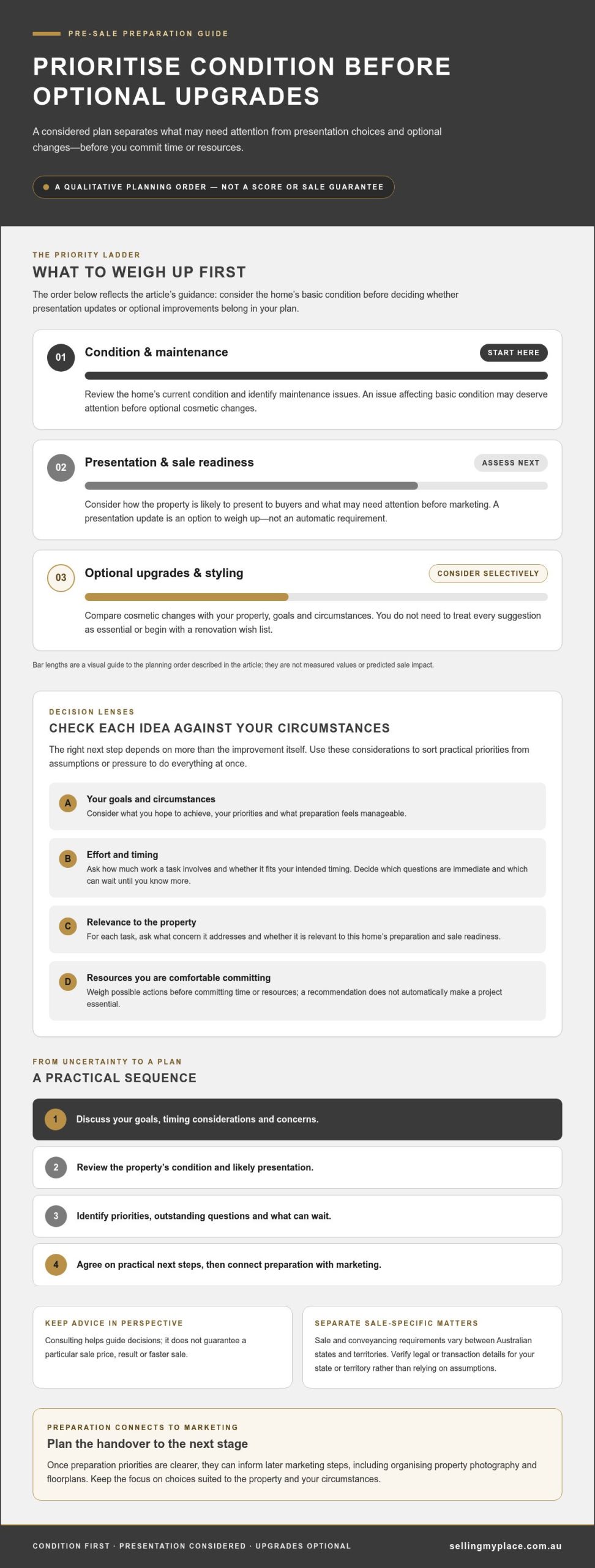
Recommendations can be grouped by priority, likely effort and relevance to sale readiness. For instance, an issue affecting the home’s basic condition may warrant attention before optional cosmetic changes. A presentation update might be worth considering, but that doesn’t mean it must be part of your plan. The right choice depends on the property, your priorities and the resources you’re comfortable committing.
Keep perspective when considering improvement ideas. Ask what concern each task addresses, how much work it involves and whether it fits your intended timing. The goal is to make an informed choice, not to treat every suggestion as essential or assume a particular project will change the sale result.
Sale and conveyancing requirements can vary between Australian states and territories. Legal or transaction details relevant to your sale need careful, state-specific verification rather than assumptions based on general advice. Keep preparation decisions separate from matters that require advice specific to your sale and jurisdiction.
In practice, the steps are straightforward: discuss your goals, review the property, identify priorities, then agree on what happens next. This sequence helps you make informed choices and connect preparation with later marketing steps, such as organising photography and floorplans, without promising a particular price or timeframe.
If you’re weighing up what to do first, you can discuss your pre-sale plans and start shaping a considered approach.
Which Pre-Sale Improvements Should You Prioritise?
Start by separating issues that affect the home’s condition or day-to-day presentation from optional upgrades chosen mainly for a different look. Pre-sale property consulting can help you compare possible tasks against the property’s needs, likely buyer expectations and your own priorities. The aim isn’t to improve everything, but to decide what’s relevant before you commit time and resources.
| Task | Issue addressed | Effort | Dependencies | Reason to consider it |
|---|---|---|---|---|
| Attend to visible maintenance concerns | Wear or faults that may distract from the home’s condition | Varies with the issue | May need further assessment before work is planned | Helps make the property feel cared for and ready to present |
| Declutter and clean key areas | Spaces that feel crowded or difficult to view | Often manageable, depending on the home | Sorting belongings and planning access | Can make rooms easier to understand during a viewing |
| Refresh a presentation detail | A visible cosmetic distraction | Usually limited, but depends on the change | Choosing a suitable approach and organising the work | May help create a more consistent overall impression |
| Consider a larger renovation or styling change | A broader functional or aesthetic concern | Potentially substantial | Scope, timing and other preparation decisions | Worth weighing carefully against your goals and sale readiness |
Should you repair, renovate, style or sell as-is?
Repairs address condition; renovations change or update the home; styling focuses on presentation. Selling as-is may also suit your circumstances. These choices aren’t interchangeable, and none automatically improves the sale outcome. Consider the purpose and scope of each option rather than assuming every project adds value.
How can you decide what is worth doing before listing?
Ask whether the issue is visible, how it may affect a buyer’s experience, what effort is involved and how it fits your sale timing. A leaking tap, for example, is different from a colour choice you’d simply prefer to change. Consider likely buyer expectations in context, not as a reason to pursue every possible upgrade.
Imagine a home with a dated kitchen and several minor maintenance tasks. Rather than begin a major renovation, a considered plan might prioritise practical readiness first, then revisit whether the kitchen needs any presentation changes. That keeps decisions grounded in the home and your priorities. For wider context, consider how preparation choices relate to research on determining a home’s market value in Australia.
A Practical Pre-Sale Property Consulting Checklist for Homeowners
A little organisation before making decisions can make sale preparation feel more manageable. Use this checklist to gather your thoughts and identify what needs attention. It’s a starting point for discussion, not an exhaustive list of documents or a substitute for state-specific legal advice.
What should you have ready before discussing your sale?
- Goals: Note why you’re considering a sale, your intended timing and what a suitable outcome looks like for your circumstances.
- Property condition: Write down known repairs, maintenance concerns and improvements already completed. Include areas you’re unsure about.
- Priority decisions: List what matters most to you, along with any work you’re reluctant to take on or questions about whether it’s worthwhile.
- Preparation: Consider household routines, access to different areas of the home and how much time you can realistically give to getting ready.
- Marketing readiness: Record questions about what needs to be organised before photography, floorplans or property marketing can proceed.
Gather relevant property information and documents you already have, such as records of completed work or other details that may help explain the home’s condition. Keep a separate list of unanswered questions. This makes it easier to distinguish what you know from what needs further advice.
How can you keep preparation manageable?
Once you’ve discussed your situation, sort actions into three groups: decisions still to make, tasks you’ve agreed to organise, and items to revisit before marketing. Some owners can handle straightforward organising themselves, such as clearing surfaces or arranging access. Questions involving conveyancing, legal obligations or technical issues may call for appropriate professional advice. Requirements can vary across Australian states and territories, so avoid relying on a general checklist for legal matters.
Be realistic about sequence and capacity. A task may depend on access to a room, need to fit around family routines or require consideration alongside other work. Keep the agreed priorities visible, perhaps in a short written list, so optional jobs don’t quietly take over the plan.
Preparation should support your next steps, not become an endless project. If a new idea comes up, compare it with your original goals and decide whether it’s essential, useful or simply a preference. That check-in helps keep attention on sale readiness while leaving room to adapt if your circumstances change.
For a considered plan shaped around your property and priorities, discuss pre-sale consulting support.
How Kincade International Direct Sales Supports Your Pre-Sale Decisions
Kincade International Direct Sales provides pre-sale property consulting and real estate advisory services for Australian residential property owners. The focus is on helping you think through preparation decisions in context: your goals, the property’s condition and what you want organised before marketing begins.
That advice connects early planning with the practical steps that follow. Rather than treating preparation and marketing as unrelated tasks, you can consider how decisions about the home fit alongside sale planning, conveyance considerations and the listing materials you’ll need. No preparation plan can promise a particular price or sale timeframe, but a clear sequence can make the process easier to manage.
What support can sit alongside pre-sale consulting?
Pre-sale property consulting can sit alongside neighbourhood market reports and broader marketing preparation. Professional photography and floorplans are part of the wider listing offering, helping prepare property information for presentation to buyers. They’re marketing elements, not a guarantee of what a consultation or preparation work will achieve.
Conveyance advice can also help you consider transaction-related steps. It’s distinct from legal representation, and any legal requirements that apply to a sale should be considered in the context of the relevant Australian state or territory.
For owners looking at the wider selling pathway, Kincade International Direct Sales offers property marketing on a flat-fee, commission-free basis. Listings remain active until sold, with no time limits or agency commissions. This gives you a clear way to consider how preparation leads into listing and marketing.
What is a useful next step for a homeowner?
Begin with the details you already know. Think about your reasons for selling, likely timeline, concerns about the property and the decisions you’d like help weighing up. You don’t need every answer ready. A conversation can start with the home and your priorities, then help clarify which questions deserve attention first.
That steady start can make the next choices feel more manageable, whether you’re still weighing up a move or beginning to prepare for market. Talk through your property sale plans with Kincade International Direct Sales and take the next step with a considered plan.
Move Towards Sale with a Clearer Plan
Preparing your home for sale doesn’t mean taking on every repair, renovation or presentation idea. A clear set of priorities can help you focus on what’s relevant to your property, your circumstances and your readiness to move forward.
Pre-sale property consulting and real estate advisory services can help you consider those decisions before marketing begins. Kincade International Direct Sales connects preparation with broader sale support, including neighbourhood market reports, professional photography and floorplans. Its property marketing model is flat-fee and commission-free, with no promise of a particular sale price or timeframe.
You don’t need every detail settled before taking the next step. Start with your goals, concerns and likely timing, then work through the decisions in a manageable order. Talk through your property sale plans and begin shaping an approach that feels right for your home and circumstances.
Frequently Asked Questions
Is pre-sale property consulting worth it?
It can be useful if you’re unsure what to address before selling or how to organise the work. Pre-sale property consulting helps you consider your home’s condition, your priorities and the steps ahead before committing to optional improvements. Its value is in clearer decisions and planning, not a guaranteed sale price or a promise that every recommendation will increase buyer interest. It can help you focus on what’s relevant to your circumstances.
What does a pre-sale property consultant do?
A pre-sale property consultant helps you think through preparation before marketing begins. This may involve discussing your sale goals, reviewing concerns about the property and identifying practical priorities. The adviser can help separate necessary preparation from optional work and map out possible next steps. Advice should reflect your home and circumstances, rather than follow a one-size-fits-all renovation checklist. You remain in control of which tasks, if any, you decide to pursue.
When should I get pre-sale property advice?
Consider seeking advice when you’re beginning to think about selling, particularly if you’re unsure what work to do or when to start. An earlier conversation gives you more room to weigh options and organise priorities before marketing preparations gather pace. You don’t need every detail decided first. Your goals, questions and concerns provide a useful starting point for working out what deserves attention and what can wait.
What should I fix before selling my house?
There’s no single repair list that suits every property. Start by noting known condition issues and anything that could affect a buyer’s understanding or experience of the home. Then consider each task in light of its relevance, the effort involved and your priorities. An adviser can help organise those decisions, but no repair or improvement should be treated as a guaranteed way to raise the sale price.
Should I renovate my house before selling?
A renovation isn’t automatically the right choice before selling. Consider the home’s current condition, the scope of the proposed work, your available time and what you hope to achieve. For some owners, maintenance or presentation tasks may be more suitable; others may prefer to sell without major work. Pre-sale advice can help you compare these options in context, without assuming a renovation will deliver a particular return or sale outcome.
Can pre-sale consulting guarantee a higher sale price?
No. Preparation advice can’t guarantee a particular sale price or a faster sale. The outcome depends on factors including market conditions, buyer decisions and the property’s features. Consulting can help you make informed choices about readiness and presentation, then plan the steps ahead with greater clarity. Treat it as decision support, not a promise of a financial result. A considered plan helps you focus on actions that suit your home and circumstances.
Can I get pre-sale property advice without using a traditional commission agent?
Yes. Property advice and the structure of a marketing service are separate considerations. Kincade International Direct Sales offers pre-sale consulting alongside commission-free, flat-fee property marketing for residential owners. The advice can help you plan preparation, while the wider service supports the selling journey. You can outline your goals, concerns and likely timeline to discuss how these options fit your plans, without assuming the marketing approach guarantees a particular sale outcome.
Tips for a Fast House Sale: A Practical Australian Seller’s Checklist
The fastest way to sell your home may be to slow down before it goes on the market. These tips for a fast house sale start with reducing buyer hesitation, not rushing into a listing or accepting the first offer. When your home is prepared, priced with current comparable sales in mind and presented clearly, serious buyers have fewer reasons to hold back.
It’s understandable to feel pressure to move quickly, especially when there’s a big life change behind the sale. But a fast result shouldn’t mean making decisions in the dark or leaving important tasks until inspection day. A little structure can help you attract early interest while keeping your expectations and priorities in view.
This practical Australian seller’s checklist will help you decide what to tackle before launch, how to shape a pricing and marketing plan, and what to look for as enquiries, inspections and offers come in. Whether you’re selling by owner or using professional support, you’ll have a clearer way to prepare, compare your options and make considered decisions without feeling hurried.
Key Takeaways
- Use these tips for a fast house sale to build a clear plan around your timing, priorities and what buyers are looking for.
- Compare recent sales of similar homes with current competing listings to support a realistic price position, rather than relying on a formula.
- Help buyers assess your home with clear photographs, accurate listing details and a floorplan that answers practical questions.
- Review enquiries, inspection attendance and buyer feedback regularly to spot when your presentation, listing information or price positioning may need attention.
- Compare selling by owner, traditional agency support and flat-fee marketing based on the involvement, guidance and fee structure that suit you.
Tips for a Fast House Sale Start With a Clear, Realistic Plan
A move can be time-sensitive, whether you’re coordinating a new job, a family change or your next home. But setting a firm sale date before you know how ready the property is or what buyers are doing can add pressure without giving you more control. Treat a fast sale as a goal shaped by your preparation, buyer demand and the terms you’re willing to accept.
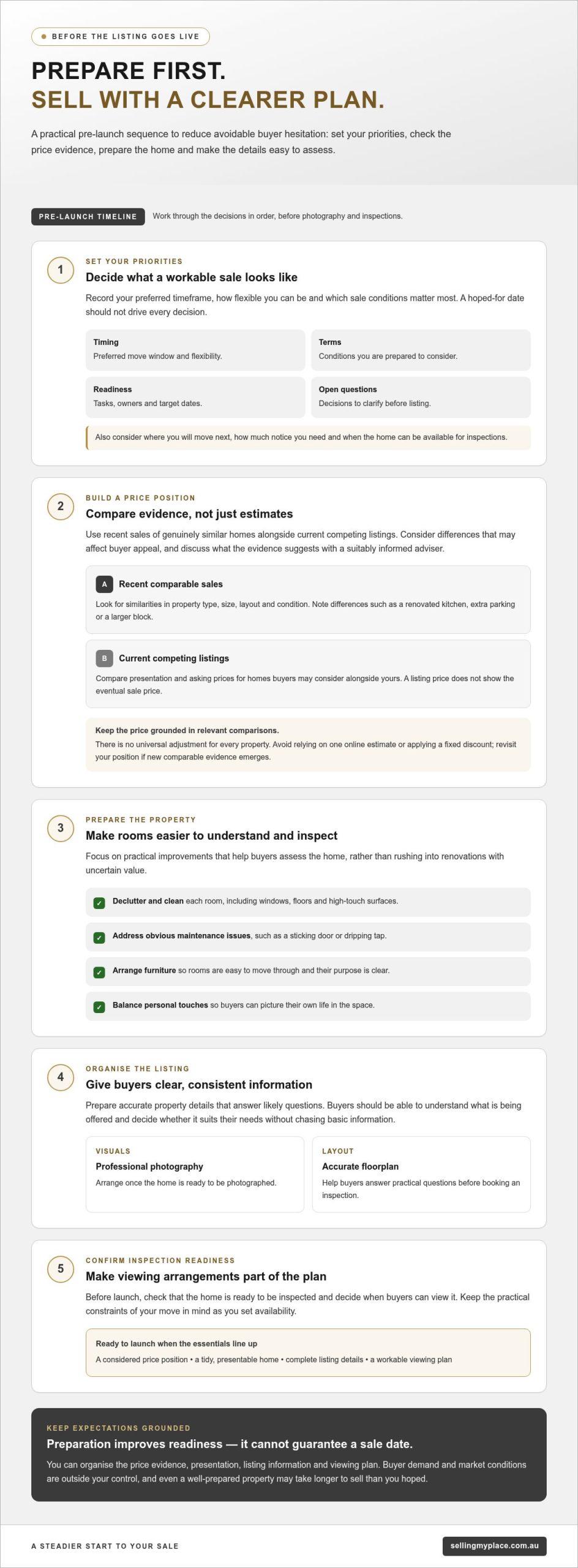
Preparation before launch can reduce avoidable buyer hesitation by making the home, its price and its key details easier to assess. Start with four practical areas: set a considered price position, prepare the property for presentation, organise accurate marketing information and decide how buyers can view the home. Then record your preferred timing, acceptable terms and what needs to happen before you can move.
What Can You Control When Selling a Home Quickly?
You can organise the parts of the sale that are in your hands. Buyers and market conditions aren’t controllable, and even a well-prepared property may take longer to sell than you’d hoped. Focus first on a price position informed by comparable evidence, a tidy and presentable home, and listing information that answers likely questions. These steps improve readiness; they can’t guarantee a particular result or timeframe.
Before the listing goes live, check that the home is ready to be photographed and inspected, and that the property details are consistent and complete. Buyers should be able to understand what’s being offered and decide whether it suits their needs without having to chase basic information.
Set Your Sale Priorities Before You List
Write down your preferred timeframe, how flexible you can be and which sale conditions matter most. Consider practical constraints, too: where you’ll move next, how much notice you need to organise the move, and when you can make the home available for inspections. If you’re considering a seller-led approach, this overview of For Sale By Owner (FSBO) offers background on the model. Check sale or contract questions against relevant Australian advice.
Turn those priorities into a working checklist. Assign each task, set a realistic deadline and record decisions that still need advice. For example, one household member might coordinate repairs while another gathers property information. The right split depends on your circumstances. This simple plan keeps urgent tasks visible without letting a hoped-for sale date drive every decision.
- Timing: preferred move window and flexibility.
- Terms: conditions you’re prepared to consider.
- Readiness: tasks, owners and target dates.
- Open questions: decisions to clarify before listing.
With your priorities recorded, you’ll have a steadier basis for the next decisions: setting a price position and preparing the property for buyers.
Price and Prepare Your House Before the Listing Goes Live
Price and presentation work together. Buyers weighing your home against other options may lose interest if the asking price seems out of step with the evidence or the property is difficult to assess from its listing. One of the most useful tips for a fast house sale is to do this thinking before launch, when you still have time to make considered adjustments.
Evidence-based price preparation means comparing recent sales of genuinely similar homes with current competing listings, then accounting for differences that may affect buyer appeal. It doesn’t mean applying a fixed discount or relying on one online estimate. For a closer look at the process, read this 2026 guide to determining a home’s market value.
How to Set a Realistic Asking Price
Look for recent sales with meaningful similarities in property type, size, layout and condition. Note where a comparison differs: a renovated kitchen, extra parking or a larger block may affect how useful that sale is as a guide. Then review current listings buyers are likely to consider alongside yours. Compare their presentation and asking prices, but remember that a listing price doesn’t show the eventual sale price. Discuss what the evidence suggests with a suitably informed adviser, and revisit your position if new comparable evidence emerges. For context on weighing offers, see these property sale negotiation tips.
An asking price set too high for the available evidence may discourage buyers from enquiring or inspecting, especially if competing homes appear to offer better value. There’s no universal adjustment that suits every property. Aim for a price position you can explain using relevant comparisons, and be ready to consider both the buyer’s offer and its conditions.
A Pre-Launch Home Preparation Checklist
Choose practical improvements that help buyers understand and inspect the property, rather than rushing into renovations with uncertain value. Before photography, work through this short list:
- Declutter and clean each room, including windows, floors and high-touch surfaces.
- Address obvious maintenance issues, such as a sticking door or a dripping tap.
- Arrange furniture so rooms feel easy to move through and their purpose is clear.
- Keep personal touches balanced so buyers can picture their own life in the space.
- Once the home is ready, arrange professional photography and an accurate floorplan.
Clear images and a reliable floorplan help buyers judge the home before they book an inspection. Kincade International Direct Sales provides professional photography and floorplans as part of its property marketing service. For guidance on preparing your property or reviewing your sale approach, explore pre-sale support.
Make Your House Easy to Discover, Understand and Inspect
A buyer who can quickly understand a home’s layout, features and practical details is better placed to decide whether to enquire or book an inspection. Accurate listing materials help buyers assess whether a property suits their needs and make more informed enquiries. Treat the photographs, description and floorplan as one set of information, and check that they tell a consistent story.
What Buyers Need From Your Listing
Use clear photographs that represent the home honestly and help buyers understand how rooms connect. Pair them with accurate property details, useful room descriptions and a well-prepared floorplan. Before publishing, check that the description matches what a buyer will see in person. For further guidance on presenting a home online, read this guide to residential property listing services.
A simple question-and-answer check can reveal gaps in your listing:
- How does the home flow? Use the floorplan and images to show the connection between living areas, bedrooms and outdoor spaces.
- What are the rooms used for? Give each room a clear, accurate description rather than relying on photos alone.
- What details might affect a buyer’s decision? Confirm the relevant property information and have reliable answers ready for common enquiries.
If a detail is uncertain, verify it before the listing goes live. Clear information builds confidence; vague or inconsistent details can leave buyers with questions that might otherwise have been answered upfront.
Prepare for Inspections Without Adding Unnecessary Stress
Inspection access needs to work for buyers and your household. Choose times that offer reasonable opportunities to view the home while fitting around work, school, pets and other routines. If several people share the home, agree on the plan in advance so everyone knows what to expect.
Before each viewing, focus on a short reset rather than trying to make the house perfect:
- Clear everyday clutter from key surfaces and walkways.
- Open curtains and switch on lights where needed.
- Secure personal belongings and confidential paperwork.
- Make sure buyers can move through the main rooms comfortably.
After each inspection, note attendance, recurring questions and feedback. If visitors repeatedly ask about the same feature, consider whether the listing needs clearer information. These observations can help you refine the buyer experience as the campaign progresses. Kincade International Direct Sales provides residential listing and marketing support, with details available through its listing options.
Use Early Buyer Feedback to Keep Your Sale Moving
Once your home is listed, buyer response gives you useful evidence about how the campaign is landing. Rather than reacting to every comment, look for patterns across enquiries, inspection attendance, questions and offers. These tips for a fast house sale are about making measured decisions, not changing course simply because the first few days feel quiet.
A Simple Process for Reviewing Buyer Response
After each inspection, record how many people attended, what they asked and any feedback they shared. Note the quality of enquiries and offers, too: are buyers asking relevant questions, requesting another look or proposing terms you can consider? Compare this with the expectations you set before launch. If you’re managing enquiries yourself, this step-by-step guide to selling your own home may help you organise the process.
Look for repeated signals. One visitor’s preference may be personal; several buyers asking about the same missing detail or expressing the same concern could point to something worth addressing. A trusted adviser can help you judge whether feedback is a pattern or an isolated view.
What to Revisit if Enquiries Are Slow
Work through the likely causes in a calm order before changing your strategy. Check whether the listing is reaching buyers, whether the photographs and description represent the property clearly, and whether inspection times are manageable for people interested in viewing. Then revisit your price position against current comparable evidence and competing listings.
Change one well-supported element at a time, then observe whether the response shifts. If you update the listing details and adjust the price simultaneously, it may be harder to tell what helped. Keep a short review record:
- Enquiries: volume and recurring questions.
- Inspections: attendance and any consistent feedback.
- Offers: price, conditions and how well the terms fit your priorities.
- Next step: the single change you’ll make, or why you’ll hold steady for now.
A quiet spell doesn’t automatically call for an incentive or price change. Consider the offer’s conditions and likely net proceeds alongside the headline amount, and seek advice if you’re unsure. A considered response can protect your sale priorities while keeping the campaign responsive.
Kincade International Direct Sales offers real estate advisory support to help owners interpret buyer response and consider next steps. Review the available sale support.
Choose a Fast-Sale Pathway That Fits Your Priorities
The right sale pathway depends on how much time you can give the process, how confident you feel handling buyer communication and what kind of support you want. Selling by owner, using traditional agency support or choosing flat-fee marketing are different ways to organise the work. None guarantees a faster sale or a higher price, so compare responsibilities and support before committing.
| Pathway | Seller involvement | Marketing support | Advice and fee structure |
|---|---|---|---|
| Sell by owner | You manage buyer enquiries, inspections and sale decisions. | You organise the listing and any photography or floorplan support you need. | You retain direct control, and should identify the advice you need and how any services are charged. |
| Traditional agency support | You make key decisions while agreeing on who handles campaign tasks and buyer contact. | Review the agreed scope for listing exposure, photography and floorplans. | Review the advice provided, commission or other fees, contract terms and your responsibilities. |
| Flat-fee marketing | You may retain decision-making control while taking responsibility for agreed seller tasks. | Review the agreed scope for listing, photography and floorplan support. | Understand the flat-fee structure, advisory support, contract terms and any additional responsibilities. |
How to Compare Selling Options
Don’t compare pathways by headline fee alone. Review the listing exposure provided, whether photography and a floorplan are included, what advice is available and which tasks remain yours. Read the contract carefully so the fee structure, term and responsibilities are clear before you agree. Choose a level of hands-on involvement that fits your available time and confidence, not just your preferred sale date.
Kincade International Direct Sales provides commission-free residential property marketing for a single flat fee. The service includes listing support, professional photography, floorplans and advisory support, so owners can retain control of key decisions while drawing on help with their sale. Consider how that combination fits the tasks you want to manage and the guidance you need.
Prepare for the Next Step After an Offer
An offer is more than its price. Review the conditions, proposed timing and settlement requirements as a complete package, and consider how each part fits your stated priorities and next move. Before committing to legal documents, seek conveyancing or other qualified professional advice relevant to your circumstances. Keep written records of offers, questions and agreed next steps so everyone involved is working from the same information.
For an overview of the support and responsibilities available through Kincade International Direct Sales, explore property sale options.
Take the Next Step With a Sale Plan That Fits
A well-managed sale starts with choices you can explain: a price position informed by evidence, a home ready for buyers to inspect, and a pathway that suits your time and appetite for involvement. These tips for a fast house sale can help you act with purpose, but buyer demand and decisions remain outside your control. A clear plan keeps your goals in view without making speed the only measure of success.
Kincade International Direct Sales provides commission-free property marketing through a single flat-fee model. The service includes professional photography, floorplans and an Agent Advisory Service, and listings remain active until sold with no time limit. This gives owners marketing and advisory support while keeping the sale free of agency commissions.
Talk through your sale plan with Kincade International Direct Sales to explore its flat-fee marketing and advisory support.
Frequently Asked Questions
How can I sell my house quickly without underselling it?
Set your price using recent sales of genuinely comparable homes and the current competition, then assess each offer against both price and conditions. Consider your preferred timing, settlement needs and likely net proceeds before deciding what you’re willing to accept. Strong preparation and clear marketing can help buyers assess the property, but no approach guarantees a quick sale. If evidence or offers are difficult to interpret, seek advice before changing your expectations.
What should I fix before listing my house for a fast sale?
Start with obvious maintenance and presentation rather than rushing into major renovations. Fix practical issues such as a dripping tap or sticking door, declutter, clean thoroughly and make rooms easy to move through. These steps help buyers focus on the home and its layout. Consider whether larger work is worthwhile for your property, budget and timing before committing. Have the home ready before photography and check that listing details are accurate.
Is it better to stage a house before selling?
Staging may help buyers understand how rooms can be used, but it isn’t essential for every home. First try simple presentation: remove excess furniture, clear surfaces, improve lighting and keep the layout easy to navigate. Consider professional staging if it addresses a specific presentation challenge and fits your circumstances. Weigh the expected benefit against the effort and cost, and avoid assuming staging will guarantee a faster sale or a higher offer.
How much does pricing affect how quickly a house sells?
Pricing can influence whether buyers consider your home alongside competing listings. A price that appears out of step with recent comparable sales, condition or current alternatives may discourage enquiries and inspections. There’s no universal discount or formula that determines the right asking price. Review relevant evidence, understand how your property differs from comparisons, and reassess if buyer response is consistently weaker than expected. Market conditions and buyer decisions also affect timing.
Can I sell my house fast without using a traditional real estate agent?
Yes. You can sell by owner, or use a marketing and advisory service while retaining responsibility for key decisions. The right fit depends on the time and confidence you have for managing enquiries, inspections and offers. Kincade International Direct Sales provides commission-free property marketing for a single flat fee, supported by professional photography, floorplans and an Agent Advisory Service. Review what’s included, what you’ll manage and the available advice before choosing.
What happens if my house gets few enquiries after listing?
Review the evidence before making a change. Check whether the listing is visible, the photos and description are clear, and inspection access is workable. Compare your price positioning with current comparable sales and competing homes. Then look for repeated feedback rather than reacting to one comment, and consider changing one well-supported element at a time. Avoid rushed price changes or incentives without weighing the offer terms and likely net proceeds.
How can professional photos and a floorplan help sell a house faster?
Professional photographs can help buyers see the home’s presentation, while an accurate floorplan makes its layout and room relationships easier to understand. Together with a precise description, these materials let people assess whether the property may suit them before arranging an inspection. They can support clearer, more informed enquiries, but can’t guarantee a faster sale. Check that images represent the home honestly and that the floorplan and listing details are accurate.
Benefits of Selling Your Own Property: Is It Right for You?
What if selling your own property gave you more say over the process without leaving you to work everything out alone? The benefits of selling your own property can include greater control over pricing, inspections and buyer conversations, as well as the opportunity to avoid agency commission. Those advantages need to be weighed against the time and responsibility involved.
It’s understandable to wonder whether potential savings are worth the extra work. Marketing, buyer enquiries, offers and sale paperwork all need attention. Selling independently doesn’t have to mean managing every detail without help: some owners use flat-fee marketing and advisory services while keeping control of key decisions.
This article looks at the financial, practical and personal benefits, alongside the challenges to consider before choosing your approach. You’ll learn where greater control may help, which tasks you may need to take on, and what to ask when deciding whether to sell entirely on your own or seek professional support.
Key Takeaways
- The benefits of selling your own property can include fee flexibility and a more hands-on role, but the right balance depends on your priorities.
- Compare the full cost of each approach, including marketing and professional support, rather than focusing on commission alone.
- Consider how much time you can set aside and where you’d want expert advice, particularly with offers and paperwork.
- Before choosing a service, check its written terms, what’s included and which responsibilities remain yours.
- Use your priorities, confidence and available support to decide whether to sell independently or take a supported approach.
What are the benefits of selling your own property in Australia?
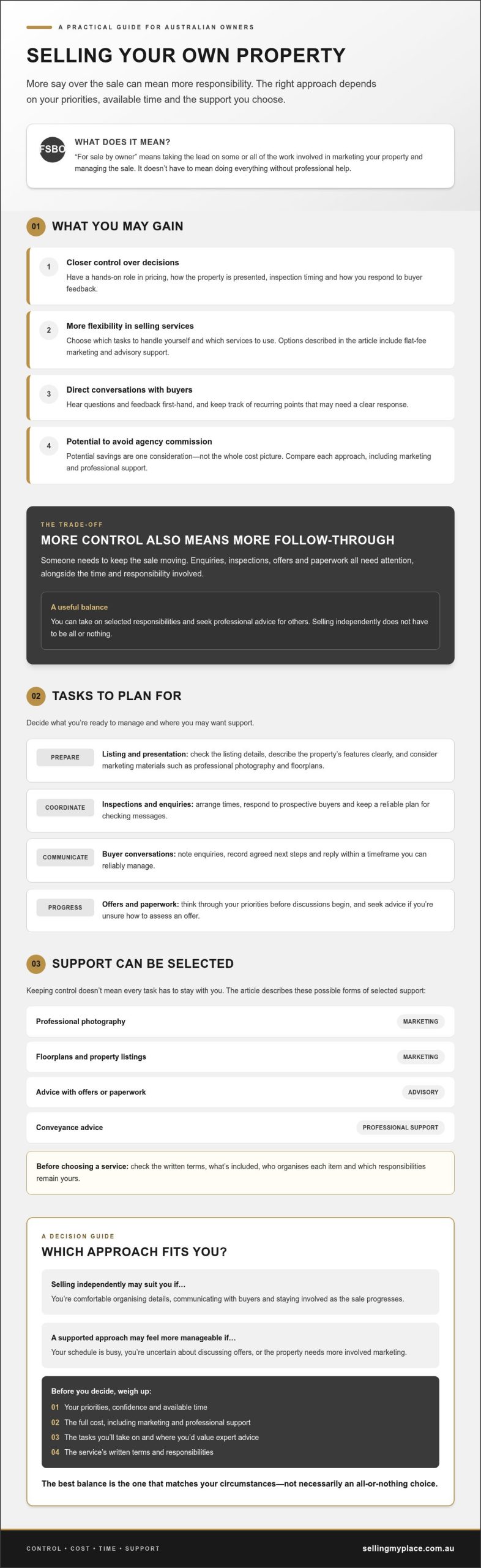
Selling your own property means taking the lead on some or all of the work involved in marketing it and managing the sale. Often described as For sale by owner (FSBO), this approach can give you closer control over decisions, more flexibility in how you pay for selling services and direct conversations with prospective buyers.
The benefits of selling your own property depend on your priorities, the property, market conditions and the support you choose. “Selling yourself” doesn’t have to mean doing everything without professional help. You could manage buyer enquiries yourself while using professional photography, floorplans, property listings or conveyance advice. Kincade International Direct Sales offers flat-fee property marketing and advisory packages, giving owners the option to stay involved while accessing selected services.
How does selling your own property differ from using a traditional agent?
The main difference is who is responsible for coordinating each part of the sale. If you sell independently, you may organise marketing, arrange inspections, respond to enquiries and lead offer discussions yourself. With an agent, some or all of these tasks may be handled on your behalf, depending on the agency’s service and your agreement.
There’s no single standard arrangement. Some owners choose a traditional agency, while others select specific marketing or advisory support and keep more tasks in their own hands. Before deciding, clarify who will prepare listing materials, manage buyer contact and assist with offers or paperwork. The written service agreement matters more than the label.
Who may benefit most from selling independently?
This approach may suit owners who are comfortable organising details, communicating with prospective buyers and staying involved as the sale progresses. If you value direct oversight, you may appreciate deciding how the property is presented, when inspections take place and how to respond to buyer feedback.
Be realistic about your time and confidence, too. A busy schedule, uncertainty about discussing offers or a property that needs more involved marketing may make a supported approach feel more manageable. The choice doesn’t have to be all or nothing. Consider which responsibilities you’re ready to take on and where professional advice could help.
How more control can shape your property sale
A hands-on role lets you stay close to the details that shape how buyers see your home. You can review listing information, decide how the property is presented and communicate directly with prospective buyers. That oversight may help you notice questions or feedback early, then decide whether anything needs clarifying or changing.
Control also comes with practical responsibilities. Someone needs to keep the sale moving. Enquiries may arrive while you’re at work or managing family commitments, and inspections need to suit both your circumstances and prospective buyers. A simple plan for checking messages, recording conversations and following up can make the process easier to manage.
Control over a property sale also means taking responsibility for decisions and following through on them. The right level of involvement is personal. You can take on selected tasks and seek professional support for others rather than assuming you must manage every part alone.
Choosing how and when to present your property
As the owner, you can check that listing details are accurate and that the property’s features are described clearly. You’ll also have input into presentation and the timing of marketing activities, based on your circumstances and readiness. For an overview of what listing support can involve, read this guide to professional residential property listing services.
Professional photography and floorplans are examples of marketing materials you may choose to use, whether you arrange them independently or through a service. Before signing up, check what’s included, who organises each item and which decisions and tasks remain yours.
Communicating directly with prospective buyers
Speaking with buyers yourself gives you first-hand insight into what they want to know, from a feature of the home to the timing of an inspection. Their feedback can help you answer clearly and keep track of recurring questions. It also calls for organisation: note enquiries, record agreed next steps and reply within a timeframe you can reliably manage.
Offer discussions require care and clear judgement. Think about your priorities before negotiations begin, including what matters to you beyond the proposed price. If you’re unsure how to assess an offer, seek advice. Explore these property sale negotiation tips as you prepare.
For guidance on the rules and process that apply to your sale, check the relevant state or territory resources. This consumer guidance on selling property is one reference; requirements and processes can differ across Australia. If you’d like to explore a more supported, hands-on approach, you can ask about property listing and advisory support.
Can selling your own property reduce selling costs?
It can. If you sell without a commission-based agency arrangement, you may avoid that particular selling expense. But commission is only one part of the picture. Owners may still pay for marketing, professional services and transaction-related costs. The benefits of selling your own property are best assessed by comparing the full costs and responsibilities of each approach, not by focusing on one fee.
Which costs should an owner compare?
Depending on your property and chosen approach, your budget may need to account for:
- Agency commission, if charged under your agreement
- Property marketing, photography and floorplans
- Conveyancing or other professional advice
- Mortgage discharge and other transaction-related expenses, where applicable
A commission-based arrangement and flat-fee marketing use different fee structures. With commission, the fee is generally linked to the sale under the agreed terms. A flat fee is set for specified services, so check exactly what it covers. Neither label tells the whole story. Compare inclusions, exclusions, payment terms and the tasks you’ll need to handle yourself.
| Arrangement | What to check | Possible owner responsibilities |
|---|---|---|
| Commission-based agency | How commission is calculated, when it’s payable and which services are included | Reviewing decisions and documents, with some sale tasks handled by the agent as agreed |
| Flat-fee marketing | Which listing and marketing services are covered, and what costs are separate | Depending on the agreement, responding to enquiries, coordinating inspections or discussing offers |
| Fully independent sale | Any separately arranged marketing and professional services | Taking the lead on sale activity and arranging advice or support where needed |
How to think about your potential net proceeds
As a starting point, estimate net proceeds by subtracting relevant selling and transaction expenses from the sale proceeds. Include costs you’ll pay directly as well as any agreed service fees. Selling independently may reduce one expense, but it can also mean taking on tasks that might otherwise be included in another arrangement.
Lower selling costs don’t guarantee a higher net sale outcome. The final result also depends on the sale price achieved and the expenses involved, and no fee structure can guarantee a particular price. To inform your planning, read this guide on how to determine a home’s market value, then compare written service terms before choosing an approach.
What should you weigh against the benefits of selling your own property?
A private sale can give you a closer hand in the process, but that involvement takes time and consistent follow-through. You may need to prepare marketing information, organise inspections, respond to buyer questions, keep track of conversations and manage offer discussions. These tasks can overlap with work and family commitments, so picture how the sale would fit into an ordinary busy week, not just an inspection day.
Paperwork is another consideration. Documents and disclosure requirements can vary between Australian states and territories and may depend on your circumstances. Check current guidance for the relevant jurisdiction and seek appropriately qualified advice if you’re unsure. The benefits of selling your own property don’t remove the need to understand the steps that apply to your sale.
How much time and confidence does a private sale require?
Ask yourself whether you can regularly monitor enquiries, arrange suitable inspection times and follow up with interested buyers. Think, too, about how comfortable you feel discussing the property and responding to questions or offers. You don’t need to be an experienced negotiator, but you should have a plan for handling conversations calmly and keeping clear records.
Make a list of the tasks you’re happy to manage and those you’d rather delegate. This can help you work out whether a fully independent sale is practical or whether selected support would make the process more manageable.
When might professional support make the process easier?
Support may be useful for preparing a property listing, arranging photography or floorplans, getting pre-sale advice or understanding conveyance steps. A service can cover selected parts of the process while you remain involved in decisions and buyer communication. Conveyance advice can help with process questions, but it shouldn’t be treated as a substitute for legal advice from a qualified legal professional.
For a practical overview of the stages to plan for, see this step-by-step guide to selling your own home. It can help you identify which responsibilities you’re prepared to take on and where you may want guidance.
A private sale may offer more direct oversight and flexibility, while asking you to coordinate more of the work. A supported arrangement can share some of that workload, but its scope and terms matter. Neither approach is automatically best for every owner. Weigh your available time, confidence and preferred level of involvement. If you’re considering flat-fee listing or advisory support, ask about property marketing and advisory options, then check the written terms and current inclusions before deciding.
How to decide whether selling your own property suits you
The best approach is the one that fits your priorities and the way you want to manage this major transition. The benefits of selling your own property may matter most if you value direct control. Having some tasks handled by a professional may matter more if time or confidence is limited. You don’t have to choose between doing everything yourself and handing over every decision.
A practical checklist for weighing your options
Before choosing, consider what you want to be responsible for and what you’d prefer to delegate. Be honest about your time, confidence and need for guidance. Then compare the written terms of each service rather than relying on a headline claim.
- Priorities: Which decisions do you want to make directly, such as how your property is presented or how buyer enquiries are handled?
- Time: Can you organise sale activity and follow up with prospective buyers alongside your other commitments?
- Confidence: Are you comfortable communicating with buyers and discussing offers, or would advice help you feel prepared?
- Support: Which tasks can you manage, and where would marketing, pre-sale consulting or conveyance advice be useful?
- Terms: What does each service include, what falls outside its scope and which responsibilities remain yours?
Compare the full service terms, including marketing inclusions and your expected workload. A lower headline fee may not tell you how much you’ll need to organise yourself, while a broader service may include tasks you don’t need. Make sure you understand the arrangement before committing.
Getting support while keeping ownership of your decisions
An owner-led sale can still include professional support. Flat-fee property marketing and advisory packages may suit sellers who want to stay involved without arranging every element alone. Depending on the service and its current inclusions, support may include property photography, floorplans and pre-sale consulting. Confirm the details and terms directly so you know what’s covered and what you’ll manage.
This can offer a middle ground: you remain closely involved in decisions while drawing on selected expertise where it’s useful. The right balance depends on your property, priorities and capacity, not a one-size-fits-all rule. Compare your options and choose the level of responsibility that feels manageable.
If you’d like to talk through what could suit your circumstances, talk through your property-selling options.
Choose a selling approach that feels right for you
The benefits of selling your own property are most meaningful when the approach suits your priorities, available time and confidence. You can keep a close hand on decisions without necessarily managing every part of the sale yourself. The key is to understand what support is available, what it includes and which responsibilities stay with you.
Kincade International Direct Sales offers flat-fee property marketing and advisory packages with no agency commissions, along with professional photography, floorplans and advisory support. Its residential listings remain available until sold, with no time limits. Check the current service details and written terms to decide whether this kind of support fits the way you want to sell.
A property sale is a significant step, and there’s no single approach that suits every owner. Compare your options and choose a path that gives you clarity about the costs, responsibilities and support involved. Talk through your property-selling options and explore what may work for your circumstances.
Frequently Asked Questions
What are the main benefits of selling your own property?
The main benefits can include having more control over sale decisions, communicating directly with prospective buyers and choosing a fee structure that suits your needs. The benefits of selling your own property depend on how much of the process you manage and what support you select. You might take the lead on enquiries while using professional marketing or advice for specific tasks. Weigh those advantages against the time and organisation involved.
Can I sell my property without using a real estate agent?
Yes, Australian owners can choose to sell without engaging a real estate agent. You can take the lead on marketing, buyer enquiries, inspections and offer discussions, or arrange selected professional services to assist. Sale processes and requirements can differ between states and territories, so check the rules that apply to your property. Consider seeking conveyancing or legal advice about contracts, disclosure and the steps needed to complete the sale.
Is selling your own home cheaper than using an agent?
It may cost less in some circumstances, but that isn’t automatic. Selling independently may avoid an agency commission, while costs for marketing, professional services and transaction-related expenses may still apply. A flat-fee marketing service has a different fee structure, so compare its written inclusions and terms with an agency agreement. Consider both the fees you’ll pay and the tasks you’ll manage yourself before deciding which option represents better value for you.
How much work is involved in selling your own property?
The workload depends on what you take on and what you delegate. Tasks may include preparing listing details, organising marketing, responding to enquiries, arranging inspections, keeping records of buyer conversations and following up on offers. You’ll also need to coordinate the sale’s next steps with the relevant professionals. Before committing, consider how these responsibilities will fit around your work and personal commitments, and identify any tasks you’d prefer to hand over.
What happens if I receive an offer I am unsure about?
You don’t need to make a decision on the spot. Ask for the offer and its conditions in writing, clarify anything you don’t understand, and consider how the terms fit your priorities. An offer may involve more than the proposed price, so check details such as conditions and proposed settlement arrangements. If you’re uncertain about the contract or legal implications, seek advice from an appropriately qualified professional before responding.
Do I still need professional help when selling privately?
Not necessarily for every task, but professional help can be useful in areas where you want more confidence or expertise. Depending on your needs, you could consider property marketing, pre-sale consulting, conveyance advice or legal advice. The right support depends on your sale and the requirements in your state or territory. Clarify what each provider does, what their service excludes and whether you need separate legal advice for contracts or other matters.
Can I use professional photography and floorplans when selling my own property?
Yes. Selling independently doesn’t prevent you from using professional photography or floorplans. You can arrange these services separately or check whether they’re included in a property listing service. Confirm the current inclusions, how the materials will be supplied and whether you need to arrange anything else for your listing. Clear images and an accurate floorplan can help prospective buyers understand the home before deciding whether to make an enquiry or arrange an inspection.
Real Estate Advisory Services: Debunking the Myths for Australian Home Sellers
Why are Australian families still handing over $25,000 or more in commissions when the national median dwelling value has climbed to $922,838? It’s a staggering amount of money to part with, especially when you’re already managing the emotional transition of moving and the complex legalities of a property settlement. Most sellers feel caught between a rock and a hard place. You want the professional edge of a top-tier campaign, but the “slick” tactics and high costs of traditional agencies often feel more like a burden than a benefit. This is exactly why real estate advisory services are becoming the preferred choice for savvy homeowners who value their equity.
We understand that your home is likely your greatest financial asset and a place filled with years of memories. You deserve to keep the full profit of your sale without feeling overwhelmed by marketing jargon or complex contracts. This article will show you how to bypass the traditional commission trap while still securing expert results through professional photography, accurate floorplans, and strategic advice. We’re going to debunk the common myths about selling and explain how a partnership-based approach gives you the confidence to lead your own sale with a steady, expert hand by your side.
Key Takeaways
- Understand how real estate advisory services provide the strategic expertise of a traditional agency while letting you retain the “commission” as your own profit.
- Debunk the common myth that only “corporate moguls” or traditional agents can secure a premium sale price for a residential family home.
- Identify the hidden costs within the standard 2-3% commission model and how a transparent flat-fee approach protects your hard-earned equity.
- Learn to use professional-grade neighbourhood market reports and pre-sale consulting to organise a high-impact campaign that resonates with local buyers.
- Discover a “steady hand” method for selling that balances professional authority with the personal care and empathy your family’s legacy deserves.
What are Residential Real Estate Advisory Services?
Think of it as having a seasoned mentor by your side, someone who knows exactly how to position a property to attract the right buyers but doesn’t take a massive slice of your sale price at the end. This is the heart of real estate advisory services. While the name might sound like something reserved for high-rise developers or corporate moguls, it is actually a deeply personal partnership designed for everyday Australian homeowners. It provides the strategic “brains” of a traditional agency, offering professional photography, detailed floorplans, and expert conveyance advice without the heavy burden of a salesperson’s commission.
Don’t let the term “advisory” intimidate you. It’s a grounded, practical way to sell. Most traditional models are built on a transactional foundation where the agent is the gatekeeper. In an advisory model, you are the pilot and we are the navigator. We provide the tools you need, such as comprehensive Neighborhood Market Reports and bespoke Pre-Sale Property Consulting, to ensure your home stands out. This shift in perspective is vital in a market where the national median dwelling value is $922,838. A standard commission could easily swallow $25,000 of your hard-earned equity. We believe that money belongs in your pocket, not ours.
Unlike a traditional model where the focus can sometimes shift toward a quick turnover to meet monthly targets, an advisor’s priority is your net profit. By focusing on core components like robust market data and a polished marketing strategy, these services put the power back into your hands. You get the professional edge of a high-end listing with the financial freedom of a private sale.
Advisory vs. Traditional Agency: The Fundamental Difference
The primary distinction lies in how the professional is compensated. Most people understand what is an estate agent and how they typically operate on a 2.65% commission basis. In contrast, an advisor works for a transparent flat fee. This removes the conflict of interest and ensures the advice you receive is purely about protecting your equity. Think of it as a “steady hand” guiding you through the settlement process. You remain the decision-maker while the advisor provides the map and the compass. For the modern Australian property ladder, this model is a logical choice for those who want professional results without the archaic cost structure of a traditional agency.
Who is Residential Advisory For?
This approach isn’t just for the tech-savvy. It’s for first-time sellers who feel overwhelmed by the legal complexity of a sale and want professional backing without a massive price tag. It’s for experienced investors looking to optimise their portfolio costs as interest rates and holding costs rise. Most importantly, it’s for families transitioning to a new life stage. Whether you’re downsizing or moving for a growing family, you need a guide who leads with heart and respects the emotional weight of the transition. Choosing real estate advisory services means choosing a partner who values your legacy as much as you do.
Debunking 5 Common Myths About Professional Property Advice
It is natural to feel a bit skeptical when you first hear about a different way to sell. For decades, the Australian property market has been dominated by a specific, high-commission formula that many homeowners assume is the only path to success. These long-held beliefs often create a sense of fear, making people feel they must choose between a “slick” traditional agent or going it completely alone. However, most of these fears are based on outdated myths that don’t reflect how modern real estate advisory services actually operate.
- Myth 1: “Advisory services are only for corporate property moguls.” While big developers use advisors, residential advisory is designed for everyday families. It’s for anyone who wants to protect their hard-earned equity while navigating a life transition.
- Myth 2: “You need a traditional agent to get the highest sale price.” Buyers don’t pay more because an agent has a fancy car; they pay for the value of your home. Professional marketing and market data are what drive premium results.
- Myth 3: “Advisors just give you a report and leave you to it.” This couldn’t be further from the truth. A quality advisor acts as a “steady hand,” providing ongoing support from the initial listing through to the final settlement.
- Myth 4: “It’s too expensive for a standard residential sale.” When you compare a transparent flat fee to the national average commission of 2.65%, the savings are usually substantial. On a median-priced home of $922,838, those savings can be life-changing.
- Myth 5: “Selling your own home means you lose out on professional marketing.” Modern advisory packages include the same high-end photography and floorplans used by top-tier agencies.
The Truth About “Sale by Owner” with Expert Backing
Many people worry that a Sale by owner approach looks amateurish. In reality, when paired with an advisory service, your listing is indistinguishable from a traditional agency’s. You receive professional photography and floorplans that highlight your home’s best features. Interestingly, many buyers actually prefer dealing directly with the owner. They appreciate the authentic, local knowledge only you can provide, as long as the initial marketing has that professional “polish” to build trust from the first click.
Why “Consulting” is More Active Than You Think
Residential advisory isn’t a passive service. It involves active pre-sale property consulting to identify small, high-impact improvements that can boost your sale price. You also receive essential conveyance advice to ensure the legal paperwork is handled correctly, reducing the stress of the settlement process. By using professional Neighbourhood Market Reports, you gain the upper hand in negotiations because you have the same data as the professionals. If you’re feeling overwhelmed by the complexity of the market, you might find it helpful to chat with a friendly advisor about your specific needs.
Advisory vs. Traditional Agents: The Commission Trap
Selling your home is one of life’s biggest transitions, yet the traditional model often feels like it’s designed to benefit the agency more than the family moving out. In 2026, the national average real estate agent commission sits at approximately 2.65%. While that might sound like a small percentage on paper, it’s a significant sum when applied to Australian property values. For a home at the national median of $922,838, you’re looking at a commission bill of roughly $24,450. This is the “commission trap” that many sellers fall into simply because they aren’t aware that real estate advisory services offer a more equitable path forward.
Traditional agencies often layer hidden costs on top of that percentage. You might be asked to pay for premium marketing packages, auctioneer fees, and administrative costs, all while the agent’s primary motivation is a quick turnover. A 0% commission, flat-fee structure changes the dynamic entirely. It allows you to be more flexible with your listing price if needed, or simply ensures that every extra dollar a buyer offers goes directly into your bank account. There’s also the myth of the “time limit.” Many traditional contracts bind you to a short exclusive period, creating a sense of urgency that can lead to underselling. An advisory partnership is different; we stay with you until your property is sold, providing a steady hand through every negotiation.
Calculating the Real Cost of a Sale
Let’s look at the numbers for a property in Sydney or Melbourne, where median values often exceed $1 million. A 2.5% commission on a $1M sale is $25,000. Compare that to a single flat-fee marketing package that covers your photography, floorplans, and listing. The difference is often $20,000 or more. What could your family do with that saving? It could be the deposit for your next home, a much-needed renovation, or a significant boost to your retirement fund. Beyond the money, there’s a profound psychological benefit. Knowing your advisor isn’t rushing for a commission check means you can wait for the right buyer, not just the first one.
Buyer Representation and the Advisory Edge
The support doesn’t have to stop when the “Sold” sticker goes up. One of the greatest advantages of real estate advisory services is the ability to access buyer representation for your next chapter. Most sellers are also buyers, and navigating the current market requires a different set of skills. Advisors can often provide access to off-market properties through their networks, giving you a head start before a home even hits the major portals. By linking your sale and purchase strategies, you create a seamless transition that reduces the stress of moving and ensures your next investment is as sound as the one you just sold.
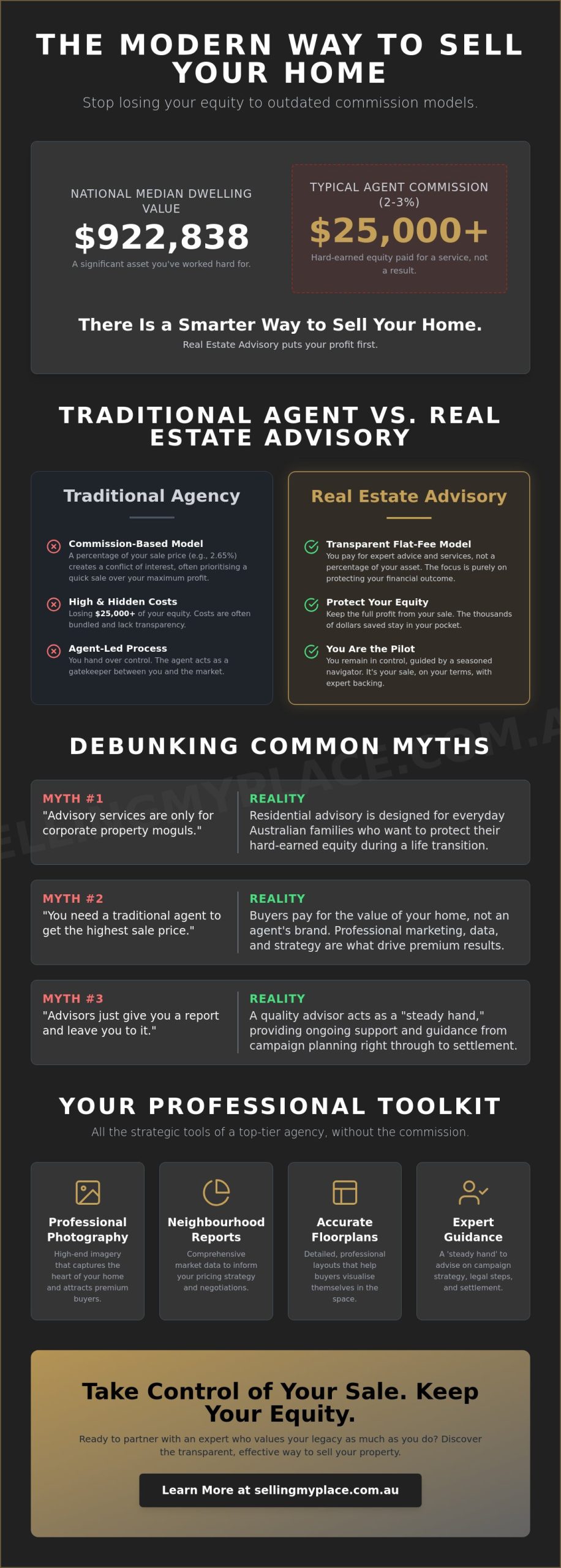
How to Use Real Estate Advisory Services to Sell Smarter
Selling your home shouldn’t feel like a high-stakes gamble or a confusing maze of paperwork. It is a methodical process that, when handled with the right tools, becomes a rewarding journey toward your next chapter. By using real estate advisory services, you aren’t just “listing” a property; you’re executing a sophisticated strategy designed to maximise your equity. This approach allows you to take the lead while we provide the professional scaffolding to support your every move. It’s about being empowered, not overwhelmed.
- Step 1: Secure a Neighbourhood Market Report. Pricing your home “on the money” is critical. With the national median dwelling value reaching $922,838 in February 2026, even a 2% error in pricing can cost you nearly $20,000.
- Step 2: Engage Pre-Sale Property Consulting. Before the first buyer walks through, we help you identify high-impact, low-cost improvements. Often, a fresh coat of paint or some basic landscaping can add far more to the sale price than the cost of the work itself.
- Step 3: Deploy Professional Photography and Floorplans. Your home needs to shine on global real estate portals. High-end visuals ensure your property isn’t just seen; it’s remembered.
- Step 4: Utilise Expert Conveyance Advice. The legal side of a settlement can be daunting. Having a steady hand to guide you through the contracts and disclosures reduces the stress of the final exchange.
- Step 5: Manage Enquiries Directly. Armed with data and professional marketing, you can talk to buyers with total confidence. You know your home better than any agent ever could.
The Power of Market Data
In the 2026 Australian property market, “gut feel” is a risky strategy. With KPMG forecasting national house price growth of 7.7% this year, the landscape is shifting quickly. A comprehensive market report helps you understand local buyer demand and recent comparable sales in your specific suburb. When a potential buyer tries to negotiate, you don’t have to rely on emotion. You can use hard data to justify your asking price, showing them exactly why your home represents a sound investment for their future. Pairing this data with proven property sale negotiation tips gives you a powerful edge when offers start coming in.
Professional Marketing Without the Agency Price
Many sellers fear that going without a traditional agent means a “DIY” look that turns buyers away. This is where Residential Property Listing Services bridge the gap. By including professional photography and detailed floorplans, your listing carries the same authority as any major agency. Buyers today are savvy; they want to see the layout and the quality of the finish before they commit to an inspection. Providing these professional touches ensures you are taken seriously by serious buyers. Ready to take the first step toward a smarter sale? Reach out to our team today to see how we can support your journey.
The Kincade Approach: Your Steady Hand in the Property Market
At Kincade International Direct Sales (KIDS), we believe the traditional way of selling property is long overdue for a change. For too many Australian families, the excitement of a successful sale is often dampened by the arrival of a massive commission bill. Our real estate advisory services were born from a desire to do things differently. By operating on a 0% commission, flat-fee model, we put the owner back where they belong: at the centre of the transaction. We provide the digital infrastructure and global marketing networks usually reserved for high-end agencies, ensuring your home reaches the right buyers without the high-end price tag.
This isn’t just about saving money, though that is a significant part of the appeal. It is about a fundamental shift in the relationship between seller and advisor. We don’t see our clients as just another settlement date on a calendar. We see families who are often navigating emotional transitions, whether that is moving into a first home, downsizing after decades in a family residence, or managing a deceased estate. Our approach combines professional authority with a heartfelt warmth that acknowledges the significance of your legacy. We’re here to ensure you feel supported, not just processed.
A Partnership Built on Trust and Empathy
Our “Steady Hand” philosophy is the cornerstone of everything we do. We aim to be proactive and competent, providing a sense of calm confidence that reduces the stress of complex processes. We understand that while you want to lead your own sale, you still need a guide who is always in your corner. Our Agent Advisory Service provides that expert backing, offering a safety net of knowledge that covers everything from initial market positioning to the final exchange of contracts. We focus on your long-term family needs because we value relationships over quick results. It’s about more than just a house; it’s about your future stability and peace of mind. When it comes to fielding offers, our advisors also equip you with essential property sale negotiation tips so you can handle every conversation with calm authority.
Start Your Commission-Free Journey Today
You have worked hard to build the equity in your home. Why should a significant portion of that hard work be handed over to an agency? Taking control of your sale is an empowering experience, especially when you have professional-grade tools and a seasoned expert by your side. With the average saving sitting at around $20,000, choosing an advisory model is a fair dinkum way to protect your profit and set yourself up for your next chapter. We invite you to step away from the commission trap and experience a more respectful, transparent way to move. Discover how Kincade empowers you to sell smarter and keep your profit.
Take the Reins of Your Property Future
Choosing a different path for your home sale is a powerful way to honour the hard work you’ve put into your property. You’ve seen how the traditional commission model often takes more than it gives, especially when the national median dwelling value is climbing. By embracing real estate advisory services, you’re reclaiming the right to manage your family’s biggest asset on your own terms while securing the professional edge you need. You’ll gain access to our global marketing network reach and the “polish” of high-end photography, but without the $20,000 commission bill typically seen in Australian sales.
Our Expert Agent Advisory Service ensures you never walk this path alone, providing a steady hand from the first market report to the final settlement. It’s about keeping your hard-earned equity where it belongs, in your pocket, to fund your next adventure or secure your family’s future. Don’t let outdated myths hold you back from a smarter, more profitable sale that respects both your time and your profit. Keep 100% of your profit—explore our flat-fee advisory packages today. Your home is a legacy you’ve built with care; we are here to help you protect it with the expert guidance you deserve.
Frequently Asked Questions
What exactly is included in a real estate advisory service for homeowners?
Our service provides a complete suite of professional tools to help you manage your own sale with total authority. This includes high-end photography and detailed floorplans to ensure your listing looks spectacular on every major portal. You also receive pre-sale property consulting to identify value-add improvements and a comprehensive market report to help you price accurately. It is about giving you the “brains” of a traditional agency without the heavy burden of a commission bill.
Can I really sell my own home without an agent and still get a top price?
You absolutely can achieve a premium price by selling independently, provided your marketing is of a professional standard. Buyers are attracted to the inherent value of your home and the data-driven pricing you present, rather than the brand of a traditional agency. In fact, many buyers find dealing directly with the owner more authentic and transparent. With the right real estate advisory services backing you, your listing will have the same authoritative reach and “polish” as any major firm.
How does a flat-fee model differ from traditional real estate commission?
The primary difference is transparency and the protection of your hard-earned equity. While traditional agents take a percentage of your final sale price, usually around 2.65% in the current market, a flat-fee model involves a single payment for specific services. This means if your home sells for more than expected, every extra dollar stays in your pocket. It removes the conflict of interest and allows for a more relaxed, partnership-focused experience where the goal is your net profit.
What happens if my property doesn’t sell within a few months?
Unlike traditional exclusive agency agreements that often expire after a fixed period, our approach is to support you until the “Sold” sticker is up. We understand that finding the right buyer for your family home might take a little longer in some market cycles. You won’t be pressured into a quick, low-value sale just to meet a salesperson’s monthly target. We remain your steady hand throughout the entire journey, regardless of the timeframe required to find the perfect buyer.
Do I still need a solicitor if I use an advisory service with conveyance advice?
Yes, you will still need a qualified legal professional to handle the final transfer of title and legal settlement. While we provide expert conveyance advice to help you understand the process and prepare your documents correctly, a solicitor or licensed conveyancer is required to perform the final legal exchange. Our advice acts as a bridge, ensuring you are well-prepared and confident before you hand over the paperwork to your legal team, making the final process much smoother.
Is real estate advisory legal in all Australian states and territories?
Real estate advisory services are a legitimate and growing part of the national property landscape in every state and territory. We operate within the legal frameworks that allow homeowners to represent themselves in a sale while receiving professional consulting and marketing support. Whether you are in a bustling capital city or a quiet regional centre, you have the right to choose a service that prioritises your equity over traditional commission structures.
How do I handle negotiations with buyers if I don’t have a traditional agent?
Negotiating directly is often simpler than people think, especially when you have a comprehensive market report to back up your asking price with hard data. We provide you with the information needed to justify your position and handle objections with calm confidence. You know the unique history and “soul” of your home better than anyone else. Sharing that authentic connection while using our strategic advice often leads to a more respectful and successful negotiation for both parties.
Will my property be listed on the major Australian real estate portals?
Your property receives maximum exposure by being listed on the leading Australian real estate websites where buyers are already looking. We ensure your home is visible to a global audience, using the professional photography and floorplans included in your package to grab attention instantly. You get the same digital infrastructure and reach as a high-priced agency, ensuring your home is seen by the widest possible pool of potential buyers across the country.
