How to Sell a House Without Commission in Australia
In Australia, you can legally sell your home without appointing a real estate agent. Selling a house without commission in Australia is possible, but a private sale still involves advertising, managing buyer enquiries and arranging the legal steps.
It’s understandable to want to keep more of your sale proceeds while ensuring the process is managed carefully. If you’re considering selling a house without commission in Australia, remember that avoiding an agent’s commission doesn’t remove your responsibilities as the seller. State and territory requirements differ, so preparation matters.
This guide covers how to advertise your home, respond to buyers and assess offers, as well as the costs and legal considerations to keep in mind. You’ll also see where professional marketing support can help while you remain in control of your decisions.
Key Takeaways
- You can sell your home without appointing an agent, but you’ll still need to manage the sale process and its legal requirements.
- Prepare the required sale contract and disclosures before advertising; the documents and timing depend on your state or territory.
- Plan your advertising to present the property clearly and reach buyers, then set aside time to respond to enquiries and arrange inspections.
- Compare the potential commission saving with the work and costs involved in selling privately, including marketing and conveyancing.
- Keep offers and key sale arrangements clear, and get the contract terms explained before you sign.
How do I advertise my private home sale in Australia?
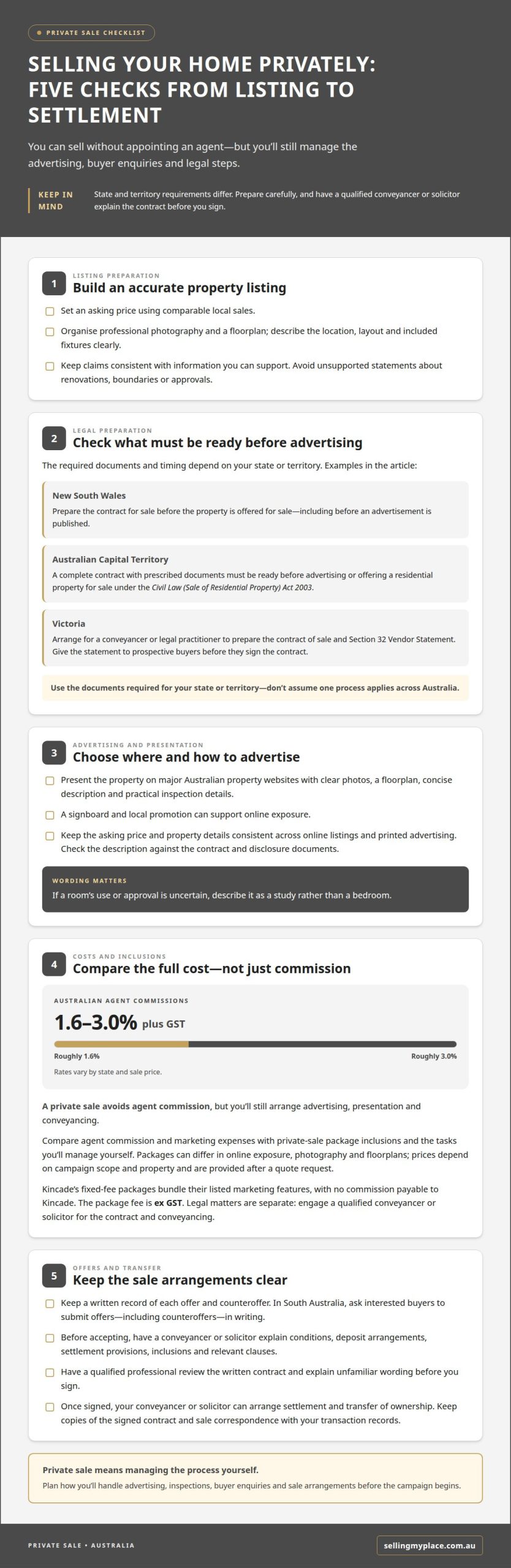
- Prepare a complete, accurate listing. Set an asking price using comparable local sales, then organise professional photography and a floorplan. Describe the home clearly, including its location, layout and included fixtures. Keep every claim consistent with information you can support; avoid unsupported statements about renovations, boundaries or approvals.
Choose a private-sale listing package by comparing its inclusions, such as online exposure, photography and floorplans. Package prices depend on the campaign scope and property, and are provided after a quote request. Plan separately for conveyancing and any advertising or presentation costs.
- Arrange the contract and disclosure documents before advertising where required. State and territory rules differ. In New South Wales, the contract for sale must be prepared before the property is offered for sale, including before an advertisement is published. In the ACT, a complete contract with prescribed documents must be ready before advertising or offering a residential property for sale under the Civil Law (Sale of Residential Property) Act 2003.
In Victoria, arrange for a conveyancer or legal practitioner to prepare the contract of sale and Section 32 Vendor Statement. Give the statement to prospective buyers before they sign the contract. Use the documents required for your state rather than assuming one process applies across Australia.
- Choose where and how to advertise. Present the property on major Australian property websites with clear photos, a floorplan, a concise description and practical inspection details. A signboard and local promotion can support online exposure. Keep the asking price and property details consistent across every listing and printed advertisement.
Before publishing, compare the description with the contract and disclosure documents. For example, describe a room as a study rather than a bedroom if its use or approval is uncertain. Accurate wording helps prevent confusion when buyers enquire or consider making an offer.
- Compare private-sale costs with agent commission. Australian agent commissions are roughly 1.6–3.0 per cent plus GST, although rates vary by state and sale price. A private sale avoids agent commission, but still involves arranging advertising, presentation and conveyancing. Compare the proposed agent commission and marketing expenses with the private-sale package inclusions and tasks you’ll manage yourself.
Compare what is included in a package rather than assuming all private-sale listings cover the same services. Kincade’s fixed-fee packages bundle their listed marketing features, with no commission payable to Kincade. The package fee is ex GST. Legal matters are separate, so engage a qualified conveyancer or solicitor to handle the contract and conveyancing.
- Manage offers, signing and ownership transfer carefully. Keep a written record of each offer and counteroffer. In South Australia, ask interested buyers to submit offers, including counteroffers, in writing. Before accepting, have a conveyancer or solicitor explain the conditions, deposit arrangements, settlement provisions, inclusions and relevant clauses.
Have a qualified professional review the written contract and explain unfamiliar wording before you sign. Once it’s signed, your conveyancer or solicitor can arrange the legal steps for settlement and transfer of ownership. Keep copies of the signed contract and sale correspondence with your transaction records.
Do I have to use an agent to sell my property?
No. You can sell a residential property yourself in Australia without appointing an estate agent. You’ll manage the advertising, inspections, buyer enquiries and sale arrangements, so decide how you’ll handle each task before the campaign begins.
-
List the property on major websites
Prepare a listing for major Australian property websites that accept private-sale advertisements. Online property portals are a common way for buyers to find homes, so include clear photos, accurate details and a considered asking price. Check every field before publishing, then keep the price and property features consistent wherever the home appears.
Use the opening lines to identify the property type, suburb and a genuine standout feature, such as a renovated kitchen or courtyard. Include inspection arrangements and a reliable way to enquire. Avoid unsupported claims about renovations, approvals or room use. Inconsistent details across listings can leave interested buyers uncertain and prompt extra questions.
-
Sell without an estate agent
Set up a process for tasks an estate agent might otherwise coordinate. Decide who will answer enquiries, schedule inspections and record buyer discussions. For example, use one email address and an enquiry log to note each buyer’s questions and preferred inspection time. This creates a clear record and makes follow-ups easier.
Choose how you’ll conduct inspections and present the home. Keep access arrangements, available times and visitor instructions clear. If you engage a licensed estate agent for a specific task, agree on their role and terms in writing. Don’t assume that appointing an agent for one part of the sale transfers responsibility for every other step.
- Prepare photographs, signage and brochures. Arrange professional property photography that shows the rooms, natural light and outdoor areas clearly. A measured floorplan can help buyers understand how the spaces connect. Use a signboard and printed brochure to support online advertising, keeping the asking price and property description consistent across each format.
Before photography, tidy visible surfaces and remove personal items that distract from the rooms. Choose an image order that starts with a strong exterior or living space, then shows the layout and features buyers may want to assess. Don’t use photos that imply a feature the property doesn’t have.
- Gather property documents and records. Bring together available plans, renovation records, approval documents, warranties and details of included fixtures. These records can help you answer buyer questions accurately and make your listing more specific. Keep copies of the published description and photographs, along with a record of enquiries and inspection arrangements.
If you’d like support with your property’s presentation, explore property photography and listing support as part of your campaign planning.
HOW MUCH IS REAL ESTATE COMMISSION IN AUSTRALIA?
A private sale doesn’t automatically result in a higher or lower price than an agent-assisted sale. The outcome depends on the property, buyer demand, presentation and negotiation. With Kincade, the fee is fixed rather than calculated as a commission on the sale price.
-
Compare private sellers with agents
Compare the tasks each approach covers, not just the commission figure. An estate agent may manage marketing, inspections, buyer enquiries and offer negotiations. A private seller takes on those jobs directly or arranges support for selected tasks. Either way, the sale needs accurate property information, a suitable asking price and careful contract handling.
For example, an owner comfortable answering buyer questions and scheduling inspections may prefer a private sale. A seller with limited time may value an agent’s involvement. Don’t assume an agent’s participation guarantees a higher sale price; weigh the service provided against its cost and the work you can manage.
-
Estimate potential commission savings
Estimate the commission on your expected sale price, then compare it with the costs of your private campaign. Australian agent commissions are roughly 1.6–3.0 per cent plus GST, with rates varying by state and sale price. The actual amount depends on the agreed rate and final sale price.
Compare the full cost of selling, including the package fee, legal costs and any services you arrange separately. Kincade’s fixed-fee packages bundle their listed marketing features, and no commission is payable to Kincade. Package prices are ex GST. Don’t treat the package as covering legal services: engage a qualified conveyancer or solicitor for contracts and conveyancing.
-
Consider agent commission negotiability
If you’re considering appointing an agent, ask for the proposed commission and marketing expenses to be set out clearly before accepting their authority. Commission rates and other outgoings are negotiable in Victoria. The written sales authority must state the negotiated commission and marketing expenses, with GST shown separately.
Compare the full terms, including the work the agent will perform and any marketing commitments. A lower commission may not mean a lower overall cost if other expenses apply. Read the authority carefully before signing, and make sure the agreed services and charges match your understanding.
-
Assess your time and selling skills
Decide whether you can manage the practical work of selling without an agent. Consider your availability for inspections, ability to respond promptly to enquiries, confidence discussing offers and willingness to coordinate paperwork. A seller who works irregular hours, for instance, may need help arranging access even when handling negotiations personally.
Keep a written record of buyer conversations, offers and agreed changes. For complex contract terms or specialist questions about title, approvals or building condition, don’t guess. A private sale can suit an organised owner, but you remain responsible for the decisions and tasks you take on.
Buyer enquiries, inspections and offer negotiation
Set a clear routine for buyer enquiries, inspections and offers. A written process helps you respond consistently and keep each decision organised.
-
Manage buyer enquiries
Choose one phone number or email address for enquiries, then record each buyer’s name, questions and preferred inspection time. Reply promptly with information you can support, such as room dimensions or included appliances. Keep a copy of the listing nearby so your answers match its description and advertised terms.
For questions about title, building condition, approvals, boundaries, tax or contract terms, don’t guess. Note the question and get suitable professional advice before responding. A careful answer is more useful than a confident assumption, especially where a buyer may rely on what you say when considering a purchase.
-
Communicate directly with buyers
Use a calm, consistent approach to follow-ups: confirm the buyer’s enquiry, provide relevant details and record any next step in writing. For example, after discussing an inspection time by phone, send a short message confirming the arrangements. This creates a shared record and helps avoid crossed wires between interested buyers.
Ask buyers what information they need to assess the property, then respond with available documents or clear explanations. Keep feedback about price, presentation or timing in a simple log. If an official offer arrives, note its terms and response deadline; sellers may have only a few days to respond.
-
Host property inspections
Set inspection times that allow you to prepare the home and give buyers a proper look around. In South Australia, property inspections usually last 30 to 45 minutes. Make access arrangements clear in advance, and keep a record of who attended and any follow-up questions they raised.
During a visit, point out features buyers can see, such as storage, outdoor areas or recent improvements. Don’t make unsupported claims about approvals, boundaries or building condition. If a buyer asks about a specialist matter, say you’ll provide an accurate response after getting appropriate advice rather than improvising.
-
Understand buyer attitudes to private sellers
Prepare for buyers to ask how the private sale works, what documents are available and how to submit an offer. Explain your process plainly, including how you’ll communicate decisions and arrange contract discussions. Clear steps help buyers understand what happens next without suggesting that private sellers must follow an agent’s process.
Invite interested buyers to put their proposed terms in writing. It can be helpful to ask buyers to put offers and counteroffers in writing. When an offer arrives, consider its price alongside conditions, deposit arrangements and settlement provisions. Have a solicitor or conveyancer explain unfamiliar terms before you accept or sign.
Legal status of selling by owner in Australia
- Confirm the requirements for your state or territory. Selling a home without an agent is legal across Australia, but owners remain responsible for meeting the applicable sale requirements. The documents and timing differ between jurisdictions. Before advertising, accepting an offer or signing, arrange advice from a qualified conveyancer or solicitor about the rules for your property.
Requirements differ between states and territories. For example, in New South Wales, a contract for sale is required before a property is listed. In the ACT, a complete contract and prescribed documents must be ready before advertising or offering a residential property for sale.
- Prepare the required disclosure documents. In Victoria, a Section 32 Vendor Statement must be given to an interested buyer before they sign the contract. A seller using a private sale will need a conveyancer or legal practitioner to prepare the Section 32 statement and contract of sale.
South Australian owners must prepare a written contract and a Form 1 Vendor’s Statement. The Form 1 must be served on the purchaser, and the seller is responsible for its completeness and accuracy when neither party has an agent. Keep property descriptions accurate; don’t claim more than the available records support.
- Understand the contract before signing. Have an appropriately qualified professional review the written contract and explain unfamiliar wording. Ask about conditions, deposit arrangements, settlement provisions, inclusions and relevant clauses before accepting an offer. For instance, a buyer’s finance condition can affect the timing and certainty of a purchase, so understand its terms rather than relying on a verbal summary.
Cooling-off rules also vary. In New South Wales, private sales usually give buyers a five-business-day cooling-off period unless it’s waived. Western Australia has no mandatory cooling-off period unless buyer and seller agree to one in the contract. The ACT has a five-business-day period for private treaty sales, but it doesn’t apply to auction sales.
- Keep records through settlement. After signing, retain copies of the contract, correspondence, receipts, approvals and agreed arrangements. Give your conveyancer or solicitor any updates that affect the sale documents or agreed terms. A clear record helps everyone track obligations from signing through settlement and ownership transfer.
Don’t guess about title, boundaries, building condition, approvals or tax when interested buyers ask questions. Gather the relevant records and have a suitably qualified professional explain matters that affect the contract or disclosure. For guidance on preparing a private sale, get support with your sale process.
Kincade International Direct Sales
Kincade International Direct Sales helps Australian homeowners market a private sale with fixed-fee packages and listing support. Its packages can suit owners who want to manage buyer conversations and inspections themselves while getting professional marketing and expert support.
Residential Property Listing Services, Pre-Sale Property Consulting and neighbourhood market reports can help you plan the campaign and understand how to position your home. Buyer Representation is also available when support is needed from the buyer’s perspective. The right next step depends on which parts of the sale you want to manage personally.
For support with your property sale, contact Kincade International Direct Sales.
Set your next move in motion
A property sale is also a transition into what comes next. Before you begin, decide how involved you want to be day to day, which tasks you’re comfortable managing and where you’d value support. That gives you a practical starting point, rather than trying to resolve every decision at once.
If selling a house without commission in Australia suits your circumstances, turn that choice into a clear plan. Identify your first priority, whether that’s preparing the property, shaping the listing or getting advice before going to market. Explore Kincade’s fixed-fee packages to see which marketing features fit your needs.
Kincade International Direct Sales can help you consider the support that fits your sale and your preferred level of involvement. Contact Kincade International Direct Sales to discuss your next step. Your sale can move forward at a pace that feels considered and right for you.
Frequently Asked Questions
How much can you save by selling privately?
The amount you save depends on the costs you would otherwise pay and the expenses involved in your private sale. Kincade’s fixed-fee packages have no commission payable to Kincade, and their listed marketing features are bundled into the package price. Compare the package fee with your expected sale costs, and remember that package prices are ex GST.
How much does it cost to sell a house in Australia?
The total cost depends on your sale method and the services you choose. Kincade’s packages provide fixed-fee property marketing, with legal services arranged separately. For a useful budget, account for the package price and engage a qualified conveyancer or solicitor for legal matters.
Can you legally sell your own home in the ACT?
Yes. ACT homeowners can sell their property privately, but they must meet the territory’s sale requirements. Under the Civil Law (Sale of Residential Property) Act 2003, the complete contract and prescribed documents must be ready before advertising or offering the home for sale. The ACT Energy Efficiency Rating must also appear in every property advertisement. Arrange conveyancing advice early so the required paperwork is prepared before marketing begins.
Do buyers want to deal with private sellers?
Buyers can consider homes offered directly by their owners, and a private sale doesn’t prevent them from making an offer. They may want clear answers about the property, an easy way to arrange an inspection and confidence that the sale documents are in order. Make your enquiry process easy to follow, provide accurate information and keep responses consistent. Buyers can also use their own solicitor or conveyancer during the purchase.
Do you need a conveyancer or a solicitor?
It’s strongly advisable to use a qualified conveyancer or solicitor for a private sale, especially for preparing or reviewing sale documents and managing settlement. The required documents vary between states. In Victoria, a conveyancer or legal practitioner prepares the contract and Section 32 Vendor Statement for an owner selling without an agent. A legal professional can also explain unfamiliar terms, buyer conditions and settlement arrangements before you sign.
How do I determine the price of my property?
Start by comparing recent sales of similar properties, considering location, condition, land and features. One suggested method is to examine sales within one kilometre and within 10 per cent of your expected value. If you’re uncertain, seek estimates from at least three local real estate professionals. Treat estimates as inputs, not guaranteed sale prices, and weigh current buyer feedback alongside the property’s features and competing listings.
How it works?
A private sale starts with setting an asking price and preparing the required sale documents. You then arrange advertising, respond to enquiries, host inspections and consider written offers. Once you accept an offer, the buyer and seller sign the contract, and conveyancing steps lead towards settlement and transfer of ownership. Documents and timing depend on the state or territory, so engage a qualified conveyancer or solicitor to prepare for the legal steps before marketing.
How does selling a house without an agent work in Australia?
You manage the sale directly rather than appointing an estate agent to handle it. That means organising the listing and inspections, communicating with buyers, negotiating offers and coordinating the contract and settlement with a conveyancer or solicitor. In New South Wales, a Contract of Sale is required before listing. Keep written records of offers, agreed terms and buyer communications throughout the process.
Selling Off Market Privately in Australia: What Homeowners Need to Know
Selling off market privately means managing your own sale while limiting how widely your property is promoted. It’s different from selling privately with a public listing: you can advertise online to reach more buyers while still handling buyer conversations and sale decisions yourself.
It’s understandable to want privacy and avoid traditional agent representation, while wondering whether a smaller audience could affect buyer interest. A private sale also means taking an active role in enquiries, inspections and offers. This guide explains the trade-offs and how to choose an approach that fits your priorities.
We’ll cover what an off-market campaign involves, what sellers need to manage and how it differs from a flat-fee listing service. Kincade International Direct Sales (KIDS) offers fixed-fee packages that include major portal listings and enquiry forwarding. KIDS is a licensed intermediary for listing purposes, not a real-estate agent. You remain involved in managing the sale, and you’ll need a qualified conveyancer or solicitor for legal matters.
Key Takeaways
- Before selling off market privately, decide how much confidentiality matters and whether you’re comfortable managing buyer conversations yourself.
- A focused sale still needs a clear plan for preparing the property, reaching prospective buyers, handling enquiries and progressing the paperwork.
- Compare confidential marketing with public portal exposure by considering buyer reach, privacy, time commitment and how enquiries will be managed.
- Use a practical checklist to settle your preferred balance of privacy, visibility and control before choosing a marketing path.
- KIDS offers fixed-fee packages with public portal exposure and enquiry forwarding. It acts as a licensed intermediary for listing purposes, not a real-estate agent.
Selling off market privately: what the terms mean for Australian homeowners
A quieter sale can appeal if you want to keep home life private, choose when inspections happen and stay closely involved in decisions. But “private” can describe who manages the sale, or how widely the property is promoted. Those are separate choices. Treating them as the same thing can lead to a marketing plan that doesn’t match your priorities.
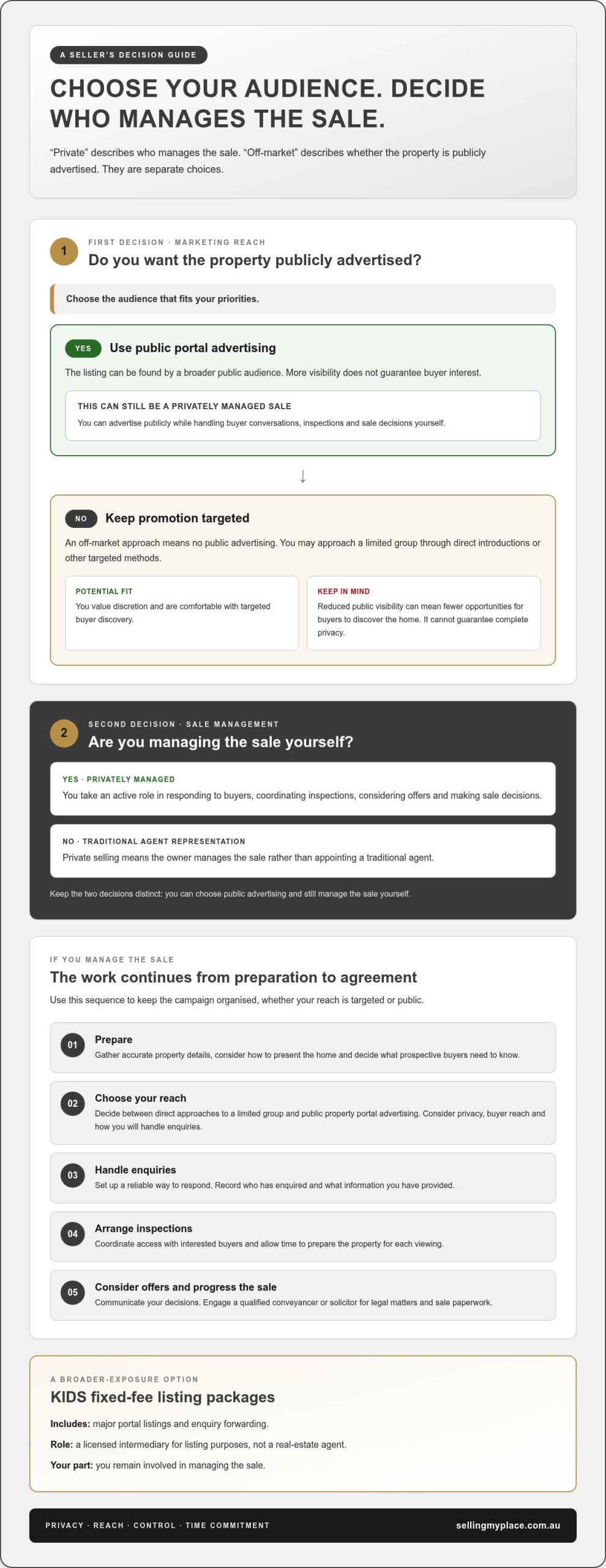
Private selling describes who manages the sale; off-market selling describes whether the property is publicly advertised.
What does selling off market privately actually involve?
An off-market sale is marketed or completed without public advertising. Rather than appearing on property portals or in public advertising, the home may be offered through direct introductions to prospective buyers or other targeted approaches. This can reduce public visibility, but it can’t guarantee complete privacy: people may share information, and interested buyers may discuss the property with others.
Private selling, by contrast, means the owner manages the sale rather than appointing a traditional agent. This can involve responding to prospective buyers, coordinating inspections and considering offers. You can keep promotion targeted or advertise publicly on portals. A privately managed sale can therefore still be highly visible online.
For a broad overview of the real estate market in Australia, remember that these terms describe different aspects of a property sale, not one fixed method.
Why do Australian sellers consider an off-market approach?
Some owners value discretion. They may prefer not to advertise their home widely while testing buyer interest, managing a sensitive life change or keeping the sale less visible to neighbours and the wider community. An off-market approach may suit that preference, but it isn’t a promise of secrecy or a guarantee of a particular sale result.
Control is another drawcard. A hands-on owner may want to decide when buyers can view the property, how enquiries are handled and whether to continue discussions with an interested party. For example, you could arrange inspections directly with a small number of prospective buyers rather than hold a public open home. The trade-off is that you’ll need time and a clear process to respond consistently and keep conversations moving.
Think about your circumstances before choosing. If discretion is the priority and you’re comfortable with targeted buyer discovery, an off-market route may suit. If you want more people to find the property, public portal advertising may be a better fit, even if you still manage the sale yourself. Selling off market privately is a combination of two decisions: who handles the sale and how broadly the home is promoted. Choose each deliberately.
How an off-market property sale works, from preparation to agreement
A well-run off-market sale still needs a clear process. The difference is how buyers hear about the property: instead of relying on broad public advertising, an off-market campaign may use targeted introductions. If you’re selling off market privately, you’ll also take an active role in organising the sale and making decisions.
Use this sequence to plan the main steps:
- Prepare: Gather accurate property details, consider how to present the home and decide what information prospective buyers will need.
- Choose your reach: Decide whether to approach a limited group directly or advertise publicly through property portals. A smaller audience may mean fewer opportunities for buyers to discover the home. Portal exposure gives the property a broader public audience, but doesn’t guarantee interest.
- Handle enquiries: Set up a reliable way to receive and respond to questions. Keep a record of who has enquired and what information you’ve provided.
- Arrange inspections: Coordinate access with interested buyers and allow time to prepare the property for each viewing.
- Negotiate and progress the sale: Consider offers and communicate your decisions. Engage a qualified conveyancer or solicitor for legal matters and sale paperwork.
Preparing the property and deciding who to reach
Before approaching buyers, make sure your property information is consistent and ready to share. Prepare details about the home’s key features, inclusions and other relevant points. Decide on your preferred level of visibility as well. A targeted introduction may feel more discreet, while public portal advertising makes the listing easier for a wider pool of buyers to find. Neither approach guarantees a particular level of interest, so choose based on your priorities rather than an assumed result.
Your choice of audience shapes the rest of the campaign. If you’re relying on introductions, plan how you’ll identify and connect with prospective buyers. If you choose public advertising, decide how you’ll respond if several enquiries arrive at once.
Managing enquiries, inspections and sale paperwork
In a privately managed sale, you remain closely involved. You’ll need to reply to buyer questions, arrange suitable inspection times, provide consistent information and decide how to respond to offers. A simple record of enquiries and follow-ups can keep conversations organised, particularly when more than one buyer is considering the property.
Keep the boundary around legal work clear. Kincade International Direct Sales (KIDS) is a licensed intermediary for listing purposes, not a real-estate agent, and doesn’t provide legal advice, contracts or conveyancing services. Engage a qualified conveyancer or solicitor for legal questions and guidance through the paperwork.
KIDS packages offer a different route to a privately managed sale: every package includes public property portal listings and enquiry forwarding. Because portal advertising is public, this isn’t an off-market campaign, even though you manage the sale. If broader online reach with seller control suits your plans, explore privately managed listing support as you map out your next steps.
Off-market sale or public listing: compare privacy, reach and control
Choosing between a confidential campaign and public portal exposure comes down to the balance you want between privacy and buyer discovery. Neither approach is automatically better. Consider how you want buyers to find the property, how much visibility feels comfortable and how much of the day-to-day work you’re prepared to manage.
Selling privately is about who controls the sale; off-market describes how widely the property is marketed.
| Consideration | Off-market marketing | Public portal exposure |
|---|---|---|
| Visibility | Promotion is limited or targeted rather than publicly advertised. | The property is publicly advertised on online portals where prospective buyers can discover it. |
| Privacy | Less public visibility may suit owners who prefer a discreet approach, but it doesn’t guarantee confidentiality. | More people can see the listing, so the sale is more publicly visible. |
| Seller workload | You may need to identify potential buyers and coordinate targeted introductions. | You’ll manage enquiries and inspection arrangements for a public listing. KIDS packages include enquiry forwarding. |
| Enquiries and discovery | Enquiries may come through the people or channels used to reach the targeted audience, which may be narrower. | Portal exposure allows a wider pool of buyers to find the property, though it can’t guarantee interest or an offer. |
The trade-off is straightforward: reducing public exposure can support a privacy preference, but may also limit the audience reached. Public advertising gives buyers more opportunity to discover the home, while making the sale more visible. In either case, you remain responsible for decisions about conversations, access and offers in a privately managed sale.
When might a confidential off-market approach suit?
A confidential approach may suit owners who place a high value on limited public visibility and are comfortable with a focused campaign. Targeted introductions can put a property in front of selected prospective buyers, but they don’t guarantee demand. Before proceeding, consider who could make suitable introductions, how you’ll assess enquiries and how you’ll keep communication clear and timely.
When might public portal exposure better fit a private sale?
Public portal listings can make a home discoverable beyond a buyer pool sourced through personal or targeted introductions. Kincade International Direct Sales (KIDS) offers owners a privately managed listing option with listings on major property portals and enquiry forwarding. KIDS is a licensed intermediary for listing purposes, not a real-estate agent. This portal-listed approach is not off-market. If broader exposure matters more than keeping the sale out of public view, compare the visibility you want with the time you can give to managing the sale.
A practical checklist for deciding how to sell your property privately
Before settling on a marketing path, decide what kind of sale experience you want and what work you can take on. Selling off market privately may give you more control over who hears about the property, but it also calls for a deliberate plan to reach buyers and manage the sale. Use this checklist to clarify your priorities.
- Set your privacy preference: Do you want limited public visibility, or are you comfortable with the property appearing on public portals?
- Choose your desired reach: Would targeted introductions suit you, or do you want potential buyers beyond your existing network to discover the home?
- Assess your available time: Can you respond to enquiries, arrange inspections and follow up with interested buyers as the campaign progresses?
- Plan who will communicate: Are you comfortable answering questions and discussing offers directly, or would listing administration and enquiry forwarding help?
- Decide what support you need: Which parts of the process do you want to manage yourself, and where would practical listing support make the experience easier?
- Allow for legal support: Plan to engage a qualified conveyancer or solicitor for legal matters and conveyancing questions.
Questions to answer before choosing your marketing approach
Start with the key choice: is limited visibility more important to you than broad public discovery? Then consider how you’ll reach prospective buyers, manage inspection requests and keep communication organised. A confidential approach may mean more direct work to find and engage interested buyers. Public portal exposure makes the property visible to a wider audience, while bringing enquiries to manage. Be realistic about the time and support you’ll want throughout.
For a fuller owner-led process, use a step-by-step guide to selling your own home in Australia alongside your checklist. Before moving towards an agreement, arrange independent legal and conveyancing support suited to your circumstances.
What to understand before using a flat-fee listing service
A flat-fee listing option can combine owner control with public exposure. Kincade International Direct Sales (KIDS) offers three fixed-fee packages with 0% commission: Classic at $799 ex GST, Signature at $999 ex GST and Prestige at $1,999 ex GST. Every package includes listings on major property websites and local portals such as Homely and Soho, enquiry forwarding by SMS and email, 24/7 seller dashboard access and a Market Valuation Report. This is a public listing approach, not a confidential off-market campaign. KIDS is a licensed intermediary for listing purposes, not a real-estate agent.
The packages differ in their included marketing. Classic includes professional photography and a 600 × 900 mm For Sale signboard. Signature includes everything in Classic, with a larger 1200 × 1800 mm signboard, email and phone expert support, and a dedicated property website and URL. Prestige includes everything in Signature, plus 15-20 professional photographs, a floorplan redraw, a Facebook and Instagram ad campaign, 50 premium A4 brochures, a 1-on-1 dedicated specialist, a James Edition listing and a 1200 × 1800 mm photo signboard.
Listings remain live until sold, withdrawn or two years from the commencement date, whichever occurs first. Consider this listing period alongside the package features and the role you want to play in managing the sale. If this balance of reach and control suits your plans, explore privately managed listing support.
A privately managed sale with broader exposure: how KIDS supports owners
Choosing a privately managed sale doesn’t mean you have to keep your property out of public view. Kincade International Direct Sales (KIDS), a service of Kincade International Realty, offers fixed-fee packages for listing on property portals while you retain control of buyer conversations and sale decisions. This differs from a confidential off-market campaign: the listing is public, but you remain closely involved.
KIDS is a licensed intermediary for listing purposes, not a real-estate agent. Its role is to provide listing support. You remain responsible for managing the sale and deciding how to respond to buyers. This distinction matters if you want portal exposure without traditional agent representation.
What KIDS includes in its privately managed listing packages
Every KIDS package includes a Realestate.com.au listing, listings on local portals such as Homely and Soho, a Market Valuation Report and 24/7 seller dashboard access. Enquiry forwarding by SMS and email is included across all packages, so buyer enquiries can be forwarded to you.
All three packages are listed until sold for a fixed fee, with 0% commission. Classic costs $799 ex GST and includes professional photography, a 600 × 900 mm For Sale signboard, email expert support, a dedicated website and URL, international network access and the included portal listings and dashboard. Signature costs $999 ex GST and includes everything in Classic, plus a 1200 × 1800 mm For Sale signboard and email and phone expert support.
Prestige costs $1,999 ex GST and includes everything in Signature, plus Kincade Global Network priority in the UK and USA, 15-20 professional photographs, a floorplan redraw, a Facebook and Instagram ad campaign, 50 premium A4 brochures, a 1-on-1 dedicated specialist, a James Edition listing and a 1200 × 1800 mm photo signboard. All listed features are included in the package fee.
You can edit your listing, manage enquiries and host inspections, staying involved in the practical decisions. These tools support your role as seller; they don’t guarantee a buyer, a sale or a particular price. KIDS isn’t responsible for the outcome of a sale or lease.
Listings remain live until sold, withdrawn or two years from the commencement date, whichever occurs first. KIDS provides global exposure through its network across Australia, the United Kingdom and the United States. This broader reach is distinct from a confidential off-market campaign, because KIDS packages include public portal listings.
How to take the next step with confidence
Before choosing a package, consider the kind of support you want and how much of the sale you’re ready to manage directly. Portal exposure can help buyers discover the property beyond a privately sourced audience, while you retain control over communications and decisions. It isn’t the same as selling off market privately because the property is advertised publicly.
KIDS offers three fixed-fee packages with 0% commission. Prices are ex GST, and each package bundles its listed features into the flat fee. Comparing the inclusions can help you choose the level of listing support that fits your priorities, from the Classic package through to Prestige with its additional marketing features and dedicated specialist.
For legal matters and conveyancing questions, engage a qualified conveyancer or solicitor. KIDS doesn’t provide legal advice, contracts or conveyancing services. If a privately managed, portal-listed approach suits your plans, explore KIDS listing support.
Choose a sale path that feels right for you
A property sale is a significant step, and the right approach should reflect more than a preference for keeping things quiet or reaching a wider audience. Consider what will help you feel informed and in control: a clear plan, time to respond to buyers and confidence in the decisions ahead.
If selling off market privately is still on your mind, use your priorities as your guide. Start by deciding how much visibility you’re comfortable with and what kind of support would make managing the sale more manageable.
KIDS offers a privately managed listing option for owners who want public portal exposure while staying involved in their sale. Compare the three fixed-fee packages and choose the level of included support that suits your plans. To explore your options, get started with KIDS.
With a considered plan and qualified legal support, you can move towards your next chapter with greater clarity.
Frequently Asked Questions
Can I sell my property off market privately in Australia?
Yes. Australian owners can sell privately, but selling off market privately means choosing not to advertise the property publicly. Requirements for preparing and progressing a sale can vary between states and territories, so general information isn’t legal guidance for your circumstances. In NSW and the ACT, a Contract of Sale is required before listing. In Victoria, a Section 32 Vendor Statement must be provided before contracts are signed. Engage a qualified conveyancer or solicitor for advice about the legal steps and documents relevant to your property.
Is selling off market the same as selling privately?
No. These terms refer to separate choices: whether you manage the sale yourself and how the property is promoted. For example, an owner can manage buyer conversations and decisions while advertising the home on public portals. Alternatively, they can manage the sale themselves and approach buyers through more limited channels. Think about whether you value discretion, wider discovery or direct involvement most, then choose your marketing approach accordingly.
Does off-market selling mean my property will not appear online?
Not necessarily. “Off market” usually means the home isn’t publicly advertised, which may include not appearing on public property portals. Its actual visibility depends on the channels used to reach prospective buyers. If you choose a KIDS package, your listing appears on Realestate.com.au and local portals such as Homely and Soho, so it receives public online exposure. That’s different from a confidential campaign, even though you remain involved in managing the sale.
Can I list my home on Realestate.com.au without an agent?
Individual owners can’t list directly on Realestate.com.au, according to KIDS’ service information. KIDS acts as a licensed intermediary for listing purposes, helping private owners access portal listings without appointing a traditional real-estate agent. Enquiries are forwarded by SMS and email, and sellers can use the 24/7 dashboard to stay across their listing. KIDS isn’t an agent and doesn’t provide legal advice, prepare contracts or provide conveyancing services.
What are the risks of selling a property off market?
A limited campaign may mean fewer buyers discover the property, which can reduce the range of interest you receive. You may also be responsible for keeping track of conversations, arranging inspections and deciding how to respond to offers. Before choosing this path, consider how you’ll reach potential buyers and whether you have time to manage the process. A more discreet approach isn’t automatically the best fit for every seller.
Do I need a conveyancer to sell my home privately?
Engage a qualified conveyancer or solicitor for legal matters, including advice about contracts and requirements that apply to your sale. KIDS doesn’t provide legal advice, prepare contracts or provide conveyancing services. Requirements can differ across Australia, so a qualified professional can explain what applies to your property and circumstances. It’s sensible to arrange that support early, rather than waiting until you’re discussing an offer or preparing paperwork.
How long does a KIDS property listing stay active?
A KIDS listing stays live until the property is sold, withdrawn or two years from the commencement date, whichever happens first. That describes how long the listing can remain active; it isn’t a promise that a sale will happen within that time or at a particular price. Owners remain responsible for decisions about the sale, and KIDS isn’t responsible for its outcome.
How to Vet Potential Buyers Yourself: A Practical Australian Seller’s Guide
What if the buyer offering the most isn’t the one best placed to complete the sale? If you’re working out how to vet potential buyers yourself, it’s natural to look for clear signs that an enquiry is genuine, especially when every inspection and follow-up takes time. But a confident manner or a high offer isn’t proof that a buyer is ready to proceed.
A fair, consistent process helps you distinguish serious interest from casual enquiries without relying on assumptions about someone’s demeanour. You also don’t need to collect more personal information than is reasonable to assess their readiness. A measured approach can protect your privacy while keeping conversations respectful and focused.
This guide explains what to ask, how to discuss a buyer’s finance and timing, and what evidence may help you assess their preparedness. You’ll also learn to compare offers by looking beyond the headline figure to conditions, timeframes and the buyer’s ability to proceed. A little structure, from your first reply through to the next steps after an offer, can help you stay in control of your private sale and make decisions with greater confidence.
Key Takeaways
- Learn how to vet potential buyers yourself with a consistent process for assessing readiness fairly.
- Ask clear, courteous questions to understand a buyer’s finance, timing and next steps without relying on first impressions.
- Compare offers by their conditions and likelihood of proceeding, not just the headline amount.
- Keep buyer checks proportionate and handle personal information thoughtfully. Treat warning signs as reasons to clarify, not proof of wrongdoing.
- Advisory and conveyance support can help you organise enquiries and move from an offer towards the next stage with greater confidence.
Why vet potential buyers yourself before progressing a home sale?
A promising enquiry is a welcome start, but it doesn’t tell you whether someone is ready to buy. Buyer vetting means asking consistent, relevant questions to understand a person’s readiness, ability to proceed and any conditions attached to an offer. It isn’t about interrogating every visitor or trying to predict the future. It’s a practical way to decide what follow-up makes sense before arranging another inspection or progressing negotiations.
A calm, repeatable approach helps you focus on useful indicators rather than impressions. Someone may be enthusiastic during a viewing but still need to arrange finance, sell another property or clarify their preferred timing. A reserved buyer may be well prepared. A person’s manner, appearance, occupation or communication style isn’t evidence of financial readiness or commitment. Ask each buyer the same core questions, then assess their answers and offer terms on their merits.
This is a practical form of due diligence: gathering and considering relevant information before making a decision. The general concept is outlined in What is Due Diligence? For a private seller, the aim is straightforward: understand the buyer’s next steps without treating a conversation or document as a guarantee of a completed sale.
What does it mean to vet a potential property buyer?
Separate interest from preparedness. An enquiry shows that someone wants to know more; a prepared buyer can usually explain their next step, such as arranging finance or making an offer with stated conditions. Neither guarantees the sale will proceed. Focus on observable details, including whether answers are clear and agreed follow-ups happen, rather than drawing conclusions from personal characteristics.
When should you start checking buyer readiness?
Start with light questions when arranging an inspection or a detailed property discussion. Ask what stage the buyer is at and whether they have a timeframe in mind. Save more specific questions about finance, conditions and offer terms for when you’re considering an offer. Casual browsers don’t need a formal screening. This staged approach keeps the exchange welcoming while helping you prepare for the next decision.
Keep your questions proportionate. You can ask a buyer to explain their finance position or relevant conditions, then consider what information you need for the decision at hand. Avoid collecting or circulating sensitive personal details unnecessarily, and handle anything shared with discretion. If a response is unclear, ask a neutral follow-up rather than assuming bad intent.
Early screening can help prevent avoidable delays. If a buyer says they need to complete another step before making an offer, take that into account before arranging repeated viewings or changing your plans. The purpose isn’t to discourage genuine buyers; it’s to make expectations clear on both sides. For an overview of the wider sale process, read this step-by-step guide to selling your own home.
How to vet potential buyers yourself: a clear screening process
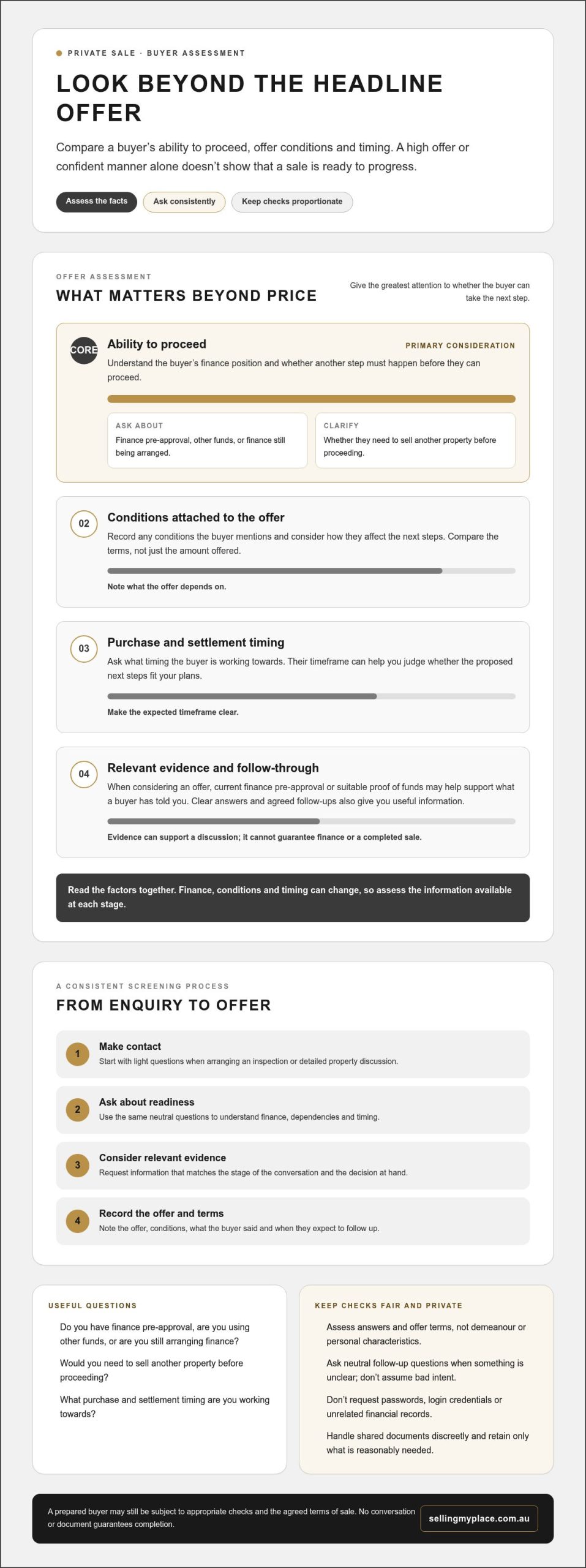
A simple process makes buyer conversations easier to manage and compare. Use the same stages for each serious enquiry: make contact, ask readiness questions, consider relevant evidence, then record any offer and its terms. This keeps discussions fair and gives you a record to refer to if details change or you need to follow up.
A buyer who is ready, able and willing to progress is still subject to appropriate checks and the agreed terms of sale. This is a practical guide, not a guarantee that a sale will complete. Finance, conditions and timing can change, so assess the information in front of you at each stage.
What questions can you ask a potential buyer?
Keep questions neutral and consistent. For example: “Do you have finance pre-approval, are you using other funds, or are you still arranging finance?” Follow up with “Would you need to sell another property before proceeding?” and “What purchase and settlement timing are you working towards?” These questions focus on practical next steps, not private details unrelated to the sale.
Listen for specifics rather than a particular style of response. One buyer might explain that they have pre-approval and want to discuss an offer; another might say their purchase depends on selling their current home. Record what each person says, any conditions they mention and when they expect to follow up. If an answer is uncertain, note that accurately instead of filling gaps with assumptions.
Government guidance can also help you understand the steps buyers may be considering. Guidance on planning to buy a property outlines aspects of purchasing a home, including due diligence. Check the requirements and processes that apply to your circumstances, as they may differ across Australia.
What evidence can help establish readiness?
When you’re considering an offer, relevant evidence might include current finance pre-approval or suitable proof of funds. Match the request to the stage of the conversation and the question you need answered. A casual inspection doesn’t call for detailed financial records. A document can support what a buyer has told you, but it can’t remove all uncertainty or guarantee finance will be available at settlement.
Protect the buyer’s privacy as carefully as your own. Don’t request account passwords, login credentials or unrelated financial records. If someone shares a document, limit who can access it, store it securely and retain only what you reasonably need for the sale process. Avoid forwarding sensitive material casually or keeping copies indefinitely.
Write down the offer amount, conditions, finance information and proposed timing as separate items. That makes it easier to clarify an incomplete offer without pressure or crossed wires. If you’d value guidance while organising buyer enquiries and assessing next steps, explore property sale advisory support.
How to compare buyers and offers beyond the offer amount
A strong offer is more than its headline figure. Compare the amount with the buyer’s finance position, conditions, proposed timing and communication. A higher offer may be less certain if it depends on an unresolved sale or further checks. A lower offer may have different advantages, but still needs careful review. Neither enthusiasm nor a single piece of evidence guarantees settlement.
Use the same categories for each offer and compare like with like. A short written record helps you see what’s clear, what needs clarification and which details come from a conversation rather than the offer itself.
Which offer details deserve a closer look?
Read the full written offer instead of relying on a verbal summary. Note whether the amount is clear, what conditions apply, when the buyer proposes to proceed and whether the offer depends on selling another property. Record any requested contract changes or further checks, so you can identify what needs a response before deciding how to proceed.
- Offer amount: Record the amount as written and note whether any terms could affect it.
- Finance status: Note what the buyer has explained and any relevant evidence provided.
- Conditions: List outstanding checks, a required sale of another property or proposed changes.
- Timing: Note the proposed next steps and settlement timeframe.
- Communication: Record whether responses and follow-ups have been clear and timely, without treating style alone as proof of readiness.
For example, one buyer might offer more but need to sell their current home first, while another proposes a different amount and timing with fewer stated conditions. Neither buyer is automatically the stronger option. The comparison shows why you need to understand what each offer depends on and how its terms fit your circumstances.
How do you compare certainty without making assumptions?
Keep the comparison fair by using the same evidence categories for every buyer and recording when each detail was provided. Finance pre-approval can indicate progress, but it isn’t a guarantee of final lending or settlement. Prompt communication is useful context, not proof that a buyer can complete the purchase.
Separate confirmed information from unanswered questions. Write “pre-approval sighted” rather than concluding “finance secured”, or record “offer subject to sale” instead of assuming when that sale will happen. Careful wording helps you compare readiness without overstating what you know or making personal judgements.
Contract wording and conveyancing questions can have important implications, and sale requirements differ across Australia. If a condition or proposed change is unclear, seek advice from an appropriate conveyancing professional before relying on your interpretation. For more guidance on keeping discussions constructive while weighing terms, see these Australian property sale negotiation tips. A structured approach to how to vet potential buyers yourself helps you weigh the whole offer, not just the number that first catches your eye.
How to spot buyer red flags while protecting privacy
Buyer checks don’t need to feel like an interrogation. You can explain your process politely: “I ask each interested buyer the same questions so I can understand their timing and any conditions before we take the next step.” Keep requests relevant and give buyers a chance to clarify. A concern is a prompt to pause and ask, not proof of dishonesty.
Look for changes or pressure in the details, rather than judging someone’s personality. A buyer may have a genuine reason for changing plans. What matters is whether the updated information is clear enough for you to decide how to proceed.
Which buyer behaviours merit a pause or follow-up?
Pause to clarify if a buyer gives different accounts of their finance position, proposed timing or offer conditions. You can refer calmly to what they said earlier: “I understood your offer depended on selling another property. Has that changed?” This gives them room to explain and helps you keep your notes accurate.
Be cautious if someone repeatedly pressures you to decide before you’ve reviewed the written terms, asks you to proceed without documenting important details or requests sensitive information that isn’t needed to discuss the sale. Repeatedly missing agreed calls or follow-ups may also reduce your confidence in their readiness. None of these behaviours alone establishes fraud. Consider the full context and avoid making accusations you can’t support.
How can sellers share information safely?
Prepare your home for inspections with privacy in mind. Put away identity documents, financial paperwork, mail and anything showing passwords, alarm codes or other security details. Keep household information that isn’t relevant to the property out of view, and avoid sharing personal routines or travel plans during a viewing.
- Limit what you request: Ask only for information relevant to the buyer’s readiness or offer.
- Keep records secure: Store messages and relevant documents in a protected location, rather than leaving them open on a shared device.
- Restrict access: Share buyer information only with people who need it to progress the sale.
- Review what you retain: Don’t keep personal information longer than it’s useful for the sale process.
Privacy and identity-checking requirements can vary across Australia and may depend on the circumstances. Before requesting or retaining identity documents, check current guidance from relevant Australian government and privacy authorities, and get appropriate advice if you’re unsure about your obligations. Don’t assume a practice used in one part of the country applies everywhere.
A steady, documented approach helps protect your household while treating genuine buyers respectfully. If you’d like support with buyer enquiries and sale decisions, get guidance on assessing potential buyers.
How advisory support can help you vet buyers with confidence
Managing a private sale doesn’t mean you have to work through every buyer question alone. Advisory support can help you organise enquiries, prepare consistent questions and think through an offer’s terms, while you remain involved in decisions about your property.
Kincade International Direct Sales’ Agent Advisory Service provides dedicated support with pre-sale consulting and conveyance advice. This support can help as you prepare your sale process, respond to buyer enquiries and consider how to progress an offer. Buyer representation is also available. The right support depends on the questions you’re working through, rather than a one-size-fits-all script.
What support can make a private sale easier to manage?
Pre-sale consulting can help you set up a practical process before enquiries arrive: decide where to record contact details, which readiness questions to ask and how to track follow-ups. Having this framework ready can make buyer conversations more consistent and less pressured when interest picks up.
Good property information helps, too. Professional photography and floorplans give buyers a clearer view of the home, while neighbourhood market reports can support informed conversations about the property and its market context. These materials don’t establish a buyer’s finance position, but they can help keep discussions focused on the home and the buyer’s questions.
A flat-fee, commission-free residential marketing model may suit owners who want to retain control while drawing on professional support. Kincade International Direct Sales provides residential property marketing alongside advisory support, so sellers can take a hands-on role without managing every part of the process unaided.
What are your next steps after assessing a buyer?
Once you’ve assessed an enquiry or received an offer, keep the details together and work through them methodically. Record the written amount, conditions, finance information and proposed timing. Clarify any gaps before deciding, and use conveyance advice to understand questions about the sale’s progression and relevant documents. Contract requirements vary across Australia, so consider the rules that apply to your property and circumstances.
- Keep the offer on record: Refer to written terms, not just a verbal summary.
- Check the conditions: Note what needs to happen before the buyer can proceed.
- Plan the next conversation: Prepare focused questions about outstanding details or timing.
- Seek guidance where needed: Use advisory and conveyance support to work through the next steps.
If you’re weighing up how to vet potential buyers yourself while keeping a private sale organised, the guide to professional residential property listing services explains how listing support can fit into an owner-led sale. For advice tailored to your property sale, discuss your sale with the advisory team.
Move towards your sale with confidence
Assessing a buyer isn’t a pass-or-fail test. It’s a way to make your next decision carefully, based on the information available and the terms on the table. As your sale progresses, keep asking clear questions, considering the answers and seeking advice when a decision feels uncertain. A steady approach can help you protect what matters while staying open to genuine opportunities.
If you want to retain control while drawing on professional support, Kincade International Direct Sales offers commission-free residential marketing through a flat-fee model. Its Agent Advisory Service includes pre-sale consulting and conveyance advice, supported by professional photography, floorplans and neighbourhood market reports.
Whether you’re at the first enquiry or weighing up an offer, you don’t have to make every call alone. Talk through your sale with an adviser and take the next step with a clearer sense of direction. Talk through your sale with a steady, experienced adviser.
Frequently Asked Questions
How do you know if a homebuyer is serious?
You can’t know for certain from a viewing or conversation, but a buyer’s follow-through offers useful clues. Notice whether they respond to straightforward questions, arrange agreed next steps and explain what they need to do before making an offer. For example, if someone says they’ll send written terms, note whether those terms arrive. Treat these as indicators, not a guarantee of a completed sale.
Can a seller ask a potential buyer for proof of funds in Australia?
Yes, you can ask for relevant evidence, such as suitable proof of funds, when it’s appropriate to the discussion. Explain why you’re asking and limit the request to what helps you assess the buyer’s readiness. A buyer can decide what they’re comfortable sharing. Don’t ask for banking passwords, account login details or complete financial records, and avoid keeping documents you don’t need.
What should you ask a buyer before accepting an offer on your home?
Ask what the offer depends on, whether the buyer needs to sell another property, what their finance arrangements are and what timing they’re proposing. Clarify whether they’re requesting particular inclusions, contract changes or further checks. Ask for the complete offer in writing so you can consider all its terms together. If anything is unclear, get an explanation before deciding how to respond.
Is finance pre-approval a guarantee that a buyer can complete the purchase?
No. Finance pre-approval indicates that a lender has considered information provided by the buyer, but it isn’t a promise that a particular purchase will be funded. The lender may still need to assess the property, review updated information or complete other checks. Ask what stage the buyer’s finance is at, but don’t treat pre-approval alone as certainty that the sale will settle.
What are red flags when selling a house privately?
Possible warning signs include details that keep changing without a clear explanation, pressure to decide before reviewing written terms, or requests for personal information unrelated to the sale. A buyer who repeatedly misses agreed follow-ups may also warrant a pause. These behaviours don’t prove dishonesty. Keep a factual record, ask a calm clarifying question and decide whether you’re comfortable taking the next step.
Can you reject an offer if you are unsure about the buyer’s finance?
You can decide not to proceed with an offer if you’re uncomfortable with the information available, but property sale processes and contract rules vary across Australia. Before communicating acceptance or rejection, consider getting conveyancing advice about the offer, its conditions and how your response may be treated. If you need more information, ask the buyer to clarify their finance position before deciding.
How can you protect your personal information when selling your home?
Put away mail, identity documents, bills and papers that reveal account details before inspections. Keep buyer correspondence in a separate, secure place, and avoid sending sensitive documents through casual or public channels. Share only information needed for the sale, and remove access when it’s no longer required. If you’re unsure about handling identity information, check current Australian privacy guidance before collecting or retaining it.
What is a Vendor’s Statement? The Essential Australian Guide to Property Disclosure
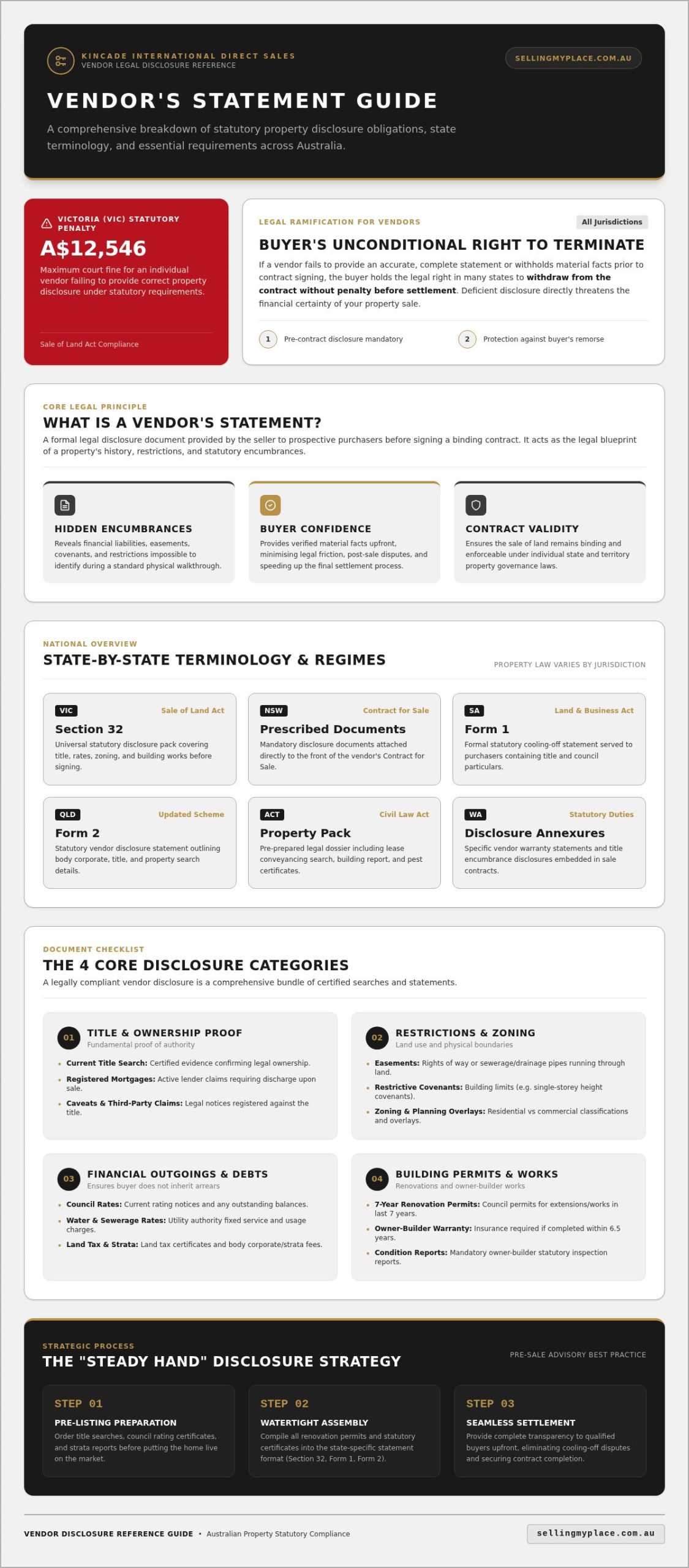
Did you know that in Victoria, an individual vendor can face a court fine of up to A$12,546 for failing to provide the correct property disclosure? It’s a sobering figure that highlights just how serious the legal side of selling can be. Selling your home is a major life transition, and it’s completely normal to feel a bit overwhelmed by the mountain of paperwork landing on your kitchen table. You’re likely asking yourself, what is a vendor’s statement, and why does every state seem to have a different name for it?
We understand the weight of this responsibility and the fear of getting it wrong. This guide will demystify exactly what this document entails, why it’s the most critical piece of your property sale, and how to navigate the legal requirements across Australia with absolute confidence. You don’t have to face this alone or worry about high conveyancing costs eating into your hard-earned equity. We’ll walk you through the specific rules for your state, from Section 32s to Form 1s, and provide a clear checklist to ensure your disclosure is watertight so you can focus on your next chapter.
Key Takeaways
- Gain a clear understanding of what is a vendor’s statement and how this essential disclosure document protects your interests throughout the sale.
- Identify the specific documents required in your state, from title searches to easement details, to ensure your contract remains legally sound.
- Learn why having your paperwork organised before your property goes live on the market fosters buyer confidence and speeds up the settlement process.
- Discover how to navigate complex disclosure laws without the stress of high commissions by using expert pre-sale property consulting.
- Empower yourself with a practical checklist of information you must share to avoid common legal pitfalls and secure a successful, commission-free sale.
What is a Vendor’s Statement in the Australian Property Market?
If you’re preparing to sell your home, you’ve likely come across a pile of paperwork that feels a bit daunting. At its heart, what is a vendor’s statement? It’s a formal legal disclosure document that you, as the seller, must provide to a potential purchaser before they sign a contract. The vendor’s statement is the legal blueprint of a property’s history and restrictions. It serves as the primary way to inform a buyer about encumbrances, financial obligations, or land use issues that aren’t easily spotted during a physical inspection or a Saturday morning walkthrough.
Transparency is the cornerstone of a successful sale. If you fail to provide an accurate or complete statement, the consequences are significant. In many states, a buyer has the legal right to withdraw from the contract without penalty before settlement if the disclosure is found to be deficient. This can be a devastating outcome after you’ve already started packing your boxes and planning your move. Getting this document right isn’t just about ticking a box; it’s about protecting your financial future and ensuring your sale remains “sold”. Professional Victorian agencies like Fateh Real Estate emphasize that this level of disclosure is what builds the necessary trust between a vendor and a prospective buyer.
Why Transparency Protects Your Sale
Choosing to be completely open about your property’s history is a strategic move that builds immediate credibility. When a serious buyer sees a thorough disclosure, they feel a sense of security. It reduces the likelihood of “buyer’s remorse” or legal disputes that can flare up long after the keys have changed hands. We often talk about the “steady hand” approach to selling. By being honest and proactive now, you save yourself a world of stress and potential litigation later. A complete statement shows you’re an organised, professional seller who respects the process and the people involved.
Common Names for the Statement Across Australia
Because property law is managed by state and territory governments, the name of this document changes depending on where your home is located. In Victoria, it’s almost universally called a “Section 32”, which refers to the specific part of the Sale of Land Act. If you’re selling in New South Wales, these disclosures are typically bundled as prescribed documents within the Contract for Sale. South Australians will know it as a “Form 1”, while Queenslanders now use a “Form 2” under their updated disclosure scheme.
While the names differ, the statutory vendor disclosure requirements in Australia all share the same underlying spirit. Whether you’re providing a property pack in the ACT or navigating the specific requirements in Western Australia, the goal is to ensure the buyer has all the material facts before making a life-changing decision. Understanding these local variations is the first step toward a confident, commission-free sale.
The Core Ingredients: What Must Be Disclosed?
Understanding what is a vendor’s statement requires looking closely at the legal bones of your property. It isn’t just a single document. Instead, it’s a comprehensive folder of certificates that ensures the buyer knows exactly what they’re stepping into. At the very top of your list is a current Title Search. This proves you’re the legal owner and reveals any mortgages or caveats that need to be cleared before the property changes hands.
Beyond ownership, you must disclose easements and covenants. Easements, such as sewerage pipes running through your backyard, or restrictive covenants that stop you from building a second storey, can significantly impact a buyer’s plans. Zoning information is equally vital. It confirms if the land is residential or commercial and identifies any specific overlays. You’ll also need to include financial details to ensure the buyer isn’t inheriting your debts. These typically include:
- Current council rates and any outstanding amounts.
- Water and sewerage charges.
- Land tax certificates, where applicable.
- Body corporate or strata fees if the property is on a shared title.
For a reliable benchmark on these requirements, Consumer Affairs Victoria’s guide to Section 32 statements offers a clear look at these statutory duties.
Building Permits and Warranty Insurance
Transparency about building works is non-negotiable. If you’ve renovated or extended in the last seven years, those permits must be included in your disclosure. Owner-builders have additional responsibilities. They often need a condition report and warranty insurance if the works were completed within the last six years and six months. Leaving out unapproved structures, like a “DIY” deck or shed, is a gamble that rarely pays off. It often leads to collapsed sales or messy legal claims after the settlement date.
Environmental and Neighbourhood Factors
Your disclosure must also cover the environment around your fence line. This includes whether the property is in a bushfire-prone area or has a flood-plain overlay. You’re also required to share any formal notices from authorities about future local developments, such as a planned road widening or new infrastructure nearby. These details are critical when you look at how to determine market value of a home in australia, as they affect long-term desirability. If you’re feeling unsure about which specific certificates apply to your street, a quick chat for conveyance advice can provide the steady hand you need.
State-by-State Breakdown: Navigating Regional Rules
Property law in Australia isn’t a “one size fits all” affair. Each state and territory operates under its own specific legislation, which means the answer to what is a vendor’s statement depends largely on where your fence line sits. This regional variation can feel like a hurdle, but it shouldn’t deter you. Whether you’re in a high-disclosure state like Victoria or a “buyer beware” region, the commission-free sale process is absolutely viable. It simply requires a steady hand and the right local knowledge. Securing professional conveyance advice early on is the smartest way to ensure you meet your specific local obligations without the stress of hidden legal traps.
Victoria, NSW, and Queensland Requirements
In Victoria, the rules are particularly clear. A Section 32 is mandatory and must be ready before your property is even “offered” for sale. You cannot legally market the home to the public without this document in place. Moving across the border to NSW, the focus shifts to the Contract of Sale. Specific prescribed documents, such as a Section 10.7 zoning certificate and a drainage diagram, must be attached before you start showing buyers through the front door. Queensland recently updated its framework with the Property Law Act 2023. As of 1 August 2025, sellers must provide a formal Form 2 Seller Disclosure Statement. If you’re selling a unit or townhouse, providing body corporate certificates and sinking fund details is now a critical part of the process. These eastern states place a significant burden of disclosure on the seller to ensure the buyer is fully informed before signing.
Western Australia, SA, and the Territories
South Australia uses a rigorous disclosure document known as a Form 1. This must be served to the purchaser at least 10 clear days before the settlement date. In many cases, the service of this form is what actually triggers the buyer’s statutory two-day cooling-off period. In Western Australia, the approach is slightly different. While WA doesn’t have a single “vendor’s statement” for general land, disclosure is managed through specific warranties within the Contract for Sale of Land. It remains a more traditional “buyer beware” environment, yet material facts about the property’s structural integrity or illegal drug contamination must still be shared to avoid future litigation.
The Territories and Tasmania have their own unique disclosure packets. In the ACT, the seller must commission and provide building, pest, and energy efficiency reports upfront. This is a significant shift from other states where the buyer typically covers these costs. While the names and timelines change across the country, the spirit of disclosure remains the same. Being organised with your paperwork shows you are a professional seller who values transparency and a smooth transition for the next family to call your house a home.
Preparing Your Statement: Timing and Professional Support
Timing is everything. Many homeowners only start asking what is a vendor’s statement after they’ve found a keen buyer, but that’s a risky strategy. You should ideally have your disclosure document finalised before your property ever goes live on the market. In a “Sale by Owner” context, having your paperwork ready is a significant advantage. It signals to every person walking through your open home that you are a professional, organised seller. This transparency builds immediate rapport and gives buyers the confidence to make an offer on the spot.
The process of gathering information starts with contacting your local council, water authorities, and state land registries. You’ll need to collect various certificates regarding zoning, rates, and any notices issued against the land. While you can certainly take the lead in collecting these raw documents to speed things up, the final assembly requires a qualified eye. A legal professional should always draft the final version to ensure every statutory requirement is met.
The Risk of the ‘DIY’ Legal Document
It might be tempting to use a generic template you’ve found online to save a few dollars. However, this is one area where “doing it yourself” can backfire. A minor omission or a misinterpretation of a planning overlay can grant the buyer a legal “right to rescind”. This allows them to walk away from the contract at the 11th hour without penalty. It’s a heartbreaking situation that is easily avoided. Our expert real estate advisory service is designed to help you spot these potential red flags early, keeping your sale on track.
Working with a Conveyancer or Solicitor
A professional conveyancer typically requires about 7 to 14 days to produce a complete statement. This timeframe depends on how quickly local authorities respond to certificate requests. When looking at the costs, you’ll encounter professional fees for the expert’s time and “disbursement” fees, which are the third-party costs for the certificates themselves. We understand that managing these details can feel stressful. That’s why SellingMyPlace integrates expert conveyance advice directly into our partnership approach. We provide the steady hand you need to navigate the legalities of disclosure without the burden of high commissions.
Ready to ensure your paperwork is watertight? Contact our advisory team for a pre-sale consultation.
Selling Smarter: How Expert Advisory Simplifies Disclosure
Taking control of your property sale doesn’t mean you have to walk the path alone. By now, you’ve gained a deep understanding of what is a vendor’s statement and why it serves as the foundation of a secure transaction. At SellingMyPlace, through the Kincade International Direct Sales (KIDS) approach, we’ve reimagined the selling journey. We pair professional authority with heartfelt support. Our Agent Advisory Service acts as the steady hand you need to navigate these complex disclosure requirements. We ensure you’re never just a number in a database, but a partner in a shared mission to protect your family’s legacy.
Success in the modern Australian market requires a two-pronged strategy. First, you need professional marketing, including high-end photography and detailed floorplans, to capture the buyer’s imagination. Second, you need total legal readiness. When these elements work together, you create a sense of trust that naturally leads to higher offers. By having your disclosure documents prepared and vetted early, you eliminate the friction that often kills deals at the last minute. You’re not just listing a house; you’re presenting a transparent, high-value opportunity to the market.
The Partnership Advantage
The traditional DIY route can feel isolating and fraught with legal anxiety. In contrast, the KIDS partnership model provides a safety net. We offer the expertise of a seasoned advisor who understands the emotional significance of your transition. This backing significantly reduces the stress of managing paperwork. If you’re curious about how this fits into the broader process, our guide on how to sell your own home provides the full context you need to move forward with confidence.
Your Next Steps to a Successful Sale
Your journey toward a successful, commission-free sale starts with a single, informed step. We encourage you to reach out for a comprehensive neighbourhood market report to ground your expectations in current data. Remember, the average seller saves around A$20,000 in commissions by choosing this path. That’s a significant amount of equity that stays in your pocket for your next adventure. Getting the foundations right, starting with a watertight vendor’s statement, is the key to unlocking these savings. Contact our expert team today to discuss your commission-free sale and let’s start this chapter together.
Your Path to a Confident, Commission-Free Sale
Selling your family home is more than a transaction; it’s the start of a new chapter. By understanding exactly what is a vendor’s statement and how it functions as the legal backbone of your sale, you’ve already taken a massive step toward a successful outcome. Whether you’re navigating Victoria’s Section 32 or South Australia’s Form 1, being prepared with the right title searches and certificates ensures you stay in the driver’s seat. You don’t have to tackle the legal complexities alone or worry about high costs. Our partnership model means you have a steady hand guiding you through every disclosure requirement.
With expert pre-sale consulting and comprehensive conveyance advice included, you can move forward with total peace of mind. Remember, the average seller saves around A$20,000 in commissions by choosing this transparent, direct path. It’s about keeping your equity where it belongs while ensuring your sale is watertight and professional. Ready to sell smarter and keep 100% of your profit? Contact our expert advisory team today. We’re here to help you protect your legacy and celebrate this significant life transition with confidence.
Frequently Asked Questions
Can I sell my house without a vendor’s statement in Australia?
In most Australian states, including Victoria, New South Wales, and Queensland, you cannot legally sell your residential property without a formal disclosure document. Failing to provide one usually grants the buyer a statutory right to rescind the contract at any time before settlement. While Western Australia operates under a different framework, sellers are still bound by strict warranties. We always recommend having your paperwork finalised before listing to ensure your sale is legally robust and professional from day one.
How long is a vendor’s statement valid for?
There isn’t a single expiry date for the entire document, but the individual certificates within it must be current to be legally valid. Most legal professionals recommend that documents like title searches and council rate certificates be no more than three to six months old. If your property remains on the market for an extended period, you may need to refresh certain reports to ensure the information remains accurate for a new purchaser. This keeps your disclosure “live” and protects you from claims of outdated data.
What happens if I forget to disclose something in the Section 32?
Forgetting a material fact in your Section 32 or vendor’s statement can be a costly mistake that jeopardises your transaction. If the omission is significant, such as a hidden easement or an unapproved renovation, the buyer may have the legal right to walk away from the sale and receive their full deposit back. In some jurisdictions, you could also face statutory fines. Our Agent Advisory Service acts as a steady hand to help you identify these details early, reducing the risk of a collapsed sale.
Do I need a lawyer to prepare my vendor’s statement?
While you can technically gather the certificates yourself, it is highly recommended to have a qualified conveyancer or solicitor prepare the final document. The legal requirements for what is a vendor’s statement are strict, and even a small clerical error can lead to a rescinded contract. At SellingMyPlace, we integrate expert conveyance advice into our partnership approach. This ensures your disclosure is professionally drafted while you still enjoy the benefits of a commission-free, flat-fee sale that protects your hard-earned equity.
Is a vendor’s statement the same as a contract of sale?
No, they are two distinct documents that serve different purposes in the selling process. The vendor’s statement is a disclosure document that provides the buyer with essential facts about the property’s history, zoning, and restrictions. The Contract of Sale is the legal agreement that outlines the purchase price, settlement date, and commercial terms. In many states, these two documents are bundled together, but the statement focuses on “what” is being sold, while the contract focuses on the “how” of the transaction.
How much does it cost to get a vendor’s statement drafted?
The cost typically consists of two parts: the professional fee for the conveyancer’s time and the disbursement costs for the required certificates. Disbursement costs vary depending on your local council and water authority, as they charge different rates for their reports. Since we operate on a flat-fee model, we focus on providing expert pre-sale consulting to help you manage these foundations efficiently. This approach ensures you save an average of A$20,000 in commissions compared to traditional agencies while still receiving professional support.
Does the vendor’s statement show if there is a mortgage on the property?
Yes, a vendor’s statement must include a current title search, which will show any registered mortgages or caveats currently on the land. This transparency allows the buyer’s legal team to confirm that any existing mortgage will be discharged at the time of settlement. It is a standard part of every property transaction and doesn’t affect your ability to sell, provided there is enough equity to cover the debt. Being open about these details from the start builds a foundation of trust with your potential purchaser.
What is the difference between a Section 32 and a Section 10.7 certificate?
A Section 32 is the term used in Victoria to describe the entire vendor’s statement package. In contrast, a Section 10.7 certificate is a specific planning document required in New South Wales that details how a property can be used, including zoning and development restrictions. While a Victorian Section 32 includes many different certificates, a Section 10.7 is just one of the prescribed documents that must be attached to an NSW Contract of Sale before a property can be marketed to the public.
DIY Open for Inspections: The Ultimate Australian Guide
Did you know that the average Australian homeowner could be handing over between A$16,000 and A$29,000 in agent commissions just for the sake of a few Saturday morning walk-throughs? Selling your family home is a deeply emotional milestone, and the idea of strangers wandering through your private sanctuary can feel incredibly daunting. You might worry about coming across as too pushy or feel anxious about the security of your most valuable asset while managing open for inspections yourself. It is a significant transition, and it’s perfectly natural to feel protective of the place where you’ve built your life.
Here at Kincade International Direct Sales, we believe you’re the best person to tell your home’s story. This guide will show you how to host a professional, high-impact inspection that secures top-tier buyers while keeping your hard-earned equity exactly where it belongs. You’ll master the art of “pro in your pocket” hospitality, ensuring every visitor feels welcomed and every detail is handled with care. We’ll walk you through essential safety protocols, the latest 2026 legal requirements for states like Victoria and New South Wales, and the subtle staging secrets that create an immediate emotional connection for every buyer who walks through your front door.
Key Takeaways
- Discover how to retain an average of A$20,000 in sale profit by leveraging your unique property history and genuine passion for your home.
- Master the “First 30 Seconds” rule and learn the essential steps for managing open for inspections yourself to create a professional, neutral canvas that buyers can’t resist.
- Implement robust security protocols, including digital sign-in tools and “No ID, No Entry” policies, to protect your family’s sanctuary while capturing high-quality buyer data.
- Adopt a “steady hand” approach to hosting, allowing you to welcome guests warmly and answer questions with factual confidence without the pressure of a hard sell.
- Convert walk-throughs into genuine offers by using the 24-hour follow-up rule and providing personalised digital resources to your most promising leads.
The Benefits and Mindset of Managing Open for Inspections Yourself
Let’s talk about the elephant in the room: the money. Saving an average of A$20,000 in commissions is a life-changing amount of equity to keep in your pocket. In the current 2026 market, with national commissions sitting between 2.0% and 2.65% plus GST, managing open for inspections yourself is the most direct path to protecting your financial legacy. On a median Australian home, this can represent a saving of up to A$29,000. That is a significant boost to your next deposit or retirement fund (and perhaps a well-earned holiday, too).
But it’s about more than just the bank balance. You possess an intimate knowledge of your home that no agent can replicate in a brief walk-through. You know exactly which window catches the morning light in winter and which local park has the best playground for toddlers. While traditional agencies often claim that owners are “too emotional” to handle buyers, we believe your genuine passion is your greatest asset. When you speak authentically about the lifestyle your home offers, buyers feel a sense of trust that a polished sales pitch can’t replace. You aren’t just selling bricks and mortar; you’re sharing a story of stability and community.
Why the DIY Approach is Gaining Ground in Australia
The 2026 property landscape is more transparent than ever. With digital listing accessibility at our fingertips, the “empowered seller” has moved from the fringes to the mainstream. Modern Sale by owner strategies have evolved alongside technology, giving you the same marketing reach as the big franchises. Many Australians now prefer this direct partnership, valuing the control they have over their own schedules and the quality of buyer interactions. It feels less like a transaction and more like a thoughtful hand-over to the next generation.
Overcoming the “Owner Bias” Hurdle
To succeed, you must master a subtle psychological shift. You’re no longer the resident; you’re the professional property host. This means viewing your home as a “product” designed to meet a buyer’s aspirations. It involves creating a neutral canvas where strangers can visualise their own furniture in the lounge and their own kids in the backyard. When a visitor offers a critique, try not to take it personally. It isn’t a reflection on your memories; it’s simply a buyer trying to see if the house fits their specific needs. Maintaining this “steady hand” ensures you remain a calm, helpful guide throughout the process.
Utilising a flat-fee model provided by Kincade International Direct Sales offers the professional infrastructure, such as high-end floorplans and photography, that allows you to compete on a level playing field. It serves as your professional safety net, ensuring your home is presented with the decorum and authority it deserves while you focus on the heart of the home.
Preparing Your Home and Self for a Successful Inspection
First impressions are everything. The “First 30 Seconds” rule starts from the moment a buyer pulls up at the kerb. You want them to feel a sense of homecoming before they even step through the front door. When managing open for inspections yourself, your goal is to bridge the gap between the professional Photography in your listing and the reality of the walk-through. If the images promised a sun-drenched, airy sanctuary, ensure the blinds are up and the windows are sparkling. A home that looks exactly like its photos builds immediate trust.
Decluttering is your most powerful tool for creating a neutral canvas. It isn’t about erasing your life; it’s about making room for theirs. Removing personal photos or excessive knick-knacks helps prospective buyers imagine their own family heirlooms on your mantelpiece. To facilitate this, you might explore storage units (XS to XL) with JOIN ME self storage to temporarily house your items and maximise your floor space. Think about the sensory experience too. Open the windows to let in a fresh breeze, set the air conditioning to a comfortable 22 degrees, and avoid heavy perfumes or “staged” scents like baking cookies. A clean, fresh-smelling home feels reliable and well-loved. When managing open for inspections yourself, you’re not just opening a door; you’re curating a lifestyle.
The Pre-Inspection Checklist
Before the first visitor arrives, run through a final check to eliminate “maintenance fatigue.” This is the feeling a buyer gets when they see a long list of small jobs, like a dripping tap or a loose door handle, and start mentally deducting thousands from their offer. It’s often helpful to have a partner or friend walk through with fresh eyes to spot things you might have missed.
- Organise a professional clean, paying special attention to windows and high-traffic floor areas.
- Open all internal doors to create a sense of flow and space.
- Turn on every light, even during the day, to highlight the home’s best features.
- Play soft, ambient music at a low volume to settle the “quiet house” nerves.
Professional Marketing Materials on Display
Your hallway table should look like a high-end concierge desk. Providing physical floorplans and brochures allows guests to take a piece of your home with them. It keeps your property top-of-mind when they’re reviewing their options over coffee later that afternoon. Include a “Features List” that points out things they can’t see, like high-grade insulation or recent electrical upgrades. Most importantly, have Neighborhood Market Reports ready to show. This transparency builds immense credibility, proving that your asking price is grounded in local reality. If you’re feeling unsure about how to present these details, reaching out for expert pre-sale advice can help you refine your presentation to a professional standard.
The Logistics of the Day: Safety, Security, and Sign-ins
The morning of your first inspection is often a mix of excitement and nervous energy. While you’ve prepared the house to look its best, it’s equally important to prepare for the logistics of welcoming strangers into your private sanctuary. One of the most effective ways to maintain control is by implementing a strict “No ID, No Entry” policy. It’s a standard professional practice that buyers respect. By positioning yourself at the front door, you act as both a welcoming host and a diligent guardian of your family’s space. We strongly recommend using a “partner system” for every event. One person stays at the entrance to manage sign-ins, while the other floats through the home to answer questions and keep a watchful eye on the rooms. Never host an open house entirely alone; having that extra set of hands and eyes is essential for your confidence and safety.
When managing open for inspections yourself, you must be mindful of the Privacy Act 1988. The old-fashioned paper clipboard sitting on a hallway table is now a significant privacy risk, as it allows every visitor to see the names and phone numbers of those who arrived before them. Instead, use a digital sign-in app or a QR code on a framed stand. This ensures that buyer data remains private and secure, while also giving you a clean, accurate list for your post-inspection follow-ups. Most serious buyers expect this level of digital professionalism in 2026.
Managing the Flow of Visitors
If a group of people arrives at once, don’t feel rushed. Greet everyone warmly but keep them at the entrance until they’ve completed the sign-in process and shown identification. If the house starts to feel crowded, it’s perfectly acceptable to ask the next group to wait a moment in the garden or on the porch. This allows those already inside to experience the rooms without feeling cramped, ensuring every corner of your home gets the attention it deserves. Your role is to guide the rhythm of the day, ensuring a smooth and respectful experience for everyone involved.
Digital Security and Privacy Measures
Before the first guest arrives, take a moment to secure your digital life. Ensure your Wi-Fi network is password-protected and that any sensitive documents, such as bank statements or passports, are stored in a locked safe or moved off-site. Small electronics and prescription medications should also be tucked away. It’s a vital precaution because most Australian home insurance policies explicitly exclude theft or malicious damage caused by invited guests where there is no evidence of forced entry. While your policy likely includes up to A$20 million in public liability coverage for injuries, protecting your portable valuables is entirely up to you. If you have smart home cameras, ensure they are used ethically to monitor high-traffic areas, providing you with that extra layer of peace of mind throughout the day.
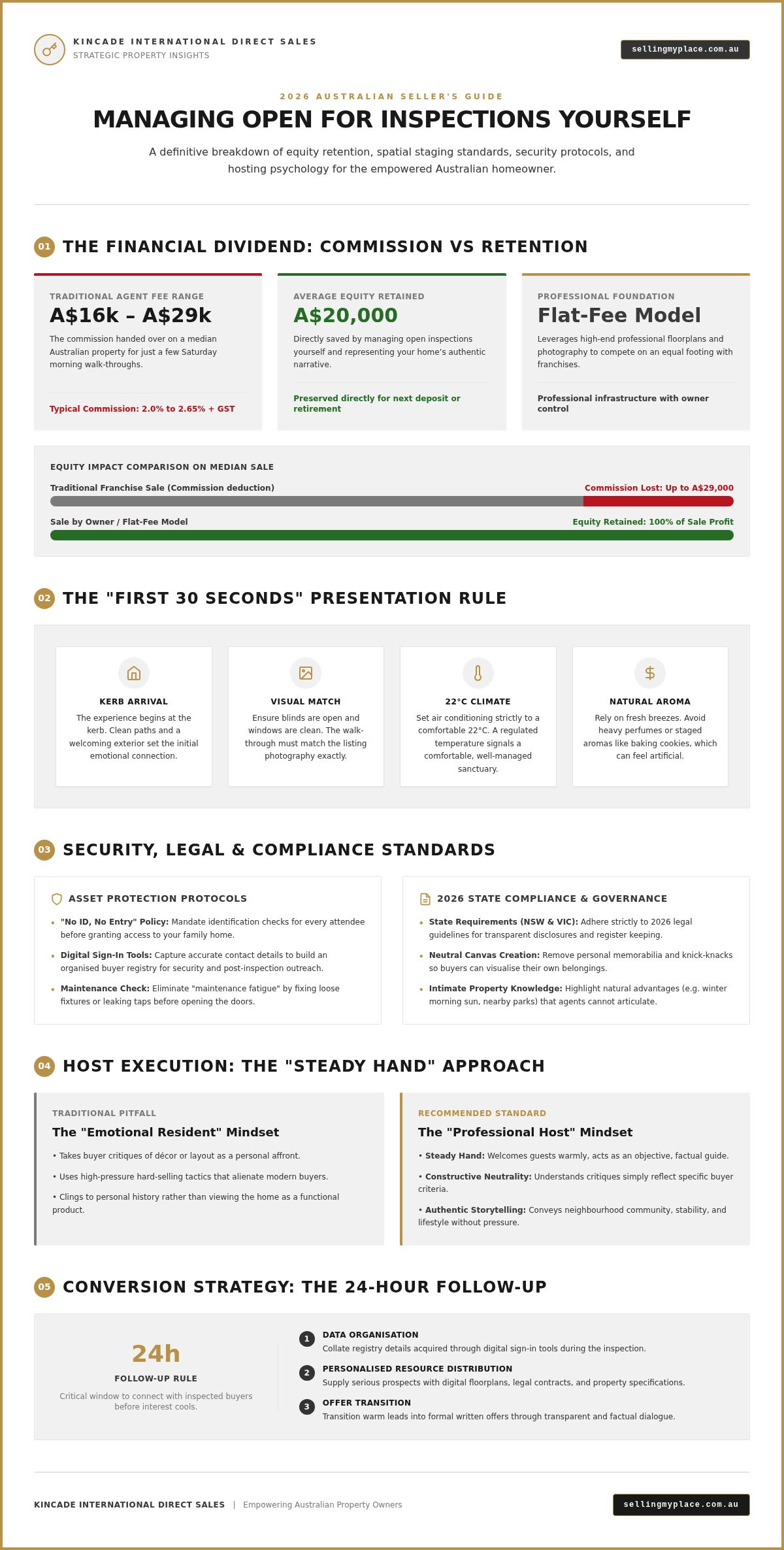
Hosting Like a Pro: Engaging Buyers Without the Hard Sell
Managing open for inspections yourself doesn’t mean you have to be a high-pressure salesperson. In fact, most Australian buyers find the presence of a pushy agent quite off-putting. They want to wander through your home at their own pace, imagining where their sofa will go or how the kitchen will work for their family dinners. Master the “soft greet”: a warm smile, a friendly hello, and a simple invitation to look around freely. Once you’ve checked their ID and registered them, step back. Give them space to breathe. You’re there as a resource, not a shadow.
When a buyer does approach you, adopt the “Steady Hand” approach. This means answering questions with calm, factual confidence rather than getting defensive or emotional. It’s helpful to categorise your visitors. Research suggests that up to 30% of attendees in suburban Australia are “looky-loos” or curious neighbours. Be polite to everyone, but save your deeper energy for the serious buyers who are asking about settlement terms or local school zones. By remaining objective, you build a bridge of trust that often leads to more transparent conversations.
Common Buyer Questions and Pro-Level Answers
One of the most common questions you’ll face is “Why are you selling?”. Avoid over-explaining or sounding defensive. Instead, keep it future-focused: “We’ve loved our time here, but we’re looking to downsize now that the kids have moved out.” For technical queries about easements or boundaries, never guess. It is perfectly professional to say, “That’s a great question; I’ll check the contract with my solicitor and get back to you this afternoon.” This accuracy protects you and shows the buyer you’re a serious, reliable vendor.
The Art of the Subtle Close
As guests prepare to leave, use open-ended questions to gauge their interest. Asking “How does this home compare to others you’ve seen today?” provides vital feedback without sounding desperate. If they seem keen, you might mention that you’ve already received a few enquiries or point them toward the property sale negotiation tips you’re following to ensure a fair deal for everyone. Before they walk out, ensure they have a brochure and your direct mobile number. If you’d like a “pro in your pocket” to help rehearse these conversations, you can book an agent advisory session to sharpen your hosting skills before the big day.
Post-Inspection Strategy: Turning Walk-throughs into Offers
Once the last visitor has left and you’ve locked the front door, the real momentum begins. Managing open for inspections yourself doesn’t end when the “Open Home” sign comes down; it simply shifts into a more strategic gear. In the Australian market, your speed and professionalism during the follow-up phase often determine how quickly you move from a walk-through to a signed contract. It’s about maintaining that connection you’ve built throughout the day.
Apply the 24-hour follow-up rule. Reach out to every attendee while the memory of your home is still fresh. It’s helpful to categorise your leads into three groups. “Hot” leads are those who asked for settlement terms or requested a contract. “Warm” leads are visitors who spent significant time in the property and asked lifestyle questions. “Cold” leads are typically those who did a quick circuit and left. Send a personalised SMS or email thanking them for their time and include a link to your digital floorplan. This small gesture provides genuine value and keeps your property top-of-mind without feeling intrusive.
Analysing Your Feedback
Don’t be afraid to ask for honest feedback. Use a simple template to gather market insights, asking what they liked most and if anything didn’t quite meet their expectations. If several buyers mention that the “kitchen feels dark,” it’s a clear signal to adjust your lighting before the next weekend. Consistent feedback is a gift. It tells you exactly how the market perceives your home’s value. If you receive complex or conflicting signals, our Real Estate Advisory Services can help you interpret these patterns and decide if a shift in presentation or price is necessary.
Readying the Contract
In the fast-paced 2026 market, being “offer-ready” is essential. Ensure your Section 32 or Contract of Sale is digital and ready for instant sharing via email or a QR code link. Buyers appreciate the transparency of having the legal details at their fingertips immediately after an inspection. We recommend collaborating closely with your Conveyance Advice provider to ensure you’re prepared to handle incoming offers the moment they arrive. There is an incredible sense of accomplishment in closing a deal with confidence, knowing you’ve navigated the process with heart and kept every cent of the commission for your family’s future.
Your Path to a Successful, Commission-Free Sale
You have the tools, the local knowledge, and the genuine heart to present your home better than any third party ever could. By mastering the shift from resident to professional host and implementing robust security measures, you have laid the groundwork for a smooth inspection day. Remember that managing open for inspections yourself is simply about facilitating an emotional connection while maintaining a steady, objective hand during those vital buyer conversations. It is a significant life transition, but it’s one you are now fully equipped to handle with grace and authority.
You don’t have to navigate this journey alone. With professional marketing tools like high-end photography and floorplans at your disposal, plus expert pre-sale consulting to guide your strategy, you can confidently keep 100% of your sale profit. It’s time to take control of your property’s legacy and ensure your hard-earned equity stays exactly where it belongs. We’re here to act as your “pro in your pocket” whenever you need a steady hand to guide you through the process.
Start your commission-free selling journey with our expert advisory today and move toward your next chapter with total peace of mind. You’ve worked hard for your home; now, let’s make sure it works hard for you.
Frequently Asked Questions
Do I legally need an agent to host an open for inspection in Australia?
You are legally permitted to host your own property inspections in every Australian state and territory. However, compliance is key. In New South Wales, you must have a completed Contract of Sale ready before any advertising or inspection takes place. Similarly, Victorian sellers must provide a Section 32 Vendor’s Statement. Managing open for inspections yourself requires following these statutory standards to ensure your sale remains legally sound and protected from potential rescission.
What is the best time and day to hold an open house for maximum turnout?
Saturday is the undisputed king of the Australian open home circuit, typically between 10:00 am and 2:00 pm. This window captures the highest volume of active buyers. For properties in high-demand metropolitan areas, a 30-minute weeknight “twilight” inspection on a Thursday can also be effective. This caters to busy professionals who want to view a home before the weekend rush, helping you build early momentum for your listing.
How do I handle a buyer who wants to negotiate the price on the spot?
If a buyer attempts to negotiate on the spot, maintain your professional decorum. It’s best to thank them for their interest and ask them to submit their offer in writing via email or your digital platform. This gives you space to consult with your solicitor or advisory service without the pressure of an immediate verbal commitment. A formal process ensures that every offer is documented and treated with the seriousness it deserves.
Is it better to have a “Price on Application” or a clear price guide?
Providing a clear price guide is generally more effective than “Price on Application” (POA). In the current 2026 market, buyers value transparency and often filter out listings that lack a price range. A clear guide attracts qualified leads who are actually in your budget, whereas POA can lead to frustration and missed opportunities. Using a Neighborhood Market Report helps you set a realistic range that justifies your expectations to prospective purchasers.
How do I prevent “tyre kickers” from wasting my time during inspections?
You can minimise time-wasters by asking qualifying questions during the sign-in process. Ask if they have a property to sell first or if they’ve already secured finance pre-approval. While you should be welcoming to everyone, focusing your deeper conversations on those who provide specific feedback or ask about settlement terms is a smart way of managing open for inspections yourself. It keeps your energy high for the most serious prospects.
What should I do if nobody shows up to my first open for inspection?
If your first inspection has no attendees, don’t lose heart. It’s usually a signal to review your marketing visibility or your price guide. Check that your listing is prominent on the major portals and that your photography is doing the heavy lifting. You might consider booking a session with a real estate advisory service to audit your presentation and ensure your digital “shop front” is appealing to the right demographic.
Should I provide food or drinks for people attending the inspection?
Keep it simple and professional. While the scent of fresh coffee is a classic touch, providing actual food can be a distraction and creates a risk of spills on your carpets. A few chilled bottles of water on a hot day are a thoughtful, neighbourly gesture that buyers appreciate. Your focus should remain on the property’s features and the lifestyle it offers rather than running a catering service.
How many open for inspections should I plan before considering a price change?
We generally recommend reviewing your strategy after three to four weeks of active inspections. If you have hosted six to eight opens without receiving a serious offer or consistent “warm” leads, the market is giving you a clear signal. This doesn’t always mean a price drop is necessary; sometimes a fresh set of professional photos or a minor adjustment to your marketing copy can reignite buyer interest and attract a different pool of purchasers.
Navigating Australian Property: 2026 Home Owner’s Guide to Private Sales
What if the biggest hurdle to your family’s next chapter isn’t the market itself, but the A$20,000 or more you’re expected to hand over in commissions? For many, the traditional path to selling a home feels like a lopsided arrangement where you provide the asset and someone else takes a significant slice of the reward. If you’ve ever felt that the current model of private real estate sales australia puts the agent’s interests ahead of your own equity, you aren’t alone. It’s a common frustration to feel like a passenger in your own life transition, especially when hidden marketing fees and rigid contracts start to pile up.
We believe you deserve a more empowering way to move forward, one that treats your home as the hard-earned legacy it is. This guide will show you how to find the best available properties or list your own for a premium price while retaining your full profit. You’ll discover how to access professional photography, expert negotiation support, and global listing reach without the burden of traditional commissions. From legal essentials to mastering open homes, we’re here to provide the steady hand you need to manage your 2026 property journey with absolute confidence.
Key Takeaways
- Understand how the market environment for private real estate sales australia has evolved in 2026 to empower owners through digital-first marketing and total transparency.
- Learn how to bypass traditional 2-3% commission structures and keep an average of A$20,000 more of your hard-earned equity by choosing a professional flat-fee model.
- Discover the psychological power of professional visual marketing and how pre-sale consulting identifies high-ROI improvements that make your property stand out.
- Gain the confidence to manage your own enquiries and open houses, acting as the most passionate and knowledgeable advocate for your home’s unique story.
- Master the art of reading between the lines of property listings to spot genuine value and opportunity in a competitive digital landscape.
Understanding the Landscape of Private Real Estate Sales in Australia
The Australian property market in 2026 is no longer a closed book held only by traditional agencies. We’ve entered an era where transparency and digital-first marketing have become the standard, shifting the focus back to the person who matters most: you. Choosing private real estate sales australia isn’t just a way to avoid fees; it’s a sophisticated strategy that places control of your family’s future firmly in your hands. While the features of your home, like a sun-drenched deck or a renovated kitchen, are vital, the method you use to list them is what determines how much of the final price stays in your pocket. Direct sales offer a professional middle ground, blending the support of experts with the financial freedom of a commission-free model.
The Evolution of the Australian Property Market
Our digital world has completely rebalanced the scales. Today, homeowners have the same tools at their fingertips that were once exclusive to big offices. In a market where interest rates and living costs are top of mind, the demand for commission-free alternatives has never been stronger. Modern sellers aren’t just looking for a quick result; they’re prioritising equity preservation. They’ve realised that handing over a large percentage of their home’s value to an agent doesn’t always translate to a better outcome. This evolution in private real estate sales australia means you can access high-tier marketing once reserved for luxury agencies. It’s a shift toward stability and common sense where you’re a partner in a professional process rather than just a number in a database.
Public vs. Private Listings: What is the Difference?
Visibility is the heartbeat of any sale. While major portals offer a broad view, private listings through global marketing networks reach specific, motivated buyers without the competitive noise. One of the greatest advantages of this approach is the “listed until sold” philosophy. You don’t have the ticking clock of a 90-day agency agreement hanging over your head, which reduces stress and allows for a more grounded decision-making process. Keeping your listing fresh for a national audience is simple when you have professional floorplans and photography that speak directly to a buyer’s aspirations. It’s about presenting a lifestyle, not just a structure. This method ensures your home remains a premium offering for as long as it takes to find the right buyer.
Decoding Property Listings: How to Spot Value and Opportunity
Buying or selling a home is deeply personal. A listing is more than a list of features; it’s a window into a potential future. For those exploring private real estate sales australia, understanding how to interpret these listings is a superpower. Serious buyers look for clarity and honesty. If a listing feels vague or lacks essential data, it’s often a sign of a missed opportunity for the seller or a red flag for the buyer. You want to see the “soul” of the home, not just the square metres.
The Hidden Market: Finding Off-Market Properties
Off-market properties are the industry’s quiet achievers. These homes aren’t splashed across public portals; instead, they move through discreet networks. Sellers often choose this path to maintain privacy or test the market without the public pressure of “days on market” counters. To find these gems, you need to be part of the right circles. Engaging professional buyer representation can give you that crucial head start, ensuring you see the home before the rest of the country does. It’s about being proactive rather than reactive in your search.
Evaluating Professional Marketing: Photography and Floorplans
High-end photography isn’t a luxury; it’s a non-negotiable tool for establishing a premium feel. It creates an emotional anchor, helping a buyer imagine their morning coffee in that specific kitchen. Accurate floorplans are equally vital because they allow buyers to mentally arrange their furniture. This transparency reduces “tyre-kickers” and attracts serious enquiries from people who already know the layout suits their lifestyle. Professional visuals act as a silent negotiator, setting a high perceived value before anyone even steps through the front door.
Watch out for listings with poor lighting or missing details. Sometimes, these “diamonds in the rough” are actually fantastic properties simply held back by a lack of professional presentation. If you’re selling, don’t let your hard-earned equity be undermined by a dark photo or a blurry floorplan. The standard for private real estate sales australia is rising; buyers expect high-quality information. If you’re buying, these poorly marketed listings might be where the real value hides, as they often attract fewer eyes and less competition. Taking the time to look past the presentation can lead to a spectacular deal.
The True Cost of Selling: Commissions vs. Flat-Fee Models
Traditional agencies in Australia typically charge between 2% and 3% in commission. For a family selling a home worth A$1 million, that’s a cheque for A$20,000 to A$30,000 handed over at settlement. It’s a significant amount of equity that could otherwise fund a renovation, pay down a mortgage, or secure a retirement. When you choose Sale by owner, you’re not just taking a DIY approach; you’re opting for a sophisticated, expert-backed strategy. Modern private real estate sales australia allow you to bypass these exorbitant fees while still having a “steady hand” to guide you. Our Expert Agent Advisory Service acts as your personal consultant, ensuring you never feel alone during the negotiation phase. We help you handle the paperwork and the psychological dance of the deal with calm confidence, turning a stressful transaction into a manageable partnership.
Calculating Your Potential Equity Savings
Kincade International Direct Sales users save an average of A$20,000 per sale compared to traditional agency models. This isn’t just a one-off saving; it’s the preservation of your 100% sale profit, which can have a massive impact on your long-term financial stability. Imagine what that A$20,000 could do for your next deposit or your family’s future. Choosing a commission-free path doesn’t mean you’re sacrificing quality or professional oversight. It simply means you’re paying for the services you actually use rather than a percentage of your home’s total value. It’s a logical shift toward a more equitable way of doing business in the current property market, where every dollar of equity counts toward your next chapter.
The Flat-Fee Advantage: Professionalism Without the Price Tag
A truly professional marketing package should include high-end photography, detailed floorplans, and comprehensive neighbourhood market reports to ensure your property stands out. Unlike traditional agencies that might push for a quick sale to meet their monthly targets, a flat-fee model offers the peace of mind of a “no time limit” listing policy. This means you’re listed until sold, removing the anxiety of a 90-day expiry date. You can access Residential Property Listing Services that rival any major agency, providing global reach and premium presentation. This partnership ensures you have the tools to succeed in private real estate sales australia without the pressure of mounting marketing costs or ticking clocks. You maintain the authority over your sale while we provide the infrastructure and support to make it happen.
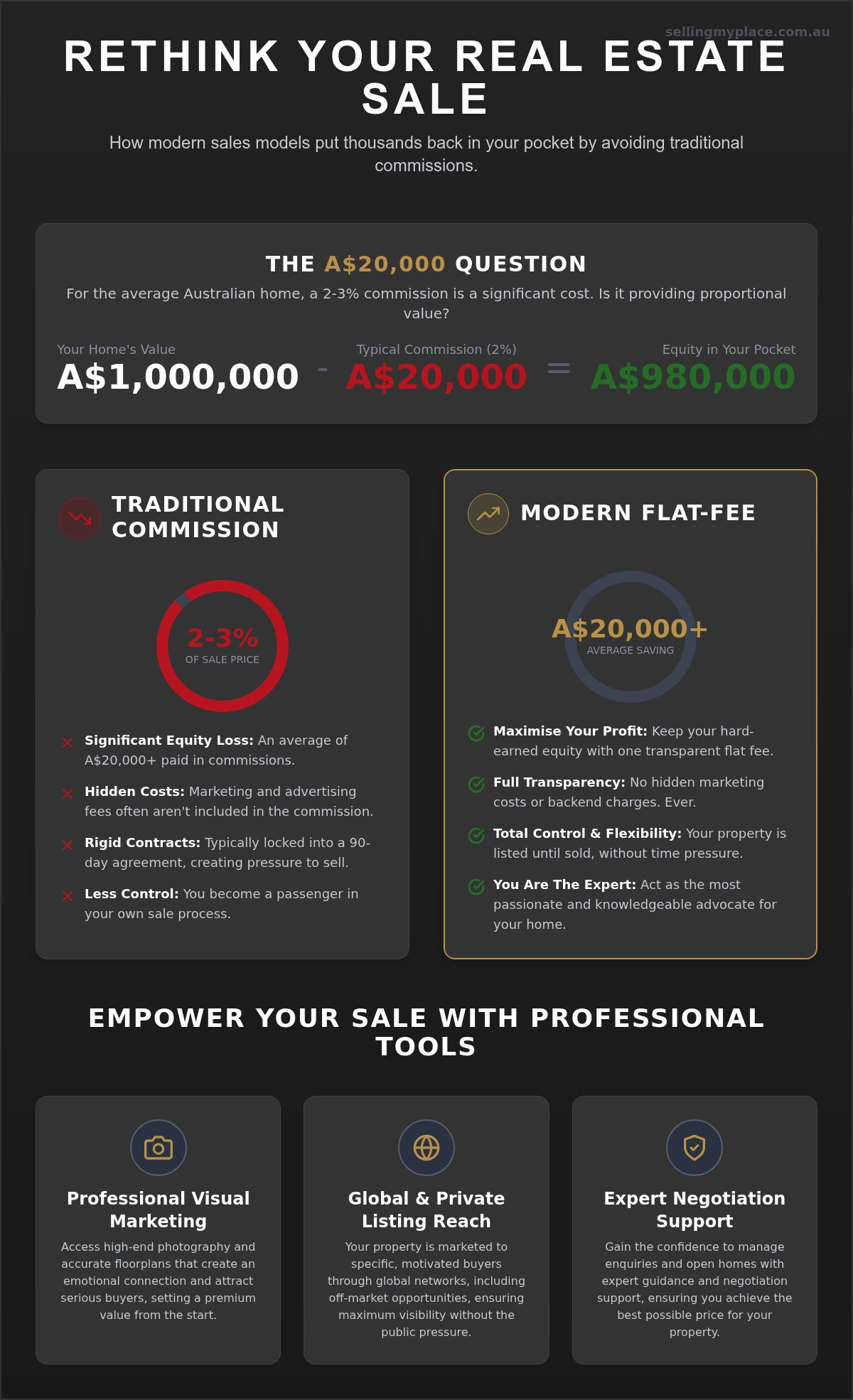
Preparing Your Property for Sale to Maximise Profit
Your home is more than bricks and mortar; it’s where your children grew up or where you’ve built your sanctuary. This emotional connection is a strength, but it can also cloud your judgement when preparing for the market. In the digital-first environment of 2026, the first ten seconds a buyer spends looking at your listing are the most critical. If the visuals don’t spark a sense of “this is the one,” they’ll keep scrolling. Success in private real estate sales australia depends on presenting a polished, aspirational lifestyle that invites buyers to see themselves in your space. This means moving beyond generic cleaning and focusing on the strategic presentation of your home’s unique story.
Expert Pre-Sale Consulting: Small Changes, Big Impact
Identifying “deal breakers” early is essential. These are the small things, like a leaky tap or a scuffed skirting board, that signal a lack of care to a potential buyer during their first inspection. Pre-sale consulting helps you focus on high-ROI improvements, ensuring you don’t over-capitalise on renovations that won’t move the needle. By centring your home’s best features through professional staging and a thoughtful layout, you create a neutral yet warm environment. Having an unbiased advisory service by your side provides the calm confidence needed to make these practical decisions without the weight of sentimentality holding you back.
Pricing Strategy: How to Determine Market Value of a Home in Australia
Setting the right price is a delicate balance of ambition and reality. In 2026, buyers are more informed than ever, and overpricing remains the most common reason properties linger on the market. To avoid this, you must use hard data rather than guesswork. We provide detailed neighbourhood market reports that show exactly what similar homes have sold for recently. This transparency allows you to justify your asking price to savvy buyers, whether you choose a “Fixed Price” or a “Price Guide” strategy. Understanding the psychology of these options helps you position your home as a fair and attractive opportunity in a competitive landscape.
Don’t forget the power of a well-crafted story. While data secures the mind, storytelling captures the heart. Your property description should highlight the “un-seeables,” like the way the morning light hits the breakfast nook or the quiet community feel of the street. This blend of professional data and personal warmth is what makes private real estate sales australia so effective. If you’re ready to see how your home measures up in the current market, our team is here to provide a tailored market report to get you started on your journey.
Taking Control: Your Journey from Listing to Settlement
Stepping into the role of your own advocate is a powerful moment. While traditional agents often claim that only they can handle the pressure of an open house, the truth is that nobody knows the heartbeat of your home better than you do. When you manage private real estate sales australia, you aren’t just showing a house; you’re sharing a lifestyle. You can point out where the kids did their homework or how the garden changes with the seasons. Handling enquiries with professional confidence comes naturally when you realise you’re simply having a conversation with another family looking for their next chapter. It’s about being prepared, being honest, and maintaining that sense of calm authority we’ve discussed throughout this guide.
Negotiation Tips for the Modern Australian Seller
Negotiation can feel like the most daunting part of the process, but it doesn’t have to be. The key is to remain objective and grounded. Remember, a buyer’s offer isn’t a critique of your home’s worth; it’s a starting point for a professional agreement. By understanding the buyer’s motivations, such as their desired settlement date or their need for a stable neighbourhood, you can close the deal more effectively. If the technical side of the conversation feels heavy, you can always lean on our Real Estate Advisory Services. Having that expert support in your corner ensures you’re never negotiating in the dark, allowing you to secure a premium price while keeping your equity intact.
The Legal Finish Line: Conveyancing and Settlement
As you approach the finish line, the focus shifts to the finer details of Australian property law. This is where professional conveyance advice becomes your most valuable asset. Ensuring all paperwork is organised and compliant is vital for a stress-free transition. During the final weeks, you’ll coordinate with your legal representative to manage the bank’s requirements and prepare for the settlement date. It’s a time of reflection and excitement. Celebrating a successful sale is even sweeter when you know you’ve navigated the process with dignity and saved upwards of A$20,000 in unnecessary fees. Once the keys are handed over, our Buyer Representation services can help you find your next sanctuary with the same level of care and expertise.
Embracing Your Future with Confidence and Equity
Choosing to take the lead in your property journey is a decision that honours both your home’s legacy and your family’s financial future. We’ve explored how private real estate sales australia have evolved into a sophisticated, professional path where you no longer have to choose between expert support and keeping your hard-earned equity. By leveraging professional photography, detailed floorplans, and a “listed until sold” approach, you place your property in the best possible light without the burden of traditional commissions. It’s about ensuring that the value you’ve built over years stays exactly where it belongs: with you.
You’ve seen that success comes from a blend of data-driven pricing and heartfelt storytelling. With a steady hand to guide you through negotiations and settlement, the process becomes a rewarding transition rather than a source of stress. It’s time to step into this new era of home ownership where you remain the primary beneficiary of your asset’s value. We’re ready to stand beside you as you move toward your next sanctuary.
Start your commission-free selling journey with Kincade International Direct Sales today and keep 100% of your sale profit while enjoying expert advisory support every step of the way. Your next chapter is waiting, and we’re here to help you reach it with absolute peace of mind.
Frequently Asked Questions
How do I list properties for sale without paying a traditional commission?
You can list your property by choosing a flat-fee marketing service like Kincade International Direct Sales. This modern approach allows you to access major property portals and global networks for a single upfront fee rather than a percentage of your final sale price. By removing the commission-based agent from the equation, you retain 100% of your equity. You’ll manage the inspections yourself while we provide the professional infrastructure to ensure your listing reaches a national audience.
What is included in a flat-fee property marketing package?
A comprehensive package provides everything you need to rival a traditional agency’s presentation. You’ll receive high-end professional photography, detailed floorplans, and neighbourhood market reports to help you price your home accurately. We also include global listing reach and a professional signpost for your property. The goal is to provide a steady hand through our Agent Advisory Service, ensuring you have expert guidance from the moment you list until the keys are handed over.
Can I really sell my own home as professionally as an agent?
You absolutely can, especially when you have the right tools and support. Most buyers today find properties online, so as long as your marketing looks professional, they don’t mind dealing with the owner directly. In fact, many buyers prefer it because you can answer specific questions about the home’s history and neighbourhood that an agent might not know. We provide the professional polish and advisory support to ensure your property stands out as a premium offering.
How much can I save by using a direct sales model in Australia?
On average, homeowners utilising the private real estate sales australia model save approximately A$20,000 per transaction. This figure is based on avoiding the standard 2% to 3% commission typically charged by traditional agencies. When you consider that you also avoid high marketing mark-ups and hidden fees, the total amount of equity you keep can be life-changing. It’s a sensible way to protect your profit and your family’s future during a major life transition.
What are off-market properties and how do I find them?
Off-market properties are homes for sale that aren’t advertised on major public portals. Sellers often choose this path for privacy or to test the market quietly. To find these opportunities, you can use our buyer representation services, which tap into private networks and direct sales databases. Accessing these listings gives you a competitive edge, allowing you to view homes and negotiate deals before the general public even knows they’re available, often leading to a more grounded transaction.
Is professional photography and a floorplan really necessary for my listing?
They are absolutely vital for securing a premium price in 2026. High-quality visuals are the first thing a buyer sees, and they set the tone for the entire sale. A clear floorplan allows buyers to mentally move into the space, which reduces tyre-kickers and attracts more serious enquiries. Without these professional elements, your property might be overlooked, even if it’s the best value in the street. First impressions are everything in a digital-first market.
How does the Agent Advisory Service support me during the sale?
Think of our Agent Advisory Service as your personal property consultant. We provide expert backing during the most complex parts of the sale, including pre-sale consulting to identify high-ROI improvements and guidance during negotiations. If you’re unsure how to handle an offer or need help with contract details, we’re here to provide a calm, grounded perspective. We ensure you feel empowered and supported from your initial listing right through to the final settlement phase.
What happens if my property doesn’t sell within a few months?
One of the biggest benefits of our model is the listed until sold policy. Unlike traditional agency agreements that often expire after 90 days, we have no time limits on your listing. This removes the pressure to accept a low offer just because a contract is ending. You can keep your property on the market for as long as it takes to find the right buyer, maintaining total control over your sale and your equity.
Factors Affecting Property Value in Australia: The 2026 Seller’s Guide
Your family home might be worth exactly what the market dictates, but the amount that actually lands in your bank account is entirely up to you. In a cooling market where national dwelling values recently dipped by 0.9 per cent, understanding the specific factors affecting property value in Australia has never been more critical. It’s a stressful tightrope to walk, especially when you’re trying to make sense of conflicting data while high agent commissions threaten to eat away at your life’s work. We understand that this transition is about more than just a transaction; it’s about protecting your family’s future and the legacy you’ve built.
This guide is designed to give you back control and provide a steady hand through the selling process. You’ll discover how to navigate the current 4.35 per cent cash rate environment and identify the specific home features that truly drive up local interest. We’ll show you how to maximise your sale price and keep 100 per cent of your profit, ensuring you don’t lose an average of $20,000 to commissions. By the end, you’ll have a clear strategy to sell with confidence and move into your next chapter with your full equity intact.
Key Takeaways
- Understand how the RBA cash rate and national economic trends influence the price ceiling for your home in the current 2026 landscape.
- Identify the specific physical and local factors affecting property value in Australia, such as the “Golden Triangle” of rooms and school catchment zones.
- Learn why professional photography and high-quality floorplans are essential for standing out and driving inspections in a cooling market.
- Discover how to protect your family’s legacy by avoiding high agent commissions and keeping 100 per cent of your sale profit.
- Gain a clear, step-by-step strategy to navigate conflicting market data with the calm confidence of a seasoned expert.
The Australian Property Market: Macro Factors You Can’t Control
Selling a family home often feels like trying to read the weather; you can prepare the garden and paint the deck, but you cannot stop the rain. In the current climate, macro-economic conditions act as the atmospheric pressure of the housing world. Understanding the external factors affecting property value in Australia is the first step toward building a grounded, realistic sale strategy. We often see homeowners stressed by national headlines, yet the “Big Three”—interest rates, inflation, and economic confidence—impact every suburb differently. While professional real estate appraisal methods provide a technical baseline for what a house is worth, these broader shifts often dictate the final price a buyer is actually willing to pay on auction day.
Government policy also plays a significant role in propping up or cooling down demand. For instance, the Australian Government 5% Deposit Scheme continues to support eligible buyers, while state-based First Home Owner Grants, such as the $20,000 available in Tasmania or the $50,000 in the Northern Territory, keep certain price brackets active. However, national data can be misleading. This is why a detailed Neighborhood Market Report is far more useful than generic news; it filters these broad trends through the lens of your specific street, where local supply and demand dynamics truly dictate your price ceiling.
The Interest Rate Ripple Effect
The Reserve Bank of Australia kept the official cash rate at 4.35 per cent as of September 2026, a figure that remains the primary lever for buyer borrowing power. When rates are steady or rising, buyers become more cautious, and mortgage stress can lead to increased inventory as more homes hit the market. You might feel tempted to hold out for a rate drop, but in a cooling market where national values recently fell by 0.9 per cent in a single month, waiting can sometimes mean chasing the market down. It is often better to sell with a clear head in today’s known conditions than to gamble on the RBA’s next move.
Demographic Shifts and Housing Demand
The legacy of the “tree change” and “sea change” movements continues to influence where Australians want to live, even as some return to employment centres. Migration patterns and the desire for more useable space keep certain regions resilient while others soften. For homeowners in lifestyle-rich areas, the ability to generate short-term income through BnB Booking can significantly enhance a property’s appeal to the growing investor market. Market sentiment is the collective emotional state of Australian buyers in 2026. This shared mood, driven by everything from employment security to the 3.5 per cent annual inflation rate, determines whether a buyer views your home as a safe harbour or a financial risk. By understanding these shifts, you can position your property to meet the specific aspirations of today’s families.
While the role of the RBA in relation to housing sets the broader financial boundaries for what buyers can afford, the physical reality of your home is what clinches the deal. Land size has long been one of the primary factors affecting property value in Australia, yet modern families now prioritise useable space over raw acreage. A smaller, well-designed block with an integrated alfresco area often outshines a sprawling, unkempt yard that suggests endless weekend chores. Buyers are looking for a lifestyle, not a second job.
Inside the home, the “Golden Triangle” of rooms remains the most significant driver of perceived worth. Kitchens, bathrooms, and master suites are where buyers look for luxury and longevity. In 2026, sustainability has also moved from a “nice-to-have” to a non-negotiable. High-quality insulation and solar systems are viewed as future-proofing measures that protect buyers from rising living costs. To help potential owners understand how these elements fit together, professional floorplans are essential; they allow a family to mentally move their furniture in before they even step foot on the property.
Kerb Appeal and First Impressions
The psychology of the “front gate” experience cannot be overstated. A buyer’s emotional connection often begins the moment they pull up to the kerb. Simple acts like tidying garden beds, painting the front door, or ensuring the letterbox isn’t leaning can add thousands to the perceived value. Modern Australian buyers are particularly drawn to low-maintenance landscaping that offers a lush feel without the heavy lifting. Organising your exterior to look effortless suggests a home that has been loved and meticulously maintained, which reduces buyer anxiety about hidden maintenance issues.
Internal Layout and Modern Functionality
We’ve seen a permanent shift toward multi-purpose living. A dedicated “work from home” space is now a top priority for professionals, and a home that offers quiet zones alongside open-plan areas will always command a premium. High-end Photography is the best way to showcase this balance; it captures the light and flow that make a house feel like a home. If you’re wondering how your specific layout measures up against current buyer expectations, you might find it helpful to speak with an advisor about your property’s unique strengths.
Location and Infrastructure: Beyond the Boundary Fence
Value doesn’t end at your front gate. In fact, many of the most significant factors affecting property value in Australia are entirely external to your title deed. Buyers aren’t just purchasing bricks and mortar; they’re buying into a lifestyle, a commute, and a community. This is why two identical houses in the same suburb can have vastly different price tags based on which side of a specific road they sit. It’s about the “anchor” of the location, the sense of place that makes a family feel they’ve found their forever home.
Local amenities play a massive role in this emotional connection. Walking distance to a vibrant local cafe strip or a well-maintained park adds a layer of desirability that generic data simply can’t capture. We’ve seen that the “good coffee” factor is real; buyers will often pay a premium for the convenience of a weekend stroll to their favourite local spot. However, it’s also vital to look at what’s coming next. Checking local council plans for zoning changes or new developments is a crucial step in future-proofing your sale. A new shopping centre nearby might boost convenience, but a proposed high-rise development next door could impact your privacy and sunlight. Staying informed about these external shifts ensures you’re never caught off guard during negotiations.
The Power of School Zones
For many Australian families, the local school catchment is the ultimate “hidden” value driver. Being on the right side of a boundary line can change a valuation by a six-figure sum, as parents look to secure their children’s education without the ongoing cost of private tuition. These properties tend to show remarkable long-term stability, even when the broader market softens, because the demand for quality education remains constant. You can learn how to determine the market value of a home in Australia by cross-referencing your address with the latest NAPLAN results and local school intake maps. It’s one of the most reliable ways to justify a higher asking price to a motivated buyer.
Transport and Connectivity
The rise of the “20-Minute Neighbourhood” has reshaped urban planning across the country. Buyers now prioritise homes where work, shops, and health services are all reachable within a short trip. Proximity to public transport hubs or major employment centres is a massive drawcard, though there’s a delicate balance to strike. While being near a train station adds value, being too close to the tracks can detract from the “quiet street” premium that many families still crave. Upcoming infrastructure projects, like rail extensions or highway upgrades planned for the next few years, can act as a catalyst for future capital growth. If your home is positioned to benefit from these connections, it’s a major selling point that deserves a spotlight in your marketing.
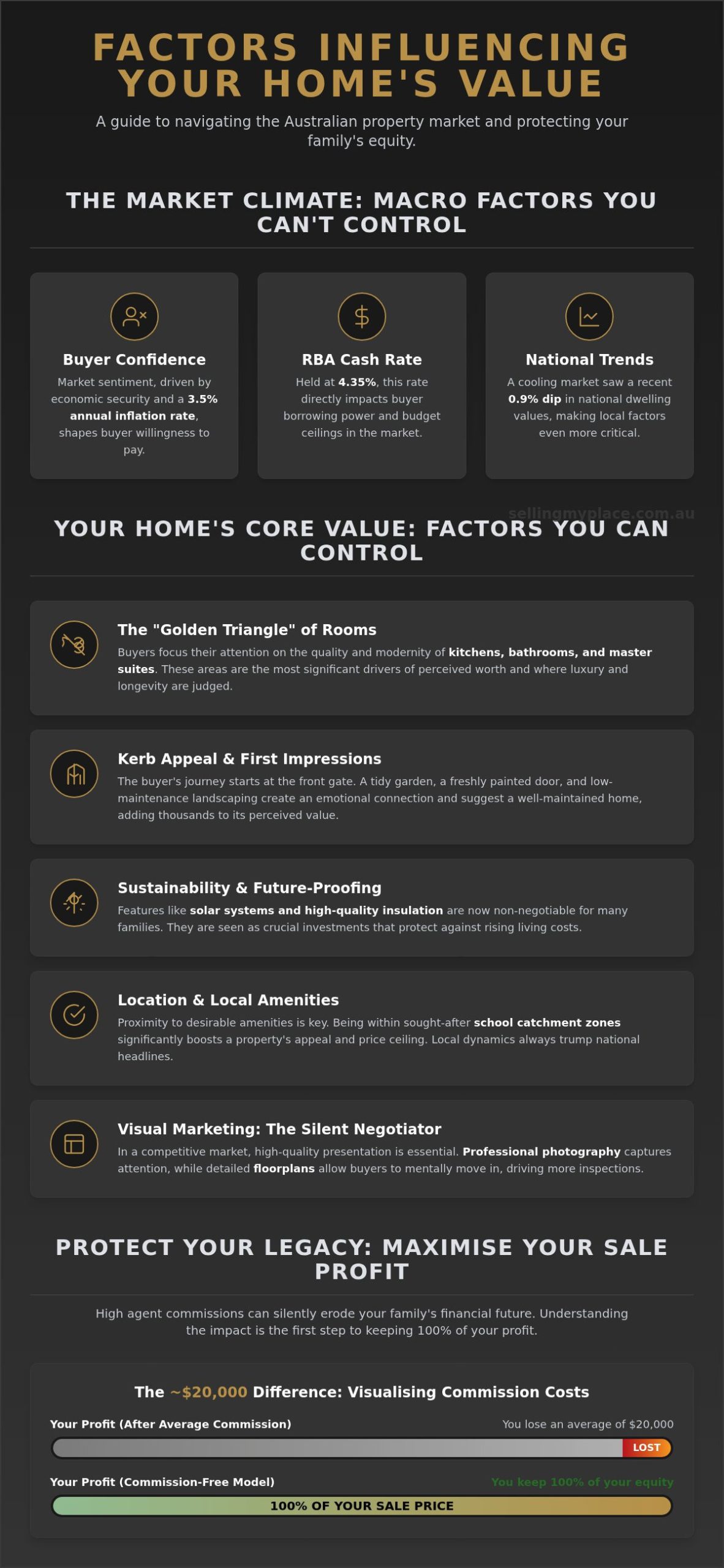
Visual Marketing: The “Silent Negotiator” of Property Value
Many sellers assume that market value is a rigid number set in stone by banks and spreadsheets. In reality, value is often a range, and where your final sale price lands within that range depends heavily on perception. While we have already explored the economic shifts and local infrastructure that provide the foundation, visual marketing is one of the most powerful controllable factors affecting property value in Australia. It acts as a silent negotiator, setting the tone for every conversation before a buyer even steps onto your driveway. Choosing to sell your own home shouldn’t mean settling for a ‘DIY’ look; it’s about meeting professional standards to ensure your property is taken seriously by the most competitive buyers. To see how these standards are applied by industry leaders, you might check out The Agency Coffs Coast for an example of high-end regional property presentation.
High-quality marketing does more than just look pretty. It builds trust and reduces the perceived risk for a buyer. When a listing looks polished, it suggests the home itself has been cared for with the same level of attention. By positioning your home as a lifestyle rather than just a collection of rooms, you invite buyers to visualise their own future there. This emotional connection is what drives people to stretch their budgets during negotiations, turning a casual browser into a determined bidder. If you are ready to showcase your home’s true potential, you can book a consultation with our team to discuss the best visual strategy for your area.
Smartphone cameras have come a long way, but they still cannot replicate the impact of professional equipment and expert editing. A professional photographer understands how to use wide-angle lenses to capture the flow of a room without distorting it, and how to balance natural light to make a space feel warm and inviting. These images are often the first point of contact a buyer has with your legacy. We’ve seen that listings with professional media receive significantly more clicks and inspection requests than those without. This is why Kincade International Direct Sales includes professional photography in every package; we believe every Australian seller deserves to put their best foot forward without the burden of high upfront marketing costs.
The Floorplan Advantage
An accurate floorplan is perhaps the most underrated tool in your marketing arsenal. Research within the real estate industry suggests that approximately 1 in 3 buyers will actually ignore a listing if it doesn’t include a floorplan. It provides the essential context that photos alone cannot, helping buyers understand the relationship between the “Golden Triangle” of rooms we discussed earlier. Beyond just generating interest, floorplans help qualify buyers by ensuring the layout suits their specific needs before they book an inspection. You can also use these documents during Pre-Sale Property Consulting to identify minor layout improvements that could significantly boost your final sale price. It’s about removing friction and making it as easy as possible for a buyer to say “yes”.
Maximising Your Sale Profit: The KIDS Commission-Free Model
After navigating the complex factors affecting property value in Australia, from the RBA cash rate to the “Golden Triangle” of internal rooms, the final hurdle is ensuring that value actually stays in your pocket. It’s a common misconception that a high sale price automatically equals a high profit. In reality, the traditional commission model often acts as a significant “equity leak,” draining your hard-earned wealth at the very moment you should be celebrating. Protecting your family’s legacy means looking beyond the “sold” sticker and focusing on the net result. We believe that the equity in your home belongs to you, not an agency’s bottom line.
Kincade International Direct Sales (KIDS) was founded on the belief that the modern Australian seller deserves a more transparent, partnership-based approach. By choosing to sell your own home with the support of our flat-fee model, you effectively bypass the commission trap. This isn’t just about cutting costs; it’s about empowerment. You receive the same professional-grade Residential Property Listing Services, including the global marketing reach and professional media we’ve discussed, but without the high marketing costs or percentage-based fees that can erode your profit.
Traditional Agents vs. Flat-Fee Advisory
The financial difference is often startling. On a typical Australian property, sellers save an average of $20,000 in commissions by moving away from the traditional model. There’s a persistent myth that local agents have a “magic touch” that unlocks higher prices, but in 2026, market exposure and presentation are the true drivers of value. KIDS provides the global marketing network required to find the right buyer, while our Agency Flat Fee ensures your costs remain fixed and predictable. This allows you to move into your next chapter with your full equity intact, rather than leaving a significant portion of it on the closing table.
The Steady Hand: Expert Advisory and Conveyance
We understand that the legal and negotiation phases of a sale can feel daunting. That’s why we provide a “steady hand” through our Real Estate Advisory Services, acting as a safety net for those who want to take control of their sale. Navigating the legal journey is made simple with professional Conveyance Advice, ensuring that every contract and disclosure meets the necessary standards. From handling initial enquiries to the final settlement steps, our team provides the expert guidance you need to close the deal with confidence. It’s a professional, supported way to sell that prioritises your family’s needs over a quick commission.
Taking Charge of Your Home’s Future
Navigating the various factors affecting property value in Australia can feel like a daunting task, but you don’t have to do it alone. We’ve explored how macro trends like the 4.35 per cent cash rate provide the backdrop, while your home’s unique physical features and local school catchments drive individual interest. Most importantly, we’ve seen how professional presentation and strategic marketing can elevate your property above the competition, ensuring you achieve the best possible result in any market condition.
Your home is likely your greatest asset; protecting the equity you’ve built over many years is our top priority. By choosing a commission-free model, you can save an average of $20,000 per sale while still benefiting from professional photography, floorplans, and our expert advisory service. It’s about selling with confidence and keeping your hard-earned profit where it belongs. When you’re ready to start your next chapter with a steady hand by your side, protect your equity and sell commission-free with SellingMyPlace.com.au. We look forward to helping you move forward with peace of mind and your full legacy intact.
Frequently Asked Questions
What is the single biggest factor affecting property value in Australia?
While location is the traditional answer, the primary ceiling on property prices in 2026 is the RBA cash rate and its impact on buyer borrowing power. The current 4.35 per cent rate directly dictates what a family can afford to bid. However, within your local area, the specific street position and proximity to lifestyle amenities remain the most influential factors affecting property value in Australia that you can actually leverage.
How much value does a renovation actually add to an Australian home?
A well-planned renovation can return significantly more than its cost, provided you focus on the “Golden Triangle” of rooms. Kitchens, bathrooms, and master suites typically offer the highest return on investment because they are the most expensive for a buyer to fix themselves. Modern Australian buyers also look for energy-efficient upgrades, such as solar and insulation, which can add thousands to the perceived worth of a property in today’s climate.
Does the school catchment area really impact my property price?
Yes, being on the right side of a boundary line for a high-performing public school is one of the most resilient factors affecting property value in Australia. Parents often view a home in a top catchment as a long-term investment in their children’s education, which can lead to a six-figure premium over similar homes nearby. These properties tend to hold their value even when broader market sentiment begins to soften.
Can I sell my home without a traditional agent and still get a high price?
You can certainly achieve a premium price by selling your own home if you maintain professional standards in your marketing and presentation. Buyers respond to quality photography, clear floorplans, and accurate data rather than the logo on a sign. With the right real estate advisory services to guide your negotiations, you can achieve a result that matches or exceeds what a traditional agent might deliver.
How much can I save by using a commission-free real estate model?
Australian sellers save an average of $20,000 by choosing a commission-free, flat-fee model over a traditional percentage-based agency. This significant saving allows you to protect your home’s equity and put that money toward your next life transition. Because you aren’t paying a large portion of your profit to an agent, you have more flexibility in your negotiations while still ensuring you walk away with 100 per cent of the profit.
What should be included in a professional neighbourhood market report?
A comprehensive report should include recent local sales data, current supply and demand levels, and an analysis of how long properties are sitting on the market. It should also highlight local infrastructure projects or zoning changes that might influence future growth. These reports empower you to set a realistic asking price based on hard evidence rather than guesswork, giving you a steady hand during the entire selling process.
Is professional photography worth the investment for a private sale?
Professional photography is essential because it acts as your silent negotiator in the digital space. High-quality images and floorplans are the primary tools for reducing buyer friction and driving inspections. Since 1 in 3 buyers will skip a listing that lacks a floorplan, including professional media is non-negotiable for a successful result. It ensures your home stands out as a premium lifestyle choice rather than just another online listing.
What are the legal risks of selling my own property in Australia?
The primary risks involve ensuring all legal disclosures are accurate and that the contract of sale is correctly prepared for your specific state. These risks are easily managed by seeking professional Conveyance Advice and utilising an expert advisory service as a safety net. Having professional support through the legal journey ensures that your sale is compliant and secure, allowing you to focus on the emotional significance of your move.
Buyer Advocates in Australia: Navigating the Property Market with Expert Support
What if your Saturday mornings weren’t spent rushing between mediocre open homes, only to watch a property you loved sell for well over your limit at a frantic auction? It’s a common story in our current market, and frankly, it’s exhausting to feel like you’re always one step behind. Most Australians now realise that navigating this landscape alone is a recipe for burnout, which is why more people are turning to buyer advocates to level the playing field. You likely share that nagging fear of overpaying or, worse, accidentally buying a “lemon” with hidden defects just to finally end the search.
By partnering with an expert, you’re no longer walking that high-stakes path alone. This article reveals how professional support can help you secure your ideal property while saving you time, stress, and thousands in negotiation. We’ll explore the strategic advantages of accessing silent or off-market listings and the peace of mind that comes from having a steady hand by your side. You’ll discover how a dedicated advocate turns a stressful chore into a calculated investment move, ensuring a seamless transition into your next chapter without the usual property-hunt fatigue.
Key Takeaways
- Understand why a licensed professional is vital for balancing the scales against selling agents who are focused solely on the vendor’s result.
- Discover the strategy behind accessing off-market and “silent” listings to avoid the exhaustion of the public auction cycle and aggressive competition.
- Learn how the fee structures for buyer advocates work and how expert negotiation can effectively pay for itself by securing a better purchase price.
- Identify how to verify credentials and evaluate a negotiator’s “steady hand” to ensure they align with your family’s long-term lifestyle goals.
- Explore how reinvesting the $20,000 typically saved from a commission-free sale can provide the professional support needed to secure your next home.
What is a Buyer Advocate and Why are They Vital in Today’s Market?
Buying property in 2026 often feels like a high-stakes chess match where the other side has already memorised your moves. When you walk into an inspection, the selling agent is charming, helpful, and polite. However, their legal and financial loyalty lies entirely with the vendor. Their job is to extract the highest possible price from your pocket. This is where buyer advocates step in to change the dynamic. By hiring a licensed professional to act exclusively for you, you’re no longer the underdog. You’re a prepared buyer with a seasoned strategist in your corner.
Not all support looks the same. You might choose a “search and select” service if you’re time-poor but feel confident in your bidding. Alternatively, full “negotiation and auction” representation provides a protective shield during the most stressful moments of the transaction. In a market that often feels driven by fear of missing out, having an objective expert helps you stay grounded. They replace emotional urgency with cold, hard data, ensuring you don’t overpay in the heat of the moment.
The Key Roles of a Professional Advocate
Think of your advocate as a filter that catches the “lemons” before they sour your future. Their role extends far beyond just browsing online listings. It’s about providing a steady hand through a complex process.
- Property sourcing: They find homes that actually suit your lifestyle and long-term financial goals, often uncovering hidden gems before they even hit the public portals.
- Due diligence: They’re trained to spot structural red flags, restrictive easements, or upcoming zoning changes that could impact your property’s value.
- Negotiation: They handle the back-and-forth theatrics of selling agents, using their experience to secure the best possible terms without you ever feeling pressured.
Advocate vs. Selling Agent: Understanding the Legal Divide
The distinction here is absolute. An advocate never works for the seller on the same transaction; there is no “middle ground” or dual agency allowed. This independence is what protects your interests. While a selling agent wants the highest price, your advocate wants the lowest price and the most favourable conditions. A buyer advocate has a strict fiduciary duty to act solely in the best interests of the purchaser at all times.
By removing the emotional weight of the search, these experts allow you to focus on the excitement of your new chapter. They provide the professional authority needed to navigate the Australian market with confidence and clarity.
The Hidden Value: Accessing Off-Market and Silent Listings
Ever feel like the best houses are gone before the “For Sale” sign even hits the lawn? That’s because they often are. An off-market property is a home sold without a single public advertisement. No glossy brochures, no portal listings, and definitely no stressful weekend crowds. Vendors often choose this “silent” path for privacy, speed, or to avoid high marketing costs, especially when they want a discreet result. For you, the buyer, this is where buyer advocates truly earn their keep. They spend years building deep-seated relationships with local agents, ensuring they’re the first phone call made when a quiet listing becomes available.
Having the “first look” in a low-stock environment is a massive competitive advantage. While other buyers are busy refreshing their apps and waiting for the Tuesday morning updates, you’re already walking through a home that matches your brief. This industry network acts as an invisible bridge, connecting you to opportunities that the general public simply cannot see. It’s a proactive way to find a home that fits your family’s future without the noise of the open market.
Why Silent Listings are the “Holy Grail” for Buyers
Public auctions are high-pressure environments specifically designed to push prices up through competition. By contrast, a silent sale allows for a more human conversation. You aren’t just a number in a bidding war; you’re a serious purchaser dealing with a vendor who might value a specific settlement date or a lack of “theatrics” over the absolute highest bid. This approach significantly reduces the emotional fatigue that comes from the endless cycle of public inspections. It’s about finding those hidden gems that the rest of the market doesn’t even know exist, giving you the space to think clearly.
How Advocates Vet Properties Before You See Them
Your time is precious. A professional advocate doesn’t just send you every link that pops up; they act as a rigorous filter. They conduct pre-inspections to check for structural red flags or poor capital growth potential long before you step foot on the driveway. To ensure you’re making a sound investment, they use data-driven methods for how to determine market value of a home in australia. This benchmarking process means you aren’t guessing what a property is worth based on a vague guide price. Instead, you’re making an offer based on local reality and historical performance.
If you’re tired of missing out on the “good ones,” it might be time to chat with a specialist about what’s quietly available in your preferred area right now.
Analysing the Cost: Are Buyer Advocate Fees Worth the Investment?
When you’re already stretching your budget to reach a healthy deposit, adding a professional fee can feel like a bridge too far. It’s a fair question: is it actually worth paying for help to buy a home? To answer that, we need to look beyond the initial invoice and consider the long-term financial impact of a single mistake. In the high-pressure environment of Australian real estate, the “winner’s curse” is real. This happens when a buyer, driven by exhaustion and emotion, pays significantly more than a property’s true value just to end the search. By contrast, buyer advocates act as a circuit breaker, ensuring your investment is based on logic rather than fatigue.
The financial logic becomes clearer when you weigh the professional fee against the potential savings. A fee of $10,000 to $20,000 might seem substantial, yet it’s often a small price to pay if it prevents a $50,000 overpayment at a heated auction. For many of our clients, this investment is easily managed by reinvesting the $20,000 typically saved through our commission-free selling model. It’s a strategic cycle: you keep your profit when you sell, then use that surplus to ensure your next purchase is secured at the best possible price.
Fixed Fees vs. Percentage Commissions
Transparency is the foundation of a good partnership. In Australia, you’ll generally find two ways that buyer advocates charge for their expertise. Some use a percentage of the final purchase price, which can occasionally create a perceived conflict of interest; after all, if the price goes up, so does the fee. We believe a flat-fee model is often more reassuring for the purchaser. It provides total peace of mind because you know exactly what the cost is from day one. Your advocate’s only incentive is to find the right home at the lowest possible price, keeping their “steady hand” focused firmly on your budget goals.
Quantifying the “Invisible” Savings
There are also the “invisible” costs that quickly add up when you’re searching solo. Think about the hundreds of dollars spent on building and pest reports for properties you didn’t end up buying because you were outbid or discovered a late-stage red flag. An advocate’s rigorous vetting process means you only spend money on reports for homes that are genuine contenders. If you require a detailed assessment of a potential home, you can visit Lin Inspects to see how their professional services offer peace of mind. Then there’s the value of your time. Reducing a search from six months of wasted weekends to six weeks of targeted viewing is a massive win for your quality of life and your hip pocket.
Finding the right person to guide your property journey is about more than just checking a box; it’s about building a partnership based on trust and shared goals. Since this professional will be handling one of the most significant financial transitions of your life, you need to be certain their values align with yours. Start by verifying their basic credentials. Every legitimate advocate must hold a valid real estate licence in the state where you’re looking to buy. Beyond the legal minimums, look for membership in the Real Estate Buyers Agents Association of Australia (REBAA). This accreditation acts as a hallmark of quality, ensuring they adhere to a strict code of conduct and professional standards.
Once the paperwork is in order, pay close attention to their temperament. Do they lead with a “steady hand” and a sense of calm confidence, or do they rely on aggressive theatrics? In a heated auction environment, you want a negotiator who stays grounded when others are losing their cool. Their experience should also match your specific needs. An expert who specialises in high-yield investment units might not have the same nuanced understanding of what makes a perfect long-term family home. Always ask for a clear, written agreement that outlines every fee and service provided so there are no surprises down the road.
The Interview Checklist
When you sit down for a consultation, treat it like a job interview. You’re the boss, and you’re looking for the best possible candidate to protect your interests. Use these questions to peel back the layers of their service:
- “How many off-market deals have you closed in the last 12 months?” This reveals the actual strength of their local network and whether they can truly deliver on the promise of silent listings.
- “What is your process for conducting due diligence on a tight timeframe?” You need to know they can move fast without cutting corners on structural or legal checks.
- “Do you receive any kickbacks from selling agents or developers?” The answer must be a firm “no.” Any hint of a referral fee from the other side of the transaction is a total deal-breaker.
Red Flags to Watch Out For
Be wary of anyone who wears too many hats. A true specialist focuses solely on the buyer’s side. If they also sell property or offer “in-house” listings, a conflict of interest is almost inevitable. You should also be cautious of promises that sound too good to be true, such as “guaranteed” capital growth or “unbeatable” bargains. The market is unpredictable; a professional’s job is to manage risk, not make impossible claims. Finally, ensure they are transparent about their professional indemnity insurance. This is a non-negotiable layer of protection for you and your future home.
If you’re ready to find a partner who puts your family’s needs first, book a quiet chat with our team to see how we can support your next move.
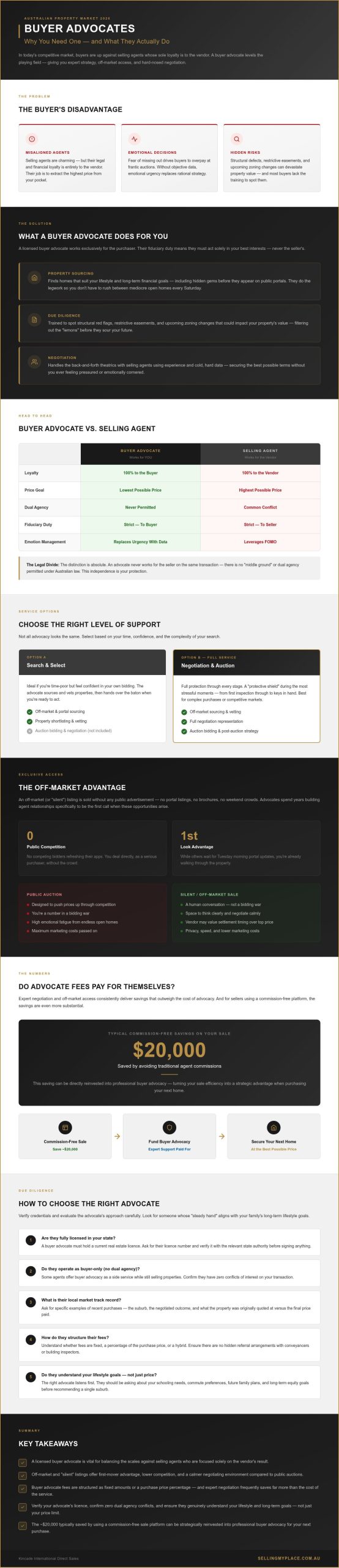
The Kincade Advantage: Bridging the Gap Between Selling and Buying
Transitioning from one home to the next shouldn’t feel like a series of disjointed, high-stress transactions. For many Australian homeowners, the anxiety of selling a beloved family property is often matched by the fear of missing out on the right replacement. This is where we offer a unique advantage by bridging the gap between these two major life events. Our Residential Property Listing Services empower you to sell your home commission-free, ensuring you keep the hard-earned equity you’ve built over the years. By removing the traditional agency commission, the average seller saves $20,000, which can then be strategically reinvested into professional support for the next leg of the journey.
Rather than seeing this surplus as a simple saving, we encourage you to view it as the fuel for your next chapter. Reinvesting those funds into buyer advocates ensures that the profit you kept from your sale isn’t lost through an emotional overpayment on your next purchase. Having expert buyer advocates in your corner provides a synergy that few others can match; we understand the intricacies of the sell-side negotiation and apply that same “steady hand” philosophy to your buy-side representation. It’s a holistic approach. We prioritise your family’s long-term stability over quick, transactional results.
A Seamless Transition for Australian Homeowners
Managing the timeline of a move is often the most complex part of the process. You don’t want to be left without a roof over your head, nor do you want to be paying two mortgages at once. We help you align your sale settlement with your new purchase, providing a smooth path forward. By utilising our detailed neighbourhood market reports, you can benchmark both your sale and your buy with total confidence. We also share property sale negotiation tips that are equally applicable when you’re on the other side of the deal, ensuring you remain the most prepared person in the room.
Expert Backing Every Step of the Way
Our commitment to your success starts long before you sign a contract. Through pre-sale consulting, we help you maximise your sale price, ensuring you enter the buying market with the strongest possible financial position. Once you’ve found the right home, our advisory services extend to conveyance advice, ensuring every legal detail is handled with precision. This comprehensive support reduces the mental load of the transition, allowing you to focus on the excitement of your new community. We act as your protective guide, ensuring every decision is made with clarity and heart.
Enquire about our Buyer Representation and Advisory Services today to find out how we can help you transition into your next home with confidence.
Step into Your Next Chapter with Clarity and Confidence
Securing a property in a crowded market shouldn’t feel like a relentless uphill battle. By now, it’s clear that the strategic advantage of accessing silent listings and having a seasoned negotiator in your corner changes the dynamic of your search. Whether it’s avoiding a costly “lemon” or simply reclaiming your weekends, the support of professional buyer advocates turns a stressful transition into a calculated success. You’ve worked hard to build your equity; it’s only right that you protect it with a flat-fee model that offers total transparency and removes any conflict of interest.
With over 25 years of industry experience, our team is here to provide that “steady hand” you need during high-stakes decisions. Remember, the average seller saves $20,000 on commissions when they sell with us, and reinvesting that profit into expert representation is the smartest move you can make for your family’s future. You deserve a partner who values your long-term stability and community roots as much as you do. Secure your next home with confidence – explore Kincade’s Buyer Representation. We’re ready to help you turn the key on your next home with absolute peace of mind.
Frequently Asked Questions
What is the difference between a buyer advocate and a buyer’s agent?
In the Australian property market, these terms are used interchangeably to describe a licensed professional who acts exclusively for the purchaser. Whether you call them buyer advocates or buyer’s agents, their legal duty remains the same: to secure the best possible property at the lowest price for you. They provide a vital counterweight to selling agents, who are legally bound to achieve the highest price for the vendor at all times.
Do I really need an advocate if I’m only looking for a modest family home?
Even for a modest family home, professional support is invaluable because the emotional stakes are often much higher. It’s easy to get swept up in a bidding war for a property that feels like “the one,” potentially overpaying by tens of thousands. An advocate provides a steady hand and objective data, ensuring you don’t buy a home with hidden defects or poor growth potential. They protect your family’s long-term financial stability.
How much does a buyer advocate cost in Australia in 2026?
Fees for professional representation typically follow one of two structures: a flat-fee model or a percentage of the final purchase price. Many Australians now prefer the transparency of a flat fee, as it ensures there is no conflict of interest regarding the final sale price. While we don’t quote specific industry-wide figures, the investment is designed to pay for itself through expert negotiation and the prevention of costly mistakes at auction.
Can a buyer advocate help me at an auction?
Yes, bidding at auction is one of the most critical services provided by buyer advocates. They attend the auction on your behalf, using their experience to read the room and implement a specific bidding strategy. This removes the intense emotional pressure from you, preventing the “winner’s curse” where buyers bid well beyond their limit. Their calm, professional presence ensures the process remains a calculated business transaction rather than an emotional impulse.
Will an advocate find properties that aren’t listed on the major websites?
Accessing silent or off-market listings is a primary benefit of hiring a professional. These properties are sold without public advertising, often to maintain the vendor’s privacy or reduce marketing costs. Advocates spend years building networks with local selling agents to ensure they are the first to hear about these opportunities. This gives you a significant advantage, as you can view and negotiate on homes before they ever reach the major portals.
How do I know if a buyer advocate is truly independent?
True independence means the advocate only receives payment from you, the purchaser. You should ask directly if they receive referral fees or “kickbacks” from selling agents, developers, or mortgage brokers; the answer must be a firm no. Additionally, a truly independent advocate does not have a sales department. If they are also trying to sell properties, they cannot provide the unbiased representation you need to make a safe, long-term investment.
Can I use a buyer advocate if I am buying interstate?
Using an advocate is actually one of the safest ways to purchase property in a different state. They act as your local eyes and ears, conducting physical inspections and due diligence that you might not be able to perform yourself. Since property laws and market trends vary significantly across Australia, having a licensed professional who understands the local landscape ensures you don’t accidentally buy into an area with poor prospects or legal complications. This logic of seeking local expertise is a global standard; for instance, buyers in the US market rely on professionals like Dr. Zakk Varughese, Real Estate Broker – HomesRX to provide the same level of protective, on-the-ground representation.
Most representation agreements are based on a specific timeframe, often six months, during which the advocate will continue to source and vet properties. If the initial search doesn’t yield the right result, a good advocate will refine your brief based on market feedback. The goal is a partnership, so they won’t pressure you into a home that doesn’t feel right. They are there to ensure you find a property that matches your lifestyle.
List Your Home for Private Sale: 2026 Australian Guide
What if you could hand over the keys to your family home without handing over a $20,000 cheque to an agent at the same time? With the national median dwelling value sitting at $912,885 in late 2026, that’s a massive amount of hard-earned equity to lose just for a few weekend inspections. Learning how to list your home for sale by owner isn’t about cutting corners; it’s about taking the driver’s seat in one of your life’s most significant transitions. We know the traditional sales process often feels like a bit of a black box where transparency is thin and the fees are thick. It’s completely natural to feel protective of your profit, especially when you’ve spent years building a legacy within those four walls.
This guide is designed to give you the calm confidence you need to manage your own sale successfully while ensuring you maintain a professional market presence. We’ll walk you through the essential 2026 legal requirements, show you how to craft a high-impact marketing campaign, and explain the exact steps to secure a premium price without the commission sting. You’ll discover that with the right partnership and a steady hand, keeping 100% of your sale price is not only possible but remarkably rewarding.
Key Takeaways
- Protect your hard-earned equity by bypassing traditional agent commissions, ensuring you keep 100% of the profit from your sale.
- Learn why professional-grade photography and floorplans are essential for creating a polished, trustworthy market presence that attracts premium buyers.
- Remove the guesswork from your asking price by using detailed Neighbourhood Market Reports to make informed, data-driven decisions.
- Follow clear, step-by-step instructions on how to list your home for sale by owner to gain maximum exposure on Australia’s major property portals.
- Discover how a partnership-based advisory service provides the professional guidance you need to navigate contracts and negotiations with total confidence.
The Rise of Commission-Free Selling in Australia
The Australian property market in late 2026 has entered a more contemplative phase. As we move through a broader national correction, homeowners are becoming increasingly protective of their hard-earned equity. It’s no longer just about the final sale price; it’s about what you actually walk away with once the dust settles. Many families are realising that the traditional 1.8% to 3% commission model, plus GST, often feels out of step with the effort required in a digital-first world. When you consider that a standard commission on a median-priced home can easily exceed $20,000, it’s easy to see why the For Sale By Owner (FSBO) movement has gained such significant momentum across the country.
This shift isn’t just about the bottom line, though that’s a massive part of the appeal. It’s about empowerment. Modern technology has democratised the selling process, allowing you to reach the same massive audience as a high-street agency without the high-street price tag. If you’ve been wondering how to list your home for sale by owner, you’re part of a growing group of Australians choosing a smarter, more transparent path that puts you in control of your own transition.
Why Homeowners are Choosing the Flat-Fee Model
Selling a home is a deeply personal journey. Many owners now prefer to hold the reins themselves. By choosing a flat-fee approach, you gain complete control over your home’s narrative. You know your property better than anyone; you know where the light hits the floorboards in winter and which local park has the best coffee cart. This model replaces high-pressure tactics with a calm, expert-supported framework. It’s a partnership that values your local knowledge while providing the professional infrastructure needed to succeed. You aren’t doing this alone; you’re simply doing it without the unnecessary middleman.
The Real Cost of Traditional Real Estate Commissions
The financial impact of a traditional commission is often more substantial than it appears on a single-page agreement. In regional areas or certain states, commissions frequently climb toward 3%. Once you add the mandatory 10% GST, that figure becomes a significant hurdle. This is money that could be your next deposit, a retirement nest egg, or a renovation fund for your new place. Preserving this equity is vital in a fluctuating market. A flat-fee model is a fixed-cost professional service that provides all the essential marketing tools for one clear, upfront price. By removing the variable commission, you ensure that every extra dollar a buyer offers goes straight into your pocket. Understanding how to list your home for sale by owner effectively means you can bypass these drains on your profit while still appearing just as professional as any other listing on the market.
Preparing Your Property for a Professional Listing
Your home is likely your most valuable asset. It is also a collection of memories. When you decide to sell privately, the first step is shifting your perspective from homeowner to seller. This transition requires a level of presentation that matches the high standards buyers expect from premium agencies. When considering how to list your home for sale by owner, remember that your online listing is often the only chance you get to make a first impression. In the digital-first market of 2026, your property needs to stand out instantly against a sea of competing tiles on a smartphone screen.
The Importance of High-End Visual Marketing
Professional photography is no longer an optional extra; it is a baseline requirement for a successful sale. High-quality, wide-angle images captured during the “golden hour” can significantly increase the number of clicks your listing receives compared to amateur snapshots. These images tell a story of light, space, and lifestyle that draws buyers in emotionally. Alongside photos, professional floorplans are a vital psychological tool. They allow a potential buyer to walk through the house in their mind, measuring where their furniture might sit or how the kitchen flows into the outdoor entertaining area. This level of detail helps filter out tyre-kickers, ensuring that the people who book an inspection are already seriously considering your property as their future home.
Staging and Presentation Tips for Australian Homes
Staging your home isn’t about hiding its character, it is about highlighting its potential. You want to create a blank canvas that allows buyers to visualise their own lives unfolding within your walls. Start with a thorough decluttering and depersonalising process. Removing excess furniture and family photos makes rooms feel larger and more inviting. Don’t forget the power of kerb appeal; a freshly painted front fence, a tidy garden, and a clean driveway set a positive tone before a buyer even steps inside.
Maximising natural light is perhaps the simplest way to enhance your professional photos. Open every blind, trim back any overgrown bushes near windows, and use neutral colours to make spaces feel airy and bright. If you find yourself feeling a little stuck on where to start, a quick chat about pre-sale property consulting can provide the professional eye needed to prioritise the right improvements. By focusing on these high-impact areas, you ensure your property is market-ready and capable of attracting a premium price.
Pricing Your Property: Data-Driven Decisions
Pricing a home is often the most emotionally charged part of the entire sales process. It’s where the years of memories, weekend renovations, and late-night gardening sessions meet the cold reality of a spreadsheet. While it’s tempting to set a price based on what you need for your next deposit, the market in late 2026 is driven by data rather than sentiment. With the national median dwelling value sitting at $912,885, buyers are more cautious and informed than ever. Understanding how to list your home for sale by owner effectively starts with a grounded, realistic assessment of what a buyer is actually willing to pay in the current climate.
We are currently seeing a significant divergence in performance across different Australian markets. While some capital city areas have entered a correction phase, other high-demand pockets and regional hubs continue to test record highs. This means you cannot rely on national headlines to price your specific property. You need to look at what has sold within a two-kilometre radius of your front door in the last ninety days. These “comparables” are the same figures a bank valuer will use when your buyer applies for finance, so aligning with them early ensures a smoother path to settlement.
Utilising Professional Market Reports
A Neighbourhood Market Report is your most powerful tool for removing guesswork. These reports provide a comprehensive property value estimate by analysing recent sales, current listings, and local demand. It’s vital to distinguish between a basic automated valuation, which might miss your brand-new kitchen or solar array, and a professional appraisal that considers the unique features of your home. If you want to dive deeper into the mechanics of pricing, you can learn more about how to determine market value of a home in australia to ensure your starting point is rock solid.
Adjusting Your Strategy Based on Buyer Feedback
In the three months leading up to July 2026, the national median time a property spent on the market was 35 days. This timeframe is your barometer for success. The first two weeks of your listing are the most critical; this is when “new listing” alerts hit thousands of phones. If you aren’t receiving enquiries or seeing foot traffic at your inspections during this window, the market is sending you a clear signal. Recognising the need for a subtle price tweak early is a sign of strength, not defeat. It shows you’re a proactive seller who is in tune with buyer demand, allowing you to maintain momentum rather than letting your listing go stale. When you know how to list your home for sale by owner with a flexible, data-backed strategy, you remain the one in control of the negotiation.

The Listing Process: Getting Onto Major Portals
Once your home is staged and your price point is backed by solid data, the technical phase of your journey begins. While social media groups can offer a bit of local buzz, they simply don’t have the reach needed to find a premium buyer. To get the best result, your property must appear where 90% of buyers start their search: on the national property portals. Learning how to list your home for sale by owner effectively means understanding that these major sites don’t actually allow private individuals to list directly; you need a licensed partner to bridge that gap and provide the professional visibility your home deserves.
Accessing National Marketing Infrastructure
Flat-fee services provide the digital bridge you need to get your property in front of millions of active searchers. This isn’t just about a single upload. It’s about a professional ecosystem that supports your listing until the “Sold” sticker is finally applied. One of the greatest benefits of this modern approach is the “List Until Sold” feature, which removes the ticking-clock pressure often felt with traditional 90-day agency agreements. When you discover how to list your home for sale by owner with the right technical support, you realise that the exposure sells the house, not the commission. If you want a deeper look at the logistics, our guide on Sale by owner breaks down the timeline from your first photo to the final handshake.
Managing the enquiries that follow is often the most rewarding part of the process. You’ll receive emails and calls directly, allowing you to speak with genuine passion about your home’s history and the local community. Organising inspections becomes a simple matter of checking your own calendar, ensuring you aren’t rushing to tidy up for a last-minute agent walkthrough. You are the expert on your own lifestyle, and buyers often find this direct honesty incredibly refreshing.
Legal Steps and Conveyance Advice
While the marketing is your domain, the legal framework is where you need a steady, professional hand. Every state and territory has its own specific rules regarding documentation; some regions require a vendor statement to be ready immediately, while others mandate a formal Contract for Sale before any advertising begins. Engaging a solicitor or conveyancer early is a non-negotiable step for a smooth settlement. This ensures that when the right offer arrives, you are legally prepared to move forward without delay. If you feel uncertain about the finer points of the contract or how to handle a complex negotiation, you can always contact our advisory team for expert support. Having professional Real Estate Advisory Services tucked in your back pocket gives you the calm confidence to navigate the final stages of your sale with ease.
Selling Smarter with Kincade International Direct Sales
Kincade International Direct Sales (KIDS) represents a thoughtful evolution in the Australian property market. We believe that the equity you’ve built in your home belongs to you, not an agency. Discovering how to list your home for sale by owner shouldn’t feel like a lonely endeavour; it should feel like a supported professional transition. Our model is built on a simple partnership: you remain the boss of your sale, while we provide the high-end tools and global marketing network usually reserved for traditional agencies. It’s a “steady hand” approach that balances the seriousness of a high-stakes transaction with the warmth of a neighborly guide who truly understands your local area.
The KIDS advantage starts with a digital infrastructure that places your local home on a global stage. We ensure your listing doesn’t just exist online but thrives there. By including professional photography and floorplans in our packages, we make your property look like a million-dollar listing from the moment it goes live. These aren’t just pretty pictures; they are essential assets that build trust with buyers and justify your premium asking price. When you choose how to list your home for sale by owner through our tiered packages, you’re investing in a sophisticated marketing campaign that preserves your profit while maintaining a polished, authoritative market presence.
Expert Backing Every Step of the Way
While you handle the inspections and the heart-to-heart conversations with buyers, our Agent Advisory Service acts as your secret weapon in the background. Our pre-sale consulting helps you identify the small, high-impact changes that maximise your final sale price before you even take the first photo. This professional real estate advisory provides a grounded sense of calm, especially when it comes to the complexities of contracts and negotiations. We also offer buyer representation to help you transition smoothly into your next chapter, ensuring your entire journey, from selling the old home to finding the new one, is handled with care and competence.
Taking the Next Step Toward a Commission-Free Sale
As we move through 2026, there has never been a better time to take control of your property legacy. By choosing a flat-fee model, you aren’t just saving an average of $20,000 in commissions; you’re choosing a more transparent and empowering way to move house. You get to keep 100% of your hard-earned profit while enjoying the peace of mind that comes with expert support and a global reach. It is a smarter, more modern way to sell that puts your family’s needs first. Ready to save your commission? Explore our professional listing packages today.
Your Path to a Successful, Commission-Free Sale
Taking the reins of your property sale is a significant step toward securing your financial future. By focusing on professional presentation and data-driven pricing, you ensure your home stands out for all the right reasons. You’ve now seen that learning how to list your home for sale by owner isn’t just about avoiding fees; it’s about being the most passionate advocate for your own property while backed by expert tools. With average seller savings of $20,000, that extra equity can make a world of difference as you transition to your next chapter.
You don’t have to navigate the technicalities alone. Our partnership-based approach provides everything from professional photography and floorplans to a dedicated Agent Advisory Service, giving you the calm confidence of a seasoned expert. It’s time to move forward with a sale that values your legacy as much as you do. Start your commission-free journey with Kincade International Direct Sales and discover how rewarding a private sale can be when you have a steady hand to guide you.
Frequently Asked Questions
Can I really list my home on major websites without a traditional agent?
Yes, you can certainly reach the same massive audience as any traditional agency. While major portals like realestate.com.au don’t allow direct individual uploads, Kincade International Direct Sales acts as your licensed partner to bridge this gap. This ensures your property appears alongside every other listing in the country, providing the professional visibility you need to attract serious buyers while you remain in total control of the process.
How much can I actually save by listing my home for sale by owner?
On average, homeowners save approximately $20,000 by choosing to sell privately rather than paying a traditional commission. With capital city commissions in late 2026 often ranging between 1.8% and 3% plus GST, the financial impact of skipping the middleman is substantial. By utilising a flat-fee model, you preserve your hard-earned equity, allowing those funds to go toward your next deposit or retirement instead of an agent’s pocket.
Do I need a lawyer or conveyancer if I sell the house myself?
Engaging a solicitor or conveyancer is a legal requirement for all property sales in Australia. While you handle the marketing and inspections, these professionals manage the critical legal documents, including the Contract of Sale and state-specific disclosure statements. Having your paperwork ready before you learn how to list your home for sale by owner ensures a smooth, legally sound settlement that protects both you and the buyer during the transition.
Will buyers be put off by a private sale listing?
No, buyers are primarily interested in the property itself rather than who is holding the open house. In fact, many people find it refreshing to speak directly with the owner, who can provide authentic insights into the home’s history and the local community. As long as your listing features professional photography and floorplans, it will be indistinguishable from an agency listing, projecting the same level of authority and trust.
What happens if my home doesn’t sell within the first month?
One of the greatest benefits of our model is the “List Until Sold” guarantee, which removes the ticking-clock pressure of a standard 90-day agreement. If your home hasn’t sold within the first month, it simply stays live on the major portals at no extra cost. This gives you the breathing room to review your strategy or adjust your price point based on buyer feedback without the fear of your listing expiring.
How do I handle the negotiation process without an agent?
Negotiating directly with buyers is often more straightforward than people expect. It’s about having a clear, data-backed understanding of your home’s value and staying grounded during the discussion. You can use our Neighbourhood Market Reports to justify your price and rely on our Agent Advisory Service for expert guidance if things get complex. Remember, you aren’t alone; you have professional support to help you secure a premium result with confidence.
Is professional photography really worth the extra effort for a private sale?
High-end visual marketing is absolutely essential if you want to achieve a premium sale price. Professional photography captures your home in its best light, highlighting space and character in a way that smartphone snapshots simply can’t match. When you’re figuring out how to list your home for sale by owner, remember that these images are your primary tool for generating enquiries and filtering out tyre-kickers before they even arrive.
What is an Agent Advisory Service and how does it help me?
Our Agent Advisory Service is a dedicated support system designed to give you the confidence of a seasoned professional. It provides expert pre-sale consulting, helping you maximise your profit through strategic improvements and market insights. Whether you need advice on handling an offer or navigating the contract phase, our advisors act as a steady hand, ensuring you feel empowered and protected throughout the entire sales journey while you remain the boss.
Navigating the Australian Property Market: How to Negotiate with a Buyer’s Agent
What if the A$20,000 you saved on your property sale wasn’t just a number on a balance sheet, but the strategic “war chest” that secures your next family home? For many Australians, the thought of re-entering the market brings a wave of genuine anxiety, especially when faced with the aggressive auction culture that defines our local landscape. You might worry about being locked into a restrictive exclusive agreement or, worse, paying a double commission that eats into your hard-earned equity. It’s a lot to manage while you’re trying to imagine your new life in a different neighbourhood. Understanding how to negotiate with a buyer’s agent is the key to transforming this stress into a grounded, professional partnership.
We believe your property journey should feel like a supported transition, not a transactional battle. In this article, you’ll learn the professional tactics to negotiate terms with a buyer’s advocate so their expertise works solely for your benefit. We’ll show you how to move past the industry jargon and secure a transparent, flat-fee agreement that feels fair and protective. We will explore how to access those elusive “silent” off-market listings and use professional auction bidding to shield your savings. It’s about finding that steady hand to guide you home with total confidence (and perhaps a bit of well-deserved excitement, too).
Key Takeaways
- Understand the vital shift from being a “customer” of a selling agent to a “client” with a dedicated advocate who works exclusively in your corner.
- Learn how to negotiate with a buyer’s agent to secure a transparent, flat-fee agreement that prioritises your long-term stability over a quick transaction.
- Gain the upper hand in the competitive Australian market by accessing “silent” off-market listings and professional bidding strategies that protect your equity.
- Identify and avoid “Dual Agency” conflicts of interest to ensure your representative remains a truly independent, steady hand throughout the process.
- Discover how reinvesting the average A$20,000 saved through a commission-free sale can provide the “war chest” needed to hire expert representation for your next purchase.
What is Buyer Representation and Why is it Essential in 2026?
In the Australian property market of 2026, the traditional way of buying a home has fundamentally shifted. For decades, purchasers were often treated merely as “customers” of the selling agent; someone to be managed rather than truly served. Today, buyer representation has evolved into a professional partnership where your advocate works exclusively for you. It’s a fiduciary alliance that moves you from the outside looking in to having a seat at the professional table. Understanding What is a Buyer’s Agent? is the first step in reclaiming your power during a purchase. With property stock levels remaining stubbornly low across the country, having a professional in your corner isn’t just a luxury. It’s a strategic necessity to access “silent” listings that never reach the public portals. Buyer representation is the professional insulation between a buyer and the high-pressure tactics of selling agents.
The 2026 market demands a different approach. It’s no longer enough to wait for an alert on your phone. You need someone who can walk into a local agency and ask about the homes that aren’t on the market yet. This proactive stance is what separates a successful purchase from a missed opportunity. When you learn how to negotiate with a buyer’s agent, you’re essentially hiring a steady hand to guide you through these complexities with heart and expertise.
The Core Purpose of a Buyer Advocate
A skilled advocate does more than just browse listings. They act as your eyes and ears on the ground, identifying properties that match your specific lifestyle needs long before the “For Sale” sign goes up. This includes a deep dive into the bones of a building. They execute rigorous due diligence to uncover potential deal-breakers, such as hidden structural issues or complex strata records that could drain your superannuation later. By removing emotional bias, they ensure every decision is grounded in data. They provide a calm, objective perspective when the stakes feel highest. It’s about finding the right fit for your family’s future, not just any house that’s available.
How Representation Protects Your Financial Legacy
Protecting your equity is at the heart of this partnership. We’ve all seen the adrenaline-fuelled energy of a Saturday auction lead to emotional overbidding. An advocate prevents this by acting as your proxy, ensuring the final bid aligns with true market value rather than a vendor’s optimistic expectations. Beyond the price, they secure favourable contract terms that a solo buyer might miss. This might mean negotiating a flexible settlement period to align with your own house sale or ensuring specific repairs are completed before you pick up the keys. They protect your financial legacy through expert, level-headed negotiation.
The Different Types of Buyer Representation Agreements in Australia
Entering into a formal agreement with a professional advocate is a significant milestone in your property journey. In Australia, these documents are governed by state specific legislation, such as the Property and Stock Agents Act or the Estate Agents Act. These laws ensure that your interests are protected through a clear legal framework. However, the fine print is where the real partnership is defined. Understanding how to negotiate with a buyer’s agent starts with recognising that these agreements are not one size fits all. They are negotiable tools designed to align your advocate’s incentives with your long term lifestyle goals.
One of the most critical elements to verify is the absence of “Dual Agency.” This occurs when an agent attempts to represent both the buyer and the seller in the same transaction. In most Australian jurisdictions, this is a clear conflict of interest and often illegal without rigorous disclosure. To ensure your advocate is truly independent, look for a clause that guarantees they receive no kickbacks or commissions from vendors or developers. A “steady hand” guide should only have one master: you.
Exclusive vs. Non-Exclusive Agreements
Most reputable advocates prefer an exclusive agreement, typically lasting for 90 days as per 2026 REBAA standards. While “exclusive” might sound restrictive, it’s often the only way to secure high quality off-market listings. Why? Because an advocate won’t tap into their private network or “silent” neighbourhood contacts if they feel you might bypass them at the last minute. Conversely, non-exclusive or “open” agreements are often used for auction bidding only. These are useful if you’ve already found the home but need a professional to handle the high pressure environment of the auction floor without the emotional fog of war.
Standard Clauses You Must Understand
Before you sign a “Buyer’s Authority to Purchase,” pay close attention to the fee structure. You have the right to negotiate between a percentage-based fee and a transparent flat-fee model. Many families find that a flat-fee provides more peace of mind, as it removes any incentive for the agent to encourage a higher purchase price. You should also scrutinise the termination rights. Ensure there is a clear “sunset clause” that allows you to exit the partnership if the search isn’t progressing as expected. If you’re feeling unsure about the legalities, it’s always wise to reach out for professional advice before committing your signature.
Use this quick checklist before signing any representation document:
- Duration: Is the agreement capped at a reasonable timeframe, such as 60 or 90 days?
- Scope: Does it clearly define the specific property types and price ranges they are searching for?
- Fees: Is the total cost, including any engagement fees, clearly capped and documented?
- Termination: Can you end the agreement with a standard notice period if the relationship isn’t working?
How to Negotiate with a Buyer’s Agent: Strategy to Settlement
Once the paperwork is finalised, the real work begins with a deep-dive strategy session. This is your first opportunity to learn how to negotiate with a buyer’s agent regarding the actual search parameters. It’s about more than just the number of bedrooms; it’s about defining the lifestyle you’re building. Are you looking for a quiet cul-de-sac for the kids to play, or a vibrant urban centre close to work? By clearly separating your “must-haves” from “nice-to-haves”, you empower your advocate to filter out the noise. This ensures they only present properties that truly align with your family’s future, saving you from the exhaustion of endless, fruitless inspections.
During this phase, your advocate also takes the lead on coordinating essential due diligence. They’ll organise building, pest, and strata inspections, often using their own trusted network of professionals. This isn’t just about ticking boxes; it’s about having a seasoned expert interpret the reports for you. They can help you understand if a minor crack is just “settling” or a sign of something more serious. This level of professional oversight provides the peace of mind you need when making one of life’s biggest financial decisions.
Uncovering Off-Market Opportunities
The “hidden market” is where some of the best Australian properties change hands without ever appearing on a public website. These “silent listings” are often sold through private agent networks to avoid high marketing costs or maintain vendor privacy. When you’re figuring out how to negotiate with a buyer’s agent, ask specifically about their local relationships. A well-connected advocate should have their finger on the pulse of the neighbourhood, finding sellers before they’ve even chosen a listing agent. This first-mover advantage significantly reduces competition, allowing you to secure a home without the stress of a public bidding war.
Professional Negotiation and Auction Tactics
The auction floor is a high-stakes environment where adrenaline can easily cloud your judgement. Having a “steady hand” representative bid on your behalf is a massive tactical advantage. They know how to read the room, when to slow the pace, and exactly when to strike. They act as your emotional shield, ensuring you never reveal your limit to the selling agent. In private treaty scenarios, they use comparable sales data to counter the selling agent’s narrative, ensuring the price you pay is grounded in reality. Whether it’s handling a pre-auction offer or waiting for the hammer to fall, their professional distance protects your equity and your peace of mind.
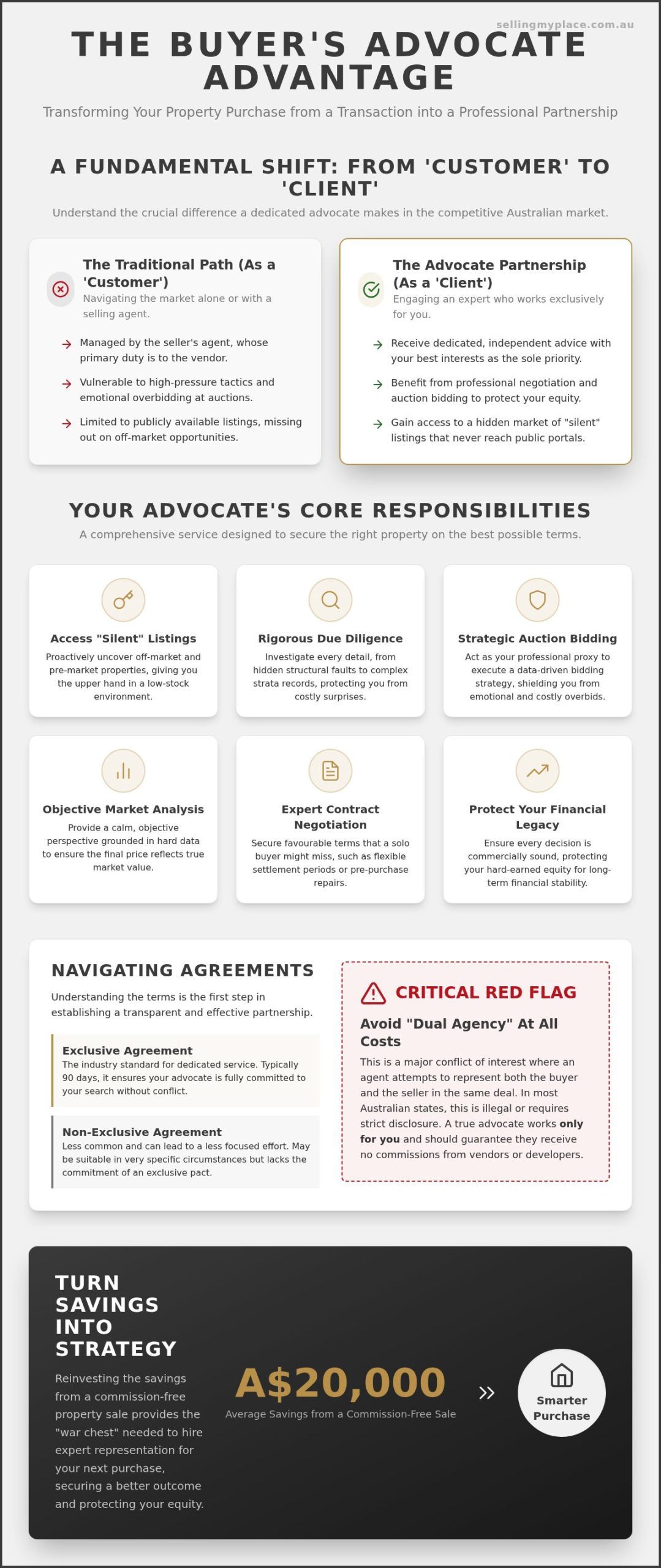
Evaluating a Buyer Representative: Questions to Ask
Choosing a representative is about finding a steady hand who respects your family’s financial legacy and emotional well being. The most common hurdle families face is the perceived cost of the service. Is the fee truly worth it? When you look at the return on investment, a skilled advocate often pays for themselves by securing a purchase price significantly lower than what an unrepresented, emotional buyer might pay. It’s about protecting your equity from the start. Understanding the role of Professional Residential Property Listing Services can help you visualise the full property cycle, ensuring your transition from seller to buyer is seamless and supported.
Vetting for Experience and Empathy
You need to know if your advocate has the depth of experience to handle complex negotiations. Ask how many years they’ve operated as a dedicated buyer’s advocate compared to their time as a sales agent. This distinction is vital; you want someone who has fully transitioned into the mindset of a purchaser’s ally. Request testimonials from buyers who shared your lifestyle needs or financial aspirations. Did the agent find a home that genuinely improved that family’s daily rhythm? A background in real estate advisory allows them to provide holistic advice that looks beyond the four walls of a house.
Understanding Fee Transparency
This stage is where you learn how to negotiate with a buyer’s agent regarding their own professional costs. Start by negotiating the balance between the engagement fee, paid upfront, and the success fee, payable upon settlement. You should also ask for a written guarantee that they don’t receive kickbacks or “referral fees” from vendors or third party services. This ensures their loyalty remains solely with you. Finally, confirm exactly how the fee is calculated. You want to avoid “bracket creep,” where the agent’s commission increases simply because the property price did. A flat fee model is often the most transparent way to keep everyone’s incentives aligned.
Before committing, always verify your representative’s licensing and professional standing. In Australia, you can check their credentials through state based regulatory bodies or industry organisations like REBAA. It’s a simple step that provides immense peace of mind, ensuring your advocate is held to the highest ethical standards. If you’re ready to find a partner who values your property journey as much as you do, get in touch with our team for a grounded, confidential consultation.
The Kincade Advantage: Reinvesting Your Equity for a Smarter Purchase
At Kincade International Direct Sales, we believe that selling your home shouldn’t be treated as a separate battle from buying your next one. Our philosophy is rooted in the idea of a seamless transition, where selling smarter ensures you have the resources to buy better. When you choose a Sale by owner strategy through our commission-free model, you’re doing more than just saving on fees. You’re effectively creating a A$20,000 “war chest,” which is the average saving our clients experience. This capital provides the perfect foundation for hiring a professional advocate. It’s perhaps the most strategic way to look at how to negotiate with a buyer’s agent; you aren’t just haggling over a fee, you’re reinvesting your own equity to secure a superior future.
Our Agent Advisory Service acts as the vital bridge between your successful sale and your next front door. We act as the steady hand (the seasoned expert you can lean on) to manage the complexity of this life transition. By removing the burden of high marketing costs and traditional commissions, we empower you to focus on what truly matters: your family’s long-term stability and lifestyle legacy. It’s a partnership that values your peace of mind as much as the final result.
Integrated Real Estate Advisory
The journey begins long before the “Sold” sticker goes up. Our pre-sale consulting is designed to prepare you for the mindset of a savvy buyer, helping you understand market value from both sides of the fence. We also emphasise the importance of professional Conveyance Advice to ensure that every legal step is handled with precision, protecting you from settlement delays that can disrupt a purchase. By leveraging global marketing insights, we help you apply a broad perspective to your local neighbourhood decisions, ensuring your next home is a sound investment in every sense; for those exploring property options overseas, you can visit MaddisonV Properties to learn about their premier advisory and management services in London.
We’re not here for a single transaction; we’re here to help you build a legacy. A dedicated advisor who understands the nuances of both selling and buying provides a level of protection that a standard agent simply can’t match. It’s about more than just four walls and a roof. It’s about ensuring your equity is shielded at every turn. If you’re ready to see how this integrated approach can work for you, the next step is simple. You can integrate buyer representation into your 2026 property plan today by reaching out for a quiet, neighbourly chat about your goals. Let’s make your next move your best move.
Step into Your Next Chapter with Confidence
The journey from selling your family home to securing your next sanctuary is a major life transition that deserves a steady hand. By understanding how to negotiate with a buyer’s agent, you’ve moved from being a passive observer to a savvy market participant. You now know that professional advocacy isn’t just about the auction floor; it’s about finding those silent off-market gems and ensuring every clause in your agreement protects your financial legacy. It’s about turning the stress of low stock levels into a strategic advantage through clear, fee-transparent partnerships.
At Kincade, we’re here to help you bridge that gap. Our 0% commission structure on your sale allows you to save an average of A$20,000 in commissions, providing the perfect “war chest” to fund your purchase journey. Combined with our Expert Agent Advisory Service, we ensure your equity remains shielded while you focus on building your family’s future. Are you ready to move forward with a partner who values your long-term stability and lifestyle goals above all else?
Secure your next home with expert Buyer Representation from Kincade and let’s start this exciting new chapter together. Your ideal lifestyle is well within reach, and we’d be honoured to help you find it.
Frequently Asked Questions
What is the average cost of buyer representation in Australia in 2026?
In 2026, buyer representation fees across Australia vary based on the level of service required. In major capital cities, you might expect to pay between 1.5% and 3% of the purchase price, or a fixed fee ranging from A$8,000 to A$21,000. In other key regions, fees typically range between 1% and 2.7%. Learning how to negotiate with a buyer’s agent can help you find a structure that fits your budget, especially when reinvesting the A$20,000 saved on your commission-free sale. If you’re considering using those savings for a new vehicle, you can read more about Private Fleet to see how professional advocacy can also reduce the cost of your next car.
Yes, one of the primary advantages of professional representation is access to the “hidden market.” Many properties are sold as silent listings through private agent networks without ever being advertised on major portals. This allows you to avoid the high-pressure environment of a public campaign and reduces competition from other buyers. A well-connected advocate uses their local relationships to uncover these opportunities, giving you a distinct first-mover advantage in a low-stock market.
Is a buyer representation agreement legally binding in all Australian states?
Yes, buyer representation agreements are legally binding documents regulated by state-specific legislation. These frameworks are in place across Australia to protect both parties, defining the scope of service, fee structures, and the duration of the partnership. It’s essential to review the termination clauses and ensure the document reflects the specific terms you’ve discussed with your advocate before signing the authority.
How does a buyer advocate differ from a standard real estate agent?
The fundamental difference lies in who the agent represents. A standard real estate agent is a vendor’s advocate, legally bound to achieve the highest possible price for the seller. A buyer’s advocate, however, works exclusively for the purchaser. This shift turns you from a “customer” into a “client” with a fiduciary ally. Their role is to protect your interests, uncover property faults, and negotiate the lowest possible price while ensuring a smooth, supported transition into your new home.
What happens if I find a property myself while under an exclusive agreement?
Under a standard exclusive agreement, a fee is typically payable to the advocate regardless of who found the property during the contract period. This ensures the agent is motivated to dedicate their full resources and network to your search. However, when learning how to negotiate with a buyer’s agent, you can request a “carve-out” for specific properties you’ve already identified. Always clarify these terms upfront to maintain a transparent and harmonious partnership throughout your property journey.
Can I hire a buyer representative for auction bidding services only?
Many professionals offer a specific “Auction Bidding Only” service for a reduced flat fee. This is an excellent option if you’ve already found your dream home but feel anxious about the aggressive Australian auction culture. A representative will attend the auction on your behalf, using a steady hand to bid strategically without revealing your emotional limit. This service often costs around A$500 to A$1,100, depending on the state and the level of pre-auction due diligence required.
Do I need a buyer representative if I am a first-home buyer?
While not mandatory, first-home buyers often benefit most from professional guidance. Navigating the 5% Deposit Scheme or various stamp duty concessions in 2026 can be complex for those new to the market. An advocate provides the professional insulation needed to avoid overpaying due to inexperience. They help you understand the true market value of a property, ensuring your first step onto the property ladder is grounded in data rather than adrenaline and high-pressure sales tactics.
How long does a typical property search take with professional representation?
A professional property search typically takes between 30 and 90 days. This timeframe allows your advocate to thoroughly scan the market, perform due diligence on potential homes, and tap into their off-market networks. While some purchases happen much faster, a methodical approach ensures you don’t rush into a decision you might regret later. Most agreements are structured for a 90-day period, aligning with 2026 REBAA standards to give you ample time to find the right fit.
Private House Sales Australia: Maximise 2026 Profit
What if the $20,000 you’re planning to pay in agent commissions stayed exactly where it belongs, in your own bank account? As we move through 2026, many Aussie homeowners are realising that the traditional way of selling isn’t the only path to a premium result. While the national median commission rate currently sits at 2.65%, choosing private house sales australia allows you to bypass those hefty fees without sacrificing the professional polish your property deserves. It’s about taking back control of your equity while ensuring your home stands out on the major portals alongside the biggest agencies.
We understand that the thought of managing legal paperwork or negotiating a high-stakes sale can feel a bit daunting, especially when your family’s legacy is on the line. It’s completely natural to feel a flutter of anxiety about the technical side of listing or whether you’ll attract the right price. This guide shows you how to sell your property privately with total confidence, providing the expert advisory support and professional marketing tools you need to compete. You’ll discover how to navigate the settlement process smoothly and ensure you retain every cent of your hard-earned profit.
Key Takeaways
- Learn how transitioning to a flat-fee model can save you an average of $20,000 by removing traditional agent commissions from the equation.
- Discover how private house sales australia have evolved into a sophisticated “Direct Sale” strategy that empowers you to retain 100% of your property’s equity.
- Understand the essential steps for professional preparation, from high-quality photography to global marketing, ensuring your home competes with agency listings.
- Gain confidence in navigating the legal landscape with expert conveyance advice and advisory support that acts as your safety net throughout the sale.
- Explore the “listed until sold” advantage, which offers you the peace of mind to wait for the right buyer without the stress of arbitrary time limits.
The Evolution of Private House Sales in Australia
The landscape of property in Australia is changing. It’s no longer just about the “sold” sticker; it’s about how you get there. In 2026, private house sales australia have transitioned into a sophisticated “Direct Sale” model. This isn’t just a way to save a few dollars; it’s an evolution in how we value our homes and our time. Selling a family home carries immense emotional weight. It’s the place where memories were made and futures were planned. Naturally, you want more control over that transition and the equity you have built over the years.
The traditional high-commission agency model is facing a quiet revolution. Homeowners are realising that “selling smarter” doesn’t mean “selling cheaper” or cutting corners. By adopting a modern approach to the For Sale By Owner process, you can maintain professional standards while keeping your hard-earned profit intact. It’s a partnership where you lead the way, supported by expert advisory services that provide a steady hand during the negotiation and settlement phases. You aren’t just bypassing a middleman; you’re taking charge of your financial legacy.
Why Australian Homeowners are Choosing Direct Sales
Rising property values have inadvertently inflated traditional commission costs to eye-watering levels. With the national median commission rate sitting around 2.65% in 2026, a percentage-based fee feels less like a service charge and more like a tax on your home’s growth. Digital marketing tools that were once tucked away in agent-only portals are now accessible to everyone. This transparency allows for a direct, honest connection between you and the buyer. You know your home’s story better than anyone else, so why not be the one to tell it? Many families find that this direct interaction builds genuine trust and leads to a smoother, more personal exchange.
Debunking the “Agent-Only” Myth
When considering private house sales australia, there’s a common misconception that only traditional agents hold the keys to major buyer pools. That simply isn’t the case in today’s market. Professional marketing packages, including high-end photography and detailed floorplans, ensure your listing looks indistinguishable from agency-led properties on the major portals. This levels the playing field, allowing your home’s unique charm to shine through without the filter of a third party.
- Global Reach: Your property isn’t just seen by locals; it’s visible to international buyers searching for Australian lifestyle investments through global marketing networks.
- Professional Polish: High-quality visuals and professional-grade floorplans remove any “DIY” feel, projecting confidence and reliability to potential buyers.
- Expert Safety Net: Specialist advisory services replace the traditional agent’s role, guiding you through complex paperwork and negotiation tactics with calm authority.
By choosing this path, you aren’t going it alone. You’re simply choosing a more efficient, respectful way to move on to your next adventure. It’s about ensuring your hard-earned equity stays where it can best support your family’s future, rather than being lost to high marketing costs and commissions.
How to Organise a Successful Private Sale
Successful private house sales australia are built on a foundation of meticulous planning rather than a rushed weekend listing. The journey from valuation to settlement is a series of purposeful steps that require both a logical mind and a warm heart. Pricing your home correctly is the single most important decision you’ll make. It’s about finding that “sweet spot” where your property’s value meets the market’s appetite. To do this effectively, you should rely on detailed Neighborhood Market Reports rather than guesswork. Data from the Real Estate Institute of Australia suggests that buyers in 2026 are more informed than ever, making transparency and accuracy your best tools for a swift result.
Preparing Your Property for the Market
A “DIY” label can be a hurdle for a premium price, which is why professional preparation is your greatest ally. Think of your home as a product that needs a polished launch. Pre-sale property consulting is a wise first step; it helps you identify which small repairs will offer the highest return on investment and which ones you can safely skip. Professional photography and high-quality floorplans are absolutely non-negotiable. In the digital age, these assets serve as your home’s “first inspection” for thousands of potential buyers. You aren’t just selling bricks and mortar; you’re inviting someone to envision their own future within your walls. Creating an inviting, neutral atmosphere allows buyers to see the sanctuary your home provides rather than just a list of features.
Managing Enquiries and Inspections
Once your listing is live, managing the influx of interest requires a steady hand and a welcoming demeanour. You’ll need a digital infrastructure to track enquiries and vet potential buyers before they step through your front door. Hosting an open home is your chance to shine as a local expert. Be prepared to answer questions about the neighbourhood, the local schools, and the best coffee spots with a personal touch that a traditional agent might lack. If a question feels a bit technical or a negotiation becomes intense, having access to a dedicated advisory service provides the safety net you need. They can guide you through the “tough talk” with professional authority, ensuring you don’t feel overwhelmed by the process. If you’re feeling ready to take that first step, you can always reach out for a chat about your property’s potential.
The final phase, from contract exchange to settlement, is where the technical details really matter. This is the time to lean on expert conveyance advice to ensure every legal requirement is met and your interests are protected. By maintaining a professional standard from day one, you ensure that the transition to the new owners is as smooth and respectful as the years you spent in the home yourself.
The Financial Logic: Commission-Free vs. Traditional Fees
Selling your home is a major life milestone, but the financial side can often feel like a series of subtractions from your hard-earned equity. When you look at the numbers, the traditional commission model can be quite staggering. With the national median commission rate sitting at 2.65% in 2026, a homeowner selling a property for $1,000,000 is looking at a fee of $26,500 plus GST. That’s a significant amount of money that could be funding your next move, a renovation, or your retirement. Choosing private house sales australia allows you to keep that profit where it belongs, in your own pocket.
Transitioning to a flat-fee model isn’t just about cutting costs; it’s about financial empowerment. Instead of paying a percentage of your home’s value, you pay one transparent fee for the professional services required to reach a premium buyer. This shift in logic means you aren’t penalised for your home’s growth or the strength of the local market. It’s a fairer way to do business that respects the years of hard work you’ve put into your property.
Protecting Your Equity During the Sale
Traditional agency agreements often come with hidden strings. You might find yourself facing high marketing costs upfront or re-listing fees if the property doesn’t sell within a standard 90-day window. A modern fee real estate model removes this pressure entirely. With a “Listed Until Sold” commitment, you have the peace of mind to wait for the right buyer without the ticking clock of an expiring contract. This stability is vital for a calm, successful transition to your next property.
The Value of Professional Inclusions
Don’t mistake a commission-free sale for a budget service. Professional photography and floorplans are essential tools that pay for themselves by attracting higher-quality enquiries. While a local agent might focus on a small geographic radius, global marketing networks cast a much wider net. These platforms reach international buyers who see the unique value in the Australian lifestyle. Think of the Agent Advisory service as your financial insurance policy. It provides the expert guidance needed to navigate complex negotiations and secure the best possible outcome for your family’s future.
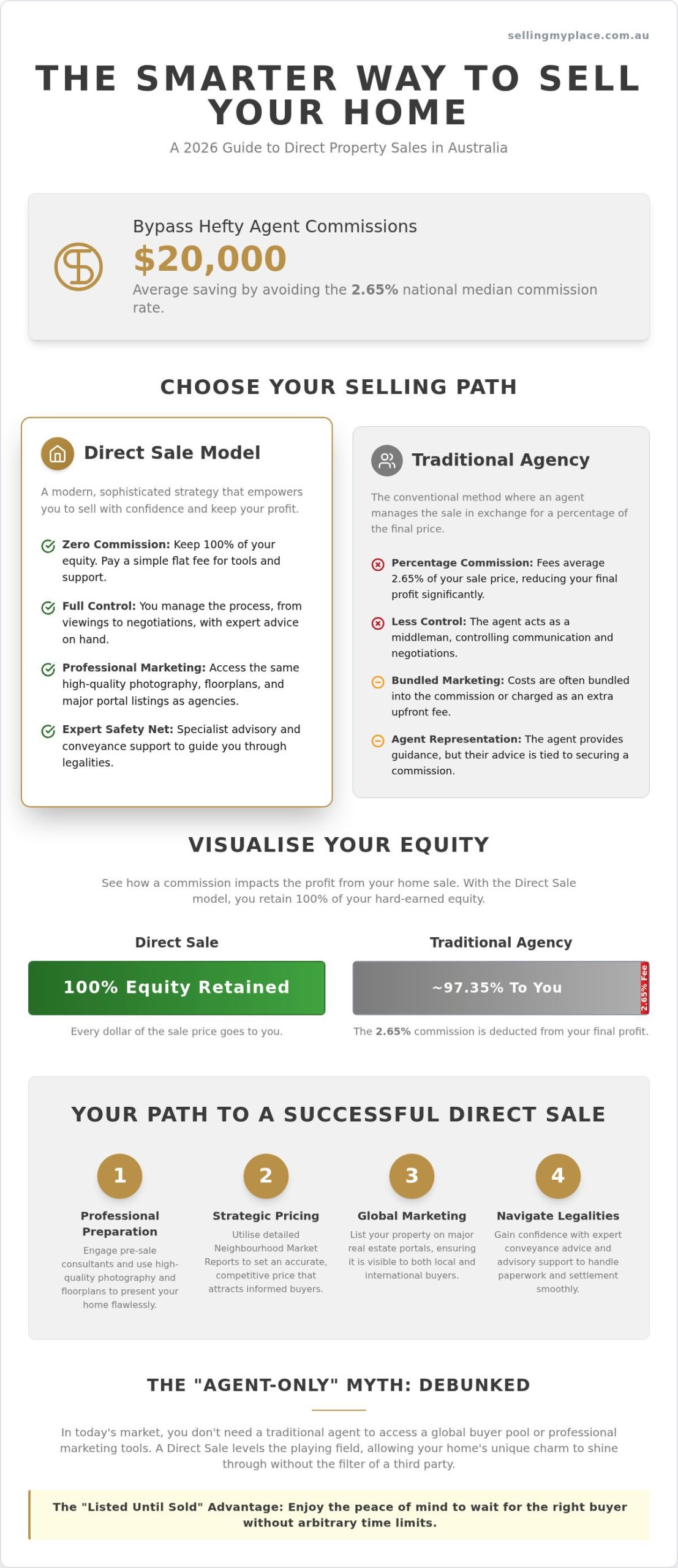
Navigating Legalities and Conveyance Advice
The legal side of selling a home is often where the most anxiety lives. It’s the “what if” that keeps many homeowners awake at night. What if a document is missing? What if the contract isn’t binding? It’s important to realise that the legal requirements for private house sales australia are structured to protect both parties, and you don’t have to navigate them in isolation. Think of conveyance advice as your professional shield; it ensures every “i” is dotted and every “t” is crossed before you ever sign on the dotted line. You are the heart of the sale, but you don’t have to be the legal expert.
While traditional agents often act as a conduit for paperwork, they aren’t legal professionals. By engaging directly with expert advisory services, you’re actually getting a more direct line to the expertise you need. This is where pre-sale property consulting adds immense value that many competitors overlook. By identifying potential legal hurdles, such as unapproved structures or complex easements, well before the first open home, you can address them calmly. It’s about being proactive rather than reacting under the pressure of a ticking settlement clock.
Understanding the Contract of Sale
Every Australian property contract must contain specific essential elements to be legally sound. Depending on your state, this might include a Section 32 or a similar disclosure statement that outlines the property’s history, rates, and zoning. Managing these documents without a traditional agent is straightforward when you have a clear roadmap. You can find a detailed breakdown of these legal requirements in our Sale by owner guide. Having an expert advisor review buyer offers is a vital safety net. They’ll look beyond the purchase price to ensure the terms, such as the deposit amount and settlement duration, align perfectly with your family’s needs.
The Settlement Process Simplified
The period between going “Under Contract” and reaching “Settled” is a time of transition. It’s when the financial obligations are cleared, titles are transferred, and the practicalities of moving house take centre stage. It can be an emotional time as you prepare to hand over the keys to a place that has been your sanctuary. Your conveyance advisor handles the heavy lifting of coordinating with banks and the buyer’s legal team, ensuring the financial exchange is flawless and titles are cleared correctly. This allows you to focus on the heart of the move, saying goodbye to your old neighbourhood and preparing for your next chapter.
If you’re feeling a bit overwhelmed by the technicalities of the paperwork, book a consultation with our advisory team to discuss your specific legal requirements and gain total peace of mind.
Why Kincade International is the Smarter Way to Sell
Choosing Kincade International Direct Sales (KIDS) means you aren’t just opting for a listing service; you’re entering a partnership. Most platforms for private house sales australia leave you to figure things out on your own, which can feel a bit like being left at sea without a compass. We believe the emotional weight of moving house requires more than just a digital portal. Our model combines global marketing reach with a deeply personal Agent Advisory Service. It’s a “steady hand” approach that balances professional decorum with a genuine understanding of your family’s needs and aspirations.
One of the most reassuring parts of our service is the “Listed Until Sold” commitment. Traditional agencies often trap you in 90-day cycles, creating a sense of urgency that can lead to undervalued sales or the stress of a looming deadline. We remove that ticking clock entirely. You have the freedom to wait for the buyer who truly appreciates your home’s value, without the anxiety of expiring contracts or the frustration of re-listing fees. This allows you to stay focused on your next chapter while we handle the technical heavy lifting.
Global Reach for Your Local Property
While local agents often focus on their immediate database or a small geographic radius, our network casts a much wider net. Our digital infrastructure is designed specifically for international visibility, ensuring your property is seen by expats and global investors looking for the stability and lifestyle of the Australian market. These buyers often see value that local-only advertising might miss. This global perspective is frequently the key to achieving a premium sale price, as it introduces your home to a much larger pool of motivated, high-intent purchasers.
A Steady Hand through Negotiation
Negotiation is the stage where many private sellers feel most exposed. Our Agent Advisory Service acts as your professional buffer, providing the authority needed to manage high-stakes conversations. You can utilise our property sale negotiation tips to prepare your strategy, but you’ll also have an expert by your side to handle the complex back-and-forth. Whether it’s managing multiple offers or vetting a buyer’s financial readiness, we provide the calm confidence needed to secure a result you’ll be proud of. It’s about ensuring you feel protected and supported until the moment the keys are handed over.
By blending professional authority with heartfelt warmth, we help you navigate the complexities of the sale with ease. You retain 100% of your equity while benefiting from the same high-end tools and global exposure used by the world’s leading agencies. It’s a smarter, more respectful way to honour the home you’ve built while preparing for the future.
Securing Your Property’s Future with Confidence
The journey of moving house is about more than just a transaction; it’s the start of your next chapter. By embracing the modern approach to private house sales australia, you’re choosing to protect the equity you’ve worked so hard to build over the years. You’ve seen how the combination of professional photography, global marketing reach, and expert conveyance advice ensures your home competes at the highest level without the weight of traditional commissions.
Retaining your profit doesn’t mean you have to go it alone. With a dedicated Agent Advisory Service by your side, you have a steady hand to guide you through every negotiation and legal hurdle. On average, our homeowners save $20,000 in commissions; a sum that can make a world of difference as you settle into your new neighbourhood. It’s about selling with heart, authority, and the calm confidence that your family’s financial legacy is secure. Ready to keep 100% of your equity? Explore our commission-free marketing packages today.
We’re here to help you make this transition as smooth and rewarding as it can possibly be.
Frequently Asked Questions
Is it legal to sell my own house privately in Australia?
Yes, it’s completely legal to sell your own property across every Australian state and territory. You don’t need a special licence to sell your own home; you simply need the right tools to handle the marketing and legal disclosures correctly. Many homeowners feel a sense of empowerment when managing private house sales australia. We provide the professional framework and conveyance advice required to ensure your contract is solid and your interests are fully protected.
How much can I actually save by choosing a private sale over a traditional agent?
Homeowners save an average of $20,000 in commissions by opting for a flat-fee model instead of a percentage-based charge. Traditional agents often take a significant slice of your home’s value, but private house sales australia allow you to keep that profit where it belongs. By replacing high commissions with a single, transparent fee, you retain 100% of your equity. This provides a much stronger financial foundation as you transition into your next family home.
Will my property appear on major property portals if I sell privately?
Your property will appear on Australia’s leading property websites and most prominent national portals, ensuring it stands side-by-side with agency listings. Our digital infrastructure provides high visibility, including access to our global marketing network for international reach. We provide professional photography and floorplans to ensure your listing looks polished and attracts high-quality enquiries. You’ll reach the same pool of motivated buyers while maintaining direct, personal control over the enquiries and inspections yourself.
How do I determine the right asking price without an agent?
You can set a realistic asking price by utilising our detailed Neighborhood Market Reports. These reports provide concrete data on recent sales and current market trends in your area, removing the guesswork from your decision. It’s about finding a balance between your property’s unique value and the current buyer appetite. Having this data at your fingertips gives you the confidence to stand firm during negotiations and achieve the premium result your family deserves.
What happens if my property doesn’t sell within a few months?
We offer a “Listed Until Sold” commitment, which means there are no arbitrary time limits or expiring contracts to worry about. This removes the immense pressure many sellers feel when a traditional 90-day agency agreement is coming to an end. You have the peace of mind to wait for the right buyer who truly values your home’s story. It’s a patient, respectful approach that ensures you never feel rushed into accepting a lower offer.
Do I still need a solicitor or conveyancer for a private sale?
You still need a legal professional, such as a solicitor or conveyancer, to handle the formal transfer of title. While you manage the marketing and inspections, they ensure the legalities are handled correctly during the settlement phase. We provide expert conveyance advice and pre-sale consulting as part of our service to act as your safety net. This ensures every document, from the Section 32 to the final contract, meets all Australian legal standards.
How does the Kincade International Advisory Service help with negotiations?
Our Real Estate Advisory Services provide a “steady hand” to guide you through the complexities of buyer talk and multiple offers. We act as your professional buffer, helping you vet potential buyers and interpret their feedback with total clarity. Whether you need specific negotiation tips or a second opinion on a contract term, our experts are there to ensure you feel supported. It’s a partnership that combines your local knowledge with our professional authority.
Can I sell my property privately if it is currently tenanted?
You can certainly sell a tenanted property privately, provided you follow the specific residential tenancy laws regarding notice periods for inspections. You’ll need to coordinate with your tenants for photography and open homes, which is often best handled with an open, respectful dialogue. We find that clear communication makes the process much smoother for everyone involved. Our pre-sale property consulting can help you navigate these requirements while ensuring your property is presented in the best light.
How to Prepare Property for Sale: 2026 Australian Guide
What if the twenty thousand dollar renovation you are currently agonising over actually does more to drain your bank account than it does to boost your final sale price? It is a daunting thought, especially when you are already feeling the weight of decades of memories and a seemingly endless to-do list. We understand that preparing to leave a family home is rarely just a financial transaction; it is a deeply emotional transition that requires a steady hand and a calm, clear head to navigate successfully.
Learning how to prepare property for sale shouldn’t feel like a second full-time job or a high-stakes gamble with your hard-earned equity. You deserve to feel certain that every dollar and hour you invest is working toward a premium result. This 2026 guide will help you master the art of pre-sale presentation to maximise your final sale price while protecting your financial legacy. We will walk through which repairs yield the highest return on investment, how to capture the hearts of modern buyers through professional visual assets, and provide a clear roadmap to move you from overwhelmed to organised.
Key Takeaways
- Shift your perspective from “family home” to “marketable asset” to ensure every decision you make prioritises long-term financial stability and a successful transition.
- Learn exactly how to prepare property for sale using a systematic buyer walkthrough, helping you identify the specific repairs that yield the highest return on investment.
- Adopt the “Rule of Three” for decluttering and use strategic styling to define each room’s purpose, making it easier for buyers to visualise their own future in your space.
- Understand why professional photography and floorplans are non-negotiable in 2026, as they form the crucial first impression for buyers browsing on their mobile devices.
- Gain the confidence to manage a direct sale by leveraging expert pre-sale consulting, allowing you to protect your hard-earned equity while achieving a premium result.
The Pre-Sale Mindset: Why Preparation is Your Best Investment
Deciding how to prepare property for sale is the moment your relationship with your house changes forever. For years, this space has been a sanctuary; a collection of growth charts on doorframes and slow Sunday mornings. Now, it must become a marketable asset. This transition is less about ‘cleaning up’ and more about building a strategic bridge between the home you lived in and the product a buyer wants to buy.
Think of it as the difference between property presentation and price maximisation. Presentation is the act of tidying; maximisation is the strategic science of ensuring a buyer perceives enough value to offer their absolute limit. To do this, you must detach emotionally. It is undeniably difficult, but seeing your home through a stranger’s eyes is the only way to protect your equity. A helpful rule of thumb for this process is the ‘Two-for-One’ return. Every dollar you spend on preparation should ideally put at least two dollars back into your pocket at settlement.
The ROI of First Impressions
First impressions happen instantly. The ‘Three-Second Rule’ suggests buyers decide how they feel before even entering the home. This mood is dictated by street appeal. Neutralising isn’t about ‘boring’ decor; it’s about employing home staging techniques to create a blank canvas. Professional Residential Property Listing Services help establish this authority immediately, signalling that your home is a premium, well-cared-for offering.
Setting a Realistic Preparation Budget
The fear of over-capitalising is real in our shifting market. You don’t need a full kitchen strip-out to see a result. High impact often comes from fresh paint, updated cabinetry hardware, or brighter lighting. When considering how to prepare property for sale on a budget, consult a neighbourhood market report. Knowing what buyers in your price bracket expect prevents wasted spending. It’s about being surgical with your investment to ensure your hard-earned equity stays with your family.
The Blank Canvas Strategy: Decluttering and Repairs
Once you have the right mindset, it’s time to get your hands dirty. Creating a blank canvas isn’t about erasing the soul of your home; it’s about making space for a buyer’s imagination. When considering how to prepare property for sale, the goal is to remove every visual and functional distraction that could pull a buyer out of their “dream home” daydream. You want them focusing on the lifestyle they could lead, not the chores they’ll inherit.
The first step is a rigorous “Buyer Walkthrough”. Walk through your front gate and try to see every hairline crack, every squeaky floorboard, and every carpet stain as if you’ve never seen them before. These tiny flaws might seem like “character” to you, but to a buyer, they look like a growing to-do list. Use the “Rule of Three” for decluttering: sort every item into Keep, Donate, or Store. If you haven’t used it in a year, it shouldn’t be in your living room during an inspection.
Addressing deferred maintenance is equally critical. If a tap leaks or a gate doesn’t latch, a buyer starts wondering what else is broken that they can’t see. Removing this “negotiation leverage” ensures they focus on the price, not the repairs. Finally, invest in a deep clean that goes beyond the surface. Scrub the grout, wash the windows inside and out, and steam the carpets. A home that smells and looks fresh feels instinctively well-maintained and loved.
The Repair Audit: Fixing What Matters
Focus on “Functional Integrity” first. Ensure every tap, door handle, and light switch works perfectly. A fresh coat of a neutral paint, like “Antique White USA”, can brighten a room instantly and hide minor scuffs. Don’t forget the garden; a fresh layer of mulch and defined edges create that all-important street appeal. If you’re feeling overwhelmed by the volume of tasks, our Pre-Sale Property Consulting can help you prioritise the repairs that truly matter.
Depersonalising Your Space
Remove family photos and quirky collections. You want buyers to see themselves in the kitchen, not feel like they’re intruding on your private life. Organise your cupboards and robes too. Buyers will peek inside to see if there’s enough room for their own belongings. By removing heavy drapes and bulky furniture, you invite in air and light, making every room feel larger. This isn’t just about cleaning; it’s about creating a sense of possibility for the next family to build their own legacy.
Strategic Styling: Staging Your Home for Success
Styling often feels like a luxury reserved for high-end glossy magazines, but in reality, it is a fundamental part of how to prepare property for sale for any Australian homeowner. While professional staging involves replacing every stick of furniture, strategic styling is a more nuanced, cost-effective approach. It is about working with your existing layout to highlight space and flow, ensuring that a buyer’s first thought isn’t “where will my table go?” but “I can see myself living here.”
Every room in your home needs a clearly defined job. If you have a ‘junk room’ filled with old exercise bikes and half-packed boxes, it is time to transform it into a clear, inviting home office or a peaceful reading retreat. This clarity helps buyers understand the value of every square metre you are selling. It can be difficult to see your own home objectively after years of living there, which is why our Pre-Sale Property Consulting is so valuable. It provides a fresh set of expert eyes to ensure your layout makes sense to a stranger’s perspective.
Consider the sensory experience as well. You want the atmosphere to feel neighbourly and welcoming. A subtle scent of fresh linen or a soft, low-volume acoustic playlist can lower a buyer’s guard and make the inspection feel like a visit to a friend’s home rather than a high-stakes transaction. These small, thoughtful touches build an emotional connection that hard data alone cannot achieve.
The Power of Hire Furniture
Sometimes, your old faithful sofa or a worn dining set can anchor a room in the past. Hiring a few key pieces for your ‘Hero Rooms’, specifically the living area, master bedroom, and outdoor entertaining space, can instantly elevate the home’s overall class. You don’t need a full house of new furniture; often, a modern coffee table or a contemporary bedhead is enough. Pairing these with soft furnishings like textured throws, rugs, and cushions adds warmth and soul without reintroducing the clutter you worked so hard to remove.
Lighting and Atmosphere
Light is the ultimate space-maker in any property. Start by maximising natural light; clean your windows thoroughly and trim back any external shrubs that are casting heavy shadows. For the interior, follow the ‘Warm White’ rule. Ensure all light globes are consistent in colour temperature and functional. Flickering or mismatched globes can make a space feel unsettled or neglected. By using floor lamps to create cosy nooks, you can suggest a lifestyle of evening relaxation that resonates deeply with modern buyers.
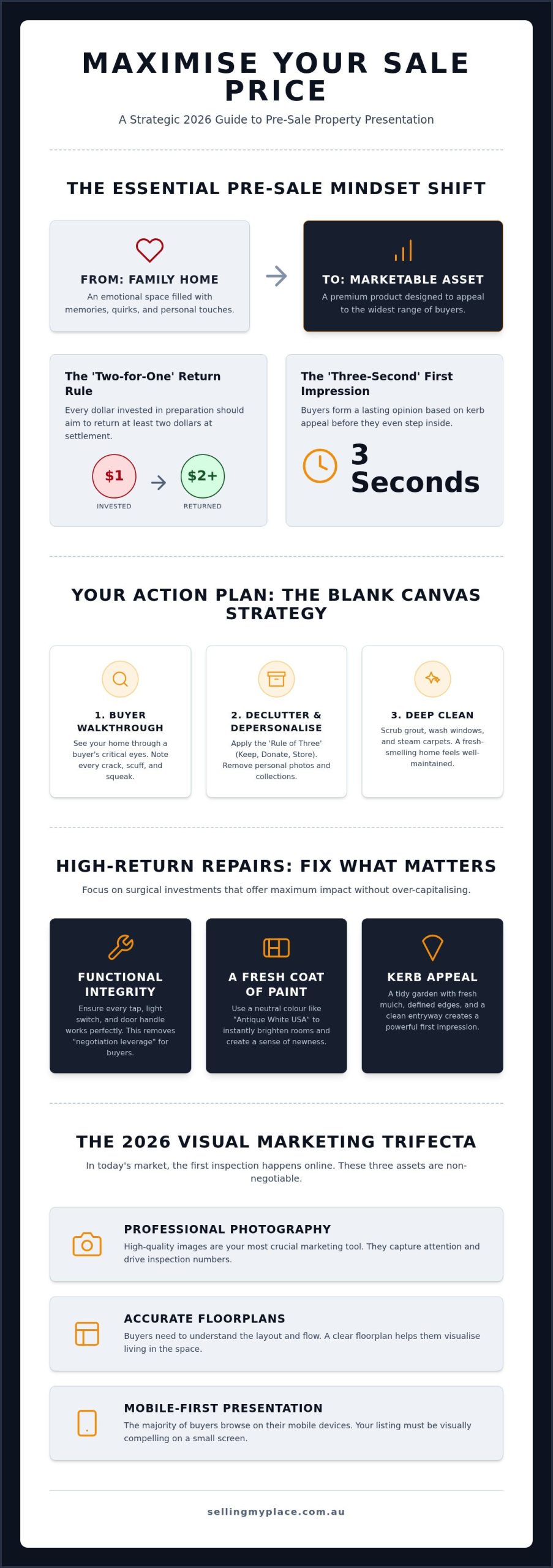
The Visual Marketing Trifecta: Photography, Floorplans, and Digital Appeal
In 2026, the first inspection of your home doesn’t happen at the front gate; it happens on a smartphone screen. Whether a buyer is scrolling through a property portal during their commute or lying in bed at night, your digital presentation is the ultimate gatekeeper. If your photos don’t captivate them within seconds, they won’t bother reading your carefully crafted description. Understanding how to prepare property for sale must include a “digital first” strategy, as your online appeal directly dictates the quality and volume of your enquiries.
There is a profound psychological difference between professional wide-angle photography and DIY “phone shots”. A smartphone often struggles with light balance, making rooms appear cramped, dark, or distorted. Professional imagery, however, manages perspective to create a sense of breathability and aspiration. It signals to a buyer that the home is a premium asset that has been cared for with pride. To ensure your home is ready when the photographer arrives, follow a simple morning checklist: clear all cars from the driveway, turn on every light, hide all bins, and ensure every toilet lid is firmly down.
Capturing the Lifestyle
Great photography does more than just document a room; it tells a story about the life a buyer could lead within those walls. We often suggest aiming for a “Golden Hour” shot, where the soft, amber light of dusk makes a property look its most inviting and neighbourly. These lifestyle close-ups, like a sun-drenched breakfast nook or a perfectly styled outdoor entertaining area, help justify your asking price by selling a future state of relaxation and comfort. Because we know these visuals are the cornerstone of a successful direct sale, KIDS includes professional photography in our flat-fee marketing packages as a standard feature.
The Essential Floorplan
After the main hero photo, the floorplan is statistically the most important feature of any listing. It allows buyers to “move in” mentally, helping them decide if their existing furniture fits or if the layout suits their family’s specific rhythm. Accurate floorplans are a practical necessity that reduces “wasted” inspections from buyers whose needs don’t match your home’s dimensions. For those with larger blocks, including a site plan is a brilliant way to showcase the full potential of your land, especially if you have a granny flat or significant outdoor space.
Ready to showcase your home to its full potential? Contact our team today to learn more about our professional marketing assets and advisory services.
Transitioning to Market: The Direct Sale Advantage
The final stage of your journey is where the hard work of preparation meets the excitement of the market launch. By following a structured plan on how to prepare property for sale, you have already done the heavy lifting that most traditional agents would claim as their own. This thoroughness gives you the ultimate leverage: the ability to Sell Your Own Home with absolute confidence. You aren’t just a seller; you are an informed owner who knows every corner and value point of the asset.
Transitioning to market requires a “Steady Hand” approach. Using our Real Estate Advisory Services allows you to finalise your strategy with an expert who values your family’s outcome over a quick commission. Part of this involves reviewing a detailed Neighbourhood Market Report to time your “Go-Live” date perfectly. You want to launch when buyer demand is peak and competition is manageable. Before that first “Open for Inspection”, ensure your conveyance advice is locked in and your contracts are ready for a signature. Being prepared legally is just as important as being prepared visually.
Negotiation Readiness
When a home is presented flawlessly, it naturally creates a sense of “Fear Of Missing Out” (FOMO) among buyers. They see a property that is move-in ready and well-loved, which reduces their desire to haggle. To defend your price, you must know your property’s specific “value drivers”, whether it’s the north-facing backyard or the high-end kitchen hardware we discussed earlier. For those looking to sharpen their skills, we recommend reading Mastering the Deal to learn expert tactics for managing offers.
The Flat-Fee Revolution
The traditional model of paying away a large percentage of your home’s value is rapidly changing. Australian sellers are now saving an average of $20,000 in commissions by choosing a direct sale model. When you consider how to prepare property for sale, remember that these savings can be life-changing. They could fund your next house deposit, pay for a professional relocation, or simply sit in your offset account as a buffer for the future. Partnering with Kincade International Direct Sales (KIDS) means you get the professional photography and floorplans needed to shine, without the high marketing costs or commission drain. It is a smarter, more profitable way to honour the legacy of your home while protecting your family’s financial future.
Take the Next Step Toward a Successful Sale
Mastering how to prepare property for sale is ultimately about honouring the years you’ve spent in your home while positioning your family for whatever comes next. By focusing on high-impact repairs, strategic styling, and professional visual assets, you ensure your equity remains protected and your final price is maximised. You’ve already taken the most important step by moving from a state of overwhelm to a clear, actionable roadmap that puts you in control of your financial legacy.
Now, it’s time to turn that preparation into profit. At Kincade International Direct Sales, we act as your steady hand through this significant life transition. Our partners save an average of $20,000 in commissions, all while receiving the professional photography and floorplans essential for a modern, premium result. With our expert Agent Advisory Service by your side, you can navigate the final stages of the market with absolute confidence and calm.
Start your commission-free selling journey with Kincade International Direct Sales today and keep your hard-earned equity where it belongs. You have done the hard work; now let us help you celebrate the result your home deserves.
Frequently Asked Questions
How much should I spend on preparing my house for sale?
Aim for a preparation budget that prioritises high-impact, low-cost updates rather than major structural changes. A common benchmark is to spend around 1% to 2% of your target sale price, ensuring every dollar spent returns at least double in value. Focus on painting, garden maintenance, and fixing visible wear and tear. This strategic approach helps you understand how to prepare property for sale without risking your hard-earned equity on unnecessary renovations.
Is it better to sell a house empty or staged with furniture?
Staged homes typically attract higher offers and sell faster than empty properties because they provide a sense of scale and purpose. An empty house can often feel cold or reveal minor imperfections that furniture would otherwise soften. By using strategic styling with your existing pieces or hiring key furniture for hero rooms, you create an emotional connection that allows buyers to visualise their own lifestyle within the space.
Should I renovate the kitchen before selling my property?
A full kitchen renovation is rarely recommended just before a sale, as you risk over-capitalising and not recouping the full cost. Instead, focus on refreshing the heart of the home. Replacing dated cabinet handles, installing a modern splashback, or applying a fresh coat of specialised tile paint can transform the room for a fraction of the price. These small, thoughtful updates often yield a much higher return on investment than a complete strip-out.
What are the most important repairs to do before an open home?
Prioritise functional integrity by ensuring everything a buyer touches or tests works perfectly. This includes fixing leaky taps, sticking doors, loose handles, and flickering light globes. These minor issues might seem insignificant, but they can signal a lack of maintenance to a buyer. A clean, well-functioning home reduces their negotiation leverage and builds trust in the property’s overall condition before they even reach the first open home.
How long does it take to prepare a property for market?
Most Australian homeowners find that two to four weeks is an ideal timeframe to prepare a property for market. This allows enough time for a thorough declutter, deep cleaning, and minor cosmetic repairs without the process becoming exhausting. If you are balancing work and family life, our pre-sale property consulting can help you create a streamlined schedule, ensuring you stay on track for your preferred go-live date.
Do I really need a professional floorplan for my listing?
Yes, a professional floorplan is essential as it is the second most viewed item on a listing after the main hero photo. It helps buyers understand the flow of the home and determine if their furniture will fit, which reduces the number of wasted inspections. Because we know how vital this is, KIDS includes professional floorplans in our flat-fee packages to ensure your digital presentation is as accurate as it is inviting.
How can I make my home look better for photos without spending a fortune?
Maximising light and space is the most effective way to improve your photos without a large budget. Start by cleaning every window, opening all drapes, and removing bulky furniture that blocks the flow of a room. Using the Golden Hour for exterior shots can also add a warm, neighbourly glow to your listing. Remember, professional photography is included in our residential property listing services, ensuring your home looks its absolute best.
What is the best colour to paint my house before selling in Australia?
Neutral tones remain the gold standard for selling in the Australian market, with shades like Antique White USA or soft greys being top choices. These colours create a clean, bright, and airy blank canvas that appeals to the widest possible range of buyers. Avoid bold or highly personal colour schemes, as they can be distracting. A fresh coat of neutral paint is one of the most cost-effective ways to modernise your space instantly.
The Best Alternatives to Real Estate Agents in Australia for 2026
What if the most valuable person in your property sale wasn’t a high-commission agent, but you? You’ve likely spent years pouring love and hard work into your home, so the thought of handing over a massive chunk of your profit to a traditional agency feels quite unsettling. Many homeowners are now seeking professional alternatives to real estate agents in Australia to protect their equity from being eroded by fees. It’s natural to feel protective of your hard-earned wealth; the usual process often involves a lack of transparency or pressure to lower your price just to get a deal done quickly.
We’re here to help you discover how to take control of your sale without the stress of going it alone. You can bypass those heavy commissions and still achieve a successful result at full market value by using a strategic partnership approach. This guide will explore how modern flat-fee services and expert advisory models can save you tens of thousands of dollars while providing the safety net you need. We’ll show you how to blend professional marketing with your own local knowledge to create a selling experience that feels both empowering and deeply rewarding.
Key Takeaways
- Understand why the traditional commission model is losing its shine in a high-value market and how digital tools are putting power back into your hands.
- Explore the most effective alternatives to real estate agents in Australia, from purely independent sales to strategic flat-fee listing services that get you on the major portals.
- Learn how to manage the transition safely by using pre-sale consulting and data-driven market reports to ensure you don’t under-price your family’s biggest asset.
- Discover the financial impact of choosing a commission-free path, potentially saving an average of $20,000 while maintaining total control over your sale.
- Realise that selling without a traditional agent doesn’t mean selling alone; it’s about choosing a professional partnership that prioritises your equity over an agency’s profit.
Why Australian Homeowners are Ditching Traditional Agents
There is a quiet revolution happening in Australian driveways lately. As we move through 2026, the way we perceive property sales is changing, moving away from the old-fashioned “agent-as-gatekeeper” model toward a more transparent, partnership-based approach. With the average dwelling value in Australia hitting a record high of $1,111,100 in the early part of this year, the stakes have never been higher for families looking to move. When your home is your greatest financial asset, the thought of handing over a significant portion of its value to a third party can feel quite daunting. It’s this very feeling that’s driving a surge in interest regarding alternatives to real estate agents australia.
The desire for control is at the heart of this shift. Many homeowners have felt the sting of a “quick sale” where an agent pushed for a lower price just to clear their books, or they’ve grown tired of the lack of transparency in closed-door negotiations. By stepping into the driver’s seat, you’re not just saving money; you’re ensuring that the story of your home is told with the warmth and detail only an owner can provide. After all, who knows the afternoon sun in the kitchen or the quietness of the street better than you do?
The Real Cost of a 2.5% Commission
In 2026, the national average real estate commission is approximately 2.3% of the sale price plus GST, which effectively totals over 2.5% for most sellers. While that percentage might sound small in isolation, the reality on a million-dollar property is a staggering $25,000 or more. When you add marketing costs, which typically range from $2,000 to over $8,500, the total bill can easily exceed $30,000. This is money that could be funding your next renovation, boosting your retirement nest egg, or helping your children with a deposit of their own. These “hidden” costs of the traditional model often represent years of hard work and mortgage repayments that vanish in a single transaction.
The Transparency Gap in Modern Real Estate
In an era of open data, the traditional role of the agent as the sole source of market information has dissolved. Buyers are increasingly savvy and often prefer the directness of a conversation with the owner. Engaging in the For Sale By Owner (FSBO) process allows for a level of honesty and clarity that is sometimes lost when a third party is involved. To feel truly confident in these interactions, homeowners are turning to professional tools like Neighborhood Market Reports to ensure their pricing is backed by solid, local evidence. By using alternatives to real estate agents australia, you remove the “gatekeeper” and replace them with a direct line of communication, leading to outcomes that feel fair and transparent for everyone involved.
3 Main Alternatives to Real Estate Agents in Australia
Deciding how to navigate your property sale is a deeply personal choice that depends on your confidence, your schedule, and your financial goals. It’s not just about the transaction; it’s about finding a path that feels right for your family’s future. Fortunately, the landscape has shifted significantly, and there are now several professional alternatives to real estate agents australia that allow you to bypass traditional commissions. Whether you want to handle every detail yourself or prefer a guided experience, there’s a model that can help you protect your equity while achieving a successful result.
Pure Private Sales (FSBO)
The most independent route is the pure For Sale By Owner approach. This model gives you total autonomy over the entire process, from the initial photography to the final handshake. You are the sole voice for your home, which allows you to share those intimate details that an agent might overlook. While the independence is liberating, it does require a significant time commitment and a high level of organisation. Historically, around 70% of purely private sales can encounter hurdles, often because the property lacks the professional marketing reach needed to attract a wide pool of buyers. This path is typically best suited for those with prior experience in property or a ready-made buyer within their local community.
Flat-Fee Listing Services
Flat-fee listing services offer a practical step up from the purely DIY method. Because the major national property portals generally don’t allow private individuals to list directly, these services act as a licensed bridge to get your home in front of active buyers. You pay a set upfront fee to have your ad placed on Australia’s leading real estate websites, giving you the visibility of a big agency without the commission. It’s a functional choice, though it’s important to remember these services are often quite transactional. They provide the “billboard,” but the quality of the listing and the weight of the negotiations remain your responsibility.
The Assisted Direct Sales Model
For many Australian homeowners, the assisted direct sales model provides the most balanced and secure experience. This hybrid approach combines the savings of a commission-free sale with the professional tools and advisory support of a top-tier agency. It’s widely considered the most reliable Sale by owner method because it includes a dedicated Agent Advisory Service. Having a “steady hand” to guide you through the nuances of offers and contracts ensures you never have to guess your way through the critical moments. If you’re looking for a way to sell smarter while keeping your hard-earned profit, you might like to discuss your specific needs with our team.
Comparing the Costs, Risks, and Rewards
Deciding to move away from the traditional path requires a clear-eyed look at the numbers and the responsibilities involved. It’s a balance between the incredible financial reward of protecting your equity and the practicalities of managing the sale process. While the savings are often life-changing, we always encourage our clients to consider the full picture. Success isn’t just about avoiding a fee; it’s about achieving a result that leaves you feeling secure and satisfied with your family’s future.
Calculating Your Potential Equity Savings
Let’s look at a practical example. On a property selling for $1,000,000, a traditional agent’s commission of 2.3% plus GST effectively removes over $25,000 from your pocket. When you add marketing packages and potential auctioneer fees, your total outlay often climbs toward $35,000. By choosing alternatives to real estate agents australia, you replace that variable commission with a fixed investment. Our data shows that the average owner saves approximately $20,000 by using a flat-fee model. This isn’t just a number on a page; it’s the difference between a basic relocation and a move that sets you up with a significant financial head start.
Mitigating the Risks of Selling Privately
The primary concern for many is the risk of “getting it wrong.” Common fears include under-pricing the home or missing out on the right buyer because the property wasn’t visible enough. This is where professional Residential Property Listing Services become your greatest asset. High-quality photography and accurate floorplans are non-negotiable in 2026; they ensure your home isn’t just another listing, but a standout destination for the global market. To manage the risks effectively, consider these key areas:
- Legal Compliance: New Anti-Money Laundering laws mean you must ensure buyer identity checks are handled by your solicitor or conveyancer.
- Negotiation: Having an advisory service behind you means you aren’t guessing when an offer lands on the table.
- Time Management: You’ll need to be available for enquiries and open homes, which allows you to vet buyers personally and share your home’s unique story.
By using professional alternatives to real estate agents australia, you gain the expertise needed to navigate complex negotiations without the high-stakes pressure of a commission-driven environment. It’s about selling with a steady hand and a full heart, knowing you have the right tools to protect your legacy.
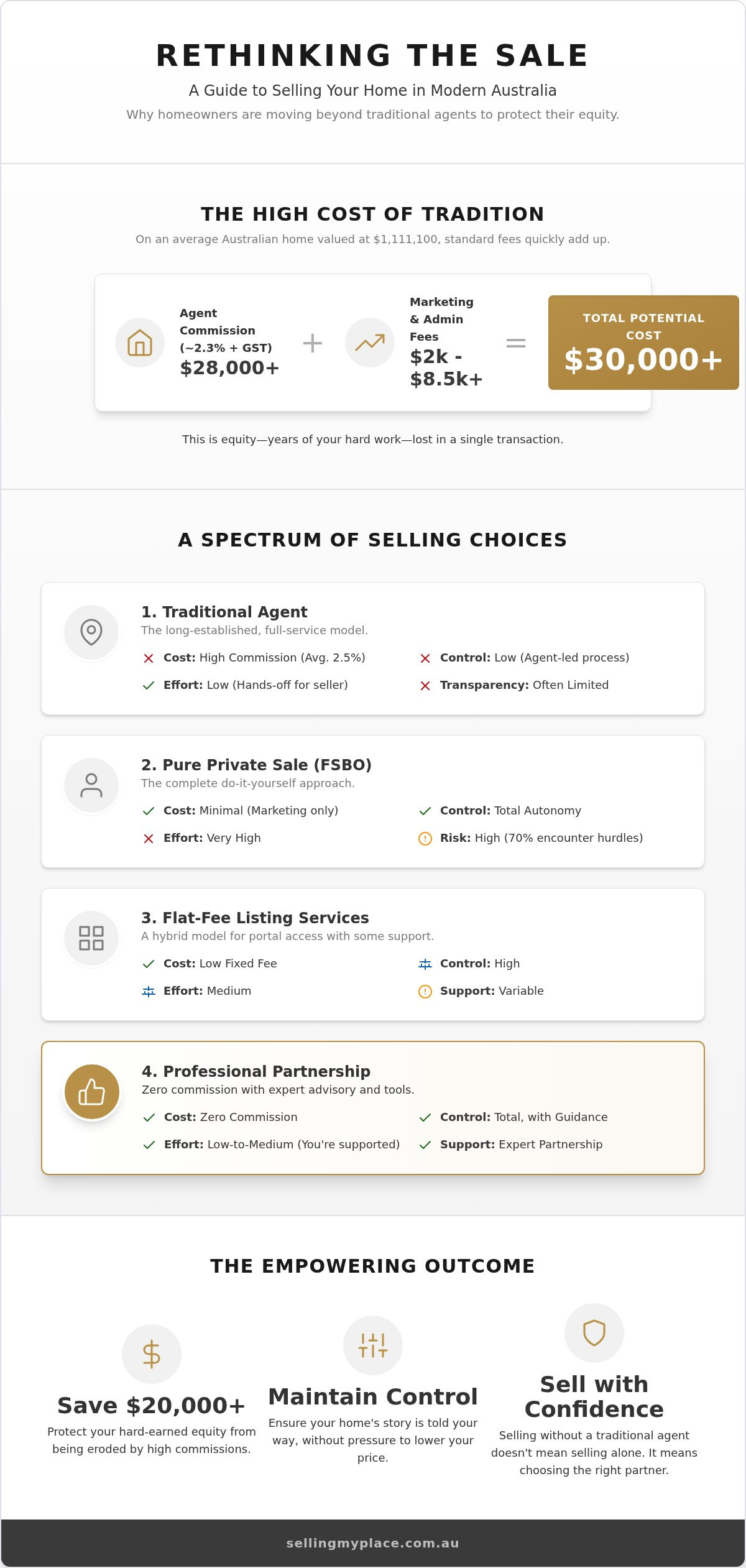
Steps to Successfully Sell Your Home Without an Agent
Taking the leap into a commission-free sale is an exciting moment, but it’s the practical, step-by-step execution that turns a plan into a successful result. Think of this process not as a solo climb, but as a guided walk where you hold the map. By leveraging professional alternatives to real estate agents australia, you can move through each phase with the confidence of a seasoned pro. The journey begins long before the first open home, starting with a thoughtful approach to presentation and a clear understanding of your property’s place in the current market.
Start with pre-sale property consulting to identify the small, high-impact improvements that add the most value to your home. Once your property is looking its best, use data-driven neighborhood market reports to anchor your expectations in reality. There’s no need to guess or rely on an agent’s “appraisal” that might be inflated just to win your business; the data tells the honest story of what buyers are actually paying in your street. This grounded approach ensures you enter the market with a price that attracts genuine interest from day one.
Marketing Your Property Like a Pro
In the digital age, your home’s first inspection happens on a smartphone screen. A successful sale relies on a “Listing Until Sold” strategy, ensuring you aren’t pressured by arbitrary agency timelines or expiring contracts. By using professional photography and floorplans, you create a narrative that resonates with both local families and international buyers. It’s about more than just a house; it’s about the lifestyle your neighbourhood offers, from the best local coffee spot to the quietest parks. This digital infrastructure allows you to reach a global audience while you maintain total control over who visits your home.
When the enquiries start rolling in, managing open homes becomes a chance to meet your future buyers face-to-face. You’ll find that being the owner often breaks down barriers, allowing for more honest and relaxed conversations. When an offer arrives, keep our property sale negotiation tips close at hand to ensure you’re securing the best possible terms. Remember, you’re the expert on your home, and that passion is your greatest asset during the negotiation phase.
The Legal and Settlement Process
While you’re handling the marketing, your legal team handles the fine print. It’s vital to secure professional conveyance advice early to prepare your contract of sale; this is a legal requirement in all Australian states and territories. This document, such as a Section 32, is the legal bedrock of your transaction. Once a price is agreed upon and the contract is signed, you’ll enter the settlement period. This is the time when final identity checks and financial transfers occur, leading to that wonderful moment when the keys change hands and your equity is safely in your bank account.
Ready to start your journey with a steady hand by your side? Reach out to our advisory team to discuss your sale.
The Kincade Approach: Professional Partnership, Zero Commission
Selling your home is about so much more than a contract; it’s about the memories you’ve built and the future you’re funding. At Kincade International Direct Sales (KIDS), we believe that choosing alternatives to real estate agents australia shouldn’t mean sacrificing professional quality or peace of mind. Our approach is built on a simple, honest truth: you deserve to keep your equity while having a steady hand to guide you through the complexities of the modern market. We don’t just provide a platform; we offer a partnership that values your family’s legacy as much as you do. It’s a way to sell that feels personal, protective, and entirely transparent.
The traditional agency model often feels purely transactional, but we know that moving house is one of life’s major transitions. By removing the 0% commission structure and replacing it with a flat-fee model, we align our goals with yours. We aren’t rushing you toward a sale just to collect a cheque; we’re providing the tools and advisory support you need to achieve the best possible market value. This is the most honest way to handle real estate, ensuring that the average owner saving of $20,000 stays in your bank account to fund your next chapter.
Expert Backing Every Step of the Way
The heart of our service is the Agent Advisory Service. Think of it as having a seasoned, multi-generational expert in your corner who isn’t motivated by a commission. Whether you’re navigating the identity checks required by the 2026 anti-money laundering laws or weighing up the nuances of a multi-offer situation, our advisors provide the calm confidence you need. We provide the same top-tier tools used by the country’s most expensive agencies, including professional photography and detailed floorplans, but at a fraction of the cost. It’s a partnership that provides a safety net, ensuring you never feel like you’re “going it alone” during such a significant life event.
Selling Smarter, Not Harder
One of the biggest stressors in a traditional sale is the ticking clock of an agency agreement. These time limits often create a sense of artificial pressure, which can lead to rushed decisions and compromised prices. Our “No Time Limit” policy removes that burden entirely, allowing you to wait for the buyer who truly recognises the value of your home. We leverage a sophisticated digital infrastructure and a global marketing network to ensure your property reaches the right audience, regardless of where they are. By choosing alternatives to real estate agents australia that focus on quality marketing and expert advice, you’re joining a growing community of savvy homeowners who value stability and smart financial management. It’s about taking control of your sale with a professional team that treats your home with the respect it deserves.
Take Control of Your Property Legacy Today
Choosing to move away from the traditional model is a powerful step toward securing your family’s financial future. By exploring modern alternatives to real estate agents australia, you’ve seen that it’s entirely possible to achieve a premium market result without the burden of heavy commissions. You don’t have to choose between going it alone or paying for services you don’t need; instead, you can embrace a professional partnership that puts you in the driver’s seat. It’s about selling with a steady hand and protecting your hard-earned equity through every stage of the process, ensuring your transition is as smooth as it is rewarding.
With professional photography, expert advisory services, and the peace of mind that comes from being listed until sold with no time limits, you’re perfectly positioned to succeed. On average, our clients save $20,000 on commissions, ensuring those funds remain available for your next life transition. We’re here to provide the tools and support you need to sell with confidence and warmth. Keep 100% of your profit and sell smarter with Kincade International Direct Sales today. Your home’s story is yours to tell, and we’re honoured to help you share it with the world.
Frequently Asked Questions
Is it legal to sell my own house in Australia without an agent?
Yes, it is completely legal to sell your own property in every Australian state and territory. While you handle the marketing and inspections, you are still required by law to engage a solicitor or conveyancer to manage the legal transfer. Many homeowners find that professional alternatives to real estate agents australia provide the perfect balance of legal security and financial freedom, allowing you to bypass commissions while staying fully compliant.
How much can I actually save by using a flat-fee real estate service?
Homeowners typically save an average of $20,000 by moving away from traditional commission structures. Since the average national commission is around 2.3% plus GST, a flat-fee model allows you to keep that equity for your next home or retirement fund. This approach replaces variable percentages with a single upfront investment that covers your marketing, photography, and advisory support, ensuring your profit stays exactly where it belongs.
Will my property still appear on the major Australian real estate portals?
Yes, your property will be visible on the most prominent Australian real estate portals. While these platforms generally don’t allow private individuals to list directly, flat-fee services use their professional licenses to place your ad where buyers are looking. This ensures your home receives the same level of exposure as any agency-listed property. Using such alternatives to real estate agents australia ensures you reach local families and international buyers through a global marketing network.
Who handles the legal paperwork if I don’t have a traditional agent?
You will need to engage a qualified solicitor or conveyancer to handle the legal complexities of the transaction. They are responsible for preparing the contract of sale and ensuring all identity checks comply with the 2026 anti-money laundering laws. Our service includes expert conveyance advice to help you navigate this phase, ensuring your paperwork is robust and your settlement process remains smooth and secure for all parties involved in the sale.
Can I still have an auction if I choose an alternative to an agent?
You can certainly choose to sell your home via auction even if you aren’t using a traditional agent. You simply need to hire a professional, licensed auctioneer to conduct the proceedings on the day. This allows you to benefit from the competitive atmosphere of an auction while still avoiding the high commission fees usually associated with the process. It is a strategic way to maintain control over the selling method and your final profit.
How do I know if I am setting the right price for my property?
Setting the correct price is achieved through detailed, data-driven research rather than guesswork. We provide comprehensive Neighborhood Market Reports that show exactly what similar properties in your street have sold for recently. By looking at actual settlement data rather than just asking prices, you can set a realistic figure that attracts genuine interest while protecting your equity. This ensures you don’t under-price your family’s most significant asset in a fragmented market.
What happens if my property doesn’t sell within the first month?
If your property doesn’t sell immediately, there is no need to feel pressured or stressed. Unlike traditional agency agreements that often expire after 90 days, our policy means your property is listed until sold with no time limits. This allows you to wait for the right buyer who truly values your home’s unique features, rather than feeling forced by an agent to lower your price just to meet an internal sales target or monthly quota.
Do I need a buyer representative if I am selling privately?
While you don’t need a buyer representative for yourself as the seller, you may encounter buyers who use their own professional representation. In these cases, having access to real estate advisory services can be incredibly helpful. An advisor acts as a steady hand during negotiations, helping you vet offers and communicate effectively with professional buyer’s agents. This ensures you remain on an equal footing throughout the entire negotiation process and secure a fair deal.
Flat Fee Property Listing Australia: The 2026 Guide to Protecting Your Equity
The equity you’ve built in your home over the years is more than just a number; it’s your hard-earned security and your family’s legacy. Yet, as we move through 2026, many Australian homeowners still feel held to ransom by commission rates that swallow tens of thousands of dollars. It’s frustrating to watch a significant slice of your profit vanish simply because property values have risen. You aren’t alone if you’re questioning why a flat fee property listing australia model isn’t already the standard. You’ve done the hard work of maintaining the garden and paying the mortgage, so it feels only right that you keep the rewards of that effort.
We understand the anxiety that comes with changing the status quo, especially when you’re worried about whether a different approach might impact your final sale price. This guide is here to show you that you don’t have to choose between professional excellence and fair pricing. We’ll explore how to secure a high-calibre listing, complete with professional photography and floorplans, while leaning on expert advisory services for those tricky negotiations. You’ll learn exactly how to bypass hidden marketing blowouts and maintain 100% of your sale profit. We’re going to break down the 2026 landscape so you can move forward with a steady hand and total confidence.
Key Takeaways
- Discover how to decouple service costs from your home’s final price, ensuring you protect your hard-earned equity and avoid traditional commission traps.
- Learn the importance of professional-grade assets, like high-end photography and floorplans, in capturing the attention of the modern digital buyer.
- Understand how expert real estate advisory services provide a steady hand during complex negotiations, ensuring you never have to navigate the sale alone.
- Identify data-driven pricing strategies and simple pre-sale improvements that help you secure a premium result while keeping your profit.
- Explore why a flat fee property listing australia combined with global marketing reach is the smartest way to manage your next major life transition.
Rethinking Real Estate: What is a Flat Fee Property Listing in Australia?
A flat fee property listing is a transparent service where you pay a single fixed price for marketing and professional support. Unlike traditional models, the fee is decoupled from your home’s final sale price, protecting your hard-earned equity from being eroded by rising commissions. This model functions as a performance-oriented partnership between the seller and the marketing provider. By choosing a flat fee property listing australia, you remove the “commission tax” that often penalises homeowners in high-growth markets. It is a straightforward way to keep your profit where it belongs; in your bank account.
As we explore Rethinking Real Estate: What is a Flat Fee Property Listing in Australia?, it becomes clear that this model is about transparency and fairness. It’s a shift away from the “black box” of traditional real estate, where marketing costs and agent bonuses can feel opaque and overwhelming.
The Evolution of the Australian Property Market
Property values in 2026 have continued to show resilience, with the national median dwelling value reaching $922,838 in early February. For many Australian families, this growth represents a significant life milestone, yet it comes with a hidden sting. When commissions are percentage-based, every dollar your home gains in value results in a larger bill from your agent. This has sparked a significant shift toward “sell my home no commission” searches as owners seek more control over their financial outcomes. We are seeing a rapid local adoption of fixed-fee models that have already dominated the UK and USA landscapes for years, providing a more stable and predictable path for sellers.
Commission vs. Flat Fee: A Financial Comparison
There is a common “Incentive Myth” that suggests a percentage-based commission makes an agent work harder. In reality, the difference between a good sale and a great sale might only mean a few hundred extra dollars for the agent’s pocket, but it represents thousands of dollars for your family’s future. Consider the following points:
- The Real Cost: On a $1M home, a 2% commission takes $20,000 from your equity. A flat fee model allows you to access professional residential property listing services for a fraction of that cost.
- Budget Certainty: Knowing your exact selling costs before you even go to market offers a sense of calm confidence.
- Marketing Quality: You receive professional-grade assets without the fear of hidden marketing blowouts that often surprise sellers at the end of a campaign.
Decoupling the service fee from the sale price ensures that your interests are truly aligned. It allows you to plan your next move with a steady hand, knowing that your hard-earned equity is protected. This isn’t just about saving money; it’s about valuing the legacy you’ve built in your home.
The Mechanics of a Professional Flat Fee Listing Service
Understanding the inner workings of a flat fee property listing australia service helps demystify the process and build confidence. It is a structured, four-step journey designed to put you in the driver’s seat while providing a sturdy framework of professional support. We begin with expert pre-sale consulting. This isn’t just a chat about price; it’s a deep dive into your property’s unique story and its position in the current market. Identifying those special features that make a house a home allows for a targeted strategy that resonates with the right buyers.
Once the strategy is set, we move to professional asset creation. This includes high-end photography and accurate floorplans, ensuring your property stands out for all the right reasons. Your home is then listed across major Australian portals and a sophisticated global marketing network. Finally, we assist with managing enquiries. Having access to real estate advisory services for negotiation and conveyance advice ensures you have a seasoned partner by your side until the keys are handed over. This comprehensive approach ensures no detail is missed.
Why Visual Marketing is Non-Negotiable
In a digital-first world, your online presentation is your only first impression. High-quality professional photography is essential for stopping the scroll on busy portals. It’s about more than just a pretty picture; it’s about inviting a buyer to imagine their life within your walls. Accurate floorplans are equally vital. They provide the spatial context that serious, qualified buyers need, effectively reducing the number of “tyre-kickers” who might otherwise waste your time. This level of professional presentation is a key component of Maximising Your Profit: A Roadmap for Australian Sellers, as it signals value and quality to the market.
Global Reach for Local Australian Properties
The days of relying on a local high-street office window to sell your home are long gone. By 2026, the primary driver of property sales is digital infrastructure. This allows local Australian properties to reach interstate investors and international buyers with ease. One of the most reassuring aspects of this model is the “listed until sold” advantage. Traditional time limits on listings can create unnecessary pressure and anxiety for families. By removing these relics of the past, you can wait for the right offer that truly reflects your home’s worth. If you’re ready to see how this modern approach can work for you, reach out to our team for a chat about your goals.
Expert Backing: The Role of Real Estate Advisory Services
Selling your family home is one of the most significant transitions you’ll ever make. It’s a time filled with memories and, naturally, a bit of trepidation. A common misconception is that choosing a flat fee property listing australia means you’re going it alone, but that couldn’t be further from the truth. Instead, you’re simply choosing a different kind of expert. By utilising real estate advisory services, you gain access to a seasoned partner who provides the professional oversight you need without the hefty commission price tag. It’s about having a steady hand to guide you through the complexities of the market.
This partnership often begins long before the first “for sale” sign goes up. Pre-sale consulting is a vital step that helps you avoid the trap of over-capitalising on renovations. We’ve all seen it; a homeowner spends $40,000 on a designer kitchen only to find it adds half that to the sale price. An advisor helps you identify the high-impact, low-cost “quick wins” that actually move the needle. This grounded, practical approach ensures your equity stays in your pocket rather than being sunk into unnecessary upgrades that don’t offer a return on investment.
Negotiation Strategies for the Empowered Seller
Dealing with potential buyers can feel like a bit of a rollercoaster, especially when emotions are running high. It’s easy to take a low offer personally or feel pressured to make a snap decision during a tense phone call. An advisory service acts as your buffer, helping you maintain an objective stance. With a large majority of property professionals expecting dwelling values to rise throughout 2026, you need to be firm on your home’s worth. We help you use data-driven Neighborhood Market Reports to justify your asking price with cold, hard facts. This empowers you to negotiate with calm confidence rather than relying on a “gut feeling” or an agent’s agenda.
Navigating the Legal Landscape
The legal transition of a property is where many sellers feel the most stress. Managing contracts and required disclosures requires an eye for detail and a thorough understanding of current regulations. This is where conveyance advice becomes indispensable. It’s about ensuring the paperwork is as solid as the foundations of your home. By having a clear roadmap for the settlement process, you can focus on your next chapter while we help ensure the legal journey is seamless. Think of it as professional decorum paired with a genuine sense of duty to your family’s financial future.
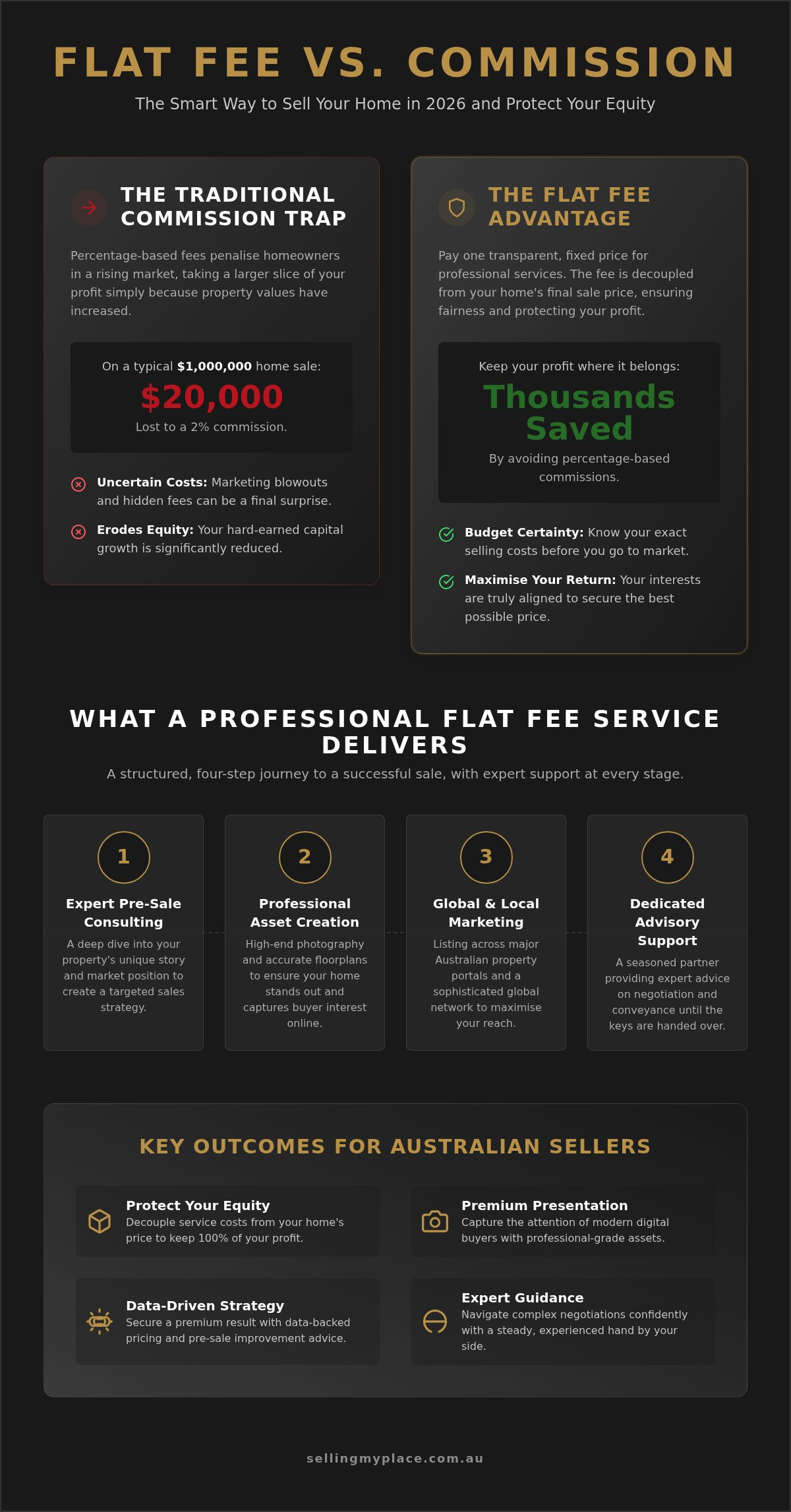
Maximising Your Profit: A Roadmap for Australian Sellers
Achieving a premium result is about more than just putting a sign in the front yard. It’s a methodical process that combines careful presentation with precise, objective data. When you opt for a flat fee property listing australia, you’re choosing a model that rewards your attention to detail and your intimate knowledge of your home. By focusing on high-impact minor repairs and curb appeal, you ensure the first impression is one of care and stability. This isn’t just about aesthetics; it’s about signalling to the market that your home has been a well-loved sanctuary for your family.
Utilising a flat fee property listing australia framework allows you to be the primary advocate for your property. You know which window catches the morning sun and which local park is best for a weekend stroll. Engaging with buyers directly allows you to convey these lifestyle benefits with a warmth and authenticity that no third party can replicate. To ensure your equity is fully protected, it’s wise to keep your marketing active until the final settlement. This provides a vital backup plan should circumstances change, giving you total peace of mind throughout the transition.
Preparing Your Home for the Professional Lens
Decluttering is your first essential step. It allows the space to breathe and lets buyers project their own lives onto the canvas you’ve created. When it comes to photography, the “Golden Hour” is particularly important in the Australian climate. This brief window of soft, warm light just before sunset can make your outdoor entertaining areas feel like a private oasis. Industry observations suggest that a well-prepared home can increase click-through rates by up to 40% compared to properties that appear cluttered or poorly lit. Small touches, like fresh mulch in the garden or a clean driveway, go a long way in stopping the scroll on a smartphone screen.
Setting the Right Price with Data
Setting the right price is perhaps the most critical decision you’ll make in your selling journey. It’s vital to determine the market value of a home in Australia using recent comparable sales rather than an agent’s “gut feeling”. Avoiding the overpricing trap is essential; a price that is too high can lead to a stale listing, which often results in a lower final sale price as buyers become wary. Transparency in your initial listing price builds immediate trust with the community and attracts genuine, qualified buyers who are ready to act. If you’re ready to take the next step in your property journey, get in touch with us today to discuss your personalised roadmap.
Why Kincade International Direct Sales is the Smarter Choice
Choosing the right partner for your property journey is about finding a balance between cutting-edge digital reach and a genuine, human connection. Kincade International Direct Sales (KIDS) provides exactly that. We don’t just list your home; we integrate it into a sophisticated global marketing network that ensures your property is seen by the right eyes, whether they’re across the street or on the other side of the world. By opting for a flat fee property listing australia through our model, you’re embracing a partnership approach that treats your sale as a significant life transition, not just another line in a ledger. We’re here to ensure your story is told with the respect and professional polish it deserves.
Security is at the heart of everything we do. This is why we offer a “listed until sold” guarantee, providing you with a sense of stability and peace of mind, regardless of how the market fluctuates in 2026. You won’t find arbitrary time limits here. Instead, you’ll find a comprehensive suite of professional assets included as standard in our packages. From high-end photography and accurate floorplans to the expert advisory services we’ve discussed, every element is designed to showcase your home’s true value while keeping your equity where it belongs. It’s a thorough, attentive service that leaves nothing to chance.
A Legacy of Expert Support
Experience matters when the stakes are this high. We leverage over 25 years of industry knowledge to guide you through every twist and turn of the selling process. This isn’t just about technical expertise; it’s about the emotional intelligence required to understand the weight of selling a family home. We know that behind every contract is a family looking toward their next chapter. We act as your “steady hand,” providing a reassuring presence that reduces the stress of complex negotiations and legal requirements. You can move forward with calm confidence, knowing you have a seasoned advisor in your corner who values long-term relationships over quick results.
Take Control of Your Property Future
The financial impact of choosing a flat fee property listing australia is profound. When you save an average of $20,000 in unnecessary commissions, that money stays with you to fund your next purchase, renovate your new space, or simply bolster your family’s financial security. You’re joining a growing movement of empowered Australian sellers who are choosing transparency and fairness over outdated traditions. It’s time to take control of your property future. Starting your journey with a professional listing is a simple, straightforward process that prioritises your needs and your legacy. We’re ready to help you make your next move your best move yet.
Your Path to a Smarter, More Profitable Sale
Your home is likely your most significant asset. As we navigate the 2026 property market, protecting the equity you’ve built should be your top priority. We’ve explored how a flat fee property listing australia allows you to maintain control while accessing the same high-calibre marketing tools used by the country’s top agencies. By choosing a partnership based on transparency rather than a percentage, you ensure your profit stays exactly where it belongs; with your family.
Securing a professional result doesn’t have to mean sacrificing your hard-earned gains to unnecessary commissions. With Kincade, you’ll save an average of $20,000 in fees while benefiting from professional photography, accurate floorplans, and our dedicated Agent Advisory Service. This isn’t just about a transaction; it’s about a steady hand guiding you through a major life transition with heart and expertise. You’ve done the hard work of building your home’s value, so let’s make sure you keep it.
Keep 100% of your profit and list with Kincade today to start your journey with a partner who values your legacy as much as you do.
Frequently Asked Questions
Is a flat fee property listing legal in all Australian states?
Yes, the flat fee model is completely legal across all Australian states and territories. Real estate commissions are not regulated by the government, meaning you have the freedom to negotiate how you pay for marketing and support. Choosing a flat fee property listing australia ensures you are operating within a transparent framework that prioritises your equity. It’s a modern approach that complies with national property laws while giving you more control over your financial outcome.
Do I still get my property listed on the major real estate websites?
Absolutely, your home will be featured on the major Australian property portals where the vast majority of buyers begin their search. We provide the digital infrastructure needed to ensure your listing looks professional and reaches a wide audience. Beyond local sites, our global marketing network helps your property gain visibility with interstate and international investors. You get the same premium digital exposure as a traditional agency listing without the high commission costs attached.
What happens if my property doesn’t sell within a few months?
We offer a “listed until sold” guarantee, which means there are no arbitrary time limits on your marketing campaign. If your property takes a little longer to find the right buyer, your listing stays active without additional listing fees. This removes the pressure to drop your price prematurely and provides a sense of stability. We’re committed to a long-term partnership, ensuring your home remains visible until the keys are successfully handed over to the new owners.
Who handles the actual property inspections and open houses?
As the person who knows your home best, you’ll handle the property inspections and open houses. This allows you to share the authentic story of your neighbourhood and the unique features of your property directly with buyers. While you host the visits, our Real Estate Advisory Services are always available to provide guidance on how to present your home effectively. Most owners find that buyers appreciate the direct, honest communication that comes from dealing with the homeowner.
Can I still use a solicitor or conveyancer for the legal paperwork?
Yes, you should always engage a qualified solicitor or conveyancer to manage the legal aspects of your sale. While we provide expert conveyance advice to help you understand the process, the actual preparation of the contract and the settlement must be handled by a legal professional. This ensures that your interests are fully protected throughout the legal journey. We work alongside your chosen representative to make sure the transition of your property is as seamless as possible.
How does the Agent Advisory Service actually help me during the sale?
Our Agent Advisory Service acts as your “steady hand” throughout the entire process, offering professional backing without the commission. We provide pre-sale consulting to help you identify high-impact improvements and use Neighborhood Market Reports to help you set a data-driven price. When it comes to negotiations, we’re there to offer strategic advice, helping you navigate complex conversations with buyers. It’s about giving you the confidence of a seasoned expert while you maintain control of the sale.
Will buyers be put off if they see I am selling without a traditional agent?
In 2026, savvy Australian buyers are becoming increasingly comfortable with direct sales models. They often prefer the transparency and direct communication that comes from dealing with the owner. As long as your property is presented professionally with high-quality assets, buyers will focus on the value of the home itself. Our professional photography and floorplans ensure your listing looks identical to a traditional agency ad, maintaining the decorum and authority expected in a high-stakes transaction.
What is included in the professional photography and floorplan package?
Our comprehensive package includes high-end photography designed to capture your home’s best features and stop the scroll on major portals. You’ll also receive accurate floorplans, which are essential for helping buyers understand the spatial layout of your property before they visit. These assets are produced to a professional standard, ensuring your home looks its absolute best. Providing this level of detail helps attract serious, qualified buyers and signals that you are committed to a high-quality, professional sale process.
Legal Requirements for Selling a House Privately in Australia: The 2026 Guide
You don’t need a middleman to sign away $20,000 of your hard-earned equity just to move onto your next life chapter. While many feel pressured to hire a traditional agent, selling your own home is a protected legal right in every corner of Australia. We understand that the weight of responsibility can feel heavy; nobody wants to risk a lawsuit or a failed settlement because they missed a state-specific disclosure. Understanding the legal requirements for selling a house privately is the first step toward a confident, successful sale that keeps your profit where it belongs: in your pocket.
It’s natural to feel a bit cautious as property laws become more digital and complex. Whether you’re worried about the mandatory 2026 Edition Contract in NSW or the strict new Seller Disclosure Statements in Queensland, you’re not alone in this journey. This guide provides a clear, professional roadmap to help you handle the 2026 legal landscape with ease. We will preview the essential documents required for each state, explain the updated 15% national withholding tax rules, and show you how to organise a legally sound settlement that protects your family’s future and your legacy.
Key Takeaways
- Confirm your legal right to sell property without an agent in any Australian state, allowing you to take full control of your home’s transition.
- Understand the essential legal requirements for selling a house privately, from preparing the Contract of Sale to providing mandatory vendor disclosures.
- Stay ahead of 2026 regulatory changes, including the new digital-first contract standards in NSW and updated identity verification rules across the country.
- Learn how to manage the exchange and settlement process safely by partnering with professional conveyancing and advisory experts.
- Discover how pre-sale consulting helps you identify and resolve legal or structural issues before they impact your sale price or settlement timeline.
Understanding Your Legal Right to Sell Property Privately in Australia
The idea that you need a real estate agent to sell your home is one of the most persistent myths in the Australian property market. In reality, no state or territory law requires you to use a middleman. You have the absolute right to represent yourself; choosing the “Sale by Owner” path is a legitimate, well-trodden route for thousands of Australians every year. By taking the reins, you’re not just saving on commission. You’re taking full ownership of your family’s transition and financial future.
While you have the freedom to sell, you also carry the weight of professional responsibility. The legal requirements for selling a house privately include a strict duty of care under the Australian Consumer Law (ACL). Essentially, you must avoid any “misleading or deceptive conduct” during your marketing and negotiations. If there’s a structural issue, a boundary dispute, or a known defect, honesty isn’t just the best policy; it’s a legal necessity that protects you from future litigation. We like to think of our role as the “steady hand” beside you. You stay in control of the heart and soul of the sale while we provide the expert advisory infrastructure to ensure every legal detail is handled with precision.
The Role of State Legislation in Property Sales
Property law in Australia is governed at the state and territory level rather than by a single federal body. This means the rules for a sale in one state will differ slightly from those in another. Understanding Your Legal Right to Sell Property Privately requires a look at your local jurisdiction, such as the Sale of Land Act or the Conveyancing Act applicable to your specific region. While the specific forms and certificates change, the core principles of transparency and full disclosure remain the same across the country. Following these local Property Acts ensures your sale stands on firm ground and remains valid from the first inspection through to the final handover.
Why Legal Compliance is Your Best Marketing Tool
Many sellers view legal paperwork as a dry, administrative hurdle to be cleared. We see it differently. A legally robust contract is actually one of your most powerful marketing assets. When potential buyers see a comprehensive disclosure package ready to go, it builds immediate, grounded trust. It shows you’ve been a diligent steward of the property and that you have nothing to hide.
Professional documentation also protects your settlement timeline. By being upfront with all mandatory reports and certificates, you significantly reduce the risk of a buyer “getting cold feet” or finding a reason to withdraw during the cooling-off period. In a 2026 market where buyers are increasingly cautious about high-stakes decisions, providing a smooth, legally sound path to purchase makes your home stand out as a low-risk, high-quality opportunity.
Essential Documents: The Contract of Sale and Vendor Disclosures
The Contract of Sale is the primary legal instrument of your transaction. It’s the document that formally binds you and your buyer together. While it might look like a stack of intimidating fine print, it’s actually a protective shield for both parties. In 2026, many states have moved toward digital-first contracts, such as the mandatory 2026 Edition in NSW, which is designed to streamline the exchange process. Meeting the legal requirements for selling a house privately starts with ensuring this document is current, accurate, and reflects the true state of your property.
Beyond the contract itself, most states require a Vendor’s Statement. A Vendor Statement is a legally binding disclosure of a property’s history and restrictions. In Victoria, this is famously known as a Section 32, while Queensland sellers must now provide a signed Form 2 Disclosure Statement and all prescribed certificates before a contract is signed. These documents ensure the buyer enters the deal with their eyes wide open, which is a vital part of managing legal obligations during a sale.
What Must Be Disclosed to the Buyer?
Transparency is your greatest ally here. You’re legally required to reveal any factors that might affect the property’s value or the buyer’s enjoyment of it. This includes:
- Encumbrances: Any easements, such as a water pipe running through the backyard, covenants, or restrictions on how the land can be used.
- Zoning: Whether the land is residential, commercial, or subject to specific overlays.
- Building Works: Any permits or structural works completed in the last seven years, ensuring they were properly certified.
- Financial Outgoings: A clear breakdown of council rates, water charges, and the 2026 land tax thresholds.
Using professional photography and Residential Property Listing Services ensures your floorplans and property details are perfectly aligned with the physical reality of the home, preventing any claims of misleading conduct.
The Consequences of Non-Disclosure
Cutting corners on disclosures is a risk that simply isn’t worth taking. If a buyer discovers a material fact was hidden or misrepresented, they often have the legal right to rescind the contract immediately. This means they can walk away with their full deposit, even just days before settlement, leaving you back at square one. Beyond a lost sale, you could face significant legal penalties for deceptive conduct. If you’re feeling unsure about which certificates apply to your specific block, it’s always worth reaching out for a bit of expert guidance to keep your sale on the right track.
Navigating State-Specific Regulations and Cooling-Off Periods
While your right to sell is a national constant, the specific legal requirements for selling a house privately change the moment you cross state lines. It’s a bit like local weather; the climate is similar, but you need to know when to pack an umbrella. One of the most significant variations involves the cooling-off period, which acts as a safety net for buyers. In NSW and Queensland, the standard period is 5 business days, whereas Victorian buyers typically have 3 business days to reconsider. If a buyer chooses to withdraw during this time, they forfeit a small portion of the deposit, usually 0.25% in NSW and QLD, or 0.2% in Victoria. In Western Australia, things are a little different, as there’s no mandatory cooling-off period unless you specifically agree to include one in the contract.
Another critical detail often overlooked is the “Warning Statement.” Many jurisdictions require specific, verbatim legal text to be physically present on the front page of the contract. If this statement is missing or obscured, the buyer might gain the legal right to walk away from the deal entirely. Additionally, if your home features a pool or spa, you must ensure a valid safety certificate is attached to the contract. In states like NSW and QLD, selling without a compliant pool fence or the correct certification isn’t just a safety risk; it’s a breach of your legal requirements for selling a house privately that can stall your settlement indefinitely.
Understanding the Cooling-Off Period
Think of the cooling-off period as a statutory “change of heart” clause. It gives the buyer time to finalise their finance or conduct one last building inspection. However, it’s not always set in stone. In NSW, a buyer can waive their right to a cooling-off period by providing a “66W certificate” signed by their solicitor. This is often used in fast-moving markets to make an offer more attractive to a seller. Understanding these nuances helps you manage expectations and ensures you don’t celebrate a “sold” sign before the legal window has officially closed.
The Auction Exception
The rules of engagement shift significantly when you move from a private treaty to an auction. Generally, properties sold under the hammer, or even within a few days on either side of a scheduled auction, carry no cooling-off period at all. This creates a “done deal” the moment the hammer falls, but it also requires stricter compliance with “Bidders Records” and public auction rules. Choosing to move forward with selling your own home via private treaty often allows for more heartfelt, flexible negotiations that auctions sometimes lack. You can take the time to find a buyer who truly values the legacy of your home, rather than just the highest bidder in a high-pressure environment.
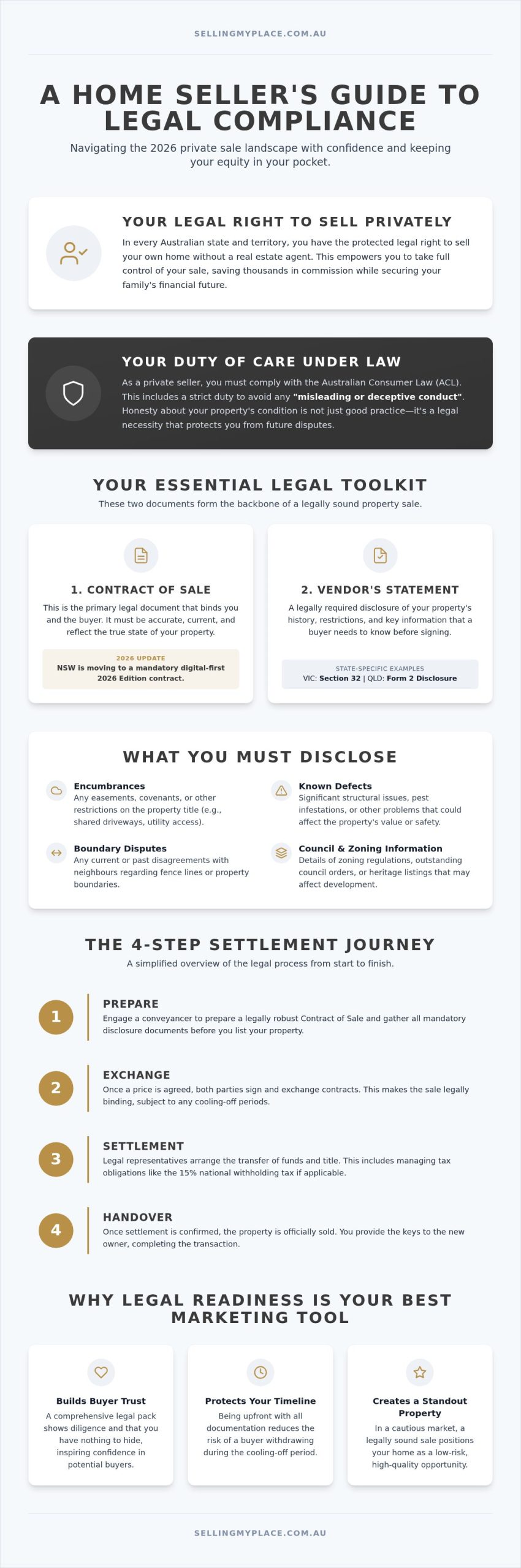
The Settlement Journey: Managing Legal Obligations from Exchange to Handover
Once you’ve accepted an offer and the handshakes are finished, you enter the “exchange of contracts” phase. This is the pivotal moment when your agreement becomes a binding legal reality. The buyer pays their deposit, which is typically 10% of the purchase price. In a private sale, this money must be held in a solicitor’s or licensed agent’s trust account for safekeeping until the deal is finalised. Meeting the legal requirements for selling a house privately means ensuring these funds are handled with total transparency, protecting both your interests and those of the buyer as you move toward the finish line.
The period between exchange and settlement is the home stretch of your sale. It’s a time for finalising paperwork and preparing for the physical move. While the initial marketing and negotiation are in your hands, the final legal transfer requires a specialist touch. This stage is about precision. It’s about ensuring every “i” is dotted and every “t” is crossed so that the ownership transition is as smooth as a quiet Sunday morning. If you’re feeling the weight of these final steps, reach out to our advisory team for expert guidance on managing your settlement timeline.
The Role of Your Conveyancer or Solicitor
While you can market your home, a licensed conveyancer must legally perform the transfer of title. They act as your legal representative in the digital sphere, handling the electronic lodgement through platforms like PEXA. This is mandatory in most Australian states in 2026. Your conveyancer also calculates the final “adjustments.” They work out the pro-rata split for council rates, water charges, and land tax, ensuring you aren’t paying for services after you’ve handed over the keys. This mathematical accuracy is essential for a clean, undisputed settlement.
Preparing for the Handover
The final week of a sale is often filled with a mix of packing and nostalgia. Legally, you’re required to provide “vacant possession” on the settlement date unless your contract specifically includes an existing tenancy. This means the property must be empty, tidy, and all rubbish removed. It’s also the time for the buyer’s final inspection. They have a statutory right to visit the property, usually within a few days of settlement, to ensure it’s in the same condition as when they signed the contract. They’ll check that the inclusions you agreed upon, like that specific chandelier or the dishwasher, are still in place. Managing this transition with a sense of calm and professional decorum ensures the legacy of your home is passed on with grace and goodwill.
How Kincade International Direct Sales Simplifies the Legal Process
Selling your home is a deeply personal transition, and while the legal side can feel a bit daunting, you don’t have to walk that path alone. We believe that every Australian should have the right to sell their own property with the confidence of a seasoned professional. Our Real Estate Advisory Services act as a vital bridge; they give you the autonomy of a private sale with the expert backing typically reserved for high-end agencies. By partnering with us, you’re ensuring that the legal requirements for selling a house privately are met with a steady hand and a meticulous eye for detail.
Our Pre-Sale Property Consulting is designed to catch potential legal or structural hiccups before they ever reach a buyer’s solicitor. We help you look at your home through a regulatory lens, identifying things like uncertified works or boundary questions that could otherwise derail a settlement. When we provide professional photography and detailed floorplans, we aren’t just making your listing look beautiful. We’re providing the visual proof that supports your mandatory disclosures, ensuring your marketing is as honest as it is inviting. This proactive approach reduces the stress of high-stakes decision-making and allows you to focus on the emotional significance of your move.
The most rewarding part of this partnership is the financial freedom it creates. By removing the traditional agency commission, our sellers save an average of $20,000. This is a significant sum that stays where it belongs: in your pocket, ready to fund your next chapter or secure your family’s legacy. We provide the professional infrastructure, you keep the profit.
Expert Backing for Every Private Seller
You’ll have access to comprehensive neighbourhood market reports, giving you a price point that is both realistic and legally defensible during negotiations. Our global marketing network ensures your property is “Listed Until Sold,” providing a sense of security that doesn’t come with a ticking clock. Having a “Steady Hand” advisor by your side means you can navigate the emotional highs and lows of negotiation with a grounded, calm perspective. We’re here to ensure you feel understood and protected throughout the entire journey.
Starting Your Commission-Free Journey
Taking control of your sale is a powerful way to honour the legacy of your home while embracing a new future. We invite you to look through our flat-fee packages, which incorporate essential conveyance advice to keep your journey legally sound from start to finish. You deserve a sale process that is as respectful and rewarding as the time you’ve spent in your home. It’s time to move forward with confidence and clarity. Explore our commission-free marketing and advisory packages today.
Step Into Your Next Chapter with Confidence
You’ve now seen that the legal requirements for selling a house privately are entirely manageable when you have the right roadmap in place. By taking charge of your own sale, you’re choosing a path that respects both your property’s legacy and your financial future. Remember, while the paperwork requires precision, you don’t have to navigate the 2026 landscape alone. From preparing the mandatory disclosures to finalising the digital settlement, the process is designed to protect your interests just as much as the buyer’s.
Why hand over a massive chunk of your equity when you can keep it? Our sellers save an average of $20,000 per sale by opting for our commission-free, flat-fee model. With our Expert Agent Advisory Service included, you get the professional safety net you need without the high marketing costs. Save thousands in commission—sell your home with Kincade International Direct Sales today.
You’ve built a life in your home; now it’s time to reap the full rewards of that hard work. We’re here to be the steady hand that guides you home.
Frequently Asked Questions
Do I legally need a real estate agent to sell my house in Australia?
No, you don’t need a real estate agent to sell your home in any Australian state or territory. The law protects your right to represent yourself as a private vendor. While you must still meet the same legal requirements for selling a house privately as an agency would, you have total control over the marketing and negotiation. Many families find this path more rewarding, both emotionally and financially, as they move toward their next chapter.
What is a Section 32 and is it required for a private sale?
A Section 32, also known as a Vendor Statement, is a mandatory legal document in Victoria that must be provided to a buyer before they sign the contract. It doesn’t matter if you’re selling with an agent or doing it yourself; the requirement remains the same. This statement discloses vital information like land use, outgoings, and easements. It’s a key part of ensuring your sale is transparent and legally binding under Victorian law.
Can I write my own Contract of Sale for a property?
While you could technically draft a document, it’s highly recommended to use a legally compliant template or have a professional prepare it. In states like NSW, the mandatory 2026 Edition Contract for Sale is the required standard for all transactions. Using a professionally drafted contract ensures you’re meeting the legal requirements for selling a house privately without leaving yourself open to technical errors that could allow a buyer to walk away from the deal.
How long is the cooling-off period for a private house sale?
The length of the cooling-off period depends entirely on your property’s location. In NSW and Queensland, buyers generally have 5 business days to change their minds, while in Victoria, the period is 3 business days. It’s important to remember that these periods only apply to private treaty sales, not auctions. Knowing these timelines helps you manage the emotional transition of the sale with a clear, grounded perspective on when the deal is final.
What happens if I make a mistake in the legal disclosures?
If you provide incorrect information or fail to disclose a material fact, the buyer may have the legal right to rescind the contract. This often means they can exit the sale and have their full deposit returned, even shortly before the settlement date. In some cases, you could also face legal penalties for misleading conduct. This is why having a steady hand and expert advisory backing is so valuable for private sellers who want to avoid these high-stakes risks.
Is the process of settlement different when selling without an agent?
The settlement process itself remains exactly the same whether you use an agent or sell privately. Your solicitor or conveyancer will still use the PEXA platform to handle the electronic transfer of title and the distribution of funds. The only difference is that you’ve managed the marketing and negotiation yourself. You still get the same professional security during the final handover, ensuring the legal transition of your home is smooth, certain, and celebratory.
Can a buyer waive their cooling-off rights in a private sale?
Yes, a buyer can choose to waive their cooling-off rights, which is often done to make their offer more competitive in a fast-moving market. In NSW, this is achieved through a 66W certificate signed by the buyer’s solicitor. In other states, specific forms or contract conditions may be used to achieve the same result. This can provide you with more certainty earlier in the process, though it’s a decision the buyer must make with their own legal advice.
Who holds the deposit when I sell my house privately?
The deposit must be held in a secure trust account, usually managed by your solicitor or conveyancer. Legally, you cannot hold the deposit in your personal bank account. This ensures the funds are protected for both parties until the settlement is successfully completed. Once the handover is finished, the trust account manager will release the funds to you, minus any agreed adjustments for rates or taxes. It’s a simple, secure way to handle the final financial exchange.
For Sale By Owner: 2026 Australian Seller’s Guide
Did you know that the average Australian seller now saves roughly $20,000 in commissions by stepping away from the traditional agency model? It is a life-changing amount of equity that belongs in your pocket, not someone else’s bank account. However, the secret to achieving a record-breaking result without an agent isn’t just about sticking a sign in the front garden. It’s about leveraging professional for sale by owner marketing packages that put your home in front of the same high-quality buyers the big franchises target.
Selling your family home is an emotional journey, and it’s completely normal to feel a bit of a flutter when thinking about the legal paperwork or the technical side of digital listings. You want the world to see your property in its best light while ensuring every detail is handled with care. This guide will show you how to select a marketing strategy that provides the professional polish of a top-tier agent with the expert support you need to feel confident at every step. We will explore the essential components of a successful 2026 campaign, from high-end photography to managing the latest market shifts, ensuring you keep every cent of your hard-earned profit.
Key Takeaways
- Learn why the shift toward “Direct Sales” allows you to lead your own campaign with the same professional tools and global reach as elite agencies.
- Identify the non-negotiable visual assets in for sale by owner marketing packages, like professional floorplans, that are essential for capturing buyer attention in 2026.
- Understand how expert advisory services provide a vital safety net, offering the guidance you need for complex negotiations without the burden of commissions.
- Discover the “listed until sold” advantage, which removes the ticking clock of traditional agency agreements and lets you wait for the perfect offer.
- Realise the long-term financial benefits of a flat-fee model and how keeping your full sale profit can significantly accelerate your next property goal.
The Evolution of For Sale By Owner Marketing Packages in 2026
The concept of For Sale By Owner has matured into a sophisticated “Direct Sales” model. It’s no longer just about putting a sign in the front yard and hoping for the best. In 2026, homeowners are reclaiming their equity by moving away from traditional 2% or 3% commission structures that often feel transactional and disconnected. Instead, they’re choosing a partnership that values their home’s story. With the leading property portals in Australia seeing over 37 million visits monthly, the market is purely digital-first. This shift means that modern for sale by owner marketing packages are designed as a professional infrastructure, providing you with everything from global reach to high-end visual assets.
Why 2026 is the Year of the Direct Seller
Information is the great equaliser. Today, sellers have unprecedented access to property data and market trends, making them the most informed participants in the transaction. You don’t need a middleman to tell you what your suburb is doing; you can see it for yourself. This transparency, combined with the availability of professional-grade tools like high-end floorplans and photography, has made 2026 the year of the empowered seller. By opting for a flat-fee model, you protect your hard-earned equity against economic shifts. It’s a grounded, practical way to ensure your family’s financial legacy remains intact while you transition to your next chapter.
The Difference Between a Listing and a Marketing Strategy
There’s a common misconception that simply being “on the portals” is enough to secure a record price. While visibility is crucial, a true marketing strategy goes much deeper. It involves crafting a narrative that resonates with the right buyer, whether they’re just around the corner or searching from overseas. High-quality for sale by owner marketing packages now incorporate global marketing networks to capture international interest, which is a significant factor in the current Australian landscape. Kincade International Direct Sales bridges this gap, offering a “steady hand” through our Agent Advisory Service. We provide the professional polish of a traditional agency but with a heartfelt, partnership-based approach that keeps you in control. It’s about having the expert support to handle complex moments while you focus on the emotional significance of your move.
What’s Inside a High-Performance Marketing Package?
Selecting the right tools for your sale is about more than just ticking boxes. It is about creating a professional presence that commands respect from savvy buyers. While some basic options might offer a simple listing, premium for sale by owner marketing packages are designed to provide a comprehensive infrastructure. This includes a global marketing network that reaches far beyond local portals, capturing the attention of international investors who are increasingly active in the Australian market. By casting a wider net, you increase the competition for your home, which is the most reliable way to drive up the final sale price.
One of the most reassuring aspects of this modern approach is the “Listed Until Sold” advantage. Traditional agency agreements often come with a 90-day expiry, which can create a sense of panic as the deadline approaches. We believe your home deserves better than a rushed decision. Without the pressure of a ticking clock, you can maintain a sense of calm confidence, knowing your property will remain visible until the perfect buyer arrives with the right offer.
Visual Storytelling: Photography and Floorplans
In a digital-first market, your property’s first “open home” happens on a smartphone screen. Professional photography is non-negotiable because it translates the emotional warmth of your living spaces into a compelling visual narrative. Equally important are accurate floorplans, which provide the structural clarity buyers need to feel confident. They help a family visualise their life within your walls, turning a casual browser into a serious lead. High-quality visuals act as a silent salesperson, significantly reducing the time a property spends on the market by filtering for highly motivated buyers before they even step through the door.
Data-Driven Pricing: Neighbourhood Market Reports
Setting the right price is often the most stressful part of the process. It’s easy to fall into the “emotional pricing” trap, where your memories and hard work inflate the figure beyond what the current market will support. To avoid this, we provide detailed Neighbourhood Market Reports that ground your expectations in reality. By analysing recent sale data for similar properties in your immediate area, you can learn how to determine market value of a home in Australia with clinical accuracy. This data-driven approach allows you to be ambitious yet realistic, ensuring you don’t scare off buyers with an inflated starting point or leave money on the table. If you feel you need a second pair of eyes on your strategy, you can always reach out to our advisory team for a steady hand during this critical phase. Choosing between for sale by owner marketing packages should ultimately feel like choosing a partner who provides the clarity and support your family needs.
Beyond the Listing: Why Expert Advisory is the Missing Link
While the digital listing gets your property in front of buyers, the real magic happens in the quiet moments of negotiation and strategy. Many homeowners feel a flicker of anxiety when they think about the technical side of a transaction. It’s the “what if” that often holds people back. This is why the most effective for sale by owner marketing packages in 2026 are no longer just about software; they are about providing a safety net. Our Agent Advisory Service acts as that steady hand, ensuring you have professional backing when things get complex. You aren’t just using a platform; you’re entering a partnership that values your peace of mind as much as your profit.
Having an expert to lean on changes the entire dynamic of a sale. It transforms the process from a stressful DIY project into a managed professional campaign. With 86% of sellers using a dedicated private sale platform achieving their asking price or higher, the data shows that the right support leads to superior outcomes. It’s about having the confidence to stand your ground during negotiations, knowing you have a seasoned advisor in your corner to help you navigate the nuances of buyer representation and offer management.
The Power of Pre-Sale Property Consulting
Success is often decided before the first photo is even taken. Pre-sale property consulting helps you identify high-ROI minor renovations that can significantly increase your final sale price. Should you refresh the kitchen cabinetry or focus on the street appeal? An expert advisor helps you make these decisions with clarity, preventing you from over-capitalising on the wrong projects. We focus on creating an inviting atmosphere that resonates with the hearts of buyers from the moment they walk through the door. This strategic preparation ensures you don’t make costly mistakes in those vital first two weeks of the listing, when buyer interest is at its absolute peak.
Navigating Legalities: Conveyance and Advisory
Contracts and settlement are often viewed as the “scary” parts of a property transaction. However, with the right guidance, these steps become manageable milestones rather than hurdles. Expert conveyance advice is essential for ensuring every T is crossed and every I is dotted, protecting your interests throughout the legal journey. This professional oversight provides the reassurance you need for a smooth sale by owner experience. By simplifying the paperwork and providing a clear roadmap to settlement, we help you focus on the excitement of your next move while we handle the technical heavy lifting.
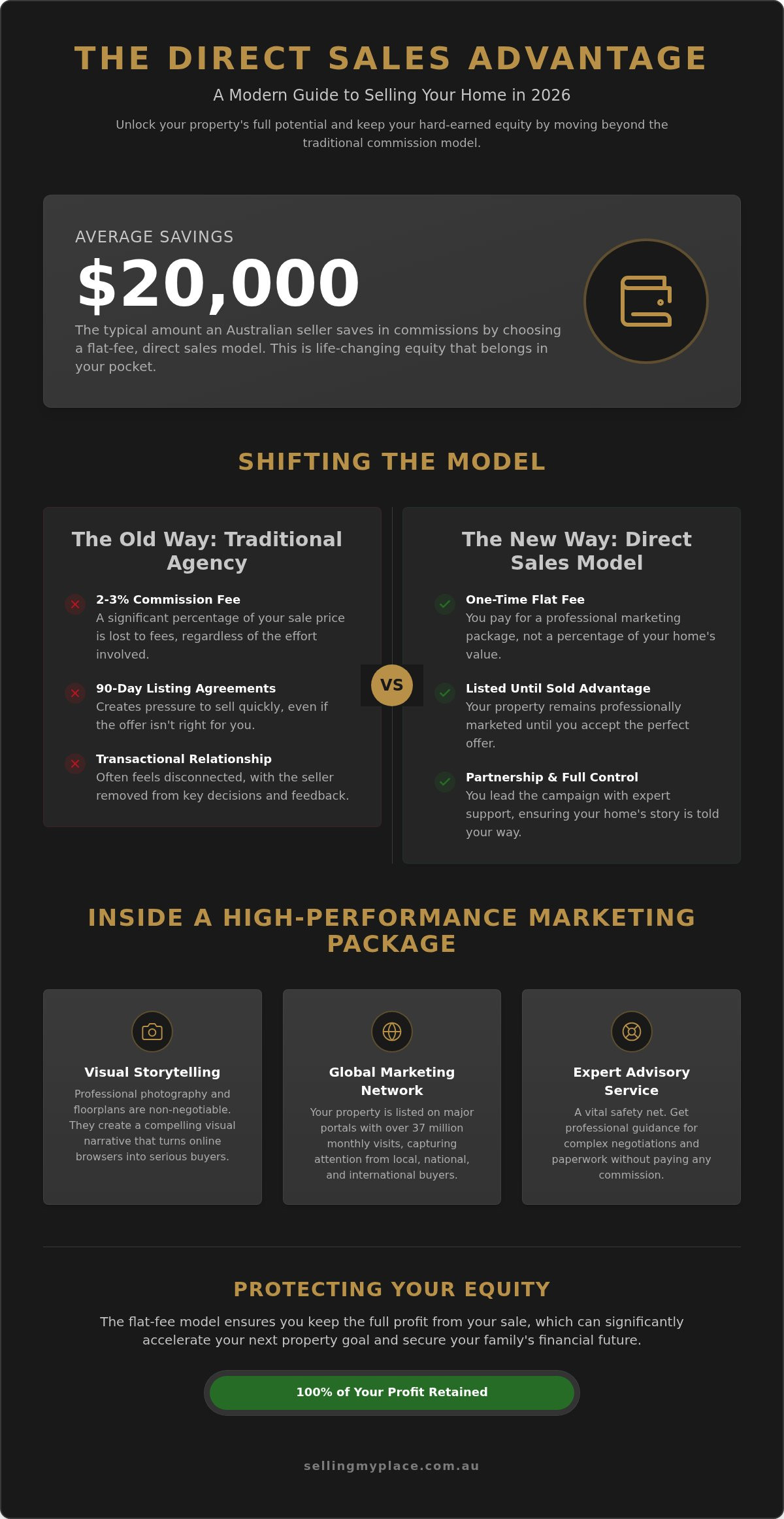
The Financial Logic: Protecting Your Equity with a Flat-Fee Model
The decision to sell your home is often the largest financial transaction of your life. It’s a moment where every dollar counts toward your future stability and your family’s goals. When you look at the ROI of high-quality for sale by owner marketing packages, the logic becomes clear. While a traditional agent might ask for a 2.5% commission, that percentage translates to a significant chunk of your hard-earned equity. On a typical Australian home, this often means walking away with $20,000 less than you deserve. Why should a stranger receive such a large portion of your life’s work?
Traditional agencies frequently layer on hidden costs that catch sellers off guard. You might find yourself paying extra marketing levies, auctioneer fees, or administration charges on top of that hefty commission. By contrast, a flat-fee model offers complete transparency. It allows for genuine wealth preservation through a 0% commission guarantee. You keep the full sale profit, ensuring your family’s financial legacy remains exactly where it belongs. This is about more than just numbers; it’s about the freedom to choose your next step without compromise.
The $20,000 Advantage: Where the Savings Go
Imagine what an extra $20,000 could do for your next chapter. It might mean a substantial mortgage reduction on your new property or the ability to fund those lifestyle upgrades you’ve always dreamed of. Keeping this equity safe also provides a vital buffer if market conditions shift during your transition. When comparing the flat-fee real estate model to percentage-based fees, the difference isn’t just a number. It’s a tangible boost to your purchasing power. This financial breathing room allows you to move forward with a sense of calm and security, knowing you haven’t overpaid for a service you can manage yourself with the right support.
Avoiding Marketing “Add-on” Traps
It’s tempting to look for the cheapest entry point, but “budget” options often lead to frustrating gaps. Some platforms offer low headline prices only to charge extra for the very things that make a listing successful. A truly professional package should be all-inclusive. You want a strategy that covers high-end photography and floorplans without a ticking clock. Our “listed until sold” promise ensures your budget is spent on assets that actually drive clicks and enquiries, rather than just keeping a listing active for a few weeks. If you’re ready to see how much equity you can protect, book a consultation with our advisory team today to discuss your custom strategy. We believe your hard work should pay off for you, not your agent.
Launching Your Sale: How to Organise Your Direct Sales Strategy
Launching your property is a moment of immense pride. It marks the culmination of your preparation and the start of a journey toward your next home. To ensure the process feels like a steady progression rather than a frantic race, we follow a methodical four-step strategy designed for maximum impact. Choosing the right for sale by owner marketing packages is just the beginning; the real success lies in the execution of your launch strategy.
- Step 1: Conduct a thorough property audit with an expert advisor to identify your home’s unique selling points.
- Step 2: Execute professional photography and floorplans to capture the home’s essence and create a digital gateway for buyers.
- Step 3: Go live on major Australian portals and our global marketing network simultaneously for maximum reach.
- Step 4: Manage enquiries and inspections with the ongoing support of a dedicated advisory service.
This structured approach ensures that no detail is overlooked. By the time your listing goes live, you’ll feel prepared, informed, and ready to welcome potential buyers into your home’s story.
Setting the Stage for Success
The 48 hours before your listing goes live are critical. We provide a checklist to ensure your home is “camera ready,” focusing on small details like fresh flowers and clear surfaces that make a big difference in person. When that first influx of buyer enquiries arrives, you’ll be ready to handle them with confidence. Remember, you’re the world’s leading expert on your own home. Positioning your property as a “must-see” in its category isn’t about sales talk; it’s about sharing the lifestyle your home offers with genuine warmth and local knowledge.
The Partnership Approach to Closing the Deal
When it comes to the negotiation phase, data is your strongest ally. You can use your Neighbourhood Market Reports to justify your asking price with clinical accuracy, showing buyers exactly how your home compares to recent local sales. It’s a grounded way to handle tough questions without getting caught in an emotional tug-of-war. If you hit a particularly tricky patch, you can always lean on your Agent Advisory Service for final contract tweaks or strategic advice. Once the offer is accepted, we’ll guide you through finalising the settlement, leaving you free to celebrate your commission-free success and focus on the exciting move ahead.
Reclaim Your Equity and Start Your Next Chapter
Selling your family home is a significant life transition that deserves both professional precision and heartfelt care. Throughout this guide, we’ve seen how modern for sale by owner marketing packages provide the elite infrastructure needed to compete with traditional agencies while keeping you in the driver’s seat. By leveraging a global marketing network and professional visual assets, you ensure your property stands out to the right buyers, whether they’re searching from just around the corner or from overseas.
You don’t have to navigate the complexities of negotiation or contracts alone. With an Expert Agent Advisory Service included, you gain the confidence of a seasoned partner without the burden of high commissions. Saving an average of $20,000 per sale isn’t just a number; it’s a deposit on your next dream or a boost to your retirement nest egg. It is about moving forward with clarity, security, and the peace of mind that comes from a job well done.
Keep 100% of your profit and sell smarter with Kincade International Direct Sales. You’ve worked hard for your home, and we’re here to help you protect every cent of its value as you step into your future.
Frequently Asked Questions
What exactly is included in for sale by owner marketing packages?
These packages provide a professional infrastructure for your sale. They include professional photography and floorplans to capture your home’s essence, along with listings on leading property portals. Beyond the visuals, you receive a Neighbourhood Market Report for accurate pricing and access to a global marketing network. Most importantly, an expert advisory service is included to guide you through the technical and emotional stages of the transaction.
Will my property appear on the major Australian property portals with these packages?
Yes, your property will be showcased on Australia’s leading real estate websites and search platforms. These sites are the primary destination for millions of monthly visitors, and our packages ensure your listing occupies prime digital real estate. By appearing where the vast majority of buyers are searching, you gain maximum exposure while keeping 100% of your hard-earned profit. It is about being seen by the right people at the right time.
How much can I actually save by selling my own home in Australia?
Sellers typically retain an average of $20,000 in equity that would otherwise be lost to commissions. This saving is based on the typical commission rates currently found across the Australian market. By opting for a flat-fee service, you protect your hard-earned profit, allowing those funds to be redirected toward your next property purchase or lifestyle goals. It is a practical and empowering way to preserve your family’s wealth.
Is professional photography really necessary for a private sale?
High-quality photography is the most critical element of your digital presence. Since most buyers find their next home online, your images act as the first “open home.” Professional shots capture the emotional appeal and light of your property, which significantly increases enquiry rates. When paired with detailed floorplans, these visuals build immediate trust and help filter for the most serious and motivated buyers before they even arrive for an inspection.
What happens if my property doesn’t sell within 90 days?
Our “listed until sold” promise ensures your property remains active on the leading portals for as long as it takes. Unlike traditional 90-day agency agreements that can create unnecessary pressure, we provide a stress-free environment for our partners. You can wait for the perfect buyer who truly understands the value of your home, ensuring you never feel forced to accept a lower offer just because a clock is ticking in the background.
Do I need a lawyer or conveyancer if I use a marketing package?
Yes, a licensed legal professional is required to manage the formal transfer of title and settlement. While for sale by owner marketing packages handle the strategic and promotional side of the sale, the legal work must be performed by a conveyancer or solicitor. We provide expert conveyance advice to help you select the right professional and ensure the contract stage proceeds smoothly and securely for all parties involved in the transition.
Can I still get help with negotiations if I am selling privately?
Absolutely, and this is where our Agent Advisory Service becomes your greatest asset. We provide expert guidance during the offer stage, helping you interpret buyer feedback and stand firm on your price. Having a “steady hand” to consult during these high-stakes moments ensures you achieve the best possible outcome. You retain full control of the sale while benefiting from professional, authoritative strategic support that reduces the typical stress of closing a deal.
How does the global marketing network help sell my Australian home?
The network broadens your reach to international buyers and Australian expats who may not be searching local portals daily. This global visibility creates a more competitive environment for your home, which is essential for driving a premium result. By presenting your property to a worldwide audience, you tap into a diverse pool of motivated buyers who are actively seeking quality Australian residential opportunities for their future stability and lifestyle.
Free Online Property Valuation: How Accurate Are They in 2026?
What if the number you just saw on a free online property valuation is actually $28,800 away from your home’s true worth? It’s a common scenario in 2026, where a 7.2% error rate on off-market properties can lead to significant confusion and the very real fear of underselling your most valuable asset. We understand the anxiety that comes with conflicting estimates; it’s hard to feel confident about your future when the digital data seems to change depending on which website you’re visiting.
You deserve to move forward with total clarity and a sense of calm. This guide will help you discover the truth behind automated property estimates and show you how to use that digital data to secure the best possible sale price for your Australian home. We’ll explore the latest 2026 accuracy benchmarks, explain why on-market data is more reliable than off-market guesses, and provide you with the tools to establish a realistic price range. By the end, you’ll have the confidence to manage your own sale and keep your hard-earned equity where it belongs.
Key Takeaways
- Learn how to treat a free online property valuation as a helpful data-driven compass rather than a definitive final sale price.
- Discover the specific “invisible factors” that algorithms often overlook, ensuring you don’t undervalue your home’s unique features or recent improvements.
- Master the technique of cross-referencing multiple digital tools to establish a realistic price floor and gain the confidence to lead your own sale journey.
- Understand how accurate market data allows you to sidestep traditional agent commissions and protect your family’s hard-earned equity.
- Explore how upgrading to a Neighborhood Market Report provides the professional-grade insights needed to secure a premium result with total peace of mind.
What is a Free Online Property Valuation?
When you’re standing in your kitchen, perhaps enjoying a morning flat white and thinking about the next chapter of your life, a free online property valuation is often the very first place your journey begins. It’s a digital starting line that offers a glimpse into your home’s potential without needing to tidy up for an unannounced visitor. While it feels like a simple search result, you’re actually interacting with a complex Automated Valuation Model (AVM). An AVM is a statistical tool that processes millions of data points to predict market value with mathematical precision.
It’s helpful to distinguish these estimates from other figures you might encounter. A bank valuation is typically conservative, focused on lender risk rather than your profit. A real estate appraisal is a human-led estimate, often influenced by the desire to secure a listing. An online estimate, however, acts as a neutral data-driven snapshot based on recent local sales and your property’s core characteristics. It provides a grounded starting point, helping you move from uncertainty toward a structured plan for your lifestyle transition.
The Role of Big Data in Australian Real Estate
Algorithms don’t just look at what happened yesterday; they analyse a decade of historical sales to identify long-term patterns in your suburb. In the Australian market, “Comparable Sales” (or “Comps”) are the lifeblood of these systems. The computer identifies properties similar to yours in land size, internal floor area, and bedroom count that have recently changed hands nearby. By weighing these “comps” against current market velocity, the algorithm calculates a price range. It’s a purely mathematical approach to a very personal asset, stripping away the noise to look at the cold, hard numbers.
Why Sellers Start with Online Estimates
The primary appeal of a free online property valuation is the lack of pressure. You can explore your options privately, without the intensity of a formal listing presentation or the feeling that you’re being pushed into a quick sale. Many homeowners use these tools to assess their equity, which is a vital step when deciding if you’re ready for a sea change or an investment upgrade. It’s about finding an objective figure to balance the deep emotional attachment we all have to our family homes. Having a realistic number in hand provides a sense of calm, allowing you to visualise your future state with confidence rather than guesswork.
The Science Behind the Screen: How Estimates are Calculated
Peering behind the digital curtain reveals a sophisticated engine room of data. When you request a free online property valuation, the algorithm begins by pulling the structural basics of your home: land size, internal floor area, and the all-important bedroom and bathroom count. These are the fixed variables, but the real intelligence lies in how the software weights recency. In our fast-moving 2026 market, a sale that settled yesterday carries significantly more weight than a similar property sold six months ago. This is because algorithms are programmed to track suburb-wide growth trends and “days on market” averages in real-time to sense the current heat of the local area.
However, these systems have a distinct blind spot. They see the box, but they don’t always see the beauty. While these models are highly advanced, research from the Brookings Institution highlights that automated systems can sometimes miss the mark when local nuances or unique architectural features aren’t perfectly captured in the raw data. If your home boasts a bespoke jarrah deck or a high-end kitchen renovation, the algorithm might categorise you simply as “renovated” without understanding the premium quality of the materials used.
Weighting Factors in the Algorithm
Software quantifies location proximity with ruthless efficiency. It measures the exact distance to amenities like train stations, parks, and schools, assigning a mathematical value to convenience. There’s often a tug-of-war between “Street Appeal” and “Land Value” in these calculations. While we might fall in love with a charming facade, the algorithm often prioritises the raw land size and zoning potential. Many tools now provide a “Confidence Score” alongside the estimate. This score is actually more important than the price itself; it tells you how much comparable data is available. A low score suggests the algorithm is guessing, while a high score means it has plenty of recent evidence to back its claim.
Data Sources: Where the Information Comes From
Most free online property valuation tools draw their power from government land registries and historical listing portals. This provides a solid foundation, but it’s not always instantaneous. There is often a lag time of several weeks between a sale occurring at auction and the official settlement data being processed by the state registry. To bridge this gap, some models incorporate user-submitted data. If you’ve recently updated your home, you can often “claim” your property on these portals to update the facts. If you’re feeling unsure about how your home’s specific upgrades are being weighed by the data, reaching out for a friendly chat can help provide the clarity you need to move forward.
Algorithm vs. Reality: Why Online Estimates Can Miss the Mark
While a free online property valuation provides a helpful ballpark, it fundamentally lacks the human eye required to judge quality. Algorithms are excellent at counting bricks and measuring land, but they’re terrible at feeling the atmosphere of a home. An Urban Institute study highlights how data-driven models can struggle with qualitative nuances, sometimes reinforcing local disparities because they cannot account for the tangible love and care poured into a property. We know your home is more than just a set of coordinates on a map; it’s a collection of memories and carefully chosen finishes that a computer simply cannot process.
Then there’s the “Outlier Effect.” If a neighbour sells their home in a desperate hurry, or if two emotional buyers get into a bidding war over a specific view, that single data point can skew the entire suburb average. A computer sees the price tag but doesn’t know the story behind it. Relying solely on a screen when setting your reserve price is a risky move. It doesn’t account for current buyer heat or the specific market sentiment on auction day. Without that human context, you might find yourself anchored to a number that doesn’t reflect the true competitive nature of the local market.
The Five Things an Algorithm Cannot See
The software often misses the sensory details that drive a buyer’s heart and ultimately their budget. These invisible factors often dictate whether a home sells for a standard price or a suburb record. They include:
- The specific orientation of the home and how natural light floods the living areas during a winter afternoon.
- Nuisance factors such as proximity to main roads or power lines which can dampen an otherwise strong valuation.
- The “wow factor” of high-end internal finishes and the quality of a professional renovation.
- The psychological pull created by expert Photography in attracting premium buyers to your listing.
- The functional flow and spatial clarity provided by accurate floorplans.
When Online Valuations are Most (and Least) Accurate
Accuracy is usually highest in “cookie-cutter” estates where every house is similar in age and style. In these areas, the algorithm has plenty of identical data points to work with. However, accuracy drops significantly for unique heritage homes or properties in rural areas with low transaction volumes. If the data is thin, the algorithm might “hallucinate,” generating a number that has completely lost touch with the ground reality. Recognising when the data is unreliable is the first step in protecting your equity and ensuring you don’t leave money on the table during your sale.
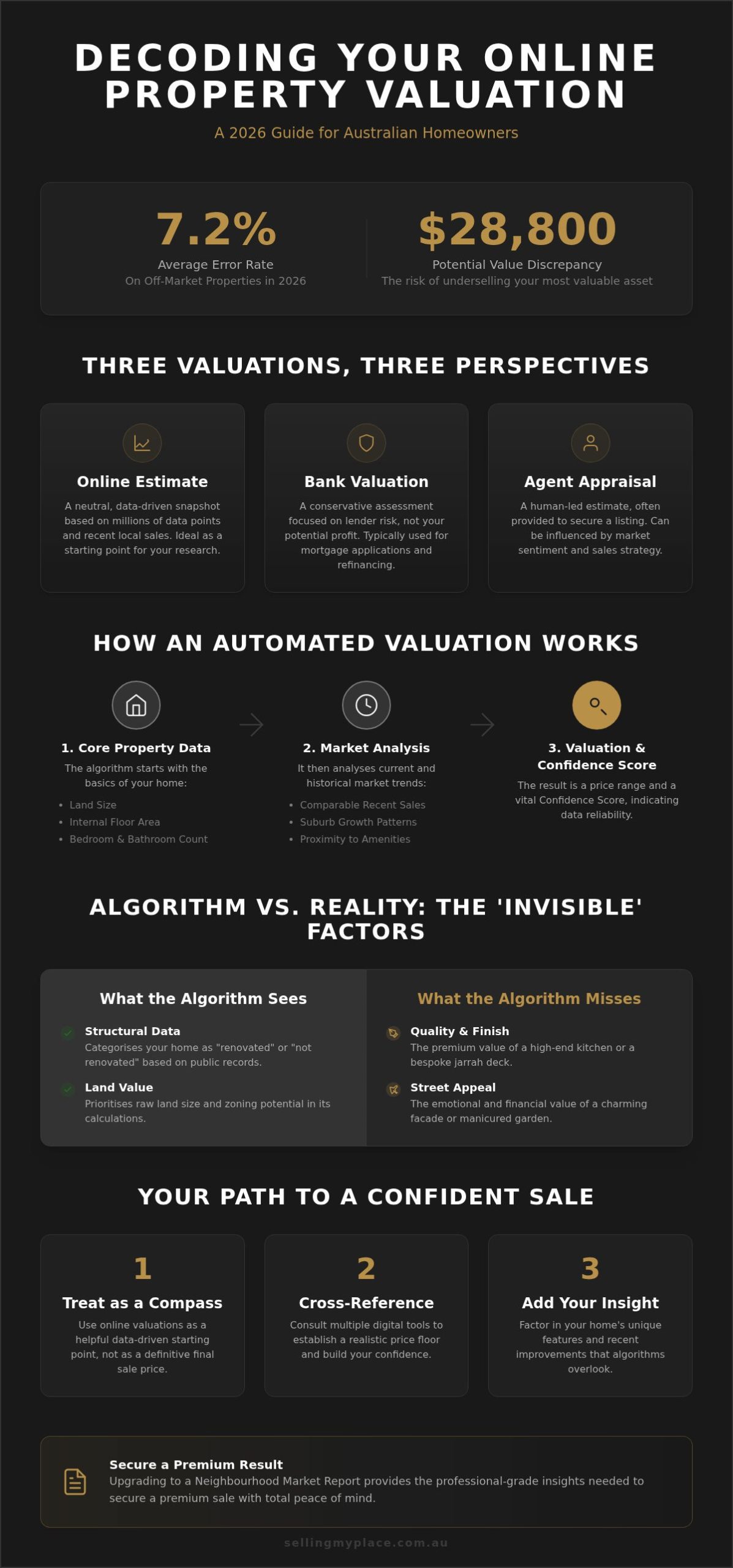
Using Your Valuation to Maximise Your Sale Price
Once you’ve received your free online property valuation, the real strategy begins. It’s helpful to view this number as your “floor” rather than your “ceiling.” It represents the minimum value the market expects based on raw data, but your goal is to build upon that foundation through smart presentation and timing. By cross-referencing estimates from three or four different digital tools, you can find a reliable median that filters out any single algorithm’s quirks. This balanced approach is a core part of how to determine the market value of a home in Australia, blending digital efficiency with a sensible reality check.
When you’re ready to list, consider whether a “Price Guide” or a “Fixed Price” better suits your suburb’s current energy. A guide often invites more conversation and competition, while a fixed price offers clarity for buyers who want to move quickly. The choice often depends on how much “buyer heat” is currently present in your specific street.
Bridging the Gap with a Neighborhood Market Report
A basic web search only tells you what has happened in the past. A Neighborhood Market Report acts as the “pro version” of a free online property valuation, telling you what is happening right now. It allows you to look closely at active competitor listings to see exactly what features buyers are prioritising this week. By identifying these “sweet spots” where demand is high but supply is low, you can position your home to stand out as the obvious choice for a premium buyer.
Pre-Sale Consulting: The Human Advantage
Data can’t tell you that a $500 tin of paint and a weekend of garden mulching might add $5,000 to your final result. Our Pre-Sale Property Consulting focuses on these high-return minor repairs that often yield a 10x return on investment. De-cluttering and staging also play a huge role in the psychological “buy-in” for visitors, making the space feel like their future home rather than someone else’s history. Professional advice transforms a static data point into a dynamic, profitable sale strategy.
Ready to see how your digital data stacks up against a professional sale strategy? Get in touch with our team today to start your commission-free journey with confidence.
The KIDS Approach: From Valuation to Commission-Free Success
Most websites treat a free online property valuation as a digital hook, designed to reel you in and hand you over to a traditional real estate agent. These agents then ask for a 2-3% commission, which can feel like a heavy price to pay for a service you’re increasingly equipped to handle yourself. We believe that once you have the data, you have the power. By choosing Residential Property Listing Services, you’re opting for a modern, commission-free alternative that puts you back in the driver’s seat of your own sale. It’s a partnership where we provide the tools and you keep the reward.
On average, our clients save $20,000 in commissions. That’s a significant sum that stays in your pocket, perhaps to fund your next deposit or simply to secure your family’s future. We also remove the ticking clock often associated with real estate listings. Our “Listed Until Sold” promise means you can test the market and wait for the right buyer without the stress of expiring contracts or mounting marketing fees. It’s a calmer, more methodical way to achieve a premium result. You shouldn’t feel rushed when making such a major life transition.
Keeping Your Equity Safe
The maths of a sale by owner is refreshingly simple: 0% commission equals 100% of the profit for you. While the idea of managing your own sale might seem daunting at first, you aren’t doing it alone. You’ll have access to professional advisory services to help you navigate the legalities, including essential Conveyance Advice to ensure the settlement process is smooth and secure. There’s a deep sense of peace that comes from being in total control of your financial legacy. You know your home better than anyone, so why not be the one to tell its story? It’s about protecting your equity and your family’s future with a steady hand.
Taking the Next Step
If you’ve spent time researching your free online property valuation and feel ready for something more substantial, it’s time to request a Neighborhood Market Report. This report moves you beyond the “just curious” phase and makes you truly market-ready. It provides the granular, local insights that algorithms often miss, giving you the professional edge needed to negotiate with confidence. We’re here to act as your seasoned guides, helping you translate data into a successful sale. Don’t just settle for a generic online number. Take the lead, secure your profit, and start your next chapter with the financial freedom you deserve.
Take Control of Your Next Chapter
Your home is likely your greatest financial asset, and moving on to your next adventure should be a time of excitement rather than anxiety. While a free online property valuation provides a useful digital compass, it’s the refined strategy and local expertise that ultimately lead you home. By combining the latest market data with professional pre-sale consulting, you ensure that no dollar of your hard-earned equity is left on the table. You’ve worked hard for your home; you deserve to keep the reward.
Choosing a commission-free path doesn’t mean going it alone. With our global marketing network and Expert Agent Advisory included in every package, you have a steady hand guiding you through every step of the process. Owners who partner with us save an average of $20,000 in commissions; money that belongs in your pocket for your future. It’s about more than just a sale; it’s about honouring your legacy and transitioning with total peace of mind. Are you ready to see what’s truly possible for your property?
Secure your equity and sell commission-free with Kincade International Direct Sales today and move forward with the confidence you deserve.
Frequently Asked Questions
How accurate are free online property valuations in Australia?
Accuracy depends on whether your home is currently listed. For properties on the market in 2026, the median error rate is often under 2%. However, for off-market homes, the discrepancy can climb significantly higher. These tools rely on “comparable sales” and public data, meaning they work best in suburbs with high turnover and many similar houses. In rural areas or for unique builds, the accuracy naturally starts to drop.
Why is there such a big difference between different online estimates?
Discrepancies exist because every platform uses a unique algorithm that weights data points differently. One website might prioritise government land registry data, while another focuses more on recent listing prices from real estate portals. These varied “recipes” for calculation mean you’ll often see a range of prices. It’s best to look at multiple sources to find a realistic median for your home’s potential value.
Can a bank valuation be lower than an online property estimate?
It’s very common for a bank valuation to come in lower than a digital estimate. This happens because banks are focused on risk mitigation rather than achieving a premium sale price. They want to know what the property would sell for in a forced sale scenario. An online estimate, by contrast, is trying to predict what a motivated buyer might pay in an open, competitive market.
How do I update the information used in my online property valuation?
You can usually update your property’s details by “claiming” the home on the specific website providing the estimate. This allows you to correct the number of bedrooms or bathrooms and add details about recent renovations. Updating these facts helps the free online property valuation tool refine its calculation. It ensures the algorithm isn’t working with outdated information from ten years ago when you first bought the place.
Do I still need a professional appraisal if I have an online estimate?
Yes, you should still seek expert advice before making a final decision on your sale price. An online tool can’t see the quality of your new stone benchtops or feel the natural light in your living room. A professional appraisal provides the human context that data misses. It helps you understand the “buyer heat” in your street and how to position your home for a premium result.
Will a free online valuation affect my credit score?
No, checking your property’s estimated value online will not affect your credit score in any way. These searches are considered “soft” enquiries that don’t involve a credit application. You can check as many different sites as you like without worrying about your financial standing. Only “hard” enquiries, which happen when a lender reviews your credit file for a loan, will show up on your report.
How often should I check my property value estimate?
Checking your estimate once every three months is usually enough to keep an eye on your equity. Property is a long-term asset, so watching the numbers too closely can be stressful. Suburb trends often take months to show up clearly in the data. A quarterly check-in gives you a grounded view of how your local market is performing without getting caught up in minor weekly fluctuations.
What is the best way to get a formal property valuation for a sale?
The most effective way to get a formal, actionable valuation for a sale is to request a Neighborhood Market Report. This provides a much deeper level of insight than a basic free online property valuation. It combines digital data with a detailed analysis of active competitors in your area. This professional approach gives you the confidence to manage your own sale and keep your hard-earned equity for yourself.
Private House Sales Australia: The Comprehensive 2026 Seller’s Guide
What if the most expensive mistake you make this year isn’t the price you set for your home, but the $20,000 you hand over to someone else just for selling it? In 2026, the traditional path of paying a 2.65% commission is no longer the only way to achieve a premium result. More homeowners are taking the reins through private house sales australia, discovering that they can maintain total control without sacrificing that polished, professional edge. It’s a shift towards keeping your hard-earned equity where it belongs, right in your own pocket.
We understand that your home is more than just an asset; it’s the heart of your family’s story. It’s natural to feel a bit of trepidation about managing the process yourself or worrying that a private listing might look less than stellar. You deserve the savings without having to compromise on quality or legal security. This guide will show you how to master the private sale process, keeping 100% of your commission while achieving a result that rivals any traditional agency. We’ll walk you through the latest 2026 identity verification laws, professional marketing strategies, and the expert advisory steps that ensure a smooth, confident settlement.
Key Takeaways
- Learn how a commission-free, flat-fee model can save you an average of $20,000 while maintaining a professional-grade property listing.
- Discover how private house sales australia leverage high-calibre marketing assets, like professional photography and floorplans, to attract premium buyers without high agency costs.
- Understand the value of a data-driven Neighborhood Market Report to ensure your home is priced competitively for the 2026 landscape.
- Explore the “steady hand” approach of Agent Advisory Services, providing you with expert support throughout the settlement process to reduce stress.
- Identify high-ROI home improvements through pre-sale consulting to ensure your property stands out in an increasingly crowded market.
Private House Sales Australia: The 2026 Landscape
Selling a family home is a significant life transition, often filled with decades of memories and hopes for the future. In 2026, the way we approach this milestone has shifted. Private house sales australia have evolved from a niche alternative into a mainstream choice for homeowners who value both their equity and their autonomy. At its core, a private sale is a direct exchange between the seller and the buyer, facilitated by professional-grade marketing rather than a traditional commission-based agent. It is about reclaiming the narrative of your move.
Why are so many Australians moving away from the standard 2% to 3% commission model? It often comes down to a desire for transparency and a refusal to lose $20,000 or more in fees that could otherwise fund a retirement or a child’s education. By utilising modern digital infrastructure, you can now access the same buyer networks once reserved for large franchises, ensuring your home is seen by the right people at the right time. The Australian property market has matured, and with that maturity comes the empowerment of the individual seller.
Why Direct Sales are Surpassing Traditional Agency
The shift toward owner-led negotiations is driven by a simple truth: no one knows the unique charm of your home better than you do. You can speak to the afternoon sun in the kitchen or the quietness of the street with a level of sincerity an agent simply can’t match. Technology has levelled the playing field, providing professional tools that make your listing indistinguishable from an agency-managed one. This rise in direct sales infrastructure means you’re no longer “going it alone”; you’re simply choosing a more efficient, modern partnership that prioritises your profit over an agent’s commission.
The Legal Framework for Private Sales in Australia
It’s a common misconception that you need an agent to sell residential property. In reality, every Australian homeowner has the legal right to sell their own home privately. While the process is straightforward, it must be grounded in sound legal practice. Engaging professional Conveyance Advice is essential to ensure all vendor disclosure requirements are met. Selling privately doesn’t mean you’re operating without a safety net. It simply means you’re the one in the driver’s seat, supported by the right experts at the right moments to ensure a secure, compliant transaction.
The Mechanics of a Successful Commission-Free Sale
Success in private house sales australia relies on a transparent, flat-fee structure that puts you back in control of your finances. Unlike the traditional commission model, where you’re essentially penalised for having a higher property value, this modern approach treats the sale as a professional service. You pay once for the high-calibre marketing and advisory tools you need, and you keep every cent of the final sale price. This clarity removes the guesswork and the hidden costs that often cloud the selling experience.
One of the most reassuring aspects of this model is the “List Until Sold” philosophy. Traditional agency agreements often come with a stressful 90-day ticking clock, creating a sense of urgency that might not serve your family’s best interests. By removing these arbitrary deadlines, you can wait for the right buyer who truly values your home’s unique story. It’s about selling with a sense of calm confidence rather than under the pressure of an expiring contract. If you’re ready to see how this partnership works, you can speak with our team about your specific goals.
Professional Marketing vs. DIY Listings
There’s a significant difference between “selling it yourself” and utilising a professional infrastructure. In 2026, a listing that looks amateur is a listing that gets overlooked. High-quality Photography acts as the digital front door to your property, creating that vital first emotional spark. When you pair those evocative images with accurate floorplans, you provide serious buyers with the spatial logic they need to fall in love with the layout. This level of polish ensures your home is presented with the dignity it deserves, avoiding the “cheap” look of low-quality, owner-taken photos.
Leveraging Global Reach
The private sale process in Australia has expanded far beyond the local neighbourhood. Our property remains a highly desirable asset on the international stage, attracting significant interest from ex-pats and overseas investors. By plugging into a global marketing network, your home is visible to buyers in London, Singapore, and beyond who are searching for the stability and lifestyle our country offers. This global digital infrastructure ensures you aren’t just waiting for a local buyer; you’re inviting the world to appreciate your home’s value.
Flat-Fee vs. Percentage Commission: The True Cost
When you sit down to calculate the potential return on your property, the numbers often tell a startling story. In the world of traditional real estate, a 2.5% commission on a $1 million home equates to $25,000. Once you add GST, that figure climbs to $27,500. This is money that effectively vanishes from your family’s balance sheet the moment the contract is signed. For those exploring private house sales australia, this realisation is often the catalyst for change. Why should the cost of selling your home increase simply because your property’s value has grown?
Traditional agencies frequently layer additional costs on top of this commission, often referred to as a “marketing levy” or advertising fee. This means you aren’t just paying for the agent’s time; you’re also footing the bill for their brand’s visibility. In contrast, a transparent flat-fee model provides a single, clear payment for professional listing services. You receive the high-calibre photography and floorplans needed to attract premium buyers, but you retain 100% of the final sale price. It’s a straightforward partnership where you pay for the work performed, not a percentage of your home’s legacy.
Calculating Your Potential Equity Savings
Visualising your net profit is about more than just digits on a screen. It’s about what that $20,000 or $30,000 saving represents for your next chapter. It could be the budget for a high-end kitchen renovation in your new place, a significant reduction in your next mortgage, or a well-deserved boost to your retirement nest egg. For families planning for future support, Aged Care Made Easy offers a comprehensive directory to explore care options. The Commission Gap is the unnecessary cost of traditional middle-management that often fails to provide proportional value in a modern, digitally-connected market. Keeping this equity gives you a stronger foothold for whatever comes next.
Beyond the financial gain, there’s a profound psychological benefit to the flat-fee approach. You’ll never feel the subtle pressure to “drop the price” just so an agent can secure a quick turnover and move on to their next listing. Since you’ve already covered the service fee, the timeline is entirely yours to command. This model offers complete transparency in all marketing expenditure, ensuring you know exactly where every dollar goes. There’s a grounded sense of calm that comes from knowing you’re in total control of the process, supported by experts who respect your bottom line as much as you do.
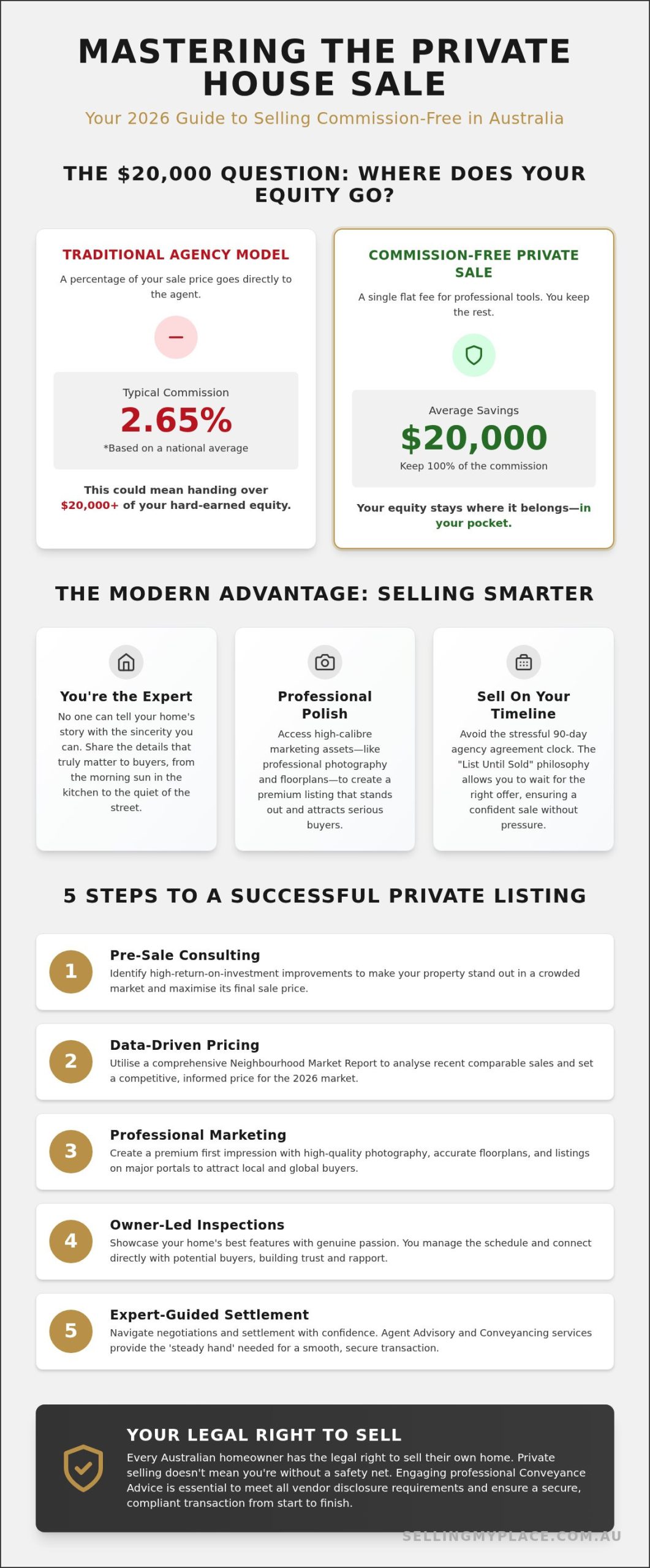
5 Essential Steps to Organise Your Private Listing
Approaching your sale with a methodical plan transforms the process from a daunting task into a series of manageable, rewarding milestones. Success in private house sales australia isn’t about luck; it’s about preparation. By following a structured path, you ensure that every detail of your home’s legacy is respected while maximising your financial return. It’s about being proactive rather than reactive.
- Step 1: Start with a data-driven Neighborhood Market Report. This removes the guesswork and helps you understand exactly where your property sits in the current local landscape.
- Step 2: Engage Pre-Sale Property Consulting. A fresh set of expert eyes can identify high-ROI improvements, such as minor repairs or styling tweaks, that significantly boost buyer appeal.
- Step 3: Arrange professional photography and floorplans. As we discussed earlier, these are your digital front door; they must be flawless to capture serious interest.
- Step 4: Write a compelling narrative. Don’t just list features; tell the story of the lifestyle your home offers, from the quiet morning coffee spot to the garden perfect for family gatherings.
- Step 5: Launch on major property portals. Use a dedicated dashboard to manage enquiries, ensuring you never miss a potential buyer while maintaining total control over your schedule.
If you’re feeling unsure about where to begin your journey, you can contact our advisory team for a personalised starting point.
Pricing for Success in the 2026 Market
Setting the right price from day one is the most critical factor in a smooth sale. You might feel tempted to “test the market” with a higher figure, but in 2026, buyers are more informed than ever. Overpricing can lead to your listing becoming “stale,” causing savvy buyers to wonder what’s wrong with the property. Using a guide on how to determine market value of a home in Australia allows you to set a price grounded in reality. When buyers ask about the price, you can confidently point to recent comparable data, showing them you’re a serious and fair seller.
Managing Inspections and Negotiations
Conducting your own open homes is a wonderful opportunity to share your genuine passion for the property. Keep the atmosphere welcoming and professional; offer a simple brochure and allow visitors the space to imagine their own lives in the rooms. When it comes to the business side, applying property sale negotiation tips ensures you remain the “steady hand” in the room. You don’t have to be a shark to get a great result. If a negotiation feels complex or emotional, that’s the perfect time to lean on your Agent Advisory Service for professional backing without the commission-based pressure.
The Kincade Advantage: Selling Smarter, Together
Entering the market without a traditional agent shouldn’t mean you’re left to figure it out on your own. At Kincade International Direct Sales (KIDS), we view ourselves as the steady hand in your journey, offering a partnership that respects the emotional weight of moving on from a family home. We’ve built a model for private house sales australia that replaces high-pressure tactics with professional support, ensuring your legacy is protected while your equity stays with you. It’s about moving forward with a sense of security and a clear path to your next chapter.
Expert Backing for Every Australian Seller
Our Agent Advisory Service is the cornerstone of this approach. It provides you with a professional safety net, giving you access to the same level of expertise you’d expect from a top-tier agency, but without the commission-based conflicts of interest. We believe that professional guidance should be a supportive resource, not a financial burden. By integrating conveyance advice and pre-sale property consulting into one cohesive experience, we reduce the stress of complex legal and marketing decisions. You don’t have to be an expert in property law or digital advertising to get a great result; you just need the right people in your corner.
Think of us as a nurturing guide who understands your community roots and family needs. We’re here to help you move through the settlement phase with absolute calm and confidence, providing answers when you need them and stepping back when you’re ready to lead. This balance ensures that while you’re in total control of the sale, you’re never truly alone in the process. It’s a professional-casual relationship built on trust, local knowledge, and a shared goal of maximising your profit.
A Global Network for a Local Sale
While your home is local, your potential buyer could be anywhere. The KIDS digital infrastructure provides a global marketing network that ensures your property is seen by a vast audience of motivated buyers, from those in your own neighbourhood to ex-pats looking to return home. This reach is a vital part of private house sales australia in 2026, allowing you to bypass the limitations of traditional local franchises. You get the best of both worlds: the personal touch of an owner-led sale and the massive visibility of an international marketing powerhouse.
This isn’t just about listing a house; it’s about taking control of your financial future and the stability of your next chapter. When you choose to sell smarter, you aren’t just saving money; you’re investing in your own family’s legacy. It’s time to embrace a more transparent, respectful way of selling that puts your needs first. To begin your journey with the right tools and a steady hand to guide you, explore our Professional Residential Property Listing Services and see how we can help you achieve a professional result on your own terms.
Secure Your Equity and Your Next Chapter
Choosing to sell your own home is a decision rooted in both financial wisdom and a deep respect for your property’s legacy. We’ve explored how the 2026 property landscape has evolved, making private house sales australia a sophisticated and secure option for those who value transparency. By bypassing the traditional commission model, you aren’t just saving an average of $20,000; you’re ensuring that the full value of your hard work remains with your family where it belongs.
Success comes down to pairing your local knowledge with professional-grade tools. With our expert Agent Advisory Service acting as your safety net and high-calibre assets like professional floorplans and photography at your disposal, you have everything needed to achieve a premium result. You don’t have to navigate this transition alone. Our team is here to provide the steady hand and nurturing guidance that makes the process feel calm, clear, and celebratory. It’s time to step into your future with confidence and total control over your move.
Start Your Commission-Free Sale Journey with SellingMyPlace.com.au today and discover how rewarding it feels to lead your own success story.
Frequently Asked Questions
Is it legal to sell my own house privately in Australia?
Yes, it’s completely legal across all Australian states and territories. Every homeowner has the right to manage their own residential sale without appointing a traditional commission-based agent. To stay protected, you simply need to ensure you’ve prepared a valid Contract of Sale and met all vendor disclosure requirements before you begin. Following the 2026 identity verification laws ensures your transaction is secure and professionally handled from start to finish.
How much commission will I save with a private house sale?
You’ll save the entire percentage-based fee typically charged by agents, which averages $20,000 per sale nationally. In 2026, with median commission rates often exceeding 2.5%, the financial benefit of a flat-fee model is significant. By retaining this equity, you’re able to put that money directly toward your next property purchase or retirement nest egg. It’s a practical way to ensure your home’s value stays in your own pocket.
Will my property appear on major national search portals?
Yes, your home will be featured on the leading property search platforms that buyers use every day. While these portals generally restrict direct access for individuals, our professional residential listing services provide the gateway you need for private house sales australia. This ensures your property maintains the same high digital visibility as any agency-managed listing, allowing you to capture the attention of motivated buyers across the country and overseas.
What happens if I need help with negotiations or contracts?
You’re never left to navigate the difficult moments alone. Our Agent Advisory Service acts as your professional safety net, offering the “steady hand” you need during complex discussions. Whether you’re unsure about a buyer’s terms or need guidance on handling multiple offers, we provide expert support to help you secure a fair result. This partnership ensures you have professional backing without the high cost of a traditional agency commission.
How do I handle the legal paperwork without a traditional real estate agent?
You manage the legal requirements by partnering with a qualified solicitor or conveyancer, which is standard practice for any property transfer. We provide integrated conveyance advice to help you understand the necessary steps for a smooth settlement. Your legal representative will handle the exchange of contracts and the final transfer of funds through the PEXA platform, ensuring the entire process is legally compliant and your family’s interests are fully protected.
Can I still get professional photography and floorplans if I sell privately?
Absolutely, as these high-calibre marketing assets are a standard part of our flat-fee model. We understand that your home’s “digital front door” must look impeccable to attract premium buyers in 2026. By providing professional photography and accurate floorplans, we ensure your listing has the polished, sophisticated feel required to stand out. You don’t have to sacrifice quality to save on commission; your home will always be presented with dignity.
Is there a time limit on how long my property can be listed?
There are no stressful time limits or 90-day expiry dates with our “List Until Sold” philosophy. We believe you should have the freedom to wait for the buyer who truly understands your home’s worth. This removes the artificial pressure often felt in traditional agency agreements, allowing you to manage the sale at a pace that suits your family’s needs. You maintain total control over your timeline and your moving plans.
What is the “Direct Sale” model compared to “For Sale By Owner”?
The Direct Sale model is a professional evolution of private house sales australia that moves beyond the basic “DIY” approach. While traditional “For Sale By Owner” methods often leave you to figure things out alone, Direct Sales provides a comprehensive professional infrastructure. You get the autonomy of an owner-led sale combined with expert advisory support, high-end marketing tools, and a global reach. It’s a smarter, more supported way to sell together.
How to Sell a Townhouse Privately in Australia: The 2026 Seller’s Guide
With the national median dwelling value reaching $922,838 in early 2026, handing over a significant slice of your equity to an agent can feel more like a sacrifice than a service. You’ve worked hard to maintain your home and navigate the unique quirks of strata life, so it’s only natural to want to protect your profit. We understand that the thought of managing contracts and marketing might feel daunting, but you don’t have to do it alone. Learning how to sell a townhouse privately is about more than just saving $20,000 in commissions; it’s about taking control of your property’s legacy with confidence and professional support.
This guide provides a clear, step-by-step roadmap to mastering the private sale process in the current Australian market. We’ll show you how to outshine traditional listings by using professional-grade visuals and transparent strata reporting to attract premium buyers. From organising your vendor statements to positioning your home in a shifting market, you’ll discover how to achieve a legally compliant, high-value result. It’s time to trade the stress of high fees for a sophisticated, partnership-based approach that puts your family’s future first.
Key Takeaways
- Retain more of your home’s equity by eliminating traditional agent commissions in favour of a transparent flat-fee model.
- Simplify the legal side of the sale by organising strata records and vendor statements well before your first inspection.
- Capture premium attention with professional-grade photography and floorplans that showcase your townhouse’s unique lifestyle appeal.
- Master how to sell a townhouse privately with the support of a dedicated Agent Advisory Service to guide your decision-making.
- Learn to manage inspections like a pro, ensuring your home feels like a welcoming display suite for every potential buyer.
The Benefits of Selling Your Townhouse Privately
Selling a home is often the culmination of years of memories, hard work, and careful planning. When you choose to explore For Sale By Owner (FSBO) methods, you’re stepping into a role that allows you to honour that history personally. By understanding how to sell a townhouse privately, you remove the barriers between your property and the right buyer, creating a transaction built on genuine connection rather than just a signature on a contract. It’s a path that offers both financial liberation and a sense of empowerment that traditional agency models often overlook. You aren’t just selling a building; you’re handing over a lifestyle you’ve nurtured to someone who will truly appreciate it.
Retaining Your Home Equity
The most immediate advantage is the preservation of your hard-earned wealth. In Australia, traditional real estate commissions often hover between 2% and 3%, which can take a massive bite out of your final sale price. On a property valued at the national median, this equates to an average saving of $20,000 kept in your pocket. Instead of watching that equity disappear into agency overheads, a flat-fee model provides the certainty of a fixed cost. This allows you to plan your next chapter with precision. Whether that means a more comfortable retirement or a larger deposit on your next family home, you deserve to keep the rewards of your property’s growth.
The Power of Direct Negotiation
Think about who truly knows the best spot for a morning coffee in your street or the way the afternoon sun hits the courtyard. It’s you. No agent, regardless of their experience, can match your intimate knowledge of the townhouse complex or the local community. When you speak directly with buyers, you provide an authentic perspective that builds trust instantly. This transparency often accelerates the process. Without a middleman filtering every question, you can provide immediate answers that help a buyer feel secure in their decision. You also gain full control over your inspection schedule, ensuring your home is shown only when it looks its absolute best, without the pressure of an agency’s rigid timeline. This level of transparency leads to a more respectful and efficient sale for everyone involved.
Preparing Your Townhouse for Sale: Strata and Legal Essentials
Selling a townhouse involves more than just tidying the courtyard and polishing the floorboards. Because your home is part of a shared community, there are extra layers of transparency required to make a buyer feel secure. Engaging a conveyancer or solicitor early in the piece is one of the smartest moves you can make. They’ll help you prepare the contract of sale and ensure all the necessary legal disclosures are in place before your first visitor arrives. This proactive approach shows potential buyers that you’re a prepared and serious seller, which naturally builds the trust needed to close a deal privately.
Navigating Strata and Body Corporate
Buyers in the 2026 market are savvier than ever, especially regarding shared costs. They’ll be hyper-focused on the health of the sinking fund and whether any special levies are planned for major capital works. To get ahead of these questions, organise a comprehensive strata inspection report and prepare a “strata pack” for interested parties. This pack should include recent meeting minutes and financial statements. It’s also vital to review your body corporate bylaws. Some complexes have strict rules about where you can place “For Sale” signage or where visitors can park during inspections. By documenting these details and addressing any communal maintenance issues early, you remove the “strata anxiety” that often holds buyers back.
Legal Compliance and Documentation
Transparency is the cornerstone of how to sell a townhouse privately with success. In most Australian states, you’re legally required to provide a vendor statement, often known as a Section 32. This document discloses essential information about the building’s history, safety compliance, and any easements. It’s your opportunity to show that the property is as solid as it looks. Your legal representative will guide you through the exchange of contracts, ensuring every “i” is dotted and every “t” is crossed. If you’re feeling a little overwhelmed by the paperwork, seeking expert conveyance advice can provide the steady hand you need to ensure a smooth, legally compliant transition for your family. Don’t forget to account for mortgage discharge fees, which typically range from $150 to $600, so there are no surprises at settlement.
Marketing Your Townhouse to a Global Audience
Presentation is everything. When you decide to learn how to sell a townhouse privately, you’re competing with thousands of other listings for a buyer’s attention. To stand out, your home needs to tell a story that resonates with a buyer’s aspirations. It isn’t just about listing a property; it’s about showcasing a lifestyle that feels both modern and attainable. We believe that every home has a unique soul, and our goal is to help you share that narrative with the world through sophisticated, professional marketing.
Visual Storytelling: Photography and Floorplans
In a digital-first market, the first “viewing” happens on a smartphone screen. DIY smartphone photos often fail to capture the depth and light that make a townhouse special, which can inadvertently devalue your property before a buyer even steps inside. Professional visuals highlight essential features like dedicated work-from-home nooks and private outdoor courtyards, both of which are high on the priority list for 2026 buyers. Accurate floorplans are equally critical. They help buyers visualise the flow and layout of the space, allowing them to place their own furniture in the rooms before they’ve even visited. For a deeper look at this, explore our guide on Visual Marketing: Photography and Floorplans That Sell to see how the right imagery can transform your listing’s performance.
Expanding Your Reach Beyond Local Portals
While local portals are a great start, your ideal buyer might be an expat returning home or an international investor looking for stability in the Australian market. By leveraging a global marketing network, you place your townhouse in front of a much wider pool of qualified buyers than a standard local listing ever could. This broader exposure is particularly valuable given that unit prices are expected to rise by 2.2% in 2026. Understanding how to sell a townhouse privately with a global reach means you aren’t limited by geography. Another advantage of this approach is the “until sold” listing feature. It removes the ticking clock often used by agencies to pressure sellers into lowering their price. To back your asking price with data, utilise neighbourhood market reports that provide concrete evidence of recent sales in your area. This combination of global visibility and local data ensures you’re selling from a position of strength.
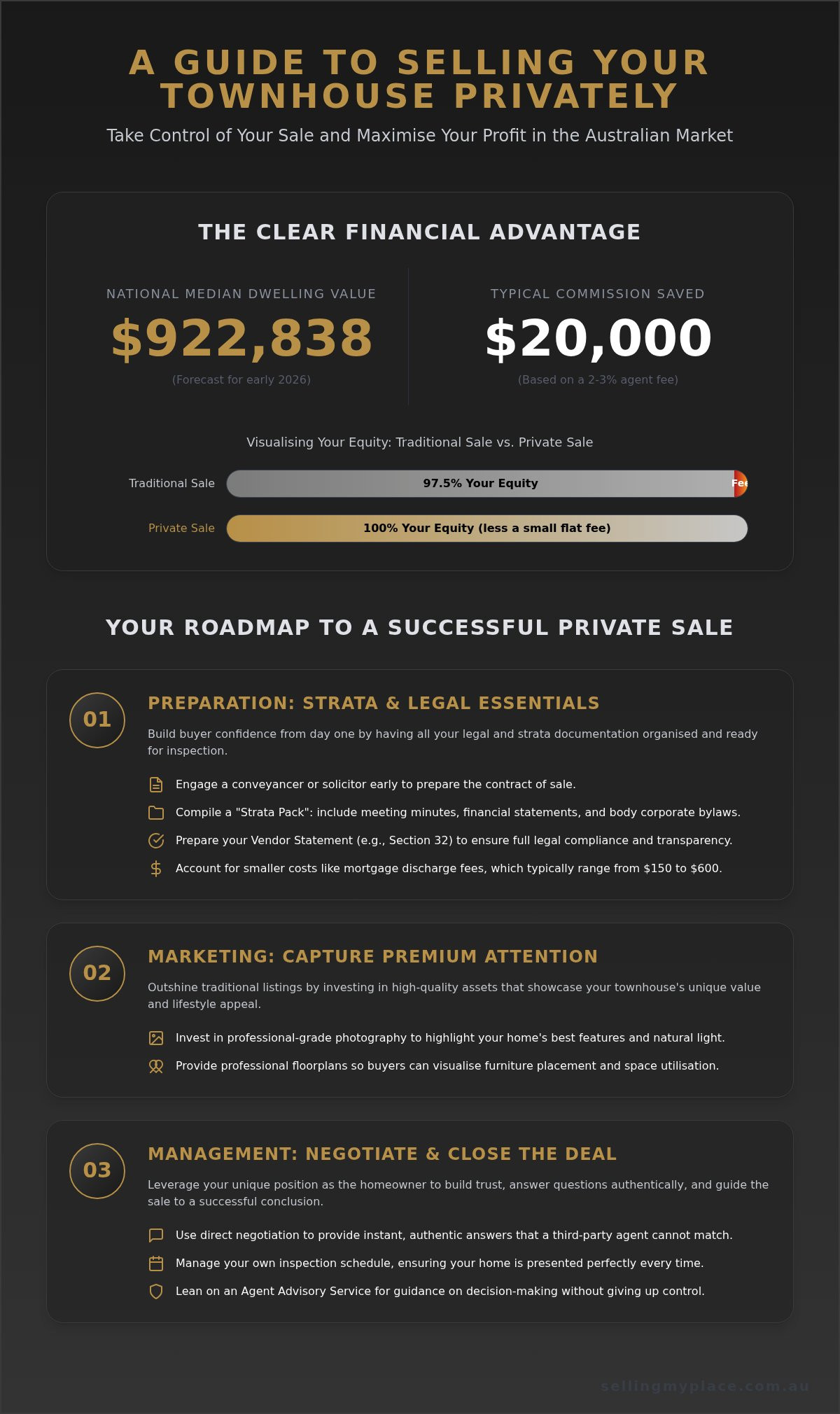
Managing Inspections and Closing the Deal
Once your marketing has sparked interest, it’s time to open your doors. Managing this stage of how to sell a townhouse privately is about creating a sensory experience that helps a buyer feel “at home” the moment they cross the threshold. Unlike a standard agency viewing, you have the freedom to schedule inspections that highlight your property’s best features, like the way the morning light hits the kitchen or the quietness of the street after work. You’re the best person to tell the story of the home, so embrace the opportunity to connect with potential buyers on a personal level.
The Art of the Private Inspection
Transforming your home into a “display suite” doesn’t require a total renovation. It’s often the small, thoughtful touches that make the difference. Ensure the temperature is perfect, the lighting is warm, and every surface is decluttered. We often recommend pre-sale property consulting to help you identify those high-impact tweaks that attract premium offers. During the tour, provide “take-home” brochures and the strata summaries we discussed earlier. This gives buyers something tangible to review over coffee later. When following up, a quick, professional-casual message to gauge interest is all that’s needed. You’re acting as a neighborly guide, not a high-pressure salesperson, which buyers find incredibly refreshing.
Negotiation and Settlement
Negotiation is where many sellers feel the most pressure, but data is your best ally. Before you enter any discussion, set a firm “walk-away” price. You can justify this figure by referencing current Neighborhood Market Reports, which provide a clear picture of what similar townhouses are actually achieving in the 2026 market. When an offer arrives, pay close attention to the conditions. Whether it’s “subject to finance” or a building inspection clause, your legal representative will help you navigate these nuances. Once the price is agreed and the contract is signed, you’ll move toward the exchange and settlement. It’s a methodical process, but with a steady hand and the right information, it’s one you can navigate with total confidence.
If you’re ready to start showing your home to qualified buyers, our team can help you prepare every detail for a successful open home. Feel free to reach out for professional pre-sale consulting to ensure your townhouse is presented at its absolute best.
Selling Smarter with Kincade International Direct Sales
Choosing to manage your own home sale shouldn’t mean sacrificing the professional standards that attract premium buyers. At Kincade, we’ve developed a model that bridges the gap between traditional agency services and independent selling. Our flat-fee approach ensures you retain your equity while still benefiting from the sophisticated tools usually reserved for high-commission firms. It’s a partnership where you’re the decision-maker, but you’re never without a steady hand to guide you through the complexities of the 2026 property market. We’ve seen first-hand how this balance of independence and expert backing can reduce the stress of a high-stakes transition while delivering a result that feels both fair and rewarding.
The Kincade Advantage: More Than Just a Listing
With over 25 years of industry experience, we understand that selling a home is as much an emotional transition as it is a financial one. We don’t just upload your property to a portal and leave you to it. Our Professional Residential Property Listing Services are designed to empower you with the same resources used by the country’s top agents. This includes access to our dedicated Agent Advisory Service, providing you with a seasoned expert to discuss strategy, review offers, or simply offer reassurance when things feel intense. We believe this collaborative model is the future of real estate, offering a more respectful and transparent way to move from one chapter of your life to the next.
Your Next Steps to a Commission-Free Sale
Ready to see what’s possible? The journey of how to sell a townhouse privately begins with clarity. Your first step is to request a comprehensive neighbourhood market report. This data provides the grounded confidence you need to set a competitive price that reflects your home’s true value in the current climate. From there, we’ll help you organise your professional photography and floorplan preparation, ensuring your townhouse makes a stunning first impression on a global stage. Taking that initial step toward a smarter, more profitable Sale by owner is about more than just saving money. It’s about taking ownership of your future and ensuring your hard-earned equity stays where it belongs: with you and your family.
Secure Your Future with a Smarter Sale
You’ve spent years building equity in your home, and now it’s time to reap the rewards. By focusing on strata transparency and professional-grade visuals, you can attract the premium buyers your property deserves. Mastering how to sell a townhouse privately isn’t just about avoiding fees; it’s about taking charge of your own story with the right support behind you. You can save an average of $20,000 in commissions while still accessing a global marketing network that reaches far beyond your local street. It’s a sophisticated way to sell that respects both your time and your bank balance.
Our Agent Advisory Service ensures you have an expert partner for every negotiation and legal hurdle, providing the calm confidence you need during this major life transition. Don’t let high agency costs eat into your hard-earned profit. It’s your home, your legacy, and your choice. Start your commission-free townhouse sale with Kincade today. We’re here to help you move forward with a sense of pride and a significantly healthier bank balance. You’ve got this.
Frequently Asked Questions
Is it legal to sell a townhouse privately in Australia?
Yes, it’s entirely legal in every Australian state and territory. No special licence is required for a homeowner to manage their own sale. While the legality is national, the specific paperwork and disclosure rules do vary by state. This is why we advocate for a partnership approach. It ensures you meet all local requirements while retaining your hard-earned equity and staying in total control of the process.
How do I handle strata documents when selling without an agent?
You should contact your strata manager or body corporate secretary to request a current strata information certificate and the last two years of meeting minutes. These documents are essential for your legal disclosures. Providing a clear strata pack to potential buyers helps build trust and transparency from the start. Having a professional review these records ensures everything is in order before you welcome your first visitor.
Do I need a solicitor if I am selling my own home privately?
Yes, engaging a solicitor or licensed conveyancer is a vital step in the process. They’ll handle the legal transfer of the property, prepare the contract of sale, and ensure the necessary vendor statements are accurate. While you manage the marketing and inspections, your legal representative ensures the transaction is compliant. They also handle the final exchange of contracts and the complexities of settlement day to protect your interests. This move toward personal empowerment is part of a global trend; for instance, those in the UK navigating legal proceedings without a solicitor often use Find a McKenzie Friend to access vetted support and guidance in court.
No, the country’s major property portals generally don’t allow private individuals to list properties directly. You typically need to go through a licensed service provider like Kincade that offers professional residential property listing services. Our model allows you to bypass traditional commissions while still gaining the massive exposure these high-traffic platforms provide. This ensures your townhouse is seen by the widest possible audience of qualified buyers in the 2026 market.
What happens if I can’t find a buyer for my townhouse?
If a buyer isn’t found immediately, we’ll work with you to review your marketing strategy and asking price based on live market feedback. Because our listings have no time limit, you won’t feel pressured to rush into a lower-than-fair offer. We can refresh your professional photography or adjust the listing description to highlight different lifestyle features. This ensures your property remains competitive and appealing in a shifting property landscape.
How do I determine the right asking price for my townhouse?
The most reliable method is to use a neighbourhood market report. This provides concrete data on recent comparable sales in your specific complex and street. Avoid relying solely on automated online estimates, as they often miss townhouse-specific nuances. Instead, look at properties with similar floorplans and strata fees that sold recently. This data-driven approach gives you the grounded confidence to stand firm during any price negotiations.
What are the common mistakes to avoid when selling privately?
One common pitfall is using low-quality DIY photography, which can devalue your home’s online presence. Another mistake is failing to disclose strata issues early, which can cause deals to fall through during the cooling-off period. When learning how to sell a townhouse privately, it’s also vital to avoid being overly emotional. Keeping a professional-casual tone helps maintain a positive rapport with potential buyers and leads to smoother results.
How does Kincade support me during the negotiation process?
We provide a dedicated Agent Advisory Service that acts as your professional sounding board. When an offer arrives, you can discuss the terms and conditions with a seasoned expert who understands the nuances of how to sell a townhouse privately. We help you evaluate the strength of the buyer’s position and suggest strategies to achieve your target price. This ensures you feel supported and empowered until the contract is signed and the sale is finalised.
How to Avoid Real Estate Agent Commission in Australia: The 2026 Seller’s Guide
What if the most expensive part of selling your family home wasn’t the preparation or the marketing, but a percentage-based fee that costs you the equivalent of a luxury SUV? In 2026, with the national median dwelling value sitting at $922,838, many Australians are questioning why they should hand over a massive slice of their equity just for a “sold” sticker. If you’re wondering how to avoid real estate agent commission while still achieving a premium result, you aren’t alone. It’s about moving away from a transactional mindset and toward an empowered, professional partnership.
We understand the weight of this decision. It’s common to feel a sense of anxiety about handling legal paperwork or a distrust of traditional “real estate speak” that often clouds the process. You deserve to feel protected and in control during such a significant life transition. This guide reveals the proven strategies to sidestep traditional commissions, potentially keeping an average of $20,000 more of your home’s equity. We’ll walk through how to access professional marketing tools, manage the sale with confidence, and use expert advisory services to ensure every legal detail is handled with a steady, experienced hand.
Key Takeaways
- Understand the “Equity Gap” and how a standard 2.5% commission can unnecessarily consume over $25,000 of your hard-earned profit on a million-dollar home.
- Learn how to avoid real estate agent commission by choosing between independent selling and modern flat-fee marketing models that provide professional support without the percentage-based cost.
- Discover the truth behind the negotiation myth and why traditional agents are often incentivised for a quick sale rather than securing the highest possible price for your family’s future.
- Master a five-step roadmap for a successful sale, from investing in high-quality photography to securing comprehensive neighbourhood market reports that put you in the driver’s seat.
- Explore a partnership-based approach where you maintain control of your sale process while accessing expert advisory services and global listing reach until your property is sold.
Why Australian Homeowners are Moving Away from Traditional Commissions
Selling your home is often the culmination of years of hard work, weekend renovations, and disciplined mortgage repayments. Yet, when the time comes to move on, many Australians find a significant portion of their hard-earned equity disappearing into a “success fee.” On a $1,000,000 home, a 2.5% commission equates to $25,000 plus GST, totalling $27,500. This is what we call the Equity Gap. It represents money that could have funded a renovation on your next property, paid for a child’s education, or bolstered a retirement nest egg. With the national median dwelling value reaching $922,838 in early 2026, these percentages are no longer just small fees; they are life-changing sums of money.
The traditional model relies on the myth of the “Super Agent” who possesses a secret database of buyers. In reality, the digital age has shifted the power. Most buyers find their next home through major online portals while scrolling on their phones during their morning commute. While it’s helpful to understand what a real estate agent does in a conventional sense, the modern seller is beginning to realise that the portal does the heavy lifting of finding the buyer, not the individual agent. For many, learning how to avoid real estate agent commission is less about cutting corners and more about protecting a family legacy.
The True Cost of a Traditional Sale in 2026
Commission is a success-based percentage that often exceeds the value of the labour provided. In a traditional sale, you aren’t just paying for a few open homes; you’re often subsidising the agent’s office rent, flashy car leases, and assistant salaries. This cost scales upward with your property’s value, which feels inherently unfair. Does it really take twice as much effort to sell a $2 million home compared to a $1 million home? Probably not. When you add auctioneer costs and high-margin marketing markups, the total bill becomes even harder to swallow. It feels less like a service and more like a tax on your success.
The Shift Toward Seller Empowerment
We’re seeing a beautiful shift in the Australian market toward transparency and seller control. Digital platforms have democratised the search process, allowing buyers to connect directly with the heartbeat of the home: the owner. By embracing how to avoid real estate agent commission through a direct sale model, you effectively become the CEO of your sale. You know the local schools, the best coffee spots, and the way the afternoon sun hits the deck better than any third party ever could. This movement is about reclaiming that narrative and ensuring every dollar of your home’s value stays where it belongs: with you.
Strategies to Avoid Real Estate Agent Commission
Most traditional advice suggests that the only way to save money on your sale is to interview three different agents and try to haggle their percentage down. We believe that’s missing the point. Even a “discounted” 1.8% commission on a median-priced home in 2026 still takes a massive bite out of your profit. If you want to know how to avoid real estate agent commission entirely, you need to look beyond negotiation and toward structural change. It’s about moving from a model where you pay for a person’s time to one where you pay for professional tools and results.
The FSBO Path: Pros and Cons
For Sale By Owner (FSBO) is the purest form of independent selling. It gives you total control over the narrative and every interaction with potential buyers. You are the one who knows the history of the home, the quietness of the street, and the way the morning light fills the kitchen. However, the biggest hurdle in the Australian market is that the major property portals don’t usually allow private individuals to list directly. This often leads to listings that look amateur or lack the reach needed to create genuine competition. Most sellers find that while they save on fees, they risk losing out on the “buzz” that drives a premium price. It’s the reason many eventually look for a professional marketing partner to bridge that gap.
The Fixed-Fee Revolution
This is where the landscape has truly changed for Australian families. Instead of a percentage, you pay for specific, high-quality services. A flat fee provides budget certainty from day one, ensuring there are no nasty surprises at settlement. You get the same professional photography, floorplans, and, crucially, access to the major portals that traditional agents use. The “Listed Until Sold” model is a particular favourite because it removes the artificial pressure of 90-day expiry dates. You sell when the right buyer arrives, not when an agent’s contract runs out. It’s a reassuring, grounded way to manage a high-stakes transition.
By decoupling services, you choose exactly what to outsource. You might want a professional photographer and a comprehensive neighbourhood market report, but you don’t need a middleman to open the front door for you. This partnership model allows you to act as the CEO of your sale while having a dedicated marketing department at your back. It’s a sophisticated way to maintain your equity while ensuring your property is presented with the polish it deserves. If you’re ready to take the next step, you can discuss a tailored approach for your property that keeps your profit in your pocket.
The ‘Negotiation’ Myth vs. The Flat-Fee Reality
A common narrative in the industry is that a traditional agent’s negotiation skills are so specialised that they effectively pay for themselves. They’ll suggest that an owner is too emotionally attached to stay objective during a deal. However, we need to look at who is actually motivated by the final result. If you’re researching how to avoid real estate agent commission, you’ve likely sensed the inherent conflict of interest in the traditional model. A quick sale at a lower price is often more profitable for an agent’s turnover than a patient sale at the highest possible price for your family.
If an agent is working on a 2.5% commission, the difference between a $950,000 sale and a $980,000 sale is only $750 for them. For you, that’s $30,000. Who is more motivated to hold out for that extra $30,000? The answer is simple. It’s you.
Who Really Negotiates the Best Price?
The truth is that nobody knows your home’s value or its unique story better than you do. You’re the one who can explain the craftsmanship of the kitchen joinery or the peace of the neighbourhood at dusk. When you act as the primary contact, you remove the “middleman whisper” where messages can be diluted or rushed. By using professional Neighborhood Market Reports, you gain the same data-driven confidence as any agency. You aren’t just hoping for a price; you’re justifying it with concrete evidence. Handling a “low-ball” offer becomes much easier when you can calmly point to recent comparable sales and local demand. It’s about being prepared, not being a salesperson.
Protecting Your Profit Margin
It’s vital to shift your focus from the gross sale price to your net bankable equity. Let’s look at the logic. If a traditional agent sells your home for $1,000,000 but takes a $25,000 commission, you walk away with $975,000. If you manage the sale yourself and achieve a price of $985,000, you actually end up with $10,000 more in your pocket. Modern Residential Property Listing Services provide the marketing reach of an agency without the equity-draining percentage. There’s also a significant psychological advantage to this approach. You won’t feel the mounting pressure to just sign so the agent can collect their fee and move to their next listing. You have the luxury of time and the security of knowing your profit is protected. Learning how to avoid real estate agent commission isn’t about doing everything alone; it’s about choosing a partnership that respects your bottom line.
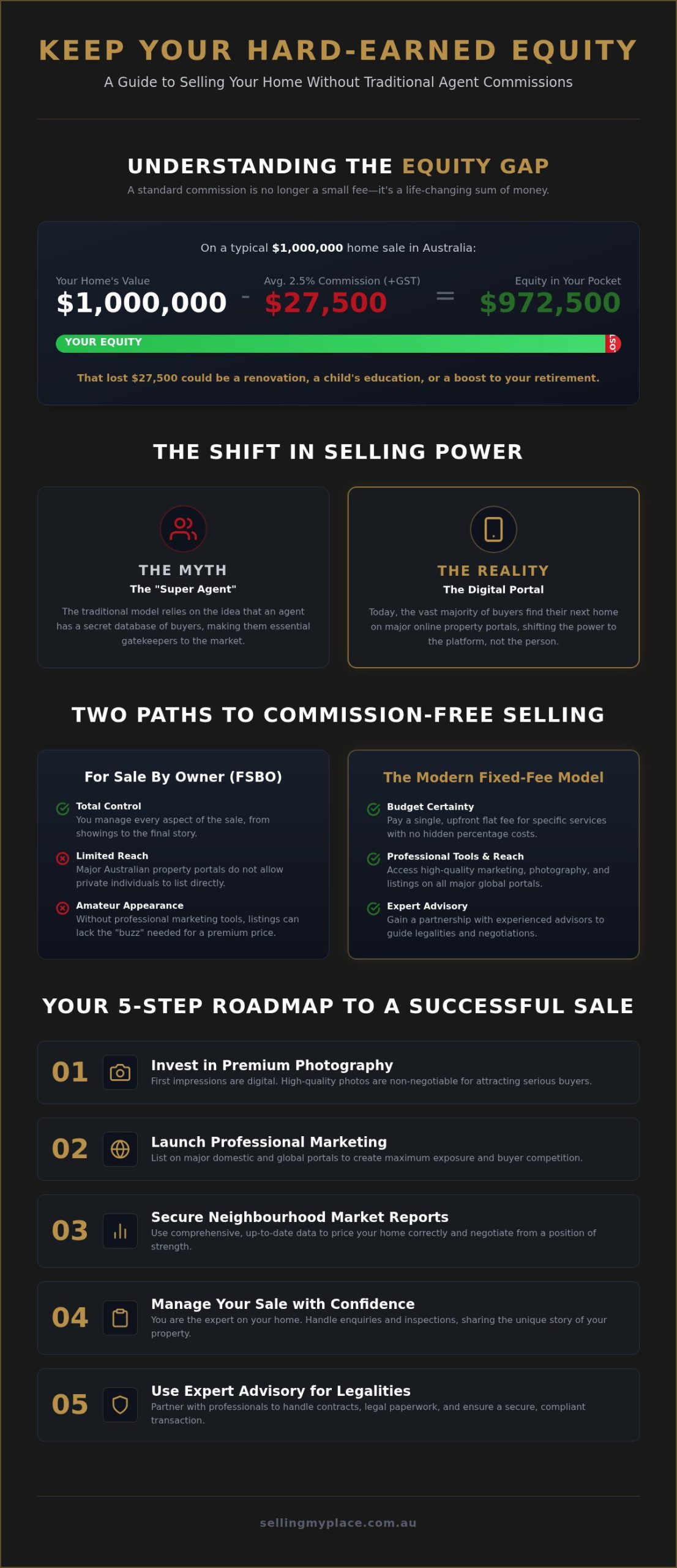
A 5-Step Roadmap to Selling Without a Traditional Agent
Deciding how to avoid real estate agent commission is a bold step toward financial freedom, but it requires a clear plan of action. Taking the reins of your sale doesn’t mean doing it all alone; it’s about being the CEO of an efficient marketing department. By following a structured roadmap, you can maintain the professional standards buyers expect while keeping your equity where it belongs. This process is about replacing a middleman with a proven system that empowers you to succeed.
If you’re ready to learn how to avoid real estate agent commission, the path forward is surprisingly structured. It begins with professional preparation, where you invest in high-quality photography that captures the emotional heart of your home. Next, you need market intelligence. Securing a comprehensive neighbourhood valuation report ensures you are pricing for the current market, not yesterday’s news. Strategic marketing follows, placing your listing on major portals and global networks to cast the widest possible net. When the enquiries start, you take the lead on inspections. This dialogue allows you to share the lifestyle benefits only an owner truly understands. Finally, legal finalisation brings everything together, using expert support to ensure the contract of sale is handled with precision.
Presenting Your Home Like a Pro
Presenting your home like a pro is about more than just a tidy lounge room. 90% of buyers decide to inspect based on the first three photos they see online. If those images don’t sing, you’ve lost them before they even read your description. High-quality imagery is non-negotiable for achieving a premium result. Accurate floorplans are equally vital; they help filter out tyre-kickers who might find the layout unsuitable for their needs, saving you time and energy on unnecessary inspections. This level of professionalisation shows buyers that you are serious and that the property has been cared for with pride.
Navigating the Legal Landscape
Navigating the legal landscape is often the part that gives sellers the most pause. Understanding the Section 32 or your specific state’s contract requirements is essential for a smooth settlement. This is where professional Conveyance Advice becomes your greatest asset. An advisory service bridges the gap between doing it yourself and doing it right, providing the peace of mind that every detail is legally sound. It’s about having a steady hand to guide you through the paperwork while you focus on the move. If you want to ensure your sale is legally watertight while maintaining your profit, you can book a consultation with our advisory team to discuss your specific needs.
The Partnership Model: How Kincade International Empowers Sellers
Kincade International Direct Sales (KIDS) represents a fundamental shift in the Australian property market. We don’t see ourselves as a traditional agency, but rather as a dedicated marketing department for your home. By choosing this partnership, you’re learning how to avoid real estate agent commission while still accessing the same high-tier marketing tools used by the country’s top firms. Our 0% commission structure is designed to keep your equity where it belongs: in your bank account. On average, our sellers save $20,000 per sale, which is a significant sum that can change the trajectory of a family’s next chapter.
We understand that selling a home is often accompanied by a ticking clock. Traditional agents often push for a quick result to meet their monthly quotas, but our “Listed Until Sold” promise removes that artificial pressure. Your property remains live across major local and international portals until the right buyer is found. This global reach ensures that whether your buyer is just around the corner or looking to relocate from overseas, your home is presented with professional authority. It’s a grounded, calm approach that respects the emotional significance of your transition.
Expert Backing Without the Price Tag
Our model provides comprehensive support that covers every practical need. You’ll have access to our Agent Advisory Service for pre-sale consulting, ensuring your home is positioned perfectly before the first enquiry arrives. This isn’t a DIY project where you’re left to figure it out alone. The flat fee includes professional photography and floorplans, ensuring your digital storefront looks impeccable. We also provide conveyance advice to ensure your legal obligations are met with total precision. It’s about having a steady hand to guide you, providing the reliability of a seasoned expert without the percentage-based sting.
Taking the Next Step Toward a Smarter Sale
Stepping into the driver’s seat of your sale is an empowering experience. When you choose a Sale by owner package, you’re choosing a future where your hard-earned profit remains your own. You get the peace of mind that comes from knowing you have professional support at every turn, from the first photo to the final settlement. It’s time to reclaim your equity and sell with confidence. Start your commission-free journey with Selling My Place today.
Reclaiming Your Equity for the Next Chapter
Selling your family home is a deeply personal milestone, and you deserve to walk away with every dollar of your hard-earned profit. We’ve looked at how the digital shift has placed the power back in your hands, allowing you to tell your property’s story with an authenticity no third party can match. By moving away from outdated percentage-based fees, you’re choosing to value your own labour and protect your family’s financial legacy.
Learning how to avoid real estate agent commission is about more than just numbers; it’s about confidence and control. With an average saving of $20,000 and a 0% commission structure, you can achieve a premium result while enjoying 100% support. From professional photography and floorplans to expert advisory services, the tools for success are already within your reach. You don’t have to sacrifice quality to maintain your equity. A steady, experienced partner is here to ensure every detail is handled with care. It’s time to take the next step and keep 100% of your profit with Kincade International Direct Sales. Your future self will thank you for making the smarter choice today.
Frequently Asked Questions
Is it legal to sell my own home without a real estate agent in Australia?
It is entirely legal to sell your property independently in every Australian state and territory. There is no legislation requiring you to hire a third-party representative to manage your sale. While the process involves specific legal obligations regarding disclosures, many owners find that managing the sale themselves is a straightforward and deeply rewarding experience. With the right professional advisory support, you can navigate the entire journey with total legal security and confidence.
How much can I actually save by avoiding real estate agent commission?
The savings depend on your property’s final sale price, but most Australian families retain a significant portion of their equity that would otherwise be lost to fees. By understanding how to avoid real estate agent commission, you can keep tens of thousands of dollars in your bank account. These funds can then be redirected toward your next mortgage, a well-deserved holiday, or your family’s long-term financial goals, ensuring your hard work benefits you, not an agency.
Will my property be listed on the major Australian property portals?
Yes, your home will be visible on the nation’s leading property search platforms. While these sites typically restrict direct private listings, our service acts as the professional bridge required to get you online. This ensures your property is seen by the widest possible audience of active buyers, providing the same high-level exposure as any traditional agency without the associated commission fees. You get the reach you need to find the perfect buyer.
What happens if I can’t find a buyer on my own?
One of the greatest advantages of a modern partnership model is the absence of artificial time constraints. You aren’t pressured by a standard 90-day agency agreement that might force a rushed decision. If a buyer isn’t found immediately, your listing remains active and supported until the right person walks through your door. This patient approach allows the market to work in your favour, ensuring you don’t have to compromise on your property’s true value.
How do I handle the legal paperwork and contract of sale?
Managing the legal side of a sale is a methodical process that is best handled with expert guidance. While you take care of showing the home and talking to buyers, professional conveyance advice ensures your Contract of Sale and necessary disclosure documents are prepared correctly. This ensures your transaction is legally watertight and compliant with your specific state’s regulations. It is about having a steady, professional hand to guide you through the technical details.
Do buyers trust homes that are ‘For Sale By Owner’ or Direct Sale?
Modern buyers are increasingly comfortable dealing directly with homeowners because they value transparency and first-hand information. When a property is presented with high-quality marketing and professional photography, it carries an immediate sense of reliability. Buyers often find it refreshing to ask questions of the person who actually lives in the home, as you can provide detailed insights into the local community and the property’s unique history that an agent simply couldn’t offer.
What is a flat-fee real estate model and how does it work?
A flat-fee model is a transparent alternative to the traditional percentage-based commission. Instead of losing a slice of your home’s value, you pay a set price for the specific professional services you need, such as portal access and marketing tools. This is a highly effective way of how to avoid real estate agent commission because it provides absolute budget certainty. You know exactly what your costs are from the outset, allowing you to calculate your net profit with precision.
Can I still have an auction if I don’t use a traditional commission-based agent?
You can absolutely choose an auction as your preferred sale method without being tied to a commission-based contract. You simply engage a professional, licensed auctioneer to conduct the proceedings on the day for a fixed fee. This allows you to create that vital sense of urgency and competition among buyers while ensuring that every dollar of the final hammer price stays in your pocket. It is a sophisticated way to achieve a premium result on your own terms.
How to Stage Your Home for Photos: 2026 Australian Guide
In the 2026 Australian property market, you aren’t just staging for a person; you are staging for a lens. With digital scrolls lasting barely a second, your home’s digital kerb appeal is the only thing standing between a high-value offer and a missed opportunity. Learning how to stage a home for photos is no longer about making a room look “nice” in person; it’s about mastering the geometry of a wide-angle shot and the flow of natural light to create an emotional connection before a buyer even steps through the front door.
It’s completely normal to feel overwhelmed by the volume of belongings in your cupboards or to worry that your lounge room looks small and dark in your own test snaps. You want to showcase the beautiful life you’ve built without losing your hard-earned equity to expensive staging companies or high agent commissions. We understand that this is a major life transition, and the pressure to get the presentation right can feel heavy when so much is at stake.
This guide reveals the professional secrets to transforming your property into a magazine-quality listing that drives physical inspections while saving you an average of A$20,000 in commissions. We will walk through everything from strategic decluttering and lighting hacks to the specific repairs that actually add value before our professional photographer arrives. By the end, you’ll have the confidence to prepare a canvas that speaks directly to a buyer’s aspirations.
Key Takeaways
- Master the psychology of “digital kerb appeal” to capture a buyer’s attention in the crucial first second of their smartphone scroll.
- Learn the “camera-first” strategy to ensure your rooms look spacious and balanced through a wide-angle lens, even if the layout feels slightly different in person.
- Discover room-by-room techniques that transform your house from a lived-in family home into an aspirational lifestyle that buyers can’t wait to inspect.
- Follow a comprehensive pre-photography checklist on how to stage a home for photos that focuses on de-personalising your space while maintaining its heartfelt warmth.
- Understand how to leverage professional photography and floorplans through a flat-fee model to protect your equity and save an average of A$20,000 in commissions.
The Psychology of Digital Kerb Appeal in 2026
In the current Australian market, the physical front gate is no longer where the first impression happens. Instead, it occurs on a high-resolution smartphone screen during a late-night scroll. This phenomenon, known as digital kerb appeal, represents the split-second decision a buyer makes to either click for more details or swipe past your listing forever. If you are learning how to stage a home for photos or researching what is home staging in a modern context, it’s the art of capturing that initial interest through a lens.
Your “hero” photo is the most critical asset you own. It must communicate your home’s entire value proposition, from its architectural charm to its promise of a better life. In 2026, buyers are filtering properties based on “lifestyle vibes” rather than just checking off bedroom counts. They want to see themselves hosting a Sunday afternoon barbecue or working from a sun-drenched home office. We see ourselves as your partner in this process, providing a steady hand to help you navigate these high-stakes decisions. High-quality visuals protect your equity by establishing a premium perception early, which effectively prevents “low-ball” offers that often stem from poor presentation.
The Three-Second Rule of Property Scrolling
Modern buyers follow a strict visual hierarchy: they look at the hero shot, then the floorplan, and only then do they explore the rest of the gallery. Digital kerb appeal is the primary funnel for modern real estate, acting as the gateway that converts a passive browser into an active lead. Lighting and colour contrast are your best friends here. A bright, airy lounge room with pops of Australian coastal blues or earthy tones will naturally drive higher click-through rates on major portals compared to a dark, cluttered space. It’s about creating a sense of calm confidence that reassures the viewer before they’ve even read the description.
Emotional Resonance vs. Architectural Accuracy
While it’s vital to be honest, property photos aren’t just about architectural accuracy; they’re about emotional resonance. Buyers buy on “feeling” but later justify the purchase with “features”. Knowing how to stage a home for photos involves creating a lifestyle narrative. Think about the “tea on the deck” effect. A simple vignette of a tray with a teapot and two cups on a balcony suggests a peaceful morning routine that a bare floor simply cannot. This emotional connection directly impacts how to determine market value of a home in australia, as perceived value often rises when a buyer feels an immediate bond with the space.
The ‘Camera-First’ Strategy: Designing for the Lens
There is a fundamental truth in real estate: a room that feels perfect to live in rarely looks perfect in a photograph. When you are learning how to stage a home for photos, you must stop designing for the human eye and start designing for the camera sensor. The lens sees the world in two dimensions, which means depth, height, and space must be manufactured through clever positioning. What feels like a warm, layered lounge room in person often translates as “clutter” to a high-resolution camera.
Professional photographers almost exclusively use wide-angle lenses to capture the full breadth of a room. While effective, these lenses create a specific type of distortion where objects at the very edge of the frame appear stretched. To manage this, we recommend keeping the immediate foreground and extreme corners of your rooms clear of bulky furniture. Embracing “negative space” is your best friend, particularly in smaller Australian apartments or units. By leaving sections of the floor and walls bare, you allow the camera to “breathe,” making the property feel expansive rather than enclosed. If you need a helping hand with your layout, our pre-sale consulting team can provide tailored advice to ensure your home looks its absolute best.
Composition is the final piece of the puzzle. Using the “Rule of Thirds” or creating strong symmetry helps anchor a viewer’s gaze. A pair of matching bedside lamps or perfectly centred cushions on a sofa creates a sense of order and stability that reassures potential buyers. Mastering styling for the camera is about removing the “noise” so the home’s true character can shine through the screen.
Furniture Re-orientation for Depth
To create a sense of three-dimensional depth on a flat screen, try pulling your furniture a few centimetres away from the walls. This creates subtle shadows and prevents the room from looking “flat.” You should also aim for a “V-Shape” arrangement. By angling armchairs slightly toward each other but keeping them open toward the photographer’s entry point, you invite the viewer into the space. Ensure there are clear, unobstructed “walk-through” paths that the camera can follow toward a primary focal point, like a fireplace or a garden view.
Lighting: The Secret to Professional-Grade Shots
The Australian sun is a powerful tool, but it can be temperamental. While “Golden Hour” is spectacular for exterior shots, midday or slightly overcast light is often superior for interiors as it provides even, soft illumination without harsh shadows. Most professionals prefer a “natural light only” approach. Turn off your indoor globes to avoid “colour cast” (that sickly yellow or blue tint) and let the daylight do the work. Removing heavy window treatments or bulky pelmets is a quick way to highlight a seamless connection to the outdoors, which is a high-priority feature for local buyers in 2026.
Room-by-Room Staging: Creating a Cohesive Visual Narrative
Room-by-room staging is where you translate the “camera-first” theory into tangible, heart-warming scenes. Each space must contribute to a cohesive visual narrative that makes a buyer think, “I could belong here.” When you are figuring out how to stage a home for photos, remember that you aren’t just selling a floorplan; you are selling a Saturday morning. It is about creating a sense of possibility that resonates with a buyer’s own family goals and lifestyle aspirations.
The kitchen should transition from a functional workplace to a vibrant social hub. Instead of hiding every appliance, use the “Rule of Three” on benchtops: perhaps a designer kettle, a matching toaster, and a single organic element like a bowl of fresh lemons or a timber board with a crusty loaf of bread. In the living area, use large rugs to anchor the space and create “conversational” seating clusters. This helps the camera understand the room’s scale and purpose instantly, turning a large, empty box into a welcoming heart of the home. Don’t forget the master suite; it should feel like a high-end hotel sanctuary, achieved through layered textures and neutral, high-thread-count bedding.
In our local market, the outdoor alfresco area is often the hero of the sale. Because we value the sun and the breeze, the backyard is essentially your most important “room.” Ensure your deck or patio is scrubbed clean and styled with comfortable furniture to highlight that quintessential Australian indoor-outdoor flow. To achieve this level of finish, you can learn more about Squirtz Property Detailing and their professional maintenance services. The process of how to stage a home for photos is truly about removing the “daily life” and replacing it with an “aspirational life” that feels both achievable and deeply desirable.
The Kitchen and Dining: The Heart of the Sale
Modern 2026 preferences lean toward minimalist elegance. For your dining table, skip the full formal place settings, which can feel a bit “staged” and dated. Instead, opt for a simple linen runner and a single, striking centrepiece. It is also vital to ensure your kitchen’s flow to the living area is clear. Since professional floorplans are included in our service, use your staging to physically mirror what the plan shows, helping the buyer’s brain connect the digital layout to the beautiful images they are seeing.
Bathrooms and Laundries: The ‘Spa’ Transformation
In the bathroom, the “White Towel” mandate is absolute. Colourful or patterned towels are a photographic risk; they can date a space or clash with the tiles. Remove all personal hygiene cues like toothbrushes, half-used soap bars, and bath mats. Spa-like bathrooms increase the perceived stability of the home’s maintenance, suggesting a property that has been cared for with a steady, attentive hand. A small orchid or a high-quality candle is all the “personality” a bathroom needs for the camera.
The ‘Work from Home’ Nook
By 2026, a dedicated workspace is a non-negotiable for most Australian professionals. Even if you don’t have a full office, you must stage a visible “nook” in your photos. Focus on styling the “Zoom Background” for potential buyers; a tidy desk, a comfortable ergonomic chair, and a bookshelf with a few curated titles can make a small corner look like a productive powerhouse. It’s about showing the buyer that this home can support their modern, flexible lifestyle without compromise.
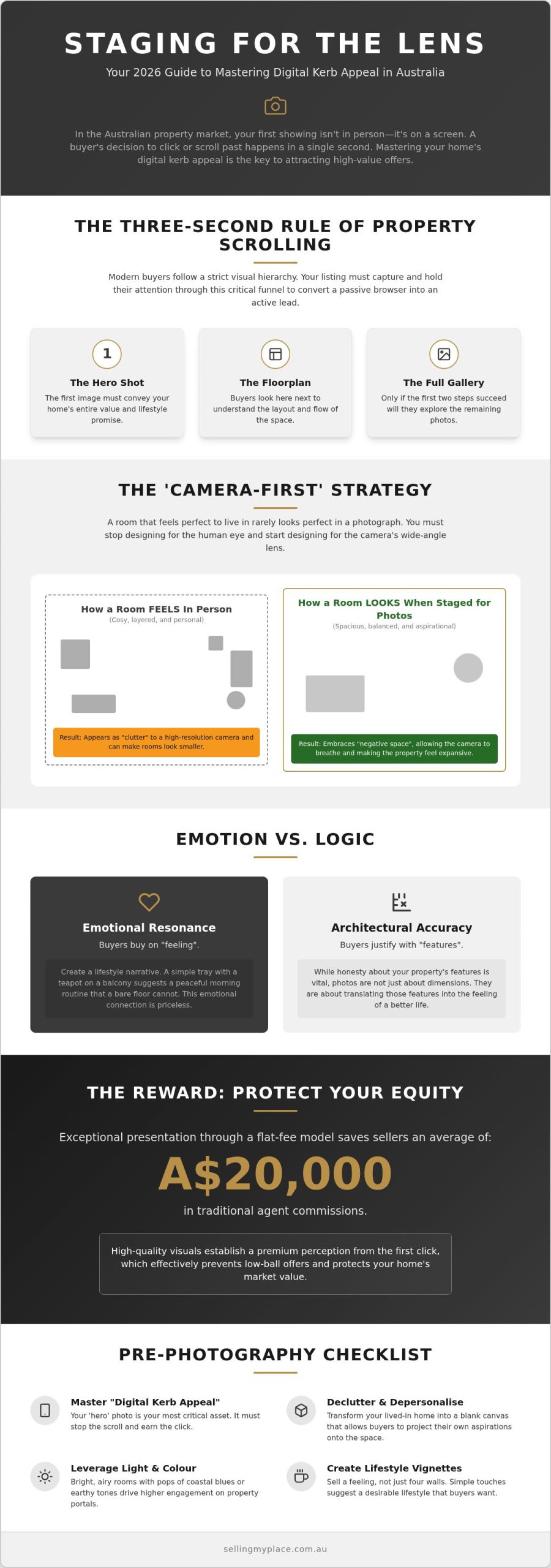
The Ultimate Pre-Photography Checklist: Small Details, Large Returns
While the heavy lifting of furniture arrangement is behind you, the final polish is what truly separates a basic listing from an aspirational lifestyle. High-resolution cameras in 2026 are incredibly unforgiving; they will find the stray fingerprint on the stainless steel fridge or the tangled charging cable snaking behind the bedside table. This stage of how to stage a home for photos is about refinement. It is about removing the evidence of your daily routine so the buyer can begin to imagine their own. We recognise that this can feel like a lot to manage, but these small efforts are what protect your equity and drive those high-value offers.
De-personalisation is a sensitive step. You’ve built a beautiful life here, and removing family photos can feel like you’re stripping away the home’s heart. Instead, try to view it as creating a clear canvas for the next family’s legacy. Replace personal snapshots with neutral art or mirrors that help bounce natural light around the room. Similarly, the “pet-free” illusion is vital. Even the most dedicated animal lovers don’t want to see a dog bed in the corner or nose prints on the sliding glass doors during their digital tour. Hide the bowls, stow the leashes, and give all glass and high-gloss surfaces an “invisible” clean that won’t catch the photographer’s flash.
The exterior needs a “glow-up” to match the interior. A quick pressure wash of the driveways and a fresh layer of dark mulch in the garden beds can make the property look significantly more well-maintained on screen. If you’re feeling a bit stuck on these final touches, our pre-sale consulting experts are here to guide you through the process with a steady, experienced hand.
The 60-Minute Pre-Shoot ‘Sprint’
In the hour before our photographer arrives, focus on stowing the “tech-clutter.” Hide every remote control, unplug charging cables, and ensure tablets are out of sight. Plump every cushion on the sofa and give them a “karate-chop” in the centre for that crisp, designer look. Crucially, check every light globe in the house. They should all be working and, ideally, should all be the same colour temperature, such as “Warm White,” to ensure the room looks cohesive and inviting in the final images.
The ‘Sniff Test’ and Visual Freshness
While the camera can’t smell, it can certainly see the “visual weight” of heavy scents like thick incense or strong candles. Avoid these and instead open every window to let in the fresh Australian air. For a touch of life, use the “greenery hack.” A few clippings of native Australian flora, like Eucalyptus or Banksia, placed in a simple glass vase can fill an empty corner beautifully without costing a cent. For a more detailed breakdown of these final steps, see our A Seller’s Checklist for a Successful Photo Shoot. Knowing exactly how to stage a home for photos ensures you don’t miss the tiny details that lead to the largest returns.
Partnering for Success: Professional Photography and Commission-Free Selling
You have done the hard work of decluttering, plumping cushions, and mastering the “camera-first” layout. Now, it is time to ensure that effort isn’t wasted. Many independent sellers fall into the trap of using a smartphone to capture their listing. While modern phones are impressive, DIY smartphone photos are the primary equity-killer for independent sellers in 2026. A phone lens cannot replicate the depth, light-balancing, and architectural straightness provided by professional equipment. Poorly lit or distorted images signal to buyers that you might be looking for a “quick and cheap” exit, which often invites low-ball offers that eat into your profit.
This is where the Kincade International Direct Sales (KIDS) model changes the game. We believe that selling your own home doesn’t mean doing it alone; it means using better tools. Our flat-fee service includes professional photography and floorplans as standard, ensuring your staged canvas is captured with the precision it deserves. We act as your “steady hand” throughout this transition, providing the professional infrastructure you need while you retain the equity you’ve built. By removing the traditional agency commission, our sellers save an average of A$20,000, which is a significant sum that stays in your pocket rather than being handed over at settlement.
Our partnership approach extends to pre-sale property consulting. If you are still unsure how to stage a home for photos or want a second pair of eyes on your lounge room layout, our experts are available to guide you. This ensures your home is “lens-ready” before our photographer even arrives. Once those high-end images are ready, they power a global marketing network that puts your property in front of qualified buyers without the burden of high marketing costs or hidden fees.
The KIDS Marketing Suite: Beyond the Photo
A beautiful photo gallery is only one part of a high-converting listing. To provide a complete picture, we integrate your staged photos with professional floorplans. This allows buyers to mentally “walk through” the home, connecting the visual appeal of your styling with the practical flow of the house. These professional visuals also feed into our Neighborhood Market Reports. When you present a polished, magazine-quality listing backed by hard data, you justify your asking price and command respect from the market. The “Sale by Owner” revolution is about homeowners keeping their hard-earned profit by taking charge of the “heart work” of staging while we handle the technical heavy lifting.
Next Steps: Your Journey to a Commission-Free Sale
Ready to move from preparation to presentation? Booking your professional shoot through the KIDS platform is a simple, streamlined process designed to reduce the stress of listing. Before the camera clicks, you can access our Agent Advisory Service for a final “staging critique.” We will help you fine-tune the details, ensuring your native greenery is positioned perfectly and your “Zoom nook” looks its best. The goal is to make sure every pixel of your listing works toward a premium result. If you are how to stage a home for photos and ready to showcase your home to the world, Contact our expert team at Selling My Place today.
Step into Your Next Chapter with Confidence
Mastering how to stage a home for photos is about more than just tidy rooms; it’s about shifting your perspective from homeowner to curator. By embracing a camera-first strategy and focusing on those high-impact details like natural light and native greenery, you’ve prepared a canvas that speaks directly to a buyer’s aspirations. You’ve done the heart-work of preparing the space, and now it’s time to let the professional tools do the rest of the heavy lifting. Selling your property is a significant life transition, and you deserve a partner who respects both your home’s legacy and your financial future.
Our flat-fee, 0% commission model is designed to empower you. By choosing a smarter way to sell, our clients save an average of A$20,000 in commissions while still receiving the premium marketing essential for a top-tier result. With professional photography and detailed floorplans already included in your package, you can present a high-value listing that truly stands out in the 2026 market. We are here to provide the steady hand and expert guidance you need to secure your equity and move forward with peace of mind. Maximise your sale price with professional photography; book your commission-free listing today. Your success is our priority, and we can’t wait to help you showcase your home to the world.
Frequently Asked Questions
Should I empty my house before taking professional photos?
No, we generally recommend keeping your furniture in place. Empty rooms often look smaller and lack the emotional heart that buyers look for when scrolling. By following our advice on how to stage a home for photos, you can use your existing belongings to create a lived-in yet aspirational feel. If a house is completely bare, it’s much harder for a buyer to visualise how their own life fits in.
How much does professional home staging cost in Australia compared to doing it myself?
Professional staging services in Australia, such as InSitu Furniture Presentation, typically range from A$2,000 for small units to over A$10,000 for large family homes. By managing the process yourself, you save these significant upfront costs while still achieving a high-end result. Our flat-fee model supports this empowerment, including the professional photography and floorplans you need to showcase your hard work without the burden of traditional agency commissions or high marketing fees.
Do I need to stage the garage or the inside of the cupboards for the shoot?
You typically don’t need to stage the inside of cupboards or the garage unless they are a standout feature. Photographers focus on primary living zones, bedrooms, and bathrooms. However, ensuring the garage is tidy and free of large piles of rubbish is a good idea, as a quick shot might be taken to show capacity. Generally, keep your hidden storage areas organised enough to avoid any unsightly overflows during the shoot.
What is the best time of day for a real estate photographer to visit?
For interior shots, midday or slightly overcast light is often best as it provides even, natural illumination without harsh shadows. If your property has spectacular views or a beautiful garden, a twilight session can add a touch of magic to the hero exterior shot. Your photographer will usually coordinate the best time based on your home’s orientation to ensure the Australian sun highlights your property’s best features rather than washing them out.
Can’t I just use a ‘Virtual Staging’ service instead of moving furniture?
Virtual staging is a useful tool for completely empty properties, but it can lead to a sense of disappointment when buyers visit for a physical inspection. Real furniture creates a tangible atmosphere that virtual renders simply can’t replicate. When you learn how to stage a home for photos using physical items, you build a consistent experience from the first digital click through to the final walk-through, which helps establish genuine trust.
What should I do with my pets during the property photo shoot?
It is best to have your pets out of the house during the photography session. This prevents them from accidentally appearing in shots or creating motion blur in the background. It also allows the photographer to move freely through the rooms without worrying about an open door or a curious cat. Removing pet beds and bowls before the shoot ensures the focus remains entirely on the home’s features rather than the animals.
Should I leave the TV on or off during the photography session?
Keep the TV turned off during the shoot. A large black screen can look like a void in photos, but a glowing screen with a random show or reflection is even more distracting. Professional photographers sometimes use digital editing to add a subtle, neutral image to the screen later, but for the session itself, off is the standard. This keeps the viewer’s attention on the room’s proportions and your beautiful styling rather than a flickering screen.
How many photos do I actually need for a standard Australian property listing?
Most standard Australian property listings thrive with between 12 and 20 high-quality images. You want enough to tell a complete story of the home without overwhelming the buyer. This usually includes a hero exterior, two shots of the main living areas, one of the kitchen, and one for each bedroom and bathroom. Quality always trumps quantity; a few stunning, well-staged photos are far more effective than dozens of repetitive or poorly composed shots.
2026 Guide: Writing Private Sale Property Descriptions
Could the difference between a “sold” sticker and a stagnant listing really come down to the way you describe your morning coffee? When you’re managing your own sale, the pressure to get the words right can feel overwhelming. You know your home better than anyone, yet staring at a blank screen makes it easy to fall into the trap of listing cold facts or sounding a bit too clinical. Learning how to write a compelling property description for private sale isn’t about using fancy industry jargon; it is about capturing the lifestyle your home offers while maintaining a professional edge that builds trust with premium buyers.
We understand that this isn’t just a transaction. It is a major life transition, and you want to ensure your hard-earned equity stays in your pocket. With properties taking longer to sell in 2026 and national home prices showing slight softening, your listing needs to work harder than ever to stand out online. This guide will show you how to balance practical features with emotional benefits, helping you secure a successful sale and save upwards of A$20,000 in agent commissions. We will walk through the exact structure you need to move from writer’s block to a scroll-stopping advertisement that attracts high-quality enquiries from genuine buyers.
Key Takeaways
- Discover why your listing serves as your digital front door and the primary way to build trust with premium buyers before they even step through the gate.
- Learn how to write a compelling property description for private sale by balancing technical features with the emotional lifestyle benefits that drive buying decisions.
- Master the “Owner’s Advantage” by highlighting intimate home details that traditional agents often miss, such as the perfect morning sun spot or the local street culture.
- Optimise your copy for mobile users on platforms like Domain and realestate.com.au by focusing on the critical first 200 characters and using a skim-friendly structure.
- Understand how to pair your refined copywriting with professional photography and expert advisory services to secure a successful, commission-free sale.
The Power of the Pen: Why Your Private Sale Description is Your Digital Front Door
Selling your home is rarely just a financial transaction. It is a significant life transition that involves closing one chapter and opening another. Beyond simply understanding real property and its legal boundaries, a great listing captures the soul of the house. In 2026, with the Australian market showing signs of softening and properties staying on the market longer, your listing description acts as your “Digital Front Door.” This is the initial point of buyer contact that determines whether a prospect will step inside for an inspection or keep scrolling through their feed.
Many owners feel a sense of hesitation when they begin typing. There is often an “Authority Gap” where sellers fear they won’t be taken seriously without a traditional agent’s gloss. However, learning how to write a compelling property description for private sale actually gives you a unique advantage. You can honour the home’s legacy with an authenticity that no third party can replicate. By pairing your heart and local knowledge with our professional advisory tools, you create a partnership that sells smarter, not harder.
The Financial Value of a Great Hook
A brilliant opening line does more than just sound nice; it protects your bottom line. With the national median dwelling value sitting at A$922,838 as of early 2026, every day your property sits idle costs you in momentum. A compelling hook increases enquiry rates by speaking directly to the buyer’s aspirations. When you capture the right audience immediately, you reduce your “days on market” and strengthen your negotiating position. This professional approach is the key to successfully managing your own sale and protecting that significant A$20,000 or more you are saving in commissions.
Avoiding the “Amateur” Trap
Trust is the most valuable currency in a private sale. To build it, you must avoid the common mistakes that signal a lack of professionalism. Shouting at buyers in ALL CAPS or cluttering your text with excessive exclamation marks often has the opposite effect of what you intend. It can make a seller look desperate or disorganized. Instead, focus on these elements of professional-grade copy:
- Radical Transparency: Honest descriptions build more trust than traditional real estate fluff.
- Clarity Over Cleverness: Use simple, evocative language that describes the lifestyle clearly.
- Clean Formatting: Avoid the “wall of text” by using short paragraphs and logical flow.
By focusing on how to write a compelling property description for private sale, you bridge the gap between owner and expert. You aren’t just listing a house; you are inviting someone to envision their future within your walls. This grounded, calm confidence is exactly what premium buyers are looking for in today’s competitive landscape.
The Anatomy of a High-Converting Listing: A 4-Part Framework
A successful listing follows a deliberate rhythm. It isn’t enough to simply dump features into a text box; you need a framework that guides a buyer from curiosity to conviction. Think of it as a four-part journey: the headline stops them, the lead hooks them, the body informs them, and the call to action moves them. When you understand how to write a compelling property description for private sale, you are essentially building a narrative that makes the reader feel like they already belong in the space. This structure ensures that your home stands out among the 278,984 dwellings currently listed across Australia.
Crafting the Killer Headline
Your headline is your first impression. With only about 80 characters to work with on major portals, every word must earn its place. A “Benefit-First” headline like “Private North-Facing Oasis with Chef’s Kitchen” is far more effective than a “Feature-First” title like “4 Bedroom House for Sale.” By choosing the right words, you highlight your unique selling point (USP) immediately. Avoid generic terms; instead, focus on what makes your property special. If you’re unsure which angle to take, our Agent Advisory Service can help you polish your headline to ensure it resonates with the current 2026 market dynamics.
Writing to the Floorplan
Buyers often struggle to visualise how a home feels just from photos. This is where your professional floorplans become your best writing tool. Use a “Mental Walkthrough” technique to describe the flow of the home. Start at the entryway and lead the reader through to the “Entertainer’s Hub” or the “Private Retreat.” This approach allows you to point out hidden value that a camera might miss, such as the thermal orientation of the living area or the clever storage tucked under the stairs. It connects the dots between the 2D drawing and the 3D experience of living there.
The lead paragraph should immediately follow the headline with a lifestyle promise. Don’t start with the bedroom count. Start with the feeling of the morning sun in the breakfast nook or the quiet peace of the cul-de-sac location. The body of your listing should then group features logically into themes. Finally, never leave a buyer wondering what to do next. A clear call to action is vital. Tell them exactly how to book a private inspection or register for an upcoming viewing. If you feel stuck on the structure, you might want to speak with a property advisor to ensure your listing is ready for prime time.
Lifestyle vs. Features: Selling the “Sizzle” of Your Home
Buying a home is rarely a purely logical decision. While a buyer might start their search with a checklist of four bedrooms and a double garage, the final choice is almost always driven by emotion. They are looking for a sanctuary, a place for their children to grow, or a space to host Sunday lunches with friends. Your job is to provide the “sizzle” that ignites that emotional connection while offering enough “steak” (the hard facts) to help them justify the purchase with logic. When you master how to write a compelling property description for private sale, you bridge the gap between a simple building and a dream lifestyle.
As the owner, you possess a unique “Owner’s Advantage” that no real estate agent can match. You know exactly where the morning sun hits the kitchen bench for that first cup of coffee. You understand the quiet rhythm of the street and which neighbours have the best citrus trees to swap fruit with. These intimate details are what truly sell a home. In a market where 97.4% of house resales in the first half of 2026 resulted in a profit, highlighting these authentic lifestyle elements can be the difference between a standard result and a premium one.
However, the “sizzle” must always be balanced with the “steak.” Buyers still need to know the practicalities to move forward. Ensure you clearly state the land size, school catchments, and any recent sustainable upgrades like solar panels or greywater systems. This combination of heart and data creates a sense of reliability and grounded confidence that reduces the stress for potential buyers.
The “Owner Loves” Section
Including a dedicated “What we love about this home” paragraph is a powerful way to humanise your listing. It allows you to share memories, like the way the backyard becomes a private oasis in summer or the convenience of the local hidden cafe just three minutes away. To keep it professional, focus on the benefits these memories provide to a new owner rather than just the nostalgia itself. This section often uncovers unique selling points that agents typically overlook, such as the specific thermal orientation that keeps the lounge cool without air conditioning.
Choosing Your Words Wisely
The vocabulary you choose can significantly impact the perceived value of your property. In 2026, buyers are looking for resilience, community, and versatility. Using evocative, Australian-centric adjectives like “sun-drenched,” “seamless indoor-outdoor flow,” or “tranquil retreat” helps them visualise their future life. Conversely, certain cliches have become white noise and should be banished from your draft to maintain a sophisticated tone.
- Power Words: Sanctuary, versatile, bespoke, integrated, sustainable, resilient.
- Words to Banish: “Location, location, location,” “Renovator’s Delight,” “Hidden Gem,” “Must see.”
- Describing Potential: Instead of “needs work,” try “a blank canvas for your creative vision” or “scope to add significant value.”
By focusing on how to write a compelling property description for private sale that leads with lifestyle, you position your home as more than just another entry on a search results page. You are offering a future that a buyer can see, feel, and ultimately, want to own.
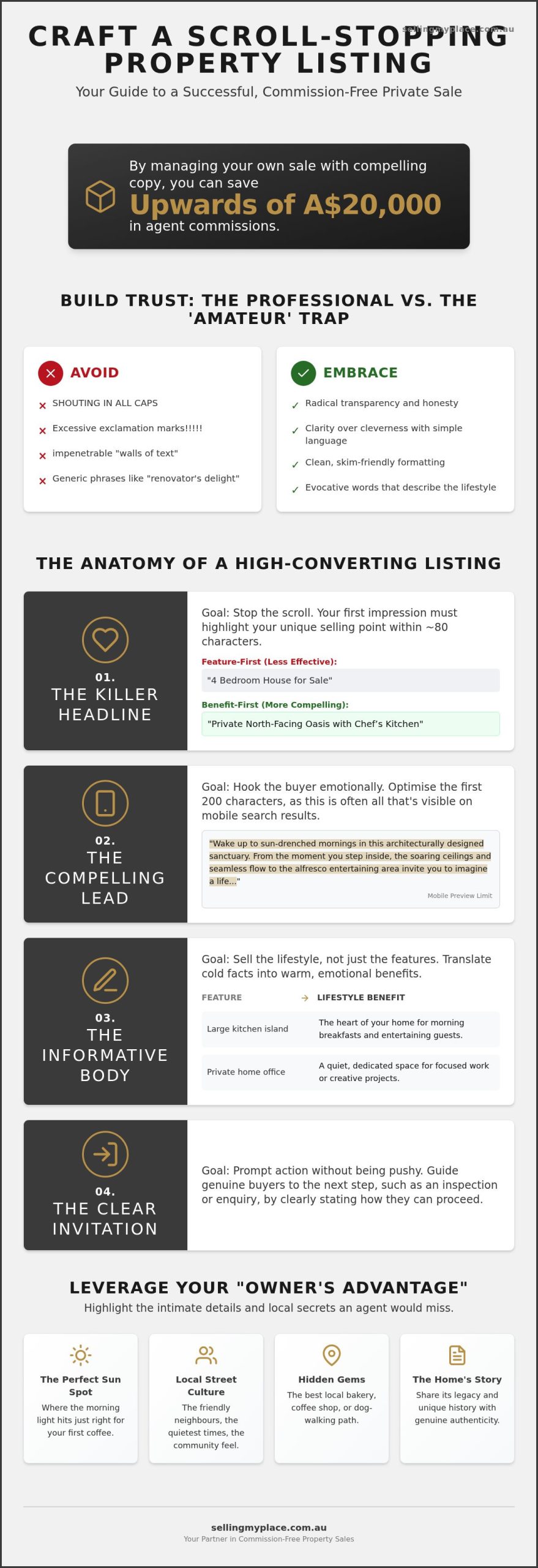
Technical Formatting for realestate.com.au and Domain
While the emotional narrative is the heart of your listing, the technical execution is the skeleton that holds it up. In 2026, the way you present your text is just as critical as the words themselves. If your formatting is clunky, buyers will simply bounce to the next property. Learning how to write a compelling property description for private sale requires a shift toward mobile-first thinking. Most Australians now hunt for homes on their smartphones, meaning your most vital information must appear before the “Read More” line.
The first 200 characters are your golden window. This snippet is what appears in search results and at the top of the mobile app. Use it to state your biggest unique selling point clearly. Beyond the hook, you must ensure your description aligns perfectly with the legal details in your Contract of Sale. Discrepancies between your marketing and the legal paperwork can create unnecessary friction or even legal hurdles during the settlement process.
Mastering the Mobile Scroll
Readability is the cornerstone of engagement. On a small screen, a “wall of text” is intimidating and often ignored. When you are refining how to write a compelling property description for private sale, remember that white space is your friend. Aim for paragraph breaks every two to three lines to keep the reader’s momentum going.
Utilising feature bullets is a brilliant way to provide quick-fire facts. Buyers in 2026 are specifically filtering for lifestyle upgrades that offer resilience and comfort. Consider a list like this:
- Energy Efficiency: 6.6kW solar system and double-glazed windows for year-round comfort.
- Working from Home: Dedicated executive study with custom built-in cabinetry.
- Outdoor Living: Saltwater pool and integrated alfresco kitchen for summer entertaining.
Bolding key terms and using sub-headings within the portal text box helps guide the eye to the information that matters most to that specific buyer. It allows them to find what they need without having to dig through paragraphs of fluff.
Portal-Specific Tips
Realestate.com.au and Domain have different character limits and display styles. While you might write a long-form story for your main advertisement, you may need to edit a punchier version for social media or secondary portals. Accurate data entry in the backend is equally important. If you forget to tick the “Pool” or “Solar” box in the features list, your property won’t show up when buyers use those specific filters.
Ensuring your listing is technically sound is a major step in the journey. For a broader look at the overall process, you can refer to our How to Sell Your Own Home: A Step-by-Step Guide. If you want to ensure your technical formatting is flawless before you hit publish, book a consultation with our advisory team for a final listing review.
Beyond the Words: The Partnership for a Successful Sale
Even the most evocative prose needs a professional stage to perform on. While you now understand how to write a compelling property description for private sale, those words must work in harmony with high-impact visuals. Think of it as a partnership where your words provide the emotional context and professional photography provides the immediate proof. When your authentic story is backed by gallery-quality imagery, you create a listing that doesn’t just inform buyers; it inspires them.
Our Agent Advisory Service is designed to bridge the gap between your intimate knowledge of the home and the professional polish required by the 2026 market. We don’t want to rewrite your experience. We want to refine it. By “peer-reviewing” your draft, our experts help you ensure that your unique insights are framed in a way that resonates with premium buyers. This collaborative approach allows you to maintain control of your narrative while benefiting from the “steady hand” of a seasoned expert.
The financial logic of this approach is compelling. By opting for a flat-fee model, you are choosing to reinvest in the quality of your marketing rather than paying for an agency’s overhead. Most of our clients find that saving upwards of A$20,000 in commissions allows them to present their home in the best possible light while still walking away with a significantly higher net return at settlement. You are the best person to tell your home’s story. We simply provide the platform and the tools to make sure that story is heard.
The Kincade Advantage
Kincade International Direct Sales (KIDS) combines your authentic voice with a marketing reach that rivals traditional agencies. Through our pre-sale property consulting, we help you identify the specific “lifestyle triggers” that will drive the most enquiry in your local area. Whether it is a sun-drenched reading nook or a resilient, sustainable garden, we know how to make those features shine. Plus, our “Until Sold” guarantee means you can move at a pace that suits your family, without the artificial pressure of a standard 90-day agency agreement.
Taking the Next Step
Before you hit the “Publish” button, take a final moment to read your listing aloud. Does it sound like the home you love? Does it clearly guide the buyer on how to take the next step? Ensure your contact details are correct and your professional floorplan is attached. Visualise the successful, commission-free settlement that awaits you. You have the knowledge and the tools to manage this transition with calm confidence.
Ready to write your success story? Contact our advisory team for a listing consultation to ensure your property hits the market with the professional edge it deserves.
Your Future Settlement Starts with the Right Words
Your journey from listing to a successful settlement is built on a foundation of trust and clear communication. By moving beyond a simple list of features and embracing the emotional narrative of your home, you’ve already done the heavy work that most agents overlook. Mastering how to write a compelling property description for private sale is the final piece of the puzzle, ensuring your digital front door is as welcoming as the real one. It is about showing buyers not just where they will live, but how they will feel when they arrive.
You don’t have to navigate this high-stakes transition alone. Our partnership approach gives you the professional tools to stand out, including high-end photography and floorplans that do the heavy lifting while your words capture the heart. With our expert Agent Advisory Service to review your draft and an “until sold” guarantee with no time limits, you can proceed with calm confidence knowing you are protecting an average of A$20,000 in equity. Start your commission-free selling journey today with our expert-backed marketing packages. We look forward to helping you turn the page to your next chapter with ease and success.
Frequently Asked Questions
How long should a property description be for a private sale?
The ideal length for a property description is typically between 300 and 500 words. This range provides enough space to cover the lifestyle narrative and the “Owner Loves” section without overwhelming a mobile user. Since the first 200 characters are the most critical for smartphone scrollers, ensure your most evocative hook is front-loaded to capture interest immediately before the “read more” break.
Do I need to mention the price in the description if it is already in the price field?
It is generally unnecessary to repeat the price within your main text if it is already clearly displayed in the portal’s dedicated field. Using that character count to focus on the home’s unique selling points is a better use of space. However, if you are using a strategy like “Offers Above” or a specific auction date, mentioning this toward the end can help clarify your expectations for the buyer.
Should I be honest about the property’s flaws in the description?
Radical transparency is one of the best ways to build trust in a private sale. While you don’t need to lead with a list of repairs, acknowledging a home’s “potential for improvement” or “original character” helps manage buyer expectations before they arrive for an inspection. This honesty ensures you are dealing with genuine enquiries from people who understand the property’s current state and see the value in its future.
Can I use AI to write my property description?
You can certainly use AI as a tool to overcome writer’s block or to help structure your initial draft. However, an AI cannot replicate your “Owner’s Advantage” or the heartfelt memories that make a house a home. Learning how to write a compelling property description for private sale involves adding those authentic, local details that only you know, which is why we recommend using our Agent Advisory Service to polish your final version.
How do I write a description for a property with “development potential”?
Focus on the technical “steak” of the property by leading with zoning, land dimensions, and street frontage. Mentioning ease of access or proximity to local infrastructure is vital for attracting investors and builders. While the potential is the main draw, briefly noting the current dwelling’s rental viability can provide a complete picture for those looking to land-bank or develop in the future.
What is the most important feature to highlight for Australian buyers in 2026?
Energy resilience and sustainable living have become the top priorities for Australian buyers in 2026. Highlighting features like high-capacity solar systems, double glazing, or thermal orientation speaks directly to the desire for lower running costs and year-round comfort. With national home prices falling slightly in July 2026, these value-add features help your property stand out as a smart, future-proof investment for families.
How often should I update my property description if it hasn’t sold?
Consider refreshing your listing every 21 to 30 days if you haven’t yet secured a successful sale. A new headline or a different lead photograph can often “reset” the listing in a buyer’s mind. Since national property listings increased by 12.4% in July 2026, staying fresh is essential to remain competitive. Use this update to respond to buyer feedback or to highlight a different seasonal lifestyle benefit.
Does the description affect my search ranking on realestate.com.au?
Your description affects your visibility through keyword optimisation rather than direct portal ranking algorithms. When you understand how to write a compelling property description for private sale, you include terms like “Home Office,” “Solar,” or “Pool” that buyers use in their filtered searches. While your listing tier determines your overall position, your copy is what ensures you appear in specific, high-intent search results.
Neighbourhood Market Reports: The Australian Seller’s Guide to Pricing with Confidence
What if the “expert” appraisal sitting on your kitchen bench is more about winning your signature than actually securing your family’s financial future? It is a daunting thought, especially as you try to make sense of neighborhood market reports while national house values have dipped by 1.1% throughout 2026. You likely feel the weight of this transition, perhaps even a bit of frustration at the conflicting data landing in your inbox. It is completely natural to worry about underpricing your most valuable asset or feeling pressured by agents who might be over-promising just to secure a listing.
We believe that local data is the ultimate equaliser for Australian homeowners. In this guide, you will learn how to interpret property data with the calm confidence of a seasoned pro. We are going to show you how to strip away agent bias, value your home accurately, and negotiate like an expert; all while keeping your hard-earned equity instead of paying it away in commissions. We will walk through the specific metrics that matter most in today’s market, giving you the tools to move toward your next chapter with total peace of mind.
Key Takeaways
- Learn why real-time data is more reliable than historical ‘gut feelings’ or outdated anecdotes in the shifting 2026 property market.
- Discover how neutral neighborhood market reports provide an objective truth, helping you avoid the common trap of over-inflated appraisals used to ‘buy’ your listing.
- Identify your property’s pricing ‘sweet spot’ by analysing actual sold prices rather than just the aspirational asking prices of your local competition.
- Master the art of timing your sale by using seasonal trend data to choose a listing date that maximises buyer interest and competition.
- Understand how a flat-fee model combined with professional advisory keeps your equity where it belongs, ensuring your strategy is always focused on your family’s bottom line.
Decoding Neighbourhood Market Reports: Why Data is Your Best Friend in 2026
The Australian property landscape in 2026 feels remarkably different than the post-COVID boom years. With national house values falling by 1.1% over the calendar year and the June quarter recording a 1.0% decline, the “gut feeling” approach to pricing is officially a thing of the past. This is where neighborhood market reports become your most valuable asset. They offer a data-driven snapshot of local performance that cuts through the noise of conflicting news headlines and dinner party anecdotes. Think of it as a clinical pulse check for your specific street, providing the clarity you need to make big decisions with a calm heart.
It’s vital to distinguish these from the simple Automated Valuation Models (AVMs) you might find on a bank’s website or a quick online estimator. While an AVM provides a rough guess based on broad suburb trends, a comprehensive market activity report dives into the specific nuances of your exact pocket. For anyone embarking on a sale by owner journey, this data acts as your foundational “steady hand.” It ensures you aren’t leaving money on the table or scaring off genuine buyers with an unrealistic figure that doesn’t align with current market conditions.
The Shift from Agent ‘Opinions’ to Hard Data
For decades, real estate agents held the “black box” of property data, leaving owners to rely entirely on their professional word. Today, digital transparency has shifted that power back into your hands. Buyers in 2026 are incredibly savvy; they’ve done their homework and they expect you to have done yours. Relying on an objective report rather than a traditional real estate appraisal helps remove the emotional attachment we all naturally feel toward our family homes. It’s much easier to negotiate when you can point to hard evidence rather than just an agent’s optimistic opinion, which might be inflated to secure your listing.
Key Metrics Every Australian Seller Should Track
To price with confidence, you need to look beyond the broad suburb median. Street-level performance often tells a very different story, especially in suburbs with diverse housing styles. Keep a close eye on Days on Market (DOM). If the average DOM is creeping up, it signals that buyer urgency is cooling. Similarly, with national auction clearance rates dropping below 50% in June 2026 for the first time since the 2020 lockdowns, you need to understand how this affects private treaty expectations. High-quality neighborhood market reports track these shifts in real-time, allowing you to pivot your strategy before the first open home even begins.
The Anatomy of a Comprehensive Property Report: What Really Matters
A truly effective property report is far more than a simple list of addresses and numbers. It’s a narrative of your local community’s recent history and a roadmap for your financial future. While broad Australian Bureau of Statistics data provides a high-level view of national trends, your success depends on understanding the specific heartbeat of your street. In a market where national house prices have recently dipped, distinguishing between an aspirational “asking price” and the cold, hard reality of a “sold price” is the difference between a successful settlement and a listing that languishes for months.
Comprehensive neighborhood market reports should also shed light on who is actually moving into your area. Are young families snapping up unrenovated post-war homes, or are downsizers looking for low-maintenance units? Knowing these demographic shifts allows you to tailor your presentation and marketing to the exact buyer profile most likely to fall in love with your home. It’s about working smarter, not harder, to protect your family’s legacy.
Comparables (Comps): Finding Your Home’s ‘Twins’
To value your home accurately, you must find its “twins” in the local area. This process involves looking at properties with similar land size, room counts, and level of finish. We suggest following the “Rule of Three”: identify at least three homes within a one-kilometre radius that have sold in the last ninety days. This provides a statistically significant baseline. Of course, no two homes are identical. You’ll need to make honest adjustments for your own property’s unique features. A sparkling new magnesium pool or a high-end kitchen renovation might add a specific premium, while a lack of off-street parking could require a slight downward adjustment to stay competitive.
Market Velocity and Inventory Levels
Understanding market velocity helps you gauge your negotiation leverage. If the “Stock on Market” is low, you’re in a position of strength, as buyers have fewer choices and may be willing to pay a premium to secure a stable home. Conversely, when inventory is high, your pricing must be razor-sharp to stand out. The absorption rate determines how many months it would take to sell all current listings at the current rate of sales, providing a clear window into buyer demand. If the data feels a bit overwhelming, you can always reach out for local property guidance to help interpret these shifting numbers with total clarity.
Market Reports vs. Real Estate Agent Appraisals: Cutting Through the Noise
It’s a scenario many Australian families face: three different agents walk through your front door, and you receive three wildly different numbers. One might be exactly what you hoped for, while another feels like a bit of a low-ball. This is where the “Buying the Listing” trap often catches well-meaning sellers. Some agents intentionally over-inflate their initial appraisal to win your business, knowing full well they will need to “condition” you to accept a lower price a few weeks into the campaign. It’s a stressful cycle that can be avoided by looking at the objective facts found in neighborhood market reports.
When you rely on a neutral data source, you’re choosing to determine the market value of a home in Australia without the polished sales pitch. The cost of a wrong appraisal isn’t just a bruised ego; it’s a tangible financial hit. Overpricing often leads to a “stale” listing that sits on the market for months. Buyers begin to wonder what’s wrong with the property, eventually leading to low-ball offers that fall far below what you might have achieved with a sharp, data-backed opening price. By checking the latest Australian Bureau of Statistics property values, you can see how your local expectations align with the broader state-level shifts, keeping your strategy grounded in reality.
The Psychology of the ‘Appraisal’ Process
Agents are often masters of persuasion, focusing on the highest possible price during their initial presentation. However, their primary goal is to get your signature on a listing agreement. Once the property is on the market, the conversation often shifts toward “the market is speaking” as they push you to lower your expectations. Using a market report allows you to cross-examine these claims. If an agent suggests a price significantly above recent local sales, you can ask for the data to back it up. A flat-fee model removes this conflict of interest entirely, as the advisor has no incentive to misrepresent the data just to secure a higher commission later.
Objectivity: Your Secret Weapon in Negotiation
Staying grounded in the numbers is your best defence against the emotional roller coaster of selling a home. When a buyer makes an offer, you can present the data from your report to justify your price point. This builds a bridge of trust that a verbal estimate from an agent simply can’t match. Buyers respect a seller who has done their homework and can point to neighborhood market reports as the basis for their decision. It transforms the negotiation from a battle of wills into a professional conversation about value, helping you stand your ground with calm confidence.
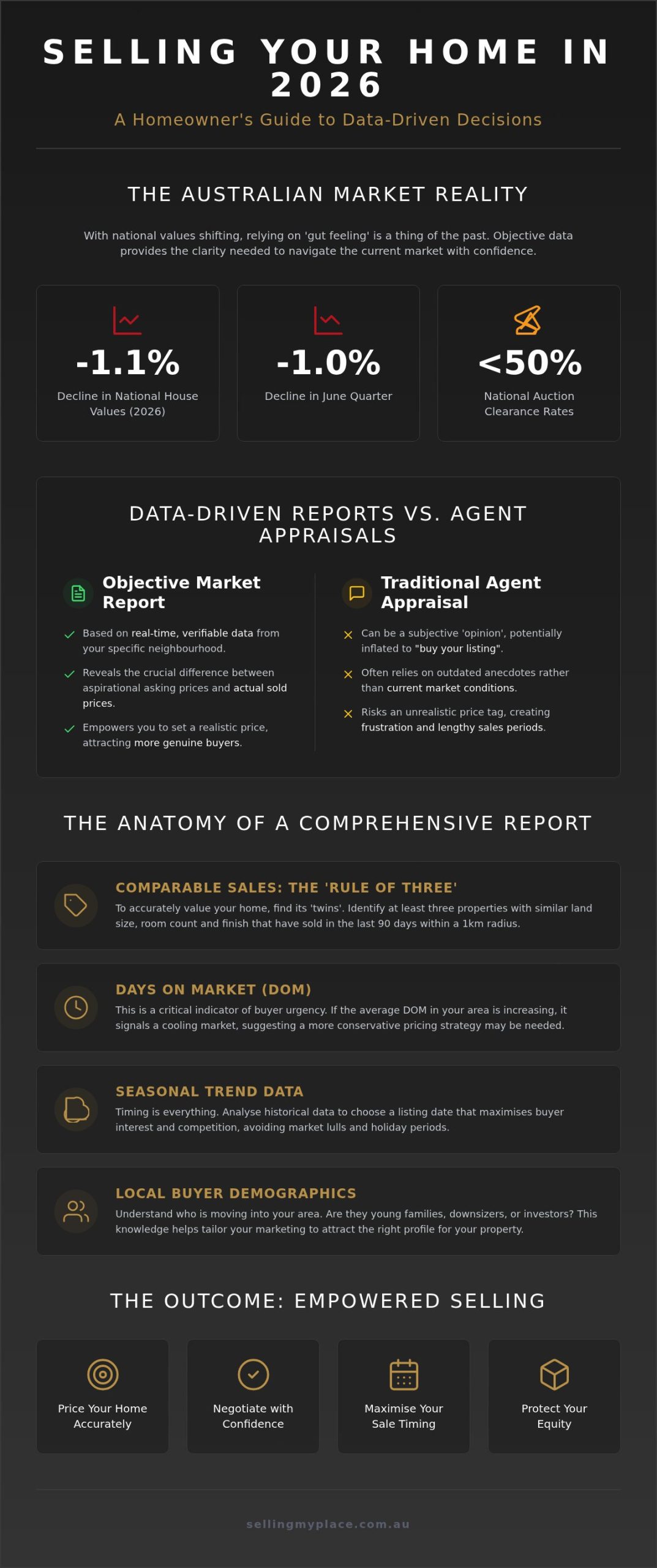
How to Leverage Local Data to Maximise Your Sale Price
Having the data at your fingertips is one thing; knowing how to wield it is what separates a standard sale from a result that truly changes your family’s future. Once you have digested your neighborhood market reports, the focus shifts to execution. It is about more than just a number on a screen; it is about how you present that value to the world. By aligning your Residential Property Listing Services strategy with the hard facts of your suburb, you can command attention and justify a premium price point with total confidence.
Strategic timing is another lever you can pull. Your report might reveal that four-bedroom family homes in your specific pocket sell for a notable premium in the spring, or perhaps that buyer activity peaks just after the school holidays. Beyond timing, you should highlight local strengths that data-savvy buyers crave. If your home sits within a coveted school catchment or boasts a high “Walk Score” to local cafes, these are non-negotiable features for your listing description. These details transform a house into a lifestyle opportunity, making it much easier for a buyer to see the long-term value of the investment.
Strategic Pricing Brackets
Most Australian buyers start their journey on major property portals, using specific price filters to narrow their search. These engines typically operate in $50,000 or $100,000 increments. If you price your home at $1,005,000, you will completely disappear from the search results of anyone with a $1M cap. This is why the “Sweet Spot” is so vital. Pricing at $995,000 ensures you appear in the maximum number of relevant searches while remaining just below a significant psychological barrier. It is the “Goldilocks” price; high enough to reflect your home’s worth, yet accessible enough to ignite a competitive bidding environment.
Using Reports for Pre-Sale Improvements
Before you pick up a paintbrush or call a landscaper, look at the “sold” comps in your report. You might find that in your area, a modernised kitchen adds far more value than a new deck. This allows you to invest your pre-sale budget where it will actually move the needle on your final sale price. Value-Add potential is identified through comparative market analysis by isolating specific features in recently sold local homes that commanded a clear price premium over unrenovated counterparts. If you are ready to see how this data applies to your specific street, reach out for a tailored market breakdown today.
Empowered Selling: How Kincade International Direct Sales Backs Your Strategy
Selling your home is a major life transition, and we don’t think you should have to sacrifice your hard-earned equity just to get professional support. The Kincade International Direct Sales (KIDS) approach is built on a foundation of transparency and partnership. We provide the exact same professional-grade neighborhood market reports that the “big” franchise agencies use, but we do it without the traditional commission structure. This means you can keep more of your profit, often saving an average of $20,000, while still having access to the highest quality data available in 2026. It is about giving you the same tools as the experts, without the high marketing costs or the pressure of a percentage-based fee.
Integration is key to a successful sale. Once you have your data, we help you weave those findings into a comprehensive marketing package. This isn’t just about putting a price on a website; it’s about building a compelling case for your home’s value. By combining your report insights with professional photography and floorplans, you create a listing that reflects the true worth of your property. This professional presentation attracts serious buyers who respect your informed position, allowing you to move through the process with a sense of calm confidence. We believe that when you are better informed, you are better protected.
Beyond the Data: The Agent Advisory Service
While data is powerful, interpreting it correctly is what makes mastering the deal second nature. Our Real Estate Advisory Services act as the “steady hand” you need when the numbers feel complex or the market feels volatile. Our advisors provide personalised pre-sale consulting to bridge the gap between a PDF report and a “Sold” sticker on your front gate. You aren’t just getting a document; you’re getting a partnership that aims to reduce the stress of the negotiation process. This guidance ensures that every decision you make is grounded in reality and focused on your family’s long-term stability.
Your Next Steps to a Commission-Free Sale
Taking control of your sale starts with a single, informed step. You can access your comprehensive neighborhood market reports today to begin your journey toward a commission-free settlement. From there, we help you prepare a professional listing with high-end photography and accurate floorplans, ensuring your home is presented in its best possible light. It is your home, your legacy, and your equity; we are simply here to ensure you have the tools to protect it all while selling on your own terms. We invite you to step into this process with us, knowing you have the support of a seasoned team that values your results as much as you do.
Step Into Your Next Chapter with Confidence
The journey of selling a family home is about more than just a transaction; it’s about honouring your hard work and protecting your future. You now have the knowledge to look past the noise of inflated appraisals and trust the objective truth found in neighborhood market reports. By focusing on actual sold data and strategic pricing brackets, you can navigate the shifts of the 2026 market with the calm authority of a seasoned pro. It’s about being informed, staying grounded, and making decisions that truly serve your family’s best interests.
At Kincade International Direct Sales, we are here to ensure you don’t have to walk this path alone. Our approach combines professional-grade data with an expert Agent Advisory Service, allowing you to keep 100% of your sale profit. You can access high-end professional marketing and street-level insights without the burden of a traditional commission. Are you ready to take the lead in your property sale? Get Your Professional Neighbourhood Market Report and Save Thousands today. We look forward to being the steady hand that helps you secure the result your family deserves.
Frequently Asked Questions
What is the difference between a market report and a bank valuation?
A bank valuation is a conservative assessment focused on lender risk, whereas a market report identifies the price a willing buyer is likely to pay in the open market. Banks often value properties lower to protect themselves against potential market shifts. A market report provides a more optimistic yet realistic range based on actual buyer competition and recent local momentum.
How often should I update my neighbourhood market report before listing?
In the shifting landscape of 2026, we suggest updating your data every 30 days. With national house values experiencing a correction, prices can move quickly. Staying current ensures your strategy remains aligned with the latest settled sales rather than outdated figures from months ago. It’s about maintaining that steady hand throughout your campaign so you don’t miss a beat.
Can I get a neighbourhood market report for free in Australia?
You can find basic summaries for free through bank apps or property portals, but they often lack the street-level nuance of a professional report. Free versions usually provide a broad suburb median which can be misleading for specific pockets. For a high-stakes sale, a comprehensive report ensures you aren’t missing the specific details that justify a premium price for your unique home.
Are online property value estimates actually accurate in 2026?
Online estimates are helpful starting points but often miss the heart of a home. They can’t see your high-end kitchen renovation or the quietness of your specific cul-de-sac. This is why neighborhood market reports are superior; they allow for a human-led interpretation of the data that accounts for the unique lifestyle features an algorithm might overlook during a market correction.
Does a neighbourhood market report include ‘off-market’ sales data?
Most reports focus on settled sales data, which is the most reliable truth in property. While off-market sales are common, they aren’t always publicly recorded with the same level of detail immediately. A professional report will focus on the most transparent and verifiable data to ensure your pricing strategy is defensible during a tough negotiation with a savvy buyer.
How do I use a market report if there haven’t been any sales in my street recently?
If your specific street is quiet, we expand the search to comparable pockets within your suburb. We look for areas with similar land sizes, school catchments, and proximity to local centres. This broader view provides a statistically significant baseline, allowing you to price your home accurately even when immediate street-level data is sparse or outdated.
Will a market report help me decide between an auction or a private treaty sale?
Absolutely. By analysing local auction clearance rates, which fell below 50% nationally in mid-2026, neighborhood market reports help you gauge the current appetite for public bidding. If your area shows a high percentage of properties passing in, a private treaty sale with a clear price might be the more reassuring and effective path for your family.
How do I explain my data-driven price to a buyer who thinks it’s too high?
Lead with the data rather than emotion. When a buyer questions your price, you can physically show them the recent comparable sales of “twin” properties in the area. This shifts the conversation from a personal disagreement to an objective discussion about market reality. It builds trust, as the buyer can see you’ve based your expectations on verifiable facts rather than guesswork.
Preparing Your House for Sale: 2026 Australian Guide
What if the secret to a record-breaking sale price in 2026 isn’t that $50,000 kitchen renovation you’ve been agonising over, but rather the things you choose to take away? We understand that the thought of learning how to prepare your house for sale can feel completely overwhelming, especially when you’re balancing a busy family life with the fear of over-capitalising. It’s a high-stakes transition, and you want to ensure every dollar spent adds genuine value to your final result without draining your hard-earned equity.
Most homeowners believe they need to fix every minor imperfection to attract a buyer, yet the most successful sales often come down to strategic subtraction and polished digital presentation. You’re likely looking for a way to stand out in the local market without losing your sanity or your savings in the process. This guide will show you how to prioritise your efforts for maximum impact. We’ll walk through a clear, stress-free checklist that covers everything from clever decluttering to the importance of professional photography, ensuring your home is ready for its close-up while you stay focused on your family’s next chapter.
Key Takeaways
- Learn how to create a neutral canvas and a “hotel feel” so buyers can easily visualise their own lives within your home.
- Apply the Golden Rule of repairs by focusing only on what’s broken or dated, ensuring you don’t over-capitalise before the sale.
- Understand why professional photography and floorplans are non-negotiable for making a powerful first impression on a smartphone screen.
- Discover how to prepare your house for sale while keeping an average of $20,000 more of your equity through a flat-fee advisory model.
- Optimise your kerb appeal to ensure the first 30 seconds of an inspection build immediate confidence and emotional connection.
The Psychology of a Sale: Decluttering and Depersonalising
Selling a home is often one of the most emotional chapters of your life. It’s where you’ve raised kids, celebrated milestones, and built a sanctuary. However, when you’re looking at how to prepare your house for sale, the first step is a psychological shift: you’re no longer selling a “home”, you’re presenting a “property”. This transition can feel a bit bittersweet, but it’s the most effective way to ensure a buyer falls in love with the space just as much as you once did.
The core of this process is depersonalising. The goal is to create a neutral canvas. If a potential buyer sees your family portrait in the hallway or your collection of vintage cricket bats in the study, they’re subconsciously reminded that they are a guest in someone else’s space. We want them to feel like they’ve just walked into their own future. Utilising proven home staging techniques helps bridge this gap, turning your personal sanctuary into a space that speaks to the widest possible audience. It’s about helping them mentally “move in” before they’ve even made an offer.
Think of the last time you stayed in a high-end boutique hotel. It felt warm, inviting, and lived-in, yet it didn’t feel like it “belonged” to anyone specific. That’s the gold standard for your presentation. It often starts with strategic subtraction. Removing bulky furniture pieces that block the natural flow of a room can instantly make a lounge feel twice its actual size. It’s amazing how much more light a room can hold once you’ve cleared out that oversized armchair that’s been in the corner for a decade.
We know this is easier said than done if you’re still living there with toddlers or a golden retriever. The trick isn’t to be perfect 24/7; that’s simply not realistic. Instead, it’s about having a “five-minute flurry” plan. Keep a few large, stylish baskets handy to quickly sweep up toys or pet accessories before an inspection. This keeps the house “inspection-ready” without making daily life a chore.
Creating a Neutral Palette
Buyers are often looking for a fresh start. While you might love your feature wall in a bold terracotta, it can be a mental block for others. Neutral colours like soft greys, warm whites, or “greige” do more than just look clean; they reflect light and make rooms feel significantly more spacious. By removing highly specific personal collections, you’re clearing the mental noise. This allows a buyer to focus on the architectural bones of the house rather than your taste in decor. When you’re figuring out how to prepare your house for sale, remember that “less is more” applies to every surface, from the kitchen bench to the mantelpiece.
The “Deep Clean” Checklist
A superficial tidy-up won’t cut it in 2026. Buyers are savvy; they’ll look at the details to judge how well the home has been maintained overall. This isn’t just about appearances, it’s about building trust.
- The “Hidden” Inspection: Yes, people will open your pantry and linen cupboards. Organised, half-empty shelves suggest the house has ample storage, whereas a packed cupboard suggests the home is too small.
- Sparkle and Shine: Focus on windows, grout lines in the bathroom, and steam-cleaning the carpets. These are the high-impact areas that signal a “well-loved” and healthy home.
- The Scent Factor: Avoid heavy air fresheners, which can trigger suspicions of hidden mould or pet issues. Instead, rely on natural ventilation and perhaps a single, subtle scent like eucalyptus or freshly laundered linen to create a sense of calm.
Strategic Repairs: Where to Invest for the Best ROI
When you’re deciding how to prepare your house for sale, it’s easy to feel pressured into expensive, full-scale renovations. You might hear stories about new kitchens adding value, but the reality is often quite different. Our Golden Rule is simple: only fix what is visibly broken or painfully dated. You want to avoid over-capitalising, which happens when the cost of your repairs exceeds the actual value they add to the final sale price. Your goal is to protect your equity, not spend it all on a house you’re about to leave.
A fresh coat of paint remains the single most cost-effective way to transform an interior. It’s remarkable how a warm, neutral white can hide years of scuffs and instantly make a space feel “new” again. Pair this with a lighting upgrade by swapping out old, yellowing plastic fixtures for modern, warm LED globes. These small changes create a sense of polished consistency throughout the home. Instead of a $30,000 kitchen gut-job, consider a “refresh” by painting old cabinetry or replacing a dated splashback. These tactical updates resonate with buyers without draining your bank account.
The “Quick Fix” Hit List
Buyers often use small maintenance issues as a barometer for how well the rest of the house has been cared for. A leaky tap or a wonky cupboard door might seem minor to you, but to a nervous buyer, it signals a potential list of hidden headaches. Walk through your home with a critical eye and tackle the easy wins. Replace dated door handles and mismatched tapware for an instant modern lift. Ensure every light switch and power point is scrubbed clean and functions perfectly. If you’re feeling stuck on where to start, our expert advisory service can help you prioritise the repairs that truly move the needle.
Flooring and Window Treatments
Your floors and windows occupy a huge amount of visual real estate. You don’t always need to replace carpets; a professional deep clean can often restore their life and remove lingering “house smells”. However, if the carpet is threadbare or heavily stained, a budget-friendly replacement in a neutral tone is usually worth the investment. For window treatments, focus on light. Remove heavy, dark drapes that block the sun. Clean, modern blinds or simple sheer curtains can make a room feel airy and inviting. If you have original floorboards hidden under old lino, consider polishing them. It’s a classic Australian feature that adds character and value for a relatively modest outlay. Knowing how to prepare your house for sale is about making these smart, tactical choices that celebrate the home’s existing strengths.
Street Appeal: Making the First 30 Seconds Count
They say you never get a second chance to make a first impression. In the world of real estate, that impression is often formed before a buyer even steps out of their car. Kerb appeal is your home’s first handshake. It sets the emotional tone for the entire inspection. If the exterior looks neglected, buyers may subconsciously assume the internal maintenance has been ignored too. When considering how to prepare your house for sale, starting at the boundary line is just as vital as the work you do inside.
Pressure washing is one of the most satisfying and high-impact tasks you can undertake. It’s incredible how years of grime on driveways and paths can vanish, revealing the original colour of the concrete or pavers beneath. Similarly, your garden needs to look manicured rather than just “tidy”. This involves a few key steps:
- Sharp edging: Define the lines along your paths and lawn to create a professional, clean finish.
- Fresh mulch: Use a dark mulch to make your plants stand out and keep weeds at bay.
- Strategic pruning: Cut back any overgrown shrubs that block windows or obscure the home’s architecture.
This level of attention to detail reassures a buyer they’re walking into a home that’s been truly cherished. The front door then acts as the final psychological focal point of the exterior. It’s where the buyer stands while the agent prepares the keys, giving them a moment to scrutinise the details. A fresh coat of paint here is a small investment with a huge emotional payoff. Choose a colour that complements your home’s existing palette but adds a touch of sophisticated personality. Whether it’s a classic navy, a contemporary charcoal, or a crisp, welcoming white, it signals that the home is modern and cared for.
The Entryway Experience
Small details at the threshold create a sense of welcome. Ensure your house number is visible and matches the home’s style; it’s a minor touch that adds instant polish. A brand-new welcome mat and a couple of healthy potted plants can soften the entry. Don’t forget the evening “drive-by”. Check that exterior lighting is functional and clean, as many buyers will cruise past after work to see how the home looks at night.
Outdoor Living Spaces
Australians value the outdoors, so treat your verandah or deck as an extension of the house. Staging these areas is a core part of how to prepare your house for sale for our local market. A clean BBQ area or a fire pit setup helps buyers visualise a lifestyle of relaxed summer evenings. Finally, ensure the lawn is freshly mowed before every open home. It’s the final piece that makes the property feel complete.
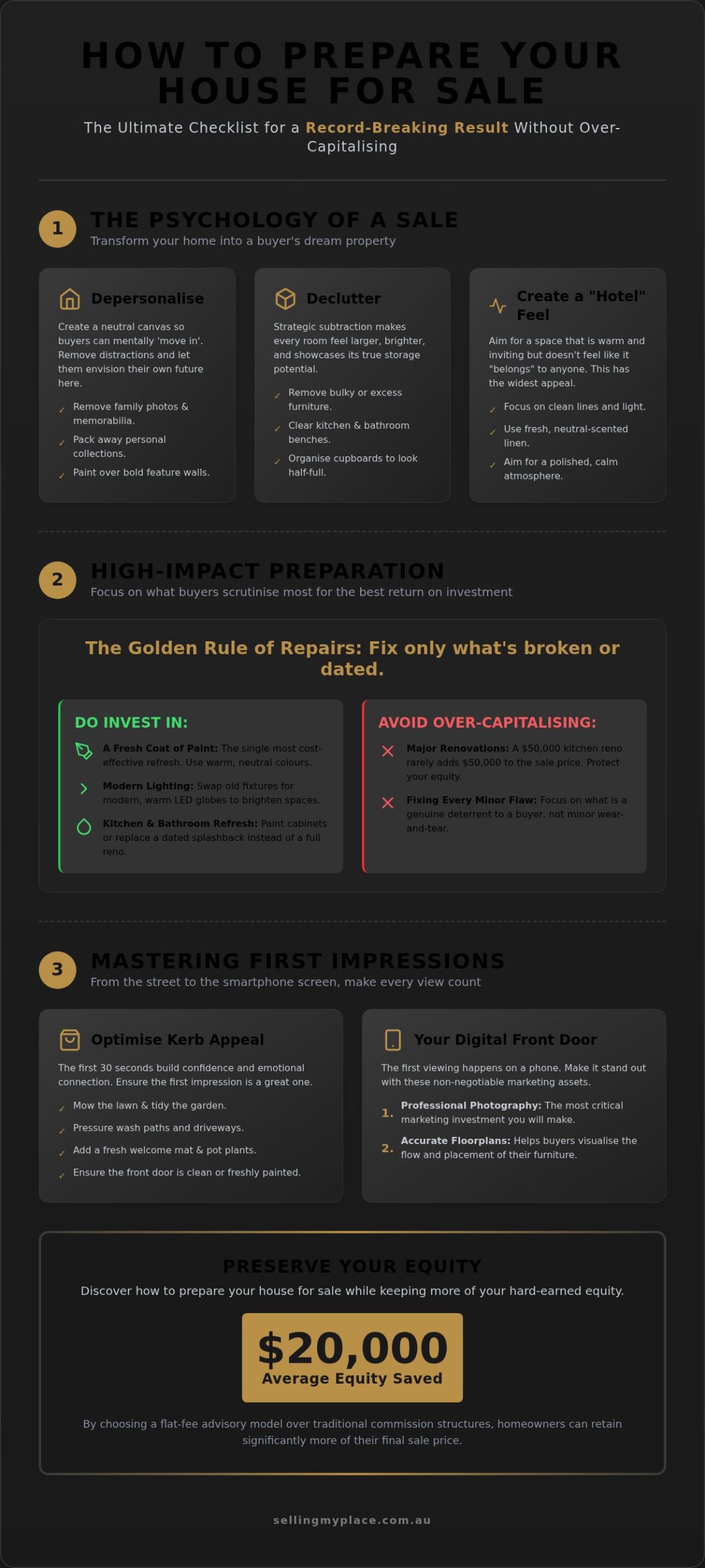
Visual Marketing: Your Digital Front Door
In 2026, the property market moves at the speed of a thumb-swipe. Before a potential buyer ever pulls up at your kerb, they’ve already walked through your hallways digitally. This makes your online listing the true “first inspection”. When you’re learning how to prepare your house for sale, understanding this digital-first reality is crucial. It’s no longer enough to have tidy rooms; you need images that stop the scroll and evoke an immediate emotional response. Your digital presentation needs to be as polished as the home itself.
Professional photography is a non-negotiable investment for any serious seller. It’s the difference between a house that sits on the market and one that sparks a bidding war. The camera sees differently than the human eye, picking up every stray power cord or smudge on a window. You’ll need to ensure the house is actually cleaner for the lens than it would be for a dinner party guest. High-definition sensors are notoriously unforgiving, so those “hidden” dust bunnies under the sofa or fingerprints on the stainless steel fridge might suddenly become the stars of the show. Think of the camera as a guest with perfect vision.
Photography: Capturing the Light
Timing is everything when it comes to capturing your home’s best side. We often recommend “Golden Hour” for exterior shots, that soft, honey-hued window just before sunset that makes every brick and leaf look magical. Inside, a professional photographer uses wide-angle lenses to capture the full volume of a room, helping buyers understand the layout without the “fish-eye” distortion of a cheap smartphone camera. Professional photos attract three times more clicks than DIY shots, ensuring your property gets the attention it deserves from the very first day it hits the portals.
The Role of Floorplans
While photos provide the “vibe”, floorplans provide the logic. They allow a buyer to “mentally move in” by measuring their existing furniture against your rooms. Accurate measurements build a bridge of trust, showing that you have nothing to hide and that the home’s proportions are exactly as described. This clarity is essential for buyers who are trying to narrow down their shortlist from their couch.
Use your floorplan to highlight flexible living zones or future renovation potential. Perhaps that sunroom could be a home office, or the master suite has space for an additional walk-in robe. By providing a comprehensive digital listing, you’re giving buyers the confidence to book a physical viewing. If you want to ensure your property stands out with high-end visual marketing and expert advice, reach out to our advisory team to discuss your listing needs.
The Financial Prep: Equity Preservation and Advisory
You’ve done the hard work of painting, decluttering, and polishing your home’s presentation. However, the final and perhaps most critical step in how to prepare your house for sale is securing your financial outcome. It’s easy to get caught up in the “vibe” of the sale and forget that at its heart, this is a major financial transition. Understanding the true cost of selling is vital. Traditional agency models often rely on a percentage-based commission, which can feel like a penalty for your home’s success. In 2026, many Australians are realising that they can achieve a record-breaking result without sacrificing a massive chunk of their hard-earned equity.
By opting for a Sale by owner approach, the average seller is able to keep an average of $20,000 more of their equity in their own pocket. That’s a significant sum that could go toward your next deposit, a well-deserved holiday, or your retirement fund. You don’t have to navigate this alone, though. Utilising a professional Agent Advisory Service allows you to access the same high-level strategy and staging advice used by top-tier agents, but within a much fairer financial framework. It’s about being the expert of your own home while having a steady, professional hand to guide you through the complexities.
Part of this “steady hand” approach includes getting your legal ducks in a row early. Seeking expert Conveyance Advice before you even hit the market is a smart move. It ensures your contract of sale is robust and ready to go the moment a buyer makes an offer, preventing unnecessary delays that can sometimes see a deal fall through. When you’re looking at how to prepare your house for sale, financial and legal readiness is just as important as a fresh coat of paint.
Determining Your Market Value
Setting the right price is a delicate balance of data and local insight. It’s important to look at actual recent sales in your specific pocket of the neighbourhood, rather than just the “asking” prices you see online. Emotion can often cloud our judgement when it comes to our own homes, so rely on hard numbers to set a realistic reserve. For a deeper dive into this process, read our guide on how to determine the market value of a home in Australia. This ensures you enter negotiations with confidence and a clear bottom line.
The Flat-Fee Advantage
The traditional commission model is often shrouded in mystery, but the flat-fee alternative is refreshingly transparent. Paying for your marketing and advisory services upfront is almost always smarter than paying a percentage of your final sale price at the end. It allows you to budget accurately and ensures that every extra dollar the market is willing to pay stays with you. At Kincade International Direct Sales, we empower you to take control of your sale journey while providing the professional tools—like photography and floorplans—you need to succeed. See how our flat-fee model can save you thousands on your next sale.
Your Next Chapter Starts with a Smart Strategy
Taking the first step toward selling your home is a significant life transition, and it’s completely natural to want everything to be perfect. As we’ve explored, knowing how to prepare your house for sale in 2026 isn’t about expensive renovations or chasing every minor flaw. It’s about strategic presentation, from the initial “hotel feel” of your decluttered lounge to the digital front door of your professional photography and floorplans. By focusing on high-impact repairs and kerb appeal, you create an emotional connection that resonates with buyers the moment they see your listing.
Beyond the aesthetics, protecting your equity is the most rewarding part of the process. With our Expert Agent Advisory Service and global marketing reach, you can navigate the market with local Australian expertise while saving an average of $20,000 in commissions. You have the power to be the expert of your own sale journey without the stress of traditional agency costs. Download our Full Seller’s Guide and start your commission-free journey today. We’re here to help you move forward with confidence and a steady hand.
Frequently Asked Questions
How much should I spend on preparing my house for sale?
You should aim to spend between 1% and 2% of your property’s estimated value on preparation. This range typically covers essential maintenance, professional cleaning, and cosmetic updates like fresh paint without the risk of over-capitalising. It’s about making smart, tactical improvements that protect your equity while ensuring the home presents at its absolute best for the first weekend of inspections.
Is it worth renovating the kitchen before selling?
A full kitchen renovation is rarely worth the investment just before a sale. Most buyers prefer to choose their own finishes, and you risk spending more on a new fit-out than you’ll actually recoup in the final price. Instead, we recommend a “refresh” by painting old cabinetry, replacing dated handles, or installing a modern splashback to provide a high-impact visual lift for a fraction of the cost.
Do I really need professional photography if I have a good smartphone?
Professional photography is a non-negotiable investment because your first inspection happens on a smartphone screen. While modern phones are impressive, they can’t match the wide-angle lenses and lighting expertise of a professional who knows how to capture a room’s true volume. High-quality images attract significantly more interest on property portals, which is a vital part of how to prepare your house for sale effectively.
How do I keep my house tidy for inspections while living in it?
The most effective strategy for living in an “inspection-ready” home is to use the “basket method” for quick tidying. Keep several large, stylish baskets handy to quickly sweep up toys, mail, or pet accessories before a potential buyer arrives. Focus on keeping high-impact areas like kitchen benches and bathroom vanities completely clear of daily clutter to maintain that polished, hotel-like feel without the stress.
What is the most important room to focus on when preparing to sell?
The kitchen is universally considered the most important room to get right for a successful sale. It acts as the emotional heart of the home and is often the space where buyers spend the most time scrutinising the details. If your kitchen feels clean, bright, and functional, it builds immediate confidence. Once the kitchen is polished, focus your attention on the main living area and the master bedroom.
Can I sell my house myself and still get a professional price?
Yes, you can absolutely achieve a professional price by selling the property yourself, especially when supported by expert advice. By using flat-fee marketing and an Agent Advisory Service, you reach the same audience as traditional agents while keeping an average of $20,000 more of your equity. This approach allows you to act as the expert on your own home while ensuring your digital presentation is world-class.
How long does it typically take to prepare a house for market?
Most homeowners should allow between two and four weeks to properly prepare their property for the market. This timeline provides enough space for deep cleaning, decluttering, and completing minor repairs without the process becoming overwhelming for the family. It also ensures you have plenty of time to book professional photography during the “Golden Hour” to make sure your online listing truly stands out from the competition.
What are the most common mistakes people make when preparing to sell?
The most common mistakes are over-capitalising on expensive renovations and neglecting the property’s street appeal. Many sellers spend thousands on internal upgrades that don’t offer a clear return, while forgetting that the front garden is the home’s first handshake. Another frequent error is failing to learn how to prepare your house for sale by depersonalising, which prevents buyers from mentally moving into the space during an inspection.
Private House Sales Australia: The 2026 Guide to Commission-Free Selling
Why would you hand over $20,000 or more of your hard-earned home equity to a third party when the tools to succeed are already in your hands? Selling a family home is a deeply personal milestone, and it’s completely natural to feel protective of the legacy you’ve built over the years. Most homeowners agree that traditional real estate commissions, which now average roughly 2.65 percent across the country, feel like an unnecessary hurdle in your next chapter. Exploring the potential of private house sales australia is a smart move once you’ve realised that the old way of doing things doesn’t always serve your family’s best interests or your bottom line.
We’re here to show you that taking the lead on your property journey doesn’t mean you have to sacrifice professional quality or peace of mind. This guide provides a clear path to saving thousands in fees while maintaining a polished, high-end presence in the market. You’ll learn how to navigate the latest July 2026 identity verification laws, master the art of professional-grade listings, and access the expert support needed to handle negotiations with total confidence. It’s about moving forward with a steady hand and a full bank account.
Key Takeaways
- Learn how to keep $20,000 or more of your home equity by switching to a 0% commission model that prioritises your family’s financial future.
- Discover why the modern approach to private house sales australia has evolved into a professional partnership that rivals traditional high-end agencies.
- Master the art of the digital first impression by using professional photography and floorplans to capture buyers where they shop most: on their smartphones.
- Gain the confidence to handle your own sale with expert advisory support that guides you through 2026 legal requirements and buyer negotiations.
- Find out how to take back control of your property’s narrative and timeline with a “list until sold” promise that removes unnecessary pressure.
What are Private House Sales in Australia?
At its heart, a private house sale is a property transaction where you, the owner, take the lead instead of hiring a traditional commission-based agent. It’s a move toward transparency and personal control. While the concept isn’t new, the way we approach private house sales australia has undergone a massive transformation. We’ve moved far beyond the old “DIY” days of hand-drawn signs and crossing your fingers. Today, it’s about “Professional Direct Sales,” a partnership where you retain the decision-making power while leaning on professional-grade tools and advisory services to ensure a seamless result.
In 2026, we’re seeing a record shift toward this model. With national median commission rates sitting around 2.65 percent, many families are choosing to protect their hard-earned equity. This trend is a response to the evolving Australian property market, where savvy sellers realise that they don’t need a middleman to tell their home’s story. Instead, they use flat-fee models that provide the same high-end marketing and reach as a traditional agency, but without the staggering “success fee” at the end. It’s a grounded, sensible way to manage one of life’s biggest transitions.
The Legal Framework for Private Sales
You might wonder if it’s actually legal to sell your own home. The answer is a resounding yes. In every Australian state and territory, you have the right to sell your property privately. However, staying on the right side of the law requires a steady hand and the right team. Since July 1, 2026, new Anti-Money Laundering and Counter-Terrorism Financing laws require strict identity verification for both buyers and sellers. You’ll need a qualified solicitor or conveyancer from day one to prepare your contract of sale and manage the legal transfer. A professional flat-fee service doesn’t replace these legal experts; it works alongside them to ensure every “i” is dotted and “t” is crossed.
Commission vs. Flat-Fee: The Real Cost
The traditional agency model often feels like a “success fee” trap. It’s easy to overlook a small percentage until you do the maths on your actual home value. If you sell a home for $1,000,000 at a 2.5 percent commission rate, you’re essentially writing a cheque for $25,000 to an agent for work you could have guided yourself. That’s a significant amount of money that could be better spent on your next deposit or your retirement. By choosing a flat-fee model, you’re opting for price certainty. You pay for the services you actually use, such as professional photography and market reports, ensuring your home equity stays right where it belongs: with you.
Why Savvy Sellers are Choosing Commission-Free Models
Choosing a different path for your property sale is often sparked by a desire for clarity. When exploring private house sales australia, transparency isn’t just a buzzword; it’s the foundation of the entire process. Removing the middleman also removes the filter that often colours buyer feedback or negotiation details. You’re the one opening the door, sharing the history of the veggie garden, and hearing the genuine excitement in a buyer’s voice. This direct connection builds trust. It ensures you’re never left wondering what’s happening behind closed doors or if a lead is being “managed” for the agent’s benefit rather than yours.
Financial Empowerment and Equity Protection
It’s hard to ignore the numbers. With the national median commission rate currently at 2.65 percent, the savings on a typical Australian home can easily exceed $20,000. That’s not just a figure on a spreadsheet. It’s the deposit for your next adventure, a complete kitchen renovation, or a significant boost to your retirement nest egg. Traditional agencies often tack on “marketing administrative fees” that can quietly eat into your profit. By opting for a flat-fee model, you protect 100 percent of your sale profit. You become the best advocate for your home because nobody understands its value, its quirks, or its soul better than you do.
Control Over the Selling Timeline
We’ve all felt that artificial pressure of an “auction day” countdown or an expiring agency agreement. It creates a sense of frantic urgency that doesn’t always lead to the best outcome for your family. A professional direct sale approach replaces that stress with a “list until sold” promise. If your property is a unique heritage gem or a high-end coastal retreat, it might need a little more time to find the right custodian. You can learn more about managing this journey in our guide on How to Sell Your Own Home: A Step-by-Step Guide to Sale by Owner in Australia. Taking the lead means you decide when to accept an offer and when to hold out for the price your home truly deserves. If you’re feeling ready to explore how this partnership works, you can always reach out for a quiet chat about your specific needs.
Mastering the Private Sale: A Step-by-Step Framework
Success in the world of private house sales australia isn’t about luck; it’s about following a methodical process that mirrors the best agencies while keeping your family’s interests at the centre. You begin with a grounded understanding of your local area. By using detailed neighbourhood market reports, you can strip away the guesswork and set a price that reflects true market value. This ensures you don’t leave money on the table or scare off genuine buyers with an unrealistic figure. It’s about being informed and confident from the very first enquiry.
Once your price is set, the focus shifts to the visual narrative. In 2026, your home’s first “open house” happens on a smartphone screen before a buyer even thinks about driving past your front gate. Launching your campaign across multiple channels ensures maximum visibility. As enquiries start rolling in, you’ll find that managing inspections is often the most rewarding part. You get to meet the people who might become the next custodians of your home. It’s a personal exchange that a busy agent simply cannot replicate.
Preparation and Presentation
Professional floorplans and photography are no longer optional extras; they are the non-negotiable standard for a successful sale. You want to present a “magazine-ready” lifestyle that invites buyers to dream. This usually involves a bit of elbow grease. Clear away the daily clutter, depersonalise your spaces, and consider small styling touches like fresh flowers or new linens to elevate the mood. When your marketing materials look polished and professional, you signal to the market that you are a serious seller who values their property.
Negotiation Strategies for Private Sellers
Negotiation is where many owners feel the most trepidation, but it’s also where you have the most power. When a low-ball offer arrives, don’t take it personally. Treat it as the start of a conversation rather than a slight. By having an Expert Agent Advisory Service in your corner, you can lean on seasoned professionals to help you structure your counter-offers and maintain your poise. For deeper insights into this phase, take a look at our guide on Mastering the Deal: Expert Property Sale Negotiation Tips for Australian Homeowners. Finally, once you’ve reached an agreement, your solicitor or conveyancer steps in to finalise the contract, ensuring the legal transition is as smooth as the sale itself.
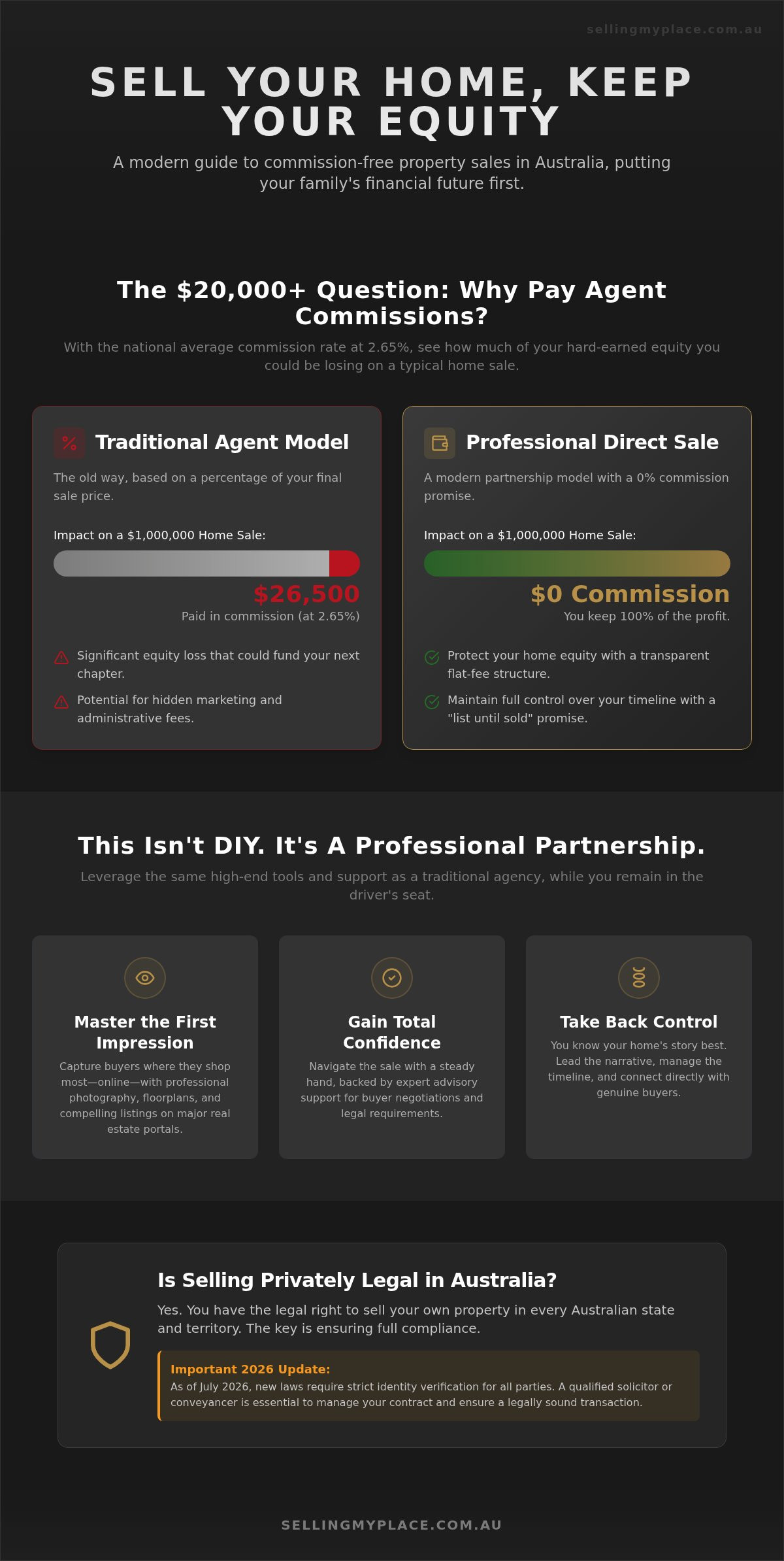
Professional Marketing: The Secret to a Record-Breaking Price
Smartphone screens have become the new front gate for Australian property. In a fast-paced digital environment, your home’s first impression happens in the palm of a buyer’s hand, often while they’re scrolling through listings late at night or during a lunch break. For those undertaking private house sales australia, this visual narrative is the single most powerful tool in your arsenal. Moving away from the “DIY” tag means embracing high-calibre marketing that invites a potential buyer to step into a new lifestyle. It’s about capturing the heart and the head simultaneously, ensuring your listing stands out with the same polish as any high-end agency.
Our approach also taps into a global network reach, attracting expats and international buyers who are looking to secure their piece of the Australian dream. This broad visibility, combined with professional-grade materials, ensures you aren’t just reaching “anyone,” but the “right” person for your home. When you present your property with authority and warmth, you build an immediate bridge of trust with buyers that carries through to the final handshake.
The Power of High-End Visuals
We’ve all seen listings with grainy, poorly lit photos taken on a mobile phone. These images can devalue a property in an instant, signalling a lack of care that might make a buyer wonder what else has been overlooked. Professional photography uses expert lighting and editing to highlight your home’s best features, which significantly increases click-through rates on major portals. Pairing these visuals with a detailed floorplan is equally vital. Detailed floorplans allow buyers to pre-qualify themselves by understanding the home’s flow and layout before they visit, which effectively reduces the number of “time-waster” enquiries you receive. It’s a respectful way to manage both your time and theirs.
Strategic Market Reports
Data is the bridge between an asking price and a signed contract. When a skeptical buyer questions your valuation, having a professional neighbourhood market report allows you to justify your position with cold, hard facts. These reports help you understand local trends, such as what features buyers in your specific suburb are currently prioritising. Whether it’s a dedicated home office or a sustainable garden, knowing what resonates allows you to tailor your message. To help you get this right, we’ve put together a comprehensive guide on How to Determine the Market Value of a Home in Australia: The 2026 Seller’s Guide. This level of preparation turns a simple sale into a strategic success. If you’re ready to see how high-end marketing can elevate your property’s potential, we invite you to book a pre-sale consultation with our team.
Launching Your Private Sale with Selling My Place
Choosing a partner for your property journey is a significant decision that impacts both your financial outcome and your peace of mind. The Kincade International Direct Sales (KIDS) model is built on the belief that you shouldn’t have to choose between saving money and receiving professional support. We offer a sophisticated partnership approach to private house sales australia, providing you with high-end photography, detailed floorplans, and neighbourhood market reports. This ensures your home is presented with the authority it deserves while you retain the equity you’ve worked so hard to build.
Our global reach provides a distinct advantage that basic DIY platforms simply cannot match. We actively tap into an international network of residential buyers and expats who are often searching for the stability and lifestyle found in the Australian market. By combining this wide-reaching visibility with expert pre-sale property consulting and conveyance advice, we ensure your property is seen by the right people, whether they are just around the corner or on the other side of the world.
The Agent Advisory Service
Even with the most beautiful marketing, the process of selling can feel complex and occasionally overwhelming. That’s why our Agent Advisory Service is the cornerstone of our partnership. Our experts act as a nurturing guide, helping you navigate the intricacies of the sale with calm confidence. We are here to reduce the stress of the process by providing grounded, professional support whenever you need it. Whether you’re unsure how to respond to a specific buyer enquiry or simply want a steady hand to lean on during negotiations, you’ll never feel like you’re managing this transition alone.
Starting Your Journey Today
Beginning your sale is a straightforward and inviting process designed to put you at ease. Our simple onboarding takes you from package selection to a live listing with minimal fuss. You can easily book your professional photography and floorplan session through our platform, ensuring your home is ready for its digital debut in its best possible light. If you’re ready to take the lead on your property’s future, we invite you to view our professional residential property listing services and see how our modern approach can work for your family.
Your Future, Your Equity, Your Choice
Embarking on a property sale is about more than just a transaction; it’s about honouring the life you’ve built and protecting your financial legacy. We’ve explored how professional-grade marketing and a strategic framework can turn the dream of a commission-free sale into a reality. By reclaiming control, you ensure that every decision aligns with your family’s needs rather than an agent’s quota. It’s a move toward transparency that rewards your hard work.
When you choose to lead your own journey with private house sales australia, you aren’t doing it alone. You’ll have the backing of an Expert Agent Advisory Service and high-end tools, including professional photography and floorplans, to make your listing shine. Most importantly, you stand to save an average of $20,000 in commissions, a sum that belongs in your pocket for your next big adventure. You have the local knowledge and the heart; we have the tools and the steady hand to help you succeed.
Ready to keep your equity? Explore our commission-free selling packages today.
Step forward with confidence, knowing your property’s potential is in the best possible hands: your own.
Frequently Asked Questions
Is it legal to sell my own house privately in Australia?
Yes, it is completely legal to sell your own home in every Australian state and territory without a traditional real estate agent. While you manage the marketing and inspections, you must still engage a qualified solicitor or conveyancer to handle the legal transfer of title. This ensures your property journey remains compliant with local laws while you retain full control over the transaction and your home equity.
How do I list my property on Australia’s leading real estate websites without an agent?
You can secure a presence on the major national property portals by partnering with a licensed flat-fee service provider like ours. Since these high-traffic websites typically don’t allow direct listings from individuals, we act as your professional gateway to ensure your home reaches the widest possible audience. This strategy gives you the same elite visibility as a traditional agency while keeping your hard-earned profit exactly where it belongs: with you.
Will buyers be put off by a private house sale?
Buyers are generally very receptive to private house sales australia, provided the property is presented with professional-grade photography and clear documentation. Many buyers actually prefer the direct communication and transparency that comes from dealing with the owner directly. When you use high-quality visuals and provide honest answers about the home’s history, you build a level of trust that traditional agents often struggle to replicate.
How much can I actually save by selling my home privately?
Most Australian sellers can expect to save an average of $20,000 by opting for a commission-free model. This figure is based on national median commission rates which currently hover around 2.65 percent of the sale price. By removing the agent’s “success fee” and avoiding the hidden marketing administrative costs often tacked onto traditional agreements, you protect your profit and gain significant financial flexibility for your next move.
Do I still need a solicitor if I am selling the house myself?
Yes, engaging a solicitor or conveyancer is a non-negotiable part of the selling process in Australia. They are responsible for preparing the Section 32 or Contract of Sale and managing the legal complexities of the settlement. While you take the lead on marketing and negotiations, your legal representative ensures that the paperwork is handled correctly and that the title transfer is legally binding and secure.
What happens if my property doesn’t sell within three months?
Unlike traditional agency agreements that often expire after 90 days, our partnership includes a “list until sold” promise with no time limits. This removes the artificial pressure of a ticking clock, allowing you to wait for the right buyer and the price your home deserves. If your property is unique or in a niche market, you have the peace of mind knowing your listing stays active without extra fees.
How do I handle the contract and settlement process in a private sale?
You handle the initial negotiation and price agreement, while your solicitor or conveyancer manages the technical settlement process. Once you’ve agreed on a price with a buyer, you simply pass their details to your legal representative to formalise the contract. This division of labour allows you to focus on the human side of the sale while experts handle the high-stakes legal requirements and identity verification checks.
Can I sell my property privately if it is currently tenanted?
You can certainly sell a tenanted property privately, provided you follow your state’s specific residential tenancy laws regarding notice periods for inspections. It’s often helpful to have an open conversation with your tenants to ensure they feel respected during the process. Many owners find that offering a small incentive, such as a temporary rent reduction, encourages cooperation for professional photography and scheduled viewings during the campaign.
Mistakes to Avoid When Selling Your Own Home: The 2026 Australian Guide
Would you willingly hand over A$24,000 of your home’s equity to a stranger just for the sake of tradition? With the national median dwelling value now sitting at A$922,838, that is exactly what many Australians are doing through standard 2.65% commissions. Choosing to sell privately is a brilliant way to reclaim that legacy for your family, but the path is often littered with expensive traps. Understanding the critical mistakes to avoid when selling your own home is the difference between a record-breaking result and a property that languishes on the market for months.
We understand that your home is more than just a floorplan; it is the backdrop to your life’s best memories, and the thought of managing the legalities and negotiations yourself can feel a little overwhelming. This guide is here to act as your steady hand, showing you how to protect your equity while avoiding the massive cost of traditional commissions. You will discover how to price your property accurately for the 2026 market, ensure your contract of sale is legally sound, and create a professional-grade listing that attracts the highest possible offers while keeping 100% of the profit.
Key Takeaways
- Protect your hard-earned equity by bypassing traditional 2.65% commissions, potentially saving you over A$20,000 in unnecessary fees.
- Learn the critical mistakes to avoid when selling your own home, such as allowing emotional attachment to cloud your pricing strategy and market positioning.
- Expand your reach far beyond the local street corner by utilising global marketing networks and professional photography to attract high-value buyers.
- Secure your sale with professional conveyance advice and documented agreements, ensuring you navigate building inspections and finance hurdles with confidence.
- Shift from a solo effort to a supported sale by integrating expert advisory services that offer the steady hand needed for a successful settlement.
The Financial Impact: Is Commission Your Biggest Avoidable Mistake?
The Australian property market in 2026 is a different beast than it was even five years ago. With the national median dwelling value reaching A$922,838, the standard 2.65% commission is no longer just a small fee; it is a significant portion of your hard-earned wealth. For many families, paying over A$24,000 in agency fees feels like an outdated tax on their lifestyle. One of the most significant mistakes to avoid when selling your own home is falling for the “commission trap”, which is the belief that you must sacrifice a slice of your equity to secure a buyer. In reality, the “secret Rolodex” of buyers that agents once touted has been replaced by digital portals that everyone can access.
Today, buyers don’t wait for a phone call from an agent to hear about a new listing. They have alerts set on their phones, and they are browsing digital platforms the moment a property goes live. When you understand the modern For Sale By Owner (FSBO) process, you realise that the digital infrastructure does the heavy lifting for you. Choosing to sell privately isn’t about “going it alone” or doing more work; it is about choosing a smarter partnership that keeps your profit where it belongs, which is in your bank account. It is a shift from a transactional expense to a strategic investment in your family’s future.
Understanding the Flat-Fee Revolution
The rise of the Agency Flat Fee model has changed the game for Australian sellers. Instead of a percentage-based commission that grows as your home’s value increases, a flat fee provides a transparent, upfront cost for the essential tools you need. This includes high-end Residential Property Listing Services that put your home in front of the same audience as the big traditional agencies. You get the professional photography and floorplans that are non-negotiable for a premium price, but without the lingering stress of a massive bill at settlement. It is about professional authority meeting common sense, ensuring you have the same digital reach as any high-street office while maintaining 100% of your equity.
Opportunity Cost and Your Next Move
Think about what an extra A$20,000 could do for your next transition. It might be the deposit for an investment property, a complete kitchen renovation in your new place, or simply a year’s worth of mortgage repayments. The emotional relief of a commission-free settlement day is profound. Protecting your equity is the first vital step in a successful move, providing you with a “steady hand” as you close one chapter and begin the next. When you avoid the mistake of overpaying for services that the internet now provides for free, you aren’t just saving money; you are securing your legacy and ensuring your family’s stability for years to come.
Presentation and Pricing: Avoiding the ‘Market-Cold’ Reception
It’s easy to look at your living room and see the first steps your children took or the laughter shared over birthday dinners. However, one of the most common mistakes to avoid when selling your own home is allowing this deep emotional attachment to dictate your asking price. Sentiment doesn’t show up on a bank valuation. In a market where national house prices are forecast to grow by 7.7% through 2026, buyers are more analytical than ever. They aren’t just looking at your home; they are comparing it against every other data point available on their screens.
To avoid the trap of overpricing and subsequent stagnation, you must lead with logic. Utilising Neighborhood Market Reports allows you to set a price grounded in current local sales evidence rather than memories. This data-driven approach protects you from the “market-cold” reception that happens when a property sits for months without an offer. Remember the ‘First 48’ rule: your listing receives the highest volume of digital traffic in the first two days. If the price is wrong or the presentation is lacking, you’ve missed your best window to capture a premium buyer.
The Psychology of the Australian Buyer
Modern buyers in 2026 are looking for a lifestyle, not just a postcode. They often “swipe left” on listings featuring amateur smartphone photos that feel dark, cluttered, or lived-in. To attract high-value interest, you must neutralise your space. This means removing personal photos and bold decor to create a blank canvas where a stranger can visualise their own future. Highlight lifestyle features that resonate with today’s trends, such as dedicated home offices or seamless indoor-outdoor entertaining areas, rather than just listing room counts. If you’re unsure where to start with your home’s presentation, you might like to chat with us about your property’s unique potential.
Professional Photography vs. DIY Snapshots
High-end visual storytelling is the foundation of a successful private sale. Professional lighting and wide-angle lenses aren’t just luxuries; they are essential tools that justify a premium asking price by making spaces feel bright and aspirational. Alongside stunning imagery, providing detailed floorplans is a non-negotiable requirement for 2026. A floorplan keeps a buyer engaged with your listing for longer, allowing them to mentally arrange their furniture and plan their life in the home before they even step through the front door. This level of professionalism signals to the market that you are a serious seller with a high-quality offering.
Marketing Reach: Why a ‘For Sale’ Sign Isn’t Enough
Placing a sign in the front yard is a lovely tradition, but it is no longer the primary way to find a buyer in a connected market. One of the most common mistakes to avoid when selling your own home is relying solely on local visibility. In 2026, the buyer for your home might currently be sitting in a cafe in Sydney or an office in London, browsing listings on their lunch break. If your marketing doesn’t reach them where they are, your property remains invisible to the biggest pool of potential offers. The digital world has removed geographical barriers, meaning your competition isn’t just the house down the street; it’s every property on a buyer’s filtered search results.
To attract the maximum sale price, you need to be where the eyeballs are. This means moving beyond social media groups and community boards. You need to tap into a global marketing network that treats your home with the same prestige as a multi-million dollar estate. Digital portals have become the modern town square, and visibility here is non-negotiable. However, simply being present isn’t enough; you must avoid “marketing fatigue”. This happens when a listing becomes stale after a few weeks. Keeping your content fresh with new insights about the local community or updated seasonal photos ensures your home stays at the top of search results. It is about maintaining momentum until the right person falls in love with the space.
Digital Infrastructure Checklist
Professional Residential Property Listing Services level the playing field, giving you the same digital “push” as the largest agencies. This infrastructure ensures you aren’t just an “owner-seller” but a sophisticated market participant. Consider these essentials for your 2026 campaign:
- Listing on all leading national property portals to ensure maximum exposure to active buyers across the country.
- Utilising retargeting ads that gently follow interested buyers as they browse the web, keeping your home top-of-mind during their search.
- Leveraging automated push notifications that alert registered buyers the second your property hits the market or has a status update.
Attracting the Right Demographic
Selling a house is a transaction, but selling a lifestyle is an invitation to a new future. Your marketing materials should include specific neighbourhood data that speaks directly to your likely buyer’s aspirations. Are you near the best schools, the quietest parks, or the most vibrant coffee strips? Tailor your description to tell a story. Instead of just saying “three bedrooms”, describe the morning sun hitting the breakfast nook or the peace of a quiet cul-de-sac. This emotional connection is what drives high-value offers. Buyers in 2026 want to know about the community they are joining, not just the bricks and mortar they are buying. Providing this context makes your listing feel grounded and authentic.
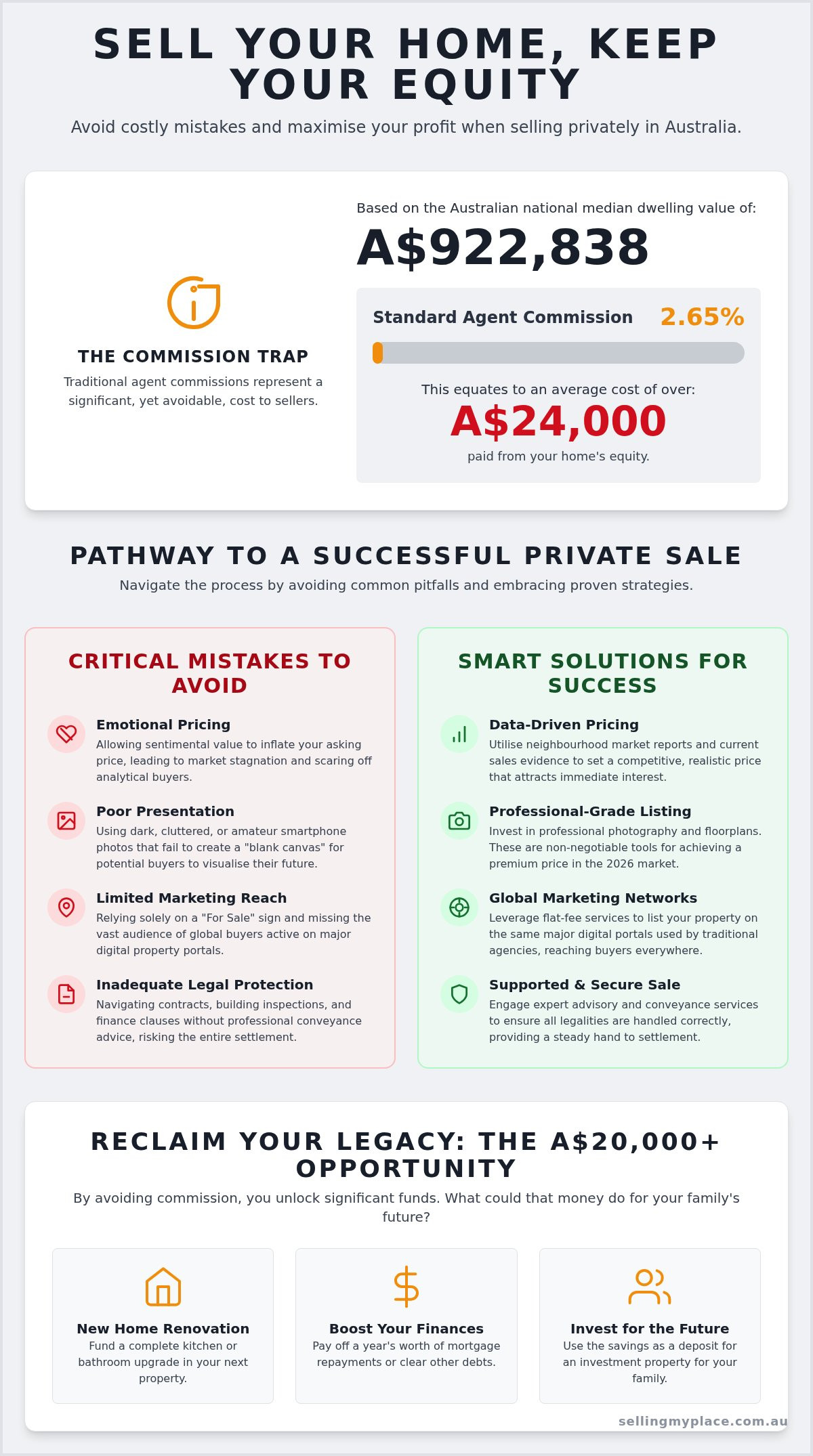
Legal and Negotiation Pitfalls: Protecting Your Settlement
The moment a potential buyer expresses interest, the process shifts from a marketing campaign to a high-stakes legal dance. One of the most significant mistakes to avoid when selling your own home is relying on a “handshake deal” or a verbal promise. In the fast-paced Australian market of 2026, every agreement must be documented and legally sound from the very first interaction. Whether it is a cooling-off period or a specific settlement date, having a clear paper trail protects your interests and ensures that your property’s legacy is handled with the respect it deserves.
Managing the common hurdles of “subject to finance” and “building and pest inspections” requires a calm, steady hand. These clauses are standard in most Australian contracts; however, they can feel like roadblocks if you aren’t prepared. By securing professional Conveyance Advice early in the piece, you ensure that your paperwork is “PEXA-ready”. PEXA is now the non-negotiable standard for digital settlements in Australia, allowing for a seamless, secure transfer of funds and title on settlement day. This digital infrastructure reduces the risk of manual errors and provides the transparency you need during such a major life transition.
Mastering the Negotiation
Some traditional agents claim that only a middleman can negotiate effectively. However, as the person who knows your home’s story best, you are often its most passionate and informed advocate. The key is to remove the emotion and treat the sale like a professional transaction. Using proven property sale negotiation tips will help you hold your ground on price while identifying serious, qualified buyers versus “tyre kickers” who aren’t ready to commit. Focus on the facts of the market and the value of your property’s unique features to guide the conversation toward a successful result.
The Vendor Statement and Disclosure
Honesty is not just the best policy; it is a legal requirement. Avoiding the mistake of “hiding” property flaws is crucial, as modern building inspections will inevitably find them. In states like Victoria, the Section 32 (or your local equivalent Vendor Statement) must be accurate and comprehensive. Pre-Sale Property Consulting can help identify potential legal red flags before they have the chance to kill a deal. If you’re feeling a little overwhelmed by the legal requirements of your state, you might like to contact our advisory team for a friendly chat about your specific needs. This proactive approach ensures that once you find the right buyer, the path to settlement remains clear and stress-free.
Selling Smarter: The Partnership Approach to FSBO
Perhaps the most restrictive mindset in the Australian property market is the belief that you only have two choices: pay a high-commission agent or struggle through a lonely, complex DIY process. This “all or nothing” mentality is one of the primary mistakes to avoid when selling your own home. When you try to do everything in isolation, you risk missing the fine details that professional buyers and their solicitors look for. Integrating professional advisory into your sale by owner journey creates a powerful middle ground, giving you the expertise of a seasoned professional without the heavy financial burden of a percentage-based commission.
The Kincade method is designed to be that “steady hand” you need during a major life transition. By combining high-end Residential Property Listing Services with a 0% commission structure, we ensure your equity remains yours. You shouldn’t have to choose between professional marketing and your family’s profit. This partnership approach provides you with the same global reach and digital infrastructure used by traditional agencies, but with the transparency of a flat fee. It is a more respectful, modern way to sell that acknowledges your role as the best advocate for your property while providing the expert backup required to close the deal with confidence.
Your 2026 Action Plan
Success in the current market requires a methodical approach. Start by organising your legal documents and professional marketing materials well before your preferred launch date. One of the benefits of our model is that we offer listing longevity with no time limits; you can take the time to find the right buyer without the pressure of an expiring agency contract. Your final checklist for a smooth settlement should include:
- A completed and verified Vendor Statement (Section 32).
- Professional photography and a detailed floorplan to anchor your digital listing.
- Current Neighborhood Market Reports to justify your asking price during negotiations.
- A clear understanding of the PEXA digital settlement process.
Ready to Sell Smarter?
Stepping away from the traditional agency model doesn’t mean stepping into the unknown. It means taking control of your financial future with the backing of a team that values your legacy as much as you do. The confidence that comes from professional support allows you to enjoy the process of showing your home, knowing that the technical and legal details are being handled correctly. You have worked hard to build equity in your property; now is the time to protect it. If you are ready to experience a more personal, profitable way to move, we are here to guide you every step of the way. Get started today and keep 100% of your profit.
Securing Your Family’s Financial Legacy
Your home is likely your most significant asset, and the decisions you make today will echo through your family’s future for years to come. By identifying the critical mistakes to avoid when selling your own home, you have already taken the first step toward a more profitable and peaceful transition. You now recognise that protecting your equity doesn’t mean sacrificing professional quality. In fact, with the right partnership, you can save an average of A$20,000 in commissions while still presenting your property with the high-end photography and floorplans that modern buyers expect.
Selling privately in 2026 is about blending your passion for your property with our expert Agent Advisory Service to ensure every legal and digital detail is perfect. You don’t have to navigate the complexities of contracts and negotiations alone. We are here to act as your steady hand, providing the infrastructure and confidence you need to achieve a record-breaking result. If you are ready to reclaim your profit and move forward on your own terms, we would love to help you get started today.
Book a consultation to avoid costly mistakes and keep 100% of your profit
Frequently Asked Questions
What is the most common mistake when selling your own home in Australia?
The most common mistake is incorrectly pricing the property based on sentimental value rather than current market data. This often leads to the home sitting on the market for months, which is one of the primary mistakes to avoid when selling your own home in 2026. Using objective local sales evidence ensures your starting point is both realistic and attractive to the most qualified buyers in your area.
Do I really need professional photography if I have a great smartphone?
Yes, professional photography is essential because buyers in 2026 make decisions based on high-quality digital listings. While modern smartphones are impressive, they cannot replicate the lighting, wide-angle perspectives, and professional editing required to make a space feel truly aspirational. Premium imagery combined with detailed floorplans is what keeps potential buyers engaged with your listing for longer and justifies a higher asking price.
How do I handle negotiations without an agent involved?
Approach negotiations with a professional mindset by focusing on the data rather than personal feelings. It helps to have a clear bottom line and to understand the specific needs of the buyer before the conversation begins. Having an expert advisory service in your corner provides a steady hand, ensuring you remain confident and firm on your property’s true value during the high-stakes negotiation process.
Is it legal to sell my own house without a real estate licence?
It is perfectly legal for an Australian homeowner to sell their own residential property without a real estate licence. While agents must be licensed to sell on behalf of others, you have the right to represent your own interests. You simply need to ensure all legal disclosures, such as the Section 32, are correctly prepared by a qualified legal professional to meet state regulations.
How do I price my home accurately without an agent’s appraisal?
You can achieve an accurate price by researching recent comparable sales in your immediate area through Neighborhood Market Reports. Focus on properties with similar land sizes and features that have sold within the last six months. This objective data provides a much more reliable foundation than a traditional agent’s appraisal, which can sometimes be inflated to win your business rather than reflecting the true market value.
What happens if a buyer asks for a building and pest inspection?
A building and pest inspection is a standard part of the Australian property journey and should be viewed as a step toward a secure settlement. Being honest about any known issues from the start prevents the deal from falling through later. Pre-sale consulting can help you identify and address these concerns before the property even hits the market, ensuring the final inspection is stress-free.
How much can I actually save by avoiding traditional commissions?
Most Australian sellers save an average of A$20,000 by bypassing traditional 2.65% commissions. With the national median dwelling value now at A$922,838, these savings are substantial and can significantly boost your budget for your next move or renovation. Avoiding these unnecessary fees is one of the most effective ways to protect your hard-earned equity during a major life transition while keeping 100% of the profit.
Is PEXA mandatory for private sellers in Australia?
PEXA is the industry standard for digital settlements across Australia and is effectively mandatory for a secure, modern property transfer. It allows for the instantaneous exchange of funds and title, reducing the stress of settlement day. While you are selling privately, your conveyance advisor will use PEXA to ensure the legal transfer is handled with professional authority and the security that your family deserves.
Free Property Valuation Australia: The 2026 Seller’s Guide to Accuracy and Profit
What if the “flattery pricing” you’re hearing from local agents is actually the biggest risk to your family’s financial future? It is a stressful position to be in, standing at the crossroads of a major life transition while staring at three different online estimates that don’t seem to agree. You want a realistic figure, not a sales pitch, because underpricing your home could mean waving goodbye to years of hard-earned equity. We understand that a home is more than just a title deed; it’s your sanctuary and your legacy.
This guide is designed to help you secure a reliable free property valuation and transform that raw data into a strategic, commission-free sale. With the national median dwelling value sitting at $937,000 as of June 2026, and major cities like Sydney seeing recent price corrections, having a steady hand to guide you is more important than ever. We’ll walk you through how to identify a truly accurate price range, ways to boost your property’s appeal before listing, and the steps to keep your full profit without losing a cent to traditional agency fees. It’s about moving forward with calm confidence and the professional support you deserve.
Key Takeaways
- Understand why a free property valuation serves as a vital health check for your home’s equity, helping you separate a bank’s lending figures from your actual selling potential.
- Learn to distinguish between automated data and professional insights so you don’t leave money on the table when your unique home improvements aren’t captured by an algorithm.
- Guard yourself against “flattery pricing” and the common agent trap that often leads to price fatigue and disappointing final results.
- Discover how small, strategic updates and professional photography can help you justify a premium price and beat your initial valuation.
- Master the transition from data to dollars by using independent market reports and expert advisory to manage your own successful, commission-free sale.
What is a Free Property Valuation and Why is it Your Best Starting Point?
Think of a free property valuation as a vital health check for your most significant asset. It isn’t just a random figure on a screen; it’s the foundation of your future financial security. To move forward with clarity, you first need a solid grasp of what property valuation is and how it differs from the conservative estimates your bank might provide. While a bank’s report is designed to protect their lending risk, a market-focused valuation looks at the heartbeat of local demand. It’s about what a real person is willing to pay to call your house “home.”
The 2026 Australian property market has been a tale of two stories. With the RBA cash rate holding at 4.35% as of July, we’ve seen Sydney house prices dip by 3.3% in the June quarter while Perth has surged by a staggering 17.1%. This volatility means that an estimate from even six months ago is likely out of date. Regular check-ins via a free property valuation are no longer just a curiosity; they’re a necessity for any homeowner who wants to make an informed choice. It helps you answer the big questions. Should you invest in that kitchen renovation now, or is the market appetite strong enough to sell immediately and move on?
The Benefits of Knowing Your Home’s Worth Early
Getting an early handle on your property’s value allows you to plan your next move with a clear head. Whether you’re looking to downsize to a quiet suburb or upgrade for more space, you need to know your “walk-away” figure. This is the actual cash you’ll have left in your pocket after all costs are settled. It stops the guesswork and the midnight worrying. When you understand the specific trends in your street, you can spot opportunities that broader city-wide reports might miss.
How Kincade Supports Your Discovery Phase
We believe in empowering you with data that isn’t tied to a high-pressure sales pitch. Our Neighbourhood Market Reports provide a transparent look at what homes in your area are actually fetching, focusing on settled sale prices rather than ambitious listing figures. This independent perspective is vital. It’s about providing a steady hand and professional backing without the weight of a traditional agency commission. By using our Pre-Sale Property Consulting, you can prepare for a successful “sale by owner” experience. You’ll have the floorplans, photography, and advisory support needed to showcase your home’s true value while keeping your equity where it belongs: with your family.
AVMs vs. Professional Appraisals: Which One Should You Trust?
Most homeowners start their journey with a free property valuation generated by a computer. It’s incredibly convenient; you type in your address and get a number in seconds. This is what we call an Automated Valuation Model, or AVM. While these tools are a fantastic starting point for understanding your general equity, they operate by looking through a rear-view mirror. They rely on historical data and public records to provide a snapshot, which can sometimes lag behind the actual pulse of your neighbourhood.
An AVM is often spot on for suburban blocks where every house is similar. However, it can miss the mark significantly if you’ve recently added a third bathroom or spent your weekends perfecting a native garden. A computer simply cannot see the “soul” of a home. Relying solely on an algorithm in a shifting market, like we’ve seen in the June quarter of 2026 with capital city prices falling by 1.4% overall, can be risky. You need a steady hand to interpret those numbers and adjust for the nuances of your specific property.
Understanding Automated Valuation Models (AVMs)
AVMs pull data from three main pillars: recent sales of similar properties, land size, and basic property features like bedroom count. It is a helpful way to estimate the market value of your home quickly. But remember, these models don’t know if a house two doors down sold for less because it was in original 1970s condition. In rapidly changing cycles, such as the current 2026 downturn in Sydney and Melbourne, using multiple digital sources is the best way to find a realistic consensus value before you take the next step.
The Human Element: Professional Advisory Appraisals
A computer doesn’t feel the “wow factor” of a light-filled living room or a perfectly positioned deck. A professional advisor does. This human oversight is what separates a generic estimate from a strategic price point. This is where Kincade’s Advisory Service adds genuine value. We look at the emotional pull of your home and consider current buyer sentiment, which is vital given that auction clearance rates have dipped to 52.4% recently.
Don’t be seduced by the highest number you see on a screen or hear from a pushy agent. An inflated figure might feel good for a day, but it can lead to “price fatigue” if the market doesn’t agree, eventually forcing a lower final result. Accuracy is what protects your profit and your family’s legacy. If you’re feeling unsure about the conflicting numbers you’ve seen online, you might find it helpful to chat with a local expert who can help you make sense of the data without the pressure of a commission-based sales pitch.
Avoiding the “Agent Trap”: Why Free Appraisals Can Be Costly
It’s a lovely feeling when an agent walks through your front door and suggests a figure that exceeds your wildest expectations. However, this is often the moment where many Australian sellers unknowingly fall into the “agent trap.” In the industry, we call this “buying the listing.” It happens when an agent provides an inflated estimate simply to win your business, knowing full well the property will likely sell for less. While it feels good in the lounge room, it can be a costly mistake once the campaign begins.
When a home is launched at an unrealistic price, it often sits on the market for weeks without a serious offer. In the current 2026 climate, where buyers are increasingly selective and properties are taking longer to sell, this lead to “price fatigue.” Potential buyers start to wonder what is wrong with the home because it hasn’t sold yet. Eventually, the seller is forced to make significant price reductions, often ending up with a lower final result than if they had priced it accurately from the start. The psychological stress of adjusting your expectations mid-campaign is immense, especially when your family’s future plans are hanging in the balance.
The Conflict of Interest in Traditional Appraisals
The core of the problem lies in the traditional commission-based model. An agent who is chasing a percentage-based fee is naturally incentivised to tell you what you want to hear to secure your signature. That “free” agent appraisal isn’t truly free if it costs you $50,000 in lost equity due to a botched pricing strategy. To spot a realistic appraisal, look for an advisor who backs their claims with hard data from recent settled sales in your street, rather than just pointing to ambitious asking prices of homes that are still sitting on the market.
The Kincade Alternative: Data Without the Pressure
We take a different path. Because Kincade operates on a 0% commission structure, our advice is never clouded by the need to “win” a listing at any cost. Our focus is entirely on your success and helping you keep 100% of your profit. We believe in empowering you with factual strength. By using a professional market value determination, you can set a strategy based on reality. This independent free property valuation approach allows you to negotiate with buyers from a position of confidence. You aren’t just guessing a number; you are presenting a case for your home’s value that is supported by professional photography, floorplans, and a deep understanding of the local landscape. It’s about being a “steady hand” in your own sale, ensuring your hard-earned equity stays exactly where it belongs.
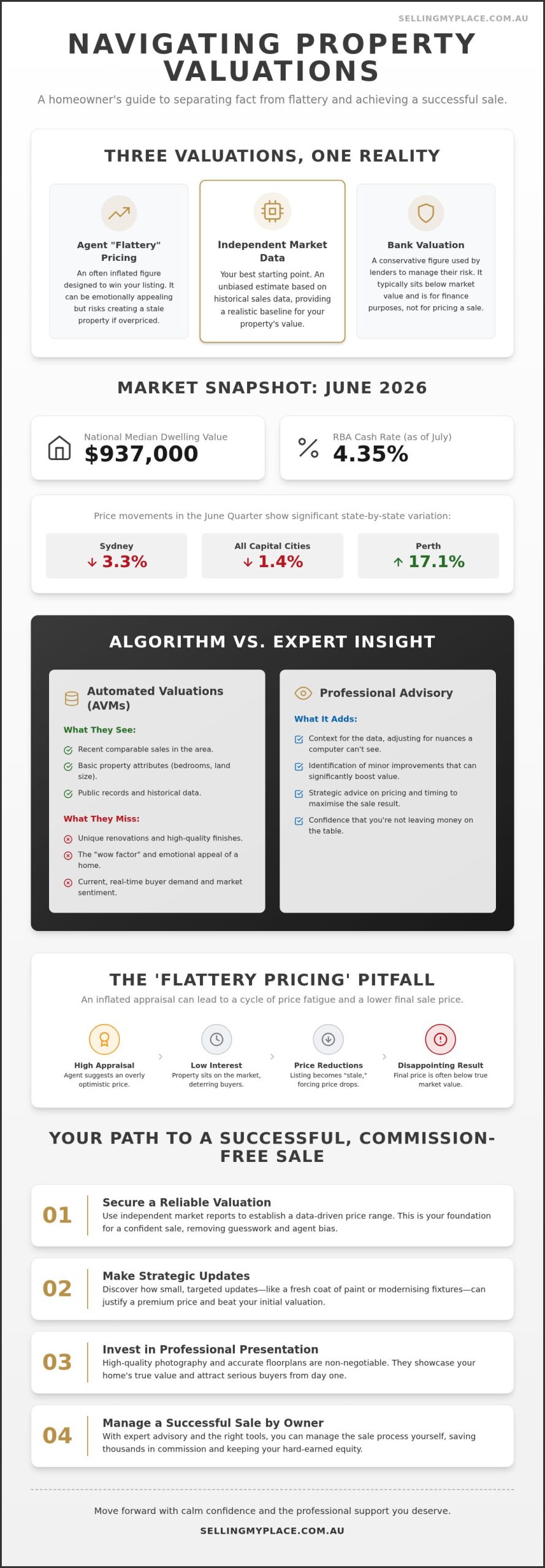
Maximising Your Result: How to Beat Your Current Valuation
Once you’ve received your free property valuation, it’s natural to feel either a sense of relief or a slight twinge of disappointment. However, that number is simply a starting point based on current market conditions and historical data. It isn’t a fixed destiny. You have the power to influence how buyers perceive your home’s worth. By focusing on both the visible and invisible elements of your property, you can push your final sale price toward the top end of your valuation range, or even beyond it. It’s about taking a proactive approach to your family’s equity.
Start with a “kerb appeal” audit. Buyers in 2026 are looking for stability and pride of ownership. Simple acts like pressure-cleaning the driveway, refreshing the mulch in your garden beds, or painting a tired front fence can add thousands to the perceived value. These aren’t just cosmetic changes; they signal to a buyer that the home has been loved and maintained. When a property looks cared for from the street, it sets a positive emotional tone before the front door even opens.
Pre-Sale Consulting and Presentation
In a digital-first market, your home’s first “showing” happens on a smartphone screen. This is why professional photography is non-negotiable. High-quality images captured with a steady hand can highlight the lifestyle your home offers, rather than just the dimensions of the rooms. Similarly, a clear floorplan is essential for the “mental move-in” process. It allows buyers to visualise where their favourite sofa will sit or how the kids’ rooms connect to the main living area. Addressing small DIY fixes, such as leaky taps or cracked tiles, prevents buyers from mentally “discounting” your valuation before they’ve even stepped inside.
Don’t overlook the “invisible” value. In 2026, energy efficiency is a high priority for Australian families facing rising living costs. If you have solar panels, double-glazed windows, or a high-star energy rating, make sure these are documented. Having a tidy folder of maintenance logs and appliance certificates gives buyers the calm confidence they need to make a premium offer. It shows you’ve been a diligent steward of the property, which reduces their perceived risk.
Strategic Marketing to the Right Audience
Your free property valuation also helps you identify the most likely buyer for your home. If your property sits in a price bracket favoured by first-home buyers, your marketing should focus on lifestyle, proximity to parks, and community roots. If it’s an executive residence, highlight the luxury finishes and proximity to business hubs. At Kincade, we use a global marketing network to reach buyers that local agents often miss. This broader reach, combined with highlighting lifestyle features that an algorithm cannot measure, ensures your home is presented to those who will value it most.
If you want to ensure you aren’t leaving money on the table, you can book a pre-sale consultation with our team to create a tailored plan that maximises your profit and protects your legacy.
Taking the Next Step: From Valuation to a Successful Sale
Once you’ve secured your free property valuation, the path forward often feels like the most daunting part of the journey. You have the data, but how do you translate those numbers into a successful result? It’s about moving from curiosity to a clear, actionable strategy. We view this transition not as a series of transactions, but as a partnership designed to protect your family’s financial legacy. By following a structured roadmap, you can replace the typical stress of selling with a sense of grounded control.
- Step 1: Secure your independent Neighbourhood Market Report. This document provides the factual bedrock for your sale, showing you exactly what buyers are paying for homes like yours without any agent-driven bias.
- Step 2: Consult with a Kincade advisor. Data is only half the story; the other half is interpretation. Our advisors help you read between the lines of your report to plan a “sale by owner” strategy that fits your specific timeline and goals.
- Step 3: Organise professional marketing assets. This is where you justify your price. High-quality photography and detailed floorplans ensure your home’s true worth is visible to every potential buyer from the first click.
- Step 4: List with confidence. Armed with facts and professional support, you can launch your property knowing you are keeping 100% of the sale profit. On average, our clients save $20,000 in commissions, which is a significant boost to any future plans.
Your Partnership with Kincade International
We pride ourselves on being the “steady hand” throughout your entire step-by-step selling process. Selling a home involves complex moving parts, from initial pricing to final settlement. This is why we facilitate access to conveyance advice, ensuring the legal transition is as smooth as the marketing campaign. By removing the traditional agent commission, we empower you to fund your next chapter, whether that’s a coastal downsize or a larger family sanctuary. You deserve to realise the full value of your hard-earned equity.
Ready to See What Your Place is Worth?
The Australian property market in 2026 requires a more sophisticated approach than simply putting a sign in the front yard. You have the expertise, the data, and the professional support of a global network at your fingertips. It is time to step away from the “agent trap” and take back control of your sale. Our flat-fee packages are designed to put the owner back in the driver’s seat, providing all the tools of a high-end agency without the high-end costs. You’ve worked hard for your home; now, let’s make sure that hard work pays off for you. Get your professional property advice today.
Secure Your Financial Legacy Today
Navigating the 2026 property market doesn’t have to be a source of stress. You now have the tools to distinguish between a basic free property valuation and the strategic advisory needed to secure a premium result. By moving past the “agent trap” and focusing on factual data, you’re not just selling a house; you’re protecting your family’s future. Whether it’s through a “kerb appeal” audit or leveraging global marketing exposure, you have the power to command the price your home truly deserves.
At Kincade, we’re here to act as your steady hand. Our 0% commission model means you keep 100% of your profit, allowing you to save an average of $20,000 in fees. With our Expert Advisory Service included, you’ll have professional guidance at every turn, from the first market report to the final settlement. It’s time to move forward with calm confidence and the support of a partner who values your legacy as much as you do.
Start your commission-free selling journey with Kincade today and take the first step toward a more profitable, stress-free move. We can’t wait to help you write your next chapter.
Common Questions About Property Valuation
Is a free online property valuation really accurate?
A digital estimate is a solid starting point, but it isn’t a definitive final price. These tools use Automated Valuation Models that look at historical data and public records. They often miss unique features, such as a bespoke native garden or a high-end kitchen renovation, which can add significant appeal. For a more precise figure, it’s best to pair digital data with professional advisory to account for the current “soul” of your home and buyer sentiment.
How often should I check my home’s estimated market value?
Checking your value every three to six months is a wise habit in the 2026 market. With national house prices showing quarterly shifts and interest rates holding steady, staying updated helps you make better decisions about when to sell or renovate. Regular digital check-ins ensure you aren’t basing your family’s financial future on outdated figures from 2025.
Do I need a real estate agent to get a property appraisal in Australia?
No, you don’t need a commission-based agent to understand what your home is worth. You can access independent Neighbourhood Market Reports and professional advisory services that provide factual, data-driven insights. This allows you to avoid the “flattery pricing” often used by agents to secure a listing, giving you a clearer, more honest view of your equity.
What is the difference between a bank valuation and a market appraisal?
A bank valuation is a conservative estimate used to manage lending risk, while a market appraisal focuses on what a buyer is likely to pay. Banks often value properties lower to protect their interests. A market-focused free property valuation considers lifestyle appeal and local demand, giving you a more realistic selling range for your next chapter.
Can I use a free valuation to set my reserve price at auction?
It isn’t recommended to use a basic online estimate as your sole guide for a reserve price. While it gives you a ballpark figure, a reserve should be based on recent settled sales and current auction clearance rates, which were around 52.4% in late July 2026. Professional advisory helps you set a strategic reserve that reflects real-time market conditions rather than just historical averages.
How much can I save by selling my own home after getting a valuation?
Australian homeowners typically save an average of $20,000 in commissions by managing their own sale. By using a free property valuation as your foundation and opting for a flat-fee advisory model, you keep 100% of your equity. This significant saving provides a much-needed boost when you’re looking to fund a downsize or upgrade to a new area.
Does solar or energy efficiency really increase my home value in 2026?
Yes, energy efficiency is a major drawcard for 2026 buyers who are increasingly conscious of rising living costs. Features like high-star energy ratings, solar panels, and double-glazing add tangible value that standard algorithms often overlook. Highlighting these “invisible” benefits in your marketing can help you justify a higher price point than a standard valuation suggests.
What documents do I need to prepare for a professional property advisory session?
Having your most recent rates notice, a list of major renovations, and any building or pest reports ready is very helpful. If you have warranties for appliances or solar installation certificates, include those as well. This information allows an advisor to provide a more nuanced and accurate assessment of your home’s true market potential, ensuring every detail is accounted for.
Best For Sale By Owner Sites Australia: 2026 Guide
If you could keep an extra A$20,000 from your home sale simply by changing who hits the ‘publish’ button, why wouldn’t you? Selling a family home is a deeply personal transition, and it’s only natural to feel protective of the equity you’ve spent years building. You likely want to avoid hefty agent commissions, but the fear of underselling or getting tangled in complex legal paperwork is enough to make anyone feel a little unsettled. It’s a significant life event, and you deserve to feel supported rather than just processed through a system.
The good news is that selling privately in 2026 has evolved into a sophisticated partnership. This guide will help you identify the best for sale by owner websites australia currently offers, ensuring you find a platform that provides professional-quality listings and genuine expert advisory. We’ll explore how to secure a premium presence on major portals while maintaining the “steady hand” support needed for a stress-free settlement. By the end of this article, you’ll know exactly how to maximise your profit while keeping the heart of your home’s legacy intact.
Key Takeaways
- Understand how the best for sale by owner websites australia have evolved from simple DIY tools into professional platforms that empower you to sell with total confidence.
- Identify why “Listed Until Sold” guarantees and global marketing reach are non-negotiable features for any private seller in the current market.
- Learn how a pre-sale property consultation can uncover small, high-impact improvements that help you secure a much higher price for your home.
- Discover the importance of using a Neighbourhood Market Report to price your home with precision, protecting your equity from the risk of underselling.
- Gain insights into the partnership-based model that offers 0% commission while providing the “steady hand” guidance needed for a smooth settlement.
What are For Sale By Owner (FSBO) Websites?
For many Australian families, the home is more than just bricks and mortar; it’s a sanctuary and a significant part of their financial legacy. Traditionally, selling that legacy meant handing over a substantial slice of equity to a real estate agent in the form of commissions. However, the rise of For Sale By Owner (FSBO) platforms has completely changed the conversation. These websites act as a vital bridge, allowing you to list your property directly on major property portals. This isn’t just a basic ‘do it yourself’ project anymore. It represents a shift toward ’empowered selling’ where you maintain the lead role while being supported by professional-grade tools and infrastructure.
Choosing to use for sale by owner websites australia means you’re prioritising transparency and personal connection. In 2026, the movement toward direct transactions has reached a significant tipping point. Homeowners are increasingly savvy, recognising that they are often the best advocates for their own properties. They know the local coffee spots, the friendly neighbours, and the way the afternoon sun hits the back deck. The core promise of this model is simple. You maintain total control over every decision and keep 100% of the sale profit, which frequently results in savings of A$20,000 or more compared to traditional agency fees.
How the FSBO Model Works in Australia
Under Australian law, individuals generally cannot list directly on the biggest real estate portals without a real estate license. FSBO websites solve this hurdle by acting as the licensed entity that facilitates your listing on your behalf. You pay a transparent flat fee rather than a percentage-based commission; this shift significantly reduces your upfront risk and long-term costs. Instead of wondering if an agent’s high marketing expenses will eventually pay off, you invest in a platform that enables direct communication with buyers. You’re the one telling the story of your home, which often resonates much more deeply with potential new owners who value a genuine, personal touch.
Why 2026 is the Year to Sell Smarter
The digital infrastructure available today has made professional marketing accessible to everyone. High-quality photography and detailed floorplans are no longer exclusive to traditional agencies. As Sale by owner becomes a mainstream choice, buyers have also become more comfortable dealing directly with the person who knows the property best. This direct connection fosters trust and often speeds up the transaction process. By using for sale by owner websites australia, you’re joining a community of homeowners who value stability, legacy, and the financial freedom that comes from a commission-free sale.
Evaluating the Best FSBO Platforms: Key Features to Look For
When you start comparing for sale by owner websites australia, it’s easy to get overwhelmed by flashy packages and tech-heavy dashboards. However, selling a home is a deeply human experience, not just a digital transaction. A platform should feel like a partner, providing a steady hand to guide you through the process rather than just a software interface. The most reliable services offer a ‘Listed Until Sold’ guarantee. This is essential because it removes the pressure of a ticking clock. You shouldn’t have to worry about recurring monthly fees or your listing disappearing before you’ve found the perfect buyer for your family’s legacy.
There is also a significant difference between a basic listing site and a full-service marketing partner. A basic site might get you onto a portal, but it leaves you to manage the complexities of negotiation and settlement alone. A true partner provides human advisory services. Having an expert to call when a negotiation gets tricky or when you’re unsure about a contract clause can save you thousands of dollars and hours of stress. It’s about finding a balance between the autonomy of a private sale and the security of professional expertise.
Portal Access: Beyond the Big Two
While appearing on realestate.com.au and Domain is the baseline, the best platforms look further afield. Australia’s property market is increasingly interconnected with the rest of the world. High-value residential properties often attract interest from expats and international investors. Why limit your reach to a local audience when you can tap into a global marketing network? Ensuring your property has high-tier placement on these portals is just as vital. A listing buried on page ten is a listing that isn’t working for you. Visibility is the currency of a successful sale, and your platform choice should guarantee you’re seen by the right people at the right time.
Professional Marketing Assets
First impressions happen in a heartbeat. In 2026, buyers are more visually driven than ever, making professional Photography and floorplans non-negotiable. A professional floorplan allows a buyer to mentally move their furniture into your home before they’ve even stepped through the front door. It provides a sense of scale and flow that photos alone cannot capture. Look for packages that include these assets as standard. When your listing looks like a high-end agency production, you command more respect and, ultimately, a higher price. If you’re feeling unsure about which marketing tools will best highlight your home’s unique character, you can always reach out for a quick chat about your specific needs.
The Gap Between ‘Listed’ and ‘Sold’: The Advisory Advantage
While clicking ‘publish’ on a digital portal is a significant milestone, it’s rarely the finish line. Many for sale by owner websites australia provide the technical keys to the digital front door, but they often leave you standing on the doorstep when it comes to the complex human interactions that follow. A professional listing attracts interest; however, an expert advisory service is what turns that interest into a successful settlement. This is the ‘Advisory Advantage.’ It bridges the gap between simply being visible and actually being sold. Think of it as having a seasoned mentor by your side, someone who understands that this isn’t just a transaction. It’s a major life transition that deserves a steady hand.
Navigating the emotional landscape of selling a family home requires more than just a software dashboard. It’s easy to feel overwhelmed by the volume of enquiries or the pressure of a fast-moving market. Pre-sale property consulting helps you identify small but vital value-add opportunities before you even launch. Whether it’s a minor repair or a styling tweak, these insights ensure you aren’t leaving money on the table. This partnership approach reduces the stress of complex property transitions, giving you the confidence to move forward with your next chapter while feeling completely protected.
Agent Advisory Services: Your Secret Weapon
An Agent Advisory Service acts as your professional backbone in a competitive market. It provides the support you need to manage tricky enquiries and vet potential buyers effectively, ensuring your time is spent on genuine leads. One of the most critical steps is learning how to determine the market value of a home in Australia using real-time expert data. Without this grounded perspective, you might risk pricing yourself out of the market or, worse, underselling your most valuable asset. The right for sale by owner websites australia will offer this human-led guidance as a standard part of their partnership.
Negotiation and Closing the Deal
When it comes to the final stages, mastering the art of negotiating your property sale is what secures your hard-earned equity. Advisory services help you separate the serious offers from the casual browsers, ensuring you remain in the driver’s seat without feeling alone. You’ll have access to strategies that protect your interests during the high-stakes closing phase. By having an expert to bounce ideas off, you can approach the negotiating table with calm confidence. You’ll know exactly when to hold firm and when to move, ensuring a smooth path to a stress-free settlement.
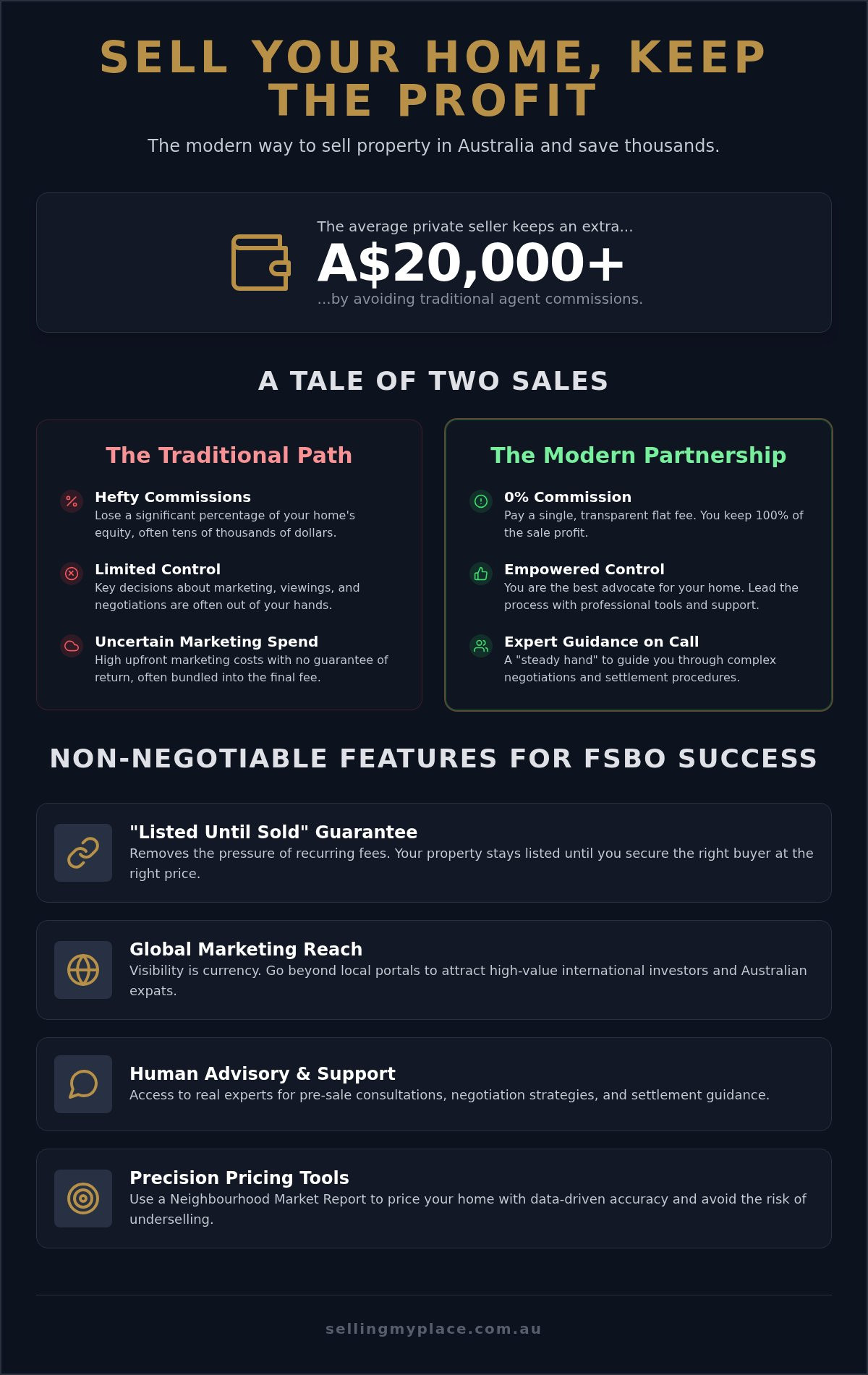
Preparing Your Property for a Private Sale Success
Success in the private sale market isn’t just about being seen; it’s about being ready. When you use for sale by owner websites australia, the quality of your preparation directly correlates to the speed and profit of your sale. Think of this phase as a deliberate, five-step launch sequence designed to protect your equity and ensure a smooth transition for your family. It begins with a thorough Pre-Sale Property Consultation. This isn’t just a casual walk-through. It’s a strategic assessment to identify minor repairs or styling adjustments that could significantly boost your property’s appeal. By addressing these early, you remove potential hurdles that buyers might use to negotiate your price down later.
- Step 1: Conduct a Pre-Sale Property Consultation to identify high-impact, low-cost repairs.
- Step 2: Secure a detailed Neighbourhood Market Report to pin down an accurate, data-backed price.
- Step 3: Organise professional photography and floorplans to ensure your home stands out against agency listings.
- Step 4: Prepare your legal documentation and seek early conveyance advice to avoid settlement delays.
- Step 5: Launch your listing simultaneously across national and global networks for maximum impact.
Pricing Strategy and Market Data
One of the biggest challenges for private sellers is justifying their asking price to skeptical buyers. In 2026, buyers are more informed than ever, and they’ll challenge you if your price feels like a “guess.” This is where a Neighbourhood Market Report becomes your most powerful tool. It provides specific, local data that allows you to stand your ground with confidence. Avoiding the overpricing trap is vital; a listing that sits on the market for too long becomes stale, leading buyers to wonder what’s wrong with the home. By using for sale by owner websites australia that provide real-time market data, you can set a price that is both ambitious and defensible.
The Legal Essentials: Conveyance and Contracts
The legal side of property can feel daunting, but it doesn’t have to be. Seeking professional Conveyance Advice before your first open home is a wise move. Each Australian state has its own specific regulations regarding private sales, and being prepared ensures you don’t hit a wall during the final stages. Having your contract of sale ready to go shows buyers that you’re a serious, professional seller. It fosters trust and keeps the momentum going once you’ve found the right person for your home. If you’re feeling unsure about the legal requirements in your specific area, get in touch for a supportive chat to help clarify your next steps.
Selling Smarter with Kincade International Direct Sales
Kincade International Direct Sales (KIDS) redefines what’s possible for the modern seller by moving beyond the limitations of traditional for sale by owner websites australia. We don’t just provide a platform; we offer a sophisticated partnership that prioritises your family’s financial legacy. By combining a 0% commission model with professional agency-grade tools, we empower you to take the lead while we provide the infrastructure. This approach results in an average saving of A$20,000, a significant sum that can fundamentally change the trajectory of your next move. Whether that means a larger deposit for your next home or extra security for your retirement, that equity belongs in your pocket.
Our philosophy is built on the idea of being a “steady hand” throughout your transition. We understand that selling a home is often tied to major life changes, and the process should feel supportive rather than stressful. You shouldn’t have to choose between saving money and receiving professional guidance. By bridging this gap, we’ve become the preferred choice for Australian families who value transparency, stability, and the respect their property deserves. It’s about selling smarter, not just selling alone.
Our Comprehensive Marketing Package
Your home’s first impression should be nothing short of exceptional. Our marketing package ensures this by including professional photography and detailed floorplans as standard features. These assets don’t just make your listing look better; they build immediate credibility with serious buyers. Your property will be launched across both national and global networks, ensuring you reach the widest possible audience, including international investors looking for a slice of the Australian lifestyle. With our ‘Listed Until Sold’ promise, you’ll never feel the pressure of a looming deadline or recurring fees. Plus, our dedicated Agent Advisory Service is always available to help you navigate the nuances of buyer enquiries and market fluctuations.
Take the First Step Toward an Empowered Sale
If you’re ready to step away from high marketing costs and reclaim your equity, the path forward is clear. Preparing for your property’s debut on the national stage is a collaborative process that starts with understanding your unique goals. We invite you to begin with a personalised consultation, where we can discuss how to best highlight your home’s character and value. You have the local knowledge and the heart; we provide the professional reach and the expert backing. Together, we can ensure your sale is a successful, celebratory milestone for your family. Enquire about our professional listing and advisory packages today and discover the difference of an empowered sale.
Your Path to a Successful Private Sale
Choosing to sell your home privately is a powerful decision that puts your family’s financial future first. The landscape of for sale by owner websites australia has transformed into a professional ecosystem where you no longer have to sacrifice expert support to save on costs. By combining high-end marketing assets like professional photography and floorplans with a dedicated Agent Advisory Service, you can navigate the complexities of the 2026 market with total confidence. It’s about having that steady hand to guide you through negotiations while ensuring you keep every cent of your hard-earned equity.
The transition to your next chapter should be celebratory rather than stressful. With an average saving of A$20,000 per sale and a 0% commission structure, you’re not just selling a property; you’re protecting your legacy. Our team is here to ensure you feel supported at every turn, from the first listing to the final settlement. Secure your commission-free sale with our expert advisory team and take the first step toward a more rewarding selling experience. You’ve built the home; now it’s time to reap the full rewards of your investment.
Frequently Asked Questions
Are for sale by owner websites legal in Australia?
Yes, selling your own property is completely legal in every Australian state and territory. While traditional agents often suggest otherwise, you have the right to represent yourself in the sale of your own asset. The best for sale by owner websites australia act as a licensed bridge, allowing you to access professional marketing tools while you remain the primary point of contact for all potential buyers.
Can I list my property on realestate.com.au and Domain without an agent?
You cannot list directly on these major portals as a private individual, but you can certainly do so through a dedicated FSBO platform. These services hold the required corporate real estate licenses to place your property alongside agency listings. This ensures your home receives the same visibility as any other property on the market, allowing you to reach millions of active buyers across the country.
How much can I actually save by selling my own home privately?
Most Australian homeowners save an average of A$20,000 by choosing a commission-free model. This figure is based on avoiding the typical 2% to 3% commission that traditional agents charge on the final sale price. When you factor in the removal of high upfront marketing fees, the total amount of equity you keep for your family’s next move becomes a significant financial advantage.
What happens if my property doesn’t sell within a few months?
If you choose a platform with a “Listed Until Sold” guarantee, your listing remains active without any additional time limits or recurring monthly fees. This provides a sense of calm confidence, as you aren’t pressured by a ticking clock or mounting costs. You can wait for the right buyer who truly values your home’s legacy, rather than feeling forced to accept a lower offer just to close a deal.
Do I need a lawyer or conveyancer if I use an FSBO website?
Yes, professional conveyance advice is a vital part of a successful settlement. While you handle the marketing and buyer enquiries, a legal expert ensures the contract of sale is prepared correctly and the transfer of title is handled according to state regulations. Integrating professional legal support with the right for sale by owner websites australia ensures your transaction is both profitable and legally secure.
How do I handle property inspections and open homes myself?
Managing inspections is quite straightforward and allows you to set times that actually suit your family’s schedule. You are the best person to answer specific questions about the local community, the friendly neighbours, or the best nearby schools. Most buyers actually find it refreshing to speak directly with the owner, as it fosters a more transparent and honest conversation about the property’s history.
Will buyers take me seriously if I am not using a traditional real estate agent?
Buyers will absolutely take you seriously if your property is presented with professional-grade marketing. When your listing includes high-quality photography and detailed floorplans, it looks identical to an agency production on the major portals. In the 2026 market, savvy buyers value direct communication and often prefer the lack of “agent speak” when negotiating their future home.
What is the difference between a listing service and a property advisory service?
A basic listing service simply puts your property on the internet and leaves the rest to you. In contrast, a property advisory service provides a “steady hand” throughout the entire journey. This includes expert guidance on pricing strategy, help with vetting potential buyers, and support during the negotiation phase. It turns a solo DIY project into a professional partnership that prioritises your peace of mind.
The Property Sale Without Agent Process: A Professional Roadmap for Australian Sellers
Did you know that Australian homeowners pay over $10 billion in real estate agent commissions every single year? It’s a staggering figure that represents a massive slice of hard-earned family equity handed over just as you’re trying to move on to your next chapter. We understand the hesitation; the thought of managing a property sale without agent process can feel like standing at the base of a mountain without a map. It’s perfectly natural to worry about legal slip-ups or the stress of negotiating your own price (we’ve all been there), but you don’t have to sacrifice your savings for peace of mind.
You deserve to feel like the CEO of your own home’s legacy, backed by the right expertise. This guide is your professional roadmap to reclaiming that equity while keeping the process smooth, legally compliant, and completely under your control. We’ll walk you through every critical milestone, from preparing your mandatory disclosure documents to hosting your first open home with confidence. By the end of this article, you’ll have the step-by-step clarity needed to secure a result that honours your property’s true value without losing $30,000 to commission fees.
Key Takeaways
- Transform from a passive client into the active director of your own sale, ensuring you keep every cent of your property’s hard-earned equity.
- Navigate the property sale without agent process with total confidence by following a professional roadmap that covers everything from marketing to legal settlement.
- Learn to set a data-driven “Sold” price and utilise professional-grade photography to make your home stand out in the competitive Australian market.
- Discover how to access global marketing networks and expert advisory services without the burden of traditional agency commissions.
- Master the art of vetting serious buyers and managing the critical cooling-off period to ensure a smooth, stress-free path to settlement.
Understanding the Property Sale Without Agent Process in Australia
The property sale without agent process is often misunderstood as a “do it yourself” hobby. In reality, it’s a sophisticated professional framework where you, the homeowner, take the lead as the active director of your sale rather than a passive observer. By choosing this path, you’re embracing a model that prioritises your equity. Instead of losing a median of 2.65% of your sale price to commissions, which is over $24,000 on a median priced home, you partner with a flat-fee service that provides the professional infrastructure you need without the high overheads. This shift in perspective allows you to treat your home sale with the seriousness it deserves while keeping the rewards of your hard work.
It’s 100% legal to sell your own home in every state and territory across Australia. This approach, often referred to as For sale by owner, allows you to maintain total control over your property’s legacy. At Kincade International Direct Sales (KIDS), we provide the professional photography, floorplans, and global listing access that traditionally belonged only to high-street agencies. You aren’t doing this alone; you’re simply choosing a smarter, more transparent partnership that values your family’s financial future over an agency’s bottom line.
The Legal Foundations: What You Need First
Before you even think about putting a sign in the front yard, your first step is engaging a licensed conveyancer or solicitor. This is the “safety net” of the property sale without agent process. In most Australian states, it’s a legal requirement to have a Contract of Sale and relevant disclosure documents, like a Section 32 in Victoria or a full Contract of Sale in NSW, ready before you advertise. Your legal representative ensures the paperwork is water-tight, protecting you from potential pitfalls during the exchange. For a more detailed look at these state-specific requirements, you can explore our How to Sell Your Own Home: A Step-by-Step Guide to Sale by Owner in Australia.
Debunking the ‘Agent-Only’ Myth
There’s a common fear that buyers only trust big-name agency brands. This simply isn’t true in the modern market. Buyers search by location, price, and features; they don’t filter by the logo on the “For Sale” sign. Digital platforms have democratised exposure, allowing your home to sit right alongside agency listings on major portals. As for negotiation, you know your home better than any third party. With the right data and a calm, professional approach, you’re the best person to convey its value to a prospective buyer. You’re the expert of your own life and your own home, and that authenticity is a powerful tool in any negotiation.
Setting the Stage: Valuation and Professional Presentation
Setting the right price is perhaps the most emotional hurdle in the property sale without agent process. It’s easy to look at the years of memories and the renovations you’ve poured your heart into and see a value that reflects your attachment. However, the 2026 market is driven by data. Buyers are more informed than ever, and an overpriced listing can quickly become “stale” on digital portals. To avoid this, you need to step back and look at your home through the eyes of a professional analyst. Using comprehensive Neighbourhood Market Reports allows you to justify your asking price to skeptical buyers with cold, hard facts rather than just a “gut feeling.”
Once the price is right, your home needs to look the part. In the digital age, your property’s first “open house” happens on a smartphone screen. Professional-grade visuals are the non-negotiable price of entry. High-quality photography doesn’t just look pretty; it significantly increases online click-through rates by tapping into the psychology of first impressions. When a buyer sees a crisp, well-lit image, they subconsciously attribute that quality to the home itself. If you’re feeling unsure about where to start with your home’s presentation, a quick chat about pre-sale property consulting can provide the clarity you need to move forward with confidence.
Determining True Market Value
To find your “Sold” price, you must analyse recent data for comparable properties in your immediate area. Look for homes with similar land size, bedroom counts, and finish levels that have settled in the last three to six months. While regulations vary by state, the Queensland government advice on selling your home offers a great perspective on different sale methods that can influence your valuation strategy. For a deep dive into the technical side of pricing, our How to Determine the Market Value of a Home in Australia: The 2026 Seller’s Guide provides the tools you need to stay competitive.
Investing in Visual Storytelling
Photography is a capital investment in your equity, not a cost to be cut. Alongside professional photos, accurate floorplans are essential conversion tools. They allow buyers to “live” in the house before they even visit, mentally placing their furniture and planning their life in your space. Before the photographer arrives, take the time to de-clutter and stage each room. You want to highlight the home’s legacy and warmth while leaving enough “blank space” for a new family to imagine their own future there. This professional approach ensures your property sale without agent process yields the highest possible return.
Executing a High-Impact National Marketing Strategy
Marketing your home effectively is about much more than just sticking a sign in the front lawn and hoping for the best. In a professional property sale without agent process, you leverage a global marketing network that ensures your home is seen by the right eyes, whether they’re just down the street or across the country. Traditional agencies often charge between $2,000 and $6,000 for a standard metropolitan marketing campaign, but much of that cost goes toward maintaining their fancy office and brand name. By choosing a flat-fee model, you bypass these unnecessary overheads. You’re not just saving money; you’re investing in a strategy that keeps your listing live and fresh until the right buyer walks through your door.
When you write your listing description, skip the dry list of features. Buyers in 2026 are looking for a sense of stability and community. Describe how the morning sun hits the breakfast nook or the way the local park becomes a hub for families on the weekend. This evocative language creates an emotional connection that a standard agency template often misses. You’re telling the story of a home’s legacy, and that’s something no one can articulate better than you.
The Digital Advantage
Modern buyers are digital natives. They don’t wait for the Saturday paper; they set alerts on major listing platforms and scroll through social media. To stand out, your description needs to be SEO-optimised to match 2026 search trends, ensuring it appears when buyers search for specific lifestyle features. By using a licensed third-party platform to access Australia’s leading property search engines, you get the same premium exposure as an agency without the premium price tag. Don’t forget your own networks either. A well-placed post in a local neighbourhood community group can often find a buyer who is already in love with your area.
Consistency and Continuity
One of the biggest stresses of selling with an agent is the ticking clock of a standard 90 day agreement. If the property doesn’t sell quickly, you’re often pressured to drop the price or pay for more marketing. A flat-fee approach with no time limits removes this artificial pressure. You can sell at your own pace, ensuring you wait for the offer that truly reflects your property’s value. When enquiries do come in, responding promptly and with a warm, professional tone builds immediate trust. You’re the most knowledgeable person about the property, and that direct line of communication is often a breath of fresh air for buyers. This level of transparency is a hallmark of a successful property sale without agent process.
Managing Enquiries, Inspections, and Price Negotiations
The property sale without agent process shifts into high gear once the enquiries start rolling in. This is the moment where your preparation meets the public, and it’s completely normal to feel a mix of excitement and a little bit of nerves. When you manage these interactions yourself, you have a unique opportunity to share the “soul” of the home in a way no third party ever could. You aren’t just selling bricks and mortar; you’re passing on a legacy to the next owner. By maintaining a warm, professional demeanour, you set a tone of mutual respect that makes the entire transaction feel less like a battle and more like a partnership.
Vetting potential buyers is your first line of defence against time-wasters. Before you agree to a private inspection, don’t be afraid to ask a few gentle but firm questions. Ask how long they’ve been looking and, crucially, if they have their finance pre-approval in place. Serious buyers in the 2026 market expect these questions and will respect your professional approach. If a buyer seems hesitant or unprepared, it’s okay to suggest they attend a scheduled open home instead. This protects your time and ensures you’re focusing your energy on the people most likely to reach the settlement finish line.
Negotiation can feel like the most daunting part of the journey, but it doesn’t have to be. Remember the data-driven price you set in the earlier stages of the property sale without agent process. Use that research as your anchor. When a buyer makes an offer, listen more than you speak. If you ever feel out of your depth or hit a stalemate, our Agent Advisory Service is available to act as your professional safety net. We can provide the negotiation support you need to protect your equity and ensure you don’t leave money on the table. If you’re ready to discuss how we can support your specific negotiation, reach out to our expert advisory team today.
Mastering the Open Home
An open home should feel like a welcoming neighbourhood event rather than a clinical viewing. Open the curtains to let in the natural light, perhaps have some soft music playing, and ensure the temperature is comfortable. Provide every visitor with a professional brochure and a copy of your Neighbourhood Market Report. This gives them something tangible to take away and reinforces the value of your property. Collecting feedback is essential, but do it with a light touch. A simple follow-up text or email the next day asking for their thoughts on the price and presentation is usually all that’s required to gauge interest.
The Art of the Deal
When an offer arrives, it’s time to move the conversation from verbal to written. A verbal offer is a great start, but a signed contract is what secures your future. If you have multiple interested parties, be transparent. Let everyone know there is competing interest, as this naturally encourages buyers to put their best foot forward. For a deeper look at the psychological and practical side of this stage, explore our guide on Mastering the Deal: Expert Property Sale Negotiation Tips for Australian Homeowners. Being organised and staying calm during this phase is what separates a good sale from a great one.
Finalising the Sale: Contracts, Conveyance, and Settlement
Reaching the “Under Offer” stage is a momentous milestone in your journey. It represents the successful culmination of your hard work, but it also signals the start of the most detail-oriented phase of the property sale without agent process. This period is defined by the cooling-off period, which varies by state. In New South Wales, for example, buyers typically have five business days to finalise their decision. During this time, the “Sold” sticker isn’t quite on the sign yet, so it’s vital to maintain your calm, professional momentum. You’ve acted as the director of your sale this far, and now it’s time to let the legal framework you’ve put in place do its heavy lifting.
As you approach the finish line, take a moment to visualise the financial impact of your “steady hand” approach. By bypassing the national median commission of 2.65 per cent, you’re likely retaining upwards of $24,000 on a median-priced Australian home. This isn’t just a number on a spreadsheet; it’s a significant boost to your family’s future stability. Whether that equity goes toward your next deposit or provides a comfortable buffer for your new lifestyle, the reward for managing your own sale is tangible and profound. Closing this chapter yourself adds an emotional layer of satisfaction, knowing you’ve protected your property’s legacy with integrity.
Conveyance Advice and Legal Safety
Your licensed conveyancer or solicitor is your ultimate safety net during the contract phase. They handle the intricate legal dance of title transfers and ensure all state-specific disclosure obligations are met. If a building and pest inspection uncovers a minor issue, don’t let it derail the deal. These reports are standard practice, and your legal advisor can help you navigate any necessary adjustments to the contract with confidence. For a broader look at how professional support fits into a private sale, see our Professional Residential Property Listing Services: The Modern Australian Seller’s Guide.
The Settlement Countdown
In the 2026 Australian market, the settlement process is almost entirely digital, primarily through platforms like PEXA. This means the exchange of funds and the transfer of land happens simultaneously and securely in the cloud. Before this occurs, the buyer will request a final inspection. This is their chance to ensure the home is in the same condition as when they signed the contract. Ensure the gardens are tidy and the house is clean; it’s the final “neighbourly” gesture before handing over the keys. Once the digital “keys” are exchanged, you can officially celebrate a successful property sale without agent process, knowing you’ve achieved a professional result on your own terms.
Step Into Your Next Chapter with Confidence
You’ve now seen that the property sale without agent process isn’t just about saving money; it’s about honouring the legacy of your home and protecting your family’s financial future. By taking the lead, you ensure that every dollar of equity stays exactly where it belongs: with you. We’ve explored how data-driven pricing, professional visual storytelling, and a calm, “steady hand” approach to negotiation can yield results that rival any traditional agency. You don’t have to navigate this journey alone, though.
With the right professional infrastructure in place, you can move forward with total peace of mind. We provide the professional photography and floorplans needed to capture a buyer’s heart, backed by an expert Agent Advisory Service that acts as your safety net from listing to settlement. It’s time to realise the true value of your property while keeping 100 per cent of your sale profit.
Take control of your home sale and save thousands with Kincade International Direct Sales. Your next adventure is waiting, and we’re here to help you reach it with confidence and heart.
Frequently Asked Questions
Is it legal to sell my own property in Australia without a real estate agent?
Yes, it’s completely legal to sell your own home in every Australian state and territory without being a licensed real estate agent. You have the right to represent yourself throughout the entire transaction, from the first open home to the final exchange of keys. While you manage the marketing and viewings, you’ll still work alongside a solicitor or conveyancer to handle the legal transfer of title, ensuring your sale is fully compliant with local property laws.
How much can I realistically save by selling my property without an agent?
Most Australian sellers save between $20,000 and $30,000 in agent commissions by managing the sale themselves. When you consider the national median agent commission of 2.65 per cent, the savings on a median priced home are substantial. These funds represent pure equity that stays in your pocket, allowing you to put more toward your next deposit or simply enjoy the fruits of your property’s growth.
Can I still list my home on Australia’s leading property portals if I sell privately?
You can absolutely list your home on the nation’s most popular property search engines as a private seller. While these major portals don’t allow individuals to list directly, a licensed flat-fee service acts as your professional gateway. This ensures your property appears alongside every other listing in your suburb, providing the same national visibility and buyer reach as a traditional agency without the commission-heavy contract.
What happens if a buyer asks a difficult question during an inspection?
Honesty is always the best policy when a buyer asks a tricky question during an inspection. If you don’t have the answer on the spot, simply let them know you’ll double-check and get back to them promptly. This transparency builds far more trust than a vague answer. Buyers often find it refreshing to speak directly with the owner, as you have first-hand knowledge of the home’s history and neighbourhood quirks.
Do I need to hire a solicitor or conveyancer for a private property sale?
Yes, a qualified solicitor or conveyancer is a mandatory part of the process for every property sale in Australia. While an agent is optional, a legal expert is required to prepare the Contract of Sale and manage the transfer of title. They act as your professional safety net, ensuring all disclosure documents are accurate and that the settlement process through platforms like PEXA runs smoothly and securely.
How do I handle the price negotiation process without an agent in the middle?
Handling the negotiation as part of the property sale without agent process involves using hard data to anchor your discussions. When a buyer makes an offer, ask for it in writing and compare it against your Neighbourhood Market Reports. If you ever feel stuck or pressured, you can call on an Agent Advisory Service to provide expert guidance, ensuring you protect your equity and reach a price that reflects the true value of your home.
Is there a time limit on how long my property can be listed with a flat-fee service?
There are no time limits on how long your property can be listed when you choose a professional flat-fee service. Your home remains on the market until it’s sold, removing the artificial pressure of a 90 day agency agreement. This “list until sold” approach allows you to wait for the right buyer and the right offer, ensuring you never feel forced into a quick sale that doesn’t meet your financial goals.
How to Advertise Property for Sale Privately: The 2026 Australian Seller’s Guide
What if you could pocket an extra $20,000 from your home sale simply by telling your own story? It is a question more Australians are asking as they realise that handing over a massive chunk of their hard-earned equity is no longer the only way to get a premium result. You might feel a little nervous about the logistics or worry that a private listing could look less professional than the glossy ads next door. It is completely normal to feel protective of your home and your finances during such a significant life transition. This guide will show you exactly how to advertise property for sale privately on Australia’s major portals like realestate.com.au and Domain, ensuring your listing attracts high-quality buyers without the sting of a commission cheque.
We understand that the process can feel daunting, especially when you discover that you cannot simply sign up to the big real estate sites as an individual. You deserve a clear, stress-free path to settlement that does not sacrifice your peace of mind or your profit. In the following chapters, we will break down the exact steps to bypass traditional agency fees while maintaining a professional-grade presence. From mastering the “licensed bridge” to access the best platforms to managing enquiries with calm confidence, you are about to discover how to take the lead in your own property journey with the support of a seasoned expert by your side.
Key Takeaways
- Understand why individual sellers cannot list directly on major portals and how a licensed third-party bridge provides the essential gateway to Australia’s biggest buyer audiences.
- Master the step-by-step process of how to advertise property for sale privately while maintaining a professional image that rivals any traditional agency listing.
- Discover why professional photography and floorplans are non-negotiable tools for building buyer trust and helping prospective families mentally move into your home.
- Learn the “24-Hour Rule” and other organisational secrets for managing enquiries and inspections with the poise of a seasoned expert.
- Explore how to leverage a real estate advisory service to navigate the complexities of pre-sale consulting and conveyance with absolute confidence.
The Reality of Private Advertising: Why You Can’t Just ‘Sign Up’ to REA
Many homeowners feel a bit miffed when they first try to list their own home. You have the photos ready, you have written a heartfelt description, but realestate.com.au and Domain simply won’t let you create a seller account as an individual. It feels like a closed shop, doesn’t it? The truth is, while these platforms are the undisputed heavyweights of Australian property, they are built to interface exclusively with licensed professionals. However, learning how to advertise property for sale privately isn’t about fighting the system; it’s about using a licensed bridge to cross over into that premium digital space.
This is where the third-party licensed agency model becomes your greatest ally. Platforms like Kincade act as your gateway, providing the legal credentials required to get your home in front of the 6.6 million unique visitors browsing the major portals every month. There is a common misconception that choosing to sell privately means you are stuck with a lonely sign in the front yard or a buried post on social media. That couldn’t be further from the truth. You get the exact same digital real estate as the local franchise agent, but you remain the one holding the keys and the conversation. There is a subtle but vital difference between a “Private Sale”, which describes the transaction method, and “Private Advertising”, which is the strategic use of a portal bridge to ensure your home isn’t invisible to the market.
The Legal Requirement for a Licensed Agent
Portals enforce a strict agent-only policy primarily for quality control and consumer protection. It ensures that every listing meets specific industry standards and that vendor disclosure obligations are respected, keeping the marketplace safe for everyone involved. By using a flat-fee service, you satisfy these legal requirements through a professional conduit. In a private sale context, a Licensed Representative acts as your digital partner, ensuring your listing meets portal standards while you retain full control over the sale itself.
Commission vs. Flat-Fee: The $20,000 Difference
The financial side of this choice is often the most life-changing part of the journey. In the 2026 market, the national average commission sits between 2% and 3%, which means on a $900,000 sale, you could be looking at a $22,500 bill (plus GST, of course). Contrast that with a single, transparent flat fee that covers your listing until it is sold. This “listed until sold” feature is a massive relief for private sellers; it removes the ticking clock and the pressure to drop your price just to avoid extra marketing fees. To get a better handle on how this works, you might explore Understanding the Flat-Fee Real Estate Model to see why so many Aussies are making the switch. It is not just about saving money; it’s about protecting your home’s equity for your next chapter.
Preparing Your Marketing Assets: Photography and Floorplans
You have seven seconds. That is the average time a buyer spends looking at your lead photo before deciding to click or keep scrolling. In the fast-paced world of digital property portals, your imagery acts as your primary handshake. If you are learning how to advertise property for sale privately, the biggest mistake you can make is thinking a few quick snaps on your iPhone will suffice. While modern phones are impressive, they lack the wide-angle lenses and high-dynamic-range processing needed to make a small bedroom feel airy or a sun-drenched deck look inviting rather than washed out. Professional assets do more than just look pretty; they signal to the market that you are a serious, professional seller.
Understanding how to advertise property for sale privately means recognising that your listing needs to be indistinguishable in quality from corporate agency ads. When your home sits alongside high-budget campaigns, it must hold its own to maintain credibility. This levels the playing field, ensuring buyers focus on the value of your home rather than the “DIY” feel of the advertisement. While you are navigating NSW private sale requirements or similar state guidelines, remember that your marketing quality is just as vital as your legal preparation for building trust with a potential buyer.
Professional Photography: More Than Just a Pretty Picture
A professional property photographer uses specialised equipment to create a sense of space and flow. Wide-angle lenses are essential for capturing the full context of a room without distorting the edges; meanwhile, professional lighting kits balance the shadows in those tricky corners. Your “hero shots” are your most valuable currency. Usually, this is a striking front-on view of the home or a beautifully staged main living area that highlights the lifestyle on offer. Top tip: Schedule your shoot for the “golden hour”, that soft, warm light just before sunset, to give your exterior shots a welcoming, aspirational glow that draws the eye.
Why Floorplans are Non-Negotiable
If photography captures the heart, the floorplan captures the head. Industry data consistently shows that listings featuring a floorplan receive significantly more engagement and longer view times than those without. A clear layout allows a buyer to mentally “move in”, figuring out where the sofa goes or if the kids’ rooms are far enough away from the master suite. This also serves as a brilliant filter; it reduces “tyre-kicker” enquiries from people whose needs simply don’t fit your layout, saving you time on unnecessary inspections. Always ensure your plan marks the North-facing aspect, as savvy Australian buyers are often hunting for that perfect natural light. If you are feeling overwhelmed by the logistics of staging and shooting, reaching out for professional pre-sale consulting can help you get these vital pieces in place with ease.
How to Craft a Compelling Private Property Advertisement
Writing your own ad is where your intimate knowledge of the home truly shines. While an agent might see four walls and a roof, you see the place where your children took their first steps or where the afternoon sun creates the perfect reading nook in the corner of the lounge. Learning how to advertise property for sale privately gives you the chance to tell this story directly to the next family who will cherish it. It isn’t about being “salesy”; it’s about being authentic and highlighting the lifestyle that a simple list of features can never fully capture. To do this effectively, you need a structured approach that balances emotional appeal with the practical details buyers crave.
The most successful private ads follow a proven five-step path. First, identify your Unique Selling Point (USP). This is the “secret sauce” only you know, like the fact that the street is so quiet you can hear the birds at dawn. Second, craft a headline that leads with a major benefit. Instead of “3 Bedroom House for Sale,” try something evocative like “Sun-Drenched Garden Oasis in a Quiet Cul-de-Sac.” Third, use the “Inverted Pyramid” structure. Put the most critical information—price, location, and key specs—right at the top. Fourth, weave in lifestyle-oriented language that speaks to legacy, stability, and community. Finally, always end with a clear, welcoming Call to Action that tells buyers exactly how to book an inspection.
The Owner’s Advantage in Copywriting
Agents often fall into the trap of using generic “real estate speak” because they are juggling dozens of listings. You have the luxury of focus. You can mention the best local coffee shop just a three-minute stroll away or the specific way the light hits the kitchen bench while you make your morning tea. This personal “heart” sells the dream of living there far better than a dry list of dimensions ever could. For a deeper look at managing this entire journey, our How to Sell Your Own Home: A Step-by-Step Guide offers a comprehensive roadmap for the modern Australian seller.
Optimising for Search Portals
While your story captures the heart, your data must satisfy the search engines. Ensure you select every relevant attribute—bedrooms, bathrooms, and car spaces—as these are the primary filters buyers use. Integrate keywords like “renovated,” “quiet street,” or “investment opportunity” naturally into your text to help your ad appear in more specific searches. While you are navigating the Victorian private sale process or your local equivalent, remember to keep your formatting professional. Avoid using “ALL CAPS” or excessive exclamation marks; they can make a listing look desperate or unprofessional. A clean, well-spaced description with bullet points for key features is much easier for a busy buyer to digest on a mobile screen.
Managing Enquiries and Inspections with Professionalism
Once you have mastered the digital side of how to advertise property for sale privately, your phone will start to buzz. This is the moment where your preparation meets the public. To keep your sanity and your schedule in check, we recommend setting up a dedicated email address and a separate mobile number specifically for your sale. This simple step ensures that property enquiries don’t get lost between school newsletters and work emails. It also allows you to switch “off” when you need a break. Remember the ’24-Hour Rule’: responding to a lead within a day is the hallmark of a serious, professional seller. In a competitive market, silence is a deal-killer.
Before you invite anyone into your sanctuary, it is perfectly acceptable to vet your visitors. A polite question like, “Have you already secured finance in principle?” helps separate the genuine buyers from those just starting their journey. For your peace of mind, always record the name and contact details of every person who attends an inspection. It is often a good idea to have a friend or family member present during open homes, ensuring you feel supported while you showcase your property’s best features. Safety and organisation are the foundations of a stress-free sale.
The Art of the Private Inspection
Preparing for an inspection is about creating an emotional atmosphere. Open the curtains to let in that beautiful Aussie sun, light a subtle candle, and ensure the temperature is just right. As the owner, you are the ‘Nurturing Guide.’ You can answer questions about the friendly neighbours or the local primary school with a level of warmth an agent simply cannot match. However, know when to step back. After the initial greeting and a brief tour of the highlights, let the buyers wander through the rooms at their own pace. This gives them the space to imagine their own lives unfolding within your walls without feeling watched.
Negotiation Without the Middleman
When the inevitable “What’s your lowest price?” comes up, stay grounded. You don’t have to answer on the spot. A simple, “We are looking for fair market value based on recent local sales” is a strong, professional response. Having your contract of sale ready to go is essential; it shows you are prepared to move to settlement without delay. For more detailed strategies on handling these conversations, see our guide on Mastering the Deal: Expert Property Sale Negotiation Tips. If you would like a steady hand to guide you through these final steps, contact our advisory team today for a confidential chat about your goals.
Scaling Your Sale with Kincade International Direct Sales
Choosing Kincade is about more than just finding a way to list on the big portals; it’s about plugging into a sophisticated digital infrastructure that treats your home with the respect it deserves. When you look at how to advertise property for sale privately, you quickly realise that the technology is only half the battle. You need a partner who understands that you aren’t just selling an asset. You are moving on from a significant chapter of your life. Our “Listed Until Sold” model is designed specifically to remove the artificial pressure of traditional 90-day agency agreements. There is no ticking clock here. You have the freedom to wait for the right buyer who sees the true value in your property, all while knowing that every cent of that final sale price stays exactly where it belongs: in your pocket.
By removing the middleman, you aren’t just saving an average of $20,000 in commission; you are taking back control of your legacy. Kincade provides the global marketing network reach of a major franchise but keeps the heart of the transaction between the two people who matter most: the seller and the buyer. This approach ensures a transparent, honest exchange that often leads to a smoother transition for both families. It is the ultimate reward for your hard work and the smartest way to protect your home’s hard-earned equity.
A Partnership Approach to Selling
We view this journey as a true partnership. Kincade doesn’t just hand you a login and walk away. Through our Agent Advisory Service, we act as a steady hand from the moment you consider listing until the day you hand over the keys. Part of that support includes providing professional neighbourhood market reports. These reports are vital because they give you the same data the big agencies use, allowing you to set a price that is both competitive and rewarding. If you are unsure where to start with your pricing strategy, our guide on How to Determine the Market Value of a Home in Australia provides a clear framework for the 2026 market.
The Path to Settlement
The final stretch of a sale is often where the most anxiety creeps in. Kincade supports you through this by offering conveyance advice, ensuring you understand the legal flow of the transaction. Imagine the moment of settlement; you are handing over the keys, but instead of seeing a massive chunk of your profit disappear into an agent’s commission, that equity remains yours. Whether it is for your next family home or a retirement nest egg, you have protected your financial future. It is a future state defined by stability and pride. You took the lead, you told your home’s story, and you succeeded. Start your commission-free selling journey with Kincade today and experience a more personal, profitable way to move.
Take the Lead in Your Next Life Transition
You have discovered that selling your home without a traditional agent is not about cutting corners; it is about taking a professional, heart-led approach to your future. By leveraging a licensed bridge to Australia’s major portals and presenting your property with high-end marketing, you ensure your home stands out for all the right reasons. Understanding how to advertise property for sale privately allows you to maintain total control while protecting the legacy you have built over the years.
With 0% commission and 100% of the profit staying with you, the financial freedom this path provides is often life-changing. Our flat-fee model includes the professional photography and floorplans you need to attract premium buyers, helping our clients save an average of $20,000 per sale. This is your opportunity to move forward with absolute confidence and your hard-earned equity intact.
Empower your sale and keep your commission with Kincade International Direct Sales
We are here to act as your steady hand and trusted guide throughout this journey. You have the local knowledge and the passion for your home; we provide the digital infrastructure and expert advice to make it happen. It is time to turn the page on your own terms and start your next chapter with peace of mind.
Frequently Asked Questions
Can I list on Realestate.com.au without a licensed agent?
No, you cannot list directly on these platforms as an individual. Realestate.com.au and Domain require a licensed real estate agent to upload and manage listings. To bypass this, you can use a flat-fee service that acts as your licensed representative. This provides you with the same professional visibility as a traditional agency while allowing you to manage the sale and enquiries yourself.
How much does it cost to advertise my property privately in Australia?
The cost of a private sale is typically much lower than a traditional agency commission. Instead of paying a percentage of your final sale price, you will usually pay a one-off flat fee for your listing and marketing assets. This fee often covers your presence on major portals until the property is sold, ensuring you keep your hard-earned equity for your next chapter.
What is the best way to write a property description for a private sale?
The most effective approach is to lead with the lifestyle benefits only an owner truly understands. Focus on your home’s unique selling points, such as the quiet community or the way the morning sun hits the kitchen bench. Use a benefit-driven headline and keep the most important details like price and bedroom count at the top of the description for easy reading on mobile devices.
Do I need professional photos if I am selling my house myself?
Yes, professional photography is essential to maintain a high standard of credibility. Buyers often decide whether to click on a listing within seven seconds. High-quality images taken with wide-angle lenses ensure your home looks spacious and inviting. This helps your listing compete with corporate agency ads and signals to the market that you are a serious, professional seller.
How do I handle phone calls and emails from potential buyers?
Setting up a dedicated email and phone number for your sale helps you stay organised and professional. Aim to respond to all enquiries within 24 hours to show you are a serious seller. When talking to buyers, be honest and warm, acting as a helpful guide to the property and the local area while keeping a record of every contact for your security.
Can I still sell privately if my property is currently listed with an agent?
You should carefully review your current agency agreement before making a move. Most traditional agents use an Exclusive Agency Agreement that entitles them to a commission even if you find the buyer yourself during the contract period. It is usually best to wait until your current agreement expires or is formally terminated before you start learning how to advertise property for sale privately.
What happens if my property doesn’t sell within the first month?
There is no need to panic if you don’t find a buyer immediately. Unlike traditional agency contracts that might expire after 90 days, many private listing services offer a “listed until sold” guarantee. If interest is low, take a moment to review your price against recent neighbourhood market reports while you refine how to advertise property for sale privately to reach the right audience.
Is it safe to show my home to strangers during a private sale?
Selling privately is very safe when you follow a few simple precautions. Always record the name and contact details of every person who attends an inspection and consider having a friend or family member present for support. Trust your instincts. Most buyers are simply families looking for their next home, just like you, and they appreciate the chance to meet the owner.
