2026 Guide: Writing Private Sale Property Descriptions
Could the difference between a “sold” sticker and a stagnant listing really come down to the way you describe your morning coffee? When you’re managing your own sale, the pressure to get the words right can feel overwhelming. You know your home better than anyone, yet staring at a blank screen makes it easy to fall into the trap of listing cold facts or sounding a bit too clinical. Learning how to write a compelling property description for private sale isn’t about using fancy industry jargon; it is about capturing the lifestyle your home offers while maintaining a professional edge that builds trust with premium buyers.
We understand that this isn’t just a transaction. It is a major life transition, and you want to ensure your hard-earned equity stays in your pocket. With properties taking longer to sell in 2026 and national home prices showing slight softening, your listing needs to work harder than ever to stand out online. This guide will show you how to balance practical features with emotional benefits, helping you secure a successful sale and save upwards of A$20,000 in agent commissions. We will walk through the exact structure you need to move from writer’s block to a scroll-stopping advertisement that attracts high-quality enquiries from genuine buyers.
Key Takeaways
- Discover why your listing serves as your digital front door and the primary way to build trust with premium buyers before they even step through the gate.
- Learn how to write a compelling property description for private sale by balancing technical features with the emotional lifestyle benefits that drive buying decisions.
- Master the “Owner’s Advantage” by highlighting intimate home details that traditional agents often miss, such as the perfect morning sun spot or the local street culture.
- Optimise your copy for mobile users on platforms like Domain and realestate.com.au by focusing on the critical first 200 characters and using a skim-friendly structure.
- Understand how to pair your refined copywriting with professional photography and expert advisory services to secure a successful, commission-free sale.
The Power of the Pen: Why Your Private Sale Description is Your Digital Front Door
Selling your home is rarely just a financial transaction. It is a significant life transition that involves closing one chapter and opening another. Beyond simply understanding real property and its legal boundaries, a great listing captures the soul of the house. In 2026, with the Australian market showing signs of softening and properties staying on the market longer, your listing description acts as your “Digital Front Door.” This is the initial point of buyer contact that determines whether a prospect will step inside for an inspection or keep scrolling through their feed.
Many owners feel a sense of hesitation when they begin typing. There is often an “Authority Gap” where sellers fear they won’t be taken seriously without a traditional agent’s gloss. However, learning how to write a compelling property description for private sale actually gives you a unique advantage. You can honour the home’s legacy with an authenticity that no third party can replicate. By pairing your heart and local knowledge with our professional advisory tools, you create a partnership that sells smarter, not harder.
The Financial Value of a Great Hook
A brilliant opening line does more than just sound nice; it protects your bottom line. With the national median dwelling value sitting at A$922,838 as of early 2026, every day your property sits idle costs you in momentum. A compelling hook increases enquiry rates by speaking directly to the buyer’s aspirations. When you capture the right audience immediately, you reduce your “days on market” and strengthen your negotiating position. This professional approach is the key to successfully managing your own sale and protecting that significant A$20,000 or more you are saving in commissions.
Avoiding the “Amateur” Trap
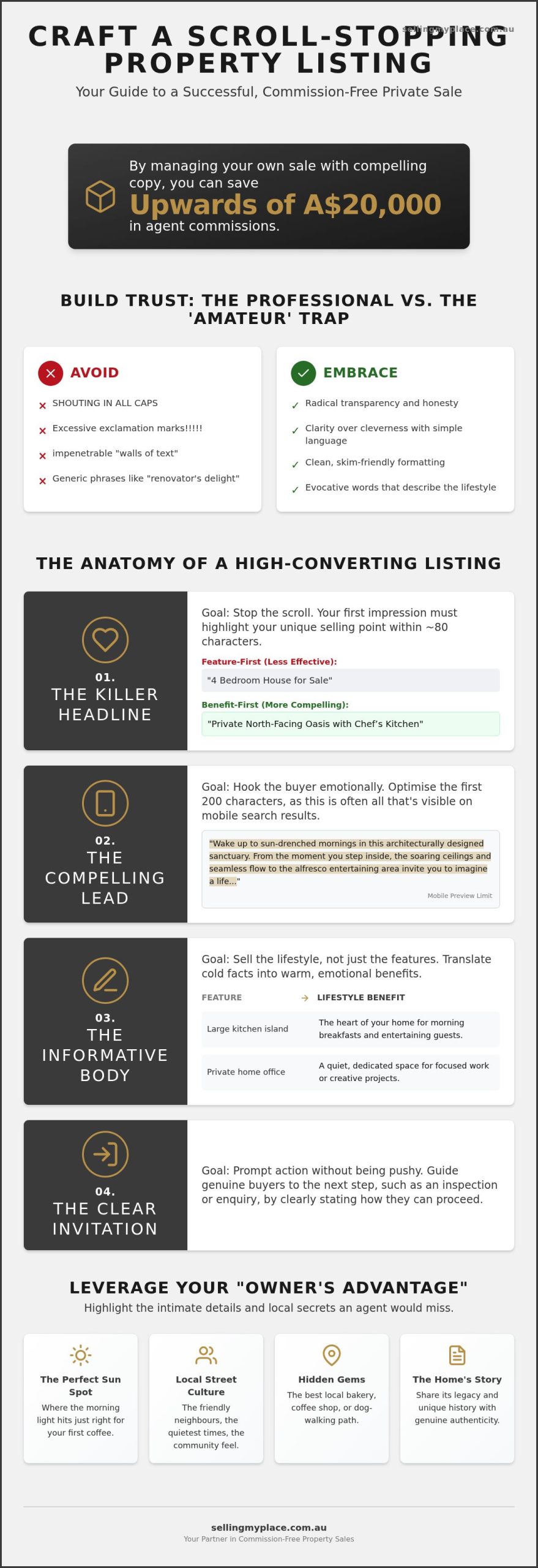
Trust is the most valuable currency in a private sale. To build it, you must avoid the common mistakes that signal a lack of professionalism. Shouting at buyers in ALL CAPS or cluttering your text with excessive exclamation marks often has the opposite effect of what you intend. It can make a seller look desperate or disorganized. Instead, focus on these elements of professional-grade copy:
- Radical Transparency: Honest descriptions build more trust than traditional real estate fluff.
- Clarity Over Cleverness: Use simple, evocative language that describes the lifestyle clearly.
- Clean Formatting: Avoid the “wall of text” by using short paragraphs and logical flow.
By focusing on how to write a compelling property description for private sale, you bridge the gap between owner and expert. You aren’t just listing a house; you are inviting someone to envision their future within your walls. This grounded, calm confidence is exactly what premium buyers are looking for in today’s competitive landscape.
The Anatomy of a High-Converting Listing: A 4-Part Framework
A successful listing follows a deliberate rhythm. It isn’t enough to simply dump features into a text box; you need a framework that guides a buyer from curiosity to conviction. Think of it as a four-part journey: the headline stops them, the lead hooks them, the body informs them, and the call to action moves them. When you understand how to write a compelling property description for private sale, you are essentially building a narrative that makes the reader feel like they already belong in the space. This structure ensures that your home stands out among the 278,984 dwellings currently listed across Australia.
Crafting the Killer Headline
Your headline is your first impression. With only about 80 characters to work with on major portals, every word must earn its place. A “Benefit-First” headline like “Private North-Facing Oasis with Chef’s Kitchen” is far more effective than a “Feature-First” title like “4 Bedroom House for Sale.” By choosing the right words, you highlight your unique selling point (USP) immediately. Avoid generic terms; instead, focus on what makes your property special. If you’re unsure which angle to take, our Agent Advisory Service can help you polish your headline to ensure it resonates with the current 2026 market dynamics.
Writing to the Floorplan
Buyers often struggle to visualise how a home feels just from photos. This is where your professional floorplans become your best writing tool. Use a “Mental Walkthrough” technique to describe the flow of the home. Start at the entryway and lead the reader through to the “Entertainer’s Hub” or the “Private Retreat.” This approach allows you to point out hidden value that a camera might miss, such as the thermal orientation of the living area or the clever storage tucked under the stairs. It connects the dots between the 2D drawing and the 3D experience of living there.
The lead paragraph should immediately follow the headline with a lifestyle promise. Don’t start with the bedroom count. Start with the feeling of the morning sun in the breakfast nook or the quiet peace of the cul-de-sac location. The body of your listing should then group features logically into themes. Finally, never leave a buyer wondering what to do next. A clear call to action is vital. Tell them exactly how to book a private inspection or register for an upcoming viewing. If you feel stuck on the structure, you might want to speak with a property advisor to ensure your listing is ready for prime time.
Lifestyle vs. Features: Selling the “Sizzle” of Your Home
Buying a home is rarely a purely logical decision. While a buyer might start their search with a checklist of four bedrooms and a double garage, the final choice is almost always driven by emotion. They are looking for a sanctuary, a place for their children to grow, or a space to host Sunday lunches with friends. Your job is to provide the “sizzle” that ignites that emotional connection while offering enough “steak” (the hard facts) to help them justify the purchase with logic. When you master how to write a compelling property description for private sale, you bridge the gap between a simple building and a dream lifestyle.
As the owner, you possess a unique “Owner’s Advantage” that no real estate agent can match. You know exactly where the morning sun hits the kitchen bench for that first cup of coffee. You understand the quiet rhythm of the street and which neighbours have the best citrus trees to swap fruit with. These intimate details are what truly sell a home. In a market where 97.4% of house resales in the first half of 2026 resulted in a profit, highlighting these authentic lifestyle elements can be the difference between a standard result and a premium one.
However, the “sizzle” must always be balanced with the “steak.” Buyers still need to know the practicalities to move forward. Ensure you clearly state the land size, school catchments, and any recent sustainable upgrades like solar panels or greywater systems. This combination of heart and data creates a sense of reliability and grounded confidence that reduces the stress for potential buyers.
The “Owner Loves” Section
Including a dedicated “What we love about this home” paragraph is a powerful way to humanise your listing. It allows you to share memories, like the way the backyard becomes a private oasis in summer or the convenience of the local hidden cafe just three minutes away. To keep it professional, focus on the benefits these memories provide to a new owner rather than just the nostalgia itself. This section often uncovers unique selling points that agents typically overlook, such as the specific thermal orientation that keeps the lounge cool without air conditioning.
Choosing Your Words Wisely
The vocabulary you choose can significantly impact the perceived value of your property. In 2026, buyers are looking for resilience, community, and versatility. Using evocative, Australian-centric adjectives like “sun-drenched,” “seamless indoor-outdoor flow,” or “tranquil retreat” helps them visualise their future life. Conversely, certain cliches have become white noise and should be banished from your draft to maintain a sophisticated tone.
- Power Words: Sanctuary, versatile, bespoke, integrated, sustainable, resilient.
- Words to Banish: “Location, location, location,” “Renovator’s Delight,” “Hidden Gem,” “Must see.”
- Describing Potential: Instead of “needs work,” try “a blank canvas for your creative vision” or “scope to add significant value.”
By focusing on how to write a compelling property description for private sale that leads with lifestyle, you position your home as more than just another entry on a search results page. You are offering a future that a buyer can see, feel, and ultimately, want to own.
Technical Formatting for realestate.com.au and Domain
While the emotional narrative is the heart of your listing, the technical execution is the skeleton that holds it up. In 2026, the way you present your text is just as critical as the words themselves. If your formatting is clunky, buyers will simply bounce to the next property. Learning how to write a compelling property description for private sale requires a shift toward mobile-first thinking. Most Australians now hunt for homes on their smartphones, meaning your most vital information must appear before the “Read More” line.
The first 200 characters are your golden window. This snippet is what appears in search results and at the top of the mobile app. Use it to state your biggest unique selling point clearly. Beyond the hook, you must ensure your description aligns perfectly with the legal details in your Contract of Sale. Discrepancies between your marketing and the legal paperwork can create unnecessary friction or even legal hurdles during the settlement process.
Mastering the Mobile Scroll
Readability is the cornerstone of engagement. On a small screen, a “wall of text” is intimidating and often ignored. When you are refining how to write a compelling property description for private sale, remember that white space is your friend. Aim for paragraph breaks every two to three lines to keep the reader’s momentum going.
Utilising feature bullets is a brilliant way to provide quick-fire facts. Buyers in 2026 are specifically filtering for lifestyle upgrades that offer resilience and comfort. Consider a list like this:
- Energy Efficiency: 6.6kW solar system and double-glazed windows for year-round comfort.
- Working from Home: Dedicated executive study with custom built-in cabinetry.
- Outdoor Living: Saltwater pool and integrated alfresco kitchen for summer entertaining.
Bolding key terms and using sub-headings within the portal text box helps guide the eye to the information that matters most to that specific buyer. It allows them to find what they need without having to dig through paragraphs of fluff.
Portal-Specific Tips
Realestate.com.au and Domain have different character limits and display styles. While you might write a long-form story for your main advertisement, you may need to edit a punchier version for social media or secondary portals. Accurate data entry in the backend is equally important. If you forget to tick the “Pool” or “Solar” box in the features list, your property won’t show up when buyers use those specific filters.
Ensuring your listing is technically sound is a major step in the journey. For a broader look at the overall process, you can refer to our How to Sell Your Own Home: A Step-by-Step Guide. If you want to ensure your technical formatting is flawless before you hit publish, book a consultation with our advisory team for a final listing review.
Beyond the Words: The Partnership for a Successful Sale
Even the most evocative prose needs a professional stage to perform on. While you now understand how to write a compelling property description for private sale, those words must work in harmony with high-impact visuals. Think of it as a partnership where your words provide the emotional context and professional photography provides the immediate proof. When your authentic story is backed by gallery-quality imagery, you create a listing that doesn’t just inform buyers; it inspires them.
Our Agent Advisory Service is designed to bridge the gap between your intimate knowledge of the home and the professional polish required by the 2026 market. We don’t want to rewrite your experience. We want to refine it. By “peer-reviewing” your draft, our experts help you ensure that your unique insights are framed in a way that resonates with premium buyers. This collaborative approach allows you to maintain control of your narrative while benefiting from the “steady hand” of a seasoned expert.
The financial logic of this approach is compelling. By opting for a flat-fee model, you are choosing to reinvest in the quality of your marketing rather than paying for an agency’s overhead. Most of our clients find that saving upwards of A$20,000 in commissions allows them to present their home in the best possible light while still walking away with a significantly higher net return at settlement. You are the best person to tell your home’s story. We simply provide the platform and the tools to make sure that story is heard.
The Kincade Advantage
Kincade International Direct Sales (KIDS) combines your authentic voice with a marketing reach that rivals traditional agencies. Through our pre-sale property consulting, we help you identify the specific “lifestyle triggers” that will drive the most enquiry in your local area. Whether it is a sun-drenched reading nook or a resilient, sustainable garden, we know how to make those features shine. Plus, our “Until Sold” guarantee means you can move at a pace that suits your family, without the artificial pressure of a standard 90-day agency agreement.
Taking the Next Step
Before you hit the “Publish” button, take a final moment to read your listing aloud. Does it sound like the home you love? Does it clearly guide the buyer on how to take the next step? Ensure your contact details are correct and your professional floorplan is attached. Visualise the successful, commission-free settlement that awaits you. You have the knowledge and the tools to manage this transition with calm confidence.
Ready to write your success story? Contact our advisory team for a listing consultation to ensure your property hits the market with the professional edge it deserves.
Your Future Settlement Starts with the Right Words
Your journey from listing to a successful settlement is built on a foundation of trust and clear communication. By moving beyond a simple list of features and embracing the emotional narrative of your home, you’ve already done the heavy work that most agents overlook. Mastering how to write a compelling property description for private sale is the final piece of the puzzle, ensuring your digital front door is as welcoming as the real one. It is about showing buyers not just where they will live, but how they will feel when they arrive.
You don’t have to navigate this high-stakes transition alone. Our partnership approach gives you the professional tools to stand out, including high-end photography and floorplans that do the heavy lifting while your words capture the heart. With our expert Agent Advisory Service to review your draft and an “until sold” guarantee with no time limits, you can proceed with calm confidence knowing you are protecting an average of A$20,000 in equity. Start your commission-free selling journey today with our expert-backed marketing packages. We look forward to helping you turn the page to your next chapter with ease and success.
Frequently Asked Questions
How long should a property description be for a private sale?
The ideal length for a property description is typically between 300 and 500 words. This range provides enough space to cover the lifestyle narrative and the “Owner Loves” section without overwhelming a mobile user. Since the first 200 characters are the most critical for smartphone scrollers, ensure your most evocative hook is front-loaded to capture interest immediately before the “read more” break.
Do I need to mention the price in the description if it is already in the price field?
It is generally unnecessary to repeat the price within your main text if it is already clearly displayed in the portal’s dedicated field. Using that character count to focus on the home’s unique selling points is a better use of space. However, if you are using a strategy like “Offers Above” or a specific auction date, mentioning this toward the end can help clarify your expectations for the buyer.
Should I be honest about the property’s flaws in the description?
Radical transparency is one of the best ways to build trust in a private sale. While you don’t need to lead with a list of repairs, acknowledging a home’s “potential for improvement” or “original character” helps manage buyer expectations before they arrive for an inspection. This honesty ensures you are dealing with genuine enquiries from people who understand the property’s current state and see the value in its future.
Can I use AI to write my property description?
You can certainly use AI as a tool to overcome writer’s block or to help structure your initial draft. However, an AI cannot replicate your “Owner’s Advantage” or the heartfelt memories that make a house a home. Learning how to write a compelling property description for private sale involves adding those authentic, local details that only you know, which is why we recommend using our Agent Advisory Service to polish your final version.
How do I write a description for a property with “development potential”?
Focus on the technical “steak” of the property by leading with zoning, land dimensions, and street frontage. Mentioning ease of access or proximity to local infrastructure is vital for attracting investors and builders. While the potential is the main draw, briefly noting the current dwelling’s rental viability can provide a complete picture for those looking to land-bank or develop in the future.
What is the most important feature to highlight for Australian buyers in 2026?
Energy resilience and sustainable living have become the top priorities for Australian buyers in 2026. Highlighting features like high-capacity solar systems, double glazing, or thermal orientation speaks directly to the desire for lower running costs and year-round comfort. With national home prices falling slightly in July 2026, these value-add features help your property stand out as a smart, future-proof investment for families.
How often should I update my property description if it hasn’t sold?
Consider refreshing your listing every 21 to 30 days if you haven’t yet secured a successful sale. A new headline or a different lead photograph can often “reset” the listing in a buyer’s mind. Since national property listings increased by 12.4% in July 2026, staying fresh is essential to remain competitive. Use this update to respond to buyer feedback or to highlight a different seasonal lifestyle benefit.
Does the description affect my search ranking on realestate.com.au?
Your description affects your visibility through keyword optimisation rather than direct portal ranking algorithms. When you understand how to write a compelling property description for private sale, you include terms like “Home Office,” “Solar,” or “Pool” that buyers use in their filtered searches. While your listing tier determines your overall position, your copy is what ensures you appear in specific, high-intent search results.
