Selling Off Market Privately in Australia: What Homeowners Need to Know
Selling off market privately means managing your own sale while limiting how widely your property is promoted. It’s different from selling privately with a public listing: you can advertise online to reach more buyers while still handling buyer conversations and sale decisions yourself.
It’s understandable to want privacy and avoid traditional agent representation, while wondering whether a smaller audience could affect buyer interest. A private sale also means taking an active role in enquiries, inspections and offers. This guide explains the trade-offs and how to choose an approach that fits your priorities.
We’ll cover what an off-market campaign involves, what sellers need to manage and how it differs from a flat-fee listing service. Kincade International Direct Sales (KIDS) offers fixed-fee packages that include major portal listings and enquiry forwarding. KIDS is a licensed intermediary for listing purposes, not a real-estate agent. You remain involved in managing the sale, and you’ll need a qualified conveyancer or solicitor for legal matters.
Key Takeaways
- Before selling off market privately, decide how much confidentiality matters and whether you’re comfortable managing buyer conversations yourself.
- A focused sale still needs a clear plan for preparing the property, reaching prospective buyers, handling enquiries and progressing the paperwork.
- Compare confidential marketing with public portal exposure by considering buyer reach, privacy, time commitment and how enquiries will be managed.
- Use a practical checklist to settle your preferred balance of privacy, visibility and control before choosing a marketing path.
- KIDS offers fixed-fee packages with public portal exposure and enquiry forwarding. It acts as a licensed intermediary for listing purposes, not a real-estate agent.
Selling off market privately: what the terms mean for Australian homeowners
A quieter sale can appeal if you want to keep home life private, choose when inspections happen and stay closely involved in decisions. But “private” can describe who manages the sale, or how widely the property is promoted. Those are separate choices. Treating them as the same thing can lead to a marketing plan that doesn’t match your priorities.
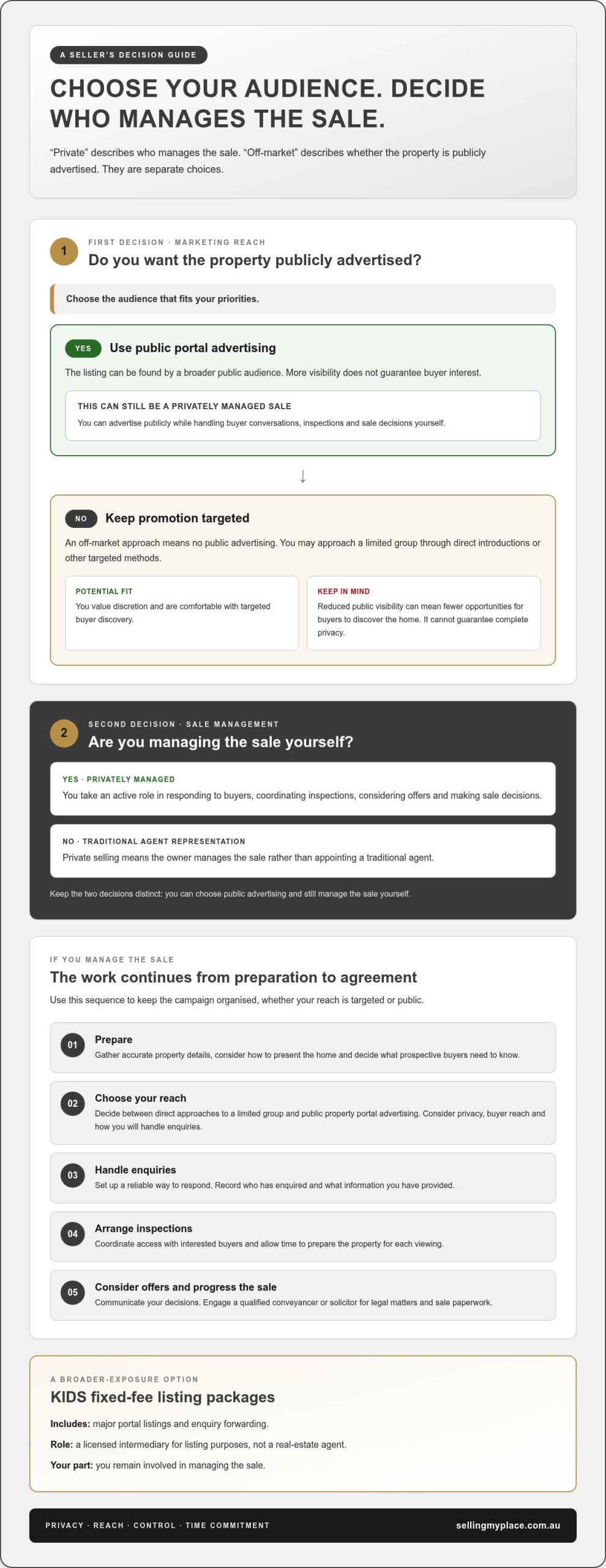
Private selling describes who manages the sale; off-market selling describes whether the property is publicly advertised.
What does selling off market privately actually involve?
An off-market sale is marketed or completed without public advertising. Rather than appearing on property portals or in public advertising, the home may be offered through direct introductions to prospective buyers or other targeted approaches. This can reduce public visibility, but it can’t guarantee complete privacy: people may share information, and interested buyers may discuss the property with others.
Private selling, by contrast, means the owner manages the sale rather than appointing a traditional agent. This can involve responding to prospective buyers, coordinating inspections and considering offers. You can keep promotion targeted or advertise publicly on portals. A privately managed sale can therefore still be highly visible online.
For a broad overview of the real estate market in Australia, remember that these terms describe different aspects of a property sale, not one fixed method.
Why do Australian sellers consider an off-market approach?
Some owners value discretion. They may prefer not to advertise their home widely while testing buyer interest, managing a sensitive life change or keeping the sale less visible to neighbours and the wider community. An off-market approach may suit that preference, but it isn’t a promise of secrecy or a guarantee of a particular sale result.
Control is another drawcard. A hands-on owner may want to decide when buyers can view the property, how enquiries are handled and whether to continue discussions with an interested party. For example, you could arrange inspections directly with a small number of prospective buyers rather than hold a public open home. The trade-off is that you’ll need time and a clear process to respond consistently and keep conversations moving.
Think about your circumstances before choosing. If discretion is the priority and you’re comfortable with targeted buyer discovery, an off-market route may suit. If you want more people to find the property, public portal advertising may be a better fit, even if you still manage the sale yourself. Selling off market privately is a combination of two decisions: who handles the sale and how broadly the home is promoted. Choose each deliberately.
How an off-market property sale works, from preparation to agreement
A well-run off-market sale still needs a clear process. The difference is how buyers hear about the property: instead of relying on broad public advertising, an off-market campaign may use targeted introductions. If you’re selling off market privately, you’ll also take an active role in organising the sale and making decisions.
Use this sequence to plan the main steps:
- Prepare: Gather accurate property details, consider how to present the home and decide what information prospective buyers will need.
- Choose your reach: Decide whether to approach a limited group directly or advertise publicly through property portals. A smaller audience may mean fewer opportunities for buyers to discover the home. Portal exposure gives the property a broader public audience, but doesn’t guarantee interest.
- Handle enquiries: Set up a reliable way to receive and respond to questions. Keep a record of who has enquired and what information you’ve provided.
- Arrange inspections: Coordinate access with interested buyers and allow time to prepare the property for each viewing.
- Negotiate and progress the sale: Consider offers and communicate your decisions. Engage a qualified conveyancer or solicitor for legal matters and sale paperwork.
Preparing the property and deciding who to reach
Before approaching buyers, make sure your property information is consistent and ready to share. Prepare details about the home’s key features, inclusions and other relevant points. Decide on your preferred level of visibility as well. A targeted introduction may feel more discreet, while public portal advertising makes the listing easier for a wider pool of buyers to find. Neither approach guarantees a particular level of interest, so choose based on your priorities rather than an assumed result.
Your choice of audience shapes the rest of the campaign. If you’re relying on introductions, plan how you’ll identify and connect with prospective buyers. If you choose public advertising, decide how you’ll respond if several enquiries arrive at once.
Managing enquiries, inspections and sale paperwork
In a privately managed sale, you remain closely involved. You’ll need to reply to buyer questions, arrange suitable inspection times, provide consistent information and decide how to respond to offers. A simple record of enquiries and follow-ups can keep conversations organised, particularly when more than one buyer is considering the property.
Keep the boundary around legal work clear. Kincade International Direct Sales (KIDS) is a licensed intermediary for listing purposes, not a real-estate agent, and doesn’t provide legal advice, contracts or conveyancing services. Engage a qualified conveyancer or solicitor for legal questions and guidance through the paperwork.
KIDS packages offer a different route to a privately managed sale: every package includes public property portal listings and enquiry forwarding. Because portal advertising is public, this isn’t an off-market campaign, even though you manage the sale. If broader online reach with seller control suits your plans, explore privately managed listing support as you map out your next steps.
Off-market sale or public listing: compare privacy, reach and control
Choosing between a confidential campaign and public portal exposure comes down to the balance you want between privacy and buyer discovery. Neither approach is automatically better. Consider how you want buyers to find the property, how much visibility feels comfortable and how much of the day-to-day work you’re prepared to manage.
Selling privately is about who controls the sale; off-market describes how widely the property is marketed.
| Consideration | Off-market marketing | Public portal exposure |
|---|---|---|
| Visibility | Promotion is limited or targeted rather than publicly advertised. | The property is publicly advertised on online portals where prospective buyers can discover it. |
| Privacy | Less public visibility may suit owners who prefer a discreet approach, but it doesn’t guarantee confidentiality. | More people can see the listing, so the sale is more publicly visible. |
| Seller workload | You may need to identify potential buyers and coordinate targeted introductions. | You’ll manage enquiries and inspection arrangements for a public listing. KIDS packages include enquiry forwarding. |
| Enquiries and discovery | Enquiries may come through the people or channels used to reach the targeted audience, which may be narrower. | Portal exposure allows a wider pool of buyers to find the property, though it can’t guarantee interest or an offer. |
The trade-off is straightforward: reducing public exposure can support a privacy preference, but may also limit the audience reached. Public advertising gives buyers more opportunity to discover the home, while making the sale more visible. In either case, you remain responsible for decisions about conversations, access and offers in a privately managed sale.
When might a confidential off-market approach suit?
A confidential approach may suit owners who place a high value on limited public visibility and are comfortable with a focused campaign. Targeted introductions can put a property in front of selected prospective buyers, but they don’t guarantee demand. Before proceeding, consider who could make suitable introductions, how you’ll assess enquiries and how you’ll keep communication clear and timely.
When might public portal exposure better fit a private sale?
Public portal listings can make a home discoverable beyond a buyer pool sourced through personal or targeted introductions. Kincade International Direct Sales (KIDS) offers owners a privately managed listing option with listings on major property portals and enquiry forwarding. KIDS is a licensed intermediary for listing purposes, not a real-estate agent. This portal-listed approach is not off-market. If broader exposure matters more than keeping the sale out of public view, compare the visibility you want with the time you can give to managing the sale.
A practical checklist for deciding how to sell your property privately
Before settling on a marketing path, decide what kind of sale experience you want and what work you can take on. Selling off market privately may give you more control over who hears about the property, but it also calls for a deliberate plan to reach buyers and manage the sale. Use this checklist to clarify your priorities.
- Set your privacy preference: Do you want limited public visibility, or are you comfortable with the property appearing on public portals?
- Choose your desired reach: Would targeted introductions suit you, or do you want potential buyers beyond your existing network to discover the home?
- Assess your available time: Can you respond to enquiries, arrange inspections and follow up with interested buyers as the campaign progresses?
- Plan who will communicate: Are you comfortable answering questions and discussing offers directly, or would listing administration and enquiry forwarding help?
- Decide what support you need: Which parts of the process do you want to manage yourself, and where would practical listing support make the experience easier?
- Allow for legal support: Plan to engage a qualified conveyancer or solicitor for legal matters and conveyancing questions.
Questions to answer before choosing your marketing approach
Start with the key choice: is limited visibility more important to you than broad public discovery? Then consider how you’ll reach prospective buyers, manage inspection requests and keep communication organised. A confidential approach may mean more direct work to find and engage interested buyers. Public portal exposure makes the property visible to a wider audience, while bringing enquiries to manage. Be realistic about the time and support you’ll want throughout.
For a fuller owner-led process, use a step-by-step guide to selling your own home in Australia alongside your checklist. Before moving towards an agreement, arrange independent legal and conveyancing support suited to your circumstances.
What to understand before using a flat-fee listing service
A flat-fee listing option can combine owner control with public exposure. Kincade International Direct Sales (KIDS) offers three fixed-fee packages with 0% commission: Classic at $799 ex GST, Signature at $999 ex GST and Prestige at $1,999 ex GST. Every package includes listings on major property websites and local portals such as Homely and Soho, enquiry forwarding by SMS and email, 24/7 seller dashboard access and a Market Valuation Report. This is a public listing approach, not a confidential off-market campaign. KIDS is a licensed intermediary for listing purposes, not a real-estate agent.
The packages differ in their included marketing. Classic includes professional photography and a 600 × 900 mm For Sale signboard. Signature includes everything in Classic, with a larger 1200 × 1800 mm signboard, email and phone expert support, and a dedicated property website and URL. Prestige includes everything in Signature, plus 15-20 professional photographs, a floorplan redraw, a Facebook and Instagram ad campaign, 50 premium A4 brochures, a 1-on-1 dedicated specialist, a James Edition listing and a 1200 × 1800 mm photo signboard.
Listings remain live until sold, withdrawn or two years from the commencement date, whichever occurs first. Consider this listing period alongside the package features and the role you want to play in managing the sale. If this balance of reach and control suits your plans, explore privately managed listing support.
A privately managed sale with broader exposure: how KIDS supports owners
Choosing a privately managed sale doesn’t mean you have to keep your property out of public view. Kincade International Direct Sales (KIDS), a service of Kincade International Realty, offers fixed-fee packages for listing on property portals while you retain control of buyer conversations and sale decisions. This differs from a confidential off-market campaign: the listing is public, but you remain closely involved.
KIDS is a licensed intermediary for listing purposes, not a real-estate agent. Its role is to provide listing support. You remain responsible for managing the sale and deciding how to respond to buyers. This distinction matters if you want portal exposure without traditional agent representation.
What KIDS includes in its privately managed listing packages
Every KIDS package includes a Realestate.com.au listing, listings on local portals such as Homely and Soho, a Market Valuation Report and 24/7 seller dashboard access. Enquiry forwarding by SMS and email is included across all packages, so buyer enquiries can be forwarded to you.
All three packages are listed until sold for a fixed fee, with 0% commission. Classic costs $799 ex GST and includes professional photography, a 600 × 900 mm For Sale signboard, email expert support, a dedicated website and URL, international network access and the included portal listings and dashboard. Signature costs $999 ex GST and includes everything in Classic, plus a 1200 × 1800 mm For Sale signboard and email and phone expert support.
Prestige costs $1,999 ex GST and includes everything in Signature, plus Kincade Global Network priority in the UK and USA, 15-20 professional photographs, a floorplan redraw, a Facebook and Instagram ad campaign, 50 premium A4 brochures, a 1-on-1 dedicated specialist, a James Edition listing and a 1200 × 1800 mm photo signboard. All listed features are included in the package fee.
You can edit your listing, manage enquiries and host inspections, staying involved in the practical decisions. These tools support your role as seller; they don’t guarantee a buyer, a sale or a particular price. KIDS isn’t responsible for the outcome of a sale or lease.
Listings remain live until sold, withdrawn or two years from the commencement date, whichever occurs first. KIDS provides global exposure through its network across Australia, the United Kingdom and the United States. This broader reach is distinct from a confidential off-market campaign, because KIDS packages include public portal listings.
How to take the next step with confidence
Before choosing a package, consider the kind of support you want and how much of the sale you’re ready to manage directly. Portal exposure can help buyers discover the property beyond a privately sourced audience, while you retain control over communications and decisions. It isn’t the same as selling off market privately because the property is advertised publicly.
KIDS offers three fixed-fee packages with 0% commission. Prices are ex GST, and each package bundles its listed features into the flat fee. Comparing the inclusions can help you choose the level of listing support that fits your priorities, from the Classic package through to Prestige with its additional marketing features and dedicated specialist.
For legal matters and conveyancing questions, engage a qualified conveyancer or solicitor. KIDS doesn’t provide legal advice, contracts or conveyancing services. If a privately managed, portal-listed approach suits your plans, explore KIDS listing support.
Choose a sale path that feels right for you
A property sale is a significant step, and the right approach should reflect more than a preference for keeping things quiet or reaching a wider audience. Consider what will help you feel informed and in control: a clear plan, time to respond to buyers and confidence in the decisions ahead.
If selling off market privately is still on your mind, use your priorities as your guide. Start by deciding how much visibility you’re comfortable with and what kind of support would make managing the sale more manageable.
KIDS offers a privately managed listing option for owners who want public portal exposure while staying involved in their sale. Compare the three fixed-fee packages and choose the level of included support that suits your plans. To explore your options, get started with KIDS.
With a considered plan and qualified legal support, you can move towards your next chapter with greater clarity.
Frequently Asked Questions
Can I sell my property off market privately in Australia?
Yes. Australian owners can sell privately, but selling off market privately means choosing not to advertise the property publicly. Requirements for preparing and progressing a sale can vary between states and territories, so general information isn’t legal guidance for your circumstances. In NSW and the ACT, a Contract of Sale is required before listing. In Victoria, a Section 32 Vendor Statement must be provided before contracts are signed. Engage a qualified conveyancer or solicitor for advice about the legal steps and documents relevant to your property.
Is selling off market the same as selling privately?
No. These terms refer to separate choices: whether you manage the sale yourself and how the property is promoted. For example, an owner can manage buyer conversations and decisions while advertising the home on public portals. Alternatively, they can manage the sale themselves and approach buyers through more limited channels. Think about whether you value discretion, wider discovery or direct involvement most, then choose your marketing approach accordingly.
Does off-market selling mean my property will not appear online?
Not necessarily. “Off market” usually means the home isn’t publicly advertised, which may include not appearing on public property portals. Its actual visibility depends on the channels used to reach prospective buyers. If you choose a KIDS package, your listing appears on Realestate.com.au and local portals such as Homely and Soho, so it receives public online exposure. That’s different from a confidential campaign, even though you remain involved in managing the sale.
Can I list my home on Realestate.com.au without an agent?
Individual owners can’t list directly on Realestate.com.au, according to KIDS’ service information. KIDS acts as a licensed intermediary for listing purposes, helping private owners access portal listings without appointing a traditional real-estate agent. Enquiries are forwarded by SMS and email, and sellers can use the 24/7 dashboard to stay across their listing. KIDS isn’t an agent and doesn’t provide legal advice, prepare contracts or provide conveyancing services.
What are the risks of selling a property off market?
A limited campaign may mean fewer buyers discover the property, which can reduce the range of interest you receive. You may also be responsible for keeping track of conversations, arranging inspections and deciding how to respond to offers. Before choosing this path, consider how you’ll reach potential buyers and whether you have time to manage the process. A more discreet approach isn’t automatically the best fit for every seller.
Do I need a conveyancer to sell my home privately?
Engage a qualified conveyancer or solicitor for legal matters, including advice about contracts and requirements that apply to your sale. KIDS doesn’t provide legal advice, prepare contracts or provide conveyancing services. Requirements can differ across Australia, so a qualified professional can explain what applies to your property and circumstances. It’s sensible to arrange that support early, rather than waiting until you’re discussing an offer or preparing paperwork.
How long does a KIDS property listing stay active?
A KIDS listing stays live until the property is sold, withdrawn or two years from the commencement date, whichever happens first. That describes how long the listing can remain active; it isn’t a promise that a sale will happen within that time or at a particular price. Owners remain responsible for decisions about the sale, and KIDS isn’t responsible for its outcome.
How to List on realestate.com.au Without an Agent in Australia
Want your home to reach a major property portal without appointing a traditional selling agent to manage the sale? If you want to list your property without an agent, note that private sellers can’t submit a for-sale property directly: a licensed real estate agency must handle the portal listing. A flat-fee platform like Kincade International Direct Sales may provide a route through an agency while you manage much of the sale yourself, rather than appointing a traditional commission-based agent.
It’s understandable to wonder whether a private listing will reach enough buyers and whether you’re ready to field enquiries and present your property accurately. Portal access is only the first step. Clear details, strong photography and a floorplan can help create a credible advertisement. You’ll also need to understand which parts of the selling process remain your responsibility.
This guide explains the available routes to a major portal listing, what information to prepare and how to weigh a fully self-managed sale against a supported private-sale service or traditional agency. Before choosing a package, check whether it currently provides portal access and what marketing or advisory support is included. With the right preparation, you can make a considered choice about control, exposure and support.
Key Takeaways
- Private sellers can’t submit a sale listing directly to the major property portal, but may be able to use an eligible provider.
- Compare self-managed and supported private-sale routes by checking who handles the listing, marketing and owner responsibilities.
- Prepare accurate property details, quality images and a floorplan, and make sure every advertised feature can be substantiated.
- Before proceeding, confirm portal placement, package inclusions, fees and listing duration in writing.
- Choose your level of support based on the time, confidence and control you want throughout the sale.
Can you list on a major property portal without an agent? Understand the available routes
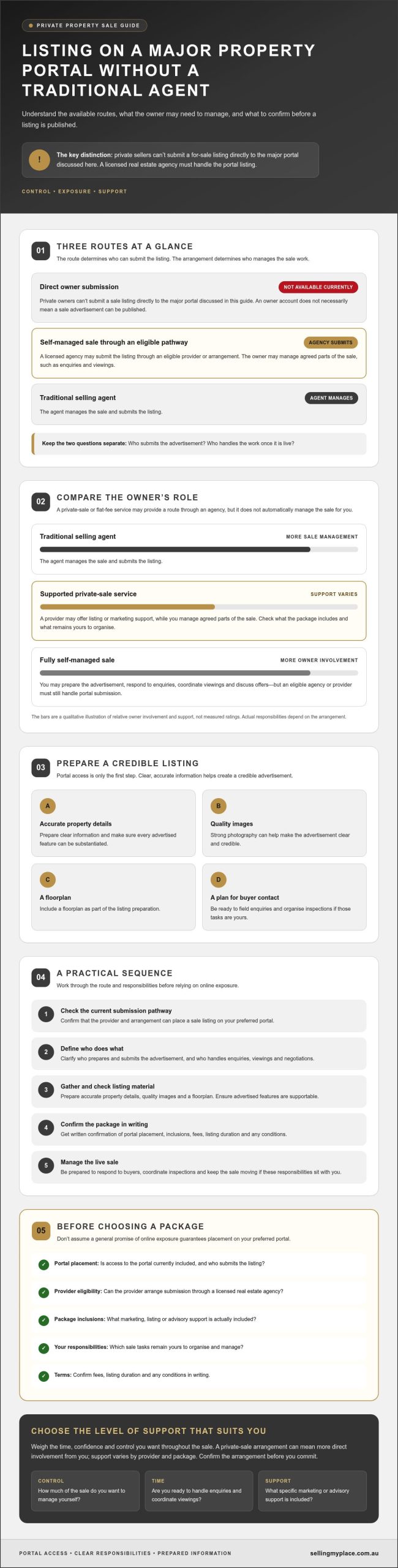
Yes, you may be able to sell without appointing a traditional selling agent to manage the sale, but private owners can’t submit a for-sale property directly to the major Australian property portal discussed in this guide. Under current submission arrangements, a licensed real estate agency must handle the portal listing. A private-sale or flat-fee marketing provider may offer a route through an agency, but confirm the provider’s eligibility and the package’s portal access before committing.
This distinction matters because portal rules determine who can submit sale advertisements. A provider that helps prepare or promote an advertisement doesn’t automatically mean it can be published on your preferred portal. Check the current submission requirements and get clear confirmation from the provider rather than relying on a general claim of online exposure.
What does “without an agent” mean when listing a property?
Usually, it means not appointing a traditional selling agent to take charge of the sale. With a private-sale arrangement, you may manage buyer enquiries, organise inspections and lead negotiations yourself. A flat-fee marketing service can provide listing or marketing support, but that support is separate from managing the sale on your behalf. Check exactly what the provider handles and what remains yours to organise.
Can owners submit directly to the portal?
For a property offered for sale, private owners can’t submit an advertisement directly under current arrangements. The listing must be submitted through a licensed real estate agency, which may be arranged through a private-sale platform. As portal requirements and provider eligibility can change, check the portal’s current seller information and ask the provider to confirm it can place your sale listing. Get the answer in writing, including any conditions that apply.
At a glance: possible routes to a sale listing
- Traditional selling agent: The agent manages the sale and submits the listing.
- Private-sale platform: A licensed agency may submit the listing, while you manage agreed parts of the sale.
- Direct private submission: Not currently available for sale listings on the major portal discussed here.
These routes describe the general distinction, not a promise that any particular provider or package is eligible. Confirm current access, inclusions and your responsibilities before proceeding.
Whichever route you consider, a private sale still takes active work. You’ll need to prepare accurate property information, promote the home, respond to buyers and keep the sale moving. Choosing not to use a traditional agent doesn’t remove the need for an eligible submission pathway or a clear plan for managing the listing.
Compare direct, self-managed and flat-fee routes to a realestate.com.au listing
Portal access is only one part of the decision. An advertisement can be prepared and a sale managed in different ways, so consider separately who submits the listing and who handles the work once it’s live. The comparison below outlines the broad distinctions. Confirm current portal access and exactly what any provider will do before you choose.
| Route | Portal access | Owner responsibilities | Support and questions to check |
|---|---|---|---|
| Direct owner submission | Private owners can’t currently submit a sale listing directly to realestate.com.au. | You’d prepare and manage the sale, but need to establish an eligible submission pathway first. | Check the portal’s latest requirements. Don’t assume an owner account allows you to publish a sale ad. |
| Self-managed sale through an eligible pathway | Access depends on the agency or provider submitting the listing and its current eligibility. | You may prepare the advertisement, respond to enquiries, coordinate viewings and discuss offers. | Confirm who submits the ad, what support is included and which sale tasks remain yours. |
| Flat-fee marketing service | Placement depends on the service’s current portal access and package terms. | You may still manage buyer communications, inspections and negotiations, depending on the arrangement. | Ask in writing whether realestate.com.au placement is included, along with the specific marketing and advisory inclusions. |
What does a fully self-managed listing involve?
Self-management gives you greater control, but it also puts the practical work in your hands. You’ll need to prepare the property information and advertisement, respond to prospective buyers, organise viewings and handle offer discussions. It may suit sellers with the time and confidence to take on those tasks. First, confirm how the listing can reach the portal. Don’t rely on direct submission being available.
How can a flat-fee property marketing service help?
A marketing service can support parts of the preparation without necessarily taking over sale management. Kincade International Direct Sales describes services including professional photography, floorplans, neighbourhood market reports and advisory support. Its flat-fee model is an alternative to agency commission, not a promise of a particular sale result. Check which inclusions apply and whether the current package enables realestate.com.au placement.
Think about the tasks you’re comfortable owning. If you’re confident managing enquiries but want help presenting the home, marketing support may be worth exploring. If you’d prefer someone else to lead the sale, assess that responsibility separately from the cost structure. To compare the available support, review flat-fee property marketing and advisory options and confirm portal access and package details before deciding.
Prepare a credible realestate.com.au listing before you publish
A clear, well-prepared advertisement helps buyers understand the home before deciding whether to arrange an inspection. Reviewing it before publication also gives you a chance to catch mistakes while there’s still time to correct them. Gather the key details, check every claim and decide how prospective buyers will contact you.
Gather property details, photography and a floorplan
Build your listing from information you can check, rather than memory or assumptions. Use this pre-publication checklist:
- Property details: Confirm the address, property type, room count and features. Check dimensions and inclusions against reliable records where available.
- Features and condition: Describe fixtures, renovations and other selling points precisely. Don’t present an upgrade as new or recently completed unless you can support that description.
- Photography: Review each image to ensure it shows the property fairly and represents its current condition. Check that the photos match the written description.
- Floorplan: Use a clear floorplan and verify that its labels and dimensions are correct. Buyers use it to understand the layout, so errors can lead to confusion.
- Enquiries: Decide which contact details to publish, who will respond and how you’ll arrange viewing requests. A simple plan helps you keep track of buyer conversations.
Professional photography and floorplans can help present the home clearly. If you’re using a marketing provider, confirm which materials are included and review the final advertisement yourself before it goes live.
Check advertising claims and seller obligations
Accuracy matters. Avoid unsupported statements about renovations, included fixtures, boundaries or potential future development. If a detail is uncertain, check it or leave it out rather than asking buyers to rely on a guess. Keep relevant records available so you can substantiate information in the advertisement if questions arise.
Disclosure, advertising and sale requirements can differ between Australian states and territories. Check current guidance from the relevant official state or territory consumer affairs or fair trading authority, and seek conveyancing advice about documents and transaction responsibilities. A conveyancer or solicitor can help clarify what applies to your circumstances. Don’t assume the requirements in one state apply everywhere.
Before you list on realestate.com.au without an agent, read the completed advertisement from a buyer’s point of view. Are the features easy to understand? Do the photos and floorplan match the claims? This final check can help you publish a more credible listing and begin buyer conversations on a sound footing.
Follow these steps to publish and manage your private property listing
A smooth sale starts with confirming the listing pathway, then keeping the advertisement and buyer communication organised. Use this workflow before and after publication. If you plan to list on realestate.com.au without an agent managing the sale, be clear about which tasks you’ll handle and what your chosen provider will do.
- Confirm the submission route. Check realestate.com.au’s current requirements and ask the service provider to confirm in writing that it can submit your sale listing. Don’t assume portal access is included just because a service offers online marketing.
- Review the service scope. Ask which platforms the package covers, what marketing materials and advisory support are included, and what you’ll need to manage yourself. Confirm any applicable fees, listing duration, renewal or extension conditions, and other terms in writing.
- Prepare the final advertisement. Gather the property details, images and floorplan, then check that every material claim is accurate. Decide how prospective buyers will contact you and who will receive their enquiries.
- Approve before publication. Read the complete advertisement as it will appear to buyers. Verify the address, features, inclusions, room details and contact arrangements. Ask the provider how to request corrections and who is responsible for submitting them.
- Set up an enquiry routine. Choose a reliable way to monitor messages and respond consistently. Keep a record of questions, your answers and inspection requests so you can follow up and give prospective buyers the same accurate information.
- Check the live listing. Once published, confirm it appears on the agreed platform and review the displayed details. Check it regularly and promptly request corrections if information changes or an error appears. Keep track of the agreed listing period so you know what happens as it approaches its end.
Clear written terms make it easier to spot gaps before they become frustrating. If a provider offers marketing or pre-sale advice, clarify precisely what that assistance covers. It doesn’t necessarily mean the provider will manage enquiries, inspections or negotiations for you.
To compare the support available for a private sale, ask about property marketing and advisory options, including current portal access and package conditions.
Choose the right support for listing on realestate.com.au without an agent
The right level of support depends on how much time you can give the sale, how comfortable you feel speaking with buyers and how much control you want to retain. If you’re confident handling enquiries, viewings and offer discussions, an owner-managed approach may suit you. If you’d like help presenting the property or getting advice before sale, a flat-fee service may offer a middle ground between doing everything yourself and appointing a traditional selling agent.
Kincade International Direct Sales describes a flat-fee model without agency commission, with services including professional photography, floorplans, neighbourhood market reports and an Agent Advisory Service. These inclusions may help with marketing preparation and advice, but they don’t automatically mean the provider manages the sale or can place your property on realestate.com.au. Treat it as an option to investigate, and confirm current portal access and package terms directly before deciding.
When a flat-fee supported sale may suit your plans
This route may appeal if you want to stay closely involved while getting help with selected parts of the process. For example, you might be happy to speak with prospective buyers but prefer professional photography and a floorplan to support the presentation. Check which inclusions apply to the package you’re considering, and ask what tasks, such as enquiries and negotiations, remain yours.
Questions to ask before choosing a listing service
Get clear, written answers before you commit. Cover portal access as well as the work involved in preparing and managing the listing.
- Portal access: Can the service currently arrange a sale listing on realestate.com.au? Who submits it, and what eligibility conditions apply?
- Platforms and duration: Which websites are included, how long will the listing remain active, and what happens if the agreed period ends?
- Inclusions and terms: Are photography, floorplans, market reports or advisory support included? Confirm applicable fees and any other package conditions in writing.
- Your responsibilities: Who prepares or approves the advertisement, responds to buyer enquiries, coordinates viewings and handles offer discussions?
- Advice and conveyancing: What does the advisory support cover, who provides it, and what conveyance advice is available? Clarify the scope and whether separate professional advice may be needed.
Choose the arrangement that fits the way you want to sell, not just the way the listing is submitted. Before committing, compare the support you’ll receive with the time and responsibility you’re prepared to take on yourself.
Take your next step with clarity and confidence
You can list on realestate.com.au without an agent managing your sale, but confirm the current portal pathway and provider eligibility before relying on a listing. Prepare accurate property details, then weigh the time and responsibility of managing buyers yourself against the marketing and advice a supported private-sale service may include.
Kincade International Direct Sales describes a flat-fee marketing model without agency commission, with professional photography, floorplans and an Agent Advisory Service offering pre-sale consulting and conveyance advice. Confirm current portal access, package inclusions and your responsibilities directly before making a decision.
If you’re considering a supported sale, discuss a supported, commission-free sale and ask what applies to your circumstances. With the right information and level of support, you can choose a way forward that suits your plans.
Frequently Asked Questions
Can I list on realestate.com.au without an agent?
Not by submitting a for-sale advertisement directly as a private owner. Current submission arrangements require a licensed real estate agency to lodge sale listings, although you may be able to manage the sale yourself through a private-sale pathway. Portal rules and provider eligibility can change. Check realestate.com.au’s current seller information and ask any provider to confirm in writing that it can arrange placement before you pay or rely on that exposure.
How do I get my property on realestate.com.au without a traditional agent?
You may be able to use a private-sale service that arranges submission through a licensed agency, rather than appointing a traditional agent to manage the sale. If you want to list on realestate.com.au without an agent overseeing the process, first confirm the provider’s current access and eligibility. Then agree who prepares the advertisement, fields enquiries, arranges inspections and handles offers. Get the portal placement and your responsibilities confirmed in writing.
Can a flat-fee service list my home on realestate.com.au?
A flat-fee service may be able to arrange a listing, but don’t assume portal access is included or currently available with every provider or package. Ask who submits the advertisement, whether the service can currently place sale listings on realestate.com.au, and what conditions apply. Confirm the platforms, listing period, inclusions and fees in writing. Marketing support and portal submission are distinct, and neither guarantees a sale or a particular result.
What information do I need to list a property on realestate.com.au?
Prepare the property address, type, room details, features, inclusions and any dimensions you plan to advertise. Gather clear, current photographs and a floorplan, then check that they match the home and written description. Have relevant property records available to support claims about renovations, fixtures or boundaries. You’ll also need seller contact arrangements for buyer enquiries. Check applicable state or territory disclosure and advertising requirements through official sources before publication.
Do I still have to manage buyer enquiries if I sell without an agent?
Often, yes. In a self-managed sale, the owner may need to monitor and respond to enquiries, arrange inspections, answer questions consistently and discuss offers. A marketing provider may assist with advertising without managing those parts of the sale. Before engaging a service, ask which communications it handles and what remains your responsibility. Set up a reliable way to record enquiries and follow up so interested buyers receive accurate information.
Is selling privately the same as selling without any professional help?
No. Selling privately usually means retaining control of key sale tasks, not necessarily doing every part alone. You can seek separate marketing or advisory support while managing buyer communications and negotiations yourself. For example, Kincade International Direct Sales describes a flat-fee model without agency commission, with photography, floorplans, neighbourhood market reports and an Agent Advisory Service for pre-sale consulting and conveyance advice. Confirm which services apply and what professional guidance you may still need.
What should I check before paying for a private property listing service?
Ask whether realestate.com.au placement is currently available, who submits the listing and what eligibility conditions apply. Confirm the platforms, marketing materials, advisory inclusions, listing duration, fees and any renewal terms in writing. Clarify whether you or the provider will prepare the advertisement, respond to buyers, arrange inspections and manage offers. Check the provider’s current terms and verify relevant state or territory selling and disclosure requirements through official sources before committing.
