Managing the Emotional Side of Selling a Home: A Practical Guide
What if the hardest part of selling your home isn’t the paperwork, but letting go of the life you’ve built there? A familiar kitchen, family gatherings and quiet routines can make a property feel like part of the family. That’s why managing the emotional side of selling a home can be challenging, especially when buyer feedback or negotiation starts to feel like a judgement of your memories rather than an opinion about the property.
If you’re feeling attached, uncertain or unsettled by each new milestone, you’re not being unreasonable. Selling is both a practical decision and a personal transition, and there’s no need to rush yourself through it. A useful starting point is to identify what matters most in the sale, then use those priorities to guide decisions when emotions run high.
This guide shares practical ways to create space between emotion and decision-making, from setting clear priorities before listing to keeping buyer feedback in perspective. You’ll also learn how a clear sale process and professional advice can help organise decisions and reduce avoidable uncertainty, so you can stay involved and feel more in control as you move towards your next chapter.
Key Takeaways
- Recognise that a home sale can bring up memories, identity and feelings about a major life change. Managing the emotional side of selling a home starts with noticing those feelings without letting them make decisions for you.
- Identify pressure points across your sale timeline, including buyer comments about presentation or condition, which can feel more personal than intended.
- If an offer surprises or disappoints you, pause before responding and return to the priorities you set for the sale.
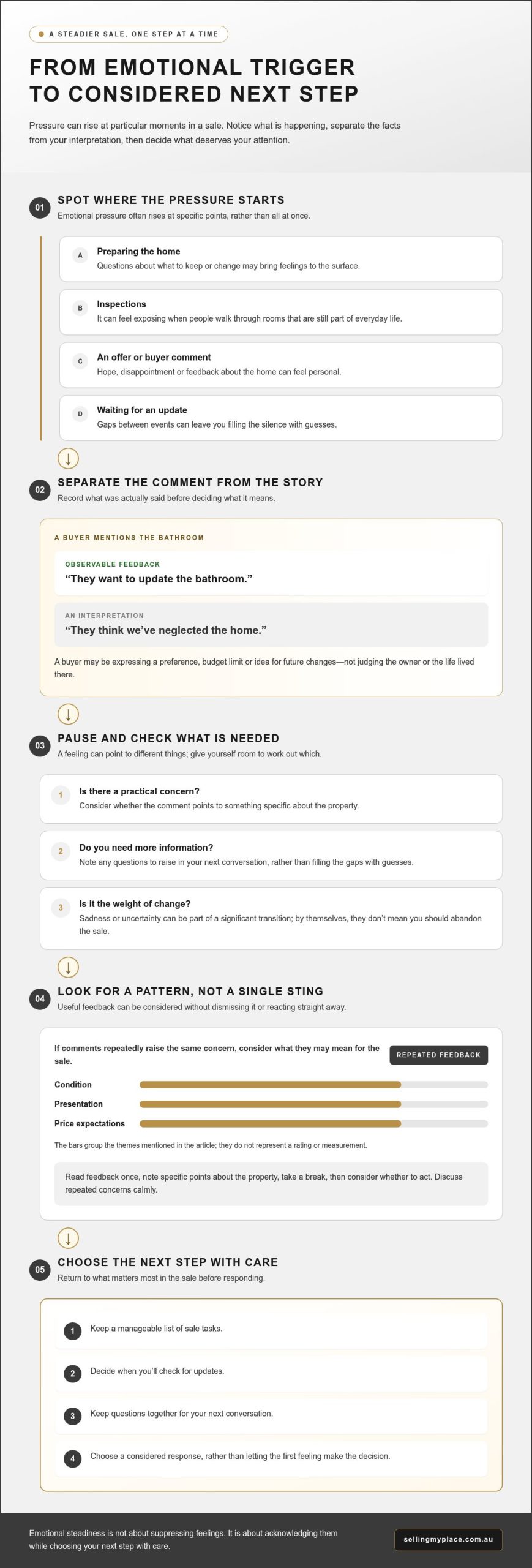
- Use a simple reset: name the feeling, identify its trigger, take a moment, then choose a considered next step.
- Professional marketing and advisory support can add structure to sale tasks, helping you stay involved while reducing avoidable uncertainty.
Why managing the emotional side of selling a home matters
Selling a home can mean more than changing address. It may involve letting go of familiar routines, a sense of independence or a place that has held important family moments. At the same time, a sale can bring opportunity and relief. Whatever your reason for moving, your response is personal, and it can change as the process unfolds.
Managing the emotional side of selling a home means noticing what you feel while giving yourself room to make decisions at a considered pace. It doesn’t mean suppressing emotion or caring less about the property. It means separating a feeling from the decision in front of you, so a difficult moment doesn’t automatically dictate what happens next. For example, feeling hurt by a buyer’s comment doesn’t mean you need to change the asking price or reject an offer straight away.
Emotional steadiness in a property sale means acknowledging your feelings while choosing your next step with care.
Feelings can shift between preparing the property, welcoming people through for inspections, considering offers and reaching settlement. You might feel ready to move one day, then unexpectedly unsettled when a room is cleared or an offer arrives. Sadness or uncertainty can be part of a significant transition; by themselves, they don’t mean you should abandon a sale. Pause and consider whether the feeling is signalling a practical concern, a need for more information or simply the weight of change.
Why a home can feel like more than a property
A kitchen might bring back family dinners; a spare room may represent the independence of a first home or the years spent raising children. These associations are examples of place attachment, the emotional bond that forms between a person and a specific environment, such as a home. Selling can also be complicated by circumstances such as downsizing, separation, bereavement or relocation. But there’s no single story behind a sale, and not everyone experiences it as a loss.
Common feelings sellers may experience
Attachment, relief, uncertainty, excitement and sadness can all arise during a sale. They aren’t competing reactions: you can be looking forward to a new chapter and still miss the home you’re leaving. Rather than judging yourself for feeling one way or another, notice what’s present and when it appears. That small pause can help you respond thoughtfully, especially when a sale milestone brings an unexpected emotional shift.
How to recognise emotional triggers during a home sale
Emotional pressure often rises at particular points in a sale rather than arriving all at once. Preparing your home may bring up questions about what to keep or change. Inspections can feel exposing, as people walk through rooms that are still part of your everyday life. An offer may prompt hope, disappointment or difficult decisions, while waiting for updates can leave you filling the silence with guesses.
Knowing your likely pressure points helps you prepare for them. Notice what tends to unsettle you, when it happens and what decision, if any, needs to be made. For instance, if inspection feedback tends to feel personal, plan to read it once, note any specific points about the property and take a break before deciding whether to act. This is a practical part of managing the emotional side of selling a home: it creates a moment to respond thoughtfully instead of reacting to the first feeling.
When buyer feedback feels personal
A buyer’s comment about the kitchen, paintwork or price can sting, especially when you’ve cared for the home over many years. But a buyer is usually expressing a preference, budget limit or idea for future changes, not assessing your taste or the life you’ve lived there. Buyer feedback is about how a property suits their needs, not a judgement of its owner.
Try separating the observable comment from the meaning you’ve attached to it. “They want to update the bathroom” is feedback; “they think we’ve neglected the home” is an interpretation. Still, don’t dismiss useful information. If comments repeatedly raise the same concern about condition, presentation or price expectations, consider them calmly and discuss what they may mean for your sale.
Why waiting and change can heighten stress
There may be gaps between an inspection, an enquiry, an offer and the next update. Not knowing what will happen or when can make it tempting to check for news constantly. Meanwhile, keeping the home ready, managing family routines and making it available for inspections can add to the load. Recognising that combination can help you plan for the strain rather than blame yourself for feeling unsettled.
Focus on what’s within your control: prepare a manageable list of sale tasks, decide when you’ll check for updates, and keep questions for your next conversation in one place. A predictable check-in routine can give the process some shape without assuming how quickly a sale will progress. For practical structure as you prepare, discuss your property sale plans.
Handle offers and negotiation without losing perspective
An offer can feel like a verdict on a home you’ve cared for, especially if it’s lower than you hoped or arrives with conditions you didn’t expect. Taking a measured approach doesn’t mean you care less. It means giving the offer a fair assessment before deciding what to do next.
Try not to infer a buyer’s motives from the terms alone. A proposed price, preferred timing or condition tells you what they’re putting forward, not necessarily why. Focus first on the details in the offer and how they compare with your priorities and the information available to you. For more practical guidance, explore these property sale negotiation tips.
A practical pause before responding to an offer
Before replying, record the offer details and note any response deadline. Then take a breath and review the full picture rather than focusing only on the figure. Consider the proposed timing, conditions and how each fits your circumstances. If you’re finding it hard to assess the terms on your own, property sale advice can help you consider your options more clearly.
| Immediate reaction | Considered next step |
|---|---|
| “They don’t value our home.” | Write down the offer as presented, then assess its terms against relevant information. |
| “We need to accept or reject this now.” | Check the response deadline and use the time available to review your priorities. |
| “Those conditions must mean the buyer isn’t serious.” | Separate the stated conditions from assumptions about the buyer’s intentions. |
How to keep the decision grounded in your priorities
Return to the reasons you decided to sell. Perhaps timing matters because of a planned move, or certainty is more important to you than holding out for an imagined perfect result. Your priorities provide a useful reference point, but they don’t have to dictate a single answer. Assess an offer against its terms, your circumstances and the information available, rather than against an ideal outcome that may not be realistic.
Declining, accepting or negotiating can each be a considered choice. Before settling on a response, ask: Does this option support what matters most to us? What information would help us decide? Managing the emotional side of selling a home includes allowing those questions to guide the discussion, rather than letting disappointment or excitement make the decision on its own.
Practical ways to manage emotions before, during and after the sale
A simple reset can help you move from an immediate reaction to a considered response. Use it when a task feels overwhelming, a conversation becomes tense or a milestone brings up unexpected feelings:
- Name the feeling: Is it worry, frustration, sadness or relief?
- Identify the trigger: What happened just before the feeling surfaced?
- Pause: Give yourself a moment before replying or making a non-urgent decision.
- Choose a next step: Decide what information, conversation or practical action would help.
If your thoughts are racing, write down the facts separately from your interpretation. For instance, record “the inspection feedback mentioned the garden” as a fact, then note any assumptions you’re making about what it means. Revisit the decision when you feel more settled. This routine can make managing the emotional side of selling a home feel more deliberate, without expecting you to switch off your feelings.
Make room for priorities and questions
Keep a short list of what matters most in the sale, such as timing, household needs and the offer terms you need to understand. Add questions as they arise, then use the list to guide discussions rather than trying to hold every detail in your head. If you’re planning a sale by owner, this guide to selling your own home can help you think through the process and its practical steps.
Protect routines and relationships during the process
Keep familiar routines where you can, whether that’s a regular family meal, a walk or a quiet hour away from sale-related tasks. Agree with household members how you’ll share preparation jobs and discuss decisions. You might set aside a time to talk through sale matters, so they don’t take over every conversation or evening.
There’s no required way to say goodbye to a home. You may want to take photos, share a memory or simply focus on the move ahead. Make space for what feels right to you, without turning a farewell into another task to get perfect. After settlement, give yourself room to adjust; a change in routine can take time.
If distress persists, feels unmanageable or is affecting your day-to-day wellbeing, consider speaking with a qualified mental health professional. Practical property guidance can help organise sale tasks, while emotional support can address how the transition is affecting you. For guidance with the practical side of your sale, get in touch with our property advisory team.
How supportive guidance can make selling feel more manageable
A clear sale process won’t remove every difficult feeling, and it shouldn’t ask you to set those feelings aside. What it can do is make practical decisions easier to see: what needs attention now, what can wait and where you can get considered advice. That structure can reduce avoidable uncertainty while leaving you involved in decisions about your home.
What a steady, supportive sale process can provide
Professional marketing and advisory support can help organise the practical work of presenting a property and progressing a sale. Professional photography and floorplans give buyers useful ways to understand the home, while neighbourhood market reports provide context for discussions about the market. Pre-sale consulting and real estate advice can help you work through questions as they arise, rather than trying to solve every detail at once.
Kincade International Direct Sales provides flat-fee property marketing and advisory packages, with a 0% commission structure. The service includes residential listings, professional photography and floorplans, alongside pre-sale consulting and real estate advice. Owners remain involved in their sale while using a clear framework for marketing and sale tasks. Defined tasks and access to advice can help you approach each step with more information, without promising that the emotional parts will disappear.
As you consider your options, it may help to ask what would make the process feel clearer. Is it understanding the marketing plan, knowing what needs to happen before listing, or having advice available when you’re weighing a decision? Naming the question can make the next conversation more useful.
Choosing your next step at a pace that feels right
You don’t need to settle every detail at once. Identify the question creating the most uncertainty today, then review the proposed sale process before making commitments or major decisions. A clear explanation of the steps, marketing and advisory support can help you decide what suits your circumstances and how involved you want to be.
Taking time to understand your options is part of managing the emotional side of selling a home. If you’re ready to explore practical support for your sale, Talk through your next step.
Move forward with clarity and support
Selling a home can hold both personal meaning and practical decisions. Remember that feelings may shift throughout the process; noticing a trigger and pausing before you respond can help you make choices in line with your priorities. Managing the emotional side of selling a home isn’t about caring less. It’s about giving yourself room to consider each next step.
A clear sale process can help organise the practical details without pretending to remove every uncertainty. Kincade International Direct Sales’ flat-fee property marketing and advisory packages include professional photography and floorplans, as well as pre-sale consulting, so you can access practical support while remaining involved in your sale.
You don’t need to have every answer before taking the next step. Start with the question that matters most to you, then explore the marketing and advisory support available at a pace that feels right. Talk through your next step when you’re ready. With considered decisions and practical support, you can move towards what comes next with greater confidence.
Frequently Asked Questions
Is it normal to feel sad when selling a home?
Yes, sadness can be a natural response to leaving a home that holds memories or familiar routines. You might also feel relief, excitement or uncertainty, sometimes all at once. There’s no required way to feel, and your emotions don’t have to match anyone else’s. Notice when sadness arises and give yourself space to acknowledge it, while still considering the practical decisions in front of you.
How do I stop taking buyer feedback about my home personally?
Separate what the buyer actually said from the meaning you’re attaching to it. A comment about updating a bathroom may reflect the buyer’s preferences or plans, rather than a judgement of your care for the home. Write down the feedback plainly, then consider whether it raises a useful point about presentation, condition or price expectations. You can take relevant information seriously without treating it as a personal criticism.
Can emotions affect decisions when selling a home?
Yes, strong feelings can influence how you respond to feedback, offers or uncertainty. Disappointment might make an offer feel like an insult, while excitement could make it tempting to decide before weighing all the terms. Managing the emotional side of selling a home means noticing that reaction and pausing. Review the offer details, timing, conditions and your priorities before choosing whether to accept, decline or negotiate.
What should I do if I feel overwhelmed while selling my home?
Pause and work out what feels most difficult right now. Name the feeling, identify its trigger, then separate the known facts from assumptions or worst-case thoughts. Choose one manageable next step, such as writing down a question for your next sale discussion. Protect time for ordinary routines where possible. If distress persists, feels unmanageable or affects daily life, consider speaking with a qualified mental health professional.
How do I cope with selling a family home?
Give yourself permission to recognise what the home has meant to your family, without feeling you need to follow a particular farewell ritual. You might share stories, take photos or simply talk about the move together. If others are involved in the sale, agree how you’ll discuss decisions and divide practical tasks. People may respond differently, so making room for those differences can help the transition feel more considered.
How can I stay calm when negotiating a home sale?
Before responding, record the offer and review its terms, including timing and conditions. Compare them with your priorities and relevant information about the property, rather than guessing at the buyer’s motives or measuring the offer against a perfect outcome. If you feel surprised or disappointed, take a pause and seek measured advice if needed. A considered response may be to accept, decline or negotiate, depending on your circumstances.
Online real estate agent vs traditional: which suits your sale?
When comparing an online real estate agent vs traditional sale, the biggest difference may not be where the agent works, but who handles each part of the process. An online model doesn’t automatically mean you’re on your own, and a traditional agency’s higher level of involvement shouldn’t be assumed without checking what’s included.
It’s understandable to weigh a lower-fee option against the reassurance of more hands-on support, especially when you’re managing buyer enquiries, inspections and important sale paperwork. The useful comparison is between the actual services, tasks and terms, not just the labels or headline fees.
This guide explains how to compare marketing, communication, negotiation support, costs and your responsibilities under each model. Before signing, find out who handles buyer enquiries and inspections, what support is available when offers arrive, and whether professional photography, floorplans, neighbourhood market reports or advisory services are included. Once you know who does what, you can choose an approach that fits your time, confidence and support needs.
Key Takeaways
- Compare the online real estate agent vs traditional options by the tasks and support included, not the label alone.
- Check which marketing materials and advisory services are included in writing, and whether any costs are separate.
- Before signing, clarify who manages buyer enquiries, inspections, negotiations and sale paperwork.
- Match the level of hands-on support to your available time, confidence and preferred level of involvement.
- Review the agreement and complaint pathways so you know what to expect if questions arise during the sale.
Online real estate agent vs traditional: what is the real difference?
The main distinction is usually how the service is delivered, not whether a real person is involved. An online provider may use digital tools for property information, communication and listing administration. A traditional agency often works through direct contact with an agent and an agency team. Neither label tells you on its own how much support you’ll receive or how much of the selling work you’ll need to do.
For a useful overview of what is an online real estate agent, separate the online platform from the service agreement. The online real estate agent vs traditional comparison comes down to which tasks are included, who carries them out and how the provider charges.
What does an online real estate agent do?
Online property services can combine digital listing tools with professional marketing and human advice. A service might provide a property listing, photography, floorplans or a neighbourhood market report, alongside advisory support. Inclusions vary, so check the agreement for the specific service you’re considering.
A listing service doesn’t necessarily manage every step of the sale. Ask who responds to buyer enquiries, arranges or conducts inspections, follows up interested buyers and communicates offers. If you’re expected to take on any of these tasks, consider whether you have the time and confidence to do so.
What does a traditional real estate agent do?
A traditional agency may coordinate the campaign, communicate with buyers, arrange inspections and negotiate offers on the seller’s behalf. The agent may also guide you through decisions as the sale progresses. The level of involvement depends on the provider, the people handling your sale and the terms you agree to.
Traditional service isn’t identical across Australia, and online support varies too. One provider may offer substantial advice through online communication; another may leave more buyer-facing work to the owner. Read the agreement rather than relying on assumptions about the model.
In short: online describes a way of delivering services, while traditional usually describes a more agency-centred approach. The service agreement sets out what you actually receive, including:
- Fee structure: whether you’ll pay a flat fee or a commission, and what the charge covers.
- Marketing: which listing and promotional materials are included.
- Support and tasks: who handles buyer contact, inspections and follow-up.
- Terms: what the agreement requires and how long it applies.
Compare these details side by side. That will show whether the service matches your preferred level of involvement, instead of leaving you to choose by label alone.
Compare fees, marketing and support, not just the agent label
A lower or more predictable fee can be appealing, but it only tells part of the story. In the online real estate agent vs traditional comparison, weigh the fee model against the work included, the support available and any expenses treated separately in the agreement. A fee structure alone can’t tell you how a campaign will perform or what sale outcome to expect.
How do commission and flat-fee models differ?
A commission is generally calculated in relation to the sale, while a flat fee is a set charge for the agreed service. Ask for the full terms in writing: what the fee covers, whether any costs are payable separately, and what happens if the sale doesn’t proceed as planned. Compare the full services and costs rather than assuming one model will automatically cost less overall.
| What to compare | Questions to ask |
|---|---|
| Fee model | Is the fee commission-based or flat? What services and any separately payable expenses are covered? |
| Marketing | Which listing channels and campaign activities are included? Are professional photography and floorplans part of this agreement? |
| Support | Who is your main contact? Who responds to buyer enquiries and helps you consider or discuss offers? |
| Your tasks | Are you expected to arrange or host inspections, answer enquiries or follow up interested buyers? |
| Agreement terms | How long does the agreement apply, and what are the conditions for ending or changing it? |
What marketing and personal support should you check?
Look beyond a promise of online exposure. Ask which platforms will carry the listing, whether photography and floorplans are included, and who coordinates campaign updates. Confirm whether you’ll speak directly with an adviser about buyer interest and offers, or whether those tasks sit with you. Get the details in writing before you commit. For more on the elements to assess, see this guide to professional residential property listing services.
Traditional agencies and online providers can have different agreements and service arrangements. For wider context, explore the Real Estate Institute of Australia’s information on Australian real estate industry standards.
If you’re considering a flat-fee listing and advisory support, you can discuss your selling options with Kincade International Direct Sales and clarify which services and responsibilities apply to the arrangement.
Will an online agent provide enough support during your sale?
Online service doesn’t automatically mean you’re left to manage the sale alone. Some providers pair digital listing tools with professional advice, while others expect the owner to take a more active role in dealing with buyers. The key questions are what support is available, when you can access it and where the provider’s role ends.
That distinction matters when offers arrive and you need to make decisions. Ask whether an adviser can help you understand an offer or prepare for a negotiation, and what that assistance covers. For practical pointers, read these property sale negotiation tips. Advice and negotiation support vary by service, so check the scope rather than assuming it’s included.
Which sale tasks might remain with the owner?
Before signing, map out the work from listing to offer. For each task, confirm whether the provider, you or another professional is responsible. This can reveal gaps that aren’t obvious from a marketing description.
- Buyer contact: Who answers enquiries, shares property information and follows up interested buyers?
- Inspections: Who arranges access and conducts inspections? If you’re responsible, what coordination is expected?
- Campaign updates: Who prepares or organises marketing materials, and how will you hear about buyer interest and progress?
- Offers and paperwork: Who communicates offers and explains the next steps? Clarify separately who handles contract preparation and legal or conveyancing work.
Marketing assistance and conveyancing are different services. If a provider mentions conveyance advice, ask what it covers and whether you’ll still need a solicitor or conveyancer for other parts of the transaction.
How can you assess the support before signing?
Ask who your main contact will be, how you can reach them and what response expectations apply during the campaign. Request written details of any advice, negotiation assistance and service limits. Check the agreement’s duration, exit terms and any obligations that continue if you change your selling plans.
A clear conversation now can prevent uncertainty later. CHOICE’s guide to how to choose a real estate agent offers further questions to consider when assessing an agent’s service and terms. Use those questions alongside your own task list, then choose the arrangement that gives you the level of guidance and involvement you’re comfortable with.

Which real estate agent model fits your time, confidence and priorities?
The right choice depends on more than the fee. Think about how much time you can give the sale, how comfortable you feel speaking with prospective buyers, and whether you’d rather coordinate tasks yourself or have an agent take a more hands-on role. Choose a service whose responsibilities feel manageable from the outset, while allowing for your needs to change during the sale.
When might a traditional agency suit your situation?
A traditional agency may suit you if you want an agent to coordinate more campaign activity and prefer regular, direct communication as decisions arise. That can feel reassuring if you have limited time or would rather not lead buyer conversations and offer discussions yourself. Still, don’t assume every agency agreement includes the same hands-on help. Confirm who manages each task, how updates are provided and what the agent’s role covers.
When might an online service suit your situation?
An online service may appeal if you’re comfortable being more involved, value digital access and want to consider a different fee structure. Some services combine residential property listings with marketing materials and advisory support, but inclusions and the scope of advice vary. Check that the services address the areas where you want help. A flat fee alone won’t tell you how much you’ll need to do.
For a practical sense of the owner’s role, read this guide on how to sell your own home. Even if you don’t plan to manage the whole sale yourself, it can help you identify which responsibilities you’re happy to take on and where you’d value professional guidance.
To compare providers fairly, use the same written checklist for each option. Assess how well each agreement matches your needs across:
- Time: Can you respond to buyers and coordinate any tasks assigned to you?
- Confidence: Are you comfortable discussing interest and offers, or do you want more guidance?
- Control: Do you want to be closely involved, or would you prefer the agent to coordinate more of the campaign?
- Support: Is your contact and their role clear, including the limits of any advice?
- Fit: Are marketing inclusions, responsibilities and agreement terms set out clearly in writing?
The best match is the one that fits your actual capacity, not an ideal version of your schedule. If a flat-fee listing and advisory approach is on your shortlist, discuss your selling options with Kincade International Direct Sales and confirm which inclusions and responsibilities apply.
How to choose an Australian selling service with confidence
Once you’ve compared the models, turn your priorities into a simple due-diligence check. The aim isn’t to find a label that sounds reassuring. It’s to understand exactly what you’re agreeing to and whether the service fits your sale.
A practical checklist before you commit
- 1. List your priorities. Note how much time you can give the sale, which tasks you’re comfortable handling and where you want advice or hands-on help.
- 2. Compare written inclusions. Check marketing deliverables such as listing exposure, photography and floorplans alongside the fee structure. Ask which services are included and whether any expenses may be charged separately.
- 3. Clarify responsibilities. Confirm who manages enquiries, inspections, negotiations and campaign updates. Find out who your contact is and what advisory support covers.
- 4. Review the agreement. Read the duration, cancellation conditions, service responsibilities and other obligations before signing. Ask for an explanation of anything unclear.
- 5. Check complaint pathways and local guidance. Find out how the provider handles complaints and where to seek further help. Property sale and consumer requirements can vary by state or territory, so check current guidance for your location and obtain independent advice if needed.
Questions to ask every prospective provider
Ask each provider the same questions so you can compare answers fairly: What does the fee cover? Could any services involve separate charges? Who responds to buyers, coordinates inspections and supports offer discussions? How will campaign progress be communicated? What happens if you want to end the agreement? Clear written answers make it easier to compare the support on offer, not just the presentation.
The online real estate agent vs traditional decision comes down to the service and terms that suit your priorities. Kincade International Direct Sales offers flat-fee, commission-free property marketing and advisory packages. Its listed services include professional photography, floorplans, neighbourhood market reports and advisory support. Confirm current package inclusions, responsibilities and the scope of advice before deciding.
Compare those details with each provider’s written offer, then choose with a clear view of who does what. To discuss the available selling options, contact Kincade International Direct Sales.
Choose the support that lets you sell with confidence
The online real estate agent vs traditional decision isn’t simply about choosing a lower fee or a familiar agency model. Compare what each provider will do, what you’ll need to manage and how much guidance you want with buyer enquiries, inspections and offer discussions. Then check the written agreement for marketing inclusions, responsibilities, terms and any separately payable expenses.
Kincade International Direct Sales offers a flat-fee, commission-free property marketing and advisory model. Professional photography and floorplans are among its listed services, and its Agent Advisory Service offers pre-sale consulting and conveyance advice. Confirm which services are included in the package you’re considering, along with the current scope of advisory support and the terms.
If you’d like to explore whether this approach fits your priorities, discuss your property sale with Kincade International Direct Sales. Contact the team to clarify the package inclusions and responsibilities before deciding.
Frequently Asked Questions
Is an online real estate agent cheaper than a traditional agent?
An online service may use a flat-fee structure, while a traditional agency commonly charges commission linked to the sale. The total cost depends on the agreement and any separate expenses. Compare what each fee covers, including marketing and support, rather than judging by the headline fee. The online real estate agent vs traditional choice should also reflect which sale tasks you’ll handle and how much professional guidance you want.
Can an online real estate agent negotiate with buyers?
Some online services may provide advice or assistance with offers, but negotiation support varies between providers. Before signing, ask who communicates offers, whether an adviser can help you assess or respond to them, and what the service’s limits are. Get the answers in writing. If you’re expected to lead negotiations yourself, consider whether you feel comfortable discussing terms and responding to buyer questions.
What is the difference between an online agent and a traditional real estate agent?
The difference is generally how the service is delivered, not whether human support is available. Online providers may use digital tools for listings and communication, while traditional agencies often coordinate directly through an agent or team. Either model can vary in marketing, advice and seller responsibilities. Compare the written agreement to see who handles enquiries, inspections, offers and campaign updates before deciding which arrangement suits you.
Do online real estate agents include professional photography and floorplans?
Some online property services include professional photography and floorplans, but inclusions vary by provider and package. Check whether both are part of the specific service you’re considering, or whether they involve separate arrangements or charges. Also confirm how the listing will be presented and where it will appear. Kincade International Direct Sales lists photography and floorplans among its services, but verify current package inclusions before proceeding.
How much does an online real estate agent cost in Australia?
There isn’t one standard cost for an online real estate agent in Australia. Providers may charge a flat fee or use another structure, and marketing or other services may be charged separately. Ask for a written breakdown of the fee, inclusions and possible additional expenses so you can compare the full agreement with other options. Kincade International Direct Sales describes its model as flat-fee and commission-free; confirm its current terms directly.
What should I check before signing with an online real estate agent?
Check the written inclusions, fee structure, agreement duration and cancellation conditions before signing. Clarify who handles buyer enquiries, inspections, offer discussions and campaign updates, and identify the contact available to you. Confirm whether photography, floorplans and advisory support apply to your agreement, and ask about any separate expenses. If a term is unclear, request an explanation in writing and consider independent advice before committing.
Can I sell my home without a traditional real estate agent?
Yes, you can choose a sale-by-owner approach or use a property marketing and advisory service instead of a traditional agency. The level of support differs: you may take responsibility for buyer enquiries, inspections and follow-up, or receive some guidance depending on the service. Before choosing, consider the time you can give the sale and confirm who handles each task, including any conveyancing or contract responsibilities.
How to Create a Property Floor Plan: A Practical Guide
A useful floor plan depends on accurate measurements, not fancy software. If you’re wondering how to create a property floor plan, it can be hard to know where to start: which rooms and openings should you include, and how precise do your measurements need to be? A confusing sketch can leave buyers with more questions than answers.
A clear plan should represent the home faithfully, but you don’t have to be a designer to make a useful start. Measure each space, record doors, windows and other important details, then sketch and check the layout so it’s easy to follow.
You’ll also learn when a hand-drawn plan or digital tool may suit your needs, and when professional preparation could help present a property for sale. A simple sketch can be a useful first draft. For listing materials, sellers may also consider a professionally prepared plan. The aim is straightforward: give prospective buyers a clearer sense of how the home connects, room by room.
Key Takeaways
- Learn how to create a property floor plan by recording the rooms and features buyers need to understand the layout.
- Follow a practical measuring sequence, from gathering simple tools to checking room dimensions and your sketch.
- Choose a hand sketch, digital tool or professionally prepared plan based on how you’ll use the finished drawing.
- Check dimensions, labels and layout before sharing the plan. A tidy appearance can’t make inaccurate details reliable.
- Use your floor plan alongside property photography to give prospective buyers a clearer sense of how the home’s spaces connect.
What a property floor plan shows and why it matters to buyers
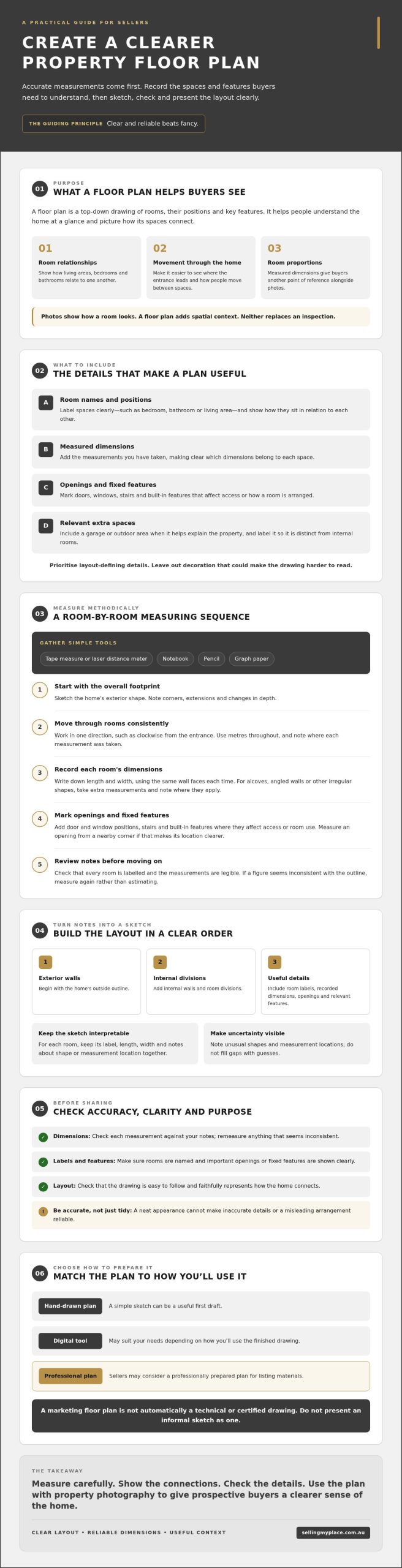
You don’t need design expertise to make a useful start. Pay attention to how rooms connect, where people enter and move through the home, and which features shape the layout. A property floor plan is a top-down drawing showing rooms, their positions and key features, helping someone understand the home at a glance.
The Floor plan reference explains the common elements of this kind of drawing. For a property listing, the purpose is practical: help buyers picture the layout and compare spaces. A marketing floor plan isn’t automatically a technical or certified drawing, so don’t present an informal sketch as one. For a broader look at how plans fit into presenting a home for sale, see this residential property listing services guide.
What details belong on a property floor plan?
As you consider how to create a property floor plan, focus on details that help readers interpret the layout without cluttering the page. Include:
- Room names and positions: Label spaces clearly, such as “bedroom”, “bathroom” or “living area”, and show how they relate to one another.
- Measured dimensions: Add room measurements you’ve taken, and make clear which dimensions belong to each space.
- Layout features: Mark doors, windows and stairs, along with built-in features that affect how a room is arranged or accessed.
- Relevant extra spaces: Show a garage or outdoor area if it helps explain the property, and label it so readers can distinguish it from internal rooms.
Not every detail needs to appear. Prioritise features that change how someone understands the home, and leave out decorative touches that could make the drawing harder to read.
How a clear plan helps a buyer understand the home
Photos can show a bright kitchen or welcoming lounge, but they don’t always explain where those rooms sit in the overall layout. A plan can show whether the living area connects directly to the kitchen, how bedrooms relate to the bathroom, and where the main entrance leads. Buyers can use those relationships to picture everyday movement, from bringing shopping inside to moving between shared and private spaces.
Room dimensions also give readers a way to compare proportions. A bedroom may look spacious in a carefully framed photo, while its measurements offer another point of reference. Neither gives a complete experience of the property, and a floor plan doesn’t replace an inspection. It adds spatial context.
Clear labels and reliable dimensions help buyers understand the layout without guesswork. Keep the drawing honest: a neat presentation is helpful, but it can’t make inaccurate measurements or a misleading arrangement reliable.
How to measure your home and sketch a property floor plan
A dependable sketch starts with a repeatable method, not a perfect drawing. As you work through how to create a property floor plan, measure each space carefully, write figures down straight away and mark anything unusual rather than filling gaps with guesses.
Prepare a simple room-by-room measuring checklist
Gather a tape measure or laser distance meter, notebook, pencil and graph paper. Start with the home’s overall footprint, then move through the rooms in one consistent direction, such as clockwise from the entrance. Use metres throughout, and note where each measurement was taken so you can interpret it later.
- Sketch the outline. Draw the exterior shape of the home, noting corners, extensions or changes in depth.
- Measure each room. Record its length and width, using the same wall faces each time. For alcoves, angled walls or other irregular shapes, take extra measurements and note where they apply.
- Record openings and fixed features. Add door and window positions, stairs and built-in features where they affect access or room use. Measure the position of an opening from a nearby corner if that will make its location clear.
- Review your notes. Check that every room is labelled and the measurements are legible. If a figure seems inconsistent with the outline, measure again rather than estimating.
A room-by-room checklist can help you avoid missing spaces or repeating measurements. For each room, leave space for its label, length, width and any notes about shape or measurement location. The how to draw a floor plan guide also outlines a practical approach to measuring spaces and adding features.
Sketch the layout without losing important details
Draw exterior walls first, then add internal walls and room divisions. Your first sketch doesn’t need to be to scale. Focus on representing the layout faithfully and leaving enough space for notes. Mark entrances, doors, windows and stairs with simple, consistent symbols, and label rooms as you go.
Include a key for symbols that might not be obvious. Leave space beside each room for dimensions and notes, and show which way a door opens only if it helps explain movement through the space. These details can make the difference between a sketch that’s easy to follow and one that leaves buyers guessing.
Once the measurements and rough layout are in place, decide whether to refine the sketch yourself or consider a professional floor plan for listing materials. If you’re preparing a property for sale and want to discuss floor plans, contact the team.
How to turn your measurements into a clear, scaled floor plan
Once you’ve checked your measurements, turn them into a drawing that’s easy to read. Scale is the relationship between a real measurement and the size shown on the page. For example, if you choose a scale where 1 cm represents 1 m, a 4 m wall should appear 4 cm long.
Scale keeps drawn proportions connected to recorded measurements. Use the same scale throughout the plan. Otherwise, rooms may look larger or smaller than they are in relation to one another. A scaled drawing can still contain errors, so check it against your notes rather than assuming the method or tool has made it accurate.
Choose a drawing method that suits your needs
Graph paper is a straightforward option for a low-tech draft. Use its grid to keep lines consistent, and revise the drawing as you confirm dimensions. Digital drawing tools can make labels, resizing and repeated edits easier. If you’re preparing a property listing and presentation quality or time is a concern, consider having the plan professionally prepared.
| Method | Effort | Editing ease | Suitability for a listing |
|---|---|---|---|
| Graph-paper sketch | Hands-on drafting | Simple to mark up, but redraws may take time | Useful as a clear draft; presentation depends on the finished drawing |
| Digital template or drawing tool | Time to learn the tool and enter measurements | Often convenient for changing labels and layout | Can work if checked carefully and presented clearly |
| Professionally prepared plan | Less drawing work for you; requires arranging preparation | Ask how corrections can be made | An option when a polished listing presentation matters |
No method guarantees accuracy. Your measurements and review are what keep the plan faithful to the home.
Add scale, labels and visual hierarchy
Use consistent line styles for walls, openings and other features, and include a key if any symbols might be unclear. Keep room names and dimension labels readable, with enough space that they don’t crowd the drawing. Use the same names throughout, such as “living room”, rather than switching between labels for the same space.
As you decide how to create a property floor plan, aim for clarity over decoration. Buyers should be able to find room names, understand proportions and follow the layout without having to decipher the page.
How to check a DIY property floor plan before sharing it
A DIY floor plan can be useful for property marketing if you check the measurements and describe the plan’s limitations honestly. A polished appearance is no substitute for accurate dimensions or a layout that reflects the home. Treat your drawing as a guide to understanding the spaces, not as a technical document. If you need it for a technical purpose, check the requirements with the relevant professional or organisation first.
A practical accuracy check before you publish
Before adding the plan to marketing materials, compare it with your notes and the home itself. Re-measure a selection of rooms, including any with unusual shapes, and confirm that the figures match. Then check the positions of doors, windows and stairs, along with the connections between rooms. A second pair of eyes can help: ask someone unfamiliar with the property to follow the layout and point out anything confusing.
- Dimensions: Do the figures match your recorded measurements? Are approximate dimensions clearly identified?
- Layout: Are the room connections and positions of openings and stairs represented correctly?
- Labels: Are room names consistent and easy to read?
- Interpretation: Can someone unfamiliar with the home understand the plan without your explanation?
Common floor-plan mistakes and how to avoid them
Awkward corners are easy to simplify by accident. Don’t guess their shape or leave out a fixed feature if doing so could change how a buyer understands the room. Check that labels and dimensions remain readable, and make sure decorative elements don’t compete with the layout.
Be clear about what you’ve measured and what you’ve estimated. If some figures are approximate, say so plainly. Don’t present estimates as verified measurements. If a room’s shape or a dimension is uncertain, revisit it before sharing the drawing. An honest limitation is more useful than false precision.
As you decide how to create a property floor plan for a listing, remember that a DIY draft can be a helpful starting point, while a professionally prepared plan may suit sellers who want a more polished presentation. Kincade International Direct Sales offers floor plans as part of its property marketing services. Check the current scope and process if you’re considering this option.
For help preparing a property listing, contact the team about your listing.
How to use your finished floor plan in a property listing
A finished floor plan helps prospective buyers understand how the home fits together, while photography shows its appearance and atmosphere. Use the plan to add spatial context, not as a substitute for images. A buyer might see the kitchen in a photograph, then use the plan to understand how it connects to the dining or living area.
Before sharing the plan, check that it still reflects the property and that room names match the wording in the listing. If changes have been made since you measured, update the plan or arrange a fresh check. Sellers preparing the rest of their sale materials may also find this step-by-step guide to selling your own home helpful.
Prepare a floor plan for listing photos and property details
Choose a clean version that stays legible on a screen, where buyers may view it at different sizes. Keep room labels and dimensions clear, and avoid squeezing in decorative details that distract from the layout. Use consistent names across the plan and property details so readers don’t have to guess whether “family room” and “living room” refer to separate spaces.
Pair the plan with photographs that help people connect the layout with the rooms themselves. A photo can show the outlook from a bedroom, for example, while the plan explains where that bedroom sits in relation to the bathroom and living areas. Together, they offer complementary information and help buyers build a more complete picture before arranging an inspection.
When to ask for professional floor-plan support
Consider professional help if the layout is complex, you’re short on time, or you want a more polished asset for your listing. Before agreeing to a service, ask what measurements are taken, what review or checking steps are included, and what final materials you’ll receive. Confirm the current scope and process rather than assuming every provider prepares plans in the same way.
Kincade International Direct Sales’ property marketing services include floor plans, photography and residential property listings. If you’re deciding how to create a property floor plan for your sale, start with your own measurements, then consider what support would make the presentation clearer for buyers.
For questions about presenting your home for sale, find out more about property marketing support.
Present your property with a clearer picture
A useful floor plan doesn’t need elaborate design; it needs to represent the home faithfully. As you consider how to create a property floor plan, focus on recording measurements carefully, showing how rooms connect and checking the drawing before sharing it. A consistent scale and clear labels help buyers interpret the layout, while photographs add visual detail a plan can’t provide.
You can begin with a hand-drawn sketch, then decide whether a digital version or professional preparation better suits your listing. Kincade International Direct Sales offers floor plans alongside professional photography and residential property listings, bringing key marketing elements together. Check the current service scope and process to understand what’s included.
A thoughtful plan can make it easier for prospective buyers to picture the home and decide whether it may suit their needs. Discuss your property marketing needs with the team to take the next step towards presenting your home with confidence.
Frequently Asked Questions
How do you create a property floor plan yourself?
Start by sketching the home’s overall shape, then measure each room and note its position, doors, windows, stairs and fixed features. Record measurements in metres and label each space as you go. Transfer your notes to graph paper or a digital drawing tool, keeping proportions consistent if you’re working to scale. Before sharing the plan, compare it with your measurements and check that someone unfamiliar with the home can follow the layout.
What should be included in a property floor plan?
Include clearly named rooms, their relative positions and dimensions you’ve actually measured. Show doors, windows and stairs, along with built-in features that affect how people use or move through a space. Add a garage or outdoor area if it helps explain the property, and label it clearly. Focus on details that help readers understand the layout. Unnecessary decoration or unsupported measurements can make the plan harder to interpret.
Can I draw a floor plan without special software?
Yes. Graph paper, a pencil, a ruler and your measurements are enough to create a useful hand-drawn plan. Use the grid to keep walls and room proportions consistent, and leave space for labels and dimensions. If you need to change the drawing, make corrections legibly or redraw it. Digital tools are optional. They can make editing easier, but they don’t replace careful measuring and checking.
How do I measure a room for a floor plan?
Measure the room’s length and width from wall to wall, using a tape measure or laser distance meter, and write each figure down immediately. Keep measurements in metres and note where each one was taken. For an alcove, angled wall or irregular room, record extra lengths to show the shape rather than treating it as a simple rectangle. Measure door and window positions too if they clarify access or how the room is arranged.
Does a property floor plan need to be drawn to scale?
A plan for personal reference can be a rough sketch, but consistent scale makes proportions easier to understand. Scale means drawn lengths represent real measurements in the same ratio throughout the plan. For example, if 1 cm represents 1 m, a 3 m wall should be drawn 3 cm long. Label dimensions clearly, and remember that a scaled drawing can still be inaccurate if its measurements or layout are wrong.
Should I make my own floor plan or hire a professional?
Make your own plan if you can measure the spaces carefully and need a straightforward drawing for general understanding. Consider professional preparation if the layout is complex, you’re short on time or you want a polished asset for a property listing. Before engaging a provider, ask what measurements, checking steps and final materials are included. A marketing plan isn’t automatically a technical drawing, so check requirements for any other intended use.
How can I check whether my floor plan is accurate?
Compare the drawing with your notes and re-measure rooms where a figure seems uncertain, especially spaces with unusual shapes. Check that room connections, doors, windows and stairs appear in the right places, and make sure labels match the property details. Then ask someone unfamiliar with the home to interpret the plan. If any dimensions are estimates, identify them clearly rather than presenting them as measured figures.
How Do I Get a Comprehensive Market Analysis for My Home Before Selling It?
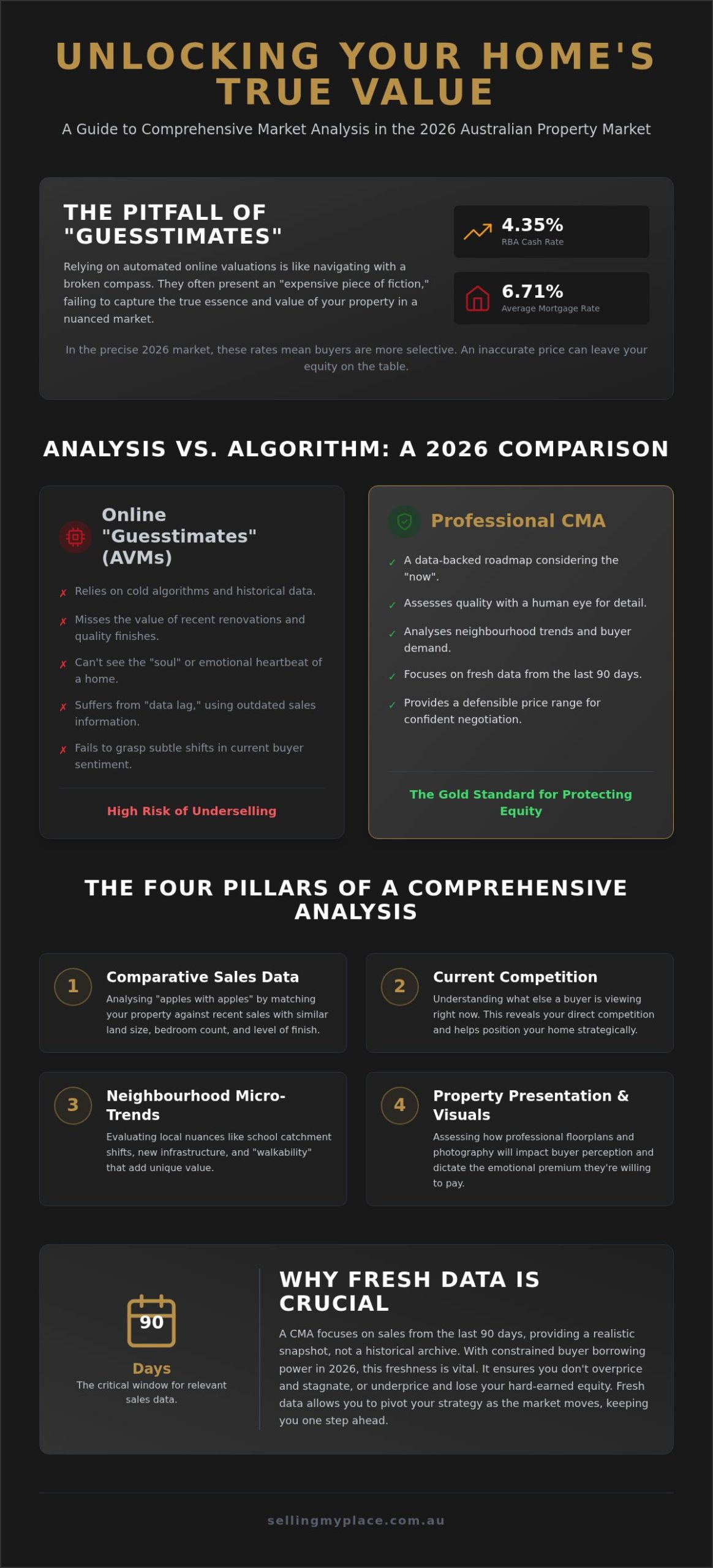
The “guesstimate” you found online is likely the most expensive piece of fiction you’ll ever read. Selling a home is one of the most significant transitions your family will ever navigate, and it’s natural to feel a bit of a squeeze in the current climate. With the RBA cash rate at 4.35% and mortgage rates averaging 6.71%, the 2026 market has become a space where precision matters more than ever. You’ve likely encountered conflicting data from various websites, leaving you asking, how do i get a comprehensive market analysis for my home before selling it? It’s a valid concern, especially when you want to avoid leaving your equity to chance or high-pressure sales tactics.
We’re here to show you that securing a professional, unbiased market analysis is the key to protecting your legacy and ensuring a premium sale price. We’ll explore how to obtain a defensible price range and a clear strategy to maximise your profit, giving you the steady hand you need to negotiate with absolute confidence. By moving away from transactional noise and toward data-driven clarity, you can approach your sale with the peace of mind that your home’s value is fully protected.
Key Takeaways
- Learn why a detailed Comparative Market Analysis (CMA) is the essential gold standard for protecting your property equity, offering far greater precision than basic council valuations or automated estimates.
- Understand the “Four Pillars” of accurate pricing, including how to analyse “apples with apples” sales data and evaluate the current local competition through the eyes of a selective buyer.
- Discover the specific steps for how do i get a comprehensive market analysis for my home before selling it? to bypass the “data lag” issues often found in common online valuation tools.
- Gain a practical, step-by-step strategy for gathering raw market data and conducting your own local research to ensure your home is positioned for a premium result in a balanced market.
- See how professional Neighbourhood Market Reports provide the depth of a traditional agency appraisal while maintaining a commission-free environment that puts your family’s financial interests first.
What is a Comprehensive Market Analysis (CMA) for Property?
A Comprehensive Market Analysis, or CMA, is far more than a simple price tag. It’s a detailed report that aligns your home with similar properties that have recently sold and those currently competing for attention on the market. While council valuations provide a baseline for rates, they often lag behind real-world desirability and don’t account for the emotional heartbeat of a home. A CMA is considered the gold standard because it looks at the “now”, examining neighbourhood trends, specific property features, and current buyer demand metrics. Many owners start their journey by asking, how do i get a comprehensive market analysis for my home before selling it? to ensure they aren’t underselling their most valuable asset. A CMA is a data-backed roadmap for a successful, high-profit property sale.
To get the full picture, an analysis must dive into the local nuances that make your street unique. This includes looking at recent infrastructure changes, school catchment shifts, and the specific “walkability” of your pocket. It’s about more than just square metres; it’s about how your home fits into the current lifestyle aspirations of Australian buyers. By looking at these layers, you move from a “guesstimate” to a position of professional authority. For homeowners in Western Australia, referencing the detailed local feedback found on regalgateway.com illustrates how specific area knowledge can validate a property’s true market standing.
CMA vs. Online Guesstimates
Automated valuation models, or AVMs, rely on cold algorithms that often miss the soul of a property. These “instant” tools see a three-bedroom house on a 600-square-metre block, but they can’t see the high-end stone benchtops or the clever way you’ve opened up the living area. Relying on an AVM is risky because it often ignores recent internal renovations that significantly boost value. For a true reflection of your home’s worth, understanding property comparables requires a human eye to assess quality and finish. In the 2026 market, human expertise is vital for interpreting subtle shifts in buyer sentiment that a machine simply cannot grasp.
Why Timing Matters in the 2026 Australian Market
With the RBA cash rate holding at 4.35%, buyer borrowing power is more constrained than in previous years. This makes the “freshness” of your data critical. A CMA focuses on sales from the last 90 days, providing a realistic snapshot rather than a historical archive. This helps you navigate the current property cycle, which can often feel like a bit of a rollercoaster. When buyers are being more selective, having a clear view of the immediate landscape ensures you don’t overprice and stagnate, or underprice and lose out on your hard-earned equity. Fresh data allows you to pivot your strategy as the market moves, keeping you one step ahead of the competition. This emphasis on data-driven strategy is also essential in global luxury hubs, where specialists like vincentlim.sg provide similar precision for premium estates in Singapore.
The Four Pillars of a Truly Comprehensive Analysis
A truly robust analysis stands on four foundational pillars. When you’re wondering, how do i get a comprehensive market analysis for my home before selling it?, it’s vital to look beyond just the final sale price of the house next door. Pillar 1 is Comparative Sales Data. This involves looking at “apples with apples” by matching your property against others with similar land size, bedroom count, and level of finish. Pillar 2 shifts the focus to Current Competition. In a more balanced 2026 market, understanding what else a buyer is viewing right now is as important as what sold last month. Pillar 3 covers Neighbourhood Micro-Trends. This includes everything from new school catchment boundaries to local infrastructure projects that could boost long-term value. Finally, Pillar 4 addresses Property Presentation and Visuals. This is often the most overlooked part of an analysis, yet it dictates the emotional premium a buyer is willing to pay.
The Role of Professional Floorplans and Photography
Professional visuals are not just marketing fluff; they are essential data points. Accurate floorplans allow potential buyers to “mentalise” the space, imagining where their own furniture will sit. This creates an early emotional attachment that often translates into stronger offers. High-end photography significantly lifts click-through rates on listing portals, ensuring your home isn’t lost in the digital crowd. When these elements are included in your initial strategy, they provide a clearer picture of how your home will be perceived relative to the competition. It’s about building a narrative of quality that data alone cannot convey.
Analysing Neighbourhood Market Reports
A professional neighbourhood report is the key to answering how do i get a comprehensive market analysis for my home before selling it? while ensuring your equity remains protected. These reports should give you a clear-eyed view of local activity, including median prices, clearance rates, and days on market. Interpreting “days on market” is particularly useful for gauging buyer urgency. If the median is 61 days, as seen in recent data, a home selling in 14 days suggests high demand for that specific pocket. Understanding these nuances helps you how to determine the market value of a home in Australia with precision.
If you’re feeling overwhelmed by the sheer volume of data, our team can help you secure a tailored report that organises these pillars into a clear action plan. This ensures you aren’t just guessing, but are instead guided by a steady hand and local expertise.
Professional CMA vs. Free Online Valuation Tools: A 2026 Comparison
It’s incredibly tempting to rely on the “instant” valuation buttons found on major property portals. These Automated Valuation Models (AVMs) offer a quick fix for curiosity, but they typically provide low to medium accuracy at best. When you’re asking, how do i get a comprehensive market analysis for my home before selling it?, it’s important to recognise that a computer algorithm can’t walk through your front door. A professional CMA offers high-level precision because it accounts for the specific condition and unique charm of your property, whereas a generic tool treats every house on the street as a uniform data point.
The most significant hurdle with online tools is the “Data Lag” issue. Most automated sites pull information from settled sales records, which can be up to six months old by the time they appear. In the dynamic 2026 market, where buyer sentiment can shift following a single RBA announcement, six-month-old data is effectively ancient history. Relying on outdated figures can lead to a pricing strategy that is completely out of step with current reality. The cost of this error is high; for many Australian sellers, a mere 5% valuation mistake can result in leaving $50,000 or more on the table. That is a significant portion of your hard-earned equity to lose simply for the sake of a “free” estimate.
When an Online Estimate is “Enough”
There are certainly times when a quick online guesstimate serves a purpose. If you’re in the very early stages of a long-term plan or own a highly generic unit in a large complex where dozens of identical properties have sold recently, an AVM can give you a rough ballpark. However, you should never use these basic tools to make a final list-price decision. A better approach is to use multiple data sources to create a broad “valuation range” while acknowledging that the final figure requires a much deeper dive into current local demand.
The “Human Touch” in Property Valuation
A seasoned expert brings a level of intuition that no machine can replicate. An algorithm might see a standard block of land, but it won’t understand the premium value of a north-facing backyard that captures the winter sun or the quiet safety of a specific cul-de-sac. These are the emotional factors that drive buyers to push their budgets further. If you’re serious about protecting your financial future, it’s a wise move to organise a professional consultation. This ensures you have a steady hand guiding your strategy, allowing you to interpret the nuances of the 2026 landscape with absolute certainty.
Step-by-Step: How to Organise Your Own Market Analysis
Taking control of your property sale starts with a clear understanding of the ground you’re standing on. You don’t need to wait for an agent to tell you what your home is worth; in fact, doing your own groundwork is the best way to ensure you aren’t being “bought” with an inflated appraisal. If you’re asking, how do i get a comprehensive market analysis for my home before selling it?, the first step is to gather raw data from leading Australian property portals. Focus specifically on the “Sold” sections rather than current listings. Look for properties within a one-kilometre radius that have settled in the last 90 days. This gives you a baseline of what buyers are actually paying in a market where the RBA cash rate sits at 4.35%.
Attending Open Homes as a “Secret Shopper”
Data on a screen only tells half the story. To truly understand your competition, you must see how other homes present in person. When you visit local open homes, look past the styling and focus on the level of finish, the flow of natural light, and the general maintenance. Pay close attention to the buyer foot traffic; are people lingering or doing a quick five-minute lap? Ask the listing agent direct questions to gauge interest levels, such as “How many contracts have been requested?” or “What has the feedback been on the price guide?” This real-world analysis helps you see your own home through the selective eyes of a 2026 buyer.
Once you’ve gathered your personal observations, it’s time to add a layer of professional suburb-level data. Securing a Neighbourhood Market Report provides the deep metrics, like clearance rates and median price shifts, that individual portal searches might miss. The final step in this process is to consult an independent agent advisory service. This allows you to synthesise all your findings with the help of a seasoned expert who has no commission bias, ensuring your strategy is built on facts rather than a sales pitch.
Synthesising the Data
To make sense of everything you’ve found, create a simple comparison spreadsheet. List the “sold” properties you’ve researched and adjust your estimated price based on the differences. If a house sold for A$950,000 but had a larger block than yours, you might adjust downwards. Conversely, if your home features an extra bathroom or a modern kitchen renovation that the “comp” lacked, you can justify a higher range. This methodical approach gives you a defensible price that stands up during negotiations. For those looking to take full control of the process, our Sale by owner guide offers a clear path forward. If you’re ready to move from research to action, you can request your expert advisory session here to finalise your strategy with absolute confidence.
How Selling My Place Empowers You with Expert Market Insights
Most traditional real estate models are built on a transactional foundation where the agent’s commission is the primary driver. This can often lead to a conflict of interest, especially when you are trying to determine an honest value for your family home. We take a different path. By using the Kincade International Direct Sales model, we offer a commission-free alternative that puts you back in the driver’s seat. If you have been wondering, how do i get a comprehensive market analysis for my home before selling it? without the sales pressure, our approach provides the answer. We provide Neighbourhood Market Reports that offer the same analytical depth and data precision as a high-end agency, but within a flat-fee structure that protects your equity.
Our Agent Advisory Service acts as the steady hand you need during this major life transition. We provide expert pre-sale consulting to help you synthesise complex data into a clear, actionable strategy. This isn’t just about listing a property; it’s about a partnership where you have access to professional visuals, floorplans, and global marketing networks. On average, owners who take control of their sale through our model achieve a saving of A$20,000. That is a significant sum that stays in your pocket, helping to secure your family’s financial future rather than being absorbed by high marketing costs and agency commissions.
A Partnership Approach to Selling
We see ourselves as a nurturing guide rather than a middleman. Our philosophy is simple: we provide the professional tools and expert backing, and you keep the profit. One of the most reassuring aspects of our service is the “listed until sold” commitment. There are no arbitrary time limits or mounting fees to worry about, which reduces the stress of the 2026 market. You can take the time to find the right buyer who truly values your home’s legacy. For a deeper look at how we’ve modernised the process, explore our guide on Professional Residential Property Listing Services.
Next Steps: Secure Your Equity
Accurate analysis is the very first step in protecting your family’s legacy. When you have a clear-eyed view of your home’s worth, you can negotiate from a position of calm confidence. We invite you to reach out for a no-obligation chat about your property goals and the unique features of your local area. It’s about ensuring you have the right information at the right time. Get your comprehensive market analysis and start selling smarter today to ensure your next move is your best one yet.
Take the Lead on Your Property Journey
A true market analysis is about more than just numbers on a page; it’s about the security of your family’s future and the legacy of your home. You’ve seen how professional photography and floorplans elevate perceived value, and why human expertise consistently outshines cold, outdated algorithms. By moving away from “guesstimates” and toward data-driven clarity, you position yourself to capture the best possible result in a shifting market. When you ask, how do i get a comprehensive market analysis for my home before selling it?, you’re really seeking a path that respects your hard-earned equity and provides a sense of calm during a major life transition.
Our Agent Advisory Service provides that steady hand, helping you save an average of A$20,000 in commissions while navigating the 2026 property landscape with ease. You don’t have to do this alone, but you also don’t have to give away your profit to get professional results. Secure your comprehensive market analysis and sell commission-free to start your next chapter on the strongest possible footing. You have the tools, the data, and the community support to achieve a premium result on your own terms. We look forward to helping you move forward with confidence.
Frequently Asked Questions
How long does a comprehensive market analysis take to complete?
A thorough Neighbourhood Market Report typically takes between 24 and 48 hours to compile. This timeframe allows our Agent Advisory Service to move beyond basic automated data and manually verify recent local sales. We focus on the last 90 days of activity to ensure accuracy in the current 2026 market. While instant online tools take seconds, they lack the human oversight required to protect your equity and account for your home’s unique features.
Can I get a market analysis if I am not ready to sell yet?
Absolutely, and in fact, we encourage it. Understanding your property’s position is a vital part of long-term financial planning. Many of our clients ask, how do i get a comprehensive market analysis for my home before selling it? simply to track their equity or decide on future renovations. Having this data early allows you to move with a steady hand when the time eventually comes to list, ensuring you aren’t rushed into high-stakes decisions.
How does a CMA differ from a formal bank valuation for a mortgage?
A CMA focuses on the likely selling price in the open market, while a bank valuation is often more conservative. Banks look at “forced sale” scenarios to mitigate their own risk, which is why their figures are frequently lower. In contrast, a comprehensive analysis accounts for emotional buyer triggers, high-end photography, and professional floorplans. It aims to find the “premium” price you can achieve through strategic marketing rather than a baseline figure for lending purposes.
Is a market analysis free when using a flat-fee service?
Our Neighbourhood Market Reports are included as part of our flat-fee property marketing and advisory packages. Unlike traditional agencies that offer “free” appraisals to secure a high-commission listing, our reports are provided within a transparent, 0% commission structure. This ensures the advice you receive is completely unbiased. You get the depth of a professional agency analysis without the hidden costs or the pressure to sign a restrictive, commission-based contract.
What happens if the market analysis price is lower than I expected?
If a report shows a lower figure, it’s an opportunity to adjust your strategy before going live. Our Agent Advisory Service helps you interpret the data, looking at whether the result is due to temporary market shifts or specific presentation issues. We might suggest focusing on pre-sale property consulting to lift the home’s appeal. It’s better to face the reality of the 2026 market early than to stagnate on the portals with an unrealistic price.
Do I need a new market analysis if I don’t sell within three months?
Yes, we recommend refreshing your data every 90 days to stay aligned with the current RBA cash rate and local demand. In a fluctuating environment, a report from six months ago is effectively ancient history. A fresh analysis ensures your pricing remains defensible and competitive. Because our model allows you to stay “listed until sold” with no time limits, keeping your market insights up to date is a vital part of a successful long-term sale strategy.
How accurate are market reports in a fluctuating interest rate environment?
Market reports are highly accurate when they prioritise recent “settled” sales and current clearance rates. In a 2026 climate where mortgage rates average 6.71%, buyer borrowing power can change quickly. A comprehensive analysis accounts for these shifts by looking at the most recent 90 days of data. This human-led interpretation helps you understand how interest rate movements are impacting local buyer urgency, providing a much more reliable guide than a static, automated estimate.
Can home styling and presentation change my market analysis results?
Presentation can significantly shift the “emotional premium” a buyer is willing to pay. While the raw data provides a baseline, professional photography and floorplans help buyers mentalise the space, often leading to offers at the higher end of your valuation range. A home that is styled to highlight natural light and flow will consistently outperform a poorly presented “comp”. Our advisory service includes pre-sale consulting specifically to help you maximise these visual data points.
Ways to Sell Your Home in Australia: A Comprehensive 2026 Guide
Did you know that the average Australian homeowner currently hands over more than $20,000 in commissions just to see a “Sold” sticker on their front gate? It’s a staggering figure that often feels like a penalty for your own years of hard work and disciplined mortgage repayments. When you’re looking for the best ways to sell your home in Australia, it’s normal to feel a bit of a sting at the thought of your family’s equity vanishing into someone else’s pocket. You’ve nurtured your property and built a life there. The selling process should feel like a reward, not a source of anxiety over commissions and complex legal paperwork.
We understand that this is more than a transaction; it’s a major life transition that deserves a steady hand and a bit of genuine warmth. This comprehensive 2026 guide promises to show you how to maximise your sale profit by using professional, cost-effective methods that keep you in the driver’s seat. We’ll preview the latest market shifts, compare the benefits of flat-fee advisory services against traditional models, and explain how to secure a premium, global listing without the traditional price tag. Let’s look at how you can move forward with confidence, knowing your legacy is protected and your next chapter is off to the best possible start.
Key Takeaways
- Explore how modern digital infrastructure has transformed the traditional real estate landscape, offering smarter and more transparent ways to sell your home in Australia.
- Learn to calculate the true cost of your sale, comparing the “commission sting” of high-percentage fees against the financial stability of a flat-fee advisory service.
- Discover the essential steps for preparing a “Global Ready” listing, from conducting a thorough property audit to utilising professional floorplans and photography.
- Gain peace of mind with expert guidance that helps you navigate legal paperwork and conveyance advice without the pressure of a traditional transactional agency.
- Understand how to protect your family’s legacy by retaining your full property equity while still accessing a premium, worldwide marketing network.
The Evolution of Selling Property in Australia
The Australian property market is more than just a collection of bricks and mortar; it’s the heartbeat of our national economy and the foundation of most family legacies. For decades, the path to selling was narrow and dominated by high-commission agencies that acted as the sole gatekeepers to the market. However, as we move through 2026, the landscape has fundamentally shifted. Homeowners are no longer passive participants in their own financial stories; they are informed, tech-savvy, and deeply protective of their equity. This evolution isn’t just about saving money. It’s about a desire for transparency, partnership, and control over one of life’s most significant transitions.
Why the Traditional Agent Model is Changing
The most pressing driver for this change is what many call the “$20,000 problem.” As property values have climbed across the country, traditional commission rates (averaging between 2% and 3%) have translated into eye-watering sums of money. When you consider that a median-priced home can easily attract a commission fee exceeding $20,000, it’s easy to see why families are questioning the value they receive in return. Digital platforms have democratised access to major property portals, meaning the exclusive access agents once held has largely dissolved. Today, the most effective ways to sell your home in Australia involve leveraging global digital infrastructure to reach a wider pool of potential buyers directly, ensuring your hard-earned wealth stays within your family circle.
The Rise of Direct Sales and Advisory
Selling your home yourself used to mean a lonely DIY journey, often fraught with anxiety over legal paperwork and negotiation tactics. The rise of professional direct sales has changed that narrative entirely. There is a clear distinction between a basic “For Sale By Owner” listing and a supported direct sale. Modern sellers are looking for a partnership; a “steady hand” to guide them through the complexities of pre-sale property consulting and conveyance advice. Kincade International Direct Sales bridges this gap by providing an Agent Advisory Service. We combine your intimate local knowledge of your home’s unique charm with our professional marketing infrastructure. It’s a way to sell your home in Australia that offers the best of both worlds: professional-grade photography and floorplans that attract premium buyers, paired with the freedom of a 0% commission structure. You aren’t just a transaction; you’re a partner in a process designed to protect your legacy and your future.
Comparing Your Options: 4 Ways to Sell Your Home
Choosing between the different ways to sell your home in Australia is a decision that impacts your family’s financial future for years to come. It’s about finding a balance between professional support and protecting your hard-earned equity. While most Australians are familiar with the local agent down the road, the market has expanded to include smarter, more tech-driven alternatives. Every property is unique, and the method that worked for your neighbour might not be the most efficient path for your own transition.
There are four primary paths you can take in today’s market:
- Traditional Full-Service Agents: They offer a “hands-off” experience but take a significant slice of your profit through commissions and marketing contributions.
- Public Auction or Tender: These methods are excellent for creating urgency in a hot market, though they are often tied to high agency fees and stressful timelines.
- Pure ‘For Sale By Owner’ (FSBO): You take total control of the listing and negotiation. This saves the most money but leaves you without a safety net during complex legal steps or high-stakes negotiations.
- The Hybrid Partnership Model: This modern approach provides professional marketing infrastructure and expert advisory services for a flat fee, keeping your equity intact.
Traditional Agency vs. Private Sale
Savvy sellers are increasingly looking beyond the local shopfront. While a traditional agent relies on their existing local database, a private sale backed by a global digital network reaches a much wider pool of buyers, including expats and interstate investors. This is why Sale by owner is no longer a fringe choice; it’s a strategic move for those who want to stay in control. It’s also vital to look closely at “no sale, no fee” promises. These often hide substantial “marketing contributions” that you must pay upfront, regardless of whether the property actually sells.
Auctions and Tenders in the Modern Market
Auctions can be a brilliant tactical choice when your property has unique features that spark emotional bidding. The psychological impact of seeing a home sell “under the hammer” creates a sense of urgency that private treaties sometimes lack. You can find more detail on these processes in the official government guide on selling methods. Interestingly, you don’t need a high-commission agent to run one. You can organise an independent auctioneer while managing the marketing yourself through a professional listing service. If you’re feeling a bit overwhelmed by these choices, you can always reach out for a friendly chat to weigh up your options.
Calculating the Real Cost of Selling: Commissions vs. Flat Fees
When you sit down to tally the expenses of moving, the numbers can become overwhelming quite quickly. In 2026, the national median real estate agent commission sits at approximately 2.65%. While that might sound like a small percentage on paper, it often translates to a “commission sting” that drains $20,000 or more from your final settlement. This is equity you’ve built through years of hard work, and seeing it disappear into a transactional fee can be disheartening. Protecting this family legacy is one of the most compelling reasons to explore modern ways to sell your home in Australia.
A flat-fee model offers a refreshing contrast. Instead of a percentage-based penalty for a high sale price, you pay for the actual services required to achieve a premium result. This typically includes high-end photography, detailed floorplans, and comprehensive market reports. Perhaps most importantly, it should offer a “list until sold” guarantee. Traditional 90-day agency agreements often create an artificial sense of panic. Having no time limits on your listing allows you to wait for the right buyer who truly values your home’s story, rather than rushing to meet an agent’s expiry date.
Hidden Costs of Traditional Selling
Traditional selling often comes with a trail of unexpected invoices. You might encounter advertising “rebates” that don’t quite cover the costs or premium listing surcharges for major property portals. Many agents also suggest expensive furniture staging, which can cost thousands for just a few weeks. Professional, evocative photography can often achieve that same premium feel without the multi-thousand-dollar rental bill. Before you commit to any path, learning how to determine market value of a home in Australia is the smartest first step you can take. Data from the Real Estate Institute of Australia shows that an informed seller is always in a stronger position to negotiate.
The Value of Expert Advisory
A common misconception is that agent advice is “free.” In reality, that guidance is baked into the high commission you pay at the end. Paying for professional pre-sale consulting and conveyance advice separately provides a much higher return on investment. This flat-fee approach aligns your interests with your advisor. They aren’t just chasing a quick commission; they’re acting as a steady hand to ensure your legal paperwork is flawless and your strategy is sound. It’s a partnership built on transparency. Consider the typical Australian family saving an average of $20,000 by choosing Kincade International Direct Sales. That’s a significant sum that could fund a renovation, a child’s education, or your next big adventure.

Preparing Your Home for a Successful Direct Sale
Getting your property ready for the market is about more than just a quick tidy up. It’s a series of thoughtful steps that transform your family home into a “Global Ready” listing. When you’re exploring the most effective ways to sell your home in Australia, preparation is where you truly protect your equity. By taking a proactive approach, you ensure that the first impression buyers receive is one of quality and care. This methodical process reduces stress and sets a solid foundation for a smooth transition to your next chapter.
To achieve a premium result without the traditional agency price tag, follow these five essential steps:
- Step 1: Property Audit. Walk through your home with a critical eye. Organise those small repairs you’ve been putting off; a leaky tap or a scuffed skirting board can distract a buyer from the home’s true value.
- Step 2: High-End Visuals. Utilise professional photography and detailed floorplans. These aren’t luxuries; they’re the digital front door to your property.
- Step 3: Data-Driven Pricing. Secure a Neighbourhood Market Report. Confidence comes from knowing the numbers, not just hoping for the best.
- Step 4: Legal Readiness. Organise your documents and seek preliminary conveyance advice early. This prevents any last-minute hurdles during the settlement phase.
- Step 5: Strategic Launch. Place your listing on major Australian and global property portals to ensure maximum visibility.
Visual Marketing: More Than Just Pretty Pictures
In the digital age, the “first-click” appeal of your listing is everything. If a buyer isn’t captivated by the lead image, they’ll simply keep scrolling. Floorplans are equally non-negotiable for serious Australian buyers. They need to visualise how their lifestyle fits into your space. Before the professional photoshoot, declutter each room to let the natural light and architectural features shine. A clean, open space allows potential buyers to project their own future onto the property. If you’re ready to showcase your home to the world, contact our advisory team today to get started.
Setting the Right Price Through Data
Moving beyond a “gut feel” is crucial for a successful sale. Comprehensive market reports allow you to interpret “recently sold” data with a steady hand. You aren’t just looking at prices; you’re looking at the “why” behind them. The psychology of pricing is fascinating. A realistic, data-backed price often sparks more competitive offers than an over-inflated one that sits stagnant on the market. By pricing accurately from day one, you build trust with buyers and create a sense of genuine opportunity. This transparency is a hallmark of a professional direct sale, ensuring you attract the right people at the right time.
The Kincade Advantage: Selling Smarter, Not Harder
Have you ever felt like you were choosing between two extremes? On one hand, you have the high-commission agent who takes a massive slice of your hard-earned equity. On the other, you have a lonely DIY path that leaves you vulnerable to legal errors or negotiation stress. When considering the various ways to sell your home in Australia, most people aren’t looking for an “either/or” scenario. They’re looking for a partnership. This is the gap Kincade fills, providing a sophisticated middle ground that combines professional authority with a genuine focus on your family’s needs.
Our approach is built on a simple, heartfelt premise: no one knows your home better than you do. You understand the way the morning light hits the kitchen bench and the quiet charm of the local park. We match that intimate knowledge with our global marketing centre and digital infrastructure. By offering Residential Property Listing Services that are simplified for the modern era, we ensure your home reaches buyers across the street and across the world. Best of all, our 0% commission structure means that every dollar of profit stays exactly where it belongs; in your pocket, protecting your family’s legacy.
Expert Support When You Need It Most
Selling a property is a high-stakes decision, and it’s natural to want a steady hand to guide you. Our Agent Advisory Service acts as your safety net. We provide pre-sale consulting to help you avoid common pitfalls, such as misinterpreting market data or choosing the wrong visual strategy. We also offer professional conveyance advice to help you navigate the settlement process with calm confidence. Because we offer a “List Until Sold” guarantee, you’ll never feel the artificial pressure of a 90-day agency agreement. You can take the time to find the buyer who truly loves your home as much as you have.
Your Home, Your Profit, Our Infrastructure
Kincade has become the trusted choice for Australians who want to sell smarter. It’s about more than just numbers; it’s about the emotional benefit of being in control of your own journey. You get to lead the conversations while we provide the professional floorplans, photography, and market reports that give you an edge. It’s a supportive, neighbourly way to handle a major life transition. If you’re ready to protect your equity and move forward with a sense of pride, discover how Kincade helps you sell for more and keep your hard-earned wealth intact.
Securing Your Family’s Future with a Smarter Sale
You’ve spent years building equity in your property, and choosing between the different ways to sell your home in Australia shouldn’t mean sacrificing that legacy. We’ve explored how the 2026 market rewards those who embrace digital transparency and professional support over outdated, high-commission models. By focusing on high-quality visuals and data-driven pricing, you can attract the right buyers while keeping your hard-earned profit where it belongs.
It’s all about finding that steady hand to guide you through the complexities of negotiations and legal contracts. With Kincade, you don’t just save an average of $20,000 in commissions; you gain a partner who provides professional photography, floorplans, and a dedicated Agent Advisory Service. You’re in control of your transition, supported by an infrastructure designed to celebrate your home’s true value. Ready to take the next step? Start your commission-free selling journey with Kincade today and move forward with absolute confidence. Your next chapter is waiting, and we’re here to help you start it on the best possible footing.
Frequently Asked Questions
What is the cheapest way to sell a house in Australia?
The most cost-effective path involves a commission-free, flat-fee model. This approach eliminates the percentage-based fees that typically scale with your property’s value. By opting for a direct sale, you ensure that the entirety of your sale price contributes to your future rather than an agency’s bottom line. It stands out as one of the most financially sound ways to sell your home in Australia while maintaining a premium marketing presence.
Can I sell my own home without a real estate agent?
Absolutely. You have the full legal right to manage your own property sale in every state. While it involves personally hosting inspections and answering enquiries, many owners find this personally rewarding. You don’t have to navigate the technicalities alone, though. Using a professional marketing infrastructure provides the digital reach you need while leaving you in total control of the final negotiation and sale price.
How much commission do real estate agents charge in Australia in 2026?
While rates are not regulated and remain negotiable, the national median commission in 2026 sits at approximately 2.65%. These fees often vary between metropolitan and regional areas, sometimes reaching as high as 3.5% in certain states. Beyond the commission, traditional agencies often charge additional thousands for marketing and advertising. This total cost is why so many savvy homeowners are now seeking more transparent, fixed-price alternatives.
Do I need a lawyer or conveyancer to sell my house privately?
Yes, engaging a qualified solicitor or conveyancer is a non-negotiable part of the process. They handle the essential legal transfer of title and ensure the Contract of Sale meets all state-specific requirements. Seeking preliminary conveyance advice early can prevent delays and ensure your rights are protected throughout the exchange. This legal support provides the necessary safety net for a successful private transaction, giving you peace of mind from start to finish.
How do I list my property on major Australian property portals without an agent?
Major listing sites generally require a licensed real estate entity to post advertisements. You can bridge this gap by using a professional residential property listing service. This provides you with the same high-visibility digital presence as a traditional agency, ensuring your home is seen by millions of active buyers. It’s a strategic way to access the same marketing power without being tied to a high-commission contract.
What are the risks of selling my home by owner?
The primary risks involve emotional pricing or feeling unsupported during complex negotiations. Without accurate data, it’s easy to misjudge the market’s pulse. However, these risks are easily managed by using professional market reports and expert advisory services. Having a steady hand to review offers and provide pre-sale consulting ensures you don’t leave money on the table or fall into common legal traps during the contract phase.
How long does it typically take to sell a home in Australia?
Market duration is highly variable and depends on your property’s location and unique features. Some homes find their perfect match in a few weeks, while others benefit from a longer exposure to find a premium buyer. One of the best ways to sell your home in Australia is to avoid the pressure of a 90-day expiry. A list until sold approach allows you to wait for the right offer without the stress of a ticking clock.
What happens during the settlement process in a direct sale?
Settlement is the final legal step where the property title officially transfers to the buyer and you receive the balance of the sale price. Your conveyancer or solicitor handles the heavy lifting here, coordinating with the buyer’s representative and the banks. In a direct sale, this process remains largely the same as a traditional one. You simply hand over the keys once your legal representative confirms that the funds have been successfully cleared.
Using Property Market Reports to Price Smarter in 2026
What if the difference between a record-breaking sale and a property that sits idle isn’t the colour of your kitchen splashback, but how you interpret a few lines of data? In 2026, the market is moving at a unique pace; with median days on market averaging 49 days, the sellers who succeed look beyond the glossy photos. It’s natural to feel overwhelmed when you first learn how to use a property market report, especially when faced with spreadsheets that feel more like homework than a helping hand. You want to honour your home’s history while making a savvy financial move, but the fear of mispricing your asset is a heavy weight to carry.
We understand that selling is a major life transition, not just a transaction. This article will help you turn raw data into a strategic pricing roadmap, giving you the confidence to set a competitive asking price. We’ll explore which data points truly drive value and how to use this evidence to justify your price to buyers. By the end, you’ll have the tools to be your own expert, ensuring you keep every cent of your profit. Whether you are looking for stability or a fresh start, we are here to provide the steady hand you need.
Key Takeaways
- Move beyond guesswork by learning how to anchor your sale in professional-grade data that reflects the actual state of the 2026 market.
- Discover exactly how to use a property market report to decode metrics like Days on Market, ensuring you set a price that attracts genuine interest from day one.
- Master the ‘Rule of Three’ to find perfect comparable properties, helping you build a data-backed justification for your home’s unique value.
- Learn to create an ‘Evidence Bundle’ that empowers you to handle negotiations with calm confidence and successfully defend your price against low-ball offers.
- Understand how to leverage professional neighbourhood insights to bypass expensive commissions and keep more of your hard-earned equity in your own pocket.
Understanding the Power of a Property Market Report
A property market report is a sophisticated synthesis of historical sales, current listings, and broader suburb trends. Think of it as a bridge between the emotional value you place on your family home and the practical reality of what a buyer is willing to pay. While many people think these documents are just for buyers looking for a bargain, sellers actually need this data far more in the current 2026 market. With the market often described as being in a “holding pattern” as we watch interest rate decisions, having a clear view of Understanding Real Estate Economics is vital to your success.
Data provides a “steady hand” during what is naturally an emotional process. It moves you away from the stress of “gut feel” and into a position of calm confidence. You might have seen Automated Valuation Models (AVMs) online; those quick, computer-generated estimates that often vary by tens of thousands of dollars. While they are a starting point, they lack the nuance of a professional report. A professional document provides a strategic roadmap rather than a random guess, ensuring you don’t leave money on the table or scare off buyers with an unrealistic figure.
The Anatomy of a Modern Property Report
A truly useful report goes beyond a simple price range. It breaks down the sales history of your immediate area, identifies comparable properties, and analyses suburb demographics. One of the most critical things to remember is that “Sold” data is significantly more valuable than “Asking Price” data. An asking price is often a reflection of a seller’s hope; a sold price is a reflection of market truth. Most high-quality reports draw from professional-grade digital infrastructure like RP Data or CoreLogic, which are the same tools used by the country’s top-tier agencies and official government records.
Breaking the ‘Agent Myth’
For a long time, there was a belief that only real estate agents held the “secret” keys to market data. That simply isn’t true anymore. Transparency is the future of Australian real estate. By accessing these same professional insights, you can accurately determine the market value of a home in Australia without needing a traditional agent. Learning how to use a property market report allows you to act as your own expert. It removes the need for expensive commissions and puts the power back into your hands, where it belongs. You aren’t just selling a house; you’re managing a major life transition with the best evidence available.
Decoding the Data: Key Metrics Every Seller Must Know
Looking at a spreadsheet for the first time can feel a bit like reading a different language. However, once you grasp the core metrics, the fog starts to lift. Learning how to use a property market report begins with the Median Suburb Price. It’s a helpful benchmark for your general area, but please don’t treat it as a bible for your specific home. Your property has its own soul and unique features; a median price doesn’t account for that stunning new deck or the quietness of your particular street.
Then we have Auction Clearance Rates and Vendor Discounting. These metrics reveal the “heat” of the local market. If clearance rates are high, an auction might be your best bet to drive competition. On the flip side, vendor discounting tells you how much other sellers are dropping their prices to get a deal across the line. If you notice discounting is on the rise, it’s a signal to be more realistic with your initial figure. It’s about being proactive rather than reactive. If you’re feeling stuck on these numbers, our team is always happy to discuss your specific report.
Reading Between the Lines of ‘Days on Market’
Days on Market (DOM) is perhaps the most telling indicator of buyer urgency. A short DOM suggests a “seller’s market” where buyers are tripping over themselves to sign a contract. A long DOM, perhaps approaching the 2026 average of 49 days seen in similar global markets, often points to a “cooling” phase. This metric carries a heavy psychological weight. When a property sits on the market for too long, buyers begin to wonder if something is wrong, even if the house is perfect. Knowing how to use a property market report allows you to identify these shifts before the evening news catches up.
Supply and Demand Indicators
You also need to look at stock levels. Are you competing with five other homes or fifty? High stock levels mean you need to work harder to stand out, perhaps through better photography or more flexible viewing times. Don’t forget about rental yields, either. Even if you’re selling to a family, high yields attract investors, which broadens your pool of potential buyers and adds another layer of demand. Sometimes, a “micro-market” trend might emerge where houses on one side of a park sell faster than the other. These tiny details are what turn a standard sale into a strategic success, helping you protect your family’s future wealth.
From Data to Dollars: Setting Your Asking Price
Now that you’ve grasped the core metrics, it’s time to translate those numbers into a figure that works for your family’s future. Selecting your “comps,” or comparable properties, is where the art meets the science. You aren’t just looking for any house that sold nearby; you are looking for three to five properties that mirror your own in land size, bedroom count, and the quality of the finish. This is the heart of how to use a property market report effectively. It allows you to move past the generic estimates of a computer and into a “Street-Smart” valuation that reflects the real world.
We often recommend the “Rule of Three” when analysing these comps. Look at three recently sold homes to see what buyers actually paid, three currently listed homes to see who you’re competing against, and three failed listings. Those failed listings are often the best teachers; they show you exactly where the market said “no” to a price. While it’s tempting to add a 5% “buffer” to your price for negotiation room, this can often lose you money. In a market where 24.5% of homes might sell above list price if priced correctly, an unrealistic starting point can make your home go stale, leading to a lower eventual sale price than if you’d been sharp from day one.
The Comparison Framework
When matching your home to others, be honest about the “X-Factor.” Does your neighbour have a better view? Is your kitchen renovation more modern? You must adjust your price up or down for these differences. It’s also vital to ignore “outlier” sales, such as a property sold to a developer at a massive premium that doesn’t fit the local pattern. By filtering this data accurately, you gain the upper hand to sell your own home with a genuine competitive edge. You become the most informed person in the room, which is a very powerful place to be.
The ‘Sweet Spot’ Strategy
Psychological pricing plays a huge role in how buyers search online. There is a significant difference between listing at $995,000 and $1,000,000, as it often places you in different search result brackets. Testing the market is a dynamic process; if your report feedback suggests buyer interest is low after the first two weeks, you must be prepared to review your position. Ultimately, true market value is the quiet intersection where hard data meets the emotional spark of a buyer who can finally see their future in your hallway.

Using Your Report as a Negotiation Tool with Buyers
Negotiation can often feel like a high-stakes standoff, particularly when it’s your own family home on the line. However, knowing how to use a property market report as a communication tool changes the dynamic entirely. Instead of a “he said, she said” scenario, you can present a serious buyer with what we call an Evidence Bundle. This is essentially a curated selection of the data you’ve already analysed, shared openly to build trust. When a buyer sees that your price isn’t just a hopeful number but is anchored in actual sold data, the conversation shifts from conflict to collaboration.
This transparency is your best defence against a low-ball offer. If a buyer suggests a figure well below your asking price, you don’t need to get defensive or emotional. You simply point to the “Sold” section of your report. You might say, “I understand you’re looking for a bargain, but the data shows three similar homes on this street sold for a higher price per square metre in the last quarter.” It’s about maintaining a steady hand and letting the evidence do the heavy lifting for you. If you need a hand preparing this data, you can always reach out to our advisory team for a chat.
Handling Objections with Facts
Buyers in 2026 are often cautious, sometimes citing headlines about “market crashes” to justify a lower bid. This is where your clearance rate data becomes invaluable. If your local clearance rates are holding steady, you can gently correct their assumption with local facts rather than opinions. Similarly, if you are justifying a premium price for a premium position, use the land value data in your report to show the scarcity of your block size. Combining these hard facts with proven property sale negotiation tips allows you to stay in control of the narrative without ever sounding pushy.
Creating a Transparent Sales Environment
There is a quiet power in being a “Smarter Seller” rather than a traditional salesperson. When you show a buyer the low stock levels in your neighbourhood market report, you aren’t manufacturing urgency; you are simply showing them the current reality of supply and demand. Buyers are far more likely to sign a contract when they feel they have all the information. By explaining how to use a property market report to them, you position yourself as a trusted guide. It’s a neighborly approach that says: “The data supports this price, and here is why.” This level of honesty often reduces the stress for both parties and leads to a much smoother transition for everyone involved.
Maximising Your Profit with Professional Neighbourhood Market Reports
While generic online estimates can provide a rough starting point, they are often a blunt instrument in a market that requires a scalpel. These automated tools use broad algorithms that simply cannot account for the subtle nuances of Australian residential homes, such as the quietness of a particular cul-de-sac or the bespoke quality of a recent renovation. This is where a professional neighbourhood market report proves its worth. By using the same professional-grade digital infrastructure as the country’s top agencies, you ensure your pricing strategy is built on solid ground rather than digital guesswork.
The KIDS Advantage
Our Residential Property Listing Services are designed to bridge the gap between high-level data and global marketing. By choosing a flat-fee model, the average seller saves $20,000 in commissions that would otherwise eat into their family’s equity. We believe this is the most protective way to sell; it allows you to keep 100% of your hard-earned profit while still accessing the professional tools usually reserved for traditional agencies. It’s about empowering you to be the expert of your own home, backed by a team that values your legacy as much as you do.
Data is a powerful map, but sometimes you need a guide to help you read the terrain. That’s why we include an Expert Agent Advisory Service to help you interpret your specific report. Whether you’re unsure about a particular comparable sale or need to refine your “sweet spot” price, having a seasoned professional to talk to provides that essential steady hand. Learning how to use a property market report becomes much simpler when you have a partner who can help you spot the micro-market trends that others might miss.
Your Next Steps to a Successful Sale
Before your property goes live on the global market, it’s helpful to run through a final check to ensure your data and presentation are perfectly aligned. Taking control of your equity means being prepared for every buyer interaction with confidence and clarity. Here is a brief roadmap for your next steps:
- Request your professional neighbourhood market report to get the most recent “Sold” data.
- Organise professional photography and floorplans that highlight the features your data-backed price reflects.
- Review your comparable sales once more to ensure they are within the last six months.
- Prepare your “Evidence Bundle” so you can show buyers exactly how to use a property market report to understand your home’s value.
By following this methodical approach, you aren’t just putting a sign in the ground. You are launching a strategic campaign that celebrates your home’s history while securing your financial future. It’s a celebratory moment, and we’re here to ensure you feel supported every step of the way.
Taking the Next Step Toward Your Successful Sale
Selling your home is more than a simple trade; it is the closing of one chapter and the hopeful start of another. By now, you understand that a successful sale in 2026 relies on more than just luck or a “gut feeling”. It requires a strategic alignment with the market truth found in your data. Mastering how to use a property market report gives you the upper hand, allowing you to defend your price with evidence and negotiate with a sense of calm authority. You’ve learned how to filter out the noise of generic estimates and focus on the “Sold” data that truly reflects your home’s worth.
You don’t have to walk this path alone. You can maximise your profit and sell smarter with a KIDS flat-fee package today. Our service ensures you keep 100% of your sale profit while providing the professional neighbourhood market reports and expert advisory support you need at every step. This is your opportunity to take control of your equity and move forward with total peace of mind. We are here to provide the steady hand you deserve as you step into your next adventure.
Frequently Asked Questions
How accurate are free online property valuation reports in Australia?
Free online reports, often called Automated Valuation Models, are general estimates based on broad algorithms. They can vary significantly because they don’t account for the “X-factor” of your specific home, such as a high-quality renovation or a quiet street position. A professional neighbourhood market report is much more reliable. It uses agency-grade digital infrastructure and historical sold data to give you a clearer picture of your home’s actual value in the 2026 market.
What is the difference between a market report and a bank valuation?
A market report reflects what a buyer might pay based on comparable sales and current trends. A bank valuation is a conservative assessment used for lending risk. Banks often value properties lower than the market price to protect their own mortgage interest. In contrast, a market report helps you set a strategic asking price to maximise your profit. It focuses on the potential sale price rather than just a minimum security value.
Should I share my property market report with potential buyers?
Sharing a report can build trust and transparency with serious buyers. It creates an “Evidence Bundle” that justifies your asking price. When buyers see the data you used, they feel more confident that your figure isn’t just a guess. Learning how to use a property market report as a negotiation tool helps you counter low-ball offers by showing the reality of recent local sales in a professional, non-confrontational way.
How often should I update my property market research during a sale?
You should update your research every 30 days or if a major economic shift occurs, such as an interest rate change. In 2026, the market can shift quickly. Keeping your data fresh ensures you aren’t basing your decisions on outdated sales that no longer reflect current buyer sentiment or stock levels. Regular updates allow you to stay proactive and maintain a “steady hand” throughout the entire sale process.
What are ‘comparable sales’ and how many do I need?
Comparable sales are properties similar to yours in land size, bedroom count, and quality that sold within the last six months. We recommend finding three to five properties that closely mirror your home. This gives you a statistically significant sample size to accurately determine your property’s value. It ensures your pricing isn’t skewed by a single outlier sale, providing a much more reliable foundation for your own sale by owner strategy.
Can a property report help me decide whether to sell by auction or private treaty?
Absolutely. By looking at auction clearance rates in your report, you can gauge the “heat” of the local market. High clearance rates suggest an auction might drive healthy competition. Conversely, if clearance rates are low, a private treaty allows more time for thoughtful negotiation. Your report provides the evidence needed to choose the most effective sale method for your specific circumstances, helping you feel supported and in control.
Why is the ‘median price’ in my report different from what I think my home is worth?
The median price is the middle point of all sales in an area, meaning it includes everything from unrenovated cottages to luxury builds. It is a benchmark for the suburb’s general performance, not a specific valuation of your home. Understanding how to use a property market report involves looking beyond the median to find the specific “comps” that match your home’s unique features, lifestyle appeal, and the legacy you have built there.
What happens if the report data contradicts my expectations?
If the data is lower than expected, it’s a signal to review your strategy before going live. It might mean the market has cooled or your expectations were based on outdated figures. Using a professional report allows you to adjust your price proactively. This prevents your home from sitting on the market too long and becoming “stale” in the eyes of buyers. It’s about making informed decisions that protect your family’s future equity.
How to Stage Your Home for Photos: 2026 Australian Guide
In the 2026 Australian property market, you aren’t just staging for a person; you are staging for a lens. With digital scrolls lasting barely a second, your home’s digital kerb appeal is the only thing standing between a high-value offer and a missed opportunity. Learning how to stage a home for photos is no longer about making a room look “nice” in person; it’s about mastering the geometry of a wide-angle shot and the flow of natural light to create an emotional connection before a buyer even steps through the front door.
It’s completely normal to feel overwhelmed by the volume of belongings in your cupboards or to worry that your lounge room looks small and dark in your own test snaps. You want to showcase the beautiful life you’ve built without losing your hard-earned equity to expensive staging companies or high agent commissions. We understand that this is a major life transition, and the pressure to get the presentation right can feel heavy when so much is at stake.
This guide reveals the professional secrets to transforming your property into a magazine-quality listing that drives physical inspections while saving you an average of A$20,000 in commissions. We will walk through everything from strategic decluttering and lighting hacks to the specific repairs that actually add value before our professional photographer arrives. By the end, you’ll have the confidence to prepare a canvas that speaks directly to a buyer’s aspirations.
Key Takeaways
- Master the psychology of “digital kerb appeal” to capture a buyer’s attention in the crucial first second of their smartphone scroll.
- Learn the “camera-first” strategy to ensure your rooms look spacious and balanced through a wide-angle lens, even if the layout feels slightly different in person.
- Discover room-by-room techniques that transform your house from a lived-in family home into an aspirational lifestyle that buyers can’t wait to inspect.
- Follow a comprehensive pre-photography checklist on how to stage a home for photos that focuses on de-personalising your space while maintaining its heartfelt warmth.
- Understand how to leverage professional photography and floorplans through a flat-fee model to protect your equity and save an average of A$20,000 in commissions.
The Psychology of Digital Kerb Appeal in 2026
In the current Australian market, the physical front gate is no longer where the first impression happens. Instead, it occurs on a high-resolution smartphone screen during a late-night scroll. This phenomenon, known as digital kerb appeal, represents the split-second decision a buyer makes to either click for more details or swipe past your listing forever. If you are learning how to stage a home for photos or researching what is home staging in a modern context, it’s the art of capturing that initial interest through a lens.
Your “hero” photo is the most critical asset you own. It must communicate your home’s entire value proposition, from its architectural charm to its promise of a better life. In 2026, buyers are filtering properties based on “lifestyle vibes” rather than just checking off bedroom counts. They want to see themselves hosting a Sunday afternoon barbecue or working from a sun-drenched home office. We see ourselves as your partner in this process, providing a steady hand to help you navigate these high-stakes decisions. High-quality visuals protect your equity by establishing a premium perception early, which effectively prevents “low-ball” offers that often stem from poor presentation.
The Three-Second Rule of Property Scrolling
Modern buyers follow a strict visual hierarchy: they look at the hero shot, then the floorplan, and only then do they explore the rest of the gallery. Digital kerb appeal is the primary funnel for modern real estate, acting as the gateway that converts a passive browser into an active lead. Lighting and colour contrast are your best friends here. A bright, airy lounge room with pops of Australian coastal blues or earthy tones will naturally drive higher click-through rates on major portals compared to a dark, cluttered space. It’s about creating a sense of calm confidence that reassures the viewer before they’ve even read the description.
Emotional Resonance vs. Architectural Accuracy
While it’s vital to be honest, property photos aren’t just about architectural accuracy; they’re about emotional resonance. Buyers buy on “feeling” but later justify the purchase with “features”. Knowing how to stage a home for photos involves creating a lifestyle narrative. Think about the “tea on the deck” effect. A simple vignette of a tray with a teapot and two cups on a balcony suggests a peaceful morning routine that a bare floor simply cannot. This emotional connection directly impacts how to determine market value of a home in australia, as perceived value often rises when a buyer feels an immediate bond with the space.
The ‘Camera-First’ Strategy: Designing for the Lens
There is a fundamental truth in real estate: a room that feels perfect to live in rarely looks perfect in a photograph. When you are learning how to stage a home for photos, you must stop designing for the human eye and start designing for the camera sensor. The lens sees the world in two dimensions, which means depth, height, and space must be manufactured through clever positioning. What feels like a warm, layered lounge room in person often translates as “clutter” to a high-resolution camera.
Professional photographers almost exclusively use wide-angle lenses to capture the full breadth of a room. While effective, these lenses create a specific type of distortion where objects at the very edge of the frame appear stretched. To manage this, we recommend keeping the immediate foreground and extreme corners of your rooms clear of bulky furniture. Embracing “negative space” is your best friend, particularly in smaller Australian apartments or units. By leaving sections of the floor and walls bare, you allow the camera to “breathe,” making the property feel expansive rather than enclosed. If you need a helping hand with your layout, our pre-sale consulting team can provide tailored advice to ensure your home looks its absolute best.
Composition is the final piece of the puzzle. Using the “Rule of Thirds” or creating strong symmetry helps anchor a viewer’s gaze. A pair of matching bedside lamps or perfectly centred cushions on a sofa creates a sense of order and stability that reassures potential buyers. Mastering styling for the camera is about removing the “noise” so the home’s true character can shine through the screen.
Furniture Re-orientation for Depth
To create a sense of three-dimensional depth on a flat screen, try pulling your furniture a few centimetres away from the walls. This creates subtle shadows and prevents the room from looking “flat.” You should also aim for a “V-Shape” arrangement. By angling armchairs slightly toward each other but keeping them open toward the photographer’s entry point, you invite the viewer into the space. Ensure there are clear, unobstructed “walk-through” paths that the camera can follow toward a primary focal point, like a fireplace or a garden view.
Lighting: The Secret to Professional-Grade Shots
The Australian sun is a powerful tool, but it can be temperamental. While “Golden Hour” is spectacular for exterior shots, midday or slightly overcast light is often superior for interiors as it provides even, soft illumination without harsh shadows. Most professionals prefer a “natural light only” approach. Turn off your indoor globes to avoid “colour cast” (that sickly yellow or blue tint) and let the daylight do the work. Removing heavy window treatments or bulky pelmets is a quick way to highlight a seamless connection to the outdoors, which is a high-priority feature for local buyers in 2026.
Room-by-Room Staging: Creating a Cohesive Visual Narrative
Room-by-room staging is where you translate the “camera-first” theory into tangible, heart-warming scenes. Each space must contribute to a cohesive visual narrative that makes a buyer think, “I could belong here.” When you are figuring out how to stage a home for photos, remember that you aren’t just selling a floorplan; you are selling a Saturday morning. It is about creating a sense of possibility that resonates with a buyer’s own family goals and lifestyle aspirations.
The kitchen should transition from a functional workplace to a vibrant social hub. Instead of hiding every appliance, use the “Rule of Three” on benchtops: perhaps a designer kettle, a matching toaster, and a single organic element like a bowl of fresh lemons or a timber board with a crusty loaf of bread. In the living area, use large rugs to anchor the space and create “conversational” seating clusters. This helps the camera understand the room’s scale and purpose instantly, turning a large, empty box into a welcoming heart of the home. Don’t forget the master suite; it should feel like a high-end hotel sanctuary, achieved through layered textures and neutral, high-thread-count bedding.
In our local market, the outdoor alfresco area is often the hero of the sale. Because we value the sun and the breeze, the backyard is essentially your most important “room.” Ensure your deck or patio is scrubbed clean and styled with comfortable furniture to highlight that quintessential Australian indoor-outdoor flow. To achieve this level of finish, you can learn more about Squirtz Property Detailing and their professional maintenance services. The process of how to stage a home for photos is truly about removing the “daily life” and replacing it with an “aspirational life” that feels both achievable and deeply desirable.
The Kitchen and Dining: The Heart of the Sale
Modern 2026 preferences lean toward minimalist elegance. For your dining table, skip the full formal place settings, which can feel a bit “staged” and dated. Instead, opt for a simple linen runner and a single, striking centrepiece. It is also vital to ensure your kitchen’s flow to the living area is clear. Since professional floorplans are included in our service, use your staging to physically mirror what the plan shows, helping the buyer’s brain connect the digital layout to the beautiful images they are seeing.
Bathrooms and Laundries: The ‘Spa’ Transformation
In the bathroom, the “White Towel” mandate is absolute. Colourful or patterned towels are a photographic risk; they can date a space or clash with the tiles. Remove all personal hygiene cues like toothbrushes, half-used soap bars, and bath mats. Spa-like bathrooms increase the perceived stability of the home’s maintenance, suggesting a property that has been cared for with a steady, attentive hand. A small orchid or a high-quality candle is all the “personality” a bathroom needs for the camera.
The ‘Work from Home’ Nook
By 2026, a dedicated workspace is a non-negotiable for most Australian professionals. Even if you don’t have a full office, you must stage a visible “nook” in your photos. Focus on styling the “Zoom Background” for potential buyers; a tidy desk, a comfortable ergonomic chair, and a bookshelf with a few curated titles can make a small corner look like a productive powerhouse. It’s about showing the buyer that this home can support their modern, flexible lifestyle without compromise.
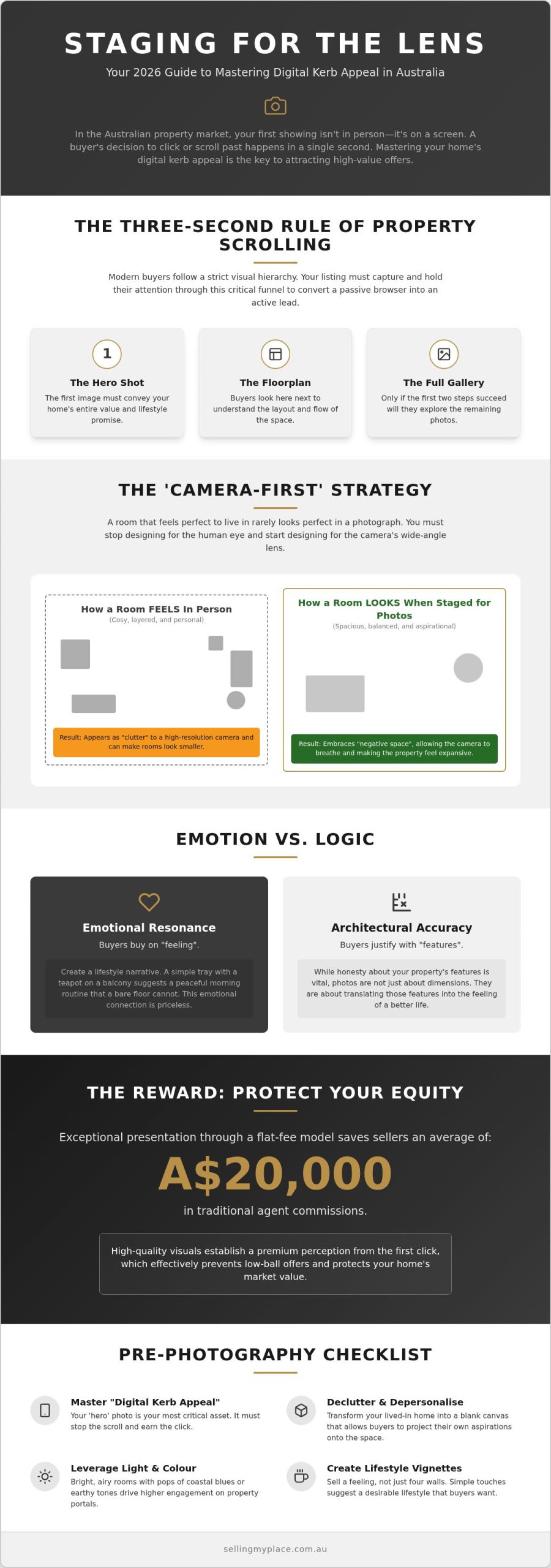
The Ultimate Pre-Photography Checklist: Small Details, Large Returns
While the heavy lifting of furniture arrangement is behind you, the final polish is what truly separates a basic listing from an aspirational lifestyle. High-resolution cameras in 2026 are incredibly unforgiving; they will find the stray fingerprint on the stainless steel fridge or the tangled charging cable snaking behind the bedside table. This stage of how to stage a home for photos is about refinement. It is about removing the evidence of your daily routine so the buyer can begin to imagine their own. We recognise that this can feel like a lot to manage, but these small efforts are what protect your equity and drive those high-value offers.
De-personalisation is a sensitive step. You’ve built a beautiful life here, and removing family photos can feel like you’re stripping away the home’s heart. Instead, try to view it as creating a clear canvas for the next family’s legacy. Replace personal snapshots with neutral art or mirrors that help bounce natural light around the room. Similarly, the “pet-free” illusion is vital. Even the most dedicated animal lovers don’t want to see a dog bed in the corner or nose prints on the sliding glass doors during their digital tour. Hide the bowls, stow the leashes, and give all glass and high-gloss surfaces an “invisible” clean that won’t catch the photographer’s flash.
The exterior needs a “glow-up” to match the interior. A quick pressure wash of the driveways and a fresh layer of dark mulch in the garden beds can make the property look significantly more well-maintained on screen. If you’re feeling a bit stuck on these final touches, our pre-sale consulting experts are here to guide you through the process with a steady, experienced hand.
The 60-Minute Pre-Shoot ‘Sprint’
In the hour before our photographer arrives, focus on stowing the “tech-clutter.” Hide every remote control, unplug charging cables, and ensure tablets are out of sight. Plump every cushion on the sofa and give them a “karate-chop” in the centre for that crisp, designer look. Crucially, check every light globe in the house. They should all be working and, ideally, should all be the same colour temperature, such as “Warm White,” to ensure the room looks cohesive and inviting in the final images.
The ‘Sniff Test’ and Visual Freshness
While the camera can’t smell, it can certainly see the “visual weight” of heavy scents like thick incense or strong candles. Avoid these and instead open every window to let in the fresh Australian air. For a touch of life, use the “greenery hack.” A few clippings of native Australian flora, like Eucalyptus or Banksia, placed in a simple glass vase can fill an empty corner beautifully without costing a cent. For a more detailed breakdown of these final steps, see our A Seller’s Checklist for a Successful Photo Shoot. Knowing exactly how to stage a home for photos ensures you don’t miss the tiny details that lead to the largest returns.
Partnering for Success: Professional Photography and Commission-Free Selling
You have done the hard work of decluttering, plumping cushions, and mastering the “camera-first” layout. Now, it is time to ensure that effort isn’t wasted. Many independent sellers fall into the trap of using a smartphone to capture their listing. While modern phones are impressive, DIY smartphone photos are the primary equity-killer for independent sellers in 2026. A phone lens cannot replicate the depth, light-balancing, and architectural straightness provided by professional equipment. Poorly lit or distorted images signal to buyers that you might be looking for a “quick and cheap” exit, which often invites low-ball offers that eat into your profit.
This is where the Kincade International Direct Sales (KIDS) model changes the game. We believe that selling your own home doesn’t mean doing it alone; it means using better tools. Our flat-fee service includes professional photography and floorplans as standard, ensuring your staged canvas is captured with the precision it deserves. We act as your “steady hand” throughout this transition, providing the professional infrastructure you need while you retain the equity you’ve built. By removing the traditional agency commission, our sellers save an average of A$20,000, which is a significant sum that stays in your pocket rather than being handed over at settlement.
Our partnership approach extends to pre-sale property consulting. If you are still unsure how to stage a home for photos or want a second pair of eyes on your lounge room layout, our experts are available to guide you. This ensures your home is “lens-ready” before our photographer even arrives. Once those high-end images are ready, they power a global marketing network that puts your property in front of qualified buyers without the burden of high marketing costs or hidden fees.
The KIDS Marketing Suite: Beyond the Photo
A beautiful photo gallery is only one part of a high-converting listing. To provide a complete picture, we integrate your staged photos with professional floorplans. This allows buyers to mentally “walk through” the home, connecting the visual appeal of your styling with the practical flow of the house. These professional visuals also feed into our Neighborhood Market Reports. When you present a polished, magazine-quality listing backed by hard data, you justify your asking price and command respect from the market. The “Sale by Owner” revolution is about homeowners keeping their hard-earned profit by taking charge of the “heart work” of staging while we handle the technical heavy lifting.
Next Steps: Your Journey to a Commission-Free Sale
Ready to move from preparation to presentation? Booking your professional shoot through the KIDS platform is a simple, streamlined process designed to reduce the stress of listing. Before the camera clicks, you can access our Agent Advisory Service for a final “staging critique.” We will help you fine-tune the details, ensuring your native greenery is positioned perfectly and your “Zoom nook” looks its best. The goal is to make sure every pixel of your listing works toward a premium result. If you are how to stage a home for photos and ready to showcase your home to the world, Contact our expert team at Selling My Place today.
Step into Your Next Chapter with Confidence
Mastering how to stage a home for photos is about more than just tidy rooms; it’s about shifting your perspective from homeowner to curator. By embracing a camera-first strategy and focusing on those high-impact details like natural light and native greenery, you’ve prepared a canvas that speaks directly to a buyer’s aspirations. You’ve done the heart-work of preparing the space, and now it’s time to let the professional tools do the rest of the heavy lifting. Selling your property is a significant life transition, and you deserve a partner who respects both your home’s legacy and your financial future.
Our flat-fee, 0% commission model is designed to empower you. By choosing a smarter way to sell, our clients save an average of A$20,000 in commissions while still receiving the premium marketing essential for a top-tier result. With professional photography and detailed floorplans already included in your package, you can present a high-value listing that truly stands out in the 2026 market. We are here to provide the steady hand and expert guidance you need to secure your equity and move forward with peace of mind. Maximise your sale price with professional photography; book your commission-free listing today. Your success is our priority, and we can’t wait to help you showcase your home to the world.
Frequently Asked Questions
Should I empty my house before taking professional photos?
No, we generally recommend keeping your furniture in place. Empty rooms often look smaller and lack the emotional heart that buyers look for when scrolling. By following our advice on how to stage a home for photos, you can use your existing belongings to create a lived-in yet aspirational feel. If a house is completely bare, it’s much harder for a buyer to visualise how their own life fits in.
How much does professional home staging cost in Australia compared to doing it myself?
Professional staging services in Australia, such as InSitu Furniture Presentation, typically range from A$2,000 for small units to over A$10,000 for large family homes. By managing the process yourself, you save these significant upfront costs while still achieving a high-end result. Our flat-fee model supports this empowerment, including the professional photography and floorplans you need to showcase your hard work without the burden of traditional agency commissions or high marketing fees.
Do I need to stage the garage or the inside of the cupboards for the shoot?
You typically don’t need to stage the inside of cupboards or the garage unless they are a standout feature. Photographers focus on primary living zones, bedrooms, and bathrooms. However, ensuring the garage is tidy and free of large piles of rubbish is a good idea, as a quick shot might be taken to show capacity. Generally, keep your hidden storage areas organised enough to avoid any unsightly overflows during the shoot.
What is the best time of day for a real estate photographer to visit?
For interior shots, midday or slightly overcast light is often best as it provides even, natural illumination without harsh shadows. If your property has spectacular views or a beautiful garden, a twilight session can add a touch of magic to the hero exterior shot. Your photographer will usually coordinate the best time based on your home’s orientation to ensure the Australian sun highlights your property’s best features rather than washing them out.
Can’t I just use a ‘Virtual Staging’ service instead of moving furniture?
Virtual staging is a useful tool for completely empty properties, but it can lead to a sense of disappointment when buyers visit for a physical inspection. Real furniture creates a tangible atmosphere that virtual renders simply can’t replicate. When you learn how to stage a home for photos using physical items, you build a consistent experience from the first digital click through to the final walk-through, which helps establish genuine trust.
What should I do with my pets during the property photo shoot?
It is best to have your pets out of the house during the photography session. This prevents them from accidentally appearing in shots or creating motion blur in the background. It also allows the photographer to move freely through the rooms without worrying about an open door or a curious cat. Removing pet beds and bowls before the shoot ensures the focus remains entirely on the home’s features rather than the animals.
Should I leave the TV on or off during the photography session?
Keep the TV turned off during the shoot. A large black screen can look like a void in photos, but a glowing screen with a random show or reflection is even more distracting. Professional photographers sometimes use digital editing to add a subtle, neutral image to the screen later, but for the session itself, off is the standard. This keeps the viewer’s attention on the room’s proportions and your beautiful styling rather than a flickering screen.
How many photos do I actually need for a standard Australian property listing?
Most standard Australian property listings thrive with between 12 and 20 high-quality images. You want enough to tell a complete story of the home without overwhelming the buyer. This usually includes a hero exterior, two shots of the main living areas, one of the kitchen, and one for each bedroom and bathroom. Quality always trumps quantity; a few stunning, well-staged photos are far more effective than dozens of repetitive or poorly composed shots.
How to Determine the Market Value of a Home in Australia: The 2026 Seller’s Guide
Did you know that national auction clearance rates have dipped to just 45 per cent as of June 2026? It’s a sobering figure that confirms we’ve moved into a buyer’s market, where the “set and forget” pricing of previous years simply won’t cut it anymore. We understand that selling your family home is far more than a transaction; it’s an emotional milestone that deserves a steady hand and a clear head. You might be wondering how to determine market value of a home in australia when the headlines are full of talk about interest rates and cooling prices. It’s completely natural to feel a bit of doubt when looking at free online estimates or to worry about leaving money on the table in this changing landscape.
You deserve to feel certain about your property’s worth, and we’re here to help you find that clarity. In this guide, you’ll master the data and expert strategies needed to accurately value your property and secure the best possible sale price without paying traditional commissions. We’ll walk you through decoding current market trends, understanding the “multi-speed” landscape across our capital cities, and building a defensible price range that gives you total confidence when it’s time to negotiate with buyers. Let’s work together to ensure your next chapter starts on the best possible footing.
Key Takeaways
- Understand the “Golden Triangle” of valuation to see why current buyer demand often outweighs historical data in a cooling property market.
- Learn how to use the “Rule of Three” to select accurate comparable properties that justify your asking price to both banks and savvy buyers.
- Discover how to determine market value of a home in Australia by identifying the unique lifestyle features that automated online estimates simply can’t capture.
- Gain the confidence to set a strategic price range that drives competition and protects your equity without the burden of high agency commissions.
What Exactly is ‘Market Value’ in the 2026 Australian Property Market?
At its heart, market value is a meeting of minds. It’s the price a willing buyer is prepared to pay, and a willing seller is prepared to accept, in an open and competitive market. In the 2026 climate, where the RBA cash rate remains steady at 4.35 per cent, this definition is more than academic; it’s the foundation of your financial legacy. Understanding how to determine market value of a home in australia requires looking past the four walls and into the psychology of the current buyer.
We often talk about the “Golden Triangle” of valuation: Location, Condition, and Current Demand. While you can’t change your street address, you can certainly influence how your home’s condition meets the specific demands of today’s cautious buyers. It’s vital to remember that not all figures are created equal. A council rating is for tax purposes and often lags behind reality. An Appraised value from a bank is usually conservative because they’re managing lending risk. An agent’s appraisal, meanwhile, is often just an estimate of what they think will get you to sign a contract.
The Difference Between Price and Value
There’s an old saying in property circles: price is what you pay, but value is what you get. Price is the hard number on the final contract, but value is the lifestyle the buyer envisions. Emotional triggers, like a sun-drenched breakfast nook or a quiet home office, can push a price well above a bank’s spreadsheet. However, with tighter lending criteria in 2026, those emotional ceilings are often capped by a buyer’s borrowing capacity. You need to find the sweet spot where a buyer’s heart and their bank’s valuation overlap.
Why Traditional Appraisals Can Be Biased
Many sellers unfortunately fall for the “buying the listing” trap. This happens when an agent quotes an inflated price just to secure your business, only to suggest a “price adjustment” three weeks later when the property fails to sell. It’s a stressful cycle that leaves money on the table. Taking a commission-free approach allows for a more objective view of your equity. This is why seeking expert real estate advisory early in the process is so beneficial. It provides a steady, unbiased hand to help you navigate the multi-speed market of 2026 without the pressure of a looming commission check.
Using Neighbourhood Market Reports to Build a Data-Driven Foundation
To get a real handle on how to determine market value of a home in australia today, you have to look beyond the ‘for sale’ signs on your street. You need a data-driven foundation. We start by looking at three vital signs: the median house price, average days on market (DOM), and current clearance rates. In July 2026, the national auction clearance rate has settled around 45 per cent. This tells us we are firmly in a buyer’s market. If properties in your suburb are sitting on the market for 45 days or more, it’s a signal that buyers are being cautious and selective. Understanding these numbers helps you set a price that attracts interest rather than one that causes your listing to go stale.
Neighbourhood Market Reports offer a level of detail that generic apps simply can’t match. They help you establish a baseline by looking at your specific property type. For instance, while Sydney’s overall clearance rate is 43.1 per cent, the rate for renovated family homes in your specific pocket might be much higher. It’s about finding the truth in the numbers. This methodical approach reduces the stress of the unknown, giving you a clear path forward.
Decoding Suburb Trends
Prices don’t exist in a vacuum. We often see a “ripple effect” where price growth in a central hub eventually pushes buyers into neighbouring suburbs. In 2026, we’re also seeing a huge impact from local infrastructure. New transport centres or school catchment changes can add significant value almost overnight. However, broad postcode data can be misleading. A home on a quiet cul-de-sac will always command a premium over one on a main road; even if they share the same suburb name. These micro-markets are where the real value is found.
The Limitations of Free Online Property Estimates
It’s tempting to rely on Automated Valuation Models (AVMs) that pop up on your phone. While these algorithms are a handy starting point, they have significant blind spots. They rely on historical data, which creates a “data lag” problem. In a cooling market like we’re seeing in mid-2026, six-month-old sales data might be completely irrelevant to today’s pricing strategy. This is why a free online property valuation is often more myth than reality. A computer can’t see your brand-new kitchen or feel the peace of your backyard. If you want a truly accurate picture of your equity, you might consider requesting a tailored report for your specific street to see what’s really happening on the ground.
The Comparative Method: Identifying and Analysing ‘Comps’ Like a Professional
While the broad suburb data we discussed earlier sets the stage, the real magic happens when you get down to the “comps” or comparable sales. This is where you move from generalities to the specific reality of your street. Understanding how to determine market value of a home in australia often boils down to a simple but effective strategy we call the “Rule of Three.” It’s a methodical way to ensure you aren’t just guessing based on a lucky sale from last year.
To use this rule, you need to identify three properties that have sold in the last 90 days, three that are currently listed, and three that failed to sell, such as those withdrawn or passed in at auction. The sold properties represent the “floor” of the market; the price buyers are actually paying. The active listings are your direct competition, showing you what buyers are seeing right now. Most importantly, the failed sales serve as a warning. In a market where national clearance rates are hovering around 45 per cent, these properties often reveal the exact price point where buyers simply walk away.
When selecting your comps, be honest about the criteria. A true comparable should share a similar land area, age, and level of renovation. If a neighbour’s house sold for a premium but features a brand-new swimming pool and a double garage while yours has a carport and an original kitchen, you must adjust your expectations. We recommend “adding” or “subtracting” value based on these features. For example, if a comp has an extra bathroom, you might subtract a nominal amount from their sale price to find a realistic baseline for your own home.
Where to Find Reliable Sales Data
Don’t rely solely on commercial property portals, as their data can sometimes be delayed or incomplete. Official government land registries provide the most accurate “sold” figures. Focus your search on a 1km radius from your front door and stick to sales within the last 90 days. To compare internal living spaces accurately, look for professional floorplans in the archived listings. This allows you to see if a “four-bedroom” home actually has a similar footprint to yours or if the rooms are significantly smaller.
Analysing the Competition
There is no substitute for getting out and visiting open homes in your area. This isn’t just about being a “nosy neighbour”; it’s about seeing exactly what a buyer experiences. Compare the “curb appeal” and the quality of the visual marketing. You’ll quickly start to notice why some properties in your street feel “stale” after a month on the market while others sell in a week. Often, it’s a combination of realistic pricing and a presentation that makes an emotional connection from the moment a buyer pulls up to the kerb.

Beyond the Algorithm: Expert Advisory and Property Nuance
Data provides the skeleton of your valuation, but the soul of your home’s worth often lies in details a computer simply cannot see. While we’ve discussed how to use suburb metrics and comparable sales, understanding how to determine market value of a home in australia also requires a seasoned eye for nuance. A property algorithm can’t see the way the afternoon sun hits your deck, the peace of a cul-de-sac location, or the high-end finish of a bespoke kitchen renovation. These intangibles are often what bridge the gap between a standard bank valuation and a premium sale price.
This is where Pre-Sale Property Consulting becomes invaluable. It’s about identifying value-add opportunities before you ever hit the market. Perhaps a minor cosmetic update or a professional styling session could shift the perceived value by tens of thousands of dollars. We believe that presentation, supported by high-quality photography, tells a story that data alone cannot. It creates an emotional connection, and in a multi-speed market, emotion is frequently the catalyst for a higher offer. Our Agent Advisory Service acts as that steady hand, providing the expert guidance you’d expect from a traditional agent but without the heavy commission-based pressure.
The Value of an Independent Perspective
Selling your home is a major life transition, and it’s okay to feel the weight of that responsibility. Getting professional guidance shouldn’t mean you’re locked into a traditional listing contract. Independent real estate advisory services are particularly vital for complex properties, such as those with strata titles, rural acreage, or unique architectural builds. Having an expert back your pricing strategy gives you the confidence to stand firm during negotiations, knowing your range is based on both hard data and professional insight. If you’re ready to see how these nuances apply to your specific property, reach out for a tailored consultation today.
Identifying “Hidden” Value Drivers
In 2026, buyer preferences have shifted significantly toward sustainability. We’re seeing that energy efficiency and clever solar orientation are no longer just nice-to-haves; they are major value drivers that can set your home apart. Similarly, being within a coveted school catchment zone remains a powerful lever, often adding a 10-15 per cent premium compared to a similar home just outside the boundary. Don’t overlook the scarcity factor either. If your home has a unique architectural heritage or a view that can’t be built out, its value isn’t just a number. It’s a reflection of its rarity in the local landscape.
From Valuation to Listing: Finalising Your Strategy to Maximise Profit
Once you’ve gathered your data and considered the unique charm of your home, it’s time to move from theory to reality. Setting the right listing price is the final, crucial step in how to determine market value of a home in australia. In the 2026 market, we find that a “Price Range” often performs better than a single “Fixed Price.” By offering a range, you invite a broader pool of buyers through the door. More feet on the carpet usually leads to more competitive offers, which is exactly what you need when national clearance rates are sitting below 50 per cent.
The psychology of pricing plays a massive role in your success. You might wonder why a property is listed at $995,000 instead of a round $1,000,000. It isn’t just an old retail trick; it’s about how buyers search online. Most property portals use price brackets. Pricing just under a major milestone ensures your home appears in more search results, capturing buyers at both the top of one bracket and the bottom of the next. It’s a small tweak that can significantly increase your listing’s visibility.
As you finalise your figure, remember to factor in your savings. Choosing flat-fee real estate models allows you to protect your equity from being eroded by high commissions. To back up your price during negotiations, prepare an “Evidence File.” This is a simple folder containing the comparable sales you identified earlier. When a buyer tries to lowball your price, you can calmly present the data that justifies your range. It shifts the conversation from opinion to fact.
The “Sale by Owner” Pricing Advantage
When you aren’t paying a 2 or 3 per cent commission, you gain a significant strategic edge. You can afford to be more competitive with your asking price to generate multiple offers quickly, or you can hold firm to maximise your final take-home profit. Learning how to price your home for sale by owner involves a high level of transparency. Don’t be afraid to share your Neighbourhood Market Report with serious buyers. It builds trust and shows them you’ve done your homework.
When to Adjust Your Price
The market will always give you feedback. We recommend the “21-Day Rule.” If you’ve had plenty of online views but no one is booking an inspection, you likely have a “marketing problem” related to your photos or description. However, if people are visiting the home but no offers are coming in, you likely have a “pricing problem.” In a multi-speed market, being prepared to refine your valuation based on real-time feedback is vital. Our Agent Advisory team can help you pivot your strategy if the local landscape shifts, ensuring you never stay stagnant on the market.
Step Into the Market with Absolute Confidence
Navigating a cooling market in 2026 doesn’t have to be a source of stress. By now, you’ve seen that understanding how to determine market value of a home in australia is a deliberate blend of hard data and the subtle, lifestyle-driven details that make your property unique. Whether it’s applying the “Rule of Three” to find accurate comps or setting a psychological price range that triggers buyer interest, you now have the tools to protect your equity and sell on your own terms.
You don’t have to walk this path alone. Our approach combines the precision of professional photography and floorplans with the “steady hand” of expert Agent Advisory, ensuring your listing looks and performs its best. By avoiding traditional agency commissions, our sellers save an average of $20,000; money that stays in your pocket for your next big move. Ready to take the next step? Get Your Professional Neighbourhood Market Report & Start Selling Smarter today. We’re here to support your transition with the care and expertise your family deserves.
Frequently Asked Questions
What is the most accurate way to value my home in Australia?
The most accurate way to value your home involves combining recent comparable sales data with professional independent advisory. While algorithms provide a helpful baseline, they can’t account for the unique features or the emotional appeal of your property. By looking at properties sold within a 1km radius in the last 90 days and adjusting for differences in condition and land size, you create a realistic price range that reflects what buyers are actually paying.
Is a bank valuation the same as market value?
A bank valuation is typically lower than the actual market value because it’s a conservative assessment designed to manage lending risk. Banks look at what they could recoup in a forced sale, whereas market value represents what a willing buyer would pay in an open, competitive environment. It’s common to see a gap between these two figures, especially for unique or highly desirable homes that attract emotional bidding from motivated families.
How much does a professional property appraisal cost?
Most real estate agents offer free appraisals as a way to win your listing, but these can sometimes be inflated to secure your business. If you require a sworn valuation from a certified practising valuer for legal or official purposes, you should expect to pay a fixed fee based on the property’s complexity. For sellers looking for objective guidance without the commission pressure, independent advisory services offer a balanced and cost-effective alternative to traditional models.
Can I determine my home’s value without a real estate agent?
You can absolutely learn how to determine market value of a home in australia without relying on a traditional real estate agent. By accessing professional Neighbourhood Market Reports and official land registry data, you can build a data-driven foundation yourself. Combining this data with independent pre-sale consulting allows you to set a price with confidence while maintaining total control over your sale and protecting your equity from high commissions.
How do recent sales in my street affect my property’s value?
Recent sales in your street are the strongest indicator of your property’s value because they represent the most relevant micro-market data. Buyers often compare your home directly with those nearby, so a high sale price next door can lift your property’s perceived value. Conversely, if several homes nearby have struggled to sell or were passed in at auction, it’s a signal that local demand might be cooling or price expectations are currently too high.
Does a renovation always increase my home’s market value?
A renovation doesn’t always guarantee an increase in market value, particularly if the cost of the work exceeds the added value. In 2026, buyers are specifically looking for functional improvements like energy efficiency or modernised kitchens rather than purely cosmetic changes. It’s wise to consult with an advisor before starting major works to ensure your investment aligns with what local buyers are actually prepared to pay a premium for in your specific suburb.
What should I do if my home valuation is lower than expected?
If your valuation comes in lower than expected, it’s a good time to objectively re-examine your comparable sales and current market feedback. Sometimes a lower figure is the result of temporary market cooling or a specific feature that buyers are currently avoiding. You might consider small, high-impact improvements to presentation or adjusting your timing to wait for a more favourable period in the multi-speed market cycle to ensure you don’t undersell your asset.
How often should I update my property’s market value estimate?
You should update your property’s market value estimate every 30 to 90 days, especially in a cooling climate like we’re seeing in mid-2026. Market conditions can shift quickly based on interest rate changes or local supply levels. Keeping your data fresh ensures your pricing strategy remains competitive and helps you avoid the trap of chasing the market down if prices in your suburb begin to soften during your listing period.
Professional Residential Property Listing Services: The Modern Australian Seller’s Guide
What if the most expensive part of selling your home, that hefty agent commission, was actually the one thing you didn’t need to pay to get a premium result? It is a bit of a shock to the system, isn’t it? When you have spent years building equity in your property, the thought of handing over A$20,000 or more to an aggressive agent feels like a step backward. Most Australian sellers believe they have to choose between professional Residential Property Listing Services and keeping their hard-earned profit, but that is a bit of a myth we are happy to debunk.
We understand that selling your home is about more than just a transaction; it is about your family’s future and the legacy you are leaving behind. You deserve the peace of mind that comes with world-class marketing and expert advisory without the stress of high-pressure tactics or the fear of a legal misstep during settlement. In this guide, we will show you how to achieve a premium sale price while maintaining full control of your journey. You will discover how to access professional-quality marketing and steady guidance so you can walk away with 100% of your sale profit and your confidence intact.
Key Takeaways
- Learn how modern Residential Property Listing Services are disrupting the traditional commission model to help you retain more of your home’s equity.
- Understand why high-impact marketing, such as professional photography and floorplans, is essential for capturing buyer interest and achieving a premium price.
- Discover how a flat-fee structure can save you upwards of A$20,000, giving you a significant head start on your next property purchase.
- Explore how expert advisory and pre-sale consulting can help you navigate the complexities of settlement and conveyance with total confidence.
- See how leveraging a global digital infrastructure ensures your property remains visible and competitive until the moment it is sold.
What are Residential Property Listing Services in the Modern Market?
The landscape of selling your home in Australia is changing, and it’s doing so with the homeowner’s interests at the forefront. For decades, the traditional agency model was the only path, often requiring a significant chunk of your equity, sometimes upwards of 2.65% in commission, just to get your front door noticed. Today, a more transparent alternative has emerged. Residential Property Listing Services are a comprehensive marketing and advisory suite that empowers you to present your home to the world with professional polish while keeping your hard-earned profit where it belongs: in your pocket.
This shift isn’t just about saving money; it’s about a fundamental change in how we value the process of moving house. The “old way” of selling frequently left families feeling sidelined in their own life transitions, pressured by aggressive timelines and opaque marketing costs. By contrast, modern listing services focus on three core pillars: maximum visibility on major portals, high-end professional presentation, and the steady hand of expert support during the negotiation phase. It’s a partnership that respects your intelligence and your investment.
The Evolution of the Australian Real Estate Model
The rise of digital platforms has completely democratised property visibility. In the past, agents held the keys to the kingdom through private databases and local networks. Now, the digital landscape, often inspired by the collaborative spirit of a Multiple Listing Service (MLS), allows property details to be shared instantly across the country. This has paved the way for the “Smart Seller,” an Australian homeowner who prioritises their own financial legacy over outdated industry traditions. Choosing a commission-free path doesn’t mean you’re on your own; it simply means you’re choosing a service-oriented model over a transactional one.
Why Homeowners are Moving Away from Traditional Agents
Many Australians are finding that the traditional agent model lacks the transparency they need during such a high-stakes decision. High-street agencies often require “lock-in” contracts that can last months, even if you aren’t happy with the service. There’s also the emotional benefit of maintaining control. When you manage your own sale with professional backing, you aren’t just another listing in an agent’s portfolio. You’re the person who knows the home’s story best, supported by Residential Property Listing Services that provide the technical and legal scaffolding to ensure everything runs smoothly. It’s about feeling protected, not pressured, throughout the entire journey.
The Anatomy of a High-Impact Property Listing
First impressions aren’t just important. They are everything. When a potential buyer scrolls through a digital portal, your home has roughly three seconds to capture their heart before they move to the next suburb’s results. This is why professional Residential Property Listing Services treat marketing as a strategic narrative rather than a simple checklist. A high-impact listing is a digital open house that remains accessible 24 hours a day, inviting the right people to imagine their future within your walls.
Visual Storytelling: Photography and Floorplans
Professional photography is the non-negotiable “front door” of your property. Using “good enough” smartphone photos or poorly lit shots can cost you thousands in the final sale price because they fail to communicate the home’s true value. High-quality imagery highlights the unique character and warmth of your space, setting a standard that justifies a premium price. If you are preparing your home for the market, referencing a trusted Victorian property selling guide can help you understand the legal and presentation standards expected in the Australian market.
Alongside imagery, accurate floorplans are a psychological tool. They allow buyers to “move in” mentally, planning where the sofa will go or how the kids’ rooms will connect. This level of detail significantly reduces “tyre-kicker” enquiries, as buyers who reach out are already familiar with the layout and serious about the opportunity. To ensure your home stands out from the crowd, it’s worth considering how professional photography and floorplans can transform your listing’s performance.
Global Reach: Beyond the Local Suburb
The modern Australian market isn’t confined to your local postcode. Investors and families from across the globe are often looking for a slice of the Australian lifestyle, particularly in high-growth areas. To tap into this international buyer pool, you need a digital infrastructure that manages global enquiries seamlessly. Professional Residential Property Listing Services provide this reach, ensuring your home is visible on major international portals until the day it is sold.
A “listed until sold” promise is vital because it removes the artificial pressure of a ticking clock. Traditional agents often use short-term “stale” ad warnings to pressure sellers into lowering their price. By maintaining a constant, high-quality presence without time limits, you retain the power to wait for the right offer. Combined with neighbourhood market reports that provide concrete data on recent sales, you can set a competitive price with the calm confidence that your property is getting the exposure it truly deserves.
Flat-Fee vs. Commission: Calculating the Real ROI
When you sit down to calculate the potential profit from your home sale, that final number often feels a bit smaller once you factor in the traditional agent’s cut. With the national median real estate commission sitting at approximately 2.65%, selling a property valued at A$1,000,000 means handing over A$26,500 in commission alone. It is a significant amount of your hard-earned equity that could be better spent on your next mortgage or a well-deserved family holiday. By choosing modern Residential Property Listing Services, you effectively bypass this traditional “success tax” in favour of a transparent, flat-fee structure that puts you back in the driver’s seat. The growing movement toward commission free real estate is helping Australian families reclaim tens of thousands of dollars in equity that would otherwise be lost to percentage-based fees.
One of the most liberating aspects of a 0% commission model is the flexibility it gives you during negotiations. When you don’t have to “cover the agent’s fee” just to break even, you have more room to move with potential buyers. This often leads to a smoother, faster settlement because you aren’t fighting to protect a margin that isn’t even yours to keep. It debunks the long-standing myth that a higher commission somehow guarantees a higher sale price. In reality, it is the quality of your marketing and the strength of your advisory support that drive a premium result, not the percentage you pay at the end.
The Maths of a Smarter Sale
Let’s look at the direct impact on your pocket. If you save an average of A$20,000 by avoiding commissions, you can choose to reinvest a small portion of that into Pre-Sale Property Consulting. This identifies high-value improvements that can actually add fifty or a hundred thousand dollars to your final sale price. Unlike traditional models that rush you through a 30-day auction campaign, a flat-fee service often includes a “listed until sold” promise. This provides a strategic advantage; you can wait for the perfect buyer without the looming threat of mounting marketing costs or the pressure to accept a low-ball offer just because the contract is expiring. If you are also navigating the buying side of your move, understanding how a flat fee buyer’s agent Australia wide can remove conflicts of interest and protect your purchasing budget is equally valuable.
The Value of Expert Advisory Services
There is a common misconception that a flat fee means you’re just paying for a spot on a website. In a professional partnership, your fee secures a steady hand and a dedicated advisor who values your legacy as much as you do. This is the crucial difference between a simple “upload platform” and comprehensive Residential Property Listing Services. You get access to Real Estate Advisory Services that help you vet buyers, manage complex enquiries, and navigate the latest 2026 AML/CTF regulations with ease. It is about protecting your equity through total financial transparency and having a seasoned expert in your corner who isn’t motivated by a quick commission, but by your long-term success.

Navigating the Sale: From Pre-Sale Consulting to Conveyance
Selling a home is a journey of many steps, and the transition from a live listing to a signed contract requires more than just a bit of luck. It requires a strategic bridge between the “do it yourself” approach and the traditional agency model. This is where modern Residential Property Listing Services truly shine, providing the expert scaffolding you need to handle the complexities of the Australian market with absolute poise. You aren’t just putting a sign in the front garden; you’re engaging a suite of professional tools designed to protect your interests from the very first enquiry to the final settlement day.
Pre-Sale Consulting: Maximising Your Property’s Appeal
Before the first potential buyer walks through your door, Pre-Sale Property Consulting helps you see your home through a fresh set of eyes. It is about identifying the “low-hanging fruit,” those small repairs or styling choices that offer a high-value return on a modest investment. Perhaps it’s a fresh coat of paint in a neutral tone or simply decluttering to let the natural light do the talking. By using concrete data from Neighbourhood Market Reports, we help you position your home accurately against current local competition. This “Steady Hand” approach ensures you feel prepared and calm when the first open home arrives, knowing every detail has been considered with care.
The Negotiation and Legal Framework
Once the offers start arriving, the role of an Agent Advisory Service becomes invaluable. Handling buyer representation without the usual “middle man” pressure allows you to have authentic, heartfelt conversations with potential new owners. However, having an expert to help you vet those buyers ensures you’re only dealing with serious contenders who have their finances in order. We help you understand the nuances of the contract of sale and the broader settlement process, significantly reducing the risk of common legal pitfalls. Professional conveyance advice is the essential legal bridge that ensures the valid transfer of property ownership while protecting both your financial interests and regulatory compliance under Australian law.
The safety net of professional advisory means you don’t have to fear making a mistake during such a significant life transition. Whether it’s navigating the latest 2026 AML/CTF identity verification rules or ensuring your ATO Clearance Certificate is ready to avoid the 15% withholding tax, having a seasoned partner makes all the difference. It’s about more than just a transaction; it’s about a smooth, stress-free transition to your next chapter. If you are ready to lead your sale with heart and professional backing, it’s time to explore how our Real Estate Advisory Services can support your journey.
Selling Smarter with Kincade International Direct Sales
Kincade International Direct Sales isn’t about replacing the human element of a property sale; it’s about amplifying it through a sophisticated partnership. While traditional agencies often focus on their own brand visibility and local dominance, we focus entirely on your results. By choosing our Residential Property Listing Services, you aren’t just securing a spot on a website. You’re gaining access to a digital infrastructure that spans borders, ensuring your home is seen by the right eyes, whether they are located across the street or across the ocean. It’s a unique partnership where your intimate knowledge of your home’s story meets our professional marketing expertise.
We’ve designed our model to be the “steady hand” you need during what can be a high-stakes life transition. Many sellers feel a sense of trepidation when moving away from the traditional agent model, but our approach provides a professional safety net that removes the risk without the heavy cost. You remain the primary advocate for your property, supported by a team that values your family’s needs and your long-term success. It is a modern way to sell that respects your intelligence and protects your financial future.
A Global Network for Your Local Home
The modern buyer is mobile, tech-savvy, and often global. We have spent years building a marketing reach that connects Australian residential property with active buyer pools in the UK and the USA, providing a level of exposure that a local high-street agent simply can’t match. Kincade’s digital systems work around the clock to manage enquiries, ensuring that no matter the time zone, a potential buyer receives a prompt and professional response. This doesn’t feel like a cold, automated process. Instead, our advisory service maintains a neighbourly accessibility that makes you feel supported at every turn. We’re here to guide you, acting as a seasoned advisor who prioritises your legacy over a quick transaction.
Your Profit, Your Legacy, Your Sale
There is a profound emotional significance to selling a family home. It represents years of hard work and, quite literally, your financial legacy for the next generation. Keeping 100% of your profit isn’t just a financial win; it’s about ensuring your hard-earned equity follows you into your next chapter. We understand that some properties take a little longer to find that perfect match, which is why our “Listed Until Sold” promise is so central to our mission. We never give up on your property, and we never pressure you to lower your price just to clear our books or meet a monthly quota.
Kincade has become the trusted choice for thousands of Australian families because we bridge the gap between the “DIY” route and the expensive traditional model. We provide the expert advisory and world-class marketing you’d expect from a luxury boutique, but with a flat-fee structure that respects your bottom line. If you’re ready to take control of your sale and achieve a premium result with expert backing, you can view our property listing packages here to get started today. We look forward to being your partner in this significant journey.
Your Future Awaits: Take the Lead on Your Property Sale
Your home is more than just bricks and mortar; it’s the foundation of your family’s next great adventure. By choosing modern Residential Property Listing Services, you’re deciding to prioritise your own financial legacy over outdated industry traditions. We’ve explored how high-impact marketing and global reach can find the right buyer, while a flat-fee model ensures you keep your hard-earned equity. With an average saving of A$20,000 and the security of an Expert Agent Advisory Service, you can navigate the path to settlement with total confidence.
Our “listed until sold” promise means we’re in this partnership for the long haul, providing a steady hand until the keys are handed over. You don’t have to face the stress of aggressive agents or complex legal hurdles alone. It’s time to embrace a smarter, more transparent way to sell that keeps your interests at the heart of every decision. Start your commission-free sale journey with Kincade International Direct Sales and discover the difference that a dedicated, heart-led partnership can make for your future. You’ve worked hard for your home, and we’re here to help you protect every cent of its value.
Frequently Asked Questions
What exactly are residential property listing services?
Residential Property Listing Services provide a professional alternative to traditional real estate agencies by offering the tools and visibility needed to sell your home independently. This typically includes listings on major Australian portals, professional marketing materials, and access to expert advisory. It’s a partnership that empowers you to manage the sale process while keeping 100% of the profit, supported by a steady hand to guide you through the technicalities.
How much can I save by using a flat-fee listing service instead of a traditional agent?
You can save a significant amount of equity, often upwards of A$20,000 for a median-priced Australian home. Since traditional agents often charge a commission of around 2% to 3%, the costs can escalate quickly as your property value grows. A flat-fee model removes this percentage-based success tax, allowing you to reinvest those savings into your next mortgage or family needs rather than handing them over as a transaction fee.
Is it difficult to sell my own home without a traditional real estate agent?
It’s far more manageable than many people expect, especially when you have professional scaffolding in place. While the idea of a sale by owner can feel daunting, modern listing services bridge the gap by handling the complex digital marketing and providing expert advice. You are the best person to tell your home’s story; we simply provide the professional platform and legal guidance to ensure you do it safely and successfully.
Will my property still appear on the major national property portals?
Yes, your home will be visible on the most visited national property websites in Australia to ensure maximum exposure. These platforms are where the vast majority of buyers begin their search, so visibility here is non-negotiable. Our Residential Property Listing Services ensure your home is presented with the same professional polish as any agency listing, capturing the attention of local and interstate buyers the moment they start scrolling.
What happens if my property doesn’t sell within a few months?
We stand by a listed until sold promise, meaning there are no artificial time limits or expiring contracts to worry about. Unlike traditional 30-day auction campaigns that can leave a property feeling stale if it doesn’t sell immediately, our model allows you to wait for the right offer. This removes the pressure to accept a lower price just because a marketing deadline is approaching, giving you total peace of mind.
Can I get help with the legal and conveyance side of the sale?
Absolutely, as we provide dedicated conveyance advice to ensure the legal transfer of your property is smooth and compliant. Navigating Australian property law and the latest 2026 AML/CTF regulations requires precision. We provide the necessary legal framework and support to manage contracts and settlement, reducing the risk of mistakes and ensuring you feel protected throughout the entire transition to the new owners.
How does the Agent Advisory Service help me during negotiations?
Our Agent Advisory Service acts as a professional sounding board, helping you vet potential buyers and evaluate offers with a clear head. Negotiations can be emotional, so having a seasoned expert to review the terms and provide market context is invaluable. We help you identify serious, qualified buyers and navigate the back-and-forth of price discussions, ensuring you achieve a premium result without the usual middle man pressure.
What is included in a professional photography and floorplan package?
A professional package includes high-resolution photography designed to highlight your home’s best features and an accurate floorplan to help buyers visualise the layout. These aren’t just simple snapshots; they are strategic marketing tools that create an emotional connection with viewers. By presenting a polished, detailed digital twin of your property, you reduce unnecessary enquiries and attract serious buyers who are ready to take the next step.
