Real Estate Agent Fees to Sell a House in Australia (2026)
Why should your hard-earned home equity be treated like a communal pot of gold for everyone but your family? With the national median commission sitting at 2.65 per cent as of June 2026, many Australian homeowners are shocked to find that a standard sale can easily strip $20,000 or more from their final settlement. When you ask how much do real estate agents charge to sell a house, the answer is often a complex web of percentage-based fees, upfront marketing costs, and hidden expenses that can feel like an unnecessary tax on your legacy.
It’s completely understandable to feel protective of the value you’ve built over years of weekend renovations and mortgage repayments. This guide will peel back the layers of the 2026 property market to reveal the true cost of selling, from state-by-state commission averages to the latest anti-money laundering regulations. You’ll discover exactly how to navigate these expenses and, more importantly, how to secure a professional, premium result while keeping every cent of your profit where it belongs; in your pocket. We’ll explore the breakdown of marketing versus commission and introduce a more sophisticated, heart-led approach to selling that honours your home’s true worth.
Key Takeaways
- Identify the three main pillars of selling costs so you aren’t caught off guard by hidden legal or property preparation expenses.
- Get a clear breakdown of how much do real estate agents charge to sell a house in 2026 compared to more modern, commission-free alternatives.
- Learn why investing in professional photography and accurate floorplans is the most effective way to drive buyer interest without overspending on bloated marketing campaigns.
- Discover how to protect your hard-earned home equity by closing the “Equity Gap” typically created by traditional percentage-based models.
- Master the art of the deal with expert negotiation strategies that allow you to sell your property confidently while maintaining full control of your profit.
The True Cost of Selling a House: Understanding the 2026 Landscape
Selling a home is rarely just a financial transaction; it’s a major life transition that carries deep emotional weight. Whether you’re downsizing from the family nest or moving toward your next big adventure, the process involves a complex jigsaw of costs that can quickly add up. When you start tallying the figures, you’ll find the total cost of sale includes the agent’s commission, professional marketing, legal fees, and the necessary preparation to make your property shine. It’s a significant undertaking that requires a steady hand and a clear head to manage effectively.
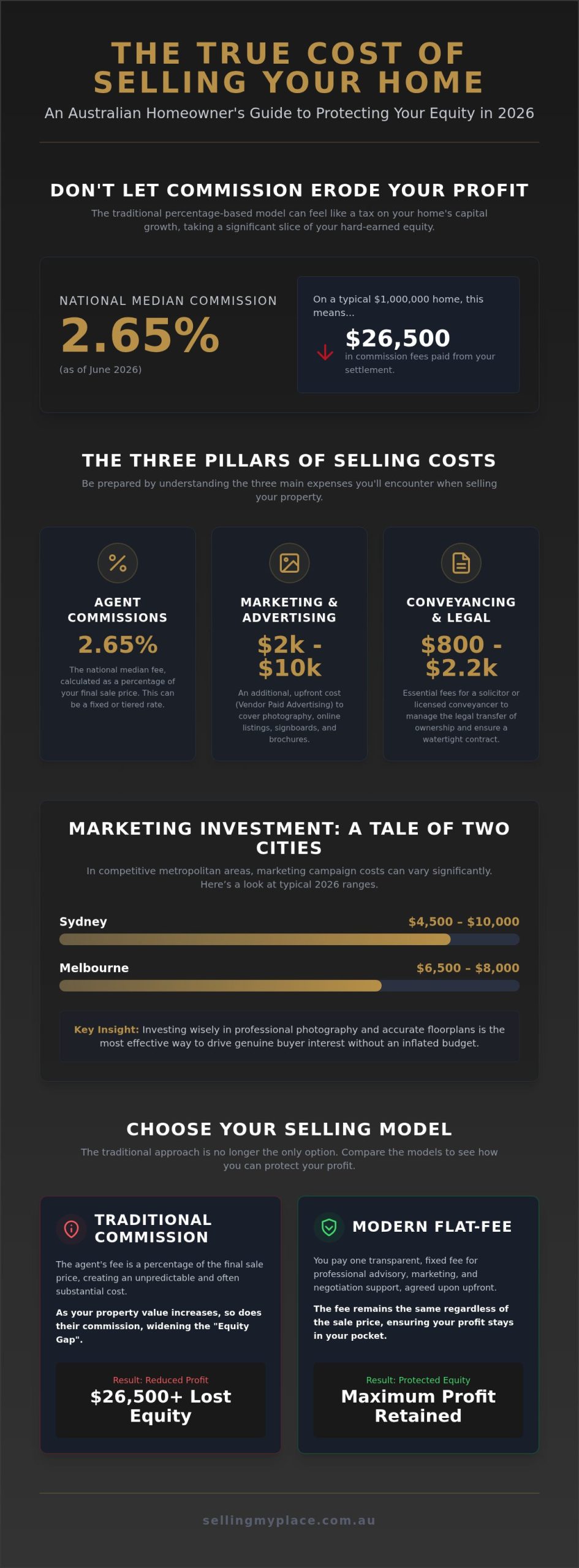
Many homeowners find themselves asking how much do real estate agents charge to sell a house only to be met with a figure that represents years of mortgage repayments. In 2026, the national median commission rate has settled at approximately 2.65 per cent. On a million-dollar home, that is over $26,000 gone before you’ve even considered the cost of signage or photography. This loss of equity can feel like a penalty for your property’s capital growth, making it harder to fund your next chapter. While this percentage-based model has been the standard for decades, modern alternatives now allow for professional, high-end results without the predatory price tag.
The Breakdown of Traditional Agent Commissions
Most agencies calculate their fee as a slice of your final sale price, which means as the market grows, so does their payday. You will likely encounter two main structures: fixed and tiered. A fixed commission is a set percentage regardless of the final price, while a tiered structure might charge a higher percentage on any amount achieved above a certain threshold. While this is often framed as an incentive for the Real estate agent to work harder, it often just widens the gap between the service provided and the fee paid. In competitive Australian markets where property values remain high, these percentage-based fees have become an increasingly expensive “tax” on your hard-earned equity.
Conveyancing and Legal Costs
Beyond the agent, you will need a solicitor or licensed conveyancer to handle the legal transfer of ownership. This role is vital for protecting your interests and ensuring the contract is watertight. In 2026, typical fees for professional conveyance advice range between $800 and $2,200, depending on the complexity of the sale. This cost covers the preparation of the Contract of Sale and the navigation of the settlement process. Local knowledge is essential here; a seasoned expert can spot special conditions or zoning issues that could derail a sale. It’s one of the few areas where professional support is non-negotiable for a smooth, stress-free settlement.
Understanding these costs is the first step toward taking back control of your sale. You don’t have to follow the traditional path just because it’s the most common one. By looking closely at how much do real estate agents charge to sell a house and comparing it to modern, flat-fee advisory models, you can protect your equity while still achieving a premium result. The landscape has changed, and today’s sellers are more empowered than ever to choose a partnership that values their profit as much as they do.
Marketing Your Property: Where Your Money Actually Goes
While the commission covers the agent’s professional time and expertise, the marketing budget is the engine that actually brings potential buyers through your front door. It’s often the most visible part of the cost to sell a house, yet many vendors are surprised to learn it’s typically an additional, upfront expense. In the industry, this is known as Vendor Paid Advertising (VPA). It represents a critical investment in your home’s legacy, ensuring that the years of care you’ve poured into your property are reflected in how it’s presented to the world.
When you’re weighing up how much do real estate agents charge to sell a house, you must account for these separate promotional costs. In 2026, a standard marketing campaign in Australia generally ranges from $2,000 to $10,000. For those in competitive metro areas, the numbers are often more specific; Sydney campaigns typically sit between $4,500 and $10,000, while Melbourne averages between $6,500 and $8,000. These funds cover everything from the digital “town square” of online portals to the physical presence of a signboard on your nature strip.
The Power of Professional Visuals
Your property’s first showing doesn’t happen at a scheduled open house; it happens on a smartphone screen, often late at night. This makes professional photography a non-negotiable requirement for capturing those crucial initial clicks. It isn’t just about lighting or high-resolution lenses; it’s about evocative storytelling that helps a buyer visualise their future life in your home. Alongside imagery, a professional floorplan is the second most vital feature of any listing. It allows buyers to mentally arrange their furniture and understand the flow of the space before they’ve even arrived. While some might suggest a modern phone camera is sufficient, in a sophisticated market, “good enough” often leads to being overlooked by the most serious buyers.
Digital Reach and Global Exposure
A significant portion of your marketing budget is dedicated to premium listings on major Australian property portals. These platforms provide the essential visibility needed to attract local interest. However, a truly effective strategy in 2026 looks beyond the local suburb to target interstate investors and global buyers. By using advanced social media targeting and a global marketing network, your home can find its way to the right person, regardless of where they currently live. This digital infrastructure ensures your property stays listed until it’s sold, providing a sense of calm and security that you won’t be hit with unexpected “re-listing” fees if the perfect buyer takes a little longer to appear. If you’re feeling a bit overwhelmed by these choices, you can reach out for a friendly chat about a tailored marketing plan that suits your home’s unique needs.
Flat Fee vs. Commission: Comparing the Two Models
When you start investigating how much do real estate agents charge to sell a house, the standard 2 per cent or 2.5 per cent commission can seem like an unavoidable cost of doing business. However, it’s vital to remember that this fee is essentially a tax on the wealth you’ve built through years of hard work. The “Equity Gap” is the difference between what you walk away with after a traditional sale versus a modern, commission-free approach. For most Australian families, this gap represents a significant sum that could be better used to secure their next chapter.
There’s a persistent myth that agents are only motivated to get the best price if they have a percentage-based incentive. In reality, a professional advisor’s reputation and duty of care are far more reliable drivers of success. Savvy sellers are increasingly turning to flat-fee real estate because it provides the same professional support and market reach without the predatory cost structure. It’s a partnership built on transparency rather than a transactional slice of your home’s value.
Calculating Your Potential Savings
The numbers speak for themselves when you look at the impact on your bank balance. On a typical $1M home sale, choosing a flat-fee model over a 2 per cent commission can save you more than $20,000 in pure equity. This isn’t just “extra money”; it’s a deposit for a child’s first home, a significant boost to your retirement fund, or the freedom to renovate your next property. When homeowners ask how much do real estate agents charge to sell a house, they’re often looking for a way to justify the expense, but the math rarely favours the seller in a high-value market. Knowing your costs upfront before the campaign even begins removes the stress of the unknown and lets you plan your move with a sense of calm confidence.
What’s Included in a Professional Flat-Fee Package?
Choosing a flat fee doesn’t mean you’re on your own. A comprehensive package through the KIDS model provides all the professional tools you need to achieve a premium result:
- Professional Assets: High-end photography and floorplans that make your listing stand out in digital searches.
- Expert Advisory: Access to seasoned professionals who guide you through pricing, presentation, and legal requirements.
- Market Intelligence: Detailed neighbourhood reports to help you understand your property’s true value and local competition.
- Freedom of Time: Unlike traditional agents who may push for a quick sale to move on to the next commission, a flat-fee listing often has no time limits, letting you wait for the perfect offer.
By shifting the focus from commission to professional advisory, you’re not just saving money; you’re taking an empowered stance in the property market. It’s about ensuring that the reward for your years of homeownership stays exactly where it belongs; with you and your family.
The ‘Negotiation Myth’: Do You Really Need a Traditional Agent?
One of the most common hurdles for homeowners considering a commission-free sale is the nagging fear of underselling. Traditional agencies often lean into this worry, suggesting that their specific “negotiation magic” is the only way to achieve a premium price. But is that true? When you reflect on how much do real estate agents charge to sell a house, it becomes clear that the value they provide must be weighed against the actual net profit you receive. Buyers in 2026 are savvy; they often find dealing directly with an owner refreshing and more transparent. You know the property’s soul, the best time of day for light in the kitchen, and the friendly nature of the neighbours better than any third party ever could.
The reality is that most buyers feel more at ease talking to the person who has actually lived in the home. This direct connection builds trust, which is the foundation of any successful negotiation. By removing the middleman, you eliminate the “transactional” feel that often accompanies traditional sales. When you combine your personal passion for the home with professional advisory support, you create a powerful environment for a successful sale.
Professional Backing for the Modern Seller
You don’t have to be a professional salesperson to achieve a professional result. By utilising detailed Neighbourhood Market Reports, you can price your home with the same precision as any local agency. Our Agent Advisory Service acts as your “steady hand,” ensuring you’re never navigating contract queries or conveyance hurdles alone. This support allows you to handle buyer enquiries with poise and confidence. Applying expert property sale negotiation tips ensures you maintain control of the conversation while keeping your family’s financial future at the heart of every decision.
Maximising Your Final Sale Price
True success isn’t measured by the “gross” sale price on a contract; it’s measured by the “net” result that lands in your bank account. If a traditional agent manages to squeeze an extra $5,000 out of a buyer but charges you $25,000 in commission, you haven’t won; you’ve lost $20,000 in hard-earned equity. Our pre-sale property consulting provides the styling and presentation insights needed to add genuine value before the first viewing. You can create a competitive environment among buyers by being transparent and responsive, often achieving a result that matches or exceeds traditional methods without the need for an expensive auctioneer.
Get expert advisory support for your sale today.
Selling Smarter: Protecting Your Equity with Kincade
Choosing how to sell your home is one of the most significant financial decisions you’ll ever make. In a 2026 market where every dollar of equity counts toward your future stability, the traditional commission model often feels like an outdated relic. When you look closely at how much do real estate agents charge to sell a house, it becomes clear that the value often doesn’t align with the cost. The Kincade International Direct Sales (KIDS) model offers a logical, sophisticated alternative. It’s a partnership designed for those who want to keep their profit while still benefiting from the “steady hand” of a seasoned expert. You aren’t just saving money; you’re choosing a more transparent, respectful way to handle a major life transition.
Many people start with a simple sale by owner mindset, focusing primarily on avoiding fees. However, the reality of being an empowered seller is much broader. It’s about having the confidence to lead the process, backed by the same high-end tools used by the country’s top agencies. This approach allows you to remain the primary advocate for your home, the person who understands its story best, while we provide the professional framework to ensure that story reaches the right audience. It’s a shift from being a “do-it-yourself” seller to a “professionally supported” owner who values legacy and community over quick, expensive transactions.
The Kincade Partnership Advantage
Our approach is built on providing a comprehensive suite of services that levels the playing field for every homeowner. You gain access to a global marketing network, ensuring your property is seen by investors and families across Australia and beyond. Professional photography and floorplans come as standard, because we know that high-quality visual storytelling is the most effective way to drive digital engagement. Throughout the journey, our dedicated advisory support remains by your side from the initial listing through to the final settlement, providing the calm confidence needed to navigate complex negotiations and legal requirements without the sting of a percentage-based commission.
Next Steps for Your Property Sale
Taking control of your sale is simpler than you might think. You can have a professional, high-impact listing live and attracting buyers in a matter of minutes. To get a clear picture of your starting point, we recommend requesting a neighbourhood market report to see exactly where your property stands in the current landscape. This data-driven insight, combined with our pre-sale consulting, ensures you price and present your home for maximum impact. When you’re ready to stop wondering how much do real estate agents charge to sell a house and start protecting your hard-earned equity, we’re here to help you take that next step. Start your commission-free selling journey with Kincade today.
Secure Your Legacy and Your Next Chapter
Deciding how to move forward with your property sale is about more than just finding a buyer; it’s about protecting the life you’ve built. We’ve explored the reality of how much do real estate agents charge to sell a house in 2026, from the national median commission of 2.65 per cent to the often hidden costs of premium marketing. You now know that while high-quality photography and floorplans are non-negotiable for a premium price, losing a massive slice of your equity to a percentage-based fee is entirely optional.
By choosing a partnership-based approach, you can keep your profit while still enjoying the security of a dedicated Agent Advisory Service. With professional visual assets included as standard, the average owner saves $20,000 per sale. This is money that stays in your pocket for your next deposit, your retirement, or your family’s future. You have the local knowledge and the passion for your home; we simply provide the professional tools and global reach to help you succeed.
Save an average of $20,000 and sell your home commission-free with Kincade.
It’s time to take the lead in your property journey with a steady hand by your side. You deserve a sale process that is as rewarding as it is professional. We look forward to helping you achieve the result your hard work deserves.
Frequently Asked Questions
How much is the average real estate commission in Australia in 2026?
The national median real estate commission in Australia is approximately 2.65 per cent of the final sale price as of June 2026. This figure varies significantly across the country; for instance, Tasmania often sees the highest median rates at around 3.25 per cent, while metropolitan areas in New South Wales and Victoria typically average closer to 2.1 per cent. These rates are fully negotiable and usually exclude GST and marketing costs.
Can I really sell my house without a traditional real estate agent?
Yes, you can absolutely sell your home without a traditional agent by choosing an empowered seller model. Modern platforms provide you with the same professional infrastructure used by high-end agencies, such as listings on major portals and expert floorplans, while allowing you to host your own inspections. This approach puts you in the driver’s seat, ensuring you retain the full value of your home’s equity without sacrificing professional standards.
What are the hidden costs of selling a house I should look out for?
When you’re trying to figure out how much do real estate agents charge to sell a house, don’t forget the separate marketing budget. These upfront advertising costs can range from $2,000 to $10,000 and are usually paid by the vendor regardless of the sale outcome. Other hidden expenses include conveyancing legal fees, auctioneer charges, and administrative costs related to 2026 anti-money laundering compliance checks for both buyers and sellers.
Is it worth paying for professional property styling?
Investing in professional property styling is often one of the most effective ways to increase your home’s perceived value. A well-presented home creates an immediate emotional connection with buyers, which can lead to a faster sale and a higher final price. Our pre-sale property consulting can help you decide whether a full furniture package or strategic decluttering is the right path to showcase your home’s unique character and legacy.
How do I negotiate the sale price if I sell the house myself?
Negotiating a sale requires a balance of firm market data and calm confidence. You should start with a clear understanding of your property’s value by using neighbourhood market reports to set a realistic expectation. When an offer arrives, focus on the buyer’s settlement terms as much as the price. Having access to a dedicated Agent Advisory Service ensures you have a professional sounding board to help you evaluate offers and counter-offer with poise.
What is the difference between a real estate agent and a property advisor?
A traditional real estate agent typically works on a commission basis and manages the entire sales transaction, often focusing on a quick result to move to their next listing. In contrast, a property advisor provides expert guidance and professional tools for a flat fee, acting as a “steady hand” to support your sale. This partnership model empowers you to handle the personal side of the sale while receiving high-level strategic support and market intelligence.
Does a flat-fee service include listing on major property portals?
A professional flat-fee service ensures your home is listed on Australia’s leading property portals, such as realestate.com.au and Domain. This digital visibility is the most critical element of any modern campaign, as it reaches the vast majority of active buyers nationally and globally. By using a professional listing service, you get the same premium exposure as a traditional agency but without the ongoing percentage-based commission costs that strip away your equity.
What happens if my property doesn’t sell within three months?
Unlike traditional agency agreements that often expire or require expensive renewals after 90 days, our model provides the freedom of no time limits on your listing. If your property hasn’t sold within three months, you can maintain your presence in the market without the pressure to drop your price prematurely. This allows you to wait for the right buyer who truly values your home, providing a sense of calm and security throughout the process.
