Kincade International Realty  ·  Sydney — New York — London
kincadeintrealty.com.au | Sign In

Real Estate Agent Commission Calculator Australia: The 2026 Seller’s Guide

Reading Time: 12 minutes

What if the single largest expense in your home-selling journey isn’t the styling or the professional photography, but the “success fee” you pay at the very end? You’ve likely spent years, perhaps decades, building equity and creating a sanctuary for your family, so it’s natural to feel protective of your wealth. Using a real estate agent commission calculator australia helps you see the reality of the current market, where the national median commission rate has reached 2.65% in 2026. Many Australian families are understandably feeling the pinch of rising living costs and looking for a fairer way forward.

It’s okay to want transparency; in fact, it’s exactly why we’re here to help. This guide will show you exactly what to expect from current market rates, whether you’re in a metro centre or a regional town. We’ll break down the confusing world of tiered structures and reveal how a flat fee alternative can help you protect your legacy, ensuring you walk away with the profit you deserve. Let’s look at the numbers together and find a path that puts your family’s future first.

Key Takeaways

  • Learn how to accurately use a real estate agent commission calculator australia to reveal the true cost of selling, including the essential 10% GST addition.
  • Understand the regional price disparity across Australia and why your location significantly influences the commission rate you’re likely to be quoted.
  • Identify the hidden marketing expenses, such as professional photography and floorplans, that traditional calculators often leave out of the final equation.
  • Compare the long-term impact of traditional commissions against a flat-fee model to see how you can protect an average of $20,000 in home equity.
  • Discover how an Agent Advisory Service offers professional guidance and a global marketing network without the burden of percentage-based success fees.

Understanding Real Estate Commissions in Australia

Real estate commission is essentially a service fee paid to an agency for managing the sale of your property. It’s calculated as a percentage of the final price achieved at auction or private treaty. While it sounds straightforward, the dollar amount can be staggering once you look at the results from a real estate agent commission calculator australia. For many Australian families, this equity represents decades of hard work, early mornings, and sacrificed holidays. It’s your legacy; seeing a significant portion of it disappear in a single transaction can feel quite unsettling. Understanding Real Estate Commissions helps clarify that these fees cover everything from marketing strategy to negotiation, but it doesn’t mean the price is fixed or mandatory.

In 2026, we see a massive disparity across the country. If you’re selling a family home in Melbourne, you might be quoted between 1.6% and 2.5%, with the metropolitan national average sitting at 2.08%. However, our friends in regional areas or states like Tasmania often face much higher rates, with Tasmania reaching a median of 3.25%. This often happens because there’s less competition between agencies in smaller towns. It hardly seems fair that a seller in a regional centre pays more simply because of their postcode. This is why a steady hand is needed to guide you through these costs, ensuring you aren’t overcharged by “slick” operators who view your home as just another transaction.

The Range: What is “Normal” in 2026?

The national median commission rate currently sits at approximately 2.65%, but the range can swing wildly from 1.5% in high-competition city pockets to 3.5% in more remote areas. Be careful with “low” commission quotes that seem too good to be true. Often, these agents make up the difference by charging higher marketing levies for things like signboards and internet listings. You must also remember the GST trap; most quotes exclude the 10% GST, which is added on top at settlement. When you lose $20,000 or more to fees, that’s money that isn’t going toward your next bond or your retirement. The emotional weight of that loss is real and avoidable.

Is Commission Mandatory? The Rise of the Flat Fee

There’s a common misconception that percentage-based fees are a legal requirement. They aren’t. In Australia, commission rates are fully negotiable and not regulated by the ACCC. Before you sign any paperwork, run your expected sale price through a real estate agent commission calculator australia to see the total cost in black and white. This freedom has led to a welcome shift toward professional residential property listing services that empower owners to take control. By choosing a flat-fee model, you’re opting for a partnership that values your profit as much as the sale itself. It’s about selling smarter, protecting your hard-earned wealth, and ensuring the “fair go” still exists in the Australian property market.

How to Use a Real Estate Agent Commission Calculator

Using a real estate agent commission calculator australia is often the first step toward clarity during a stressful transition. It’s a simple bit of maths, but the emotional impact of the result can be heavy. To find your base cost, multiply your expected sale price by the commission percentage and divide by 100. For instance, a $1,000,000 sale at a 2% rate equals a $20,000 fee. However, there’s a common hurdle many sellers overlook. Most agents quote their fees exclusive of GST, meaning you must add 10% to that figure to see the real total. In our example, that $20,000 quickly becomes $22,000.

Think about that number for a moment. For many Australian families, $22,000 represents nearly a year’s worth of mortgage repayments or a significant boost to a retirement fund. Seeing it as a simple percentage feels abstract; seeing it as a concrete dollar figure brings the reality of the situation home. Learning How to Use a Real Estate Agent Commission Calculator is about more than just balancing a ledger. It’s about protecting the equity you’ve worked so hard to build over the years.

Fixed vs. Tiered Commission Structures

Most agents will offer a fixed rate, which is a straight percentage of whatever the final sale price happens to be. Others might suggest a tiered commission structure. A tiered commission is a performance-based fee structure often used to incentivise higher sale prices. For example, an agent might charge 2% on the first $1,000,000 and 5% on every dollar achieved above that target. While some argue this motivates the agent, it can create a conflict where the agent’s windfall grows much faster than your own profit. Before using a real estate agent commission calculator australia, ensure you’ve clarified which structure your agent is proposing.

The 2026 Commission Comparison Table

To help you visualise these costs, we’ve outlined how different rates impact your bottom line across common Australian price points. These figures include the mandatory GST to give you a transparent view of the potential “equity gap.”

Sale Price Commission Rate Base Fee Total (Inc. GST)
$500,000 2.0% $10,000 $11,000
$1,000,000 2.5% $25,000 $27,500
$2,000,000 3.0% $60,000 $66,000

The disparity is clear. As your property value increases, the traditional “success fee” grows exponentially. If you’re feeling overwhelmed by these figures, it might be time to reach out for a confidential chat about how a flat-fee approach could work for your specific situation.

The True Cost of Selling: Fees the Calculator Might Miss

While a real estate agent commission calculator australia provides a vital baseline, it rarely tells the whole story. Many homeowners are surprised to find that the commission is merely the tip of the iceberg in a traditional sales model. Beyond that percentage, you’re often presented with a separate invoice for Vendor Paid Advertising (VPA). This covers the “machinery” of the sale: the glossy brochures, the premier listings on major portals, and the signboard out the front. In major cities like Melbourne, a standard marketing campaign in 2026 typically ranges from $6,500 to $8,000. Premium packages for luxury estates can easily exceed $12,000.

It’s a big financial risk to take on. Traditional agencies sometimes apply their own markups to these third-party services, which can feel a bit cheeky when you’re already paying a premium commission. These costs are often payable upfront or shortly after the campaign begins, regardless of whether the house actually sells. If you choose an auction, you’ll also need to budget for the auctioneer’s fee. Even if the property passes in, that fee is still due. Protecting your equity means looking at every line item, not just the headline commission rate.

Marketing and Presentation Costs

In our digital-first market, your home’s first “open house” happens on a smartphone screen. High-quality professional photography and floorplans are non-negotiable for capturing attention in a crowded market. Traditional agents often push for “agency-branded” marketing materials that serve to promote their own brand as much as your property. We believe in a different approach. By integrating high-end marketing into a single, transparent fee, you remove the anxiety of mounting invoices and ensure every dollar spent is working directly for your sale price.

Legal and Advisory Fees

Budgeting for professional conveyance advice is an essential step that many calculators overlook. This legal support ensures that the contract of sale is sound and that the settlement process is smooth. Additionally, engaging in pre-sale property consulting can save you from expensive mistakes during the cooling-off period or building inspection phase. Before you rely solely on a real estate agent commission calculator australia, remember that legal and advisory costs sit outside that percentage. Having a “steady hand” advisor who doesn’t take a slice of your profit provides a unique level of clarity. This partnership allows you to focus on the emotional significance of your move while we handle the technical complexities with calm confidence.

Real Estate Agent Commission Calculator Australia: The 2026 Seller’s Guide

Comparing Traditional Commissions vs. The Flat-Fee Model

Most tools you’ll find online act as a ledger for loss. When you use a real estate agent commission calculator australia, the focus is usually on how much you owe the agency at settlement. But there’s a more empowering way to look at these numbers: the “Savings Gap.” Imagine for a moment that your sale reaches an extra $50,000 at auction. In a traditional model, the agent’s fee climbs right along with that price, taking a larger slice of your success. With a flat-fee approach, that extra profit stays exactly where it belongs, in your pocket. What could your family do with an additional $20,000? It might be the deposit for a child’s first home, a long-awaited renovation, or simply the peace of mind that comes with a healthier bank balance.

There is often a lingering fear that paying less means receiving less support. This simply isn’t the case in 2026. Choosing a sale by owner strategy with professional backing gives you the best of both worlds. You maintain control of the process while leveraging high-end marketing and expert advice. It’s a modern partnership that respects your intelligence as a homeowner while providing the safety net you need to navigate the complexities of the Australian property market. It’s about moving away from a transactional relationship and toward a guided experience that values your home as much as you do.

The Mathematical Advantage

To truly understand the benefit, you need to look at the total cost of a traditional campaign versus a streamlined flat fee. Follow these three steps to see the difference for yourself:

  • Step 1: Use a real estate agent commission calculator australia to find the base commission on your expected sale price, ensuring you include the 10% GST.
  • Step 2: Add your estimated marketing expenses, which we previously noted can range from $6,500 to $12,000 for a standard city campaign.
  • Step 3: Compare this grand total to a one-off flat fee from a service like KIDS, which covers your professional photography, floorplans, and advisory needs in one go.

Risk vs. Reward: A Fair Assessment

We understand that the idea of “doing it alone” can feel daunting. This is where our Agent Advisory Service steps in as your steady hand. You aren’t actually alone; you’re simply removing the middleman who takes a percentage of your equity. The flat-fee model provides the same marketing infrastructure as a major agency without the percentage-based tax on your equity. This shift puts you back in the driver’s seat, allowing you to manage inspections and speak directly to buyers who value the personal touch of a homeowner. It’s a more transparent, heartfelt way to transition from one chapter of your life to the next. If you’re ready to see how much you could save, contact our team today for a tailored breakdown of your potential profit.

Maximising Your Sale Profit with Kincade International Direct Sales

Choosing a path for your home sale is about more than just numbers; it’s about who you trust to stand beside you during one of life’s most significant transitions. At Kincade International Direct Sales (KIDS), we operate with a philosophy of 0% commission and 100% heart. We believe every Australian seller deserves a “fair go” and the opportunity to keep their hard-earned equity. While a traditional real estate agent commission calculator australia shows you how much you stand to lose, our model is designed to show you how much you can protect. By removing the percentage-based fee, we ensure that the rewards of a rising market stay with the person who actually owns the property.

Your home is a sanctuary and a legacy. Selling it requires a global perspective, not just a local one. Our global marketing network ensures your property is seen by the right buyers, whether they are across the street or across the world. This isn’t a “do it alone” journey. We provide a steady hand through our dedicated Agent Advisory Service, offering expert backing from the moment you consider listing until the final conveyance advice is settled. It is the logical conclusion for the empowered seller who wants professional results without the traditional price tag.

What’s Included in Your Flat Fee?

We believe in transparency from the very beginning. Unlike traditional models where every extra service feels like a new invoice, our flat-fee approach is comprehensive. You receive the professional tools needed to compete at the highest level of the Australian market. This includes:

  • Professional presentation: High-end photography and detailed floorplans come as standard to ensure your digital listing stands out.
  • Local insights: Detailed neighbourhood market reports to help you price your home with confidence and accuracy.
  • Expert guidance: Access to our Agent Advisory Service for negotiation tips that help you close the deal like a pro.
  • Total commitment: There are no time limits on our support. We stay with you as a partner until your property is sold.

Your Next Steps to an Empowered Sale

The transition from feeling overwhelmed to taking control is simpler than you might think. It starts with information. Instead of staring at a real estate agent commission calculator australia and feeling the pinch of potential loss, start with a Neighbourhood Market Report. This gives you a grounded, realistic valuation of your home based on actual local data. Once you see the true value of your equity, the decision to protect it becomes clear. It’s time to move beyond the transactional and toward a partnership that values your family’s future. Ready to save your equity? Calculate your savings and list with Kincade today to begin your journey with a steady hand by your side.

Taking Control of Your Property Legacy

You’ve worked hard for your home. Seeing the results of a real estate agent commission calculator australia shouldn’t feel like a financial setback. It’s clear that traditional percentage-based fees and hidden marketing markups can take a significant slice of your family’s future wealth. By choosing a flat-fee approach, you aren’t just saving money; you’re choosing a partnership that values your profit as much as you do. You get to keep the “fair go” alive while still accessing high-end photography, global marketing, and the steady hand of an expert advisor.

We’re here to help you transition into your next chapter with confidence and clarity. With no commission, ever, and professional marketing included as standard, you can focus on the emotional significance of your move rather than the mounting costs. Our expert advisor support stays with you until the property is sold, ensuring you never feel alone in the process. Your next chapter deserves a start that is as prosperous as it is peaceful.

Keep 100% of your profit; save $20,000 on average with our flat-fee model

Frequently Asked Questions

Is GST included in real estate agent commission quotes?

No, most real estate agent commission quotes in Australia are provided exclusive of GST. This means you must add a further 10% to the quoted percentage or dollar figure at settlement. For example, a 2% commission on a $1,000,000 sale is $20,000, but the actual invoice you pay will be $22,000 once GST is included. It’s a common trap that can lead to a surprise bill at the end of your journey.

What is the average real estate commission in Australia for 2026?

The national median commission rate for 2026 is approximately 2.65%. However, this figure fluctuates significantly depending on your location. While metropolitan sellers might see averages around 2.08%, those in regional areas often pay much more. For instance, Tasmania currently holds the highest state median at 3.25%. Using a real estate agent commission calculator australia is the best way to see how these national averages translate into local dollar amounts for your specific property.

Can I negotiate the commission rate with my real estate agent?

Yes, you can absolutely negotiate the commission rate with any traditional agent. There is no regulated or mandatory fee in Australia, so agents are free to set their own prices. Many sellers find that agents are more willing to move on their percentage if the property is in a high-demand area or has a high expected sale price. It’s always worth having a heart-to-heart conversation about fees before you sign any sales authority.

What is a tiered commission structure and how does it work?

A tiered commission is an incentive-based fee where the agent’s percentage increases once a specific price target is met. For example, you might agree to pay 2% on the first $1,000,000 and 5% on every dollar achieved above that amount. While this is designed to motivate the agent to reach a higher price, it can lead to a much larger total fee that eats into your final profit more aggressively than a flat or fixed rate would.

How much can I save by using a flat-fee real estate service?

Australian sellers save an average of $20,000 per sale by choosing a flat-fee model over a traditional percentage-based agency. Because the fee is fixed and doesn’t grow alongside your property’s value, you keep a significantly larger portion of your equity. This saving is particularly noticeable in 2026 as property prices continue to climb, making traditional commissions more expensive for the homeowner while the agent’s workload remains largely the same.

Do I still have to pay for marketing if I use a flat-fee agent?

It depends on the provider, but at KIDS, high-end marketing is included as part of your single flat fee. This includes professional photography, floorplans, and listing support. Traditional agents often charge for marketing as a separate “Vendor Paid Advertising” cost on top of their commission. By bundling these services, a flat-fee model provides a more transparent and grounded way to manage your selling budget without any hidden surprises or agency markups.

What happens if my property doesn’t sell within the contract period?

Most traditional agents operate on a “no sale, no commission” basis, but you may still be responsible for marketing costs already incurred. In contrast, our flat-fee partnership includes a promise to stay with you as a steady hand until the property is sold. There are no time limits on our advisory support, ensuring you have professional guidance and market reports for as long as it takes to find the right buyer for your home.

How does a flat-fee service differ from “For Sale By Owner”?

While “For Sale By Owner” is a completely solo journey, a flat-fee service is a guided partnership. You still handle the inspections and talk directly to buyers, but you have the professional infrastructure of a major agency behind you. This includes expert advisory services for negotiation, professional photography, and global marketing reach. It’s the smartest move for empowered sellers who want to maintain control while still having a seasoned expert to help navigate the complexities.

How to Price Your Home for Sale by Owner: The 2026 Australian Guide

Reading Time: 12 minutes

What if the most expensive mistake you make this year isn’t paying too much for your next house, but asking too much for the one you’re selling? It’s a valid worry. When you take the reins and look at how to price your home for sale by owner, the weight of protecting your family’s legacy can feel immense, especially with Sydney and Melbourne markets showing a 2.1 to 3.2 percent dip from their recent peaks. You want to honour your home’s value without scaring off the very buyers you need to attract.

We understand this isn’t just a transaction; it’s the start of your next chapter. Determining your property’s worth doesn’t have to be a source of late-night stress. By using a data-driven approach, you can avoid the overpricing trap, secure a price that reflects your home’s true worth, and keep the median national commission of 2.65 percent; often A$20,000 or more; exactly where it belongs: in your bank account.

This 2026 guide provides the steady hand you need to navigate conflicting online valuations and new AML/CTF regulations. You will discover how to build a defensible asking price, choose between Auction and Private Treaty strategies, and walk into negotiations with the quiet confidence of a seasoned local expert.

Key Takeaways

  • Understand why the first 21 days of your listing represent the “Honeymoon Period” and how to set a price that captures premium buyer interest before the momentum fades.
  • Learn why relying on current portal asking prices can be a trap and how to use settled sales from the last six months to ground your valuation in market reality.
  • Master the “Plus/Minus” method for how to price your home for sale by owner by adjusting for unique property features against at least five recent local sales.
  • Discover the strategic differences between setting a negotiation buffer for a private treaty sale and choosing an effective auction reserve that avoids illegal underquoting.
  • Recognise the value of a “steady hand” and how professional advisory services can help you protect your equity and navigate the complexities of 2026 property regulations.

The Strategy of Pricing: Why Your Opening Figure Defines Your Sale

Market value isn’t a figure based on your mortgage balance or the total cost of the renovations you’ve lovingly completed over the years. It is, quite simply, what a willing buyer is prepared to pay in the current Australian climate. When you’re researching understanding real estate appraisal, you’ll find that professional valuations rely on hard evidence and recent transactions rather than sentiment or hope. For those learning how to price your home for sale by owner, this distinction is your strongest shield. Your opening figure acts as a digital handshake; it’s the very first impression you make on your local community.

The first 21 days of your campaign represent the “Honeymoon Period”. This is when buyer excitement is at its absolute peak. New listings trigger immediate alerts for thousands of active house-hunters who are ready to act. If your price is too high during this window, you aren’t just “testing the market”; you’re actively driving motivated buyers into the arms of your competitors. They’ll use your overpriced home as a benchmark to justify buying the better-valued property just a few streets away. Positioning your home as the best value in your suburb doesn’t mean underselling; it means pricing with a steady hand to generate the competition that ultimately drives a record result.

The Psychology of the Australian Buyer

Australian buyers are savvy and time-poor. They use digital filters on major portals to scan specific price brackets. If you price your home at A$1,005,000, you’ll vanish from the searches of every buyer who has capped their limit at a round A$1,000,000. While “Offers Over” might seem like a clever way to spark interest, it can sometimes feel evasive to a buyer looking for transparency. A clear, grounded price invites an honest conversation and builds the trust necessary for a high-stakes negotiation.

The Cost of Getting it Wrong

When a listing sits on the market for too long, it becomes “stale” in the eyes of the public. Buyers start to wonder if there’s a hidden structural issue or perhaps a difficult settlement condition. This suspicion leads to low-ball offers that wouldn’t have dared surface during your first week. A price reduction often results in a lower final result than a correct initial price. By pricing accurately from the start, you protect your equity and avoid the exhausting cycle of chasing a cooling market downward. You deserve a sale that feels like a victory, not a compromise.

Data Over Guesswork: Using Comparative Market Analysis (CMA)

When you’re trying to figure out how to price your home for sale by owner, it’s tempting to scroll through Realestate.com.au and see what the neighbours are asking. This is a common trap. Asking prices are merely marketing signals, often inflated by hope or agent promises. Instead, you need to look at “Settled Sales”. These are the cold, hard figures of what has actually changed hands in the last six months. In a 2026 market where Sydney and Melbourne have seen values dip by over 2 percent, using data from a year ago could leave your property sitting idle while the market moves away from you.

Finding “True Comparables” is an art. It’s not enough to find a three-bedroom house in the same postcode. You must look for properties on similar land sizes, with comparable finishes, and ideally within a two-kilometre radius. For those in New South Wales, the NSW Government’s guide to selling property offers a helpful framework for the legal steps involved in these transactions. Identifying whether your specific pocket is rising, flat, or softening allows you to position your price with surgical precision. If you feel overwhelmed by the data, a quick Neighborhood Market Report can clarify the local landscape for you.

Beyond the Free Online Valuation

Automated valuation models, or AVMs, are helpful starting points, but they are limited by their algorithms. They can’t see the premium stone in your kitchen or the way the afternoon sun hits your deck. They miss “lifestyle” value; the emotional pull that makes a buyer pay a premium. Obtaining a Neighborhood Market Report provides the granular detail that a standard online estimate simply cannot reach. This helps you identify “outlier” sales, such as a property sold under duress or a family transfer, which might otherwise skew your data and lead to a pricing mistake.

Professional Appraisal vs. Agent Estimates

Mastering how to price your home for sale by owner requires moving past the “agent appraisal”. Some agents may “buy the listing” by quoting an unrealistically high price just to secure your signature. An independent advisory service offers a more objective view, focusing on your family’s needs rather than a commission. While a bank valuation is often conservative to protect the lender, a professional market appraisal considers the emotional appeal of your home. Investing in professional floorplans and photography further justifies a top-of-range price, showing buyers exactly why your property is worth their investment.

Auction vs. Private Treaty: Adapting Your Price to the Method

Choosing between an auction and a private treaty isn’t just about the date on the calendar. It’s about how you invite people into your home’s story. When you’re deciding how to price your home for sale by owner, the method you choose changes the psychology of every interaction with a potential buyer. A private treaty sale is often a thoughtful, one-on-one conversation, while an auction is a public display of competitive desire. Both require a different approach to your figures to ensure you don’t leave money on the table.

For unique or high-end Australian properties, you might even consider an “Expressions of Interest” (EOI) campaign. This approach keeps the price hidden and asks buyers to put forward their best offer by a certain date. It’s a sophisticated way to let the market define the value without the pressure of a public auction. Regardless of the method, your reserve price must reflect current market reality. With national home values showing zero growth in May 2026, setting a reserve based on last year’s records could see your property passed in, which is a stressful outcome for any family.

Pricing for Private Treaty

In a private treaty sale, setting a “buffer” is a standard part of the negotiation dance. We often recommend the “5% Rule”: your asking price should rarely be more than 5 percent above your target price. If you go higher, you risk scaring off the very people who would have fallen in love with your home. If a buyer asks, “What is your bottom line?”, you don’t need to give away your position. Instead, focus on the value you’ve built. A “steady hand” response might be: “We’re looking for a fair market result based on recent local sales; we’re happy to consider any serious offer you’d like to put in writing.”

The Auction Price Guide

Auctions rely on competitive tension. This is where the price guide strategy comes in, but you must be incredibly careful to avoid illegal underquoting. In Victoria, 2026 regulations now require reserve prices to be published earlier to increase transparency. A lower, attractive guide can lead to a higher finish by bringing more people to the front lawn on the day. However, your price guide must be a genuine representation of what you would actually accept. The reserve is your ultimate safety net. While it stays confidential until the auctioneer calls the property “on the market”, it should be grounded in the data we discussed in the previous section.

How to Price Your Home for Sale by Owner: The 2026 Australian Guide

Step-by-Step: How to Calculate Your Final Listing Price

Now that we’ve moved past the theory, it’s time to get down to the actual arithmetic of how to price your home for sale by owner. Start by collating at least five settled sales from the last 180 days within a two-kilometre radius of your front door. These aren’t just addresses on a map. They’re the benchmarks for your success. Once you have these figures, look at what’s currently “active” on the market. Buyers are comparing your home to these listings right now, so you need to know exactly what they’re seeing at Saturday open homes to ensure your property stands out as the superior choice.

Applying the “Plus/Minus” method helps you account for the unique soul of your property compared to those recent sales. If a comparable house had a pool and yours doesn’t, you might subtract A$20,000 from their sale price to find your baseline. Conversely, if your home is on a quiet cul-de-sac while the neighbour’s is on a busy road, you might add A$10,000 to your estimate. This process ensures your figure isn’t a guess but a calculated reflection of the local landscape. Before you commit to a number, sense-check your findings with an independent Agent Advisory Service to ensure your logic holds up under scrutiny.

The Plus/Minus Adjustment Framework

Valuing an extra bedroom or a renovated kitchen requires a steady hand and an eye for current buyer trends. In 2026, a dedicated home office or a high-end kitchen renovation can significantly sway a buyer’s emotional needle. High-quality curb appeal and professional photography can add 2 to 3 percent to your perceived value by creating a powerful first impression before a buyer even steps inside. Don’t forget to distinguish between the land value; which is often the primary driver in capital cities; and the improvement value of the dwelling itself.

Finalising the “Sweet Spot”

Choosing your final listing price requires a bit of search engine savvy. While “charm pricing” like A$899,000 works in retail, real estate portals often use A$50,000 increments. Selecting a round number like A$900,000 ensures you appear in searches for both people looking up to that limit and those starting from it. We recommend preparing an “Evidence File” containing your research to show buyers exactly why your price is fair and defensible. For more on how to maximise your home’s appeal before you list, see our guide on Pre-Sale Property Consulting.

Ready to lock in a price that protects your family’s future? Our Real Estate Advisory Services provide the professional oversight you need to launch your campaign with total confidence.

The Expert Edge: Why Professional Advisory Beats a Generic Valuation

Selling your family home is one of the most emotional transitions you’ll ever undertake. It represents years of memories and a significant portion of your financial legacy. While you’ve now learned the mechanics of how to price your home for sale by owner, taking this journey alone can still feel daunting. Choosing a “sale by owner” path doesn’t mean you have to be isolated. In fact, the most successful sellers are those who pair their local knowledge with a professional support system. The Kincade Agent Advisory Service provides that essential “steady hand”, offering the calm confidence needed to navigate high-stakes pricing in a shifting 2026 market.

Accuracy in your initial figure does more than just attract buyers; it streamlines the entire back-end process. When your price is grounded in reality, the conveyance process often moves faster because bank valuations are more likely to align with the contract price. This reduces the risk of a sale falling through due to finance issues. Additionally, using professional floorplans and photography is vital for communicating value to the increasing number of interstate and overseas buyers looking at Australian property. These tools allow a buyer in Perth or London to walk through your home virtually, giving them the confidence to make a premium offer without a physical inspection.

Leveraging a Global Marketing Network

Many sellers worry that they’ll miss out on “premium” buyers by not using a traditional agency. The reality is that international exposure often finds the very buyers local agents overlook. By listing on major portals until your property is sold, you remove the artificial time pressure of a standard 90-day agency agreement. You can hold out for the price your home truly deserves. Best of all, the flat-fee advantage means you could keep A$20,000 or more in your pocket at settlement. Before committing to any selling arrangement, it’s worth reviewing a detailed flat fee vs commission real estate Australia comparison to understand exactly how much of your equity you stand to protect. That is a significant sum that can be better spent on your next chapter or your family’s future stability.

Your Next Steps to a Successful Sale

The path to a record-breaking result starts with preparation. Your first step is to gather the most current data available for your specific pocket of Australia. Don’t rely on guesswork when the stakes are this high. You can organise your Neighborhood Market Report today to see exactly how your property compares to recent settled sales. Once you have your data, booking professional photography will ensure your home’s true worth is showcased to the world from day one. Ready to take the lead? You can get started with a flat-fee marketing package right now and take full control of your sale with our expert guidance by your side.

Your Path to a Record Result Starts Today

You now have the clarity needed to navigate the shifting 2026 property landscape with total confidence. By prioritising settled sales over hopeful asking prices and aligning your figure with digital search brackets, you’ve mastered the most critical lessons on how to price your home for sale by owner. This data-driven approach protects your hard-earned equity and ensures your home stands out during that vital “Honeymoon Period” of the listing.

You deserve a sale process that respects your time and your family’s financial legacy. Our partnership model provides the professional tools and the steady hand of an expert advisor without the burden of traditional agency costs. Save thousands and sell smarter with our Flat-Fee Marketing Packages. You’ll benefit from an average saving of A$20,000 in commissions, a listing that stays active until sold with no time limits, and our comprehensive Agent Advisory Service included in every package.

Take the lead on your property journey today. We’re here to help you achieve the exceptional result your home deserves and your family’s future requires.

Frequently Asked Questions

Is a free online property valuation accurate enough to set my price?

Free online valuations use algorithms that often miss the specific lifestyle features and unique soul of your home. While they provide a helpful starting point, they can’t account for your recent high-end kitchen renovation or the quietness of your particular cul-de-sac. For a reliable result on how to price your home for sale by owner, you must combine these digital estimates with a deep dive into recent settled sales data from your immediate area.

What is the difference between a bank valuation and a market appraisal?

A bank valuation is a conservative assessment designed to protect a lender’s risk; it’s often significantly lower than what you’d expect. A market appraisal considers current buyer demand, emotional appeal, and the competitive nature of the local landscape. It reflects what a person is actually willing to pay on the open market today rather than just the asset’s “safe” value for a mortgage.

How do I avoid “underquoting” when selling my own home in Australia?

Underquoting occurs when a property is advertised for less than the seller’s true asking price or the estimated market value. To stay compliant with Australian state laws, ensure your advertised price guide is a genuine reflection of what you would accept at settlement. Keep a clear file of recent comparable sales to justify your figure if authorities or buyers ever query your pricing strategy during the campaign.

Should I price my home higher to leave room for negotiation?

While it’s tempting to add a large buffer, pricing too high often backfires by scaring off your best buyers during the vital first three weeks. We recommend the “5% Rule”, where your asking price is no more than 5 percent above your target. This leaves enough room for a healthy conversation without making your home look like poor value compared to other active listings in your suburb.

How often should I review my price if the property hasn’t sold?

You should review your price every 14 to 21 days if you aren’t seeing consistent enquiry or inspection numbers. The market speaks quickly. If the “Honeymoon Period” passes without a serious offer, it’s a clear signal that your initial figure might be slightly out of step with current buyer expectations. A quick adjustment can often reignite interest before the listing becomes stale.

Can I change my price once the property is listed on realestate.com.au?

Yes, you have the flexibility to update your price at any time through your listing dashboard. These changes typically flow through to major portals like realestate.com.au almost immediately. It’s often a smart move to adjust your figure if you notice you’re sitting just outside a popular search bracket, such as A$1,005,000 versus a round A$1,000,000, to capture a wider audience of house-hunters.

What is a CMA and why do I need one for a sale by owner?

A CMA stands for Comparative Market Analysis. It’s a detailed report that compares your property to similar homes that have actually changed hands nearby in the last six months. This is an essential tool for anyone learning how to price your home for sale by owner because it provides the hard evidence you need to negotiate firmly and confidently with potential buyers during the final stages of a sale.

How do I handle a buyer who says my home is overpriced?

When a buyer claims your home is overpriced, stay calm and ask them which recent settled sales they are using as a comparison. Often, buyers use “asking prices” of other homes rather than actual sale results. By presenting your own Evidence File of recent local transactions, you can steer the conversation back to the facts and protect your equity with a steady hand and quiet confidence.

How to Sell Your Own Home: A Step-by-Step Guide to Sale by Owner in Australia

Reading Time: 12 minutes

What if you could keep the A$20,000 you were prepared to pay in commissions and put it directly into your family’s future instead? It is a question more Australians are asking as they look to take the reins of their own property journey. Choosing a sale by owner approach isn’t just about saving money; it is about maintaining control over your most valuable asset while ensuring the process remains sophisticated and seamless.

We understand that selling a home is deeply personal and can feel quite daunting, especially with the weight of legal paperwork and the fear of underselling. You deserve to feel empowered and protected throughout this transition. This guide will show you how to master the private sale process, allowing you to retain 100% of your equity through professional marketing and expert advisory.

We will walk through the essential steps for a successful Australian sale, covering everything from the new July 2026 anti-money laundering regulations to the secrets of a high-impact listing. You’ll discover how to balance the technical details with a heartfelt approach, ensuring you have a steady hand to guide you toward a result you can truly celebrate.

Key Takeaways

  • Learn how a sale by owner approach keeps your hard-earned equity in your pocket by replacing traditional commissions with a sophisticated, professional strategy.
  • Identify high-impact improvements through a pre-sale consultation and use local market data to set a price that attracts genuine interest from the right buyers.
  • Discover how to access the same digital infrastructure as the big agencies, ensuring your listing shines on Australia’s leading property portals.
  • Gain the confidence to manage enquiries and qualify buyers effectively, keeping your inspection schedule focused on serious, high-intent contenders.
  • Understand the critical legal milestones from the initial offer to the final settlement to ensure a smooth and protected transition for your family.

What is “Sale by Owner” and is it Right for Your Australian Property?

Selling a home is often the biggest financial and emotional transition a family makes. Traditionally, this meant handing the keys to an agent and watching a significant chunk of your equity disappear in commissions. However, a For Sale by Owner (FSBO) approach is changing that narrative across Australia. It is a commission-free alternative where you, the owner, lead the way. This isn’t about being on your own in a cold, transactional sense; it’s about stepping into a partnership where you control the story of your home while experts handle the heavy lifting of the digital infrastructure.

We’ve seen a clear shift from old-school high-commission models to modern flat-fee professional services. Why? Because homeowners realise they are the true experts on their property’s history, the best local coffee spots, and the way the afternoon sun hits the back deck. There’s a common myth that a private sale is only for lower-priced properties. That simply isn’t true. High-end homes benefit immensely from the direct, authentic connection between a seller and a buyer, ensuring no detail of the home’s legacy is lost in translation. Choosing a sale by owner strategy allows you to maintain total control while retaining 100% of your property’s equity.

The Financial Logic: Commission vs. Flat-Fee

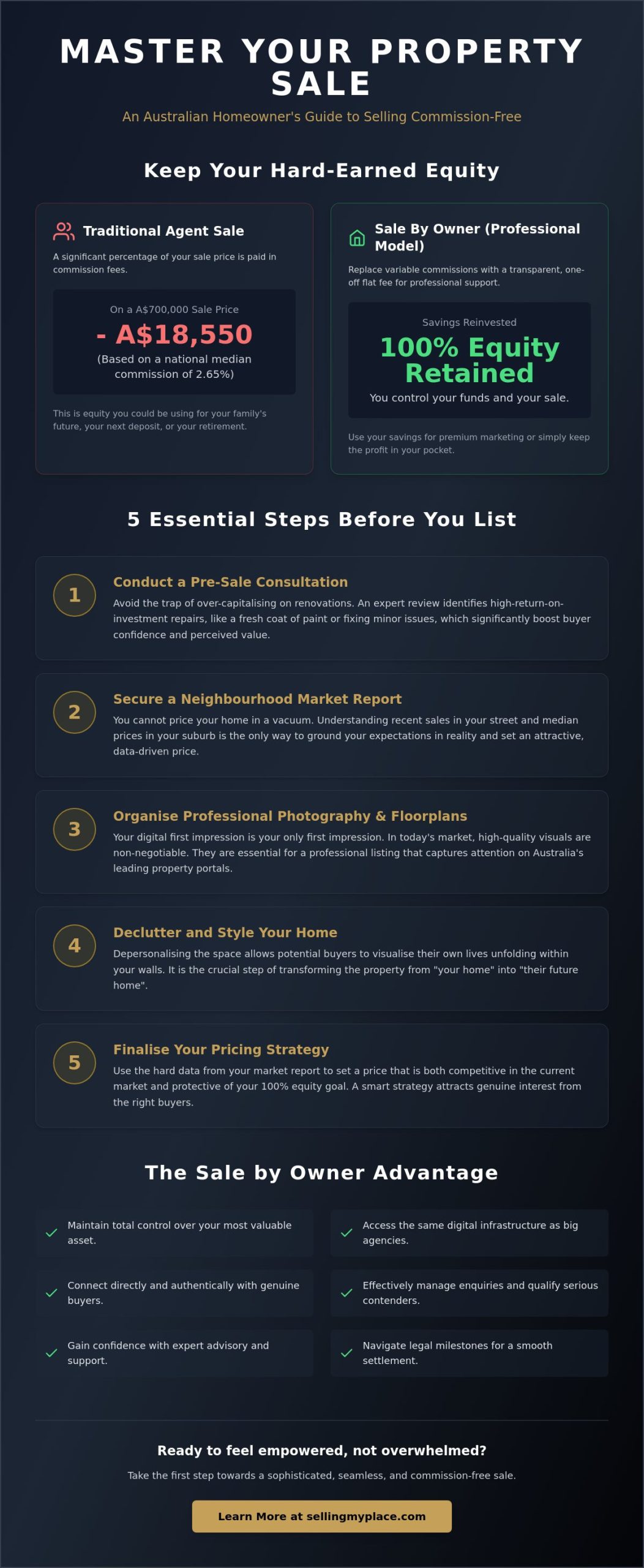
The numbers tell a compelling story. According to research from June 2026, the national median commission for agents sits at roughly 2.65%. On a A$700,000 sale, that is A$18,550. It’s a massive sum that could be better used for your next deposit or retirement fund. By choosing a sale by owner model, you replace that variable percentage with a transparent flat fee. This allows you to reinvest those savings into premium marketing, like professional photography and floorplans, ensuring your home looks just as polished as any listing on the market. Plus, many of these arrangements offer “listed until sold” peace of mind, removing the ticking clock of a traditional 90-day agency agreement.

Is Your Mindset Ready for a Private Sale?

Success in a private sale often comes down to a steady hand and a genuine love for your community. Are you ready to be the primary advocate for your home? You don’t need to be a shark-like negotiator. In fact, most buyers find it refreshing to speak directly with the person who has actually lived in the house. Your passion is your greatest asset. When you combine that local insider knowledge with a professional support system, the stress of the process begins to melt away. It’s about feeling empowered, not overwhelmed, as you guide your family toward its next chapter.

Preparing Your Home: The 5 Essential Steps Before You List

Preparation is the bridge between a property that sits on the market and one that sells for a premium price. When you choose a sale by owner strategy, you aren’t just tidying up for a weekend open home; you are curateing an experience for a future family. This process requires a steady hand and a clear focus on where your efforts will yield the highest return. Before the first buyer walks through your front door, follow these five essential steps to ensure your home stands out in the competitive Australian market.

  • Step 1: Conduct a Pre-Sale Property Consultation. Avoid the trap of over-capitalising on renovations. An expert review identifies high-ROI repairs, like a fresh coat of paint in a modern neutral or fixing that leaky tap, which can significantly boost buyer confidence.
  • Step 2: Secure a Neighbourhood Market Report. You cannot price your home in a vacuum. Understanding the recent sales in your street and the median prices in your suburb is the only way to ground your expectations in reality.
  • Step 3: Organise Professional Photography and Floorplans. Your digital first impression is your only first impression. High-quality visuals are non-negotiable for a professional-looking listing.
  • Step 4: Declutter and Style. Depersonalising the space allows buyers to visualise their own lives unfolding within your walls. It’s about moving from “your home” to “their future.”
  • Step 5: Finalise Your Pricing Strategy. Use the data from your market report to set a price that is competitive yet protective of your 100% equity goal.

The Power of Professional Photography and Floorplans

In the digital age, your home’s “open house” begins the moment a buyer scrolls past your listing on their phone. Using iPhone photos is perhaps the costliest mistake a private seller can make. Professional photography uses light and angles to tell a story, creating an emotional pull before the first inspection even begins. Equally vital are accurate floorplans. They don’t just show the layout; they help serious buyers plan their furniture placement and understand the flow of the home. This reduces “tyre-kicker” enquiries and ensures those who do book a viewing are already halfway to making an offer. If you want to see how professional visuals can transform your listing, consider booking a pre-sale property consultation to get your home camera-ready.

Leveraging Neighbourhood Market Reports

With the Reserve Bank of Australia holding the cash rate at 4.35% as of June 2026, buyers are more discerning than ever about value. A comprehensive market report is your shield against low-ball offers. It should include detailed data on properties currently for sale and those that have settled in the last six months. When a buyer questions your asking price, you won’t need to rely on emotion. Instead, you can point to concrete local data to justify your position. Your local insider knowledge, paired with these hard facts, makes you a more formidable negotiator than any generic agent who might be juggling twenty other listings at once.

Marketing Your Property to a Global Audience

Once your home is camera-ready, it is time to share your story with the world. Many people worry that a sale by owner approach limits their reach to just a “For Sale” sign on the front lawn. This couldn’t be further from the truth. In fact, a professional private sale strategy utilises the exact same digital infrastructure as the largest agencies in the country. You can place your home where the eyes already are: on major property portals like Realestate.com.au and Domain.com.au. Understanding how modern residential property listing services work can help you make the most of this digital reach without paying traditional agent commissions. To maximise your results, developing a structured property marketing plan in Australia ensures every channel works together to attract the right buyers at the right price.

The beauty of this modern approach is the “Listed Until Sold” philosophy. Traditional agency agreements often trap you in a 90-day window, creating a sense of frantic urgency that can lead to rushed decisions or underselling. Why put that pressure on your family? By removing the ticking clock, you maintain a position of strength. You can wait for the right buyer who truly values the legacy you’ve built, rather than settling for the first offer just to meet an agent’s deadline. It is about moving at a pace that respects the emotional weight of the transition.

Writing Descriptions That Sell

Your property description shouldn’t read like a dry inventory of bedrooms and bathrooms. Buyers can see those details in the data section. Instead, use this space to paint a picture of the lifestyle your home offers. Does the breakfast nook catch the soft morning sun? Is there a particular spot in the garden where the kookaburras gather at dusk? This heartfelt, evocative language creates an emotional bridge. To keep readers engaged on mobile devices, use short, punchy sentences and clear bullet points. It makes the information accessible for busy families scrolling through listings between school runs or work meetings.

The Global Connection

Australia remains a highly attractive destination for international buyers looking for stability and community. A robust digital marketing network ensures your residential property for sale is visible to expats and overseas investors alike. This global reach is a significant advantage, as it broadens your buyer pool beyond just the local neighbourhood. Managing these enquiries doesn’t have to be a headache, even with different time zones. By using integrated digital tools, you can respond to questions at your own pace, ensuring every potential buyer feels welcomed and informed, no matter where they are in the world.
How to Sell Your Own Home: A Step-by-Step Guide to Sale by Owner in Australia

Handling Enquiries, Inspections, and the Art of Negotiation

Once the enquiries start rolling in, the process shifts from digital screens to your front doorstep. This is the moment where the “steady hand” approach becomes your greatest asset. Many homeowners worry that a sale by owner means they have to act like a high-pressure salesperson. In reality, the most successful private sales are built on neighbourly warmth and transparent communication. You aren’t “selling” so much as you are hosting a guest who might become the next custodian of your family home.

To protect your time and peace of mind, it is vital to qualify buyers before they arrive. Ask gentle but direct questions over the phone. Have they spoken to a lender? Are they familiar with the local area? This simple step ensures your inspection schedule is filled with genuine contenders rather than weekend tyre-kickers. It allows you to maintain a stress-free routine that suits your lifestyle, rather than rearranging your life for every casual enquiry.

What about the “money talk”? It’s the part people fear most. If a buyer asks about price, stay grounded in the data you gathered from your market report. You don’t need to feel awkward when you have facts on your side. Simply state your position with calm confidence, knowing you have the right to protect your property’s value. Negotiation is not a battle; it is a conversation about value and legacy. For a deeper dive into how to approach these conversations with confidence, our guide on property sale negotiation tips for Australian homeowners can help you prepare for every scenario.

Mastering the Private Inspection

Aim for a welcoming, grounded atmosphere when preparing for an inspection. Open the blinds to let in that beautiful Australian light and ensure the home feels fresh and inviting. Remember the “less is more” rule. Let buyers explore at their own pace. Stay nearby to answer questions about the local schools or the best nearby parks, but give them the space to imagine their own furniture in the rooms. After they leave, a quick, friendly follow-up text is a great way to gather honest feedback without being pushy.

Expert Backing: The Agent Advisory Service

You don’t have to navigate the complex world of offers alone. While you lead the inspections, having access to real estate advisory services provides a professional safety net. If a “lowball” offer arrives or a buyer’s representative gets aggressive, your advisor can help you interpret the situation and draft a strategic response. This support bridges the gap between a verbal offer and a legally binding contract, ensuring you never feel out of your depth. If you are ready to take the next step with professional support, explore our real estate advisory services to see how we can help you secure the best result.

Reaching the stage where you have accepted an offer is a moment for genuine celebration. It is the culmination of your hard work and the start of a new chapter for your family. However, the path from “Offer Accepted” to “Settlement Day” involves a series of technical milestones that require precision and a steady hand. While a sale by owner approach puts you in the driver’s seat, you aren’t expected to navigate the legal complexities of property law in isolation. This final phase is about ensuring a secure, transparent transfer of your most valuable asset.

In Australia, the legal transfer of property is a formal process that begins with the Contract of Sale. Depending on your state, specific disclosure requirements must be met before the sale is finalised. For instance, Victorian sellers must provide a Section 32 Vendor Statement, while those in South Australia require a Form 1. Since July 1, 2026, new federal Anti-Money Laundering (AML) laws also require all parties to provide identification documents for verification. Engaging a professional conveyancer or solicitor to handle these details ensures your interests are protected, turning a complex process into a calm and orderly transition. If you are also navigating the purchase of your next home at the same time, understanding the full strategy for selling and buying a house at the same time in Australia can help you coordinate both settlements without the stress of bridging finance or missed deadlines.

Navigating Conveyance Advice

One of the most effective ways to reduce stress is to organise your legal paperwork before the first buyer even walks through your front door. This proactive approach prevents last-minute hurdles and builds immediate trust with potential buyers. Common pitfalls, such as missing building permit disclosures or failing to secure an ATO Clearance Certificate for properties valued at A$750,000 or more, can cause significant delays. By seeking early conveyance advice, you can identify these requirements early, protecting your equity and ensuring the settlement process remains a smooth experience for everyone involved.

The Kincade Partnership: Why You Aren’t Selling Alone

Choosing a direct sales model means you lead the conversation about your home’s heart and history, while we provide the professional infrastructure to support your journey. You keep 100% of your profit and pay 0% in agent commissions. Instead, you benefit from a single, transparent flat fee that covers everything from high-end marketing to expert advisory. It is a partnership built on empathy, community roots, and the shared goal of seeing your family thrive. You have the local knowledge; we have the steady hand to help you cross the finish line with confidence.

Organise your professional property listing with Kincade today and take the first step toward a more empowered way to sell.

Stepping Into Your Next Chapter with Confidence

Selling your family home is a significant milestone that deserves both professional precision and a personal touch. You now have the roadmap to navigate the Australian market, from the initial pre-sale consultation to the final settlement. By combining your unique insider knowledge of your property with a high-impact digital presence, you can reach the right buyers without sacrificing your hard-earned equity.

Choosing a sale by owner path doesn’t mean you have to be a solo act. It is about taking control while having a steady hand to guide you through the technical details. Every package we offer includes professional photography and floorplans to ensure your home looks its absolute best. You also gain access to our Agent Advisory Service for expert negotiation support, helping you save an average of A$20,000 in agency commissions.

Start your commission-free sale journey with Kincade International Direct Sales

Your property’s legacy is in good hands because it is in your hands. We look forward to helping you secure a future that is as bright and stable as the home you have built.

Frequently Asked Questions

Is it legal to sell my own home in Australia without an agent?

Yes, it is perfectly legal to sell your property privately in every Australian state and territory. You aren’t required by law to engage a licensed real estate agent. You must, however, ensure you comply with state-specific disclosure requirements, such as providing a Section 32 in Victoria or a Form 1 in South Australia. Additionally, all sellers must now adhere to federal Anti-Money Laundering laws that came into effect on July 1, 2026.

How much can I actually save with a “Sale by owner” model?

The savings are often significant, typically ranging from A$15,000 to over A$30,000 depending on your property’s value. Since the national median commission for agents is approximately 2.65%, a sale by owner approach allows you to keep that entire amount as equity. By removing the commission, you can reinvest a small portion into premium marketing while keeping the vast majority of the profit for your family’s next move.

Will my property appear on Realestate.com.au and Domain if I sell privately?

Yes, your home will receive full exposure on Australia’s leading property portals. While these websites don’t allow individual private sellers to upload listings directly, professional service providers facilitate this for you. This ensures your home is visible to the millions of buyers who use these platforms every day. You get the same digital reach as a traditional agency without the high commission costs associated with their services.

How do I determine the right price for my home without an agent appraisal?

You can set a confident price by using a Neighbourhood Market Report to analyse recent settled sales in your street. With the RBA holding the cash rate at 4.35% as of June 2026, buyers are looking for genuine value. Basing your price on hard data rather than an emotional estimate helps you justify your position during negotiations. This evidence-based approach is often more accurate than a generic agent appraisal.

What happens if I can’t sell my property within 90 days?

There is no need to worry about a ticking clock. Unlike traditional agency agreements that often expire after 90 days, a professional private sale model typically operates on a “listed until sold” basis. This removes the frantic pressure to accept a low offer just to meet a deadline. You have the freedom to wait for the right buyer who truly appreciates the lifestyle and legacy your home offers.

Do I need a lawyer for a private house sale?

Yes, you must engage a qualified conveyancer or solicitor to handle the legal transfer of the property. While you lead the marketing and inspections, a legal professional is essential for preparing the contract of sale and managing the settlement process. They ensure all paperwork is compliant with state laws and that your equity is protected when the funds are transferred on settlement day. This provides a vital layer of security.

How do I handle negotiations if I’m not a salesperson?

You handle them with a steady hand and a focus on helpfulness. You don’t need to be a master negotiator; you just need to be the expert on your own home. If an offer feels complex or a buyer is being difficult, you can call upon real estate advisory services for expert support. This partnership ensures you have a professional advocate in your corner to help bridge the gap between an offer and a signed contract.

Can I still use professional photography if I’m selling the home myself?

Absolutely, and it is one of the most important steps for a successful sale. Every professional listing package should include high-end photography and floorplans to ensure your home stands out online. These visuals create the emotional pull that brings buyers to your door. By using the same professional tools as the big agencies, you ensure your private listing looks sophisticated, polished, and ready to achieve a premium result.

Stay Informed

Market Insights & Seller Resources Delivered Free.

Join thousands of Australian property owners receiving our weekly market updates, state legal guides, and exclusive seller tips — no agent required.