Property advisory services for Australian buyers
A property decision is only as sound as the due diligence behind it. Knowing what to look for in a property advisory service means looking for clear advice on value, access to suitable properties and thorough checks, including strata records and planned infrastructure. An advisor should explain the risks as well as the potential rewards, without pressuring you to buy.
A useful property service should offer more than a shortlist. You should be able to understand how the adviser assesses value, what research supports recommendations and how the process addresses details that could affect your decision.
This guide explains what property advisory services can include, how value and opportunities are assessed, and what due diligence to expect. It also covers how to assess an adviser’s experience, incentives and approach, so you can choose support that fits your next move.
Key Takeaways
- Look for an advisor whose experience, qualifications and reputation fit your needs, and whose recommendations are independent and free from pressure.
- Assess whether the service supports the full buying process, from property selection and value assessment to due diligence and negotiation.
- Compare like-for-like sales and consider how a property’s location, condition and features affect its value.
- Include strata records and infrastructure plans in your due diligence to uncover details that could shape your decision.
- Understand what a fee covers and how its structure relates to the work involved before deciding whether advisory support suits your purchase.
What does your property advisory service include?
A buyer’s agent represents the purchaser in a property transaction. Financial advisers cover financial services, while property investment advisers focus on property strategy and market research.
Adviser independence and credentials
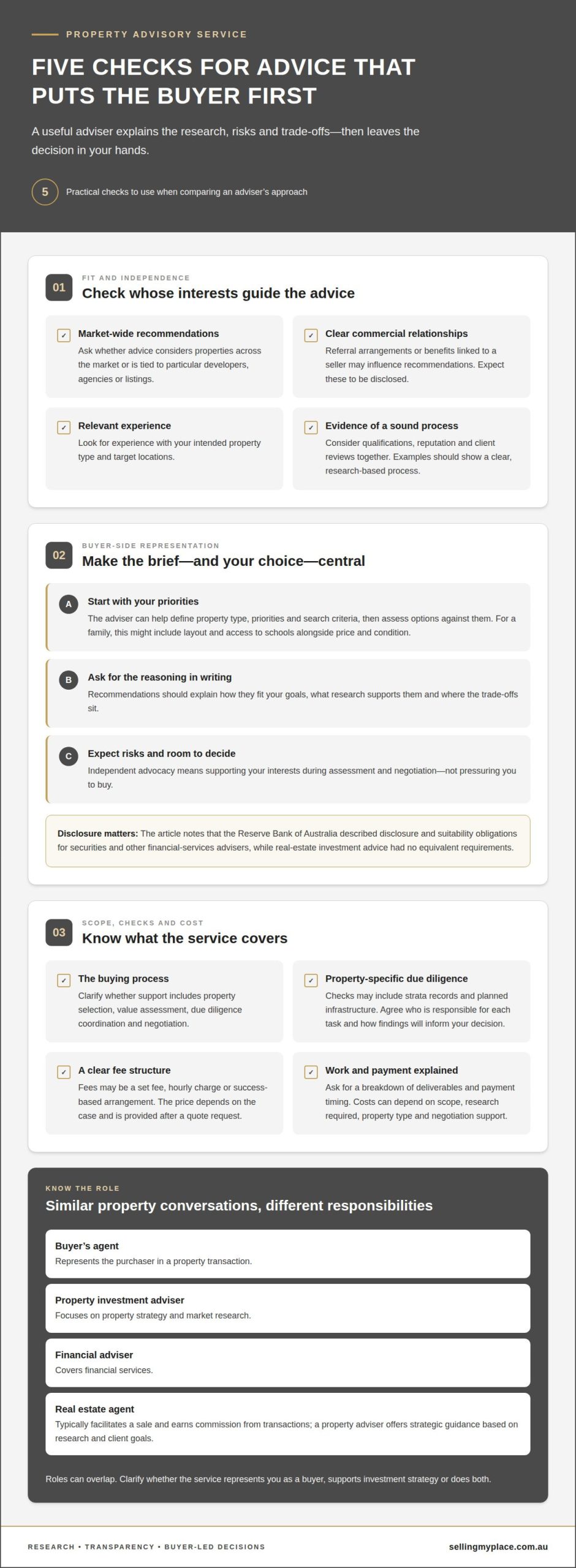
When assessing a property advisory service, start with its incentives and relevant experience. Find out whether recommendations draw on properties across the market or are tied to particular developers, agencies or listings. Advice should be based on your goals, with any commercial relationships made clear.
Look at experience with your intended property type and target locations. Check qualifications, industry reputation and client reviews, then consider whether their examples show a clear, research-based process.
Buyer-side representation and advocacy
Buyer-side representation centres the purchaser’s brief. An adviser may help define the property type, priorities and search criteria, then assess options against them. A family, for example, might weigh layout and access to schools alongside price and condition.
Independent advocacy means supporting the buyer’s interests during assessment and negotiation. The adviser should explain the reasoning behind recommendations, identify trade-offs and give you room to decide without pressure. Whether working with an Australian buyer’s advocate or consulting residential specialists such as Mountain View Realty in overseas markets, having dedicated representation ensures your property criteria guide every step of the purchase.
Understand how the adviser is paid and whether referral arrangements could influence recommendations. A benefit linked to a particular seller may create a conflict, especially if it rewards introductions rather than advice. Clear disclosure helps you judge whose interests shape the recommendation.
The Reserve Bank of Australia noted that securities and other financial-services advisers had Corporations Law obligations for disclosure and suitability, while real-estate investment advice had no equivalent requirements. This distinction makes it important to examine how a property adviser explains risks, incentives and the basis for recommendations.
Use these checks to compare an adviser’s approach with your needs:
- Match their experience to your property type and intended location.
- Review qualifications, reputation and client feedback together.
- Look for independence from specific sellers, developers or agencies.
- Expect a written explanation of how recommendations fit your goals.
- Notice whether the adviser discusses risks and gives you room to decide.
A real estate agent typically facilitates a sale and earns commission from transactions, while a property adviser offers strategic guidance based on research and client goals. Roles can overlap, so clarify whether the service represents you as a buyer, supports investment strategy or does both. In certain property markets, vendors may also consider alternative transaction models, such as direct acquisitions through firms like Covenant Properties, rather than standard agency listings.
Is It Worth Hiring A Property Adviser?
A property adviser can bring structure to research, acquisition and negotiation. The value comes from weighing each decision against your goals, budget and tolerance for risk.
Property acquisition and negotiation
Acquisition support can turn a broad brief into a focused search. An adviser may assess whether a property suits your priorities, coordinate due diligence and help shape an offer strategy. Before negotiations, agree on the adviser’s role, which decisions are yours and how recommendations will be explained.
During negotiation, consider how the adviser uses comparable sales, the property’s condition and your preferred terms. A clear strategy helps you decide when to offer, which conditions matter and when to step back. The adviser should explain the trade-offs, not treat every purchase as a win.
A strategy-led purchase starts with why you’re buying. An owner-occupier may prioritise location, layout and daily convenience, while an investor may consider rental prospects and longer-term plans. Set priorities before reviewing listings. This gives inspections a purpose and makes properties easier to compare consistently.
Property investment also calls for realistic expectations. Of Australian property investors who continue investing, 92% do not get past their first or second property. This figure is a reminder to plan beyond the first purchase: consider how repayments, maintenance and future goals fit your broader financial picture.
Advisory fees and costs
Australian property advisory fees can be structured in different ways, such as a set fee, an hourly charge or a success-based arrangement. The price depends on the case and is provided after a quote request; factors include the scope of work, research required, property type and negotiation support.
Compare the fee structure with the work included. Search support, property assessment, due diligence coordination and offer negotiation can represent different levels of involvement. Request a clear breakdown of deliverables and payment timing, then consider whether the scope matches the decisions you need help with.
Due diligence is part of assessing a property. An adviser may help organise checks and consider their findings alongside your purchase decision, but establish who is responsible for each task. A building concern, for example, may affect your offer strategy, while a title or contract issue can change the terms you’re prepared to accept.
Before proceeding, map out the decision points:
- Define your purchase goals, budget and non-negotiable features.
- Agree on the adviser’s scope and fee structure.
- Review each property against your criteria and available evidence.
- Use due diligence findings to inform your offer and negotiation approach.
- Keep the final decision aligned with your priorities and capacity.
If you’re weighing up the support that would suit your purchase, you can discuss your property goals as a next step.
Data-led valuations and comparable sales
An asking price reflects the seller’s position, not proof of market value. A data-led assessment compares a property with relevant sales and explains how differences affect the comparison. Two houses on the same street, for example, may differ in land size, condition, layout or outlook. Those details matter when judging whether a sale is a useful guide.
Start with properties that share the home’s key characteristics. Compare an apartment with similar apartments, and a detached house with properties that have comparable locations, land and building features. Nearby sales can help, but a property across a major road or in a different pocket may attract different demand. Local context gives the figures meaning.
Review the evidence behind each comparison. Note the sale date, property type, location and condition, then consider features that could explain a price difference. A renovated kitchen, off-street parking or larger outdoor area may distinguish one sale from another. A sound assessment explains these differences instead of treating every nearby sale as equal.
How to assess comparable sales
Ask how the evidence leads to the conclusion. A useful comparison explains why each sale was selected, how it is similar and where it differs. If the property needs repairs, for instance, a renovated comparable needs careful interpretation. The aim is not to force a precise adjustment, but to make the reasoning visible and relevant to your decision.
Separate asking prices from completed sales. A current listing shows what a seller hopes to achieve; a completed transaction shows what a buyer agreed to pay. Neither figure tells the whole story. Consider the property’s presentation, sale conditions and whether the comparison genuinely matches the home you’re assessing.
Use a simple comparison checklist:
- Match property type, location and land or floor area.
- Compare condition, renovations, layout and outdoor space.
- Distinguish completed sales from advertised asking prices.
- Record why each comparable is relevant and where it differs.
- Relate the evidence to your intended use and purchase priorities.
Market context affects how comparable evidence should be read. A home in a tightly held street may attract different interest from one near a busy road, even if their floor areas are alike. Amenities, transport access and nearby development can also influence appeal. An adviser should connect these factors to the property rather than relying only on broad area averages.
Treat an estimate as a reasoned view, not a promise of a future sale price. The result depends on the property, buyer interest and transaction circumstances. A thoughtful adviser explains the evidence, its limits and its practical implications for your offer. You can then judge whether the price fits your priorities rather than relying on a headline figure.
Due diligence, including strata reports and infrastructure plans
Due diligence connects a property’s records and surroundings to your decision. For an apartment, review strata records as well as the condition of shared areas. For a house, consider building condition, boundaries and nearby planning proposals. These checks can reveal practical issues that a viewing alone won’t show.
For a unit or townhouse, review the strata report, including meeting minutes, financial records, maintenance plans and references to building work. Repeated discussion of roof repairs, for example, may affect your view of future costs and disruption. Look for patterns across the records, not just a single note, and identify matters needing further professional review.
Check how the owners corporation manages shared spaces and planned maintenance. Records about lifts, balconies, plumbing or car parks can show the building’s priorities. Compare them with what you saw during an inspection. If a report mentions a defect or proposed work, identify the area involved and consider how it could affect your plans.
For nearby infrastructure, identify proposals and understand their stage and likely effect. A road, rail connection or utility project could change access, noise or neighbourhood activity. Maps can show proximity, while planning documents may explain the proposal’s scope. Distinguish confirmed works from early proposals, then consider how each could affect everyday use.
Use a consistent review sequence so important details don’t get lost:
- Match strata records to the building and lot you’re considering.
- Note recurring maintenance issues, proposed works and financial commitments.
- Compare report findings with inspection observations and property features.
- Locate nearby infrastructure proposals on maps and planning documents.
- Record questions for relevant specialists before making a decision.
Keep a written issues register for each property. For example, record a strata reference to balcony repairs beside your inspection notes and identify the area affected. List infrastructure proposals separately, noting whether they relate to transport, utilities or public space. This makes it easier to compare evidence instead of relying on memory after several inspections.
An adviser can help interpret findings in light of your objectives and bring relevant information together. A neighbourhood market report adds local context, while strata documents and infrastructure plans address questions about the property and its surroundings. Keep the evidence types distinct: market data describes comparable activity; due diligence identifies property-specific details and proposals that may influence your choice.
Connect each document to a decision. A maintenance concern may prompt a closer inspection; a proposed transport change may affect how you assess the location. Record the source, issue and practical relevance. This gives you a clearer basis for comparing options and deciding which findings need specialist attention before proceeding.
How are Australian property advisory fees structured, and what do they typically cost?
Property advisory fees vary with the work involved, so compare the scope before comparing amounts. Common structures include a fixed fee for an agreed service, hourly billing for time spent or a success-based fee linked to a purchase. Each affects how costs accrue and how the adviser is rewarded. Compare deliverables, incentives and timing, not just the fee label.
A fixed fee can make an agreed scope easier to understand, such as a defined research task or a stage of acquisition support. Hourly billing ties cost to time spent and may suit work with an evolving scope. A success-based fee links payment to a completed purchase, so consider how that incentive aligns with advice to proceed or pause.
The price depends on the case and is given after a quote request; cost factors include the scope of advice, research required, property type, location and level of acquisition support. Compare the quoted work with your actual needs. A search-only brief differs from support that includes assessing options, coordinating due diligence and negotiating an offer.
Read the engagement terms to understand what the fee covers and when payment is due. Note whether the scope includes property research, inspections, written recommendations, negotiation or follow-up. If the service has stages, identify what each one delivers. A shortlist and market assessment, for instance, differ from support through an offer and contract process.
Keep advisory charges separate from other purchase expenses. Your budget may also include conveyancing, inspections and lender-related costs. Listing these separately helps you see the full commitment and distinguish strategic advice from independent checks and the property’s purchase price.
- Compare the same scope of work across fee proposals.
- Identify whether billing is fixed, hourly or success-based.
- Match payment stages to specific deliverables.
- Separate advice fees from conveyancing, inspection and lending expenses.
- Consider whether the payment structure could influence recommendations.
If you need help assessing one property, a broad acquisition package may exceed your needs. If you want support with search, research and negotiation, a narrow valuation task may leave important work out of scope. First define the decisions you need help with, then compare the relevant work and payment terms.
If you’re planning a property sale and want to understand the support available, discuss your property needs.
Kincade International Direct Sales: Residential Property Listing Services
Kincade International Direct Sales can help homeowners prepare and market a residential property, or buyers seeking representation. Its Residential Property Listing Services include professional photography, floorplans and neighbourhood market reports, supported by a global marketing network. Properties remain listed until sold, with no time limit.
For owners planning a sale, Pre-Sale Property Consulting can help bring preparation and marketing decisions into focus. For buyers, Buyer Representation offers support from the purchaser’s side. Neighbourhood market reports can also provide local context when weighing property decisions. These services suit different needs, so consider whether you’re preparing to sell, seeking buyer-side support or looking for market information.
For a conversation about your property needs, contact Kincade International Direct Sales or visit sellingmyplace.com.au.
Make your next property move with clarity
Your next step is to decide what kind of support would make the biggest difference. You might want a sounding board before committing, help preparing a home for sale, or representation while buying. A clear brief gives any property conversation a practical starting point.
Knowing what to look for in a property advisory service means choosing support that fits the decision ahead, rather than taking on help you don’t need. Consider what you want to achieve, which parts feel complex, and where informed guidance could help you move forward with confidence.
For owners preparing to sell, Kincade International Direct Sales offers Residential Property Listing Services and Pre-Sale Property Consulting. Buyers can access Buyer Representation. Each offering serves a different point in a property journey, whether you’re planning a sale or considering a purchase.
Contact Kincade International Direct Sales to discuss your property plans. A considered next step can help you approach the journey with confidence.
Frequently Asked Questions
Can you negotiate on my behalf?
Yes, a buyer-side adviser can negotiate for you when that work is included in the agreed scope. Before negotiations, set out your preferred price range, offer conditions and settlement preferences in writing. The adviser can communicate your position and respond to counteroffers, while you retain control of the final decision. Clarify how offers will be presented and approved, so time-sensitive decisions follow your instructions.
What services does a property advisory service provide in Australia?
Services can include purchase strategy, property searches, market analysis, comparable-sales research, due diligence coordination and negotiation support. Some advisers focus on investment planning, while others represent buyers through an acquisition. A family-home buyer, for example, may need a shortlist based on lifestyle priorities, while an investor may seek research on rental demand and ownership considerations. Confirm the scope and deliverables in writing.
What qualifications and licences should an Australian property adviser have?
There isn’t one qualification that covers every property adviser’s work across Australia. Ask about qualifications, any relevant state or territory licence details, the issuing body and the work each credential permits. Verify applicable details through the relevant official register. Distinguish property advice from financial or legal advice, which require different expertise, and make sure the adviser clearly explains their role.
How can I check a property adviser’s experience, track record and client reviews?
Ask for examples of previous work involving similar property types, buyer goals and market conditions. A useful example explains the adviser’s role, the research completed and how the client made a decision, rather than relying only on a claimed result. Read reviews across different sources and look for specific comments about communication and process. Separate the adviser’s contribution from market movements and other factors outside their control.
How can I tell whether a property adviser is independent or earns commissions from third parties?
Ask how the adviser is paid and whether referral fees, commissions or other benefits come from sellers, developers or agencies. Request written disclosure of relevant relationships and ask whether recommendations consider properties beyond those sources. If an adviser promotes a development, for example, clarify any commercial relationship and how alternatives are assessed. Payment arrangements and recommendation criteria make independence easier to judge.
What questions should I ask before hiring a property advisory service?
Ask what the service includes, what work you’ll receive and who makes each decision. Clarify the fee structure, payment timing, conflicts of interest and how the adviser supports due diligence. Ask how recommendations are documented and how often you’ll receive updates. These practical questions help you assess what to look for in a property advisory service and whether its process suits your purchase goals and preferred level of involvement.
How do property advisers assess locations, property values, rental yields and growth prospects?
Advisers can compare completed sales, property features and local conditions to form a view on value. Research may consider amenities, transport, planning activity and housing supply. For an investment, weigh rental income against ownership expenses, vacancy periods and property condition. Growth prospects are assessed through evidence and market context, not promised as an outcome. Ask how each factor informs the recommendation.
What due diligence should a property adviser do before recommending a property?
Due diligence should connect property records and inspection findings to the risks relevant to your purchase. For an apartment, review strata records, maintenance discussions and planned works. For any property, consider title and contract documents, building condition, boundaries and nearby infrastructure proposals. The adviser should identify issues that need specialist attention and explain their potential effect on your decision. Legal document review belongs with a qualified conveyancer or solicitor.
