
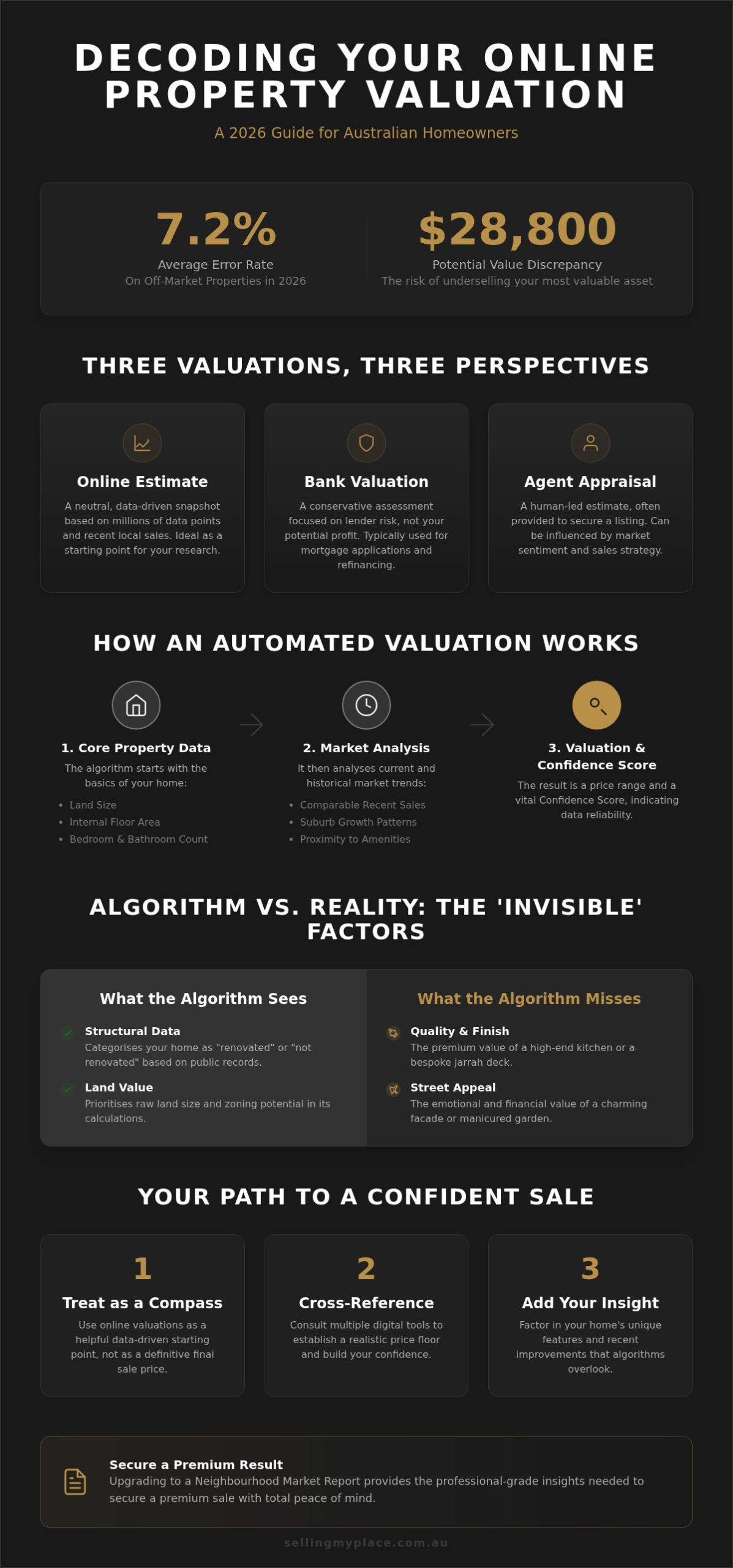
What if the number you just saw on a free online property valuation is actually $28,800 away from your home’s true worth? It’s a common scenario in 2026, where a 7.2% error rate on off-market properties can lead to significant confusion and the very real fear of underselling your most valuable asset. We understand the anxiety that comes with conflicting estimates; it’s hard to feel confident about your future when the digital data seems to change depending on which website you’re visiting.
You deserve to move forward with total clarity and a sense of calm. This guide will help you discover the truth behind automated property estimates and show you how to use that digital data to secure the best possible sale price for your Australian home. We’ll explore the latest 2026 accuracy benchmarks, explain why on-market data is more reliable than off-market guesses, and provide you with the tools to establish a realistic price range. By the end, you’ll have the confidence to manage your own sale and keep your hard-earned equity where it belongs.
Key Takeaways
- Learn how to treat a free online property valuation as a helpful data-driven compass rather than a definitive final sale price.
- Discover the specific “invisible factors” that algorithms often overlook, ensuring you don’t undervalue your home’s unique features or recent improvements.
- Master the technique of cross-referencing multiple digital tools to establish a realistic price floor and gain the confidence to lead your own sale journey.
- Understand how accurate market data allows you to sidestep traditional agent commissions and protect your family’s hard-earned equity.
- Explore how upgrading to a Neighborhood Market Report provides the professional-grade insights needed to secure a premium result with total peace of mind.
What is a Free Online Property Valuation?
When you’re standing in your kitchen, perhaps enjoying a morning flat white and thinking about the next chapter of your life, a free online property valuation is often the very first place your journey begins. It’s a digital starting line that offers a glimpse into your home’s potential without needing to tidy up for an unannounced visitor. While it feels like a simple search result, you’re actually interacting with a complex Automated Valuation Model (AVM). An AVM is a statistical tool that processes millions of data points to predict market value with mathematical precision.
It’s helpful to distinguish these estimates from other figures you might encounter. A bank valuation is typically conservative, focused on lender risk rather than your profit. A real estate appraisal is a human-led estimate, often influenced by the desire to secure a listing. An online estimate, however, acts as a neutral data-driven snapshot based on recent local sales and your property’s core characteristics. It provides a grounded starting point, helping you move from uncertainty toward a structured plan for your lifestyle transition.
The Role of Big Data in Australian Real Estate
Algorithms don’t just look at what happened yesterday; they analyse a decade of historical sales to identify long-term patterns in your suburb. In the Australian market, “Comparable Sales” (or “Comps”) are the lifeblood of these systems. The computer identifies properties similar to yours in land size, internal floor area, and bedroom count that have recently changed hands nearby. By weighing these “comps” against current market velocity, the algorithm calculates a price range. It’s a purely mathematical approach to a very personal asset, stripping away the noise to look at the cold, hard numbers.
Why Sellers Start with Online Estimates
The primary appeal of a free online property valuation is the lack of pressure. You can explore your options privately, without the intensity of a formal listing presentation or the feeling that you’re being pushed into a quick sale. Many homeowners use these tools to assess their equity, which is a vital step when deciding if you’re ready for a sea change or an investment upgrade. It’s about finding an objective figure to balance the deep emotional attachment we all have to our family homes. Having a realistic number in hand provides a sense of calm, allowing you to visualise your future state with confidence rather than guesswork.
The Science Behind the Screen: How Estimates are Calculated
Peering behind the digital curtain reveals a sophisticated engine room of data. When you request a free online property valuation, the algorithm begins by pulling the structural basics of your home: land size, internal floor area, and the all-important bedroom and bathroom count. These are the fixed variables, but the real intelligence lies in how the software weights recency. In our fast-moving 2026 market, a sale that settled yesterday carries significantly more weight than a similar property sold six months ago. This is because algorithms are programmed to track suburb-wide growth trends and “days on market” averages in real-time to sense the current heat of the local area.
However, these systems have a distinct blind spot. They see the box, but they don’t always see the beauty. While these models are highly advanced, research from the Brookings Institution highlights that automated systems can sometimes miss the mark when local nuances or unique architectural features aren’t perfectly captured in the raw data. If your home boasts a bespoke jarrah deck or a high-end kitchen renovation, the algorithm might categorise you simply as “renovated” without understanding the premium quality of the materials used.
Weighting Factors in the Algorithm
Software quantifies location proximity with ruthless efficiency. It measures the exact distance to amenities like train stations, parks, and schools, assigning a mathematical value to convenience. There’s often a tug-of-war between “Street Appeal” and “Land Value” in these calculations. While we might fall in love with a charming facade, the algorithm often prioritises the raw land size and zoning potential. Many tools now provide a “Confidence Score” alongside the estimate. This score is actually more important than the price itself; it tells you how much comparable data is available. A low score suggests the algorithm is guessing, while a high score means it has plenty of recent evidence to back its claim.
Data Sources: Where the Information Comes From
Most free online property valuation tools draw their power from government land registries and historical listing portals. This provides a solid foundation, but it’s not always instantaneous. There is often a lag time of several weeks between a sale occurring at auction and the official settlement data being processed by the state registry. To bridge this gap, some models incorporate user-submitted data. If you’ve recently updated your home, you can often “claim” your property on these portals to update the facts. If you’re feeling unsure about how your home’s specific upgrades are being weighed by the data, reaching out for a friendly chat can help provide the clarity you need to move forward.
Algorithm vs. Reality: Why Online Estimates Can Miss the Mark
While a free online property valuation provides a helpful ballpark, it fundamentally lacks the human eye required to judge quality. Algorithms are excellent at counting bricks and measuring land, but they’re terrible at feeling the atmosphere of a home. An Urban Institute study highlights how data-driven models can struggle with qualitative nuances, sometimes reinforcing local disparities because they cannot account for the tangible love and care poured into a property. We know your home is more than just a set of coordinates on a map; it’s a collection of memories and carefully chosen finishes that a computer simply cannot process.
Then there’s the “Outlier Effect.” If a neighbour sells their home in a desperate hurry, or if two emotional buyers get into a bidding war over a specific view, that single data point can skew the entire suburb average. A computer sees the price tag but doesn’t know the story behind it. Relying solely on a screen when setting your reserve price is a risky move. It doesn’t account for current buyer heat or the specific market sentiment on auction day. Without that human context, you might find yourself anchored to a number that doesn’t reflect the true competitive nature of the local market.
The Five Things an Algorithm Cannot See
The software often misses the sensory details that drive a buyer’s heart and ultimately their budget. These invisible factors often dictate whether a home sells for a standard price or a suburb record. They include:
- The specific orientation of the home and how natural light floods the living areas during a winter afternoon.
- Nuisance factors such as proximity to main roads or power lines which can dampen an otherwise strong valuation.
- The “wow factor” of high-end internal finishes and the quality of a professional renovation.
- The psychological pull created by expert Photography in attracting premium buyers to your listing.
- The functional flow and spatial clarity provided by accurate floorplans.
When Online Valuations are Most (and Least) Accurate
Accuracy is usually highest in “cookie-cutter” estates where every house is similar in age and style. In these areas, the algorithm has plenty of identical data points to work with. However, accuracy drops significantly for unique heritage homes or properties in rural areas with low transaction volumes. If the data is thin, the algorithm might “hallucinate,” generating a number that has completely lost touch with the ground reality. Recognising when the data is unreliable is the first step in protecting your equity and ensuring you don’t leave money on the table during your sale.
Using Your Valuation to Maximise Your Sale Price
Once you’ve received your free online property valuation, the real strategy begins. It’s helpful to view this number as your “floor” rather than your “ceiling.” It represents the minimum value the market expects based on raw data, but your goal is to build upon that foundation through smart presentation and timing. By cross-referencing estimates from three or four different digital tools, you can find a reliable median that filters out any single algorithm’s quirks. This balanced approach is a core part of how to determine the market value of a home in Australia, blending digital efficiency with a sensible reality check.
When you’re ready to list, consider whether a “Price Guide” or a “Fixed Price” better suits your suburb’s current energy. A guide often invites more conversation and competition, while a fixed price offers clarity for buyers who want to move quickly. The choice often depends on how much “buyer heat” is currently present in your specific street.
Bridging the Gap with a Neighborhood Market Report
A basic web search only tells you what has happened in the past. A Neighborhood Market Report acts as the “pro version” of a free online property valuation, telling you what is happening right now. It allows you to look closely at active competitor listings to see exactly what features buyers are prioritising this week. By identifying these “sweet spots” where demand is high but supply is low, you can position your home to stand out as the obvious choice for a premium buyer.
Pre-Sale Consulting: The Human Advantage
Data can’t tell you that a $500 tin of paint and a weekend of garden mulching might add $5,000 to your final result. Our Pre-Sale Property Consulting focuses on these high-return minor repairs that often yield a 10x return on investment. De-cluttering and staging also play a huge role in the psychological “buy-in” for visitors, making the space feel like their future home rather than someone else’s history. Professional advice transforms a static data point into a dynamic, profitable sale strategy.
Ready to see how your digital data stacks up against a professional sale strategy? Get in touch with our team today to start your commission-free journey with confidence.
The KIDS Approach: From Valuation to Commission-Free Success
Most websites treat a free online property valuation as a digital hook, designed to reel you in and hand you over to a traditional real estate agent. These agents then ask for a 2-3% commission, which can feel like a heavy price to pay for a service you’re increasingly equipped to handle yourself. We believe that once you have the data, you have the power. By choosing Residential Property Listing Services, you’re opting for a modern, commission-free alternative that puts you back in the driver’s seat of your own sale. It’s a partnership where we provide the tools and you keep the reward.
On average, our clients save $20,000 in commissions. That’s a significant sum that stays in your pocket, perhaps to fund your next deposit or simply to secure your family’s future. We also remove the ticking clock often associated with real estate listings. Our “Listed Until Sold” promise means you can test the market and wait for the right buyer without the stress of expiring contracts or mounting marketing fees. It’s a calmer, more methodical way to achieve a premium result. You shouldn’t feel rushed when making such a major life transition.
Keeping Your Equity Safe
The maths of a sale by owner is refreshingly simple: 0% commission equals 100% of the profit for you. While the idea of managing your own sale might seem daunting at first, you aren’t doing it alone. You’ll have access to professional advisory services to help you navigate the legalities, including essential Conveyance Advice to ensure the settlement process is smooth and secure. There’s a deep sense of peace that comes from being in total control of your financial legacy. You know your home better than anyone, so why not be the one to tell its story? It’s about protecting your equity and your family’s future with a steady hand.
Taking the Next Step
If you’ve spent time researching your free online property valuation and feel ready for something more substantial, it’s time to request a Neighborhood Market Report. This report moves you beyond the “just curious” phase and makes you truly market-ready. It provides the granular, local insights that algorithms often miss, giving you the professional edge needed to negotiate with confidence. We’re here to act as your seasoned guides, helping you translate data into a successful sale. Don’t just settle for a generic online number. Take the lead, secure your profit, and start your next chapter with the financial freedom you deserve.
Take Control of Your Next Chapter
Your home is likely your greatest financial asset, and moving on to your next adventure should be a time of excitement rather than anxiety. While a free online property valuation provides a useful digital compass, it’s the refined strategy and local expertise that ultimately lead you home. By combining the latest market data with professional pre-sale consulting, you ensure that no dollar of your hard-earned equity is left on the table. You’ve worked hard for your home; you deserve to keep the reward.
Choosing a commission-free path doesn’t mean going it alone. With our global marketing network and Expert Agent Advisory included in every package, you have a steady hand guiding you through every step of the process. Owners who partner with us save an average of $20,000 in commissions; money that belongs in your pocket for your future. It’s about more than just a sale; it’s about honouring your legacy and transitioning with total peace of mind. Are you ready to see what’s truly possible for your property?
Secure your equity and sell commission-free with Kincade International Direct Sales today and move forward with the confidence you deserve.
Frequently Asked Questions
How accurate are free online property valuations in Australia?
Accuracy depends on whether your home is currently listed. For properties on the market in 2026, the median error rate is often under 2%. However, for off-market homes, the discrepancy can climb significantly higher. These tools rely on “comparable sales” and public data, meaning they work best in suburbs with high turnover and many similar houses. In rural areas or for unique builds, the accuracy naturally starts to drop.
Why is there such a big difference between different online estimates?
Discrepancies exist because every platform uses a unique algorithm that weights data points differently. One website might prioritise government land registry data, while another focuses more on recent listing prices from real estate portals. These varied “recipes” for calculation mean you’ll often see a range of prices. It’s best to look at multiple sources to find a realistic median for your home’s potential value.
Can a bank valuation be lower than an online property estimate?
It’s very common for a bank valuation to come in lower than a digital estimate. This happens because banks are focused on risk mitigation rather than achieving a premium sale price. They want to know what the property would sell for in a forced sale scenario. An online estimate, by contrast, is trying to predict what a motivated buyer might pay in an open, competitive market.
How do I update the information used in my online property valuation?
You can usually update your property’s details by “claiming” the home on the specific website providing the estimate. This allows you to correct the number of bedrooms or bathrooms and add details about recent renovations. Updating these facts helps the free online property valuation tool refine its calculation. It ensures the algorithm isn’t working with outdated information from ten years ago when you first bought the place.
Do I still need a professional appraisal if I have an online estimate?
Yes, you should still seek expert advice before making a final decision on your sale price. An online tool can’t see the quality of your new stone benchtops or feel the natural light in your living room. A professional appraisal provides the human context that data misses. It helps you understand the “buyer heat” in your street and how to position your home for a premium result.
Will a free online valuation affect my credit score?
No, checking your property’s estimated value online will not affect your credit score in any way. These searches are considered “soft” enquiries that don’t involve a credit application. You can check as many different sites as you like without worrying about your financial standing. Only “hard” enquiries, which happen when a lender reviews your credit file for a loan, will show up on your report.
How often should I check my property value estimate?
Checking your estimate once every three months is usually enough to keep an eye on your equity. Property is a long-term asset, so watching the numbers too closely can be stressful. Suburb trends often take months to show up clearly in the data. A quarterly check-in gives you a grounded view of how your local market is performing without getting caught up in minor weekly fluctuations.
What is the best way to get a formal property valuation for a sale?
The most effective way to get a formal, actionable valuation for a sale is to request a Neighborhood Market Report. This provides a much deeper level of insight than a basic free online property valuation. It combines digital data with a detailed analysis of active competitors in your area. This professional approach gives you the confidence to manage your own sale and keep your hard-earned equity for yourself.