Did you know that national auction clearance rates have dipped to just 45 per cent as of June 2026? It’s a sobering figure that confirms we’ve moved into a buyer’s market, where the “set and forget” pricing of previous years simply won’t cut it anymore. We understand that selling your family home is far more than a transaction; it’s an emotional milestone that deserves a steady hand and a clear head. You might be wondering how to determine market value of a home in australia when the headlines are full of talk about interest rates and cooling prices. It’s completely natural to feel a bit of doubt when looking at free online estimates or to worry about leaving money on the table in this changing landscape.
You deserve to feel certain about your property’s worth, and we’re here to help you find that clarity. In this guide, you’ll master the data and expert strategies needed to accurately value your property and secure the best possible sale price without paying traditional commissions. We’ll walk you through decoding current market trends, understanding the “multi-speed” landscape across our capital cities, and building a defensible price range that gives you total confidence when it’s time to negotiate with buyers. Let’s work together to ensure your next chapter starts on the best possible footing.
Key Takeaways
- Understand the “Golden Triangle” of valuation to see why current buyer demand often outweighs historical data in a cooling property market.
- Learn how to use the “Rule of Three” to select accurate comparable properties that justify your asking price to both banks and savvy buyers.
- Discover how to determine market value of a home in Australia by identifying the unique lifestyle features that automated online estimates simply can’t capture.
- Gain the confidence to set a strategic price range that drives competition and protects your equity without the burden of high agency commissions.
What Exactly is ‘Market Value’ in the 2026 Australian Property Market?
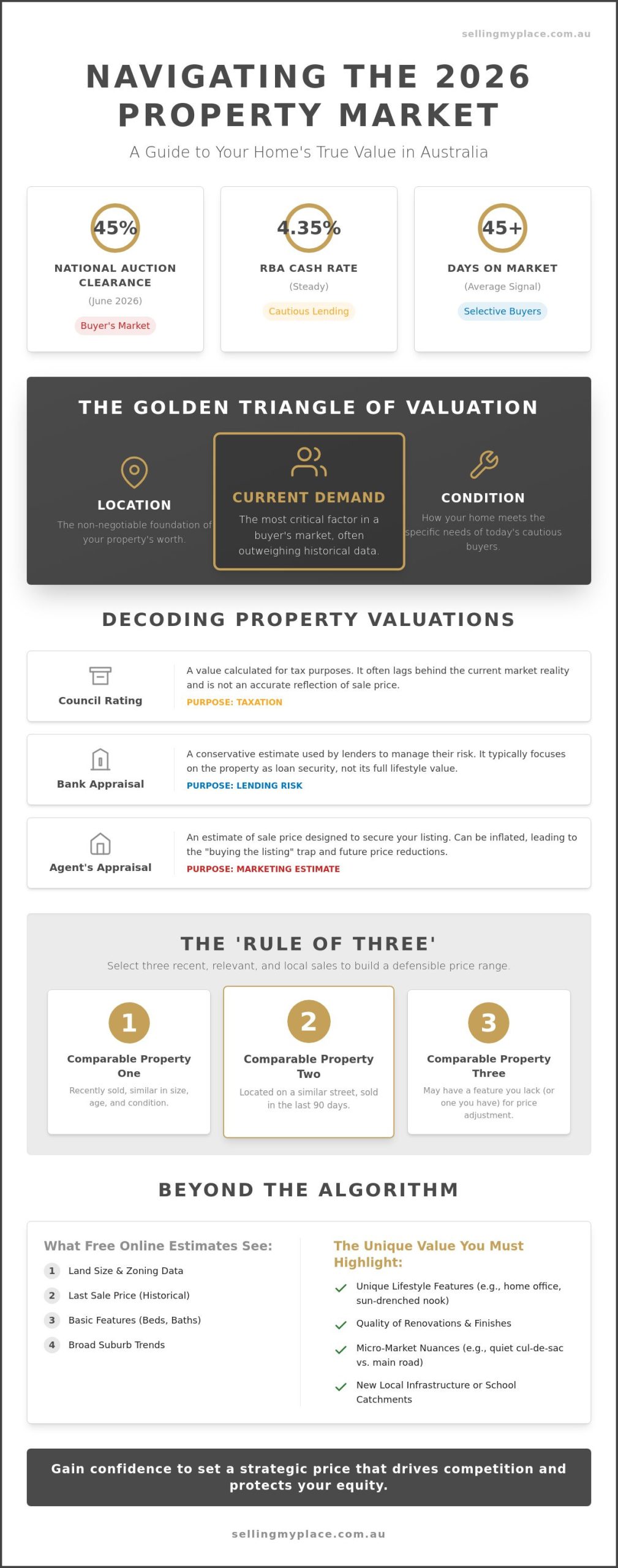
At its heart, market value is a meeting of minds. It’s the price a willing buyer is prepared to pay, and a willing seller is prepared to accept, in an open and competitive market. In the 2026 climate, where the RBA cash rate remains steady at 4.35 per cent, this definition is more than academic; it’s the foundation of your financial legacy. Understanding how to determine market value of a home in australia requires looking past the four walls and into the psychology of the current buyer.
We often talk about the “Golden Triangle” of valuation: Location, Condition, and Current Demand. While you can’t change your street address, you can certainly influence how your home’s condition meets the specific demands of today’s cautious buyers. It’s vital to remember that not all figures are created equal. A council rating is for tax purposes and often lags behind reality. An Appraised value from a bank is usually conservative because they’re managing lending risk. An agent’s appraisal, meanwhile, is often just an estimate of what they think will get you to sign a contract.
The Difference Between Price and Value
There’s an old saying in property circles: price is what you pay, but value is what you get. Price is the hard number on the final contract, but value is the lifestyle the buyer envisions. Emotional triggers, like a sun-drenched breakfast nook or a quiet home office, can push a price well above a bank’s spreadsheet. However, with tighter lending criteria in 2026, those emotional ceilings are often capped by a buyer’s borrowing capacity. You need to find the sweet spot where a buyer’s heart and their bank’s valuation overlap.
Why Traditional Appraisals Can Be Biased
Many sellers unfortunately fall for the “buying the listing” trap. This happens when an agent quotes an inflated price just to secure your business, only to suggest a “price adjustment” three weeks later when the property fails to sell. It’s a stressful cycle that leaves money on the table. Taking a commission-free approach allows for a more objective view of your equity. This is why seeking expert real estate advisory early in the process is so beneficial. It provides a steady, unbiased hand to help you navigate the multi-speed market of 2026 without the pressure of a looming commission check.
Using Neighbourhood Market Reports to Build a Data-Driven Foundation
To get a real handle on how to determine market value of a home in australia today, you have to look beyond the ‘for sale’ signs on your street. You need a data-driven foundation. We start by looking at three vital signs: the median house price, average days on market (DOM), and current clearance rates. In July 2026, the national auction clearance rate has settled around 45 per cent. This tells us we are firmly in a buyer’s market. If properties in your suburb are sitting on the market for 45 days or more, it’s a signal that buyers are being cautious and selective. Understanding these numbers helps you set a price that attracts interest rather than one that causes your listing to go stale.
Neighbourhood Market Reports offer a level of detail that generic apps simply can’t match. They help you establish a baseline by looking at your specific property type. For instance, while Sydney’s overall clearance rate is 43.1 per cent, the rate for renovated family homes in your specific pocket might be much higher. It’s about finding the truth in the numbers. This methodical approach reduces the stress of the unknown, giving you a clear path forward.
Decoding Suburb Trends
Prices don’t exist in a vacuum. We often see a “ripple effect” where price growth in a central hub eventually pushes buyers into neighbouring suburbs. In 2026, we’re also seeing a huge impact from local infrastructure. New transport centres or school catchment changes can add significant value almost overnight. However, broad postcode data can be misleading. A home on a quiet cul-de-sac will always command a premium over one on a main road; even if they share the same suburb name. These micro-markets are where the real value is found.
The Limitations of Free Online Property Estimates
It’s tempting to rely on Automated Valuation Models (AVMs) that pop up on your phone. While these algorithms are a handy starting point, they have significant blind spots. They rely on historical data, which creates a “data lag” problem. In a cooling market like we’re seeing in mid-2026, six-month-old sales data might be completely irrelevant to today’s pricing strategy. This is why a free online property valuation is often more myth than reality. A computer can’t see your brand-new kitchen or feel the peace of your backyard. If you want a truly accurate picture of your equity, you might consider requesting a tailored report for your specific street to see what’s really happening on the ground.
The Comparative Method: Identifying and Analysing ‘Comps’ Like a Professional
While the broad suburb data we discussed earlier sets the stage, the real magic happens when you get down to the “comps” or comparable sales. This is where you move from generalities to the specific reality of your street. Understanding how to determine market value of a home in australia often boils down to a simple but effective strategy we call the “Rule of Three.” It’s a methodical way to ensure you aren’t just guessing based on a lucky sale from last year.
To use this rule, you need to identify three properties that have sold in the last 90 days, three that are currently listed, and three that failed to sell, such as those withdrawn or passed in at auction. The sold properties represent the “floor” of the market; the price buyers are actually paying. The active listings are your direct competition, showing you what buyers are seeing right now. Most importantly, the failed sales serve as a warning. In a market where national clearance rates are hovering around 45 per cent, these properties often reveal the exact price point where buyers simply walk away.
When selecting your comps, be honest about the criteria. A true comparable should share a similar land area, age, and level of renovation. If a neighbour’s house sold for a premium but features a brand-new swimming pool and a double garage while yours has a carport and an original kitchen, you must adjust your expectations. We recommend “adding” or “subtracting” value based on these features. For example, if a comp has an extra bathroom, you might subtract a nominal amount from their sale price to find a realistic baseline for your own home.
Where to Find Reliable Sales Data
Don’t rely solely on commercial property portals, as their data can sometimes be delayed or incomplete. Official government land registries provide the most accurate “sold” figures. Focus your search on a 1km radius from your front door and stick to sales within the last 90 days. To compare internal living spaces accurately, look for professional floorplans in the archived listings. This allows you to see if a “four-bedroom” home actually has a similar footprint to yours or if the rooms are significantly smaller.
Analysing the Competition
There is no substitute for getting out and visiting open homes in your area. This isn’t just about being a “nosy neighbour”; it’s about seeing exactly what a buyer experiences. Compare the “curb appeal” and the quality of the visual marketing. You’ll quickly start to notice why some properties in your street feel “stale” after a month on the market while others sell in a week. Often, it’s a combination of realistic pricing and a presentation that makes an emotional connection from the moment a buyer pulls up to the kerb.
Beyond the Algorithm: Expert Advisory and Property Nuance
Data provides the skeleton of your valuation, but the soul of your home’s worth often lies in details a computer simply cannot see. While we’ve discussed how to use suburb metrics and comparable sales, understanding how to determine market value of a home in australia also requires a seasoned eye for nuance. A property algorithm can’t see the way the afternoon sun hits your deck, the peace of a cul-de-sac location, or the high-end finish of a bespoke kitchen renovation. These intangibles are often what bridge the gap between a standard bank valuation and a premium sale price.
This is where Pre-Sale Property Consulting becomes invaluable. It’s about identifying value-add opportunities before you ever hit the market. Perhaps a minor cosmetic update or a professional styling session could shift the perceived value by tens of thousands of dollars. We believe that presentation, supported by high-quality photography, tells a story that data alone cannot. It creates an emotional connection, and in a multi-speed market, emotion is frequently the catalyst for a higher offer. Our Agent Advisory Service acts as that steady hand, providing the expert guidance you’d expect from a traditional agent but without the heavy commission-based pressure.
The Value of an Independent Perspective
Selling your home is a major life transition, and it’s okay to feel the weight of that responsibility. Getting professional guidance shouldn’t mean you’re locked into a traditional listing contract. Independent real estate advisory services are particularly vital for complex properties, such as those with strata titles, rural acreage, or unique architectural builds. Having an expert back your pricing strategy gives you the confidence to stand firm during negotiations, knowing your range is based on both hard data and professional insight. If you’re ready to see how these nuances apply to your specific property, reach out for a tailored consultation today.
Identifying “Hidden” Value Drivers
In 2026, buyer preferences have shifted significantly toward sustainability. We’re seeing that energy efficiency and clever solar orientation are no longer just nice-to-haves; they are major value drivers that can set your home apart. Similarly, being within a coveted school catchment zone remains a powerful lever, often adding a 10-15 per cent premium compared to a similar home just outside the boundary. Don’t overlook the scarcity factor either. If your home has a unique architectural heritage or a view that can’t be built out, its value isn’t just a number. It’s a reflection of its rarity in the local landscape.
From Valuation to Listing: Finalising Your Strategy to Maximise Profit
Once you’ve gathered your data and considered the unique charm of your home, it’s time to move from theory to reality. Setting the right listing price is the final, crucial step in how to determine market value of a home in australia. In the 2026 market, we find that a “Price Range” often performs better than a single “Fixed Price.” By offering a range, you invite a broader pool of buyers through the door. More feet on the carpet usually leads to more competitive offers, which is exactly what you need when national clearance rates are sitting below 50 per cent.
The psychology of pricing plays a massive role in your success. You might wonder why a property is listed at $995,000 instead of a round $1,000,000. It isn’t just an old retail trick; it’s about how buyers search online. Most property portals use price brackets. Pricing just under a major milestone ensures your home appears in more search results, capturing buyers at both the top of one bracket and the bottom of the next. It’s a small tweak that can significantly increase your listing’s visibility.
As you finalise your figure, remember to factor in your savings. Choosing flat-fee real estate models allows you to protect your equity from being eroded by high commissions. To back up your price during negotiations, prepare an “Evidence File.” This is a simple folder containing the comparable sales you identified earlier. When a buyer tries to lowball your price, you can calmly present the data that justifies your range. It shifts the conversation from opinion to fact.
The “Sale by Owner” Pricing Advantage
When you aren’t paying a 2 or 3 per cent commission, you gain a significant strategic edge. You can afford to be more competitive with your asking price to generate multiple offers quickly, or you can hold firm to maximise your final take-home profit. Learning how to price your home for sale by owner involves a high level of transparency. Don’t be afraid to share your Neighbourhood Market Report with serious buyers. It builds trust and shows them you’ve done your homework.
When to Adjust Your Price
The market will always give you feedback. We recommend the “21-Day Rule.” If you’ve had plenty of online views but no one is booking an inspection, you likely have a “marketing problem” related to your photos or description. However, if people are visiting the home but no offers are coming in, you likely have a “pricing problem.” In a multi-speed market, being prepared to refine your valuation based on real-time feedback is vital. Our Agent Advisory team can help you pivot your strategy if the local landscape shifts, ensuring you never stay stagnant on the market.
Step Into the Market with Absolute Confidence
Navigating a cooling market in 2026 doesn’t have to be a source of stress. By now, you’ve seen that understanding how to determine market value of a home in australia is a deliberate blend of hard data and the subtle, lifestyle-driven details that make your property unique. Whether it’s applying the “Rule of Three” to find accurate comps or setting a psychological price range that triggers buyer interest, you now have the tools to protect your equity and sell on your own terms.
You don’t have to walk this path alone. Our approach combines the precision of professional photography and floorplans with the “steady hand” of expert Agent Advisory, ensuring your listing looks and performs its best. By avoiding traditional agency commissions, our sellers save an average of $20,000; money that stays in your pocket for your next big move. Ready to take the next step? Get Your Professional Neighbourhood Market Report & Start Selling Smarter today. We’re here to support your transition with the care and expertise your family deserves.
Frequently Asked Questions
What is the most accurate way to value my home in Australia?
The most accurate way to value your home involves combining recent comparable sales data with professional independent advisory. While algorithms provide a helpful baseline, they can’t account for the unique features or the emotional appeal of your property. By looking at properties sold within a 1km radius in the last 90 days and adjusting for differences in condition and land size, you create a realistic price range that reflects what buyers are actually paying.
Is a bank valuation the same as market value?
A bank valuation is typically lower than the actual market value because it’s a conservative assessment designed to manage lending risk. Banks look at what they could recoup in a forced sale, whereas market value represents what a willing buyer would pay in an open, competitive environment. It’s common to see a gap between these two figures, especially for unique or highly desirable homes that attract emotional bidding from motivated families.
How much does a professional property appraisal cost?
Most real estate agents offer free appraisals as a way to win your listing, but these can sometimes be inflated to secure your business. If you require a sworn valuation from a certified practising valuer for legal or official purposes, you should expect to pay a fixed fee based on the property’s complexity. For sellers looking for objective guidance without the commission pressure, independent advisory services offer a balanced and cost-effective alternative to traditional models.
Can I determine my home’s value without a real estate agent?
You can absolutely learn how to determine market value of a home in australia without relying on a traditional real estate agent. By accessing professional Neighbourhood Market Reports and official land registry data, you can build a data-driven foundation yourself. Combining this data with independent pre-sale consulting allows you to set a price with confidence while maintaining total control over your sale and protecting your equity from high commissions.
How do recent sales in my street affect my property’s value?
Recent sales in your street are the strongest indicator of your property’s value because they represent the most relevant micro-market data. Buyers often compare your home directly with those nearby, so a high sale price next door can lift your property’s perceived value. Conversely, if several homes nearby have struggled to sell or were passed in at auction, it’s a signal that local demand might be cooling or price expectations are currently too high.
Does a renovation always increase my home’s market value?
A renovation doesn’t always guarantee an increase in market value, particularly if the cost of the work exceeds the added value. In 2026, buyers are specifically looking for functional improvements like energy efficiency or modernised kitchens rather than purely cosmetic changes. It’s wise to consult with an advisor before starting major works to ensure your investment aligns with what local buyers are actually prepared to pay a premium for in your specific suburb.
What should I do if my home valuation is lower than expected?
If your valuation comes in lower than expected, it’s a good time to objectively re-examine your comparable sales and current market feedback. Sometimes a lower figure is the result of temporary market cooling or a specific feature that buyers are currently avoiding. You might consider small, high-impact improvements to presentation or adjusting your timing to wait for a more favourable period in the multi-speed market cycle to ensure you don’t undersell your asset.
How often should I update my property’s market value estimate?
You should update your property’s market value estimate every 30 to 90 days, especially in a cooling climate like we’re seeing in mid-2026. Market conditions can shift quickly based on interest rate changes or local supply levels. Keeping your data fresh ensures your pricing strategy remains competitive and helps you avoid the trap of chasing the market down if prices in your suburb begin to soften during your listing period.