
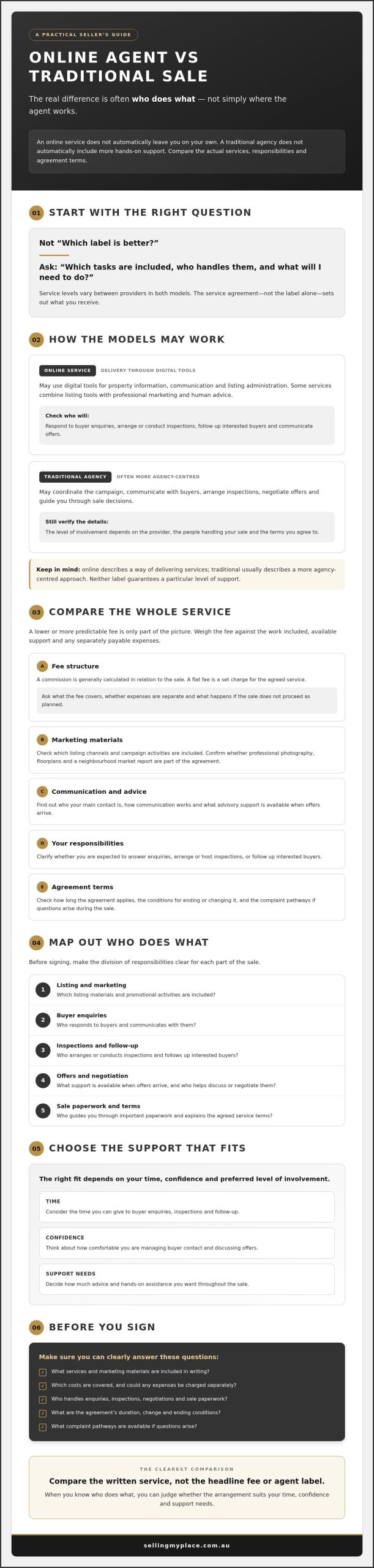
When comparing an online real estate agent vs traditional sale, the biggest difference may not be where the agent works, but who handles each part of the process. An online model doesn’t automatically mean you’re on your own, and a traditional agency’s higher level of involvement shouldn’t be assumed without checking what’s included.
It’s understandable to weigh a lower-fee option against the reassurance of more hands-on support, especially when you’re managing buyer enquiries, inspections and important sale paperwork. The useful comparison is between the actual services, tasks and terms, not just the labels or headline fees.
This guide explains how to compare marketing, communication, negotiation support, costs and your responsibilities under each model. Before signing, find out who handles buyer enquiries and inspections, what support is available when offers arrive, and whether professional photography, floorplans, neighbourhood market reports or advisory services are included. Once you know who does what, you can choose an approach that fits your time, confidence and support needs.
Key Takeaways
- Compare the online real estate agent vs traditional options by the tasks and support included, not the label alone.
- Check which marketing materials and advisory services are included in writing, and whether any costs are separate.
- Before signing, clarify who manages buyer enquiries, inspections, negotiations and sale paperwork.
- Match the level of hands-on support to your available time, confidence and preferred level of involvement.
- Review the agreement and complaint pathways so you know what to expect if questions arise during the sale.
Online real estate agent vs traditional: what is the real difference?
The main distinction is usually how the service is delivered, not whether a real person is involved. An online provider may use digital tools for property information, communication and listing administration. A traditional agency often works through direct contact with an agent and an agency team. Neither label tells you on its own how much support you’ll receive or how much of the selling work you’ll need to do.
For a useful overview of what is an online real estate agent, separate the online platform from the service agreement. The online real estate agent vs traditional comparison comes down to which tasks are included, who carries them out and how the provider charges.
What does an online real estate agent do?
Online property services can combine digital listing tools with professional marketing and human advice. A service might provide a property listing, photography, floorplans or a neighbourhood market report, alongside advisory support. Inclusions vary, so check the agreement for the specific service you’re considering.
A listing service doesn’t necessarily manage every step of the sale. Ask who responds to buyer enquiries, arranges or conducts inspections, follows up interested buyers and communicates offers. If you’re expected to take on any of these tasks, consider whether you have the time and confidence to do so.
What does a traditional real estate agent do?
A traditional agency may coordinate the campaign, communicate with buyers, arrange inspections and negotiate offers on the seller’s behalf. The agent may also guide you through decisions as the sale progresses. The level of involvement depends on the provider, the people handling your sale and the terms you agree to.
Traditional service isn’t identical across Australia, and online support varies too. One provider may offer substantial advice through online communication; another may leave more buyer-facing work to the owner. Read the agreement rather than relying on assumptions about the model.
In short: online describes a way of delivering services, while traditional usually describes a more agency-centred approach. The service agreement sets out what you actually receive, including:
- Fee structure: whether you’ll pay a flat fee or a commission, and what the charge covers.
- Marketing: which listing and promotional materials are included.
- Support and tasks: who handles buyer contact, inspections and follow-up.
- Terms: what the agreement requires and how long it applies.
Compare these details side by side. That will show whether the service matches your preferred level of involvement, instead of leaving you to choose by label alone.
Compare fees, marketing and support, not just the agent label
A lower or more predictable fee can be appealing, but it only tells part of the story. In the online real estate agent vs traditional comparison, weigh the fee model against the work included, the support available and any expenses treated separately in the agreement. A fee structure alone can’t tell you how a campaign will perform or what sale outcome to expect.
How do commission and flat-fee models differ?
A commission is generally calculated in relation to the sale, while a flat fee is a set charge for the agreed service. Ask for the full terms in writing: what the fee covers, whether any costs are payable separately, and what happens if the sale doesn’t proceed as planned. Compare the full services and costs rather than assuming one model will automatically cost less overall.
| What to compare | Questions to ask |
|---|---|
| Fee model | Is the fee commission-based or flat? What services and any separately payable expenses are covered? |
| Marketing | Which listing channels and campaign activities are included? Are professional photography and floorplans part of this agreement? |
| Support | Who is your main contact? Who responds to buyer enquiries and helps you consider or discuss offers? |
| Your tasks | Are you expected to arrange or host inspections, answer enquiries or follow up interested buyers? |
| Agreement terms | How long does the agreement apply, and what are the conditions for ending or changing it? |
What marketing and personal support should you check?
Look beyond a promise of online exposure. Ask which platforms will carry the listing, whether photography and floorplans are included, and who coordinates campaign updates. Confirm whether you’ll speak directly with an adviser about buyer interest and offers, or whether those tasks sit with you. Get the details in writing before you commit. For more on the elements to assess, see this guide to professional residential property listing services.
Traditional agencies and online providers can have different agreements and service arrangements. For wider context, explore the Real Estate Institute of Australia’s information on Australian real estate industry standards.
If you’re considering a flat-fee listing and advisory support, you can discuss your selling options with Kincade International Direct Sales and clarify which services and responsibilities apply to the arrangement.
Will an online agent provide enough support during your sale?
Online service doesn’t automatically mean you’re left to manage the sale alone. Some providers pair digital listing tools with professional advice, while others expect the owner to take a more active role in dealing with buyers. The key questions are what support is available, when you can access it and where the provider’s role ends.
That distinction matters when offers arrive and you need to make decisions. Ask whether an adviser can help you understand an offer or prepare for a negotiation, and what that assistance covers. For practical pointers, read these property sale negotiation tips. Advice and negotiation support vary by service, so check the scope rather than assuming it’s included.
Which sale tasks might remain with the owner?
Before signing, map out the work from listing to offer. For each task, confirm whether the provider, you or another professional is responsible. This can reveal gaps that aren’t obvious from a marketing description.
- Buyer contact: Who answers enquiries, shares property information and follows up interested buyers?
- Inspections: Who arranges access and conducts inspections? If you’re responsible, what coordination is expected?
- Campaign updates: Who prepares or organises marketing materials, and how will you hear about buyer interest and progress?
- Offers and paperwork: Who communicates offers and explains the next steps? Clarify separately who handles contract preparation and legal or conveyancing work.
Marketing assistance and conveyancing are different services. If a provider mentions conveyance advice, ask what it covers and whether you’ll still need a solicitor or conveyancer for other parts of the transaction.
How can you assess the support before signing?
Ask who your main contact will be, how you can reach them and what response expectations apply during the campaign. Request written details of any advice, negotiation assistance and service limits. Check the agreement’s duration, exit terms and any obligations that continue if you change your selling plans.
A clear conversation now can prevent uncertainty later. CHOICE’s guide to how to choose a real estate agent offers further questions to consider when assessing an agent’s service and terms. Use those questions alongside your own task list, then choose the arrangement that gives you the level of guidance and involvement you’re comfortable with.
Which real estate agent model fits your time, confidence and priorities?
The right choice depends on more than the fee. Think about how much time you can give the sale, how comfortable you feel speaking with prospective buyers, and whether you’d rather coordinate tasks yourself or have an agent take a more hands-on role. Choose a service whose responsibilities feel manageable from the outset, while allowing for your needs to change during the sale.
When might a traditional agency suit your situation?
A traditional agency may suit you if you want an agent to coordinate more campaign activity and prefer regular, direct communication as decisions arise. That can feel reassuring if you have limited time or would rather not lead buyer conversations and offer discussions yourself. Still, don’t assume every agency agreement includes the same hands-on help. Confirm who manages each task, how updates are provided and what the agent’s role covers.
When might an online service suit your situation?
An online service may appeal if you’re comfortable being more involved, value digital access and want to consider a different fee structure. Some services combine residential property listings with marketing materials and advisory support, but inclusions and the scope of advice vary. Check that the services address the areas where you want help. A flat fee alone won’t tell you how much you’ll need to do.
For a practical sense of the owner’s role, read this guide on how to sell your own home. Even if you don’t plan to manage the whole sale yourself, it can help you identify which responsibilities you’re happy to take on and where you’d value professional guidance.
To compare providers fairly, use the same written checklist for each option. Assess how well each agreement matches your needs across:
- Time: Can you respond to buyers and coordinate any tasks assigned to you?
- Confidence: Are you comfortable discussing interest and offers, or do you want more guidance?
- Control: Do you want to be closely involved, or would you prefer the agent to coordinate more of the campaign?
- Support: Is your contact and their role clear, including the limits of any advice?
- Fit: Are marketing inclusions, responsibilities and agreement terms set out clearly in writing?
The best match is the one that fits your actual capacity, not an ideal version of your schedule. If a flat-fee listing and advisory approach is on your shortlist, discuss your selling options with Kincade International Direct Sales and confirm which inclusions and responsibilities apply.
How to choose an Australian selling service with confidence
Once you’ve compared the models, turn your priorities into a simple due-diligence check. The aim isn’t to find a label that sounds reassuring. It’s to understand exactly what you’re agreeing to and whether the service fits your sale.
A practical checklist before you commit
- 1. List your priorities. Note how much time you can give the sale, which tasks you’re comfortable handling and where you want advice or hands-on help.
- 2. Compare written inclusions. Check marketing deliverables such as listing exposure, photography and floorplans alongside the fee structure. Ask which services are included and whether any expenses may be charged separately.
- 3. Clarify responsibilities. Confirm who manages enquiries, inspections, negotiations and campaign updates. Find out who your contact is and what advisory support covers.
- 4. Review the agreement. Read the duration, cancellation conditions, service responsibilities and other obligations before signing. Ask for an explanation of anything unclear.
- 5. Check complaint pathways and local guidance. Find out how the provider handles complaints and where to seek further help. Property sale and consumer requirements can vary by state or territory, so check current guidance for your location and obtain independent advice if needed.
Questions to ask every prospective provider
Ask each provider the same questions so you can compare answers fairly: What does the fee cover? Could any services involve separate charges? Who responds to buyers, coordinates inspections and supports offer discussions? How will campaign progress be communicated? What happens if you want to end the agreement? Clear written answers make it easier to compare the support on offer, not just the presentation.
The online real estate agent vs traditional decision comes down to the service and terms that suit your priorities. Kincade International Direct Sales offers flat-fee, commission-free property marketing and advisory packages. Its listed services include professional photography, floorplans, neighbourhood market reports and advisory support. Confirm current package inclusions, responsibilities and the scope of advice before deciding.
Compare those details with each provider’s written offer, then choose with a clear view of who does what. To discuss the available selling options, contact Kincade International Direct Sales.
Choose the support that lets you sell with confidence
The online real estate agent vs traditional decision isn’t simply about choosing a lower fee or a familiar agency model. Compare what each provider will do, what you’ll need to manage and how much guidance you want with buyer enquiries, inspections and offer discussions. Then check the written agreement for marketing inclusions, responsibilities, terms and any separately payable expenses.
Kincade International Direct Sales offers a flat-fee, commission-free property marketing and advisory model. Professional photography and floorplans are among its listed services, and its Agent Advisory Service offers pre-sale consulting and conveyance advice. Confirm which services are included in the package you’re considering, along with the current scope of advisory support and the terms.
If you’d like to explore whether this approach fits your priorities, discuss your property sale with Kincade International Direct Sales. Contact the team to clarify the package inclusions and responsibilities before deciding.
Frequently Asked Questions
Is an online real estate agent cheaper than a traditional agent?
An online service may use a flat-fee structure, while a traditional agency commonly charges commission linked to the sale. The total cost depends on the agreement and any separate expenses. Compare what each fee covers, including marketing and support, rather than judging by the headline fee. The online real estate agent vs traditional choice should also reflect which sale tasks you’ll handle and how much professional guidance you want.
Can an online real estate agent negotiate with buyers?
Some online services may provide advice or assistance with offers, but negotiation support varies between providers. Before signing, ask who communicates offers, whether an adviser can help you assess or respond to them, and what the service’s limits are. Get the answers in writing. If you’re expected to lead negotiations yourself, consider whether you feel comfortable discussing terms and responding to buyer questions.
What is the difference between an online agent and a traditional real estate agent?
The difference is generally how the service is delivered, not whether human support is available. Online providers may use digital tools for listings and communication, while traditional agencies often coordinate directly through an agent or team. Either model can vary in marketing, advice and seller responsibilities. Compare the written agreement to see who handles enquiries, inspections, offers and campaign updates before deciding which arrangement suits you.
Do online real estate agents include professional photography and floorplans?
Some online property services include professional photography and floorplans, but inclusions vary by provider and package. Check whether both are part of the specific service you’re considering, or whether they involve separate arrangements or charges. Also confirm how the listing will be presented and where it will appear. Kincade International Direct Sales lists photography and floorplans among its services, but verify current package inclusions before proceeding.
How much does an online real estate agent cost in Australia?
There isn’t one standard cost for an online real estate agent in Australia. Providers may charge a flat fee or use another structure, and marketing or other services may be charged separately. Ask for a written breakdown of the fee, inclusions and possible additional expenses so you can compare the full agreement with other options. Kincade International Direct Sales describes its model as flat-fee and commission-free; confirm its current terms directly.
What should I check before signing with an online real estate agent?
Check the written inclusions, fee structure, agreement duration and cancellation conditions before signing. Clarify who handles buyer enquiries, inspections, offer discussions and campaign updates, and identify the contact available to you. Confirm whether photography, floorplans and advisory support apply to your agreement, and ask about any separate expenses. If a term is unclear, request an explanation in writing and consider independent advice before committing.
Can I sell my home without a traditional real estate agent?
Yes, you can choose a sale-by-owner approach or use a property marketing and advisory service instead of a traditional agency. The level of support differs: you may take responsibility for buyer enquiries, inspections and follow-up, or receive some guidance depending on the service. Before choosing, consider the time you can give the sale and confirm who handles each task, including any conveyancing or contract responsibilities.