
Could a tax you usually don’t owe still affect how you plan your sale? For anyone searching “stamp duty for sellers australia”, the usual answer is reassuring: transfer duty, commonly called stamp duty, is generally the buyer’s responsibility, not a tax charged to the seller simply for selling a home. Still, settlement can involve other costs, and the details of your transaction matter.
It’s understandable to worry that an unexpected bill could reduce your sale proceeds, especially when stamp duty is easily confused with capital gains tax, land tax, GST or conveyancing costs. These are separate charges and obligations, and whether they apply to you depends on your circumstances.
This 2026 guide explains who usually pays transfer duty and when, which sale-related costs sellers may still face, and what to check before settlement, including rates adjustments. You’ll also learn where to confirm the rules for your state or territory and when to ask a conveyancer or qualified tax professional about your specific sale, so you can plan with greater clarity.
Key Takeaways
- For stamp duty for sellers australia, the usual starting point is that the buyer pays transfer duty when ownership changes.
- Transfer duty is separate from capital gains tax and other sale-related costs, which may depend on your circumstances.
- Check the transaction details carefully if your sale isn’t a standard residential property transfer.
- Use the relevant state or territory revenue authority to confirm current duty guidance for the property and transaction.
- A written sale-cost checklist can help you prepare for tax questions, professional fees, loan matters and marketing decisions before settlement.
Stamp duty for sellers in Australia: what the term means
“Stamp duty” is the familiar name Australians often use for property transfer duty. The precise terminology and rules depend on the state or territory, because the duty is imposed under state or territory arrangements rather than as a single federal property tax. The general Stamp duty overview explains the term’s wider use, but your local revenue authority is the place to confirm how it applies to a particular transaction.
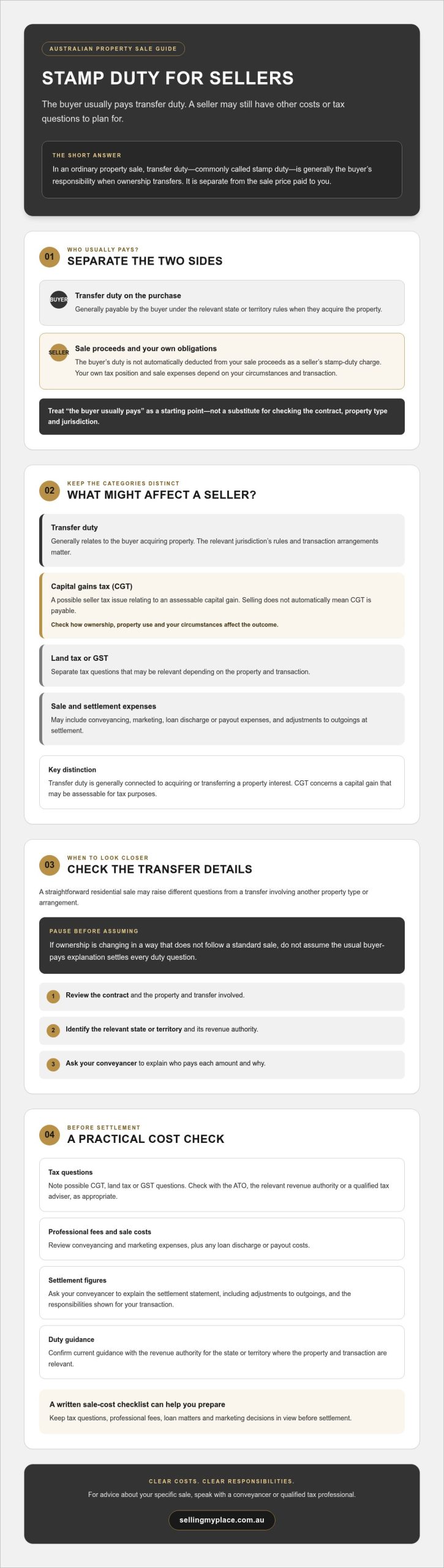
For sellers, the usual position is reassuring: the buyer generally pays transfer duty when property ownership transfers. It’s separate from the amount the buyer agrees to pay you under the sale contract, so the buyer’s duty isn’t automatically deducted from your sale proceeds as a seller’s stamp-duty charge. Treat this as a starting point, though, not a substitute for checking the contract, property type and jurisdiction.
Is stamp duty normally paid by the buyer or seller?
In an ordinary property sale, the buyer is generally responsible for the duty associated with acquiring the property. The sale price is paid to the seller under the contract; transfer duty is a separate obligation assessed under the relevant jurisdiction’s rules. Settlement can also involve other payments and adjustments, so ask your conveyancer to explain the figures and responsibilities shown for your transaction.
As a general rule, the buyer pays transfer duty on a property purchase, but the applicable jurisdiction, transaction details and contract should always be checked.
What does transfer duty apply to?
Transfer duty is commonly associated with acquiring or transferring certain interests in property. The exact transactions covered, how duty is assessed and who is responsible are determined by each state or territory’s legislation and official guidance. A straightforward residential sale may therefore raise different questions from a transfer involving another property type or arrangement.
If ownership is changing in a way that doesn’t follow a standard sale, don’t assume the usual buyer-pays explanation settles every duty question. Check the contract and ask a conveyancer to identify the relevant revenue authority’s guidance for the property and transfer involved.
If you’re looking up stamp duty for sellers australia, focus on separating the buyer’s transfer-duty obligation from your own sale proceeds and obligations. A clear explanation of the contract and settlement figures can help you understand what is being paid, by whom and why.
Do sellers pay stamp duty, or other taxes and selling costs?
Understanding stamp duty for sellers australia starts with separating the buyer’s transfer duty from the costs and tax questions that may belong to you as the seller. They aren’t interchangeable, and not every seller faces the same obligations. The Australian Government’s Stamp duty rules page explains the general framework and links to state and territory guidance.
| Item | How it may relate to a sale | What to check |
|---|---|---|
| Transfer duty | Generally payable by the buyer when they acquire property, subject to the relevant rules. | Confirm the jurisdiction’s guidance and the transaction arrangements. |
| Capital gains tax (CGT) | A possible seller tax issue relating to an assessable capital gain. A sale doesn’t automatically mean CGT is payable. | Ask the ATO or a qualified tax adviser how your ownership, use and circumstances affect the outcome. |
| Land tax or GST | Separate tax questions that may be relevant depending on the property and transaction. | Check with the relevant revenue authority, the ATO or a qualified adviser. |
| Sale and settlement expenses | May include conveyancing, marketing, loan discharge or payout expenses, and adjustments to outgoings at settlement. | Review your contract, loan details and settlement statement with the relevant professional. |
How is transfer duty different from capital gains tax?
Transfer duty is generally connected to acquiring or transferring a property interest. CGT, by contrast, concerns a capital gain that may be assessable for tax purposes. Whether CGT applies, and how it’s treated, depends on individual circumstances. Don’t assume that selling a home or investment property automatically creates a tax bill. The Australian Taxation Office (ATO) provides current CGT guidance. For advice tailored to you, speak with a tax professional who can consider ownership, how the property was used and your wider circumstances.
Could land tax or GST affect a property seller?
Possibly, but neither is another name for transfer duty, and their application isn’t identical for every seller. Property use, ownership structure and the type of transaction can all be relevant factors to verify. Check land-tax questions with the relevant state or territory revenue authority, and GST questions with the ATO or a qualified tax adviser. Your conveyancer can help identify transaction details to raise, but shouldn’t replace tax advice.
A written cost checklist can help keep confirmed taxes separate from professional fees, marketing decisions and loan matters. If you’re considering how to prepare and market your home, property sale support information is available here. Kincade International Direct Sales provides flat-fee property marketing and advisory services. Marketing support is separate from stamp-duty advice and doesn’t determine your tax obligations.
When can an Australian property sale need a closer duty check?
The usual buyer-pays approach is a useful starting point, but it won’t answer every question about a particular transfer. If the arrangement differs from a straightforward residential sale, pause before assuming the standard explanation applies. The relevant rules depend on the state or territory where the property is located and on the details of the transaction.
Which transaction details should sellers flag?
Before settlement, tell your conveyancer if the transfer involves anything out of the ordinary, such as:
- a transfer between related parties rather than an ordinary sale to an unrelated buyer
- a partial interest in the property, rather than the whole interest
- unusual consideration, or an arrangement where the agreed payment isn’t straightforward
- a property type or transaction structure that isn’t a standard residential sale.
These are prompts for a closer review, not claims that duty will necessarily apply or that a particular party must pay it. Terminology and treatment can differ across jurisdictions. Ask your conveyancer to check the current guidance from the revenue authority for the state or territory where the property sits, and to seek qualified tax advice if the transaction raises broader tax questions.
Can a contract change who pays a duty?
There’s an important distinction between who may be legally liable under duty rules and what the parties agree about payments between themselves. A contract may set out payment or reimbursement arrangements, but that wording shouldn’t be treated as a substitute for confirming the statutory position. The effect of any clause depends on the transaction and applicable law, so have a conveyancer explain it before you rely on an assumption.
Contract terms may allocate costs between the parties, but they don’t replace checking who is liable under the relevant duty rules.
Read the sale contract closely and ask how any duty-related wording flows through to the settlement statement. Check which party is expected to make each payment, whether an agreed contribution or adjustment is recorded, and whether those arrangements match the advice you’ve received. If something is unclear, raise it before settlement rather than relying on a verbal understanding.
For sellers researching stamp duty for sellers australia, the practical safeguard is to match three things: the property’s jurisdiction, the nature of the transfer and the contract’s payment terms. A conveyancer can help interpret the settlement documents and identify questions for the relevant authority. That way, the general rule remains a guide while the actual transaction gets the careful review it needs.
How sellers can check stamp duty before settlement
A few well-organised checks can help you separate the buyer’s duty question from your own contract and settlement responsibilities. If you’re researching stamp duty for sellers australia, use this process to find the right official guidance and know which questions to put to your conveyancer.
What information should sellers gather first?
Start with the details that help an adviser identify the rules for your transaction. You don’t need to gather more personal or financial information than is relevant.
- Identify the property’s jurisdiction. Note the state or territory where the property is located. The applicable duty guidance comes from that jurisdiction’s revenue authority.
- Describe the transaction. Clarify whether it’s an ordinary residential sale or has features such as a transfer of part of an interest, related parties or unusual consideration. These details are prompts for review, not proof that duty applies.
- Review the contract. Have the signed or proposed contract available, including any wording about duty, contributions or adjustments. Ask your conveyancer to explain clauses you’re unsure about.
- Check settlement arrangements. Gather the proposed settlement date and relevant settlement information, then ask how payments and adjustments are expected to appear in the settlement statement.
Share only what’s needed with the professionals helping with the transaction. Take care not to circulate unnecessary identifying, banking or other sensitive personal information.
Who can confirm the answer for your transaction?
For the current official position, check the revenue authority for the state or territory where the property sits. Its guidance is the appropriate starting point for duty rules and any relevant forms, calculators or updates. Don’t rely on a general online estimate unless you’ve confirmed that its inputs and assumptions match your transaction.
Your conveyancer or solicitor can help interpret the contract and settlement implications. Ask them to clarify who is legally liable, how any agreed payment arrangement is recorded, and whether unclear contract wording needs attention before settlement. If the answer depends on unusual transaction details, ask what further professional advice is appropriate.
Keep tax questions in their own lane. For income-tax or GST guidance, consult the Australian Taxation Office (ATO) or a qualified tax professional. Duty checks shouldn’t be replaced by decisions about how to market the property.
For information about preparing and marketing your residential property, see the property sale support options. This support can help you plan the sale process, while duty and tax questions remain with the relevant authority and qualified advisers.
Plan the sale with clear costs and the right support
A clear cost picture can make a major sale feel more manageable. Buyers generally pay transfer duty, while sellers should separately check their own tax position and the expenses involved in preparing and completing the sale. Keep those categories distinct: the buyer’s duty isn’t a substitute for checking your own obligations, and a marketing decision doesn’t determine your tax liability.
How should sellers build a reliable sale-cost picture?
Start a written checklist and label each item as confirmed, estimated or awaiting professional advice. That simple step helps prevent an assumption from being mistaken for a settled cost. You might organise it under these headings:
- Taxes: note any advice or official guidance you’ve received about your own tax position. Keep buyer transfer duty separate.
- Professional fees: record conveyancing and any tax advice you’re seeking, based on information provided by the relevant professional.
- Loan matters: ask your lender and conveyancer what needs to be checked about your loan and its handling at settlement.
- Marketing and preparation: list the services and sale-preparation choices you’re considering, and confirm their terms directly.
Update the checklist as the contract and settlement details become clearer. For a practical overview of the owner-led sale process, read this guide on how to sell your own home. It can help you think through the steps involved without mixing them up with duty or tax advice.
Where does property-selling support fit in?
Marketing support can help organise how your home is presented and listed, but it can’t determine who owes tax or how duty rules apply. Kincade International Direct Sales offers flat-fee property marketing and advisory packages, including professional photography and floorplans. Its commission-free model is separate from tax, conveyancing and loan-related questions. Find out more about professional residential property listing services.
For anyone weighing up stamp duty for sellers australia, the steady approach is to verify duty with the relevant revenue authority, get transaction-specific advice where needed, and plan the rest of the sale costs in their own categories. A marketing service can support the sale process, but it doesn’t change your duty or tax position.
Move ahead with a clearer sale plan
For stamp duty for sellers australia, the key takeaway is that buyers generally pay transfer duty, while sellers should check their own tax position and sale costs separately. The contract, transaction details and state or territory rules matter, so confirm what applies with the relevant revenue authority and a conveyancer before settlement.
A written checklist can help you keep confirmed obligations, professional advice, loan matters and marketing decisions organised. Kincade International Direct Sales is a commission-free property marketing and advisory service with a flat-fee model. Its services include professional photography and floorplans, separate from tax advice or duty obligations.
With clear information and the right support, you can take the next step with greater confidence.
Frequently Asked Questions
Do sellers pay stamp duty when selling a house in Australia?
Generally, no. In an ordinary Australian residential sale, the buyer usually pays transfer duty, commonly called stamp duty, when acquiring the property. It’s separate from the sale price and isn’t automatically deducted from your proceeds as a seller’s duty payment. Check the contract and settlement arrangements for your specific transaction, particularly if the transfer is unusual or involves more than a standard sale.
Is stamp duty the same as capital gains tax?
No. Transfer duty is generally associated with acquiring or transferring certain property interests, while capital gains tax (CGT) concerns a capital gain that may be assessable for tax purposes. Selling a property doesn’t automatically mean you’ll owe CGT. The outcome can depend on factors such as ownership and how the property was used. Check current Australian Taxation Office (ATO) guidance and seek advice for your circumstances.
Can a seller be responsible for transfer duty in Australia?
The buyer generally pays transfer duty in an ordinary property purchase, but don’t assume that rule answers every transaction. The applicable legislation and transaction details determine legal liability, while a contract may separately describe how the parties arrange or share a payment. If your sale involves a partial interest, related parties or another non-standard feature, ask your conveyancer to check the relevant state or territory rules.
How much stamp duty does a seller pay?
For a typical residential sale, the seller generally doesn’t pay the buyer’s transfer duty, so there usually isn’t a seller stamp-duty amount to calculate. That doesn’t mean the seller has no sale costs or tax questions: conveyancing, loan-related matters and a possible CGT liability are separate considerations. Don’t rely on a generic calculator for an unusual transfer. Confirm the transaction details with the relevant revenue authority and your adviser.
What happens if the sale contract says the seller pays stamp duty?
Ask your conveyancer to explain the clause before relying on it. Contract wording may set out an agreed payment or reimbursement arrangement between the parties, but it doesn’t necessarily change who is legally liable under the relevant duty legislation. Have the clause read alongside the transaction details and settlement statement, and clarify who is expected to pay what before settlement. If needed, seek advice from a qualified professional.
Do sellers pay stamp duty on an investment property sale?
In an ordinary sale, the buyer generally pays transfer duty, whether the property is an investment or a home. For the seller, an investment property may raise separate tax questions, including whether a capital gain is assessable. The result depends on the owner’s circumstances and the property’s history. Check the ATO’s current CGT guidance and speak with a qualified tax professional rather than assuming duty and CGT are the same.
Does every Australian state and territory have the same stamp-duty rules?
No. Transfer duty is governed by state and territory rules, so terminology, processes and the way a particular transaction is treated can vary. The property’s location determines which revenue authority’s guidance to check. For a current answer, use that authority’s official information and ask your conveyancer how it applies to your contract and settlement. Avoid relying on a rule or calculator intended for a different jurisdiction.
Should I check stamp duty before settlement?
Yes, especially if the transaction isn’t a straightforward residential sale or the contract includes unclear payment wording. Identify the property’s state or territory, review the transaction type and contract, then check the relevant revenue authority’s current guidance. Ask your conveyancer to clarify liability and settlement arrangements before you rely on an assumption. For sellers researching stamp duty for sellers australia, this helps keep the buyer’s duty distinct from your own sale costs and tax questions.