You have seen the headline: “List your home for just $799.” It sounds simple. It sounds like a deal. But experienced Australian sellers know that what a flat-fee package advertises and what it actually delivers can be two very different things.
Flat fee real estate agents have genuinely disrupted the traditional commission model, giving sellers more control over their costs. The problem is that not every package is built the same way. One service’s $799 might include professional photography, premium portal syndication, and a floor plan. Another’s might include none of those things, leaving you to pay separately for every component that actually drives buyer interest.
This guide is designed to change how you evaluate your options. Rather than taking marketing copy at face value, you will walk away with a clear, practical understanding of every deliverable that belongs in a quality flat-fee property marketing package. From portal reach and visual assets to legal compliance and seller support, this breakdown covers the full picture. By the end, you will have a checklist you can use to compare any package with confidence before you commit.
Why Flat-Fee Marketing Packages Are Not All Created Equal
The flat-fee model has grown significantly across Australia as sellers seek to avoid traditional commission costs, but “flat fee” describes a pricing structure, not a guaranteed set of deliverables. Two packages priced at similar figures can produce vastly different results for your sale, depending on portal syndication tier, visual asset quality, and the level of support included after your listing goes live.
Understanding where flat-fee packages sit in the broader pricing landscape helps you evaluate them correctly. Australian real estate marketing generally operates on three billing structures: monthly retainers (ongoing management), performance-based pricing (rare, tied to results), and project-based pricing (finite deliverables for a fixed cost). Flat-fee property marketing packages are project-based. You are buying a defined scope of work, not an ongoing service relationship. That distinction matters because every item either is or is not included, and there is no automatic provision for extras.
The most important filter to apply immediately is transparency. Quality providers clearly separate what the flat fee covers from what requires additional spend. A package that buries portal upgrade costs, photography charges, or floor plan fees in the fine print is not genuinely flat-fee in practice. If a provider cannot tell you exactly what is and is not included, that ambiguity is a signal worth heeding.
For a thorough grounding in how the flat-fee model works before you compare packages, understanding exactly what you are paying for in a fixed-fee arrangement is a useful starting point.
The sections below break down every major component category so you can assess any package against a concrete checklist, rather than marketing copy.
Portal Syndication: Which Sites Your Listing Actually Reaches
Portal reach is the single most consequential variable in a flat-fee real estate marketing package, and it should be the first thing you verify in writing.
Realestate.com.au and Domain are Australia’s two dominant portals, commanding the overwhelming majority of active buyer traffic. Any package that excludes either one limits your buyer pool before a single enquiry is made. Confirm both are explicitly named in your package, not implied by phrases like “all major portals.”
Listing tier matters as much as portal inclusion. On realestate.com.au, a standard listing sits below Premiere, Highlight, and Feature placements in search results. Buyers who don’t scroll past the promoted results may never see your property at all. Ask your provider whether the flat fee covers a standard position or an upgraded tier, and whether any upgrade is a one-time cost or time-limited. The duration and placement tier of your listing directly affects how long it maintains prominent visibility in search results.
International syndication is not standard. Some flat-fee providers extend listings to international platforms. If your property is likely to attract offshore interest, verify whether international syndication is available and which markets it covers, rather than assuming it is included.
Two questions to ask before you commit:
- Does the package state the exact portal names, listing tier, and active duration in writing? Vague references to “major portals” are a red flag.
- If you reduce your asking price and need to refresh or re-list, does that incur an additional fee? This affects your total cost if the property takes longer to sell.
If you are still working out whether to list at all, the complete guide to listing and selling your home in Australia covers what to expect from valuation through to settlement.
Photography and Visual Assets: The Non-Negotiables and the Nice-to-Haves
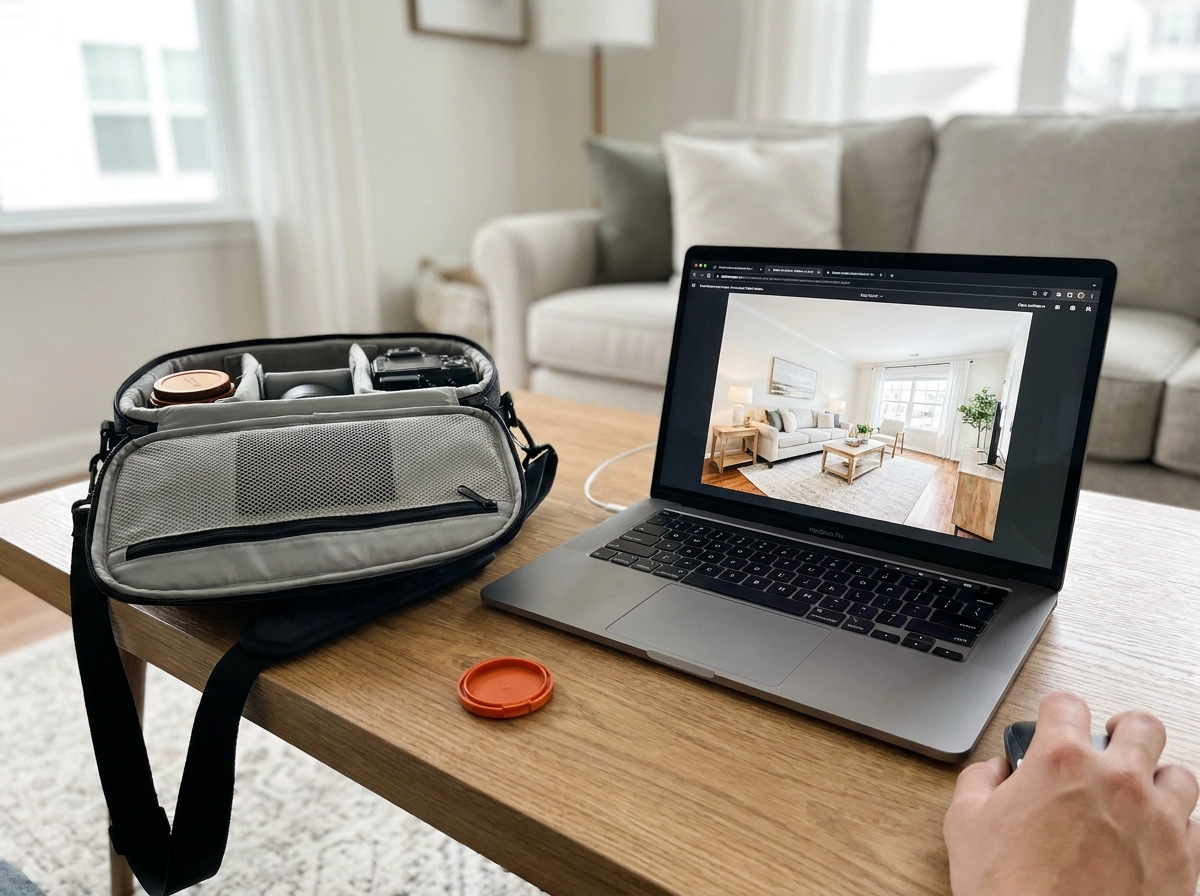
Once your listing is live on the right portals, what buyers actually see determines whether they enquire. Visual assets are where that decision gets made.
Professional photography is the single highest-impact element in any listing. Buyers consistently engage more with professionally shot listings than those photographed on a smartphone, and the gap in enquiry rates is material, not marginal. Some flat-fee packages include a photo shoot in the base price; others treat it as a paid add-on. Confirm this before you sign up.
When reviewing any photography inclusion, check three specific things: the number of final edited images delivered, the turnaround time from shoot to delivery, and whether a reshoot is available if conditions on the day are poor. Bad weather or an unstaged property can undermine an otherwise strong shoot.
Beyond standard photography, several additional visual formats are worth understanding:
- Drone and aerial photography adds genuine value for large blocks, rural properties, and homes with notable outdoor features such as pools, views, or landscaping. It is rarely included in base packages and is usually priced as an add-on.
- 3D virtual tours (Matterport-style walkthroughs) allow interstate and overseas buyers to inspect a property without travelling. These extend your buyer pool meaningfully for premium or regional listings but are almost never included in a standard flat-fee package. For a fuller look at how these formats work alongside floor plans and drone footage, see Beyond Still Images: 3D Tours, Drones, and Floorplans.
- Video walkthroughs are a separate product from 3D tours. A video is a linear, edited production that typically requires a videographer and carries higher production costs. Clarify which format is being offered before assuming either is included.
- Twilight photography captures a property under dusk lighting and can markedly lift the visual appeal of certain homes. It is almost always a chargeable add-on. Confirm the cost before assuming it is bundled.
Floor Plans: Why Their Inclusion (or Absence) Affects Buyer Behaviour
Beyond photography, floor plans are one of the most requested elements by buyers browsing online listings. Photographs show how a property looks; a floor plan shows how it works. Buyers use floor plans to pre-qualify a property spatially before committing to an inspection, filtering out layouts that don’t suit their household before they ever contact the seller.
Understand what type of floor plan you’re getting
There are two distinct types. A marketing floor plan is a clean 2D diagram designed for listing purposes, showing room layout, flow, and approximate dimensions. An architectural or measured floor plan is a precise technical document used for construction and planning. Most flat-fee real estate packages that include floor plans provide the marketing version, which is entirely appropriate for listing purposes and what buyers expect to see on portal listings.
Check whether it’s measured on-site or drawn from council records
This distinction matters. Council-sourced plans can be outdated or inaccurate, particularly for apartments where internal layouts have been modified since original construction. A floor plan measured on-site is more accurate and more credible to buyers scrutinising room dimensions before making an offer. For a deeper look at why this matters and what to expect from the process, Beyond the Photos: Why Floor Plans are Essential for a Successful Sale provides useful context.
Know the cost range and upgrade options
Some providers include a marketing floor plan in their standard package; others charge it as a standalone add-on; the cost varies depending on property size and provider. 3D floor plans, which render the layout with furniture and spatial depth, are increasingly used in premium listings and may be available as a paid upgrade. Weigh that cost against your property’s price point and likely buyer profile before committing.
SellingMyPlace.com.au includes marketing floor plans within its flat-fee service. Given that comparable packages routinely treat floor plans as an extra cost, this inclusion directly reduces the add-on spend sellers face elsewhere.
Listing Copywriting and Property Description: Who Writes Your Listing?
Your listing copy is not decorative text. It is a searchable, keyword-bearing asset that influences how your listing ranks in portal search results and whether buyers click through or scroll past.
Copy quality affects discoverability. realestate.com.au’s support documentation addresses how search engines rank property listings, and experienced copywriters treat listing text and metadata as discoverability levers. A description that omits relevant suburb names, property features, or lifestyle keywords may rank lower than comparable properties, suppressing enquiry before a single buyer sees your home.
Flat-fee packages handle copywriting differently. Some include professionally written copy as standard. Others provide a template for sellers to self-complete, or offer copy review as an optional add-on. The more important question is whether included copy is tailored or generic. A templated description can miss the selling points that matter most: north-facing orientation, recent kitchen renovation, proximity to a new train station, or exceptional street appeal.
Platform formatting adds another layer of complexity. realestate.com.au enforces a 150-character limit for listing headlines. An experienced writer works within these constraints while keeping the headline compelling and keyword-rich. An inexperienced seller often does not know the limit exists until the platform truncates it.
If copy is seller-written, check whether the provider offers a review or edit service and whether guidance materials are available. Sellers writing their own descriptions risk overpromising on features, omitting key inclusions, or inadvertently using terms restricted under Australian Consumer Law. For practical guidance on structuring your own description effectively, review the Key Takeaways from a dedicated guide to writing private sale property descriptions.
For-Sale Signage and Print Marketing: Still Relevant in 2026?
Beyond your listing copy, physical and social marketing assets still play a meaningful role in generating buyer enquiry, particularly in markets where not every potential buyer starts their search online.
For-sale signage works hardest in suburban and regional areas, where passing traffic represents a genuine lead source. A corflute board planted at the front of a property catches neighbours, local commuters, and people actively driving streets in a target suburb. That passive visibility is difficult to replicate through digital channels alone.
Whether signage is included in a flat-fee real estate agent package varies considerably. Some providers include a standard corflute board and installation in their base fee; others charge it as an add-on. Availability also differs by location, as state regulations and individual council zoning rules govern permitted sign sizes, placement, and quantities. Confirm the rules for your local government area before factoring signage into your marketing plan.
One important exception: sellers in body corporate or strata-managed buildings should verify whether their scheme rules permit external signage before assuming it is usable, regardless of what the package includes. Many strata schemes explicitly prohibit for-sale boards on common property or building facades.
Print materials, including brochures and property flyers, are less commonly bundled but genuinely useful at open-for-inspections. Sellers conducting their own inspections, as is standard in private sale arrangements, benefit from handing prospective buyers a professionally printed summary to take away.
Social media graphic assets, pre-formatted listing images sized for Facebook, Instagram, and similar platforms, are increasingly included in a high-impact marketing package and allow sellers to promote their listing organically to their own networks at no additional cost.
Seller Support and Service Levels: The Difference That Doesn’t Show Up in the Brochure
Physical marketing assets get sellers to the starting line. Support is what carries them across it.
Support level is the most underestimated variable in any flat-fee property marketing package.
Confirm the basics first. Ask every provider which support channels they offer: phone, email, live chat, or an account portal. Then ask about hours and response times. A 48-hour email turnaround is not adequate when a buyer is ready to submit an offer today and has three other properties on their shortlist.
Pricing strategy guidance is a genuine differentiator. Access to comparable sales data, suburb price trend reports, and guidance on setting an asking price or auction reserve is high-value support that some providers include as standard and others reserve for premium tiers. Sellers who enter the market without this information risk overpricing into stagnation or underpricing unnecessarily. Confirm whether it is in the package before you commit.
Negotiation support separates the functional from the minimal. Some flat-fee providers guide sellers through the offer and counteroffer process; others consider their role complete once the listing is published. Know which type you are buying before you need it.
Inspection coordination is similarly inconsistent. Support for scheduling open-for-inspections, managing buyer enquiries, and following up with attendees post-inspection varies widely across providers. Ask specifically, because it rarely appears in the headline feature list.
SellingMyPlace.com.au includes pricing strategy tools, expert guides, and step-by-step resources designed to carry sellers from listing through to settlement. For sellers weighing up their options, the What to Look for in a Flat-Fee Property Service guide is a practical reference point before making any final decision.
Legal and Compliance Inclusions: What Australian Sellers Must Not Overlook
Australian property sales are governed by state-based legislation, and disclosure obligations differ materially across jurisdictions. A flat-fee real estate marketing package does not replace legal advice, but a quality provider will identify what documentation you must obtain before your listing goes live.
State-specific requirements every seller must know:
- NSW: Under the Conveyancing Act 1919, a solicitor or conveyancer must prepare a Contract for Sale before the property can be advertised. Required attachments include a title search, Section 10.7 Planning Certificate, and sewerage diagram. This is a conveyancing cost outside your marketing package; budget for it separately.
- Victoria: Victoria requires a Vendor’s Statement (commonly called a Section 32) to be prepared before a buyer can sign a contract, confirm the current requirements with a Victorian conveyancer, as specifics are governed by state legislation. Again, this sits outside the marketing fee. Confirm whether your provider offers guidance on obtaining one.
- QLD, SA, WA and other jurisdictions: Each has its own disclosure framework. Requirements vary enough that sellers should verify their state’s obligations before committing to a listing date.
Fair Trading obligations apply nationwide. Property advertising must not be misleading or deceptive under fair trading legislation in every state. When you self-manage a listing under a flat-fee model, you carry personal responsibility for the accuracy of your listing copy. A quality provider will make this responsibility explicit, not bury it in terms and conditions.
Some flat-fee platforms reduce this risk by including template contracts, disclosure checklists, or referrals to conveyancing partners. This compliance scaffolding meaningfully lowers the risk for sellers who are unfamiliar with their state’s requirements.
Before you commit to any package, ask directly: does the service include any legal review component, or does all contract and disclosure preparation rest with you? Then factor those external legal costs into your total cost-to-sell. Know what’s required before you list so there are no compliance surprises once your property is live.
Pricing Transparency: How to Read a Package Fee Schedule Like a Seller, Not a Buyer
Once legal costs are factored in, the next number to interrogate is the package price itself.
The foundational principle is simple: a transparent fee schedule separates the provider’s service fee from any third-party media spend. What the provider charges for their work is one line item. What gets paid to realestate.com.au or Domain is another. Any provider that bundles these without disclosure makes it impossible to know what you are actually paying for.
As covered earlier, low headline prices that require significant add-on spend can exceed the cost of a more inclusive package, build a total-cost model across every item you intend to use.
Build a total-cost model, not a headline comparison. List every item included in each package, then price every item you intend to use that is not included. This gives you a genuine like-for-like figure across providers.
GST affects that figure materially. A package priced excluding GST will carry a 10% GST component on top, factor this into your budget from the start. Portal listing fees from major portals are also typically subject to GST; confirm this with your provider. Calculate your total budget on a GST-inclusive basis or you will underestimate costs.
A specific red flag: some providers include portal listing fees as a pass-through cost at a marked-up rate. You pay above the actual portal charge, with the margin hidden inside the package. Transparent providers either include portal costs at actual cost within the flat fee or pass them through with no mark-up.
Finally, confirm payment timing. Most flat-fee packages are payable upfront and non-refundable, regardless of whether the property sells. This is structurally different from commission-based arrangements, where fees are deducted from settlement proceeds. Knowing this before you commit protects you from a surprise if circumstances change.
State-by-State Variations That Affect What Your Package Must Include
Fee transparency tells you what you’re paying. State-based licensing tells you whether the package can legally deliver what it promises.
Licensing requirements for private property sales differ across Australia. In some states, sellers can manage significant parts of the transaction without a licensed agent involved. In others, a licensed agent must be named on the listing or appointed before certain steps can proceed. Knowing which category your state falls into determines what your flat-fee provider must be authorised to do on your behalf.
Major Australian portals require listings to be submitted through licensed entities, private individuals cannot list directly. Confirm your provider holds the necessary access agreements with the portals before you commit.
Queensland sellers have an additional step to confirm. Queensland has additional agent-appointment documentation requirements before an agent can legally act for a seller, ask your flat-fee provider specifically how this step is handled in their Queensland process before you sign up.
Signage is governed at the local council level, not by your provider. Some councils restrict the size, placement, or number of for-sale signs permitted on a property. Body corporate and strata schemes may prohibit external signage entirely. Check your local rules before treating a sign as a guaranteed deliverable, even if it is included in your package.
Cooling-off periods after contract signing vary by state and affect how offers are received and accepted. A flat-fee provider operating across multiple states should proactively flag these differences. If they do not, that is a gap in their service.
Before committing, confirm the provider holds a valid licence in your state and that any state-specific obligations are clearly identified as your responsibility or theirs.
The Flat-Fee Package Evaluation Checklist for Australian Sellers
Once you have confirmed your provider is licensed in your state, apply this checklist to every package you are evaluating.
1. Portal syndication
- Which portals are included by name?
- What listing tier is provided: standard, feature, highlight, or premiere?
- Is international syndication available for offshore buyer reach?
- How long is the listing active, and does a price reduction trigger a re-listing fee?
2. Photography
- Is professional photography included or an add-on?
- How many edited images are delivered?
- Is drone photography available, and at what cost?
- What is the reshoot policy if weather or conditions are poor on the day?
3. Floor plan
- Is a marketing floor plan included in the base fee?
- Is it measured on-site or generated from council plans?
- Is a 3D floor plan available as a paid upgrade?
4. Copywriting
- Is listing copy written by the provider or self-completed by the seller?
- Is a copy review or edit service available?
- Are guidance materials provided to help sellers avoid errors under Australian Consumer Law?
5. Signage and print
- Is a for-sale board included and installed?
- Are property brochures or flyers available?
- Are social media graphic assets provided for organic promotion?
6. Support
- What channels are available: phone, email, live chat?
- What are the support hours and typical response times?
- Is pricing guidance included, such as comparable sales data or suburb reports?
- Does the provider offer negotiation support once offers arrive?
7. Legal and compliance
- Does the provider flag state-specific disclosure requirements relevant to your property?
- Are template contracts, disclosure checklists, or conveyancing referrals included?
- Is the provider licensed to operate in your state?
8. Pricing transparency
- Is the full fee schedule itemised, not summarised?
- Are portal listing costs included or charged separately as a pass-through?
- Is GST clearly stated on every fee line?
- Is the fee payable upfront or contingent on sale?
SellingMyPlace.com.au’s packages include portal syndication, marketing floor plans, and seller support tools. Use this checklist to compare it against any alternative side by side, scoring each item as included, available as an add-on, or absent. The package that answers every item in writing is the one built on transparency, not marketing copy.
What to Do Before You Choose a Flat-Fee Package
With the checklist complete, apply it before you commit to any provider.
Score every package in writing. Request a written breakdown of every item on the checklist above. If a provider cannot confirm their inclusions clearly and in writing, that evasiveness is the answer. Do not proceed.
Calculate your true cost-to-sell by adding GST and any add-on costs to the headline fee, the method is covered in full in the pricing section above.
Verify the provider’s licence in your state and confirm which compliance steps, contract preparation, mandatory disclosures, rest with you rather than the provider.
SellingMyPlace.com.au offers flat-fee property marketing packages with transparent inclusions, marketing floor plans, and seller support. For any seller applying this checklist, it is a strong and clearly structured starting point.
The right package is not the cheapest one. It is the one that covers the components that most affect buyer reach and sale outcome for your specific property and market. A package that saves you $200 but omits a key portal tier or offers no support after listing can cost you far more at settlement.
Conclusion
Choosing a flat-fee marketing package is not simply a cost decision; it is a strategic one. The right package delivers broad portal reach, professional visual assets, compliant documentation, and reliable seller support. The wrong one saves you a modest upfront sum while quietly costing you buyer engagement, negotiating leverage, and ultimately, sale price.
Before committing to any provider, verify inclusions in writing, calculate your true cost-to-sell, and confirm licensing in your state. Use the checklist in this post as your filter, not an afterthought.
Australian sellers who approach this process with the same scrutiny they apply to any major financial decision consistently achieve better outcomes. Your marketing package is the first impression your property makes on the market. Make it count.
Start your comparison today at SellingMyPlace.com.au and evaluate your options with full transparency from the first click.
Frequently Asked Questions
What is the difference between a flat-fee property marketing package and traditional commission-based real estate services?
Flat-fee packages are project-based pricing arrangements where you pay a fixed cost for a defined scope of work, not an ongoing service relationship. Traditional commission-based services charge a percentage of the sale price, typically deducted from settlement proceeds. With flat-fee services, you pay upfront regardless of whether the property sells, giving you certainty over costs but also personal financial responsibility. Additionally, flat-fee providers often give sellers more control over their marketing costs and what services they choose to add or exclude.
Are all flat-fee property marketing packages at the same price point created equal?
No. Two packages priced at similar figures can produce vastly different results because they vary significantly in what they include. One $799 package might include professional photography, premium portal syndication, and floor plans, while another might include none of those things, requiring you to pay separately for each component. The key is to verify what's included in writing rather than relying on marketing copy. Transparency about what is and isn't included is a quality signal—if a provider buries portal upgrade costs, photography charges, or floor plan fees in the fine print, that's a red flag.
Which portals should I absolutely confirm are included in my flat-fee package?
You must confirm that both realestate.com.au and Domain are explicitly included in your package, as these are Australia's two dominant portals commanding the overwhelming majority of active buyer traffic. It's equally important to verify the listing tier (standard, feature, highlight, or premiere) your package provides, since a standard listing sits below promoted results in search and buyers may never see your property if they don't scroll past the top placements. Ask for portal names and tier levels in writing rather than accepting vague references to 'all major portals.'
Is professional photography essential to include in a flat-fee package, or can I save money by photographing the property myself?
Professional photography is the single highest-impact element in any listing and should be prioritized. Buyers consistently engage more with professionally shot listings than those photographed on a smartphone, and the gap in enquiry rates is material, not marginal. While some flat-fee packages include professional photography in the base price, others treat it as an add-on. When evaluating photography inclusions, confirm three things: the number of final edited images delivered, the turnaround time, and whether a reshoot is available if conditions are poor. Investing in professional photography typically delivers much stronger returns than the cost savings from self-photography.
What state-specific legal requirements should I be aware of before listing a property under a flat-fee package?
Property sales are governed by state-based legislation with different disclosure obligations. In NSW, a solicitor or conveyancer must prepare a Contract for Sale before advertising, with required attachments including a title search, Section 10.7 Planning Certificate, and sewerage diagram. Victoria requires a Vendor's Statement (Section 32) before a buyer can sign a contract. Queensland has additional agent-appointment documentation requirements. Every state has its own framework, so verify your state's specific obligations before listing. Importantly, when you self-manage a listing under a flat-fee model, you carry personal responsibility for ensuring your listing complies with fair trading legislation and is not misleading or deceptive. Ask your provider explicitly whether they include any legal review component or if all contract and disclosure preparation rests entirely with you.