
What if avoiding percentage-based agent commission didn’t mean managing every part of your sale alone? If you’re exploring how to sell property zero commission, it’s worth understanding what “zero” covers, whether a flat fee includes the marketing you need and how much support is available when buyers have questions.
Zero commission doesn’t mean selling is free. It usually means paying a set fee for an agreed service instead of a percentage of the sale price. The useful comparison isn’t just the fee structure: look at what’s included and how comfortable you are handling buyer conversations, negotiations and practical sale tasks.
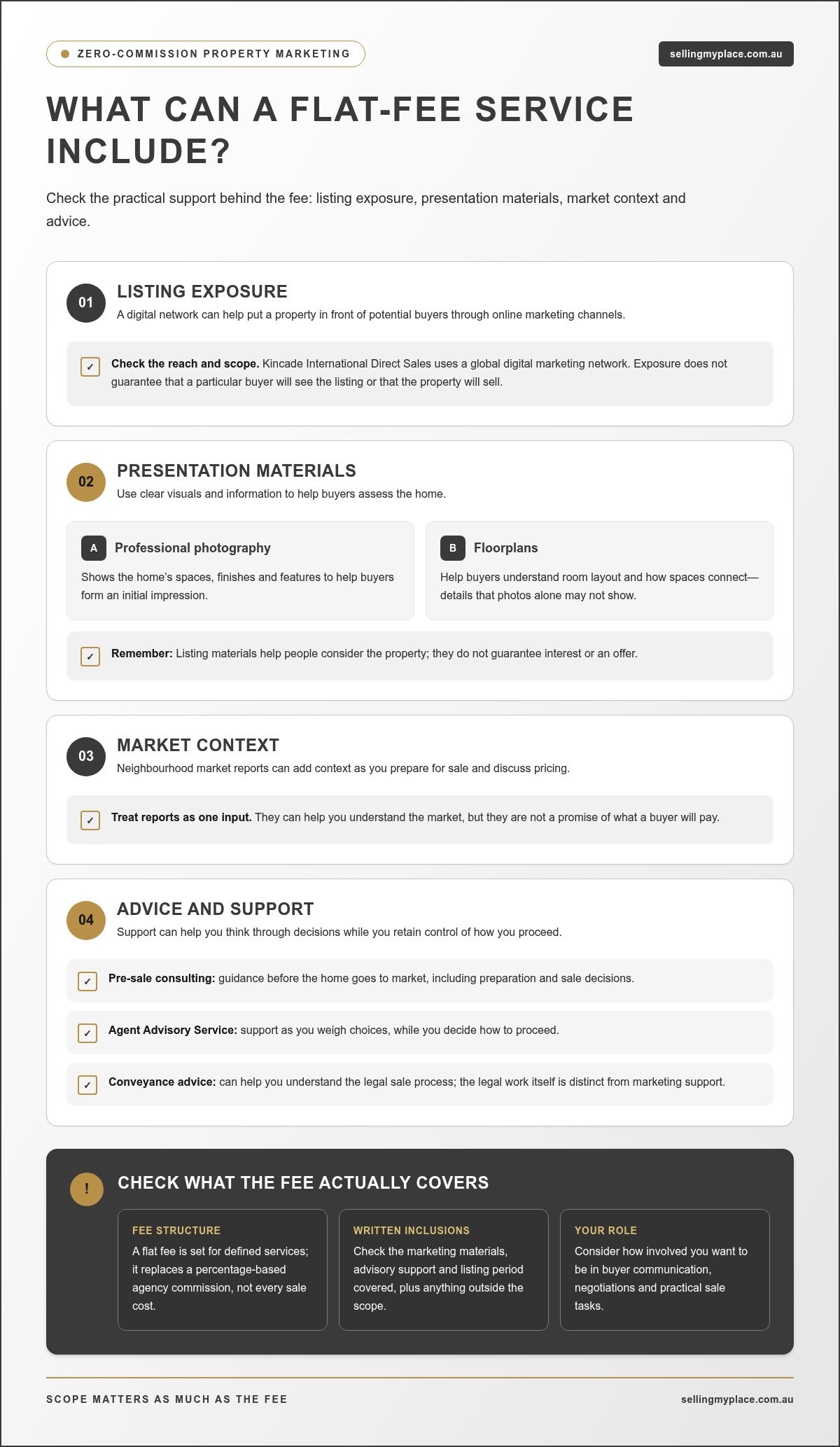
A flat-fee approach can offer a middle ground between traditional commission-based representation and managing everything yourself. Kincade International Direct Sales combines professional photography, floorplans and neighbourhood market reports with Agent Advisory Service support, pre-sale consulting and conveyance advice. This gives sellers professional resources while retaining control over key decisions.
In this guide, you’ll learn how zero-commission selling works, what to look for in a flat-fee service and how to weigh marketing and support against the tasks you’re prepared to manage. You can then choose an approach that fits your priorities, not just its fee structure.
Key Takeaways
- To sell property zero commission, understand that a flat fee replaces percentage-based agency commission, but other sale costs may still apply.
- Compare the service scope, marketing materials, advisory support and listing duration, not just the fee structure.
- Professional photography and floorplans can help present your home clearly, while a digital listing network can provide exposure without guaranteeing a sale.
- Decide how involved you want to be and how much time you can give to buyer communication and sale tasks.
- Consider whether photography, floorplans, neighbourhood market reports and advisory support offer the balance of control and assistance you want.
What does sell property zero commission actually mean?
In plain English, zero commission means no percentage-based agency commission is charged on the property’s sale price. Instead of paying an agent a share of the final amount, a seller may use a service with an agreed flat fee for defined marketing or advisory support. The phrase describes how the service is charged, not whether selling a home is entirely cost-free.
Zero-commission property selling means marketing a home without a percentage-based agency commission, usually through a fixed-fee service with a defined scope. It doesn’t guarantee a sale or a particular sale price. The service can help you promote the property and access advice, but the outcome still depends on factors such as buyer interest, the property and your sale decisions. For context on how agent compensation can differ, see Real estate broker commissions and flat-fee services.
If you’re working out how to sell property zero commission, separate the marketing and advisory arrangement from the legal work involved in transferring a home. Property marketing can cover materials and listing support; conveyancing concerns the legal sale process and is a distinct part of the transaction. The two may happen alongside each other, but don’t assume one service fee covers both.
How is zero commission different from no-cost selling?
“Zero commission” refers to the absence of a sale-price percentage charged as agency commission. A marketing or advisory service may still charge a flat fee for agreed work. Sellers may also have separate expenses connected with preparing, marketing or legally transferring a property. The useful question is not whether a service sounds free, but what its fee covers and what remains separate.
Compare the written inclusions and fee terms rather than relying on labels. Look for details on the marketing materials, advisory support and listing period covered, as well as work or expenses outside the service scope. This gives you a clearer view of the arrangement before deciding how you want to sell.
What does a flat-fee property service change?
A percentage commission changes with the final sale price; a flat fee is set for defined services rather than calculated as a share of the result. This can make the service charge easier to understand in advance, but the fee structure alone doesn’t tell you how much practical help you’ll receive. Scope matters just as much as price: listing support, photography, floorplans and advice can all differ between services.
The model can also change how involved you are. With a commission-based agent, the arrangement may include representation across parts of the sale; with a flat-fee service, you may retain more control and take a more active role. Neither structure suits every seller. Consider the tasks you’re comfortable handling and the support you value before weighing the options.
Keep the legal conveyancing process in view, too. A marketing or advisory fee doesn’t automatically include the preparation or handling of sale documents. Conveyance advice can help you understand that part of the journey, while the legal work itself remains distinct. Knowing where one service ends and another begins helps you budget and plan with fewer surprises.
What can a zero-commission property marketing service include?
A flat-fee arrangement describes how the service is charged, but its inclusions determine what practical help you receive. A commission-free marketing service can bring together listing exposure, presentation materials and advice, allowing you to retain a role in decisions while getting professional support. The right mix depends on what you want help with and which selling tasks you’re comfortable managing yourself.
A digital listing network can put a property in front of potential buyers through online marketing channels. Kincade International Direct Sales uses a global digital marketing network, but exposure isn’t a promise that a particular buyer will see the listing or that the property will sell. Professional photography and floorplans add useful context: images show the home’s presentation, while a plan helps people understand room layout and flow.
How do listing materials support a property sale?
Photos help prospective buyers form an initial impression of spaces, finishes and features. A floorplan adds another layer by showing how rooms connect, which can be difficult to judge from images alone. Clear listing information helps people assess whether the home’s layout and features may suit their needs before arranging a closer look. These materials support informed consideration; they don’t guarantee interest or an offer.
Neighbourhood market reports can add context as you prepare for sale and discuss pricing. They’re one input for understanding the market, not a promise of what a buyer will pay. For wider industry context, Real Estate Institute of Australia (REIA) insights can help readers explore information about Australia’s property sector and market.
What role does professional advice play?
Pre-sale consulting provides guidance before a home goes to market, helping you think through preparation and sale decisions. The Agent Advisory Service offers support as you weigh choices, while leaving you in control of how you proceed. Buyer representation has a different focus: it relates to representing a buyer, rather than marketing a seller’s property.
Conveyance advice is also distinct from listing and buyer-facing activity. It relates to the legal side of a property transfer, while marketing services focus on presenting and promoting the home. Advice can help clarify the process, but it isn’t the conveyancing work itself.
Use this table to compare what each feature can contribute and the questions it may help you answer:
| Service feature | Potential seller benefit | Question it helps answer |
|---|---|---|
| Digital listing network | Online exposure across a marketing network | Where may buyers encounter the listing? |
| Photography and floorplans | Visual detail and a clearer sense of layout | How can buyers understand the home’s presentation and flow? |
| Neighbourhood market reports | Context for preparation and pricing discussions | What market information can inform my decisions? |
| Pre-sale consulting and Agent Advisory Service | Guidance for planning and decisions | Where would professional input be useful? |
| Conveyance advice | Guidance distinct from marketing activity | What legal-transfer questions should I understand? |
If you’re considering how to sell property zero commission, compare the actual support and deliverables with the tasks you’ll take on. Commission-free property marketing support brings together marketing resources and advisory assistance for sellers who want to retain control.
Zero commission versus traditional commission: how should you compare?
A percentage-based commission ties the agency fee to the property’s sale price. A flat-fee model uses an agreed charge for defined services instead. Neither structure tells the whole story: services with different fee models may also differ in marketing, advice and how much of the sale you manage yourself.
The fee structure alone can’t tell you which selling service is right; compare the support, deliverables and seller responsibilities that come with it. This matters because a lower or more predictable fee may still leave you with tasks you’d rather have help handling. Equally, paying a percentage doesn’t automatically mean every service or level of support is included.
Which selling model fits your preferred level of involvement?
Start with an honest assessment of your time and confidence. If you’re comfortable coordinating parts of the sale and making direct decisions, a flat-fee service may suit your preference for control, especially when paired with defined marketing and advisory support. If you want someone to take a more hands-on role, clarify what that representation involves. Traditional agents’ services can vary, so don’t assume every commission arrangement includes the same tasks or support.
More control can mean more participation. Depending on the service structure, you may have a greater role in responding to enquiries, communicating with interested buyers or making decisions during negotiations. Think about when you’d welcome professional guidance and when you’d rather manage things directly. The best fit should reflect your comfort level, not just how the fee is calculated.
What should you compare beyond the fee structure?
Set the service details side by side. Compare the included marketing deliverables, the reach of the listing network, access to advice and how long the property remains listed. Then clarify how buyer enquiries, negotiations and sale decisions are handled. These practical details show what you’re paying for and where your own time may be needed. For more context on listing support, see Professional Residential Property Listing Services: The Modern Australian Seller’s Guide.
A useful comparison separates the fee basis from the working arrangement:
| Model | Fee basis | Seller role | Support structure |
|---|---|---|---|
| Traditional commission | Percentage linked to the sale price | Depends on the agreed representation and service scope | Can involve agent support, but inclusions and responsibilities vary |
| Flat-fee marketing and advisory | Agreed fee for defined services | May retain more direct control and take an active role | Can combine marketing materials with advisory support; clarify how enquiries and decisions are handled |
For a like-for-like comparison, write down the service inclusions and responsibilities before weighing the fee. A service may, for example, include professional photography, floorplans, advisory access and a listing that remains active until sold without time limits. Match each inclusion against what matters to you, then note any tasks you’d handle yourself. That gives you a clearer picture of the trade-off between hands-on assistance, seller control and the practical work of bringing a property to market.
How can you decide whether selling property zero commission suits you?
The right selling approach should fit your time, confidence and appetite for direct involvement. Before deciding whether to sell property zero commission, map out the tasks you’re happy to manage and where professional guidance would make the process more manageable.
- Start with your involvement and available time. Consider how much time you can set aside for preparing the property, responding to buyer enquiries and keeping sale tasks moving. Greater control can be appealing, but it often comes with more direct participation.
- List the support you value most. Write down the marketing materials, advice and communication support you want. You might prioritise photography and floorplans, guidance before launch, help thinking through buyer conversations or advice as you weigh sale decisions.
- Compare the arrangements in writing. Set out each option’s fee basis, included services, listing terms and any responsibilities you’ll take on. A written comparison makes differences easier to spot than a headline label alone.
- Separate the stages of the sale. Preparation, marketing, negotiation and conveyancing each need attention, but they aren’t the same task. Decide where you’ll lead, where advisory support would help and how you’ll handle the legal transfer process.
What should you clarify before choosing a service?
Look for clear descriptions of which marketing materials and advisory services the flat fee covers, how long the listing stays active and what ongoing support means in practice. Then consider your own capacity: would you feel comfortable handling buyer communication and making sale decisions, or would guidance at key moments help you feel more assured?
For a service that keeps a listing active until sold without time limits, that duration can be an important part of your comparison. Listing duration alone doesn’t tell you how buyer enquiries or negotiations are managed. Add those responsibilities to your written notes so you understand the working arrangement as well as its timeline.
How can you prepare for the sale without taking on every task alone?
Divide your plan into seller-led decisions and tasks supported by marketing or advisory services. You might lead on presentation choices and decisions about an offer, while using professional photography, floorplans and pre-sale consulting to support preparation. The Agent Advisory Service can also provide input as you consider your next steps.
Plan how you’ll respond to buyer enquiries and approach negotiations before the first conversation arises. A step-by-step guide to sale by owner in Australia can help you map the process, while a guide to property sale negotiation can help you think through buyer discussions. Conveyancing remains a distinct part of the transaction, so include it in your planning rather than treating marketing support as a substitute.
Commission-free property marketing and advisory support combines marketing resources with guidance for sellers who want to stay involved in the sale.
How Selling My Place supports a zero-commission property sale
Selling a home involves more than choosing a fee model. You need a clear way to present the property, reach prospective buyers and make considered decisions as the sale progresses. Kincade International Direct Sales’ flat-fee marketing and advisory service offers a middle ground: you retain control of key choices while accessing professional marketing materials and guidance.
The service brings together professional photography, floorplans, neighbourhood market reports and a global digital marketing network. Each supports a different part of the sale: photography and plans help present the home, market reports provide context for preparation and pricing discussions, and the network supports digital marketing exposure. Exposure can’t guarantee buyer interest or a sale, but these resources give you practical tools for putting your property forward.
What support can sellers access through the service?
Listings can remain active until sold without time limits, giving sellers an ongoing listing rather than a set end date. This doesn’t guarantee a sale or a particular timeframe. Agent Advisory Service support, including pre-sale consulting, can help you consider decisions before the property goes to market and as you work through the sale. Conveyance advice relates to the transfer process, distinct from marketing and buyer-facing activity.
The balance is intentional: you stay involved in decisions, with professional resources to support the work around them. For example, use photography and floorplans to present the property clearly, then draw on neighbourhood market information as you prepare for pricing discussions. Advisory support can help you think through your approach while you remain responsible for the choices that matter to you.
As you consider the support, think about which parts of the sale you want to lead and where guidance would be useful:
- Property presentation: professional photography and floorplans help show the home’s features and layout.
- Market context: neighbourhood market reports offer information to consider during sale preparation and pricing discussions.
- Digital marketing: a global digital marketing network supports the listing’s exposure without promising a specific audience or result.
- Sale guidance: Agent Advisory Service support, pre-sale consulting and conveyance advice address different decisions and stages.
What is a sensible next step for an interested seller?
Before discussing your options, jot down a few details: the property you’re selling, your preferred timing and how involved you want to be. Note the marketing and advice you value most, too. This gives the conversation a useful starting point and helps you focus on whether the service scope and flat-fee structure fit your priorities, rather than judging by the fee label alone.
For sellers considering how to sell property zero commission, a practical discussion can help clarify the model and the support available. Talk through your property sale with our team.
Choose a selling approach that feels right for you
A property sale is a significant transition, and the process should feel workable for your circumstances, not simply appealing on paper. Before you decide how to sell property zero commission, think about what would help you feel informed and in control: a clear view of the service scope, room to make your own decisions and professional guidance where you’d value it.
Your next step can be a practical conversation about your property, timing and preferred level of involvement. Talk through how the flat-fee model works, what support it includes and whether the balance suits the way you want to sell. Arriving with a few priorities in mind can make that discussion more useful, whether you’re ready to move ahead or still weighing your options.
Talk through your property sale with our team to discuss a sale plan that fits your priorities. You don’t need every detail settled before you begin; a clear conversation can help you identify your next steps.
Frequently Asked Questions
Is selling property with zero commission really free?
No, not necessarily. Zero commission means no percentage-based agency commission is charged, not that selling has no costs. A flat-fee service may charge for defined marketing and advisory work, while other sale-related expenses can remain separate. If you plan to sell property zero commission, compare written inclusions, fee terms and your responsibilities before deciding. This helps you understand what the arrangement covers rather than relying on the label alone.
Can I sell my property without an agent and still get professional support?
Yes. You can take a more active role in the sale while using a property marketing and advisory service for professional assistance. For example, photography and floorplans can help present your home, while pre-sale consulting can support decisions before launch. You’ll still have responsibilities, such as making sale decisions and handling agreed tasks. This differs from traditional full-service representation, and the support offered varies between arrangements.
How much can I save by selling property with zero commission?
There’s no single saving that applies to every seller. The difference depends on your sale price, the fee structure and which services are included in each arrangement. Compare the full written scope and fee terms with the commission-based option you’re considering, including any tasks you’ll manage yourself. A lower fee alone doesn’t show which model is the better fit; the value of the support and your preferred involvement matter too.
What happens if my property does not sell straight away?
What happens next depends on the listing duration and ongoing service terms. With Kincade International Direct Sales, a property can remain listed until sold without time limits. That means there’s no set time limit on the listing, not a guarantee that a sale will occur. Review the service terms to understand how continued listing and support work if the sale takes longer than expected.
Do zero-commission property services include photography and floorplans?
Inclusions vary, so look at the stated deliverables rather than assuming every service provides the same materials. Kincade International Direct Sales provides professional photography and floorplans. Photos give prospective buyers a visual impression of the home, while a floorplan helps them understand how rooms connect and how the layout works. These tools can make property information clearer, but they don’t guarantee more enquiries, a higher sale price or a faster result.
Is a flat-fee service better than paying a traditional property commission?
It depends on your priorities, how involved you want to be and the support you need. A flat fee changes how the service charge is structured compared with percentage-based commission, but it doesn’t determine the service scope or your responsibilities. Compare marketing deliverables, advisory access, listing duration and the tasks you’ll handle yourself. The better fit is the arrangement that aligns with your comfort level and sale priorities, not simply the fee label.
Can I negotiate the sale price when using a zero-commission service?
Yes. As the seller, you make decisions about offers and the sale outcome you’re prepared to accept. The support available during buyer discussions depends on the service arrangement. Kincade International Direct Sales offers advisory support and buyer representation, which is a distinct service for buyers. Before negotiations begin, consider your priorities and how you’ll communicate them clearly. Preparing in advance can help you approach offer discussions thoughtfully, without guaranteeing a particular result.