
A fixed-fee quote can make conveyancing costs easier to understand, but it may not include every expense. Conveyancing is the legal and administrative work involved in transferring property ownership. The total depends on whether you’re buying or selling, the property and the searches required.
It’s understandable to want a clear figure before making a major property decision. Buyers and sellers need different work, and government charges or third-party search costs may sit outside a quoted professional fee.
This guide explains what conveyancing covers, why costs vary for buyers and sellers, and how to compare fixed-fee quotes without overlooking possible extras. It also outlines what to look for in a quote to understand the costs before settlement.
Key Takeaways
- Separate the professional fee from disbursements and government charges to understand the full conveyancing cost.
- Compare the work required for a purchase with a sale, as the searches, documents and settlement tasks can differ.
- Look beyond the “fixed fee” label: identify which services are included and which third-party costs may be additional.
- Match your quote to the transaction, including whether the property is a house, unit or more complex sale.
- If you’re preparing to sell or buy, Kincade International Direct Sales offers residential property listing services, buyer representation and pre-sale property consulting.
Why Do Buyers and Sellers Pay Different Conveyancing Fees?
Buyers and sellers need different legal work, searches and settlement documents, so their quotes can differ. Separate the professional fee from third-party disbursements to see what each quote covers.
Professional Fees and Disbursements
The professional fee pays for the conveyancer’s or solicitor’s work; disbursements are costs paid to third parties during the transaction. This distinction matters because a fixed professional fee may not include searches, certificates or electronic settlement charges.
The work varies depending on your role. A buyer’s conveyancer reviews the contract, coordinates title and property searches, works with the lender where relevant, and prepares for settlement. A seller’s conveyancer prepares sale documents, responds to enquiries and arranges discharge of existing mortgages.
Property type can change the workload. A house sale may require different council or building information. The quote should distinguish the conveyancer’s work from external charges, rather than presenting everything as one unexplained base fee.
Property Certificates and Search Fees
Property certificates and search fees are third-party disbursements that provide records about a property, its title or associated charges. Required searches depend on the property’s location and type, and their costs may sit outside the professional fee.
These charges help explain why apartments may involve different search costs from houses.
Are conveyancing fees tax deductible or included in the property’s cost base in Australia? Tax treatment depends on the property’s use and whether each cost is capital or relates to earning income. Keep the itemised statement, separating professional work, searches and settlement charges, so each amount can be assessed in the right context.
At settlement, conveyancing fees and disbursements are commonly paid and accounted for through the electronic settlement process. Compare the itemised estimate with the final statement to identify professional fees and third-party charges, such as certificates, searches or platform fees.
Services included in conveyancing fees
A conveyancer coordinates the legal and administrative work required to transfer property ownership. For a buyer, this can mean reviewing the contract and organising settlement; for a seller, it includes preparing sale documents and responding to enquiries.
Typical inclusions depend on the transaction and the quote’s scope. Read the service description alongside its exclusions, especially for searches, lender-related work and third-party charges. Similar fixed-fee quotes may cover different tasks, so check the listed services against whether you’re buying or selling.
What a Buyer’s Quote May Cover
For a purchase, conveyancing often starts with contract review. The conveyancer checks key terms, explains obligations and helps identify issues that need attention before signing. Once the contract is agreed, they coordinate searches and certificates, communicate with the seller’s representative and prepare transfer documents.
If a buyer has a home loan, the conveyancer also coordinates settlement details with the lender. They calculate the funds required, prepare settlement figures and arrange the electronic transfer of money and title. Stamp duty is a separate government charge, not the conveyancer’s professional fee, so the quote should distinguish legal work from the buyer’s wider purchase costs.
When reviewing a buyer’s quote, separate contract work from settlement coordination. Check whether the scope includes correspondence with the lender and preparation of transfer documents, or whether those tasks are charged separately. Property type can also affect which searches or certificates are needed.
What a Seller’s Quote May Cover
A seller’s conveyancer prepares the contract documents, provides property information and responds to questions from the buyer’s representative. They also coordinate mortgage discharge details where a loan is secured against the property, then prepare settlement figures showing adjustments and amounts payable.
In Queensland, sellers must provide a seller disclosure statement and prescribed certificates before the buyer signs the contract, under requirements effective from 1 August 2025. That work can affect what a seller’s quote includes. A Queensland seller can compare whether preparing those documents appears in the professional fee or as a separate item.
Third-Party and Settlement Charges
Some charges relate to the platform used to complete the transaction, rather than the conveyancer’s professional work. Check whether this amount is included in the quoted fee or listed separately as a disbursement, so it’s accounted for in your expected settlement costs.
Ask how the final statement separates professional work, certificates, searches and electronic settlement charges. This breakdown helps explain changes between the initial estimate and settlement, particularly if a lender, property type or required document adds work. Keep the quote and final statement together to make the transaction costs easier to review later.
If you’re preparing a property sale and need guidance alongside the legal process, conveyance advice for your sale can help you understand the roles involved.
Choosing a conveyancer or solicitor
The right professional depends on your state, transaction type and the legal work involved. Compare the service scope and total conveyancing costs, not just the headline charge.
Choosing a Conveyancer
A conveyancer focuses on the legal and administrative tasks involved in property transfers. Their experience with your state’s contracts, searches and settlement process matters because requirements and costs vary across Australia.
These figures are professional fees, not necessarily the total cost, which may also include searches, certificates and other disbursements.
Queensland has no separate licence for non-lawyer conveyancers, so conveyancing is handled by solicitors and law practices. Consider the professional’s legal practice and relevant property experience. In NSW, conveyancers must disclose costs upfront and transparently, helping you understand the stated scope and charges.
Compare quotes by checking the transaction covered, the work included and any exclusions. A straightforward house transfer may require different searches and documents from an apartment purchase. Where relevant, check whether the quote accounts for lender coordination, contract review, certificates and electronic settlement.
Online conveyancers in Australia typically charge professional fees 10-20% less than traditional practices. A lower fee alone doesn’t explain which services are included, so compare the scope alongside the price. The useful comparison is the work being done for your particular property and transaction.
Choosing a Solicitor
A solicitor can handle conveyancing as part of a broader legal practice. This may suit a transaction with additional legal issues, such as a complex contract or company involvement, where advice beyond routine transfer work is relevant.
Professional fees differ by state and practice.
These ranges help put quotes in context, but the transaction’s requirements influence the fee. A property with multiple titles, unusual contract terms or additional parties may need more review and coordination. Council and title searches also affect disbursements, which should be distinguished from the solicitor’s professional charge.
Read the quote for its named services, exclusions and likely third-party costs. Check whether it covers contract advice, lender communications, document preparation and settlement coordination. An itemised quote makes it easier to compare professional work with external charges, rather than judging conveyancing costs by one figure.
Choose a professional whose experience and quoted scope suit your transaction. A routine sale and a complex purchase require different work, so look for a clear outline of the legal tasks involved in your matter.
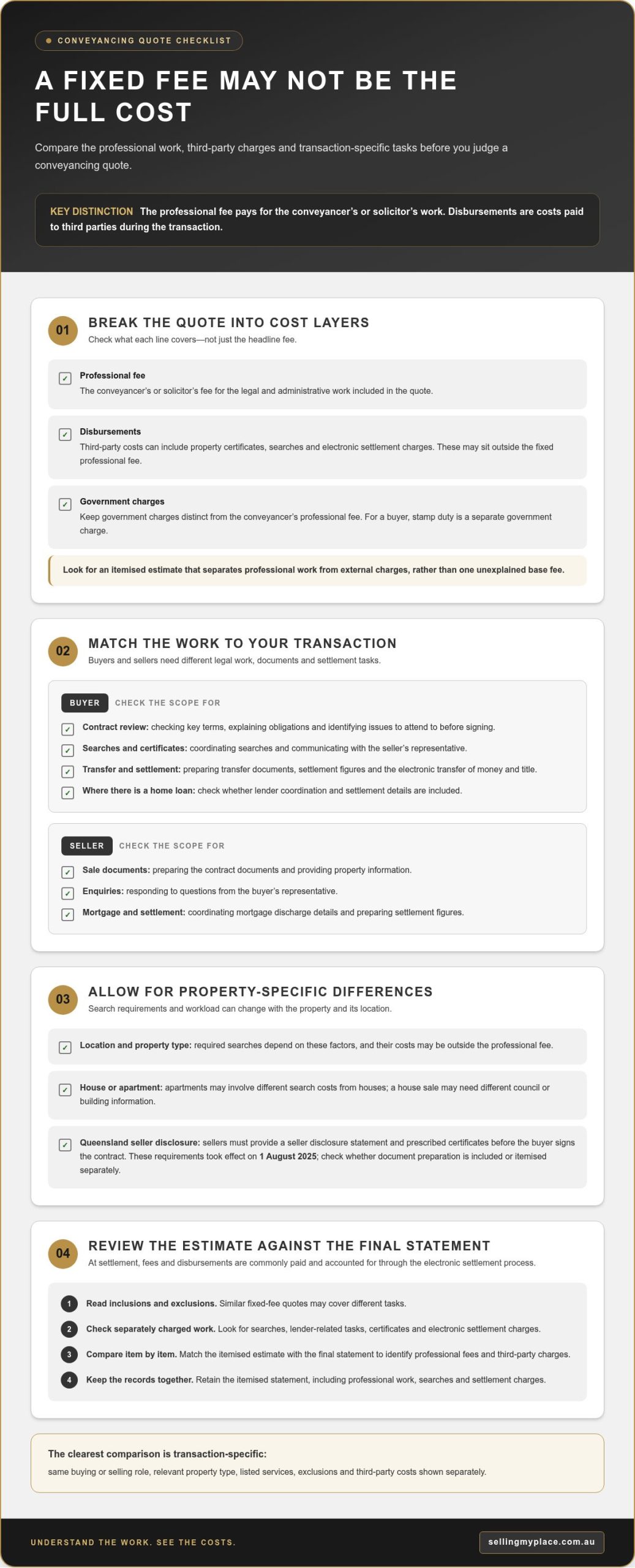
Comparing fixed-fee conveyancing quotes
A fixed fee sets out a defined professional charge, but the transaction’s full cost may include separate disbursements. Compare quotes for the same property type and service scope to see what each figure covers.
Factors Affecting Quotes
A conveyancing quote reflects the transaction’s complexity, required documents, property type and included work. A seller’s matter differs from a purchase, while an apartment may need strata information that a standard house does not. Multiple titles or lender coordination can add tasks, which is why similar-looking quotes may cover different work.
State-based charges affect the overall amount, even when the professional fee is fixed. In Victoria, transfer registration costs A$104.30 plus A$2.34 for every A$1,000 of the purchase price, capped at A$3,614. These government charges are separate from professional fees, so check whether a quote includes them or lists them separately.
Transaction timing and structure matter, too. Off-the-plan conveyancing can take months or years, depending on when construction is completed.
Comparing Quotes and Saving on Fees
Compare like with like: use the same transaction type, property details and requested services for each quote. Then separate the professional fee from searches, certificates, electronic settlement charges and government costs. This gives you a clearer estimate than comparing headline totals alone.
Check each inclusions list against the work your transaction needs. For a purchase, look for contract review, title searches, settlement coordination and lender communication where relevant. For a sale, check whether document preparation and mortgage discharge coordination are covered. A missing item can make a low initial fee difficult to compare.
Use an itemised quote to identify optional tasks and third-party charges. A search is not the same as professional work, and transfer registration is not the conveyancer’s fee. Comparing these categories separately helps you see where quotes differ and avoid paying for services your transaction doesn’t require.
Low-Cost Conveyancing Quotes
A low-cost quote may offer a narrower service scope or use an online process. Online conveyancers in Australia typically charge professional fees 10-20% less than traditional practices. That difference makes the listed services and exclusions especially important to compare, rather than assuming each quote covers the same work.
Check whether the quoted amount covers your actual transaction, including searches, titles and settlement tasks. If a seller’s quote excludes a required document, or a buyer’s leaves out lender coordination, the final total may differ from the initial fee. A clear breakdown shows what is included and charged separately.
Choose the quote that matches the work required, not simply the lowest amount. A standard purchase and an off-the-plan purchase involve different timeframes and coordination. Comparing quotes for the same transaction lets you assess professional fees and disbursements fairly.
Fixed conveyancing fees for buying and selling
Fixed-fee quotes can make the professional charge predictable, but buyers and sellers need different work. The quoted fee is only one part of the transaction’s total cost.
The total can include searches and statutory disbursements, while transfer registration, stamp duty and other government charges may sit outside the conveyancer’s fee. Check the quote’s inclusions before treating its fixed professional fee as the full amount required for settlement.
Why Buyer and Seller Quotes Differ
Buyers need contract review, title searches, transfer documents and coordination with their lender where a loan applies. A unit purchase may also require strata information. These tasks shape the quote, along with the property’s location and the number of titles involved.
Sellers have different responsibilities. Their conveyancer prepares sale documents, responds to buyer enquiries and coordinates discharge of an existing mortgage.
The difference between buying and selling estimates reflects different work and disbursements, not simply a different label on the quote. Sellers should check which documents and settlement tasks are included; buyers should look for searches and lender coordination where relevant.
What a Fixed Fee Covers
“Fixed fee” usually describes the professional charge for the work listed in the quote, rather than every cost associated with buying or selling. Search fees, certificates, registration charges and electronic settlement costs may be listed separately. For a fair comparison, match quotes for the same transaction type and property details.
Government charges can materially affect a buyer’s final budget. In Victoria, transfer registration costs A$104.30 plus A$2.34 for every A$1,000 of the purchase price, capped at A$3,614. Queensland transfer registration costs A$248.04 plus A$46.56 for every A$10,000 above A$180,000. These charges are distinct from professional fees.
For sellers, the fixed-fee scope may depend on the sale documents and settlement work required.
Before comparing totals, separate professional fees, disbursements and government charges in each quote. If you’re preparing to sell, get guidance on preparing your property sale alongside your conveyancing arrangements.
Kincade International Direct Sales: Residential Property Listing Services
Kincade International Direct Sales can help if you’re preparing to sell and want property marketing support alongside your conveyancing arrangements. Its Residential Property Listing Services use a flat-fee model and include professional photography. The packages also offer features such as floorplans and neighbourhood market reports to help owners present their home to buyers.
The service provides residential listings through a global marketing network, with no time limits and a 0% commission structure. Pre-Sale Property Consulting can help you plan the sale, while Buyer Representation supports people looking for guidance on a purchase. These services address marketing and property decisions, while legal transfer work remains part of conveyancing.
If you’re weighing up your next property move, you’re welcome to contact Kincade International Direct Sales or visit sellingmyplace.com.au.
Make your next property move with a clear plan
Use the average conveyancing fees in Australia in 2026 as a planning reference, then shape your next steps around your own property goals. A move is more than a transaction: it can mean choosing a home that fits your life or preparing a place that holds years of memories. Clarity about responsibilities and costs gives you more room to make those decisions thoughtfully.
If you’re preparing to sell, Kincade International Direct Sales offers Residential Property Listing Services and Pre-Sale Property Consulting to support your marketing decisions. Buyer Representation can help buyers approach their search with a clearer sense of what matters to them. These services complement, but do not replace, the legal work involved in conveyancing.
Take the next step at your pace. Contact Kincade International Direct Sales to discuss your property plans and find a considered way forward.
Frequently Asked Questions
What is conveyancing?
Conveyancing is the legal process of transferring property ownership from seller to buyer. It covers tasks such as reviewing the contract, preparing transfer documents and coordinating settlement. For example, a buyer’s conveyancer helps arrange registration of the transfer, while the seller’s representative handles documents needed to complete the sale. This work connects the contract, payment and title transfer so the change in ownership can be completed.
Are conveyancing fees paid upfront?
Conveyancing fees and disbursements are commonly paid at settlement and accounted for through the electronic settlement process. They’re often included in the settlement figures rather than paid as one upfront bill. Search costs or other arrangements may have different payment timing, so read the payment terms in the engagement documents. Keep the final statement with your property records for reference.
How do I get an accurate quote?
Give the conveyancer the details that shape the work: whether you’re buying or selling, the state, property type and transaction structure. Include relevant information about a loan, multiple titles or an owners corporation, as these can affect searches and settlement tasks. Ask for an itemised estimate that separates professional work from disbursements and government charges. A quote based on the actual contract is more useful than a generic estimate.
What goes wrong if I just pick the cheapest option?
The lowest headline fee may cover a narrower scope than another quote. Search fees, lender coordination or additional title work could be charged separately, making the final bill different from the initial comparison. A missing service can also leave you unsure who handles a task before settlement. Compare itemised inclusions and exclusions, not just the professional fee, and match each quote to the same transaction details.
What government fees do you pay on top in QLD?
Queensland buyers may pay transfer duty and Titles Queensland registration charges, separate from professional fees. Transfer registration is A$248.04 plus A$46.56 for every A$10,000 of the purchase price above A$180,000. From 1 July 2026, registering a new mortgage or releasing an existing mortgage costs A$248.04 each.
What are the average conveyancing fees in Australia in 2026 for sellers?
These Australia-wide estimates depend on the sale’s documents, searches and settlement work.
How much do conveyancers and property solicitors charge in each Australian state and territory?
Indicative professional-fee ranges vary by location and practitioner. These are professional fees, not total costs.
What is included in a fixed conveyancing fee, and what costs extra?
A fixed conveyancing fee generally covers the professional tasks listed in the quote, such as contract work, document preparation and settlement coordination. Search costs, certificates, government registration charges and electronic settlement platform fees may be additional. Check the itemised scope against your transaction, including whether lender-related work or property-specific searches are included or charged separately.