A property listing doesn’t have to come with a countdown. An unlimited length property listing can stay advertised until the property is sold, with no preset time limit, when it’s offered on an unlimited-duration basis.
It’s understandable to focus on how long your home will be visible to buyers. But duration is only part of the picture: portal advertising, the flat-fee package and the details in your listing all affect how your property is presented.
This guide explains how listing periods work, what to consider about portal exposure and flat-fee packages, and which property details help buyers understand what’s on offer. You’ll get a clearer picture of the choices involved and how they fit into your sale.
Key Takeaways
- Check whether a listing has a set end date or can remain advertised until the property sells; different listing types can have different time limits.
- Consider how portal placement and useful visual details, such as a floorplan or video, may affect how buyers engage with your listing.
- Assess a flat-fee package by what it includes, such as photography, floorplans and market information, as well as how its terms suit your sale.
- Make your description practical and specific: highlight at least five property features, along with relevant details about the home and neighbourhood.
- Bring together your advertising choices, property information and sale goals to shape a listing plan that fits your circumstances.
Property advertising on major portals
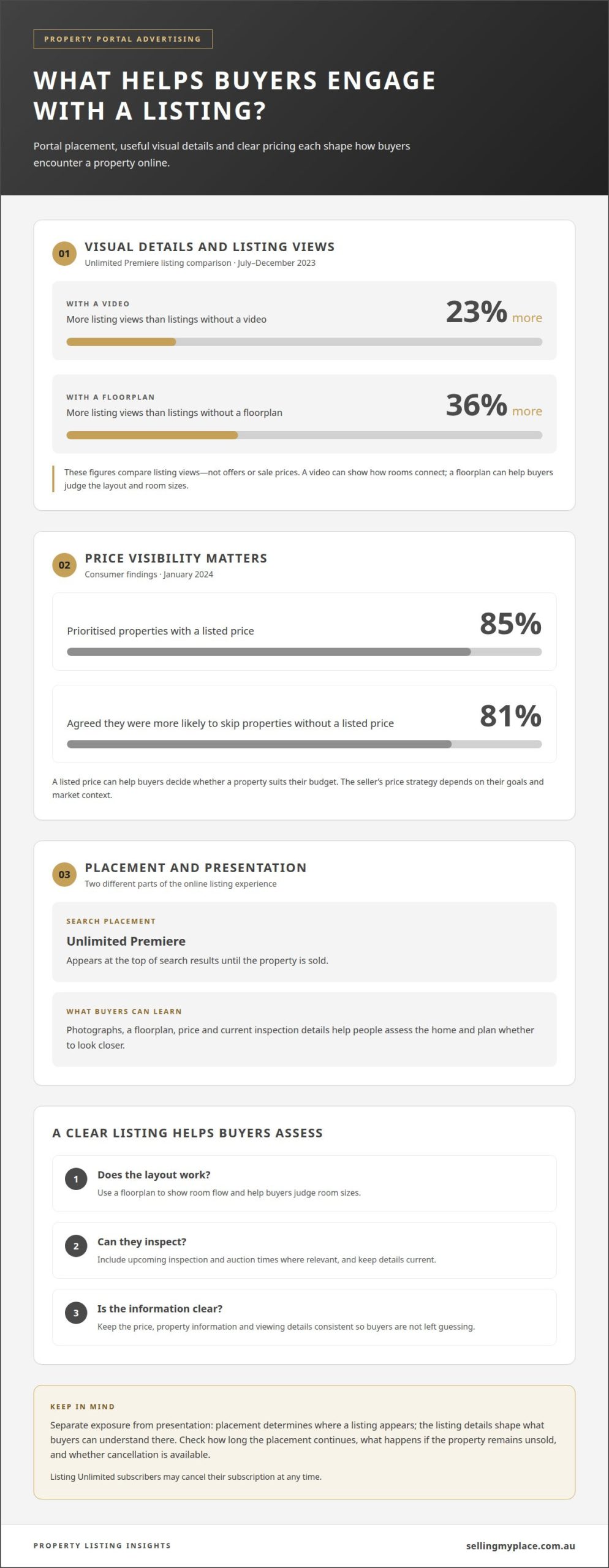
For an Australian home seller, portal advertising affects how buyers encounter a property online. A listing’s position, photographs, floorplan, price and inspection details each help people decide whether to look closer. An Unlimited Premiere listing appears at the top of search results until the property is sold. That placement can keep the listing visible in search results, while the property remains available for sale. It doesn’t replace clear information: buyers still need to understand what the home offers and how to arrange an inspection.
Visual material gives buyers another way to assess a home before visiting. For the period July 2023 to December 2023, Unlimited Premiere listings with a video achieved 23% more listing views than listings without a video. Listings with a floorplan achieved 36% more listing views than listings without one. These figures compare views, not offers or sale prices. A video can show how rooms connect, while a floorplan helps buyers judge the layout and room sizes. Both can make an online estate listing more informative.
Price visibility is another consideration. In January 2024, 85% of consumers said they prioritised properties with a listed price, while 81% agreed they were more likely to skip properties without one in search results. Those findings highlight how a price can help buyers decide whether a property suits their budget. However, choosing a price strategy depends on the seller’s goals and market context. A listing should present the chosen approach clearly, so buyers aren’t left guessing about the sale.
Useful inspection information can also make a listing easier to act on. Include upcoming inspection and auction times where relevant, so property seekers can plan ahead. For example, a buyer comparing homes after work can see whether an advertised inspection fits their schedule. Keep details consistent across the listing: an outdated time or unclear instruction can create avoidable confusion. Clear directions, accurate property information and current viewing details help turn online interest into a practical next step.
When reviewing portal advertising, separate exposure from presentation. Top placement concerns where a listing appears; images, plans, pricing and inspection times shape what buyers can learn there. Ask how long the chosen placement continues, what happens when a property remains unsold, and whether cancellation is available. Listing Unlimited subscribers may cancel their subscription at any time. These details matter when comparing advertising arrangements, because duration and presentation affect different parts of the selling experience through Kincade International Direct Sales.
Before publication, organise the listing around a buyer’s likely decisions: does the location suit them, does the layout work, and can they inspect? Match each question to a useful detail, such as a floorplan showing room flow or an inspection time for planning. Review the price and property information together rather than treating advertising placement as the whole strategy. This helps you see what buyers can learn and where the listing needs clearer information.
Flat-fee selling packages
A flat-fee package has a set charge rather than a charge calculated as a percentage of the sale price. For Australian sellers, the practical question is what the fee covers. Kincade International Direct Sales offers three fixed-fee packages, each with portal listings, enquiry forwarding, dashboard access and a Market Valuation Report. Compare the package inclusions with the marketing and support you need.
Start by comparing the package inclusions: the listing, marketing materials and support. A seller who already has polished photographs may value portal exposure most. Someone preparing the property may find professional photography or a floorplan more useful. Match the inclusions to your priorities rather than choosing by package name alone.
Duration deserves particular attention. If the property remains unsold, an end date or renewal arrangement can affect the overall cost and workload. An unlimited-duration arrangement means the listing can remain active until the sale, rather than ending after a preset period. Read the duration alongside cancellation terms and any conditions attached to continued advertising. These details explain how the arrangement works over time.
Then distinguish flat-fee from commission-based structures. A flat fee doesn’t describe the inclusions by itself. Check whether portal listings, photography, floorplans and market reports are included. Kincade International Direct Sales bundles its stated features into each package, so comparing those inclusions makes it easier to see what the service covers.
Use a simple comparison before deciding:
- Coverage: note whether listing preparation, photography, floorplans and advertising are included.
- Duration: identify the end date, renewal terms or until-sold arrangement.
- Support: distinguish marketing materials from advice about preparing or presenting the property.
- Conditions: understand cancellation terms and what happens if your sale plans change.
This comparison also clarifies the difference between packages with narrower and broader inclusions. A seller who already has accurate property information may need different support from someone still shaping their sale plan. Pre-sale property consulting can help owners prepare, while the package features determine the marketing provided. Understand the scope before choosing.
For a practical next step, set out your priorities, then match each one to an included service. If you want guidance connecting package options with your sale goals, discuss your property sale needs.
Listing descriptions and property features
A strong description helps buyers picture the home and decide whether it suits them. Include at least five features, such as a renovated kitchen, natural light, storage, outdoor space or a separate study. Choose details that are accurate and useful, rather than relying on broad praise like “stunning” without explaining what makes the property distinctive.
Yes. Australian property advertising should be accurate and not misleading, so avoid unsupported claims and make material information clear. Disclosure requirements depend on the property and circumstances, so don’t treat a general description as a complete account of every issue. Engage a qualified conveyancer or solicitor for legal matters.
Start with the property’s address, building size and land size where possible. Then focus on what a buyer needs to understand: the layout, standout features and how the spaces work. For example, “The open-plan kitchen and living area opens onto a covered deck” gives a clearer picture than “great for entertaining”. A floorplan can help buyers follow the layout.
Specific details make features more meaningful. Instead of saying “plenty of storage”, name the walk-in pantry or built-in wardrobes. Rather than “large backyard”, describe the usable lawn or established garden. Use measured, verifiable details where available; don’t imply a room’s use, renovation quality or property size beyond what the information supports.
Neighbourhood attractions can add useful context when relevant and described accurately. Mention nearby facilities or local features that matter to buyers, such as a park or transport connection. Focus on location facts, not promises about travel times or future changes. Buyers can then weigh the home and its surroundings together.
A high-resolution black-and-white floorplan with clear block fonts can make room labels easier to read; PNG is a suggested format. Keep the plan consistent with the written description. If the text calls a room a study, for instance, the floorplan should use the same label. A mismatch can leave buyers unsure which information to rely on.
What are the risks of writing an overly long property listing? Buyers may miss important details when key features are buried beneath repetition or lengthy descriptions. Keep each sentence focused on one useful point, and remove claims that add no clear information.
Before publication, check the copy against the property details and floorplan. Confirm that every feature is specific, relevant and accurate. A concise account of the layout, at least five standout features and nearby attractions gives buyers practical information without making them sift through unnecessary wording.
Listing duration and time limits
A property’s advertising period depends on its listing type and the terms attached to that listing. An unlimited-duration arrangement can keep a residential sale listing active until the property sells, rather than ending on a preset date. That gives the seller more time on market, but duration alone doesn’t determine how buyers respond.
The 60-day rule applies to rental listings, all realcommercial listings and Developer Project profile listings. This is a rule for those listing categories, not a universal time limit for every Australian residential sale listing. A standard home-for-sale advertisement should be understood through its own platform and package terms.
Can unlimited length property listings improve views or enquiries? They can keep a property advertised for longer, giving buyers more time to find it, but duration alone doesn’t determine how many views or enquiries it receives. Visibility, price, presentation and buyer demand also shape engagement.
Do property listing limits vary by Australian state or territory? The 60-day rule described here is tied to rental, realcommercial and Developer Project profile listings, rather than being a stated state or territory rule for residential sales. For a home sale, the relevant duration depends on the listing arrangement and applicable platform conditions.
When reviewing an end date, distinguish the listing’s duration from the portal advertising included in the package. Kincade International Direct Sales lists homes on Realestate.com.au and local portals such as Homely and Soho. Check the stated duration and which portals are included to understand where buyers may see the property and how long it remains advertised.
Look closely at the terms that define an active listing. Kincade International Direct Sales listings remain active until sold, withdrawn or two years from commencement, whichever comes first. Those endpoints explain what “until sold” means in practice and when the listing will no longer be active.
Longer exposure can be useful when a sale takes more time, but the listing should stay current. If the asking price, inspection arrangements or property details change, outdated information can confuse prospective buyers. Check the live listing after each change and make sure its details match your current sale plan.
Before choosing a duration, work through these points:
- Listing category: identify whether it’s a residential sale, rental, realcommercial or Developer Project profile listing.
- End date: note any expiry date, renewal process or ongoing arrangement.
- Conditions: understand cancellation terms and what keeps advertising active.
- Updates: plan how price, inspection and property-detail changes will appear.
These steps distinguish the listing duration from its portal and package features. For Australian home sellers, the key is to understand the duration terms and what advertising the chosen package includes.
How to create an unlimited property listing in Australia?
To create an unlimited-duration residential listing, choose an arrangement that keeps the property advertised until it sells, without a preset time limit. The listing’s terms should make clear which advertising is included and how changes are handled. This gives you a defined starting point before preparing the property information.
Use this sequence to build the listing:
- Set the sale plan. Decide your intended sale method, price approach and preferred inspection arrangements. For example, consider whether buyers will see a price or auction details.
- Choose the listing terms. Confirm that the arrangement has no preset end date and understand its cancellation conditions. An unlimited-duration listing is different from an advertisement that expires and needs renewal.
- Prepare the property information. Gather the address, building and land details where available, plus accurate descriptions of the home. Consistent facts make it easier to prepare the copy and supporting materials.
- Organise the presentation. Arrange photography and a floorplan, then align the written details with what those materials show. For example, use matching room names in the description and plan.
- Prepare buyer-facing details. Add the chosen price approach and upcoming inspection or auction times. Clear information helps buyers understand how to take the next step.
- Review and publish. Read the complete listing as a buyer would. Correct outdated details before publication, then keep important information current while the property remains advertised.
Each step has a practical purpose. Your sale plan guides how the listing presents the property; the terms define its duration; and accurate details help buyers assess the home. If an inspection time changes, updating the listing prevents prospective buyers from relying on an old schedule.
Portal advertising is a separate consideration from listing duration. Kincade International Direct Sales packages include listings on Realestate.com.au and local portals such as Homely and Soho, while the listing remains active until sold, withdrawn or two years from commencement. Review both the included advertising and duration terms, since ongoing exposure doesn’t mean every advertising feature is the same across packages.
After publication, keep a simple record of changes to the price, property details and viewing arrangements. For example, note when an inspection time changes, then check that the live listing reflects it. This creates a useful update process instead of relying on memory during a busy sale.
For help putting these steps together around your property and sale plan, discuss your listing requirements.
Kincade International Direct Sales: Residential Property Listing Services
Kincade International Direct Sales provides residential property listings with no time limit, keeping a property listed until it sells. Its commission-free property marketing service includes a global marketing network, professional photography and floorplans. Neighbourhood market reports can also help owners understand local sale conditions while preparing their listing.
This approach may suit Australian homeowners who want ongoing listing duration and a flat-fee model, rather than a commission-based arrangement. Pre-sale property consulting can help owners plan their sale, while Buyer Representation supports buyers seeking guidance in their property search.
If you’re weighing up an ongoing listing or preparing to sell, contact Kincade International Direct Sales to discuss your property sale.
Make your next move with confidence
Choosing an unlimited length property listing is one part of a broader sale plan. Your next step is to decide what you need from the package, including the marketing features and support that suit your sale. Consider what would make the process manageable, from preparing property information to understanding the listing terms.
Kincade International Direct Sales offers Residential Property Listing Services and Pre-Sale Property Consulting for homeowners planning a sale. Buyer Representation is available for people looking for support with a property search. Choose the service that fits where you are in your property journey.
A considered plan can help you move forward at your own pace, with a clearer sense of what comes next. Contact Kincade International Direct Sales to discuss your property goals and take the next step with confidence.
Frequently Asked Questions
How long will my property be listed?
For a Kincade International Direct Sales listing, advertising continues until the property is sold, withdrawn or reaches two years from its commencement date. This gives you an ongoing listing period, with a defined maximum duration. If your sale plans change, withdrawal is one of the stated endpoints. Keep a note of the commencement date so you can track the listing period and plan any next steps clearly.
What are the total fees?
The total depends on the package selected, and package prices are exclusive of GST. Kincade International Direct Sales uses a flat-fee model, rather than charging commission on the sale. The packages bundle their listed marketing features, so your choice affects which inclusions apply. For budgeting, consider the selected package and GST together, then review its inclusions against the support and marketing you want for your sale.
What support do you provide once I’m listed?
Support includes enquiry forwarding by SMS and email, plus access to a seller dashboard. Email expert support is included across the packages; phone expert support is included with Signature and Prestige. Prestige also includes a dedicated specialist. For example, the dashboard gives you a place to manage listing activity, while forwarded enquiries help you respond to prospective buyers and organise your next conversation.
Which Australian property websites offer unlimited-length listings?
Kincade International Direct Sales lists homes on major Australian property portals and local platforms, including Homely and Soho. It acts as a licensed intermediary for portal listings, as individuals can’t list directly on some major portals. Portal availability and the listing arrangement are separate considerations, so look at both the websites included and the duration terms. That helps you understand where buyers may see the property and how long it stays advertised.
How much do unlimited-length property listings cost in Australia?
Costs depend on the selected package, and all prices are ex GST. The flat-fee structure bundles the stated features rather than adding commission based on the sale price. Compare the package inclusions, such as photography, portal listings and support, with the marketing you need. This makes it easier to choose the package that fits your sale.
What listing limits apply to property descriptions on Australian real estate websites?
Description limits are set by each portal’s listing fields and publishing rules, so there isn’t one character limit for every Australian property website. Put essential facts near the beginning so buyers can quickly understand the home. If a portal restricts the description length, prioritise the layout, standout features and relevant location details, then remove repeated adjectives or claims that add little information.
How do unlimited-length listings compare with standard property listings?
An unlimited-duration listing stays active under its stated terms rather than ending at a preset date. For Kincade International Direct Sales, the listing remains active until sold, withdrawn or two years from commencement, whichever comes first. This describes the duration, not a promise of more enquiries or a sale. Review package inclusions separately when weighing the options.
What details should an Australian property listing include?
Include the property address, building and land sizes where available, and at least five accurate features that help buyers assess the home. Pair clear room descriptions with matching floorplan labels. Add relevant neighbourhood attractions and current inspection or auction details where applicable. Accurate, consistent information helps buyers understand the property and decide whether to arrange a viewing.