
You can legally do your own conveyancing in Australia, but the rules and practical requirements differ between states and territories. If you’re weighing up whether to do your own conveyancing in Australia, the short answer is yes. However, you remain responsible for any error that delays settlement, leads to default interest or gives the other party grounds to terminate the contract.
It’s understandable to consider handling the work yourself. Buying or selling a home already involves plenty to organise, and conveyancing can look like a set of forms and deadlines. But the details matter: contracts, disclosures, searches and settlement requirements vary across Australia, and a missed obligation can have serious consequences.
This guide explains what DIY conveyancing involves, how requirements differ across states, and when professional help from a conveyancer or lawyer may be the steadier choice. You’ll also learn how to weigh potential savings against the time, responsibility and risk involved, so you can make a considered decision about your property transaction.
Key Takeaways
- DIY conveyancing is allowed, but the work and your responsibility for mistakes can vary by state.
- In Victoria, weigh the requirements under the Sale of Land Act 1962 and the Transfer of Land Act 1958 against the risks of handling contracts and disclosures yourself.
- Understand how mandatory electronic settlement affects your role, particularly in New South Wales, where the final stages require an authorised settlement agent.
- Consider whether a conveyancer’s transaction-focused support or a lawyer’s broader legal services better fit your property matter.
- Before deciding, balance the work involved and potential consequences of errors against the support and protections available when you use a professional.
Can I do the conveyancing work myself?
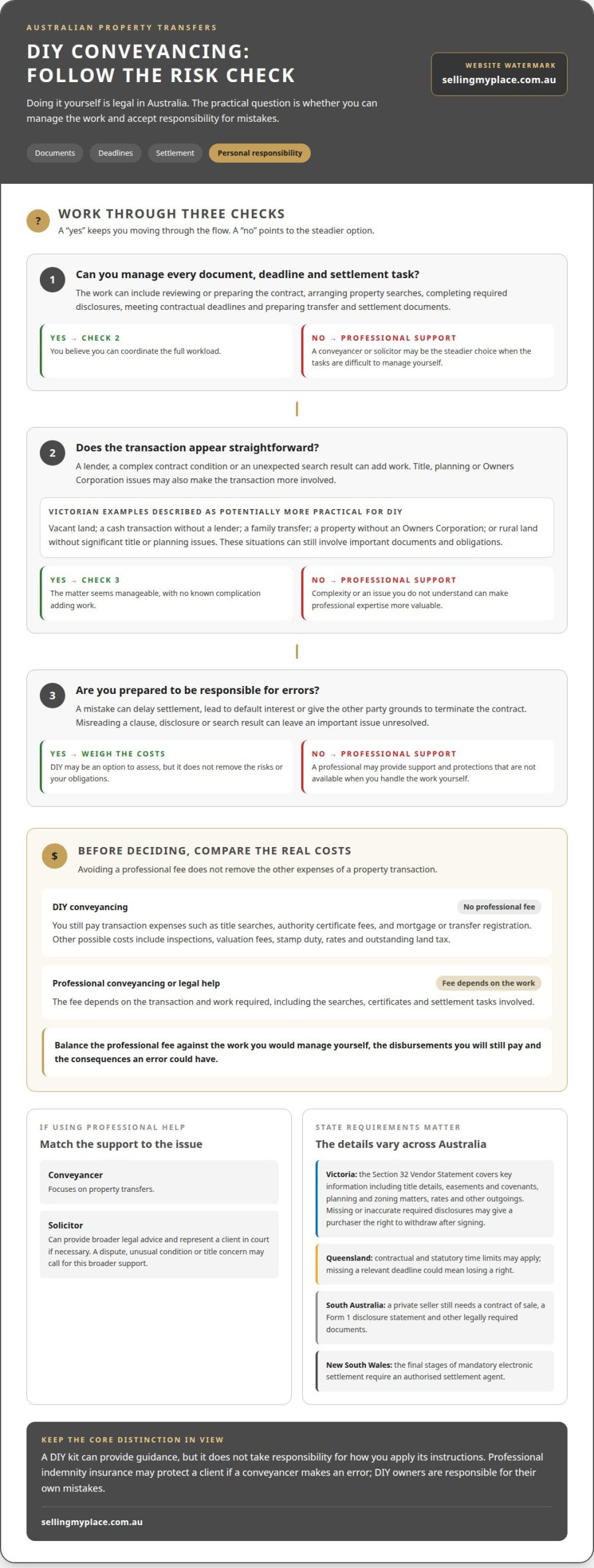
Yes, you can handle your own conveyancing in Australia, but requirements differ by state. The key question is whether you can manage each document, deadline and settlement task while accepting responsibility for errors.
Legal permission for DIY conveyancing
DIY conveyancing means managing the legal and administrative work of transferring property without engaging a conveyancer or solicitor. It isn’t against the law to do your own conveyancing in Australia, but permission doesn’t remove your obligations under the contract or state rules.
That distinction matters to buyers and sellers: a DIY kit can provide guidance, but following it doesn’t transfer responsibility to its author. In Queensland, contractual and statutory time limits may apply, and you could lose a right if you miss the relevant deadline.
DIY conveyancing steps and paperwork
DIY conveyancing involves coordinating the contract, property checks, required disclosures and settlement documents. For a purchase, this generally means reviewing the contract, arranging relevant searches, meeting contractual deadlines and preparing for transfer and settlement.
For a sale, you’ll need to prepare or arrange the contract and required disclosure documents, then manage signing, settlement and title transfer. The documents vary by state and transaction. For example, a South Australian private seller still needs a contract of sale, a Form 1 disclosure statement and other legally required documents.
Before committing, list each document, who is responsible for completing it and its due date. A missed search or incomplete disclosure can affect the transaction, not just add paperwork. Buyers also need to understand how search results relate to both the contract and the property being transferred.
Risks, errors and personal liability
The main risk is that you remain personally responsible for mistakes while handling the transaction. An error can delay settlement, lead to default interest or give the other party grounds to terminate the contract.
Misreading a clause, disclosure or search result can also leave an important issue unresolved. In Queensland, misunderstanding conveyancing documents or search results can lead to unnecessary litigation and loss. A kit may explain common tasks, but it cannot take responsibility for how you apply its instructions to your contract.
Professional indemnity insurance may protect a client if a conveyancer makes an error; DIY owners are responsible for their own mistakes. Licensed conveyancers and solicitors in NSW must hold this insurance. Consider the consequences of a missed deadline or incorrect document, not just the time needed to complete each step.
Professional fees compared with DIY
A conveyancer or solicitor’s fee depends on the transaction and work required, and is provided after a quote request. The cost can reflect the property matter’s complexity and the searches, certificates and settlement tasks involved.
DIY avoids a professional fee, but it doesn’t remove transaction expenses. Disbursements can include title searches, authority certificate fees, and mortgage or transfer registration. Other costs may include inspections, valuation fees, stamp duty, rates and outstanding land tax.
Compare the professional fee with the tasks you would manage yourself, the disbursements you’ll still pay and the consequences of an error. This gives you a clearer basis for deciding whether DIY is worth the responsibility.
DIY Conveyancing Victoria | Is It Legal & Worth the Risk?
According to the Victorian Government, DIY conveyancing is legal in Victoria under the Sale of Land Act 1962 and the Transfer of Land Act 1958. That permission doesn’t make every transaction straightforward. A vacant block or family transfer may involve fewer complications than a property with planning, title or Owners Corporation issues. The decision turns on what you need to understand and manage.
DIY may be more practical for vacant land, cash transactions without a lender, family transfers, properties without an Owners Corporation, or rural land without significant title or planning issues. These situations can still involve important documents and obligations. A lender, complex contract condition or unexpected search result can add work and make professional expertise more valuable.
A Victorian Section 32 Vendor Statement must disclose key property information, including title details, easements and covenants, planning and zoning matters, rates and other outgoings. If required disclosures are missing or inaccurate, a purchaser may have the right to withdraw after signing. That makes careful preparation and review important for sellers and buyers alike.
A licensed conveyancer or solicitor can prepare a compliant contract with relevant disclosure documents, check title details and explain contract conditions. They can also conduct searches and enquiries, help calculate stamp duty, and tailor special conditions to the transaction. Ask for an itemised statement of likely costs before work starts; legal practitioners and conveyancers generally disclose costs before or when retained.
Choose professional support that matches the issue. A conveyancer focuses on property transfers, while a solicitor can provide broader legal advice and represent a client in court if necessary. If a contract dispute, unusual condition or title concern goes beyond conveyancing, a solicitor may be the more appropriate choice. Both conveyancers and lawyers complete specific training.
Professional indemnity insurance may provide protection if a professional makes an error. Before engaging a conveyancer or solicitor, understand what work they’ll handle, their itemised costs and how they’ll communicate about deadlines or problems. If you’re dissatisfied, keep the contract, emails and a dated record of events. Describe the specific issue in writing and ask for a clear response before deciding what to do next.
DIY can suit a straightforward Victorian transaction when you can manage the documents, disclosures and deadlines. For a complicated Section 32, an unclear contract condition or a search result you can’t interpret, professional review can help you understand the issue before it affects the sale. If you’re considering selling privately, contact Kincade International Direct Sales for guidance on your sale options.
Should I Choose a Conveyancer or a Lawyer?
In Australia, the choice depends on the transaction’s complexity and the legal support you need. Electronic settlement also shapes the process: in Victoria, property settlements are conducted online using PEXA.
Electronic conveyancing became mandatory for most transactions in New South Wales, and the online settlement mandate was introduced in August 2020. Victoria’s framework includes the Electronic Transactions (Victoria) Act 2000. These rules make settlement a digital process, rather than a paper exchange completed entirely in person.
For a Victorian purchase, PEXA is the platform used for electronic settlement. The buyer’s representative coordinates settlement tasks with the seller’s representative and relevant lender. The platform supports the transfer and financial settlement, but doesn’t remove the need to meet contract deadlines or resolve issues with title, searches or documents beforehand.
A licensed conveyancer focuses on property transactions, including searches, contract requirements and settlement arrangements. A solicitor can also handle conveyancing, while providing broader legal advice and representing a client in court if necessary. If a dispute or unusual legal issue arises, that wider scope may matter. Both conveyancers and lawyers complete specific training.
State deadlines and settlement processes differ because contracts, statutory time limits and electronic settlement requirements vary by jurisdiction. In Queensland, contractual and statutory time limits may apply, and rights can be lost if they aren’t exercised on time. A buyer there has a five-business-day cooling-off period after signing a residential property contract. Keep track of the dates that apply to your contract.
Settlement is when the purchase money and transfer documents are dealt with to complete the sale. If there’s a mortgage, the lender’s requirements and timing become part of the coordination. In Queensland, the buyer or solicitor investigates title and relevant departments before completion; after completion, the buyer or lender attends to registration. The buyer becomes the legal owner upon registration.
Government charges and transaction expenses can include stamp duty, title searches, authority certificate fees, and mortgage or transfer registration. Requirements depend on the state, property and transaction. Other expenses may include building and pest inspections, survey reports, rates, scheme levies and outstanding land tax. A professional can identify the relevant searches and charges for the matter.
Choose a conveyancer for a property-focused transaction with clear requirements. Consider a solicitor if a contract dispute, complex condition or broader legal concern needs attention. Either way, understanding who will coordinate the platform, lender communication, deadlines and registration helps you judge the support needed for a smooth transfer.
Doing your own conveyancing in NSW
DIY conveyancing rules differ between Australian states and territories, so there isn’t one national process. In NSW, buyers and sellers can handle their own conveyancing, but electronic conveyancing is mandatory for most transactions. The final stages must be completed by a registered settlement agent authorised to use the online settlement platform.
That means doing your own conveyancing in NSW doesn’t mean completing every task alone. You can manage much of the preparation, but the final electronic settlement requires an authorised professional. Plan for this early, alongside the contract dates and responsibilities shared with the other party.
A NSW conveyancing transaction can involve examining the sale contract, arranging inspections and finance, and exchanging the contract. It may also include paying the deposit, arranging stamp duty, checking property obligations and disclosures, adjusting rates, changing title and attending settlement. Each task connects to the next: contract terms inform deadlines, while searches and disclosures help reveal obligations tied to the property.
For a buyer, the work may include reviewing the contract, arranging building and pest inspections, organising finance and conducting searches. A seller may need to provide accurate disclosure information and coordinate documents for the transfer. Both parties must meet the contract’s requirements, even when real estate agents help coordinate communication.
Search results and contract conditions need to be understood together. A title search, for example, may identify property interests that affect what the buyer receives. Checking property obligations and disclosures also helps clarify responsibilities such as rates adjustments. If an inspection, search or finance arrangement raises an issue, it may affect what happens before settlement.
NSW conveyancers must be licensed with NSW Fair Trading and complete an accredited course. Solicitors also handle conveyancing, and solicitors and conveyancers are equally qualified to do conveyancing in NSW. A conveyancer focuses on property transfers; a solicitor can advise on other areas of law that may arise during a transaction.
Compare the work you can manage with the tasks that require professional involvement. DIY still means organising documents, searches, inspections, finance, disclosures and deadlines, then arranging an authorised settlement agent for completion. A seller who is coordinating a sale with real estate agents may also need to manage contract and settlement requirements at the same time.
NSW’s licensed conveyancers are regulated by NSW Fair Trading. If a conveyancer is dishonest with money entrusted to them, a client may have access to the Property Services Compensation Fund administered by NSW Fair Trading. These protections don’t remove the need to understand your transaction, but they are part of the difference between using a licensed professional and doing the work yourself.
Rules differ across Australian states and territories. In NSW, buyers and sellers can manage their own conveyancing, but most transactions require electronic conveyancing, and a registered settlement agent authorised to use the online settlement platform must handle the final stages.
Whether you can do your own conveyancing in Australia
Yes, you can do your own conveyancing in Australia. The practical question is whether you can manage the legal documents, deadlines and settlement requirements for your particular property transaction. Requirements differ between states, so a process that works for one property may not suit another.
Think of conveyancing as a chain of connected tasks, not just signing a contract. A buyer may need to review contract terms, arrange searches and inspections, coordinate finance, meet disclosure requirements and prepare for settlement. A seller may need to prepare required documents and ensure the transaction proceeds according to the contract. An error at one stage can affect what follows.
State procedures show why location matters. Electronic settlement procedures can mean DIY owners need support with the final stages. In Victoria, property settlements are conducted online through PEXA. These arrangements mean DIY doesn’t necessarily involve handling every part of settlement personally.
Queensland provides another example of the work involved. Before completion, the buyer or their solicitor investigates title and searches relevant departments; a survey may also be conducted. At completion, the buyer pays the balance if search results are satisfactory, and the seller hands over documents needed for registration and the keys. Legal ownership follows registration of the transfer.
South Australian private sellers still need to prepare a contract of sale, a Form 1 statutory disclosure statement and other legally required documents. Settlements are conducted electronically, with the vast majority processed through PEXA. So a private sale does not remove the seller’s documentation responsibilities or the need to complete the transfer properly.
DIY may be more manageable when the transaction is straightforward and you can organise each task, interpret the documents and keep every deadline in view. It becomes harder when a search raises an issue, a contract clause is unclear or an unexpected dispute develops. In Queensland, anyone out of their depth during a dispute should seek a solicitor’s help promptly.
To decide, map the work against your own knowledge and available time. Include searches, disclosures, contract obligations, settlement arrangements and registration, then identify where errors could affect the other party or completion. Real estate agents can assist with sale communications, but they don’t replace the conveyancing work. If you’re planning a property sale, discuss support for your sale alongside the legal work the transaction requires.
Kincade International Direct Sales
Kincade International Direct Sales supports the property decisions around your transaction, whether you’re preparing to sell or looking to buy. Its residential listing services, buyer representation and pre-sale property consulting address the market-facing parts of that journey, while neighbourhood market reports can help inform your plans.
Keep the roles clear: conveyancing covers legal documents, deadlines and settlement, while property advice and representation focus on your sale or purchase. If you’re weighing up DIY conveyancing, consider these needs separately and arrange appropriate support for each part of the transaction.
For guidance on your property plans, contact Kincade International Direct Sales.
Plan your next property move with clarity
A property move involves more than completing a transfer. The legal work and decisions around selling or buying need to fit together, especially when timing, preparation and your preferred level of involvement matter. Give each part of the move a clear place in your plans before making commitments.
If you’re still weighing up whether to do your own conveyancing in Australia, use that decision to set boundaries around the work. Identify what you’ll manage yourself, what requires legal expertise, and how property decisions will be handled alongside the transfer. A clear division can help you move forward without confusing sales support with legal advice.
Kincade International Direct Sales can assist with the property side of that planning, including preparing to sell or making decisions as a buyer. For a considered conversation about your next move, contact Kincade International Direct Sales. Take the next step when you’re ready, with a plan that feels clear and right for you.
Frequently Asked Questions
Should the buyer and seller use the same conveyancer?
Don’t assume one conveyancer can act for both parties throughout a transaction. A shared representative may face a conflict if the buyer’s and seller’s interests differ; in South Australia, a conveyancer may need to stop acting for both parties if a conflict arises. Separate representation helps each party receive advice focused on their own position, particularly if negotiations or a dispute develop.
What happens on Settlement Day?
Settlement is when the agreed payment and transfer arrangements are completed so ownership can move to the buyer. In an electronic settlement, the parties’ representatives coordinate the transaction through the platform, including the funds and documents required for transfer. Before the scheduled day, confirm that outstanding contract requirements and funds are ready. After settlement, registration records the transfer of title.
What are the risks and common mistakes of doing your own conveyancing?
Common risks include misunderstanding a contract clause, overlooking a disclosure or search result, and missing a deadline. For example, failing to exercise a contractual right within its required timeframe may mean losing that right. An error can delay settlement, lead to default interest or give the other party grounds to terminate. A DIY kit provides guidance, but doesn’t take responsibility for your decisions or mistakes.
Can you use an online conveyancing platform or PEXA without a conveyancer?
Using an online platform doesn’t remove the need to meet your state’s settlement requirements. In NSW, electronic conveyancing is mandatory for most transactions, and anyone handling their own matter must arrange for a registered settlement agent authorised to use the platform to complete the final stages. PEXA is used for Victorian electronic settlements, but the platform itself doesn’t interpret contract terms or resolve legal issues.
When should you hire a conveyancer or property lawyer instead of doing it yourself?
Get professional help if a title search raises an issue, a contract condition is unclear or a dispute emerges. A conveyancer focuses on the property transfer; a solicitor can also address broader legal issues and represent a client in court if needed. For example, a Queensland DIY conveyancer who is out of their depth in a dispute should seek a solicitor’s help promptly.