
A solicitor isn’t automatically the only option when you sell a home. If you’re wondering whether you need a solicitor or conveyancer to sell, both can handle the legal work involved in transferring ownership; DIY conveyancing may also be an option. The right path depends on the legal work your sale involves and how comfortable you are managing it.
When selling a home in Australia, you can manage the conveyancing yourself, but you remain responsible for the legal paperwork and steps. A solicitor or conveyancer can handle that work. A solicitor may suit a sale involving broader legal issues, while a conveyancer focuses on property transfers.
This guide explains the differences, what to consider when comparing services and how costs depend on the work involved. It also covers DIY conveyancing, so you can decide what support suits your sale and circumstances.
Key Takeaways
- A solicitor, conveyancer or DIY approach may suit a sale, depending on the legal work involved and how much you’re comfortable managing yourself.
- Understand the roles each legal professional can perform, then choose support that fits the complexity of your sale.
- When comparing quotes, look beyond the headline fee and consider what work and disbursements are included.
- Getting key property information and documents organised before listing can help prepare you for the sale process.
- Conveyance advice can help you understand the legal side of selling, while pre-sale consulting and listing services support other parts of your sale.
DIY conveyancing: Is it an option?
Australian sellers can handle their own conveyancing, but must take responsibility for the legal steps and paperwork. Alternatively, engage a solicitor or conveyancer. The right choice depends on your property, its state or territory, and how comfortable you are managing the process.
DIY conveyancing risks
With DIY conveyancing, you are responsible for the transaction’s legal paperwork, deadlines and communications. A missed step or unclear contract term can complicate the sale, particularly if questions arise about the property or the buyer requests changes. A legal professional can manage those details and explain what needs attention. DIY avoids professional involvement but takes time and care.
Qualifications and regulation
Solicitors and conveyancers have different professional roles and qualification pathways. Rules and regulators vary by state or territory, so don’t assume one national system applies. Before engaging a legal professional, identify the relevant regulatory body and check that the provider is authorised in the property’s jurisdiction. Compare the written scope and quote, not just the job title.
Quotes can differ because providers include different work, disbursements and communication in their fees. Ask for an itemised breakdown showing what is covered, what may cost extra and how changes to the transaction are handled. This is more useful than comparing headline figures alone.
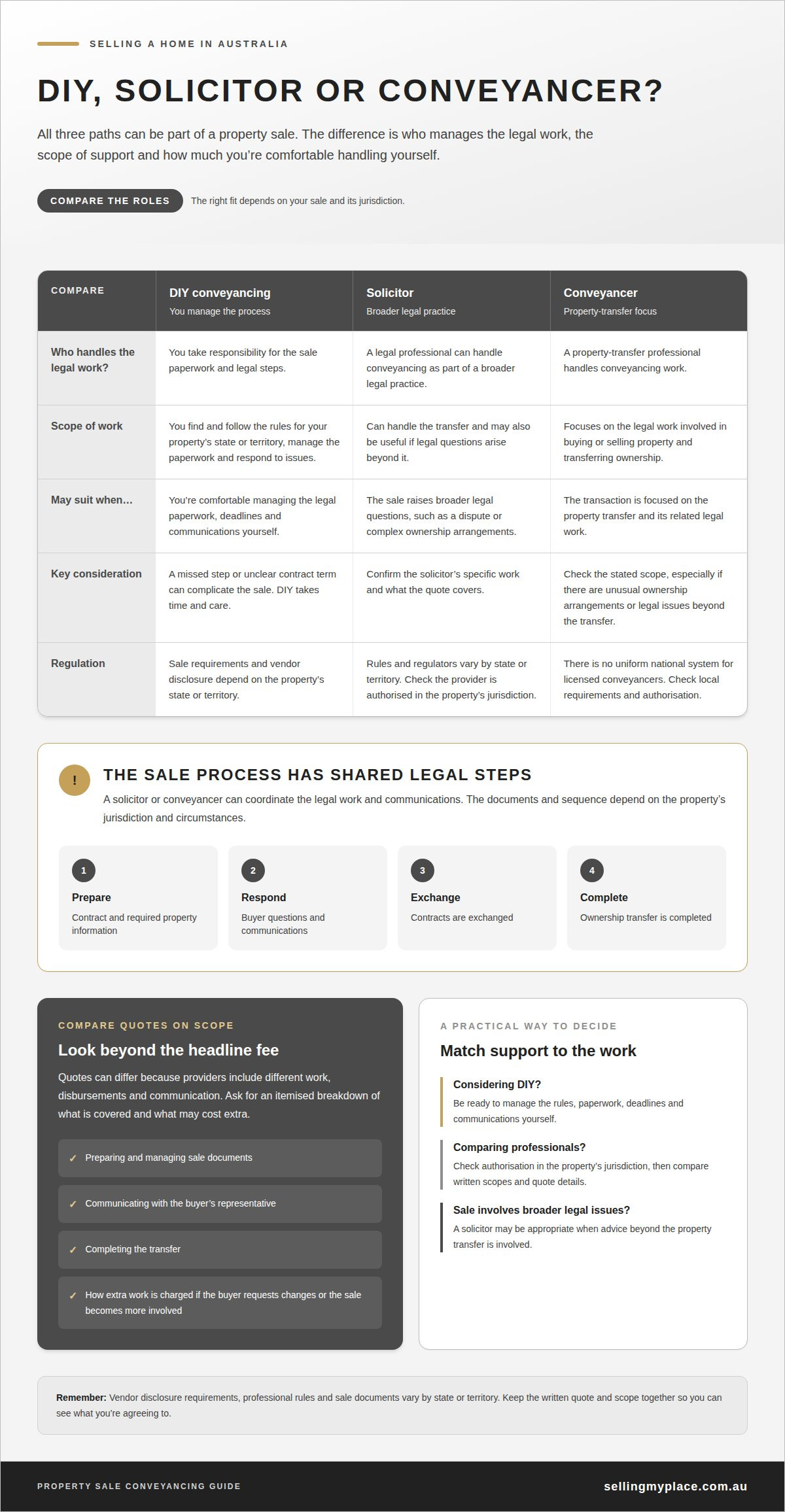
| Option | Who manages the legal work | What to consider |
|---|---|---|
| DIY conveyancing | You handle the sale paperwork and process | Time, confidence and responsibility for each step |
| Solicitor | A legal professional handles conveyancing work | Scope of service, relevant regulation and quote detail |
| Conveyancer | A property-transfer professional handles conveyancing work | Scope of service, relevant regulation and quote detail |
For each quote, clarify whether it covers preparing and managing sale documents, communicating with the buyer’s representative and completing the transfer. Ask how extra work is charged, including if the buyer requests changes or the sale becomes more involved. Keep the written quote and scope together so you can see exactly what you’re agreeing to.
State-specific sale requirements
Vendor disclosure requirements are not the same across Australia. The required information and sale documents depend on the state or territory where the property is located, so understand the local process before listing. A solicitor or conveyancer can explain the requirements for your transaction and help organise the relevant paperwork.
Choose DIY only if you’re ready to find and follow the rules for your property’s jurisdiction, manage the paperwork and respond to issues as they arise. If you’d prefer support with the legal steps, compare regulated providers’ written scopes and choose the assistance that suits your sale.
Conveyancer vs solicitor: What’s the difference and which should you choose?
Solicitors and conveyancers can both handle legal work involved in transferring property ownership. Their training and professional scope differ, while the rules for a sale depend on its state or territory.
Solicitor roles and authority
A solicitor is a legal professional who can handle conveyancing as part of a broader legal practice. That wider scope may be useful if the sale raises legal questions beyond the transfer, such as a dispute or complex ownership arrangements. Ask what work the solicitor will do and what the quote covers.
For a straightforward sale, compare the work offered, not just the title. Check whether the solicitor will prepare and review sale documents, communicate with the buyer’s representative and guide you through the transfer. A clear written scope shows who is responsible for each task.
Licensed conveyancer roles and authority
A conveyancer focuses on the legal work involved in buying or selling property. This can include coordinating transaction documents and communications through to the ownership transfer. Unlike a solicitor, a conveyancer’s practice centres on property transfers rather than a wider range of legal matters.
“Licensed conveyancer” does not describe one uniform national system. Each state or territory has its own rules and professional arrangements, so requirements depend on where the property is located. Compare the conveyancer’s stated scope with your sale’s needs, especially if it involves unusual ownership arrangements or a legal issue beyond the transfer.
Sale process and appointment timing
A sale generally involves preparing the contract and required property information, responding to the buyer’s questions, exchanging contracts and completing the transfer. The legal professional coordinates these steps and communications on your behalf. The documents and sequence depend on the property’s jurisdiction and circumstances.
Appoint a solicitor or conveyancer before the legal work needs to begin, ideally while preparing your property for market. Early involvement gives them time to identify documents to organise and explain the local sale process before a contract is ready. You don’t have to wait until you receive an offer to discuss the transaction.
Choose based on the work your sale calls for. A conveyancer may suit a transaction focused on transferring ownership; a solicitor may be more appropriate when wider legal advice is involved. In either case, compare the proposed scope, communication and responsibility for each stage. For practical support planning your sale, discuss your sale requirements.
Benefits and drawbacks of solicitors
A solicitor may suit a sale that raises legal questions beyond transferring ownership. For example, an ownership dispute or a complicated contract may need advice beyond routine conveyancing. A legal professional can also advise you before the property goes to market, helping identify issues before they interrupt the sale.
A solicitor’s broader legal perspective can help when connected issues affect the transaction. If a buyer raises a contract concern or an ownership detail needs attention, a solicitor may be able to advise on both the legal question and the sale process. This can be a practical fit when the matter involves more than preparing documents and progressing the transfer.
Solicitor support can also reduce the legal administration you manage yourself. The solicitor can communicate with the buyer’s legal representative and explain the effect of proposed contract changes. You still need to provide accurate property information and respond to requests promptly. Agreeing responsibilities clearly helps avoid uncertainty about who is handling each task.
There are trade-offs. A solicitor’s broader legal expertise may exceed what a straightforward sale requires if the work is mainly about the property transfer. The scope matters: a solicitor’s title alone doesn’t tell you which tasks are included, who will manage day-to-day updates or what happens if an issue arises. Ask for these details in writing before engaging them.
Use these questions to assess whether a solicitor suits your sale:
- What needs advice? Identify whether the sale involves a legal question beyond the transfer.
- What work is included? Confirm who prepares documents, handles communications and explains contract changes.
- Who will be your contact? Establish how updates and requests will be handled throughout the transaction.
- How is additional work treated? Ask how the scope changes if a dispute or unexpected legal issue emerges.
A solicitor may be particularly useful if you need advice before listing, rather than support only after an offer. For instance, an ownership question could affect the information prepared for the sale. Raising it early gives you time to understand the issue before the contract process begins. Choose advice that addresses your legal concern, not simply the broadest service.
For a sale involving standard transfer work, compare the solicitor’s proposed role with the help you need. A detailed scope lets you weigh legal guidance against the practical tasks involved. If you’re comfortable coordinating straightforward administration, a broader advisory role may not be essential. If a legal complication could affect the contract or ownership, that wider perspective may be worth considering.
Conveyancing costs for buying and selling
Conveyancing costs in Australia depend on the work included, the property and the transaction. A sale quote and a purchase quote aren’t automatically comparable: each may cover different documents, communications and transfer tasks. Ask for the scope in writing before comparing providers. This shows what the professional fee covers and which costs relate to separate transaction services.
For a sale, ask whether the quote includes preparing the contract, handling buyer enquiries and coordinating the transfer. A disbursement is an outlay paid to a third party for a transaction-related service. Ask which outlays are anticipated, which are included in the quoted total and how additional work is charged. This helps ensure the headline fee reflects the full scope.
A purchase quote may cover different tasks, such as reviewing the contract and progressing the buyer’s transfer. If you’re selling one property and buying another, request a breakdown for each transaction. This shows whether a combined quote fully covers both matters or assumes some tasks can be shared across the sale and purchase.
The work may also change as the transaction progresses. Complicated ownership details, for example, may require further enquiries or document handling. A buyer’s request to amend contract terms may mean extra communication. Ask how these situations affect the quoted fee and whether the provider will explain proposed charges before doing extra work.
Use this process to compare quotes:
- Separate professional fees from disbursements. Ask for each category to be itemised.
- Match the scope. Compare quotes covering the same sale or purchase tasks.
- Ask about extra work. Clarify how amendments and unexpected enquiries affect charges.
- Confirm payment timing. Find out when fees and third-party outlays are payable.
Don’t compare a low headline fee with a broader service until you’ve checked the details. One quote may include a task that another charges for separately. A written breakdown makes it easier to compare equivalent work and understand which costs may arise as the transaction progresses.
For an Australian sale or purchase, ask for costs in Australian dollars. Overseas conveyancing figures reflect a different legal and property system, so they aren’t a sound basis for judging an Australian quote. Instead, focus on the work, disbursements and terms stated in your local quote.
A useful quote describes the work, exclusions and possible extra charges in plain language. If a line item is unclear, ask which task it covers and when it may apply. This gives you a clearer basis for choosing the support that suits your transaction, rather than relying on the first figure presented.
What legal documents does a seller need to prepare before listing a property?
The documents involved in an Australian property sale depend on its state or territory and the property itself. Before listing, gather records that help establish ownership, describe the property and explain relevant changes. Your solicitor or conveyancer can identify which documents apply and prepare the sale contract for your circumstances.
Start with paperwork that identifies the property and its owners. Title details and purchase records can help clarify ownership, while a mortgage statement may identify a lender whose interest needs to be addressed during the sale. If more than one person owns the home—or if you are dealing with a property passed down through generations—give your conveyancing professional the correct names and ownership information. For families managing inherited estates and wanting to keep their ancestral documentation well-structured, digital lineage platforms like kyucsovn.com highlight how family histories and genealogical records can be preserved and managed online.
Next, gather records about the home’s features and history. These might include plans, approvals or certificates for renovations, along with warranties or invoices for significant work. A renovated kitchen, added room or altered outdoor structure may prompt buyer questions. Keeping supporting paperwork together makes it easier to provide accurate details.
For a unit or townhouse, gather the owners corporation or strata records you hold. These may include correspondence, meeting materials or information about levies and building works. Sale documents and disclosure requirements vary by jurisdiction and property type, so your legal professional can explain which records are needed.
Other useful information may include current service details, insurance records and documents about leases or occupancy arrangements, if relevant. A tenanted property, for example, has different practical details from a home that will be vacant at settlement. Share relevant records early so the sale paperwork reflects the arrangement accurately.
Prepare a folder with these categories:
- Ownership: title and purchase records, plus details of each owner.
- Property changes: renovation plans, approvals, invoices and warranties you hold.
- Strata or owners corporation: available levy, meeting and building-work information.
- Occupancy and services: lease or occupancy details and relevant service records.
- Existing finance: mortgage information and lender contact details.
Not every example is required in every state. The documents depend on the property’s location, type and sale circumstances. A solicitor or conveyancer can review what you’ve gathered, identify relevant gaps and explain how the information fits into the contract and any applicable disclosure material.
Getting organised before listing can also help you answer buyer questions consistently. Keep copies together and tell your legal professional if a document is missing, a renovation lacks paperwork or ownership details have changed. For support preparing your property for sale and organising the next steps, discuss your pre-sale requirements.
Vendor disclosure requirements depend on the property’s location and type. A solicitor or conveyancer can identify the applicable requirements and explain which records to provide.
Kincade International Direct Sales: Conveyance Advice
Kincade International Direct Sales offers Conveyance Advice to help you understand how conveyancing fits into your sale. This can help when you’re weighing your next steps, organising sale plans or clarifying questions about the property transfer. For legal work such as preparing sale documents or managing the transfer, engage a qualified solicitor or conveyancer. Conveyance advice can inform your selling decisions, but it does not replace engaging a legal professional to carry out the conveyancing.
If you’re planning a sale and would like guidance on the conveyancing side, contact Kincade International Direct Sales.
Set your sale up for a confident next step
Before deciding, consider what support would make the sale manageable. If you’re asking, “Do I need a solicitor or conveyancer to sell?”, think about the legal work involved and where you want professional guidance. A clear plan can help you move from preparation to market with fewer unanswered questions.
The legal transfer is one part of a property sale. Kincade International Direct Sales also offers Residential Property Listing Services, Pre-Sale Property Consulting and Buyer Representation, helping sellers consider marketing and their next move alongside the sale. These services complement, but don’t replace, legal conveyancing support.
When you’re ready to talk through the practical side of your property plans, contact Kincade International Direct Sales. A thoughtful next step can make the transition feel clearer and more manageable.
Frequently Asked Questions
Who is allowed to do conveyancing?
Property transfers can be handled by solicitors and conveyancers, or by sellers who manage their own conveyancing. Professional titles, qualification requirements and regulatory arrangements depend on the Australian state or territory. If you engage a conveyancer, establish that they are authorised to provide conveyancing services in the property’s jurisdiction. Conveyancing generally focuses on the legal work involved in transferring ownership.
Do you need a solicitor or conveyancer to sell a property in Australia?
No. Sellers may manage their own conveyancing, so hiring a solicitor or conveyancer isn’t the only option. However, legal documents and disclosure requirements vary between states and territories, and the ownership transfer still needs to be completed correctly. Consider professional support if you’re unsure how to handle a contract issue, property disclosure or buyer request. The tasks depend on the property’s location and circumstances.
Can a property seller do their own conveyancing in Australia?
Yes. A property seller can choose DIY conveyancing and take responsibility for the transaction’s legal administration. You would need to manage the relevant paperwork and communications and keep track of each step through to transfer. The process can be demanding if the buyer raises questions or requests contract changes. If you choose this approach, understand the requirements for the property’s state or territory.
What is the difference between a solicitor and a conveyancer when selling a home?
A solicitor can provide broader legal services, while a conveyancer focuses on property transfers. A sale involving a legal dispute, for example, may call for advice beyond routine conveyancing. A straightforward transfer may centre on preparing and progressing the property transaction. Since the title alone doesn’t show what’s included, compare the professional’s scope with the legal issues in your sale.
How much does a conveyancer or solicitor cost to sell a house in Australia?
Costs depend on the work required and what the quoted service includes. A quote may separate professional fees from transaction-related outlays or treat particular tasks differently. For a useful comparison, request itemised quotes for the same work and note how each handles extra enquiries or contract changes. The property type, sale circumstances and legal support required can affect the overall cost.
When should a property seller choose a solicitor rather than a conveyancer?
Consider a solicitor if your sale raises legal questions beyond the property transfer. An ownership dispute or contract concern, for example, may require broader legal advice. If the work centres on progressing the transfer, a conveyancer’s specialist focus may suit the task. Identify the legal issues you need help with and compare each professional’s stated scope against those needs.