
A conveyancer who treats your property transaction as mere administrative paperwork is one of the quietest financial risks you can take. Knowing how to choose a good conveyancer in Australia isn’t just about ticking a legal compliance box; it’s about partnering with a proactive safeguard who protects your hard-earned equity before contracts are signed.
It’s completely natural to feel uneasy about the fine print. Between tightening statutory disclosure obligations, confusing differences between conveyancers and solicitors, and the dread of surprise settlement disbursements, the legal side of moving can easily become overwhelming. You deserve a steady hand, upfront fee transparency, and the calm reassurance that your settlement will finish on time without expensive delays or penalty interest.
This 2026 guide gives you a clear framework to evaluate professional qualifications, assess digital settlement readiness, and demand complete cost certainty. Ahead, you’ll discover the exact questions to ask so your upcoming property transition unfolds with total legal confidence.
Key Takeaways
- Understand the practical distinctions between a licensed conveyancer and a property solicitor to ensure your transaction receives the exact level of legal oversight it requires.
- Apply a structured framework on how to choose a good conveyancer in Australia, verifying active state credentials, comprehensive insurance coverage, and modern electronic settlement readiness.
- Protect your budget against surprise settlement charges by learning how to assess fee transparency, distinguishing professional service costs from mandatory administrative disbursements.
- Arm yourself with essential vetting questions to confirm who manages your file directly, standard contract review timeframes, and robust cybersecurity safeguards.
- Discover why preparing your contract of sale and statutory disclosure documents before going to market prevents costly negotiation delays and safeguards your equity.
What Does a Property Conveyancer Do in Australia?
A conveyancer acts as your legal guardian during one of life’s most significant milestones. At its core, the legal process of conveyancing involves transferring legal property ownership from one party to another. Yet, reducing this work to simple paperwork overlooks the protective wall a practitioner builds around your interests. When learning how to choose a good conveyancer in Australia, your primary goal is finding someone who catches fine-print liabilities before they jeopardise your settlement.
Core Responsibilities During a Residential Property Transaction
Your conveyancer manages the complex statutory steps that safeguard property title transfers from listing through to final financial completion:
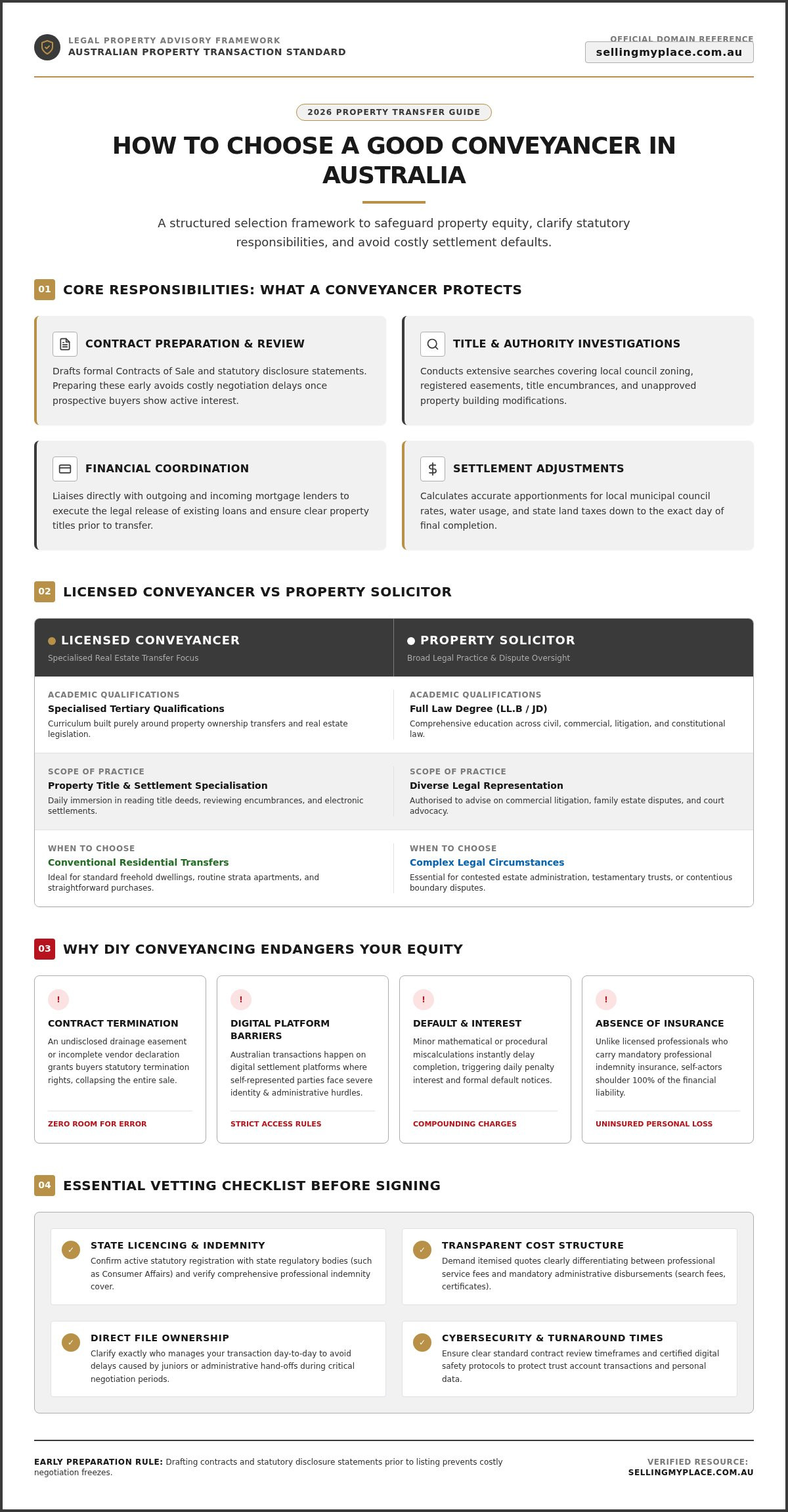
- Contract preparation and review: Drafting the formal Contract of Sale and statutory disclosure statements; preparing these documents early prevents costly negotiation delays once prospective buyers show interest.
- Title and authority investigations: Conducting searches covering local council zoning, registered easements, title encumbrances, and unapproved building modifications.
- Financial coordination: Liaising directly with outgoing and incoming lenders to release existing mortgages and clear property titles.
- Settlement adjustments: Calculating precise apportionments for local council rates, water usage, and land taxes up to the settlement day.
Why DIY Conveyancing Puts Your Property Equity at Risk
Handling your own property legalities might sound like an easy way to trim expenses, but property transfers leave zero room for error. A single undisclosed drainage easement or an incomplete vendor declaration can grant buyers statutory termination rights, collapsing your sale right before completion.
Beyond disclosure pitfalls, independent buyers and sellers face substantial technical barriers. Australian property transfers take place almost exclusively across digital settlement platforms where self-represented parties face cumbersome verification hurdles. A minor administrative miscalculation can delay settlement, instantly triggering daily penalty interest or formal default notices. Licensed conveyancers carry mandatory professional indemnity insurance, ensuring your transaction is shielded against costly oversight. Understanding how to choose a good conveyancer in Australia guarantees your family’s equity remains backed by dedicated legal expertise and genuine accountability.
Licensed Conveyancer vs Solicitor: Which Professional Do You Need?
Deciding between a licensed conveyancer and a property solicitor is often the first hurdle homeowners face when reviewing their transaction. Both professionals hold statutory approval to manage legal settlements and prepare statutory paperwork. However, their day-to-day focus, academic qualifications, and scope of practice differ substantially. Understanding these distinctions helps clarify how to choose a good conveyancer in Australia who matches the specific legal profile of your property.
Key Differences in Qualifications, Scope, and Focus
Licensed conveyancers complete specialised tertiary qualifications built entirely around real estate transfers. They spend every day interpreting title deeds, reviewing encumbrances, and coordinating electronic settlements. Solicitors hold general law degrees, allowing them to practise across diverse legal fields including commercial litigation, family disputes, and estate law. As highlighted in Consumer Affairs Victoria’s guide to conveyancers and legal practitioners, both professions operate under strict regulatory oversight and compulsory professional indemnity schemes. For conventional freehold homes or straightforward strata apartments, conveyancers often deliver exceptionally focused, communicative care.
When Your Sale Requires a Qualified Property Solicitor
Certain property transfers step outside standard statutory procedures, demanding legal counsel that can address formal disputes or complex contract restructuring. You will likely require an admitted solicitor rather than a conveyancer if your transaction involves:
- Contested estate administration, complex testamentary trusts, or unresolved probate orders
- Contentious boundary alignments, formal adverse possession claims, or disputed heritage covenants
- Custom vendor finance terms, long-term options deeds, or off-the-plan developments with bespoke leaseholds
- Active disputes where a counterparty threatens contract rescission or Supreme Court proceedings
State legislation can also dictate this decision. For instance, independent conveyancers are not licensed in Queensland or the Australian Capital Territory, where conveyancing work must occur within an admitted law practice. For standard residential property transfers nationwide, partnering with an agile, title-focused professional keeps your sale moving smoothly without unnecessary overheads. If you are preparing to list your home and want clarity around the right legal pathway, you can reach out for bespoke conveyance advice to protect your hard-earned equity right from day one.
How to Choose a Good Conveyancer in Australia: 5-Step Selection Framework
Selecting the right property legal partner requires looking past generic promises of smooth service. A brilliant conveyancer does not simply process files; they act as a proactive shield against contractual bottlenecks, missed deadlines, and unexpected expenses. Knowing how to choose a good conveyancer in Australia comes down to applying a methodical vetting system before signing a letter of engagement.
Step 1 & 2: Verifying Licences and Experience in Your Property Type
Your first move is checking official government registers to ensure your representative holds an active, unrestricted licence. Inquire about current professional indemnity insurance coverage, which typically mandates protection of at least $1.5 million to $2 million per claim. Seeking an active member of the Australian Institute of Conveyancers (AIC) offers instant assurance of ongoing professional development and strict ethical standards.
Equally, match their daily workload to your property type. A practitioner who primarily handles standard Torrens title suburban homes may stumble when interpreting complex strata by-laws, community title levies, rural water licences, or local heritage overlays. For homeowners coordinating their own campaign, our comprehensive guide on how to sell your own home details how early legal preparation pairs with direct vendor marketing.
Step 3 & 4: Assessing Digital Settlement Readiness and Cybersecurity
Electronic conveyancing dominates the Australian property landscape. Over 88% of national property transfers execute via PEXA, making digital fluency an absolute prerequisite. When evaluating candidates, ask about their electronic settlement track record:
- PEXA workspace efficiency: Ensuring their team proactively pre-populates financial workspaces well ahead of the scheduled settlement hour.
- Verification of Identity (VOI): Confirming they adhere strictly to ARNECC safe harbour standards using secure biometric digital apps or in-person verification.
- Anti-fraud protocols: Validating that trust account details are shared via encrypted client portals or confirmed through verbal phone callbacks, never vulnerable plain-text emails.
Step 5: Understanding Fee Structures and Uncovering Hidden Disbursements
True cost transparency separates exceptional conveyancers from budget operators. A quote should clearly delineate between the conveyancer’s professional service fee and third-party statutory disbursements billed at cost. Disbursements commonly represent 20% to 35% of overall conveyancing expenses, covering council zoning certificates, title registry searches, water drainage plans, and PEXA platform fees. Be cautious of ultra-low quotes that quietly tack on surprise administrative charges for file opening, phone calls, or electronic document storage. Mastering how to choose a good conveyancer in Australia ensures total budget certainty from exchange through to financial completion.
Essential Questions to Ask Before Engaging a Conveyancing Professional
An initial telephone consultation reveals far more than a polished promotional website ever could. Understanding how to choose a good conveyancer in Australia requires asking targeted questions that probe daily operational habits, not just headline promises. Treat this preliminary conversation as an empowering interview for the custodian of your property settlement.
Probing Turnaround Times and Contract Review Protocols
Momentum matters immensely during property transactions, especially when keen buyers are eager to exchange contracts. A proactive practitioner should review or draft standard residential contracts within two to three business days. Ask these precise questions before committing:
- File ownership: Will a qualified practitioner manage my file personally, or will daily correspondence be delegated to junior administrative staff?
- Contract review billing: Are pre-signing contract evaluations charged individually per document, or do they fold into the final settlement invoice?
- Negotiation responsiveness: How quickly can your office approve customized special conditions or finance clauses when an offer arrives?
Quick turnaround times keep interested buyers engaged before enthusiasm cools. Coupling swift legal reviews with proven property sale negotiation tips ensures you never lose a compelling offer to procedural delays.
Clarifying Settlement Day Protocol and Contingency Planning
Settlement day ought to bring relief, not unexpected panic. Establishing how a firm handles sudden hiccups before they occur protects both your timeline and your sanity:
- Colleague coverage: If your dedicated conveyancer is suddenly unwell or away, does a fully briefed peer step in immediately without disrupting the settlement schedule?
- Lender friction: What protocols exist to resolve last-minute banking document discrepancies on the electronic settlement platform before deadline windows close?
- Inspection disputes: If a buyer’s final pre-settlement inspection uncovers damaged fixtures or missing inclusions, how aggressively does the firm negotiate financial holdbacks or prompt resolutions?
A dependable professional remains calm, accessible, and thoroughly organized when pressure mounts. If you are preparing your home for listing and want total assurance throughout the settlement process, contact our advisory team today to secure experienced conveyance advice tailored to your sale.
Streamlining Your Property Sale: Integrating Legal Advice with Smart Marketing
Selling a home is far more than hosting weekend inspections and waiting for offers. Real transaction momentum happens when sharp presentation connects directly with rigorous legal preparation. When exploring how to choose a good conveyancer in Australia, sellers often focus exclusively on the final settlement exchange. However, establishing proactive legal groundwork must start well before the first prospective buyer walks through your front door.
Preparing Your Contract of Sale Before Listing on the Market
Across Australian property markets, presenting a legally compliant contract of sale up front isn’t merely good practice; in many jurisdictions, it’s a strict statutory obligation. Having your contract and mandatory vendor disclosures prepared early prevents costly negotiation delays once serious buyers emerge. Incomplete disclosure paperwork can cause sudden buyer cancellations or statutory contract rescissions, derailing your campaign just as offers peak. Aligning your legal preparation alongside our comprehensive residential property listing services ensures your campaign launches with complete buyer clarity and legal compliance.
Taking Control of Your Sale with Dedicated Advisory Support
More Australian homeowners are choosing direct sales models to protect their hard-earned equity, avoiding traditional percentage-based agency commissions in favour of transparent flat fees. Independent property sales should never mean sacrificing professional standardisation or legal protection. You can achieve an exceptional outcome by harmonising legal precision with high-impact visual marketing:
- Professional visual assets: Pairing sound conveyance advice with high-calibre photography and precise floorplans ensures strong emotional appeal across digital listings.
- Direct vendor empowerment: Engaging directly with interested buyers establishes trust and transparency while you maintain full control of contract negotiations.
- Comprehensive advisory backing: Accessing real estate advisory services gives you seasoned guidance across every milestone, from pre-sale preparation to settlement day.
Mastering how to choose a good conveyancer in Australia gives you the legal confidence needed to run an independent sale smoothly. When legal diligence and smart property marketing operate hand in hand, you secure the best possible financial result for your property. Ready to take charge of your sale with genuine confidence? Connect with our team for expert advice and discover how empowering flat-fee property support can be.
Secure Your Property Settlement with Total Peace of Mind
Navigating a property transaction marks the beginning of an exciting new lifestyle chapter. When you master how to choose a good conveyancer in Australia, you replace procedural anxiety with calm confidence. You ensure that every title search, statutory disclosure statement, and digital settlement workspace is managed with meticulous precision. Protecting your hard-earned equity ultimately comes down to demanding transparent fee structures, early contract preparation, and proactive communication.
You don’t have to navigate this milestone in isolation. Backed by national Australian coverage, our dedicated Agent Advisory Service pairs independent vendor marketing with trusted conveyance advice and pre-sale consulting. By choosing transparent flat-fee structures over percentage commissions, you retain your rightful equity while enjoying complete legal reassurance from listing through to final handover. Connect with our expert property advisors today to protect your sale and move forward with absolute peace of mind.
Frequently Asked Questions
How much does a conveyancer cost in Australia?
Conveyancing expenses comprise two distinct parts: the practitioner’s professional service fee and statutory out-of-pocket disbursements. Disbursements cover essential administrative searches such as local council zoning certificates, water drainage diagrams, land tax clearances, and electronic settlement platform lodgement fees. Because disbursement charges reflect the exact search costs billed by government authorities, your total investment depends heavily on your property type and state jurisdiction.
When should I hire a conveyancer when selling a property?
You should engage a conveyancer before advertising your home or hosting prospective buyers. In several Australian states, marketing a residential dwelling without a complete, compliant contract is unlawful. Learning how to choose a good conveyancer in Australia well before your marketing launch ensures your vendor disclosure paperwork is legally airtight, eliminating unnecessary negotiation hold-ups and preventing buyers from withdrawing during initial contract reviews.
Can I do my own conveyancing in Australia?
While self-representation is legally permissible in most jurisdictions, managing your own property transfer creates enormous financial vulnerabilities. Self-represented individuals face strict administrative hurdles accessing national electronic settlement networks. Furthermore, laypeople lack professional indemnity insurance. A single missed easement disclosure, incorrectly calculated rates adjustment, or delayed lodgement can collapse your transaction and leave you personally liable for substantial penalty interest.
What is the difference between a conveyancer and a solicitor?
A licensed conveyancer specialises entirely in property transfers, whereas a solicitor holds comprehensive legal qualifications to practise across civil litigation, estate management, and family law. When evaluating how to choose a good conveyancer in Australia, a dedicated conveyancer is ideal for straightforward residential titles. However, an admitted solicitor is necessary if your sale involves disputed probate trusts, contentious boundary litigation, or commercial lease conditions.
How long does the conveyancing process take from contract to settlement?
The standard conveyancing timeline typically spans between 30 and 90 days following the formal exchange of contracts. Common contractual timeframes sit at 42 days in New South Wales and between 30 to 60 days in Victoria and Queensland. Both parties can mutually negotiate shorter or extended settlement dates to align with mortgage approvals, lease endings, or planned removalist bookings.
What happens if settlement is delayed by the other party?
When one party fails to settle on the agreed date, the non-defaulting party can serve a formal Notice to Complete and charge daily penalty interest as outlined in the contract. If the defaulting party fails to complete within the notice period (typically 14 days), the innocent party usually retains the right to terminate the agreement, forfeit the deposit, and seek damages for breach.
Do conveyancers check the physical condition of the property?
No, conveyancers examine the legal status and registered documentation of a property rather than its physical building defects. They confirm boundaries, easements, and local council planning certificates, but they do not assess structural integrity or pest activity. Buyers must commission independent building, timber pest, and strata inspectors to evaluate the physical state of the building before committing unconditionally.