How to Handle Offers When Selling Privately: An Australian Homeowner’s Guide
What if the most daunting part of your property journey wasn’t the cleaning or the “for sale” sign, but the simple ping of an email notification? It’s the moment you’ve worked toward, yet many homeowners find themselves frozen when the first buyer makes a move. Learning how to handle offers when selling privately shouldn’t feel like a high-stakes gamble against a seasoned professional. You’ve likely felt that familiar prickle of anxiety about being low-balled or the confusion that comes with “subject to finance” clauses. It’s perfectly natural to worry about losing a buyer during the back-and-forth of a negotiation.
We understand that this transition is about more than just bricks and mortar; it’s about your legacy and your next chapter. This guide is designed to hand you the keys to the negotiation table, showing you how to evaluate, counter, and accept offers with total confidence. We’ll explore how to distinguish a serious buyer from a tyre-kicker and how to secure a clean, unconditional contract. By the end, you’ll be ready to achieve a premium sale price while keeping that $20,000 commission exactly where it belongs: in your pocket.
Key Takeaways
- Understand why verbal offers are merely expressions of interest and how to transition a buyer toward a formal, written contract that sticks.
- Learn how to handle offers when selling privately by weighing up the “Offer Certainty” of an unconditional bid against a higher price with complex conditions.
- Discover the art of the counter-offer and why keeping the conversation moving is the best way to secure a clean, high-value result for your family home.
- Recognise the importance of having your conveyancing advice ready early to navigate state-specific cooling-off periods with calm confidence.
- Explore how professional support and 0% commission models allow you to negotiate like an expert while saving an average of $20,000 in traditional fees.
Receiving Your First Property Offer: The Non-Binding Reality
That first notification that someone wants to buy your home is a milestone moment. It’s the culmination of your hard work, from decluttering the spare room to hosting open inspections. However, it’s vital to ground this excitement in the practicalities of the Australian property market overview. In our local landscape, an offer isn’t a final destination; it’s the start of a structured legal process. Understanding how to handle offers when selling privately begins with recognising that until ink meets paper, everything remains fluid.
A formal offer in the Australian residential market typically consists of four key pillars: the proposed purchase price, the deposit amount (usually 10%), the preferred settlement period, and any specific conditions such as “subject to finance” or a satisfactory building and pest inspection. Verbal offers, while exciting, are technically just “expressions of interest”. They carry no legal weight. You aren’t locked in, and neither are they. This non-binding reality is actually your best friend, as it gives you the breathing room to step back and evaluate the proposal without the pressure of an immediate deadline.
Verbal vs. Written Offers
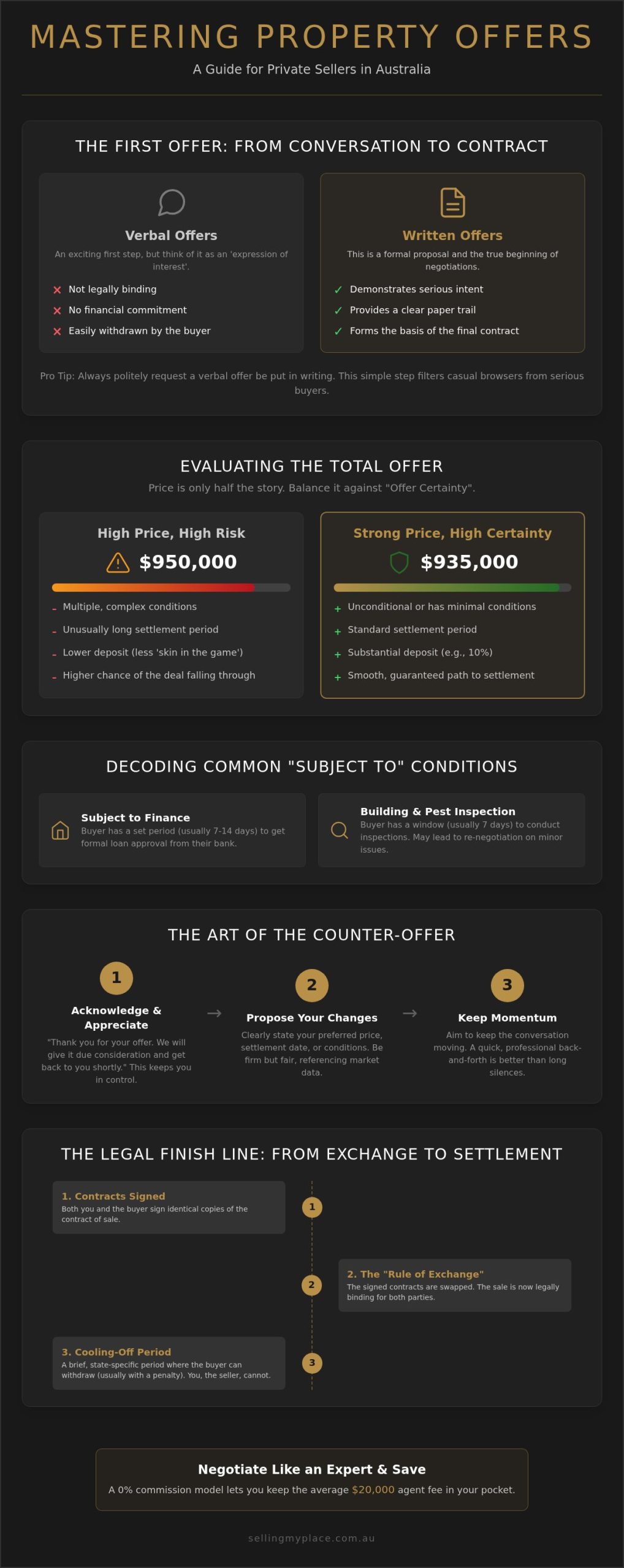
Always ask a buyer to follow up a verbal offer in writing. This simple request acts as a natural filter, separating the casual browsers from the serious contenders who are ready to commit. A written “Letter of Offer” establishes buyer seriousness and provides a clear paper trail for your records. When you receive one, acknowledge it with professional warmth but maintain your boundaries. A simple, “Thank you for your offer, we’ll give it due consideration and get back to you shortly,” keeps you in the driver’s seat. Learning how to handle offers when selling privately means staying calm and professional, even when an offer is exactly what you were hoping for.
The Rule of Exchange
In Australia, the sale only becomes binding when both the buyer and the seller have signed the contract of sale and these documents have been physically or digitally swapped. This “Rule of Exchange” protects you from being pressured into a low price or a rushed decision. You have the right to change your mind or hold out for a better offer right up until that moment. It’s often helpful to have your Conveyance Advice ready early so you can move quickly once you find the right buyer. Exchange of contracts is the definitive point of sale where the agreement becomes legally binding for both the buyer and the seller.
Evaluating the Total Offer: Why Price is Only Half the Story
When that first written offer lands on the kitchen table, the big, bold number at the top naturally grabs your attention. It’s the figure you’ve likely been dreaming about since you first decided to list. However, masterfully knowing how to handle offers when selling privately requires looking past the price tag to evaluate “Offer Certainty”. A sky-high offer laden with complex conditions can sometimes be less valuable than a slightly lower, “clean” offer that guarantees a smooth path to settlement. You’re looking for a package that respects the value of your home while offering the peace of mind that the deal won’t fall over at the eleventh hour.
To benchmark these proposals effectively, many savvy sellers use Neighborhood Market Reports to see how similar properties have recently performed. This data provides the backbone for your decision-making, helping you weigh up whether a buyer’s terms are in line with current market standards. The private sale negotiation process often involves a delicate dance between these terms and the final price. A substantial deposit, usually 10%, is another critical indicator; it shows the buyer has “skin in the game” and is less likely to walk away for trivial reasons.
Common “Subject To” Conditions
Most offers come with strings attached. A “Subject to Finance” clause is standard, usually giving the buyer 7 to 14 days to secure formal bank approval. Building and pest inspections typically require a 7-day window. Be mindful that these inspections can sometimes lead to post-offer price chipping if minor issues are discovered. The most challenging condition is “Subject to Sale”, where the buyer needs to sell their own home before buying yours. These require extra caution for private sellers, as they can tie up your property for weeks without a guaranteed result.
Settlement Periods and Flexibility
The standard settlement in Australia is often 30, 60, or 90 days. While a 30-day settlement gets you your funds faster, a 90-day window might give you the breathing room you need to find your next home without the stress of moving twice. If you can be flexible with your dates, use it as a bargaining chip. You might accept a slightly lower price in exchange for a settlement date that aligns perfectly with your next move. If you’re currently staring at a complex offer and need a steady hand to help decode the fine print, you might like to speak with a property advisor who can guide you through the specifics.
The Art of the Counter-Offer: Professional Negotiation Strategies
Entering a negotiation can feel like a high-stakes chess match, but it’s really just a conversation about value and legacy. When you decide to issue a counter-offer, you are technically rejecting the buyer’s original proposal and presenting a new one. This is a critical step in mastering how to handle offers when selling privately. You aren’t saying “no” to the person; you’re saying “not yet” to the terms. By adopting a “Steady Hand” approach, you can remain firm on your property’s worth while staying warm and empathetic toward the buyer’s aspirations.
To keep the momentum, you might apply some property sale negotiation tips that help bridge the gap between their opening bid and your expectations. It’s about finding that sweet spot where both parties feel they’ve achieved a win. If a buyer seems hesitant or offers a price that is clearly disconnected from reality, you need to be prepared to walk away. Recognising a “tyre kicker” early saves you emotional energy and keeps your home available for a serious buyer who truly values what you’ve built.
Structuring the Conversation
Never simply reject an offer with a flat “no”. Always provide a “because”. Use your market data to justify your position. For example, you might mention how your home compares to recent sales mentioned in the Victorian government’s guide to private property sales or local market reports. Don’t be afraid of the power of silence. After you’ve made your counter-offer, give the buyer space to think. Rushing them often signals desperation, while a calm pause projects professional confidence and gives them room to visualise their future in the home.
Handling Multiple Offers
If you’re lucky enough to have multiple interested parties, transparency is your best tool. You don’t need to reveal the exact dollar amounts of other bids, but letting buyers know they are in a competitive situation is only fair. A “Best and Final” strategy can be very effective here. Ask all parties to submit their absolute highest offer and best terms by a set time. This avoids the messy practice of “gazumping” and ensures you maintain your reputation as a fair and honest seller. Mastering the skill of how to handle offers when selling privately involves knowing exactly when to stand your ground and when to invite everyone to put their best foot forward.
The Legal Finish Line: Contracts, Cooling-Off, and Conveyancing
The handshake is done, the price is agreed, and the emotional weight of the negotiation begins to lift. Now, the focus shifts to the technicalities of the legal finish line. Knowing how to handle offers when selling privately requires a clear understanding of the cooling-off period, which acts as a short safety net for buyers. In New South Wales, Queensland, and the ACT, buyers generally have five business days to change their minds; though this incurs a small penalty, typically 0.25% of the purchase price. In Victoria, it is three clear business days, while South Australia offers just two. Western Australia and Tasmania have no statutory cooling-off period at all.
Having your Conveyance Advice ready before you even open your first inspection ensures you aren’t scrambling when these timelines start ticking. If a buyer does decide to pull out during this window, the applicable penalty fee is usually deducted from their deposit and paid to you. It’s a protection measure that compensates you for the time the property was off the market. Once the cooling-off period expires, or if the sale was unconditional from the start, you can finally update your Residential Property Listing from “Under Offer” to “Sold”. This is a moment to celebrate. It signals to the community that your home has found its next custodian.
Finalising the Contract of Sale
Your solicitor or conveyancer will be your primary partner during this final phase. They ensure every detail you negotiated, from the final price to the inclusion of specific window furnishings, is accurately reflected in the paperwork. They will handle the formal exchange, which is the physical or digital swapping of signed contracts between parties. Once signed and exchanged, the contract is legally binding. This provides the ultimate security for both parties as you move toward the final handover of the keys.
The Settlement Process
The weeks leading up to settlement involve a flurry of administrative tasks, usually managed via digital platforms like PEXA or Sympli. You’ll need to organise your move while the buyer performs a final inspection, typically a few days before the keys change hands. This is their chance to ensure the property is in the same condition as when they first signed. Because you’ve chosen a flat-fee model, the most rewarding part of this process is seeing the final settlement statement. Without a hefty commission eating into your result, you keep every cent of the equity you’ve built over the years. If you’re ready to secure your legal paperwork and start the process, you can book a pre-sale consultation today.
Selling Smarter with the Kincade Agent Advisory Service
Selling your family home is one of life’s most significant transitions. It’s about more than just a transaction; it’s about the memories you’ve built and the future you’re creating. While the process can feel overwhelming, you don’t have to do it alone. The Kincade Agent Advisory Service acts as your professional partner, providing the expertise you need to understand exactly how to handle offers when selling privately. By combining professional Photography and detailed floorplans, we ensure your property makes a stunning first impression. This high-quality presentation doesn’t just attract more eyes; it attracts the right kind of serious buyers who are ready to make competitive offers from day one.
Professional Support Without the Commission
You deserve to keep the equity you’ve worked so hard to build. In a traditional sale, a significant portion of your profit disappears into agency commissions. By choosing a 0% commission model, our clients save an average of $20,000 per sale. That’s a life-changing amount of money that stays in your pocket. Our advisors provide the “steady hand” you need during the negotiation phase, helping you decode complex “subject to” clauses and evaluate the true certainty of every proposal. This partnership approach means you’re always in the driver’s seat, but you have a seasoned expert in the passenger seat to help navigate the tricky turns. It’s the most transparent and empowering way to sell your home in 2026, combining the savings of a private sale with the security of professional backing.
Your Next Steps to a Successful Sale
Ready to take the next step? Getting started is a straightforward and supportive process. Your journey begins with a KIDS marketing package, designed to give your home the professional edge it needs in a competitive market. You’ll gain access to a comprehensive neighbourhood market report, which is essential for setting a price that reflects your home’s true value. We’ve shown you how to handle offers when selling privately, from the first expression of interest to the final exchange of contracts. Now, it’s time to put that knowledge into action. You can move forward with the confidence that your legacy is protected and your financial future is secure. Organise your commission-free listing today and discover how a partnership-based approach can transform your selling experience.
Take Control of Your Property Legacy
Mastering how to handle offers when selling privately is about balancing the technicalities of a contract with the emotional significance of moving on. You now know that a “clean” offer often outweighs a higher, conditional bid and that staying firm but empathetic is the secret to a successful negotiation. By focusing on offer certainty and keeping your legal advice ready, you’ve turned a complex process into a manageable path toward settlement.
You don’t have to navigate this final hurdle alone. Our flat-fee model includes professional photography and floorplans to showcase your home’s true value, alongside an expert Agent Advisory Service to guide your decisions. Best of all, you’ll save an average of $20,000 in commissions, ensuring your hard-earned equity stays with your family. This is about more than just a sale; it’s about starting your next chapter on the best possible footing.
Ready to take the lead? Start your commission-free sale journey with Kincade International Direct Sales and move toward your future with total peace of mind. Your successful sale is just a conversation away.
Frequently Asked Questions
Is a verbal offer legally binding when selling a house privately in Australia?
No, a verbal offer is not legally binding in the Australian property market. It is simply an expression of interest. For a sale to be legally enforceable, both parties must sign a written contract of sale and a formal exchange must occur. This protects you from being locked into a deal before you’ve had the chance to review the terms with your legal advisor. Always ask for offers in writing to confirm the buyer’s seriousness.
What does “subject to finance” actually mean for a seller?
“Subject to finance” is a common condition where the buyer’s obligation to purchase depends on their bank formally approving their home loan. This clause usually specifies a timeframe, often 7 to 14 days. If the bank declines the loan within this period, the buyer can typically withdraw without penalty. Understanding these conditions is a key part of learning how to handle offers when selling privately so you can manage your timeline effectively.
How much deposit should I ask for in a private sale?
A standard deposit in Australia is typically 10% of the total purchase price. While you can negotiate a smaller amount, such as 5%, a higher deposit serves as a strong sign of buyer commitment. This money is usually held in a solicitor’s or conveyancer’s trust account until settlement. A healthy deposit provides you with security, ensuring the buyer has a significant financial stake in seeing the transaction through to completion.
Can I accept a higher offer after I have already said “yes” to someone else?
Legally, you can accept a higher offer until the contracts have been formally signed and exchanged by both parties. However, once you’ve verbally accepted an offer, the buyer will likely start spending money on inspections and legal fees. While “gazumping” is legal in most states, it can damage your reputation as a fair seller. It’s often better to use a “Best and Final” strategy to resolve interest from multiple parties before committing.
How long does the cooling-off period last for the buyer?
The cooling-off period varies significantly across Australia. In New South Wales, Queensland, and the ACT, it is five business days. Victoria offers three clear business days, while South Australia provides two. Notably, Western Australia and Tasmania have no statutory cooling-off period unless specifically written into the contract. Remember, these periods do not apply if a property is sold at auction, where the contract becomes binding immediately upon the fall of the hammer.
Do I need a solicitor if I am selling my home privately?
Yes, you will almost certainly need a solicitor or a licensed conveyancer to handle the legal transfer of title. While you can manage the marketing and negotiation yourself, the legal paperwork and settlement through platforms like PEXA require professional oversight. A legal expert ensures the contract of sale is drafted correctly and that all state-specific requirements are met. This protects your interests and ensures the final handover of your property is legally sound.
What is the best way to reject a low-ball offer without offending the buyer?
The best way to handle a low-ball offer is to remain professional and provide data-backed reasons for your rejection. Instead of a flat “no”, try saying, “We appreciate your interest, but based on recent local sales, we’re looking for an offer closer to our guide.” Providing a counter-offer keeps the conversation moving. This “Steady Hand” approach shows you’re serious about the value of your home while remaining open to a fair negotiation.
How does the Kincade Agent Advisory Service help with negotiations?
The Kincade Agent Advisory Service acts as your professional partner when you are learning how to handle offers when selling privately. Our advisors help you evaluate the “Offer Certainty” of every proposal, looking beyond just the price to the fine print of the conditions. We provide the expert backing you need to negotiate with confidence, ensuring you secure a clean contract while saving an average of $20,000 in traditional agency commissions.
