What if the buyer offering the most isn’t the one best placed to complete the sale? If you’re working out how to vet potential buyers yourself, it’s natural to look for clear signs that an enquiry is genuine, especially when every inspection and follow-up takes time. But a confident manner or a high offer isn’t proof that a buyer is ready to proceed.
A fair, consistent process helps you distinguish serious interest from casual enquiries without relying on assumptions about someone’s demeanour. You also don’t need to collect more personal information than is reasonable to assess their readiness. A measured approach can protect your privacy while keeping conversations respectful and focused.
This guide explains what to ask, how to discuss a buyer’s finance and timing, and what evidence may help you assess their preparedness. You’ll also learn to compare offers by looking beyond the headline figure to conditions, timeframes and the buyer’s ability to proceed. A little structure, from your first reply through to the next steps after an offer, can help you stay in control of your private sale and make decisions with greater confidence.
Key Takeaways
- Learn how to vet potential buyers yourself with a consistent process for assessing readiness fairly.
- Ask clear, courteous questions to understand a buyer’s finance, timing and next steps without relying on first impressions.
- Compare offers by their conditions and likelihood of proceeding, not just the headline amount.
- Keep buyer checks proportionate and handle personal information thoughtfully. Treat warning signs as reasons to clarify, not proof of wrongdoing.
- Advisory and conveyance support can help you organise enquiries and move from an offer towards the next stage with greater confidence.
Why vet potential buyers yourself before progressing a home sale?
A promising enquiry is a welcome start, but it doesn’t tell you whether someone is ready to buy. Buyer vetting means asking consistent, relevant questions to understand a person’s readiness, ability to proceed and any conditions attached to an offer. It isn’t about interrogating every visitor or trying to predict the future. It’s a practical way to decide what follow-up makes sense before arranging another inspection or progressing negotiations.
A calm, repeatable approach helps you focus on useful indicators rather than impressions. Someone may be enthusiastic during a viewing but still need to arrange finance, sell another property or clarify their preferred timing. A reserved buyer may be well prepared. A person’s manner, appearance, occupation or communication style isn’t evidence of financial readiness or commitment. Ask each buyer the same core questions, then assess their answers and offer terms on their merits.
This is a practical form of due diligence: gathering and considering relevant information before making a decision. The general concept is outlined in What is Due Diligence? For a private seller, the aim is straightforward: understand the buyer’s next steps without treating a conversation or document as a guarantee of a completed sale.
What does it mean to vet a potential property buyer?
Separate interest from preparedness. An enquiry shows that someone wants to know more; a prepared buyer can usually explain their next step, such as arranging finance or making an offer with stated conditions. Neither guarantees the sale will proceed. Focus on observable details, including whether answers are clear and agreed follow-ups happen, rather than drawing conclusions from personal characteristics.
When should you start checking buyer readiness?
Start with light questions when arranging an inspection or a detailed property discussion. Ask what stage the buyer is at and whether they have a timeframe in mind. Save more specific questions about finance, conditions and offer terms for when you’re considering an offer. Casual browsers don’t need a formal screening. This staged approach keeps the exchange welcoming while helping you prepare for the next decision.
Keep your questions proportionate. You can ask a buyer to explain their finance position or relevant conditions, then consider what information you need for the decision at hand. Avoid collecting or circulating sensitive personal details unnecessarily, and handle anything shared with discretion. If a response is unclear, ask a neutral follow-up rather than assuming bad intent.
Early screening can help prevent avoidable delays. If a buyer says they need to complete another step before making an offer, take that into account before arranging repeated viewings or changing your plans. The purpose isn’t to discourage genuine buyers; it’s to make expectations clear on both sides. For an overview of the wider sale process, read this step-by-step guide to selling your own home.
How to vet potential buyers yourself: a clear screening process
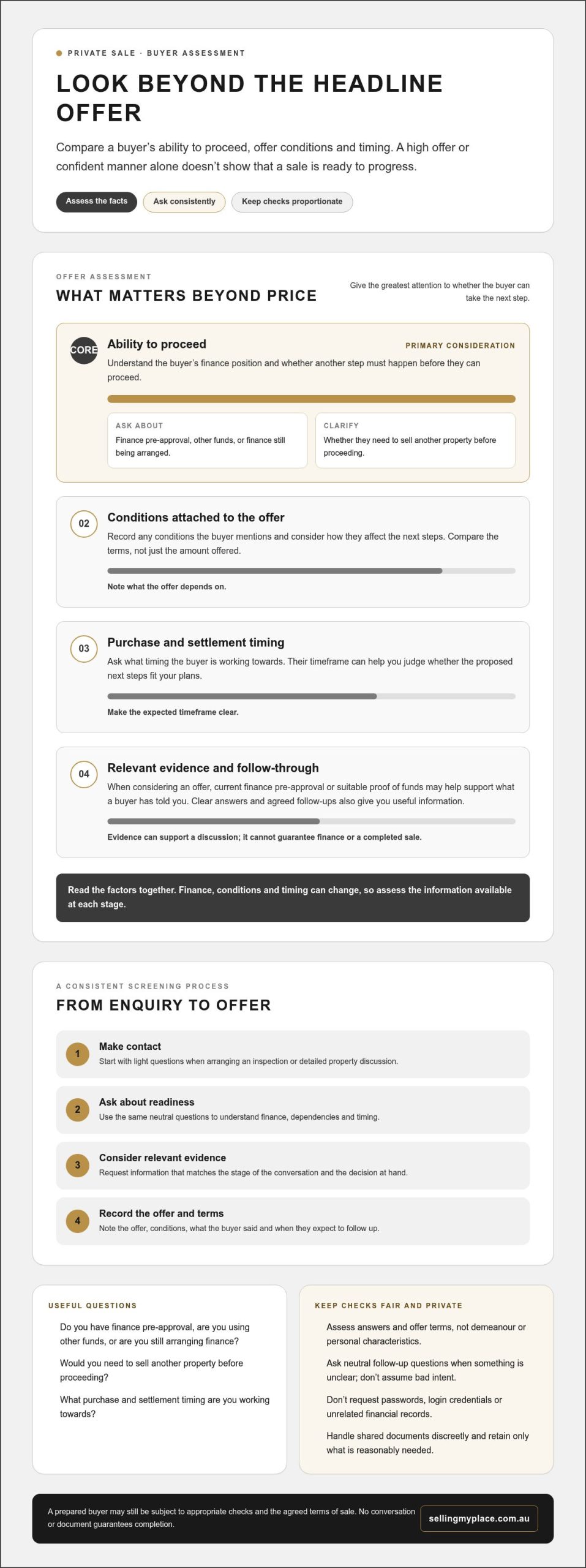
A simple process makes buyer conversations easier to manage and compare. Use the same stages for each serious enquiry: make contact, ask readiness questions, consider relevant evidence, then record any offer and its terms. This keeps discussions fair and gives you a record to refer to if details change or you need to follow up.
A buyer who is ready, able and willing to progress is still subject to appropriate checks and the agreed terms of sale. This is a practical guide, not a guarantee that a sale will complete. Finance, conditions and timing can change, so assess the information in front of you at each stage.
What questions can you ask a potential buyer?
Keep questions neutral and consistent. For example: “Do you have finance pre-approval, are you using other funds, or are you still arranging finance?” Follow up with “Would you need to sell another property before proceeding?” and “What purchase and settlement timing are you working towards?” These questions focus on practical next steps, not private details unrelated to the sale.
Listen for specifics rather than a particular style of response. One buyer might explain that they have pre-approval and want to discuss an offer; another might say their purchase depends on selling their current home. Record what each person says, any conditions they mention and when they expect to follow up. If an answer is uncertain, note that accurately instead of filling gaps with assumptions.
Government guidance can also help you understand the steps buyers may be considering. Guidance on planning to buy a property outlines aspects of purchasing a home, including due diligence. Check the requirements and processes that apply to your circumstances, as they may differ across Australia.
What evidence can help establish readiness?
When you’re considering an offer, relevant evidence might include current finance pre-approval or suitable proof of funds. Match the request to the stage of the conversation and the question you need answered. A casual inspection doesn’t call for detailed financial records. A document can support what a buyer has told you, but it can’t remove all uncertainty or guarantee finance will be available at settlement.
Protect the buyer’s privacy as carefully as your own. Don’t request account passwords, login credentials or unrelated financial records. If someone shares a document, limit who can access it, store it securely and retain only what you reasonably need for the sale process. Avoid forwarding sensitive material casually or keeping copies indefinitely.
Write down the offer amount, conditions, finance information and proposed timing as separate items. That makes it easier to clarify an incomplete offer without pressure or crossed wires. If you’d value guidance while organising buyer enquiries and assessing next steps, explore property sale advisory support.
How to compare buyers and offers beyond the offer amount
A strong offer is more than its headline figure. Compare the amount with the buyer’s finance position, conditions, proposed timing and communication. A higher offer may be less certain if it depends on an unresolved sale or further checks. A lower offer may have different advantages, but still needs careful review. Neither enthusiasm nor a single piece of evidence guarantees settlement.
Use the same categories for each offer and compare like with like. A short written record helps you see what’s clear, what needs clarification and which details come from a conversation rather than the offer itself.
Which offer details deserve a closer look?
Read the full written offer instead of relying on a verbal summary. Note whether the amount is clear, what conditions apply, when the buyer proposes to proceed and whether the offer depends on selling another property. Record any requested contract changes or further checks, so you can identify what needs a response before deciding how to proceed.
- Offer amount: Record the amount as written and note whether any terms could affect it.
- Finance status: Note what the buyer has explained and any relevant evidence provided.
- Conditions: List outstanding checks, a required sale of another property or proposed changes.
- Timing: Note the proposed next steps and settlement timeframe.
- Communication: Record whether responses and follow-ups have been clear and timely, without treating style alone as proof of readiness.
For example, one buyer might offer more but need to sell their current home first, while another proposes a different amount and timing with fewer stated conditions. Neither buyer is automatically the stronger option. The comparison shows why you need to understand what each offer depends on and how its terms fit your circumstances.
How do you compare certainty without making assumptions?
Keep the comparison fair by using the same evidence categories for every buyer and recording when each detail was provided. Finance pre-approval can indicate progress, but it isn’t a guarantee of final lending or settlement. Prompt communication is useful context, not proof that a buyer can complete the purchase.
Separate confirmed information from unanswered questions. Write “pre-approval sighted” rather than concluding “finance secured”, or record “offer subject to sale” instead of assuming when that sale will happen. Careful wording helps you compare readiness without overstating what you know or making personal judgements.
Contract wording and conveyancing questions can have important implications, and sale requirements differ across Australia. If a condition or proposed change is unclear, seek advice from an appropriate conveyancing professional before relying on your interpretation. For more guidance on keeping discussions constructive while weighing terms, see these Australian property sale negotiation tips. A structured approach to how to vet potential buyers yourself helps you weigh the whole offer, not just the number that first catches your eye.
How to spot buyer red flags while protecting privacy
Buyer checks don’t need to feel like an interrogation. You can explain your process politely: “I ask each interested buyer the same questions so I can understand their timing and any conditions before we take the next step.” Keep requests relevant and give buyers a chance to clarify. A concern is a prompt to pause and ask, not proof of dishonesty.
Look for changes or pressure in the details, rather than judging someone’s personality. A buyer may have a genuine reason for changing plans. What matters is whether the updated information is clear enough for you to decide how to proceed.
Which buyer behaviours merit a pause or follow-up?
Pause to clarify if a buyer gives different accounts of their finance position, proposed timing or offer conditions. You can refer calmly to what they said earlier: “I understood your offer depended on selling another property. Has that changed?” This gives them room to explain and helps you keep your notes accurate.
Be cautious if someone repeatedly pressures you to decide before you’ve reviewed the written terms, asks you to proceed without documenting important details or requests sensitive information that isn’t needed to discuss the sale. Repeatedly missing agreed calls or follow-ups may also reduce your confidence in their readiness. None of these behaviours alone establishes fraud. Consider the full context and avoid making accusations you can’t support.
How can sellers share information safely?
Prepare your home for inspections with privacy in mind. Put away identity documents, financial paperwork, mail and anything showing passwords, alarm codes or other security details. Keep household information that isn’t relevant to the property out of view, and avoid sharing personal routines or travel plans during a viewing.
- Limit what you request: Ask only for information relevant to the buyer’s readiness or offer.
- Keep records secure: Store messages and relevant documents in a protected location, rather than leaving them open on a shared device.
- Restrict access: Share buyer information only with people who need it to progress the sale.
- Review what you retain: Don’t keep personal information longer than it’s useful for the sale process.
Privacy and identity-checking requirements can vary across Australia and may depend on the circumstances. Before requesting or retaining identity documents, check current guidance from relevant Australian government and privacy authorities, and get appropriate advice if you’re unsure about your obligations. Don’t assume a practice used in one part of the country applies everywhere.
A steady, documented approach helps protect your household while treating genuine buyers respectfully. If you’d like support with buyer enquiries and sale decisions, get guidance on assessing potential buyers.
How advisory support can help you vet buyers with confidence
Managing a private sale doesn’t mean you have to work through every buyer question alone. Advisory support can help you organise enquiries, prepare consistent questions and think through an offer’s terms, while you remain involved in decisions about your property.
Kincade International Direct Sales’ Agent Advisory Service provides dedicated support with pre-sale consulting and conveyance advice. This support can help as you prepare your sale process, respond to buyer enquiries and consider how to progress an offer. Buyer representation is also available. The right support depends on the questions you’re working through, rather than a one-size-fits-all script.
What support can make a private sale easier to manage?
Pre-sale consulting can help you set up a practical process before enquiries arrive: decide where to record contact details, which readiness questions to ask and how to track follow-ups. Having this framework ready can make buyer conversations more consistent and less pressured when interest picks up.
Good property information helps, too. Professional photography and floorplans give buyers a clearer view of the home, while neighbourhood market reports can support informed conversations about the property and its market context. These materials don’t establish a buyer’s finance position, but they can help keep discussions focused on the home and the buyer’s questions.
A flat-fee, commission-free residential marketing model may suit owners who want to retain control while drawing on professional support. Kincade International Direct Sales provides residential property marketing alongside advisory support, so sellers can take a hands-on role without managing every part of the process unaided.
What are your next steps after assessing a buyer?
Once you’ve assessed an enquiry or received an offer, keep the details together and work through them methodically. Record the written amount, conditions, finance information and proposed timing. Clarify any gaps before deciding, and use conveyance advice to understand questions about the sale’s progression and relevant documents. Contract requirements vary across Australia, so consider the rules that apply to your property and circumstances.
- Keep the offer on record: Refer to written terms, not just a verbal summary.
- Check the conditions: Note what needs to happen before the buyer can proceed.
- Plan the next conversation: Prepare focused questions about outstanding details or timing.
- Seek guidance where needed: Use advisory and conveyance support to work through the next steps.
If you’re weighing up how to vet potential buyers yourself while keeping a private sale organised, the guide to professional residential property listing services explains how listing support can fit into an owner-led sale. For advice tailored to your property sale, discuss your sale with the advisory team.
Move towards your sale with confidence
Assessing a buyer isn’t a pass-or-fail test. It’s a way to make your next decision carefully, based on the information available and the terms on the table. As your sale progresses, keep asking clear questions, considering the answers and seeking advice when a decision feels uncertain. A steady approach can help you protect what matters while staying open to genuine opportunities.
If you want to retain control while drawing on professional support, Kincade International Direct Sales offers commission-free residential marketing through a flat-fee model. Its Agent Advisory Service includes pre-sale consulting and conveyance advice, supported by professional photography, floorplans and neighbourhood market reports.
Whether you’re at the first enquiry or weighing up an offer, you don’t have to make every call alone. Talk through your sale with an adviser and take the next step with a clearer sense of direction. Talk through your sale with a steady, experienced adviser.
Frequently Asked Questions
How do you know if a homebuyer is serious?
You can’t know for certain from a viewing or conversation, but a buyer’s follow-through offers useful clues. Notice whether they respond to straightforward questions, arrange agreed next steps and explain what they need to do before making an offer. For example, if someone says they’ll send written terms, note whether those terms arrive. Treat these as indicators, not a guarantee of a completed sale.
Can a seller ask a potential buyer for proof of funds in Australia?
Yes, you can ask for relevant evidence, such as suitable proof of funds, when it’s appropriate to the discussion. Explain why you’re asking and limit the request to what helps you assess the buyer’s readiness. A buyer can decide what they’re comfortable sharing. Don’t ask for banking passwords, account login details or complete financial records, and avoid keeping documents you don’t need.
What should you ask a buyer before accepting an offer on your home?
Ask what the offer depends on, whether the buyer needs to sell another property, what their finance arrangements are and what timing they’re proposing. Clarify whether they’re requesting particular inclusions, contract changes or further checks. Ask for the complete offer in writing so you can consider all its terms together. If anything is unclear, get an explanation before deciding how to respond.
Is finance pre-approval a guarantee that a buyer can complete the purchase?
No. Finance pre-approval indicates that a lender has considered information provided by the buyer, but it isn’t a promise that a particular purchase will be funded. The lender may still need to assess the property, review updated information or complete other checks. Ask what stage the buyer’s finance is at, but don’t treat pre-approval alone as certainty that the sale will settle.
What are red flags when selling a house privately?
Possible warning signs include details that keep changing without a clear explanation, pressure to decide before reviewing written terms, or requests for personal information unrelated to the sale. A buyer who repeatedly misses agreed follow-ups may also warrant a pause. These behaviours don’t prove dishonesty. Keep a factual record, ask a calm clarifying question and decide whether you’re comfortable taking the next step.
Can you reject an offer if you are unsure about the buyer’s finance?
You can decide not to proceed with an offer if you’re uncomfortable with the information available, but property sale processes and contract rules vary across Australia. Before communicating acceptance or rejection, consider getting conveyancing advice about the offer, its conditions and how your response may be treated. If you need more information, ask the buyer to clarify their finance position before deciding.
How can you protect your personal information when selling your home?
Put away mail, identity documents, bills and papers that reveal account details before inspections. Keep buyer correspondence in a separate, secure place, and avoid sending sensitive documents through casual or public channels. Share only information needed for the sale, and remove access when it’s no longer required. If you’re unsure about handling identity information, check current Australian privacy guidance before collecting or retaining it.