
What if the hardest part of selling your home isn’t the paperwork, but letting go of the life you’ve built there? A familiar kitchen, family gatherings and quiet routines can make a property feel like part of the family. That’s why managing the emotional side of selling a home can be challenging, especially when buyer feedback or negotiation starts to feel like a judgement of your memories rather than an opinion about the property.
If you’re feeling attached, uncertain or unsettled by each new milestone, you’re not being unreasonable. Selling is both a practical decision and a personal transition, and there’s no need to rush yourself through it. A useful starting point is to identify what matters most in the sale, then use those priorities to guide decisions when emotions run high.
This guide shares practical ways to create space between emotion and decision-making, from setting clear priorities before listing to keeping buyer feedback in perspective. You’ll also learn how a clear sale process and professional advice can help organise decisions and reduce avoidable uncertainty, so you can stay involved and feel more in control as you move towards your next chapter.
Key Takeaways
- Recognise that a home sale can bring up memories, identity and feelings about a major life change. Managing the emotional side of selling a home starts with noticing those feelings without letting them make decisions for you.
- Identify pressure points across your sale timeline, including buyer comments about presentation or condition, which can feel more personal than intended.
- If an offer surprises or disappoints you, pause before responding and return to the priorities you set for the sale.
- Use a simple reset: name the feeling, identify its trigger, take a moment, then choose a considered next step.
- Professional marketing and advisory support can add structure to sale tasks, helping you stay involved while reducing avoidable uncertainty.
Why managing the emotional side of selling a home matters
Selling a home can mean more than changing address. It may involve letting go of familiar routines, a sense of independence or a place that has held important family moments. At the same time, a sale can bring opportunity and relief. Whatever your reason for moving, your response is personal, and it can change as the process unfolds.
Managing the emotional side of selling a home means noticing what you feel while giving yourself room to make decisions at a considered pace. It doesn’t mean suppressing emotion or caring less about the property. It means separating a feeling from the decision in front of you, so a difficult moment doesn’t automatically dictate what happens next. For example, feeling hurt by a buyer’s comment doesn’t mean you need to change the asking price or reject an offer straight away.
Emotional steadiness in a property sale means acknowledging your feelings while choosing your next step with care.
Feelings can shift between preparing the property, welcoming people through for inspections, considering offers and reaching settlement. You might feel ready to move one day, then unexpectedly unsettled when a room is cleared or an offer arrives. Sadness or uncertainty can be part of a significant transition; by themselves, they don’t mean you should abandon a sale. Pause and consider whether the feeling is signalling a practical concern, a need for more information or simply the weight of change.
Why a home can feel like more than a property
A kitchen might bring back family dinners; a spare room may represent the independence of a first home or the years spent raising children. These associations are examples of place attachment, the emotional bond that forms between a person and a specific environment, such as a home. Selling can also be complicated by circumstances such as downsizing, separation, bereavement or relocation. But there’s no single story behind a sale, and not everyone experiences it as a loss.
Common feelings sellers may experience
Attachment, relief, uncertainty, excitement and sadness can all arise during a sale. They aren’t competing reactions: you can be looking forward to a new chapter and still miss the home you’re leaving. Rather than judging yourself for feeling one way or another, notice what’s present and when it appears. That small pause can help you respond thoughtfully, especially when a sale milestone brings an unexpected emotional shift.
How to recognise emotional triggers during a home sale
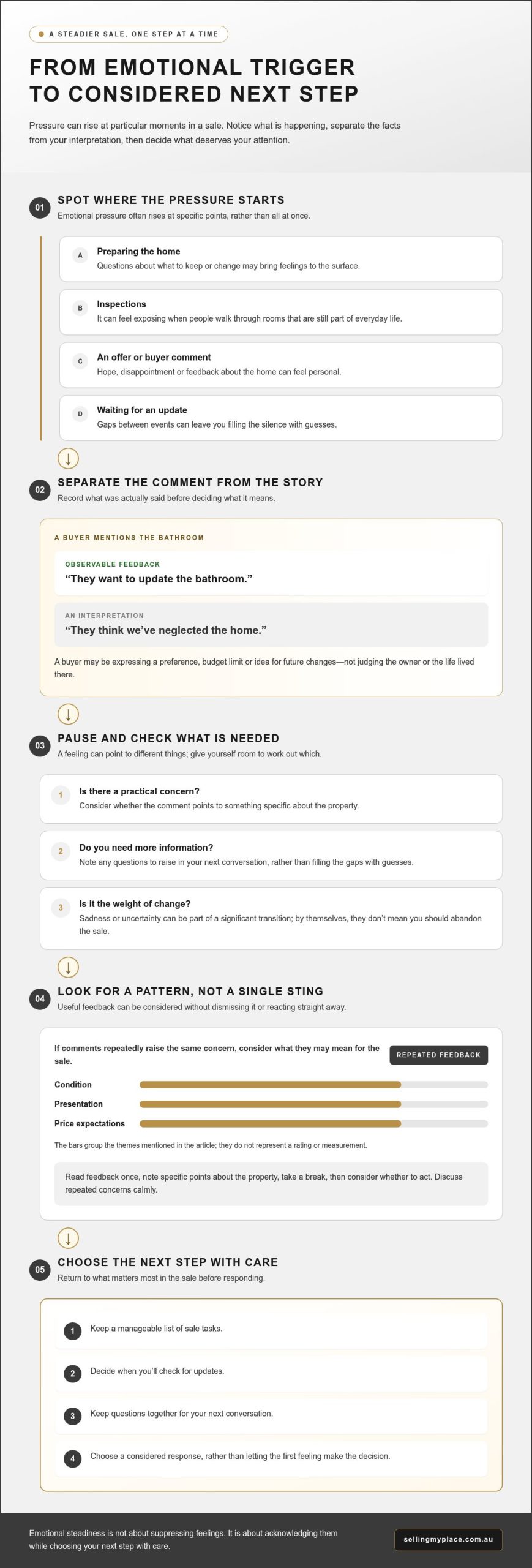
Emotional pressure often rises at particular points in a sale rather than arriving all at once. Preparing your home may bring up questions about what to keep or change. Inspections can feel exposing, as people walk through rooms that are still part of your everyday life. An offer may prompt hope, disappointment or difficult decisions, while waiting for updates can leave you filling the silence with guesses.
Knowing your likely pressure points helps you prepare for them. Notice what tends to unsettle you, when it happens and what decision, if any, needs to be made. For instance, if inspection feedback tends to feel personal, plan to read it once, note any specific points about the property and take a break before deciding whether to act. This is a practical part of managing the emotional side of selling a home: it creates a moment to respond thoughtfully instead of reacting to the first feeling.
When buyer feedback feels personal
A buyer’s comment about the kitchen, paintwork or price can sting, especially when you’ve cared for the home over many years. But a buyer is usually expressing a preference, budget limit or idea for future changes, not assessing your taste or the life you’ve lived there. Buyer feedback is about how a property suits their needs, not a judgement of its owner.
Try separating the observable comment from the meaning you’ve attached to it. “They want to update the bathroom” is feedback; “they think we’ve neglected the home” is an interpretation. Still, don’t dismiss useful information. If comments repeatedly raise the same concern about condition, presentation or price expectations, consider them calmly and discuss what they may mean for your sale.
Why waiting and change can heighten stress
There may be gaps between an inspection, an enquiry, an offer and the next update. Not knowing what will happen or when can make it tempting to check for news constantly. Meanwhile, keeping the home ready, managing family routines and making it available for inspections can add to the load. Recognising that combination can help you plan for the strain rather than blame yourself for feeling unsettled.
Focus on what’s within your control: prepare a manageable list of sale tasks, decide when you’ll check for updates, and keep questions for your next conversation in one place. A predictable check-in routine can give the process some shape without assuming how quickly a sale will progress. For practical structure as you prepare, discuss your property sale plans.
Handle offers and negotiation without losing perspective
An offer can feel like a verdict on a home you’ve cared for, especially if it’s lower than you hoped or arrives with conditions you didn’t expect. Taking a measured approach doesn’t mean you care less. It means giving the offer a fair assessment before deciding what to do next.
Try not to infer a buyer’s motives from the terms alone. A proposed price, preferred timing or condition tells you what they’re putting forward, not necessarily why. Focus first on the details in the offer and how they compare with your priorities and the information available to you. For more practical guidance, explore these property sale negotiation tips.
A practical pause before responding to an offer
Before replying, record the offer details and note any response deadline. Then take a breath and review the full picture rather than focusing only on the figure. Consider the proposed timing, conditions and how each fits your circumstances. If you’re finding it hard to assess the terms on your own, property sale advice can help you consider your options more clearly.
| Immediate reaction | Considered next step |
|---|---|
| “They don’t value our home.” | Write down the offer as presented, then assess its terms against relevant information. |
| “We need to accept or reject this now.” | Check the response deadline and use the time available to review your priorities. |
| “Those conditions must mean the buyer isn’t serious.” | Separate the stated conditions from assumptions about the buyer’s intentions. |
How to keep the decision grounded in your priorities
Return to the reasons you decided to sell. Perhaps timing matters because of a planned move, or certainty is more important to you than holding out for an imagined perfect result. Your priorities provide a useful reference point, but they don’t have to dictate a single answer. Assess an offer against its terms, your circumstances and the information available, rather than against an ideal outcome that may not be realistic.
Declining, accepting or negotiating can each be a considered choice. Before settling on a response, ask: Does this option support what matters most to us? What information would help us decide? Managing the emotional side of selling a home includes allowing those questions to guide the discussion, rather than letting disappointment or excitement make the decision on its own.
Practical ways to manage emotions before, during and after the sale
A simple reset can help you move from an immediate reaction to a considered response. Use it when a task feels overwhelming, a conversation becomes tense or a milestone brings up unexpected feelings:
- Name the feeling: Is it worry, frustration, sadness or relief?
- Identify the trigger: What happened just before the feeling surfaced?
- Pause: Give yourself a moment before replying or making a non-urgent decision.
- Choose a next step: Decide what information, conversation or practical action would help.
If your thoughts are racing, write down the facts separately from your interpretation. For instance, record “the inspection feedback mentioned the garden” as a fact, then note any assumptions you’re making about what it means. Revisit the decision when you feel more settled. This routine can make managing the emotional side of selling a home feel more deliberate, without expecting you to switch off your feelings.
Make room for priorities and questions
Keep a short list of what matters most in the sale, such as timing, household needs and the offer terms you need to understand. Add questions as they arise, then use the list to guide discussions rather than trying to hold every detail in your head. If you’re planning a sale by owner, this guide to selling your own home can help you think through the process and its practical steps.
Protect routines and relationships during the process
Keep familiar routines where you can, whether that’s a regular family meal, a walk or a quiet hour away from sale-related tasks. Agree with household members how you’ll share preparation jobs and discuss decisions. You might set aside a time to talk through sale matters, so they don’t take over every conversation or evening.
There’s no required way to say goodbye to a home. You may want to take photos, share a memory or simply focus on the move ahead. Make space for what feels right to you, without turning a farewell into another task to get perfect. After settlement, give yourself room to adjust; a change in routine can take time.
If distress persists, feels unmanageable or is affecting your day-to-day wellbeing, consider speaking with a qualified mental health professional. Practical property guidance can help organise sale tasks, while emotional support can address how the transition is affecting you. For guidance with the practical side of your sale, get in touch with our property advisory team.
How supportive guidance can make selling feel more manageable
A clear sale process won’t remove every difficult feeling, and it shouldn’t ask you to set those feelings aside. What it can do is make practical decisions easier to see: what needs attention now, what can wait and where you can get considered advice. That structure can reduce avoidable uncertainty while leaving you involved in decisions about your home.
What a steady, supportive sale process can provide
Professional marketing and advisory support can help organise the practical work of presenting a property and progressing a sale. Professional photography and floorplans give buyers useful ways to understand the home, while neighbourhood market reports provide context for discussions about the market. Pre-sale consulting and real estate advice can help you work through questions as they arise, rather than trying to solve every detail at once.
Kincade International Direct Sales provides flat-fee property marketing and advisory packages, with a 0% commission structure. The service includes residential listings, professional photography and floorplans, alongside pre-sale consulting and real estate advice. Owners remain involved in their sale while using a clear framework for marketing and sale tasks. Defined tasks and access to advice can help you approach each step with more information, without promising that the emotional parts will disappear.
As you consider your options, it may help to ask what would make the process feel clearer. Is it understanding the marketing plan, knowing what needs to happen before listing, or having advice available when you’re weighing a decision? Naming the question can make the next conversation more useful.
Choosing your next step at a pace that feels right
You don’t need to settle every detail at once. Identify the question creating the most uncertainty today, then review the proposed sale process before making commitments or major decisions. A clear explanation of the steps, marketing and advisory support can help you decide what suits your circumstances and how involved you want to be.
Taking time to understand your options is part of managing the emotional side of selling a home. If you’re ready to explore practical support for your sale, Talk through your next step.
Move forward with clarity and support
Selling a home can hold both personal meaning and practical decisions. Remember that feelings may shift throughout the process; noticing a trigger and pausing before you respond can help you make choices in line with your priorities. Managing the emotional side of selling a home isn’t about caring less. It’s about giving yourself room to consider each next step.
A clear sale process can help organise the practical details without pretending to remove every uncertainty. Kincade International Direct Sales’ flat-fee property marketing and advisory packages include professional photography and floorplans, as well as pre-sale consulting, so you can access practical support while remaining involved in your sale.
You don’t need to have every answer before taking the next step. Start with the question that matters most to you, then explore the marketing and advisory support available at a pace that feels right. Talk through your next step when you’re ready. With considered decisions and practical support, you can move towards what comes next with greater confidence.
Frequently Asked Questions
Is it normal to feel sad when selling a home?
Yes, sadness can be a natural response to leaving a home that holds memories or familiar routines. You might also feel relief, excitement or uncertainty, sometimes all at once. There’s no required way to feel, and your emotions don’t have to match anyone else’s. Notice when sadness arises and give yourself space to acknowledge it, while still considering the practical decisions in front of you.
How do I stop taking buyer feedback about my home personally?
Separate what the buyer actually said from the meaning you’re attaching to it. A comment about updating a bathroom may reflect the buyer’s preferences or plans, rather than a judgement of your care for the home. Write down the feedback plainly, then consider whether it raises a useful point about presentation, condition or price expectations. You can take relevant information seriously without treating it as a personal criticism.
Can emotions affect decisions when selling a home?
Yes, strong feelings can influence how you respond to feedback, offers or uncertainty. Disappointment might make an offer feel like an insult, while excitement could make it tempting to decide before weighing all the terms. Managing the emotional side of selling a home means noticing that reaction and pausing. Review the offer details, timing, conditions and your priorities before choosing whether to accept, decline or negotiate.
What should I do if I feel overwhelmed while selling my home?
Pause and work out what feels most difficult right now. Name the feeling, identify its trigger, then separate the known facts from assumptions or worst-case thoughts. Choose one manageable next step, such as writing down a question for your next sale discussion. Protect time for ordinary routines where possible. If distress persists, feels unmanageable or affects daily life, consider speaking with a qualified mental health professional.
How do I cope with selling a family home?
Give yourself permission to recognise what the home has meant to your family, without feeling you need to follow a particular farewell ritual. You might share stories, take photos or simply talk about the move together. If others are involved in the sale, agree how you’ll discuss decisions and divide practical tasks. People may respond differently, so making room for those differences can help the transition feel more considered.
How can I stay calm when negotiating a home sale?
Before responding, record the offer and review its terms, including timing and conditions. Compare them with your priorities and relevant information about the property, rather than guessing at the buyer’s motives or measuring the offer against a perfect outcome. If you feel surprised or disappointed, take a pause and seek measured advice if needed. A considered response may be to accept, decline or negotiate, depending on your circumstances.