Mistakes to Avoid When Selling Your Own Home: The 2026 Australian Seller’s Guide
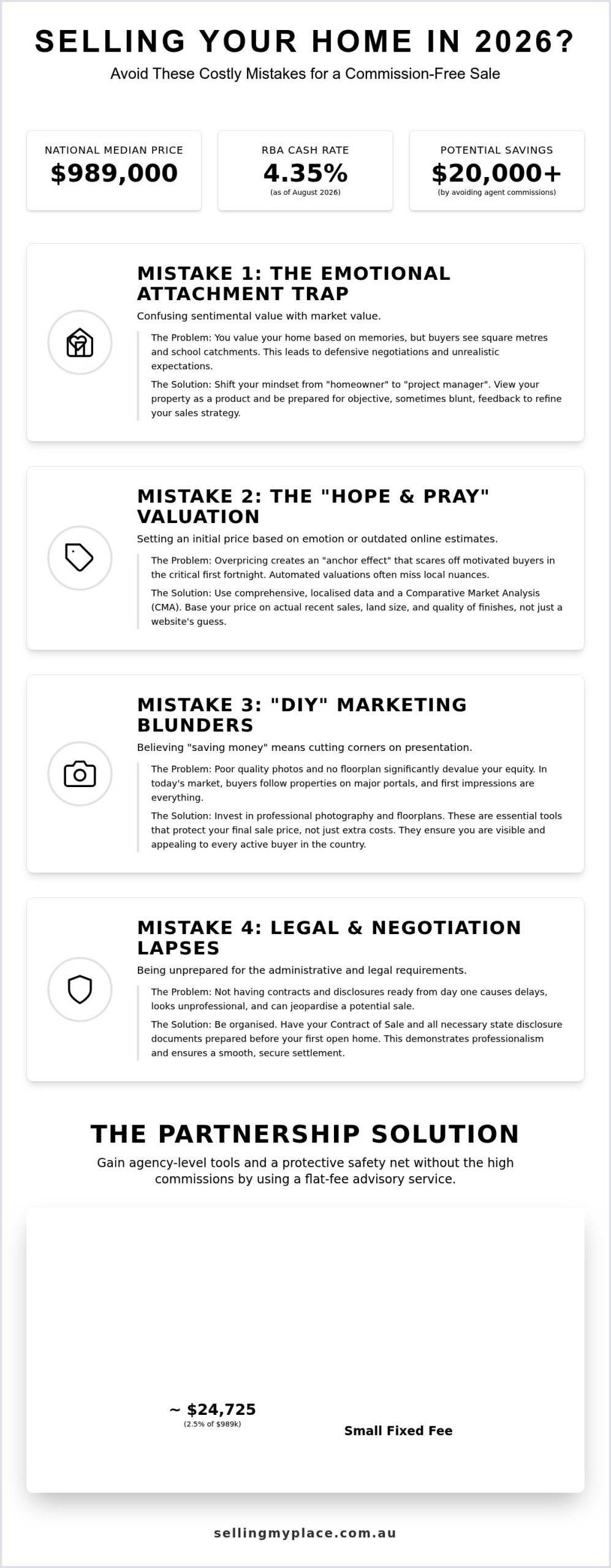
What if the most expensive part of selling your home wasn’t the fresh coat of paint or the professional photography, but the signature you put on a standard agency contract? In a 2026 market where the national median house price sits at $989,000, handing over a massive chunk of your equity to an agent can feel like a step backwards for your family’s future. It’s a significant life transition, and we understand the pressure to get everything right while identifying the common mistakes to avoid when selling your own home. You might be worried about underpricing your sanctuary or feeling overwhelmed by the logistics of legal paperwork and buyer enquiries.
We believe you shouldn’t have to choose between professional results and your bank balance. This guide serves as your steady hand, helping you master the art of commission-free selling with total confidence. By sidestepping these costly errors, you can save upwards of $20,000 in commissions and achieve a professional-grade result independently. We’re going to explore everything from understanding the current 4.35% cash rate environment to managing a smooth, stress-free settlement process that keeps your family’s future secure.
Key Takeaways
- Learn how to separate your heart from your house to make the objective, professional decisions that today’s buyers expect.
- Identify the critical mistakes to avoid when selling your own home, particularly the pricing traps that can stall your progress in the first fortnight.
- Discover why professional photography and floorplans are essential investments that protect your equity rather than just additional costs.
- Understand the fundamentals of Australian contract requirements and negotiation strategies to ensure a secure and legally sound settlement.
- Find out how a flat-fee advisory service provides a protective safety net, giving you agency-level tools without the high commissions.
The Professional Mindset: Why Most Private Sales Fail Before They Start
Success in the current market isn’t about doing things on the cheap; it’s about doing things professionally without the weight of an unnecessary commission. One of the primary mistakes to avoid when selling your own home is confusing “saving money” with “cutting corners.” When you decide to sell independently, you aren’t just a homeowner anymore. You are a project manager overseeing a high-stakes transaction. This requires a mental shift from seeing your house as a sanctuary filled with memories to viewing it as a product on a shelf. In a cooling market where national prices saw a slight decline of 0.3% in July 2026, this objectivity is your greatest asset.
Many Australians fall into the “Emotional Attachment Trap.” It’s natural to value your home based on the years of life lived within its walls, but buyers only see the square metres and the school catchment. If you can’t look at your property through the eyes of a stranger, you risk making defensive decisions during negotiations. Professionalism means being prepared for honest, sometimes blunt, feedback from potential buyers and using it to refine your strategy rather than taking it personally.
The Myth of the “Magic” Real Estate Agent
There is a persistent belief that agents possess a “secret database” of buyers that private sellers simply cannot access. The truth is much simpler. Modern buyers follow properties, not people. The real drivers of the Australian market are the major national property portals and digital search engines. When your home is listed on these platforms with professional-grade photography and clear floorplans, you are visible to every active buyer in the country. Choosing a For Sale By Owner (FSBO) model allows you to tap into these same networks. By using professional advisory services, you gain the infrastructure of a global agency without the transactional feel of a traditional commission-based relationship.
Setting Your “Sale by Owner” Strategy
One of your biggest advantages is time. Traditional agencies often demand 90-day exclusive contracts to create artificial urgency, but selling independently allows you to “list until sold.” With the Reserve Bank holding the cash rate at 4.35% as of August 2026, buyers are more cautious and may take longer to secure finance. You can afford to wait for the right offer that respects your property’s value. To make this work, you must be organised from day one. This includes:
- Documentation: Have your Contract of Sale and disclosure documents ready before the first open home.
- Communication: Set up a professional email or phone line specifically for enquiries to keep your personal life separate.
- Market Knowledge: Study local results so you can address the common mistakes to avoid when selling your own home before they impact your bottom line.
Pricing Pitfalls: Avoiding the “Hope and Pray” Valuation
Setting the price for your home is often the most emotional hurdle you’ll face. It’s easy to fall into the trap of “sentiment pricing,” where you value the property based on what you need for your next deposit or the memory of your renovations. However, the market is indifferent to your goals. One of the most critical mistakes to avoid when selling your own home is ignoring the market reality of 2026. With the national median house price sitting at $989,000 and the cash rate holding at 4.35%, buyers are incredibly discerning. They aren’t just looking for a home; they’re looking for value that aligns with their specific borrowing capacity.
If you set your price too high initially, you trigger the “anchor effect.” This creates a psychological barrier that scares off motivated buyers during the first fortnight, which is typically your most active period. Many sellers rely on automated valuation models (AVMs) found on bank websites, but these are often outdated or lack the nuance of your specific street. To establish a credible price floor, you need deep, localised data. Utilising comprehensive Neighborhood Market Reports ensures you’re making decisions based on actual local sales rather than computer-generated guesses.
Interpreting Comparative Market Analysis (CMA)
A true comparative analysis goes beyond looking at what the house next door sold for last year. You must account for land size, block orientation, and the quality of recent finishes. In August 2026, you also need to factor in local supply levels. If three similar houses just hit the market in your suburb, your pricing strategy must adapt. Aim for the “sweet spot”: a price that invites competition. When multiple buyers see genuine value, they’ll compete; this often pushes the final result higher than a static, over-optimistic listing price ever could.
The Hidden Cost of Underpricing
The fear of leaving money on the table keeps many private sellers awake at night. While overpricing kills momentum, underpricing can feel like a loss of hard-earned equity. Using professional appraisals helps validate your listing price and provides a shield against low-ball offers. If a buyer comes in with an offer that feels disrespectful, don’t take it personally. Use your data to justify your position and stay firm. If you’re feeling unsure about your property’s current worth, you might find it helpful to chat with a property advisor who can provide a grounded perspective on your local market.
Marketing Blunders: When “DIY” Visuals Devalue Your Equity
In the digital-first market of 2026, your property’s first open home doesn’t happen on a Saturday morning. It happens on a smartphone screen at 10 pm. One of the most damaging mistakes to avoid when selling your own home is assuming that a modern smartphone camera is “good enough” for your listing. While the latest iPhone takes great family snaps, it cannot replicate the wide-angle lenses, professional lighting, and post-production expertise required to capture a room’s true dimensions. This “iPhone Effect” often leads to dark, cramped, or distorted images that devalue your equity instantly. Industry observations suggest that poor visuals can result in a final sale price that is $50,000 lower than a property with high-quality marketing.
Viewing professional photography as an investment rather than a cost is a hallmark of a successful private seller. You have roughly two seconds to capture a buyer’s attention before they scroll past your home. If that hero image doesn’t spark an emotional connection, the buyer is gone. You aren’t just selling bricks and mortar; you are selling a future lifestyle. Professional imagery highlights the warmth of the sun in the living room and the flow of the kitchen, inviting that “first click” that leads to a physical inspection.
The Power of Professional Floorplans
A high-definition floorplan is no longer optional. It allows buyers to “mentally move in” by understanding the spatial logic of your home before they even step through the door. Does the master bedroom have enough space for a king-sized bed? Is the home office tucked away from the noise of the kitchen? A floorplan answers these questions immediately. In 2026, buyers also expect to see site plans and orientation to judge natural light. This transparency filters out “tyre-kickers” whose needs don’t match your layout, ensuring that every person who walks through your door is a genuine contender.
Staging and Presentation: Beyond the Declutter
Presentation is about depersonalisation. You want buyers to see their own lives in the space, not yours. Remove the family photos and the collection of fridge magnets to create a blank canvas. Focus on high-ROI cosmetic repairs, like a fresh coat of neutral paint or updated cabinet handles, rather than overcapitalised renovations that you won’t recoup. Finally, think about the lifestyle narrative. On inspection day, ensure the temperature is perfect, the lighting is soft, and there’s a subtle, welcoming scent. You’re creating a feeling of stability and home that resonates on a deep, emotional level.
Negotiation and Legal Lapses: Protecting Your Settlement
Once your marketing has successfully drawn in the right crowd, the journey moves from presentation to persuasion. One of the most frequent mistakes to avoid when selling your own home is the urge to fill the silence during a negotiation. It is a natural human reaction to keep talking when we feel nervous, but in real estate, the first person to speak often reveals their position too early. Instead of rushing to justify your price, let the buyer’s offer hang in the air for a moment. This grounded, calm approach demonstrates that you are confident in your property’s value and aren’t pressured by the clock.
Legal paperwork often feels like the most daunting part of the process, yet it is simply the framework that keeps your equity safe. Your Contract of Sale is the foundation of the entire deal. In 2026, compliance is stricter than ever; for instance, the Seller Disclosure Scheme requires absolute transparency to prevent a buyer from terminating the contract later. This is where professional guidance becomes your safety net. To ensure your paperwork is water-tight before the first offer arrives, it is wise to reach out for professional conveyance advice that protects your family’s interests.
Mastering the Private Treaty Negotiation
- Qualify the buyer: Before you spend hours negotiating, ask for a letter of pre-approval. With the cash rate at 4.35%, you need to know their lender is actually ready to move.
- Handle the “Building and Pest” hurdle: If a report identifies a minor issue, don’t get defensive. Use it as a tool for transparency; sometimes a small price adjustment is better than losing a motivated buyer during the cooling-off period.
- Close the gap: Use professional counter-offers. Instead of a flat “no,” try “I can’t accept that price, but I can meet you halfway if we settle in 30 days.”
A “Subject to Finance” clause is a contractual condition that grants the buyer a specific timeframe, usually 14 days, to secure formal mortgage approval, which effectively puts your settlement timeline on hold until the bank gives the final green light.
The Legal Roadmap to Settlement
In the 2026 landscape, the exchange of contracts has become a streamlined, digital experience. Ensuring your Section 32 or relevant state disclosure documents are current is non-negotiable; an out-of-date certificate can stall a settlement for weeks or even provide a legal loophole for a buyer to exit. Most Australian settlements now occur through PEXA, a secure digital platform that allows for the simultaneous exchange of funds and property titles. This technology removes the old-fashioned stress of bank cheques and physical meetings, providing you with real-time confirmation that your sale is officially complete.
The Partnership Solution: Selling Smarter with Kincade
Selling your home independently doesn’t mean you have to walk the path alone. The Direct Sales model represents the future of the Australian property market because it empowers you to maintain total control while utilising the sophisticated infrastructure of a global agency. Many homeowners believe they must choose between a high-commission agent or a cheap DIY approach. We offer a Goldilocks solution that provides professional-grade results without the transactional feel of traditional real estate. By choosing this partnership, you sidestep the most common mistakes to avoid when selling your own home while keeping 100% of your hard-earned profit.
The flat-fee advantage is simple: you gain access to the same tools the big agencies use, but you don’t pay for their high overheads or franchise fees. We’ve seen that the average owner can retain a significant portion of their equity that would otherwise be lost to commission. This is money that stays in your pocket, where it belongs, to fund your next move or secure your family’s future. Our Agent Advisory Service acts as your steady hand, providing the calm confidence you need when faced with complex decisions or high-stakes negotiations.
Pre-Sale Consulting: Your Competitive Edge
Success starts long before the first open home. Our pre-sale property consulting provides customised advice on how to present your home to the 2026 market. We help you identify which features will resonate with local buyers and which specific aspects of your property deserve the spotlight. By leveraging deep neighbourhood data, you can justify a premium price with hard evidence rather than guesswork. You also benefit from a global marketing network that ensures your listing remains active and visible until the right buyer is found, reaching far beyond the limits of a traditional local agency office.
Next Steps: From Listing to Sold
Getting started is a straightforward, supportive process. You can begin with a professional marketing package today, which includes the high-definition photography and floorplans we discussed earlier. We understand that life transitions don’t always follow a 90-day schedule. That’s why we offer a No Time Limit guarantee; your listing stays active until it’s sold, giving you peace of mind in a shifting market. It’s about protecting your equity and your sanity. Take a moment to consider the impact of those significant savings on your lifestyle. When you’re ready to move forward with a professional, heart-led approach, Kincade International Direct Sales is here to guide you every step of the way.
Your Path to a Confident, Commission-Free Sale
Stepping away from the traditional agency model is more than just a financial decision; it’s about taking ownership of your family’s legacy. By prioritising objective data over sentiment and professional marketing over DIY efforts, you ensure your property stands out in the 2026 market. We’ve walked through the essential mistakes to avoid when selling your own home, giving you a roadmap to navigate everything from the first enquiry to the final digital settlement with PEXA.
You don’t have to choose between saving money and receiving expert support. With Kincade, you keep the entirety of your sale price because there is no commission, ever. You’ll benefit from being listed until sold with no time limits, supported by our expert Agent Advisory Service every step of the way. This partnership gives you the professional infrastructure of a global agency while keeping you firmly in the driver’s seat. It’s a grounded, calm approach to one of life’s biggest transitions.
Save $20,000 in commissions—start your professional listing today with Kincade International. We’re ready to act as your steady hand and help you achieve the result your home deserves.
Frequently Asked Questions
Is it legal to sell my own home in Australia without an agent?
It is perfectly legal in every Australian state and territory to sell your own residential property. You have the right to represent yourself and manage the transaction from listing to settlement. While you must follow specific state-based disclosure laws, there is no requirement to engage a commission-based agent. Many owners find that acting as their own advocate provides a more transparent and rewarding experience during this major life transition.
How much can I actually save by selling my own home?
By choosing a commission-free model, the average Australian seller can save approximately $20,000. This calculation is based on standard agency commission rates applied to current national property values. Because you aren’t paying for an agent’s overheads or franchise fees, you retain 100% of the equity you’ve built in your home. This substantial sum can then be used for your next deposit, renovations, or family savings.
What is the biggest mistake people make when pricing their own home?
The most common error is setting a price based on personal sentiment or the memory of your renovations rather than current market data. This is one of the primary mistakes to avoid when selling your own home, as an inflated anchor price can stall your campaign in the first fortnight. Relying on accurate neighbourhood market reports allows you to set a credible price floor that invites competition and protects your equity.
Do I still need a solicitor if I am selling the property myself?
Yes, while you are managing the marketing and enquiries, you still require a qualified solicitor or conveyancer to handle the legal transfer of title. They prepare the Contract of Sale and ensure your disclosure documents comply with state laws, such as the Seller Disclosure Scheme. This professional oversight ensures your settlement through digital platforms like PEXA is secure, legal, and stress-free for both you and the buyer.
How do I handle open homes and inspections as a private seller?
Managing inspections is about creating a welcoming, professional atmosphere that allows buyers to imagine their own life in your home. You can choose between scheduled open homes or private viewings, which often attract more qualified buyers. It is helpful to use a digital sign-in process to capture attendee details for follow-up. This direct interaction allows you to share your local knowledge and answer questions with genuine heart and authority.
Will my property appear on the major real estate websites if I sell privately?
Yes, your property will appear on the most prominent national real estate portals and search engines used by millions of Australians daily. These digital platforms are the primary destination for active buyers, and our listing service ensures you have a professional presence there. By appearing alongside every other home on the market, you capture the same high-intent audience as a traditional agent, without the associated commission costs.
What happens if I can’t find a buyer right away?
If a buyer isn’t found immediately, we offer a listed until sold guarantee with no time limits. This provides a significant advantage in the 2026 market, where the 4.35% cash rate means buyers are often more cautious and may take longer to secure finance. Unlike traditional 90-day agency contracts, our model allows you to remain patient and wait for an offer that truly reflects your property’s value.
Can I still get professional photography if I don’t use a commission-based agent?
Absolutely, and it is a non-negotiable step for a successful sale. High-quality imagery and floorplans are included in our marketing services because they help you sidestep common mistakes to avoid when selling your own home. Professional photography captures the true dimensions and light of your property in a way a smartphone cannot. This ensures your home makes a powerful first impression on those crucial digital portals where most buyer journeys begin.
