What if the right asking price isn’t one perfect figure, but a defensible range you can refine as buyers respond? Working out how to price your home for private sale can feel daunting when comparable sales are hard to find, online estimates disagree and the stakes are personal.
In 2026, market conditions are shifting: Australian home prices had fallen for six consecutive months by September, according to atRealty. That makes current, relevant evidence especially important. Price too high and buyers may look elsewhere; price too low and you could leave value on the table. An online estimate alone won’t resolve either risk.
This guide explains how to build an asking-price range from comparable sales, choose a pricing and negotiation strategy, and decide when buyer feedback calls for a review. It also covers how neighbourhood market reports and pre-sale advice can support an evidence-led approach throughout your private-sale campaign.
Key Takeaways
- Learn how to price your home for private sale by building a realistic asking-price range from relevant evidence, not guesswork.
- Use settled sales to assess what buyers have paid, then account for the differences between those homes and yours.
- Compare firm, range-based and competitive asking-price strategies, and weigh the risks before choosing an approach.
- Set review points before your campaign begins, then assess patterns in enquiry, inspections, feedback and comparable sales before adjusting.
- Bring pricing evidence together with pre-sale planning and marketing support, including neighbourhood market reports and a flat-fee model without agency commissions.
How to price your home for private sale: start with a defensible range
Choosing a price is a balance: you want to protect the value of your home while giving suitable buyers a reason to take a closer look. The asking price is your public starting point for attracting interest and negotiating. It isn’t a guaranteed sale result. Your decision should reflect both the evidence and your circumstances.
A defensible asking-price range is an evidence-based guide, not a promise. It gives you reasoned boundaries for pricing and negotiation, while recognising that the eventual result depends on the buyer, the property and the terms you agree.
What does an asking price mean in a private sale?
In a private sale, you negotiate the price and terms directly with a prospective buyer, or with support you’ve engaged. The advertised figure starts that conversation; it isn’t automatically the amount a buyer will pay. The final agreed sale price is the amount recorded in the sale contract once you and the buyer reach agreement.
Market value is different. It’s an informed view of what a property could reasonably sell for, based on relevant evidence and its characteristics. It helps guide your decision, but it isn’t the same as an advertised price or a guaranteed outcome. The private sale process describes the broad approach of selling without a traditional agent. Within that process, supported by Kincade International Direct Sales, you choose how to present and negotiate your price.
Your strategy should reflect the evidence and your priorities, including how much flexibility you want in negotiations. There’s no single approach that suits every home or seller.
Why a range is more useful than one unsupported figure
A single figure can suggest more certainty than the evidence supports. A range makes that uncertainty visible and helps you decide where to begin, which offers merit consideration and when new information might justify a change. Each boundary should have a reason behind it, rather than being chosen simply because it feels comfortable.
For example, if a home has a feature that makes comparisons difficult, a range can acknowledge that uncertainty while keeping the decision grounded in evidence. You don’t have to advertise a range: it can be a private planning tool to help you choose one public asking figure and prepare for negotiation.
To make the range useful, connect it to comparable settled sales, your property’s features and condition, and the circumstances of your sale. Asking prices show what sellers hope to achieve, not what buyers have agreed to pay. In the next section, you’ll build your range from comparable evidence. For a deeper look at valuation principles, consult a guide to determining your home’s market value, then weigh that context alongside property-specific sales evidence.
Build your private-sale price range from comparable evidence
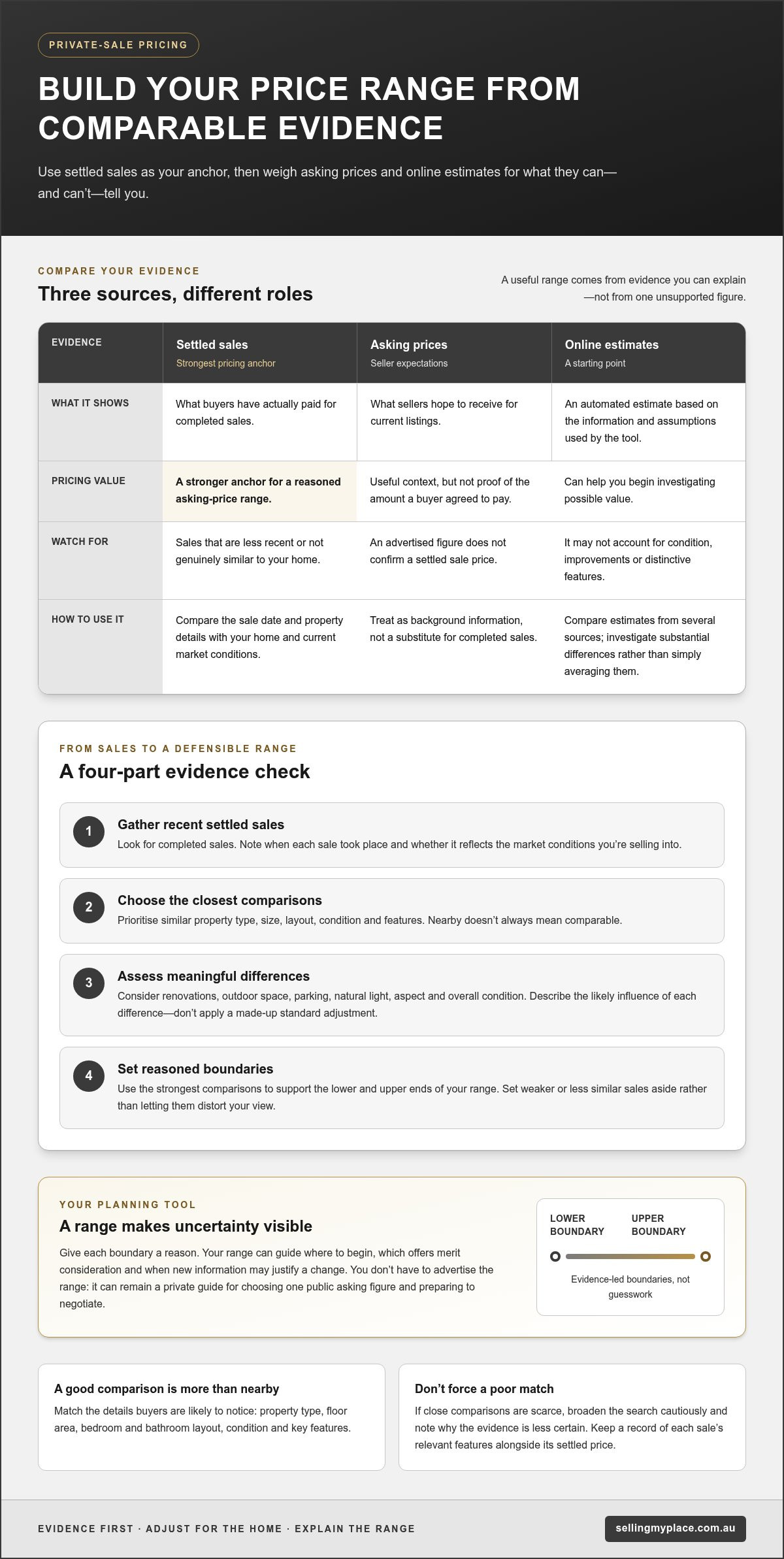
A sound price range starts with what buyers have actually paid for homes like yours, not simply what other sellers hope to receive. Recent, genuinely comparable settled sales provide a stronger pricing anchor than asking prices alone. Advertised prices reveal a seller’s expectations; they don’t confirm that a buyer agreed to pay that amount.
Use this process to turn market information into a reasoned range:
- Gather recent settled sales. Look for completed sales rather than relying on current listings. Note the sale date and check that the evidence reflects the market conditions you’re selling into.
- Select the closest comparisons. Prioritise homes with a similar property type, size, layout, condition and features. A nearby property isn’t automatically a useful comparison if its design or presentation differs substantially.
- Assess the differences. Consider how renovations, outdoor space, parking, natural light, aspect and overall condition may affect buyer appeal. Describe each difference and its likely direction of influence instead of applying a made-up standard percentage or dollar adjustment.
- Form a supported range. Use the strongest comparisons to establish sensible lower and upper boundaries. Give each end a clear rationale, and set weaker or less similar sales aside rather than letting them distort your view.
Choose comparable sales that genuinely help
Start with homes that match yours in the ways buyers are likely to notice: property type, floor area, bedroom and bathroom layout, condition and key features. Then consider whether they sold in a similar market context. If close comparisons are scarce, broaden your search cautiously, perhaps to a different property type or a less recent sale, and note why that evidence is less certain. Don’t force a poor match just to fill a list.
Keep a simple record of each sale’s relevant features alongside its settled price. This makes it easier to see whether your range is supported by a consistent group of homes or rests on one unusual result. For wider context, the Real Estate Institute of Australia market insights can help you follow broader residential market information. National or state trends, however, can’t replace property-level comparisons.
Use online estimates and professional input with care
Automated estimates are useful starting points, but an online tool may not account for your home’s condition, recent improvements or distinctive features. Compare estimates from several sources. If they differ substantially, investigate what information or assumptions may explain the gap. Don’t simply average the figures and treat the result as a valuation.
Neighbourhood market reports and pre-sale consulting can add context as you assess sales and property differences. A fuller guide to neighbourhood market reports can help explain how broader local data fits alongside comparable sales. Kincade International Direct Sales also provides pricing and private-sale advice as part of its advisory support.
Choose an asking-price strategy without overpricing or underpricing
Once you have a supported range, decide how to present your price to buyers. The right approach depends on your evidence, how much flexibility you have and the conditions of your campaign. A figure below your estimate isn’t automatically a smarter move: it may attract attention, but it can also expose you to offers that don’t meet your acceptable outcome.
When deciding how to price your home for private sale, consider three common approaches:
- Firm asking price: State one figure grounded in your sales evidence. This gives buyers a clear reference point, while still leaving room to negotiate if you choose.
- Price range: Where appropriate, a range can signal flexibility and acknowledge uncertainty. Its boundaries should be meaningful, and you should be prepared to explain the basis for them.
- Competitive asking price: Set an attractive, evidence-supported figure to encourage enquiries from qualified buyers. Pricing below your estimate is a deliberate tactic with trade-offs, not a requirement for every private sale.
Think about your priorities before choosing. If you have room to negotiate, a firm figure may give you a useful opening position. If you need a particular outcome or have limited flexibility, make sure your advertised approach doesn’t invite offers you’re unwilling to consider. Campaign conditions matter too: buyer interest and relevant settled sales may shift, so keep your decision anchored to evidence rather than assumptions about how buyers will react.
When a competitive asking price may help
A compelling price can prompt suitable buyers to enquire, especially when it aligns with comparable evidence and the home’s presentation. But a figure chosen solely to generate attention can create pressure to consider offers below your acceptable level. Decide your boundaries in advance. Strong enquiry or interest from more than one buyer may affect negotiations, but it doesn’t guarantee competing offers or a particular sale result.
How to avoid an asking price that stalls interest
Limited qualified enquiries or repeated buyer comments that the price feels too high may point to a mismatch, particularly if your campaign is reaching its intended audience. First check the presentation: unclear photos, incomplete property details or difficulty arranging an inspection can also weaken interest. Look for patterns across feedback and activity rather than treating one person’s reaction as proof that the price is wrong.
If the evidence suggests a change is warranted, review your comparable sales and campaign response before revising the figure. A considered adjustment can be more effective than a rushed reduction after a quiet viewing or a single low offer.
Before advertising, check the current price-advertising requirements for your state or territory. Rules and guidance can differ, including how prices or ranges may be presented. Use the relevant government or consumer regulator’s current guidance to make sure your chosen strategy is appropriate for the property’s location.
Review and adjust your private-sale price using campaign evidence
Before your listing goes live, decide when you’ll review its performance. A planned check-in helps you avoid changing the price in response to one buyer’s comment or a quiet inspection. You might review after a set period or once you’ve gathered enough enquiry and viewing feedback to spot patterns. Choose a schedule that suits your campaign, then stick to it unless genuinely new evidence calls for an earlier review.
At each check-in, assess the whole picture: the number and quality of enquiries, inspection attendance, recurring feedback and any new comparable sales. One signal on its own rarely tells the full story. A listing might attract plenty of casual questions but few serious inspections, or have steady attendance alongside repeated concerns about price. Those patterns point to different things to investigate.
Read buyer responses without overreacting
Separate general interest from serious engagement. A buyer who asks about availability is at an earlier stage than someone who inspects, asks detailed questions and discusses terms. Record what people say and do, including whether they return for another look or make an offer. One person’s view is useful feedback, not a verdict on your home’s value.
Look for repeated, specific comments. If several prospective buyers independently raise the same concern about price, compare that pattern with your original sales evidence and any new settled sales. If their comments focus on a feature or presentation issue instead, a price change may not address the real obstacle.
Make a measured price review
Before revisiting the figure, check that the listing is accurate and the marketing materials show the property clearly. Confirm that key details are complete, photographs and floorplans represent the home well, and inspection arrangements are straightforward. If those basics need attention, improve them before deciding that the asking price is the problem.
When sustained campaign evidence conflicts with your initial assumptions, return to your price range. Ask whether the comparable sales still support it and whether buyer feedback consistently sits outside your expectations. A revised asking price should recognise what the evidence suggests while respecting your priorities and acceptable terms. If you keep the price unchanged, record why. If you adjust it, note what information supports the decision.
Keep a simple review log with the date, enquiry and inspection patterns, recurring comments, comparable sales considered, presentation checks and your decision. This creates a clear record of how your view developed, rather than leaving you to rely on memory during a stressful campaign. Once interest turns into an offer, a guide to property sale negotiation can help you consider the proposed price alongside conditions and timing.
Kincade International Direct Sales provides private-sale campaign and pricing advice to help you review buyer feedback and your approach.
Set your private-sale price with Selling My Place support
Pricing evidence is most useful when it informs the whole sale plan. Bring your comparable sales, proposed asking-price range and preferred negotiation approach together with a clear plan for presenting the home and reviewing buyer response. Pre-sale consulting and neighbourhood market reports can help you examine your assumptions and form a considered view before your property is advertised.
Kincade International Direct Sales supports Australian homeowners with flat-fee property marketing and advisory packages, without agency commissions. The service combines listing support with practical advice, while keeping the asking price grounded in evidence rather than presenting any figure as a guaranteed result.
What professional private-sale support can contribute
Pre-sale consulting and the Agent Advisory Service can help you review pricing assumptions alongside your sale preparation. Professional photography and floorplans give buyers a clearer picture of the home and its layout, while neighbourhood market reports provide relevant context for weighing your comparisons. Conveyance advice is also available as part of the advisory support, helping you consider the transaction process without treating this article as legal advice.
As you prepare to list, keep the key decisions connected. A price supported by sales evidence still needs marketing that accurately represents the property, and a well-presented listing is more useful when you’ve decided how you’ll assess enquiries and offers. Organise your plan around these practical elements:
- Evidence: Keep a record of the settled sales and property features that inform your pricing view.
- Range: Set reasoned lower and upper boundaries, and decide which figure or format to advertise.
- Strategy: Be clear about your flexibility, priorities and approach to negotiating with interested buyers.
- Review points: Choose when you’ll assess enquiry quality, inspections, feedback and any new comparable sales.
Take the next step with a clear pricing plan
Knowing how to price your home for private sale doesn’t mean predicting the final agreed price. It means making a considered starting decision, understanding the evidence behind it and being ready to review the plan as the campaign unfolds. A flat-fee model gives sellers access to listing and professional services without agency commissions, while keeping the sale decision in their hands. Residential listings remain active until sold, with no time limits.
Kincade International Direct Sales brings the pricing plan together with flat-fee marketing and advisory support, so you can make informed decisions without agency commissions or a promised sale price.
Move forward with a pricing plan you can stand behind
Deciding how to price your home for private sale is an important step, but it doesn’t mean you have to predict the future. Treat your asking price as a considered starting point, then let credible evidence and buyer response inform your next decisions. A written plan can help you stay steady: note what supports your price, what you’re willing to negotiate and what campaign signals would prompt a review.
That clarity can make the next stage feel more manageable. Kincade International Direct Sales brings flat-fee marketing and advisory support together, from professional photography and floorplans to neighbourhood market reports, pre-sale consulting and conveyance advice. There’s no agency commission, and the focus is on helping you make informed choices without promising a particular sale price.
Ready to turn your sales evidence into a practical private-sale pricing plan? Talk with Kincade International Direct Sales about the flat-fee marketing and advisory support available for your campaign.
Frequently Asked Questions
Can I change my asking price after listing my home privately?
Yes, you can generally revise your asking price during a private-sale campaign, but check any applicable state or territory requirements before updating your advertising. Make the change consistently wherever the property is promoted, and note the date and reasoning. For instance, a fresh settled sale or a clear pattern in buyer feedback may support a review. A change is a pricing decision, not a guarantee of increased interest or a particular offer.
Should I price my home above market value to leave room for negotiation?
Not automatically. A higher asking price may give you negotiating room, but if buyers see it as out of step with comparable properties, some may not enquire. Decide first what terms and outcome you could accept, then consider whether your starting figure is supported by the evidence and leaves realistic scope to negotiate. If you choose a higher figure, be prepared to explain its basis and review the response rather than assuming buyers will bargain it down.
Is an online property estimate accurate enough to set my asking price?
Use an online estimate as a prompt for further research, not as your only pricing basis. Automated tools may rely on recorded property details and sales data that don’t reflect renovations, condition, layout or features that make your home distinctive. If two estimates differ, check whether their property information or comparable sales differ too. When working out how to price your home for private sale, test any estimate against relevant settled sales and the specific characteristics buyers will see.
How do I price a home when there are few comparable recent sales?
Start with the closest settled sales you can find, even if the matches aren’t exact. Note where each comparison differs, such as property type, size, condition or sale date. You can widen the search to less recent or less similar sales, but treat those as supporting context rather than equal evidence. If your property is unusual, a market report or pre-sale advice can help you build a reasoned range from the available information.
Can a buyer offer less than the advertised price in a private sale?
Yes. An advertised price is an invitation for buyers to consider the property, not a requirement that they offer that amount. A buyer can propose a lower figure or different terms, and you can accept, decline or make a counteroffer. Consider the complete offer, including conditions and proposed timing, rather than focusing on price alone. Keep your preferred terms and minimum acceptable outcome clear before responding, and have the agreed details documented appropriately.
Do Australian states and territories have different rules for property price advertising?
Yes, requirements can differ between states and territories, and some rules apply to agents rather than private sellers. Don’t assume a rule described for an agent applies to your own listing. Before publishing or changing a price, check current guidance from the relevant state or territory consumer affairs or fair trading authority, especially if you plan to advertise a price range.