
Settlement is the legal and financial handover that transfers a property from seller to buyer. In Australia, it usually takes place 30 to 90 days after the contract is signed or exchanged, depending on the contract. This guide explains the property settlement process, including what happens when ownership changes hands.
It’s natural to think of settlement as the finish line. It’s also when the final funds, property-related adjustments and ownership documents come together. Knowing what each part means can make this major transition easier to manage.
Here, you’ll learn how to prepare, what to check before settlement, which costs may be adjusted between buyer and seller, and how agreed contract changes can affect the process. You’ll also find out what happens on settlement day and what follows once the property is yours.
Key Takeaways
- Settlement transfers legal ownership and finalises the financial side of a property sale; the date is set out in the contract.
- In Australia, settlement usually takes place 30 to 90 days after the contract is signed or exchanged, depending on the contract.
- Arrange the final inspection before settlement day so there’s time to raise concerns about the property’s condition or agreed repairs.
- Review the adjustment statement carefully: it divides property-related charges between seller and buyer, with responsibility changing at settlement.
- Prepare for the handover by organising insurance, moving arrangements and any required contract changes with the other party’s agreement.
Pre-settlement inspections
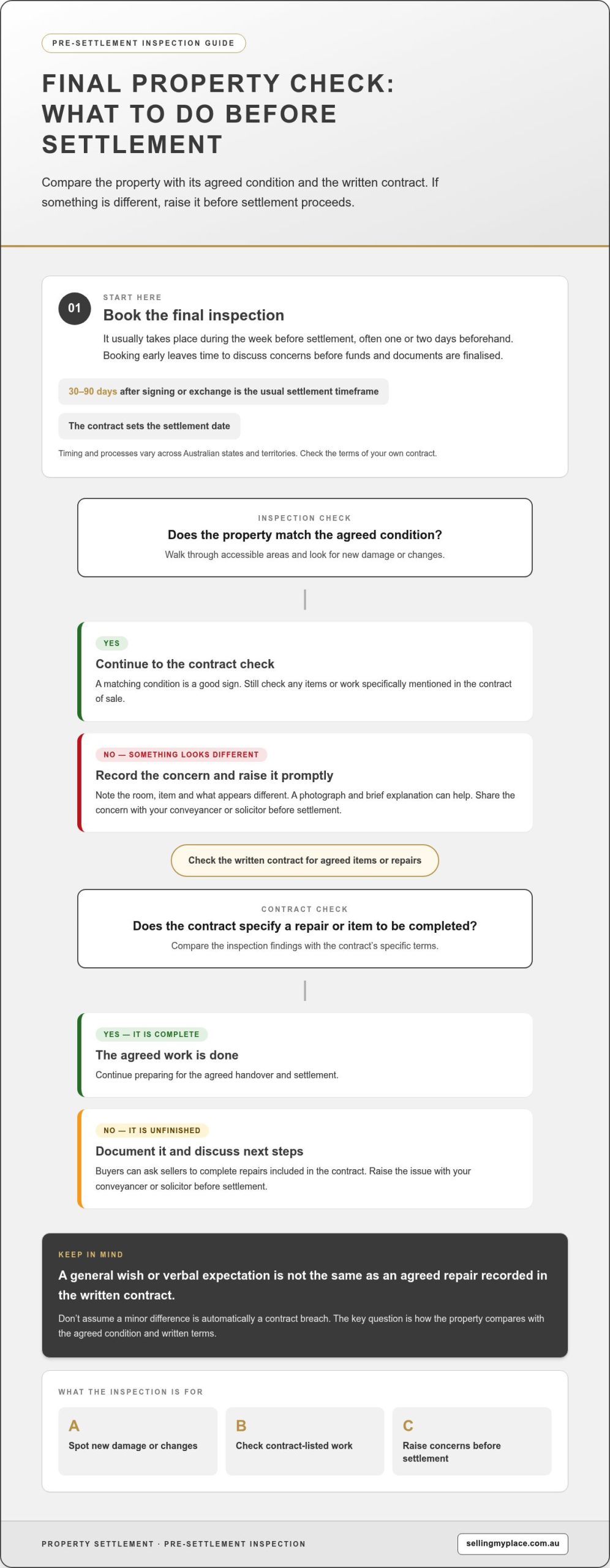
A pre-settlement inspection gives the buyer a final chance to compare the property’s condition with what was agreed at purchase. It’s a practical check before the contract of sale is finalised, not a replacement for earlier inspections or enquiries. For example, the buyer can look for new damage and check whether repairs promised in the contract are complete.
Settlement rules and timelines vary across Australian states and territories, and the contract sets the settlement date. Regional processes also affect how ownership transfers, so buyers should check the terms of their own contract rather than assume another territory’s timing applies.
In Australia, settlement usually takes place 30 to 90 days after the contract is signed or exchanged, depending on the contract terms. Across the country, the process typically takes 1 to 3 months to complete fully.
The final inspection usually takes place during the week before settlement, often one or two days beforehand. Booking it ahead of settlement day leaves time to raise concerns with a conveyancer or solicitor and discuss next steps before funds and documents are finalised.
Use the inspection to compare the property with the agreed condition and the contract’s specific terms. A focused check can cover:
- Walk through each accessible area and look for damage that wasn’t present when you agreed to buy.
- Check items or work specifically mentioned in the contract of sale, such as a repair the seller agreed to complete.
- Record any concern clearly, noting the room, item and what appears different.
- Raise issues promptly with your conveyancer or solicitor, before settlement proceeds.
During the process, buyers can ask sellers to complete unfinished repairs included in the contract. For instance, if the contract specifies a repair to a particular area, the buyer can check during the final inspection whether it’s been completed. The written contract matters: a general wish or verbal expectation isn’t the same as an agreed repair recorded in it.
If the inspection reveals a concern, describe it precisely and share it with your conveyancer or solicitor before settlement. A photograph, location and brief explanation can make the issue easier to understand. Don’t assume a minor difference is automatically a contract breach. The key question is how the property compares with the agreed condition and written terms.
For buyers, the inspection is the final practical opportunity to identify a change before ownership transfers. Sellers can help make the handover clear by completing contractually agreed repairs before the appointment. Arrange the inspection early enough for both sides to discuss any concerns before settlement day.
What steps should be taken to prepare for a property settlement?
Preparing for settlement means coordinating the contract, funds, insurance and handover in advance. Buyers and sellers each have tasks that help the agreed transfer proceed smoothly.
Preparing documents and funds
Settlement documents record the agreed transaction details and support the transfer of funds and ownership. The buyer’s conveyancer or solicitor handles legal requirements and enquiries after the contract is signed. Settlement agents coordinate with the buyer and lender to arrange payment to the seller.
Keep the contract of sale and settlement correspondence organised, and respond promptly to requests from your conveyancer. Buyers should understand how the deposit already paid relates to the purchase price and the remaining balance. Clear records help distinguish amounts paid from the funds still needed to complete settlement.
Preparing funds and insurance
Preparing funds means arranging access to the amount needed to complete the purchase, including the balance due at settlement. In Australia, the deposit is normally paid upfront to secure the property. Account separately for the remaining amount and other settlement costs.
Buyers should arrange building and contents insurance from the purchase date. The property and its contents need cover during the transaction, not just after moving in. Keep lender communications and payment instructions together so funds can be arranged with the lender and conveyancer ahead of settlement.
Getting ready for settlement day
Settlement day brings together the practical handover and the transfer of funds and documents. Buyers generally don’t need to attend in person because their conveyancer or solicitor handles settlement. The settlement agent works with the buyer and lender to transfer funds to the seller, while the relevant government agency registers the ownership transfer.
Sellers living in the property need to move out in time to hand over the keys after settlement. They should notify their gas and electricity providers when ownership changes. Conveyancers write to councils and water authorities to help update property accounts as part of the changeover.
Before settlement day, align your moving plans with the settlement date in the contract. For example, a buyer can arrange access and key collection with the agent once settlement is complete and registration has taken place. Sellers can schedule removal and utility notifications around the agreed handover, rather than assume keys can be exchanged earlier.
- Buyers: organise building and contents insurance from the purchase date, and keep lender and conveyancer communications accessible.
- Sellers: plan to vacate in time for key handover, then notify gas and electricity providers of the ownership change.
- Both parties: keep settlement documents together and promptly address requests affecting the agreed purchase price or transfer.
For owners preparing a sale, settlement and sale preparation guidance can help clarify the steps leading to handover.
Settlement adjustments and outgoing payments
Settlement brings together the remaining purchase price, lender funds and adjustments for property-related charges. Reviewing how each amount is calculated helps buyers understand what will be transferred to the seller.
Adjusting settlement amounts
Settlement adjustments divide property-related charges between the seller and buyer. The seller is responsible up to settlement day, and the buyer is responsible from then on. These adjustments affect the amount each party pays or receives at settlement.
Depending on the transaction, adjustments can include council rates, water charges and body corporate fees. Stamp duty, stamp duty concessions and the First Home Owner Grant may also feature in settlement calculations. The adjustment statement shows how relevant amounts are allocated across the ownership period.
Before authorising your conveyancer or solicitor to proceed with final settlement, review the pre-settlement adjustment statement. Check the listed charges, the dates used to divide them and the resulting amount payable. After settlement, responsibility for ongoing costs, rates and charges transfers to the buyer.
Lender funds and seller payment
Lender funds and the buyer’s available funds are combined to pay the seller at settlement. The full amount due must be accounted for before ownership can transfer.
On settlement day, the buyer’s conveyancer or solicitor and lender coordinate the transfer of funds to the seller. The buyer pays the balance of the purchase price after accounting for the deposit and any settlement adjustments. The lender draws down the buyer’s loan, and the settlement payment is debited from the loan account.
Once settlement is complete, the buyer should receive settlement details, including a statement of adjustment showing how funds were distributed. Keep this record with the contract and other purchase documents. It provides a clear account of final payments and the charges allocated to each party.
Settlement costs and fees
Australian property settlement costs can include stamp duty, council rates, water charges and body corporate fees, alongside adjustments and other transaction payments. The charges depend on the property, location, contract and applicable concessions. The settlement statement records the amounts due.
In Victoria, land transfer duty is usually paid at settlement, but buyers have up to three months after settlement to pay. Stamp duty and other adjustments should not be treated as interchangeable: duty relates to the transfer, while adjustments divide property charges between seller and buyer.
To understand the total outgoing amount, compare the purchase price balance with each listed adjustment and payment. Ask your conveyancer or solicitor to explain any entry you can’t reconcile before authorising the final transfer. This clarifies the funds required and the amount going to the seller.
Meaning of property settlement
Property settlement is the legal and financial step that transfers ownership from seller to buyer. It completes the transaction after the parties have agreed on a purchase, paid the deposit, signed and exchanged the contract, and completed any cooling-off period. The contract sets the settlement date, tying this milestone to the agreement rather than simply to moving day. A property settlement process explained through these milestones separates signing from the actual transfer of ownership.
The settlement period starts when the contract of sale is signed and ends on the scheduled settlement day. During this time, the buyer’s solicitor or conveyancer handles legal requirements and makes enquiries about the property. The buyer and seller remain bound by the contract, but ownership has not yet changed hands. Signing creates agreed obligations; settlement completes the transfer.
On settlement day, the remaining purchase funds are transferred, documents are exchanged and ownership is registered through the relevant government agency in the buyer’s state or territory. The seller receives the funds due, and the buyer becomes the new owner once registration is complete. In Victoria, for example, the transfer of land document transfers ownership from seller to buyer.
Settlement also addresses interests affecting the title. Transfer documents can provide for third-party rights, including caveats and previous mortgages, to be removed or released so clear title can pass to the buyer. A mortgage doesn’t disappear simply because the purchase price has been paid. The required documents and funds must deal with the existing interest as part of the transaction.
Registered ownership details also matter when more than one person buys a property. In Victoria, joint owners hold the property jointly, and if one owner dies, ownership automatically passes to the surviving owner or owners. Tenants in common, by contrast, can hold equal or unequal shares and dispose of their interest as they see fit. These ownership forms shape what the title records.
Settlement is more than a payment or key handover. It brings together the agreed price, transfer documents, title interests and registration. In Victoria, the buyer pays the balance, receives the property title and becomes the registered owner at settlement, taking possession unless otherwise arranged. The practical handover follows the legal change, though its timing depends on the parties’ arrangements.
For buyers, the clearest way to understand the process is to separate three events: contract, settlement and registration. The contract records what the parties agreed; settlement completes the financial and document exchange; registration records the buyer as owner. With the property settlement process explained through these distinct stages, it’s clear why paying a deposit or signing the contract doesn’t itself transfer ownership.
That distinction is central to property settlement: the seller’s obligations are completed, the buyer’s payment is finalised, and the ownership record changes. The state or territory’s registration process and the contract terms determine how the transfer is recorded and what follows for possession.
What are the steps in the Australian property settlement process?
The process moves from a signed contract to payment, registration and handover. The contract sets the settlement date, while the buyer’s conveyancer or solicitor coordinates legal enquiries and documents. With the property settlement process explained in stages, it’s easier to see how each task leads to the transfer.
In Australia, settlement usually occurs 30 to 90 days after the contract is signed or exchanged, depending on its terms. In New South Wales, most settlements take place 42 days after contracts are exchanged. The agreed date gives both parties and their representatives a timetable for completing the remaining tasks.
- The contract is signed or exchanged. The settlement period begins, and the buyer’s conveyancer or solicitor handles legal requirements and enquiries about the property. Outstanding contract conditions need attention because they can affect whether the transaction is ready to proceed.
- Documents and funding are prepared. The conveyancer arranges transfer documents, including provisions for removing or releasing third-party rights such as caveats and previous mortgages. The buyer, lender and conveyancer coordinate the funds required to pay the seller. Loan approval delays or missing paperwork can hold things up.
- Final amounts are brought together. The conveyancer arranges stamp duty to be paid at the same time as settlement. Adjustments account for relevant property charges, such as council rates, water charges and body corporate fees. The buyer’s funds and lender’s contribution are coordinated for the final transfer.
- Settlement takes place. The buyer’s and seller’s representatives, along with their lenders, complete the financial and document exchange. In Australia, the process normally takes about an hour. Buyers generally don’t need to attend in person because their conveyancer or solicitor handles the transaction.
- Ownership is registered and possession follows. The transfer is registered through the relevant government agency in the buyer’s state or territory. Once settlement is complete and the buyer is registered with the Land Titles Office, they can collect the keys from the agent. In Victoria, the buyer becomes the registered owner and takes possession unless otherwise arranged.
Some purchases involve linked transactions. In a simultaneous settlement, the buyer sells one property and buys another on the same day, using the sale proceeds to fund the purchase. Because the transactions depend on each other, a delay in the sale can affect the purchase, so representatives coordinate both settlements.
Outstanding contract conditions, loan approval delays, missing paperwork or title issues can delay settlement. If a delay arises, the parties’ conveyancers manage the necessary communication and next steps. After settlement, the buyer should receive details, including a statement of adjustment confirming how funds were distributed.
Understanding the property settlement process explained as a sequence helps clarify what to expect: contract requirements come first, then funding and documents, followed by settlement and registration. If you’re preparing to sell, discuss your property sale plans and the steps that lead to settlement.
Kincade International Direct Sales: Residential Property Listing Services
Kincade International Direct Sales offers Residential Property Listing Services for Australian owners preparing to bring a home to market. Its commission-free marketing service includes professional photography, floorplans and neighbourhood market reports, with listings remaining active until sold and no time limits.
Turn to the service when you’re planning a sale and want to organise how your property is presented to buyers. Pre-Sale Property Consulting can help you consider the preparation and marketing approach, while Buyer Representation supports people looking for help on the purchasing side. Neighbourhood Market Reports can also provide local context as you consider your next move.
For a measured next step, contact Kincade International Direct Sales or visit sellingmyplace.com.au.
Take your next property move with confidence
With the property settlement process explained, you can look beyond the handover and start planning what comes next. A sale or purchase is also a chance to make considered decisions about timing, presentation and the support that suits your plans.
If you’re preparing to sell, Kincade International Direct Sales’ Residential Property Listing Services and Pre-Sale Property Consulting can support your planning. If you’re buying, Buyer Representation offers support on the purchasing side. The right next step is the one that helps you move forward with clarity and keep your priorities in view.
Contact Kincade International Direct Sales to discuss your property plans and where to begin.
Take it one decision at a time. A considered move can help you make a confident start on what comes next.
Frequently Asked Questions
What is settlement?
Settlement is the point in a property sale when the financial and legal handover is completed. The seller receives the amount due, and the buyer’s ownership transfer is registered through the relevant state or territory agency. Signing a contract alone, for example, doesn’t make the buyer the registered owner. Settlement completes the transaction, while registration records the new ownership and possession follows the parties’ arrangements.
Can I move in straight away after settlement?
You can usually take possession after settlement if the contract doesn’t make different arrangements. In Victoria, the buyer takes possession at settlement unless otherwise agreed. Before organising removalists, confirm when keys can be collected and whether the seller has vacated. For instance, settlement may be complete while the practical key handover is still being arranged through the agent. Plan your move-in to match the possession terms in your contract.
When do I pay my deposit and stamp duty?
The deposit is normally paid upfront to secure the property, following the payment arrangements for your purchase. Stamp duty is commonly arranged by the conveyancer for payment at settlement. In Victoria, land transfer duty is usually paid then, although buyers have up to three months after settlement to pay. Keep the deposit receipt and settlement figures together to distinguish the initial payment from later amounts due.
What is property settlement in Australia?
In Australia, property settlement is the legal and financial completion of a property transaction between buyer and seller. It follows the signed and exchanged contract, deposit payment and completion of any cooling-off period. The contract sets the agreed settlement date. For example, the buyer may have paid a deposit but still needs settlement and registration before becoming the registered owner.
What happens on settlement day when buying property in Australia?
On settlement day, the buyer’s and seller’s representatives coordinate funds and documents to complete the transaction. The buyer’s lender contributes the loan funds, and the seller receives the amount due. The ownership transfer is then registered through the relevant government agency in the buyer’s state or territory. Buyers generally don’t attend in person; their conveyancer or solicitor handles the arrangements and communicates when settlement is complete.
What are the buyer’s and seller’s responsibilities before settlement?
Before settlement, the buyer needs to organise the required funds, arrange building and contents insurance from the purchase date, and complete a final inspection. The seller must meet the contract terms and, if living in the property, move out in time for key handover after settlement. Sellers should also notify gas and electricity providers when ownership changes. Both parties should address outstanding contract requirements promptly.
What is a settlement agent or conveyancer, and what do they do?
A conveyancer manages property transfer matters, including legal requirements and enquiries after the buyer signs the contract. A settlement agent works with the buyer and lender to arrange the transfer of funds to the seller on settlement day. Together, their roles help coordinate documents, payments and registration. For example, a buyer’s conveyancer can explain an entry in the adjustment statement, while the lender arranges its contribution to settlement funds.
What happens if settlement is delayed or fails in Australia?
Outstanding contract conditions, loan approval delays, missing paperwork or title issues can delay settlement. In New South Wales, interest may be charged if the buyer can’t pay all settlement costs by the settlement date. The parties can change settlement terms if they both agree.