Navigating Australian Property: 2026 Home Owner’s Guide to Private Sales
What if the biggest hurdle to your family’s next chapter isn’t the market itself, but the A$20,000 or more you’re expected to hand over in commissions? For many, the traditional path to selling a home feels like a lopsided arrangement where you provide the asset and someone else takes a significant slice of the reward. If you’ve ever felt that the current model of private real estate sales australia puts the agent’s interests ahead of your own equity, you aren’t alone. It’s a common frustration to feel like a passenger in your own life transition, especially when hidden marketing fees and rigid contracts start to pile up.
We believe you deserve a more empowering way to move forward, one that treats your home as the hard-earned legacy it is. This guide will show you how to find the best available properties or list your own for a premium price while retaining your full profit. You’ll discover how to access professional photography, expert negotiation support, and global listing reach without the burden of traditional commissions. From legal essentials to mastering open homes, we’re here to provide the steady hand you need to manage your 2026 property journey with absolute confidence.
Key Takeaways
- Understand how the market environment for private real estate sales australia has evolved in 2026 to empower owners through digital-first marketing and total transparency.
- Learn how to bypass traditional 2-3% commission structures and keep an average of A$20,000 more of your hard-earned equity by choosing a professional flat-fee model.
- Discover the psychological power of professional visual marketing and how pre-sale consulting identifies high-ROI improvements that make your property stand out.
- Gain the confidence to manage your own enquiries and open houses, acting as the most passionate and knowledgeable advocate for your home’s unique story.
- Master the art of reading between the lines of property listings to spot genuine value and opportunity in a competitive digital landscape.
Understanding the Landscape of Private Real Estate Sales in Australia
The Australian property market in 2026 is no longer a closed book held only by traditional agencies. We’ve entered an era where transparency and digital-first marketing have become the standard, shifting the focus back to the person who matters most: you. Choosing private real estate sales australia isn’t just a way to avoid fees; it’s a sophisticated strategy that places control of your family’s future firmly in your hands. While the features of your home, like a sun-drenched deck or a renovated kitchen, are vital, the method you use to list them is what determines how much of the final price stays in your pocket. Direct sales offer a professional middle ground, blending the support of experts with the financial freedom of a commission-free model.
The Evolution of the Australian Property Market
Our digital world has completely rebalanced the scales. Today, homeowners have the same tools at their fingertips that were once exclusive to big offices. In a market where interest rates and living costs are top of mind, the demand for commission-free alternatives has never been stronger. Modern sellers aren’t just looking for a quick result; they’re prioritising equity preservation. They’ve realised that handing over a large percentage of their home’s value to an agent doesn’t always translate to a better outcome. This evolution in private real estate sales australia means you can access high-tier marketing once reserved for luxury agencies. It’s a shift toward stability and common sense where you’re a partner in a professional process rather than just a number in a database.
Public vs. Private Listings: What is the Difference?
Visibility is the heartbeat of any sale. While major portals offer a broad view, private listings through global marketing networks reach specific, motivated buyers without the competitive noise. One of the greatest advantages of this approach is the “listed until sold” philosophy. You don’t have the ticking clock of a 90-day agency agreement hanging over your head, which reduces stress and allows for a more grounded decision-making process. Keeping your listing fresh for a national audience is simple when you have professional floorplans and photography that speak directly to a buyer’s aspirations. It’s about presenting a lifestyle, not just a structure. This method ensures your home remains a premium offering for as long as it takes to find the right buyer.
Decoding Property Listings: How to Spot Value and Opportunity
Buying or selling a home is deeply personal. A listing is more than a list of features; it’s a window into a potential future. For those exploring private real estate sales australia, understanding how to interpret these listings is a superpower. Serious buyers look for clarity and honesty. If a listing feels vague or lacks essential data, it’s often a sign of a missed opportunity for the seller or a red flag for the buyer. You want to see the “soul” of the home, not just the square metres.
The Hidden Market: Finding Off-Market Properties
Off-market properties are the industry’s quiet achievers. These homes aren’t splashed across public portals; instead, they move through discreet networks. Sellers often choose this path to maintain privacy or test the market without the public pressure of “days on market” counters. To find these gems, you need to be part of the right circles. Engaging professional buyer representation can give you that crucial head start, ensuring you see the home before the rest of the country does. It’s about being proactive rather than reactive in your search.
Evaluating Professional Marketing: Photography and Floorplans
High-end photography isn’t a luxury; it’s a non-negotiable tool for establishing a premium feel. It creates an emotional anchor, helping a buyer imagine their morning coffee in that specific kitchen. Accurate floorplans are equally vital because they allow buyers to mentally arrange their furniture. This transparency reduces “tyre-kickers” and attracts serious enquiries from people who already know the layout suits their lifestyle. Professional visuals act as a silent negotiator, setting a high perceived value before anyone even steps through the front door.
Watch out for listings with poor lighting or missing details. Sometimes, these “diamonds in the rough” are actually fantastic properties simply held back by a lack of professional presentation. If you’re selling, don’t let your hard-earned equity be undermined by a dark photo or a blurry floorplan. The standard for private real estate sales australia is rising; buyers expect high-quality information. If you’re buying, these poorly marketed listings might be where the real value hides, as they often attract fewer eyes and less competition. Taking the time to look past the presentation can lead to a spectacular deal.
The True Cost of Selling: Commissions vs. Flat-Fee Models
Traditional agencies in Australia typically charge between 2% and 3% in commission. For a family selling a home worth A$1 million, that’s a cheque for A$20,000 to A$30,000 handed over at settlement. It’s a significant amount of equity that could otherwise fund a renovation, pay down a mortgage, or secure a retirement. When you choose Sale by owner, you’re not just taking a DIY approach; you’re opting for a sophisticated, expert-backed strategy. Modern private real estate sales australia allow you to bypass these exorbitant fees while still having a “steady hand” to guide you. Our Expert Agent Advisory Service acts as your personal consultant, ensuring you never feel alone during the negotiation phase. We help you handle the paperwork and the psychological dance of the deal with calm confidence, turning a stressful transaction into a manageable partnership.
Calculating Your Potential Equity Savings
Kincade International Direct Sales users save an average of A$20,000 per sale compared to traditional agency models. This isn’t just a one-off saving; it’s the preservation of your 100% sale profit, which can have a massive impact on your long-term financial stability. Imagine what that A$20,000 could do for your next deposit or your family’s future. Choosing a commission-free path doesn’t mean you’re sacrificing quality or professional oversight. It simply means you’re paying for the services you actually use rather than a percentage of your home’s total value. It’s a logical shift toward a more equitable way of doing business in the current property market, where every dollar of equity counts toward your next chapter.
The Flat-Fee Advantage: Professionalism Without the Price Tag
A truly professional marketing package should include high-end photography, detailed floorplans, and comprehensive neighbourhood market reports to ensure your property stands out. Unlike traditional agencies that might push for a quick sale to meet their monthly targets, a flat-fee model offers the peace of mind of a “no time limit” listing policy. This means you’re listed until sold, removing the anxiety of a 90-day expiry date. You can access Residential Property Listing Services that rival any major agency, providing global reach and premium presentation. This partnership ensures you have the tools to succeed in private real estate sales australia without the pressure of mounting marketing costs or ticking clocks. You maintain the authority over your sale while we provide the infrastructure and support to make it happen.

Preparing Your Property for Sale to Maximise Profit
Your home is more than bricks and mortar; it’s where your children grew up or where you’ve built your sanctuary. This emotional connection is a strength, but it can also cloud your judgement when preparing for the market. In the digital-first environment of 2026, the first ten seconds a buyer spends looking at your listing are the most critical. If the visuals don’t spark a sense of “this is the one,” they’ll keep scrolling. Success in private real estate sales australia depends on presenting a polished, aspirational lifestyle that invites buyers to see themselves in your space. This means moving beyond generic cleaning and focusing on the strategic presentation of your home’s unique story.
Expert Pre-Sale Consulting: Small Changes, Big Impact
Identifying “deal breakers” early is essential. These are the small things, like a leaky tap or a scuffed skirting board, that signal a lack of care to a potential buyer during their first inspection. Pre-sale consulting helps you focus on high-ROI improvements, ensuring you don’t over-capitalise on renovations that won’t move the needle. By centring your home’s best features through professional staging and a thoughtful layout, you create a neutral yet warm environment. Having an unbiased advisory service by your side provides the calm confidence needed to make these practical decisions without the weight of sentimentality holding you back.
Pricing Strategy: How to Determine Market Value of a Home in Australia
Setting the right price is a delicate balance of ambition and reality. In 2026, buyers are more informed than ever, and overpricing remains the most common reason properties linger on the market. To avoid this, you must use hard data rather than guesswork. We provide detailed neighbourhood market reports that show exactly what similar homes have sold for recently. This transparency allows you to justify your asking price to savvy buyers, whether you choose a “Fixed Price” or a “Price Guide” strategy. Understanding the psychology of these options helps you position your home as a fair and attractive opportunity in a competitive landscape.
Don’t forget the power of a well-crafted story. While data secures the mind, storytelling captures the heart. Your property description should highlight the “un-seeables,” like the way the morning light hits the breakfast nook or the quiet community feel of the street. This blend of professional data and personal warmth is what makes private real estate sales australia so effective. If you’re ready to see how your home measures up in the current market, our team is here to provide a tailored market report to get you started on your journey.
Taking Control: Your Journey from Listing to Settlement
Stepping into the role of your own advocate is a powerful moment. While traditional agents often claim that only they can handle the pressure of an open house, the truth is that nobody knows the heartbeat of your home better than you do. When you manage private real estate sales australia, you aren’t just showing a house; you’re sharing a lifestyle. You can point out where the kids did their homework or how the garden changes with the seasons. Handling enquiries with professional confidence comes naturally when you realise you’re simply having a conversation with another family looking for their next chapter. It’s about being prepared, being honest, and maintaining that sense of calm authority we’ve discussed throughout this guide.
Negotiation Tips for the Modern Australian Seller
Negotiation can feel like the most daunting part of the process, but it doesn’t have to be. The key is to remain objective and grounded. Remember, a buyer’s offer isn’t a critique of your home’s worth; it’s a starting point for a professional agreement. By understanding the buyer’s motivations, such as their desired settlement date or their need for a stable neighbourhood, you can close the deal more effectively. If the technical side of the conversation feels heavy, you can always lean on our Real Estate Advisory Services. Having that expert support in your corner ensures you’re never negotiating in the dark, allowing you to secure a premium price while keeping your equity intact.
The Legal Finish Line: Conveyancing and Settlement
As you approach the finish line, the focus shifts to the finer details of Australian property law. This is where professional conveyance advice becomes your most valuable asset. Ensuring all paperwork is organised and compliant is vital for a stress-free transition. During the final weeks, you’ll coordinate with your legal representative to manage the bank’s requirements and prepare for the settlement date. It’s a time of reflection and excitement. Celebrating a successful sale is even sweeter when you know you’ve navigated the process with dignity and saved upwards of A$20,000 in unnecessary fees. Once the keys are handed over, our Buyer Representation services can help you find your next sanctuary with the same level of care and expertise.
Embracing Your Future with Confidence and Equity
Choosing to take the lead in your property journey is a decision that honours both your home’s legacy and your family’s financial future. We’ve explored how private real estate sales australia have evolved into a sophisticated, professional path where you no longer have to choose between expert support and keeping your hard-earned equity. By leveraging professional photography, detailed floorplans, and a “listed until sold” approach, you place your property in the best possible light without the burden of traditional commissions. It’s about ensuring that the value you’ve built over years stays exactly where it belongs: with you.
You’ve seen that success comes from a blend of data-driven pricing and heartfelt storytelling. With a steady hand to guide you through negotiations and settlement, the process becomes a rewarding transition rather than a source of stress. It’s time to step into this new era of home ownership where you remain the primary beneficiary of your asset’s value. We’re ready to stand beside you as you move toward your next sanctuary.
Start your commission-free selling journey with Kincade International Direct Sales today and keep 100% of your sale profit while enjoying expert advisory support every step of the way. Your next chapter is waiting, and we’re here to help you reach it with absolute peace of mind.
Frequently Asked Questions
How do I list properties for sale without paying a traditional commission?
You can list your property by choosing a flat-fee marketing service like Kincade International Direct Sales. This modern approach allows you to access major property portals and global networks for a single upfront fee rather than a percentage of your final sale price. By removing the commission-based agent from the equation, you retain 100% of your equity. You’ll manage the inspections yourself while we provide the professional infrastructure to ensure your listing reaches a national audience.
What is included in a flat-fee property marketing package?
A comprehensive package provides everything you need to rival a traditional agency’s presentation. You’ll receive high-end professional photography, detailed floorplans, and neighbourhood market reports to help you price your home accurately. We also include global listing reach and a professional signpost for your property. The goal is to provide a steady hand through our Agent Advisory Service, ensuring you have expert guidance from the moment you list until the keys are handed over.
Can I really sell my own home as professionally as an agent?
You absolutely can, especially when you have the right tools and support. Most buyers today find properties online, so as long as your marketing looks professional, they don’t mind dealing with the owner directly. In fact, many buyers prefer it because you can answer specific questions about the home’s history and neighbourhood that an agent might not know. We provide the professional polish and advisory support to ensure your property stands out as a premium offering.
How much can I save by using a direct sales model in Australia?
On average, homeowners utilising the private real estate sales australia model save approximately A$20,000 per transaction. This figure is based on avoiding the standard 2% to 3% commission typically charged by traditional agencies. When you consider that you also avoid high marketing mark-ups and hidden fees, the total amount of equity you keep can be life-changing. It’s a sensible way to protect your profit and your family’s future during a major life transition.
What are off-market properties and how do I find them?
Off-market properties are homes for sale that aren’t advertised on major public portals. Sellers often choose this path for privacy or to test the market quietly. To find these opportunities, you can use our buyer representation services, which tap into private networks and direct sales databases. Accessing these listings gives you a competitive edge, allowing you to view homes and negotiate deals before the general public even knows they’re available, often leading to a more grounded transaction.
Is professional photography and a floorplan really necessary for my listing?
They are absolutely vital for securing a premium price in 2026. High-quality visuals are the first thing a buyer sees, and they set the tone for the entire sale. A clear floorplan allows buyers to mentally move into the space, which reduces tyre-kickers and attracts more serious enquiries. Without these professional elements, your property might be overlooked, even if it’s the best value in the street. First impressions are everything in a digital-first market.
How does the Agent Advisory Service support me during the sale?
Think of our Agent Advisory Service as your personal property consultant. We provide expert backing during the most complex parts of the sale, including pre-sale consulting to identify high-ROI improvements and guidance during negotiations. If you’re unsure how to handle an offer or need help with contract details, we’re here to provide a calm, grounded perspective. We ensure you feel empowered and supported from your initial listing right through to the final settlement phase.
What happens if my property doesn’t sell within a few months?
One of the biggest benefits of our model is the listed until sold policy. Unlike traditional agency agreements that often expire after 90 days, we have no time limits on your listing. This removes the pressure to accept a low offer just because a contract is ending. You can keep your property on the market for as long as it takes to find the right buyer, maintaining total control over your sale and your equity.
Using Property Market Reports to Price Smarter in 2026
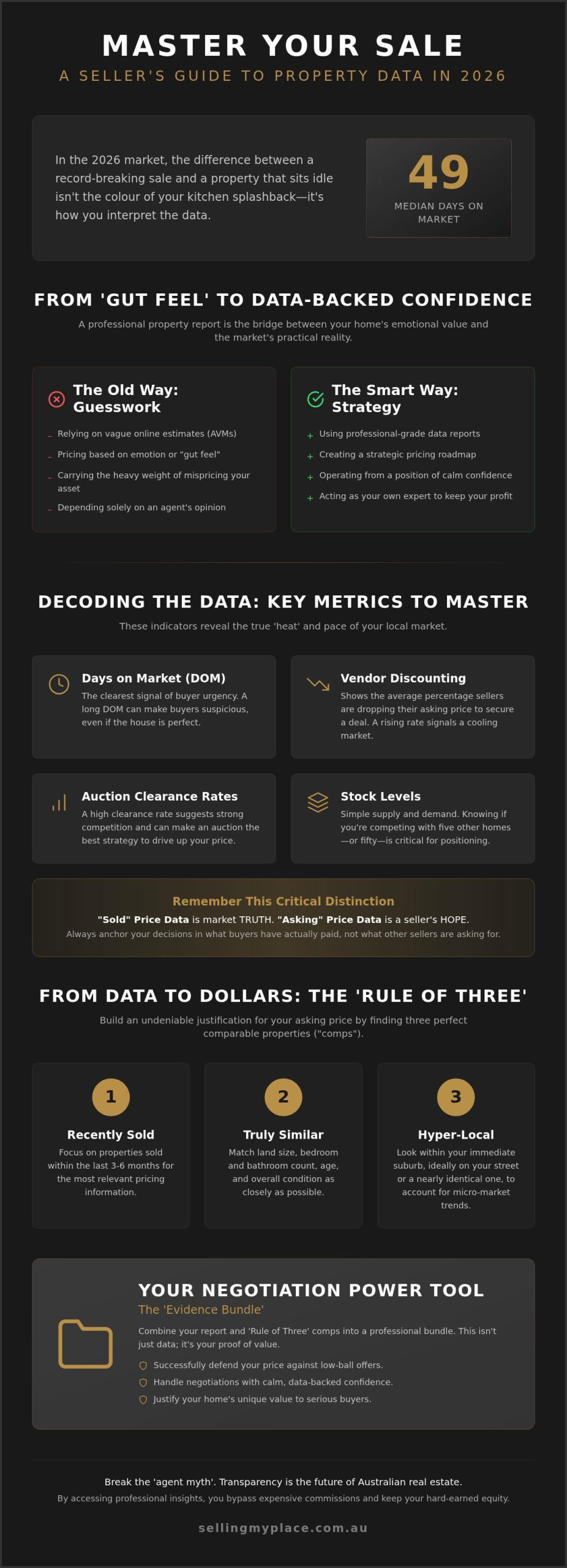
What if the difference between a record-breaking sale and a property that sits idle isn’t the colour of your kitchen splashback, but how you interpret a few lines of data? In 2026, the market is moving at a unique pace; with median days on market averaging 49 days, the sellers who succeed look beyond the glossy photos. It’s natural to feel overwhelmed when you first learn how to use a property market report, especially when faced with spreadsheets that feel more like homework than a helping hand. You want to honour your home’s history while making a savvy financial move, but the fear of mispricing your asset is a heavy weight to carry.
We understand that selling is a major life transition, not just a transaction. This article will help you turn raw data into a strategic pricing roadmap, giving you the confidence to set a competitive asking price. We’ll explore which data points truly drive value and how to use this evidence to justify your price to buyers. By the end, you’ll have the tools to be your own expert, ensuring you keep every cent of your profit. Whether you are looking for stability or a fresh start, we are here to provide the steady hand you need.
Key Takeaways
- Move beyond guesswork by learning how to anchor your sale in professional-grade data that reflects the actual state of the 2026 market.
- Discover exactly how to use a property market report to decode metrics like Days on Market, ensuring you set a price that attracts genuine interest from day one.
- Master the ‘Rule of Three’ to find perfect comparable properties, helping you build a data-backed justification for your home’s unique value.
- Learn to create an ‘Evidence Bundle’ that empowers you to handle negotiations with calm confidence and successfully defend your price against low-ball offers.
- Understand how to leverage professional neighbourhood insights to bypass expensive commissions and keep more of your hard-earned equity in your own pocket.
Understanding the Power of a Property Market Report
A property market report is a sophisticated synthesis of historical sales, current listings, and broader suburb trends. Think of it as a bridge between the emotional value you place on your family home and the practical reality of what a buyer is willing to pay. While many people think these documents are just for buyers looking for a bargain, sellers actually need this data far more in the current 2026 market. With the market often described as being in a “holding pattern” as we watch interest rate decisions, having a clear view of Understanding Real Estate Economics is vital to your success.
Data provides a “steady hand” during what is naturally an emotional process. It moves you away from the stress of “gut feel” and into a position of calm confidence. You might have seen Automated Valuation Models (AVMs) online; those quick, computer-generated estimates that often vary by tens of thousands of dollars. While they are a starting point, they lack the nuance of a professional report. A professional document provides a strategic roadmap rather than a random guess, ensuring you don’t leave money on the table or scare off buyers with an unrealistic figure.
The Anatomy of a Modern Property Report
A truly useful report goes beyond a simple price range. It breaks down the sales history of your immediate area, identifies comparable properties, and analyses suburb demographics. One of the most critical things to remember is that “Sold” data is significantly more valuable than “Asking Price” data. An asking price is often a reflection of a seller’s hope; a sold price is a reflection of market truth. Most high-quality reports draw from professional-grade digital infrastructure like RP Data or CoreLogic, which are the same tools used by the country’s top-tier agencies and official government records.
Breaking the ‘Agent Myth’
For a long time, there was a belief that only real estate agents held the “secret” keys to market data. That simply isn’t true anymore. Transparency is the future of Australian real estate. By accessing these same professional insights, you can accurately determine the market value of a home in Australia without needing a traditional agent. Learning how to use a property market report allows you to act as your own expert. It removes the need for expensive commissions and puts the power back into your hands, where it belongs. You aren’t just selling a house; you’re managing a major life transition with the best evidence available.
Decoding the Data: Key Metrics Every Seller Must Know
Looking at a spreadsheet for the first time can feel a bit like reading a different language. However, once you grasp the core metrics, the fog starts to lift. Learning how to use a property market report begins with the Median Suburb Price. It’s a helpful benchmark for your general area, but please don’t treat it as a bible for your specific home. Your property has its own soul and unique features; a median price doesn’t account for that stunning new deck or the quietness of your particular street.
Then we have Auction Clearance Rates and Vendor Discounting. These metrics reveal the “heat” of the local market. If clearance rates are high, an auction might be your best bet to drive competition. On the flip side, vendor discounting tells you how much other sellers are dropping their prices to get a deal across the line. If you notice discounting is on the rise, it’s a signal to be more realistic with your initial figure. It’s about being proactive rather than reactive. If you’re feeling stuck on these numbers, our team is always happy to discuss your specific report.
Reading Between the Lines of ‘Days on Market’
Days on Market (DOM) is perhaps the most telling indicator of buyer urgency. A short DOM suggests a “seller’s market” where buyers are tripping over themselves to sign a contract. A long DOM, perhaps approaching the 2026 average of 49 days seen in similar global markets, often points to a “cooling” phase. This metric carries a heavy psychological weight. When a property sits on the market for too long, buyers begin to wonder if something is wrong, even if the house is perfect. Knowing how to use a property market report allows you to identify these shifts before the evening news catches up.
Supply and Demand Indicators
You also need to look at stock levels. Are you competing with five other homes or fifty? High stock levels mean you need to work harder to stand out, perhaps through better photography or more flexible viewing times. Don’t forget about rental yields, either. Even if you’re selling to a family, high yields attract investors, which broadens your pool of potential buyers and adds another layer of demand. Sometimes, a “micro-market” trend might emerge where houses on one side of a park sell faster than the other. These tiny details are what turn a standard sale into a strategic success, helping you protect your family’s future wealth.
From Data to Dollars: Setting Your Asking Price
Now that you’ve grasped the core metrics, it’s time to translate those numbers into a figure that works for your family’s future. Selecting your “comps,” or comparable properties, is where the art meets the science. You aren’t just looking for any house that sold nearby; you are looking for three to five properties that mirror your own in land size, bedroom count, and the quality of the finish. This is the heart of how to use a property market report effectively. It allows you to move past the generic estimates of a computer and into a “Street-Smart” valuation that reflects the real world.
We often recommend the “Rule of Three” when analysing these comps. Look at three recently sold homes to see what buyers actually paid, three currently listed homes to see who you’re competing against, and three failed listings. Those failed listings are often the best teachers; they show you exactly where the market said “no” to a price. While it’s tempting to add a 5% “buffer” to your price for negotiation room, this can often lose you money. In a market where 24.5% of homes might sell above list price if priced correctly, an unrealistic starting point can make your home go stale, leading to a lower eventual sale price than if you’d been sharp from day one.
The Comparison Framework
When matching your home to others, be honest about the “X-Factor.” Does your neighbour have a better view? Is your kitchen renovation more modern? You must adjust your price up or down for these differences. It’s also vital to ignore “outlier” sales, such as a property sold to a developer at a massive premium that doesn’t fit the local pattern. By filtering this data accurately, you gain the upper hand to sell your own home with a genuine competitive edge. You become the most informed person in the room, which is a very powerful place to be.
The ‘Sweet Spot’ Strategy
Psychological pricing plays a huge role in how buyers search online. There is a significant difference between listing at $995,000 and $1,000,000, as it often places you in different search result brackets. Testing the market is a dynamic process; if your report feedback suggests buyer interest is low after the first two weeks, you must be prepared to review your position. Ultimately, true market value is the quiet intersection where hard data meets the emotional spark of a buyer who can finally see their future in your hallway.
Using Your Report as a Negotiation Tool with Buyers
Negotiation can often feel like a high-stakes standoff, particularly when it’s your own family home on the line. However, knowing how to use a property market report as a communication tool changes the dynamic entirely. Instead of a “he said, she said” scenario, you can present a serious buyer with what we call an Evidence Bundle. This is essentially a curated selection of the data you’ve already analysed, shared openly to build trust. When a buyer sees that your price isn’t just a hopeful number but is anchored in actual sold data, the conversation shifts from conflict to collaboration.
This transparency is your best defence against a low-ball offer. If a buyer suggests a figure well below your asking price, you don’t need to get defensive or emotional. You simply point to the “Sold” section of your report. You might say, “I understand you’re looking for a bargain, but the data shows three similar homes on this street sold for a higher price per square metre in the last quarter.” It’s about maintaining a steady hand and letting the evidence do the heavy lifting for you. If you need a hand preparing this data, you can always reach out to our advisory team for a chat.
Handling Objections with Facts
Buyers in 2026 are often cautious, sometimes citing headlines about “market crashes” to justify a lower bid. This is where your clearance rate data becomes invaluable. If your local clearance rates are holding steady, you can gently correct their assumption with local facts rather than opinions. Similarly, if you are justifying a premium price for a premium position, use the land value data in your report to show the scarcity of your block size. Combining these hard facts with proven property sale negotiation tips allows you to stay in control of the narrative without ever sounding pushy.
Creating a Transparent Sales Environment
There is a quiet power in being a “Smarter Seller” rather than a traditional salesperson. When you show a buyer the low stock levels in your neighbourhood market report, you aren’t manufacturing urgency; you are simply showing them the current reality of supply and demand. Buyers are far more likely to sign a contract when they feel they have all the information. By explaining how to use a property market report to them, you position yourself as a trusted guide. It’s a neighborly approach that says: “The data supports this price, and here is why.” This level of honesty often reduces the stress for both parties and leads to a much smoother transition for everyone involved.
Maximising Your Profit with Professional Neighbourhood Market Reports
While generic online estimates can provide a rough starting point, they are often a blunt instrument in a market that requires a scalpel. These automated tools use broad algorithms that simply cannot account for the subtle nuances of Australian residential homes, such as the quietness of a particular cul-de-sac or the bespoke quality of a recent renovation. This is where a professional neighbourhood market report proves its worth. By using the same professional-grade digital infrastructure as the country’s top agencies, you ensure your pricing strategy is built on solid ground rather than digital guesswork.
The KIDS Advantage
Our Residential Property Listing Services are designed to bridge the gap between high-level data and global marketing. By choosing a flat-fee model, the average seller saves $20,000 in commissions that would otherwise eat into their family’s equity. We believe this is the most protective way to sell; it allows you to keep 100% of your hard-earned profit while still accessing the professional tools usually reserved for traditional agencies. It’s about empowering you to be the expert of your own home, backed by a team that values your legacy as much as you do.
Data is a powerful map, but sometimes you need a guide to help you read the terrain. That’s why we include an Expert Agent Advisory Service to help you interpret your specific report. Whether you’re unsure about a particular comparable sale or need to refine your “sweet spot” price, having a seasoned professional to talk to provides that essential steady hand. Learning how to use a property market report becomes much simpler when you have a partner who can help you spot the micro-market trends that others might miss.
Your Next Steps to a Successful Sale
Before your property goes live on the global market, it’s helpful to run through a final check to ensure your data and presentation are perfectly aligned. Taking control of your equity means being prepared for every buyer interaction with confidence and clarity. Here is a brief roadmap for your next steps:
- Request your professional neighbourhood market report to get the most recent “Sold” data.
- Organise professional photography and floorplans that highlight the features your data-backed price reflects.
- Review your comparable sales once more to ensure they are within the last six months.
- Prepare your “Evidence Bundle” so you can show buyers exactly how to use a property market report to understand your home’s value.
By following this methodical approach, you aren’t just putting a sign in the ground. You are launching a strategic campaign that celebrates your home’s history while securing your financial future. It’s a celebratory moment, and we’re here to ensure you feel supported every step of the way.
Taking the Next Step Toward Your Successful Sale
Selling your home is more than a simple trade; it is the closing of one chapter and the hopeful start of another. By now, you understand that a successful sale in 2026 relies on more than just luck or a “gut feeling”. It requires a strategic alignment with the market truth found in your data. Mastering how to use a property market report gives you the upper hand, allowing you to defend your price with evidence and negotiate with a sense of calm authority. You’ve learned how to filter out the noise of generic estimates and focus on the “Sold” data that truly reflects your home’s worth.
You don’t have to walk this path alone. You can maximise your profit and sell smarter with a KIDS flat-fee package today. Our service ensures you keep 100% of your sale profit while providing the professional neighbourhood market reports and expert advisory support you need at every step. This is your opportunity to take control of your equity and move forward with total peace of mind. We are here to provide the steady hand you deserve as you step into your next adventure.
Frequently Asked Questions
How accurate are free online property valuation reports in Australia?
Free online reports, often called Automated Valuation Models, are general estimates based on broad algorithms. They can vary significantly because they don’t account for the “X-factor” of your specific home, such as a high-quality renovation or a quiet street position. A professional neighbourhood market report is much more reliable. It uses agency-grade digital infrastructure and historical sold data to give you a clearer picture of your home’s actual value in the 2026 market.
What is the difference between a market report and a bank valuation?
A market report reflects what a buyer might pay based on comparable sales and current trends. A bank valuation is a conservative assessment used for lending risk. Banks often value properties lower than the market price to protect their own mortgage interest. In contrast, a market report helps you set a strategic asking price to maximise your profit. It focuses on the potential sale price rather than just a minimum security value.
Should I share my property market report with potential buyers?
Sharing a report can build trust and transparency with serious buyers. It creates an “Evidence Bundle” that justifies your asking price. When buyers see the data you used, they feel more confident that your figure isn’t just a guess. Learning how to use a property market report as a negotiation tool helps you counter low-ball offers by showing the reality of recent local sales in a professional, non-confrontational way.
How often should I update my property market research during a sale?
You should update your research every 30 days or if a major economic shift occurs, such as an interest rate change. In 2026, the market can shift quickly. Keeping your data fresh ensures you aren’t basing your decisions on outdated sales that no longer reflect current buyer sentiment or stock levels. Regular updates allow you to stay proactive and maintain a “steady hand” throughout the entire sale process.
What are ‘comparable sales’ and how many do I need?
Comparable sales are properties similar to yours in land size, bedroom count, and quality that sold within the last six months. We recommend finding three to five properties that closely mirror your home. This gives you a statistically significant sample size to accurately determine your property’s value. It ensures your pricing isn’t skewed by a single outlier sale, providing a much more reliable foundation for your own sale by owner strategy.
Can a property report help me decide whether to sell by auction or private treaty?
Absolutely. By looking at auction clearance rates in your report, you can gauge the “heat” of the local market. High clearance rates suggest an auction might drive healthy competition. Conversely, if clearance rates are low, a private treaty allows more time for thoughtful negotiation. Your report provides the evidence needed to choose the most effective sale method for your specific circumstances, helping you feel supported and in control.
Why is the ‘median price’ in my report different from what I think my home is worth?
The median price is the middle point of all sales in an area, meaning it includes everything from unrenovated cottages to luxury builds. It is a benchmark for the suburb’s general performance, not a specific valuation of your home. Understanding how to use a property market report involves looking beyond the median to find the specific “comps” that match your home’s unique features, lifestyle appeal, and the legacy you have built there.
What happens if the report data contradicts my expectations?
If the data is lower than expected, it’s a signal to review your strategy before going live. It might mean the market has cooled or your expectations were based on outdated figures. Using a professional report allows you to adjust your price proactively. This prevents your home from sitting on the market too long and becoming “stale” in the eyes of buyers. It’s about making informed decisions that protect your family’s future equity.
How to Maximise Your Property Sale Price: The 2026 Australian Seller’s Guide
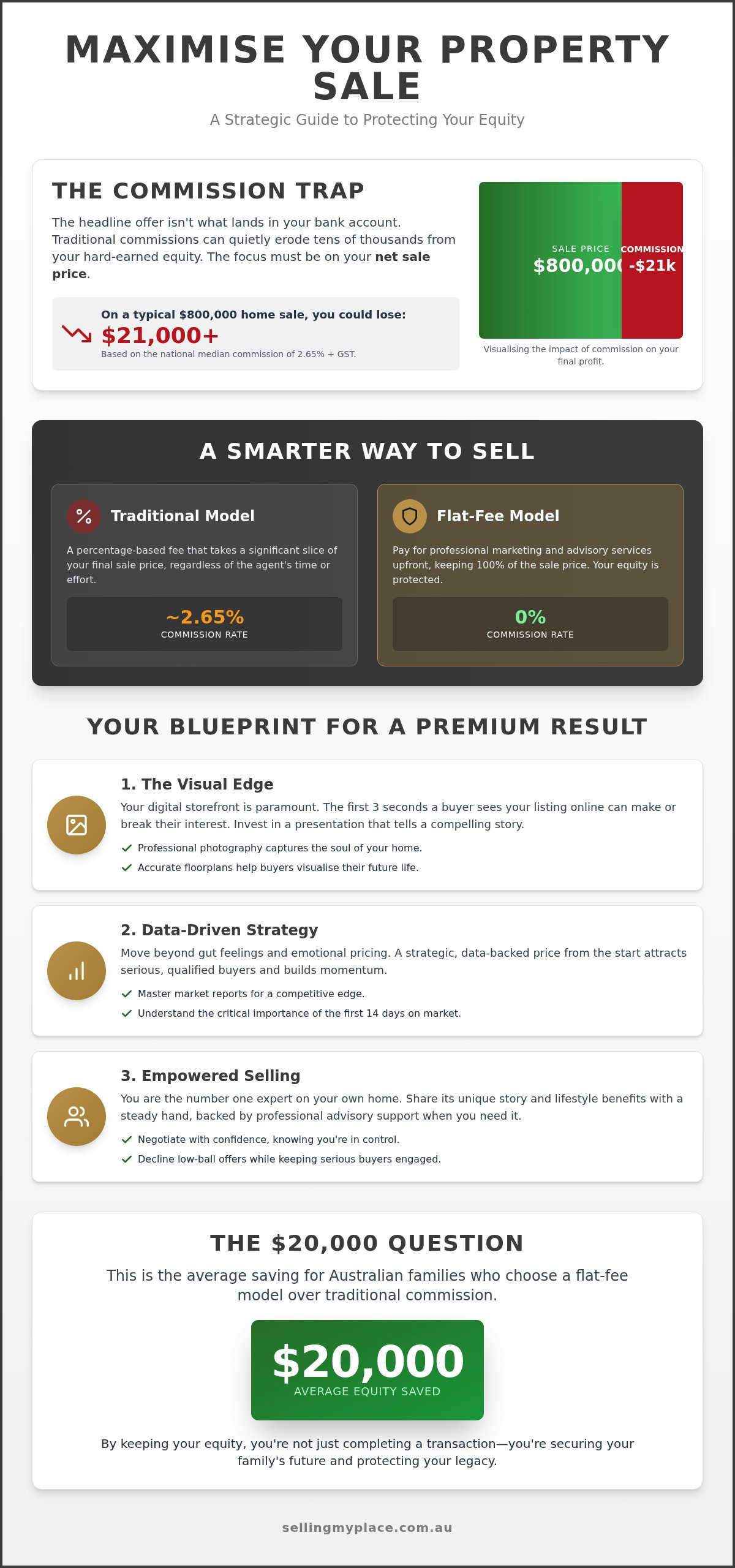
What if the secret to a record-breaking home sale wasn’t about finding the right agent, but about reclaiming the equity you’ve worked decades to build? Knowing how to maximise property sale price in 2026 requires a shift in perspective, moving away from traditional commission models that can quietly erode your hard-earned profit. With the national median real estate commission sitting at approximately 2.65 per cent, many Australian families are understandably anxious about losing a significant portion of their wealth just as they’re preparing for their next big chapter.
We understand that selling your home is about much more than a simple transaction; it’s the culmination of years of memories and a foundation for your future stability. It’s perfectly normal to feel some uncertainty about which renovations truly add value or how to present your home to stand out. This guide offers a clear, strategic framework to elevate your property’s value through professional presentation and smarter marketing. You’ll discover how to maintain a steady hand throughout the process, ensuring a smooth transition while keeping one hundred per cent of your sale profit. We’ll walk through the essentials of high-end photography, the power of accurate floorplans, and the professional advisory steps that lead to a truly exceptional result.
Key Takeaways
- Focus on your net sale price rather than just the offer figure to ensure high commissions don’t eat into your hard-earned equity.
- Discover how to maximise property sale price by prioritising a digital-first presentation that includes professional photography and high-definition floorplans.
- Understand the critical importance of the first 14 days on the market and why data-driven pricing beats relying on a gut feeling.
- Learn to maintain a steady hand during negotiations, giving you the confidence to decline low-ball offers while keeping serious buyers interested.
- Explore how a flat-fee marketing model provides the same global reach and professional tools as traditional agencies while saving you an average of $20,000.
Beyond the Offer: Understanding Net Profit and the Commission Trap
When you see a ‘Sold’ sticker on a signboard, it’s easy to get swept up in the headline figure. However, the number that truly dictates your next move is the net sale price. This is the final amount that lands in your bank account after every cost, fee, and tax has been settled. If you are exploring how to maximise property sale price, you must look beyond the offer and focus on your equity. The Commission Trap is the loss of equity to percentage-based fees that remain high regardless of the actual effort or time an agent spends on your sale.
The Real Math of a Property Sale
A typical sale involves several layers of expense that can quickly stack up. There is the marketing campaign, legal fees for conveyancing, and the agent’s commission. With the national median commission sitting at 2.65 per cent in 2026, a family selling a house for $800,000 could be looking at over $21,000 in commission alone, plus GST. A big part of this process involves understanding property valuation and how it differs from a purely emotional price tag.
This is why many savvy Australians are shifting toward a 0 per cent commission mindset. By choosing a flat-fee model, sellers are saving an average of $20,000 per sale. Visualise that extra $20,000 as part of your next home deposit or a boost to your retirement nest egg. It’s about protecting your legacy rather than funding an agent’s marketing. When you keep your equity, you’re not just making a sale; you’re securing your family’s future.
Shifting from Transactional to Strategic Selling
You’ve lived in the home. You know where the morning light hits the breakfast nook and which local park is best for a weekend stroll. This emotional intelligence is a powerful tool that no external agent can truly replicate. When you represent your own home, you’re not just selling bricks and mortar; you’re sharing a lifestyle. You are the expert on your own home’s story.
By moving away from a transactional approach, you can maintain a professional centre of operations for your sale. Professional advisory services now provide the technical support once exclusive to traditional agents. This setup ensures you have a steady hand to guide you through the complexities of the market while you remain the primary voice for your property. It’s a partnership that values your family’s needs over a quick result, helping you learn how to maximise property sale price through genuine connection and professional presentation.
The Visual Edge: Professional Presentation That Drives Premium Offers
Your digital storefront has officially replaced the traditional kerb appeal as the most critical factor in a successful sale. In 2026, a buyer’s journey doesn’t begin at your front gate; it starts with a thumb-scroll on a smartphone. This “First Click” psychology means you have roughly three seconds to capture a buyer’s imagination. Learning how to maximise property sale price begins with understanding that your online listing is a high-stakes invitation into a future lifestyle. While you focus on the visual appeal, remember that a higher sale price also interacts with your Australian taxation obligations for sellers, making it vital to protect your equity through smart presentation choices.
Why Professional Photography is an Investment, Not a Cost
Professional photography is the engine room of your marketing strategy. High-quality images, particularly those captured during the “golden hour” when Australian light is at its softest, can significantly increase digital engagement. It isn’t just about documenting rooms; it’s about capturing the soul of the home. A professional lens highlights the texture of your stone benchtops and the way light spills across the timber floors, creating an emotional hook that stock-standard photos simply miss. If you’re unsure where to start with your home’s presentation, a quick chat about tailored pre-sale advice can provide the clarity you need.
The Floorplan Factor: Helping Buyers Visualise Their Future
Modern buyers are analytical. They want to know if the third bedroom can double as a quiet home office or if the kitchen flows naturally to the alfresco area. Integrating accurate floorplans into your listing allows potential purchasers to “move in” mentally before they even book an inspection. This transparency builds trust and filters for the most serious enquiries, saving you time and energy. It’s a simple tool that demonstrates the true flexibility of your floor space, which is a key driver in how to maximise property sale price.
Preparing for the Camera: A Premium Checklist
To achieve a high-end look, your home needs to feel like a sanctuary. This involves strategic visual storytelling that highlights hidden value, such as ample storage or premium finishes. Use this room-by-room approach to ensure your property is camera-ready:
- Kitchen: Clear all appliances from benchtops, add a single bowl of fresh citrus or a bunch of herbs for a pop of colour.
- Living Areas: Plump all cushions, remove personal photographs, and ensure rugs are perfectly aligned.
- Bedrooms: Use crisp, neutral linen and ensure all bedside lamps are working to create a warm, inviting glow.
- Outdoor Spaces: Pressure-wash the paths, trim the lawn edges, and set the outdoor table to suggest a relaxed weekend lunch.
By treating your home as a professional set, you’re not just selling a house; you’re offering a dream that buyers are willing to pay a premium to secure.
Data-Driven Pricing: Mastering Market Reports for a Record Result
While professional photography and floorplans draw the eye, it’s the data that ultimately seals the deal. Many owners rely on a gut feel based on what they believe their home is worth, but this can be a costly mistake in a fluctuating market. To truly learn how to maximise property sale price, you need to lean on cold, hard facts rather than emotional attachment. Neighbourhood Market Reports provide a clear window into what buyers are actually paying right now, allowing you to find that sweet spot where value meets demand.
Analysing comparable sales correctly is an art form. It’s not just about the number of bedrooms; you must consider the land size, the home’s orientation to the sun, and the quality of internal finishings. Does your kitchen have stone benchtops or laminate? Is the backyard north-facing? These details matter. Start your journey by securing a free property value estimate to establish a realistic baseline for your strategy. This ensures you enter the market with a steady hand and a clear head.
Understanding the 2026 Market Dynamics
In 2026, interest rates and local supply levels play a significant role in buyer sentiment. If there are several similar homes on the market in your area, your pricing must be sharper to stand out. We often suggest an Anchor Pricing strategy. This involves setting a price that feels accessible enough to invite competition, which frequently drives the final result higher than a static, premium-only price tag. Identifying your target buyer profile, such as young families or downsizers, allows you to price the home in a way that resonates with their specific budget and lifestyle aspirations.
Leveraging Professional Advisory Services
It’s understandably difficult to be objective about a home where you’ve built a life. This is where a professional Agent Advisor becomes your greatest asset. They provide the necessary distance to make rational decisions, acting as a nurturing guide through the complexities of the sale. Pre-sale consulting can pinpoint exactly which repairs will offer the highest return on investment, ensuring you don’t spend money on renovations that buyers won’t value. By listening to real-time feedback from initial enquiries, you can adjust your position quickly. This is vital because the first 14 days on the market are when buyer interest is at its absolute peak; if you overprice during this window, you risk your listing becoming stale, which is the opposite of how to maximise property sale price.
The Art of the Deal: Negotiation Tactics for Independent Sellers
Negotiation often feels like the most daunting part of the process, but it’s actually where your deep connection to the home becomes your greatest strength. To understand how to maximise property sale price, you must learn to separate your emotional memories from the financial transaction. By staying the “steady hand” during offers, you project a sense of calm confidence that reassures buyers and protects your position. It’s about being firm on value while remaining warm and accessible in your communication.
One of the most powerful tools in your kit is the word “No.” It might feel counterintuitive, but declining a low-ball offer doesn’t have to mean losing the buyer. Instead, it’s an opportunity to re-anchor the conversation to the data-driven value you’ve already established. If you need more granular strategies for these high-stakes moments, our property sale negotiation tips offer deep-dive tactics to help you navigate every counter-offer with ease.
Handling Enquiries and Filtering Buyers
Not every enquiry leads to a contract, and that’s perfectly fine. Your goal is to identify the most serious contenders early on so you can focus your energy where it matters most. Start by asking gentle, qualifying questions: “Has your finance been pre-approved?” or “What is your ideal settlement timeframe?” These conversations help you filter out the “tyre-kickers” while building genuine rapport. It’s about being the helpful, local expert without oversharing. If a buyer seems hesitant, a proactive follow-up call a few days after an inspection can often turn a “maybe” into a formal offer.
Closing the Sale: From Offer to Settlement
Once an offer is on the table, creating a gentle sense of urgency can help bring things to a head. Using “best and final” deadlines when you have multiple interested parties ensures everyone puts their best foot forward. After the price is agreed, the focus shifts to the technicalities. Professional conveyance advice is essential here to ensure your contract is legally sound and protects your hard-earned equity. Managing building and pest inspection results with confidence is also key; don’t let a minor maintenance issue derail your result. If you’re feeling overwhelmed by the back-and-forth, reach out for professional advisory support to ensure every detail of your sale is handled with care. This methodical approach ensures a smooth transition to settlement, allowing you to move forward with total peace of mind.
Empowered Selling: How Kincade International Direct Sales Maximises Your Equity
For many Australian families, the choice often feels like a compromise between a “cheap” private sale and an expensive agency experience. We believe you shouldn’t have to choose. The KIDS philosophy is built on the idea that every homeowner deserves access to professional tools and a global reach without the burden of a percentage-based commission. By providing a flat-fee marketing infrastructure, we empower you to take control of your future. Learning how to maximise property sale price is ultimately about combining your local heart with our global digital network, ensuring your home is seen by the right buyers at the right time.
One of the most significant advantages of this approach is the “Listed Until Sold” benefit. Traditional agents often push for a quick result to meet their own monthly targets, which can lead to unnecessary pressure to drop your price. With our model, there are no arbitrary time limits or mounting costs. You have the freedom to wait for the offer that truly reflects your home’s value, allowing you to maintain a steady hand throughout the entire process. Your property is positioned on a global stage through an integrated digital network that mirrors the marketing power of any premium agency, but with the equity staying exactly where it belongs: in your bank account.
A Partnership, Not a Commission
We see our role as a dedicated partner in your transition. Our Agent Advisory Service is designed to support you through every complex decision, from interpreting market data to navigating the final stages of a contract. We provide professional photography and high-definition floorplans that make your listing indistinguishable from an agent-led sale, ensuring you capture that critical “First Click” we discussed earlier. When you consider the average saving of $20,000 per sale, it becomes clear why sale by owner is becoming the smartest financial move for modern Australians who value their legacy and financial independence.
Taking the Next Step Toward Your Sale
Getting started is a straightforward process that begins with choosing a marketing package tailored to your needs. You’ll receive the same high-end presentation tools and professional advisory support used by the country’s top-performing listings. There is a profound sense of peace of mind that comes from knowing you are protected by a commission-free structure. You’ve done the hard work of maintaining and loving your home; now it’s time to ensure you reap the full rewards of that effort. If you’re ready to learn more about how to maximise property sale price while protecting your hard-earned equity, we’re here to guide you every step of the way. Enquire today to see how much commission you could save.
Securing Your Legacy and Your Next Big Chapter
Selling your home is a significant life transition, and it’s one you shouldn’t have to navigate with the weight of high commissions pulling at your profit. By focusing on professional-grade presentation and data-driven pricing, you’ve already taken the most important steps in learning how to maximise property sale price. The true measure of success isn’t just the figure on the contract; it’s the net equity that remains in your pocket once the dust has settled. Protecting that hard-earned wealth allows you to step into your next adventure with total financial confidence.
You don’t have to do this alone. With the support of our expert Agent Advisory Service, professional photography, and detailed floorplans, you can achieve a record-breaking result while saving an average of $20,000 in commissions. This partnership-based approach ensures you remain the steady hand in your sale while enjoying the global reach of a premium marketing infrastructure. It’s time to claim the full value of your home and your hard work. Maximise your sale profit with our commission-free listing packages and start your journey today. Your future self will certainly thank you for the extra equity.
Frequently Asked Questions
How much can I actually save by not using a traditional real estate agent?
You can save an average of $20,000 by choosing a flat-fee model over a traditional commission-based agent. Since the national median commission in Australia for 2026 is approximately 2.65 per cent, the costs of selling a standard family home can quickly escalate into the tens of thousands. By eliminating the percentage-based fee, you keep one hundred per cent of your sale profit. This extra equity provides a significant boost for your next deposit or retirement plans.
Will buyers be put off if I am selling the property myself?
Buyers are rarely put off by a direct sale if the listing is presented professionally. In fact, many purchasers appreciate the opportunity to speak directly with the person who knows the home’s history and lifestyle benefits best. When you utilise professional photography and floorplans, your listing is indistinguishable from one led by a traditional agency. This professional edge builds immediate trust and ensures that the focus remains entirely on the value of your property.
How do I know what my house is worth without an agent’s appraisal?
You can determine your home’s value by utilising comprehensive Neighbourhood Market Reports and data-driven property estimates. These reports look at actual recent sales of comparable properties in your area, considering land size, orientation, and internal finishes. Our Agent Advisory Service provides the objectivity needed to interpret this data without the emotional bias owners often feel. This methodical approach is a key part of how to maximise property sale price by finding the market’s sweet spot.
What is the most cost-effective renovation to increase my sale price?
The most cost-effective improvements often involve enhancing “First Click” appeal rather than major structural changes. Pre-sale property consulting can help you identify high-return tasks like professional painting, garden tidying, or updating lighting fixtures. These small but strategic updates ensure your home looks its best for the camera. By focusing on visual storytelling and presentation, you create an emotional hook that drives premium offers without the stress of a full-scale renovation project.
Can I still get my property on Australia’s major real estate websites without an agent?
Yes, your property will be featured on Australia’s leading property search websites through our integrated digital network. While individuals cannot typically list directly on these major national portals, our flat-fee infrastructure provides the necessary professional gateway. This ensures your home reaches a broad audience of active buyers, giving you the same marketing power as a high-end agency. You get the visibility you need to drive competition while maintaining total control over your equity and the sale process.
How does the Kincade Agent Advisory Service help with negotiations?
Our Agent Advisory Service acts as a steady hand, providing the technical expertise and distance required during high-stakes discussions. We help you qualify buyers by asking the right questions about their finance and settlement needs, which filters out less serious enquiries. When an offer arrives, we provide the strategic guidance to help you navigate counter-offers. This support ensures you feel empowered to hold firm on your price and achieve a record-breaking result.
What happens if my property doesn’t sell within the first month?
If your property doesn’t sell immediately, you are protected by our “Listed Until Sold” philosophy. Unlike traditional agencies that may pressure you to drop your price to meet their internal targets, we have no arbitrary time limits. This removes the stress of a ticking clock, allowing you to wait for the buyer who truly values your home. You can adjust your strategy based on real-time feedback while knowing your marketing presence remains active and professional.
Is professional photography really necessary for a private sale?
Professional photography is absolutely non-negotiable if you want to understand how to maximise property sale price. In a digital-first market, your photos are your first and most important point of contact with potential buyers. High-quality images captured in the right light highlight the lifestyle and “soul” of the home, which amateur smartphone snaps simply cannot replicate. This investment ensures your property stands out in a crowded market and attracts the serious, premium offers you deserve.
Flat Fee Property Listing Australia: The 2026 Guide to Protecting Your Equity
The equity you’ve built in your home over the years is more than just a number; it’s your hard-earned security and your family’s legacy. Yet, as we move through 2026, many Australian homeowners still feel held to ransom by commission rates that swallow tens of thousands of dollars. It’s frustrating to watch a significant slice of your profit vanish simply because property values have risen. You aren’t alone if you’re questioning why a flat fee property listing australia model isn’t already the standard. You’ve done the hard work of maintaining the garden and paying the mortgage, so it feels only right that you keep the rewards of that effort.
We understand the anxiety that comes with changing the status quo, especially when you’re worried about whether a different approach might impact your final sale price. This guide is here to show you that you don’t have to choose between professional excellence and fair pricing. We’ll explore how to secure a high-calibre listing, complete with professional photography and floorplans, while leaning on expert advisory services for those tricky negotiations. You’ll learn exactly how to bypass hidden marketing blowouts and maintain 100% of your sale profit. We’re going to break down the 2026 landscape so you can move forward with a steady hand and total confidence.
Key Takeaways
- Discover how to decouple service costs from your home’s final price, ensuring you protect your hard-earned equity and avoid traditional commission traps.
- Learn the importance of professional-grade assets, like high-end photography and floorplans, in capturing the attention of the modern digital buyer.
- Understand how expert real estate advisory services provide a steady hand during complex negotiations, ensuring you never have to navigate the sale alone.
- Identify data-driven pricing strategies and simple pre-sale improvements that help you secure a premium result while keeping your profit.
- Explore why a flat fee property listing australia combined with global marketing reach is the smartest way to manage your next major life transition.
Rethinking Real Estate: What is a Flat Fee Property Listing in Australia?
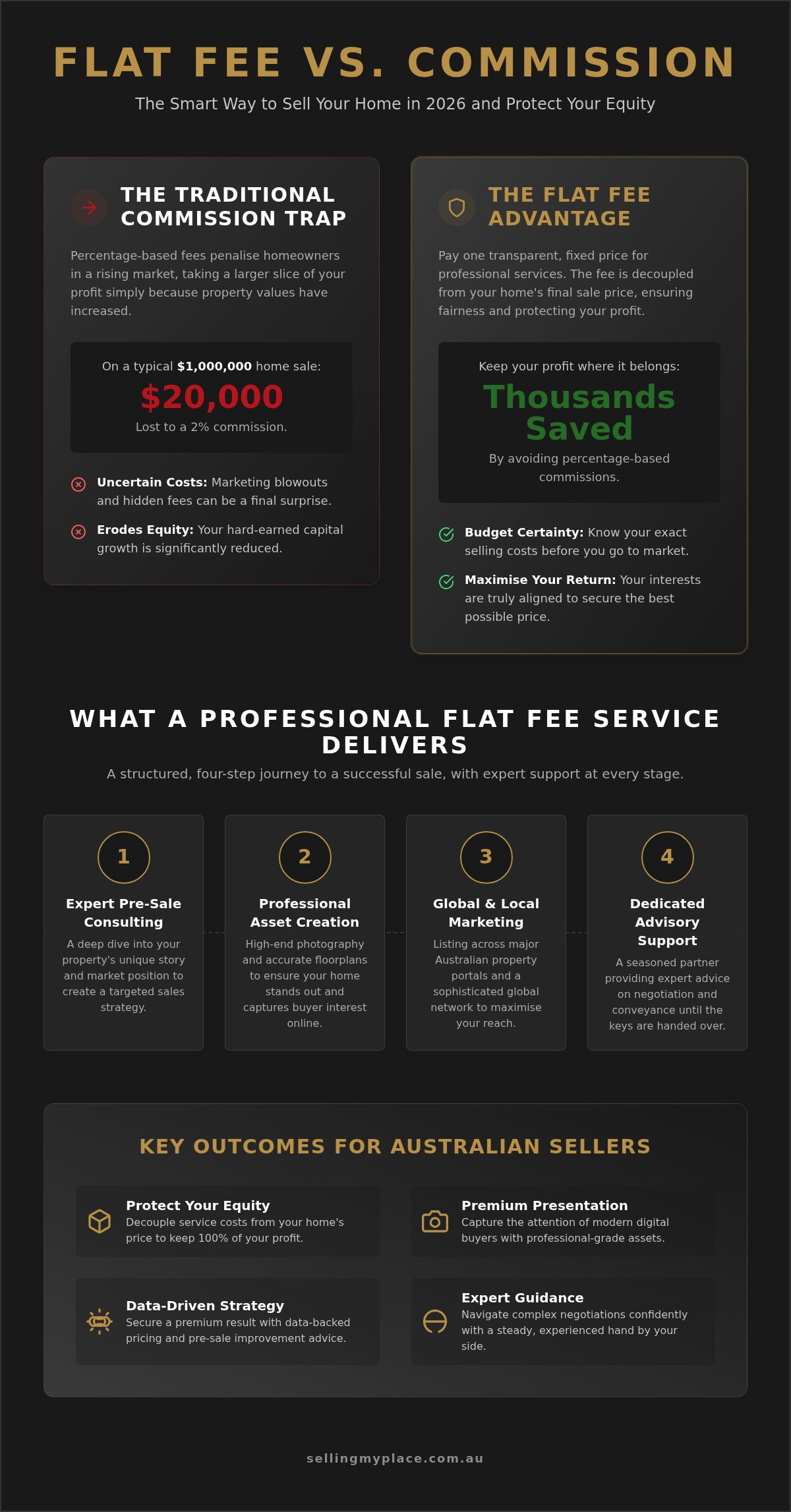
A flat fee property listing is a transparent service where you pay a single fixed price for marketing and professional support. Unlike traditional models, the fee is decoupled from your home’s final sale price, protecting your hard-earned equity from being eroded by rising commissions. This model functions as a performance-oriented partnership between the seller and the marketing provider. By choosing a flat fee property listing australia, you remove the “commission tax” that often penalises homeowners in high-growth markets. It is a straightforward way to keep your profit where it belongs; in your bank account.
As we explore Rethinking Real Estate: What is a Flat Fee Property Listing in Australia?, it becomes clear that this model is about transparency and fairness. It’s a shift away from the “black box” of traditional real estate, where marketing costs and agent bonuses can feel opaque and overwhelming.
The Evolution of the Australian Property Market
Property values in 2026 have continued to show resilience, with the national median dwelling value reaching $922,838 in early February. For many Australian families, this growth represents a significant life milestone, yet it comes with a hidden sting. When commissions are percentage-based, every dollar your home gains in value results in a larger bill from your agent. This has sparked a significant shift toward “sell my home no commission” searches as owners seek more control over their financial outcomes. We are seeing a rapid local adoption of fixed-fee models that have already dominated the UK and USA landscapes for years, providing a more stable and predictable path for sellers.
Commission vs. Flat Fee: A Financial Comparison
There is a common “Incentive Myth” that suggests a percentage-based commission makes an agent work harder. In reality, the difference between a good sale and a great sale might only mean a few hundred extra dollars for the agent’s pocket, but it represents thousands of dollars for your family’s future. Consider the following points:
- The Real Cost: On a $1M home, a 2% commission takes $20,000 from your equity. A flat fee model allows you to access professional residential property listing services for a fraction of that cost.
- Budget Certainty: Knowing your exact selling costs before you even go to market offers a sense of calm confidence.
- Marketing Quality: You receive professional-grade assets without the fear of hidden marketing blowouts that often surprise sellers at the end of a campaign.
Decoupling the service fee from the sale price ensures that your interests are truly aligned. It allows you to plan your next move with a steady hand, knowing that your hard-earned equity is protected. This isn’t just about saving money; it’s about valuing the legacy you’ve built in your home.
The Mechanics of a Professional Flat Fee Listing Service
Understanding the inner workings of a flat fee property listing australia service helps demystify the process and build confidence. It is a structured, four-step journey designed to put you in the driver’s seat while providing a sturdy framework of professional support. We begin with expert pre-sale consulting. This isn’t just a chat about price; it’s a deep dive into your property’s unique story and its position in the current market. Identifying those special features that make a house a home allows for a targeted strategy that resonates with the right buyers.
Once the strategy is set, we move to professional asset creation. This includes high-end photography and accurate floorplans, ensuring your property stands out for all the right reasons. Your home is then listed across major Australian portals and a sophisticated global marketing network. Finally, we assist with managing enquiries. Having access to real estate advisory services for negotiation and conveyance advice ensures you have a seasoned partner by your side until the keys are handed over. This comprehensive approach ensures no detail is missed.
Why Visual Marketing is Non-Negotiable
In a digital-first world, your online presentation is your only first impression. High-quality professional photography is essential for stopping the scroll on busy portals. It’s about more than just a pretty picture; it’s about inviting a buyer to imagine their life within your walls. Accurate floorplans are equally vital. They provide the spatial context that serious, qualified buyers need, effectively reducing the number of “tyre-kickers” who might otherwise waste your time. This level of professional presentation is a key component of Maximising Your Profit: A Roadmap for Australian Sellers, as it signals value and quality to the market.
Global Reach for Local Australian Properties
The days of relying on a local high-street office window to sell your home are long gone. By 2026, the primary driver of property sales is digital infrastructure. This allows local Australian properties to reach interstate investors and international buyers with ease. One of the most reassuring aspects of this model is the “listed until sold” advantage. Traditional time limits on listings can create unnecessary pressure and anxiety for families. By removing these relics of the past, you can wait for the right offer that truly reflects your home’s worth. If you’re ready to see how this modern approach can work for you, reach out to our team for a chat about your goals.
Expert Backing: The Role of Real Estate Advisory Services
Selling your family home is one of the most significant transitions you’ll ever make. It’s a time filled with memories and, naturally, a bit of trepidation. A common misconception is that choosing a flat fee property listing australia means you’re going it alone, but that couldn’t be further from the truth. Instead, you’re simply choosing a different kind of expert. By utilising real estate advisory services, you gain access to a seasoned partner who provides the professional oversight you need without the hefty commission price tag. It’s about having a steady hand to guide you through the complexities of the market.
This partnership often begins long before the first “for sale” sign goes up. Pre-sale consulting is a vital step that helps you avoid the trap of over-capitalising on renovations. We’ve all seen it; a homeowner spends $40,000 on a designer kitchen only to find it adds half that to the sale price. An advisor helps you identify the high-impact, low-cost “quick wins” that actually move the needle. This grounded, practical approach ensures your equity stays in your pocket rather than being sunk into unnecessary upgrades that don’t offer a return on investment.
Negotiation Strategies for the Empowered Seller
Dealing with potential buyers can feel like a bit of a rollercoaster, especially when emotions are running high. It’s easy to take a low offer personally or feel pressured to make a snap decision during a tense phone call. An advisory service acts as your buffer, helping you maintain an objective stance. With a large majority of property professionals expecting dwelling values to rise throughout 2026, you need to be firm on your home’s worth. We help you use data-driven Neighborhood Market Reports to justify your asking price with cold, hard facts. This empowers you to negotiate with calm confidence rather than relying on a “gut feeling” or an agent’s agenda.
Navigating the Legal Landscape
The legal transition of a property is where many sellers feel the most stress. Managing contracts and required disclosures requires an eye for detail and a thorough understanding of current regulations. This is where conveyance advice becomes indispensable. It’s about ensuring the paperwork is as solid as the foundations of your home. By having a clear roadmap for the settlement process, you can focus on your next chapter while we help ensure the legal journey is seamless. Think of it as professional decorum paired with a genuine sense of duty to your family’s financial future.
Maximising Your Profit: A Roadmap for Australian Sellers
Achieving a premium result is about more than just putting a sign in the front yard. It’s a methodical process that combines careful presentation with precise, objective data. When you opt for a flat fee property listing australia, you’re choosing a model that rewards your attention to detail and your intimate knowledge of your home. By focusing on high-impact minor repairs and curb appeal, you ensure the first impression is one of care and stability. This isn’t just about aesthetics; it’s about signalling to the market that your home has been a well-loved sanctuary for your family.
Utilising a flat fee property listing australia framework allows you to be the primary advocate for your property. You know which window catches the morning sun and which local park is best for a weekend stroll. Engaging with buyers directly allows you to convey these lifestyle benefits with a warmth and authenticity that no third party can replicate. To ensure your equity is fully protected, it’s wise to keep your marketing active until the final settlement. This provides a vital backup plan should circumstances change, giving you total peace of mind throughout the transition.
Preparing Your Home for the Professional Lens
Decluttering is your first essential step. It allows the space to breathe and lets buyers project their own lives onto the canvas you’ve created. When it comes to photography, the “Golden Hour” is particularly important in the Australian climate. This brief window of soft, warm light just before sunset can make your outdoor entertaining areas feel like a private oasis. Industry observations suggest that a well-prepared home can increase click-through rates by up to 40% compared to properties that appear cluttered or poorly lit. Small touches, like fresh mulch in the garden or a clean driveway, go a long way in stopping the scroll on a smartphone screen.
Setting the Right Price with Data
Setting the right price is perhaps the most critical decision you’ll make in your selling journey. It’s vital to determine the market value of a home in Australia using recent comparable sales rather than an agent’s “gut feeling”. Avoiding the overpricing trap is essential; a price that is too high can lead to a stale listing, which often results in a lower final sale price as buyers become wary. Transparency in your initial listing price builds immediate trust with the community and attracts genuine, qualified buyers who are ready to act. If you’re ready to take the next step in your property journey, get in touch with us today to discuss your personalised roadmap.
Why Kincade International Direct Sales is the Smarter Choice
Choosing the right partner for your property journey is about finding a balance between cutting-edge digital reach and a genuine, human connection. Kincade International Direct Sales (KIDS) provides exactly that. We don’t just list your home; we integrate it into a sophisticated global marketing network that ensures your property is seen by the right eyes, whether they’re across the street or on the other side of the world. By opting for a flat fee property listing australia through our model, you’re embracing a partnership approach that treats your sale as a significant life transition, not just another line in a ledger. We’re here to ensure your story is told with the respect and professional polish it deserves.
Security is at the heart of everything we do. This is why we offer a “listed until sold” guarantee, providing you with a sense of stability and peace of mind, regardless of how the market fluctuates in 2026. You won’t find arbitrary time limits here. Instead, you’ll find a comprehensive suite of professional assets included as standard in our packages. From high-end photography and accurate floorplans to the expert advisory services we’ve discussed, every element is designed to showcase your home’s true value while keeping your equity where it belongs. It’s a thorough, attentive service that leaves nothing to chance.
A Legacy of Expert Support
Experience matters when the stakes are this high. We leverage over 25 years of industry knowledge to guide you through every twist and turn of the selling process. This isn’t just about technical expertise; it’s about the emotional intelligence required to understand the weight of selling a family home. We know that behind every contract is a family looking toward their next chapter. We act as your “steady hand,” providing a reassuring presence that reduces the stress of complex negotiations and legal requirements. You can move forward with calm confidence, knowing you have a seasoned advisor in your corner who values long-term relationships over quick results.
Take Control of Your Property Future
The financial impact of choosing a flat fee property listing australia is profound. When you save an average of $20,000 in unnecessary commissions, that money stays with you to fund your next purchase, renovate your new space, or simply bolster your family’s financial security. You’re joining a growing movement of empowered Australian sellers who are choosing transparency and fairness over outdated traditions. It’s time to take control of your property future. Starting your journey with a professional listing is a simple, straightforward process that prioritises your needs and your legacy. We’re ready to help you make your next move your best move yet.
Your Path to a Smarter, More Profitable Sale
Your home is likely your most significant asset. As we navigate the 2026 property market, protecting the equity you’ve built should be your top priority. We’ve explored how a flat fee property listing australia allows you to maintain control while accessing the same high-calibre marketing tools used by the country’s top agencies. By choosing a partnership based on transparency rather than a percentage, you ensure your profit stays exactly where it belongs; with your family.
Securing a professional result doesn’t have to mean sacrificing your hard-earned gains to unnecessary commissions. With Kincade, you’ll save an average of $20,000 in fees while benefiting from professional photography, accurate floorplans, and our dedicated Agent Advisory Service. This isn’t just about a transaction; it’s about a steady hand guiding you through a major life transition with heart and expertise. You’ve done the hard work of building your home’s value, so let’s make sure you keep it.
Keep 100% of your profit and list with Kincade today to start your journey with a partner who values your legacy as much as you do.
Frequently Asked Questions
Is a flat fee property listing legal in all Australian states?
Yes, the flat fee model is completely legal across all Australian states and territories. Real estate commissions are not regulated by the government, meaning you have the freedom to negotiate how you pay for marketing and support. Choosing a flat fee property listing australia ensures you are operating within a transparent framework that prioritises your equity. It’s a modern approach that complies with national property laws while giving you more control over your financial outcome.
Do I still get my property listed on the major real estate websites?
Absolutely, your home will be featured on the major Australian property portals where the vast majority of buyers begin their search. We provide the digital infrastructure needed to ensure your listing looks professional and reaches a wide audience. Beyond local sites, our global marketing network helps your property gain visibility with interstate and international investors. You get the same premium digital exposure as a traditional agency listing without the high commission costs attached.
What happens if my property doesn’t sell within a few months?
We offer a “listed until sold” guarantee, which means there are no arbitrary time limits on your marketing campaign. If your property takes a little longer to find the right buyer, your listing stays active without additional listing fees. This removes the pressure to drop your price prematurely and provides a sense of stability. We’re committed to a long-term partnership, ensuring your home remains visible until the keys are successfully handed over to the new owners.
Who handles the actual property inspections and open houses?
As the person who knows your home best, you’ll handle the property inspections and open houses. This allows you to share the authentic story of your neighbourhood and the unique features of your property directly with buyers. While you host the visits, our Real Estate Advisory Services are always available to provide guidance on how to present your home effectively. Most owners find that buyers appreciate the direct, honest communication that comes from dealing with the homeowner.
Can I still use a solicitor or conveyancer for the legal paperwork?
Yes, you should always engage a qualified solicitor or conveyancer to manage the legal aspects of your sale. While we provide expert conveyance advice to help you understand the process, the actual preparation of the contract and the settlement must be handled by a legal professional. This ensures that your interests are fully protected throughout the legal journey. We work alongside your chosen representative to make sure the transition of your property is as seamless as possible.
How does the Agent Advisory Service actually help me during the sale?
Our Agent Advisory Service acts as your “steady hand” throughout the entire process, offering professional backing without the commission. We provide pre-sale consulting to help you identify high-impact improvements and use Neighborhood Market Reports to help you set a data-driven price. When it comes to negotiations, we’re there to offer strategic advice, helping you navigate complex conversations with buyers. It’s about giving you the confidence of a seasoned expert while you maintain control of the sale.
Will buyers be put off if they see I am selling without a traditional agent?
In 2026, savvy Australian buyers are becoming increasingly comfortable with direct sales models. They often prefer the transparency and direct communication that comes from dealing with the owner. As long as your property is presented professionally with high-quality assets, buyers will focus on the value of the home itself. Our professional photography and floorplans ensure your listing looks identical to a traditional agency ad, maintaining the decorum and authority expected in a high-stakes transaction.
What is included in the professional photography and floorplan package?
Our comprehensive package includes high-end photography designed to capture your home’s best features and stop the scroll on major portals. You’ll also receive accurate floorplans, which are essential for helping buyers understand the spatial layout of your property before they visit. These assets are produced to a professional standard, ensuring your home looks its absolute best. Providing this level of detail helps attract serious, qualified buyers and signals that you are committed to a high-quality, professional sale process.
Buyer Representation in Australia: The 2026 Guide to Smarter Property Purchasing
In the high-stakes theatre of Australian real estate, the selling agent isn’t your friend; they’re a legally bound advocate for the person on the other side of the contract. It’s a tough reality to face when you’re searching for a family home or a stable investment. Most of us wouldn’t walk into a courtroom without a lawyer, yet many Australians still front up to aggressive auctions alone. Professional buyer representation has evolved from a luxury service into a strategic shield for your family’s financial legacy. It’s about more than just finding a house; it’s about ensuring you don’t overpay in a market where the national median home price now sits at A$894,000.
We understand the frustration of missing out on “silent listings” or feeling that pang of FOMO as prices shift. You want a fair go and a professional who prioritises your interests above a quick sale. In this 2026 guide, we’ll show you how to gain an edge with expert advocacy and handle the stress of complex negotiations. We’ll also break down the latest regulatory shifts, including the new AML/CTF identity checks and the tightening of underquoting laws, so you can secure your piece of Australia with absolute peace of mind.
Key Takeaways
- Understand the fundamental shift from being a solo purchaser to having a dedicated advocate who prioritises your family’s interests over the vendor’s bottom line.
- Gain the inside track on “silent listings” and off-market opportunities that provide a significant advantage in Australia’s competitive 2026 property landscape.
- Learn how professional buyer representation protects your equity by closing the “overpayment gap” through disciplined, expert negotiation.
- Identify the essential benchmarks for a trustworthy partner, from ensuring total independence to verifying their genuine, street-level local market expertise.
- Discover how a comprehensive advisory approach creates a seamless transition when you are balancing the sale of one home with the purchase of your next.
Understanding Buyer Representation: Why Every Australian Purchaser Needs an Advocate
Most people walk into a property transaction thinking they’re on equal footing with the agent at the door. They aren’t. The selling agent has a single mission: to extract the highest possible price for the vendor. Professional buyer representation flips this script. It ensures that you, the purchaser, have a licensed expert whose sole legal and ethical duty is to protect your interests and your bank balance. This isn’t just about finding a house; it’s about redressing a structural imbalance that has favoured sellers for decades.
While many people ask what is a buying agent, the core of the role is fiduciary duty. This means your representative must put your needs above all else, including their own. This level of advocacy used to be reserved for the “top end of town” or high-flying investors. Today, with the national median house price reaching A$989,000, professional representation has become a vital tool for families and first-home buyers who simply cannot afford a costly mistake. You wouldn’t go to court without a lawyer, so why walk into a million-dollar negotiation without an expert in your corner?
Selling agents are masters of psychology. They use “social proof” through crowded open homes and “scarcity” via looming auction dates to create a sense of urgency. Without a professional buffer, it’s incredibly easy to succumb to emotional overspending at the final hurdle. A representative acts as your “steady hand,” filtering out the noise and focusing on the cold, hard data of a property’s true value. They see the cracks in the cornices when you only see the beautiful garden. This grounded perspective is what saves your equity before you even sign the contract.
The Power Imbalance in Modern Real Estate
Selling agents are highly trained in negotiation tactics designed to push your financial limits. They aren’t being “mean”; they’re doing their job for the vendor. By hiring your own advocate, you remove the emotional target from your back. Your representative handles the aggressive follow-up calls and the high-pressure auction environment, allowing you to make decisions based on logic rather than the fear of missing out. It’s about protecting your emotional well-being as much as your wallet.
Buyer’s Agent vs. Buyer Representative: What’s in a Name?
Whether they’re called a buyer’s agent in New South Wales or a buyer representative in other states, the most important factor is independence. A true advocate never accepts “referral fees” or kickbacks from developers or selling agencies. They work only for you. This transparency is what builds a lasting partnership, ensuring the advice you receive is grounded in your long-term family goals. Having buyer representation means you have a partner who knows the streets, the local council quirks, and the real market value, not just the glossy brochure price.
The Strategic Advantage: How Professional Representation Unlocks Off-Market Opportunities
Accessing the “hidden market” is perhaps the most celebrated perk of engaging professional buyer representation. While the average purchaser is glued to real estate portals, a seasoned advocate is working their network of local selling agents to find properties before they’re even photographed. These industry relationships turn your representative into a hub of real-time information. It isn’t just about what’s for sale today; it’s about what’s coming onto the market next month. This “First Look” advantage allows you to secure a deal in a quiet lounge room rather than a crowded auction yard.
The Real Estate Buyers Agents Association of Australia notes that these off-market transactions are increasingly common in tightly held suburbs where privacy is paramount. By the time a property hits a major portal, it has already been “shopped” to the top-tier advocates. If you’re only looking at what’s public, you’re essentially looking at the leftovers. In a cooling market where national property listings increased by 12.4% in July 2026, the sheer volume of choices can be overwhelming. Having an expert to curate this “hidden” stock ensures you only see the gems that match your legacy goals.
The Anatomy of a Silent Listing
Vendors often choose a silent sale to avoid the stress of public open homes or to save on significant marketing costs. For you, this means less competition and a more rational negotiation process. Your representative acts as a filter, only bringing you listings that actually meet your brief, which saves you from wasting your Saturdays on properties that don’t fit. Pre-market listings, where a vendor is testing the waters before a full campaign, provide a unique window to strike a deal while the seller is still flexible and motivated to avoid a long campaign.
Data Over Hype: The Due Diligence Phase
Access is only half the battle. Once a property is identified, the focus shifts to rigorous due diligence. It’s easy to be swayed by professional styling and soft lighting, but your advocate looks at the bones of the deal. They use data-driven Neighborhood Market Reports to validate off-market pricing and ensure you aren’t paying a “convenience premium” just because a property isn’t public. In a market where the national median home price is A$894,000, guessing the value of an off-market gem is a risk you don’t need to take.
A critical part of this process involves analysing comparable sales to determine fair value. For example, a comparable sale would be a four-bedroom home on a 550-square-metre block that sold in your target suburb within the last ninety days. This objective approach removes the selling agent’s bias from the equation. If you’d like to see how this level of insight could change your search, reach out for a quiet chat about your lifestyle aspirations.
Evaluating the Investment: Does Hiring a Buyer’s Representative Actually Save You Money?
It’s a common question for many Australian families: if I’m already spending hundreds of thousands on a home, why add another fee to the pile? It’s a fair concern. However, viewing buyer representation as a transactional cost misses the bigger picture of equity protection. In a market where the national median house price has reached A$989,000, even a 2% or 3% error in valuation can cost you tens of thousands of dollars. Professional advocacy isn’t just about finding a house; it’s about ensuring the price you pay aligns with the actual market value, not an emotionally charged asking price.
Most advocates operate on either a fixed fee or a percentage-based model. While the upfront cost is visible, the “Overpayment Gap” is often hidden. Selling agents are experts at anchoring your expectations high. A representative closes this gap by using objective data to challenge the agent’s narrative. Beyond the purchase price, they protect you from the “lemon” property. By coordinating rigorous building, pest, and strata inspections, they save you from structural or legal nightmares that could surface years down the track. When you factor in the hundreds of hours saved on searching and inspections, the investment often pays for itself before you even move in.
Negotiation as an Art Form
There’s a massive difference between “haggling” and strategic real estate negotiation. One is a battle of wills; the other is a calculated chess match. Auction representation is where a “steady hand” truly shines. When the adrenaline is pumping and the auctioneer is calling for “just one more thousand,” it’s easy to lose sight of your limit. Having a professional hold the paddle removes the emotional target from your back. They handle the “Best and Final Offer” pressure with poise, ensuring you don’t blink first or overextend your family’s financial future.
The Long-Term ROI of an Expert Purchase
Buying in the right pocket of a neighbourhood can significantly impact your future capital growth. An expert knows which streets are rising and which have reached their peak. Securing your equity is about more than just the day of the sale; it’s about Mastering the Deal to ensure your purchase aligns with long-term stability. This “no-regrets” purchase provides a sense of calm confidence. You aren’t just buying a house; you’re securing a legacy for your family in a community where you can actually see yourselves growing old. That peace of mind is perhaps the greatest return on investment of all.
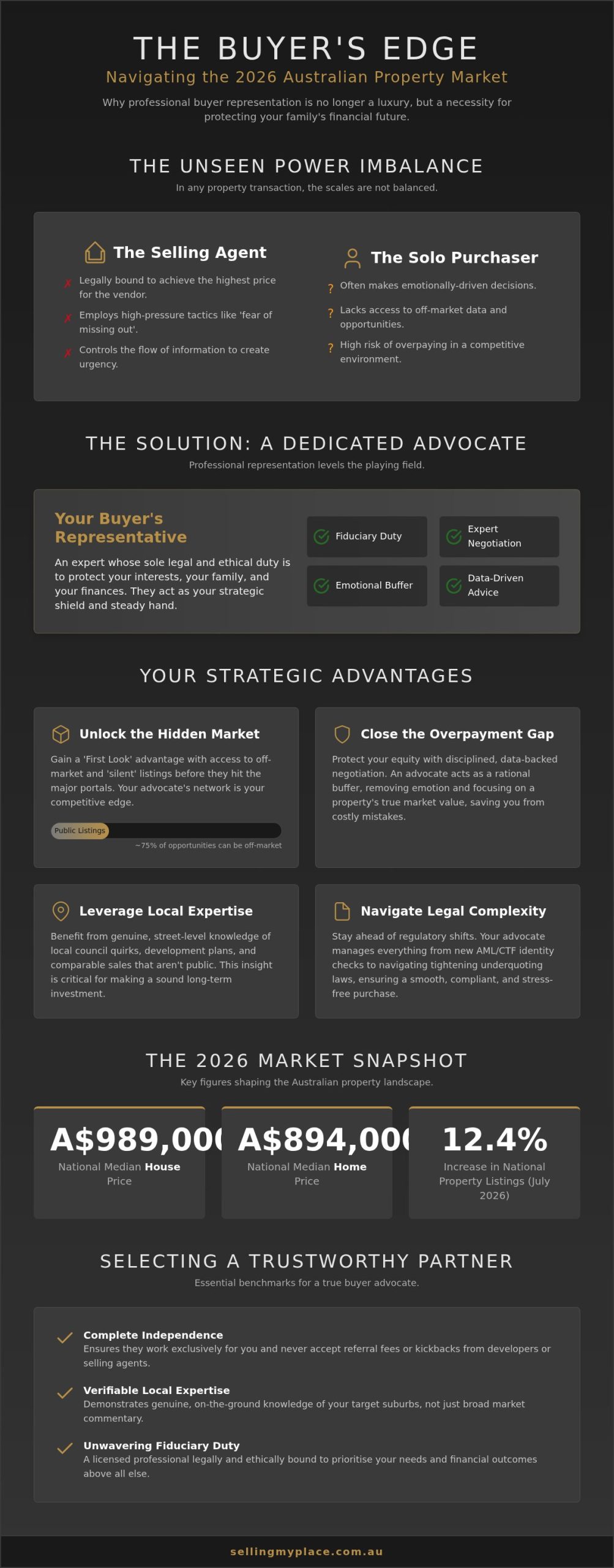
Selecting Your Partner: Key Criteria for a Trustworthy Buyer Advocate
Selecting the right partner for buyer representation is a decision that shapes your family’s future stability. It’s about finding a “steady hand” who prioritises your legacy over a quick transaction. Because a property purchase is often the largest financial commitment you’ll ever make, the person standing beside you must be more than just a negotiator; they must be a protector of your interests. To ensure you find the right fit, consider these five essential criteria during your selection process:
- Verify Independence: In 2026, with stricter agent conduct laws across Australia, you must ensure your advocate isn’t receiving hidden “spotter’s fees” or commissions from developers. A trustworthy advocate has a single source of income: you.
- Assess Local Depth: Do they know which streets in your target suburb are prone to traffic noise or which side of the hill gets the best winter sun? This granular, street-level knowledge separates a genuine expert from someone who just knows the postcodes.
- Evaluate Communication Style: You want a partner who projects calm confidence. If they feel like a salesperson pushing a quick result, they aren’t the right advocate for a major life transition.
- Check Their Track Record: Ensure they have specific experience with your property type. Someone specialising in high-yield investment units might not have the same eye for the structural nuances of a multi-generational family home.
- Review Their Secondary Network: A great advocate brings a team of reliable building inspectors, trades, and legal experts to the table, ensuring your due diligence is watertight.
Questions to Ask During Your Initial Consultation
When you sit down for that first meeting, it’s your chance to see behind the professional veneer. Don’t be afraid to ask direct questions that test their transparency and local roots:
- “How do you source your off-market properties, and can you describe your relationship with local selling agents?”
- “Can you show me a recent case study where you negotiated a price significantly below the vendor’s expectation?”
- “What is your specific process for due diligence and risk assessment before I sign a contract?”
The Importance of Conveyance and Legal Advice
Your representative must work hand-in-hand with legal professionals to protect your equity. Understanding every clause in the contract of sale before you sign the dotted line is vital for a “no-regrets” purchase. Using a service like Kincade’s Conveyance Advice ensures a smooth settlement process, bridging the gap between that final handshake and the day you finally get the keys. If you’re ready to secure your next home with a professional partner by your side, reach out to our advisory team for a quiet conversation about your aspirations.
Beyond the Listing: How Kincade’s Advisory Service Secures Your Next Home
Kincade International Direct Sales operates on a mission to empower property owners and purchasers alike. By integrating professional buyer representation into our broader advisory framework, we ensure that your transition between homes is managed with a “steady hand.” Most agencies treat the sale of one property and the purchase of another as isolated events, often leaving families in a state of limbo or financial stress. We bridge this gap by aligning your selling strategy with your buying goals, ensuring that every move you make is a calculated step toward long-term stability.
Our global network and digital infrastructure provide a distinct advantage that reaches far beyond the local suburb. While we are deeply rooted in Australian communities, our reach allows us to tap into resources and buyer pools that traditional local agencies simply cannot access. This partnership is built on more than just data; it is built on a sense of duty to your family’s future. We understand that a home is more than a set of coordinates; it is the foundation of your community life and personal legacy.
A Holistic Approach to Property Transitions
We treat the property journey as a unified cycle rather than a series of disconnected hurdles. A major component of our “Sell Smarter” philosophy involves maximising the capital you have available for your next purchase. By utilising a Commission-Free Sale for your current residence, you retain a significantly larger portion of your equity. This isn’t just about saving money; it’s about increasing your buying power in a competitive market. When you aren’t paying away tens of thousands in traditional agency commissions, you have more flexibility to secure the specific features or location that your family deserves.
Taking the First Step Toward Your New Chapter
Embarking on a new property chapter should be a time of celebration, not exhaustion. When you engage with our buyer representation service, the process starts with a methodical, confidential consultation. We don’t rush you into inspections; we take the time to understand the emotional significance of your move. We’ll discuss how our advisory services can mitigate the stress of the “middle period” between settlement dates, ensuring you feel protected and informed at every turn.
Visualise your future state: a home secured through expert negotiation, a sale handled with zero commission, and a transition managed by a trusted advisor who values your long-term roots. If you are ready to experience a more sophisticated way to move, we invite you to take the direct call to action and reach out to our team today. Let’s work together to secure your family’s next great milestone.
Your Next Chapter Starts with a Steady Hand
Securing a home in Australia’s current climate shouldn’t feel like a battle you’re destined to lose alone. By choosing professional buyer representation, you transition from a solitary purchaser to a protected partner. Throughout this guide, we’ve explored how expert advocacy unlocks silent listings and ensures you never overpay in the heat of an auction. It’s about securing a legacy for your family while keeping your hard-earned equity exactly where it belongs. At Kincade, we bring over 25 years of seasoned industry expertise to every consultation, offering a calm perspective in a fast-moving market.
Our flat-fee model is designed specifically to protect your family’s financial future, while our comprehensive Agent Advisory Service supports you from the very first listing through to a successful settlement. You deserve a transparent, stress-free path to your new front door. Secure your next home with Kincade’s expert buyer representation; contact us today. We look forward to helping you plant roots in a community you’ll love for years to come. Your future home is waiting, and we’re ready to help you find it.
Frequently Asked Questions
What exactly is the difference between a real estate agent and a buyer’s representative?
A traditional real estate agent is legally and ethically bound to achieve the highest possible price for the vendor. In contrast, buyer representation means you have a licensed professional working exclusively for you to secure the lowest price and best terms. They act as your advocate, providing an objective counterweight to the selling agent’s tactics. It’s a partnership where your financial security and lifestyle goals are the only priorities on the table.
How much does buyer representation typically cost in Australia?
Fees across Australia generally follow two structures: a fixed fee or a percentage of the final purchase price. While specific costs vary depending on the level of service and the complexity of your search, most advocates offer a transparent breakdown during your initial consultation. Investing in professional advocacy often pays for itself by closing the “overpayment gap” and protecting you from costly structural mistakes that aren’t immediately visible to the untrained eye.
Can a buyer’s representative help me at an auction?
Yes, acting as a “steady hand” during the heat of an auction is a core part of the service. Your representative will handle the bidding strategy, keep a calm head when prices rise, and ensure you never exceed your pre-determined limit. Removing the emotional target from your back allows you to walk away from a bad deal or secure a win without the stress of holding the paddle yourself.
Will I still have the final say on which property I buy?
Absolutely, you maintain total control over the final decision throughout the entire journey. Your representative provides the data, the due diligence, and the expert negotiation, but the choice to sign the contract remains yours. Think of them as a seasoned guide who maps out the best path; you’re still the one driving the car. Their role is to empower you with confidence, not to make the choice for you.
Do buyer’s representatives have access to properties that aren’t on the internet?
Yes, advocates have deep networks that provide access to “silent listings” and pre-market opportunities. These properties never hit major portals, meaning you face significantly less competition. In a market where national property listings rose by 12.4% in July 2026, having someone to filter both public and private stock ensures you only spend time on gems that truly match your family’s long-term legacy and lifestyle needs.
Is it worth hiring a representative if I am only buying a small unit?
Definitely, because even a small unit represents a significant portion of your equity. Overpaying by just 5% on a unit can wipe out years of capital growth. A representative ensures you aren’t buying into a building with hidden strata issues or poor historical resale value. Whether it’s a first home or a compact investment, professional buyer representation provides the same level of protection and strategic advantage as it does for a large family estate.
How does the process of working with a buyer representative actually start?
The process begins with a thoughtful, confidential consultation to define your specific needs and aspirations. We’ll discuss your budget, preferred neighbourhoods, and the lifestyle features that matter most to your family. This initial brief becomes the foundation of our search. Under the new AML/CTF laws effective July 2026, we’ll also guide you through the necessary identity verification steps to ensure your purchase is compliant and ready to move forward without delay.
Can a representative help me with the legal paperwork and conveyancing?
While a representative isn’t a lawyer, they coordinate closely with legal experts to review the contract of sale. They ensure that building, pest, and strata reports are thoroughly analysed before you commit. By working alongside professional conveyancers, your advocate provides a seamless link between the negotiation and the final settlement. This holistic approach ensures that every legal and structural detail is checked, keeping your family’s interests safe from listing to keys.
High-Impact Real Estate Marketing Strategies for Sellers in 2026
What if you could command a premium sale price and professional-grade exposure without handing over a single cent of your hard-earned equity in commissions? It’s natural to feel a bit of anxiety when looking at the 2026 property market, especially when trying to implement effective real estate marketing strategies for sellers on your own. Between navigating the latest digital portal requirements and the stress of organising high-end photography, the weight of selling your own home can feel overwhelming. You want your property to stand out. However, the thought of high upfront costs or underselling your family’s biggest asset is enough to keep anyone awake at night.
This guide will show you how to master professional-grade tactics that rival any traditional agency, ensuring you keep 100% of your commission while achieving a top-tier result. We will explore everything from leveraging global digital networks to managing professional suppliers with ease, so you can transition to your next chapter with confidence and a much healthier bank balance. By the end of this article, you’ll have a clear roadmap to a stress-free, professional-looking listing that protects your profit and honours the value of your home.
Key Takeaways
- Discover how the shift toward property-centric marketing in 2026 allows you to reach global buyers without relying on traditional agency models.
- Learn why professional-grade photography and floorplans are essential to capturing interest within the critical first three seconds of a listing.
- Master effective real estate marketing strategies for sellers by utilising Australia’s major property portals and targeted social media to find passive buyers.
- Follow a clear, step-by-step playbook to prepare your property for a premium sale while retaining 100% of your commission.
- Explore how a sophisticated flat-fee approach can save you an average of A$20,000 while still providing expert advisory support and global exposure.
The Evolution of Property Marketing: Why 2026 Favours the Seller
The Australian property market has undergone a profound transformation. For decades, the focus was firmly on the agent, with their portrait dominating the billboard and their personal brand taking centre stage. However, the evolution of property marketing has shifted the spotlight back to where it belongs: on your home. In 2026, buyers don’t care about an agent’s career highlights; they care about the lifestyle your property promises. This move toward property-centric marketing means that the right real estate marketing strategies for sellers are now more accessible than ever, allowing you to present your home with the same polish as a high-end agency.
Digital globalisation has played a massive part in this shift. Your buyer is no longer just the person driving past your “For Sale” sign on a Saturday morning. They could be a professional relocating from Melbourne, an expat in London, or an investor in Singapore. Because the search process has moved entirely online, a property in a quiet Australian suburb can now achieve global visibility instantly. This transparency has empowered sellers, but it has also raised the bar for quality. A professional listing isn’t just a luxury; it’s a fundamental requirement for building trust with a buyer who may be viewing your home from thousands of kilometres away.
Breaking the Commission Cycle
Traditional real estate models often demand a 2% to 3% commission, which can feel like a heavy tax on your hard-earned equity. On a typical Australian home, this can easily amount to tens of thousands of dollars. Many savvy homeowners are joining the “Direct Sale” movement, realising that they can achieve a premium result without the sting of a commission. It’s a common misconception that choosing a no-commission path means going it alone. By using modern real estate marketing strategies for sellers, you can access professional listing services and global reach while keeping your profit in your own pocket. In fact, sellers using a flat-fee model often save an average of A$20,000, which is a significant boost to their next deposit or retirement fund.
The Role of Expert Advisory in Marketing
Effective marketing begins long before the first shutter click of a camera. It starts with pre-sale property consulting to identify the high-value improvements that actually move the needle for buyers. Whether it’s a fresh coat of paint in the right neutral tone or minor landscaping, these choices are informed by detailed neighbourhood market reports. Having a steady hand to guide you through the complexities of the settlement process and conveyance advice ensures that the professional image you’ve built is matched by a seamless transaction. This advisory-led approach provides the confidence of an expert partnership without the traditional agency price tag.
Visual Storytelling: Professional Photography and Floorplans
In the digital age, your first open house doesn’t happen on a Saturday morning at your front door. It happens on a smartphone screen, often late at night while a potential buyer is scrolling through property portals. You have roughly three seconds to capture their attention before they move on to the next listing. This is why visual assets are the cornerstone of effective real estate marketing strategies for sellers. It isn’t just about showing the rooms; it’s about telling the story of a life well-lived and inviting someone else to imagine their future within your walls.
Professional wide-angle photography is a non-negotiable element of this process. These specialized lenses capture the true volume of a room, creating a sense of space and light that a standard phone camera simply cannot replicate. While modern phones are impressive, they often struggle with “barrel distortion” or poor light balancing, which can make even the most beautiful home look cramped or gloomy. To ensure your shoot is a success, follow this simple preparation checklist:
- Declutter every surface, including kitchen benches and bathroom vanities.
- Open all curtains and blinds to flood the home with natural Australian sunlight.
- Turn on every light in the house, including bedside lamps, to create a warm glow.
- Remove personal items like family photos, fridge magnets, and pet bowls.
- Ensure the exterior is tidy, with bins tucked away and cars moved out of the driveway.
Capturing the Heart of the Home
Buyers generally buy on emotion and then justify the purchase with logic. Using natural light and “lifestyle” shots, such as a sun-drenched reading nook or a beautifully set alfresco dining area, helps create that vital emotional pull. Your “hero shot,” which is usually the front of the house or the primary living area, must be impeccable. DIY photos can actually devalue your property in the eyes of a buyer, as they suggest a lack of care or professional oversight. If you’re feeling unsure about how to present your home’s best side, reaching out for a bit of expert advice can ensure your visual presentation is flawless.
Floorplans: The Blueprint of a Sale
Research suggests that approximately one in three buyers will completely ignore a listing if it lacks a floorplan. It’s a critical tool that allows people to “move in” mentally before they’ve even stepped foot on the property. They can measure where their favourite sofa will go or see exactly how the master bedroom relates to the nursery. A professional floorplan adds a layer of agent-grade legitimacy to your listing, reassuring buyers that the information is accurate and professional. It provides the spatial context that static photos sometimes lack, making the entire marketing package feel comprehensive and trustworthy.
Maximising Digital Reach: Portals, Socials, and Global Networks
Getting your home in front of the right eyes requires more than just a “For Sale” sign and a prayer. In the Australian market, visibility is dominated by the leading property portals that attract millions of monthly visitors. While these platforms are often seen as the exclusive playground of traditional agencies, modern real estate marketing strategies for sellers now provide a direct pathway to these high-traffic platforms. By listing your home where the buyers already are, you ensure your property is seen alongside every other professional listing in your suburb. It’s about creating a level playing field where the quality of your home, and the professional visual storytelling we discussed earlier, can truly shine.
Beyond the major portals, successful sellers use data-driven neighbourhood market reports to understand exactly who their buyer is. Is it a young family looking for a backyard, or an investor seeking a high-yield unit? Knowing this allows you to tailor your digital reach. If your property is a high-value residence, a global marketing network becomes essential. In 2026, capital is incredibly mobile. An Australian lifestyle property is an attractive asset for international buyers, and your marketing should reflect that global appeal by appearing on international syndication networks that reach expats and investors worldwide.
Beyond the Local Suburb
Your property’s discoverability shouldn’t end at the suburb boundary. Sophisticated SEO ensures that when someone searches for a lifestyle change in your specific region, your home appears in the results. This is particularly vital for attracting international interest. Global listing syndication pushes your property to dozens of countries, reaching buyers who might never visit a local Australian portal. Even “off-market” strategies have evolved. You can build momentum through private networks and digital infrastructure before the public launch, creating a sense of exclusivity that can drive up the final sale price without the stress of a public deadline.
The Social Media Strategy
Social media is a powerhouse for finding “passive” buyers, making it one of the most effective real estate marketing strategies for sellers in a competitive market. These are people who aren’t actively checking portals every day but would move for the right opportunity. Targeted social media ads allow you to place your home directly into the feeds of people based on their lifestyle interests and browsing habits. A short, engaging video walkthrough can stop a thumb mid-scroll far more effectively than a static image. Don’t underestimate the power of community, either. Sharing your listing in local suburb groups can spark word-of-mouth interest that leads to a genuine enquiry. It’s a personal, neighbourly way to find a buyer who will love your home as much as you have.
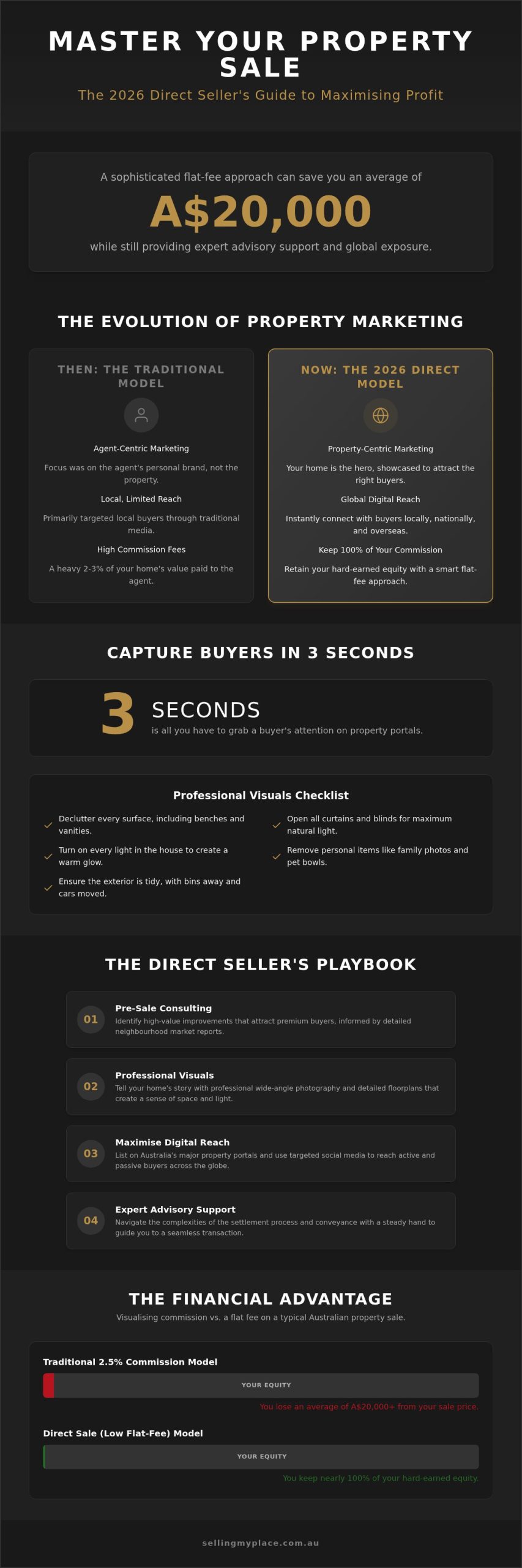
The Direct Seller’s Playbook: A Step-by-Step Marketing Plan
Many traditional agencies like to keep their marketing processes shrouded in mystery, suggesting that only they possess the “secret tools” for a successful sale. In reality, the most effective real estate marketing strategies for sellers are quite straightforward when you have a structured plan to follow. This playbook demystifies the process, putting the power back into your hands while ensuring you don’t sacrifice an ounce of professionalism. By following these five steps, you can transition from a homeowner to a successful seller with total confidence.
- Step 1: Pre-Sale Consultation. Before you even think about a camera, you need to identify high-value improvements. A professional pre-sale property consulting session helps you decide which minor repairs or styling choices will actually increase your sale price.
- Step 2: Professional Assets. Secure your professional photography and floorplans. As we’ve discussed, these are the primary drivers of digital engagement.
- Step 3: Compelling Copywriting. Draft benefit-driven copy that highlights the lifestyle your home offers. Instead of just listing “three bedrooms,” describe the “sun-drenched morning coffee spot” or the “short, leafy walk to the local primary school.”
- Step 4: The Global Launch. Go live across the “Big Three” Australian portals and global networks simultaneously. This creates an immediate surge of interest and competition.
- Step 5: Advisory Support. Utilise expert real estate advisory services to manage enquiries, negotiate offers, and guide you through the conveyance process.
Timing Your Launch
The “Golden Window” for a property listing is typically the first 14 days. This is when your home is “new” to the market and receives the highest volume of views. To make the most of this period, you must coordinate your professional photography, signage, and online listing so they all hit the market at once. One of the greatest benefits of a modern flat-fee model is the “no time limit” listing. This removes the stress of a ticking clock, allowing you to wait for the right buyer without the fear of your listing becoming “stale” or being forced into a price reduction by a looming agency contract expiry.
Negotiating Like a Pro
Negotiation doesn’t have to be a high-stress confrontation. When you’re armed with detailed neighbourhood market reports, you have the data needed to defend your asking price with calm authority. If you receive multiple offers, you can manage them transparently without the pressure of a public auction. This methodical approach ensures the marketing success you’ve built translates into a premium final settlement. If you’re ready to take the first step toward a commission-free sale, get in touch with us to discuss your property’s potential.
The Kincade Advantage: Professional Results Without the Sting
Selling My Place (Kincade International Direct Sales) isn’t just about listing a property; it’s about redefining how Australians approach the biggest transaction of their lives. By combining global digital infrastructure with a personal, advisory-led model, we ensure you don’t have to choose between professional exposure and financial sense. Implementing high-impact real estate marketing strategies for sellers shouldn’t come with a hidden “success tax” that drains your profit. Instead, our model prioritises your equity, allowing you to deploy sophisticated tactics while retaining 100% of your commission. It’s a smarter, more transparent way to move forward.
The financial reality of this approach is quite remarkable. On average, our sellers save approximately A$20,000 by avoiding traditional percentage-based fees. When you consider that this saving comes while still receiving professional photography, detailed floorplans, and reach into global networks, the decision becomes a matter of logic rather than tradition. We view this as a genuine partnership. Our goal is your success, not a quick transaction to meet an agency quota. By removing the pressure of commission, we create an environment where the focus remains entirely on your needs and your property’s potential.
A Partnership Approach
We believe selling a home is an emotional transition that deserves more than a purely transactional service. Our Agent Advisory Service acts as your “steady hand,” providing the calm confidence needed to navigate complex negotiations and buyer enquiries. You aren’t left to figure out the legalities alone, either. With professional conveyance advice available, you have a clear, supported path from the first enquiry to the final settlement. This supportive experience aims to reduce the typical stress of selling, replacing it with a sense of shared purpose and expert local knowledge that feels both personal and protective.
Your Equity, Your Future
Take a moment to visualise what that A$20,000 saving could mean for your future. Perhaps it’s a significant boost to the deposit for your next family home, a contribution to your children’s education, or the security of a more comfortable retirement. This is your legacy. Keeping that profit where it belongs is a powerful way to honour the years of hard work you’ve put into your property. Selling smarter isn’t just about the final price on the contract; it’s about the financial freedom you carry into your next chapter. Are you ready to take control? Contact our expert advisors today to start your commission-free journey.
Your Path to a Successful, Commission-Free Sale
The shift toward property-centric marketing in 2026 has opened doors that were once locked behind agency gates. By mastering professional real estate marketing strategies for sellers, you’ve seen how simple it is to combine global reach with high-end visual storytelling. You don’t need to sacrifice your equity to achieve a premium result. Instead, you can rely on a model that includes professional photography and floorplans as standard, ensuring your home looks impeccable on every major portal from day one.
Choosing to sell your own home is an empowering step toward protecting your family’s financial legacy. With an average saving of A$20,000 in commissions and the peace of mind that comes from being listed until sold with no time limits, you’re firmly in the driver’s seat. We’re here to act as your steady hand, providing the advisory support you need to navigate this transition with total confidence and warmth. It’s about more than just a transaction; it’s about honouring the home you’ve built.
Start your commission-free sale today with our expert marketing advisory. It’s time to celebrate your home’s true value and keep your hard-earned profit exactly where it belongs.
Frequently Asked Questions
Can I really list my home on Australia’s major property portals without a traditional agent?
Yes, you can list on the nation’s premier property search platforms through a licensed listing service. While the largest portals typically don’t allow private individuals to list directly, a flat-fee service provides the professional bridge required. This ensures your home appears alongside every other agency listing, maintaining a level playing field for your property’s visibility and reach.
How much can I actually save by using a flat-fee real estate marketing strategy?
Australian homeowners save an average of A$20,000 in commissions by opting for a flat-fee model. This figure represents the equity you would otherwise pay to a traditional agent based on a percentage of the final sale price. By implementing these real estate marketing strategies for sellers, you retain more of your property’s value while still accessing professional-grade exposure and support.
Is professional photography included in the flat-fee marketing packages?
High-quality wide-angle photography and professional floorplans are standard inclusions in our marketing packages. We understand that visual storytelling is the most critical factor in capturing a buyer’s interest within the first few seconds of their search. Providing these assets as part of a fixed fee ensures your property presents with the same polish and authority as any high-end agency listing.
What happens if my property doesn’t sell within the first few months?
Your property remains listed until it’s sold, as there are no time limits on your listing. Traditional agency contracts often expire after 90 days, which can lead to stressful price reductions or the need to re-list. Our approach removes this pressure, allowing you to wait for the right buyer and the right price without worrying about additional fees or contract renewals.
How do I handle the legal side of the sale without an agent?
You can manage the legal requirements by utilising professional conveyance advice and advisory services. While you are the primary point of contact for buyers, experts guide you through the documentation and settlement process. This partnership ensures all Australian legal standards are met, providing a secure and compliant path from the initial offer to the final exchange of keys.
Will buyers take my listing seriously if I am selling it myself?
Buyers focus on the property’s quality and the professionalism of the listing rather than the name of the agency. When your home is presented with professional photography, accurate floorplans, and clear descriptions, it carries a high level of legitimacy. Many buyers actually prefer the direct transparency and local knowledge that only a homeowner can provide during an inspection.
What is pre-sale property consulting and do I really need it?
Pre-sale property consulting is a strategic review that identifies which minor improvements will yield the highest return on investment. It’s an essential step for those using real estate marketing strategies for sellers to ensure they aren’t over-capitalising on renovations. By focusing on high-impact changes like styling or landscaping, you can significantly boost your home’s appeal and final sale price.
How does a global marketing network help sell a local Australian home?
A global marketing network exposes your property to international investors and Australian expats living abroad. In a mobile world, your buyer might be searching from London or Singapore. Global syndication ensures your listing appears on international platforms, increasing the pool of potential buyers and creating more competition; this often leads to a more favourable sale price for your local residence.
Buyer Advocates in Australia: How to Level the Playing Field in 2026
Did you know that nearly one in five Australian homes are sold before the public ever sees a ‘For Sale’ sign? In 2026, the property game isn’t just about who has the highest budget; it’s about who has the best map of the hidden market. Most people walk into an open home feeling like they’re already behind, and with the national median dwelling value sitting at $933,137, the stakes for your family’s future have never been higher. This is why more Australians are turning to professional buyer advocates to act as their steady hand and strategic shield.
It’s completely normal to feel a bit of a squeeze when the RBA cash rate is holding at 4.10% and every weekend feels like a marathon of inspecting properties that don’t quite fit the bill. You likely worry about overpaying in a competitive suburb or, worse, accidentally buying a ‘lemon’ with hidden structural issues. This guide will show you how to level the playing field, ensuring you secure a quality home at a fair price without the typical auction-day anxiety. We’ll explore the latest 2026 market trends, the power of off-market access, and how a seasoned expert protects your interests from the first search to the final settlement.
Key Takeaways
- Learn why professional buyer advocates have become a strategic necessity for navigating the competitive and fast-moving Australian property landscape of 2026.
- Discover how to gain exclusive access to ‘silent’ off-market listings, giving you a head start before a home even hits the public real estate portals.
- Understand how professional negotiation prevents emotional overbidding, protecting your hard-earned equity and saving you from costly ‘lemon’ properties.
- Identify the essential credentials and local, ‘street-by-street’ knowledge you must look for when choosing a representative to protect your interests.
- Explore how an integrated advisory service can bridge the gap between selling and buying, ensuring your family’s next big move is a seamless and calm transition.
What is a Buyer Advocate and Why are Australians Using Them?
Imagine walking into a high-stakes negotiation where the person across the table does this for a living, forty hours a week, while you only do it once every decade. That is the traditional reality of the Australian property market. A buyer advocate, often called a buyer’s agent, is a licensed real estate professional who represents your interests alone. While the selling agent is legally bound to get the highest possible price for the vendor, your advocate is there to secure the best property at the lowest price. The concept of Buyer brokerage has evolved significantly in recent years, moving from a niche service for the wealthy to a strategic necessity for everyday families. This isn’t just about convenience. It’s about ensuring a ‘fair go’ in a market where the rules of engagement are heavily weighted toward the seller. Most buyer advocates offer three primary levels of support: a comprehensive ‘top-to-bottom’ search and acquisition service, a ‘negotiation only’ package for a home you’ve already found, or simply acting as your calm, professional voice during the adrenaline-fueled environment of an auction.
The Difference Between a Selling Agent and a Buyer’s Advocate
It is a common mistake to think the friendly agent at an open home is there to help you. Legally, they have a ‘duty of care’ to the seller, meaning their primary goal is to extract every possible dollar from your pocket. Because of this inherent conflict of interest, an agent cannot legally represent both the buyer and the seller in the same transaction. A buyer advocate acts as your personal buffer. They filter out the sales spin and high-pressure tactics, allowing you to make decisions based on cold, hard data rather than the emotional pull of a well-styled lounge room. They are the steady hand that keeps the process grounded and focused on your long-term goals.
Why 2026 is the Year of the Represented Buyer
With the RBA cash rate sitting at 4.10% as of March 2026, borrowing capacity has tightened for almost everyone. A single average income earner has seen their budget drop by roughly $37,000 this year alone, according to recent market data. In this climate, there is simply no room for error. While digital property portals make it look easy to find a home, the sheer volume of data can be misleading. You need an expert to interpret those numbers and spot the difference between a genuine bargain and a ‘lemon’ hidden behind a fresh coat of paint. As of July 2026, new AUSTRAC regulations have also brought buyer advocates under stricter professional oversight, ensuring they operate with a level of transparency that matches their growing importance. A buyer advocate is your professional safeguard against emotional overspending.
The 5 Strategic Benefits of Professional Buyer Representation
Buying a home is often the most significant financial decision you will ever make. It is also one of the most emotional. While the previous section highlighted why the market feels tilted, let’s look at the specific ways buyer advocates act as your strategic equaliser. It starts with your most precious resource: time. Instead of spending every Saturday for six months criss-crossing the suburbs, an advocate handles the heavy lifting. They filter the noise, manage the ‘inbox fatigue’ that comes from endless property alerts, and present you with only the gems that actually fit your brief.
Beyond saving time, there is the vital role of due diligence. It’s easy to fall in love with a sun-drenched kitchen, but an expert eye looks for the things that could cost you tens of thousands later. They identify ‘lemons’, which are properties with structural issues, poor orientation, or problematic local developments, before you spend a cent on building and pest inspections. This proactive screening ensures you are only pursuing homes that represent a sound long-term investment for your family.
Accessing Off-Market and ‘Pre-Market’ Properties
Perhaps the greatest advantage is seeing what everyone else misses. The Real Estate Buyers Agents Association of Australia (REBAA) estimates that up to 20% of properties nationwide are sold off-market. These ‘silent’ sales happen because vendors value privacy or want to test the waters without a public campaign. Through deep-rooted local networks, advocates get the call before these homes hit the portals. If you want to understand the mechanics of this hidden world, our guide on what is an off-market property and how to find one explains how these opportunities are uncovered.
Auction Bidding and Emotional Detachment
Australian auctions are designed as high-pressure theatre. The rapid-fire calls and the crowd’s energy are carefully orchestrated to trigger emotional bidding. When you have a professional standing in your place, that theatre loses its power. A buyer advocate stays grounded, sticking strictly to a pre-determined limit based on comparable sales data, not adrenaline. Understanding the expert property sale negotiation tips used by the other side of the table can give you a significant edge when the hammer is about to fall.
Ultimately, having an expert in your corner ensures you never pay a cent more than market value. If you’re feeling overwhelmed by the search or worried about the high stakes of 2026, you might find it helpful to connect with a professional property advisor who can provide a steady hand for your next move. This partnership transforms a stressful transaction into a celebratory milestone for your family’s future.
Evaluating the Cost: Are Buyer Advocate Fees Worth It?
When you sit down to look at your budget, the idea of adding another line item for professional fees can feel daunting. It’s a valid concern. However, in the 2026 market, the question isn’t just about the cost of the service, but the cost of the mistakes you might make without it. Most buyer advocates in Australia work on either a percentage-based commission or a fixed flat-fee structure. While percentage fees are traditional, many families now prefer the transparency of a fixed fee, as it ensures the advocate’s only motivation is finding the right home, not increasing the purchase price to boost their own pay.
Think about the ‘Hidden Saving’. It is remarkably easy to over-bid by $50,000 in the heat of a negotiation or to settle for a property that requires significant remediation work down the track. Beyond the dollars, there is the immense value of your own time. If an advocate saves you five hours of research and inspections every week for three months, that is sixty hours of your life back. When you partner with a service like Kincade, you can also leverage the savings from our flat-fee selling model to essentially fund your buyer representation, creating a seamless and financially savvy transition from one home to the next.
Calculating the Return on Investment (ROI)
To truly see the value, you need to look at the ROI. This involves comparing the fee against the potential saving on the purchase price and the avoidance of high-risk properties. A professional appraisal is the cornerstone of this calculation. By understanding how to determine the market value of a home in Australia, you can see exactly where an advocate’s negotiation skills have shaved thousands off the asking price. It’s about data-led decisions rather than guesswork.
Common Misconceptions About Advocate Fees
A frequent myth is that buyer advocates are a luxury reserved for the high-end luxury market. In reality, they are often most valuable for everyday families who have the most to lose from a poor investment. Another common concern involves ‘kickbacks’. You should always ensure your advocate is completely independent and does not receive referral fees from developers or selling agencies. A flat-fee structure often provides the most transparent alignment of interests, ensuring your advocate is firmly on your side of the fence.
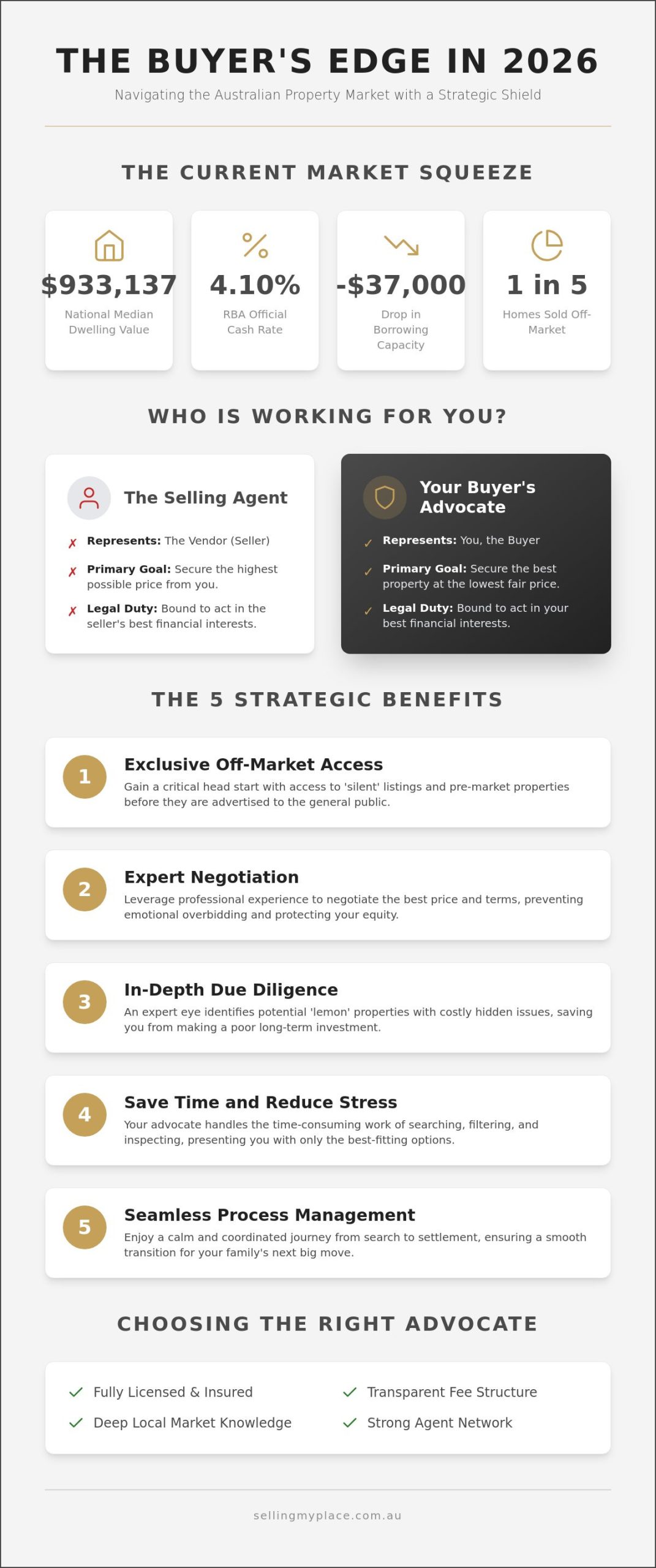
How to Choose the Right Advocate for Your Property Journey
Selecting the person who will guide your family toward its next home is a decision that deserves more than a cursory glance at a website. It is about finding a partnership built on trust and a shared vision for your future. In the Australian market, the first non-negotiable step is verifying that your representative holds a full real estate licence and maintains membership in professional bodies like the Real Estate Institute of Australia (REIA). While some digital platforms offer generic data, true buyer advocates possess deep, ‘street-by-street’ knowledge of your target suburbs. They should be able to tell you which pockets are prone to afternoon traffic noise and which side of a particular street holds its value better during a market dip. This level of local nuance is what separates a transactional service from a genuine advisory partnership.
We always suggest interviewing at least three different advocates before making your choice. This isn’t just about comparing fee structures; it is about finding a ‘steady hand’ whose personality meshes with your own. You need someone who prioritises your family’s long-term stability over the convenience of a quick transaction. A quality advocate is often the one who tells you to walk away from a property because it doesn’t meet your long-term needs, even if it means their search continues for another month. They act as your calm, professional shield in a process that can otherwise feel quite overwhelming.
Essential Questions to Ask During Your Consultation
During your initial consultation, move beyond the pleasantries and ask for specific operational details. How exactly do they access off-market properties? Is it through a genuine, decades-old network of local agents, or are they simply relying on the same email alerts as everyone else? In the 2026 climate, where auction dynamics can be unpredictable, ask for their specific strategy for bidding when competition is high. Finally, request recent case studies of purchases similar to your own brief. Seeing how they have navigated budgets and requirements like yours provides a clear window into their practical competence and negotiation style.
Vetting for Independence and Integrity
The most vital question you must ask is: ‘Do you receive any commissions or rebates from third parties?’ Absolute independence is the bedrock of professional advocacy. You must ensure they are not also acting as a selling agent for any properties they recommend, as this creates an immediate and legal conflict of interest. A partnership approach, much like our own philosophy at Kincade, focuses on your family’s legacy and community roots rather than a quick result. If you would like to experience this level of dedicated support for your next move, you can connect with our property advisory team to discuss how we can help you buy better.
The Kincade Advantage: Bridging the Gap Between Selling and Buying
A property journey isn’t just a set of two separate transactions; it is the closing of one chapter and the hopeful beginning of another. At Kincade International Direct Sales (KIDS), we view this transition through a lens of partnership and empathy. Most Australians find themselves caught in a stressful middle ground, trying to coordinate a sale while simultaneously hunting for their next home. We bridge this gap by acting as your seasoned guide for the entire process. Our Agent Advisory Service provides the same level of expert backing for purchasers as we do for our commission-free sellers. This ensures that the “steady hand” you relied on to sell your previous home is the same one helping you navigate the complexities of buyer advocates and the search for your next legacy property.
Our “Direct Sales” philosophy is built on empowerment. We provide you with the professional tools typically reserved for high-commission agencies, including professional photography, detailed floorplans, and comprehensive neighborhood market reports. This data-driven approach allows you to step into the market with a level of confidence that few unrepresented buyers ever achieve. Because Kincade maintains a broad national presence, we offer a perspective that goes beyond a single suburb. We understand how divergent market trends across the country can impact your local decisions, providing a birds-eye view that local-only agents simply cannot match.
A Holistic Approach to Your Property Legacy
The financial logic of our model is simple yet powerful. When you choose to sell commission-free with KIDS, you often save tens of thousands of dollars that would otherwise go toward agency fees. This retained equity can then be used to “fund” your professional buyer representation, essentially allowing the sale of your home to pay for the expert who secures your next one. This holistic approach reduces the financial friction of moving and provides immense peace of mind. Beyond the search, we offer dedicated support for conveyance advice and pre-sale consulting, ensuring every legal and strategic detail is handled with the seriousness it deserves. We invite you to view your next move not as a hurdle, but as a seamless and celebratory journey.
Next Steps: Embarking on Your Purchase with Confidence
Success in the 2026 property market requires more than just a deposit; it requires a team. Before you attend your next open home or scroll through another listing portal, it is vital to have your “team” ready. This includes your advocate, your conveyancer, and your real estate advisor. Getting started is as simple as a conversation. During a Kincade advisory session, we can help you map out your goals, assess the current market landscape, and determine the best strategy for your specific family needs. You don’t have to do this alone. Discover how Kincade’s expert advisory services can secure your next property and help you move forward with the calm confidence you deserve.
Your Future Home is Within Reach
The Australian property landscape of 2026 demands a new approach to buying. By now, you understand how the right representation can unlock off-market gems and protect your family from the emotional pitfalls of auction day. Choosing to work with professional buyer advocates isn’t just about finding a house; it’s about securing a sound financial foundation for your future. Whether you’re searching for your first home or your forever sanctuary, the peace of mind that comes from expert negotiation is invaluable.
When you pair our national expertise and global reach with a commission-free sale, you keep your hard-earned equity exactly where it belongs: in your pocket. Our clients save an average of $20,000 on commissions, providing the perfect launchpad for their next purchase. With our Expert Agent Advisory Service by your side, you can move forward with the calm confidence of a seasoned pro. Partner with Kincade for a smarter, commission-free property journey and let us help you turn the key to your next chapter. Your dream home is out there, and with the right team, you’ll find it sooner than you think.
Frequently Asked Questions
What is the typical fee for a buyer advocate in Australia?
In the Australian market, you will generally find two main fee structures: a percentage of the final purchase price or a fixed flat fee. These costs reflect the level of service provided, whether it is a full search or just auction bidding, and often vary between capital cities like Sydney and Perth. It is always best to ask for a clear breakdown during your initial consultation to ensure the structure aligns with your budget and provides the transparency you need.
Can a buyer advocate help me if I am buying in a different state?
Yes, they are often essential for interstate buyers who cannot physically attend every open home. An advocate acts as your “boots on the ground,” performing thorough inspections and providing objective feedback on the property and its location. They also help you navigate state-specific contract nuances, ensuring you feel as confident as a local throughout the entire process.
Do buyer advocates only work for property investors?
Not at all. While investors certainly value the data-driven approach, many families use buyer advocates to find their forever homes and manage the emotional stress of the search. Having a professional in your corner is just as important for a family home purchase as it is for an investment, as it protects your long-term equity and ensures you don’t overpay in a competitive market.
What happens if the buyer advocate finds a property I already saw online?
Their value remains significant even if you spotted the listing first. The advocate’s role shifts to professional evaluation and negotiation, where they perform a deep-dive appraisal to determine the home’s true market value. They will identify any potential “lemons” and handle the high-pressure bidding to ensure you secure the property at the best possible price, regardless of where the search began.
How does a buyer advocate get access to off-market listings?
Access to the “silent market” comes through deep-rooted, professional relationships with local real estate agents. Many vendors prefer to sell quietly to avoid public open homes or high marketing campaigns. Agents will often contact reputable buyer advocates first to see if they have a qualified client ready to buy, often resulting in a successful sale before the property is ever advertised to the general public.
Is a buyer advocate the same as a mortgage broker?
No, they perform very different roles in your property team. A mortgage broker focuses on your finance, helping you organise the right loan structure and securing your pre-approval. A buyer advocate focuses on the asset itself, handling the search, the due diligence, and the final price negotiation to ensure you buy the right property under the right conditions.
Can a buyer advocate help with the building and pest inspection process?
Yes, they typically coordinate the entire inspection process on your behalf. They work with trusted, independent inspectors to ensure the report is thorough and then sit down with you to explain what the findings mean in plain English. If issues are uncovered, your advocate can use that information as leverage to negotiate a price reduction or advise you to walk away if the risks are too high.
Property Marketing Plan Australia: A Comprehensive Guide for 2026 Home Sellers
What if the key to unlocking your home’s true value isn’t hidden behind hefty commission fees, but lies in a strategy you can lead yourself? We know that saying goodbye to a family home is one of life’s most significant transitions. It’s a time filled with memories and, quite naturally, a fair bit of stress about getting the result you deserve. You likely feel that a property marketing plan australia should be more than just a list of expensive portal ads. It should be a thoughtful reflection of your home’s unique story and its place in the community.
We agree that watching your hard-earned profits disappear into traditional agency pockets feels unsettling, especially when you’re the one who knows your local streets best. This guide is designed to empower you with the exact roadmap needed to achieve a professional-grade listing and maximise your sale price while keeping your equity where it belongs. We’ll explore how to organise high-impact photography, navigate the 2026 digital landscape, and present your home with a level of polish that rivals any traditional agency.
Key Takeaways
- Understand why a structured plan serves as the engine room of your sale, protecting your peace of mind and preventing expensive, ad-hoc mistakes.
- Learn to identify the non-negotiables for a professional listing, including the lifestyle-focused storytelling found in quality photography and floorplans.
- Discover how to design a high-impact property marketing plan australia that reaches the right buyers while bypassing traditional agency commissions.
- Explore the significant financial advantages of flat-fee solutions, allowing you to retain more of your home’s equity for your next chapter.
- Follow a practical, step-by-step roadmap to prepare your property, from researching local market reports to leveraging expert pre-sale consulting.
What is a Property Marketing Plan and Why Does Your Sale Depend on It?
Think of your marketing strategy as the engine room of your entire sale. It’s the central force that transforms a simple listing into a competitive event that draws people in. When you’re preparing to move on from a place filled with years of memories, the last thing you need is the uncertainty of ad-hoc decisions. A structured property marketing plan australia provides a sense of calm during what can be a whirlwind time. It ensures you aren’t just throwing money at advertisements and hoping for the best. Instead, you’re making calculated moves that protect your equity. Without a clear plan, it’s far too easy to fall into the trap of expensive, last-minute mistakes that quickly eat into your final profit.
The broader real estate business has evolved far beyond the days of just placing a grainy photo in a local office window. With the cooling market of 2026, where national home price growth has moderated to 5.8%, buyers are being much more selective. They aren’t just looking for a house; they’re looking for a lifestyle and a sense of security. A professional first impression isn’t just about looking “fancy.” It’s about psychology. When a listing looks polished and intentional, buyers subconsciously feel the home itself has been well-maintained. This builds the essential trust necessary for them to feel confident making a high-value offer.
The Shift from Traditional to Digital-First Selling
Success in 2026 requires digital precision. Industry data shows that roughly 90% of Australian property searches now begin on a mobile device. If your home doesn’t look stunning on a five-inch screen, you’ve lost most of your audience before they’ve even read the first sentence of your description. Moving beyond the “local agent window” means tapping into a national and even global buyer network. By prioritising digital infrastructure, you ensure your home is visible to the growing number of interstate buyers looking for value outside of the major capital city hubs.
Setting Your Marketing Objectives
Defining what success looks like goes much deeper than just the final sale price. Are you looking for a quick settlement to fund a sea-change, or is your priority squeezed into every last dollar of equity? Your property marketing plan australia should reflect these personal goals. You also need to identify your target buyer persona. A first-home buyer looking for a low-maintenance unit will respond to very different language and imagery than an investor or a growing family. By setting a clear timeline and specific goals, you can organise your preparations to align perfectly with your next big life transition.
The Essential Ingredients of a High-Performing Marketing Plan
Building on the strategic foundation we’ve established, it’s time to look at the specific tools that bring your home to life. A high-performing property marketing plan australia isn’t about doing everything; it’s about doing the right things with absolute precision. In a market where Sydney median values sit at $1,265,608 as of June 2026, the stakes are far too high for amateur snapshots or rushed descriptions. You need a suite of assets that project confidence and care, showing buyers that your home is a premium opportunity worth their attention.
Photography and Floorplans: Your Visual Handshake
First impressions are almost always digital. High-quality Photography is the single most effective investment you can make in your campaign. It acts as a visual handshake, welcoming potential buyers into your space before they even step through the front door. Coupled with accurate floorplans, these tools allow buyers to “move in” mentally. They start imagining where the sofa will go or how the morning light hits the kitchen bench. The Real Estate Institute of Australia often highlights that professional standards in presentation are vital for maintaining consumer trust in the property sector. By choosing professional-grade visuals, you aren’t just selling a building; you’re selling the future lifestyle that exists within its walls.
The words you choose are just as vital as the images. Rather than a dry list of features, your property copy should tell a story. Does the backyard host legendary summer barbecues? Is the study a quiet sanctuary for a home business? Focus on evocative, lifestyle-oriented language that highlights the stability and community your neighbourhood offers. If you find yourself stuck on how to frame your home’s best bits, our friendly advisors are always here to help you find the right words.
Digital Reach and Listing Portals
Visibility is the lifeblood of your sale. Your property marketing plan australia must ensure your home appears where buyers are actually looking. This means securing placement on the nation’s leading property portals. In 2026, these platforms use sophisticated algorithms to match your home with the right people. It’s also important to look for “listed until sold” options. These provide a safety net, ensuring you never feel pressured by a ticking clock or expiring ad. By leveraging global marketing networks, you can also reach international buyers and expats who are increasingly looking for a slice of the Australian dream, ensuring no stone is left unturned in your search for the perfect buyer.
Comparing Marketing Models: Traditional Agency vs. Flat-Fee Solutions
When you stand in your kitchen, picturing the next family who will share meals there, the financial reality of the sale is often at the back of your mind. However, choosing how to execute your property marketing plan australia is one of the most significant financial decisions you’ll make. Historically, the only path to a professional result was through a traditional agency, but that often comes with a heavy “commission tax” that can feel quite personal when you see the final numbers. In 2026, many homeowners are questioning why they should hand over a significant portion of their equity when they are the ones who have cared for the property for years.
The True Cost of a Commission-Based Sale
In Australia, the national median real estate commission sits at approximately 2.65%. On a national median dwelling value of $922,838, that represents a payment of over $24,455. This isn’t just a number on a page; it’s a deposit for your next home, a renovation fund, or a boost to your retirement savings. Beyond the cost, traditional models can sometimes create a conflict of interest. Because agents are often driven by volume, there is a natural pressure to close a deal within the standard 90-day agreement, even if waiting another week might have secured a better price. You can learn more about how the industry is changing in our guide on Understanding the Flat-Fee Real Estate Model.
The Benefits of the Flat-Fee Marketing Model
The flat-fee revolution is built on the belief that you should keep 100% of your sale profit. By paying a single upfront cost for professional tools, you remove the financial fog of commissions. This model offers a level of transparency that traditional agencies often struggle to match. You get the same high-end photography and accurate floorplans we discussed earlier, but you maintain full control over the process. There’s no pressure to accept a low offer just because an agent’s contract is nearing its end. Instead, you have the freedom to sell on your own terms, backed by the same digital reach used by the biggest firms in the country. Choosing a “Sale by Owner” approach no longer means selling alone; it means selling with professional support while keeping your hard-earned equity in your own pocket.
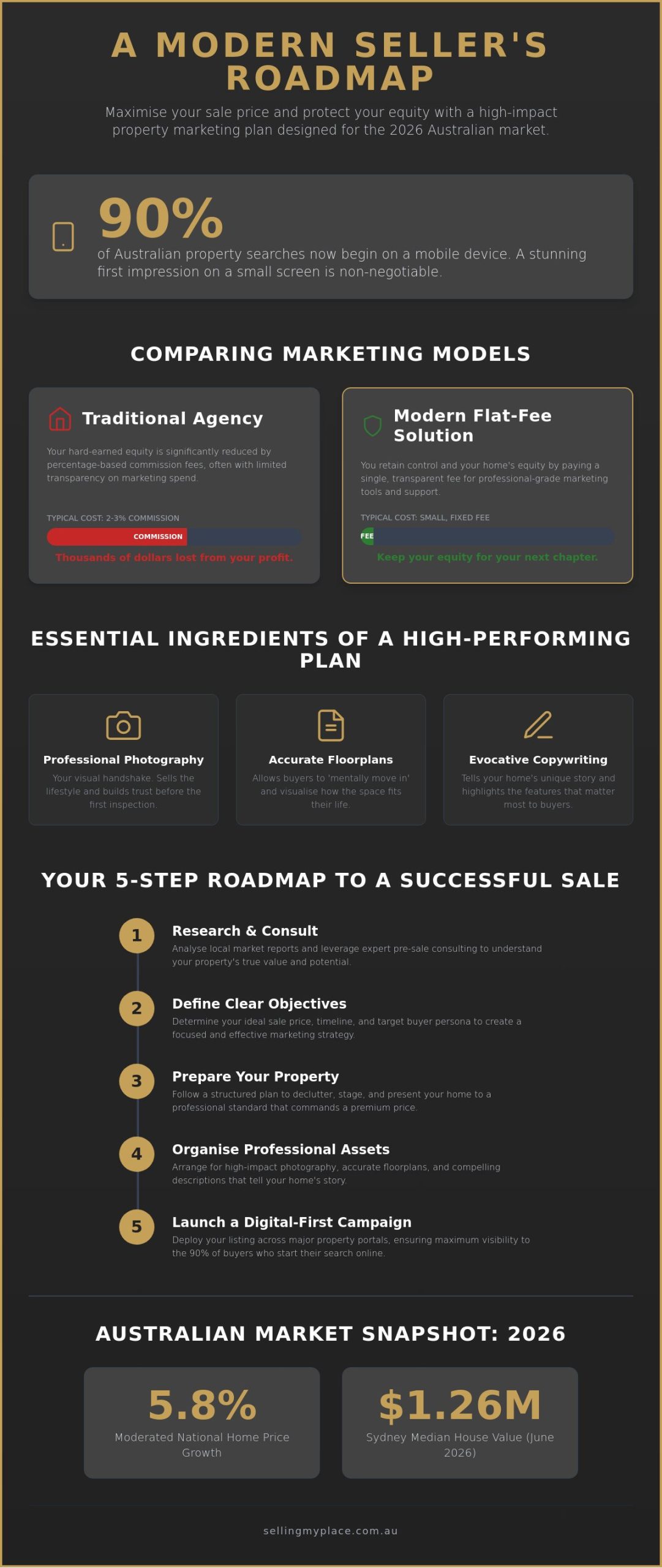
Designing Your Strategy: A Step-by-Step Guide for Australian Sellers
Moving from the “why” to the “how” is where the excitement really begins. Creating a tailored property marketing plan australia involves more than just ticking boxes; it’s about layering professional insights onto your intimate knowledge of your home. In a cooling market where buyer confidence can be fragile, a methodical approach ensures you don’t leave your result to chance. By following a clear, five-step roadmap, you can present a listing that feels both polished and deeply authentic.
- Step 1: Market Research. Start by grounding your expectations in reality. Use detailed reports to understand what similar homes in your street have actually sold for, rather than just looking at optimistic asking prices.
- Step 2: Pre-Sale Consulting. Identify high-value improvements that offer the best return. Sometimes, a simple garden tidy or a fresh coat of paint does more for your sale price than a major kitchen renovation.
- Step 3: Professional Visuals. As we’ve explored, high-end photography and floorplans are the foundations of your digital presence.
- Step 4: Global Launch. Push your listing across a digital infrastructure that reaches buyers across leading national property portals and overseas networks.
- Step 5: Expert Support. Manage enquiries and negotiations with the steady hand of an advisor to guide your decisions.
Researching Your Market Position
Setting the right price is a delicate balance of data and intuition. We recommend using Neighborhood Market Reports to see the full picture of your local area. In 2026, we’re seeing a distinct shift toward units due to affordability constraints, so understanding how your specific property category is performing is vital. Analysing recent sales helps you find your competitive edge. Are you the only four-bedroom home in the suburb with a north-facing backyard? Highlighting these specific strengths allows you to tap into the “buyer’s mindset” and justify a premium price point.
The Launch and Beyond
Timing your launch for maximum impact often means going live when buyer activity is highest, typically mid-week to build anticipation for weekend inspections. When the initial surge of enquiries begins, responding with professional warmth and clear information sets a positive tone for the entire negotiation. Once you’ve found the right buyer, the focus shifts to the paperwork. Securing early Conveyance Advice ensures your contract is ready to go, preventing any delays that could unsettle a nervous purchaser. Many sellers at this stage are also navigating the challenge of selling and buying a house at the same time in Australia, and having a clear strategy for both transactions is essential to avoiding costly settlement gaps. If you’re ready to start mapping out your specific timeline, get in touch with our team for a personalised consultation.
The Kincade Advantage: Professional Results Without the Commission
At Kincade, we believe the emotional significance of selling your home should be met with a partnership that values your legacy as much as you do. Our Kincade International Direct Sales (KIDS) model isn’t just a service; it’s a way to empower you to take the lead while we provide the professional-grade tools. You’ve already seen how a robust property marketing plan australia can be the difference between a good result and a great one. By removing the traditional agency commission from the equation, we ensure that the rewards of your hard work stay exactly where they belong: with your family.
What truly sets us apart is our “Steady Hand” approach. Through our Real Estate Advisory Services, you gain access to seasoned experts who act as your nurturing guides throughout the process. We don’t believe in the ticking clock of a standard 90-day agreement. Our “listed until sold” promise means we’re in this with you for the long haul, providing a sense of calm confidence that reduces the stress of high-stakes decision-making. You’re never just a number to us; you’re a partner in a shared mission to achieve the best possible outcome for your next life transition.
More Than Just a Listing
We provide a comprehensive ecosystem that goes far beyond a simple portal upload. From Pre-Sale Property Consulting that helps you polish your home’s presentation to vital Conveyance Advice that secures your legal standing, every piece of our service is designed to be protective and personal. Our global marketing network reaches across borders, finding buyers that a local shopfront agent might never encounter. This isn’t just about saving money; it’s about the emotional peace of mind that comes from being in total control of your story and your equity.
Join the Future of Australian Real Estate
Thousands of Australians are already realising that the old way of selling isn’t the only way. You can have the polished photography, the accurate floorplans, and the massive digital reach without the $20,000 commission bill. It’s about selling smarter, not harder. We’re here to provide the expert backing you need to step into this new chapter with clarity and pride. If you’re ready to see what’s possible, you can Start your commission-free sale journey with Kincade today and take the first step toward a more rewarding property experience.
Embrace a Smarter Path to Your Next Chapter
Selling your home is more than just a financial transaction; it’s the closing of one beautiful chapter and the start of another. By now, you understand that a high-impact property marketing plan australia doesn’t require you to sacrifice your hard-earned equity to traditional agency commissions. You have the power to combine professional-grade visuals and global digital reach with your own local expertise. Whether it’s through detailed market reports or the steady hand of our Agent Advisory Service, you are fully equipped to manage your sale with confidence and poise.
Our partners save an average of $20,000 per sale while remaining listed until sold with 0% commission. This isn’t just about the numbers; it’s about the freedom those savings provide for your family’s future. If you’re ready to embrace a smarter way to sell, we’re here to guide you every step of the way.
Discover how to save $20,000 on your home sale with Kincade
Your home has been a sanctuary for years, and you deserve a sale process that respects that legacy. We look forward to helping you move forward with clarity, support, and the best possible result for your family.
Frequently Asked Questions
How much does a professional property marketing plan cost in Australia?
The cost of a professional property marketing plan australia depends on the specific digital tools and visual assets you choose to prioritise. While traditional agency campaigns in 2026 often involve significant mark-ups on advertising, a flat-fee approach focuses on high-impact essentials. This allows you to invest in professional photography and premier portal listings without the added burden of agency overheads or unnecessary commission-based expenses.
Can I really sell my own home without a traditional real estate agent?
You can absolutely sell your own home successfully by using the same professional digital infrastructure that traditional agencies use. In the current 2026 market, the vast majority of buyers begin their search on mobile devices, meaning your listing can reach a national audience regardless of who is hosting the inspection. By taking control, you maintain a personal connection with potential buyers and ensure your home’s unique story is told with genuine warmth.
What is included in a flat-fee property marketing package?
A comprehensive flat-fee package typically includes the essential non-negotiables: professional photography, accurate floorplans, and listings on major Australian property portals. Beyond these visual assets, you also gain access to expert advisory services and neighbourhood market data. This ensures you have a professional-grade presentation and the strategic backing needed to manage enquiries and negotiations with total confidence from start to finish.
How do I get my property listed on major real estate portals if I sell privately?
Private sellers can access the country’s most frequented real estate portals by partnering with a licensed residential property listing service. These platforms generally restrict direct individual uploads, so a professional service acts as your essential gateway to the digital market. This ensures your home appears alongside every other listing in the marketplace, providing the visibility needed to attract serious buyers without the traditional gatekeeper fees.
Is professional photography really necessary for selling a home?
Professional photography is the single most important investment in your property marketing plan australia. With the majority of property searches now starting online, your home needs to stand out instantly on a screen. High-quality images build immediate trust and an emotional connection, whereas amateur photos can often lead buyers to overlook a property entirely, regardless of its actual value or local charm.
What happens if my property doesn’t sell within 90 days?
Unlike traditional agency agreements that often expire after 90 days, a “listed until sold” model provides you with ongoing support until the right buyer is found. This removes the artificial pressure to accept a lower offer just because a contract is nearing its end. It allows you to wait for the market to meet your expectations, providing peace of mind during the cooling market conditions seen across many capital cities in 2026.
Do I need a lawyer or conveyancer if I am selling the property myself?
You will still need a qualified conveyancer or solicitor to handle the legal aspects of the sale, such as preparing the contract of sale and managing the transfer of title. While you can manage the marketing and inspections yourself, these legal professionals ensure the transaction is compliant with state-specific regulations. It’s a vital step that protects your interests and ensures a smooth, secure settlement for both parties.
How do Neighborhood Market Reports help with my marketing plan?
Neighborhood Market Reports provide the objective data you need to set a realistic and competitive asking price. By looking at recent sales of similar properties in your specific street or suburb, you can identify your home’s unique competitive edge. This prevents the common mistake of overpricing, which can cause a listing to go stale, or underpricing, which leaves your hard-earned equity on the table during your life transition.
