The Real Cost of Selling a House in Australia: 2026 Seller’s Guide
What if the biggest expense in your 2026 home sale isn’t the marketing or the legal fees, but a “tax” on your hard-earned equity that you didn’t even have to pay? Selling the family home is a monumental life transition, and it’s completely natural to feel protective of the nest egg you’ve spent years building. You’ve likely felt that familiar sting of anxiety when looking at the projected cost of selling a house 2026, wondering why so much of your profit seems to vanish into someone else’s pocket before you’ve even moved out. It can feel like the system is designed to take a slice of your legacy just when you need it most.
We believe there’s a better way to navigate this journey. This guide provides a complete, transparent breakdown of Australian property selling costs, showing you exactly how to secure a professional, high-end listing while keeping tens of thousands of dollars in your own bank account. You’ll discover which marketing expenses are truly necessary to find the right buyer and how to protect your equity from outdated commission structures. We’ll walk through a clear budget for your sale, from conveyancing to settlement, giving you the steady hand and local insight you need to move forward with absolute confidence.
Key Takeaways
- Gain a clear, comprehensive breakdown of every expense involved in your sale, ensuring no hidden fees surprise you at the final settlement.
- Identify the essential marketing tools, from professional floorplans to digital listings, that are non-negotiable for attracting the right buyers in today’s market.
- Realise significant savings by accurately calculating the total cost of selling a house 2026 and discovering how to bypass the “equity tax” of traditional commissions.
- Master simple, high-impact presentation techniques that elevate your home’s appeal and increase your return on investment using what you already own.
- Learn how to access expert agent advisory services and a global marketing network while retaining every cent of your property’s hard-earned profit.
Navigating the Real Cost of Selling Your Property in 2026
When you decide to move on to your next chapter, it’s easy to focus solely on the final sale price. However, the true figure that matters is what actually lands in your bank account after the dust settles. We define the total cost of sale as a combination of marketing, legal requirements, and what we call transactional friction. This friction, primarily traditional commissions, often acts as a hidden tax on the capital growth you’ve patiently waited years to achieve. Why should an agent receive a percentage of the market growth that you, as the homeowner, earned through years of mortgage repayments and maintenance?
Calculating the cost of selling a house 2026 requires a clear look at the three pillars of the process. First, there are statutory costs, which are the non-negotiable legal and government fees. Second is presentation, covering how you prepare your home for the spotlight. Finally, there is the agency pillar. In the current Australian property market, this third pillar is where most families lose their hard-earned equity. With median house prices in Sydney having reached nearly $1.6 million in early 2026, a standard 2% commission can easily exceed $30,000. That is a significant sum that could be better spent on your next home or your retirement fund.
The Shift in the Australian Real Estate Landscape
The days when agencies held the “keys to the kingdom” are well and truly over. Digital platforms and global marketing networks have dismantled the old gatekeeper model, allowing savvy vendors to take the lead. You no longer need to pay a premium for an agency’s brand name when the buyers are looking at the property itself, not the logo on the sign. We’ve seen a massive rise in professional, commission-free selling as a mainstream path. It allows you to access high-end marketing and expert advisory services without the “success fee” trap that eats into your profit. Full service simply doesn’t have to mean high commission anymore.
Statutory and Compliance Costs You Can’t Skip
While you can save tens of thousands on commissions, some costs remain fixed. These are the essential “safety net” expenses that ensure your sale is legally sound. You’ll need to budget for mortgage discharge fees, which lenders typically charge to close out your loan; these generally range between $150 and $1,500 depending on your bank. You must also account for council rates and land tax adjustments that are settled on the day of completion. In most states, preparing disclosure documents, like the Section 32 in Victoria, is a legal requirement that your solicitor or conveyancer will organise to protect both you and the buyer from future disputes.
Breaking Down the ‘Unavoidable’ Costs: From Conveyancing to Marketing
While we’ve already explored how to shield your equity from high commissions, certain expenses are the “price of entry” for a secure and successful sale. Understanding the total cost of selling a house 2026 involves looking at the professional services that act as your safety net. These aren’t just administrative hurdles; they’re the essential steps that ensure your property’s transition to its new owner is legally sound and financially rewarding. You shouldn’t cut corners here, but you can certainly spend more wisely by knowing exactly where your money goes.
The Legal Side: Conveyancers vs. Solicitors
Choosing between a conveyancer and a solicitor is one of your first big decisions. Generally, a conveyancer is a specialist in property law and is often a more cost-effective choice for standard residential sales, with fees in New South Wales typically ranging from $800 to $2,200. However, if your sale involves complex trusts or unique contract conditions, a solicitor provides a broader level of legal protection. According to the Real Estate Institute of Australia, having your paperwork organised early is the best way to prevent stressful delays at settlement. Seeking professional Conveyance Advice ensures you’re protected from the moment a buyer makes an offer.
Marketing That Actually Moves the Needle
In 2026, your home’s first “open house” happens on a smartphone screen. This digital-first reality makes professional photography and accurate floorplans non-negotiable. While traditional signboards still have their place in the local neighbourhood, the real ROI comes from premium online listings that grab attention in a crowded market. You’ll find that spending on high-quality visuals often pays for itself by attracting more competitive bidders. It’s about creating an emotional connection before the buyer even steps through the front door, ensuring your home stands out as a premium offering rather than just another listing.
Don’t overlook the “hidden” costs that contribute to a property’s curb appeal. A professional deep clean or minor repairs like fixing a leaky tap or refreshing garden mulch can significantly impact a buyer’s perception of value. Finally, remember to check with your lender regarding mortgage discharge fees. These bank costs generally sit between $150 and $1,500, and knowing these figures ahead of time helps you build a realistic budget for your next move. If you’re feeling unsure about where to start with your budget, you can always reach out for a friendly chat about your specific needs.
The Commission Conundrum: Comparing Traditional vs. Flat-Fee Models
For decades, the standard 2.5% commission has been treated as an inevitable part of the Australian property journey. However, when we look at the numbers in 2026, this “standard” fee is often the single largest drain on a family’s wealth. If we take the median Sydney house price of approximately $1.6 million, a 2.5% commission equates to $40,000. This isn’t just a fee for service; it is what we call an “Equity Tax.” While you pay for marketing and legal work out of pocket, the commission is carved directly from the capital growth you’ve built over years of ownership. It eats into your actual profit, not just the sale price, often representing a massive chunk of the deposit for your next home.
Many homeowners worry that choosing a flat-fee model might result in a lower sale price. This is a common myth perpetuated by the traditional industry. In reality, buyers are motivated by the property itself, its location, and its presentation, not by how much the seller is paying an agent. The cost of selling a house 2026 shouldn’t be tied to the value of your asset. By choosing a professional flat-fee alternative, you’re opting for a transparent service where you pay for the work performed, rather than giving away a slice of your legacy based on a percentage of your home’s worth.
The Math of Selling: A Side-by-Side Comparison
Let’s look at how the numbers actually stack up for a typical Australian sale. In Scenario A, a traditional agent charges a 2.5% commission plus a separate marketing budget. On a million-dollar home, you’re looking at $25,000 in commission alone. In Scenario B, using the Kincade International Direct Sales flat-fee model, you pay a set amount for professional services regardless of the final price. This often results in an average saving of $20,000 per sale. Ask yourself: what could your family do with an extra $20,000? It could be the budget for a kitchen renovation in your new place, a significant boost to your retirement savings, or a year of private school fees.
The ‘Success Fee’ vs. Professional Advisory
There is a fundamental difference between paying a “success fee” and investing in professional advisory. You deserve expert guidance, but that expertise shouldn’t cost more just because your house is worth more. Our model provides a steady hand through the Agent Advisory Service, ensuring you have a seasoned expert in your corner without the percentage-based price tag. You can still access expert property sale negotiation tips to ensure you get the best possible result. This approach keeps you in the driver’s seat of your sale timeline, free from the pressure of an agency looking for a quick commission to hit their monthly targets.

Maximising ROI: Smart Spending on Pre-Sale Presentation
Preparing your home for sale is often where the emotional weight of moving truly hits home. It’s the moment you stop seeing your house as a sanctuary and start seeing it as a product. While we’ve discussed how to reduce the cost of selling a house 2026 by avoiding high commissions, knowing where to invest your presentation budget is equally vital for protecting your equity. You don’t always need a five-figure renovation to see a significant jump in your final result. Often, the most powerful changes are the ones that cost nothing but time and a little elbow grease.
We always recommend the “Rule of Three” as your starting point: clean, declutter, and depersonalise. By removing the layers of daily life (those fridge magnets and family photo walls), you allow potential buyers to project their own future onto the space. It’s about creating a blank canvas that still feels warm and inviting. Additionally, addressing small maintenance issues before they are flagged in a building inspection prevents “buyer chipping.” This is when a buyer tries to knock thousands off the price for minor faults like a stiff window or a cracked tile that would have only cost you fifty dollars to fix beforehand.
Styling and Staging on a Budget
In the 2026 market, buyers are looking for a specific “lifestyle” rather than just a floorplan. You don’t necessarily need to hire a full house of furniture to achieve this. Focus your styling efforts on the “entry zone” and the main living areas, as these are the spaces that set the emotional tone for the entire tour. Use natural lighting to your advantage and choose a neutral colour palette to maximise the sense of space. Sometimes, simply rearranging your existing furniture and adding a few high-quality linens or indoor plants can create that polished, professional look without the high price tag of traditional staging.
Data-Driven Pricing
Pricing your home is a delicate balance of logic and market pulse. You should never have to guess your market value or rely on the inflated estimates sometimes used to win listings. Instead, use Neighborhood Market Reports to see exactly what similar properties in your street have sold for in recent months. The first 21 days on the market are statistically your most valuable window of opportunity. If you overprice based on emotion, you risk your listing becoming “stale,” which often leads to a lower eventual sale price than if you had started with a realistic, evidence-based figure.
If you’re ready to see how your property stacks up against recent local sales, contact us today for a detailed market report tailored to your specific area.
Selling Smarter with Kincade International Direct Sales
We’ve spent this guide peeling back the layers of the Australian property market to reveal where your money truly goes. Understanding the real cost of selling a house 2026 means looking for a partner who prioritises your family’s future over their own bottom line. At Kincade International Direct Sales (KIDS), we’ve designed a model that removes the transactional friction of traditional commissions, replacing it with a sophisticated, flat-fee approach. It is about giving you a fair go and ensuring that the equity you’ve built stays exactly where it belongs, in your pocket.
Our approach isn’t about doing it all on your own; it’s about doing it smarter with a steady hand to guide you. We provide the same high-end tools that the big-name agencies use, including professional photography, accurate floorplans, and comprehensive market reports. However, we pair these with our global marketing network and digital infrastructure, ensuring your home reaches the right buyers without the high marketing costs usually associated with premium listings. If you’ve ever considered how to sell your own home, our model provides the expert backing to make it a reality.
Your Partnership for a Successful Sale
We believe a successful sale is built on a relationship of trust. Our Agent Advisory Service acts as your professional mentor, guiding you through the often-complex negotiation and settlement phases. One of the greatest stresses for sellers is the ticking clock of a standard agency agreement. With our “Listed Until Sold” promise, that pressure evaporates. There are no expiring contracts or time limits, allowing you to wait for the right offer that respects the value of your property. By removing the traditional commission, our clients see average savings of $20,000, which is a powerful way to protect your family’s legacy and financial stability.
Getting Started with a Flat-Fee Package
Taking the first step is simpler than you might think. Our onboarding process is designed to be inviting and methodical, mirroring a thoughtful consultation rather than a high-pressure sales pitch. You can choose a marketing tier that fits your specific property and goals, ensuring you only pay for what you actually need. We handle the technical details and the listing logistics so you can focus on your next big move. Ready to save? Explore our flat-fee listing services today and see how we can help you move forward with confidence and clarity.
Empowering Your Next Big Move
Selling your home is more than just a property transaction; it’s the culmination of years of hard work and memories. By understanding the true cost of selling a house 2026, you’ve taken the first step toward protecting your family’s legacy. We’ve seen how moving away from traditional commissions can save you an average of $20,000, providing a significant boost to your budget for whatever comes next. Whether you’re upgrading, downsizing, or relocating, you now have the knowledge to ensure your profit remains entirely yours.
You don’t have to sacrifice professional quality to save on fees. With high-end photography, accurate floorplans, and our Expert Agent Advisory Service in your corner, you can list your property with absolute confidence. It’s time to embrace a more transparent, rewarding way to sell. Keep 100% of your profit—sell with Kincade International Direct Sales. We’re here to provide the steady hand and local expertise you need for a seamless transition. We look forward to helping you make your next move your most successful one yet.
Frequently Asked Questions
What is the average real estate commission in Australia for 2026?
National real estate commissions typically range from 1.5% to 3.5% of the sale price. In metropolitan areas like Sydney, the average commission sits at approximately 2.1%, while state averages vary from 1.87% in Victoria to 2.57% in Queensland. These percentages are a major component of the total cost of selling a house 2026, often representing the largest single expense for most vendors.
Are marketing costs included in an agent’s commission?
Marketing costs are usually treated as a separate expense and are not included in the percentage-based commission fee. For a standard campaign in Sydney, you should budget between $4,500 and $10,000 to cover online listing premiums, photography, and signage. While the commission itself includes GST, the advertising budget is an additional “out of pocket” cost that is often required upfront.
How much should I budget for conveyancing when selling my house?
You should generally budget between $700 and $2,500 for professional conveyancing or legal fees. In New South Wales, these costs typically range from $800 to $2,200, while Sydney-specific services can reach up to $2,500 depending on the complexity of the contract. This fee ensures all statutory disclosure documents are accurate and that the legal transfer of the property is handled correctly.
Do I have to pay Capital Gains Tax (CGT) when I sell my home?
You generally don’t have to pay Capital Gains Tax if the property you are selling is your primary place of residence. This “main residence exemption” is a significant benefit for Australian homeowners. However, CGT may apply if the property has been used for investment purposes, as a rental, or if you’ve run a business from the premises during your period of ownership.
Is it worth paying for professional home styling?
Professional styling is a voluntary cost that can cost up to $10,000, but it often provides a high return by helping buyers visualise their future lifestyle. While it’s a significant upfront investment, it can reduce the time your property spends on the market and potentially increase the final sale price. It’s particularly effective for empty properties that might otherwise feel cold or small to prospective buyers.
What happens if my property doesn’t sell within the first month?
It is quite normal for some properties to take longer than a month, as the current median time on market in Sydney is approximately 28 days. If your property hasn’t sold, it’s a good time to review your pricing strategy and presentation with your advisor. Because we offer a “Listed Until Sold” service with no time limits, you can remain on the market without the stress of expiring contracts or mounting re-listing fees.
Can I really sell my house without a traditional real estate agent?
Yes, you can absolutely sell your home using a professional flat-fee model that bypasses traditional commission structures. This approach allows you to manage the cost of selling a house 2026 while still accessing high-end marketing tools and expert advisory services. It’s a mainstream choice for savvy homeowners who want to maintain control of their sale and keep 100% of their property’s equity.
What are the hidden fees I should look out for at settlement?
The most common “hidden” fees are mortgage discharge costs, which banks charge to close your loan; these generally range from $150 to $1,500. You should also be prepared for settlement adjustments, where you’ll pay a pro-rata amount for council rates and land tax up to the day the new owner takes possession. While these figures are standard, seeing them on your final settlement statement shouldn’t be a surprise if you’ve planned your budget early.
The Power of Floorplans: Why Spatial Clarity Sells Australian Homes Faster
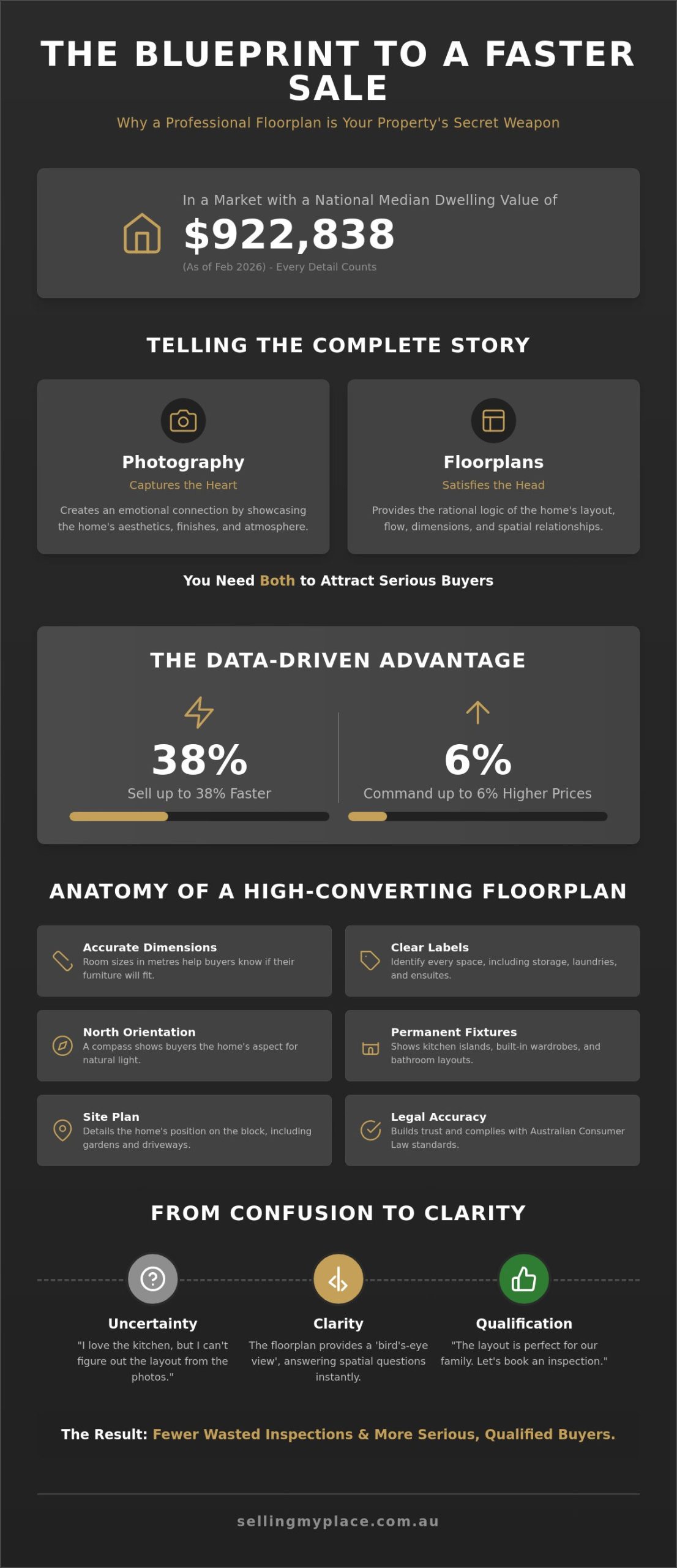
Imagine a potential buyer sitting on their lounge on a Tuesday night, scrolling through your listing. They love the kitchen’s stone benchtops and the sun-drenched deck, but they’re squinting at the screen trying to figure out if the third bedroom is close enough to the master for a nursery. Without professional floorplans, that uncertainty often turns into a skipped inspection. It’s a missed opportunity that happens more often than most sellers realise, especially when the national median dwelling value is sitting at $922,838 and every click counts.
We understand the frustration of listing fatigue when your home sits on the market while others seem to fly. It’s disheartening to host open homes only to see buyers walk out because the flow isn’t what they imagined from the photos. We’re here to help you move past the stress of high-stakes marketing and find a clearer path. In this guide, you’ll discover how a professional floorplan transforms your property listing from a simple gallery into a high-converting spatial narrative. We’ll explore the genuine ROI of spatial clarity, the essential details your plan must include to meet Australian Consumer Law standards, and how to present your home’s layout to attract truly serious buyers.
Key Takeaways
- Understand why professional floorplans act as the “rational logic” that bridges the gap between a beautiful photo and a firm offer.
- Learn how accurate dimensions and clear labelling of storage spaces help buyers visualise their life (and their furniture) in your home.
- Discover how providing spatial data can qualify potential buyers early, saving you from the frustration of wasted weekend inspections.
- Explore why professional measurements are vital for legal accuracy and how to achieve a high-end listing without the burden of traditional agency commissions.
Why Floorplans are the Secret Weapon of Successful Australian Property Listings
In the Australian property market, where the national median dwelling value reached $922,838 as of February 2026, every detail of a listing carries significant weight. While professional photography captures the heart, it’s the floorplan that satisfies the head. Essentially, What is a floor plan? It’s a scaled 2D or 3D bird’s-eye view that reveals the internal logic of a home, showing how rooms connect and where the boundaries of each space lie. For many local buyers, this is the most critical piece of information after the photos themselves. It provides a sense of transparency that photos alone can’t achieve, building an immediate bridge of trust between the seller and the purchaser.
Beyond just a simple drawing, a floorplan creates a spatial narrative. It tells the story of how a family will live, move, and grow within the walls. By offering this clarity, you’re not just selling a house; you’re providing the blueprint for a future lifestyle. This transparency is especially important given the strict Australian Consumer Law regulations regarding misleading advertising. Providing an accurate layout shows you’ve got nothing to hide and respect the buyer’s need for honest, practical data.
The Psychology of the Online Browser
When someone is scrolling through a listing, they’re doing more than just looking at colours and finishes. They’re trying to solve a puzzle. Without floorplans, the “cognitive load” of trying to piece together a kitchen’s relationship to the dining area based on separate photos can be exhausting. A clear layout allows a buyer to mentally “move in” before they’ve even stepped foot on the property. It turns a poetic description of a “sun-drenched living area” into a verifiable fact by showing the northern orientation and window placements. This clarity reduces anxiety and helps a family decide if their heavy heirloom dining table or that specific king-sized bed will actually fit.
Statistical Advantage in the 2026 Market
The 2026 market has seen a shift toward more cautious, data-driven buying. With interest rates for owner-occupiers averaging 5.50% in early 2026, purchasers aren’t likely to gamble their time on vague listings. Some industry reports suggest that properties featuring professional floorplans can sell up to 38% faster and may even command prices up to 6% higher than those without. In a cooling market where home values saw a 0.4% dip in June 2026, staying on a buyer’s shortlist is vital.
A well-executed layout ensures your home remains a contender long after the initial emotional spark of the photography has settled. It serves several practical purposes:
- It defines the flow between indoor and outdoor living spaces.
- It highlights the proximity of bedrooms to bathrooms for young families.
- It identifies “hidden” value like storage cupboards, laundries, or study nooks.
By providing this information upfront, you’re treating potential buyers as partners in the process. It’s the first step toward a successful, stress-free sale.
The Anatomy of a Perfect Floorplan: What Modern Buyers Expect to See
While we’ve established that floorplans are a vital part of your marketing toolkit, not all plans are created equal. A blurry, hand-drawn sketch scribbled on a napkin won’t cut it in today’s competitive market. Modern Australian buyers, particularly those looking at property values nearing the million-dollar mark, expect a level of technical precision that mirrors the quality of the home itself. They’re looking for a document that acts as a reliable reference point for their future life. This means including accurate room dimensions in metres or millimetres for every major living area and bedroom. It’s the difference between a buyer wondering if their king-sized bed will fit and them knowing for certain that it will.
Beyond simple wall placements, a high-quality plan must clearly label every space. Don’t leave people guessing. If there’s a tucked-away laundry, a walk-in linen cupboard, or a compact ensuite, mark it clearly. Buyers also look for permanent fixtures that dictate how they’ll use a room. Indicating the position of kitchen islands, baths, and built-in wardrobes helps them understand the functional flow of the house. To provide a truly complete picture, always include a site plan. This shows the home’s footprint in relation to the entire block, detailing driveways, garden spaces, and the distance to boundary lines.
Orientation and Natural Light
In our climate, the direction a house faces is everything. A professional floorplan must include a North-point indicator. This isn’t just a technicality; it’s a guide to how much sun will hit the living room in winter or how cool the bedrooms might stay in summer. By showing window placements and their relationship to alfresco areas, you highlight the home’s ventilation and light flow. It allows a buyer to visualise themselves enjoying a morning coffee in a sun-drenched nook or hosting a summer BBQ in a shaded outdoor zone. If you’re unsure how to best showcase your home’s unique layout, it’s often worth reaching out for a chat about your listing needs.
Gross Internal Area (GIA) vs. Total Area
Transparency is your best friend when it comes to square meterage. Buyers want to know exactly what they’re paying for, and being vague can lead to difficult conversations during the conveyance process. Gross Internal Area is the total floor space within the external walls. It’s important to distinguish this from the “total area,” which might include carports, open decking, or balconies. Providing these separate figures prevents any feeling of deception. With the Australian Consumer Law carrying heavy penalties for misleading conduct, including accurate spatial data isn’t just good marketing; it’s a necessary step to protect your sale and provide peace of mind to everyone involved.
Photography vs. Floorplans: Why You Need Both to Tell a Complete Story
If professional photography is the first spark of romance in a property search, the floorplan is the deep, meaningful conversation that follows. It’s a simple truth in the Australian market. Photos are designed to create an “emotional hook,” pulling a buyer in with beautiful light, polished floorboards, and the promise of a certain lifestyle. However, savvy purchasers are increasingly aware of the “wide-angle lens” trickery. They know a clever angle can make a modest study look like a grand master suite. To bridge this gap, floorplans provide the “rational logic” that validates those beautiful images with factual, indisputable data.
Think of your marketing as creating a digital twin of your home. When you pair high-quality images with an accurate layout, you’re providing a comprehensive view that respects the buyer’s intelligence. This synergy is more important than ever. In June 2025, New South Wales introduced legislation requiring mandatory disclosure when images in advertisements have been digitally altered to conceal faults. This reflects a broader national trend toward transparency. By providing a professional plan, you’re offering a grounding truth that reassures buyers your home is exactly what it claims to be. It turns a collection of pretty pictures into a cohesive, believable story.
Bridging the Gap Between Clicks and Inspections
A well-placed layout acts as a map for your photo gallery. Without it, a buyer might see a stunning parents’ retreat and then a separate shot of a kids’ wing, but have no idea how they relate to one another. Are they on opposite sides of the house? Is there a central lounge between them? When a buyer can reference the floorplan while scrolling through photos, they stay on your listing page significantly longer. This increased “time on page” is a key metric that property portals use to rank listings, potentially giving your home more visibility in a crowded market.
The Risk of Only Using Photos
Relying solely on photography is a gamble that often leads to high-volume but low-quality inspections. There is nothing more frustrating for a seller than hosting ten groups on a Saturday morning, only to find that half of them left disappointed because the layout didn’t suit their specific needs. Maybe they needed a home office far from the kitchen, or perhaps they required a ground-floor bathroom for an elderly relative. When you skip the spatial data, you’re inviting “tyre kickers” who could have been qualified earlier. To ensure your marketing strategy is as efficient as possible, it’s wise to look into Professional Residential Property Listing Services that prioritise this balance. Providing clarity upfront means the people walking through your front door are already half-convinced that your home is the right fit for their life.
Qualifying Buyers Early: How Spatial Data Reduces Wasted Inspections
One of the most draining parts of selling property is the “tyre-kicker” effect. These are lovely people who adore your photography but realise within moments of arriving that the house simply doesn’t fit their life. It’s a waste of their Saturday and, more importantly, your time and energy. Using floorplans as a pre-screening tool solves this problem before the first doorbell rings. It allows potential purchasers to check if their oversized modular sofa fits the lounge or if the third bedroom is actually large enough for a home office. By providing this data upfront, you’re essentially handing them a checklist to qualify themselves.
This creates a “Serious Buyer” filter. When someone books a viewing after studying the layout, they’ve already done the mental heavy lifting. They aren’t wondering if the flow works; they’re already imagining how they’ll style the space. During the open for inspection, the floorplan becomes a natural talking point. It gives you a structured way to point out the subtle benefits of the home, such as the separation between the master suite and the guest wing, which might be hard to appreciate while walking through a crowded room. If you want to ensure your listing is working as hard as possible for you, consider reaching out for a chat about your property presentation.
Saving Time for the Private Seller
For those taking the “Sale by Owner” route, efficiency isn’t just a preference; it’s a necessity. You’re likely balancing work, family, and the sale itself, so every lead needs to be high-quality. A professional layout answers those repetitive questions about room sizes and storage before they’re even asked. It reduces the number of “just looking” calls and ensures your weekends are spent with people who are genuinely interested in your home’s specific configuration. If you’re managing the process yourself, it pays to learn How to Sell Your Own Home with a focus on these time-saving tools.
Empowering the Buyer’s Decision
A floorplan’s value doesn’t end when the inspection does. It becomes a vital reference point for buyers as they discuss the property with architects or builders about potential future renovations or extensions. It even plays a role in securing finance, as valuers often use these documents to verify the property’s living area during their assessment. Providing this level of detail empowers the buyer to move forward with confidence, knowing they have all the facts at their fingertips. A professional floorplan acts as a permanent, tangible reference that keeps your home at the forefront of a buyer’s mind long after they’ve left the driveway.
Professional Marketing Without the Commission: The Kincade Advantage
By now, it’s clear that spatial clarity isn’t just a “nice to have” feature; it’s a fundamental pillar of a successful sale. However, many homeowners worry that accessing high-end assets like professional floorplans requires signing away a significant portion of their equity through a 2-3% agency commission. We believe you shouldn’t have to choose between professional quality and your family’s financial future. Through Kincade International Direct Sales (KIDS), we’ve designed a model that provides those same elite marketing tools within a transparent, flat-fee structure. It’s about giving you the “big agency” look while keeping your hard-earned results in your own pocket.
While some might be tempted to save a few dollars with a DIY sketch or a basic smartphone app, the risks are substantial. Under the Australian Consumer Law, misleading or deceptive conduct in property advertising can lead to staggering penalties, with corporations facing fines up to $100 million. A professional measurement ensures that your Gross Internal Area is recorded with pinpoint accuracy, protecting you from legal disputes during the conveyance process. When your property is uploaded to our global marketing network, these precise details ensure your home stands out to serious buyers across the country and overseas, presented with the authority it deserves.
A Partnership Approach to Selling
We don’t just hand you a marketing bundle and walk away. Our “Steady Hand” philosophy means we act as your nurturing guide through the entire process. This starts with expert pre-sale property consulting to identify which features of your layout will most appeal to your local market. We then integrate your professional photography and floorplans into a listing that competes directly with the biggest agencies on the major property portals. It’s a collaborative effort where we provide the professional framework and you provide the heart and history of the home.
Your Next Steps to a Commission-Free Sale
Getting your home ready for the market is a significant life transition, and we’re here to make it as calm and organised as possible. When you choose one of our marketing bundles, we arrange for a professional to visit your home for a comprehensive measure-up and photo session. To prepare, simply ensure all rooms are tidy and clear of clutter so the technician can easily access every corner and wall. This small bit of preparation ensures your floorplans are as detailed and inviting as possible. If you’re ready to take control of your sale and move toward your next chapter with confidence, Discover our commission-free marketing packages today.
Take the Next Step Toward Your Successful Sale
Selling your home is one of life’s most significant transitions, and it deserves a strategy that respects both your heart and your hip pocket. We’ve explored how floorplans do more than just show wall placements; they qualify your buyers, reduce the stress of wasted inspections, and provide the legal transparency required in the modern Australian market. It’s about giving purchasers the confidence to say “yes” before they’ve even walked through your front door.
You don’t have to navigate this process alone or pay high marketing costs to get professional results. Our partners save an average of $20,000 in commissions while still receiving high-end photography and professional measurement as part of their bundle. With your property listed until sold and no time limits to worry about, you can move at a pace that feels right for your family. Save thousands and sell smarter with our flat-fee marketing packages. We’re here to ensure your next chapter starts with a sense of calm and a very successful result.
Your Questions About Spatial Marketing Answered
Do I really need a professional floorplan for a small apartment?
Yes, spatial clarity is arguably more important in smaller homes where every square metre counts toward the final sale price. Buyers looking at apartments often worry about whether their existing furniture will fit without making the space feel cramped. Professional floorplans help them visualise the layout of studios or one-bedroom units that can sometimes look identical in photos, giving your listing a distinct competitive edge.
Can I draw my own floorplan for a real estate listing?
While you can technically create a sketch yourself, it is not recommended due to the legal risks involved in property marketing. Accuracy is a strict requirement under Australian Consumer Law, and professional services provide the precision needed to avoid claims of misleading conduct. A DIY version often lacks the authority and exact millimetre-perfect measurements that serious purchasers and their solicitors expect to see.
What is the difference between a 2D and a 3D floorplan for selling?
A 2D plan is a flat, bird’s-eye view showing dimensions and room connections, while a 3D version adds depth and furniture visualisations to the mix. 2D versions are excellent for technical clarity and helping buyers plan their furniture placement. 3D versions are a wonderful tool for buyers who struggle with spatial awareness, as they help them “feel” the volume and height of the rooms more effectively.
How long does it take to get a professional floorplan created?
Most professional measures take about 30 to 60 minutes on-site, with the final digital files usually delivered within 24 to 48 hours. This quick turnaround ensures your marketing campaign isn’t delayed while you wait for assets. It is a small time investment that pays off significantly by ensuring your listing is comprehensive and ready for the portals from the very first day.
Will a floorplan help with my property valuation?
Yes, providing a detailed layout can assist a valuer in accurately calculating the Gross Internal Area (GIA) of your home. Valuers rely on precise data to compare your property with recent sales in the local area. Having this information ready shows you are a prepared and transparent seller, and it helps ensure no living space or utility area is overlooked during the formal assessment.
Should I include the garden and outdoor areas in my floorplan?
Absolutely, as including a site plan that shows the house in relation to the block is highly beneficial for the Australian lifestyle. Our way of living revolves around the indoor-outdoor flow, so marking alfresco areas, decks, and garden boundaries is essential. It helps buyers understand the total utility of the land and how they might use the backyard for future entertaining or play.
How much do floorplans typically cost when not included in a package?
Industry rates vary depending on the size and complexity of the home, but they are generally considered a very low-cost investment relative to the property’s value. While we include floorplans in our flat-fee bundles to provide the best possible value, standalone costs usually reflect the time taken for a professional measure-up and digital rendering. It is a small price to pay for the peace of mind that comes with professional accuracy.
Is a floorplan legally required to sell a house in Australia?
No, there is no national law that mandates a floorplan for a residential sale, but you are legally bound to be accurate if you choose to use one. Under the Australian Consumer Law, any visual representation must be a truthful and accurate reflection of the property. Providing a professional plan is the most reliable way to meet these transparency standards and protect yourself from potential disputes during the settlement process.
How to Price Your Home for Sale by Owner: The 2026 Australian Guide
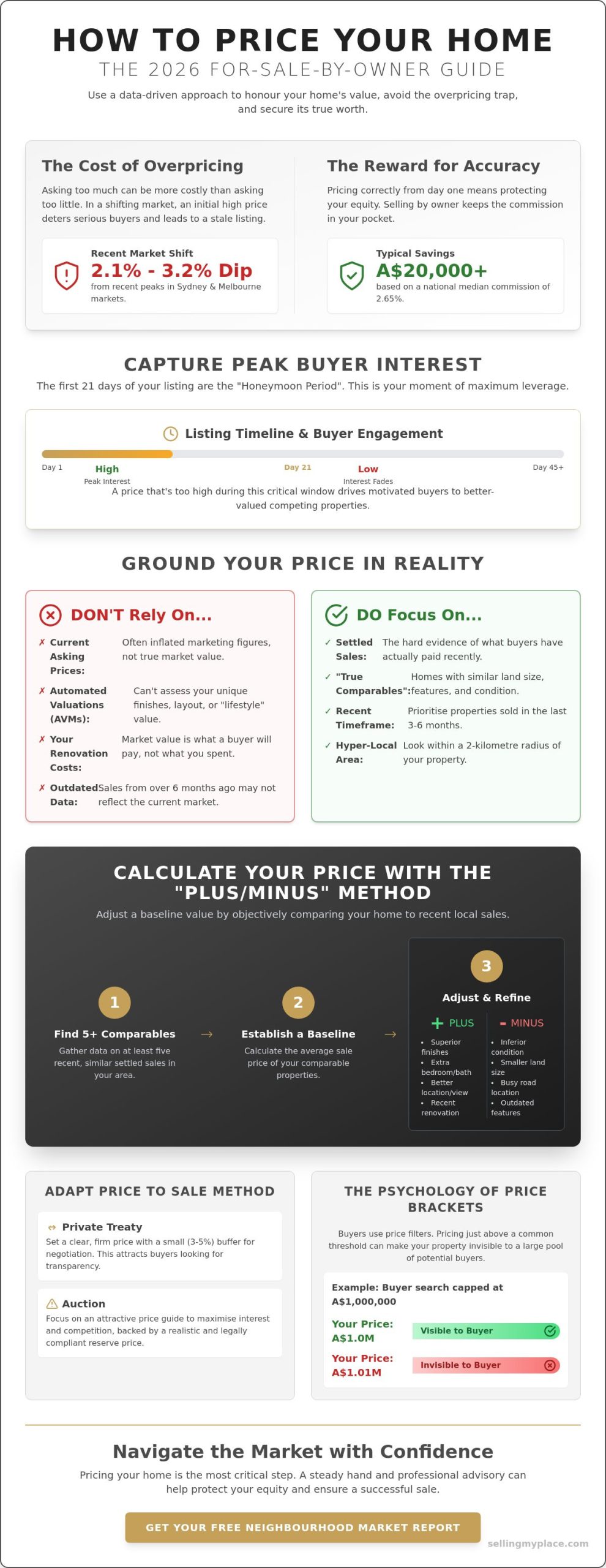
What if the most expensive mistake you make this year isn’t paying too much for your next house, but asking too much for the one you’re selling? It’s a valid worry. When you take the reins and look at how to price your home for sale by owner, the weight of protecting your family’s legacy can feel immense, especially with Sydney and Melbourne markets showing a 2.1 to 3.2 percent dip from their recent peaks. You want to honour your home’s value without scaring off the very buyers you need to attract.
We understand this isn’t just a transaction; it’s the start of your next chapter. Determining your property’s worth doesn’t have to be a source of late-night stress. By using a data-driven approach, you can avoid the overpricing trap, secure a price that reflects your home’s true worth, and keep the median national commission of 2.65 percent; often A$20,000 or more; exactly where it belongs: in your bank account.
This 2026 guide provides the steady hand you need to navigate conflicting online valuations and new AML/CTF regulations. You will discover how to build a defensible asking price, choose between Auction and Private Treaty strategies, and walk into negotiations with the quiet confidence of a seasoned local expert.
Key Takeaways
- Understand why the first 21 days of your listing represent the “Honeymoon Period” and how to set a price that captures premium buyer interest before the momentum fades.
- Learn why relying on current portal asking prices can be a trap and how to use settled sales from the last six months to ground your valuation in market reality.
- Master the “Plus/Minus” method for how to price your home for sale by owner by adjusting for unique property features against at least five recent local sales.
- Discover the strategic differences between setting a negotiation buffer for a private treaty sale and choosing an effective auction reserve that avoids illegal underquoting.
- Recognise the value of a “steady hand” and how professional advisory services can help you protect your equity and navigate the complexities of 2026 property regulations.
The Strategy of Pricing: Why Your Opening Figure Defines Your Sale
Market value isn’t a figure based on your mortgage balance or the total cost of the renovations you’ve lovingly completed over the years. It is, quite simply, what a willing buyer is prepared to pay in the current Australian climate. When you’re researching understanding real estate appraisal, you’ll find that professional valuations rely on hard evidence and recent transactions rather than sentiment or hope. For those learning how to price your home for sale by owner, this distinction is your strongest shield. Your opening figure acts as a digital handshake; it’s the very first impression you make on your local community.
The first 21 days of your campaign represent the “Honeymoon Period”. This is when buyer excitement is at its absolute peak. New listings trigger immediate alerts for thousands of active house-hunters who are ready to act. If your price is too high during this window, you aren’t just “testing the market”; you’re actively driving motivated buyers into the arms of your competitors. They’ll use your overpriced home as a benchmark to justify buying the better-valued property just a few streets away. Positioning your home as the best value in your suburb doesn’t mean underselling; it means pricing with a steady hand to generate the competition that ultimately drives a record result.
The Psychology of the Australian Buyer
Australian buyers are savvy and time-poor. They use digital filters on major portals to scan specific price brackets. If you price your home at A$1,005,000, you’ll vanish from the searches of every buyer who has capped their limit at a round A$1,000,000. While “Offers Over” might seem like a clever way to spark interest, it can sometimes feel evasive to a buyer looking for transparency. A clear, grounded price invites an honest conversation and builds the trust necessary for a high-stakes negotiation.
The Cost of Getting it Wrong
When a listing sits on the market for too long, it becomes “stale” in the eyes of the public. Buyers start to wonder if there’s a hidden structural issue or perhaps a difficult settlement condition. This suspicion leads to low-ball offers that wouldn’t have dared surface during your first week. A price reduction often results in a lower final result than a correct initial price. By pricing accurately from the start, you protect your equity and avoid the exhausting cycle of chasing a cooling market downward. You deserve a sale that feels like a victory, not a compromise.
Data Over Guesswork: Using Comparative Market Analysis (CMA)
When you’re trying to figure out how to price your home for sale by owner, it’s tempting to scroll through Realestate.com.au and see what the neighbours are asking. This is a common trap. Asking prices are merely marketing signals, often inflated by hope or agent promises. Instead, you need to look at “Settled Sales”. These are the cold, hard figures of what has actually changed hands in the last six months. In a 2026 market where Sydney and Melbourne have seen values dip by over 2 percent, using data from a year ago could leave your property sitting idle while the market moves away from you.
Finding “True Comparables” is an art. It’s not enough to find a three-bedroom house in the same postcode. You must look for properties on similar land sizes, with comparable finishes, and ideally within a two-kilometre radius. For those in New South Wales, the NSW Government’s guide to selling property offers a helpful framework for the legal steps involved in these transactions. Identifying whether your specific pocket is rising, flat, or softening allows you to position your price with surgical precision. If you feel overwhelmed by the data, a quick Neighborhood Market Report can clarify the local landscape for you.
Beyond the Free Online Valuation
Automated valuation models, or AVMs, are helpful starting points, but they are limited by their algorithms. They can’t see the premium stone in your kitchen or the way the afternoon sun hits your deck. They miss “lifestyle” value; the emotional pull that makes a buyer pay a premium. Obtaining a Neighborhood Market Report provides the granular detail that a standard online estimate simply cannot reach. This helps you identify “outlier” sales, such as a property sold under duress or a family transfer, which might otherwise skew your data and lead to a pricing mistake.
Professional Appraisal vs. Agent Estimates
Mastering how to price your home for sale by owner requires moving past the “agent appraisal”. Some agents may “buy the listing” by quoting an unrealistically high price just to secure your signature. An independent advisory service offers a more objective view, focusing on your family’s needs rather than a commission. While a bank valuation is often conservative to protect the lender, a professional market appraisal considers the emotional appeal of your home. Investing in professional floorplans and photography further justifies a top-of-range price, showing buyers exactly why your property is worth their investment.
Auction vs. Private Treaty: Adapting Your Price to the Method
Choosing between an auction and a private treaty isn’t just about the date on the calendar. It’s about how you invite people into your home’s story. When you’re deciding how to price your home for sale by owner, the method you choose changes the psychology of every interaction with a potential buyer. A private treaty sale is often a thoughtful, one-on-one conversation, while an auction is a public display of competitive desire. Both require a different approach to your figures to ensure you don’t leave money on the table.
For unique or high-end Australian properties, you might even consider an “Expressions of Interest” (EOI) campaign. This approach keeps the price hidden and asks buyers to put forward their best offer by a certain date. It’s a sophisticated way to let the market define the value without the pressure of a public auction. Regardless of the method, your reserve price must reflect current market reality. With national home values showing zero growth in May 2026, setting a reserve based on last year’s records could see your property passed in, which is a stressful outcome for any family.
Pricing for Private Treaty
In a private treaty sale, setting a “buffer” is a standard part of the negotiation dance. We often recommend the “5% Rule”: your asking price should rarely be more than 5 percent above your target price. If you go higher, you risk scaring off the very people who would have fallen in love with your home. If a buyer asks, “What is your bottom line?”, you don’t need to give away your position. Instead, focus on the value you’ve built. A “steady hand” response might be: “We’re looking for a fair market result based on recent local sales; we’re happy to consider any serious offer you’d like to put in writing.”
The Auction Price Guide
Auctions rely on competitive tension. This is where the price guide strategy comes in, but you must be incredibly careful to avoid illegal underquoting. In Victoria, 2026 regulations now require reserve prices to be published earlier to increase transparency. A lower, attractive guide can lead to a higher finish by bringing more people to the front lawn on the day. However, your price guide must be a genuine representation of what you would actually accept. The reserve is your ultimate safety net. While it stays confidential until the auctioneer calls the property “on the market”, it should be grounded in the data we discussed in the previous section.
Step-by-Step: How to Calculate Your Final Listing Price
Now that we’ve moved past the theory, it’s time to get down to the actual arithmetic of how to price your home for sale by owner. Start by collating at least five settled sales from the last 180 days within a two-kilometre radius of your front door. These aren’t just addresses on a map. They’re the benchmarks for your success. Once you have these figures, look at what’s currently “active” on the market. Buyers are comparing your home to these listings right now, so you need to know exactly what they’re seeing at Saturday open homes to ensure your property stands out as the superior choice.
Applying the “Plus/Minus” method helps you account for the unique soul of your property compared to those recent sales. If a comparable house had a pool and yours doesn’t, you might subtract A$20,000 from their sale price to find your baseline. Conversely, if your home is on a quiet cul-de-sac while the neighbour’s is on a busy road, you might add A$10,000 to your estimate. This process ensures your figure isn’t a guess but a calculated reflection of the local landscape. Before you commit to a number, sense-check your findings with an independent Agent Advisory Service to ensure your logic holds up under scrutiny.
The Plus/Minus Adjustment Framework
Valuing an extra bedroom or a renovated kitchen requires a steady hand and an eye for current buyer trends. In 2026, a dedicated home office or a high-end kitchen renovation can significantly sway a buyer’s emotional needle. High-quality curb appeal and professional photography can add 2 to 3 percent to your perceived value by creating a powerful first impression before a buyer even steps inside. Don’t forget to distinguish between the land value; which is often the primary driver in capital cities; and the improvement value of the dwelling itself.
Finalising the “Sweet Spot”
Choosing your final listing price requires a bit of search engine savvy. While “charm pricing” like A$899,000 works in retail, real estate portals often use A$50,000 increments. Selecting a round number like A$900,000 ensures you appear in searches for both people looking up to that limit and those starting from it. We recommend preparing an “Evidence File” containing your research to show buyers exactly why your price is fair and defensible. For more on how to maximise your home’s appeal before you list, see our guide on Pre-Sale Property Consulting.
Ready to lock in a price that protects your family’s future? Our Real Estate Advisory Services provide the professional oversight you need to launch your campaign with total confidence.
The Expert Edge: Why Professional Advisory Beats a Generic Valuation
Selling your family home is one of the most emotional transitions you’ll ever undertake. It represents years of memories and a significant portion of your financial legacy. While you’ve now learned the mechanics of how to price your home for sale by owner, taking this journey alone can still feel daunting. Choosing a “sale by owner” path doesn’t mean you have to be isolated. In fact, the most successful sellers are those who pair their local knowledge with a professional support system. The Kincade Agent Advisory Service provides that essential “steady hand”, offering the calm confidence needed to navigate high-stakes pricing in a shifting 2026 market.
Accuracy in your initial figure does more than just attract buyers; it streamlines the entire back-end process. When your price is grounded in reality, the conveyance process often moves faster because bank valuations are more likely to align with the contract price. This reduces the risk of a sale falling through due to finance issues. Additionally, using professional floorplans and photography is vital for communicating value to the increasing number of interstate and overseas buyers looking at Australian property. These tools allow a buyer in Perth or London to walk through your home virtually, giving them the confidence to make a premium offer without a physical inspection.
Leveraging a Global Marketing Network
Many sellers worry that they’ll miss out on “premium” buyers by not using a traditional agency. The reality is that international exposure often finds the very buyers local agents overlook. By listing on major portals until your property is sold, you remove the artificial time pressure of a standard 90-day agency agreement. You can hold out for the price your home truly deserves. Best of all, the flat-fee advantage means you could keep A$20,000 or more in your pocket at settlement. Before committing to any selling arrangement, it’s worth reviewing a detailed flat fee vs commission real estate Australia comparison to understand exactly how much of your equity you stand to protect. That is a significant sum that can be better spent on your next chapter or your family’s future stability.
Your Next Steps to a Successful Sale
The path to a record-breaking result starts with preparation. Your first step is to gather the most current data available for your specific pocket of Australia. Don’t rely on guesswork when the stakes are this high. You can organise your Neighborhood Market Report today to see exactly how your property compares to recent settled sales. Once you have your data, booking professional photography will ensure your home’s true worth is showcased to the world from day one. Ready to take the lead? You can get started with a flat-fee marketing package right now and take full control of your sale with our expert guidance by your side.
Your Path to a Record Result Starts Today
You now have the clarity needed to navigate the shifting 2026 property landscape with total confidence. By prioritising settled sales over hopeful asking prices and aligning your figure with digital search brackets, you’ve mastered the most critical lessons on how to price your home for sale by owner. This data-driven approach protects your hard-earned equity and ensures your home stands out during that vital “Honeymoon Period” of the listing.
You deserve a sale process that respects your time and your family’s financial legacy. Our partnership model provides the professional tools and the steady hand of an expert advisor without the burden of traditional agency costs. Save thousands and sell smarter with our Flat-Fee Marketing Packages. You’ll benefit from an average saving of A$20,000 in commissions, a listing that stays active until sold with no time limits, and our comprehensive Agent Advisory Service included in every package.
Take the lead on your property journey today. We’re here to help you achieve the exceptional result your home deserves and your family’s future requires.
Frequently Asked Questions
Is a free online property valuation accurate enough to set my price?
Free online valuations use algorithms that often miss the specific lifestyle features and unique soul of your home. While they provide a helpful starting point, they can’t account for your recent high-end kitchen renovation or the quietness of your particular cul-de-sac. For a reliable result on how to price your home for sale by owner, you must combine these digital estimates with a deep dive into recent settled sales data from your immediate area.
What is the difference between a bank valuation and a market appraisal?
A bank valuation is a conservative assessment designed to protect a lender’s risk; it’s often significantly lower than what you’d expect. A market appraisal considers current buyer demand, emotional appeal, and the competitive nature of the local landscape. It reflects what a person is actually willing to pay on the open market today rather than just the asset’s “safe” value for a mortgage.
How do I avoid “underquoting” when selling my own home in Australia?
Underquoting occurs when a property is advertised for less than the seller’s true asking price or the estimated market value. To stay compliant with Australian state laws, ensure your advertised price guide is a genuine reflection of what you would accept at settlement. Keep a clear file of recent comparable sales to justify your figure if authorities or buyers ever query your pricing strategy during the campaign.
Should I price my home higher to leave room for negotiation?
While it’s tempting to add a large buffer, pricing too high often backfires by scaring off your best buyers during the vital first three weeks. We recommend the “5% Rule”, where your asking price is no more than 5 percent above your target. This leaves enough room for a healthy conversation without making your home look like poor value compared to other active listings in your suburb.
How often should I review my price if the property hasn’t sold?
You should review your price every 14 to 21 days if you aren’t seeing consistent enquiry or inspection numbers. The market speaks quickly. If the “Honeymoon Period” passes without a serious offer, it’s a clear signal that your initial figure might be slightly out of step with current buyer expectations. A quick adjustment can often reignite interest before the listing becomes stale.
Can I change my price once the property is listed on realestate.com.au?
Yes, you have the flexibility to update your price at any time through your listing dashboard. These changes typically flow through to major portals like realestate.com.au almost immediately. It’s often a smart move to adjust your figure if you notice you’re sitting just outside a popular search bracket, such as A$1,005,000 versus a round A$1,000,000, to capture a wider audience of house-hunters.
What is a CMA and why do I need one for a sale by owner?
A CMA stands for Comparative Market Analysis. It’s a detailed report that compares your property to similar homes that have actually changed hands nearby in the last six months. This is an essential tool for anyone learning how to price your home for sale by owner because it provides the hard evidence you need to negotiate firmly and confidently with potential buyers during the final stages of a sale.
How do I handle a buyer who says my home is overpriced?
When a buyer claims your home is overpriced, stay calm and ask them which recent settled sales they are using as a comparison. Often, buyers use “asking prices” of other homes rather than actual sale results. By presenting your own Evidence File of recent local transactions, you can steer the conversation back to the facts and protect your equity with a steady hand and quiet confidence.
