Off market property in Melbourne and Sydney: how to find one
An off-market property isn’t automatically a bargain. In Melbourne, buyers can uncover these homes through relationships with local selling agents, a wider personal network and professional buyer representation, with finance pre-approval helping them act when a suitable property appears.
It’s easy to assume “off market” and “pre-market” mean the same thing, or that a private sale must come with a lower price. The distinction matters: an off-market home is sold without public advertising, while a pre-market home is usually shown to a small group before an expected public launch.
This guide explains how buyers can find off-market homes in Melbourne and Sydney, what separates off-market from pre-market listings, and why a seller might prefer a private sale. You’ll also see how privacy, personal circumstances and the prospect of avoiding a public campaign can shape a seller’s decision, so you can approach the search with clearer expectations.
Key Takeaways
- A buyer’s agent can use relationships with selling agents and broader networks to hear about homes before they reach public listings.
- Pre-market usually means a short first opportunity to buy before a public launch; a private off-market campaign may remain private.
- Privacy, personal circumstances and a preference for a less public sale can influence a seller’s choice of approach.
- In Sydney, a private sale doesn’t automatically mean a lower price: competition and the seller’s expectations still matter.
- Neighbourhood Market Reports can help put local property choices in context, while Buyer Representation can support a more focused search.
How can a buyer’s agent help you find off-market properties in Melbourne?
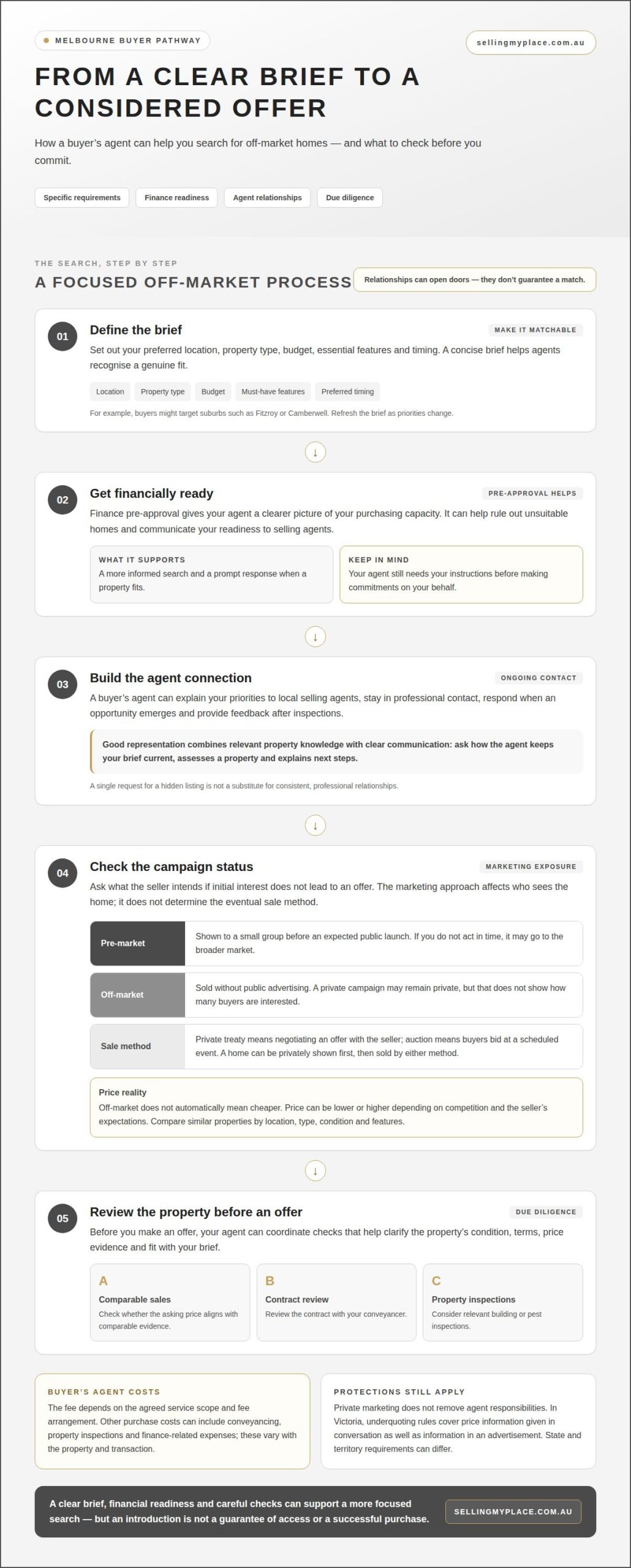
A buyer’s agent searches through selling-agent relationships and professional networks, then assesses whether each property suits your brief. For buyers targeting suburbs such as Fitzroy or Camberwell, that means sharing clear requirements, financial readiness and preferred timing with an advocate who can speak directly with local estate agents. An off-market property search is most useful when the brief is specific enough for agents to recognise a genuine match.
Relationships are built through regular, professional contact, not a single request for a hidden listing. A buyer’s agent can explain your priorities to selling agents, respond promptly when an opportunity emerges and give useful feedback after inspections. A concise brief covering location, property type, budget and essential features helps agents match a home to your needs. The agent can also refresh that brief as your priorities change.
When choosing representation, look for relevant property knowledge and clear communication with selling agents. Ask how the agent keeps your brief current, assesses a property and explains next steps. Strong relationships can lead to introductions, but they don’t guarantee access to a suitable home or a successful purchase. A sound process matters just as much as an introduction.
Finance pre-approval gives your buyer’s agent a clearer picture of your purchasing capacity. It can help them rule out unsuitable opportunities, communicate your readiness to selling agents and respond decisively when a property fits. Your agent still needs your instructions before making commitments on your behalf. Being prepared can help avoid delays when a seller is considering interest privately.
Consumer protections still apply when a home isn’t advertised. Australian state consumer laws apply to property agents whether or not a home is advertised. In Victoria, rules against underquoting cover price information given to a buyer in conversation, not just information in an advertisement. Private marketing doesn’t remove these responsibilities.
What fees and costs apply? A buyer’s agent’s fee depends on the agreed service scope and fee arrangement. Other purchase costs can include conveyancing, property inspections and finance-related expenses, which vary with the property and transaction.
What due diligence should the agent help complete? Before you make an offer, the agent can coordinate a review of comparable sales, the contract with your conveyancer, and relevant building or pest inspections. These checks help clarify the property’s condition, terms and fit with your brief, including whether the asking price aligns with comparable evidence.
Do practices differ between states and territories? Yes. Consumer laws apply across Australian states and territories, but specific requirements can differ. In Victoria, the rules also cover verbal price information. An agent working across state borders needs to understand the rules applying where each property is located. This matters when an off-market property search spans more than one jurisdiction.
Pre-market versus off-market properties
The difference is what happens after selected buyers see the home: a pre-market property is expected to reach public listings, while a private campaign stays off the public market. That distinction affects how buyers judge the time available and the likely audience for a sale.
Off-market and on-market sales
An on-market sale is publicly advertised, while an off-market sale proceeds without public advertising. Buyers can find public listings online, but private opportunities are introduced through agents or networks. The marketing method shapes who sees the property, not the legal form of the eventual sale.
A pre-market home is shown to a small group before an expected public launch. If a buyer doesn’t act in time, the property may go to the broader market. In a private campaign, the seller may keep marketing without moving to public listings. Ask what the seller intends if initial interest doesn’t lead to an offer.
This distinction can affect your decision. A pre-market viewing may provide an early opportunity, but waiting could mean competing with more buyers after launch. A private sale may have a smaller initial audience, but that doesn’t tell you how many buyers are interested or what the seller will accept.
Comparing sale methods
Off-market and on-market describe marketing exposure; private treaty and auction describe how the sale is conducted. In a private treaty, the buyer negotiates an offer with the seller. At auction, buyers bid against one another at a scheduled event.
These choices can occur at different stages. A seller may first show a home privately, then advertise it and proceed by private treaty or auction. The early marketing approach doesn’t determine the eventual sale method, so understand both before deciding how to proceed.
For example, if an advertised home is going to auction, your approach differs from negotiating directly with a seller. The sale method affects how an offer is made and when the seller considers it. Marketing status alone doesn’t answer those questions.
Prices of off-market properties
Privately marketed homes aren’t necessarily cheaper than publicly listed properties. Their prices can be lower or higher, depending on competition and the seller’s expectations. Limited exposure doesn’t automatically create a discount, and a pre-market price may not be the seller’s final position.
Compare similar properties by location, type, condition and features. A renovated home and one needing substantial work may be poor comparisons, even in the same area. Treat an asking price as a starting point for assessment, not proof of value.
For buyers and sellers weighing different approaches, discussing property sale options can help clarify which campaign suits their circumstances.
Why do sellers sell off-market?
For a seller, a private sale can offer more control over who sees the home and how it is presented. The reasons often reflect practical pressures or personal circumstances, rather than one preferred way to sell.
Reasons for choosing an off-market sale
An off-market sale lets a vendor test interest without starting with a public campaign. That can suit someone facing financial pressure, a change in personal circumstances or a preference to avoid the attention of a public sale.
Marketing costs can also influence the decision. A seller may weigh campaign spending against the chance of attracting more buyers through public advertising. A private approach may appeal if the vendor already has a likely buyer in mind or discretion matters more than broad exposure.
There’s no universal reason. One seller might want to manage a sale alongside a family change; another might prefer to avoid auction preparations and public competition. The choice reflects the vendor’s priorities, the property and the circumstances around the sale.
Reasons for choosing a quiet sale
A quiet sale limits public attention and can give a seller more control over access to the home. For example, a vendor who values privacy may prefer selected buyer enquiries over a publicly promoted campaign.
It can also reduce the disruption of preparing for open inspections. A public campaign may involve open inspections twice a week for six weeks, requiring the seller to keep the home ready for visitors. A private sale may help avoid that routine, which can matter for a busy household, family commitments or a home that’s difficult to prepare repeatedly.
Some sellers feel anxious about auctions, crowds or having neighbours and passers-by view their home. A quieter process can feel more manageable, particularly when the vendor wants conversations to focus on serious interest rather than public attention.
The trade-off is reach. A seller choosing privacy may expose the property to fewer buyers than a public campaign, which can affect competition. For a buyer, a quiet sale isn’t automatically a sign of urgency, a bargain or a seller willing to accept any asking price.
Seller circumstances can change. A vendor may begin privately, then decide to advertise if initial interest doesn’t lead to an acceptable offer. That possibility matters when buyers weigh whether to act promptly or wait for wider exposure. Each approach brings different considerations around privacy, preparation and buyer reach.
Ultimately, the vendor balances discretion and convenience against the potential benefits of a broader campaign. Understanding whether privacy, financial pressure or inspection demands are driving the choice helps buyers read the situation more clearly, without assuming the seller’s motivation or expected price.
Off-market and pre-market property listings in Sydney
Sydney buyers may encounter a home before its public launch or through a private campaign. Knowing how listings, price ranges and search bands work can help you judge opportunities without treating an early price as a final measure of value.
A selling agent may list a property before it’s ready to appear on public property websites. The period between listing and readiness can be about a week. During that window, an agent may speak with selected buyers. If the home is pre-market, it is expected to go to the broader market if a buyer doesn’t act in time. That timing gives interested buyers an early look, but doesn’t necessarily mean the seller will keep the sale private.
Sydney listings show how much prices vary by location and property type. These figures describe different sale contexts, so compare like with like rather than assuming every displayed range has the same meaning.
Search bands also appear across a mix of homes and apartments. Property type, location, size and condition all shape which comparisons are useful.
One concern is overpricing, sometimes associated with “buying the listing”: a seller chooses an agent based on an ambitious price estimate. A displayed range alone can’t establish that a home is fairly priced. The comparison matters more than the label attached to its marketing.
How can a buyer’s agent help estimate value? They can assess comparable sales, location, property type, size and condition, then weigh those against the seller’s asking price. For Sydney examples, that means treating a search band as a guide, not a substitute for property-specific analysis.
An off-market listing isn’t necessarily cheaper than a public listing. Its price may be lower or higher, depending on competition and the seller’s expectations. Whether considering a house in The Ponds or an apartment in Coogee, assess the evidence behind the asking price before deciding what the opportunity is worth. Beyond the property itself, researching neighbourhood amenities and local activities, such as pinnaclemartialarts.com.au, can help families determine whether a particular Sydney suburb suits their everyday lifestyle.
What an off-market property sale is
The phrase describes a marketing choice, not a separate kind of property ownership. For buyers, that distinction separates what an agent is doing to find an audience from the decisions involved in making an offer.
A private introduction can begin a conversation, but it doesn’t itself create an agreement to buy. The buyer and seller still need to settle the terms and proceed through the usual sale process. Treat an agent’s message as an invitation to consider the home, not as a substitute for written sale documents.
For example, a buyer may hear that a home could be available and ask to inspect it. That enquiry doesn’t mean the seller has accepted an offer or agreed to stop considering other interest. Clarify whether the seller is inviting offers, discussing a possible sale or simply gauging interest.
Marketing status can change. A seller who begins with private conversations may later choose broader advertising. Understand what the seller is currently considering and whether the opportunity remains private, rather than assuming an early approach guarantees exclusive access.
The label says nothing by itself about price, condition or competition. A buyer still needs to judge the home against relevant evidence and their own requirements. A quiet introduction may feel personal, but it shouldn’t replace a careful decision about the property and proposed terms.
For sellers, the choice is about how to introduce the home to potential buyers and how much public exposure to seek. Consider those priorities alongside the intended campaign to clarify which marketing approach fits the sale.
Sellers considering their next move can discuss property sale options before choosing how to present their home.
Kincade International Direct Sales: Neighborhood Market Reports
Kincade International Direct Sales offers Buyer Representation to support buyers searching for a home. Its Neighborhood Market Reports can help you put property choices in context when weighing a privately presented home against comparable properties.
For sellers, Pre-Sale Property Consulting can help clarify sale considerations before choosing an approach, while Residential Property Listing Services support owners preparing to market a home. The right next step depends on whether you’re buying, selling or still shaping your plans.
If you’d like to discuss your property goals, contact Kincade International Direct Sales.
Take the next step with a clear property plan
Before pursuing an off-market property, decide what matters most: the location, the features you can’t compromise on and the terms you’re prepared to consider. A clear brief gives a property professional a practical basis for assessing opportunities and keeping your search aligned with your plans.
If you’re buying, Kincade International Direct Sales offers Buyer Representation to support your search. If you’re preparing to sell, its Residential Property Listing Services and Pre-Sale Property Consulting can help you consider your options and plan the next stage. The right support depends on where you are in the property journey, whether you’re finding a home or preparing for a move.
You don’t need every detail settled before taking a first step. A conversation can help you clarify your priorities and decide what support would be useful.
Contact Kincade International Direct Sales to discuss your property goals and take the next step with confidence.
Frequently Asked Questions
What Does Off-Market Mean in Real Estate?
In real estate, off-market means a home is offered for sale without public advertising. A buyer might hear about it through a selling agent or buyer’s agent rather than an online listing. The term describes the marketing approach, not the property’s condition, contract or likely price. For example, a home discussed privately with selected buyers can still attract competing offers.
Do consumer protections still apply to off-market sales?
Yes. Australian state consumer laws apply to property agents whether or not a home is advertised. In Victoria, rules against underquoting cover price information given to a buyer in conversation, not just information in an advertisement. A private introduction doesn’t remove agent responsibilities. Buyers should still consider the price information, sale documents and property details carefully before deciding whether to proceed.
How can a buyer’s agent help you find off-market homes?
A buyer’s agent can share your property brief with selling agents and relevant professional contacts, then assess homes that match your requirements. A clear brief can distinguish a genuine fit from a property that misses an essential feature. The agent can also help coordinate inspections and discussions about an offer, so you can focus on whether the home suits your plans.
Off-Market vs On-Market: What’s the Difference?
An off-market home is offered without public advertising, while an on-market home is promoted to the broader public. That changes how buyers encounter the listing: one may come through an agent’s direct contact, while the other can be found through public advertisements. Neither approach establishes the home’s value or guarantees a particular level of buyer competition, so assess each property on its merits.
What Is an Off-Market Sale?
An off-market sale is a property sale conducted without publicly advertising the home. Private marketing does not by itself make a property purchase informal; buyers should review the sale documents and check who they are dealing with. For a buyer, the practical distinction is how the opportunity is introduced, not whether the transaction is informal. Review the property information and proposed contract terms as you would for any significant purchase.
What does off-market property mean in Australia?
In Australia, an off-market property is a home offered for sale without public advertising. It may be introduced directly to selected buyers, but “off market” doesn’t mean the property is unavailable to others or priced below market value. A seller can consider private interest while retaining the option of wider exposure. The phrase describes marketing status, not a special property category.
How do off-market property sales work in Australia?
A seller can authorise private marketing, and an agent may introduce the home to buyers who appear to fit. An interested buyer can arrange a viewing and discuss an offer with the seller. If they agree to proceed, the sale uses a normal contract of sale. Private marketing doesn’t remove the need to understand the property’s condition, price and contract terms.
Where can a buyer’s agent find off-market properties in Australia?
A buyer’s agent may hear about private opportunities through relationships with selling agents and wider professional networks. A buyer’s own connections can also surface a potential introduction, though the agent can help assess whether the property matches the search brief. In practice, a focused brief covering preferred locations, property type and essential features makes it easier to identify relevant opportunities across Australia.
Buyer Advocates in Australia: Navigating the Property Market with Expert Support
What if your Saturday mornings weren’t spent rushing between mediocre open homes, only to watch a property you loved sell for well over your limit at a frantic auction? It’s a common story in our current market, and frankly, it’s exhausting to feel like you’re always one step behind. Most Australians now realise that navigating this landscape alone is a recipe for burnout, which is why more people are turning to buyer advocates to level the playing field. You likely share that nagging fear of overpaying or, worse, accidentally buying a “lemon” with hidden defects just to finally end the search.
By partnering with an expert, you’re no longer walking that high-stakes path alone. This article reveals how professional support can help you secure your ideal property while saving you time, stress, and thousands in negotiation. We’ll explore the strategic advantages of accessing silent or off-market listings and the peace of mind that comes from having a steady hand by your side. You’ll discover how a dedicated advocate turns a stressful chore into a calculated investment move, ensuring a seamless transition into your next chapter without the usual property-hunt fatigue.
Key Takeaways
- Understand why a licensed professional is vital for balancing the scales against selling agents who are focused solely on the vendor’s result.
- Discover the strategy behind accessing off-market and “silent” listings to avoid the exhaustion of the public auction cycle and aggressive competition.
- Learn how the fee structures for buyer advocates work and how expert negotiation can effectively pay for itself by securing a better purchase price.
- Identify how to verify credentials and evaluate a negotiator’s “steady hand” to ensure they align with your family’s long-term lifestyle goals.
- Explore how reinvesting the $20,000 typically saved from a commission-free sale can provide the professional support needed to secure your next home.
What is a Buyer Advocate and Why are They Vital in Today’s Market?
Buying property in 2026 often feels like a high-stakes chess match where the other side has already memorised your moves. When you walk into an inspection, the selling agent is charming, helpful, and polite. However, their legal and financial loyalty lies entirely with the vendor. Their job is to extract the highest possible price from your pocket. This is where buyer advocates step in to change the dynamic. By hiring a licensed professional to act exclusively for you, you’re no longer the underdog. You’re a prepared buyer with a seasoned strategist in your corner.
Not all support looks the same. You might choose a “search and select” service if you’re time-poor but feel confident in your bidding. Alternatively, full “negotiation and auction” representation provides a protective shield during the most stressful moments of the transaction. In a market that often feels driven by fear of missing out, having an objective expert helps you stay grounded. They replace emotional urgency with cold, hard data, ensuring you don’t overpay in the heat of the moment.
The Key Roles of a Professional Advocate
Think of your advocate as a filter that catches the “lemons” before they sour your future. Their role extends far beyond just browsing online listings. It’s about providing a steady hand through a complex process.
- Property sourcing: They find homes that actually suit your lifestyle and long-term financial goals, often uncovering hidden gems before they even hit the public portals.
- Due diligence: They’re trained to spot structural red flags, restrictive easements, or upcoming zoning changes that could impact your property’s value.
- Negotiation: They handle the back-and-forth theatrics of selling agents, using their experience to secure the best possible terms without you ever feeling pressured.
Advocate vs. Selling Agent: Understanding the Legal Divide
The distinction here is absolute. An advocate never works for the seller on the same transaction; there is no “middle ground” or dual agency allowed. This independence is what protects your interests. While a selling agent wants the highest price, your advocate wants the lowest price and the most favourable conditions. A buyer advocate has a strict fiduciary duty to act solely in the best interests of the purchaser at all times.
By removing the emotional weight of the search, these experts allow you to focus on the excitement of your new chapter. They provide the professional authority needed to navigate the Australian market with confidence and clarity.
The Hidden Value: Accessing Off-Market and Silent Listings
Ever feel like the best houses are gone before the “For Sale” sign even hits the lawn? That’s because they often are. An off-market property is a home sold without a single public advertisement. No glossy brochures, no portal listings, and definitely no stressful weekend crowds. Vendors often choose this “silent” path for privacy, speed, or to avoid high marketing costs, especially when they want a discreet result. For you, the buyer, this is where buyer advocates truly earn their keep. They spend years building deep-seated relationships with local agents, ensuring they’re the first phone call made when a quiet listing becomes available.
Having the “first look” in a low-stock environment is a massive competitive advantage. While other buyers are busy refreshing their apps and waiting for the Tuesday morning updates, you’re already walking through a home that matches your brief. This industry network acts as an invisible bridge, connecting you to opportunities that the general public simply cannot see. It’s a proactive way to find a home that fits your family’s future without the noise of the open market.
Why Silent Listings are the “Holy Grail” for Buyers
Public auctions are high-pressure environments specifically designed to push prices up through competition. By contrast, a silent sale allows for a more human conversation. You aren’t just a number in a bidding war; you’re a serious purchaser dealing with a vendor who might value a specific settlement date or a lack of “theatrics” over the absolute highest bid. This approach significantly reduces the emotional fatigue that comes from the endless cycle of public inspections. It’s about finding those hidden gems that the rest of the market doesn’t even know exist, giving you the space to think clearly.
How Advocates Vet Properties Before You See Them
Your time is precious. A professional advocate doesn’t just send you every link that pops up; they act as a rigorous filter. They conduct pre-inspections to check for structural red flags or poor capital growth potential long before you step foot on the driveway. To ensure you’re making a sound investment, they use data-driven methods for how to determine market value of a home in australia. This benchmarking process means you aren’t guessing what a property is worth based on a vague guide price. Instead, you’re making an offer based on local reality and historical performance.
If you’re tired of missing out on the “good ones,” it might be time to chat with a specialist about what’s quietly available in your preferred area right now.
Analysing the Cost: Are Buyer Advocate Fees Worth the Investment?
When you’re already stretching your budget to reach a healthy deposit, adding a professional fee can feel like a bridge too far. It’s a fair question: is it actually worth paying for help to buy a home? To answer that, we need to look beyond the initial invoice and consider the long-term financial impact of a single mistake. In the high-pressure environment of Australian real estate, the “winner’s curse” is real. This happens when a buyer, driven by exhaustion and emotion, pays significantly more than a property’s true value just to end the search. By contrast, buyer advocates act as a circuit breaker, ensuring your investment is based on logic rather than fatigue.
The financial logic becomes clearer when you weigh the professional fee against the potential savings. A fee of $10,000 to $20,000 might seem substantial, yet it’s often a small price to pay if it prevents a $50,000 overpayment at a heated auction. For many of our clients, this investment is easily managed by reinvesting the $20,000 typically saved through our commission-free selling model. It’s a strategic cycle: you keep your profit when you sell, then use that surplus to ensure your next purchase is secured at the best possible price.
Fixed Fees vs. Percentage Commissions
Transparency is the foundation of a good partnership. In Australia, you’ll generally find two ways that buyer advocates charge for their expertise. Some use a percentage of the final purchase price, which can occasionally create a perceived conflict of interest; after all, if the price goes up, so does the fee. We believe a flat-fee model is often more reassuring for the purchaser. It provides total peace of mind because you know exactly what the cost is from day one. Your advocate’s only incentive is to find the right home at the lowest possible price, keeping their “steady hand” focused firmly on your budget goals.
Quantifying the “Invisible” Savings
There are also the “invisible” costs that quickly add up when you’re searching solo. Think about the hundreds of dollars spent on building and pest reports for properties you didn’t end up buying because you were outbid or discovered a late-stage red flag. An advocate’s rigorous vetting process means you only spend money on reports for homes that are genuine contenders. If you require a detailed assessment of a potential home, you can visit Lin Inspects to see how their professional services offer peace of mind. Then there’s the value of your time. Reducing a search from six months of wasted weekends to six weeks of targeted viewing is a massive win for your quality of life and your hip pocket.
Finding the right person to guide your property journey is about more than just checking a box; it’s about building a partnership based on trust and shared goals. Since this professional will be handling one of the most significant financial transitions of your life, you need to be certain their values align with yours. Start by verifying their basic credentials. Every legitimate advocate must hold a valid real estate licence in the state where you’re looking to buy. Beyond the legal minimums, look for membership in the Real Estate Buyers Agents Association of Australia (REBAA). This accreditation acts as a hallmark of quality, ensuring they adhere to a strict code of conduct and professional standards.
Once the paperwork is in order, pay close attention to their temperament. Do they lead with a “steady hand” and a sense of calm confidence, or do they rely on aggressive theatrics? In a heated auction environment, you want a negotiator who stays grounded when others are losing their cool. Their experience should also match your specific needs. An expert who specialises in high-yield investment units might not have the same nuanced understanding of what makes a perfect long-term family home. Always ask for a clear, written agreement that outlines every fee and service provided so there are no surprises down the road.
The Interview Checklist
When you sit down for a consultation, treat it like a job interview. You’re the boss, and you’re looking for the best possible candidate to protect your interests. Use these questions to peel back the layers of their service:
- “How many off-market deals have you closed in the last 12 months?” This reveals the actual strength of their local network and whether they can truly deliver on the promise of silent listings.
- “What is your process for conducting due diligence on a tight timeframe?” You need to know they can move fast without cutting corners on structural or legal checks.
- “Do you receive any kickbacks from selling agents or developers?” The answer must be a firm “no.” Any hint of a referral fee from the other side of the transaction is a total deal-breaker.
Red Flags to Watch Out For
Be wary of anyone who wears too many hats. A true specialist focuses solely on the buyer’s side. If they also sell property or offer “in-house” listings, a conflict of interest is almost inevitable. You should also be cautious of promises that sound too good to be true, such as “guaranteed” capital growth or “unbeatable” bargains. The market is unpredictable; a professional’s job is to manage risk, not make impossible claims. Finally, ensure they are transparent about their professional indemnity insurance. This is a non-negotiable layer of protection for you and your future home.
If you’re ready to find a partner who puts your family’s needs first, book a quiet chat with our team to see how we can support your next move.

The Kincade Advantage: Bridging the Gap Between Selling and Buying
Transitioning from one home to the next shouldn’t feel like a series of disjointed, high-stress transactions. For many Australian homeowners, the anxiety of selling a beloved family property is often matched by the fear of missing out on the right replacement. This is where we offer a unique advantage by bridging the gap between these two major life events. Our Residential Property Listing Services empower you to sell your home commission-free, ensuring you keep the hard-earned equity you’ve built over the years. By removing the traditional agency commission, the average seller saves $20,000, which can then be strategically reinvested into professional support for the next leg of the journey.
Rather than seeing this surplus as a simple saving, we encourage you to view it as the fuel for your next chapter. Reinvesting those funds into buyer advocates ensures that the profit you kept from your sale isn’t lost through an emotional overpayment on your next purchase. Having expert buyer advocates in your corner provides a synergy that few others can match; we understand the intricacies of the sell-side negotiation and apply that same “steady hand” philosophy to your buy-side representation. It’s a holistic approach. We prioritise your family’s long-term stability over quick, transactional results.
A Seamless Transition for Australian Homeowners
Managing the timeline of a move is often the most complex part of the process. You don’t want to be left without a roof over your head, nor do you want to be paying two mortgages at once. We help you align your sale settlement with your new purchase, providing a smooth path forward. By utilising our detailed neighbourhood market reports, you can benchmark both your sale and your buy with total confidence. We also share property sale negotiation tips that are equally applicable when you’re on the other side of the deal, ensuring you remain the most prepared person in the room.
Expert Backing Every Step of the Way
Our commitment to your success starts long before you sign a contract. Through pre-sale consulting, we help you maximise your sale price, ensuring you enter the buying market with the strongest possible financial position. Once you’ve found the right home, our advisory services extend to conveyance advice, ensuring every legal detail is handled with precision. This comprehensive support reduces the mental load of the transition, allowing you to focus on the excitement of your new community. We act as your protective guide, ensuring every decision is made with clarity and heart.
Enquire about our Buyer Representation and Advisory Services today to find out how we can help you transition into your next home with confidence.
Step into Your Next Chapter with Clarity and Confidence
Securing a property in a crowded market shouldn’t feel like a relentless uphill battle. By now, it’s clear that the strategic advantage of accessing silent listings and having a seasoned negotiator in your corner changes the dynamic of your search. Whether it’s avoiding a costly “lemon” or simply reclaiming your weekends, the support of professional buyer advocates turns a stressful transition into a calculated success. You’ve worked hard to build your equity; it’s only right that you protect it with a flat-fee model that offers total transparency and removes any conflict of interest.
With over 25 years of industry experience, our team is here to provide that “steady hand” you need during high-stakes decisions. Remember, the average seller saves $20,000 on commissions when they sell with us, and reinvesting that profit into expert representation is the smartest move you can make for your family’s future. You deserve a partner who values your long-term stability and community roots as much as you do. Secure your next home with confidence – explore Kincade’s Buyer Representation. We’re ready to help you turn the key on your next home with absolute peace of mind.
Frequently Asked Questions
What is the difference between a buyer advocate and a buyer’s agent?
In the Australian property market, these terms are used interchangeably to describe a licensed professional who acts exclusively for the purchaser. Whether you call them buyer advocates or buyer’s agents, their legal duty remains the same: to secure the best possible property at the lowest price for you. They provide a vital counterweight to selling agents, who are legally bound to achieve the highest price for the vendor at all times.
Do I really need an advocate if I’m only looking for a modest family home?
Even for a modest family home, professional support is invaluable because the emotional stakes are often much higher. It’s easy to get swept up in a bidding war for a property that feels like “the one,” potentially overpaying by tens of thousands. An advocate provides a steady hand and objective data, ensuring you don’t buy a home with hidden defects or poor growth potential. They protect your family’s long-term financial stability.
How much does a buyer advocate cost in Australia in 2026?
Fees for professional representation typically follow one of two structures: a flat-fee model or a percentage of the final purchase price. Many Australians now prefer the transparency of a flat fee, as it ensures there is no conflict of interest regarding the final sale price. While we don’t quote specific industry-wide figures, the investment is designed to pay for itself through expert negotiation and the prevention of costly mistakes at auction.
Can a buyer advocate help me at an auction?
Yes, bidding at auction is one of the most critical services provided by buyer advocates. They attend the auction on your behalf, using their experience to read the room and implement a specific bidding strategy. This removes the intense emotional pressure from you, preventing the “winner’s curse” where buyers bid well beyond their limit. Their calm, professional presence ensures the process remains a calculated business transaction rather than an emotional impulse.
Will an advocate find properties that aren’t listed on the major websites?
Accessing silent or off-market listings is a primary benefit of hiring a professional. These properties are sold without public advertising, often to maintain the vendor’s privacy or reduce marketing costs. Advocates spend years building networks with local selling agents to ensure they are the first to hear about these opportunities. This gives you a significant advantage, as you can view and negotiate on homes before they ever reach the major portals.
How do I know if a buyer advocate is truly independent?
True independence means the advocate only receives payment from you, the purchaser. You should ask directly if they receive referral fees or “kickbacks” from selling agents, developers, or mortgage brokers; the answer must be a firm no. Additionally, a truly independent advocate does not have a sales department. If they are also trying to sell properties, they cannot provide the unbiased representation you need to make a safe, long-term investment.
Can I use a buyer advocate if I am buying interstate?
Using an advocate is actually one of the safest ways to purchase property in a different state. They act as your local eyes and ears, conducting physical inspections and due diligence that you might not be able to perform yourself. Since property laws and market trends vary significantly across Australia, having a licensed professional who understands the local landscape ensures you don’t accidentally buy into an area with poor prospects or legal complications. This logic of seeking local expertise is a global standard; for instance, buyers in the US market rely on professionals like Dr. Zakk Varughese, Real Estate Broker – HomesRX to provide the same level of protective, on-the-ground representation.
Most representation agreements are based on a specific timeframe, often six months, during which the advocate will continue to source and vet properties. If the initial search doesn’t yield the right result, a good advocate will refine your brief based on market feedback. The goal is a partnership, so they won’t pressure you into a home that doesn’t feel right. They are there to ensure you find a property that matches your lifestyle.
Navigating the Australian Property Market: How to Negotiate with a Buyer’s Agent
What if the A$20,000 you saved on your property sale wasn’t just a number on a balance sheet, but the strategic “war chest” that secures your next family home? For many Australians, the thought of re-entering the market brings a wave of genuine anxiety, especially when faced with the aggressive auction culture that defines our local landscape. You might worry about being locked into a restrictive exclusive agreement or, worse, paying a double commission that eats into your hard-earned equity. It’s a lot to manage while you’re trying to imagine your new life in a different neighbourhood. Understanding how to negotiate with a buyer’s agent is the key to transforming this stress into a grounded, professional partnership.
We believe your property journey should feel like a supported transition, not a transactional battle. In this article, you’ll learn the professional tactics to negotiate terms with a buyer’s advocate so their expertise works solely for your benefit. We’ll show you how to move past the industry jargon and secure a transparent, flat-fee agreement that feels fair and protective. We will explore how to access those elusive “silent” off-market listings and use professional auction bidding to shield your savings. It’s about finding that steady hand to guide you home with total confidence (and perhaps a bit of well-deserved excitement, too).
Key Takeaways
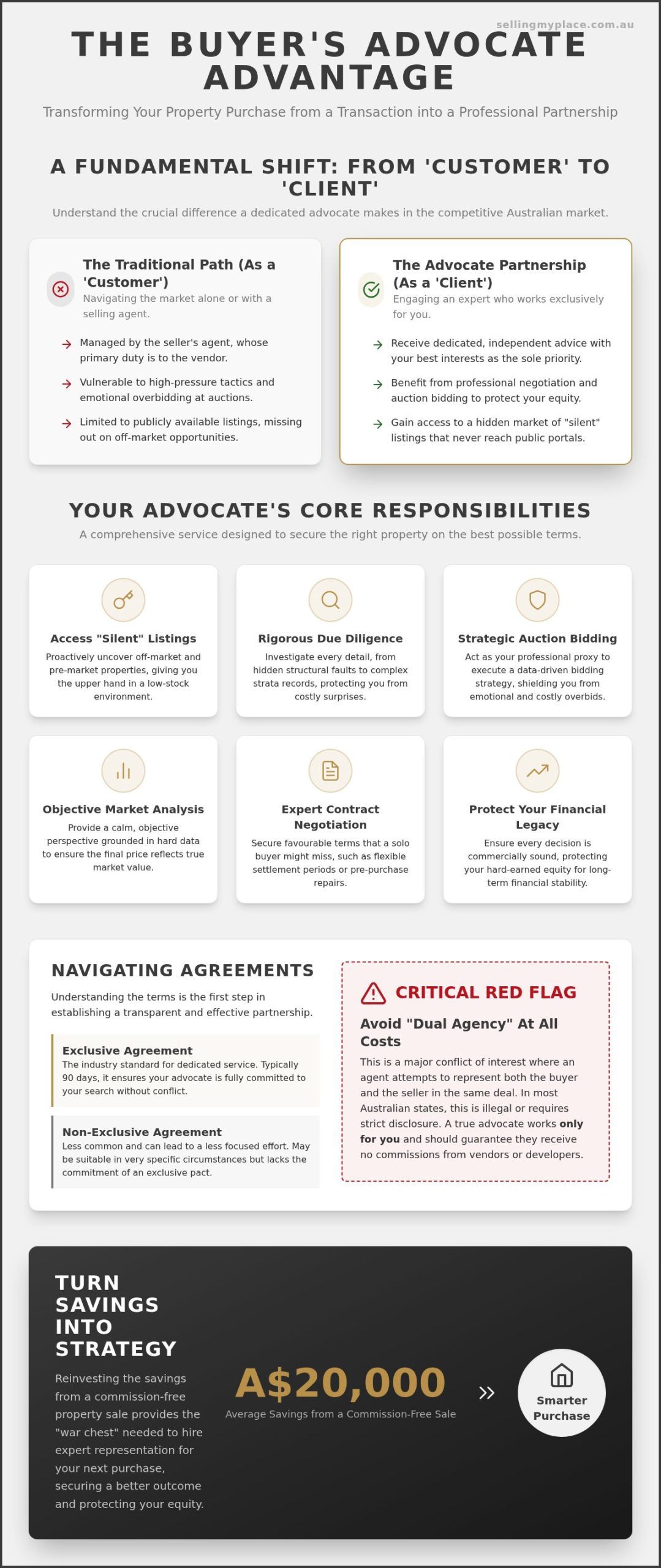
- Understand the vital shift from being a “customer” of a selling agent to a “client” with a dedicated advocate who works exclusively in your corner.
- Learn how to negotiate with a buyer’s agent to secure a transparent, flat-fee agreement that prioritises your long-term stability over a quick transaction.
- Gain the upper hand in the competitive Australian market by accessing “silent” off-market listings and professional bidding strategies that protect your equity.
- Identify and avoid “Dual Agency” conflicts of interest to ensure your representative remains a truly independent, steady hand throughout the process.
- Discover how reinvesting the average A$20,000 saved through a commission-free sale can provide the “war chest” needed to hire expert representation for your next purchase.
What is Buyer Representation and Why is it Essential in 2026?
In the Australian property market of 2026, the traditional way of buying a home has fundamentally shifted. For decades, purchasers were often treated merely as “customers” of the selling agent; someone to be managed rather than truly served. Today, buyer representation has evolved into a professional partnership where your advocate works exclusively for you. It’s a fiduciary alliance that moves you from the outside looking in to having a seat at the professional table. Understanding What is a Buyer’s Agent? is the first step in reclaiming your power during a purchase. With property stock levels remaining stubbornly low across the country, having a professional in your corner isn’t just a luxury. It’s a strategic necessity to access “silent” listings that never reach the public portals. Buyer representation is the professional insulation between a buyer and the high-pressure tactics of selling agents.
The 2026 market demands a different approach. It’s no longer enough to wait for an alert on your phone. You need someone who can walk into a local agency and ask about the homes that aren’t on the market yet. This proactive stance is what separates a successful purchase from a missed opportunity. When you learn how to negotiate with a buyer’s agent, you’re essentially hiring a steady hand to guide you through these complexities with heart and expertise.
The Core Purpose of a Buyer Advocate
A skilled advocate does more than just browse listings. They act as your eyes and ears on the ground, identifying properties that match your specific lifestyle needs long before the “For Sale” sign goes up. This includes a deep dive into the bones of a building. They execute rigorous due diligence to uncover potential deal-breakers, such as hidden structural issues or complex strata records that could drain your superannuation later. By removing emotional bias, they ensure every decision is grounded in data. They provide a calm, objective perspective when the stakes feel highest. It’s about finding the right fit for your family’s future, not just any house that’s available.
How Representation Protects Your Financial Legacy
Protecting your equity is at the heart of this partnership. We’ve all seen the adrenaline-fuelled energy of a Saturday auction lead to emotional overbidding. An advocate prevents this by acting as your proxy, ensuring the final bid aligns with true market value rather than a vendor’s optimistic expectations. Beyond the price, they secure favourable contract terms that a solo buyer might miss. This might mean negotiating a flexible settlement period to align with your own house sale or ensuring specific repairs are completed before you pick up the keys. They protect your financial legacy through expert, level-headed negotiation.
The Different Types of Buyer Representation Agreements in Australia
Entering into a formal agreement with a professional advocate is a significant milestone in your property journey. In Australia, these documents are governed by state specific legislation, such as the Property and Stock Agents Act or the Estate Agents Act. These laws ensure that your interests are protected through a clear legal framework. However, the fine print is where the real partnership is defined. Understanding how to negotiate with a buyer’s agent starts with recognising that these agreements are not one size fits all. They are negotiable tools designed to align your advocate’s incentives with your long term lifestyle goals.
One of the most critical elements to verify is the absence of “Dual Agency.” This occurs when an agent attempts to represent both the buyer and the seller in the same transaction. In most Australian jurisdictions, this is a clear conflict of interest and often illegal without rigorous disclosure. To ensure your advocate is truly independent, look for a clause that guarantees they receive no kickbacks or commissions from vendors or developers. A “steady hand” guide should only have one master: you.
Exclusive vs. Non-Exclusive Agreements
Most reputable advocates prefer an exclusive agreement, typically lasting for 90 days as per 2026 REBAA standards. While “exclusive” might sound restrictive, it’s often the only way to secure high quality off-market listings. Why? Because an advocate won’t tap into their private network or “silent” neighbourhood contacts if they feel you might bypass them at the last minute. Conversely, non-exclusive or “open” agreements are often used for auction bidding only. These are useful if you’ve already found the home but need a professional to handle the high pressure environment of the auction floor without the emotional fog of war.
Standard Clauses You Must Understand
Before you sign a “Buyer’s Authority to Purchase,” pay close attention to the fee structure. You have the right to negotiate between a percentage-based fee and a transparent flat-fee model. Many families find that a flat-fee provides more peace of mind, as it removes any incentive for the agent to encourage a higher purchase price. You should also scrutinise the termination rights. Ensure there is a clear “sunset clause” that allows you to exit the partnership if the search isn’t progressing as expected. If you’re feeling unsure about the legalities, it’s always wise to reach out for professional advice before committing your signature.
Use this quick checklist before signing any representation document:
- Duration: Is the agreement capped at a reasonable timeframe, such as 60 or 90 days?
- Scope: Does it clearly define the specific property types and price ranges they are searching for?
- Fees: Is the total cost, including any engagement fees, clearly capped and documented?
- Termination: Can you end the agreement with a standard notice period if the relationship isn’t working?
How to Negotiate with a Buyer’s Agent: Strategy to Settlement
Once the paperwork is finalised, the real work begins with a deep-dive strategy session. This is your first opportunity to learn how to negotiate with a buyer’s agent regarding the actual search parameters. It’s about more than just the number of bedrooms; it’s about defining the lifestyle you’re building. Are you looking for a quiet cul-de-sac for the kids to play, or a vibrant urban centre close to work? By clearly separating your “must-haves” from “nice-to-haves”, you empower your advocate to filter out the noise. This ensures they only present properties that truly align with your family’s future, saving you from the exhaustion of endless, fruitless inspections.
During this phase, your advocate also takes the lead on coordinating essential due diligence. They’ll organise building, pest, and strata inspections, often using their own trusted network of professionals. This isn’t just about ticking boxes; it’s about having a seasoned expert interpret the reports for you. They can help you understand if a minor crack is just “settling” or a sign of something more serious. This level of professional oversight provides the peace of mind you need when making one of life’s biggest financial decisions.
Uncovering Off-Market Opportunities
The “hidden market” is where some of the best Australian properties change hands without ever appearing on a public website. These “silent listings” are often sold through private agent networks to avoid high marketing costs or maintain vendor privacy. When you’re figuring out how to negotiate with a buyer’s agent, ask specifically about their local relationships. A well-connected advocate should have their finger on the pulse of the neighbourhood, finding sellers before they’ve even chosen a listing agent. This first-mover advantage significantly reduces competition, allowing you to secure a home without the stress of a public bidding war.
Professional Negotiation and Auction Tactics
The auction floor is a high-stakes environment where adrenaline can easily cloud your judgement. Having a “steady hand” representative bid on your behalf is a massive tactical advantage. They know how to read the room, when to slow the pace, and exactly when to strike. They act as your emotional shield, ensuring you never reveal your limit to the selling agent. In private treaty scenarios, they use comparable sales data to counter the selling agent’s narrative, ensuring the price you pay is grounded in reality. Whether it’s handling a pre-auction offer or waiting for the hammer to fall, their professional distance protects your equity and your peace of mind.
Evaluating a Buyer Representative: Questions to Ask
Choosing a representative is about finding a steady hand who respects your family’s financial legacy and emotional well being. The most common hurdle families face is the perceived cost of the service. Is the fee truly worth it? When you look at the return on investment, a skilled advocate often pays for themselves by securing a purchase price significantly lower than what an unrepresented, emotional buyer might pay. It’s about protecting your equity from the start. Understanding the role of Professional Residential Property Listing Services can help you visualise the full property cycle, ensuring your transition from seller to buyer is seamless and supported.
Vetting for Experience and Empathy
You need to know if your advocate has the depth of experience to handle complex negotiations. Ask how many years they’ve operated as a dedicated buyer’s advocate compared to their time as a sales agent. This distinction is vital; you want someone who has fully transitioned into the mindset of a purchaser’s ally. Request testimonials from buyers who shared your lifestyle needs or financial aspirations. Did the agent find a home that genuinely improved that family’s daily rhythm? A background in real estate advisory allows them to provide holistic advice that looks beyond the four walls of a house.
Understanding Fee Transparency
This stage is where you learn how to negotiate with a buyer’s agent regarding their own professional costs. Start by negotiating the balance between the engagement fee, paid upfront, and the success fee, payable upon settlement. You should also ask for a written guarantee that they don’t receive kickbacks or “referral fees” from vendors or third party services. This ensures their loyalty remains solely with you. Finally, confirm exactly how the fee is calculated. You want to avoid “bracket creep,” where the agent’s commission increases simply because the property price did. A flat fee model is often the most transparent way to keep everyone’s incentives aligned.
Before committing, always verify your representative’s licensing and professional standing. In Australia, you can check their credentials through state based regulatory bodies or industry organisations like REBAA. It’s a simple step that provides immense peace of mind, ensuring your advocate is held to the highest ethical standards. If you’re ready to find a partner who values your property journey as much as you do, get in touch with our team for a grounded, confidential consultation.
The Kincade Advantage: Reinvesting Your Equity for a Smarter Purchase
At Kincade International Direct Sales, we believe that selling your home shouldn’t be treated as a separate battle from buying your next one. Our philosophy is rooted in the idea of a seamless transition, where selling smarter ensures you have the resources to buy better. When you choose a Sale by owner strategy through our commission-free model, you’re doing more than just saving on fees. You’re effectively creating a A$20,000 “war chest,” which is the average saving our clients experience. This capital provides the perfect foundation for hiring a professional advocate. It’s perhaps the most strategic way to look at how to negotiate with a buyer’s agent; you aren’t just haggling over a fee, you’re reinvesting your own equity to secure a superior future.
Our Agent Advisory Service acts as the vital bridge between your successful sale and your next front door. We act as the steady hand (the seasoned expert you can lean on) to manage the complexity of this life transition. By removing the burden of high marketing costs and traditional commissions, we empower you to focus on what truly matters: your family’s long-term stability and lifestyle legacy. It’s a partnership that values your peace of mind as much as the final result.
Integrated Real Estate Advisory
The journey begins long before the “Sold” sticker goes up. Our pre-sale consulting is designed to prepare you for the mindset of a savvy buyer, helping you understand market value from both sides of the fence. We also emphasise the importance of professional Conveyance Advice to ensure that every legal step is handled with precision, protecting you from settlement delays that can disrupt a purchase. By leveraging global marketing insights, we help you apply a broad perspective to your local neighbourhood decisions, ensuring your next home is a sound investment in every sense; for those exploring property options overseas, you can visit MaddisonV Properties to learn about their premier advisory and management services in London.
We’re not here for a single transaction; we’re here to help you build a legacy. A dedicated advisor who understands the nuances of both selling and buying provides a level of protection that a standard agent simply can’t match. It’s about more than just four walls and a roof. It’s about ensuring your equity is shielded at every turn. If you’re ready to see how this integrated approach can work for you, the next step is simple. You can integrate buyer representation into your 2026 property plan today by reaching out for a quiet, neighbourly chat about your goals. Let’s make your next move your best move.
Step into Your Next Chapter with Confidence
The journey from selling your family home to securing your next sanctuary is a major life transition that deserves a steady hand. By understanding how to negotiate with a buyer’s agent, you’ve moved from being a passive observer to a savvy market participant. You now know that professional advocacy isn’t just about the auction floor; it’s about finding those silent off-market gems and ensuring every clause in your agreement protects your financial legacy. It’s about turning the stress of low stock levels into a strategic advantage through clear, fee-transparent partnerships.
At Kincade, we’re here to help you bridge that gap. Our 0% commission structure on your sale allows you to save an average of A$20,000 in commissions, providing the perfect “war chest” to fund your purchase journey. Combined with our Expert Agent Advisory Service, we ensure your equity remains shielded while you focus on building your family’s future. Are you ready to move forward with a partner who values your long-term stability and lifestyle goals above all else?
Secure your next home with expert Buyer Representation from Kincade and let’s start this exciting new chapter together. Your ideal lifestyle is well within reach, and we’d be honoured to help you find it.
Frequently Asked Questions
What is the average cost of buyer representation in Australia in 2026?
In 2026, buyer representation fees across Australia vary based on the level of service required. In major capital cities, you might expect to pay between 1.5% and 3% of the purchase price, or a fixed fee ranging from A$8,000 to A$21,000. In other key regions, fees typically range between 1% and 2.7%. Learning how to negotiate with a buyer’s agent can help you find a structure that fits your budget, especially when reinvesting the A$20,000 saved on your commission-free sale. If you’re considering using those savings for a new vehicle, you can read more about Private Fleet to see how professional advocacy can also reduce the cost of your next car.
Yes, one of the primary advantages of professional representation is access to the “hidden market.” Many properties are sold as silent listings through private agent networks without ever being advertised on major portals. This allows you to avoid the high-pressure environment of a public campaign and reduces competition from other buyers. A well-connected advocate uses their local relationships to uncover these opportunities, giving you a distinct first-mover advantage in a low-stock market.
Is a buyer representation agreement legally binding in all Australian states?
Yes, buyer representation agreements are legally binding documents regulated by state-specific legislation. These frameworks are in place across Australia to protect both parties, defining the scope of service, fee structures, and the duration of the partnership. It’s essential to review the termination clauses and ensure the document reflects the specific terms you’ve discussed with your advocate before signing the authority.
How does a buyer advocate differ from a standard real estate agent?
The fundamental difference lies in who the agent represents. A standard real estate agent is a vendor’s advocate, legally bound to achieve the highest possible price for the seller. A buyer’s advocate, however, works exclusively for the purchaser. This shift turns you from a “customer” into a “client” with a fiduciary ally. Their role is to protect your interests, uncover property faults, and negotiate the lowest possible price while ensuring a smooth, supported transition into your new home.
What happens if I find a property myself while under an exclusive agreement?
Under a standard exclusive agreement, a fee is typically payable to the advocate regardless of who found the property during the contract period. This ensures the agent is motivated to dedicate their full resources and network to your search. However, when learning how to negotiate with a buyer’s agent, you can request a “carve-out” for specific properties you’ve already identified. Always clarify these terms upfront to maintain a transparent and harmonious partnership throughout your property journey.
Can I hire a buyer representative for auction bidding services only?
Many professionals offer a specific “Auction Bidding Only” service for a reduced flat fee. This is an excellent option if you’ve already found your dream home but feel anxious about the aggressive Australian auction culture. A representative will attend the auction on your behalf, using a steady hand to bid strategically without revealing your emotional limit. This service often costs around A$500 to A$1,100, depending on the state and the level of pre-auction due diligence required.
Do I need a buyer representative if I am a first-home buyer?
While not mandatory, first-home buyers often benefit most from professional guidance. Navigating the 5% Deposit Scheme or various stamp duty concessions in 2026 can be complex for those new to the market. An advocate provides the professional insulation needed to avoid overpaying due to inexperience. They help you understand the true market value of a property, ensuring your first step onto the property ladder is grounded in data rather than adrenaline and high-pressure sales tactics.
How long does a typical property search take with professional representation?
A professional property search typically takes between 30 and 90 days. This timeframe allows your advocate to thoroughly scan the market, perform due diligence on potential homes, and tap into their off-market networks. While some purchases happen much faster, a methodical approach ensures you don’t rush into a decision you might regret later. Most agreements are structured for a 90-day period, aligning with 2026 REBAA standards to give you ample time to find the right fit.
Buyer Representation in Australia: The 2026 Guide to Smarter Property Purchasing
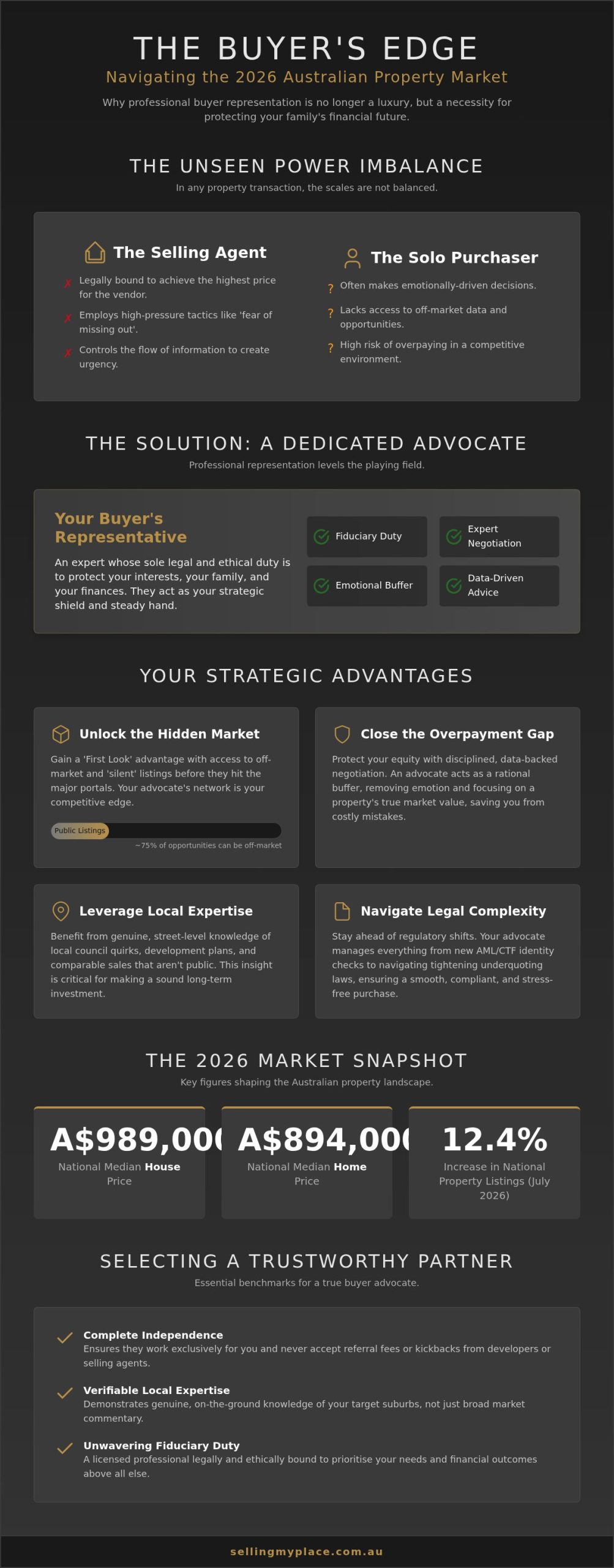
In the high-stakes theatre of Australian real estate, the selling agent isn’t your friend; they’re a legally bound advocate for the person on the other side of the contract. It’s a tough reality to face when you’re searching for a family home or a stable investment. Most of us wouldn’t walk into a courtroom without a lawyer, yet many Australians still front up to aggressive auctions alone. Professional buyer representation has evolved from a luxury service into a strategic shield for your family’s financial legacy. It’s about more than just finding a house; it’s about ensuring you don’t overpay in a market where the national median home price now sits at A$894,000.
We understand the frustration of missing out on “silent listings” or feeling that pang of FOMO as prices shift. You want a fair go and a professional who prioritises your interests above a quick sale. In this 2026 guide, we’ll show you how to gain an edge with expert advocacy and handle the stress of complex negotiations. We’ll also break down the latest regulatory shifts, including the new AML/CTF identity checks and the tightening of underquoting laws, so you can secure your piece of Australia with absolute peace of mind.
Key Takeaways
- Understand the fundamental shift from being a solo purchaser to having a dedicated advocate who prioritises your family’s interests over the vendor’s bottom line.
- Gain the inside track on “silent listings” and off-market opportunities that provide a significant advantage in Australia’s competitive 2026 property landscape.
- Learn how professional buyer representation protects your equity by closing the “overpayment gap” through disciplined, expert negotiation.
- Identify the essential benchmarks for a trustworthy partner, from ensuring total independence to verifying their genuine, street-level local market expertise.
- Discover how a comprehensive advisory approach creates a seamless transition when you are balancing the sale of one home with the purchase of your next.
Understanding Buyer Representation: Why Every Australian Purchaser Needs an Advocate
Most people walk into a property transaction thinking they’re on equal footing with the agent at the door. They aren’t. The selling agent has a single mission: to extract the highest possible price for the vendor. Professional buyer representation flips this script. It ensures that you, the purchaser, have a licensed expert whose sole legal and ethical duty is to protect your interests and your bank balance. This isn’t just about finding a house; it’s about redressing a structural imbalance that has favoured sellers for decades.
While many people ask what is a buying agent, the core of the role is fiduciary duty. This means your representative must put your needs above all else, including their own. This level of advocacy used to be reserved for the “top end of town” or high-flying investors. Today, with the national median house price reaching A$989,000, professional representation has become a vital tool for families and first-home buyers who simply cannot afford a costly mistake. You wouldn’t go to court without a lawyer, so why walk into a million-dollar negotiation without an expert in your corner?
Selling agents are masters of psychology. They use “social proof” through crowded open homes and “scarcity” via looming auction dates to create a sense of urgency. Without a professional buffer, it’s incredibly easy to succumb to emotional overspending at the final hurdle. A representative acts as your “steady hand,” filtering out the noise and focusing on the cold, hard data of a property’s true value. They see the cracks in the cornices when you only see the beautiful garden. This grounded perspective is what saves your equity before you even sign the contract.
The Power Imbalance in Modern Real Estate
Selling agents are highly trained in negotiation tactics designed to push your financial limits. They aren’t being “mean”; they’re doing their job for the vendor. By hiring your own advocate, you remove the emotional target from your back. Your representative handles the aggressive follow-up calls and the high-pressure auction environment, allowing you to make decisions based on logic rather than the fear of missing out. It’s about protecting your emotional well-being as much as your wallet.
Buyer’s Agent vs. Buyer Representative: What’s in a Name?
Whether they’re called a buyer’s agent in New South Wales or a buyer representative in other states, the most important factor is independence. A true advocate never accepts “referral fees” or kickbacks from developers or selling agencies. They work only for you. This transparency is what builds a lasting partnership, ensuring the advice you receive is grounded in your long-term family goals. Having buyer representation means you have a partner who knows the streets, the local council quirks, and the real market value, not just the glossy brochure price.
The Strategic Advantage: How Professional Representation Unlocks Off-Market Opportunities
Accessing the “hidden market” is perhaps the most celebrated perk of engaging professional buyer representation. While the average purchaser is glued to real estate portals, a seasoned advocate is working their network of local selling agents to find properties before they’re even photographed. These industry relationships turn your representative into a hub of real-time information. It isn’t just about what’s for sale today; it’s about what’s coming onto the market next month. This “First Look” advantage allows you to secure a deal in a quiet lounge room rather than a crowded auction yard.
The Real Estate Buyers Agents Association of Australia notes that these off-market transactions are increasingly common in tightly held suburbs where privacy is paramount. By the time a property hits a major portal, it has already been “shopped” to the top-tier advocates. If you’re only looking at what’s public, you’re essentially looking at the leftovers. In a cooling market where national property listings increased by 12.4% in July 2026, the sheer volume of choices can be overwhelming. Having an expert to curate this “hidden” stock ensures you only see the gems that match your legacy goals.
The Anatomy of a Silent Listing
Vendors often choose a silent sale to avoid the stress of public open homes or to save on significant marketing costs. For you, this means less competition and a more rational negotiation process. Your representative acts as a filter, only bringing you listings that actually meet your brief, which saves you from wasting your Saturdays on properties that don’t fit. Pre-market listings, where a vendor is testing the waters before a full campaign, provide a unique window to strike a deal while the seller is still flexible and motivated to avoid a long campaign.
Data Over Hype: The Due Diligence Phase
Access is only half the battle. Once a property is identified, the focus shifts to rigorous due diligence. It’s easy to be swayed by professional styling and soft lighting, but your advocate looks at the bones of the deal. They use data-driven Neighborhood Market Reports to validate off-market pricing and ensure you aren’t paying a “convenience premium” just because a property isn’t public. In a market where the national median home price is A$894,000, guessing the value of an off-market gem is a risk you don’t need to take.
A critical part of this process involves analysing comparable sales to determine fair value. For example, a comparable sale would be a four-bedroom home on a 550-square-metre block that sold in your target suburb within the last ninety days. This objective approach removes the selling agent’s bias from the equation. If you’d like to see how this level of insight could change your search, reach out for a quiet chat about your lifestyle aspirations.
Evaluating the Investment: Does Hiring a Buyer’s Representative Actually Save You Money?
It’s a common question for many Australian families: if I’m already spending hundreds of thousands on a home, why add another fee to the pile? It’s a fair concern. However, viewing buyer representation as a transactional cost misses the bigger picture of equity protection. In a market where the national median house price has reached A$989,000, even a 2% or 3% error in valuation can cost you tens of thousands of dollars. Professional advocacy isn’t just about finding a house; it’s about ensuring the price you pay aligns with the actual market value, not an emotionally charged asking price.
Most advocates operate on either a fixed fee or a percentage-based model. While the upfront cost is visible, the “Overpayment Gap” is often hidden. Selling agents are experts at anchoring your expectations high. A representative closes this gap by using objective data to challenge the agent’s narrative. Beyond the purchase price, they protect you from the “lemon” property. By coordinating rigorous building, pest, and strata inspections, they save you from structural or legal nightmares that could surface years down the track. When you factor in the hundreds of hours saved on searching and inspections, the investment often pays for itself before you even move in.
Negotiation as an Art Form
There’s a massive difference between “haggling” and strategic real estate negotiation. One is a battle of wills; the other is a calculated chess match. Auction representation is where a “steady hand” truly shines. When the adrenaline is pumping and the auctioneer is calling for “just one more thousand,” it’s easy to lose sight of your limit. Having a professional hold the paddle removes the emotional target from your back. They handle the “Best and Final Offer” pressure with poise, ensuring you don’t blink first or overextend your family’s financial future.
The Long-Term ROI of an Expert Purchase
Buying in the right pocket of a neighbourhood can significantly impact your future capital growth. An expert knows which streets are rising and which have reached their peak. Securing your equity is about more than just the day of the sale; it’s about Mastering the Deal to ensure your purchase aligns with long-term stability. This “no-regrets” purchase provides a sense of calm confidence. You aren’t just buying a house; you’re securing a legacy for your family in a community where you can actually see yourselves growing old. That peace of mind is perhaps the greatest return on investment of all.
Selecting Your Partner: Key Criteria for a Trustworthy Buyer Advocate
Selecting the right partner for buyer representation is a decision that shapes your family’s future stability. It’s about finding a “steady hand” who prioritises your legacy over a quick transaction. Because a property purchase is often the largest financial commitment you’ll ever make, the person standing beside you must be more than just a negotiator; they must be a protector of your interests. To ensure you find the right fit, consider these five essential criteria during your selection process:
- Verify Independence: In 2026, with stricter agent conduct laws across Australia, you must ensure your advocate isn’t receiving hidden “spotter’s fees” or commissions from developers. A trustworthy advocate has a single source of income: you.
- Assess Local Depth: Do they know which streets in your target suburb are prone to traffic noise or which side of the hill gets the best winter sun? This granular, street-level knowledge separates a genuine expert from someone who just knows the postcodes.
- Evaluate Communication Style: You want a partner who projects calm confidence. If they feel like a salesperson pushing a quick result, they aren’t the right advocate for a major life transition.
- Check Their Track Record: Ensure they have specific experience with your property type. Someone specialising in high-yield investment units might not have the same eye for the structural nuances of a multi-generational family home.
- Review Their Secondary Network: A great advocate brings a team of reliable building inspectors, trades, and legal experts to the table, ensuring your due diligence is watertight.
Questions to Ask During Your Initial Consultation
When you sit down for that first meeting, it’s your chance to see behind the professional veneer. Don’t be afraid to ask direct questions that test their transparency and local roots:
- “How do you source your off-market properties, and can you describe your relationship with local selling agents?”
- “Can you show me a recent case study where you negotiated a price significantly below the vendor’s expectation?”
- “What is your specific process for due diligence and risk assessment before I sign a contract?”
The Importance of Conveyance and Legal Advice
Your representative must work hand-in-hand with legal professionals to protect your equity. Understanding every clause in the contract of sale before you sign the dotted line is vital for a “no-regrets” purchase. Using a service like Kincade’s Conveyance Advice ensures a smooth settlement process, bridging the gap between that final handshake and the day you finally get the keys. If you’re ready to secure your next home with a professional partner by your side, reach out to our advisory team for a quiet conversation about your aspirations.
Beyond the Listing: How Kincade’s Advisory Service Secures Your Next Home
Kincade International Direct Sales operates on a mission to empower property owners and purchasers alike. By integrating professional buyer representation into our broader advisory framework, we ensure that your transition between homes is managed with a “steady hand.” Most agencies treat the sale of one property and the purchase of another as isolated events, often leaving families in a state of limbo or financial stress. We bridge this gap by aligning your selling strategy with your buying goals, ensuring that every move you make is a calculated step toward long-term stability.
Our global network and digital infrastructure provide a distinct advantage that reaches far beyond the local suburb. While we are deeply rooted in Australian communities, our reach allows us to tap into resources and buyer pools that traditional local agencies simply cannot access. This partnership is built on more than just data; it is built on a sense of duty to your family’s future. We understand that a home is more than a set of coordinates; it is the foundation of your community life and personal legacy.
A Holistic Approach to Property Transitions
We treat the property journey as a unified cycle rather than a series of disconnected hurdles. A major component of our “Sell Smarter” philosophy involves maximising the capital you have available for your next purchase. By utilising a Commission-Free Sale for your current residence, you retain a significantly larger portion of your equity. This isn’t just about saving money; it’s about increasing your buying power in a competitive market. When you aren’t paying away tens of thousands in traditional agency commissions, you have more flexibility to secure the specific features or location that your family deserves.
Taking the First Step Toward Your New Chapter
Embarking on a new property chapter should be a time of celebration, not exhaustion. When you engage with our buyer representation service, the process starts with a methodical, confidential consultation. We don’t rush you into inspections; we take the time to understand the emotional significance of your move. We’ll discuss how our advisory services can mitigate the stress of the “middle period” between settlement dates, ensuring you feel protected and informed at every turn.
Visualise your future state: a home secured through expert negotiation, a sale handled with zero commission, and a transition managed by a trusted advisor who values your long-term roots. If you are ready to experience a more sophisticated way to move, we invite you to take the direct call to action and reach out to our team today. Let’s work together to secure your family’s next great milestone.
Your Next Chapter Starts with a Steady Hand
Securing a home in Australia’s current climate shouldn’t feel like a battle you’re destined to lose alone. By choosing professional buyer representation, you transition from a solitary purchaser to a protected partner. Throughout this guide, we’ve explored how expert advocacy unlocks silent listings and ensures you never overpay in the heat of an auction. It’s about securing a legacy for your family while keeping your hard-earned equity exactly where it belongs. At Kincade, we bring over 25 years of seasoned industry expertise to every consultation, offering a calm perspective in a fast-moving market.
Our flat-fee model is designed specifically to protect your family’s financial future, while our comprehensive Agent Advisory Service supports you from the very first listing through to a successful settlement. You deserve a transparent, stress-free path to your new front door. Secure your next home with Kincade’s expert buyer representation; contact us today. We look forward to helping you plant roots in a community you’ll love for years to come. Your future home is waiting, and we’re ready to help you find it.
Frequently Asked Questions
What exactly is the difference between a real estate agent and a buyer’s representative?
A traditional real estate agent is legally and ethically bound to achieve the highest possible price for the vendor. In contrast, buyer representation means you have a licensed professional working exclusively for you to secure the lowest price and best terms. They act as your advocate, providing an objective counterweight to the selling agent’s tactics. It’s a partnership where your financial security and lifestyle goals are the only priorities on the table.
How much does buyer representation typically cost in Australia?
Fees across Australia generally follow two structures: a fixed fee or a percentage of the final purchase price. While specific costs vary depending on the level of service and the complexity of your search, most advocates offer a transparent breakdown during your initial consultation. Investing in professional advocacy often pays for itself by closing the “overpayment gap” and protecting you from costly structural mistakes that aren’t immediately visible to the untrained eye.
Can a buyer’s representative help me at an auction?
Yes, acting as a “steady hand” during the heat of an auction is a core part of the service. Your representative will handle the bidding strategy, keep a calm head when prices rise, and ensure you never exceed your pre-determined limit. Removing the emotional target from your back allows you to walk away from a bad deal or secure a win without the stress of holding the paddle yourself.
Will I still have the final say on which property I buy?
Absolutely, you maintain total control over the final decision throughout the entire journey. Your representative provides the data, the due diligence, and the expert negotiation, but the choice to sign the contract remains yours. Think of them as a seasoned guide who maps out the best path; you’re still the one driving the car. Their role is to empower you with confidence, not to make the choice for you.
Do buyer’s representatives have access to properties that aren’t on the internet?
Yes, advocates have deep networks that provide access to “silent listings” and pre-market opportunities. These properties never hit major portals, meaning you face significantly less competition. In a market where national property listings rose by 12.4% in July 2026, having someone to filter both public and private stock ensures you only spend time on gems that truly match your family’s long-term legacy and lifestyle needs.
Is it worth hiring a representative if I am only buying a small unit?
Definitely, because even a small unit represents a significant portion of your equity. Overpaying by just 5% on a unit can wipe out years of capital growth. A representative ensures you aren’t buying into a building with hidden strata issues or poor historical resale value. Whether it’s a first home or a compact investment, professional buyer representation provides the same level of protection and strategic advantage as it does for a large family estate.
How does the process of working with a buyer representative actually start?
The process begins with a thoughtful, confidential consultation to define your specific needs and aspirations. We’ll discuss your budget, preferred neighbourhoods, and the lifestyle features that matter most to your family. This initial brief becomes the foundation of our search. Under the new AML/CTF laws effective July 2026, we’ll also guide you through the necessary identity verification steps to ensure your purchase is compliant and ready to move forward without delay.
Can a representative help me with the legal paperwork and conveyancing?
While a representative isn’t a lawyer, they coordinate closely with legal experts to review the contract of sale. They ensure that building, pest, and strata reports are thoroughly analysed before you commit. By working alongside professional conveyancers, your advocate provides a seamless link between the negotiation and the final settlement. This holistic approach ensures that every legal and structural detail is checked, keeping your family’s interests safe from listing to keys.
