How to Make an Offer on a House in Australia: The 2026 Buyer’s Guide
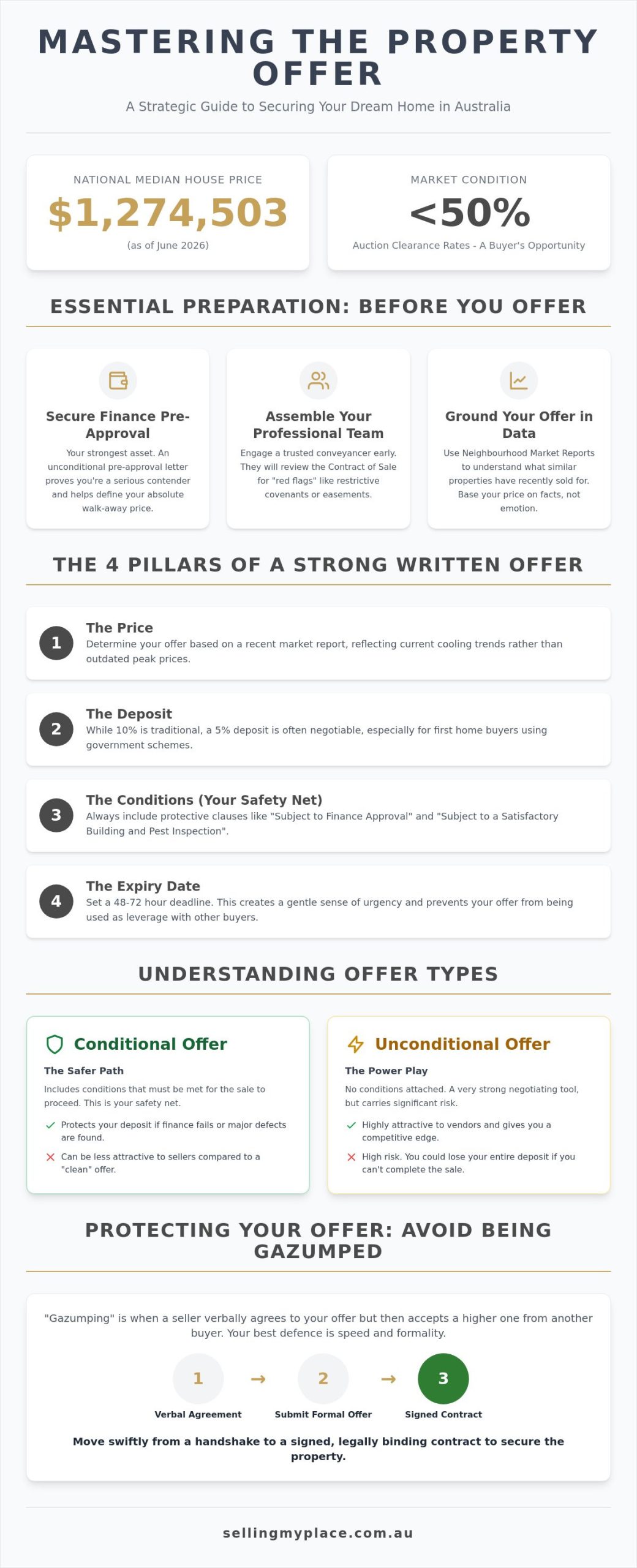
Imagine standing on the nature strip of a sun-drenched Queenslander or a leafy Melbourne terrace; you have finally found “the one,” but the thought of the actual paperwork makes your stomach do a nervous flip. It’s a feeling many of us know well, especially when the national median house price has reached $1,274,503 as of June 2026. You want to move forward, yet the fear of being gazumped or trapped in a poorly drafted contract feels like a heavy weight. Learning how to make an offer on a house australia shouldn’t feel like a gamble, particularly as auction clearance rates have dipped below 50% recently, giving buyers a rare moment to breathe and negotiate with more leverage.
We’re here to help you master the art of the property offer with professional poise and a steady hand. This guide provides the expert strategies you need to secure your dream home while firmly protecting your financial future. We’ll explore the vital differences between conditional and unconditional offers, explain how to use the current cooling market to your advantage, and ensure you have the legal safeguards in place to sleep soundly at night. You’re about to gain the clarity needed to navigate negotiations with your heart and head in perfect balance, turning that “for sale” sign into a “sold” sticker on your own terms.
Key Takeaways
- Secure your footing by understanding why unconditional finance pre-approval is your strongest asset before you even step foot in a negotiation.
- Master the formal process of how to make an offer on a house australia, ensuring every condition is drafted to protect your interests and your financial future.
- Navigate the complexities of both traditional agent-led sales and direct vendor negotiations with the confidence and poise of a seasoned local.
- Protect yourself from the heartbreak of gazumping with strategic timelines that help you move from a verbal agreement to a binding contract without delay.
- Learn how professional buyer representation can unlock “off-market” gems and provide the expert advocacy needed to secure a fair price in a shifting market.
Essential Preparation: Getting Your Ducks in a Row Before the Offer
Buying a home is more than a financial transaction; it’s about finding where your family’s future will unfold. In a market where the national median house price sits at $1,274,503, “winging it” is a strategy that often leads to disappointment. If you want to know how to make an offer on a house australia that actually gets noticed, you have to start with a foundation of cold, hard facts. This preparation is what separates the dreamers from the homeowners in what many call The Great Australian Dream.
Before you even attend an inspection, you need your professional team ready. This includes a trusted conveyancer and access to detailed Neighbourhood Market Reports. These reports help you ground your expectations in reality, showing you exactly what similar properties in the area have sold for over the last few months. Relying on emotion alone can lead to overpaying. To get it right, you should determine your price based on a recent market report before you start bidding. Having data at your fingertips gives you the confidence to stand your ground during a high-stakes negotiation.
Finance Pre-Approval: Your Secret Weapon
There is a world of difference between a quick online “soft” check and a formal, unconditional pre-approval letter from your lender. A formal letter proves to agents and vendors that you are a serious contender with the financial backing to follow through. It also streamlines the negotiation process, particularly if you’re trying to reduce the length of a cooling-off period to make your bid more attractive. Most importantly, it helps you set an absolute “walk-away” price. Knowing your limit ensures you don’t get swept up in the heat of the moment and commit to a mortgage that strains your lifestyle.
The Legal Review: Understanding the Contract of Sale
Never sign anything until a professional has looked at the Section 32 or Contract of Sale. This is where you’ll find “red flags” like restrictive covenants or easements that might prevent you from building that deck or pool you’ve been dreaming about. Professional conveyance advice is essential here to decode the legal jargon. During this stage, you should also decide on your preferred settlement terms. Whether it’s 30, 60, or 90 days, having these details ready shows the seller you are organised and ready to move. This level of preparation is the first step in mastering how to make an offer on a house australia that stands out for all the right reasons.
The Anatomy of a Strong Offer: More Than Just the Price
A handshake on the front lawn feels great, but in the fast-paced Australian property landscape, a written offer is the only true gold standard. It signals to the vendor that you are prepared, professional, and ready to commit. This isn’t just about a single dollar figure; it’s about presenting a package that makes the seller feel secure. To master how to make an offer on a house australia, you need to structure your proposal with four key pillars that balance your aspirations with practical safeguards.
- Step 1: The Price. You should determine your price based on a recent market report to ensure your bid reflects the current 2026 cooling trend rather than outdated peak prices.
- Step 2: The Deposit. While a 10% deposit is the traditional expectation, a 5% deposit is often negotiable. This is particularly common for first home buyers using government guarantees to enter the market.
- Step 3: The Conditions. These are your protective layers. Always include clauses for finance approval and satisfactory building and pest inspections to avoid expensive surprises down the track.
- Step 4: The Expiry. Don’t leave your offer hanging indefinitely. Setting an expiry date, perhaps 48 or 72 hours, creates a gentle sense of urgency and prevents your bid from being used as leverage against other buyers.
Conditional vs. Unconditional Offers
An unconditional offer is a powerful tool because it removes all uncertainty for the seller, making your bid highly attractive in a crowded field. However, it is a high-stakes move. If your bank valuation comes back lower than your offer price, you must bridge the gap yourself. Most Australian buyers are better served by a conditional offer. This includes “Subject to Sale” clauses if you need to offload your current home first. If you’re feeling unsure about which path suits your family’s needs, it might be time to chat with a local expert who can help you weigh the risks and rewards.
The Holding Deposit (Expression of Interest)
In many states, you might be asked for an “Expression of Interest” (EOI) accompanied by a small holding deposit. Is this “fair dinkum” and legally binding? Usually, the answer is no; not until both parties have signed a formal contract. This initial payment, often a few thousand dollars, simply demonstrates your sincerity to the vendor. It shows you aren’t just window shopping. Always ensure these funds are held in a registered real estate trust account or by your conveyancer to keep your hard-earned money safe while negotiations continue.
Private Treaty vs. Private Sale: Navigating Different Purchase Paths
When you’re out there searching for your next chapter, you’ll likely encounter two distinct paths: the traditional agent-led private treaty and the increasingly common sale by owner. While most Australians are used to real estate agents acting as the gatekeepers of property, many are finding that dealing directly with a vendor can be a remarkably transparent experience. It’s often a breath of fresh air to speak with the person who has actually lived in the home, raised their family there, and knows every quirk of the floorplan. It removes the “middleman” filter that can sometimes lead to mixed messages.
Mastering how to make an offer on a house australia requires you to be adaptable. When dealing with an agent, you’re navigating a professional buffer designed to maximise the sale price. When dealing with a private seller, you’re engaging in a personal conversation about their legacy. It’s vital to keep your tone warm yet professional. A little neighborly respect goes a long way; after all, they want to know their home is going to someone who will cherish it as much as they have. This human connection can often be the “secret sauce” that gets your offer across the line over a higher, colder bid.
Buying from a Private Seller
The primary benefit of direct communication is the ability to get straight answers in real-time. You can ask about the history of the renovations or the local community vibes without waiting for an agent to “check with the owner.” When you’re ready to commit, present your offer formally in writing. This maintains the decorum of a high-stakes transaction while keeping the lines of communication open. Even without an agency involved, the legal heavy lifting stays the same. Both you and the seller must involve your own conveyancers to ensure the contract is sound and that your deposit is held securely in a trust account until settlement.
The Auction Alternative
While private negotiations offer room to move, auctions are a different beast entirely. With auction clearance rates sitting below 50% across major cities in mid-2026, many buyers are successfully making offers “prior to auction” to avoid the stress of a public bidding war. This is a high-stakes move, though. If you buy prior to the auction or on the day itself, you generally waive your right to a cooling-off period. It’s a moment for a steady hand; you must have your finance, building reports, and legal reviews completed before you raise your hand or sign that contract. If the market continues to cool as it has recently, waiting for the day might actually give you more leverage if competition is thin.
Negotiation Tactics: Avoiding Gazumping and Multiple-Offer Pitfalls
There is nothing quite as heart-wrenching as receiving a phone call to say someone else has outbid you after your offer was already verbally accepted. This is the reality of gazumping. In the Australian property market, a deal isn’t legally binding until both parties have signed and exchanged the final contract of sale. To protect your aspirations, you need to understand how to make an offer on a house australia that locks the door behind you quickly. Speed is your greatest ally. By having your conveyancer ready and your deposit funds accessible, you can move from a handshake to an exchange in record time, leaving less room for another buyer to swoop in.
When you find yourself in a multiple-offer situation, the pressure can feel immense. Should you put your absolute best and final price forward immediately? It depends on the property’s value relative to your market research. Sometimes, the best bargaining chip isn’t the price at all; it’s the settlement terms. If a seller is anxious to move before the new school year or needs a longer 90-day settlement to finish their own build, matching their timeline can make your offer more attractive than a slightly higher bid with rigid terms.
Winning the Negotiation Without Overpaying
Negotiating doesn’t always mean paying less; it means paying a fair price for what you’re actually getting. If your building report uncovers structural issues or pest activity, don’t be afraid to ask for a price adjustment to cover the repairs. A Sunset Clause is another clever tool to keep in your kit. By stating that your offer expires at 5:00 PM on Friday, you prevent the agent from using your bid to bait other buyers over the weekend. If you’re feeling overwhelmed by these tactical moves, get professional real estate advisory services to refine your approach.
The Cooling-Off Period
Most states provide a safety net known as the cooling-off period, typically five business days. It’s a vital window to conduct your final due diligence, but it isn’t free. If you decide to pull out of the deal during this time, you’ll usually forfeit 0.25% of the purchase price. Think of it as an insurance policy. It gives you the space to ensure the home is exactly what it seems before you’re fully committed to the long-term journey of home ownership. Use this time wisely to double-check your finance and ensure the contract truly reflects your needs.
Professional Buyer Representation: Your Shortcut to a Successful Purchase
When you’re standing at the threshold of such a significant life transition, you don’t have to walk the path alone. While the previous sections have equipped you with the mechanics of the market, the emotional weight of a property search can still be a lot to carry. This is why a growing number of Australians are choosing professional buyer representation. It’s about having a seasoned partner who does the heavy lifting, from scouring the streets to handling the final handshake. By understanding how to make an offer on a house australia with the backing of an expert, you move from a position of hope to a position of power.
The real magic happens behind the scenes. Many of the finest family homes never actually make it to the major real estate portals. They are sold quietly, through “off-market” channels and professional networks. A dedicated representative acts as your eyes and ears on the ground, finding these hidden gems before the rest of the world even knows they are for sale. This “steady hand” approach doesn’t just save you time; it removes the high-stakes emotion from the negotiation table, often saving you thousands of dollars by keeping the focus on logic and long-term value.
The Kincade Advantage for Buyers
Kincade International Direct Sales supports your journey through a blend of expert advisory and deep market insight. We provide detailed Neighborhood Market Reports that reveal the true value of a home, ensuring you never overbid in a cooling market. Our pre-sale property consulting helps you understand a vendor’s true motivations, giving you the upper hand in any negotiation. Because we champion a flat-fee model for our sellers, we create a more transparent and honest environment where buyers can feel protected and respected throughout the entire exchange.
Next Steps on Your Property Journey
Your search for a family home should be a time of excitement, not exhaustion. Integrating our real estate advisory services into your search allows you to focus on the lifestyle you’re building while we handle the technical complexities. Whether you’re a first-time buyer navigating government grants or a seasoned investor looking for your next legacy property, we are here to provide the clarity and confidence you deserve. Let us help you navigate your next purchase with confidence.
The 2026 market offers unique opportunities for those who are prepared and well-advised. By mastering how to make an offer on a house australia and partnering with experts who value community and heart as much as the bottom line, you’re not just buying a house. You’re securing your future. Book a consultation with our team today to discuss your specific buying criteria and let’s start the search for your dream home together.
Secure Your Place in the Australian Sun
The journey to owning your own home is one of life’s most significant milestones. It’s about more than just bricks and mortar; it’s about building a legacy and a sanctuary for your family. By now, you understand that mastering how to make an offer on a house australia is a strategic blend of data-driven confidence and robust legal protection. Whether you’re navigating the traditional agent-led path or a direct Private Sale, your strongest assets remain a clear head and a steady hand. You’ve learned how to use market reports to your advantage and why a well-timed Sunset Clause can be a game-changer.
Don’t let the fear of gazumping or the complexity of contract conditions hold you back from your goals. With our Expert Agent Advisory Service and over 25 years of experience, we provide the clarity you need to move forward with poise. From detailed Neighbourhood Market Reports that ensure you never overpay to dedicated support for both traditional and FSBO transactions, we are here to champion your interests. Secure your future with expert Buyer Representation and Advisory and let’s turn those aspirations into a reality together. You’re closer to that front door than you think, and we’re here to help you turn the key.
Frequently Asked Questions
Is a verbal offer legally binding in Australia?
No, a verbal offer is not legally binding in any Australian state or territory. For a property transaction to be enforceable, the contract must be in writing and signed by both the buyer and the seller. While a verbal agreement is a lovely start to the process, it’s essentially an “agreement in principle” that allows either party to change their mind without legal consequence until the paperwork is finalised.
What is the standard deposit when making an offer on a house?
The standard deposit is traditionally 10% of the purchase price, but this is often negotiable. Many buyers, particularly those entering the market for the first time, successfully negotiate a 5% deposit. You’ll typically pay a smaller initial holding deposit of a few thousand dollars to show you’re serious, with the remainder of the agreed percentage paid once the contract becomes unconditional or at the exchange of contracts.
Can I withdraw my offer after the seller has accepted it?
Yes, you can generally withdraw your offer at any time before both parties have signed and exchanged identical copies of the contract. Once exchange occurs, the agreement becomes legally binding. If you need to back out after exchange, you’ll usually have to rely on a statutory cooling-off period, which typically lasts five business days and involves a small financial penalty of 0.25% of the purchase price.
How long does a seller have to respond to my offer?
There is no set legal timeframe for a seller to respond, but you can take control by including an expiry date in your written proposal. Most buyers allow between 48 and 72 hours for a response. This creates a respectful sense of urgency and prevents the agent from using your bid as leverage to attract higher offers from other interested parties during a busy weekend of inspections.
What does “subject to finance” actually mean in a contract?
This is a protective clause that means the purchase only proceeds if your bank provides formal, written loan approval by a specific date. It’s a vital safety net that prevents you from being legally forced to buy a property if your funding falls through. Mastering how to make an offer on a house australia with these conditions ensures you’re looking after your family’s financial security while you pursue your dream home.
What is gazumping and how can I protect myself from it?
Gazumping happens when a seller accepts your offer but then signs a contract with another buyer who offers a higher price before you’ve reached the official exchange of contracts. To protect yourself, you must move with purpose. Have your finance pre-approval ready and your conveyancer on standby to review the contract immediately. The faster you move from a verbal “yes” to a signed contract, the less chance there is for someone else to swoop in.
Do I need a lawyer before I make an offer on a property?
While you don’t strictly need a lawyer to make the initial offer, it is incredibly wise to have a conveyancer or solicitor review the Contract of Sale or Section 32 before you sign anything. They can spot hidden “red flags” like restrictive covenants or easements that might interfere with your plans for the property. Having this professional review gives you the calm confidence that your interests are fully protected from the start.
What happens if there are multiple offers on the same house?
In a multiple-offer situation, the agent will usually ask all parties to submit their “best and final” offer by a specific deadline. This is a moment for a steady hand and clear thinking. You’ll need to decide on a price that is fair but also reflects your absolute limit. Learning how to make an offer on a house australia during these competitive moments often means balancing your emotional attachment to the home with the hard data of a market report.
