Contract of sale clauses, price and settlement explained
In NSW, residential property can’t be offered for sale until a contract of sale has been prepared. To understand how to prepare a contract of sale, start with the essentials: the buyer and seller, property address, price, deposit, settlement date, conditions, possession arrangements, and what’s included or excluded. The required documents and who prepares the contract depend on the state and sale.
Getting the details right matters: a contract sets out the terms both parties agree to, and uncertainty about an inclusion, condition or date can cause problems later. This guide explains what the contract should cover, how cooling-off periods work, when settlement usually takes place and who prepares the paperwork.
It also covers state-specific requirements that can affect a sale, so you can see what needs attention before the contract is signed and exchanged.
Key Takeaways
- Check the state-specific disclosure documents before a property is offered for sale; NSW contracts have prescribed attachments and requirements.
- Most NSW residential buyers have five working days after exchange to cool off, but different rules apply at auction and across Australia.
- Settlement timing is set by the contract. In NSW, it usually takes place 42 days after exchange unless the parties agree otherwise in writing.
- Make the price, deposit, settlement date, conditions, possession arrangements and inclusions or exclusions clear in the contract.
- In NSW, a proposed residential sale contract must be prepared by an Australian legal practitioner or licensed conveyancer.
What do I need to include in the contract for sale?
In Australia, a contract should identify the parties, property, purchase price, deposit, settlement date, conditions, possession arrangements, and inclusions or exclusions. NSW residential sales have prescribed disclosure requirements, so gather the relevant documents before the property is offered for sale.
Documents to Gather Before Drafting
Gather title and planning records, property details, and documents needed to disclose the land’s condition or legal status. In NSW, a residential property cannot be offered for sale until its contract is prepared.
Complete the necessary searches, then make the contract and vendor statement available promptly so prospective buyers can review the terms and attachments together. If it is unclear whether an item, such as a removable appliance, is included, state this explicitly.
Residential Sale Contract Documents
NSW residential sale contracts must include documents prescribed by section 52A of the Conveyancing Act 1919 and Schedule 1 of the Conveyancing (Sale of Land) Regulation 2022. A section 10.7(2) planning certificate should show zoning, development controls and planning constraints; additional section 10.7(5) information may also be attached.
Strata sales need the lot and common property certificate, strata plan and applicable by-laws. Pool documentation generally applies, except for lots in strata or community schemes with more than two lots and off-the-plan contracts. Off-the-plan contracts require a Disclosure Statement and specified draft documents. The contract also includes the section 66X statement, cooling-off information and any exclusions. For homes built before 1985, it advises purchasers to consider possible loose-fill asbestos insulation.
Transfer Paperwork and Settlement Coordination
Transfer paperwork records the change of ownership and helps the parties’ representatives coordinate settlement. The settlement date in the contract gives them a shared deadline for arranging the transfer and meeting the agreed obligations.
Check that names, property details and possession terms match across the contract and transfer documents. State whether the buyer receives vacant possession or takes the property subject to a lease. For an Australian-resident seller in NSW, provide an ATO clearance certificate when the property price is $750,000 or more.
Preparing Contracts for Different Sale Types
Residential, commercial and private sales require different preparation because disclosure rules and sale terms depend on the property and transaction. NSW residential contracts have prescribed attachments. Commercial transactions and private sales should reflect the specific property, agreed conditions and applicable requirements.
To prepare a contract step by step, identify the parties and property, agree on the price and deposit terms, specify conditions and possession, gather required disclosures, then arrange review and signing. In South Australia, land sale agreements must be in writing, whether the property is sold at auction or by private treaty.
Missing a required NSW document can have serious consequences: a purchaser may rescind within 14 days of exchange if a required document wasn’t attached before signing. Preparing the paperwork carefully helps buyers understand the agreement, including its cooling-off terms, before they commit.
How does a ‘cooling off’ period work?
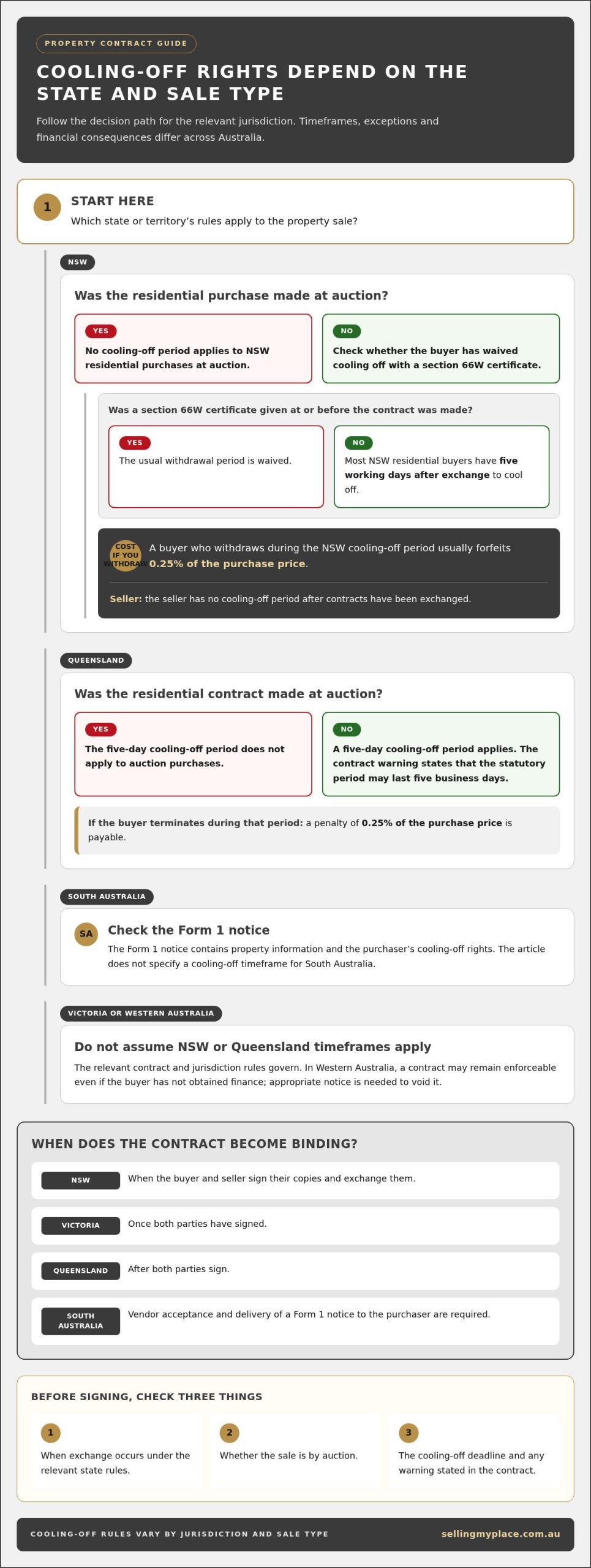
A cooling-off period gives a buyer a limited time to withdraw after a property contract is exchanged. The timeframe, exceptions and financial consequences depend on the state and sale type, so pay attention to the contract’s warning and the applicable state rules.
Across Australia, signing and exchange requirements vary by jurisdiction. In NSW, a contract becomes binding when the buyer and seller sign their copies and exchange them; in Victoria, the property is sold once both parties have signed. Queensland contracts become binding after both parties sign, while South Australian contracts require vendor acceptance and delivery of a Form 1 notice to the purchaser.
For most NSW residential purchases, the buyer has five working days following exchange to cool off. A buyer who withdraws during this period usually forfeits 0.25% of the purchase price. The seller has no cooling-off period after contracts have been exchanged, so the buyer’s decision window doesn’t give the seller an equivalent right to reconsider.
A NSW buyer can waive cooling off by giving the required section 66W certificate at or before the contract is made. This removes the usual withdrawal period, so it’s a significant decision rather than a routine signing step. The contract should clearly state the cooling-off terms, and the buyer should understand the consequences before signing or agreeing to waive them.
Auction rules differ. NSW residential purchases at auction have no cooling-off period. Queensland residential contracts have a five-day cooling-off period, except for auction purchases; the contract warning states that the statutory period may last five business days. A Queensland buyer who terminates during that period must pay a penalty of 0.25% of the purchase price.
In South Australia, the Form 1 notice contains property information and the purchaser’s cooling-off rights. For Victoria and Western Australia, don’t assume NSW or Queensland timeframes apply: the relevant contract and jurisdiction rules govern. In WA, a contract may remain enforceable even if the buyer hasn’t obtained finance, and appropriate notice is needed to void it.
Before signing, note when the exchange occurs, whether the sale is by auction, and any deadline stated in the contract. If you’re preparing a sale and want help considering contract timing, property sale guidance can help you understand the process.
Standard contract clauses and settlement timing
A property contract sets out the agreed terms, including price, deposit, conditions, possession and settlement date. These clauses work together: a finance condition, for example, should specify a clear deadline and what happens if finance isn’t approved. The settlement date gives both parties and their conveyancing representatives a target for completing the transfer.
Australian settlement periods can range from 30 to 90 days, depending on the state and agreement. In NSW, settlement usually takes place 42 days after exchange unless both parties agree otherwise in writing. The contract’s stated date is the practical guide, so check it against any agreed conditions and arrangements before signing.
Settlement adjustments account for agreed property expenses up to handover. Rates and other outgoings may be apportioned between seller and buyer so the figures reflect each party’s period of ownership. The conveyancing representatives coordinate these calculations. Before settlement, check the settlement statement against the contract and supporting figures.
If the property has a mortgage, the seller’s conveyancing representative coordinates its discharge as part of settlement. The lender’s requirements and the amount needed to clear the mortgage affect the arrangements. Keep the lender and conveyancer informed of the settlement date, and coordinate the discharge with the transfer.
A pre-settlement inspection lets the buyer check the property before handover. Arrange it close to settlement and compare the property with the contract’s inclusions and agreed condition. For example, check that listed appliances remain and agreed repairs are complete. Raise discrepancies with the representatives before settlement proceeds.
State clearly whether the buyer will receive vacant possession or take the property subject to a lease. In NSW, a seller shouldn’t let a buyer take possession before settlement without consulting their solicitor, because the seller retains the risk. Early occupation can affect access, responsibility and handover, so put any arrangement in writing rather than relying on an informal understanding.
Contract conditions also shape the timeline. A building and pest inspection, finance approval or sale of the buyer’s existing property can affect whether the transaction proceeds, so the relevant condition needs to say what must happen and by when. In Queensland, such conditions must be included in the contract to be legally binding. A 48-hour clause in Western Australia can allow the seller to continue marketing when an existing contract depends on the buyer selling another property.
Once the parties agree to a change in Western Australia, all parties should initial each amendment, and special conditions should be signed and dated. This creates a clear record of the agreed terms and helps the conveyancing process follow the same instructions through settlement.
Vendor and purchaser details, property description and sale price
Clear details about the parties, property and price define the agreement each side is making. State-specific disclosure rules also affect when prospective buyers can receive an offer for the property.
Vendor and Purchaser Details
The contract names the vendor and purchaser, identifying the parties to the property transaction. Accurate names link the agreement, signatures and transfer paperwork to the people or entities involved.
Check each party’s details against the documents they’ll use to sign and complete the sale. If more than one person is buying or selling, include each party in the contract. Confirm the purchaser’s details before signing, because changing a party later can affect the transaction and settlement arrangements.
Property Description and Title Information
The property description identifies exactly what the vendor is selling, using the address and relevant title information. This distinguishes the land from neighbouring properties and connects the contract’s disclosures to the correct property.
Review the title information for restrictions, easements and other interests affecting the property. In Victoria, the vendor statement, also called a section 32, discloses matters including title restrictions and easement locations. It also covers rates and outgoings, giving prospective buyers information that may shape their decision and the terms they agree to.
Sale Price and Offer Status
The contract records the agreed sale price and should also state the deposit amount and due date. Set out any conditions affecting the offer, the settlement date, and whether the buyer receives vacant possession or takes the property subject to a lease.
In Victoria, the contract must clearly state whether the purchase price includes or excludes GST and, if included, how it will be calculated. List other property included in the deal, along with exclusions such as a light fitting the vendor intends to remove. If an item’s inclusion is uncertain, identify it expressly rather than leaving buyers to assume.
In NSW, a residential property cannot be offered for sale until its contract of sale has been prepared. Having the contract and vendor disclosure ready lets prospective buyers consider the actual terms before making an agreement. It also helps them understand any cooling-off provisions relevant to the purchase.
Before the vendor accepts an offer, compare the proposed price, deposit, conditions and included items with the written contract. A verbal discussion about a special condition or an item left behind doesn’t replace clear wording. Record agreed changes in the contract so the final document reflects the transaction both parties intend.
Who prepares the contract of sale
Who prepares a property contract depends on the state, sale method and transaction. In NSW, a proposed residential sale contract must be prepared by an Australian legal practitioner or licensed conveyancer, then be available for inspection at the agent’s office.
Elsewhere in Australia, a solicitor, conveyancer or real estate agent may prepare the contract, depending on the sale and its requirements. For a private sale, an agent generally drafts the contract presented to a prospective purchaser making an offer. A legal practitioner or conveyancer can also prepare or review legal documents, including the contract and vendor statement.
Understanding how to prepare a contract of sale starts with knowing who is responsible for the legal paperwork in your state. Government legislation and regulations set requirements that vary between states. In NSW, for example, the contract needs prescribed disclosure documents before residential property can be offered for sale. For a Victorian sale, a legal practitioner can prepare or review both the contract and Section 32 vendor statement.
For an auction, the contract should be ready for prospective buyers to consider before bidding. In NSW, the proposed residential contract must be available for inspection at the agent’s office. Auction purchases also have different cooling-off rules from private treaty sales, so review the contract and its conditions before auction day. In South Australia, land sale agreements must be in writing whether the property is sold at auction or by private treaty.
Responsibility can also depend on who represents the seller. In NSW, if the seller has told the agent that a solicitor or conveyancer will act, or the proposed contract says so, the agent generally can’t participate in making or exchanging the contract without express authorisation from the seller or their legal representative. If an agent arranges exchange in NSW, they must provide signed contract copies to each party or their solicitor or conveyancer within two business days.
When learning how to prepare a contract of sale, involve a solicitor or conveyancer to help ensure the documents and terms meet the relevant requirements. The cost depends on the matter and is provided after a quote request; factors include the property, required searches, disclosure documents and contract amendments. Buyers should also arrange their own review before committing to a signed contract.
Preparing to sell? Discuss your property sale preparation and the practical steps involved in getting the contract ready.
Kincade International Direct Sales: Residential Property Listing Services
Kincade International Direct Sales helps Australian owners prepare to sell through Residential Property Listing Services and Pre-Sale Property Consulting. These services can help you plan your sale presentation and approach before prospective buyers view the property. Neighborhood Market Reports provide market context as you prepare your listing.
The contract still needs to be prepared by the appropriate legal practitioner or conveyancer where required, with state disclosure documents and sale terms addressed. Kincade International Direct Sales supports the listing and marketing side of the sale, while the legal paperwork follows the applicable process.
If you’re planning a sale, explore Kincade International Direct Sales’ flat-fee packages at sellingmyplace.com.au.
Take your next step with a clear plan
Knowing how to prepare a contract of sale is one part of planning a property move. Next, decide how you want the sale to unfold, what support would help and which decisions need your attention first. A clear plan lets you focus on the transition as well as the paperwork. For buyers also exploring coastal retreats or lifestyle markets abroad, real estate teams like Steve Adams & Associates offer valuable perspective on local lifestyle, community transport, and coastal living.
Kincade International Direct Sales offers Residential Property Listing Services, Buyer Representation and Pre-Sale Property Consulting. These services support owners preparing to bring a home to market and buyers seeking representation. The right starting point depends on where you are in your property journey. For buyers coordinating an overseas relocation or browsing residential homes in the UK, agencies such as Let’s Get You Moving offer search tools to explore available listings.
Take the time to choose a path that suits your plans and priorities. Contact Kincade International Direct Sales to discuss your next property step and move forward with confidence.
Frequently Asked Questions
What happens if the contract doesn’t comply?
The outcome depends on the state, the missing requirement and when the issue is raised. In NSW, a purchaser may rescind within 14 days of exchange if a required document wasn’t attached before signing. In Queensland, a buyer may be able to terminate for a seller disclosure failure up to settlement, subject to requirements. For inaccurate or incomplete disclosure, the issue must be material, unknown to the buyer, and significant enough that they wouldn’t have signed.
Should I use standard or tailored terms in the contract?
Use the applicable standard form as a starting point, then add tailored terms for matters it doesn’t cover. For example, a special condition could set out an agreed repair, a sale condition or how a particular inclusion will be handled. Each added or changed term should be clear and consistent with the rest of the contract. In Western Australia, all parties should initial agreed changes, and special conditions should be signed and dated.
What if I am selling a strata title property?
For a NSW strata property, include the lot and common property certificate, the strata plan showing the lot, and applicable scheme by-laws. These documents help buyers understand the lot’s boundaries and the rules affecting shared areas and use. A sale of a strata lot may be exempt from specified pool documentation requirements where the scheme has more than two lots. Off-the-plan contracts have separate disclosure requirements, so distinguish them from a sale of an existing strata lot.
What is exchange?
Exchange is the formal exchange of signed contract copies between buyer and seller, making the agreement binding under the applicable process. In NSW, the contract becomes binding when both parties sign their copies and exchange them. Record the exchange date clearly because it can start the buyer’s cooling-off period and count towards the settlement timetable. Signing a draft or discussing terms alone does not complete exchange.
What warranties am I deemed to have made about the property?
There isn’t one Australia-wide list of warranties that applies identically to every property sale. The contract’s express terms and the state’s disclosure requirements determine what the seller represents. For example, a clause about an included appliance should match what will remain at the property. Avoid broad statements about condition unless they’re accurate, and ensure known information and agreed exclusions are addressed consistently in the contract documents.
What information must a contract of sale include in Australia?
The contract should identify the vendor and purchaser, property address, purchase price, deposit amount and due date, settlement date, conditions, possession status, and inclusions or exclusions. Clarify whether the buyer receives vacant possession or takes the property subject to a lease. State-specific disclosure documents and special conditions add detail. For instance, a finance condition should explain what the buyer must do and the relevant deadline.
Who can prepare a contract of sale in Australia: a solicitor, conveyancer, or the parties?
Depending on the state and sale, a solicitor, conveyancer or real estate agent may prepare the contract. In NSW, a proposed residential sale contract must be prepared by an Australian legal practitioner or licensed conveyancer. The parties provide accurate details and agree the terms, but they shouldn’t assume an unsigned template meets local requirements. A buyer can arrange an independent review before signing, especially where special conditions or amendments are involved.
What documents must be attached to a residential property contract of sale in each Australian state and territory?
Attachment rules differ by jurisdiction and property type. NSW requires prescribed disclosure documents, including relevant planning and strata records; Victoria uses a vendor statement, with owners corporation documents where applicable. Queensland’s seller disclosure scheme applies from 1 August 2025. South Australia uses a Form 1 notice, while Western Australian safety requirements include specified alarms and RCDs before sale. Attachment requirements for ACT and NT sales should be assessed under their local rules.
What a Conveyancer Does for a Seller and What It Costs
A property sale isn’t finished when an offer is accepted. The seller’s conveyancer manages the legal work needed to transfer ownership, from preparing the contract to coordinating settlement and finalising the handover. Understanding what a conveyancer does for a seller also means knowing how their work fits across the pre-contract, pre-completion and post-completion stages.
Selling a home involves plenty to organise, and the legal details matter as much as the practical ones. A conveyancer helps manage contracts and disclosure requirements, handle buyer enquiries, coordinate with the seller’s lender and arrange settlement. Their fees and other transaction costs are also worth understanding early.
A conveyancer’s role has limits. Building inspections, for instance, are handled separately, and conveyancing requirements vary across Australian states and territories. Internationally, closing procedures also differ by region; for instance, US sellers often turn to dedicated agencies like County Properties for personalised transaction guidance. Understanding the process and its costs can help you approach a sale with more confidence and fewer surprises.
Key Takeaways
- A seller’s conveyancer manages the legal transfer, from preparing sale documents to completing post-settlement notifications.
- Disclosure and contract requirements vary between states, so getting the paperwork right can help prevent delays and disputes.
- Settlement involves coordinating with the buyer’s conveyancer and, where relevant, the seller’s lender to finalise funds and transfer ownership.
- Conveyancing fees and disbursements depend on the work involved; an itemised cost breakdown helps clarify what you’ll pay.
- Separate legal support from sale preparation with property marketing and pre-sale advice tailored to your selling plans.
Conveyancer and solicitor roles in property sales
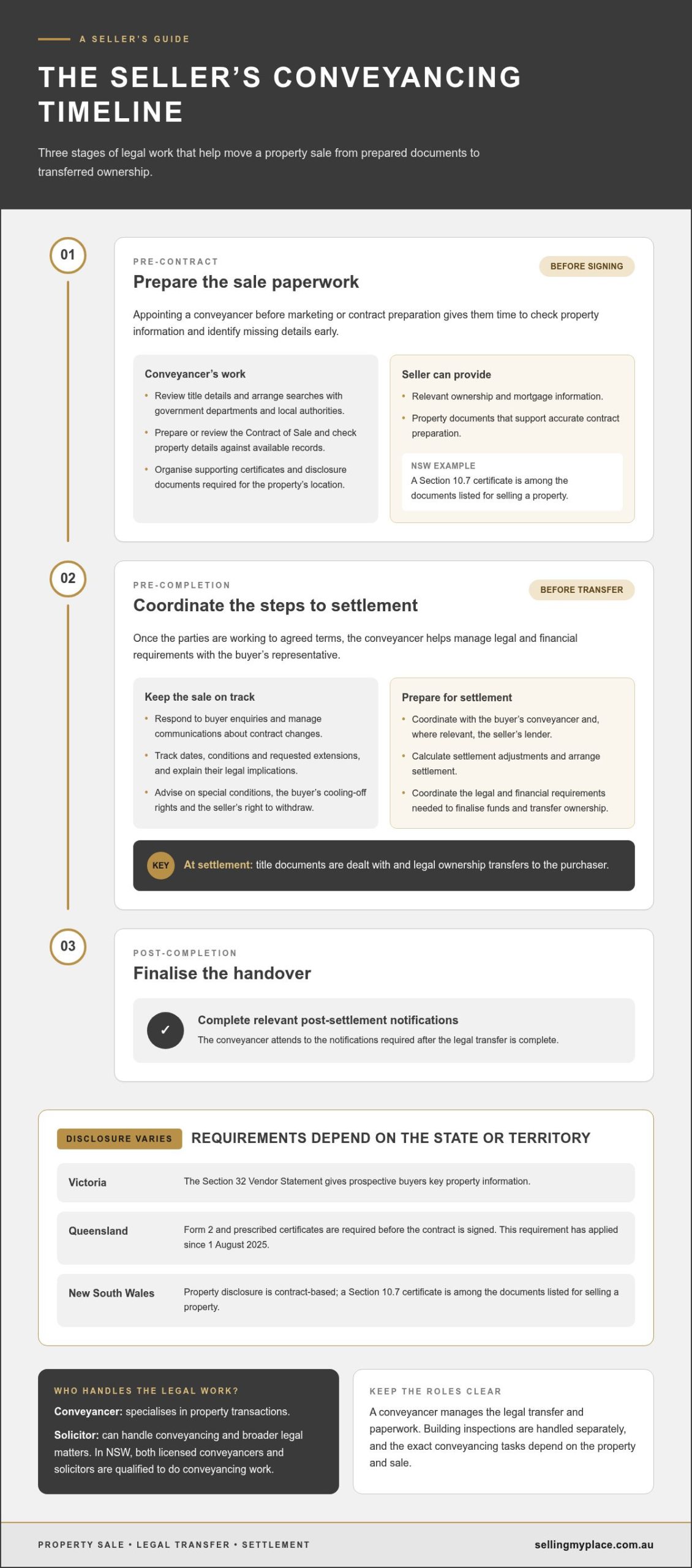
A seller’s conveyancer manages the legal work that transfers a property to its buyer. In Australia, conveyancing generally has three stages: pre-contract, pre-completion and post-completion.
Conveyancer and solicitor responsibilities
A conveyancer specialises in property transactions, while a solicitor can handle conveyancing and broader legal matters. In NSW, licensed conveyancers and solicitors are both qualified to do conveyancing work. A solicitor’s broader legal knowledge may help if a sale raises issues beyond the transfer itself. For a seller, understanding what a conveyancer does means knowing who prepares the sale documents, checks details and coordinates the legal steps with the other parties.
Property information and supporting certificates
Property information and certificates help describe the land and identify matters that could affect a sale. In NSW, a Section 10.7 certificate is among the documents listed for selling a property under the Conveyancing Act 1919. A seller’s conveyancer can review title details and arrange searches with government departments and local authorities. For example, information in a certificate or search may need to be considered when preparing the Contract of Sale, so the buyer receives relevant details before proceeding.
Sale documents and seller-provided information
Sale documents set out the property, agreed terms and information required for the transaction. In NSW, the Contract of Sale is a central document, and the Conveyancing Act 1919 specifies documents required to sell a property, including a Section 10.7 certificate. The conveyancer prepares or reviews the contract and checks that property details align with available records. The seller can help by providing relevant ownership and mortgage information, along with documents about the property that support accurate contract preparation.
Ownership transfer and appointment timing
Legal ownership transfers through the conveyancing process at settlement, when the title documents are dealt with. The seller’s conveyancer handles the legal work needed to transfer the property to the purchaser, then completes relevant post-settlement notifications. Appointing a conveyancer before marketing or contract preparation gives them time to review property information and prepare documents. This can help identify missing details before a buyer is ready to sign, rather than during a time-sensitive exchange.
The three stages provide a useful map of the work. Before the contract, the conveyancer prepares documents and checks property details. Before completion, they coordinate outstanding legal and financial requirements with the buyer’s representative. After completion, they attend to relevant notifications. In NSW, this work can include checking the contract, arranging searches, calculating settlement adjustments and attending settlement. The exact tasks depend on the property and sale, but each stage supports the same outcome: transferring ownership with the legal paperwork in order.
Risks of incomplete contracts and missed disclosure obligations
An incomplete contract or missed disclosure can complicate a sale and lead to disputes between buyers and sellers. Documents and disclosure rules vary across Australia, so the conveyancing process must reflect the property’s state or territory.
Preparing the contract and vendor’s statement
The seller’s conveyancer prepares or reviews the contract and the disclosure documents required for the property’s location. In Victoria, the Section 32 Vendor Statement gives prospective buyers key property information. In Queensland, the seller disclosure statement is Form 2, with prescribed certificates.
These documents help buyers understand the property before signing. Since 1 August 2025, Queensland sellers must give buyers Form 2 and prescribed certificates before the contract is signed. A conveyancer helps organise the required material and prepare the contract so the sale terms and disclosure documents are consistent.
Contract review and seller disclosures
Contract review means checking the proposed terms and disclosure material for accuracy, completeness and potential issues. In Victoria, the seller must provide prospective buyers with a Section 32 legal document containing key property information. Queensland’s Property Law Act 2023 introduced mandatory seller disclosure and stricter compliance obligations.
NSW property disclosure is contract-based, unlike the named disclosure documents used in Victoria and Queensland. A conveyancer reviews the contract and relevant information, then advises the seller about their obligations and any points needing attention. This review matters because buyers rely on the documents to understand what they are agreeing to purchase.
Contract terms, conditions and deadlines
Contract advice explains what each term requires and how a proposed condition could affect the sale. A conveyancer can advise on special conditions, the buyer’s cooling-off rights and the seller’s right to withdraw. A lawyer may also help if questions extend beyond conveyancing or involve broader legal issues.
Once the parties agree on terms, dates and conditions need to be tracked throughout the sale. For example, a requested extension changes the timing the parties are working towards, while a condition may require a particular action before proceeding. The conveyancer manages these communications and explains the legal implications before the seller responds.
Buyer enquiries, inspections and contract changes
The seller’s conveyancer handles legal communication with the buyer, including questions about title and requests to extend dates. If the buyer proposes a contract change, the conveyancer explains its effect and helps the seller consider a response before the revised terms are documented.
Building inspections are separate: conveyancers don’t arrange or carry out structural, pest or drug residue testing. A buyer may seek a building and pest condition in the contract, and a conveyancer can help ensure suitable wording is included. For support with the broader sale plan, explore property sale advice.
Arranging settlement and coordinating with the seller’s financial institution
Settlement is when the sale funds and ownership transfer are completed. The seller’s conveyancer coordinates the financial and title steps with the buyer’s conveyancer and, if the property has a mortgage, with the lender.
Settlement adjustments for rates and levies
Settlement adjustments divide property charges between the seller and buyer according to their agreed responsibilities at settlement. Using the relevant account details and settlement date, the conveyancer calculates adjustments for council rates, water usage and body corporate levies.
For example, if council rates cover a period beyond settlement, the settlement statement accounts for the buyer’s share after ownership changes. Water charges and body corporate levies may also need adjustments. These calculations account for ongoing property expenses alongside the purchase funds, rather than leaving an amount unresolved after the transfer.
The conveyancer prepares a settlement statement showing the payments needed to complete the sale and tells the buyer’s conveyancer which amounts are due at settlement. Reviewing the statement against the contract of sale and available rates or levy information can help identify an incorrect charge before funds are transferred.
Financial institution coordination
If the property is mortgaged, the seller’s conveyancer liaises with the existing mortgagee to arrange discharge of the mortgage. They can request a loan payout figure from the lender, establishing the amount needed to repay the debt from the sale proceeds.
This coordination connects the lender’s payout process with settlement and the title transfer. The conveyancer checks the payout information and includes the relevant payment in the settlement arrangements. This addresses the lender’s interest in the property as part of completing the sale, rather than leaving it as a separate task after ownership has transferred.
The conveyancer also checks the buyer’s deposit and coordinates with the buyer’s representative about payments needed for settlement. The contract of sale sets the agreed terms, while the settlement statement brings together the financial amounts due. If the seller has a mortgage, the payout figure is an important part of working out how the sale funds will be allocated.
Electronic settlement and title registration
Electronic settlement uses an electronic conveyancing workspace to coordinate funds and title documents between the parties. The seller’s conveyancer can facilitate settlement in the workspace and advise the seller when completion occurs.
At settlement, funds are exchanged and the legal title transfer proceeds. In Victoria, the change of ownership is registered with Land Use Victoria. The conveyancer prepares or coordinates the title transfer documents and checks that the settlement arrangements reflect the agreed transaction.
After completion, the seller’s conveyancer can notify relevant authorities of the change of ownership and pay outstanding rates and taxes. These final checks close out the seller’s responsibilities connected with the property. The buyer receives legal ownership, while the seller can see how the sale proceeds were applied, including any mortgage payout and settlement adjustments.
How does a conveyancer handle buyer enquiries, inspections and contract changes?
The seller’s conveyancer manages legal communication with the buyer and their representative during the sale. They respond to questions about title, consider requests to change dates and explain how proposed contract changes affect the seller’s position.
Buyer enquiries may concern the title, contract wording or details that need clarification before the transaction proceeds. The conveyancer checks each question against the sale documents, then communicates the response to the buyer’s conveyancer. For example, if the buyer asks about a title detail, the seller’s conveyancer can review the relevant information and explain what it means for the transaction. This keeps legal questions in the right channel and gives the seller a clearer basis for deciding how to respond.
Date changes need careful attention because a requested extension can affect the timing agreed by the parties. The conveyancer assesses the request, explains its effect and relays the seller’s response. If the seller agrees, the conveyancer helps document the variation so both parties have a clear record of the updated arrangement. A casual conversation should not be treated as a settled contract change; the conveyancer can clarify what has been agreed and what needs formal documentation.
Inspections are separate from legal enquiries. Conveyancers don’t organise or carry out building inspections, including structural, pest or drug residue testing. Those inspections concern the property’s physical condition, while conveyancing concerns the legal transaction. A buyer may ask for a building and pest inspection condition in the contract. The conveyancer can help ensure the contract wording is suitable, so the parties understand how the condition relates to the sale.
Contract changes may follow a buyer’s request, a question about a condition or a change to a proposed date. The conveyancer explains the legal effect before the seller responds. For instance, a buyer might seek more time to meet a condition or ask to change the wording. The seller can then consider the request with a clear view of its impact, rather than relying on an informal summary or assuming the change has no practical consequence.
Throughout these exchanges, the conveyancer acts for the seller, not as a neutral negotiator for both parties. Their role is to communicate the seller’s position, explain the contract’s implications and help document agreed changes. This distinction matters when a buyer’s request could alter a condition, deadline or obligation. The seller makes the commercial decision; the conveyancer provides legal guidance and helps ensure the response is accurately reflected in the transaction documents.
Keep relevant messages and documents together for the conveyancer, including buyer requests, inspection-related conditions and proposed date changes. A clear record helps them compare each request with the current contract and respond consistently. If a buyer raises several points at once, the conveyancer can separate legal questions from inspection arrangements and contract negotiations, then address each through the appropriate channel.
When should a seller appoint a conveyancer, and what should they provide?
Appointing a conveyancer before preparing the sale contract gives them time to organise the legal work and review property information. Sellers in Australia aren’t legally required to use one, but professional conveyancing is recommended because the transfer involves detailed documents and deadlines.
Early involvement is especially useful when the property needs searches, disclosure documents or mortgage discharge arrangements. In NSW, a conveyancer must be licensed with NSW Fair Trading, or the work must be done by a practising legal practitioner. In Queensland, paid conveyancing work must be carried out by a solicitor with a current practising certificate, or by supervised support staff in a law firm.
When you engage a conveyancer, provide details that help establish who owns the property and what may affect its sale. Useful records include:
- Ownership and title information, including the names of all registered owners.
- Mortgage details and the lender’s contact information, if the property has a loan.
- Available council rates, water charges and body corporate levy notices.
- Existing property documents and information relevant to buyer disclosure.
- Your contact details and identification for identity and authority checks.
For example, if two people appear on the title, the conveyancer needs to account for both when preparing sale documents. Mortgage details help them coordinate with the lender, while current rates or levy notices support settlement calculations.
Share information promptly, even if you’re unsure whether a document matters. The conveyancer can assess how it relates to the contract, searches or disclosure requirements in your state. In NSW, property disclosure is contract-based; in Victoria, the seller provides a Section 32 Vendor Statement. Queensland sellers provide Form 2 and prescribed certificates before the buyer signs.
Ask for an itemised estimate before work begins. In NSW, conveyancers and solicitors generally disclose certain conveyancing costs before or when retained. Request an itemised statement of likely costs before work starts. Disbursements may include title searches and authority certificate fees, so ask which professional fees and property-related charges are included in the estimate.
Understanding what a conveyancer does for a seller helps you appoint them at a useful point: before contract preparation, not after a buyer is waiting. For help planning your sale and organising the next steps, discuss your property sale plans.
Kincade International Direct Sales: Residential Property Listing Services
Kincade International Direct Sales helps Australian homeowners prepare and market a residential property through its Residential Property Listing Services. While your conveyancer manages the legal transfer, Kincade supports the separate task of presenting your home to buyers.
Its flat-fee marketing model includes professional photography, floorplans and neighbourhood market reports, with listings remaining active until sold and no time limits. Pre-Sale Property Consulting can help you plan the sale before launch, while Buyer Representation supports people looking to purchase. These services complement conveyancing; they don’t replace the legal work of preparing contracts or transferring ownership.
If you’re planning a sale, explore Kincade International Direct Sales’ fixed-fee packages at sellingmyplace.com.au.
Take the next step towards your property plans
Knowing what a conveyancer does for a seller helps you distinguish the legal transfer from the decisions that shape your sale. Next, clarify the outcome you want, the support you need and how you’ll present the property to potential buyers. Keeping those choices aligned can make the move from planning to market more considered.
Kincade International Direct Sales offers Residential Property Listing Services and Pre-Sale Property Consulting for owners preparing to sell. If your plans also include buying another home, its Buyer Representation can support that part of your next move. The right focus depends on where you are in the process, whether you’re weighing up your sale approach or getting the property ready for market.
For a considered conversation about your plans, contact Kincade International Direct Sales. Take the next step at your own pace, with a clearer path ahead.
Frequently Asked Questions
What is conveyancing and how does it work?
Conveyancing is the legal process of transferring land ownership from one party to another. A sale involves coordinating legal documents and transaction details between the parties. The work spans preparing the sale, managing contract and settlement arrangements, and finalising the transfer. For example, details agreed in the contract inform the checks and payments needed to complete the transaction.
How long is the conveyancing process?
Most conveyancing processes in NSW take 42 days, or around six weeks. The timeline depends on the contract’s settlement date and how quickly required documents, searches and lender arrangements are completed. A title issue or late information can affect the sequence of work, so the agreed dates in the contract provide the practical reference point. Conveyancing timeframes differ across Australia and between individual sales.
What is a conveyancer and why are they essential in 2026?
A conveyancer is a licensed professional who specialises in property transaction advice and information; they may or may not be a solicitor. Using one is not legally required in Australia, but professional help is recommended because contracts, disclosure material and settlement require careful coordination. In 2026, sellers also need to account for state-specific disclosure rules, such as Queensland’s Form 2 process, when preparing a sale.
What does a conveyancer do for a seller in Australia?
A seller’s conveyancer handles the legal work needed to transfer the property and supports the seller through the transaction. Understanding what a conveyancer does for a seller means looking beyond paperwork: they also communicate with the buyer’s representative, explain the legal implications of requests and coordinate relevant checks. For instance, if a buyer asks to change a contract date, the conveyancer explains the effect before the seller decides.
What documents does a seller’s conveyancer prepare and review?
A seller’s conveyancer prepares or reviews the Contract of Sale and checks property records and disclosure material relevant to the state. The particular documents differ: NSW sales include a Section 10.7 certificate among required documents, while Victoria uses a Section 32 Vendor Statement. In Queensland, Form 2 and prescribed certificates form part of seller disclosure. Sellers can help by sharing ownership, mortgage and property records early.
How does a conveyancer prepare the contract of sale for an Australian property?
A conveyancer prepares the contract using information about the property, its ownership and the proposed sale terms. They review title details and relevant searches, then consider whether the contract accurately describes the property and records the parties’ agreement. For example, the seller’s proposed settlement date or a buyer-requested condition needs clear wording. State requirements also shape the supporting material, so a NSW contract differs from disclosure documents used in Victoria or Queensland.
What are the steps in the conveyancing process for a property seller in Australia?
The process generally moves through pre-contract, pre-completion and post-completion stages. First, the seller’s representative gathers property information and prepares sale documents. After the buyer and seller enter the contract, the parties deal with enquiries, required checks and settlement arrangements. At settlement, funds and the title transfer are coordinated. Afterwards, the seller’s representative can manage relevant ownership notifications. State rules and the agreed contract shape the details at each stage.
What does a seller’s conveyancer do at settlement, including calculating adjustments and paying out the mortgage?
At settlement, the conveyancer coordinates the seller’s financial and title requirements with the buyer’s representative. They calculate adjustments for council rates, water usage and body corporate levies, then include those amounts in the settlement statement. If there is a mortgage, they obtain the lender’s payout figure and arrange for the loan to be paid from the sale proceeds. The remaining funds are distributed according to the settlement arrangements.
What Happens After Accepting an Offer on a House in Australia?
Accepting an offer is an important milestone, but it is only the beginning of the next stage of your sale. If you’re wondering what happens after accepting an offer on a house, you may be asking whether the deal is binding, what the buyer still needs to do and which deadlines matter.
In Australia, the next steps depend on the contract of sale and the rules in your state or territory. An accepted offer is not always the same as an unconditional, legally binding sale. Signing or exchanging the contract, any cooling-off rights and the agreed conditions all matter. The buyer’s finance approval and building or pest inspections may also affect progress, depending on the contract.
This guide covers the steps from acceptance to settlement, including how to prepare, track conditions and manage key dates. It also explains what can vary across Australia, so you can stay organised, follow the agreed terms and prepare for handover.
Key Takeaways
- Follow the contract-led steps from acceptance through to settlement.
- Check the signed contract for conditions, agreed terms and key dates. Requirements can differ between Australian states and territories.
- Track any finance or inspection conditions in the contract, including the deadlines and actions they require.
- Organise documents, confirm agreed property inclusions and access arrangements, and keep communication with your conveyancer or solicitor in one place.
- Plan your move and handover ahead of settlement, including keys, mail redirection and utility arrangements.
What accepting a house offer means for you as the seller
Hearing that a buyer wants your home can bring real relief after all the preparation and decisions involved in selling. Enjoy the milestone, then focus on what comes next: acceptance starts a contract-led process, but it is not settlement and does not automatically mean the sale is complete.
If you’re asking what happens after accepting an offer on a house, first distinguish an informal conversation from the legal paperwork. A buyer might make an offer verbally or in writing, and you might indicate that you agree with the price and terms. But don’t assume that a verbal agreement has the same effect as a properly completed contract of sale. The form of acceptance, signing or exchange process, and legal effect depend on the transaction and the rules in your state or territory.
The contract records the terms that matter, including the agreed price, deposit, settlement date, included items and any conditions. Once it takes legal effect, both parties generally need to follow those terms. Conditions can affect what happens next. For example, a finance or inspection clause may set out steps the buyer must complete before the sale becomes unconditional. The wording of the contract and applicable local rules determine the parties’ rights and obligations, so rely on the actual terms rather than a general rule of thumb.
Does accepting an offer make the house sale final?
Not necessarily. A sale may become legally binding once the required contract process is complete, but an accepted offer alone does not guarantee that the property will reach settlement. If the contract includes conditions, the buyer may need to satisfy them, or the contract may explain what happens if they are not met. Read the signed terms carefully and ask the conveyancer or solicitor handling your transaction to explain anything that is unclear.
What should a seller do straight after acceptance?
Keep the written offer and every version of the signed contract together. Make a clear record of the agreed dates, conditions and next steps, so you have one reliable reference if details are later discussed by phone or email. Contact your conveyancer or solicitor promptly to understand the contract process and coordinate the work they are handling.
- Save the paperwork: Store the written offer, signed contract and related messages together.
- Note the key dates: Record the contract deadlines and settlement date, plus who is responsible for each action.
- Keep communication clear: Share relevant documents with your conveyancer or solicitor. Keep important updates about the contract in writing.
These simple steps can prevent crossed wires as the sale progresses. Treat acceptance as the start of the agreed process, not a signal that every detail is settled. Let the written terms guide what happens next.
The contract, conditions and conveyancing steps after acceptance
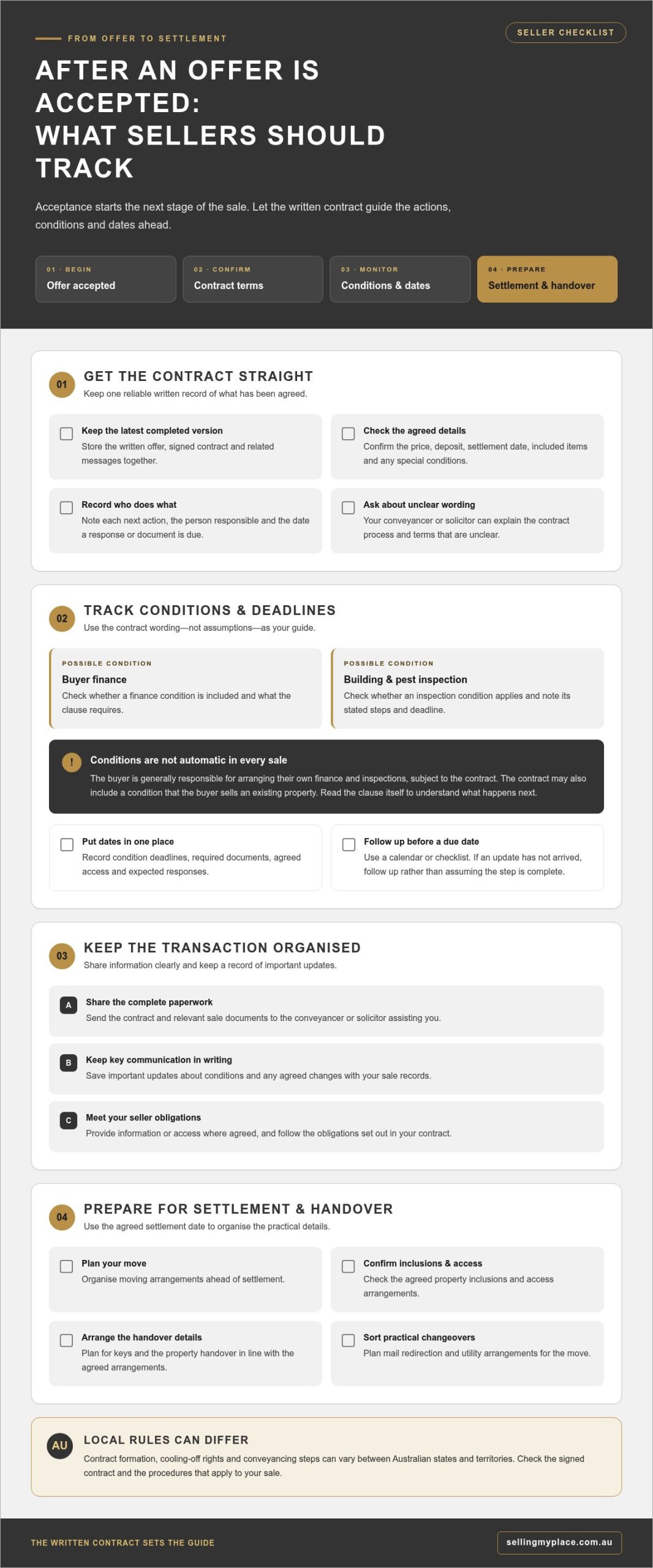
Once the offer is accepted, use the contract as your working guide rather than relying on a handshake or a summary of what was discussed. It sets out the sale terms, conditions and dates that can affect progress. Review the completed contract, identify the next actions, share relevant documents and keep a reliable record of deadlines and communications.
- Check the completed contract. Make sure you have the latest version, signed or otherwise completed through the process that applies to your sale. Confirm that the written price, deposit, settlement date, inclusions and special conditions match the agreed terms.
- Mark each condition and date. Record what needs to happen, who is responsible and when a response or document is due. A finance condition or building and pest inspection condition might be included, but neither is automatic in every sale.
- Share the paperwork. Send the complete contract and relevant sale documents to the conveyancer or solicitor assisting you. Keep copies of important communications, especially updates about a condition or an agreed change.
- Track progress and follow up. Use a calendar or checklist to monitor deadlines. If a due date is approaching and you have not received an update, follow up with the person handling that step rather than assuming it is complete.
The buyer is generally responsible for arranging their own finance and inspections, subject to the contract. As the seller, you need to meet your contractual obligations and provide information or access where agreed. An offer may also depend on the buyer selling an existing property if the contract includes that condition. Read the clause itself, since its wording determines what happens next.
There is no identical process across Australia. Contract formation, cooling-off rights and conveyancing steps can vary between states and territories, and the contract may set out additional requirements for your transaction. For vendors navigating regional markets, local agencies such as Ollie James Real Estate can provide helpful insight into regional sale practices and timing. Always ensure you rely on the terms and procedures that apply to your specific sale.
Which contract dates and conditions should sellers track?
Use the signed contract to confirm exact dates and wording. Record condition deadlines, required documents, agreed access arrangements and responses expected from either party. A shared calendar or written checklist makes responsibilities easier to follow, particularly when several people are coordinating the sale. If a clause is unclear, raise it promptly with your conveyancer or solicitor.
What does a conveyancer or solicitor do after acceptance?
Your conveyancer or solicitor helps progress transaction documents and communicates with the other parties about conveyancing. Give them the full signed contract and relevant sale documents, and keep them informed of any agreed changes. Their support helps coordinate the transaction, but you still need to follow the contract and complete your own tasks.
For practical guidance alongside the paperwork, sale-process advisory support can help you stay organised as the transaction moves forward.
Buyer finance and inspections: what sellers can expect
Some buyers need time after signing to confirm finance or arrange property inspections. Others make an offer without these conditions, or may already have completed some checks. What happens after accepting an offer on a house therefore depends on the terms in your contract, not on a universal checklist that every buyer must follow.
Distinguish between a contract with conditions still to be met and one that has become unconditional. If a finance or inspection condition applies, the buyer’s next steps may affect whether the transaction proceeds under the agreed terms. Once applicable conditions are satisfied or dealt with, the contract may move to an unconditional stage. The timing and legal effect depend on the contract and the rules in your state or territory.
While the buyer completes any agreed steps, keep your own actions practical and measured:
- Provide access for inspections as agreed and keep arrangements in writing.
- Note contract dates and pass relevant updates to your conveyancer or solicitor promptly.
- Keep messages, notices and documents about conditions together, including requests and proposed changes.
- Do not assume a delay or inspection finding means the sale has ended. Check the contract and get guidance on the next step.
What happens if the buyer’s finance is delayed or declined?
First, check whether the contract includes a finance condition and what it says about the buyer’s obligations, timing and any required notice. A lender taking longer than expected does not automatically end the sale, and a declined application does not automatically give you the right to terminate or keep the deposit. Record any notice or update, then discuss the contract steps promptly with your conveyancer or solicitor.
Keep communication calm and factual. If the buyer says their lender has not provided an answer, note when you received the update and share it with the person handling your conveyancing. Do not assume an extension, termination or entitlement to the deposit based on a phone call alone. Handle any change to the agreed process in line with the contract and applicable rules.
How should sellers handle building or pest inspections?
Findings can range from routine maintenance observations to issues the buyer wants clarified. Respond through the agreed communication process and avoid promising repairs or changing terms informally. If a report leads to a proposed variation, ask your conveyancer or solicitor how it relates to the contract before agreeing to anything.
Contract wording and relevant procedures can differ across Australia. Keep the signed terms close, meet your agreed obligations and get advice on a specific notice or request rather than relying on another sale’s experience. A pause in progress may simply mean a condition is still being dealt with.
A practical seller checklist for the weeks before settlement
As settlement approaches, small details can take up more headspace than expected. A clear checklist helps you keep documents, property arrangements and moving plans together, with the contract and your conveyancer or solicitor as your reference points. The weeks before handover can vary between sales, so organise around your confirmed settlement arrangements rather than assuming every transaction follows the same timetable.
For sellers wondering what happens after accepting an offer on a house, preparing early can help avoid last-minute scrambles. Start with the records and commitments connected to your sale:
- Sale documents: Keep the contract, any schedule of inclusions and relevant correspondence together. Add transaction documents requested by your conveyancer or solicitor.
- Written commitments: Save records of agreed repairs, access arrangements or other promises made during the sale. Make sure everyone involved has the same written details.
- Questions and deadlines: Note document requests and dates. Ask your conveyancer or solicitor to clarify anything you do not understand.
- Moving arrangements: Plan removal, mail redirection, address changes and utility arrangements around the settlement date and handover instructions.
Keep the checklist practical and up to date. If an arrangement changes, update your records and tell the people involved rather than relying on memory or an old message thread.
What documents and property details should you organise?
Gather documents relevant to your sale, including the signed contract, inclusion list, correspondence and anything specifically requested for the transaction. Check which items stay with the property, such as fixtures or appliances, and distinguish them from belongings you plan to take. If a document request or deadline is unclear, ask your conveyancer or solicitor what is needed and when.
Keep a brief record of agreed work or access as well. Note what was agreed, who is arranging it and any timing discussed. That gives everyone a shared reference if questions come up before handover.
How can you prepare for the final inspection and move?
The buyer may have a final inspection under the contract or the process used in your state or territory. Check the relevant terms and arrangements rather than assuming an inspection is automatic or has the same scope everywhere. Before handover, review the agreed inclusions and leave the property in the condition required by the contract. If you are unsure what that means for a particular item, raise it with your conveyancer or solicitor.
Coordinate removal and utility changes with the confirmed settlement arrangements. Plan mail redirection, address updates and utility changes around the move and handover. Keep keys and any agreed access items ready for the handover process.
For practical guidance while organising your sale and preparing for settlement, get support with your property sale.
Settlement day and what comes next for the seller
Settlement is the final milestone in the sale, but the arrangements depend on your contract and the process used for the transaction. Your conveyancer or solicitor will generally coordinate the required documents and communicate with the other parties about readiness. If settlement is completed electronically, they will also coordinate through the relevant electronic settlement process.
In plain terms, settlement is when the sale is completed under the contract, the buyer pays the balance and ownership is transferred. Where relevant, the process also includes paying out the seller’s mortgage. The sale proceeds are then distributed according to the transaction arrangements.
What happens on settlement day?
The general sequence is to confirm the parties are ready, complete settlement and follow the agreed handover arrangements. Your conveyancer or solicitor can update you on progress and confirm when settlement has occurred. The precise steps and timing can vary across Australia, so use your contract and transaction updates rather than assuming every sale follows the same procedure.
Hand over keys and possession as set out in the contract and related arrangements. Do not assume the buyer receives the keys at a particular time simply because settlement is scheduled for that day. Follow the instructions from the people coordinating the transaction and have the agreed handover items ready.
If you are unsure whether settlement has been completed, wait for confirmation from your conveyancer or solicitor before treating the property as handed over. If arrangements change or a delay arises, ask how it affects the agreed handover. This can prevent confusion on a day when you may also be managing a move or saying goodbye to your home.
Where can sellers get practical support through the sale?
A well-organised sale involves more than preparing the property for buyers. Owners also need to manage information, communications and transaction steps as the sale progresses. Property advice can help you approach those tasks with a clearer plan, while your conveyancer or solicitor coordinates the legal and settlement documentation.
Kincade International Direct Sales supports residential owners with property marketing and advisory guidance, including professional photography, floorplans and pre-sale consulting. Its flat-fee, commission-free model gives owners an alternative to a traditional agency commission. Advisory guidance can help you stay organised through the process, while legal and conveyancing matters remain with the professionals handling your transaction.
Settlement completes the agreed sale and marks the handover stage, subject to the contract and local process. If you are planning a residential sale and want practical support with property marketing and your next steps, discuss sale support with Kincade International Direct Sales.
Take your next property step with confidence
The offer is one milestone in a bigger transition. As you look ahead, make room to plan what comes next, whether you are coordinating a move, preparing for a new home or checking that the sale is progressing as agreed. A steady plan can make the change feel more manageable.
Understanding what happens after accepting an offer on a house also means knowing when to pause and seek clarity. Use your signed terms as the reference point, and direct questions about your obligations or the conveyancing process to the professional handling your transaction. You can also get practical guidance with the sale planning and property marketing involved.
Kincade International Direct Sales supports residential owners with property marketing and advisory options, including a flat-fee, commission-free model. If you are planning a sale and want support with marketing and your next steps, talk with us about selling your property.
With preparation and the right support, you can move into the next chapter feeling more settled and ready for what is ahead.
Frequently Asked Questions
Can I change my mind after accepting an offer on my house?
Possibly, but it depends on whether a contract has taken legal effect, what it says and the rules that apply where the property is located. Once a contract is binding, withdrawing may have serious consequences. Do not cancel arrangements or tell the buyer the sale is off based only on a conversation. Review the signed documents and speak promptly with your conveyancer or solicitor before taking action.
When does a house offer become legally binding in Australia?
There is no single trigger that applies to every Australian sale. The legal effect depends on how the offer and acceptance are documented, the contract terms and the jurisdiction. A verbal agreement is not a substitute for checking the paperwork. Ask your conveyancer or solicitor to explain when your contract takes effect, which conditions apply and whether any deadlines have started. Do not rely on a process described for another state or territory.
Is there a cooling-off period after accepting an offer on a house?
It depends on the state or territory, the contract and the circumstances of the sale. Cooling-off rights can have exceptions, so do not assume a period applies simply because an offer has been accepted. Check the contract for relevant terms and promptly seek guidance specific to your location. If you are unsure whether the agreement is binding or a deadline is close, raise that with your conveyancer or solicitor.
How long does it take to settle after accepting an offer?
There is no single settlement timeframe for every Australian house sale. If you are wondering what happens after accepting an offer on a house, check the settlement date recorded in the signed contract. The parties may agree to different arrangements, and finance, documents or other contract conditions can affect progress. If circumstances change, ask your conveyancer or solicitor how the agreed date and next steps are affected.
What happens if the buyer cannot get finance approval?
Check whether the contract includes a finance condition, what deadline applies and how the buyer must give notice. The outcome depends on those terms and the relevant rules, so do not assume the contract automatically ends or continues. Keep the buyer’s updates and any formal notices in writing. Before responding or agreeing to a change, ask your conveyancer or solicitor to explain the steps available under your contract.
Can I accept another offer after accepting one?
Do not treat a later offer as replacing an agreement already in place. Your obligations depend on whether the first contract has taken legal effect, its terms and the law that applies. Before making a commitment or telling another buyer their offer is accepted, refer the situation to your conveyancer or solicitor. This helps you understand how the existing agreement affects what you can do next.
What should I do with utilities when selling my house?
Plan utility changes around the contract’s settlement and possession arrangements, rather than cancelling services as soon as an offer is accepted. Essential services may need to remain available for agreed access, inspections or handover. Note meter readings, account responsibility and changeover arrangements as you prepare to move. Your conveyancer or solicitor can clarify transaction dates, and you can arrange account updates or closure with the relevant providers.
Understanding the Cooling Off Period When Selling: The 2026 Australian Guide
What if the most dangerous moment in your property sale isn’t finding a buyer, but the days immediately after they sign? For Australian homeowners, understanding the cooling off period when selling is often the difference between celebrating a smooth exchange and watching a transaction suddenly unravel. While statutory cooling off rights protect purchasers from high-pressure commitments, vendors are bound the instant contracts are signed, leaving you carrying all the initial risk.
Selling a home is a deeply personal milestone, and it’s completely natural to feel uneasy when a buyer holds a statutory exit pass. It’s equally frustrating trying to decipher conflicting state rules, calculating clear business days versus weekends, or wondering how cooling off provisions actually interact with conditional finance clauses.
You don’t have to leave your sale proceeds to chance. In this 2026 guide, you’ll discover exactly where you and your buyer stand legally, how to secure unconditional contracts using waiver certificates or auction-style terms, and how expert conveyance advice safeguards your equity from exchange straight through to settlement.
Key Takeaways
- Mastering the legal landscape and understanding the cooling off period when selling reveals why statutory cancellation rights favour the purchaser, leaving vendors legally bound from day one.
- Statutory windows and cancellation penalties vary significantly across Australian states and territories, making the precise counting of clear business days essential for protecting your timeline.
- If a buyer exercises their right of rescission, vendors hold a statutory right to retain a specific forfeit from the initial deposit, provided formal notice procedures are met.
- Sellers can actively eliminate transaction uncertainty by requiring formal legal waiver certificates or adopting auction-style unconditional terms prior to exchange.
- Securing independent conveyance advice empowers you to structure protective contract conditions and maintain complete control over your equity without paying traditional agent commissions.
What Is the Cooling Off Period When Selling Residential Property in Australia?
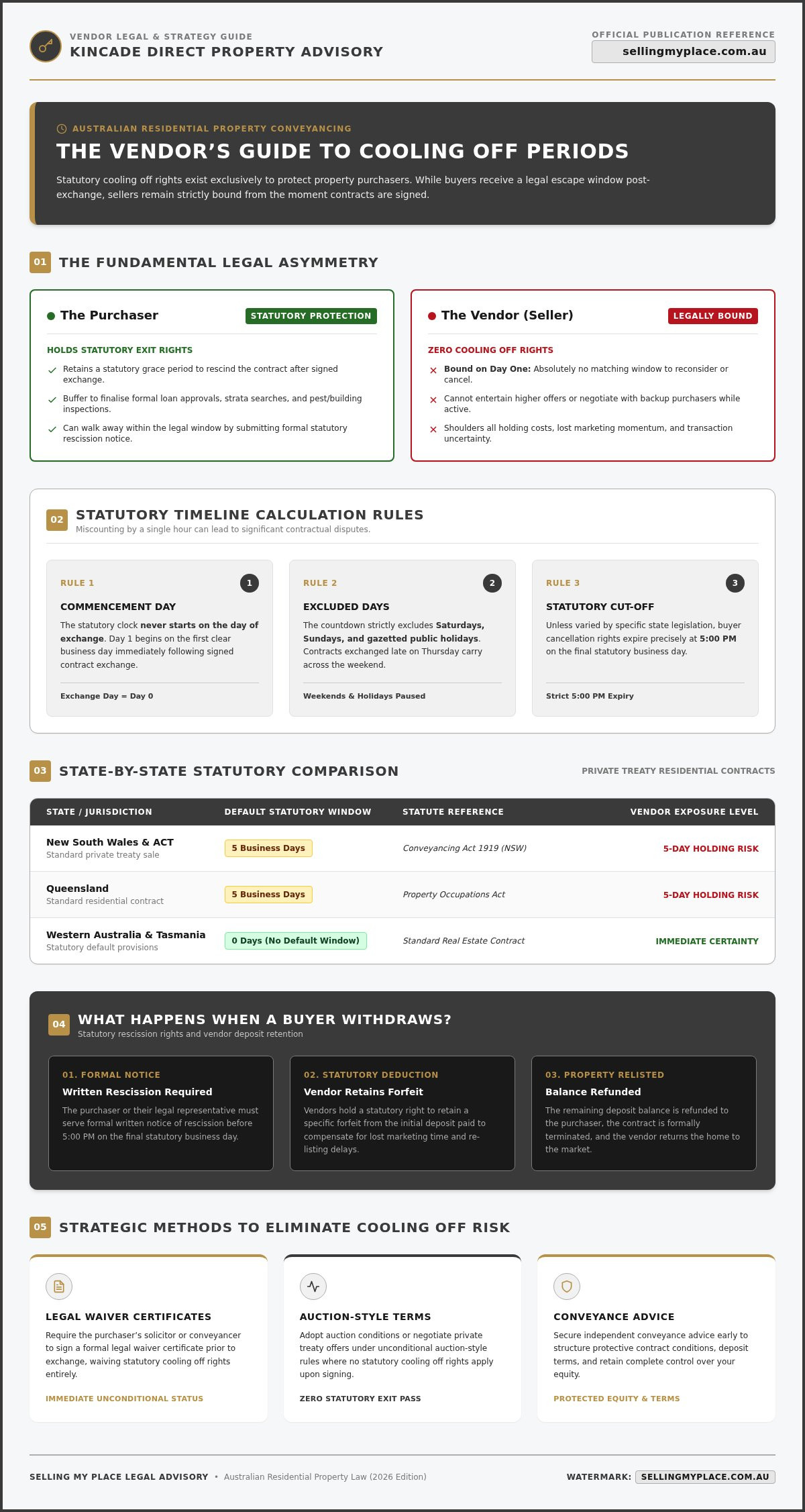
A cooling off period in Australian residential property transactions provides buyers a statutory grace period to withdraw, whereas sellers are legally bound upon contract exchange. When you sign a contract of sale as an owner, you commit entirely to the transaction; you do not receive a matching window to change your mind, reconsider an offer, or entertain a higher bid from another party. True mastery of the sales process begins with understanding the cooling off period when selling from the vendor’s perspective, replacing false assumptions of contractual security with proactive risk management.
Rooted in broader principles of consumer protection, such as the statutory safeguards outlined under a Cooling-off period (consumer rights) framework, this legislative mechanism intentionally balances power between commercial parties and private individuals. However, in private treaty property transactions, that balance tips heavily in the purchaser’s favour. The buyer retains an escape hatch. You, as the vendor, shoulder the ongoing holding costs, lost marketing momentum, and emotional uncertainty until that statutory window shuts.
Why Cooling Off Rights Exist Exclusively for Buyers
State governments instituted statutory cooling off protections to curb aggressive high-pressure sales tactics and prevent rash financial decisions during emotionally charged negotiations. The reprieve offers purchasers crucial breathing space to finalise formal loan approvals, review title covenants, or coordinate pest and building inspections without losing the property to a competing applicant. Vendors, by contrast, operate under no such sudden time pressure. Sellers typically spend weeks preparing documentation, setting reserve prices, and weighing market conditions, which is why Australian law provides no statutory right for vendors to reconsider once contracts are exchanged.
How Business Days and Commencing Hours Are Calculated
Calculating the exact expiration of a cooling off window requires strict attention to the calendar. Miscounting by a single hour can lead to significant disputes over contract validity. While specific statutory timeframes differ between states, the calculation rules follow consistent legal principles across the country:
- Commencement day: The statutory clock never starts on the day of exchange. Day one begins on the first business day immediately following signed contract exchange.
- Excluded days: The countdown excludes Saturdays, Sundays, and gazetted public holidays. A contract signed late on a Thursday afternoon frequently carries over the weekend into the following week.
- Statutory expiry time: Unless varied by specific state legislation, rights expire precisely at 5:00 PM on the final statutory business day.
Gaining clarity on these precise cut-offs ensures you know the exact minute your contract becomes unconditional, allowing you to plan your next transition with genuine confidence.
Cooling Off Periods Across Australia: State-by-State Rules and Penalties
State property acts establish differing statutory cooling off durations, ranging from zero days in Western Australia and Tasmania to five business days in New South Wales and Queensland. Because property law remains state-based rather than national, a private treaty offer structured in one jurisdiction carries fundamentally different default legal obligations than one signed across state borders. Truly understanding the cooling off period when selling requires knowing the precise statutory duration and financial deduction rules applicable to your property’s location.
Comparative Overview of Durations and Financial Forfeitures
If a buyer exercises their statutory right of withdrawal, legislation dictates whether they forfeit a financial sum to compensate you for lost market time. Here is how state statutes handle durations and statutory retention penalties:
- New South Wales and Australian Capital Territory: Provide 5 business days under the Conveyancing Act 1919 (NSW). For contracts exchanged on or after 1 June 2026, NSW requires an updated mandatory cooling off notice. In both jurisdictions, a withdrawing purchaser forfeits 0.25% of the total purchase price from their deposit. For off-the-plan contracts in NSW, this statutory window extends to 10 business days.
- Queensland: Operates under a 5 business day statutory window via the Property Occupations Act 2014 (Qld), with an identical 0.25% purchase price retention penalty.
- Victoria: Under Victoria’s private sale cooling-off rights within the Sale of Land Act 1962 (Vic), purchasers receive 3 clear business days. The statutory forfeit is the greater of $100 or 0.2% of the purchase price.
- South Australia and Northern Territory: South Australia provides 2 clear business days under the Land and Business (Sale and Conveyancing) Act 1994 (SA), requiring any deposit paid above $100 to be refunded. The Northern Territory provides 4 business days under the Law of Property Act 2000 (NT), refunding the full deposit without statutory penalty.
- Western Australia and Tasmania: Neither jurisdiction enforces an automatic statutory cooling off period for residential private treaty contracts. Any cancellation window exists only if negotiated as a special condition.
Exemptions Where No Cooling Off Period Applies
Statutory cancellation periods do not govern every transaction. Across all Australian jurisdictions, residential properties sold under the hammer at a public auction carry zero statutory cooling off rights. In Victoria, this exemption also extends to contracts signed within three clear business days before or after a scheduled public auction. Contracts signed on the day of an auction in NSW are similarly exempt, as are commercial assets, industrial developments, and rural holdings exceeding designated statutory hectarage.
Aligning these legal mechanisms with professional campaign execution ensures you maintain momentum while keeping full legal clarity. Vendors should cross-reference our guide on Professional Residential Property Listing Services to structure contracts properly from the start. If you want strategic oversight tailored to your jurisdiction before accepting private treaty offers, consider reaching out for professional real estate advisory guidance to protect your sale timeline.
What Happens When a Buyer Withdraws During the Cooling Off Window?
Having a buyer pull out of an exchanged contract can feel like a sudden gut punch. You have popped the champagne, begun visualising your upcoming move, and mentally banked the proceeds, only to have the transaction grind to a halt. When an agreement unravels, understanding the cooling off period when selling equips you to handle the legal aftermath calmly, retain your rightful statutory compensation, and relaunch your campaign without missing a beat.
The Legal Mechanics of a Contract Rescission
Walking away from a binding property contract requires rigorous procedural compliance. A purchaser cannot simply change their mind over a phone call or fire off a casual text message to announce their departure. For a rescission to hold legal validity across Australian jurisdictions, precise requirements must be met:
- Written instrument: The buyer or their legal representative must draft and sign a formal notice of rescission.
- Timely service: The notice must be served to the vendor, their nominated conveyance professional, or their licensed representative before the statutory clock runs out.
- Strict deadlines: If the statutory deadline passes by even a single minute without formal delivery, the contract converts automatically into an unconditional agreement.
Managing Deposit Funds and Retained Compensation
Once a valid notice arrives, the contract dissolves. The stakeholder holding the deposit (typically a conveyancer or trust account holder) calculates the statutory deduction applicable to your jurisdiction. If your property is in New South Wales or Queensland, the 0.25% termination fee is deducted directly from the initial holding deposit and transferred directly to you. In Victoria, the retained forfeit is the greater of $100 or 0.2% of the agreed purchase price. The stakeholder promptly refunds the remaining balance to the purchaser. While this statutory forfeit rarely replaces the emotional energy invested, it serves as direct compensation to offset your holding costs and immediate administrative delays.
Re-entering the Market Swiftly Without Losing Value
A cancelled contract does not mean your property is damaged goods. Momentum is everything in residential real estate, so your digital listings across national portals must immediately return to active status. Reach out straight away to runner-up buyers who submitted strong expressions of interest during initial opens; an experienced vendor knows how to leverage previous competition to reignite active bids. Frame the return simply as an administrative collapse tied to buyer circumstances rather than any fault of the home itself. Vendors managing their own journey should tap into established property sale negotiation tips to transform this temporary hiccup into a firm, unconditional offer from a better-qualified purchaser.
Strategic Methods for Sellers to Minimise or Eliminate Cooling Off Risks
You do not have to accept conditional vulnerability as an unavoidable part of selling your home. While statutes give buyers the right to a cooling off window, sophisticated vendors regularly negotiate contracts that neutralise or bypass these statutory delays altogether. Truly understanding the cooling off period when selling means treating contract conditions as active bargaining chips rather than passive formalities. By combining strategic negotiation with proven sale by owner principles, you retain total command over your transaction timeline.
Utilising Legal Waiver Certificates (Section 66W Equivalents)
The most absolute method to lock in a private treaty sale is requiring an unconditional legal waiver. In New South Wales, this is enacted via a Section 66W certificate, signed by the purchaser’s independent solicitor or conveyancer. Similar waiver instruments operate in Queensland and other jurisdictions. This document certifies that an independent legal practitioner explained the contract implications to the buyer and that they deliberately relinquish their cooling off rights. In competitive multi-offer situations, demanding an executed waiver certificate alongside the signed contract immediately separates uncommitted lookers from serious, qualified purchasers.
Rigorous Buyer Pre-Qualification Before Contract Signing
Unconditional certainty begins long before exchange papers hit the table. Screening prospective purchasers during initial discussions weed out buyers who intend to use statutory windows as casual thinking time. You can protect your momentum with three targeted requirements:
- Unconditional pre-approval: Ask to see formal, written finance documentation rather than vague, verbal pre-qualification claims.
- Substantial initial deposit: Insist on a meaningful holding deposit upon signing rather than a token sum; purchasers with substantial capital committed rarely walk away.
- Upfront due diligence: Encourage buyers to complete pest, building, and strata inspections prior to signing, eliminating standard rescission excuses.
Structuring Unconditional Contract Terms with Advisory Support
Partnering with seasoned property advisors ensures your contract is engineered for vendor protection from the outset. Rather than settling for open-ended finance clauses that drag on for weeks, specialized conveyance advice allows you to insert strict sunset clauses, tight five-day turnaround windows, and mandatory deposit forfeiture clauses. Ready to lock in a rock-solid sale while retaining your full equity? Speak with our property advisors to establish the right protective terms before you accept your next offer.
Maximising Sale Certainty and Profit: The Commission-Free Advisory Advantage
Traditional commission incentives often reward transaction speed over transaction security. A conventional agent, eager to bank a commission, may urge you to accept a conditional private treaty offer quickly, brushing aside the genuine risks of a cooling off cancellation. True mastery and understanding the cooling off period when selling means partnering with advisors whose goals mirror your own: achieving an unconditional contract with minimal friction. Accurate pricing plays a crucial role in preventing buyer second thoughts during this vulnerable window; consult our guide on how to determine market value of a home in australia to ensure your reserve aligns perfectly with buyer expectations.
Why Traditional Commission Models Increase Seller Vulnerability
Percentage-based commissions create an inherent conflict of interest. Agents are often motivated to slap an "under contract" banner on a listing as rapidly as possible, nudging owners into accepting conditional offers without adequate purchaser screening. When a buyer rescinds during the statutory window, the vendor carries the full burden of lost marketing momentum and emotional fatigue. By contrast, a flat-fee advisory model removes sales commission pressure entirely. The focus remains squarely on vetting genuine buyers, demanding strong contract terms, and protecting your equity.
Professional Support Without the Percentage Cut
Securing an unconditional sale does not require sacrificing your equity. Through an Agent Advisory Service, vendors access dedicated pre-sale property consulting, strategic buyer vetting, and professional conveyance advice tailored to Australian property acts. Sellers save an average of $20,000 in traditional real estate commissions while maintaining total command over their listing campaign. Retaining your full proceeds gives you the financial breathing room to negotiate firmly, rather than accepting weak conditional terms out of anxiety.
Next Steps to Secure Your Property Sale Confidently
Building transaction certainty begins well before your first open home. Work alongside experienced legal professionals to draft a comprehensive disclosure pack upfront, address potential building quirks early, and establish strict timeframes that discourage speculative offers. A thorough understanding the cooling off period when selling transforms what many consider an anxious waiting game into a well-managed legal milestone. Ready to take control of your sale and protect your net profit? Connect with the team at Kincade International Direct Sales to structure a confident, commission-free campaign.
Taking Charge of Your Property Sale and Future Equity
A successful property transition shouldn’t leave you sitting on edge, second-guessing whether a buyer will follow through. Thoroughly understanding the cooling off period when selling gives you the strategic upper hand, whether you negotiate upfront legal waiver certificates, establish strict contract timeframes, or retain statutory deposits should an uncommitted purchaser pull out.
You deserve professional support that safeguards your hard-earned wealth without cutting into your proceeds. With our dedicated Agent Advisory Service, you receive tailored pre-sale consulting and conveyance guidance backed by a listed until sold infrastructure across Australia with zero time restrictions. By eliminating traditional percentage models, sellers save an average of $20,000 in agency commissions while keeping full command of every negotiation.
Ready to achieve complete contract certainty? Take control of your sale and protect your equity with Selling My Place, and move forward into your next chapter with genuine peace of mind.
Frequently Asked Questions
Can a seller cancel a contract during the cooling off period in Australia?
No, sellers cannot cancel a contract during the cooling off period. In Australian residential property law, statutory cooling off rights protect purchasers exclusively. The moment you sign and exchange contracts, you are legally committed to completing the transaction under the agreed conditions. That is why understanding the cooling off period when selling is so vital; vendors hold no corresponding legal right to reconsider or entertain better offers once exchange occurs.
How much money does a buyer lose if they exercise their cooling off rights?
The financial forfeiture depends entirely on the state or territory governing the transaction. In New South Wales, Queensland, and the Australian Capital Territory, withdrawing buyers forfeit 0.25% of the total purchase price from their initial deposit. In Victoria, the penalty is the greater of $100 or 0.2% of the price. In South Australia, any deposit over $100 is refunded, while the Northern Territory enforces no statutory financial penalty.
Do cooling off periods apply when purchasing property at an Australian auction?
No, cooling off periods never apply to residential properties bought under auction conditions anywhere in Australia. When the hammer falls, the winning bidder must immediately sign the contract and pay the agreed deposit, creating an unconditional, legally binding agreement on the spot. In certain jurisdictions, this complete exemption also covers contracts exchanged within designated business days immediately preceding or following an advertised public auction.
What is the exact legal purpose of a Section 66W certificate?
A Section 66W certificate, commonly used under New South Wales conveyancing legislation and mirrored in other jurisdictions, legally waives a purchaser’s statutory cooling off entitlements. The certificate must be signed by the buyer’s independent solicitor or conveyancer, confirming they explained the legal effect of waiving these rights. For vendors, securing this executed certificate alongside an exchanged contract immediately locks in an unconditional, non-refundable sale.
How do public holidays and weekends impact statutory cooling off timeframes?
Public holidays and weekends pause the statutory countdown entirely across all Australian jurisdictions. The cooling off clock only ticks forward on official business days, starting from the first business day following contract exchange. If you exchange contracts on a Friday afternoon, Saturday and Sunday do not count toward the statutory tally. Similarly, gazetted public holidays extend the expiry deadline until precisely 5:00 PM on the final business day.
Is a subject to finance clause identical to a statutory cooling off period?
No, a subject to finance clause is fundamentally different from a statutory cooling off window. Cooling off is an unconditional statutory right enabling purchasers to walk away for any personal or financial reason by paying a nominal forfeit. Conversely, a finance clause is a negotiated contract condition. If a buyer’s lender formally rejects their application, the buyer can terminate the contract and receive a full deposit refund without statutory penalty deductions.
Can vendors legally refuse to grant a cooling off period to a buyer?
Vendors cannot unilaterally strip away statutory rights, but you can legally insist on unconditional terms before accepting an offer. Through strategic negotiation and professional conveyance advice, you can require purchasers to provide a formal legal waiver certificate, like a Section 66W, at exchange. When understanding the cooling off period when selling, establishing unconditional expectations upfront prevents uncommitted buyers from tying up your home under conditional statutory terms.
Legal Requirements for Selling a House Privately in Australia: The 2026 Seller’s Guide
What if the only thing standing between you and an extra $20,000 in your pocket was a stack of paperwork? It’s a common misconception that you need a traditional agent to manage the law, but in reality, you have every right to take the lead yourself. We understand that the thought of handling the legal requirements for selling a house privately in australia can feel a bit daunting. You’re likely worried about making a mistake with the Contract of Sale or getting tripped up by the new 2026 AML/CTF identity checks; it’s a lot to take in when you’re also trying to plan a major life transition.
It’s okay to feel that weight. After all, your home is your biggest asset and your family’s sanctuary. We’re here to act as your steady hand through this process. In this guide, you’ll discover exactly which documents you need to stay fully compliant with Australian law while skipping the high commission fees. We’ll walk you through state-specific rules, like the Victorian Section 32 and the latest Queensland disclosure regime, so you can reach settlement with a clear head and a genuine sense of pride.
Key Takeaways
- Confirm your right to sell without an agent, as Australian law treats agents as marketing intermediaries rather than a legal necessity for property transfers.
- Identify the specific legal requirements for selling a house privately in australia, including the crucial 2026 AML/CTF identity verification and ATO clearance protocols.
- Navigate the maze of state-specific disclosure documents, such as the Section 32 in Victoria or the Form 1 in South Australia, to ensure your contract is bulletproof.
- Avoid common compliance traps related to underquoting and consumer law by learning how to set honest price guides and accurate marketing materials.
- Understand the path to a successful settlement, including the exchange of contracts and the role of digital platforms like PEXA in finalising your sale.
Can You Legally Sell Your Own House in Australia?
The short answer is a resounding yes. There is absolutely no law in Australia that requires you to hire a real estate agent to sell your property. It’s your home, your equity, and ultimately, your choice. Many homeowners feel a bit of “legal jitters” when they first consider going it alone, but once you peel back the curtain, the process becomes much clearer. Real estate agents are effectively marketing and negotiation intermediaries; they aren’t legal necessities. While they might handle the “for sale” signs and the open homes, they don’t actually perform the legal transfer of land. That critical step is handled by a solicitor or a licensed conveyancer who ensures all the legal requirements for selling a house privately in australia are met with precision.
It’s helpful to remember that the “real” legal work happens during the conveyancing phase. This is the formal process of transferring the title from your name to the buyer’s. While an agent might facilitate the handshake, the solicitor handles the heavy lifting of the contract and settlement. You also need to be aware that the Australian Consumer Law (ACL) applies to you as a private seller just as it does to a large agency. This means you have a legal obligation to be honest and transparent in your dealings. If you keep things “above board” and follow the right protocols, selling your own home is a perfectly legal and highly rewarding path.
The Role of State vs. Federal Law
Property law in our country is a bit of a patchwork. Most of the rules regarding how land is transferred and what documents you need are governed by individual States and Territories. This is why the Australian property law landscape can feel a bit confusing if you’re looking for a single national rulebook. However, Federal law still plays a part through the ACL, which ensures that all property marketing is honest and covers things like misleading conduct. Even though you’re managing the sale yourself, you’ll still need a professional to handle the technical technicalities of conveyancing. This partnership ensures you remain compliant with state disclosure laws while the Federal rules keep the marketplace fair for everyone involved.
Why More Australians are Choosing Private Sales in 2026
The shift towards selling your own home has gained massive momentum lately. By mid-2026, we’ve seen a huge move towards digital transparency and flat-fee models that put the power back in the hands of the homeowner. Why pay a massive commission when you can access the same listing platforms and professional advisory services for a fraction of the cost? On average, sellers are saving around $20,000 per sale. That’s a significant amount of equity to keep in your pocket for your next chapter. It’s about having a “steady hand” to guide you through the compliance while you handle the personal touches. People want a partnership, not just a transaction. With the right support, managing the legal requirements for selling a house privately in australia becomes a manageable, empowering experience rather than a source of stress.
The Essential Legal Documents for a Private Sale
Once you’ve decided to take the reins, the next step is gathering your paperwork. Think of these documents as the structural integrity of your deal. The legal requirements for selling a house privately in australia aren’t meant to be hurdles; they’re safeguards for both you and your buyer. The most critical piece is the Contract of Sale. It’s often called the ‘holy grail’ of the transaction because it outlines everything from the price to the settlement date. Alongside this, you’ll need a Title Search. This proves you actually own what you’re selling and highlights any encumbrances, such as mortgages or easements, that might affect the transfer. Zoning certificates are also vital, as they show exactly what the land can and cannot be used for, which is a major factor for any buyer looking to renovate or develop.
In states like Victoria and South Australia, disclosure is king. You’ll need either a Section 32 or a Form 1. These statements are your way of telling the buyer, “Here is everything you need to know about this property.” Providing these documents isn’t just a courtesy; it’s a legal obligation. If you’re feeling a bit overwhelmed by the volume of paperwork, you might want to reach out for a chat with an advisor who can help you organise these essentials without the stress.
Preparing the Contract of Sale
In many parts of Australia, particularly New South Wales, you must have a contract ready before you even list the property online. It’s a common trap to wait for a buyer before starting the paperwork, but being prepared shows you’re a serious, reliable seller. Your contract should include all necessary certificates, such as pest and building reports or pool safety certificates if applicable. Accurate floorplans are also a legal necessity for the property description. They ensure the buyer knows exactly what they are purchasing, which reduces the risk of disputes later on. By having everything ready to go, you create a sense of calm and confidence that buyers find incredibly reassuring.
Vendor Disclosure Requirements
Honesty is your best policy when it comes to disclosure. You’re legally obligated to inform the buyer about certain things, like structural issues or illegal building works. If you stay silent on these “defects,” a buyer might have the legal right to pull out of the sale even after the contracts are signed. To help set a fair price and stay transparent, using professional Neighborhood Market Reports can be a game changer. These reports help you justify your price legally by showing comparable sales in your area. If you want to dive deeper into the specifics, the official guide on the private sale process in Victoria offers a great breakdown of how these disclosure statements protect both parties during the journey.
State-by-State Legal Nuances Across Australia
While the right to sell your own home is a national one, the specific “how-to” changes as soon as you cross a state border. It can feel like you’re learning a new language for every territory, but we’re here to help you translate. In New South Wales, the law is quite firm: you cannot even put a “for sale” sign in your front garden or list the property online until a full Contract of Sale is ready. Victoria, on the other hand, is famous for the Section 32 Vendor Statement. It’s a comprehensive disclosure that can feel like a mountain of paperwork, but it’s there to protect your legacy and the buyer’s future. Getting these details right is a core part of the legal requirements for selling a house privately in australia, ensuring you don’t face any hiccups later on.
Queensland has traditionally been a “buyer beware” state, but the new 2025 disclosure regime has shifted more responsibility onto the seller to be upfront about the property’s history. Meanwhile, over in Western Australia, they skip the standard contract for an “Offer and Acceptance” system. This process is unique but follows the same underlying principles of fairness and transparency. Each state has its own rhythm; once you understand the local beat, you can move forward with total confidence.
Cooling-Off Periods: A National Overview
The cooling-off period is your buyer’s “safety net,” and the length of this net depends on where you live. For example, Victoria offers three business days, while New South Wales and Queensland provide five. South Australians have a shorter two-day window. It’s important to know that in Western Australia, there is no mandatory cooling-off period unless you specifically write it into the contract. You can sometimes legally waive or shorten this period, such as through a Section 66W certificate in NSW, which is often used to speed up a sale when both parties are ready to commit without the extra wait.
Trust Accounts and Deposits
One question we often hear is, “Where does the deposit go if I don’t have an agent’s trust account?” It’s a fair concern. Usually, the 10% deposit is held in your solicitor’s or conveyancer’s trust account. This keeps the funds safe and independent until settlement day. Even “holding deposits” must be handled with care; your legal advisor will ensure these small initial sums are documented correctly to avoid any misunderstandings. By using a professional trust account, you ensure the legal requirements for selling a house privately in australia are met while providing peace of mind for everyone involved.
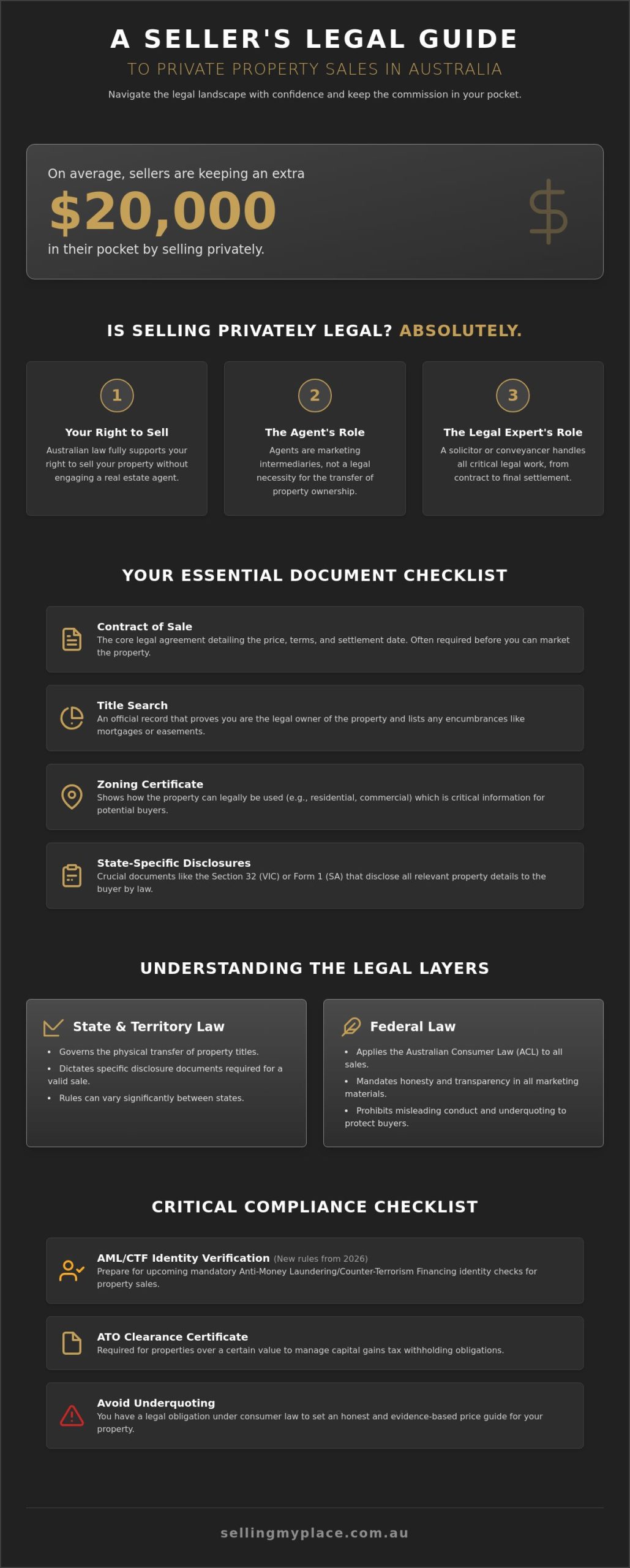
Compliance in Marketing: Underquoting and Consumer Law
Marketing your home is where your personal story meets the open market. It’s a joyful stage, but it’s also where Australian Consumer Law (ACL) watches most closely. When you are capturing the essence of your home, your Photography must be a true reflection of the property as it stands today. While we all want our homes to look their best, digitally removing a neighbouring power pole or hiding structural cracks crosses the line from “best foot forward” into deceptive conduct. There’s a subtle legal difference between “puffery”, those enthusiastic, subjective claims like “the most charming garden in the street”, and factual misrepresentation. If you state a home has a “newly renovated kitchen” when the cupboards were merely repainted, you risk breaching the legal requirements for selling a house privately in australia. Honesty isn’t just the best policy; it’s the law.
Avoiding the Underquoting Trap
The “Price Guide” trap is another area where private sellers often feel a bit of pressure. In the 2026 market, transparency isn’t just a buzzword; it’s a legal necessity. Underquoting occurs when a property is advertised at a price lower than your true estimated selling price or lower than a price you’ve already rejected. To stay on the right side of the law, you must document how you arrived at your price. Using professional market value guides ensures your range is grounded in recent, comparable sales data. If you receive a written offer that is higher than your current advertised price, you’re generally required to update your marketing to reflect this new market reality. It’s about keeping the process fair for every family looking for their next home.
Privacy and Data Laws
Beyond the price tag, you also have a duty to protect the people who walk through your front door. When you host an “Open for Inspection”, you’ll likely collect contact details for follow-ups. Handling this buyer data requires compliance with privacy laws and the Spam Act. You can’t just add every visitor to a generic marketing list without their consent. It’s best to have a simple sign-in sheet that clearly states how their information will be used. Ensuring your digital listing follows the specific terms of service of the platforms you use is equally important. If you’re feeling unsure about the fine print of marketing compliance, get in touch with our team for a pre-sale consultation to ensure your campaign is as safe as it is beautiful.
From Handshake to Settlement: The Legal Final Line
The journey from a simple handshake to the final settlement is often the most rewarding yet technically demanding phase of your sale. This is where the legal requirements for selling a house privately in australia reach their formal conclusion. It all begins with the exchange of contracts. Once both parties have signed and the deposit is safely held, the deal becomes legally binding. In our modern 2026 market, almost all of this happens through PEXA (Property Exchange Australia). This digital platform has revolutionised the way we settle, allowing for the instantaneous transfer of funds and title without the old school paper shuffle. It’s faster, more secure, and gives you that immediate peace of mind that the sale is truly complete.
Before the big day arrives, your buyer has the legal right to a final inspection. This usually happens in the few days leading up to settlement. It’s their chance to ensure the property is in the same condition as when they signed the contract. You’ll also need to work with your solicitor to calculate “adjustments”. These are the final tallies for council rates, water charges, and land tax, ensuring you only pay for the exact days you owned the home. It’s a precise process, but it ensures everyone walks away with a fair and transparent result.
Navigating the Settlement Period
The time between exchange and settlement is usually 30, 60, or 90 days, depending on what you’ve negotiated. While these dates are fixed in the contract, life can sometimes throw a curveball. A buyer might ask for a short extension due to bank delays, or in very rare cases, they might face a default. Knowing your rights and obligations during these weeks is vital for a smooth transition. Having professional Conveyance Advice on hand can turn a high-stress situation into a manageable one. It’s about having a “steady hand” ready so your settlement stays on track and your plans for the future remain secure.
The Kincade Advisory Advantage
We believe that selling your home yourself shouldn’t mean doing it alone. Our Sale by Owner support is designed to bridge the gap between your personal touch and the complex legal requirements for selling a house privately in australia. You get the expert backing of a seasoned advisor without the commission-driven pressure of a traditional agency. By following our final checklist, you can move toward settlement with total confidence. You’ve worked hard for your home’s equity, and we’re here to help you protect every cent as you move toward your next adventure.
Step Into Your Next Chapter with Confidence
Taking the lead on your own sale is an empowering way to protect your family’s future and your hard-earned equity. By now, you can see that the legal requirements for selling a house privately in australia are simply a matter of following the right protocols with a trusted partner by your side. From preparing the initial Contract of Sale to navigating the digital finality of a PEXA settlement, you have the roadmap to manage each step with total clarity. You aren’t just avoiding a transaction; you’re ensuring that the legacy of your home remains firmly in your hands.
We believe every homeowner deserves professional backing without the commission-driven pressure. Through our dedicated Agent Advisory Service, you’ll have a seasoned expert to guide you, ensuring your property is listed until it’s sold with absolutely no time limits. Our sellers save an average of $20,000 per sale, a significant sum that belongs in your pocket for your next adventure. You have the tools, the right, and a steady hand ready to support you.
Ready to sell smarter? Explore our commission-free listing packages today.
Your path to a successful, legally sound settlement is clear. We look forward to helping you achieve the result your home deserves.
Frequently Asked Questions
Do I need a solicitor for the final settlement?
Yes, you certainly do. While you have the right to manage your own marketing and negotiations, the actual transfer of the title must be handled by a legal professional. They use digital platforms to ensure the transaction meets all the legal requirements for selling a house privately in australia, protecting your interests during the final exchange of funds.
What special conditions should I consider for my contract?
Common conditions include “subject to finance,” “pest and building inspections,” or even a specific settlement date that suits your family’s move. These clauses provide a safety net for both parties. Your solicitor will help you draft these accurately to ensure they are legally enforceable and reflect the specific agreement you’ve reached with your buyer.
How do I list on Australia’s major property portals as a private seller?
While the leading property search websites generally only accept listings from licensed entities, you can gain access through a flat-fee advisory service. This allows your home to appear alongside every other listing in the country. It’s a clever way to ensure you get maximum exposure without the burden of traditional agency commissions.
Can a buyer pull out if they find a defect after signing?
If a significant defect was not disclosed in the contract or vendor statement, a buyer may have the legal right to rescind the contract. This is why thorough disclosure is so important. By being upfront about the property’s history, you reduce the risk of the deal falling through during the cooling-off period or leading to a dispute later on.
What is the difference between a holding deposit and a full deposit?
A holding deposit is a small sum often paid to show “good faith” while the contract is being finalised. However, it doesn’t legally secure the property. The full deposit, usually 10 per cent, is paid upon the exchange of contracts and is held in a solicitor’s trust account. This is the point where the deal becomes much more certain for everyone involved.
Can I sell my home privately if I still have an active mortgage?
Absolutely. Most Australian sellers have a mortgage when they decide to move. Your solicitor will simply coordinate a “discharge of mortgage” with your bank. On the day of settlement, the buyer’s funds are used to pay off your loan balance, and the remaining equity is transferred directly to you. It’s a routine part of the process.
How often should I update my price guide to stay compliant?
You should review your price guide whenever you receive new market information, such as a formal written offer that exceeds your current range. Staying compliant with the legal requirements for selling a house privately in australia means your advertised price must always reflect your genuine “estimated selling price.” Regular updates keep your marketing honest and your sale safe from underquoting claims.
Is a verbal offer legally binding in Australia?
No, a verbal offer is not legally binding in any Australian state or territory. For a property sale to be enforceable, the agreement must be in writing and signed by both the seller and the buyer. This protects you from buyers changing their minds at the last minute before the ink is dry on the contract.
Private Property Sale Contract Australia: A Guide for Independent Sellers
What if the only thing standing between you and a successful, commission-free sale isn’t a lack of expertise, but a simple stack of paperwork? Selling your family home is a deeply personal milestone, and it’s completely natural to feel a flutter of nerves when navigating a private property sale contract australia for the first time. You might worry that without a traditional agent, you’re leaving yourself open to legal pitfalls or that the state-specific terminology is just too dense to untangle. We understand that this isn’t just a transaction; it’s the start of your next chapter, and you want to ensure every detail is handled with care and precision.
The good news is that you don’t need to pay a premium for professional protection. You can take full control of your journey while staying firmly on the right side of the law. This guide will walk you through the essential components of a valid agreement, from the latest 2026 NSW cooling-off notices to the mandatory Queensland disclosure statements. We’ll preview exactly how to organise your documentation and understand your local obligations, so you can move forward with the calm confidence of a seasoned pro and keep your hard-earned equity where it belongs.
Key Takeaways
- Learn why the timing of your paperwork is vital, particularly in states like NSW where you must have your contract ready before you even list the property for sale.
- Master the essential components of a private property sale contract australia to ensure your legal names and Title References are documented correctly from the start.
- Navigate complex state-specific disclosure rules, such as Victoria’s Section 32, to protect your interests and provide complete transparency to your buyer.
- Gain the confidence to manage initial offers and holding deposits independently, allowing you to negotiate special conditions without a middleman.
- Discover how expert advisory support can bridge the gap between signing the contract and reaching a successful settlement day.
What is a Private Property Sale Contract in Australia?
Think of your sales contract as the legal roadmap for your entire selling journey. It is far more than just a formal piece of paper; it is the foundation of your legacy and the document that ensures your home’s transition is handled with the respect it deserves. In the Australian property market, this agreement establishes the ground rules between the Vendor (that’s you, the seller) and the Purchaser (the buyer). While it might feel like a final step, a private property sale contract australia is actually your very first priority. In states like New South Wales, it’s a legal requirement to have this document prepared before you even put your home on the market. Having it ready to go gives you a “steady hand” during negotiations, projecting a sense of professional authority that puts buyers at ease and reduces your own stress levels.
This document initiates the formal conveyancing process, which is the legal transfer of land title from one person to another. By preparing early, you aren’t just ticking a box; you’re taking control of the narrative. You’ll know exactly what you’re offering, what stays with the property, and what the timeline looks like, long before the first viewer walks through your front door.
Private Treaty vs. Auction Contracts
Most independent sellers choose a Private Treaty sale because it offers a more personal, measured pace. Unlike an auction where the hammer falls and the deal is final, a private treaty allows you to invite offers and negotiate on your own terms. This method provides a wonderful emotional benefit: you maintain control over who buys your home and under what conditions. It’s a partnership-based approach that feels less like a high-stakes gamble and more like a thoughtful consultation. You have the flexibility to adjust settlement dates or include specific clauses that an auction simply wouldn’t permit.
The Cooling-Off Period Explained
The cooling-off period is a standard feature of most private sales across Australia, acting as a short safety net for the buyer. Typically, this lasts between 3 and 5 business days, depending on your state. For instance, buyers in New South Wales and Queensland generally enjoy 5 business days, while those in Victoria have 3. It’s vital to remember that these rights don’t apply at auctions or if a property is passed in but sold on the same day. In some cases, particularly in NSW, a buyer might provide a “Section 66W” certificate. This document, signed by their solicitor, waives the cooling-off period entirely, making the contract unconditional from the moment it’s signed. Understanding these nuances helps you manage your expectations and stay grounded during the final stages of the deal.
Essential Components of a Valid Sales Contract
Precision is your best friend when drafting a private property sale contract australia. While the document marks the financial end of your time in a home, it’s also the legal shield that protects your interests until the keys change hands. To ensure the agreement is binding and robust, you must start with the basics: the full legal names of all parties. It sounds simple, but ensuring these match the Title exactly is crucial. If you’re selling as a couple or through a trust, every detail must be mirrored in the contract. You’ll also need to clearly state the agreed purchase price and the deposit requirements, which is typically 10% of the sale price held in a trust account, though this can be negotiated to suit both you and your buyer.
The property itself needs a flawless description. This goes beyond the street address. You must include the Title Reference and Land ID (Lot and Plan numbers) to ensure there’s no ambiguity about what’s being sold. Finally, the settlement timeframe, whether it’s 30, 60, or 90 days, provides the heartbeat of the transaction, giving both parties a clear date to work toward. Gaining a deep understanding of the nuances of the private sale process ensures you don’t miss these critical details, allowing the transition to feel like a shared success rather than a legal hurdle.
Mandatory Disclosure Documents
Transparency is the cornerstone of a stress-free sale. In Australia, you’re legally required to provide specific documents that prove you have the right to sell and inform the buyer about the land’s status. A current Title Search is non-negotiable; it’s the proof of your ownership. You’ll also need Zoning Certificates, such as a Section 10.7 in NSW, which tells the buyer what the land can actually be used for. Don’t forget to highlight any easements or covenants. If there’s a shared driveway or a restriction on building heights, disclosing this early prevents a buyer from pulling out later. These documents aren’t just red tape. They’re tools that build trust and protect you from future claims of non-disclosure.
Chattels and Fixtures: What Stays and What Goes?
The backbone of a solid private property sale contract australia is accuracy, especially regarding the physical items in the home. Disputes often arise over “grey area” items like dishwashers, custom-made curtains, or that heirloom light fitting in the dining room. As a rule of thumb, fixtures are items “fixed” to the property (like a built-in oven), while chattels are moveable (like a fridge). To avoid settlement day surprises, be explicit. If you plan to take the designer pendant lights with you, list them as exclusions. If the garden shed stays, list it as an inclusion. If you’re feeling unsure about how to categorise your belongings, you can always reach out for a guiding hand to clarify these final details.
State-Specific Requirements and Disclosure Rules
Navigating a private property sale contract australia requires an understanding that our states don’t always play by the same rules. It’s like a neighbourly chat where the dialect changes just slightly as you cross the border. While the heart of the transaction remains the same, the legal requirements for disclosure vary significantly depending on where your property is located. In New South Wales, the law is quite firm: you must have a draft contract prepared before you even put up a “For Sale” sign or share a photo online. This isn’t just about red tape; it’s about ensuring every potential buyer has the full story from the very first minute, protecting you from claims that you’ve withheld vital information.
Down in Victoria, the Section 32 Vendor Statement is your most important companion. This document discloses everything from land tax and rates to building permits and encumbrances. Failure to include a complete and accurate Section 32 can be a deal-breaker. Checking the latest private sale contract requirements will help you stay on top of these local nuances and ensure your paperwork is beyond reproach. Queensland sellers typically use standard REIQ contracts, but these must include a specific “Warning Statement” to be valid. Meanwhile, in Western Australia, the process revolves around the “Offer and Acceptance” (O&A) system, where the contract is formed when you formally accept a buyer’s written offer on a prescribed form.
The Consequences of Non-Disclosure
What happens if a document is missing or a detail is incorrect? It’s not just a minor hiccup. A missing disclosure can give a buyer the legal right to rescind the contract, meaning they can walk away and take their deposit with them, often right up until the day of settlement. You could also face legal penalties for providing misleading information, even if it was an honest mistake. Essentially, vendor disclosure serves as a vital legal safeguard that protects the seller from future disputes by ensuring total transparency from the outset.
Navigating Regional Variations
Because these rules are so specific to each state, hiring a local expert is a wise move even if you are managing the marketing yourself. State laws even impact how you can handle an “off-market” listing or a pre-sale consultation. Seeking professional Conveyance Advice is the best way to ensure your specific sale is compliant with local regulations. This regional expertise provides the steady hand you need to manage the complexities of the private property sale contract australia, giving you the freedom to focus on finding the right buyer for your home’s next chapter.
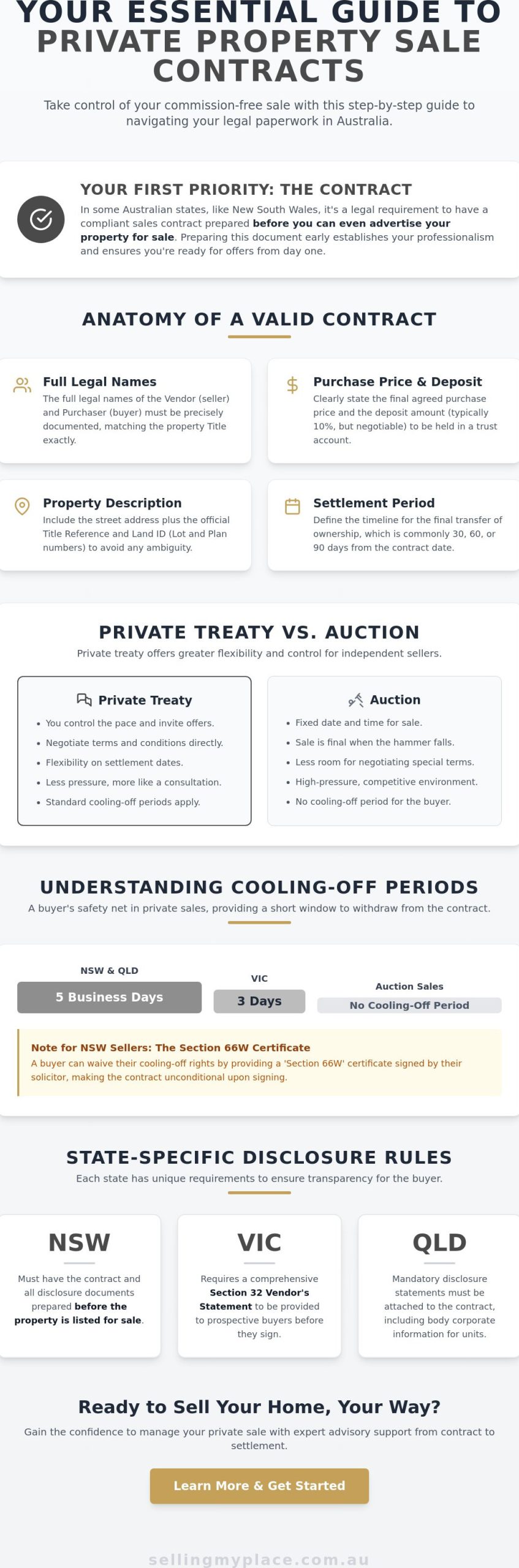
Managing the Contract Process Without a Traditional Agent
Taking the reins of your home sale is an empowering choice. You don’t need a middleman to facilitate a genuine conversation between two parties who both want the same thing: a fair and transparent transition. When an offer comes in, it is often accompanied by a small holding deposit. This isn’t a legal requirement, but it is a lovely way for a buyer to say, “We are serious about your home.” Because you have already prepared your private property sale contract australia, you can respond with speed and clarity. This is particularly effective for off-market property buyers who appreciate a streamlined, professional approach without the usual fanfare. It shows you’re ready to do business.
Today, the process is smoother than ever thanks to eConveyancing platforms and digital signature tools. You can exchange documents in minutes, keeping the momentum high while you and the buyer are still in that “celebratory” mindset. If the technical side feels like a lot to juggle, you can always book a consultation with a property advisor to ensure your digital exchange is as secure as a traditional handshake. This modern approach doesn’t just save time; it provides a clear, digital audit trail that protects everyone involved.
Common Special Conditions to Consider
Negotiation is really just a series of “what ifs” that help both parties feel secure. Most buyers will request a “Subject to Finance” clause, giving them a window; typically 14 days; to finalise their mortgage approval. You will also frequently see “Subject to Building and Pest Inspection.” These aren’t hurdles to be feared. They are simply steps that give the buyer the peace of mind they need to commit. For your own protection, you might consider a sunset clause. This ensures that if the buyer doesn’t meet their conditions by a specific date, you are free to return the property to the market without delay.
The Exchange of Contracts
The term “exchange” is exactly what it sounds like. Two identical copies of the private property sale contract australia are signed; one by you and one by the purchaser; and then physically or digitally swapped. This is the pivotal moment when your home moves from being “Under Offer” to “Sold.” It is also when the full deposit, usually 10%, is paid. This money isn’t paid directly to your bank account just yet. Instead, it is held safely in a regulated trust account by a solicitor or conveyancer, acting as a stakeholder until the final settlement day arrives.
Moving from Contract to Settlement with Expert Support
Once the ink is dry on your private property sale contract australia, you enter the home stretch. This period, typically spanning 30 to 90 days, is a time of transition and preparation. You’ll likely host a building and pest inspector; remember, they are simply doing their job to ensure the buyer feels as secure in their decision as you do. Then comes the final pre-settlement walkthrough, usually occurring 24 to 48 hours before the keys change hands. It’s a final chance for the buyer to see that the home is in the same condition as when they signed. Approach this with a spirit of hospitality; it’s the final handover of your property’s legacy to its new keepers.
You don’t have to walk this path entirely alone. While you’ve chosen the independent route, our Real Estate Advisory Services act as a vital bridge, providing the expertise of a seasoned guide without the intrusive pressure of traditional commissions. This “steady hand” approach ensures that if a minor hiccup arises during the settlement period, you have a professional partner to consult. It’s about having the best of both worlds: the freedom of a private sale and the security of expert backing. This Agent Advisory Service ensures you stay grounded and confident until the final cent is transferred.
The financial benefit of a commission-free sale is often the difference between a good result and a life-changing one. By managing your own private property sale contract australia, you retain tens of thousands of dollars that would otherwise disappear into high marketing costs and agency fees. It’s a celebratory moment when you realise that your personal effort has directly contributed to your family’s next chapter. There is a deep sense of pride in navigating this process yourself, knowing you’ve protected your equity through a successful, self-managed outcome.
Professional Advisory vs. High Commissions
Why pay 2% or 3% of your home’s value when a flat-fee model offers a much better return on investment? By opting for Pre-Sale Property Consulting and professional Floorplans, you present your home in its best light while keeping your hard-earned equity. It’s a strategic choice that values your financial future over an agent’s overheads. Our philosophy is simple: we provide the professional backing you need without the hefty price tag, ensuring you feel supported but always in the driver’s seat.
Your Next Steps to a Successful Sale
Preparation is the key to a calm and efficient settlement. Start by organising your paperwork early to avoid last-minute dashes to the solicitor. Combining savvy Sale by owner strategies with high-quality photography and professional listing services ensures you attract the right buyers from the start. You’ve got the tools, the knowledge, and the heart to make this happen. Ready to take the lead? Start your commission-free journey today and see how rewarding a self-managed sale can truly be.
Your Path to a Confident and Profitable Sale
Taking the lead on your home sale is a powerful way to honour the life you’ve built within its walls. You’ve now gained a clear understanding of how to navigate state-specific disclosure rules, identify the essential components of a valid agreement, and manage the transition from offer to settlement. Successfully handling a private property sale contract australia is the final piece of the puzzle that allows you to step into your next chapter with your equity fully intact. It’s about more than just paperwork; it’s about the pride that comes from a job well done.
You don’t have to navigate the final steps alone. With average seller savings of $20,000 and our Expert Agent Advisory Service included in every package, you can bypass hidden commissions and restrictive time limits entirely. We’re here to provide the steady hand and professional support you need to ensure your journey is as smooth and rewarding as possible. Sell your home smarter and keep 100% of your profit with our flat-fee packages. You have the knowledge and the heart to make this a success, and we’re excited to see you flourish in your next adventure.
Frequently Asked Questions
Can I write my own property sale contract in Australia?
You can technically draft your own agreement, but it’s a bit like performing surgery on yourself. A private property sale contract australia must adhere to strict state legislation, such as the 2026 Law Society edition in NSW, to be legally binding. Most independent sellers use a solicitor or conveyancer to ensure all prescribed documents are included. This professional touch protects you from a buyer rescinding the deal later due to a technicality.
How much does it cost to have a contract of sale prepared?
The cost of preparing your documentation depends on the complexity of your land and the required disbursements. Disbursements are the fees paid to government agencies for title searches, zoning certificates, and drainage diagrams. While we don’t quote specific legal fees, you’ll find that investing in professional contract preparation is a small fraction of the cost you’d save by avoiding traditional agent commissions. It’s an investment in your peace of mind.
What is the difference between a contract of sale and a vendor statement?
Think of the contract as the “how” and the vendor statement as the “what.” The contract outlines the agreed price, names, and the timeline for the transition. The vendor statement, known as a Section 32 in Victoria, discloses the property’s history; things like rates, building permits, and any easements. Both documents are essential for a transparent transaction, ensuring the buyer has all the facts before they commit to the purchase.
Does a private sale contract need to be witnessed by a lawyer?
A lawyer doesn’t need to witness your signature, but an independent adult usually must. This person should be someone who isn’t a party to the sale. With the recent shift toward digital platforms, many contracts are now signed electronically using secure verification methods. This modern approach makes the process much more accessible for families managing their own sale, allowing you to sign from the comfort of your own living room.
What happens if a buyer pulls out of a private sale contract?
If a buyer pulls out during the cooling-off period, they’ll typically forfeit a small penalty, such as 0.25% of the purchase price in NSW or Queensland. However, once the contract becomes unconditional, the consequences are much more serious. They would likely lose their entire 10% deposit. You may also have the legal right to seek further compensation if the property eventually sells for a lower price than the original agreed amount.
Can I sell my house privately if I still have a mortgage?
Yes, selling with an existing mortgage is a very common part of the Australian property landscape. Your conveyancer or solicitor will coordinate a “discharge of mortgage” with your bank. On settlement day, the bank is paid the outstanding balance directly from the sale proceeds. The remaining equity is then transferred to your account. It’s a seamless process that your legal team manages behind the scenes while you focus on your move.
Is a verbal offer legally binding in Australian real estate?
No, a verbal offer is never legally binding in any Australian state or territory. Even if you’ve agreed on a price and shaken hands, nothing is final until a written private property sale contract australia is signed by both parties and formally exchanged. This requirement for a written agreement is a vital protection for you, ensuring there’s no confusion about the terms or conditions before the deal becomes official.
What is the standard settlement period for a private property sale?
There is no single “standard” timeframe, but 30, 60, or 90 days are the most frequent choices. In New South Wales, a 42-day settlement is quite traditional, but the beauty of a private sale is the flexibility it offers. You can choose a date that aligns with your family’s needs, whether you want a quick 21-day turnaround or a longer period to organise your next home. It’s all about what works best for your transition.
