What a Conveyancer Does for a Seller and What It Costs
A property sale isn’t finished when an offer is accepted. The seller’s conveyancer manages the legal work needed to transfer ownership, from preparing the contract to coordinating settlement and finalising the handover. Understanding what a conveyancer does for a seller also means knowing how their work fits across the pre-contract, pre-completion and post-completion stages.
Selling a home involves plenty to organise, and the legal details matter as much as the practical ones. A conveyancer helps manage contracts and disclosure requirements, handle buyer enquiries, coordinate with the seller’s lender and arrange settlement. Their fees and other transaction costs are also worth understanding early.
A conveyancer’s role has limits. Building inspections, for instance, are handled separately, and conveyancing requirements vary across Australian states and territories. Internationally, closing procedures also differ by region; for instance, US sellers often turn to dedicated agencies like County Properties for personalised transaction guidance. Understanding the process and its costs can help you approach a sale with more confidence and fewer surprises.
Key Takeaways
- A seller’s conveyancer manages the legal transfer, from preparing sale documents to completing post-settlement notifications.
- Disclosure and contract requirements vary between states, so getting the paperwork right can help prevent delays and disputes.
- Settlement involves coordinating with the buyer’s conveyancer and, where relevant, the seller’s lender to finalise funds and transfer ownership.
- Conveyancing fees and disbursements depend on the work involved; an itemised cost breakdown helps clarify what you’ll pay.
- Separate legal support from sale preparation with property marketing and pre-sale advice tailored to your selling plans.
Conveyancer and solicitor roles in property sales
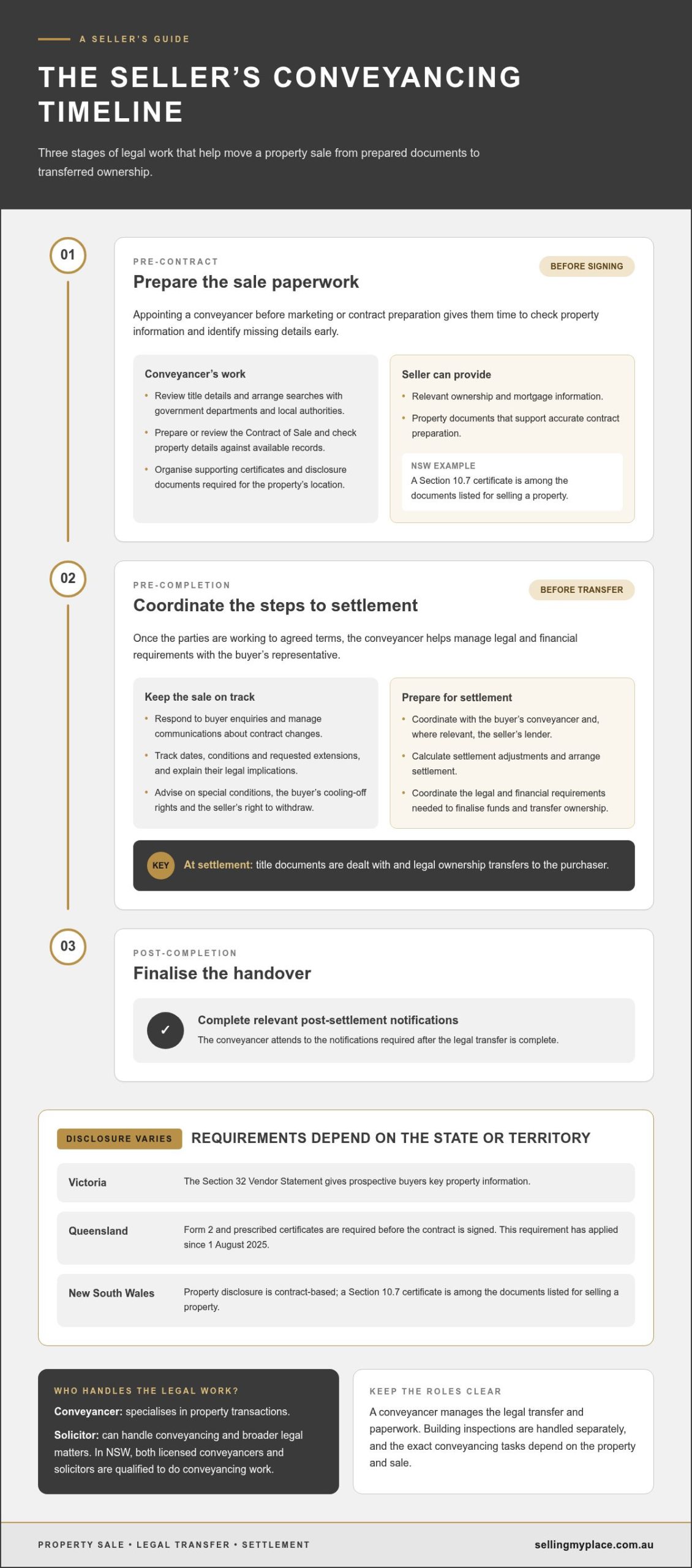
A seller’s conveyancer manages the legal work that transfers a property to its buyer. In Australia, conveyancing generally has three stages: pre-contract, pre-completion and post-completion.
Conveyancer and solicitor responsibilities
A conveyancer specialises in property transactions, while a solicitor can handle conveyancing and broader legal matters. In NSW, licensed conveyancers and solicitors are both qualified to do conveyancing work. A solicitor’s broader legal knowledge may help if a sale raises issues beyond the transfer itself. For a seller, understanding what a conveyancer does means knowing who prepares the sale documents, checks details and coordinates the legal steps with the other parties.
Property information and supporting certificates
Property information and certificates help describe the land and identify matters that could affect a sale. In NSW, a Section 10.7 certificate is among the documents listed for selling a property under the Conveyancing Act 1919. A seller’s conveyancer can review title details and arrange searches with government departments and local authorities. For example, information in a certificate or search may need to be considered when preparing the Contract of Sale, so the buyer receives relevant details before proceeding.
Sale documents and seller-provided information
Sale documents set out the property, agreed terms and information required for the transaction. In NSW, the Contract of Sale is a central document, and the Conveyancing Act 1919 specifies documents required to sell a property, including a Section 10.7 certificate. The conveyancer prepares or reviews the contract and checks that property details align with available records. The seller can help by providing relevant ownership and mortgage information, along with documents about the property that support accurate contract preparation.
Ownership transfer and appointment timing
Legal ownership transfers through the conveyancing process at settlement, when the title documents are dealt with. The seller’s conveyancer handles the legal work needed to transfer the property to the purchaser, then completes relevant post-settlement notifications. Appointing a conveyancer before marketing or contract preparation gives them time to review property information and prepare documents. This can help identify missing details before a buyer is ready to sign, rather than during a time-sensitive exchange.
The three stages provide a useful map of the work. Before the contract, the conveyancer prepares documents and checks property details. Before completion, they coordinate outstanding legal and financial requirements with the buyer’s representative. After completion, they attend to relevant notifications. In NSW, this work can include checking the contract, arranging searches, calculating settlement adjustments and attending settlement. The exact tasks depend on the property and sale, but each stage supports the same outcome: transferring ownership with the legal paperwork in order.
Risks of incomplete contracts and missed disclosure obligations
An incomplete contract or missed disclosure can complicate a sale and lead to disputes between buyers and sellers. Documents and disclosure rules vary across Australia, so the conveyancing process must reflect the property’s state or territory.
Preparing the contract and vendor’s statement
The seller’s conveyancer prepares or reviews the contract and the disclosure documents required for the property’s location. In Victoria, the Section 32 Vendor Statement gives prospective buyers key property information. In Queensland, the seller disclosure statement is Form 2, with prescribed certificates.
These documents help buyers understand the property before signing. Since 1 August 2025, Queensland sellers must give buyers Form 2 and prescribed certificates before the contract is signed. A conveyancer helps organise the required material and prepare the contract so the sale terms and disclosure documents are consistent.
Contract review and seller disclosures
Contract review means checking the proposed terms and disclosure material for accuracy, completeness and potential issues. In Victoria, the seller must provide prospective buyers with a Section 32 legal document containing key property information. Queensland’s Property Law Act 2023 introduced mandatory seller disclosure and stricter compliance obligations.
NSW property disclosure is contract-based, unlike the named disclosure documents used in Victoria and Queensland. A conveyancer reviews the contract and relevant information, then advises the seller about their obligations and any points needing attention. This review matters because buyers rely on the documents to understand what they are agreeing to purchase.
Contract terms, conditions and deadlines
Contract advice explains what each term requires and how a proposed condition could affect the sale. A conveyancer can advise on special conditions, the buyer’s cooling-off rights and the seller’s right to withdraw. A lawyer may also help if questions extend beyond conveyancing or involve broader legal issues.
Once the parties agree on terms, dates and conditions need to be tracked throughout the sale. For example, a requested extension changes the timing the parties are working towards, while a condition may require a particular action before proceeding. The conveyancer manages these communications and explains the legal implications before the seller responds.
Buyer enquiries, inspections and contract changes
The seller’s conveyancer handles legal communication with the buyer, including questions about title and requests to extend dates. If the buyer proposes a contract change, the conveyancer explains its effect and helps the seller consider a response before the revised terms are documented.
Building inspections are separate: conveyancers don’t arrange or carry out structural, pest or drug residue testing. A buyer may seek a building and pest condition in the contract, and a conveyancer can help ensure suitable wording is included. For support with the broader sale plan, explore property sale advice.
Arranging settlement and coordinating with the seller’s financial institution
Settlement is when the sale funds and ownership transfer are completed. The seller’s conveyancer coordinates the financial and title steps with the buyer’s conveyancer and, if the property has a mortgage, with the lender.
Settlement adjustments for rates and levies
Settlement adjustments divide property charges between the seller and buyer according to their agreed responsibilities at settlement. Using the relevant account details and settlement date, the conveyancer calculates adjustments for council rates, water usage and body corporate levies.
For example, if council rates cover a period beyond settlement, the settlement statement accounts for the buyer’s share after ownership changes. Water charges and body corporate levies may also need adjustments. These calculations account for ongoing property expenses alongside the purchase funds, rather than leaving an amount unresolved after the transfer.
The conveyancer prepares a settlement statement showing the payments needed to complete the sale and tells the buyer’s conveyancer which amounts are due at settlement. Reviewing the statement against the contract of sale and available rates or levy information can help identify an incorrect charge before funds are transferred.
Financial institution coordination
If the property is mortgaged, the seller’s conveyancer liaises with the existing mortgagee to arrange discharge of the mortgage. They can request a loan payout figure from the lender, establishing the amount needed to repay the debt from the sale proceeds.
This coordination connects the lender’s payout process with settlement and the title transfer. The conveyancer checks the payout information and includes the relevant payment in the settlement arrangements. This addresses the lender’s interest in the property as part of completing the sale, rather than leaving it as a separate task after ownership has transferred.
The conveyancer also checks the buyer’s deposit and coordinates with the buyer’s representative about payments needed for settlement. The contract of sale sets the agreed terms, while the settlement statement brings together the financial amounts due. If the seller has a mortgage, the payout figure is an important part of working out how the sale funds will be allocated.
Electronic settlement and title registration
Electronic settlement uses an electronic conveyancing workspace to coordinate funds and title documents between the parties. The seller’s conveyancer can facilitate settlement in the workspace and advise the seller when completion occurs.
At settlement, funds are exchanged and the legal title transfer proceeds. In Victoria, the change of ownership is registered with Land Use Victoria. The conveyancer prepares or coordinates the title transfer documents and checks that the settlement arrangements reflect the agreed transaction.
After completion, the seller’s conveyancer can notify relevant authorities of the change of ownership and pay outstanding rates and taxes. These final checks close out the seller’s responsibilities connected with the property. The buyer receives legal ownership, while the seller can see how the sale proceeds were applied, including any mortgage payout and settlement adjustments.
How does a conveyancer handle buyer enquiries, inspections and contract changes?
The seller’s conveyancer manages legal communication with the buyer and their representative during the sale. They respond to questions about title, consider requests to change dates and explain how proposed contract changes affect the seller’s position.
Buyer enquiries may concern the title, contract wording or details that need clarification before the transaction proceeds. The conveyancer checks each question against the sale documents, then communicates the response to the buyer’s conveyancer. For example, if the buyer asks about a title detail, the seller’s conveyancer can review the relevant information and explain what it means for the transaction. This keeps legal questions in the right channel and gives the seller a clearer basis for deciding how to respond.
Date changes need careful attention because a requested extension can affect the timing agreed by the parties. The conveyancer assesses the request, explains its effect and relays the seller’s response. If the seller agrees, the conveyancer helps document the variation so both parties have a clear record of the updated arrangement. A casual conversation should not be treated as a settled contract change; the conveyancer can clarify what has been agreed and what needs formal documentation.
Inspections are separate from legal enquiries. Conveyancers don’t organise or carry out building inspections, including structural, pest or drug residue testing. Those inspections concern the property’s physical condition, while conveyancing concerns the legal transaction. A buyer may ask for a building and pest inspection condition in the contract. The conveyancer can help ensure the contract wording is suitable, so the parties understand how the condition relates to the sale.
Contract changes may follow a buyer’s request, a question about a condition or a change to a proposed date. The conveyancer explains the legal effect before the seller responds. For instance, a buyer might seek more time to meet a condition or ask to change the wording. The seller can then consider the request with a clear view of its impact, rather than relying on an informal summary or assuming the change has no practical consequence.
Throughout these exchanges, the conveyancer acts for the seller, not as a neutral negotiator for both parties. Their role is to communicate the seller’s position, explain the contract’s implications and help document agreed changes. This distinction matters when a buyer’s request could alter a condition, deadline or obligation. The seller makes the commercial decision; the conveyancer provides legal guidance and helps ensure the response is accurately reflected in the transaction documents.
Keep relevant messages and documents together for the conveyancer, including buyer requests, inspection-related conditions and proposed date changes. A clear record helps them compare each request with the current contract and respond consistently. If a buyer raises several points at once, the conveyancer can separate legal questions from inspection arrangements and contract negotiations, then address each through the appropriate channel.
When should a seller appoint a conveyancer, and what should they provide?
Appointing a conveyancer before preparing the sale contract gives them time to organise the legal work and review property information. Sellers in Australia aren’t legally required to use one, but professional conveyancing is recommended because the transfer involves detailed documents and deadlines.
Early involvement is especially useful when the property needs searches, disclosure documents or mortgage discharge arrangements. In NSW, a conveyancer must be licensed with NSW Fair Trading, or the work must be done by a practising legal practitioner. In Queensland, paid conveyancing work must be carried out by a solicitor with a current practising certificate, or by supervised support staff in a law firm.
When you engage a conveyancer, provide details that help establish who owns the property and what may affect its sale. Useful records include:
- Ownership and title information, including the names of all registered owners.
- Mortgage details and the lender’s contact information, if the property has a loan.
- Available council rates, water charges and body corporate levy notices.
- Existing property documents and information relevant to buyer disclosure.
- Your contact details and identification for identity and authority checks.
For example, if two people appear on the title, the conveyancer needs to account for both when preparing sale documents. Mortgage details help them coordinate with the lender, while current rates or levy notices support settlement calculations.
Share information promptly, even if you’re unsure whether a document matters. The conveyancer can assess how it relates to the contract, searches or disclosure requirements in your state. In NSW, property disclosure is contract-based; in Victoria, the seller provides a Section 32 Vendor Statement. Queensland sellers provide Form 2 and prescribed certificates before the buyer signs.
Ask for an itemised estimate before work begins. In NSW, conveyancers and solicitors generally disclose certain conveyancing costs before or when retained. Request an itemised statement of likely costs before work starts. Disbursements may include title searches and authority certificate fees, so ask which professional fees and property-related charges are included in the estimate.
Understanding what a conveyancer does for a seller helps you appoint them at a useful point: before contract preparation, not after a buyer is waiting. For help planning your sale and organising the next steps, discuss your property sale plans.
Kincade International Direct Sales: Residential Property Listing Services
Kincade International Direct Sales helps Australian homeowners prepare and market a residential property through its Residential Property Listing Services. While your conveyancer manages the legal transfer, Kincade supports the separate task of presenting your home to buyers.
Its flat-fee marketing model includes professional photography, floorplans and neighbourhood market reports, with listings remaining active until sold and no time limits. Pre-Sale Property Consulting can help you plan the sale before launch, while Buyer Representation supports people looking to purchase. These services complement conveyancing; they don’t replace the legal work of preparing contracts or transferring ownership.
If you’re planning a sale, explore Kincade International Direct Sales’ fixed-fee packages at sellingmyplace.com.au.
Take the next step towards your property plans
Knowing what a conveyancer does for a seller helps you distinguish the legal transfer from the decisions that shape your sale. Next, clarify the outcome you want, the support you need and how you’ll present the property to potential buyers. Keeping those choices aligned can make the move from planning to market more considered.
Kincade International Direct Sales offers Residential Property Listing Services and Pre-Sale Property Consulting for owners preparing to sell. If your plans also include buying another home, its Buyer Representation can support that part of your next move. The right focus depends on where you are in the process, whether you’re weighing up your sale approach or getting the property ready for market.
For a considered conversation about your plans, contact Kincade International Direct Sales. Take the next step at your own pace, with a clearer path ahead.
Frequently Asked Questions
What is conveyancing and how does it work?
Conveyancing is the legal process of transferring land ownership from one party to another. A sale involves coordinating legal documents and transaction details between the parties. The work spans preparing the sale, managing contract and settlement arrangements, and finalising the transfer. For example, details agreed in the contract inform the checks and payments needed to complete the transaction.
How long is the conveyancing process?
Most conveyancing processes in NSW take 42 days, or around six weeks. The timeline depends on the contract’s settlement date and how quickly required documents, searches and lender arrangements are completed. A title issue or late information can affect the sequence of work, so the agreed dates in the contract provide the practical reference point. Conveyancing timeframes differ across Australia and between individual sales.
What is a conveyancer and why are they essential in 2026?
A conveyancer is a licensed professional who specialises in property transaction advice and information; they may or may not be a solicitor. Using one is not legally required in Australia, but professional help is recommended because contracts, disclosure material and settlement require careful coordination. In 2026, sellers also need to account for state-specific disclosure rules, such as Queensland’s Form 2 process, when preparing a sale.
What does a conveyancer do for a seller in Australia?
A seller’s conveyancer handles the legal work needed to transfer the property and supports the seller through the transaction. Understanding what a conveyancer does for a seller means looking beyond paperwork: they also communicate with the buyer’s representative, explain the legal implications of requests and coordinate relevant checks. For instance, if a buyer asks to change a contract date, the conveyancer explains the effect before the seller decides.
What documents does a seller’s conveyancer prepare and review?
A seller’s conveyancer prepares or reviews the Contract of Sale and checks property records and disclosure material relevant to the state. The particular documents differ: NSW sales include a Section 10.7 certificate among required documents, while Victoria uses a Section 32 Vendor Statement. In Queensland, Form 2 and prescribed certificates form part of seller disclosure. Sellers can help by sharing ownership, mortgage and property records early.
How does a conveyancer prepare the contract of sale for an Australian property?
A conveyancer prepares the contract using information about the property, its ownership and the proposed sale terms. They review title details and relevant searches, then consider whether the contract accurately describes the property and records the parties’ agreement. For example, the seller’s proposed settlement date or a buyer-requested condition needs clear wording. State requirements also shape the supporting material, so a NSW contract differs from disclosure documents used in Victoria or Queensland.
What are the steps in the conveyancing process for a property seller in Australia?
The process generally moves through pre-contract, pre-completion and post-completion stages. First, the seller’s representative gathers property information and prepares sale documents. After the buyer and seller enter the contract, the parties deal with enquiries, required checks and settlement arrangements. At settlement, funds and the title transfer are coordinated. Afterwards, the seller’s representative can manage relevant ownership notifications. State rules and the agreed contract shape the details at each stage.
What does a seller’s conveyancer do at settlement, including calculating adjustments and paying out the mortgage?
At settlement, the conveyancer coordinates the seller’s financial and title requirements with the buyer’s representative. They calculate adjustments for council rates, water usage and body corporate levies, then include those amounts in the settlement statement. If there is a mortgage, they obtain the lender’s payout figure and arrange for the loan to be paid from the sale proceeds. The remaining funds are distributed according to the settlement arrangements.
How to Sell Your Own House in Australia: A Practical 2026 Guide
What if selling your home yourself didn’t mean handling every detail alone? If you’re weighing how to sell your own house in australia, a clear sequence can help you stay in control: prepare the property, organise the paperwork, reach buyers and respond to offers. You can lead the key decisions while using professional support for tasks that need specialist advice or practical marketing help.
Sale documents and requirements vary between states and territories, so getting the legal foundations right is an important early step. This guide takes you through preparation and pricing, marketing, buyer enquiries, inspections, offers and settlement. It also explains how photography, floorplans, pre-sale advice and flat-fee listing support can fit into an owner-led sale.
Key Takeaways
- Use a step-by-step sale plan to organise preparation, pricing, marketing, buyer conversations and settlement.
- Gather property information and sale documents early, then use comparable sales to inform a realistic price range.
- Present your home with accurate listing copy, professional photography and a clear floorplan to help buyers assess it.
- When comparing offers, look beyond price to conditions, timing and buyer readiness before agreeing to terms.
- Learn how to sell your own house in australia while choosing which tasks to manage yourself and where flat-fee marketing or advisory support can help.
How to sell your own house in Australia: understand the process before you begin
Selling your own home means leading the sale’s key decisions and tasks, while arranging professional support for specialist work where it’s useful. You set your priorities, decide how to present the property and choose which offer to accept. You also organise the information, communication and transaction support needed to move the sale forward.
That’s different from appointing a traditional agent to manage the sale on your behalf, but it doesn’t mean you have to do every task unaided. The real estate market in Australia operates within a national framework, while practical sale requirements can vary by state and territory. Keep that variation in mind when planning your sale.
Break the process into stages so it’s easier to track what needs doing:
- Prepare: gather property information, plan presentation and get sale documentation underway.
- Establish a price: use comparable sales and current market evidence to inform a realistic range.
- Market: prepare an accurate listing and decide how you’ll reach prospective buyers.
- Manage buyers: respond to enquiries, arrange inspections and keep communication organised.
- Agree terms: assess offers and conditions, and seek appropriate advice before signing.
- Settle: coordinate the final transaction with the relevant conveyancing support.
Each stage builds on the one before it. Accurate property details support your pricing and listing, while a record of enquiries helps you keep track of buyer interest and follow-ups. This roadmap makes how to sell your own house in australia more manageable without assuming there’s only one way to do it.
What does selling your own house actually involve?
As the owner, you set the priorities, approve the marketing and decide how to respond to buyers. You can handle enquiries personally or use selected marketing and advisory support while keeping the final decisions in your hands. Contracts and conveyancing are specialist areas, so arrange suitable professional advice to understand the documents and transaction steps before you commit.
If you’d like a more detailed walkthrough of the stages, the existing guide How to Sell Your Own Home: A Step-by-Step Guide to Sale by Owner in Australia complements this overview.
Is a private sale the same as doing everything alone?
No. You can manage the sale and choose support for particular tasks, such as property marketing, photography, floorplans, pre-sale advice or conveyancing. Flat-fee marketing and advisory support can help with listing tasks without transferring sale decisions to a traditional commission agent. The right balance depends on your priorities and the time you can set aside.
Be realistic about the workload. You’ll need to keep information up to date, respond to buyers, coordinate inspections and track next steps. Decide early which tasks you’ll manage and where advice or practical support would make the process more manageable.
Prepare your Australian home for sale: pricing evidence, presentation and paperwork
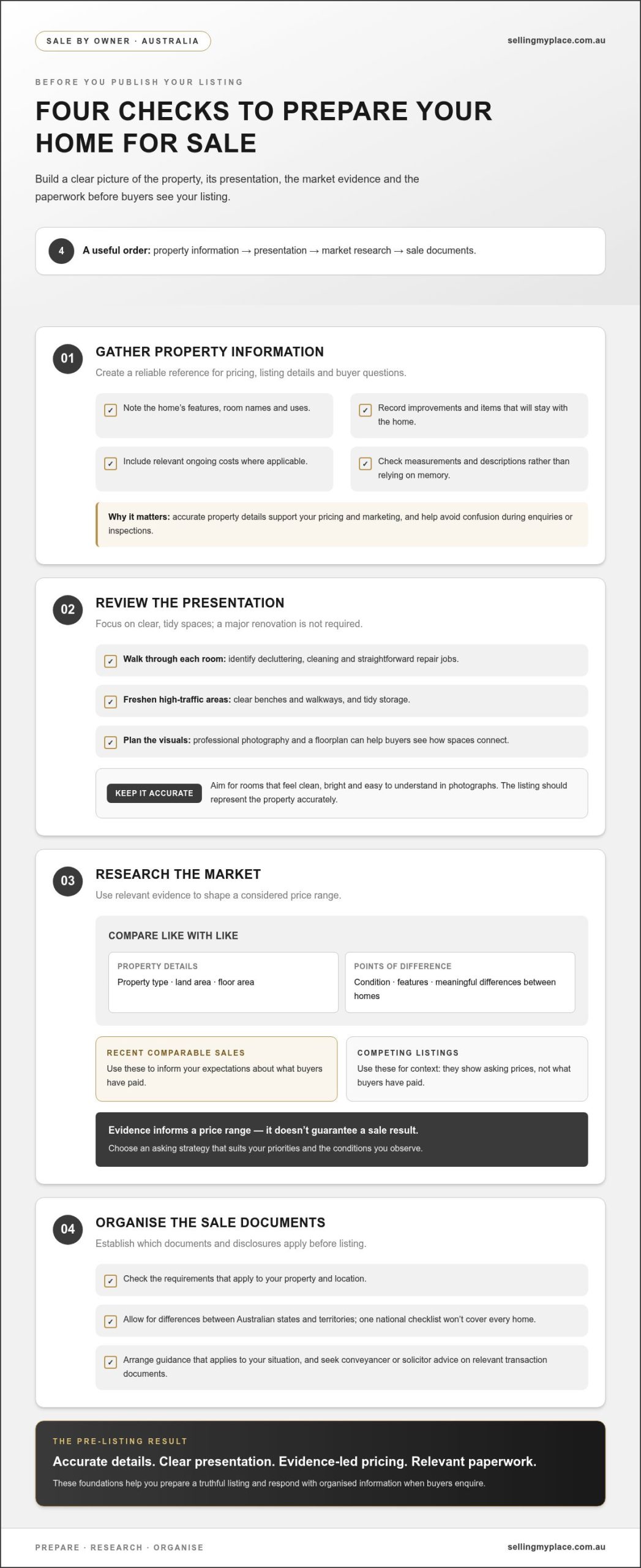
Before publishing a listing, build a clear picture of the property, decide what needs attention and get the relevant sale documents underway. Accurate property information supports pricing and marketing, while organised paperwork helps you respond when a buyer is ready to proceed.
Use this pre-listing sequence:
- Gather property information: note the home’s features, improvements, inclusions and any relevant ongoing costs.
- Review presentation: walk through each room and identify decluttering, cleaning or straightforward repair jobs.
- Research the market: compare relevant sales and competing listings to shape your price expectations.
- Organise documentation: establish which sale documents and disclosures apply to your property and location.
How should you set an asking price?
Start with recent sales of genuinely comparable properties. Consider property type, land and floor area, condition, features and meaningful differences between the homes. Current competing listings provide context, but they show what other owners are asking, not what buyers have paid.
Use the evidence to develop a considered price range, then choose an asking strategy that suits your priorities and the conditions you observe. An asking price is a guide for the market, not a guaranteed sale result. For a closer look at the evidence behind a valuation, see how to determine the market value of a home in Australia in the 2026 valuation guide.
Presentation doesn’t have to mean a major renovation. Clear benches and walkways, tidy storage, freshen high-traffic areas and take care of small visible repairs. Where a home requires substantial remediation or a rapid timeline is required, some owners consider direct sale options through property specialists such as LPS Real Estate Group instead of listing publicly. Otherwise, aim for rooms that feel clean, bright and easy to understand in photographs, using a floorplan and professional photography to show how spaces connect while representing the property accurately.
What should you organise before listing?
Prepare a property fact sheet for your own reference and to keep listing details accurate. Include room names and uses, notable features, improvements, items staying with the home and relevant ongoing costs where applicable. Check measurements and descriptions rather than relying on memory. A mismatch between the listing and the property can create confusion during enquiries or inspections.
Sale documents and disclosure requirements differ across Australian states and territories, so one national checklist won’t cover every home. Arrange guidance that applies to your property and location, and have a conveyancer or solicitor advise on the relevant transaction documents. For a state-level example, the Victorian government guide to selling property outlines information for sellers in Victoria.
Once you’ve gathered the evidence and identified any gaps, pre-sale property advice can help turn your preparation decisions into a practical plan.
Market your own house in Australia: compare exposure, presentation and buyer enquiries
A strong campaign gives prospective buyers clear, accurate information and makes it straightforward to understand the property and arrange an inspection. As you decide how to sell your own house in australia, weigh the reach you want against the time you can commit and the decisions you want to keep in your hands.
With owner-managed promotion, you organise the listing and buyer communication yourself. That gives you direct control, but you’re also responsible for the practical details. Flat-fee marketing support can help with listing presentation, professional photography and floorplans while you retain decisions about the sale. Compare options by identifying what tasks you’ll handle, what support is included and where the listing will be distributed. Exposure varies with distribution, presentation and buyer demand; no listing method can guarantee a particular response.
What makes a property listing clear and compelling?
Lead with accurate details buyers can picture: the layout, natural light, storage, outdoor areas or a useful recent improvement. Avoid sweeping claims such as “perfect for everyone”. Specific, verifiable features give readers a better sense of whether the home suits their needs.
Professional photography and a clear floorplan help buyers understand the home before they inspect it. Check that room descriptions, advertised inclusions and inspection information match the property. If something changes, update the listing promptly so buyers aren’t working from outdated details.
Before publication, compare the listing copy with your fact sheet and walk through the home as if you were seeing it for the first time. Does the description match the photos? Are room uses and inclusions clear? This check can prevent avoidable questions and help set realistic expectations from the first enquiry.
How can you manage inspections and buyer enquiries?
Set up an enquiry log in a spreadsheet or notebook. Record each buyer’s name, contact details, questions, inspection request and follow-up. One reliable record makes conversations easier to track, especially when several people are interested at once.
Respond as promptly as you reasonably can, and keep answers factual. If you’re unsure about a detail, say you’ll clarify it rather than guessing or making a promise. Before inspections, decide how buyers will book, which areas they’ll see and how you’ll record feedback. Consistent communication helps you manage the process and give interested buyers the same information.
With flat-fee marketing support, professional photography and a floorplan can help present the property, while advisory support can assist with the marketing process. You remain responsible for decisions such as how to respond to interest and which offer to consider. This approach suits owners who want practical listing support without handing over control of the sale.
Manage offers and the sale process: practical steps from negotiation to settlement
An offer is more than a number. Before responding, make sure you understand what the buyer is proposing, what they need from you and what happens next if you agree. A consistent process helps you compare offers fairly and keep a clear record of decisions.
For each offer, note the proposed price, any conditions, the requested timing and what the buyer has said about their position. Record counteroffers and changes in writing too. If a point is unclear, ask for it to be set out plainly before you decide. This is a practical part of how to sell your own house in australia while keeping negotiations organised.
How do you compare offers beyond the headline price?
Consider the whole proposal. A higher price may come with conditions or timing that don’t suit your plans, while another offer may appear more straightforward based on the information available. Consider the buyer’s stated position, but don’t treat an expression of interest or assurance as a substitute for written terms.
Keep an offer record with the date received, proposed terms, your response and any agreed changes. Before accepting or signing, have the proposed contract and relevant terms reviewed by a conveyancer or solicitor. For further perspective on weighing proposals and responding thoughtfully, Mastering the Deal: Expert Property Sale Negotiation Tips for Australian Homeowners explores property sale negotiation in more detail.
What happens after you accept an offer?
Acceptance moves the sale into the contract and settlement process. The next steps depend on the contract and the rules and procedures that apply in the state or territory where the property is located. Cooling-off rights, where applicable, and other requirements can differ, so don’t rely on a general national checklist.
A conveyancer or solicitor can advise on the contract, explain its terms and help coordinate the legal steps towards settlement. Track agreed conditions and deadlines, keep communication clear between the relevant parties, and get professional advice on questions before you sign or act on a contractual obligation. This section is general information, not legal advice for a particular transaction.
As you plan how to sell your own house in australia, allow time to understand the paperwork as well as the offer. Your conveyancing professional can guide you on documents and settlement steps relevant to the transaction. Keep copies of correspondence and agreed changes together, and refer to the signed contract for the terms and dates that govern what happens next.
If you’d like support with the sale process while retaining your decisions, explore property sale advisory and marketing support.
Choose the right selling support: keep control without carrying every task yourself
Owner-managed selling gives you direct control over decisions, but it also requires time for the work behind the sale. You don’t have to choose between doing every task alone and handing the whole process to a traditional agent. Selected support can ease particular workloads while you remain responsible for the decisions that matter to you.
Match tasks to your time and confidence. You might be comfortable speaking with buyers but want help preparing marketing materials, or prefer advice on presentation while managing enquiries yourself. Be realistic about the time you can set aside alongside work, family and your next move. That assessment helps you decide how to sell your own house in australia in a way that suits your circumstances.
Which parts of the sale can you manage, and where can support help?
Owners commonly lead decisions such as setting priorities, approving the listing and considering offers. Support can focus on particular areas: pre-sale advice can help you plan preparation, while professional photography and a floorplan can help present the home clearly. Choose which tasks to take on and where guidance or practical help would be useful.
Kincade International Direct Sales provides national flat-fee residential marketing and advisory support, rather than acting as a commission agency. Its services include professional photography, floorplans, global residential listings and an Agent Advisory Service. Listings remain available until sold, with no time limits. This support helps present and promote an owner-led sale while you retain decisions about the property and offers.
For a broader look at listing presentation and seller considerations, Professional Residential Property Listing Services: The Modern Australian Seller’s Guide explores how listing support can fit into a sale plan.
How can you take the next step with confidence?
Before settling on an approach, write down your sale goals, likely timing and preferred level of involvement. Note which jobs you’re happy to manage, where you’d value advice and what you need to understand before committing to a plan. This turns a broad decision into a practical list of support needs.
A flat-fee model suits owners who want marketing and advisory support without agency commission while keeping control of sale decisions. Internationally, similar models are widely established; for example, providers such as Congress Realty offer structured listing packages that let sellers choose between standard listing options and fuller service support. The right arrangement depends on the tasks you want help with and the responsibilities you’re prepared to take on. Start with the parts that feel least clear.
If you’re considering an owner-led sale, discuss your home sale and the support you need to explore an approach that fits your goals.
Set your sale up for a confident next step
Your next move doesn’t need a perfect, fully mapped plan. Start by deciding what matters most: the level of control you want, the time you can give the sale and the support that would make the process manageable. Those priorities give you a practical foundation for choosing how to sell your own house in australia.
For owners who want marketing support while keeping sale decisions in their hands, Kincade International Direct Sales provides national residential property marketing through a flat-fee model with no agency commission. Professional photography, floorplans and Agent Advisory Service support can help with listing presentation and guidance, while you remain in control of decisions about your home.
Before taking the next step, note your preferred timing, the tasks you’d like help with and any questions you want to resolve. Talk through your home sale and explore a flat-fee approach, then decide what fits your priorities.
Frequently Asked Questions
Can I sell my own house in Australia without a real estate agent?
Yes, you can sell your own home without appointing a real estate agent in Australia. If you’re considering how to sell your own house in Australia, plan for the time involved in presenting the property, coordinating enquiries and responding to offers. You can still engage specialist help for legal documents or selected sale tasks. A private sale means you lead the process, not that you have to manage every part without support.
What do I need to do before listing my house for sale?
Before listing, gather records that support what you advertise, such as renovation documents, appliance manuals, warranties and available notices about rates or utilities. Keep digital copies together and note where original documents are held. This makes it easier to answer detailed buyer questions without relying on memory. Confirm the disclosure material required for your state or territory before publishing the listing, as requirements differ across Australia.
How do I work out an asking price for my house in Australia?
Use recent completed sales as your main evidence, then consider current listings as competition rather than proof of value. Compare homes with similar property type, land, layout and condition, and account for differences such as renovations or parking. Your asking price is a marketing decision informed by that evidence, not a promise of the final sale price. If buyer feedback consistently suggests a mismatch, review your approach.
Do I need a solicitor or conveyancer to sell my house?
Plan to use a conveyancer or solicitor to prepare or advise on the sale contract and related legal documents. Documents and processes vary between states and territories, so seek guidance that applies to your property and transaction. A legal professional can explain the terms before you sign and help coordinate the legal steps towards settlement. This FAQ is general information, not legal advice for your circumstances.
Can I sell my house privately and still get professional marketing support?
Yes. Selling privately is compatible with getting help to prepare and promote your listing while you retain decisions about the sale. Kincade International Direct Sales provides flat-fee residential marketing and advisory support nationally in Australia. For major property portals, sellers generally need to use a licensed third-party platform to arrange a listing. Clarify how promotion is handled so you understand where your property will be advertised.
What happens after I accept an offer on my house?
After accepting an offer, have your conveyancer or solicitor confirm the next steps under the proposed contract and the process in your state or territory. They can clarify when the agreement becomes binding, explain relevant conditions and help coordinate settlement communication. Keep a copy of the written terms and note any dates or obligations. Don’t assume an informal conversation settles every contractual detail.
How long does it take to sell a house privately in Australia?
There’s no fixed timeframe for a private sale. The time to find a buyer can depend on buyer demand, your asking strategy, the property, and how it’s presented and promoted. The time from an accepted offer to settlement is a separate part of the process, shaped by the contract, conditions and relevant local procedures. When planning your move, allow flexibility rather than relying on a single expected date.
What Happens After Accepting an Offer on a House in Australia?
Accepting an offer is an important milestone, but it is only the beginning of the next stage of your sale. If you’re wondering what happens after accepting an offer on a house, you may be asking whether the deal is binding, what the buyer still needs to do and which deadlines matter.
In Australia, the next steps depend on the contract of sale and the rules in your state or territory. An accepted offer is not always the same as an unconditional, legally binding sale. Signing or exchanging the contract, any cooling-off rights and the agreed conditions all matter. The buyer’s finance approval and building or pest inspections may also affect progress, depending on the contract.
This guide covers the steps from acceptance to settlement, including how to prepare, track conditions and manage key dates. It also explains what can vary across Australia, so you can stay organised, follow the agreed terms and prepare for handover.
Key Takeaways
- Follow the contract-led steps from acceptance through to settlement.
- Check the signed contract for conditions, agreed terms and key dates. Requirements can differ between Australian states and territories.
- Track any finance or inspection conditions in the contract, including the deadlines and actions they require.
- Organise documents, confirm agreed property inclusions and access arrangements, and keep communication with your conveyancer or solicitor in one place.
- Plan your move and handover ahead of settlement, including keys, mail redirection and utility arrangements.
What accepting a house offer means for you as the seller
Hearing that a buyer wants your home can bring real relief after all the preparation and decisions involved in selling. Enjoy the milestone, then focus on what comes next: acceptance starts a contract-led process, but it is not settlement and does not automatically mean the sale is complete.
If you’re asking what happens after accepting an offer on a house, first distinguish an informal conversation from the legal paperwork. A buyer might make an offer verbally or in writing, and you might indicate that you agree with the price and terms. But don’t assume that a verbal agreement has the same effect as a properly completed contract of sale. The form of acceptance, signing or exchange process, and legal effect depend on the transaction and the rules in your state or territory.
The contract records the terms that matter, including the agreed price, deposit, settlement date, included items and any conditions. Once it takes legal effect, both parties generally need to follow those terms. Conditions can affect what happens next. For example, a finance or inspection clause may set out steps the buyer must complete before the sale becomes unconditional. The wording of the contract and applicable local rules determine the parties’ rights and obligations, so rely on the actual terms rather than a general rule of thumb.
Does accepting an offer make the house sale final?
Not necessarily. A sale may become legally binding once the required contract process is complete, but an accepted offer alone does not guarantee that the property will reach settlement. If the contract includes conditions, the buyer may need to satisfy them, or the contract may explain what happens if they are not met. Read the signed terms carefully and ask the conveyancer or solicitor handling your transaction to explain anything that is unclear.
What should a seller do straight after acceptance?
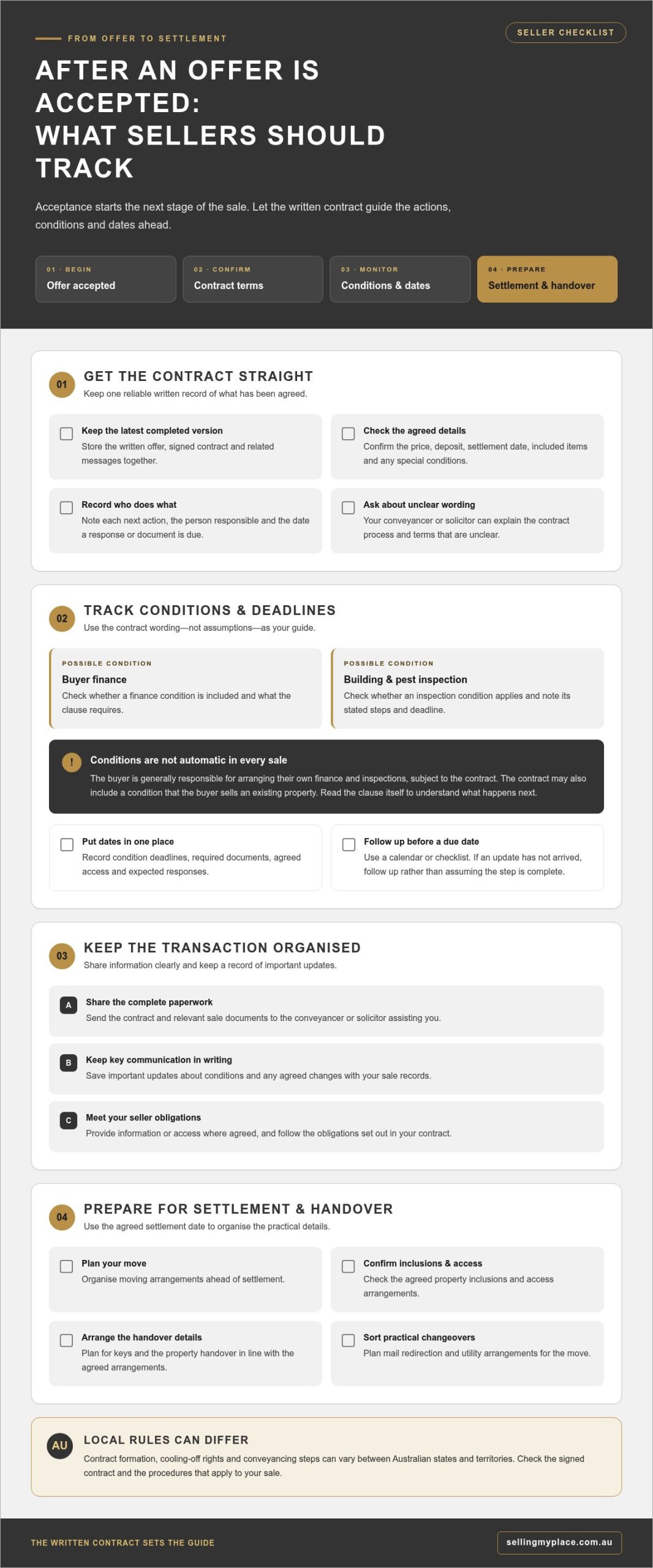
Keep the written offer and every version of the signed contract together. Make a clear record of the agreed dates, conditions and next steps, so you have one reliable reference if details are later discussed by phone or email. Contact your conveyancer or solicitor promptly to understand the contract process and coordinate the work they are handling.
- Save the paperwork: Store the written offer, signed contract and related messages together.
- Note the key dates: Record the contract deadlines and settlement date, plus who is responsible for each action.
- Keep communication clear: Share relevant documents with your conveyancer or solicitor. Keep important updates about the contract in writing.
These simple steps can prevent crossed wires as the sale progresses. Treat acceptance as the start of the agreed process, not a signal that every detail is settled. Let the written terms guide what happens next.
The contract, conditions and conveyancing steps after acceptance
Once the offer is accepted, use the contract as your working guide rather than relying on a handshake or a summary of what was discussed. It sets out the sale terms, conditions and dates that can affect progress. Review the completed contract, identify the next actions, share relevant documents and keep a reliable record of deadlines and communications.
- Check the completed contract. Make sure you have the latest version, signed or otherwise completed through the process that applies to your sale. Confirm that the written price, deposit, settlement date, inclusions and special conditions match the agreed terms.
- Mark each condition and date. Record what needs to happen, who is responsible and when a response or document is due. A finance condition or building and pest inspection condition might be included, but neither is automatic in every sale.
- Share the paperwork. Send the complete contract and relevant sale documents to the conveyancer or solicitor assisting you. Keep copies of important communications, especially updates about a condition or an agreed change.
- Track progress and follow up. Use a calendar or checklist to monitor deadlines. If a due date is approaching and you have not received an update, follow up with the person handling that step rather than assuming it is complete.
The buyer is generally responsible for arranging their own finance and inspections, subject to the contract. As the seller, you need to meet your contractual obligations and provide information or access where agreed. An offer may also depend on the buyer selling an existing property if the contract includes that condition. Read the clause itself, since its wording determines what happens next.
There is no identical process across Australia. Contract formation, cooling-off rights and conveyancing steps can vary between states and territories, and the contract may set out additional requirements for your transaction. For vendors navigating regional markets, local agencies such as Ollie James Real Estate can provide helpful insight into regional sale practices and timing. Always ensure you rely on the terms and procedures that apply to your specific sale.
Which contract dates and conditions should sellers track?
Use the signed contract to confirm exact dates and wording. Record condition deadlines, required documents, agreed access arrangements and responses expected from either party. A shared calendar or written checklist makes responsibilities easier to follow, particularly when several people are coordinating the sale. If a clause is unclear, raise it promptly with your conveyancer or solicitor.
What does a conveyancer or solicitor do after acceptance?
Your conveyancer or solicitor helps progress transaction documents and communicates with the other parties about conveyancing. Give them the full signed contract and relevant sale documents, and keep them informed of any agreed changes. Their support helps coordinate the transaction, but you still need to follow the contract and complete your own tasks.
For practical guidance alongside the paperwork, sale-process advisory support can help you stay organised as the transaction moves forward.
Buyer finance and inspections: what sellers can expect
Some buyers need time after signing to confirm finance or arrange property inspections. Others make an offer without these conditions, or may already have completed some checks. What happens after accepting an offer on a house therefore depends on the terms in your contract, not on a universal checklist that every buyer must follow.
Distinguish between a contract with conditions still to be met and one that has become unconditional. If a finance or inspection condition applies, the buyer’s next steps may affect whether the transaction proceeds under the agreed terms. Once applicable conditions are satisfied or dealt with, the contract may move to an unconditional stage. The timing and legal effect depend on the contract and the rules in your state or territory.
While the buyer completes any agreed steps, keep your own actions practical and measured:
- Provide access for inspections as agreed and keep arrangements in writing.
- Note contract dates and pass relevant updates to your conveyancer or solicitor promptly.
- Keep messages, notices and documents about conditions together, including requests and proposed changes.
- Do not assume a delay or inspection finding means the sale has ended. Check the contract and get guidance on the next step.
What happens if the buyer’s finance is delayed or declined?
First, check whether the contract includes a finance condition and what it says about the buyer’s obligations, timing and any required notice. A lender taking longer than expected does not automatically end the sale, and a declined application does not automatically give you the right to terminate or keep the deposit. Record any notice or update, then discuss the contract steps promptly with your conveyancer or solicitor.
Keep communication calm and factual. If the buyer says their lender has not provided an answer, note when you received the update and share it with the person handling your conveyancing. Do not assume an extension, termination or entitlement to the deposit based on a phone call alone. Handle any change to the agreed process in line with the contract and applicable rules.
How should sellers handle building or pest inspections?
Findings can range from routine maintenance observations to issues the buyer wants clarified. Respond through the agreed communication process and avoid promising repairs or changing terms informally. If a report leads to a proposed variation, ask your conveyancer or solicitor how it relates to the contract before agreeing to anything.
Contract wording and relevant procedures can differ across Australia. Keep the signed terms close, meet your agreed obligations and get advice on a specific notice or request rather than relying on another sale’s experience. A pause in progress may simply mean a condition is still being dealt with.
A practical seller checklist for the weeks before settlement
As settlement approaches, small details can take up more headspace than expected. A clear checklist helps you keep documents, property arrangements and moving plans together, with the contract and your conveyancer or solicitor as your reference points. The weeks before handover can vary between sales, so organise around your confirmed settlement arrangements rather than assuming every transaction follows the same timetable.
For sellers wondering what happens after accepting an offer on a house, preparing early can help avoid last-minute scrambles. Start with the records and commitments connected to your sale:
- Sale documents: Keep the contract, any schedule of inclusions and relevant correspondence together. Add transaction documents requested by your conveyancer or solicitor.
- Written commitments: Save records of agreed repairs, access arrangements or other promises made during the sale. Make sure everyone involved has the same written details.
- Questions and deadlines: Note document requests and dates. Ask your conveyancer or solicitor to clarify anything you do not understand.
- Moving arrangements: Plan removal, mail redirection, address changes and utility arrangements around the settlement date and handover instructions.
Keep the checklist practical and up to date. If an arrangement changes, update your records and tell the people involved rather than relying on memory or an old message thread.
What documents and property details should you organise?
Gather documents relevant to your sale, including the signed contract, inclusion list, correspondence and anything specifically requested for the transaction. Check which items stay with the property, such as fixtures or appliances, and distinguish them from belongings you plan to take. If a document request or deadline is unclear, ask your conveyancer or solicitor what is needed and when.
Keep a brief record of agreed work or access as well. Note what was agreed, who is arranging it and any timing discussed. That gives everyone a shared reference if questions come up before handover.
How can you prepare for the final inspection and move?
The buyer may have a final inspection under the contract or the process used in your state or territory. Check the relevant terms and arrangements rather than assuming an inspection is automatic or has the same scope everywhere. Before handover, review the agreed inclusions and leave the property in the condition required by the contract. If you are unsure what that means for a particular item, raise it with your conveyancer or solicitor.
Coordinate removal and utility changes with the confirmed settlement arrangements. Plan mail redirection, address updates and utility changes around the move and handover. Keep keys and any agreed access items ready for the handover process.
For practical guidance while organising your sale and preparing for settlement, get support with your property sale.
Settlement day and what comes next for the seller
Settlement is the final milestone in the sale, but the arrangements depend on your contract and the process used for the transaction. Your conveyancer or solicitor will generally coordinate the required documents and communicate with the other parties about readiness. If settlement is completed electronically, they will also coordinate through the relevant electronic settlement process.
In plain terms, settlement is when the sale is completed under the contract, the buyer pays the balance and ownership is transferred. Where relevant, the process also includes paying out the seller’s mortgage. The sale proceeds are then distributed according to the transaction arrangements.
What happens on settlement day?
The general sequence is to confirm the parties are ready, complete settlement and follow the agreed handover arrangements. Your conveyancer or solicitor can update you on progress and confirm when settlement has occurred. The precise steps and timing can vary across Australia, so use your contract and transaction updates rather than assuming every sale follows the same procedure.
Hand over keys and possession as set out in the contract and related arrangements. Do not assume the buyer receives the keys at a particular time simply because settlement is scheduled for that day. Follow the instructions from the people coordinating the transaction and have the agreed handover items ready.
If you are unsure whether settlement has been completed, wait for confirmation from your conveyancer or solicitor before treating the property as handed over. If arrangements change or a delay arises, ask how it affects the agreed handover. This can prevent confusion on a day when you may also be managing a move or saying goodbye to your home.
Where can sellers get practical support through the sale?
A well-organised sale involves more than preparing the property for buyers. Owners also need to manage information, communications and transaction steps as the sale progresses. Property advice can help you approach those tasks with a clearer plan, while your conveyancer or solicitor coordinates the legal and settlement documentation.
Kincade International Direct Sales supports residential owners with property marketing and advisory guidance, including professional photography, floorplans and pre-sale consulting. Its flat-fee, commission-free model gives owners an alternative to a traditional agency commission. Advisory guidance can help you stay organised through the process, while legal and conveyancing matters remain with the professionals handling your transaction.
Settlement completes the agreed sale and marks the handover stage, subject to the contract and local process. If you are planning a residential sale and want practical support with property marketing and your next steps, discuss sale support with Kincade International Direct Sales.
Take your next property step with confidence
The offer is one milestone in a bigger transition. As you look ahead, make room to plan what comes next, whether you are coordinating a move, preparing for a new home or checking that the sale is progressing as agreed. A steady plan can make the change feel more manageable.
Understanding what happens after accepting an offer on a house also means knowing when to pause and seek clarity. Use your signed terms as the reference point, and direct questions about your obligations or the conveyancing process to the professional handling your transaction. You can also get practical guidance with the sale planning and property marketing involved.
Kincade International Direct Sales supports residential owners with property marketing and advisory options, including a flat-fee, commission-free model. If you are planning a sale and want support with marketing and your next steps, talk with us about selling your property.
With preparation and the right support, you can move into the next chapter feeling more settled and ready for what is ahead.
Frequently Asked Questions
Can I change my mind after accepting an offer on my house?
Possibly, but it depends on whether a contract has taken legal effect, what it says and the rules that apply where the property is located. Once a contract is binding, withdrawing may have serious consequences. Do not cancel arrangements or tell the buyer the sale is off based only on a conversation. Review the signed documents and speak promptly with your conveyancer or solicitor before taking action.
When does a house offer become legally binding in Australia?
There is no single trigger that applies to every Australian sale. The legal effect depends on how the offer and acceptance are documented, the contract terms and the jurisdiction. A verbal agreement is not a substitute for checking the paperwork. Ask your conveyancer or solicitor to explain when your contract takes effect, which conditions apply and whether any deadlines have started. Do not rely on a process described for another state or territory.
Is there a cooling-off period after accepting an offer on a house?
It depends on the state or territory, the contract and the circumstances of the sale. Cooling-off rights can have exceptions, so do not assume a period applies simply because an offer has been accepted. Check the contract for relevant terms and promptly seek guidance specific to your location. If you are unsure whether the agreement is binding or a deadline is close, raise that with your conveyancer or solicitor.
How long does it take to settle after accepting an offer?
There is no single settlement timeframe for every Australian house sale. If you are wondering what happens after accepting an offer on a house, check the settlement date recorded in the signed contract. The parties may agree to different arrangements, and finance, documents or other contract conditions can affect progress. If circumstances change, ask your conveyancer or solicitor how the agreed date and next steps are affected.
What happens if the buyer cannot get finance approval?
Check whether the contract includes a finance condition, what deadline applies and how the buyer must give notice. The outcome depends on those terms and the relevant rules, so do not assume the contract automatically ends or continues. Keep the buyer’s updates and any formal notices in writing. Before responding or agreeing to a change, ask your conveyancer or solicitor to explain the steps available under your contract.
Can I accept another offer after accepting one?
Do not treat a later offer as replacing an agreement already in place. Your obligations depend on whether the first contract has taken legal effect, its terms and the law that applies. Before making a commitment or telling another buyer their offer is accepted, refer the situation to your conveyancer or solicitor. This helps you understand how the existing agreement affects what you can do next.
What should I do with utilities when selling my house?
Plan utility changes around the contract’s settlement and possession arrangements, rather than cancelling services as soon as an offer is accepted. Essential services may need to remain available for agreed access, inspections or handover. Note meter readings, account responsibility and changeover arrangements as you prepare to move. Your conveyancer or solicitor can clarify transaction dates, and you can arrange account updates or closure with the relevant providers.
Online real estate agent vs traditional: which suits your sale?
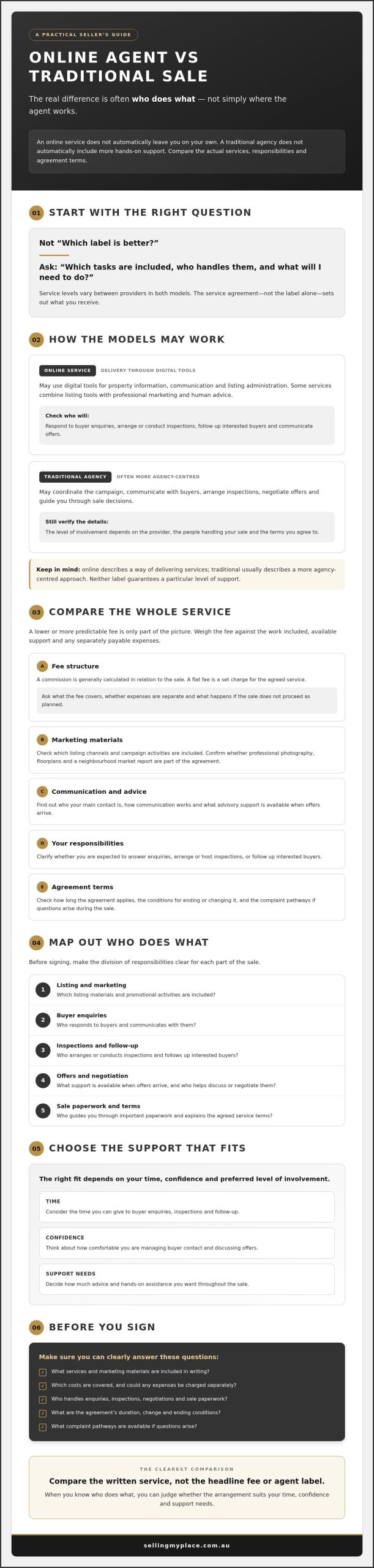
When comparing an online real estate agent vs traditional sale, the biggest difference may not be where the agent works, but who handles each part of the process. An online model doesn’t automatically mean you’re on your own, and a traditional agency’s higher level of involvement shouldn’t be assumed without checking what’s included.
It’s understandable to weigh a lower-fee option against the reassurance of more hands-on support, especially when you’re managing buyer enquiries, inspections and important sale paperwork. The useful comparison is between the actual services, tasks and terms, not just the labels or headline fees.
This guide explains how to compare marketing, communication, negotiation support, costs and your responsibilities under each model. Before signing, find out who handles buyer enquiries and inspections, what support is available when offers arrive, and whether professional photography, floorplans, neighbourhood market reports or advisory services are included. Once you know who does what, you can choose an approach that fits your time, confidence and support needs.
Key Takeaways
- Compare the online real estate agent vs traditional options by the tasks and support included, not the label alone.
- Check which marketing materials and advisory services are included in writing, and whether any costs are separate.
- Before signing, clarify who manages buyer enquiries, inspections, negotiations and sale paperwork.
- Match the level of hands-on support to your available time, confidence and preferred level of involvement.
- Review the agreement and complaint pathways so you know what to expect if questions arise during the sale.
Online real estate agent vs traditional: what is the real difference?
The main distinction is usually how the service is delivered, not whether a real person is involved. An online provider may use digital tools for property information, communication and listing administration. A traditional agency often works through direct contact with an agent and an agency team. Neither label tells you on its own how much support you’ll receive or how much of the selling work you’ll need to do.
For a useful overview of what is an online real estate agent, separate the online platform from the service agreement. The online real estate agent vs traditional comparison comes down to which tasks are included, who carries them out and how the provider charges.
What does an online real estate agent do?
Online property services can combine digital listing tools with professional marketing and human advice. A service might provide a property listing, photography, floorplans or a neighbourhood market report, alongside advisory support. Inclusions vary, so check the agreement for the specific service you’re considering.
A listing service doesn’t necessarily manage every step of the sale. Ask who responds to buyer enquiries, arranges or conducts inspections, follows up interested buyers and communicates offers. If you’re expected to take on any of these tasks, consider whether you have the time and confidence to do so.
What does a traditional real estate agent do?
A traditional agency may coordinate the campaign, communicate with buyers, arrange inspections and negotiate offers on the seller’s behalf. The agent may also guide you through decisions as the sale progresses. The level of involvement depends on the provider, the people handling your sale and the terms you agree to.
Traditional service isn’t identical across Australia, and online support varies too. One provider may offer substantial advice through online communication; another may leave more buyer-facing work to the owner. Read the agreement rather than relying on assumptions about the model.
In short: online describes a way of delivering services, while traditional usually describes a more agency-centred approach. The service agreement sets out what you actually receive, including:
- Fee structure: whether you’ll pay a flat fee or a commission, and what the charge covers.
- Marketing: which listing and promotional materials are included.
- Support and tasks: who handles buyer contact, inspections and follow-up.
- Terms: what the agreement requires and how long it applies.
Compare these details side by side. That will show whether the service matches your preferred level of involvement, instead of leaving you to choose by label alone.
Compare fees, marketing and support, not just the agent label
A lower or more predictable fee can be appealing, but it only tells part of the story. In the online real estate agent vs traditional comparison, weigh the fee model against the work included, the support available and any expenses treated separately in the agreement. A fee structure alone can’t tell you how a campaign will perform or what sale outcome to expect.
How do commission and flat-fee models differ?
A commission is generally calculated in relation to the sale, while a flat fee is a set charge for the agreed service. Ask for the full terms in writing: what the fee covers, whether any costs are payable separately, and what happens if the sale doesn’t proceed as planned. Compare the full services and costs rather than assuming one model will automatically cost less overall.
| What to compare | Questions to ask |
|---|---|
| Fee model | Is the fee commission-based or flat? What services and any separately payable expenses are covered? |
| Marketing | Which listing channels and campaign activities are included? Are professional photography and floorplans part of this agreement? |
| Support | Who is your main contact? Who responds to buyer enquiries and helps you consider or discuss offers? |
| Your tasks | Are you expected to arrange or host inspections, answer enquiries or follow up interested buyers? |
| Agreement terms | How long does the agreement apply, and what are the conditions for ending or changing it? |
What marketing and personal support should you check?
Look beyond a promise of online exposure. Ask which platforms will carry the listing, whether photography and floorplans are included, and who coordinates campaign updates. Confirm whether you’ll speak directly with an adviser about buyer interest and offers, or whether those tasks sit with you. Get the details in writing before you commit. For more on the elements to assess, see this guide to professional residential property listing services.
Traditional agencies and online providers can have different agreements and service arrangements. For wider context, explore the Real Estate Institute of Australia’s information on Australian real estate industry standards.
If you’re considering a flat-fee listing and advisory support, you can discuss your selling options with Kincade International Direct Sales and clarify which services and responsibilities apply to the arrangement.
Will an online agent provide enough support during your sale?
Online service doesn’t automatically mean you’re left to manage the sale alone. Some providers pair digital listing tools with professional advice, while others expect the owner to take a more active role in dealing with buyers. The key questions are what support is available, when you can access it and where the provider’s role ends.
That distinction matters when offers arrive and you need to make decisions. Ask whether an adviser can help you understand an offer or prepare for a negotiation, and what that assistance covers. For practical pointers, read these property sale negotiation tips. Advice and negotiation support vary by service, so check the scope rather than assuming it’s included.
Which sale tasks might remain with the owner?
Before signing, map out the work from listing to offer. For each task, confirm whether the provider, you or another professional is responsible. This can reveal gaps that aren’t obvious from a marketing description.
- Buyer contact: Who answers enquiries, shares property information and follows up interested buyers?
- Inspections: Who arranges access and conducts inspections? If you’re responsible, what coordination is expected?
- Campaign updates: Who prepares or organises marketing materials, and how will you hear about buyer interest and progress?
- Offers and paperwork: Who communicates offers and explains the next steps? Clarify separately who handles contract preparation and legal or conveyancing work.
Marketing assistance and conveyancing are different services. If a provider mentions conveyance advice, ask what it covers and whether you’ll still need a solicitor or conveyancer for other parts of the transaction.
How can you assess the support before signing?
Ask who your main contact will be, how you can reach them and what response expectations apply during the campaign. Request written details of any advice, negotiation assistance and service limits. Check the agreement’s duration, exit terms and any obligations that continue if you change your selling plans.
A clear conversation now can prevent uncertainty later. CHOICE’s guide to how to choose a real estate agent offers further questions to consider when assessing an agent’s service and terms. Use those questions alongside your own task list, then choose the arrangement that gives you the level of guidance and involvement you’re comfortable with.
Which real estate agent model fits your time, confidence and priorities?
The right choice depends on more than the fee. Think about how much time you can give the sale, how comfortable you feel speaking with prospective buyers, and whether you’d rather coordinate tasks yourself or have an agent take a more hands-on role. Choose a service whose responsibilities feel manageable from the outset, while allowing for your needs to change during the sale.
When might a traditional agency suit your situation?
A traditional agency may suit you if you want an agent to coordinate more campaign activity and prefer regular, direct communication as decisions arise. That can feel reassuring if you have limited time or would rather not lead buyer conversations and offer discussions yourself. Still, don’t assume every agency agreement includes the same hands-on help. Confirm who manages each task, how updates are provided and what the agent’s role covers.
When might an online service suit your situation?
An online service may appeal if you’re comfortable being more involved, value digital access and want to consider a different fee structure. Some services combine residential property listings with marketing materials and advisory support, but inclusions and the scope of advice vary. Check that the services address the areas where you want help. A flat fee alone won’t tell you how much you’ll need to do.
For a practical sense of the owner’s role, read this guide on how to sell your own home. Even if you don’t plan to manage the whole sale yourself, it can help you identify which responsibilities you’re happy to take on and where you’d value professional guidance.
To compare providers fairly, use the same written checklist for each option. Assess how well each agreement matches your needs across:
- Time: Can you respond to buyers and coordinate any tasks assigned to you?
- Confidence: Are you comfortable discussing interest and offers, or do you want more guidance?
- Control: Do you want to be closely involved, or would you prefer the agent to coordinate more of the campaign?
- Support: Is your contact and their role clear, including the limits of any advice?
- Fit: Are marketing inclusions, responsibilities and agreement terms set out clearly in writing?
The best match is the one that fits your actual capacity, not an ideal version of your schedule. If a flat-fee listing and advisory approach is on your shortlist, discuss your selling options with Kincade International Direct Sales and confirm which inclusions and responsibilities apply.
How to choose an Australian selling service with confidence
Once you’ve compared the models, turn your priorities into a simple due-diligence check. The aim isn’t to find a label that sounds reassuring. It’s to understand exactly what you’re agreeing to and whether the service fits your sale.
A practical checklist before you commit
- 1. List your priorities. Note how much time you can give the sale, which tasks you’re comfortable handling and where you want advice or hands-on help.
- 2. Compare written inclusions. Check marketing deliverables such as listing exposure, photography and floorplans alongside the fee structure. Ask which services are included and whether any expenses may be charged separately.
- 3. Clarify responsibilities. Confirm who manages enquiries, inspections, negotiations and campaign updates. Find out who your contact is and what advisory support covers.
- 4. Review the agreement. Read the duration, cancellation conditions, service responsibilities and other obligations before signing. Ask for an explanation of anything unclear.
- 5. Check complaint pathways and local guidance. Find out how the provider handles complaints and where to seek further help. Property sale and consumer requirements can vary by state or territory, so check current guidance for your location and obtain independent advice if needed.
Questions to ask every prospective provider
Ask each provider the same questions so you can compare answers fairly: What does the fee cover? Could any services involve separate charges? Who responds to buyers, coordinates inspections and supports offer discussions? How will campaign progress be communicated? What happens if you want to end the agreement? Clear written answers make it easier to compare the support on offer, not just the presentation.
The online real estate agent vs traditional decision comes down to the service and terms that suit your priorities. Kincade International Direct Sales offers flat-fee, commission-free property marketing and advisory packages. Its listed services include professional photography, floorplans, neighbourhood market reports and advisory support. Confirm current package inclusions, responsibilities and the scope of advice before deciding.
Compare those details with each provider’s written offer, then choose with a clear view of who does what. To discuss the available selling options, contact Kincade International Direct Sales.
Choose the support that lets you sell with confidence
The online real estate agent vs traditional decision isn’t simply about choosing a lower fee or a familiar agency model. Compare what each provider will do, what you’ll need to manage and how much guidance you want with buyer enquiries, inspections and offer discussions. Then check the written agreement for marketing inclusions, responsibilities, terms and any separately payable expenses.
Kincade International Direct Sales offers a flat-fee, commission-free property marketing and advisory model. Professional photography and floorplans are among its listed services, and its Agent Advisory Service offers pre-sale consulting and conveyance advice. Confirm which services are included in the package you’re considering, along with the current scope of advisory support and the terms.
If you’d like to explore whether this approach fits your priorities, discuss your property sale with Kincade International Direct Sales. Contact the team to clarify the package inclusions and responsibilities before deciding.
Frequently Asked Questions
Is an online real estate agent cheaper than a traditional agent?
An online service may use a flat-fee structure, while a traditional agency commonly charges commission linked to the sale. The total cost depends on the agreement and any separate expenses. Compare what each fee covers, including marketing and support, rather than judging by the headline fee. The online real estate agent vs traditional choice should also reflect which sale tasks you’ll handle and how much professional guidance you want.
Can an online real estate agent negotiate with buyers?
Some online services may provide advice or assistance with offers, but negotiation support varies between providers. Before signing, ask who communicates offers, whether an adviser can help you assess or respond to them, and what the service’s limits are. Get the answers in writing. If you’re expected to lead negotiations yourself, consider whether you feel comfortable discussing terms and responding to buyer questions.
What is the difference between an online agent and a traditional real estate agent?
The difference is generally how the service is delivered, not whether human support is available. Online providers may use digital tools for listings and communication, while traditional agencies often coordinate directly through an agent or team. Either model can vary in marketing, advice and seller responsibilities. Compare the written agreement to see who handles enquiries, inspections, offers and campaign updates before deciding which arrangement suits you.
Do online real estate agents include professional photography and floorplans?
Some online property services include professional photography and floorplans, but inclusions vary by provider and package. Check whether both are part of the specific service you’re considering, or whether they involve separate arrangements or charges. Also confirm how the listing will be presented and where it will appear. Kincade International Direct Sales lists photography and floorplans among its services, but verify current package inclusions before proceeding.
How much does an online real estate agent cost in Australia?
There isn’t one standard cost for an online real estate agent in Australia. Providers may charge a flat fee or use another structure, and marketing or other services may be charged separately. Ask for a written breakdown of the fee, inclusions and possible additional expenses so you can compare the full agreement with other options. Kincade International Direct Sales describes its model as flat-fee and commission-free; confirm its current terms directly.
What should I check before signing with an online real estate agent?
Check the written inclusions, fee structure, agreement duration and cancellation conditions before signing. Clarify who handles buyer enquiries, inspections, offer discussions and campaign updates, and identify the contact available to you. Confirm whether photography, floorplans and advisory support apply to your agreement, and ask about any separate expenses. If a term is unclear, request an explanation in writing and consider independent advice before committing.
Can I sell my home without a traditional real estate agent?
Yes, you can choose a sale-by-owner approach or use a property marketing and advisory service instead of a traditional agency. The level of support differs: you may take responsibility for buyer enquiries, inspections and follow-up, or receive some guidance depending on the service. Before choosing, consider the time you can give the sale and confirm who handles each task, including any conveyancing or contract responsibilities.
Seller’s Disclosure Obligations in Australia: The 2026 Homeowner’s Legal Guide
Laying your property’s imperfections bare on paper might feel counterintuitive when preparing to sell, but thorough pre-sale disclosure is actually your ultimate legal shield. Many homeowners worry that revealing an unapproved patio, historical pest damage, or registered drainage easements will derail an offer or diminish their return. In reality, fulfilling your seller’s disclosure obligations Australia wide ensures that once a deal is struck, it stays struck; protecting your equity against costly contract rescissions, delayed settlements, or protracted post-sale litigation.
We know that selling a home is as deeply personal as it is financial, and sorting through shifting statutory paperwork shouldn’t keep you awake at night. This 2026 guide clarifies your exact legal responsibilities, untangling mandatory reporting declarations from what traditional “buyer beware” principles still cover so you can negotiate with genuine confidence.
Ahead, we explore what constitutes a material defect across Australian jurisdictions, outline an essential pre-sale paperwork checklist, and show you how proactive transparency keeps you firmly in control of your successful property transition.
Key Takeaways
- Mastering seller’s disclosure obligations Australia wide protects your equity and prevents buyers from walking away before settlement.
- Distinguish between latent defects of title and visible property faults so you know exactly which council approvals, covenants, or notices require formal reporting.
- Understand the limits of caveat emptor and learn why upfront statutory compliance removes the threat of contract termination.
- Use our structured pre-sale audit checklist to compile your title searches, building permits, and planning certificates before welcoming your first buyer.
- Pairing independent pre-sale consulting with sound conveyance advice ensures total legal peace of mind while keeping your hard-earned sale proceeds intact.
Understanding Seller’s Disclosure Obligations in Australia: What the Law Demands
At its core, a seller’s disclosure obligation is a statutory legal duty requiring property owners to reveal specific defects, encumbrances, and regulatory restrictions to prospective purchasers before signing a binding contract. While selling a home marks a major lifestyle transition, the legal mechanics demand clear-headed precision. These statutory duties protect buyers from hidden legal impediments, ensuring fair dealing while creating an unassailable legal safeguard around the vendor’s hard-earned proceeds.
Historically, property transactions relied on the common law principle of caveat emptor, or “let the buyer beware”. Under that traditional doctrine, the burden rested almost entirely on the purchaser to uncover property faults. Today, comprehensive Vendor disclosure laws in Australia have shifted that balance. Modern legislation requires sellers to prepare formal disclosure documentation, such as a vendor statement or prescribed disclosure pack, alongside the standard contract. Meeting your seller’s disclosure obligations Australia wide does not compromise your bargaining position; upfront honesty builds genuine buyer trust and insulates you against costly post-contract disputes.
The Shift from Caveat Emptor to Mandatory Vendor Warranties
Prospective purchasers still carry a responsibility to conduct practical building and pest inspections, but they are no longer left entirely to their own devices. Contemporary property legislation holds vendors accountable for latent defects of title, unapproved structural alterations, and non-compliant building works. Under Australian legal standards, deliberate silence is treated just as seriously as active misrepresentation. Choosing not to disclose a known statutory notice or planning defect can unravel an agreement just as quickly as stating an outright falsehood.
Key Statutory Instruments Governing Australian Property Sales
Across the nation, property disclosure is governed by specific legislative instruments, from formal Section 32 statements to newly established pre-contract disclosure schemes. Beyond state property legislation, the Australian Consumer Law provides an overarching framework that penalises misleading or deceptive conduct during property negotiations. Standard contracts of sale routinely feature non-negotiable statutory warranties. Engaging pre-sale property consulting alongside professional conveyance advice ensures your documentation complies with the law before you welcome your very first buyer.
What Must You Legally Disclose? The Core Property Defect Categories
Untangling your legal responsibilities begins by distinguishing between two fundamental concepts: patent defects and latent defects. Patent defects are visible physical flaws, such as cracked window panes or worn carpets, which a buyer is expected to discover during an ordinary visual inspection. In contrast, latent defects are hidden issues that cannot be spotted by the naked eye. While latent physical faults generally fall on the buyer’s private building inspectors, latent defects of title, such as unrecorded rights of way or drainage pipelines, trigger non-negotiable seller’s disclosure obligations Australia wide.
Title Encumbrances, Easements, and Planning Restrictions
Every prospective buyer has the legal right to receive clear title to your land, free of unexpected burdens. You must formally disclose:
- Registered easements: Rights granted to service providers for stormwater drains, electricity lines, or shared access paths.
- Restrictive covenants: Legal agreements on title specifying roof materials, building heights, or restrictions preventing future subdivision.
- Planning notifications: Official zoning overlays, road-widening proposals, or compulsory acquisition notices issued by local councils or road authorities.
Structural Defects, Unapproved Works, and Pest Infestations
That DIY deck or converted garage might feel like a highlight, but missing council approvals pose substantial transaction risks. Australian courts expect vendors to disclose unpermitted additions, boundary encroachments, and owner-builder works. Similarly, active termite damage or structural subsiding must not be disguised or obscured behind fresh coats of paint. Investing early in professional Pre-Sale Property Consulting allows you to audit these vulnerabilities before listing, giving you clarity on what requires rectification or formal notice.
Environmental Hazards, Flooding Overlays, and Health Risks
Australian disclosure regulations increasingly demand proactive clarity regarding environmental exposures. If your property is situated within a declared flood inundation zone or bushfire hazard overlay, statutory documentation must accurately reflect this status. Sellers are also obligated to report known loose-fill asbestos insulation or historical chemical contamination. While the industry closely studies statutory agent’s disclosure obligations around sensitive matters such as serious crime history, private sellers must also ensure no material fact is suppressed. When you want complete peace of mind about what requires declaration, reach out for specialist conveyance guidance to protect your hard-earned sale proceeds from day one.
Caveat Emptor vs Statutory Disclosure: What Happens If You Fail to Disclose?
Failing to understand the boundary between traditional buyer diligence and mandatory legal transparency can prove devastating to your sale. While purchasers are expected to inspect physical qualities, statutory legislation strictly penalises sellers who conceal legal encumbrances, unapproved additions, or statutory notices. Overlooking these items strips away your transaction security.
| Area of Responsibility | Buyer Due Diligence (Caveat Emptor) | Mandatory Seller Disclosure |
|---|---|---|
| Physical Condition | Arranging independent building and pest reports for general wear, leaks, or age. | Declaring known structural orders, illegal building works, or concealed hazards. |
| Title & Boundaries | Surveying fence alignments and checking neighbourhood amenity. | Providing clear title searches, registered easements, covenants, and leases. |
| Statutory Compliance | Verifying future zoning suitability for personal plans. | Attaching council planning certificates, pool compliance, and safety switch status. |
Contract Rescission: The Immediate Danger Before Settlement
The most immediate hazard of breaching your seller’s disclosure obligations Australia wide is contract rescission. When statutory disclosure documents contain omissions or inaccurate statements, buyers frequently hold the legal right to terminate the contract at any time before settlement. The buyer receives their entire deposit back, often with interest. You are left with collapsed moving plans, lost conveyancing outlays, and a re-listing process that damages buyer perception and weakens negotiation leverage.
Post-Settlement Damages and Misleading Conduct Claims
Even if an oversight goes unnoticed before settlement day, liability does not necessarily end at the handover of keys. Buyers discovering concealed defects post-settlement can sue for significant financial compensation or damages under consumer protection laws. State tribunals and fair trading bodies take misleading conduct claims seriously, particularly regarding unapproved structural extensions or deliberate concealment of notices. Securing specialised Conveyance Advice early ensures every declaration is completely compliant, fully shielding your family’s equity long after the settlement dust settles.
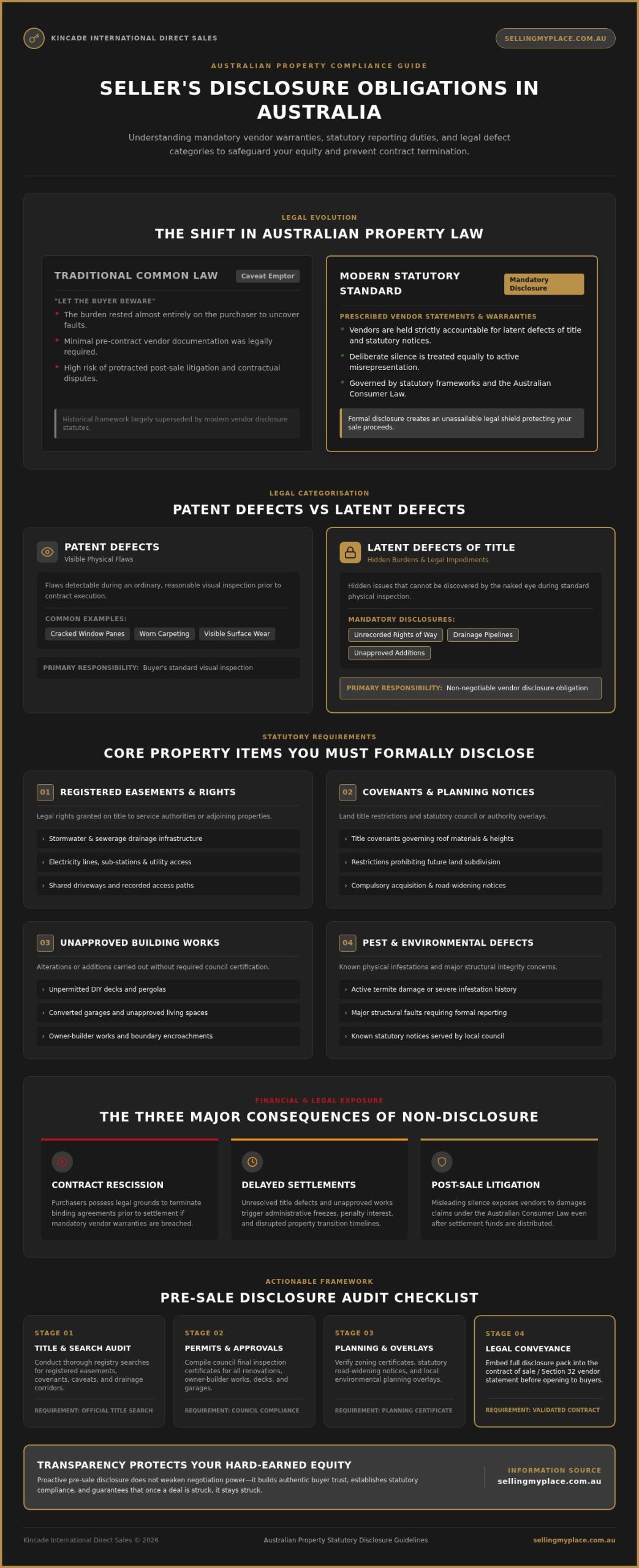
Step-by-Step Pre-Sale Disclosure Preparation: The Seller’s Audit Checklist
Preparing your legal paperwork before listing your property transforms uncertainty into calm confidence. Rather than scrambling when a prospective buyer requests the contract, working through a methodical audit checklist ensures you satisfy every aspect of your seller’s disclosure obligations Australia wide.
- Step 1: Order title searches. Confirm registered ownership, boundaries, plan numbers, and any registered easements or covenants affecting the title.
- Step 2: Collect council planning certificates. Gather official zoning documentation, building permits, and final inspection certificates for any structures built on the land.
- Step 3: Collate improvement records. Retrieve owner-builder permits, certificates of currency for home warranty insurance, and trade warranties for major additions.
- Step 4: Verify mandatory safety compliance. Test interconnected smoke alarms, ensure safety switches (RCDs) are fitted, and obtain current pool barrier certificates if applicable.
- Step 5: Draft the statutory disclosure statement. Work with your legal advisor to incorporate all mandatory certificates and disclosures into the draft contract.
Assembling Your Legal and Property Documentation Pack
A complete disclosure pack leaves no room for confusion. Request water authority diagrams showing sewer mains and drainage lines early, alongside relevant land tax clearance certificates. If your property is part of a community title or strata scheme, assemble current body corporate inspection records, capital works fund forecasts, and insurance policies. Presenting organized documentation right away signals integrity and reassures serious buyers.
Handling Known Property Imperfections with Transparent Disclosures
Draft neutral, factual summaries regarding past repairs, minor boundary discrepancies, or historical issues. Being transparent about known defects prevents buyers from weaponizing building inspection discoveries to slash their offers later. Pairing open disclosure with sound Market Valuation Principles grounds your price expectations and keeps negotiations running smoothly.
Working with Conveyancers and Legal Advisors Early
Engage a conveyancer or property solicitor before marketing photography commences. Your legal partner verifies that mandatory statutory annexures and special conditions protect your interests. Confident documentation strengthens your position during discussions; explore our guide to Sale Negotiation Strategies to see how solid contracts lead to clean deals. To ensure your paperwork is watertight before launching your campaign, contact our team for dedicated conveyance advice.
Safeguarding Your Sale: How Professional Advisory and Conveyancing Protect Your Equity
Selling your home independently doesn’t mean standing alone against legal complexities. Taking charge of your own sale gives you genuine clarity and direct oversight across every stage of the transaction. When you blend professional listing presentation with sound legal advisory, satisfying your seller’s disclosure obligations Australia wide becomes a smooth, orderly milestone rather than a source of stress.
The Power of Independent Selling Supported by Expert Advisory
A common myth suggests that selling without a traditional agent heightens your legal vulnerability. In reality, traditional commission agents aren’t legal practitioners; their focus is closing a deal, not conducting forensic documentation audits. Partnering with dedicated real estate advisory services equips you with steady, step-by-step guidance when handling buyer inquiries and presenting mandatory documentation. Bringing in Pre-Sale Property Consulting early pinpoints potential compliance red flags, such as missing permits or uncertified safety fixtures, well before a buyer’s building inspector sets foot on the property.
Retaining Full Equity Without Sacrificing Contract Security
Surrendering substantial portions of your home’s equity to traditional agency commissions isn’t required to achieve an airtight, premium transaction. Transparent flat-fee models empower homeowners to showcase their property across leading real estate channels while keeping 100% of their net sale profits. You gain top-tier photography, floorplans, and national buyer reach, all supported by the rigorous conveyance advice needed to ensure statutory compliance.
Proactive preparation eliminates the fear of contract rescission and positions you for calm, authoritative discussions with serious purchasers. When you’re ready to take control of your property journey and secure your equity, connect directly with Kincade International Direct Sales to finalise your legal paperwork and launch your market-ready campaign with complete peace of mind.
Selling with Total Confidence: Protect Your Equity from Day One
Preparing your property for the market is about honouring your home’s story while establishing a clean, legally secure transaction. Meeting your seller’s disclosure obligations Australia wide does not just keep your contract watertight; it establishes genuine buyer trust, prevents last-minute settlement hurdles, and keeps you in complete control from the first inspection through to key handover.
You don’t need to surrender your hard-earned equity to traditional agency commissions to achieve thorough legal protection. Our transparent flat-fee listing model keeps 100% of your sale profit right where it belongs. Supported by comprehensive pre-sale property consulting that pinpoints compliance risks early, our dedicated agent advisory service provides tailored conveyance advice nationwide.
Protect your hard-earned equity and ensure complete legal compliance by booking your Pre-Sale Property Advisory Consultation today. Take this exciting next step with absolute clarity, knowing your property sale rests on unshakeable ground.
Frequently Asked Questions
Can a buyer pull out of an Australian property contract if I fail to disclose an easement?
Yes, a buyer can generally terminate the contract before settlement if you fail to disclose a registered easement. Easements affect property usage and legal title, making them mandatory disclosure items. If undisclosed, buyers can exercise statutory rescission rights, retrieve their deposit in full, and potentially seek compensation for wasted legal expenses. Ensuring all title encumbrances are accurately annexed to your draft contract avoids this costly disruption.
What is the difference between a latent defect and a patent defect in property law?
Patent defects are readily noticeable physical flaws discoverable through ordinary visual inspection, such as cracked window panes or visible surface damage. Latent defects are hidden issues that cannot be identified through standard viewing, such as structural issues behind plaster, unapproved drainage, or buried encumbrances. While buyers inspect physical condition, fulfilling your seller’s disclosure obligations Australia wide requires transparent declaration of latent defects affecting title, safety, or legal compliance.
Do I need to disclose unapproved renovations or DIY building works when selling my home?
Yes, you must declare unapproved structural alterations, extensions, or unpermitted building additions to prospective purchasers. Local councils enforce strict compliance standards, and transferring a home with illegal modifications exposes the incoming buyer to formal rectification orders. Failing to declare these works can entitle buyers to terminate the agreement before settlement or sue for rectification costs. Conducting early pre-sale property consulting helps you identify and document these additions safely.
Is it mandatory to disclose past termite damage if the infestation has been fully treated?
While past pest activity that caused no structural harm rarely triggers statutory title disclosures, concealing known damage or misleading buyers is strictly unlawful. If historical activity caused structural deterioration or if a buyer asks direct questions about pest history, hiding that reality invites legal action for misrepresentation. Providing historical treatment certificates alongside an open seller declaration builds buyer confidence and eliminates the threat of protracted post-settlement disputes.
What happens if a property defect is discovered between contract exchange and settlement?
The outcome depends on whether the defect breaches a statutory vendor warranty or a specific contractual condition. If you failed to reveal a mandatory legal defect, such as an unapproved structure or statutory council notice, the buyer may have the lawful right to rescind the contract immediately. For minor physical damage occurring after exchange, the buyer cannot easily terminate but may negotiate an agreed repair or price adjustment prior to settlement.
Are seller disclosure obligations identical across every Australian state and territory?
No, statutory disclosure regimes vary substantially between jurisdictions. Some regions operate under strict pre-contract disclosure schemes requiring formal vendor disclosure packs, while others place greater emphasis on material facts or formal Section 32 statements. Despite these procedural differences across borders, navigating seller’s disclosure obligations Australia wide fundamentally requires proactive honesty. Engaging dedicated conveyance advice ensures your contract documents comply with the exact legislation governing your property’s sale.
Can I sell my property privately and still satisfy all legal disclosure requirements?
Absolutely, selling your home directly does not alter your statutory disclosure responsibilities or diminish your legal protections. Private sellers are bound by the same property legislation as traditional agents, but retain total control over the process. By combining commission-free listing platforms with professional real estate advisory services and conveyance advice, you ensure all mandatory searches, title certificates, and vendor declarations are completely compliant while saving your hard-earned equity.
How to Sell a Townhouse Privately: The 2026 Australian Seller’s Guide
Handing over A$20,000 of your hard-earned equity to an agent just to sell a property you know better than anyone isn’t a necessity; it’s a choice you no longer have to make. We understand that the thought of managing your own sale feels like a mountain to climb, especially when you’re balancing the complexities of strata records and legal disclosures. You’ve likely spent years making your townhouse a home, and the idea of losing a chunk of that legacy to commission feels inherently wrong. Learning how to sell a townhouse privately is about reclaiming that value while ensuring every legal requirement is met with total precision.
This guide is designed to be your steady hand through the 2026 Australian market, offering a clear roadmap to navigate strata-specific requirements and contract exchanges with confidence. We’ll walk you through the essential steps to create a professional-grade listing, manage your own inspections, and master the legal settlement process without the usual stress. By the end of this article, you’ll have the tools to manage your sale like a seasoned expert, keeping 100% of your profit exactly where it belongs: in your pocket.
Key Takeaways
- Protect your family’s legacy by bypassing the commission trap, potentially keeping upwards of A$20,000 in your pocket for your next home.
- Master the legal nuances of townhouse sales, including the vital role of strata inspection reports and organising a robust Section 32 with a licensed conveyancer.
- Discover how to sell a townhouse privately by leveraging professional visual assets that showcase your property’s unique layout and lifestyle appeal.
- Gain the confidence to lead your own open homes, using your insider knowledge to build trust and answer buyer queries with authentic warmth.
- Embrace a partnership-based approach that provides the security of expert pre-sale consulting without the burden of high marketing costs.
Why Selling a Townhouse Privately is Your Best Financial Move
Selling your home is one of the most significant life transitions you’ll ever experience. It is the culmination of years of hard work, careful maintenance, and family memories. Choosing how to sell a townhouse privately isn’t just a way to save on costs; it’s about stepping into the driver’s seat of your financial future. We define the private sale as a professional partnership where your intimate knowledge of the property meets a structured, digital advisory framework. By removing the traditional intermediary, you ensure that every dollar of equity stays within your family’s reach, providing a much larger deposit for your next chapter.
Calculating the Real Cost of Traditional Agents
Many sellers are shocked when they see the final settlement statement at the end of a traditional campaign. In Australia, a typical agent might charge between 2% and 3% in commission. For a townhouse valued at A$800,000, that is a staggering A$16,000 to A$24,000 gone in an instant. This “commission trap” is often compounded by high marketing costs. Agents frequently mark up advertising fees or suggest expensive print packages that don’t always serve your specific needs. A flat-fee model offers the transparency you deserve. It allows you to invest in high-quality visual assets without the hidden overheads that erode your profit.
The Townhouse Advantage in Private Sales
In the 2026 Australian property market, townhouses occupy a unique “sweet spot” for buyers. They offer the space of a house with the convenience of an apartment, making them incredibly attractive to first-home buyers and downsizers. Because these properties often involve strata title ownership, many maintenance concerns are managed by a body corporate. This structure simplifies the due diligence process for potential buyers, making townhouses much more straightforward to sell privately than large, complex estates.
Buyers in this segment value direct, honest communication. You can speak to the lifestyle benefits, like the morning sun in the courtyard or the quiet neighbours, with an authenticity no agent can replicate. Managing your own sale allows you to handle the transition with a steady, professional hand. It reduces the stress of high-pressure sales tactics and keeps the focus where it should be: on a smooth, successful settlement that respects your legacy.
Navigating Strata and Legal Requirements for Townhouses
Building trust through documentation is the cornerstone of a successful private sale. Unlike a traditional house, a townhouse involves shared responsibilities that must be clearly articulated to any prospective owner. This means documenting common property areas, such as shared driveways or gardens, and ensuring all shared-wall agreements are legally sound. When you understand how to sell a townhouse privately, you realise that providing a comprehensive paper trail isn’t a chore; it’s a professional courtesy that sets you apart from less prepared sellers. Transparency about body corporate fees and any upcoming special levies ensures there are no “nasty surprises” that could derail a deal late in the piece.
Buyers aren’t just looking at your four walls; they’re looking at the health of the entire complex. The Strata Inspection Report is your most persuasive sales tool because it provides a window into the building’s history, from past repairs to the financial robustness of the owners corporation. By providing this upfront, you eliminate the fear of the unknown that often stalls private negotiations. It shows you’ve managed your home with a steady, professional hand, which gives buyers the confidence to move forward without an agent acting as a buffer.
Strata Documentation 101
A “clear” strata report is one that shows a well-managed administrative fund for daily expenses and a healthy capital works fund for future major projects. If there’s a special levy planned for a new roof or balcony repairs, disclose it early. Honesty builds a bridge of trust that agents often struggle to maintain. You’ll want to have copies of the last few years of meeting minutes ready to show that the community is harmonious and proactive. You can find more details on general preparation in our How to Sell Your Own Home: A Step-by-Step Guide.
Legal Compliance Without the Stress
Legal requirements vary slightly across states and territories, but the core legal requirements for selling property in Australia always mandate a valid Contract of Sale before you hit the market. Depending on your state or territory, this contract may be accompanied by a vendor’s statement or a series of prescribed disclosures, but the obligation to inform the buyer remains consistent nationwide. This document must outline everything from zoning to encumbrances. Engaging a licensed conveyancer early ensures these details are watertight, protecting you during the cooling-off period and leading to a smooth exchange of contracts. If you need a hand organising these documents, our experts at Kincade International Direct Sales can offer the conveyance advice necessary to keep your sale on track and your equity protected.
Professional Marketing: Making Your Townhouse Stand Out
First impressions happen in milliseconds on a smartphone screen. Your digital listing is the virtual front door to your home, and it needs to feel as welcoming and polished as the property itself. Professional photography captures the warmth and space of your townhouse, ensuring it stands out against cluttered, low-quality competition. Mastering how to sell a townhouse privately means becoming the curator of your property’s best features, from the way the afternoon light hits the balcony to the quiet community atmosphere of your complex. By leveraging global marketing networks, you aren’t just waiting for a local buyer to walk past a sign; you’re actively reaching families and professionals who are looking to move into your specific community from across the country or even overseas.
Visual Assets That Convert Clicks to Inspections
Townhouses often feature unique multi-level designs that can be difficult to interpret through photos alone. This is where professional floorplans become your secret weapon. They allow buyers to mentally place their furniture and understand the flow between living zones and private retreats. High-quality wide-angle shots, taken with professional lighting, can reveal the true scale of your rooms without the distortion common in DIY photos. These assets provide the clarity buyers need to feel confident enough to book an inspection. For a deeper look at what makes a listing successful, explore our Professional Residential Property Listing Services Guide.
Strategic Pricing and Market Reports
Pricing is an art backed by data, and getting it right from day one is essential. An overpriced listing becomes “stale” quickly, losing that initial surge of interest that occurs when a new property hits the market. Understanding how to sell a townhouse privately involves using tools like Neighbourhood Market Reports to see what similar properties in your area actually sold for, rather than just their aspirational asking prices. This grounded approach helps you set a competitive figure that attracts serious interest while protecting your hard-earned equity. We recommend setting a realistic, data-driven price to ensure your sale remains on a smooth, predictable timeline. You can learn more about setting the right figure in our guide on How to Determine the Market Value of a Home in Australia.
When you write your listing description, focus on the lifestyle your townhouse offers. Mention the local coffee shops, the proximity to transport, and the ease of low-maintenance living. This personal touch, combined with professional-grade visuals, creates a compelling narrative that resonates with buyers on an emotional level.
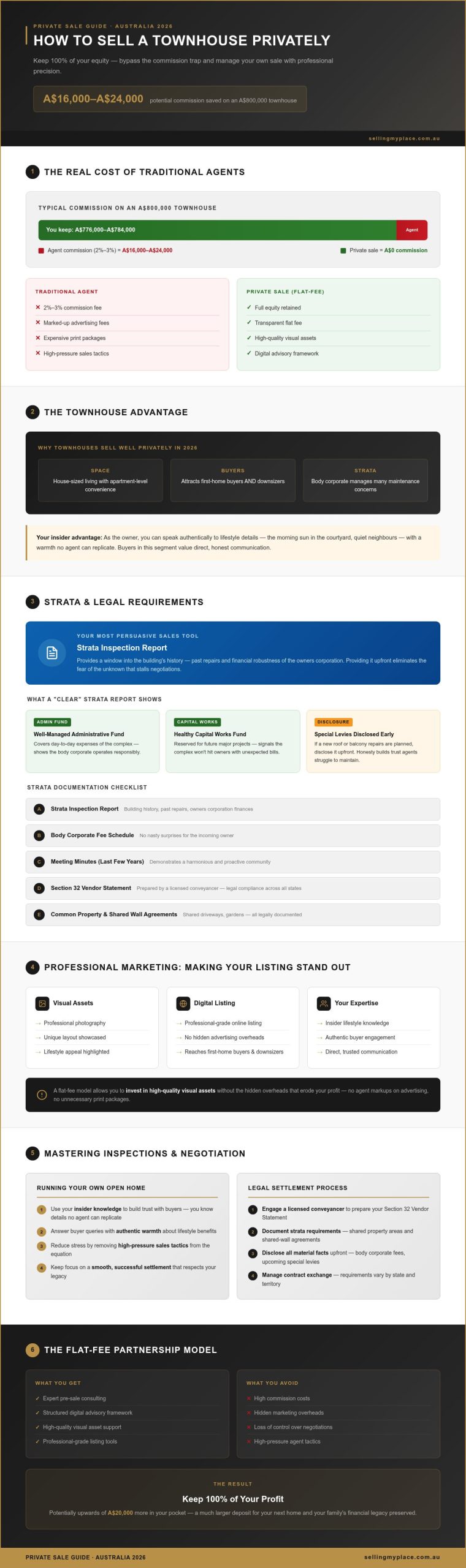
Mastering Inspections and the Art of Negotiation
Moving from the digital listing to the physical inspection is where your connection with a buyer truly begins. When you learn how to sell a townhouse privately, you discover that you are your property’s greatest asset. No one else can explain how the morning light perfectly illuminates the kitchen or where the best local coffee is found with quite the same heart. It is about being a welcoming guide rather than a high-pressure salesperson. This personal touch builds trust far more effectively than a generic agent script, allowing buyers to see the home through your eyes.
Setting the Scene for a Successful Inspection
Inside, decluttering is essential to maximise the sense of space and flow. To help clear out personal items and bulky furniture, you might consider a secure solution like SafeHouse Storage to make each room feel more expansive. Open every blind to invite natural light and use neutral, fresh scents to create a calm, grounded atmosphere. Don’t forget to highlight shared amenities like pools, gyms, or BBQ areas during the walk-through. These are valuable extensions of your own living space that add significant lifestyle weight to your asking price.
Negotiation doesn’t have to be a battle of wits. In the Australian property market, a “Fair Go” approach often yields the best results for everyone involved. This means building genuine rapport with buyers and understanding their needs as much as your own. When an offer arrives, take a breath. You aren’t just looking at a number; you’re looking at terms, settlement dates, and the buyer’s level of finance approval. Handle counter-offers with professional courtesy and calm confidence, keeping the lines of communication open and respectful.
If a conversation feels particularly high-stakes, our Expert Agent Advisory Service is here to provide the steady hand you need to navigate the final hurdles. For more detailed strategies on reaching a win-win, check out these Expert Property Sale Negotiation Tips. Managing buyer follow-ups without appearing desperate is simply a matter of timing; a warm, short message a day after the inspection is usually perfect. It allows you to answer any lingering questions about the strata title or local schools while the property is still fresh in their minds. This direct line of communication is exactly what modern buyers crave. If you’re ready to start showing your home to the right buyers, contact our advisory team today for a pre-sale consultation.
The Flat-Fee Partnership: Selling Smarter with Kincade International Direct Sales
Choosing to manage your own sale doesn’t mean you have to walk the path alone. We believe that the most successful property transitions happen when your personal passion for your home is backed by professional-grade infrastructure and expert guidance. Our commission-free model is built on this very principle. It empowers you to keep 100% of your sale price, which, for many Australian families, means an average saving of A$20,000. That is a life-changing amount of money that stays in your bank account rather than being handed over as an agency commission. When you understand how to sell a townhouse privately with the right support, the process becomes a rewarding journey rather than a source of stress.
Our Agent Advisory Service: Your Secret Weapon
Our Agent Advisory Service is the bridge between a traditional DIY approach and the polished results of a top-tier agency. We provide the “steady hand” you need, offering pre-sale property consulting and conveyance advice to ensure every legal requirement is met with precision. If you hit a roadblock during negotiations or feel unsure about a specific strata disclosure, our seasoned experts are just a phone call away. You get the benefit of a global marketing network and professional visual assets, like photography and floorplans, without the high marketing costs typically associated with big franchises. This partnership allows you to present a professional face to the market while maintaining the authentic, neighbourly connection that buyers value.
Ready to Keep Your Profit?
One of the greatest benefits of this partnership is the freedom from traditional agency pressure. Traditional agents often push for quick results or expensive auctions to meet their own monthly targets. With our “listed until sold” approach, you maintain total control over the timeline. You can wait for the right buyer who truly appreciates the value of your townhouse. This methodical, patient pace allows for a smoother settlement and a more celebratory outcome for your family. It’s about protecting your financial legacy and ensuring your hard-earned equity supports your future aspirations. Taking control of your sale is a powerful way to honour the time you’ve spent in your home. Are you ready to take the first step? Get started with our commission-free selling package today and see how simple it can be to sell smarter.
Step Into Your Future with Confidence
Taking control of your property sale is a powerful way to honour the years you’ve spent building a life in your home. By mastering the nuances of strata disclosures and presenting your property with professional photography and floorplans, you position yourself for a result that reflects the true value of your townhouse. You’ve seen that understanding how to sell a townhouse privately is about more than just a transaction; it’s about protecting your financial legacy and ensuring your family’s equity remains intact.
With our Expert Agent Advisory Service by your side, you never have to navigate the complex legal or negotiation stages alone. You can move forward knowing you’re set to save an average of A$20,000 in commissions, keeping that hard-earned profit for your next move. This is your journey, and we’re here to provide the steady hand and professional infrastructure you need to make it a success. Book a consultation with our expert advisory team today to start your next chapter with clarity. Your future self will thank you for making the choice to sell smarter.
Frequently Asked Questions
Is it legal to sell my townhouse privately in Australia?
Yes, it’s entirely legal for homeowners to sell their own property in every Australian state and territory. You aren’t required by law to use a real estate agent. By taking the vendor role yourself, you maintain full control over the process. We support this transition by providing the professional digital infrastructure and advisory services needed to ensure your sale meets all regulatory standards while you keep 100% of your profit.
Do I need a special strata report to sell my townhouse privately?
While the law doesn’t mandate a special report for private sales, providing a current Strata Inspection Report is a critical step in building buyer trust. This document outlines the financial health of the owners corporation and any upcoming capital works. When learning how to sell a townhouse privately, you’ll find that transparency regarding sinking funds and administrative levies helps buyers feel secure, often leading to a smoother and faster negotiation process.
How do I handle the deposit when selling without an agent?
The deposit is typically held in the trust account of your solicitor or licensed conveyancer until the settlement date. Since you aren’t using a traditional agency, you don’t use an agent’s trust account. This arrangement provides legal security for both you and the buyer. It’s a standard part of the settlement process that ensures funds are handled professionally and safely, allowing you to focus on the emotional transition of moving.
Can I list my townhouse on major real estate websites myself?
Most major Australian property portals don’t allow direct listings from private individuals. However, our service bridges this gap by providing access to these essential platforms through our established digital infrastructure. This ensures your townhouse receives maximum exposure alongside traditional agency listings. You get the benefit of a global marketing network while avoiding the high commissions and restrictive timelines often associated with traditional real estate franchises. It’s about reaching the right buyer on your terms.
What happens if I struggle to negotiate with a difficult buyer?
Negotiation can feel high-stakes, but you don’t have to manage it alone. Our Expert Agent Advisory Service is specifically designed to help whenever you hit a roadblock. We provide a steady hand and professional guidance to help you navigate difficult conversations or complex offers. This partnership approach ensures you reach a Fair Go outcome that respects your property’s value without the stress of going it entirely alone. Your peace of mind is our priority.
How much can I realistically save by selling my townhouse privately?
Australian homeowners save an average of A$20,000 by choosing to sell without a traditional agent. This saving comes from bypassing the standard 2% to 3% commission fees and avoiding inflated marketing markups. By using a flat-fee model, every dollar of your home’s equity stays in your pocket. It’s a significant financial boost that can provide a much larger deposit for your next home or help secure your family’s future stability and long-term legacy.
Do I still need a solicitor if I am selling the property myself?
Yes, engaging a solicitor or licensed conveyancer is essential for a safe and legal sale. They are responsible for preparing the Contract of Sale and managing the formal exchange and settlement. While you handle the marketing and inspections, your legal representative ensures all disclosures are accurate and the transfer of title is seamless. We provide conveyance advice to help you integrate these legal steps into your broader strategy for how to sell a townhouse privately.
How long does the private sale process usually take for a townhouse?
The timeline for a private sale often mirrors the broader market conditions in your area. However, a major advantage of our model is that your property is listed until sold. There are no restrictive 90-day agency agreements that pressure you to lower your price or rush into an auction. This allows you to wait for a buyer who truly values your home’s unique features, ensuring a celebratory result rather than a rushed transaction.
Navigating Australian Property: 2026 Home Owner’s Guide to Private Sales
What if the biggest hurdle to your family’s next chapter isn’t the market itself, but the A$20,000 or more you’re expected to hand over in commissions? For many, the traditional path to selling a home feels like a lopsided arrangement where you provide the asset and someone else takes a significant slice of the reward. If you’ve ever felt that the current model of private real estate sales australia puts the agent’s interests ahead of your own equity, you aren’t alone. It’s a common frustration to feel like a passenger in your own life transition, especially when hidden marketing fees and rigid contracts start to pile up.
We believe you deserve a more empowering way to move forward, one that treats your home as the hard-earned legacy it is. This guide will show you how to find the best available properties or list your own for a premium price while retaining your full profit. You’ll discover how to access professional photography, expert negotiation support, and global listing reach without the burden of traditional commissions. From legal essentials to mastering open homes, we’re here to provide the steady hand you need to manage your 2026 property journey with absolute confidence.
Key Takeaways
- Understand how the market environment for private real estate sales australia has evolved in 2026 to empower owners through digital-first marketing and total transparency.
- Learn how to bypass traditional 2-3% commission structures and keep an average of A$20,000 more of your hard-earned equity by choosing a professional flat-fee model.
- Discover the psychological power of professional visual marketing and how pre-sale consulting identifies high-ROI improvements that make your property stand out.
- Gain the confidence to manage your own enquiries and open houses, acting as the most passionate and knowledgeable advocate for your home’s unique story.
- Master the art of reading between the lines of property listings to spot genuine value and opportunity in a competitive digital landscape.
Understanding the Landscape of Private Real Estate Sales in Australia
The Australian property market in 2026 is no longer a closed book held only by traditional agencies. We’ve entered an era where transparency and digital-first marketing have become the standard, shifting the focus back to the person who matters most: you. Choosing private real estate sales australia isn’t just a way to avoid fees; it’s a sophisticated strategy that places control of your family’s future firmly in your hands. While the features of your home, like a sun-drenched deck or a renovated kitchen, are vital, the method you use to list them is what determines how much of the final price stays in your pocket. Direct sales offer a professional middle ground, blending the support of experts with the financial freedom of a commission-free model.
The Evolution of the Australian Property Market
Our digital world has completely rebalanced the scales. Today, homeowners have the same tools at their fingertips that were once exclusive to big offices. In a market where interest rates and living costs are top of mind, the demand for commission-free alternatives has never been stronger. Modern sellers aren’t just looking for a quick result; they’re prioritising equity preservation. They’ve realised that handing over a large percentage of their home’s value to an agent doesn’t always translate to a better outcome. This evolution in private real estate sales australia means you can access high-tier marketing once reserved for luxury agencies. It’s a shift toward stability and common sense where you’re a partner in a professional process rather than just a number in a database.
Public vs. Private Listings: What is the Difference?
Visibility is the heartbeat of any sale. While major portals offer a broad view, private listings through global marketing networks reach specific, motivated buyers without the competitive noise. One of the greatest advantages of this approach is the “listed until sold” philosophy. You don’t have the ticking clock of a 90-day agency agreement hanging over your head, which reduces stress and allows for a more grounded decision-making process. Keeping your listing fresh for a national audience is simple when you have professional floorplans and photography that speak directly to a buyer’s aspirations. It’s about presenting a lifestyle, not just a structure. This method ensures your home remains a premium offering for as long as it takes to find the right buyer.
Decoding Property Listings: How to Spot Value and Opportunity
Buying or selling a home is deeply personal. A listing is more than a list of features; it’s a window into a potential future. For those exploring private real estate sales australia, understanding how to interpret these listings is a superpower. Serious buyers look for clarity and honesty. If a listing feels vague or lacks essential data, it’s often a sign of a missed opportunity for the seller or a red flag for the buyer. You want to see the “soul” of the home, not just the square metres.
The Hidden Market: Finding Off-Market Properties
Off-market properties are the industry’s quiet achievers. These homes aren’t splashed across public portals; instead, they move through discreet networks. Sellers often choose this path to maintain privacy or test the market without the public pressure of “days on market” counters. To find these gems, you need to be part of the right circles. Engaging professional buyer representation can give you that crucial head start, ensuring you see the home before the rest of the country does. It’s about being proactive rather than reactive in your search.
Evaluating Professional Marketing: Photography and Floorplans
High-end photography isn’t a luxury; it’s a non-negotiable tool for establishing a premium feel. It creates an emotional anchor, helping a buyer imagine their morning coffee in that specific kitchen. Accurate floorplans are equally vital because they allow buyers to mentally arrange their furniture. This transparency reduces “tyre-kickers” and attracts serious enquiries from people who already know the layout suits their lifestyle. Professional visuals act as a silent negotiator, setting a high perceived value before anyone even steps through the front door.
Watch out for listings with poor lighting or missing details. Sometimes, these “diamonds in the rough” are actually fantastic properties simply held back by a lack of professional presentation. If you’re selling, don’t let your hard-earned equity be undermined by a dark photo or a blurry floorplan. The standard for private real estate sales australia is rising; buyers expect high-quality information. If you’re buying, these poorly marketed listings might be where the real value hides, as they often attract fewer eyes and less competition. Taking the time to look past the presentation can lead to a spectacular deal.
The True Cost of Selling: Commissions vs. Flat-Fee Models
Traditional agencies in Australia typically charge between 2% and 3% in commission. For a family selling a home worth A$1 million, that’s a cheque for A$20,000 to A$30,000 handed over at settlement. It’s a significant amount of equity that could otherwise fund a renovation, pay down a mortgage, or secure a retirement. When you choose Sale by owner, you’re not just taking a DIY approach; you’re opting for a sophisticated, expert-backed strategy. Modern private real estate sales australia allow you to bypass these exorbitant fees while still having a “steady hand” to guide you. Our Expert Agent Advisory Service acts as your personal consultant, ensuring you never feel alone during the negotiation phase. We help you handle the paperwork and the psychological dance of the deal with calm confidence, turning a stressful transaction into a manageable partnership.
Calculating Your Potential Equity Savings
Kincade International Direct Sales users save an average of A$20,000 per sale compared to traditional agency models. This isn’t just a one-off saving; it’s the preservation of your 100% sale profit, which can have a massive impact on your long-term financial stability. Imagine what that A$20,000 could do for your next deposit or your family’s future. Choosing a commission-free path doesn’t mean you’re sacrificing quality or professional oversight. It simply means you’re paying for the services you actually use rather than a percentage of your home’s total value. It’s a logical shift toward a more equitable way of doing business in the current property market, where every dollar of equity counts toward your next chapter.
The Flat-Fee Advantage: Professionalism Without the Price Tag
A truly professional marketing package should include high-end photography, detailed floorplans, and comprehensive neighbourhood market reports to ensure your property stands out. Unlike traditional agencies that might push for a quick sale to meet their monthly targets, a flat-fee model offers the peace of mind of a “no time limit” listing policy. This means you’re listed until sold, removing the anxiety of a 90-day expiry date. You can access Residential Property Listing Services that rival any major agency, providing global reach and premium presentation. This partnership ensures you have the tools to succeed in private real estate sales australia without the pressure of mounting marketing costs or ticking clocks. You maintain the authority over your sale while we provide the infrastructure and support to make it happen.

Preparing Your Property for Sale to Maximise Profit
Your home is more than bricks and mortar; it’s where your children grew up or where you’ve built your sanctuary. This emotional connection is a strength, but it can also cloud your judgement when preparing for the market. In the digital-first environment of 2026, the first ten seconds a buyer spends looking at your listing are the most critical. If the visuals don’t spark a sense of “this is the one,” they’ll keep scrolling. Success in private real estate sales australia depends on presenting a polished, aspirational lifestyle that invites buyers to see themselves in your space. This means moving beyond generic cleaning and focusing on the strategic presentation of your home’s unique story.
Expert Pre-Sale Consulting: Small Changes, Big Impact
Identifying “deal breakers” early is essential. These are the small things, like a leaky tap or a scuffed skirting board, that signal a lack of care to a potential buyer during their first inspection. Pre-sale consulting helps you focus on high-ROI improvements, ensuring you don’t over-capitalise on renovations that won’t move the needle. By centring your home’s best features through professional staging and a thoughtful layout, you create a neutral yet warm environment. Having an unbiased advisory service by your side provides the calm confidence needed to make these practical decisions without the weight of sentimentality holding you back.
Pricing Strategy: How to Determine Market Value of a Home in Australia
Setting the right price is a delicate balance of ambition and reality. In 2026, buyers are more informed than ever, and overpricing remains the most common reason properties linger on the market. To avoid this, you must use hard data rather than guesswork. We provide detailed neighbourhood market reports that show exactly what similar homes have sold for recently. This transparency allows you to justify your asking price to savvy buyers, whether you choose a “Fixed Price” or a “Price Guide” strategy. Understanding the psychology of these options helps you position your home as a fair and attractive opportunity in a competitive landscape.
Don’t forget the power of a well-crafted story. While data secures the mind, storytelling captures the heart. Your property description should highlight the “un-seeables,” like the way the morning light hits the breakfast nook or the quiet community feel of the street. This blend of professional data and personal warmth is what makes private real estate sales australia so effective. If you’re ready to see how your home measures up in the current market, our team is here to provide a tailored market report to get you started on your journey.
Taking Control: Your Journey from Listing to Settlement
Stepping into the role of your own advocate is a powerful moment. While traditional agents often claim that only they can handle the pressure of an open house, the truth is that nobody knows the heartbeat of your home better than you do. When you manage private real estate sales australia, you aren’t just showing a house; you’re sharing a lifestyle. You can point out where the kids did their homework or how the garden changes with the seasons. Handling enquiries with professional confidence comes naturally when you realise you’re simply having a conversation with another family looking for their next chapter. It’s about being prepared, being honest, and maintaining that sense of calm authority we’ve discussed throughout this guide.
Negotiation Tips for the Modern Australian Seller
Negotiation can feel like the most daunting part of the process, but it doesn’t have to be. The key is to remain objective and grounded. Remember, a buyer’s offer isn’t a critique of your home’s worth; it’s a starting point for a professional agreement. By understanding the buyer’s motivations, such as their desired settlement date or their need for a stable neighbourhood, you can close the deal more effectively. If the technical side of the conversation feels heavy, you can always lean on our Real Estate Advisory Services. Having that expert support in your corner ensures you’re never negotiating in the dark, allowing you to secure a premium price while keeping your equity intact.
The Legal Finish Line: Conveyancing and Settlement
As you approach the finish line, the focus shifts to the finer details of Australian property law. This is where professional conveyance advice becomes your most valuable asset. Ensuring all paperwork is organised and compliant is vital for a stress-free transition. During the final weeks, you’ll coordinate with your legal representative to manage the bank’s requirements and prepare for the settlement date. It’s a time of reflection and excitement. Celebrating a successful sale is even sweeter when you know you’ve navigated the process with dignity and saved upwards of A$20,000 in unnecessary fees. Once the keys are handed over, our Buyer Representation services can help you find your next sanctuary with the same level of care and expertise.
Embracing Your Future with Confidence and Equity
Choosing to take the lead in your property journey is a decision that honours both your home’s legacy and your family’s financial future. We’ve explored how private real estate sales australia have evolved into a sophisticated, professional path where you no longer have to choose between expert support and keeping your hard-earned equity. By leveraging professional photography, detailed floorplans, and a “listed until sold” approach, you place your property in the best possible light without the burden of traditional commissions. It’s about ensuring that the value you’ve built over years stays exactly where it belongs: with you.
You’ve seen that success comes from a blend of data-driven pricing and heartfelt storytelling. With a steady hand to guide you through negotiations and settlement, the process becomes a rewarding transition rather than a source of stress. It’s time to step into this new era of home ownership where you remain the primary beneficiary of your asset’s value. We’re ready to stand beside you as you move toward your next sanctuary.
Start your commission-free selling journey with Kincade International Direct Sales today and keep 100% of your sale profit while enjoying expert advisory support every step of the way. Your next chapter is waiting, and we’re here to help you reach it with absolute peace of mind.
Frequently Asked Questions
How do I list properties for sale without paying a traditional commission?
You can list your property by choosing a flat-fee marketing service like Kincade International Direct Sales. This modern approach allows you to access major property portals and global networks for a single upfront fee rather than a percentage of your final sale price. By removing the commission-based agent from the equation, you retain 100% of your equity. You’ll manage the inspections yourself while we provide the professional infrastructure to ensure your listing reaches a national audience.
What is included in a flat-fee property marketing package?
A comprehensive package provides everything you need to rival a traditional agency’s presentation. You’ll receive high-end professional photography, detailed floorplans, and neighbourhood market reports to help you price your home accurately. We also include global listing reach and a professional signpost for your property. The goal is to provide a steady hand through our Agent Advisory Service, ensuring you have expert guidance from the moment you list until the keys are handed over.
Can I really sell my own home as professionally as an agent?
You absolutely can, especially when you have the right tools and support. Most buyers today find properties online, so as long as your marketing looks professional, they don’t mind dealing with the owner directly. In fact, many buyers prefer it because you can answer specific questions about the home’s history and neighbourhood that an agent might not know. We provide the professional polish and advisory support to ensure your property stands out as a premium offering.
How much can I save by using a direct sales model in Australia?
On average, homeowners utilising the private real estate sales australia model save approximately A$20,000 per transaction. This figure is based on avoiding the standard 2% to 3% commission typically charged by traditional agencies. When you consider that you also avoid high marketing mark-ups and hidden fees, the total amount of equity you keep can be life-changing. It’s a sensible way to protect your profit and your family’s future during a major life transition.
What are off-market properties and how do I find them?
Off-market properties are homes for sale that aren’t advertised on major public portals. Sellers often choose this path for privacy or to test the market quietly. To find these opportunities, you can use our buyer representation services, which tap into private networks and direct sales databases. Accessing these listings gives you a competitive edge, allowing you to view homes and negotiate deals before the general public even knows they’re available, often leading to a more grounded transaction.
Is professional photography and a floorplan really necessary for my listing?
They are absolutely vital for securing a premium price in 2026. High-quality visuals are the first thing a buyer sees, and they set the tone for the entire sale. A clear floorplan allows buyers to mentally move into the space, which reduces tyre-kickers and attracts more serious enquiries. Without these professional elements, your property might be overlooked, even if it’s the best value in the street. First impressions are everything in a digital-first market.
How does the Agent Advisory Service support me during the sale?
Think of our Agent Advisory Service as your personal property consultant. We provide expert backing during the most complex parts of the sale, including pre-sale consulting to identify high-ROI improvements and guidance during negotiations. If you’re unsure how to handle an offer or need help with contract details, we’re here to provide a calm, grounded perspective. We ensure you feel empowered and supported from your initial listing right through to the final settlement phase.
What happens if my property doesn’t sell within a few months?
One of the biggest benefits of our model is the listed until sold policy. Unlike traditional agency agreements that often expire after 90 days, we have no time limits on your listing. This removes the pressure to accept a low offer just because a contract is ending. You can keep your property on the market for as long as it takes to find the right buyer, maintaining total control over your sale and your equity.
How to Maximize Profit Selling a House: The 2026 Australian Homeowner’s Guide
What if the biggest threat to your property profit isn’t the cooling 2026 market, but the cheque you sign at settlement? Selling a family home is a massive life transition, and it’s only natural to feel protective of the equity you’ve spent years building. You’ve likely felt a sting of uncertainty when looking at 2% to 3% agent commissions and those “hidden” marketing fees that seem to pile up before the first open home even starts. It’s why learning how to maximize profit selling a house has become the top priority for savvy Australian homeowners this year.
We understand that this process is about more than just a transaction; it’s about your future stability and the legacy you leave for your family. This guide will show you how to flip the script by using professional strategies that keep your hard-earned equity in your pocket. We will walk through how to eliminate percentage-based commissions, identify the specific renovations that actually add value, and manage a professional sale without the usual stress. You’ll discover a grounded, “steady hand” approach to securing the highest possible return while maintaining total control of your selling journey.
Key Takeaways
- Learn how to calculate your true net return by accounting for the often-overlooked costs of commissions, marketing, and legal fees.
- Identify the “Big Three” high-impact renovations that boost your property’s value without the risk of over-capitalising.
- Discover masterful pricing strategies that use digital search brackets to your advantage, ensuring you know exactly how to maximize profit selling a house.
- Master negotiation tactics that allow you to set firm walk-away figures and create competitive bidding environments among buyers.
- Explore the benefits of a commission-free, flat-fee model that protects your equity and keeps your interests at the heart of the sale.
The Real Profit Equation: Understanding What You Actually Keep
Most people focus on the “sold” sticker price. But the true measure of success is what lands in your bank account after the dust settles. To understand how to maximize profit selling a house, you have to look at the “Net Profit” equation: Sale Price minus (Commissions + Marketing + Legal + Presentation). In 2026, the primary goal for Australian sellers is to secure the highest possible net return by minimising transactional friction while protecting their family’s largest financial asset.
Consider a typical $1,000,000 property. With a standard 2.5% commission, you’re handing over $25,000 of your equity at the finish line. That’s not just a fee. It’s a significant portion of your hard-earned wealth that could have funded your next move or cleared a debt. Traditional percentage-based models often work against you because they prioritise a quick sale over the highest net result. If an agent can sell your home for $20,000 less with half the effort, their commission barely changes, but your profit takes a massive hit.
The Hidden Costs of Traditional Real Estate
In a digital-first market, the way we find homes has changed, yet many commission structures remain stuck in the past. You might be asked to pay for expensive marketing “overlays” where agents potentially profit from your advertising spend. To understand the standard of professional digital support you should expect, resources like kdinteractive.com offer insights into agency services. There’s also the “opportunity cost” of long-term agency contracts. If you’re locked in for 90 days with an agent who isn’t performing, you lose the flexibility to pivot your strategy when the market shifts. This lack of agility can be costly in a fluctuating environment.
Why Net Profit Matters More Than the ‘Headline’ Price
It’s easy to get caught up in the ego of a high “headline” price. However, a smart sale with zero commission often leaves you better off than a record-breaking price burdened by high fees. Protecting your equity is about more than just numbers; it’s about making your transition to a new lifestyle as smooth as possible. Many homeowners are now exploring For Sale By Owner (FSBO) methods or flat-fee advisory services to regain control of their sale. This psychological shift is vital. By viewing your home as your largest financial asset rather than just a house, you start making decisions based on your family’s legacy and long-term stability.
Strategic Pre-Sale Preparation: Adding Value Without Over-capitalising
Preparing your home for the market is a delicate balance of heart and logic. You want it to look its absolute best, but you don’t want to spend money you won’t get back. When considering how to maximize profit selling a house, focus your energy on the “Big Three”: the kitchen, the bathroom, and street appeal. These are the areas where buyers form their strongest emotional connections. A fresh coat of paint on the front door or new tapware in the ensuite can do wonders without breaking the bank.
The biggest trap for Australian sellers is over-capitalising. This happens when you spend $50,000 on a luxury kitchen renovation that only adds $30,000 to the final sale price. It’s a common pitfall mentioned in the Queensland Government guide to selling your home, which highlights the importance of understanding market expectations before committing to major works. Your goal is to present a clean, functional, and inviting space that allows buyers to see themselves living there, rather than being forced to pay for your specific design tastes.
The Power of Professional Visual Marketing
In 2026, the “first inspection” happens on a smartphone screen. If your imagery doesn’t capture attention in the first few seconds, buyers will simply keep scrolling. High-end Photography isn’t an optional extra; it’s the engine room of your digital engagement. It works hand-in-hand with accurate floorplans, which are now non-negotiable for high-intent buyers. A floorplan helps a purchaser mentally place their furniture and understand the flow of the home before they even step foot on the property. This transparency builds confidence and filters for the most serious prospects.
Pre-Sale Consulting: The Expert Edge
Sometimes you’re too close to the property to see the small flaws that might deter a buyer. This is where pre-sale property consulting provides a significant advantage. An external advisor acts as a “steady hand,” identifying high-ROI micro-renovations like updating light fittings or mulching the garden. They can also help you compile a “Seller’s Pack” with building reports and historical data to build immediate trust. If you’re feeling overwhelmed by the to-do list, it might be time to reach out for a chat about which steps will truly move the needle on your final result.
Masterful Pricing Strategies to Maximize Profit Selling a House
Pricing your home is where strategy meets psychology. It is far more than just picking a number that feels right; it is about sending the correct signal to the digital algorithms that govern how buyers find property today. Learning how to maximize profit selling a house requires a deep understanding of “Search Brackets.” Most Australian property portals use fixed price filters, such as $900,000 to $1,000,000. If you price your home at $1,005,000, you instantly become invisible to every buyer who has capped their search at the million-dollar mark. This simple technicality can cost you thousands in lost competition.
The “First 21 Days” rule is equally critical. In the 2026 market, where growth is uneven across different regions, your property enjoys its highest level of digital engagement during the first three weeks. If your price is too high, you waste this golden window. Conversely, “Buying a Sale” by underpricing too aggressively can be just as dangerous. While it might lead to a quick offer, it often leaves money on the table that a more nuanced, data-backed approach would have secured. Utilising professional Neighborhood Market Reports allows you to anchor your expectations in reality, ensuring your starting point is both competitive and profitable.
How to Determine Market Value in Australia
To find the true value of your home, you must look at what people actually paid, not what they hoped to get. Analysing recent “Sold” data for properties with similar land size, orientation, and features is the only way to build a reliable baseline. It is important to distinguish between “emotional value,” which is what the home is worth to you, and a “bank valuation,” which is the cold, hard figure a lender will support. Balancing these two perspectives helps you set a price that attracts buyers while standing up to the scrutiny of a formal valuation during the finance stage.
The Risks of the ‘Test the Market’ Mentality
Many sellers are tempted to “start high” just to see what happens. This often leads to “listing fatigue,” where your home stays on the market for so long that buyers start to wonder what is wrong with it. Digital history is transparent; savvy purchasers can see exactly when you listed and how many times you’ve dropped the price. These price reductions signal desperation, which invites low-ball offers. By maintaining price integrity from day one through data-backed confidence, you protect your position and keep the power in your hands during negotiations.

Negotiation Tactics and Legal Safeguards for the Modern Seller
Negotiation is where the emotional weight of selling a home truly hits. It’s the moment when years of family memories meet the cold reality of a legal contract. To protect your equity and understand how to maximize profit selling a house, you must enter this phase with a clear head and a pre-determined “Bottom Line.” This figure is the absolute minimum you are willing to accept, while your “Walk-Away” figure is the point where you politely end the conversation and wait for the next prospect. While the first offer isn’t always the best, it is often the most important because it reflects the immediate market reaction from the most active, highly-qualified buyers who have been waiting for a property like yours.
Managing multiple offers requires a delicate touch and a calm perspective. By creating a “Dutch Auction” environment, you can encourage competing buyers to put their best foot forward in a private, respectful manner. This transparency often leads to a cleaner offer with fewer conditions. However, before you put pen to paper, securing professional Conveyance Advice is essential to ensure the contract terms don’t inadvertently eat away at your final return through hidden clauses or unfavourable settlement dates.
Mastering the Deal: Negotiation Tips
Separating your emotions from the transaction is difficult, but it’s what a “steady hand” advisor does best. One of the most powerful tools in your arsenal is silence. After you state your price or counter-offer, resist the urge to fill the gap. Let the buyer process the information; often, they will fill the silence themselves by increasing their bid or clarifying their position. You can also leverage social proof by highlighting the genuine level of interest from other parties without being aggressive. For more advanced techniques to use at the kitchen table, explore our comprehensive guide on property sale negotiation tips.
Ensuring a Smooth Settlement Process
The period between signing a contract and settlement can be a nervous wait for any family. You will likely deal with “Subject to Finance” and “Building and Pest” clauses, which are standard in the Australian market. These are critical milestones where a deal can either solidify or fall apart based on how the results are handled. Your solicitor or conveyancer acts as your legal guardian during this time, ensuring that every condition is met and your profit is protected from last-minute re-negotiations. Managing this transition with a methodical approach reduces stress and ensures a successful handover. If you’re ready to navigate your sale with professional backing and a partnership-based approach, contact our advisory team for a consultation.
The Kincade Alternative: Maximising Profit via Commission-Free Selling
Choosing the right path for your property sale is often a choice between two extremes: the high-cost traditional agency or the daunting “do-it-yourself” approach. We believe there is a better way. By adopting a flat-fee marketing and advisory model, you can access the professional tools of a top-tier agency while keeping 100% of the commission. This alignment of interests is fundamental; because our fee is fixed, our only goal is to provide the “steady hand” guidance you need to secure the best possible result. It’s a partnership built on transparency, ensuring you know exactly how to maximize profit selling a house without the stress of a mounting commission bill.
One of the most liberating aspects of this model is the “Listing Until Sold” benefit. Traditional agency contracts often come with a ticking clock, creating a subtle pressure to drop your price just to secure a result before the agreement expires. With Kincade, that pressure disappears. You have the luxury of time to wait for the right buyer who truly values your home’s unique story. To find that buyer, we leverage a global marketing network and digital infrastructure that reaches far beyond the local street corner, connecting your property with high-intent purchasers that traditional local agents might simply miss.
Why Commission-Free is the Future for Australians
Homeowners across the country are increasingly reclaiming their equity by moving toward direct sales. It’s a shift driven by a simple realisation: in the digital age, you don’t need to pay a percentage of your home’s value just to find a buyer. Professional advisory services now fill the gap, providing the high-end photography, floorplans, and market reports required for a premium result. Consider the real-world impact of the average saving of $20,000 in commission. That’s a significant sum that could go toward your next deposit, a well-deserved family holiday, or simply providing a more comfortable buffer for your future stability.
Taking Control of Your Sale with Kincade
Our onboarding process is designed to be methodical and inviting, taking the weight off your shoulders from the very first day. You’ll receive expert pre-sale consulting to ensure your presentation is flawless, along with professional photography that captures the heart of your home. From there, you have access to buyer representation and strategic advice throughout the negotiation phase. You are never alone in the process; you simply have a more cost-effective team in your corner. Discover how our flat-fee model maximizes your profit today.
Secure Your Future with a Smarter Sale
You’ve worked hard to build equity in your home, and the 2026 market demands a thoughtful approach to protect it. We have explored how the true measure of success isn’t just the final sale price, but the net amount that stays in your pocket after settlement. By focusing on high-impact preparations and data-driven pricing, you can navigate the complexities of the modern landscape with confidence. Understanding how to maximize profit selling a house ultimately comes down to one simple choice: refusing to let traditional commissions erode your family’s wealth.
With Kincade, you don’t have to sacrifice quality for savings. Every package includes professional photography and floorplans to ensure your home stands out online, while our Expert Agent Advisory Service provides the “steady hand” you need during high-stakes negotiations. Our sellers save an average of $20,000 in commission fees, money that stays exactly where it belongs. Start your commission-free selling journey with Kincade International and take the first step toward a more rewarding property transition. You have the tools, the strategy, and the support to achieve a result that truly celebrates your home’s legacy.
Frequently Asked Questions
Is it really possible to maximize profit selling a house without an agent?
Yes, by using a flat-fee advisory model that provides professional tools without taking a percentage of your equity. You retain control while avoiding high commissions that typically range from 2% to 3% in Australia. This is a primary strategy for those learning how to maximize profit selling a house. It allows you to focus on the net return, ensuring your family keeps the wealth you’ve built over years.
What are the most cost-effective renovations to increase my home’s value?
Focus on the “Big Three” areas: the kitchen, bathroom, and street appeal. Simple updates like new tapware, fresh paint on the front door, and professional landscaping offer a higher return on investment than major structural changes. The goal is to avoid over-capitalising, ensuring you don’t spend more on the renovation than it adds to the final sale price. Small, thoughtful touches often create the strongest emotional connection for buyers.
How much can I save by using a flat-fee real estate service in Australia?
Homeowners save an average of $20,000 in commission fees by choosing a flat-fee model over a traditional percentage-based agency. On a million-dollar property, a standard 2.5% commission takes $25,000 out of your pocket. By switching to a commission-free structure, you protect that equity. This allows you to allocate those funds toward your next property deposit or clear existing debts, providing a more stable financial foundation for your family’s next chapter.
Do I still get professional photography and floorplans if I don’t pay commission?
Yes, professional photography and accurate floorplans are included in every Kincade package to ensure your property stands out in digital searches. High-quality visuals are essential for driving initial engagement and helping buyers mentally “move in” before they visit. These tools are non-negotiable for high-intent buyers in 2026. You receive the same high-end marketing assets as a traditional agency, but without the burden of an expensive percentage-based fee at settlement.
How do I handle the legal side of the sale without a traditional agent?
You should engage a licensed conveyancer or solicitor to manage the legal aspects, such as the contract of sale and settlement process. We provide professional conveyance advice to help you navigate these requirements with confidence. While a traditional agent might facilitate communication, they cannot provide legal advice. By working directly with a legal professional, you ensure your interests are protected and all “Subject to Finance” or “Building and Pest” clauses are handled correctly.
What happens if my property doesn’t sell within the first few weeks?
Our “Listing Until Sold” model means there are no time limits or mounting costs if your property takes longer to find the right buyer. Unlike traditional agency contracts that might pressure you to drop your price after 30 days, we provide a steady hand throughout the journey. We will review your digital engagement data and market reports to refine your strategy, ensuring your property remains competitive without the stress of a ticking clock.
Can a commission-free model still get my property on major listing sites?
Absolutely, your property will be listed on major Australian portals and through a global marketing network to reach the widest possible audience. Modern buyers search by features and location rather than by the agency name. By using our digital infrastructure, you gain the same visibility as a traditional listing. This ensures you know how to maximize profit selling a house by attracting high-quality competition from both local and international purchasers.
How do I determine the right asking price for the 2026 market?
Use professional Neighborhood Market Reports that focus on actual “Sold” data rather than optimistic “Asking” prices. In a cooling market, it’s vital to position your home within the correct digital search brackets to avoid being filtered out by buyers. Adjust your expectations based on specific features like land size and orientation. This data-backed approach prevents the “listing fatigue” that often follows an overpriced launch, keeping you in a position of strength.
How to Run an Open House Without an Agent: The 2026 Australian Seller’s Guide
Would you hand over $33,000 of your hard-earned equity just for someone to unlock your front door and hand out a few brochures? With the national median house price sitting at $1.28 million in 2026, that is the reality of traditional commission rates. It is completely natural if the thought of learning how to run an open house without an agent feels a little daunting. You might worry about appearing unprofessional or feel a sense of anxiety about inviting strangers into your sanctuary, especially as the property market cools in our major capital cities. You deserve to feel both protected and prepared during such a significant life transition.
The truth is that a successful open home is not a high-pressure sales pitch; it is a curated lifestyle experience. We will show you how to master the art of the “open for inspection” to build competition and secure a premium price without paying a cent in commission. This guide provides a steady hand through the 2026 landscape. We will cover everything from meeting new state disclosure laws to the subtle presentation touches that make buyers fall in love, ensuring you stay in total control of your sale from the first hello to the final handshake.
Key Takeaways
- Master the “sweet spot” of timing to create social proof and genuine urgency among local buyers during your inspection window.
- Learn the emotional psychology behind the “display home” lifestyle and how strategic decluttering helps buyers visualise their own future in your space.
- Discover exactly how to run an open house without an agent by adopting a “steady hand” persona that feels both professional and welcoming to your neighbours and potential buyers.
- Implement the 24-hour follow-up rule to capture momentum and learn to distinguish polite feedback from serious financial intent.
- Utilise professional visuals and expert advisory support to build a competitive environment that secures a premium result while protecting your family’s equity.
Strategic Planning: Open House vs. Private Inspections
In the Australian property market, the “open for inspection” is more than just a logistical task; it’s a psychological masterstroke. When you’re learning how to run an open house without an agent, you have to appreciate the power of social proof. Seeing a crowd at the front gate or a queue in the hallway signals to potential buyers that your home is a hot commodity. it creates an immediate sense of urgency that a quiet, one-on-one private viewing simply cannot replicate. While a private inspection offers intimacy, the open house builds the competitive tension needed to drive offers toward that premium price point.
Timing is your greatest ally here. You might be tempted to leave the doors open for hours, but the “sweet spot” is actually much shorter. Aim for a 30 to 45-minute window. This condensed timeframe forces all interested parties to arrive at once, creating a visible “buzz” that suggests high demand. To understand the foundational concept of what is an open house and its role in real estate marketing, it’s helpful to view it as a curated event rather than an all-day drop-in centre. Stick to the Saturday morning tradition, usually between 10:00 am and 12:00 pm, to align with the rhythms of local buyers who are already out and about on the “open house trail.”
Setting the Scene for Success
Success starts at least two weeks before you turn the key. Once your listing is live, you need that lead time to build momentum and enquiry. Check the Bureau of Meteorology closer to the date; the Australian sun can be harsh, so have the air conditioning running or fans circulating well before the first guest arrives. If a sudden downpour hits, a bucket for umbrellas and a mat for wet shoes at the entrance shows you’re a thoughtful, organised host. Your “Open House Kit” should be ready to go, including sign-in sheets, professional brochures, and a summary of the contract of sale for those ready to move quickly.
Legal and Safety Foundations
Your safety and peace of mind are paramount. While you’re learning how to run an open house without an agent, remember that you’re the person in charge of your domain. A visitor register isn’t just for follow-up calls; it’s a vital security and insurance requirement. Ensure every guest provides their name and contact number before entering. Since you’re selling privately, check your home insurance policy regarding public liability for visitors. To protect your sanctuary, create a “Safe Zone” by removing small valuables, jewellery, medications, and sensitive documents from sight. This allows you to focus on being a welcoming host without the distraction of worry.
Presentation: Creating the ‘Display Home’ Lifestyle
When you’re mastering how to run an open house without an agent, your primary objective is to facilitate a mental shift in your visitors. You are no longer showing them your home; you are presenting a product that could become theirs. This transition from “lived-in” to “aspirational” relies heavily on the emotional psychology of first impressions. Buyers don’t just look at floorboards and kitchen benches. They look for a lifestyle that feels more organised, peaceful, and elevated than their current one. If they can’t visualise their own morning coffee in your kitchen, they won’t make an offer.
The golden rule of preparation is simple: if an object does not add value to a room’s specific purpose, it belongs in storage. This goes beyond a quick tidy-up. You need to depersonalise with heart. While you want to keep the warmth of a family residence, you must remove the specific “you” from the space. Family photos, trophies, and idiosyncratic collections should be packed away. Replacing them with neutral, high-quality textures like linen throws or local greenery maintains the soul of the house without making guests feel like they are intruding on your private life.
To truly help buyers commit, you must provide the tools for their imagination. Professional floorplans are essential here. They allow a couple to stand in an empty corner and mentally place their favourite armchair or heirlooms. Without a floorplan, many buyers leave feeling uncertain about dimensions, which often leads to a “no” simply because they couldn’t solve the spatial puzzle in their heads. If you’re feeling overwhelmed by the staging process, our team can provide tailored advice to help you prepare.
The Sensory Experience
Light is your most powerful staging tool. Open every blind and curtain to invite the Australian sun inside. You should also “centre” your lighting by turning on every lamp and overhead light, even during a bright afternoon, to highlight architectural features. Fresh air is equally vital. Avoid heavy perfumes or the old “baked cookies” trope, as these can feel like you’re hiding something. Instead, focus on neutral cleanliness and ensure the temperature is a cool sanctuary. Following a comprehensive Ultimate Open House Checklist can help you track these small but vital sensory details before the first guest arrives.
Curb Appeal and the ‘Drive-By’ Test
The “five-second” rule is real. Many buyers will perform a drive-by before they ever commit to an inspection. If the front garden is overgrown or the entrance looks neglected, they might not even step out of the car. Fresh mulch, manicured lawns, and a sparkling front door are non-negotiable. Strategic signage is the final touch. Place “Open House” pointers at the nearest major intersections to capture local traffic and neighbours who might know someone looking to move into the area. This visibility reinforces your status as a professional and prepared seller.
Hosting with Confidence: Managing the Big Day
Stepping into the role of host requires a specific mental shift. When you’re learning how to run an open house without an agent, your most effective tool isn’t a sales pitch; it’s the “steady hand” persona. Buyers often feel pressured by traditional agents who hover and push for immediate feedback. You can stand out by being the calm, authoritative, and welcoming guide. Your goal is to be present enough to answer questions but distant enough to let buyers emotionally “move in” as they walk through your rooms. You aren’t a desperate salesman; you’re a proud homeowner facilitating a major life transition for someone new.
The Greeting Protocol sets the tone for the entire visit. As guests arrive, a warm “Welcome, feel free to take your time looking around” is far more effective than a barrage of questions. If a buyer asks a technical question about the property’s structure or local zoning that you aren’t 100% certain about, don’t guess. A powerful response is: “That’s a great question; I’ll double-check that with my advisor and get back to you this afternoon.” This protects your credibility and ensures you don’t accidentally provide incorrect information that could complicate a later contract.
Once guests are inside, honour the “Quiet Tour.” Allow people the space to whisper to their partners and visualise where their own furniture might sit. If you follow them from room to room, you break the spell. Instead, remain in a central area like the kitchen or living room, ready to assist if they look your way. This approach builds trust and shows you’re confident in the value of your home.
The Professional Sign-In Process
Capturing contact details is vital for both security and follow-up, but it must be handled with care. While many tech-savvy Australian sellers prefer digital registers on a tablet for ease of data entry, a high-quality paper register can feel more personal and less transactional. Whichever you choose, ensure you’re meeting Australian privacy standards by keeping the list out of sight from other guests. As they finish their tour, offer a tangible takeaway. A professional brochure that includes a neighborhood market report provides immense value, giving them the data they need to justify a premium offer later that evening.
Security and Crowd Control
Managing the flow of traffic is where a “Sale by Owner” campaign truly benefits from the “Two-Person” Rule. Having a trusted friend or family member help you is essential, especially if twenty groups arrive at once. One person can manage the front door and sign-in process while the other stays inside to answer questions and keep an eye on the property. If a room becomes too crowded, don’t be afraid to politely ask guests to wait a moment in the garden. Once the 30 to 45-minute window closes, perform a final walkthrough of every room. Check that all windows are locked, small valuables are still secure, and lights are off before you sit down to review your visitor list.
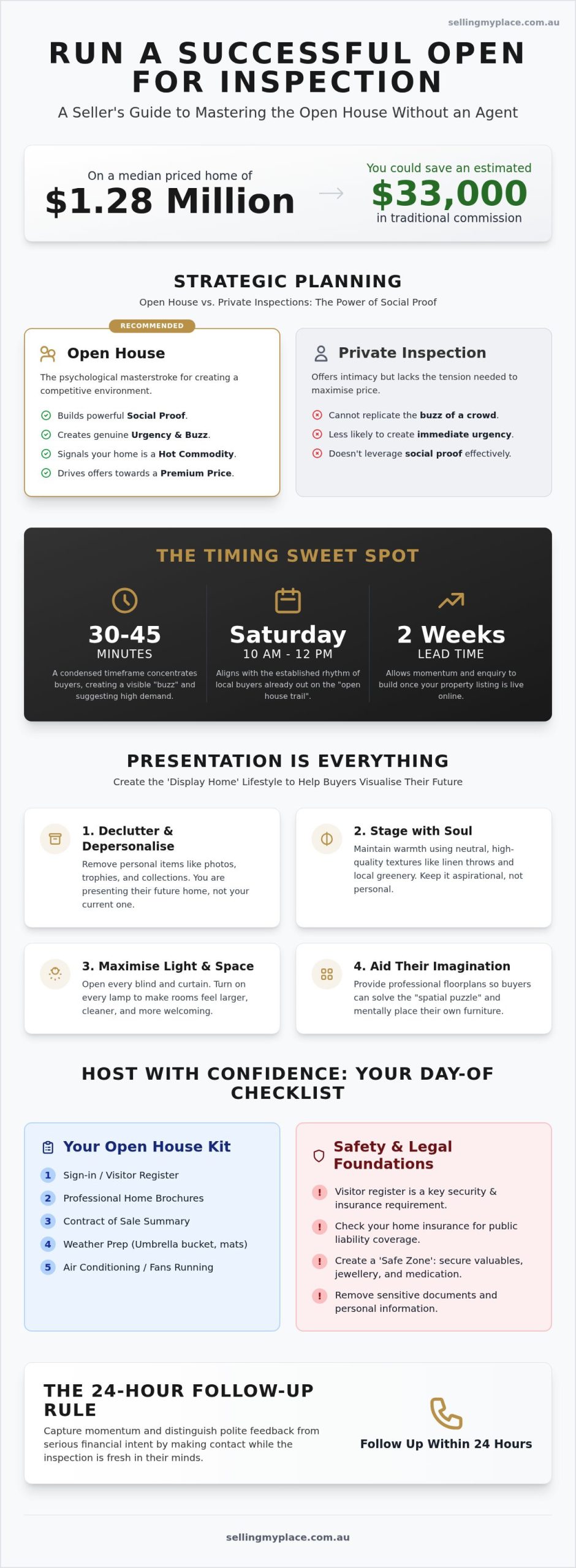
From Foot Traffic to Formal Offers: The Follow-Up
Once the final guest has departed and you have locked the front door, the most critical phase of your campaign begins. While the physical preparation was about aesthetics, the follow-up is about momentum. The “24-hour rule” is your guiding principle here. If you wait several days to contact your visitors, the emotional connection they felt while walking through your sun-drenched living room will have started to fade. By calling every person on your register within one business day, you demonstrate that you are a professional, organised seller who is serious about a result.
Learning how to run an open house without an agent means becoming adept at deciphering buyer feedback. You will quickly find that “it’s a lovely home” is often a polite way of saying the property isn’t for them. You are looking for “genuine intent,” which sounds very different. Serious buyers ask about settlement terms, request copies of the strata report, or inquire about recent council rates. When you identify these “hot” prospects, your role is to move the conversation from verbal interest to a formal “Letter of Offer” as quickly as possible. This written commitment is the only way to truly gauge a buyer’s capacity and desire.
Ethically creating a sense of competition is also part of this process. If you have multiple parties showing interest, it is perfectly acceptable to let them know. A simple, honest statement like, “I’ve had a couple of requests for the contract this morning,” can be enough to encourage a hesitant buyer to put their best foot forward. You aren’t playing games; you are simply providing them with the market context they need to make a decision.
The Art of the Follow-Up Call
Your follow-up script should be gentle and inquisitive rather than pushy. Start with a simple opening: “Hi, it’s [Your Name] from [Address]. I’m just touching base to see what your thoughts were on the home now that you’ve had some time to reflect.” If the feedback is negative, don’t take it personally. Instead, use those insights to determine the market value of your property more accurately. Sometimes, the market is telling you that a small adjustment in strategy or price is needed to find the right match.
Negotiation and Closing
When the offers do start arriving, stay grounded. The first offer you receive is often from the most eager buyer, but it isn’t always the best price the market will give you. This is where mastering property sale negotiation tips becomes invaluable. You are the one holding the phone and making the decisions, so take your time to breathe and consult your notes. Once you have agreed on a price and terms, it’s time to introduce your conveyancer to handle the legal exchange. If you find the negotiation phase daunting, our expert advisors can guide you through the conversation to ensure you secure the best possible outcome for your family.
The Competitive Edge: Selling Smarter with Expert Backing
It’s a common misconception that taking the reins of your own sale means navigating the complex Australian property market in total isolation. It doesn’t have to be that way. While you are the face of your home, having a “steady hand” in the background provides the professional authority needed to secure a premium result. If you’ve been wondering how to run an open house without an agent while still maintaining a professional edge, the answer lies in a collaborative model. You manage the heartfelt, personal connection with buyers; we provide the high-octane marketing and strategic advice that usually costs tens of thousands in commissions.
Your digital “invite” is the first point of contact. Professional Photography and floorplans are not just optional extras; they are the essential tools that get people through your door in the first place. In a cooling 2026 market, buyers are more discerning than ever. High-quality visuals signal that the property is well-maintained and that the seller is serious. When this is paired with an Agent Advisory Service, you gain a secret weapon for those technical moments. Whether it’s a question about a complex clause in the contract or a buyer trying to low-ball based on national trends, you have expert guidance just a phone call away.
The financial impact of this partnership is profound. On a median-priced capital city home of $1.28 million, saving the typical 2.65% commission keeps over $33,000 in your pocket. Think about what that does for your next chapter. It might mean a higher deposit for your next family legacy, a complete renovation of your new kitchen, or a significant boost to your retirement stability. By choosing a flat-fee model, you protect your hard-earned equity and ensure that every cent of the final sale price belongs to your family, not an agency.
The KIDS Advantage
Kincade International Direct Sales (KIDS) offers a global marketing reach that ensures your open house is seen by more than just local neighbours. Our pre-sale consulting acts as a professional review of your presentation, ensuring your “display home” lifestyle is ready for the 2026 buyer. We provide a flat-fee promise with 0% commission, meaning there are no time limits on your campaign and no hidden marketing costs. You get the professional floorplans, photography, and advisory support needed to lead your sale with total confidence.
Empowerment Through Partnership
There is a powerful psychological shift that happens when you move from “I hope it sells” to “I am selling my home.” This empowerment comes from knowing you have the best tools in the industry at your disposal. As you prepare for your first inspection, use this final checklist to ensure you’re ready:
- Are your professional floorplans and brochures displayed prominently?
- Have you secured your “Safe Zone” and organised your visitor register?
- Is the temperature controlled and the lighting “centred” to highlight your home’s best features?
- Do you have your advisor’s number ready for those tricky negotiation questions?
By following this guide, you aren’t just running an inspection; you’re protecting your family’s legacy and taking charge of one of life’s most significant transitions with heart and expertise.
Your Path to a Successful Commission-Free Sale
The journey from listing to a final settlement is one of the most significant transitions your family will ever undertake. By mastering how to run an open house without an agent, you’ve taken back the keys to your financial future and your peace of mind. You’ve seen that a premium result isn’t born from high-pressure sales tactics. Instead, it comes from a curated lifestyle presentation and the calm, steady confidence of a well-prepared host. Whether it’s the strategic timing of your 30-minute inspection or the disciplined follow-up within 24 hours, these professional habits ensure you remain in total control of your sale.
You don’t have to walk this path in isolation. With an average saving of $20,000 in commissions, you can protect your hard-earned equity while still enjoying the security of professional photography, detailed floorplans, and expert Agent Advisory backing at every step. This partnership ensures that while you lead the way, you always have a seasoned expert standing right behind you. Are you ready to take the next step toward a smarter, more rewarding sale? Start your commission-free selling journey with KIDS today. Your home is a vital part of your legacy; we are here to help you move forward with the respect and reward you deserve.
Frequently Asked Questions
Is it legal to run an open house without a real estate agent in Australia?
Yes, it’s completely legal to sell your own home in every Australian state and territory. While you can manage the marketing and inspections yourself, you must engage a solicitor or conveyancer to handle the legal transfer and contract preparation. This ensures you meet all disclosure requirements, like the seller disclosure scheme in Queensland that came into effect in August 2025, providing peace of mind for both you and your buyer.
How do I handle security and prevent theft during an open for inspection?
Protecting your sanctuary starts with a strict visitor register. Ensure every guest provides their name and contact number before they enter your home. By removing small valuables, medications, and sensitive documents, you create a safe environment for everyone. Having a trusted friend or family member present allows you to manage the flow of people effectively, ensuring no room is left unattended while you’re busy answering questions.
What should I do if a buyer wants to make an offer on the spot?
If a buyer makes an offer on the spot, acknowledge their enthusiasm with a warm smile. It’s a wonderful sign of interest, but it’s best to ask them to put their intent in writing through a formal Letter of Offer. This gives you the space to breathe and consult with your advisor before making a decision. Moving from a verbal chat to a written document ensures the process remains professional and grounded.
Do I need to provide a Section 32 or contract of sale at the open house?
You absolutely need to have your legal documents ready before you open your doors. In states like New South Wales and Victoria, a Contract of Sale or Section 32 must be available to prospective buyers before the property is even advertised. Having these documents prepared by your conveyancer shows buyers that you are an organised seller who is ready to facilitate a smooth, transparent transition for the next family.
How many open houses should I run before considering a price adjustment?
Typically, you should run your campaign for three to four weeks, covering six to eight inspections, before reviewing your price. With capital city house prices falling by 1.4% in the June quarter of 2026, it’s vital to stay responsive to market feedback. If you’ve mastered how to run an open house without an agent but aren’t seeing offers, your advisor can help you determine if a strategic adjustment is necessary.
What are the most important things to mention to buyers during the tour?
Focus on the aspects of the home that a brochure can’t capture, such as the way the morning sun hits the breakfast nook or the quietness of the street at night. Mentioning local community highlights, like the best nearby coffee shop or school zones, helps buyers visualise their new lifestyle. Your role as a host is to provide that local insider knowledge that makes the house feel like a future home.
Should I have my pets at home during the open house?
It is best to have your pets away from the home during an inspection. While your furry family members are a joy to you, some buyers may have allergies or feel uneasy around animals they don’t know. Taking your dog for a long walk or dropping your cat at a sitter’s house ensures the environment remains neutral and calm, allowing buyers to focus entirely on the property’s features without any distractions.
How do I follow up with buyers without sounding desperate?
Following up doesn’t have to feel pushy if you focus on gathering feedback. When you’re learning how to run an open house without an agent, use the 24-hour rule to check in and ask what they liked most about the home. This approach feels like a helpful consultation rather than a sales pitch. It allows you to build a relationship with genuine prospects while staying in total control of the narrative throughout the sale.
Agency Flat Fee vs Commission: The Australian Seller’s Guide for 2026
Why should your real estate agent’s pay cheque increase simply because your home’s value has grown? It’s a question many homeowners are asking as they look at the equity they’ve spent years building. When you’re selling a property in the Australian market, where property values are often substantial, a standard 2.1% commission can feel less like a fair fee and more like a significant slice of your hard-earned wealth. Choosing a flat fee real estate agent sydney families can trust is no longer about cutting corners; it’s about finding a smarter, more transparent way to protect your legacy while moving toward your next chapter.
We know that selling your home is about much more than a transaction; it’s an emotional transition that deserves a steady hand and a partnership built on trust. You might feel a bit of a sting at the thought of high commission rates, or perhaps you’re anxious that a lower fee could mean sacrificing professional quality. This guide, brought to you by Kincade International Direct Sales, will show you how to retain 100% of your sale profit while still accessing elite global marketing and expert advisory support. We’ll explore the 2026 transparency regulations and demonstrate how a fixed-fee model can save you an average of A$20,000, ensuring your equity stays exactly where it belongs.
Key Takeaways
- Learn how to keep 100% of your property sale profit by moving away from traditional percentage-based commissions. This simple shift helps you retain an average of A$20,000 in equity.
- Discover why partnering with a flat fee real estate agent sydney homeowners trust doesn’t mean sacrificing quality. You’ll still receive professional photography and access to a global marketing network.
- Understand the 2026 regulatory landscape and how a fixed fee provides the total transparency you deserve. You’ll know exactly what you’re paying for marketing and advisory services from day one.
- Explore how a dedicated Agent Advisory Service supports you through the entire process, from listing to settlement. This professional guidance ensures you feel protected during one of life’s biggest transitions.
- See how properties stay active until sold with no restrictive time limits. This model prioritises your long-term goals and family needs over a quick, transactional result.
The Shift Toward the Agency Flat Fee in Australian Real Estate
For decades, the traditional commission model was the only path for Australian sellers. But as we move through 2026, the landscape is changing. Homeowners are looking at their equity and asking why a percentage of their life’s work should be handed over for a standard service. This is why the search for a flat fee real estate agent sydney families can rely on has surged. It isn’t just about saving money; it’s about a fairer, more transparent exchange of value. People want to know they are paying for professional expertise, not just giving away a slice of their future.
There is a vital distinction to make between budget listing services and a professional flat fee agency. A budget service often leaves you to manage the complexities alone, which can be overwhelming during a major life transition. In contrast, a professional flat fee model provides a partnership. It offers the same high-end marketing and advisory support you expect from a traditional firm but decouples the cost from your home’s final sale price. Understanding what a real estate agent does helps clarify that the core tasks, such as professional photography and expert negotiation, don’t actually cost more just because your property is worth more.
The True Cost of a 2.5% Commission
When you look at the actual dollar amounts, the impact of the old commission model is staggering. With Sydney’s median house price now sitting around A$1.6 million, a 2.5% commission takes A$40,000 directly out of your pocket. That is a massive amount of money. It’s often the difference between being able to afford a dream home in a better suburb or having to settle for less. Many agents argue that a percentage-based fee provides an incentive to get a higher price, yet most sellers now see this as a myth. The real driver of a high sale price is professional marketing and a broad reach, both of which can be achieved without sacrificing your hard-earned equity.
Why “For Sale By Owner” is Evolving
The old “DIY” method of selling a home used to feel risky and unpolished. Today, that model has matured into a sophisticated Direct Sales approach. Thanks to modern digital infrastructure, you can now access the same global marketing networks that the big franchises use. This evolution means you can reach buyers across the country or even overseas with ease. You get the professional backing of high-end photography and floorplans, combined with an advisory service that acts as your steady hand during the process. It’s a grounded, reassuring way to sell that prioritises your family’s needs and your long-term stability.
What is an Agency Flat Fee and How Does It Work?
An agency flat fee is a straightforward, single payment that covers the professional marketing and sales support required to sell your home. Unlike a commission, which fluctuates based on your final sale price, this model is fixed and transparent. It represents a “Pay-for-Service” philosophy. You are paying for the actual work performed, such as professional photography and expert advisory, rather than giving away a percentage of your property’s wealth. This approach aligns perfectly with NSW Fair Trading regulations on agent agreements, ensuring you have total clarity from the moment your home goes live.
When you choose to work with a flat fee real estate agent sydney families often find that the entire process feels more collaborative. You aren’t waiting for a middleman to relay feedback from every single viewing. Because you know your home’s history and the local community better than anyone, leading your own viewings can create a more authentic connection with potential buyers. This directness often leads to faster sales. Buyers appreciate the honest, “straight from the source” information that only a homeowner can provide.
Professional Marketing Components
To stand out in the competitive 2026 market, your home needs to look spectacular. A professional flat fee model includes high-end photography and floorplans that capture the heart and flow of your property. Your listing isn’t just tucked away on a local site; it’s broadcast across global networks to reach interstate and international buyers. We also provide detailed neighbourhood market reports. These reports use real-time data to help you set a price that is both competitive and reflective of your home’s true value.
The Role of the Agent Advisory Service
Selling a home involves complex paperwork and high-stakes decisions. You don’t have to face this alone. An Agent Advisory Service acts as your professional guide, offering pre-sale consulting to ensure your home is presented in its best possible light. It’s the perfect blend of modern digital reach and expert human insight. If you’re curious about how this partnership could work for your specific suburb, you might like to reach out for a friendly chat about your goals.
Flat Fee vs. Commission: A Direct Comparison
Deciding between a traditional commission and a modern flat fee is about more than just numbers on a spreadsheet; it’s about understanding the true value of your home’s equity. In a fluctuating market, the traditional percentage model can feel like a moving target. If your property value increases, so does the agent’s pay cheque, despite the workload remaining largely the same. By choosing a flat fee real estate agent sydney sellers can lock in their costs early. This provides a level of financial certainty that is especially grounding during the high-stakes period of a property sale. When you know your costs are fixed, you can plan your next move with a calm confidence that isn’t possible under a commission-based structure.
It is vital to look at the net profit rather than just the sale price. For example, on a A$1.5 million sale, a 2.1% commission takes A$31,500 from your pocket. In contrast, a flat fee model allows you to retain a much larger portion of that wealth. From a tax perspective, while selling costs are often factored into Capital Gains Tax calculations for investment properties, for your family home, every dollar saved is pure cash in hand for your next deposit. The Real Estate Institute of Australia maintains high professional standards across the industry, but they don’t regulate fee structures, leaving you free to choose the model that best protects your legacy.
The “Incentive” Debate
Traditional agencies often claim that a percentage-based commission incentivises agents to work harder for a higher price. However, does a small fractional increase in an agent’s commission truly outweigh the owner’s natural passion? You are the best person to sell the lifestyle and heart of your home because you’ve lived it. A flat fee model empowers you to lead viewings while professional advisory services handle the heavy lifting of negotiation. This partnership ensures you have the skills of a seasoned expert behind you without the disproportionate cost of a commission.
Hidden Costs to Watch Out For
One of the biggest surprises for sellers is the “No Sale, No Fee” myth. In many traditional agreements, you still have to pay for Vendor Paid Advertising (VPA) even if the property doesn’t sell. These costs in Sydney can range from A$4,500 to A$10,000. When you add up the extras, the bill grows quickly:
- Auctioneer Fees: Often an additional A$500 to A$1,000 per event.
- Premium Portal Listings: Extra charges to stay at the top of search results.
- Administration Fees: Small “sundry” costs that bloat the final settlement statement.
An all-inclusive flat fee package removes these layers of complexity. It offers a transparent, single payment that covers your marketing and support, making the settlement process simple and stress-free.
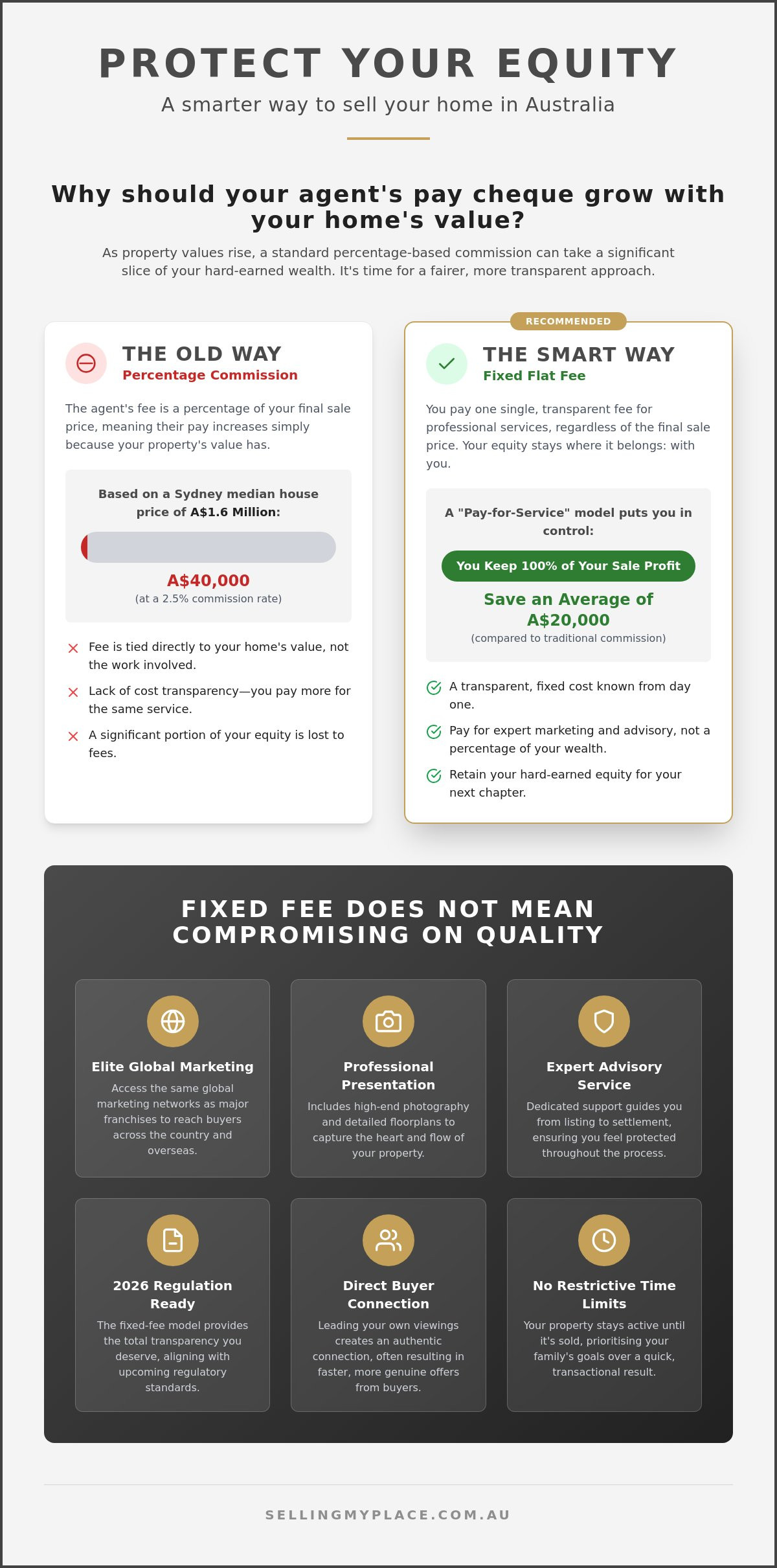
What to Look for in a Flat Fee Property Listing Service
Finding the right flat fee real estate agent sydney homeowners can trust involves looking far beyond a simple listing price. You’re searching for a partner who understands that your home is your most significant asset and a sanctuary of family memories. A truly professional service doesn’t just upload your property to a portal and leave you to it. It provides a comprehensive suite of tools designed to attract serious interest and protect your interests during the delicate journey toward settlement. It’s about combining the cost-effectiveness of a fixed fee with the sophisticated support of a seasoned expert.
When you evaluate potential partners, check for the absence of listing expiry dates or “pressure windows.” Traditional contracts often bind you to a 90-day limit, which can create a sense of desperation as the deadline looms. A partnership-based model keeps your property listed until it’s sold. This approach gives you the breathing room to wait for an offer that truly respects your home’s worth. It’s a grounded, reassuring way to sell that puts your needs ahead of an agency’s quarterly targets.
Evaluating the Marketing Package
Your online presentation is your digital kerb appeal. In the competitive 2026 market, professional photography is non-negotiable. It’s the first thing a buyer sees on their smartphone, and it must evoke an emotional connection immediately. Similarly, accurate floorplans are essential for qualifying buyers before they even step through your front door. They allow people to mentally place their furniture and imagine their daily lives in your space. Ensure your listing will appear on all major Australian property portals and reaches beyond our borders through a global marketing network to capture interstate and international interest.
The Advisory Advantage
The best services provide more than just digital space; they offer a “steady hand” through expert advisory. This includes receiving property sale negotiation tips from professionals who understand the nuances of the Australian market. You also need access to detailed reports that help you determine the market value of a home in Australia using real-time, local data. This expert backing ensures you aren’t navigating the complexities of conveyance or pre-sale consulting alone. If you’re ready to see how professional advisory can change your selling experience, you can contact our team for a personal consultation to discuss your property’s potential.
Maximising Your Sale Profit with the KIDS Direct Sales Model
The Kincade International Direct Sales (KIDS) model is designed for the savvy Australian seller who values both their hard-earned equity and professional support. When you choose a flat fee real estate agent sydney homeowners trust, you’re making a choice to protect your family’s financial legacy. Our 0% commission promise is the cornerstone of this approach. It ensures that every cent of the final sale price remains in your pocket. On average, our clients save A$20,000 per sale. That’s not just a statistic; it’s a significant amount of capital that can be reinvested into your next home or your children’s future.
We understand that the traditional “For Sale” sign represents more than a transaction. It’s a major life transition. That’s why we’ve built a digital infrastructure that rivals the largest global franchises, ensuring your home is seen by buyers across Australia and overseas. Unlike local boutique agencies that may have a limited reach, our network casts a wide net, while our Agent Advisory Service provides the grounded, personal guidance you need to navigate the process with calm confidence. It’s about having the best tools in the industry without the disproportionate price tag.
A Partnership, Not Just a Listing
Our advisors act as your professional back-office team, removing the stress of complex processes so you can focus on your move. This model is truly the logical conclusion of the Sale by owner evolution. It bridges the gap between doing everything yourself and paying an expensive commission. You’ll have a steady hand to help with everything from pre-sale property consulting to conveyance advice, ensuring you never feel alone in the journey. By decoupling the marketing cost from the sale price, we create a transparent partnership where our goals are perfectly aligned with yours.
Your Next Chapter Starts Here
Imagine the difference that saving A$20,000 on commission makes to your future buying power. It could be the extra room in your next house, a higher-quality renovation, or simply the peace of mind that comes with a larger financial buffer. You’re joining a community of empowered Australian homeowners who are moving away from outdated fee structures. The path to a successful sale is methodical and inviting. It starts with a detailed neighbourhood market report that gives you a clear picture of your property’s value. From there, we provide the professional photography and global visibility needed to reach the right buyer. Your next chapter is waiting, and we’re here to help you start it on the best possible financial footing.
Secure Your Financial Legacy and Your Next Move
Selling your home is a milestone that should leave you feeling empowered, not overcharged. We’ve explored how the traditional commission model often takes a disproportionate slice of your equity as property values rise. By choosing a flat fee real estate agent sydney families can trust, you ensure your hard-earned wealth stays exactly where it belongs. You’ve seen that a 0% commission approach doesn’t mean sacrificing quality; it means gaining a professional partner who provides high-end photography and global marketing without a “success tax” on your home’s value.
With an average saving of A$20,000 per sale, our model ensures you retain 100% of your profit to put toward your family’s future. Ready to take control of your sale? Discover how much you can save with a commission-free sale and keep every cent of your equity. Your next chapter deserves the best possible start. We’re here to provide the steady hand and professional guidance you need to make it happen with confidence.
Frequently Asked Questions
Is an agency flat fee better than a percentage commission?
Choosing an agency flat fee is often better for homeowners who wish to maintain control over their sale profits. Instead of paying a percentage that grows as your home’s value increases, you pay a fixed amount for the actual work performed. This model provides financial certainty and ensures you aren’t penalised for the growth of the Sydney property market. It’s a fairer way to pay for professional service without sacrificing your hard-earned equity.
What exactly is included in a property marketing flat fee?
A comprehensive marketing flat fee typically includes professional photography and high-quality floorplans to showcase your home’s best features. You also receive access to a global marketing network and major Australian property portals. Beyond digital listings, this fee covers dedicated Agent Advisory Services, providing the professional support needed to manage your sale from the initial listing through to settlement. It’s a complete package designed to give you a “steady hand” throughout the journey.
Will my property get the same exposure as a traditional listing?
Your property will receive identical exposure to traditional agency listings, appearing on all major property portals that Australian buyers use daily. Because we utilise a sophisticated digital infrastructure, your home is also broadcast through a global marketing network. This ensures you reach local, interstate, and international buyers, providing the same competitive visibility as any traditional firm without the high commission costs often associated with a flat fee real estate agent sydney search.
Do I have to do the house viewings myself with a flat fee model?
You typically lead the viewings yourself, which is a significant advantage because nobody knows the heart and history of your home better than you. Buyers often appreciate the authentic, direct communication that only a homeowner can provide. Our Agent Advisory Service supports you throughout this process, ensuring you feel confident and prepared to welcome potential buyers into your space. It’s a partnership that values your personal insight as the best selling tool available.
Can I still get professional negotiation help if I pay a flat fee?
Professional negotiation support is a core component of our service through the Agent Advisory Service. While you lead the viewings, our experts act as your professional “back-office” team, providing negotiation tips and guidance to help you secure the best possible offer. This partnership ensures you have seasoned real estate expertise on your side during the most critical stages of the deal. You get the benefit of expert advice without giving away a percentage of your sale price.
What happens if my property does not sell within three months?
Your property remains listed until it’s sold, as we don’t impose the restrictive 90-day time limits common in traditional agency contracts. This lack of “listing expiry” pressure allows you to wait for the right buyer and the right price without feeling rushed. It’s a patient, supportive approach that prioritises your family’s long-term goals over a quick, transactional result for an agent. We stay with you for as long as it takes to achieve your goal.
How much can I realistically save by using a commission-free service?
Sellers save an average of A$20,000 per sale by choosing a commission-free model over traditional percentage-based fees. On a median-priced Sydney home of A$1.6 million, a typical 2.1% commission would cost you over A$33,000. By partnering with a flat fee real estate agent sydney families can retain that equity, significantly increasing their buying power for their next property or life transition. It’s a meaningful saving that can change the course of your next chapter.
Is a flat fee service legal and licensed in Australia?
Flat fee services are fully legal and operate under the same Australian licensing requirements as traditional real estate agencies. We comply with all national and state regulations, including those set by NSW Fair Trading. You receive the same professional standards and legal protections you’d expect from any licensed property professional, ensuring a safe and transparent experience for your family. Our commitment is to provide a service that’s both highly competent and deeply rooted in professional duty.
