Mastering the Deal: Expert Property Sale Negotiation Tips for Australian Homeowners
What if the most powerful tool in your property sale isn’t a silver-tongued agent, but your own local knowledge and a calm, steady hand? Selling your family home is a massive life transition, and it’s entirely natural to feel a bit of a knot in your stomach when those first offers start landing on the kitchen table. With dwelling values in Sydney and Melbourne cooling as of June 2026, you might worry that savvy buyers hold all the cards. However, mastering a few key property sale negotiation tips can shift the balance back in your favour. It’s about more than just a price tag; it’s about protecting the heart and soul you’ve poured into your home.
We know that the fear of being lowballed or getting tangled in legal fine print can feel heavy, especially with the strict new identity verification laws that kicked in this July. You want to maximise your final sale price while keeping your hard-earned equity where it belongs. This guide will show you how to negotiate like a seasoned pro using proven strategies and expert advisory. We will walk you through how to handle offers directly, decode the contract essentials, and decide exactly when to say “yes” or “no” with complete confidence.
Key Takeaways
- Learn why the negotiation actually begins long before the first phone call and how your initial listing presentation dictates your bargaining power.
- Discover how to use Neighborhood Market Reports to anchor your value and implement essential property sale negotiation tips that justify your “walk-away” figure.
- Master the art of responding to lowball offers with calm confidence, using strategic silence to encourage buyers to refine their own position.
- Understand why the highest offer isn’t always the best deal and how expert conveyance advice ensures your contract terms protect your equity.
- See how a flat-fee advisory model removes traditional conflicts of interest, keeping the focus entirely on your family’s financial legacy.
Mastering the Art of the Deal: Why Property Sale Negotiation Starts Before the First Offer
Most people imagine property negotiation as a high-stakes phone call at the eleventh hour. In reality, it’s a thoughtful, multi-stage process that begins long before you greet your first visitor. If you wait until an offer is sitting on the kitchen bench to start considering negotiation theory and tactics, you have already missed the most critical opportunities to shape the narrative. Your home is a place of memories, but once it hits the market, it becomes a value proposition. Every interaction you have with a potential buyer is a brick in the wall of your eventual deal.
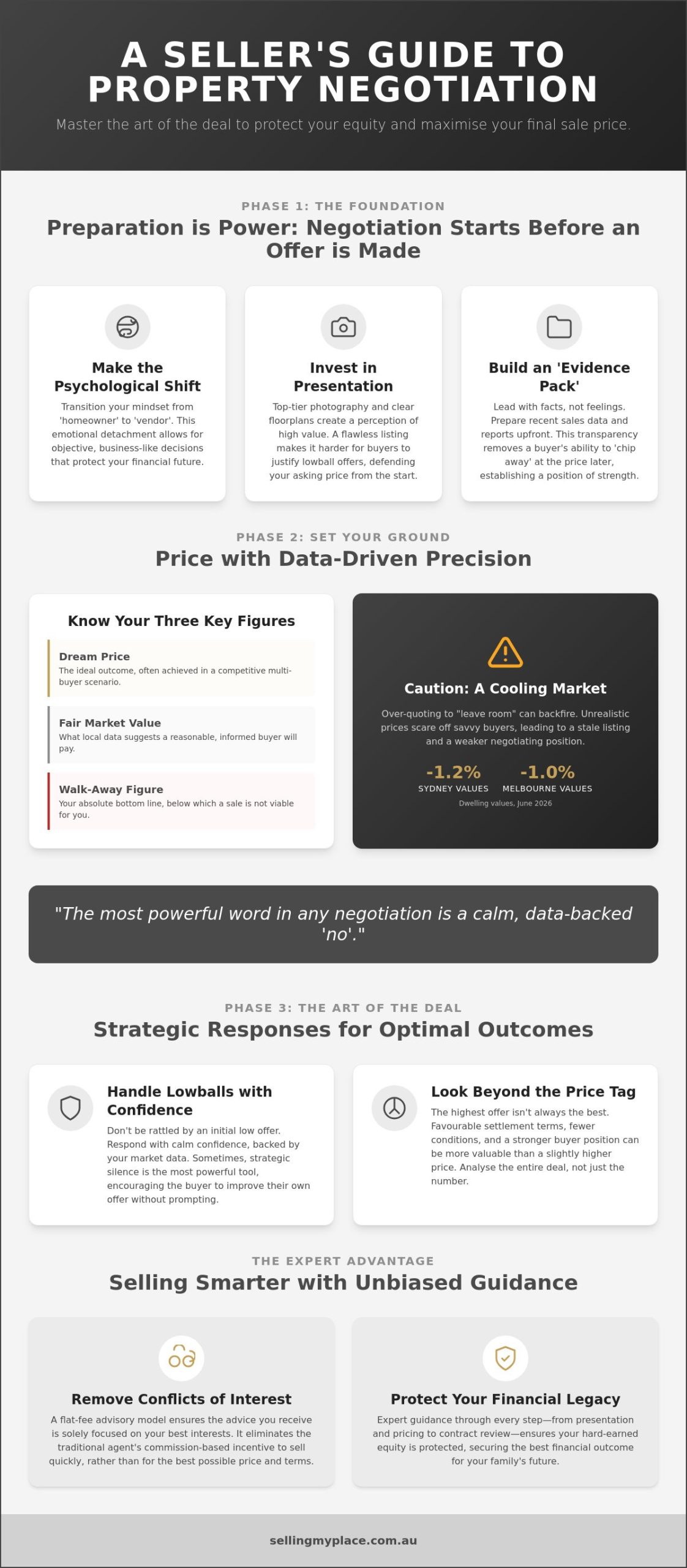
Your listing’s first impression sets the psychological ceiling for your entire campaign. When a buyer clicks through your photos, they are already deciding whether they are coming to “win” the home or “hunt” for a bargain. To protect your equity, you must make the psychological shift from “homeowner” to “vendor.” This detachment isn’t about loving your home less; it’s about respecting your financial future enough to remain objective. It’s much easier to hold your ground when you view the transaction as a partnership between your goals and the market’s reality.
Vendor authority is the grounded confidence gained when a seller replaces guesswork with professional preparation and verifiable market data.
The Power of Professional Presentation
Investing in top-tier Photography and clear Floorplans isn’t just about aesthetics. These tools act as your first line of defence against aggressive price-slashing. A polished listing signals that you are a serious, high-end seller who won’t be easily rattled. When a home is presented flawlessly, buyers find it much harder to “pick holes” or justify a lowball offer. It creates a perceived value that feels solid and non-negotiable, which is one of the most effective property sale negotiation tips for maintaining your asking price.
Establishing Your Position of Strength
Transparency is your best friend in a cooling market. By being open about the property’s condition from day one, you remove the buyer’s ability to “chip away” at the price during the cooling-off period. We recommend preparing an “evidence pack” including recent sales data and strata reports before your first open house. Engaging Real Estate Advisory Services early provides a steady hand to guide you through these initial steps. Using these property sale negotiation tips ensures you lead with facts rather than feelings, which is always the strongest position to hold during a sale.
Setting Your Ground: Data-Driven Pricing and the ‘Walk-Away’ Figure
Deciding on a price for your family home is one of the most emotionally charged moments of the selling process. It’s the point where your years of memories meet the cold reality of the current market. To navigate this successfully, you need to separate your pricing into three distinct categories. Your “dream price” is the ideal result if two buyers fall in love and start a bidding war; your “fair market value” is what the data suggests a reasonable buyer will pay; and your “walk-away figure” is the absolute bottom line where the sale no longer makes sense for your future. Having these figures clear in your mind before you even list the property provides a sense of calm that buyers will respect.
One of the most common mistakes we see is “over-quoting” to leave room for negotiation. In a cooling market, where Sydney dwelling values fell by 1.2% and Melbourne by 1.0% in June 2026, this strategy can backfire. Savvy buyers are often scared off by an unrealistic price tag, causing your property to languish on the market and lose its initial momentum. When a listing goes stale, you lose your leverage. Instead, use our Neighborhood Market Reports to justify your asking price with hard evidence. When you can show a buyer exactly why your home is valued at a certain level based on recent local sales, the conversation shifts from an emotional tug-of-war to a logical business discussion. Understanding how to determine market value of a home in Australia is the critical first step to anchoring your price with confidence in this changing landscape.
The most powerful word in any negotiation is a calm, data-backed “no.”
Understanding Local Market Dynamics
To set a firm ground, you must look closely at “Days on Market” (DOM) for similar properties in your street. If the average DOM is stretching out, you know you’ll need more patience. Similarly, keep a close eye on local auction clearance rates rather than national averages. While you are building your pricing strategy, it’s worth considering your broader Strategic Response Tactics to ensure you aren’t caught off guard by a quick offer. For those choosing a Sale by owner path, having this data at your fingertips is essential for commanding respect from buyers and their agents alike.
Defining Your Non-Negotiables
Negotiation is about more than just the final dollar amount. Before you open your doors, decide on your ideal settlement period and which chattels, like a specific designer light fitting or a custom outdoor kitchen, are included in the sale. Clearly identifying these non-negotiables early prevents them from becoming “deal-breakers” during the final heat of the deal. If you’re feeling unsure about how to balance your price expectations with the current market, you can always reach out for a chat about your goals with our advisory team.
Strategic Response Tactics: How to Handle Lowballs and Multiple Offers
Receiving a lowball offer can feel like a personal insult, especially when you’ve spent years maintaining your garden or raising a family within those walls. However, in the world of property, a low offer is often just a buyer “testing the waters” to see how you react. One of the most effective property sale negotiation tips is to never take the first number personally. It’s simply the opening line of a dialogue. By staying calm and grounded, you keep the power in your hands and signal that you aren’t easily rattled by aggressive tactics.
Sometimes, the best response is no response at all. When an offer is presented that doesn’t meet your expectations, try using the “Silence Technique.” After the buyer or their representative finishes speaking, wait for a few beats before responding. That brief, slightly uncomfortable silence often prompts the buyer to start justifying their price point or even hinting that they have “a bit more in the tank.” It shows you’re a serious seller who knows the true value of your home and won’t be pushed into a corner.
When it’s time to counter-offer, avoid round numbers. Proposing a specific figure like $952,500 instead of a flat $950,000 signals that you’ve performed a meticulous calculation of your equity, costs, and the current market. This “Power of 900” tactic makes your bottom line feel researched and firm, rather than plucked from thin air. It suggests to the buyer that there is very little “wiggle room” left because you’ve already done the hard maths.
Managing multiple offers requires a steady hand and absolute transparency to ensure you get a “fair go” from the market. Instead of playing buyers against each other in a way that feels “shonky,” invite all interested parties to submit their “best and final” offer by a set deadline. This creates a fair, competitive environment where the most committed buyer can step forward without feeling manipulated.
The Anatomy of a Counter-Offer
A successful counter-offer is a delicate balance of professional courtesy and firm boundaries. Start by acknowledging the buyer’s interest; everyone wants to feel heard. Then, apply the “Give and Get” rule. If you agree to lower your price slightly, ask for something in return, such as a shorter settlement period or a larger deposit. By applying these property sale negotiation tips, you ensure the transaction feels like a respectful partnership. For a deeper look at the legalities of this process, the Consumer Affairs Victoria negotiation guide offers excellent insights into making and receiving offers during a private sale.
Recognising a “Dud” Offer vs. a Serious Buyer
Not all offers are created equal, and some are best left on the table. A “dud” offer often comes with “strings attached” that can jeopardise your plans. Look out for these red flags in buyer behaviour:
- Vague or non-committal finance details that suggest they aren’t truly “ready to go.”
- Pushy, aggressive tactics designed to rattle your confidence.
- Unrealistic demands for immediate access or early possession before settlement.
A serious buyer usually presents a “clean” offer, meaning fewer conditions and a clear path to settlement. While a higher price tag is tempting, an offer subject to the sale of another property can often fall through. Sometimes, the bravest move is to walk away and wait for the person who truly values your home’s legacy.
Beyond the Price Tag: Negotiating Settlement Terms and Conveyance Advice
While it’s easy to get swept up in the excitement of a high dollar figure, the highest offer isn’t always the best deal for your family’s future. A slightly lower price with an unconditional contract and a 60-day settlement might actually leave you in a better financial position than a record-breaking price riddled with complex clauses. These property sale negotiation tips are about more than just the final number; they are about protecting your equity and ensuring a smooth transition to your next chapter. When you look at an offer, look at the whole picture, not just the bottom line.
A 10% deposit remains the gold standard for a reason. It provides you with a significant safety net and ensures the buyer has enough “skin in the game” to see the transaction through. If a buyer pushes for a smaller deposit, you are well within your rights to ask for more favourable settlement terms in return. Aligning your settlement date with your next move is a masterstroke that can save you a fortune in bridging finance and the sheer exhaustion of moving twice. It’s these small, practical details that turn a good sale into a great one.
The Role of Expert Conveyancing
You should always have your contract reviewed by a professional before any serious negotiation begins. This proactive step allows you to understand which “Special Conditions” you can use as bargaining chips. For instance, you might offer a slightly longer cooling-off period in exchange for a higher price. Many modern Residential Property Listing Services now recommend integrating legal support early to avoid nasty surprises. If you’re feeling overwhelmed by the legal jargon, you can get in touch for expert conveyance advice to ensure your contract is watertight.
Handling Building and Pest Results
This is often the stage where a deal can wobble. If a report comes back with minor issues, you have a choice: negotiate a small price reduction or agree to fix the repairs yourself. Generally, a price reduction is cleaner for your bottom line as it prevents you from managing tradespeople during a stressful move. You can also stand your ground on known minor defects by using an “as-is” clause, provided these were disclosed early in the campaign. Whatever you decide, ensure any agreed repairs or credits are documented precisely in the final contract to protect your interests.
Selling Smarter: How Expert Advisory Services Protect Your Profit
The traditional real estate model has long relied on a percentage-based commission, which can often lead to a subtle misalignment of goals. When an agent’s payday depends on a quick turnover, the pressure to “just sign” can feel overwhelming. By choosing a flat-fee advisory model, you remove this conflict of interest entirely. Your advisor isn’t chasing a commission; they are focused on ensuring you achieve the best possible result for your unique circumstances. This shift allows you to implement property sale negotiation tips with the backing of a professional who is truly in your corner, without the $20,000 price tag often associated with high-end agencies.
Having a professional negotiator by your side provides a vital buffer between your emotions and the buyer’s tactics. While you focus on the heart of the move, your advisor handles the strategic heavy lifting. They help you move from that initial verbal agreement to a binding exchange of contracts with total clarity. This final stage is where the “fine print” matters most, especially with the new identity verification requirements. A steady hand ensures that every T is crossed and every I is dotted, protecting your equity until the moment the keys change hands.
The KIDS Advantage
Kincade International Direct Sales (KIDS) offers a unique partnership that combines global reach with the personal touch of a local expert. Unlike the transactional feel of a standard agency, the KIDS model is built on the belief that you should keep 100% of your sale profit. This extra capital can be the difference between a modest downsized apartment and the dream coastal retreat you’ve been planning for years. You receive the professional polish and marketing power of a top-tier firm while remaining the primary decision-maker in your home’s legacy.
Your Negotiation Checklist
Before you sign on the dotted line, take a moment to breathe and run through this final summary of essentials. Trusting your gut is just as important as trusting the data. If something feels “off” about an offer, it usually is. Here are the five key steps for a successful finish:
- Confirm your walk-away figure: Ensure the offer genuinely meets your financial needs for the next chapter.
- Verify the terms: Double-check that the settlement date and deposit amount align with your moving plans.
- Review the evidence: Use your Neighborhood Market Reports one last time to confirm the price reflects current local trends.
- Consult your advisor: Run the final figures and conditions past your Real Estate Advisory Services team.
- Check the contract: Ensure all agreed repairs or special conditions are clearly written into the binding document.
Selling your home is a significant milestone, and you deserve to feel empowered throughout the entire journey. By combining these property sale negotiation tips with a supportive advisory model, you can navigate the market with confidence and grace. Discover how we empower you to sell smarter and keep your profit.
Take Control of Your Financial Legacy
Selling your home is about so much more than a transaction; it’s the bridge to your next big adventure. By embracing these property sale negotiation tips, you’ve moved from being a passive observer to a confident decision-maker. You now understand that a successful sale is built on the foundation of professional presentation, anchored by robust local data, and secured through a firm grasp of contract terms. Protecting your equity isn’t just about the final figure; it’s about making sure the transition is as smooth and stress-free as possible for your family.
You don’t have to walk this path alone. With our global marketing network reach and a dedicated Agent Advisory Service in your corner, you can achieve a premium result while keeping your hard-earned profit. Our partners save an average of $20,000 in commissions by choosing a smarter, modern way to sell. It’s time to step into your future with clarity and confidence. Start your commission-free selling journey with Kincade today and see how a partnership-based approach changes everything. You’ve got this, and we’re here to help you every step of the way.
Frequently Asked Questions
Do I really need an agent to negotiate for me?
No, you aren’t legally required to use a traditional agent to handle your sale. Many homeowners find that they are the most passionate advocates for their property’s unique history and value. By using our Real Estate Advisory Services, you gain the strategic advantage of a professional negotiator while maintaining direct control over the final decision. This partnership ensures you aren’t pressured into a quick sale that doesn’t serve your family’s long-term interests.
How do I handle a buyer who keeps pushing for a lower price?
When a buyer persists with lower offers, refocus the conversation on objective market evidence. Reference your Neighborhood Market Reports to show how your price aligns with recent local sales. If the pressure continues, a calm “no” backed by data is your most effective tool. You might also offer to adjust a settlement term instead of the price, which often satisfies a buyer’s need to feel they’ve “won” a concession.
What is the most important “Special Condition” to include in my contract?
While every sale is unique, a well-defined settlement date that aligns with your next move is often the most valuable condition for a seller. It prevents the stress and cost of bridging finance or moving into temporary accommodation. You should also ensure there is a clear “sunset clause” on any finance conditions. This prevents a buyer from tying up your property for weeks without a firm commitment to proceed.
Can I change my mind after I have verbally accepted an offer?
Yes, a verbal agreement is generally not legally binding in Australia until the written contracts are signed by both parties and formally exchanged. While it’s important to act with integrity to keep a serious buyer engaged, you aren’t locked in until that physical exchange happens. This is why moving quickly from a verbal “yes” to a binding contract is one of the most vital property sale negotiation tips for protecting your sale.
How do I know if a buyer is actually pre-approved for finance?
You should request a formal letter of “pre-approval in principle” from the buyer’s financial institution. Don’t rely on a buyer’s word alone, as their borrowing capacity may have changed with recent interest rate shifts. With the new AML/CTF regulations that began in July 2026, your legal representative will already be conducting more thorough financial checks. This added layer of scrutiny helps ensure you’re only dealing with genuine, qualified purchasers.
What should I do if the building and pest report comes back with issues?
Don’t panic if a report identifies minor defects; almost every home has them. The best approach is usually to offer a small, fair price reduction rather than attempting to organise repairs yourself while you’re busy packing. This keeps the process moving forward without you having to manage tradespeople. Ensure any agreement is documented as a specific “special condition” in the contract so there are no further disputes before settlement.
Is it better to sell at auction or via private treaty for negotiation?
Private treaty often provides a better environment for nuanced negotiation, especially in the cooling markets we saw in June 2026. Unlike the high-pressure environment of an auction, a private sale allows you to discuss settlement dates and specific conditions that might be more important to you than the final dollar amount. It gives you the time to build a rapport with the buyer and find a middle ground that respects your home’s legacy.
How much can I actually save by negotiating the sale myself?
Australian homeowners often save an average of $20,000 by choosing a commission-free model. When you remove the traditional percentage-based fee, that equity stays in your pocket to fund your next life transition. These property sale negotiation tips empower you to handle the process with professional polish while ensuring your family receives the full benefit of your home’s capital growth. It’s a significant financial win that provides a much smoother start to your next chapter.
Professional Property Photography: The Ultimate Seller’s Checklist for 2026
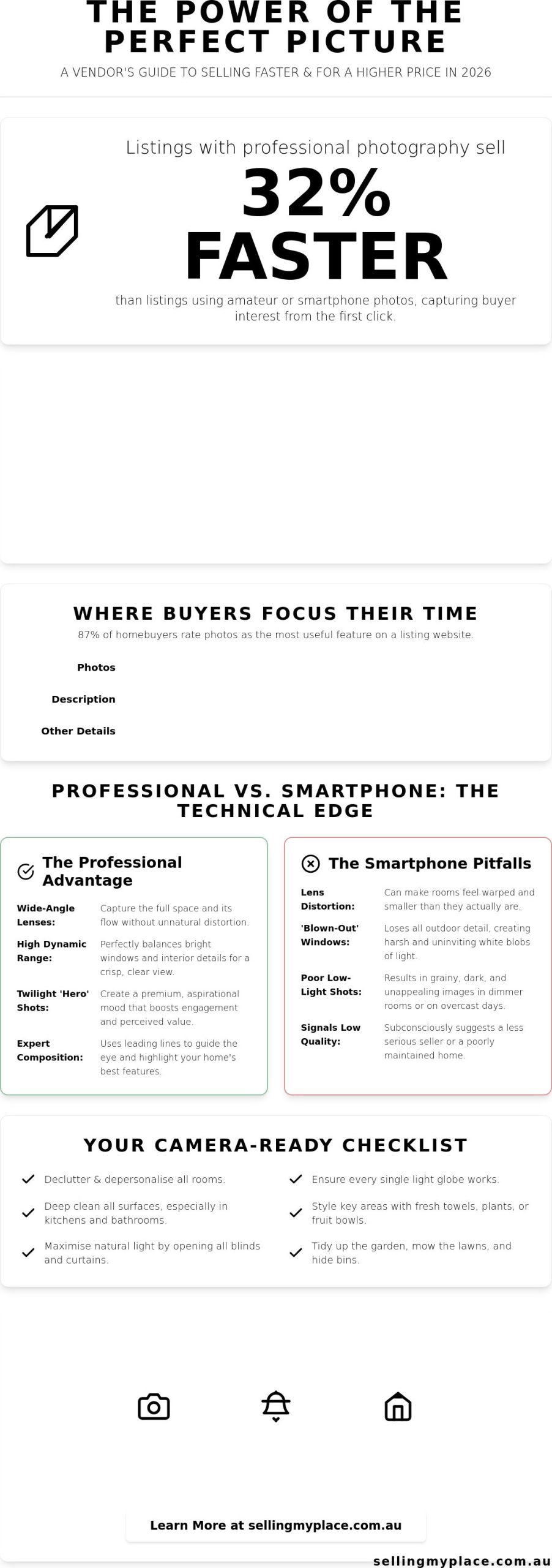
Did you know that listings featuring professional photography sell 32% faster than those that don’t? It is a striking figure that highlights just how much the “front door” of your home has shifted from the garden path to the digital screen. We understand the mix of pride and anxiety that comes with listing a family property. You want your home to look its absolute best, yet the high cost of traditional agency marketing can feel like a heavy burden on your hard-earned equity.
It’s a common worry that a DIY approach might fall short or that you’ll need to spend a fortune to get that magazine-ready finish. This article is designed to put those fears to rest. You’ll learn how to master visual marketing to potentially add thousands to your final sale price without paying a cent in commission. It is about protecting your legacy while ensuring your home shines in a crowded market.
We’ve put together the ultimate 2026 checklist to ensure your listing captures the heart of every buyer. We will walk you through the essential steps to prepare your space, from understanding the “HGTV effect” in styling to leveraging the latest trends in 3D tours and immersive floor plans.
Key Takeaways
- Learn why the “2-second rule” is the most critical hurdle to clear on listing portals and how to grab a buyer’s attention instantly.
- Understand the technical edge of professional Photography, from using wide-angle lenses to HDR techniques that make your rooms look spacious and inviting.
- Discover the “hidden costs” of using a smartphone and why professional sensor quality translates directly into more buyer enquiries.
- Access a room-by-room preparation guide to ensure your home is camera-ready, covering everything from light globes to kitchen styling.
- Find out how to retain your equity by pairing premium visuals with a flat-fee model, saving you thousands in commission.
Visual Marketing: Why Professional Photography is Your Best Sales Tool
Imagine a buyer sitting on their lounge on a Tuesday night, scrolling through a property app. They aren’t reading descriptions yet; they are scanning for a feeling. This is where professional Photography becomes your most powerful advocate. It is the primary driver of digital engagement, acting as the silent salesperson that works for you 24/7. In a market where attention is the rarest currency, you have roughly two seconds to convince a buyer to click on your listing rather than scrolling past it. This “2-second rule” is often the only difference between a packed open home and a quiet weekend with no phone calls.
High-quality imagery does far more than just show the floor plan; it builds immediate trust with a stranger. When a listing looks polished and professional, buyers subconsciously attribute that same level of care and quality to the maintenance of the home itself. This increases the perceived value of the property before they even step foot on the driveway. For those embarking on a sale by owner strategy, premium visuals are even more vital. They signal to the market that you are a serious, organised seller who respects the property’s value. It’s about bridging the gap between a private sale and a premium result by presenting your home with the dignity it deserves.
The Digital First Impression
Current data shows that 95% of buyers start their search on mobile devices. On a small screen, a dark or blurry photo is an instant rejection. Research from 2026 confirms that 87% of homebuyers find images to be the most useful feature on listing websites. In fact, viewers spend about 60% of their time looking at photos and only 20% reading the property description. If your images don’t “pop” against the hundreds of other local listings, you’re missing out on the vital inspection bookings that lead to competitive offers.
Emotional Storytelling Through Lenses
Great visuals capture a lifestyle, not just a layout of rooms. Rooted in the principles of Architectural photography, professional shots use light to evoke warmth and a sense of “home.” We aren’t just selling four walls and a roof; we’re selling the idea of slow Sunday morning coffees in a sun-drenched nook or a safe backyard for the kids to play in. These “hero shots” are especially important for social media marketing, where a single evocative image can stop the scroll and start a genuine emotional connection with a potential buyer.
The Science of a Shot: What Makes a Listing Stand Out?
Creating a listing that stops the scroll isn’t just about having a tidy house; it is about the technical science behind the lens. Professional real estate Photography relies on specific gear that a standard smartphone simply cannot replicate. Take wide-angle lenses, for example. These aren’t about tricking the buyer into thinking a room is twice its size. Instead, they allow the camera to capture the full context of a space, showing how the kitchen flows into the dining area without the distorted, curved edges of a cheap lens. It provides a generous feel that matches the physical experience of walking through the home.
Another key element is High Dynamic Range, or HDR. Have you ever tried to take a photo of your lounge room only to find the windows are a glowing white blob? HDR solves this by blending multiple exposures together. It balances the bright midday sun outside with the subtle textures of your interior styling. To effectively Tell Your Property’s Story, this balance is essential. It ensures the view of your garden is just as clear as the cushions on your sofa. When you combine this with leading lines, where the composition guides the buyer’s eye toward a focal point like a fireplace or a stunning view, the home begins to sell itself.
Then there is the “Twilight” shot. These sunset images command significantly higher engagement because they feel aspirational. The warm glow of interior lights against a deep blue sky creates a sense of sanctuary. It signals a premium listing and often justifies a higher price point in the buyer’s mind. If you’re curious about how these techniques might work for your unique floor plan, feel free to ask us for advice on your specific property.
The Role of Vertical and Horizontal Alignment
Symmetry is a quiet but powerful tool in property marketing. When walls look “wonky” in DIY photos, it creates a subconscious feeling of instability or poor quality. Professional editors spend time ensuring every vertical line is perfectly straight. This creates a polished, architectural look that signals reliability. A symmetrical, well-aligned photo feels calm and grounded, which is exactly how you want a buyer to feel when they imagine living in your home.
Advanced Lighting Techniques
In Australia, we love a bright, airy aesthetic. While natural light is the hero, it often needs a helping hand to look its best on camera. Professionals use off-camera flash to fill in dark corners, making sure every inch of your equity is visible and inviting. The “Golden Hour,” that soft window of light just before sunset, is the secret weapon for street-appeal shots. It softens harsh shadows and gives your facade a welcoming, sun-kissed glow that feels both personal and protective.
DIY vs. Professional Property Photography: Is Your Smartphone Enough?
It is incredibly tempting to reach for your smartphone when it’s time to take your listing photos. After all, modern phones take brilliant holiday snaps and clear videos of the kids. However, property Photography is a specialised field that demands more than just a high megapixel count. The biggest hurdle for any smartphone is the physical size of its sensor. A professional full-frame camera has a sensor many times larger than a phone’s, allowing it to “see” more light and detail in the shadows. When you rely on a phone, you often end up with grainy corners or “blown out” windows where the beautiful garden view becomes a white void. This lack of detail can make even the most lovingly maintained home look flat and uninspiring on a screen.
Falling into the “good enough” trap can be a costly mistake for your final result. While you might save a few dollars upfront, the hidden cost of DIY visuals is often measured in weeks of extra time on the market. Data from 2026 suggests that homes without professional imagery spend an average of 123 days on the market, compared to just 89 days for those with high-quality shots. That is over a month of extra cleaning, open homes, and the quiet anxiety of wondering why the phone isn’t ringing. Your home is likely your most significant asset; it deserves to be presented with the same level of care you’ve put into living there.
Equipment Breakdown
Professional results require a toolkit that goes far beyond a lens and a shutter. A sturdy tripod is non-negotiable for real estate work; it allows for the long-exposure shots needed to make interiors look bright and crisp without adding digital “noise.” Then there is the glass. Professional wide-angle lenses are engineered to capture the breadth of a room without the “fish-eye” distortion that makes walls look like they are leaning. Perhaps most importantly, professional post-processing allows an editor to manually blend multiple layers of light, a level of finessing that automated phone filters simply can’t replicate.
The Conversion Factor
The math behind professional visuals is compelling. Beyond just selling faster, properties with high-end photos can see a significant bump in their final sale price, often ranging between $3,400 and $11,200 more than comparable homes. This is why our Residential Property Listing Services always prioritise premium visual marketing. The impact of visual storytelling in real estate cannot be overstated; it transforms a basic list of features into an emotional narrative that justifies a premium offer. By investing in quality from day one, you aren’t just taking photos; you’re actively protecting your equity.
The Ultimate Pre-Shoot Checklist: Preparing Your Home for the Camera
While we have explored the technical side of Photography, the real magic happens before the photographer even knocks on your door. Think of your home as a film set. You aren’t just tidying up for a guest; you are curating a lifestyle that a stranger wants to buy into. This process requires a shift in mindset. You need to de-personalise your space so potential buyers can project their own future onto your walls. Start with the basics by cleaning every window until it sparkles and replacing any blown light globes. It can be an emotional hurdle to pack away family photos and mementos, but it is a vital step in transitioning from “your home” to “a premium listing.”
The kitchen and living areas are the heart of the home, so they need extra attention. Clear every single item from your kitchen benches, remove the fridge magnets, and hide the bin. In the lounge, plump the cushions and organise the bookshelf by colour or size for a curated look. A common mistake is leaving a tangle of black cables visible under the TV unit; tuck these away to keep the lines of the room clean. These small details might seem trivial, but they ensure the camera focuses on the architecture rather than the clutter. If you need help identifying these “clutter traps,” book a pre-sale consultation with us to walk through your home together.
Room-by-Room Detailing
In the bathroom, the goal is a high-end spa feel. Remove all toiletries from the shower and vanity, put the toilet lid down, and hang fresh, fluffy towels. For the bedrooms, ensure bedspreads are ironed and perfectly straight. It’s also worth checking that nothing is peeking out from under the bed, as the camera’s low angle can often catch hidden storage. In the dining room, setting the table with your best crockery can suggest an “entertainer’s delight” lifestyle, helping buyers visualise hosting their own dinner parties in the space.
Curb Appeal and Exteriors
Your outdoor areas are often the first thing a buyer sees. Mow the lawn a day or two before the shoot and ensure the pool cover is removed to show off the water. Hide garden hoses, wheelie bins, and children’s toys in the garage. It is also a good idea to park your cars off-site to keep the driveway clear and the street view unobstructed. Finally, organise your outdoor furniture to create an inviting vibe. In those final ten minutes before the shoot, turn on every light in the house and open all internal doors to create a seamless, airy flow that welcomes the camera into every corner.
Maximising Your Equity with Professional Visuals and Zero Commission
The journey of selling your home is about more than just a transaction; it is about honouring the years of memories you’ve built while securing your financial future. Many sellers feel trapped by the traditional agency model, where high marketing costs and hefty commissions eat away at their hard-earned equity. By choosing a flat-fee approach, you can access the same high-end Photography that million-dollar listings use without the sting of a percentage-based fee. The math is clear. Imagine saving $20,000 or more in commission simply by taking control of the process yourself. It is a powerful way to ensure that when the hammer falls, more of that final price stays in your pocket where it belongs.
A truly effective listing requires a cohesive marketing kit. While your photos capture the heart, combining them with professional floorplans provides the logic. Buyers want to see the flow of the home we’ve discussed in previous sections. They need to know if the sun-drenched nook shown in your hero shot is next to the master bedroom or the kitchen. It builds genuine trust. This transparency reduces the time spent answering basic questions, allowing you to focus on genuine enquiries. Because our model is “List Until Sold,” your professional visuals have the time they need to find the perfect buyer, rather than being rushed by an agent’s three-week auction cycle.
The KIDS Advantage
We act as your steady hand throughout this process, taking the logistical weight off your shoulders. Our team organises professional photographers right across Australia, ensuring you get an expert who knows how to make local homes shine. These aren’t just any photos; they are specifically tailored to meet the strict technical requirements of major property portals. This means your listing won’t just look beautiful; it will function perfectly on the screens of the thousands of buyers scanning for their next move. It is a partnership based on providing you with the tools of an expert while you retain the authority of the owner.
Next Steps for Savvy Sellers
If you’re ready to move forward, the path is simple and supportive. Start by requesting a neighbourhood market report to ensure your pricing strategy is grounded in current local data. Once you have your bearings, you can book your professional photo shoot directly through the KIDS platform. We’ll handle the coordination, allowing you to focus on those final checklist items we covered earlier. From there, your listing will be ready to go live across a global marketing network, putting your home’s best face forward to the world.
Step Into Your Property’s Future with Confidence
Your home is more than just a building; it is a significant part of your life’s story and your financial legacy. We have explored how professional Photography serves as your digital front door, capturing a buyer’s heart in just two seconds. By following our room-by-room checklist and understanding the science of a great shot, you have already done the hard work of preparing your home for a premium result. Now, it is time to ensure that result translates into maximum equity in your pocket.
Our partnership approach means you don’t have to choose between high-end marketing and saving money. With professional photography and floorplans included in our service, along with the guidance of our Expert Agent Advisory Service, you have everything you need to succeed. Sellers are saving an average of $20,000 in commission by taking this path. It is a practical, empowering way to move into your next chapter with your head held high. You are ready to present a listing that truly stands out.
Save thousands in commission and book your professional photography today
We are here to act as your steady hand, ensuring your transition is as smooth and rewarding as possible. Your home is ready for its close-up, and we can’t wait to help you share it with the world.
Frequently Asked Questions
Do I really need professional photography if I am selling my own home?
Absolutely, professional imagery is non-negotiable for a successful private sale. It signals to buyers that you are a serious seller and ensures your home competes on equal footing with agency-listed properties. High-quality visuals build immediate trust and help justify your asking price. Without them, you risk your listing being overlooked in the high-speed scroll of modern property portals. It is the most effective way to protect your equity from the start.
How long does a typical professional real estate photo shoot take?
Most shoots for a standard residential home take between one and two hours. This timeframe allows the photographer to set up lighting, find the best angles, and capture approximately 20 to 30 high-quality images. Larger estates or those requiring additional services like drone work or 3D tours will naturally take longer. It is a small investment of time that ensures every room in your home is captured in its best possible light.
Should I be home while the photographer is taking the pictures?
You don’t necessarily need to be home, though many sellers prefer to be there to provide access and a warm welcome. If you are present, it is best to stay in a room that isn’t being photographed to avoid appearing in reflections or distracting the expert. A quiet environment allows them to focus on the technical details of the Photography. Ensure you’ve completed your pre-shoot checklist before they arrive so the process is seamless.
Will the photographer move my furniture or do I need to do it?
Photographers generally don’t move furniture or large items due to insurance requirements and time constraints. They might make small adjustments to cushions or minor decor, but the heavy lifting should be finished before they arrive. Think of them as a director capturing a set you have already curated. Having the layout exactly how you want it ensures the shoot stays on schedule and focuses on delivering high-end results.
What happens if the weather is bad on the day of my scheduled shoot?
Overcast skies are actually fantastic for interior shots because they provide soft, even light without harsh shadows. However, if it is raining heavily or storming, we’ll usually reschedule to ensure your exteriors look inviting and bright. Modern editing can often perform sky replacement to turn a grey day into a blue-sky afternoon, so don’t worry too much about a few clouds. We’ll always work with you to find the best window of light.
How many photos do I actually need for a standard residential listing?
A standard listing typically benefits from 15 to 25 high-quality photos. This range allows you to showcase the hero exterior shot, the main living areas, the kitchen, master bedrooms, and any unique features like a deck or pool. You want enough variety to tell a complete story without overwhelming the buyer. Quality always trumps quantity; ten stunning shots are far more effective than forty mediocre ones that repeat the same angles.
Is drone photography or a floorplan more important than standard photos?
Standard photos remain the most important tool, but a floorplan is a very close second. While drone work is excellent for showing proximity to the beach or the size of a large block, every buyer wants to see the layout first. A floorplan provides the logic that supports the emotional appeal of your Photography. Together, they create a comprehensive marketing kit that answers a buyer’s biggest questions before they even visit for an inspection.
How soon after the shoot will I receive my edited property photos?
You can typically expect your professionally edited photos within 24 to 48 hours. This quick turnaround is essential in the fast-paced real estate market, allowing you to get your listing live while your momentum is high. The editing process involves colour correction, vertical alignment, and light blending to ensure every shot looks its absolute best. We will notify you as soon as they are ready to be uploaded to your global listing.
