Online Property Appraisal Tools and How Accurate Their Price Estimates Are
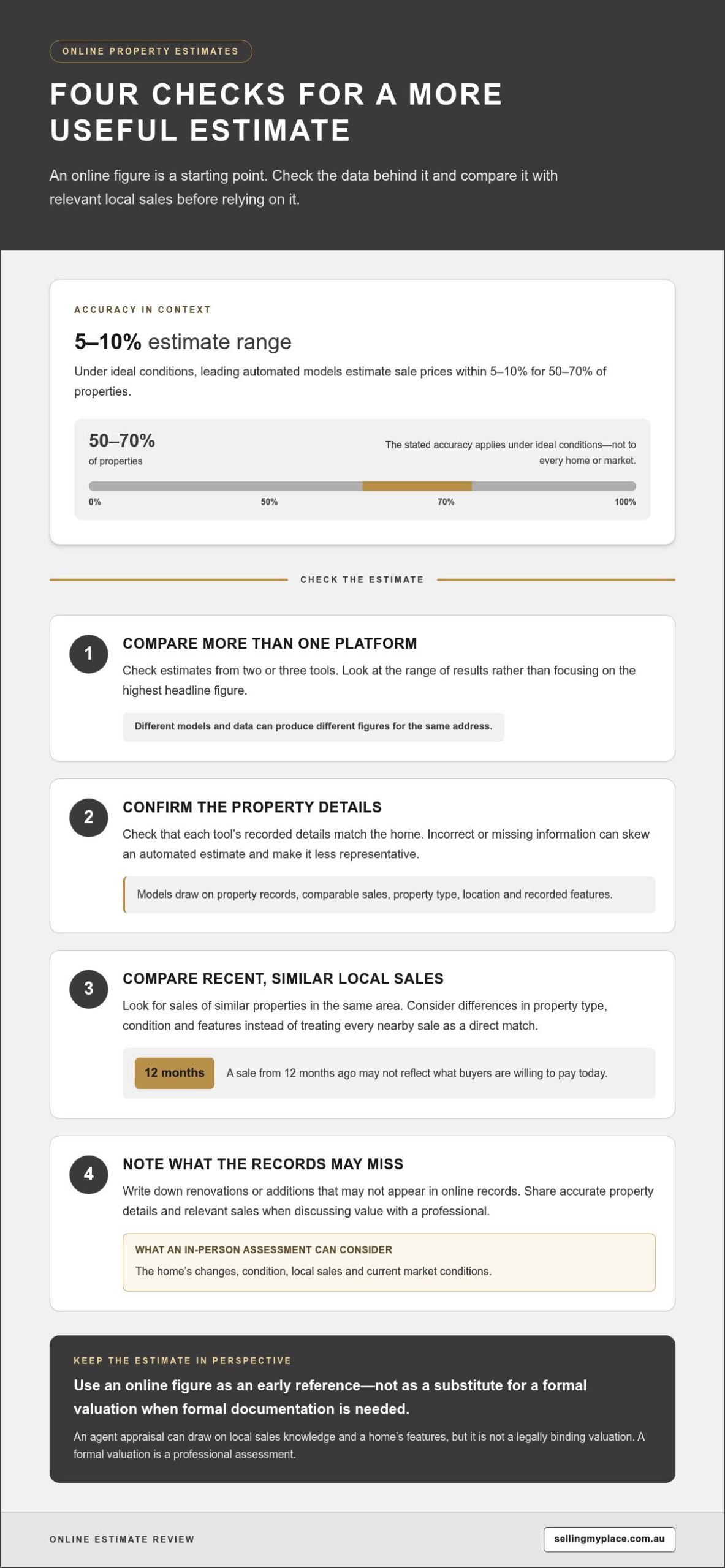
A quick online estimate is a starting point, not a definitive price. Under ideal conditions, leading automated models estimate sale prices within 5-10% for 50-70% of properties. That’s the practical limit of the accuracy of online property appraisal tools: useful for a first indication, but not a substitute for an assessment that accounts for a home’s individual features and current local conditions.
It makes sense to want a clear figure before making a major property decision. Online calculators are quick and convenient, but their accuracy depends on the property data and comparable sales available. The right option depends on how precise and formal the answer needs to be.
This guide explains how Australian online property calculators produce estimates, why their results can differ, and when those figures are useful. You’ll also learn how online estimates compare with paid valuation options, so you can choose the right next step.
Key Takeaways
- Use an online estimate as an initial guide: under ideal conditions, leading automated models estimate sale prices within 5-10% for 50-70% of properties.
- Compare estimates from more than one tool and look at the range, not just the highest figure.
- Understand what a formal valuation adds: an assessment can account for a home’s condition, renovations and features that automated data may miss.
- Compare costs with the purpose of the valuation: paid desktop reports and certified valuations serve different needs and have different price ranges.
- Allow for less reliable estimates when comparable sales are scarce or a home is an apartment, prestige property or otherwise unusual.
How accurate are online property valuations?
Online valuations offer a fast indication, but their accuracy depends on the available property data and comparable sales. Under ideal conditions, leading automated models estimate sale prices within 5-10% for 50-70% of properties.
For Australian homeowners, the key is knowing what each estimate can support. An online figure can help you start planning a sale, but it is not a substitute for a formal valuation when you need one.
Comparing Estimates and Professional Valuations
An online estimate is an automated guide, an agent appraisal draws on local sales knowledge, and a formal valuation is a professional assessment of a property’s value. Knowing the difference helps you use the right figure for the decision ahead.
Online platforms return instant estimates; agent appraisals can reflect recent local sales and a home’s particular features. However, an agent appraisal is not a legally binding valuation. A formal valuation may include an in-person assessment, considering condition, renovations, location and nearby amenities. It can take 7-14 days, rather than arriving instantly.
A seller, for example, can use an online figure as an early reference, then discuss comparable sales with an agent. If a buyer needs a formal valuation, they should engage a registered valuer. A quick estimate may not be suitable for decisions that require formal documentation.
How Automated Models Estimate Property Values
Automated valuation models use property records, recent sales and market trends to estimate value. In Australia, a model looks for comparable properties, then uses their sale prices alongside details such as property type, location and recorded features.
The result depends on the quality and relevance of those inputs. A standard home in an active market may have plenty of recent comparable sales. An estimate based on incorrect property details or older sales may be less representative. Different platforms can also use different models and data, producing different estimates for the same address.
One tool might give more weight to nearby sales, while another focuses more on broader market trends. Neither instant result captures every detail a person could assess during an inspection. Online property appraisal tools are only as useful as the data they can access and the way their models interpret it.
Checking and Improving an Estimate
Check an online estimate by comparing results from two or three platforms and reviewing the range, rather than focusing on one headline figure. Confirm that the property details shown by each tool match the home, as incorrect records can skew an estimate.
Then compare the estimate with recent sales of similar properties in the same area. Look for meaningful differences in property type, condition and features, rather than treating every nearby sale as a direct match. A sale from 12 months ago may not reflect what buyers are willing to pay today.
To prepare for professional advice, note renovations or additions that may not appear in online records. An in-person assessment can consider those changes alongside local sales and current market conditions. The online figures remain useful context, but presenting accurate property details and relevant examples gives a professional a clearer starting point for discussing value.
What is an online property value calculator?
An online property value calculator uses recorded property details and sales data to generate an automated estimate. Australian homeowners can use one for a quick indication, but formal valuations serve a different purpose and involve a more detailed assessment.
Automated Models and Professional Appraisals
An automated model calculates an estimate from property records and comparable sales, while a professional appraisal applies human assessment to the property and its local market. A quick estimate and a formal report are not interchangeable.
Australian banks use automated valuation models and recent market data, including comparable sales, property features and location trends. For refinancing, a professional bank valuation is necessary. For some Australian home loan applications, a valuer may inspect the property in person before preparing a formal valuation.
Most mortgage lending, estate settlements, divorce proceedings and court cases require valuation reports from licensed professional appraisers. These reports must meet documentation and credibility standards. A calculator can help homeowners understand an indicative figure, but it doesn’t provide that formal report. For property owners managing overseas assets or UK investments that require formal documentation, professional valuation firms such as Winfields Surveyors London offer the certified, on-site assessments needed to satisfy legal and financial requirements.
Generating Online Valuations in Australia
Online property valuation algorithms analyse recent sales, property characteristics, location and market trends to estimate value. They compare the home with properties that share relevant features, then process the available information through an automated model.
For example, a calculator may use recorded land and building details alongside recent sales in the area. If the records accurately describe the home and comparable sales reflect current conditions, the model has more relevant inputs. Missing or incorrect details can make its estimate less representative of the property as it stands.
Some platforms combine automated valuation models with comparative market analysis and, at times, input from real estate professionals. The mix varies between tools, so homeowners may see different results for the same address. An online figure remains an estimate, not a formal property valuation.
Free Online Valuation Tools
Free online tools are typically calculators on property portals that return an instant automated estimate. They offer an accessible starting point without requiring a formal report.
That convenience is useful when exploring a possible sale or tracking broad market trends. A calculator may show a range or a single figure, based on the property information and sales data available to its model. Treat the result as a guide, not as a documented valuation for lending or legal matters.
For a practical comparison, enter the same address and property details into more than one platform. Review the estimates together and note differences in the data shown. A spread between results can signal that the tools rely on different records or methods.
How Often Valuations Are Updated
Australian online valuations are refreshed as platforms add property records and sales data, but update timing varies between tools. There is no single schedule shared by every calculator.
Check when an estimate was generated and consider whether its comparable sales reflect current market conditions. A sale from 12 months ago may not represent what buyers would pay today, particularly if local trends have shifted.
Before a sale decision, use the online figure as context alongside recent comparable sales and property details. For guidance on how estimates fit into a selling decision, discuss your property sale plans.
Limitations of automated valuation algorithms
An instant estimate reflects the records and comparable sales available to a model, not a physical inspection. Missing property details, market movement and distinctive features can all affect the result.
Accuracy Limits of Automated Algorithms
Automated algorithms find patterns in recorded sales and property information, but they cannot assess every factor that influences buyers. Incorrect details in property databases can skew an automated valuation or comparative market analysis. A home’s condition, visual appeal and recent maintenance may also be difficult to capture in records.
Renovations are a clear example. An algorithm may not know about a $100,000 kitchen renovation if the improvement isn’t recorded, so its estimate may not reflect the home as it stands. Models also don’t physically inspect properties or capture buyers’ emotions and impulses, which can influence what they’re willing to pay.
Market timing presents another limitation. A sale from 12 months ago may not reflect what buyers would pay today, and an online estimate may not immediately respond to market shifts or location-specific changes. Treat the output as a data-based guide, not a complete answer to the question of what a particular buyer might offer.
Comparative market analysis has its own blind spots. A comparison may miss differences in site size, garage size, outbuildings, accessory dwelling units or property condition. For example, two homes with similar recorded floor areas may have different outdoor spaces or upkeep needs, which can affect their estimated values.
Estimates for Regional and Unusual Properties
Estimates are generally more useful for standard homes in active markets, where abundant comparable sales give a model relevant examples. In a regional area with fewer recent sales, an algorithm may have less closely matched evidence, making its comparison less specific to that home and location.
Apartments can also differ in ways that headline records do not capture. Condition, layout and features may affect value, while a sale from another apartment nearby may not be a close match. The model can only weigh distinctions represented in its data.
Prestige and unique homes are harder to value online because distinctive attributes may have no close comparable. Unusual design, extensive grounds or special additions may not fit patterns drawn from standard property sales. A human assessment can consider characteristics an algorithm may not recognise.
Use the estimate as a prompt for closer comparison: review the recorded property details, then consider whether the sales used resemble the home in condition, features and setting. This helps show where the model’s evidence is strong and where it may leave important differences out.
Costs of professional appraisals and online tools
Online calculators provide instant property estimates, while paid valuation services offer different levels of detail. In Australia, the cost depends on the assessment type and its purpose. Weigh the fee against what the valuation needs to establish, such as a sale guide or formal report.
It uses available property information and sales evidence without an in-person inspection, making it a lower-cost option than a detailed report. The trade-off is scope: a desktop assessment may not capture physical features or condition that become clear during an inspection.
These can provide more analysis than a basic desktop assessment, but paid desktop valuations are not legally binding. This matters if you need a valuation for a formal lending or legal purpose, rather than a more informed estimate of value.
These ranges describe different categories of professional work, so they should not be treated as interchangeable quotes. A formal assessment may involve an inspection and a more detailed report than a desktop estimate.
Timing also forms part of the comparison. Automated property appraisal systems return instant results, while professional appraisals typically take 7-14 days. For an owner weighing a sale, an instant figure can help with early planning; a professional report takes longer but can consider property details beyond a calculator’s records.
For example, a homeowner could begin with online estimates to understand the broad range, then decide whether a paid desktop report or formal valuation fits the next step. If refinancing, an estate settlement, divorce proceedings or a court case is involved, the required documentation can make a professional report more suitable than an instant calculator result.
A real estate agent can also use recent local sales and past sale prices to estimate a property’s value. That appraisal offers market context for selling, but it is not a legally binding valuation. Its usefulness depends on the current market, comparable properties and the home’s features. For sellers managing residential assets overseas, such as in the UK, regional specialists like Taylors Estate Agency show how local expertise captures nuances that automated systems often miss.
Compare each option by asking what evidence it includes, whether it involves an inspection, and what the report is intended to support.
In short, online estimates suit quick orientation, while paid reports provide more analysis. Match the cost and turnaround time to the decision: an initial selling plan may need market context, while formal lending or legal matters can require a professional valuation report.
How accurate are online property estimates in regional areas and for apartments or unusual homes?
Online estimates are most useful when a property has close comparables and the market has regular sales. Homes with fewer direct matches, including apartments and distinctive properties, may have less relevant evidence behind their estimates. Judge the figure against the type of property and sales data the model uses.
When nearby sales are scarce, a calculator may draw on sales from a wider area. But properties in different localities can vary in access to services, infrastructure and buyer demand. A sale elsewhere may offer context without reflecting the appeal or setting of the specific property.
Consider two houses with similar recorded floor areas. One might be near local amenities, while the other has a larger site or different condition. An automated model can only account for details in its records, so a broad comparison may be less meaningful. Recent sales of similar property types in the same locality are a more relevant reference.
Apartments bring another comparison challenge. A nearby sale may be in the same building but differ in layout, condition or outlook. Comparative market analysis can also miss differences in site size, garage size, outbuildings, accessory dwelling units and property condition. Compare like with like, including the features and condition recorded for each sale.
Unusual and prestige homes are harder to value with automated tools because standard sales may not capture their distinctive attributes. Extensive grounds, unusual design or a unique layout can set a property apart from the model’s usual comparisons. A professional inspection can add context, particularly where renovations or additions have changed the home beyond what property records show.
Some improvements need careful interpretation. Solar panels can positively affect property value, but the effect varies with system size, age and location. A calculator without those details cannot distinguish between installations. Likewise, an unrecorded extension may make a property appear more comparable to smaller homes than it really is.
For a regional, apartment or unusual property, treat the online figure as one reference point. Compare it with recent sales that share the property’s type, location and meaningful features. Then note which differences could explain a gap between the estimate and those sales. That gives a real estate professional more useful context for an appraisal.
If you’re preparing to sell a distinctive or regional home, get guidance on your property sale using local sales and property-specific details.
Kincade International Direct Sales: Residential Property Listing Services
Kincade International Direct Sales can help you turn an online estimate into a considered selling plan. Its Residential Property Listing Services support Australian homeowners preparing to bring a property to market, while Neighborhood Market Reports add sales context to an automated figure.
For owners weighing renovations, timing or how to present a home, Pre-Sale Property Consulting can help shape decisions before listing. Buyer Representation is available for people assessing a purchase and comparing an asking price with relevant property information.
An online calculator is a starting point, not a selling strategy. Pairing its estimate with local market context can help you approach the next decision with a clearer view of your property and plans. To discuss your next steps, contact Kincade International Direct Sales or visit sellingmyplace.com.au.
Turn your estimate into a considered next step
A property estimate becomes more useful when it helps you make a decision that fits your plans. Rather than chasing a single perfect figure, consider what you need to decide next: preparing to sell, assessing a purchase or understanding which improvements matter before going to market. That context gives the accuracy of online property appraisal tools a practical role, without asking an automated figure to make the decision for you.
Kincade International Direct Sales offers Residential Property Listing Services, Buyer Representation and Pre-Sale Property Consulting to support different stages. The right next step depends on whether you’re planning a sale, weighing a purchase or preparing your home. A conversation can connect the property information you’ve gathered with the decision ahead.
Contact Kincade International Direct Sales to discuss your property plans. Take the next step with a clearer sense of what matters to you.
Frequently Asked Questions
What should I do if I need a more detailed valuation than what is provided by the online tool?
Choose the next assessment based on why you need the figure. For a sale discussion, an agent can consider local sales and the features buyers may notice. If you need formal documentation for lending, legal proceedings or an estate matter, engage a registered valuer. Before arranging an assessment, gather details of renovations, property features and comparable sales to provide useful context.
Where does the property data and insights come from?
Online calculators generally draw on property records, recent sales and market trends. Government records and property databases can supply details such as location, property type and recorded features. Some platforms combine automated calculations with comparative market analysis or input from real estate professionals. If a property record omits an extension, for example, the estimate may not reflect the home’s current layout or size.
How accurate are online property appraisal tools in Australia?
Accuracy depends on the property and the quality of its comparable sales data. Under ideal conditions, leading automated models estimate actual sale prices within 5-10% for 50-70% of properties. That result applies to a portion of properties, not every home. A standard property in an active market has more relevant comparisons than a distinctive home with few similar recent sales.
What is the average error rate of Australian online property valuations?
There isn’t one average error rate that describes every Australian calculator or property. Under ideal conditions, top-performing automated valuation models estimate sale prices within 5-10% for 50-70% of properties. This is a performance range, not a promised margin for an individual home. Compare the estimate with recent, similar sales and consider whether the tool has accurate property details before interpreting its gap from a sale price.
Which Australian property appraisal websites and tools are most accurate?
No single ranking establishes one Australian platform as the most accurate for every home. Compare two or three tools using the same address, then check whether each shows the correct property features and recent comparable sales. A wide spread between estimates signals uncertainty in the available data or methods. For a sale decision, use the results as context alongside professional advice.
How do online appraisals compare with a real estate agent’s appraisal and a professional valuation?
An online appraisal produces an automated estimate; an agent’s appraisal adds local sales knowledge, while a professional valuation provides a formal assessment. An agent’s appraisal is not legally binding. A seller exploring an asking price may find an agent’s view useful, while a lender or court matter may require a professional valuation report. Match the assessment to the decision and documentation required.
What data do Australian online property appraisal tools use?
Australian tools commonly analyse recent sales, property characteristics, location and market trends. Their records may include property type and features that help identify comparable homes. Some platforms also draw on comparative market analysis or professional input. Check the address and recorded details shown in the estimate: a missing pool, incorrect bedroom count or unrecorded addition can lead the model to compare the home with properties that aren’t close matches.
What factors can make an online property appraisal inaccurate?
Incorrect records, limited comparable sales and market changes can all distort an online estimate. A model may miss renovations, maintenance, condition or features absent from its data. A recent kitchen upgrade, for instance, may not appear in property records, while an older sale may no longer reflect current buyer demand. Unique layouts, large sites and differences between nearby homes can also weaken the comparison behind the estimate.
Factors Affecting Property Value in Australia: The 2026 Seller’s Guide
Your family home might be worth exactly what the market dictates, but the amount that actually lands in your bank account is entirely up to you. In a cooling market where national dwelling values recently dipped by 0.9 per cent, understanding the specific factors affecting property value in Australia has never been more critical. It’s a stressful tightrope to walk, especially when you’re trying to make sense of conflicting data while high agent commissions threaten to eat away at your life’s work. We understand that this transition is about more than just a transaction; it’s about protecting your family’s future and the legacy you’ve built.
This guide is designed to give you back control and provide a steady hand through the selling process. You’ll discover how to navigate the current 4.35 per cent cash rate environment and identify the specific home features that truly drive up local interest. We’ll show you how to maximise your sale price and keep 100 per cent of your profit, ensuring you don’t lose an average of $20,000 to commissions. By the end, you’ll have a clear strategy to sell with confidence and move into your next chapter with your full equity intact.
Key Takeaways
- Understand how the RBA cash rate and national economic trends influence the price ceiling for your home in the current 2026 landscape.
- Identify the specific physical and local factors affecting property value in Australia, such as the “Golden Triangle” of rooms and school catchment zones.
- Learn why professional photography and high-quality floorplans are essential for standing out and driving inspections in a cooling market.
- Discover how to protect your family’s legacy by avoiding high agent commissions and keeping 100 per cent of your sale profit.
- Gain a clear, step-by-step strategy to navigate conflicting market data with the calm confidence of a seasoned expert.
The Australian Property Market: Macro Factors You Can’t Control
Selling a family home often feels like trying to read the weather; you can prepare the garden and paint the deck, but you cannot stop the rain. In the current climate, macro-economic conditions act as the atmospheric pressure of the housing world. Understanding the external factors affecting property value in Australia is the first step toward building a grounded, realistic sale strategy. We often see homeowners stressed by national headlines, yet the “Big Three”—interest rates, inflation, and economic confidence—impact every suburb differently. While professional real estate appraisal methods provide a technical baseline for what a house is worth, these broader shifts often dictate the final price a buyer is actually willing to pay on auction day.
Government policy also plays a significant role in propping up or cooling down demand. For instance, the Australian Government 5% Deposit Scheme continues to support eligible buyers, while state-based First Home Owner Grants, such as the $20,000 available in Tasmania or the $50,000 in the Northern Territory, keep certain price brackets active. However, national data can be misleading. This is why a detailed Neighborhood Market Report is far more useful than generic news; it filters these broad trends through the lens of your specific street, where local supply and demand dynamics truly dictate your price ceiling.
The Interest Rate Ripple Effect
The Reserve Bank of Australia kept the official cash rate at 4.35 per cent as of September 2026, a figure that remains the primary lever for buyer borrowing power. When rates are steady or rising, buyers become more cautious, and mortgage stress can lead to increased inventory as more homes hit the market. You might feel tempted to hold out for a rate drop, but in a cooling market where national values recently fell by 0.9 per cent in a single month, waiting can sometimes mean chasing the market down. It is often better to sell with a clear head in today’s known conditions than to gamble on the RBA’s next move.
Demographic Shifts and Housing Demand
The legacy of the “tree change” and “sea change” movements continues to influence where Australians want to live, even as some return to employment centres. Migration patterns and the desire for more useable space keep certain regions resilient while others soften. For homeowners in lifestyle-rich areas, the ability to generate short-term income through BnB Booking can significantly enhance a property’s appeal to the growing investor market. Market sentiment is the collective emotional state of Australian buyers in 2026. This shared mood, driven by everything from employment security to the 3.5 per cent annual inflation rate, determines whether a buyer views your home as a safe harbour or a financial risk. By understanding these shifts, you can position your property to meet the specific aspirations of today’s families.
While the role of the RBA in relation to housing sets the broader financial boundaries for what buyers can afford, the physical reality of your home is what clinches the deal. Land size has long been one of the primary factors affecting property value in Australia, yet modern families now prioritise useable space over raw acreage. A smaller, well-designed block with an integrated alfresco area often outshines a sprawling, unkempt yard that suggests endless weekend chores. Buyers are looking for a lifestyle, not a second job.
Inside the home, the “Golden Triangle” of rooms remains the most significant driver of perceived worth. Kitchens, bathrooms, and master suites are where buyers look for luxury and longevity. In 2026, sustainability has also moved from a “nice-to-have” to a non-negotiable. High-quality insulation and solar systems are viewed as future-proofing measures that protect buyers from rising living costs. To help potential owners understand how these elements fit together, professional floorplans are essential; they allow a family to mentally move their furniture in before they even step foot on the property.
Kerb Appeal and First Impressions
The psychology of the “front gate” experience cannot be overstated. A buyer’s emotional connection often begins the moment they pull up to the kerb. Simple acts like tidying garden beds, painting the front door, or ensuring the letterbox isn’t leaning can add thousands to the perceived value. Modern Australian buyers are particularly drawn to low-maintenance landscaping that offers a lush feel without the heavy lifting. Organising your exterior to look effortless suggests a home that has been loved and meticulously maintained, which reduces buyer anxiety about hidden maintenance issues.
Internal Layout and Modern Functionality
We’ve seen a permanent shift toward multi-purpose living. A dedicated “work from home” space is now a top priority for professionals, and a home that offers quiet zones alongside open-plan areas will always command a premium. High-end Photography is the best way to showcase this balance; it captures the light and flow that make a house feel like a home. If you’re wondering how your specific layout measures up against current buyer expectations, you might find it helpful to speak with an advisor about your property’s unique strengths.
Location and Infrastructure: Beyond the Boundary Fence
Value doesn’t end at your front gate. In fact, many of the most significant factors affecting property value in Australia are entirely external to your title deed. Buyers aren’t just purchasing bricks and mortar; they’re buying into a lifestyle, a commute, and a community. This is why two identical houses in the same suburb can have vastly different price tags based on which side of a specific road they sit. It’s about the “anchor” of the location, the sense of place that makes a family feel they’ve found their forever home.
Local amenities play a massive role in this emotional connection. Walking distance to a vibrant local cafe strip or a well-maintained park adds a layer of desirability that generic data simply can’t capture. We’ve seen that the “good coffee” factor is real; buyers will often pay a premium for the convenience of a weekend stroll to their favourite local spot. However, it’s also vital to look at what’s coming next. Checking local council plans for zoning changes or new developments is a crucial step in future-proofing your sale. A new shopping centre nearby might boost convenience, but a proposed high-rise development next door could impact your privacy and sunlight. Staying informed about these external shifts ensures you’re never caught off guard during negotiations.
The Power of School Zones
For many Australian families, the local school catchment is the ultimate “hidden” value driver. Being on the right side of a boundary line can change a valuation by a six-figure sum, as parents look to secure their children’s education without the ongoing cost of private tuition. These properties tend to show remarkable long-term stability, even when the broader market softens, because the demand for quality education remains constant. You can learn how to determine the market value of a home in Australia by cross-referencing your address with the latest NAPLAN results and local school intake maps. It’s one of the most reliable ways to justify a higher asking price to a motivated buyer.
Transport and Connectivity
The rise of the “20-Minute Neighbourhood” has reshaped urban planning across the country. Buyers now prioritise homes where work, shops, and health services are all reachable within a short trip. Proximity to public transport hubs or major employment centres is a massive drawcard, though there’s a delicate balance to strike. While being near a train station adds value, being too close to the tracks can detract from the “quiet street” premium that many families still crave. Upcoming infrastructure projects, like rail extensions or highway upgrades planned for the next few years, can act as a catalyst for future capital growth. If your home is positioned to benefit from these connections, it’s a major selling point that deserves a spotlight in your marketing.

Visual Marketing: The “Silent Negotiator” of Property Value
Many sellers assume that market value is a rigid number set in stone by banks and spreadsheets. In reality, value is often a range, and where your final sale price lands within that range depends heavily on perception. While we have already explored the economic shifts and local infrastructure that provide the foundation, visual marketing is one of the most powerful controllable factors affecting property value in Australia. It acts as a silent negotiator, setting the tone for every conversation before a buyer even steps onto your driveway. Choosing to sell your own home shouldn’t mean settling for a ‘DIY’ look; it’s about meeting professional standards to ensure your property is taken seriously by the most competitive buyers. To see how these standards are applied by industry leaders, you might check out The Agency Coffs Coast for an example of high-end regional property presentation.
High-quality marketing does more than just look pretty. It builds trust and reduces the perceived risk for a buyer. When a listing looks polished, it suggests the home itself has been cared for with the same level of attention. By positioning your home as a lifestyle rather than just a collection of rooms, you invite buyers to visualise their own future there. This emotional connection is what drives people to stretch their budgets during negotiations, turning a casual browser into a determined bidder. If you are ready to showcase your home’s true potential, you can book a consultation with our team to discuss the best visual strategy for your area.
Smartphone cameras have come a long way, but they still cannot replicate the impact of professional equipment and expert editing. A professional photographer understands how to use wide-angle lenses to capture the flow of a room without distorting it, and how to balance natural light to make a space feel warm and inviting. These images are often the first point of contact a buyer has with your legacy. We’ve seen that listings with professional media receive significantly more clicks and inspection requests than those without. This is why Kincade International Direct Sales includes professional photography in every package; we believe every Australian seller deserves to put their best foot forward without the burden of high upfront marketing costs.
The Floorplan Advantage
An accurate floorplan is perhaps the most underrated tool in your marketing arsenal. Research within the real estate industry suggests that approximately 1 in 3 buyers will actually ignore a listing if it doesn’t include a floorplan. It provides the essential context that photos alone cannot, helping buyers understand the relationship between the “Golden Triangle” of rooms we discussed earlier. Beyond just generating interest, floorplans help qualify buyers by ensuring the layout suits their specific needs before they book an inspection. You can also use these documents during Pre-Sale Property Consulting to identify minor layout improvements that could significantly boost your final sale price. It’s about removing friction and making it as easy as possible for a buyer to say “yes”.
Maximising Your Sale Profit: The KIDS Commission-Free Model
After navigating the complex factors affecting property value in Australia, from the RBA cash rate to the “Golden Triangle” of internal rooms, the final hurdle is ensuring that value actually stays in your pocket. It’s a common misconception that a high sale price automatically equals a high profit. In reality, the traditional commission model often acts as a significant “equity leak,” draining your hard-earned wealth at the very moment you should be celebrating. Protecting your family’s legacy means looking beyond the “sold” sticker and focusing on the net result. We believe that the equity in your home belongs to you, not an agency’s bottom line.
Kincade International Direct Sales (KIDS) was founded on the belief that the modern Australian seller deserves a more transparent, partnership-based approach. By choosing to sell your own home with the support of our flat-fee model, you effectively bypass the commission trap. This isn’t just about cutting costs; it’s about empowerment. You receive the same professional-grade Residential Property Listing Services, including the global marketing reach and professional media we’ve discussed, but without the high marketing costs or percentage-based fees that can erode your profit.
Traditional Agents vs. Flat-Fee Advisory
The financial difference is often startling. On a typical Australian property, sellers save an average of $20,000 in commissions by moving away from the traditional model. There’s a persistent myth that local agents have a “magic touch” that unlocks higher prices, but in 2026, market exposure and presentation are the true drivers of value. KIDS provides the global marketing network required to find the right buyer, while our Agency Flat Fee ensures your costs remain fixed and predictable. This allows you to move into your next chapter with your full equity intact, rather than leaving a significant portion of it on the closing table.
The Steady Hand: Expert Advisory and Conveyance
We understand that the legal and negotiation phases of a sale can feel daunting. That’s why we provide a “steady hand” through our Real Estate Advisory Services, acting as a safety net for those who want to take control of their sale. Navigating the legal journey is made simple with professional Conveyance Advice, ensuring that every contract and disclosure meets the necessary standards. From handling initial enquiries to the final settlement steps, our team provides the expert guidance you need to close the deal with confidence. It’s a professional, supported way to sell that prioritises your family’s needs over a quick commission.
Taking Charge of Your Home’s Future
Navigating the various factors affecting property value in Australia can feel like a daunting task, but you don’t have to do it alone. We’ve explored how macro trends like the 4.35 per cent cash rate provide the backdrop, while your home’s unique physical features and local school catchments drive individual interest. Most importantly, we’ve seen how professional presentation and strategic marketing can elevate your property above the competition, ensuring you achieve the best possible result in any market condition.
Your home is likely your greatest asset; protecting the equity you’ve built over many years is our top priority. By choosing a commission-free model, you can save an average of $20,000 per sale while still benefiting from professional photography, floorplans, and our expert advisory service. It’s about selling with confidence and keeping your hard-earned profit where it belongs. When you’re ready to start your next chapter with a steady hand by your side, protect your equity and sell commission-free with SellingMyPlace.com.au. We look forward to helping you move forward with peace of mind and your full legacy intact.
Frequently Asked Questions
What is the single biggest factor affecting property value in Australia?
While location is the traditional answer, the primary ceiling on property prices in 2026 is the RBA cash rate and its impact on buyer borrowing power. The current 4.35 per cent rate directly dictates what a family can afford to bid. However, within your local area, the specific street position and proximity to lifestyle amenities remain the most influential factors affecting property value in Australia that you can actually leverage.
How much value does a renovation actually add to an Australian home?
A well-planned renovation can return significantly more than its cost, provided you focus on the “Golden Triangle” of rooms. Kitchens, bathrooms, and master suites typically offer the highest return on investment because they are the most expensive for a buyer to fix themselves. Modern Australian buyers also look for energy-efficient upgrades, such as solar and insulation, which can add thousands to the perceived worth of a property in today’s climate.
Does the school catchment area really impact my property price?
Yes, being on the right side of a boundary line for a high-performing public school is one of the most resilient factors affecting property value in Australia. Parents often view a home in a top catchment as a long-term investment in their children’s education, which can lead to a six-figure premium over similar homes nearby. These properties tend to hold their value even when broader market sentiment begins to soften.
Can I sell my home without a traditional agent and still get a high price?
You can certainly achieve a premium price by selling your own home if you maintain professional standards in your marketing and presentation. Buyers respond to quality photography, clear floorplans, and accurate data rather than the logo on a sign. With the right real estate advisory services to guide your negotiations, you can achieve a result that matches or exceeds what a traditional agent might deliver.
How much can I save by using a commission-free real estate model?
Australian sellers save an average of $20,000 by choosing a commission-free, flat-fee model over a traditional percentage-based agency. This significant saving allows you to protect your home’s equity and put that money toward your next life transition. Because you aren’t paying a large portion of your profit to an agent, you have more flexibility in your negotiations while still ensuring you walk away with 100 per cent of the profit.
What should be included in a professional neighbourhood market report?
A comprehensive report should include recent local sales data, current supply and demand levels, and an analysis of how long properties are sitting on the market. It should also highlight local infrastructure projects or zoning changes that might influence future growth. These reports empower you to set a realistic asking price based on hard evidence rather than guesswork, giving you a steady hand during the entire selling process.
Is professional photography worth the investment for a private sale?
Professional photography is essential because it acts as your silent negotiator in the digital space. High-quality images and floorplans are the primary tools for reducing buyer friction and driving inspections. Since 1 in 3 buyers will skip a listing that lacks a floorplan, including professional media is non-negotiable for a successful result. It ensures your home stands out as a premium lifestyle choice rather than just another online listing.
What are the legal risks of selling my own property in Australia?
The primary risks involve ensuring all legal disclosures are accurate and that the contract of sale is correctly prepared for your specific state. These risks are easily managed by seeking professional Conveyance Advice and utilising an expert advisory service as a safety net. Having professional support through the legal journey ensures that your sale is compliant and secure, allowing you to focus on the emotional significance of your move.
Pricing Your Home: 2026 Guide for Australian Sellers
What if the secret to a premium sale price had nothing to do with a real estate agent’s “gut feeling” and everything to do with your own transparent market data? Selling your family home is a significant life transition, and it’s completely natural to feel a bit of a knot in your stomach when you see conflicting online estimates or worry about agent bias. You’ve worked hard to build your equity, and the last thing you want is to see it eroded by underpricing or swallowed up by traditional commissions. Understanding how to price your home for sale is about more than just picking a number; it’s about taking control of your financial legacy.
In this 2026 guide, you’ll learn the strategic art of pricing your property to attract premium buyers while bypassing high commissions to protect your family’s wealth. We’ll show you how to move past the confusion of automated valuations to find a realistic, competitive price range that reflects the true value of your home. By the end of this article, you’ll have a clear plan to sell for a flat fee, potentially saving $20,000 or more, and the confidence to stand firm in your own market research. Let’s explore how a steady hand and the right data can turn a stressful process into a rewarding new beginning.
Key Takeaways
- Understand the data sources behind digital estimates and why they provide a useful baseline but often miss your home’s unique renovations or views.
- Learn exactly how to price your home for sale by shifting your focus from optimistic “Asking” prices to verified “Sold” records in your local area.
- Discover the benefits of a specialised Neighbourhood Market Report to gain deeper insights into buyer demand and clearance rates that basic apps ignore.
- Follow a proven framework to establish a realistic price range that allows you to sell for a flat fee and protect an average of A$20,000 in family equity.
- See how professional marketing assets like floorplans and photography provide the visual evidence required to justify a premium price point to buyers.
Understanding the Science of How to Price Your Home for Sale
Most Australian sellers begin their journey by typing their address into a search bar and waiting for a magic number to appear. Behind those instant results sits an Automated Valuation Model, or AVM. Think of the AVM as a helpful, though slightly literal-minded, digital engine that crunches massive amounts of data from Valuer-General records, historical sales, and current listings to provide a snapshot of value. While these tools are incredibly convenient, they are essentially mathematical guesses based on the science of property valuation. To truly master the market, you need to understand that a computer cannot see your freshly sanded floorboards or feel the morning sun in your garden.
It is also vital to distinguish between the different “prices” you might encounter during this process. A bank valuation is almost always conservative because it is designed for lender risk management. An agent’s appraisal, on the other hand, can sometimes be inflated to encourage you to sign a listing agreement. A true market estimate is a realistic look at what a buyer will actually pay in today’s climate. By leaning into objective data, you are essentially building a protective wall around your family’s future, ensuring your equity isn’t eroded by unnecessary commissions or poor advice.
This reliance on objective data reflects a broader trend in asset management. Just as savvy owners use My Car Value to obtain accurate digital valuations for their vehicles, property sellers are increasingly using advanced metrics to safeguard their home equity against biased or outdated estimates.
The Data Points That Drive Your Estimate
Algorithms primarily look at “comparable sales,” which are properties similar to yours that have sold nearby, typically within the last six months. They weigh specific attributes like land size, the number of bedrooms, and the clarity of your floorplans to categorise your home against its neighbours. In 2026, buyer sentiment acts as a real-time filter that can either accelerate or dampen the cold hard facts found in historical data.
Why Estimates Vary Between Australian Platforms
You might notice that one major property portal gives you a figure that is A$50,000 higher than another. This happens because different platforms use proprietary algorithms and update their records at different intervals. There is often a notable lag time in official government sales data processing; it can take weeks for a settled price to appear in the Valuer-General’s database, meaning some sites are looking at older news than others.
This is where a “steady hand” approach becomes your greatest asset. Instead of getting frustrated by these discrepancies, use them to establish a working range. Learning how to price your home for sale involves looking at these variations with a calm, analytical eye. By understanding where the data comes from, you move from being a confused bystander to an empowered seller who knows exactly where their property sits in the local landscape.
The Limits of Algorithms: When a Digital Estimate Isn’t Enough
While the digital engines we explored in the previous section provide a convenient baseline, they often lack the “eyes” to see what truly makes your property a home. An algorithm can track square meterage and bedroom counts, but it cannot perceive the panoramic sunset views from your balcony or the way your architecturally designed high ceilings create a sense of sanctuary. Relying solely on a bot to decide how to price your home for sale carries a significant risk; you might set a reserve price that ignores the premium features buyers are actually willing to compete for.
Digital tools often struggle with the emotional resonance of a family home, which is why professional advisory services act as the vital bridge between cold data and market reality. When you are looking for an objective standard, it is helpful to consult the market value guidelines from the ATO, which emphasise the importance of an “unfettered” market where both parties act knowledgeably. Without this human layer of interpretation, you might find yourself anchored to a number that doesn’t reflect the true worth of your lifestyle or your legacy.
The Renovation Gap in Digital Data
If you have recently installed a designer kitchen or a sprawling spotted gum deck, do not be surprised if your free online estimate remains unchanged. These structural improvements are often “invisible” to algorithms until a new sale record is created. To protect your equity, you must manually adjust your expectations by looking at the cost of these upgrades and the value they add to the local lifestyle. Professional photography becomes your best friend here. It provides the visual evidence that justifies a higher price point to potential buyers before they even step through the front door.
Local Nuance and Street Appeal
Mastering how to price your home for sale requires a blend of data and local intuition. In many Australian suburbs, one side of a street can command a significantly higher price than the other due to school catchments, noise levels, or even the afternoon sun. Similarly, upcoming infrastructure like a new parkland or transport hub can boost value long before the data catches up; this is where the local expertise of firms like Elite Agents & Partners can help validate your research with on-the-ground reality.
Understanding these intricacies is a core part of how to determine market value of a home in australia. If you feel the digital estimates are missing the mark on your home’s unique charm, a quick chat with a professional advisor can help clarify the difference between a generic estimate and a strategic listing price.
Automated Estimates vs. Strategic Neighbourhood Market Reports
A generic online estimate is like looking at a weather forecast for the entire state when you really just want to know if it’s going to rain in your backyard. While the AVMs we discussed earlier provide a helpful starting point, they lack the granular detail required for a high-stakes sale. When you are mastering how to price your home for sale, the distinction between a generic guess and a specialised Neighbourhood Market Report is what ultimately protects your family equity. These strategic reports dive deep into the specific mechanics of your suburb, providing a level of clarity that basic apps simply cannot match.
Rather than just offering a single “magic number,” a strategic report analyses the current pulse of the market. For instance, as of June 2026, the median vendor discount across combined capitals sits at approximately 3.3%, while the median days on market is roughly 28 days. Understanding these figures in the context of your specific street allows you to spot emerging trends before the general public. If clearance rates are climbing in your pocket of the neighbourhood, you might have the leverage to aim for the higher end of your price range. This data-driven approach ensures you aren’t just guessing; you are making informed decisions based on the same intelligence used by industry professionals.
What Makes a Market Report “Strategic”?
A strategic report moves beyond the “what” and into the “why” of buyer psychology. It allows you to analyse the competition by seeing exactly what other sellers in your suburb are doing, from their initial asking prices to their final settlement figures. This transparency is a powerful tool during negotiations. When a potential buyer questions your price, you can point to concrete data regarding buyer demand and local supply to justify your position. It transforms a potentially emotional confrontation into a calm, professional conversation about market reality.
The Kincade Advantage: Human Advisory
Data is only as valuable as the person interpreting it. This is where our Agent Advisory Service provides a “steady hand” to guide your strategy. Unlike a traditional agent who might “buy the listing” by quoting an unrealistically high price just to get you to sign a contract, our advisors focus on objective truth. We help you interpret your Neighbourhood Market Report to find a price point that is both competitive and profitable. Because our model is built on a flat fee rather than a percentage, our only goal is to see you succeed. This partnership allows you to price your home more aggressively without the fear of losing A$20,000 or more to traditional commissions, keeping that hard-earned equity exactly where it belongs: in your pocket.

A Step-by-Step Framework to Price Your Property for a Commission-Free Sale
Moving from data collection to a live listing requires a methodical approach. It is not just about picking a number you like; it is about building a case that buyers cannot ignore. When you understand how to price your home for sale, you gain the upper hand in every conversation. This framework is designed to help you navigate the process with the calm confidence of a seasoned expert.
- Step 1: Gather your digital baseline. Collect at least three different free estimates from major Australian property portals. This gives you a spectrum of value and helps you identify any wild outliers.
- Step 2: Study the “Sold” reality. Look at properties similar to yours that have actually settled in the last six months. Ignore “Asking” prices on current listings; those are aspirations, not facts.
- Step 3: Factor in your commission edge. Traditional agents often charge between 2% and 3% in commission. Because you are selling commission-free, you have the flexibility to price more competitively while still protecting your bottom line.
- Step 4: Consult with a professional advisor. A human expert can validate your research and help you adjust for those “invisible” value-adders that algorithms miss.
- Step 5: Validate with visual marketing. Launch your listing with high-quality photography and detailed floorplans. These assets prove to the buyer that your price point is justified.
Setting Your “Sweet Spot” Price
There is a distinct psychology to property pricing in Australia. Pricing your home at A$995,000 often attracts more interest than a flat A$1,000,000 because it sits within a lower search bracket on most portals. You can also use your research to set a strategic “Offers Above” range, which encourages competitive interest without capping your potential. For more advice on handling the interest this creates, explore these property sale negotiation tips.
Protecting Your Equity
The goal is to maximise your “Real Net Profit.” This is the sale price minus your flat fee, rather than the sale price minus a massive commission. For example, selling a home for A$900,000 with a flat fee often puts more money in your pocket than selling for A$915,000 through a traditional agency. Keeping that extra A$20,000 in your mortgage offset account, especially with the RBA cash rate sitting at 4.35%, provides a significant long-term financial buffer for your family. If you are ready to finalise your strategy and protect your hard-earned equity, you can contact our advisory team for a personalised consultation.
Validating Your Price Point Through Professional Marketing and Advisory
Setting the right number is only half the battle. A price estimate, no matter how data-driven, is only as good as the marketing that supports it. When you are finalising how to price your home for sale, you must consider how that price is validated in the mind of the buyer. If a listing looks amateur, the buyer will naturally look for reasons to negotiate downwards. Conversely, a polished, professional presentation signals that the property is a premium offering, making your price point feel like a fair, well-researched value rather than a starting point for a haggle.
Visual Proof of Value
High-quality imagery is essential for achieving an “above estimate” result. In the digital-first world of 2026, your first open home happens on a smartphone screen. Professional photography captures the emotional essence of the space, while accurate floorplans provide the logical grounding serious buyers need to visualise their lives in your home. By mastering how to price your home for sale and backing it with visual evidence, you eliminate the guesswork that often leads to underpricing. This combination reduces buyer negotiation leverage; it is much harder to justify a lowball offer when the marketing clearly demonstrates the home’s worth and attention to detail.
Our global marketing network ensures your property isn’t just seen; it’s seen by the right people. By casting a wider net, we increase the likelihood of finding that one buyer who values your unique features as much as you do. This human connection is the ultimate validation of your pricing strategy, turning a digital estimate into a successful settlement.
The Commission-Free Path
Taking the commission-free path is about more than just saving money; it is about taking control of your property legacy. For many Australian families, the flat-fee model represents a significant shift in how wealth is preserved during a sale. When you bypass traditional commissions, you protect an average of A$20,000 in equity, providing a much-needed boost to your next chapter. It allows you to be more flexible in your negotiations without ever feeling like you are losing out.
If you are ready to move from being a curious browser to an empowered seller, understanding the mechanics of a sale by owner is your next logical step. You are the best person to represent your home’s value, and with a steady hand to guide you, the results can be truly transformative. It is time to step into the market with confidence, knowing your price is right and your future is protected.
Step Into Your Next Chapter with Confidence
You now have the tools to move beyond the uncertainty of automated guesses. By combining cold data with a “steady hand” advisory approach, you can navigate the complexities of the 2026 market with ease. We have explored why understanding how to price your home for sale is less about picking a lucky number and more about validating your property’s unique story through professional photography and floorplans. Success comes when you pair local intuition with verified market facts.
Remember that a strategic listing isn’t just about the final sale price; it’s about the “Real Net Profit” you keep at settlement. By choosing a flat-fee model, you can protect an average of A$20,000 in hard-earned equity that would otherwise be lost to traditional commissions. With our Expert Agent Advisory Service by your side, you aren’t just selling a property. You are actively securing your family’s financial legacy.
Ready to see the true potential of your property? Secure Your Strategic Neighbourhood Market Report and Sell Commission-Free today. Your home is your greatest asset, and you deserve a partner who values it as much as you do.
Frequently Asked Questions
Are free online property value estimates accurate in Australia?
Free online property value estimates serve as a helpful baseline but shouldn’t be viewed as a final figure. These tools use mathematical algorithms to process Valuer-General data and recent sales; however, they cannot perceive your home’s unique charm or recent internal upgrades. For a truly accurate outlook, these digital numbers need to be validated by a professional who understands the current street-level demand and specific neighbourhood nuances.
How is a property value estimate different from a bank valuation?
A property value estimate reflects what a buyer might pay in an open market, while a bank valuation is a conservative assessment used to manage lending risk. Banks often provide a lower figure to protect their interests in case of a forced sale. Understanding this distinction is vital when learning how to price your home for sale, as it prevents you from being discouraged by a lender’s cautious appraisal of your family’s equity.
Do I need a real estate agent to get an accurate appraisal?
You do not need a traditional real estate agent to receive an accurate appraisal of your property’s worth. While agents often provide quotes to secure a listing, independent Real Estate Advisory Services offer an objective perspective without the pressure of a commission-based contract. These services focus on providing a “steady hand” and raw data, allowing you to make decisions based on facts rather than a sales pitch.
Can I use a free estimate to set my house sale price?
Using a single free estimate to set your final sale price is risky because algorithms often lag behind real-time market shifts. These tools are excellent for establishing a working range, but they don’t account for the emotional appeal that drives premium offers. It is better to use the estimate as a foundation and then refine your strategy by looking at actual “Sold” results from the last six months in your local area.
How often should I check my property value estimate?
Checking your property value estimate once every quarter is generally sufficient to track long-term growth. However, if the Reserve Bank of Australia adjusts the cash rate, which currently stands at 4.35% as of August 2026, it is wise to look again. Major economic shifts or new local infrastructure projects can influence buyer demand and property values much faster than a standard yearly review might suggest.
Does adding solar panels or a deck increase my estimate immediately?
Physical improvements like solar panels or a new deck rarely trigger an immediate increase in automated digital estimates. These systems rely on settled sales data, which means your renovations won’t “show up” in the algorithm until a similar local home sells for a higher price. This is why professional photography is so important; it showcases these value-adders to human buyers even when the computer hasn’t caught up yet.
Why does my bank estimate differ from Domain or other major property portals?
Differences between bank estimates and property portals occur because each platform uses a proprietary algorithm and different data update cycles. Portals often incorporate recent listing activity and consumer interest, whereas banks prioritise settled government records to ensure their valuations remain conservative. This variation is why we recommend gathering multiple data points to find a realistic median range for your property before you finalise how to price your home for sale.
What is the best way to get a professional price guide without paying commission?
The most effective way to establish a professional price guide without commission is through a specialised Neighbourhood Market Report. These reports provide granular data on clearance rates and buyer demand that generic sites miss. When paired with an Agent Advisory Service, you receive the expert interpretation needed to finalise your listing price with confidence, ensuring you protect your equity while still attracting the right premium buyers.
How to Price Your Home for Sale by Owner: The 2026 Australian Guide
What if the most expensive mistake you make this year isn’t paying too much for your next house, but asking too much for the one you’re selling? It’s a valid worry. When you take the reins and look at how to price your home for sale by owner, the weight of protecting your family’s legacy can feel immense, especially with Sydney and Melbourne markets showing a 2.1 to 3.2 percent dip from their recent peaks. You want to honour your home’s value without scaring off the very buyers you need to attract.
We understand this isn’t just a transaction; it’s the start of your next chapter. Determining your property’s worth doesn’t have to be a source of late-night stress. By using a data-driven approach, you can avoid the overpricing trap, secure a price that reflects your home’s true worth, and keep the median national commission of 2.65 percent; often A$20,000 or more; exactly where it belongs: in your bank account.
This 2026 guide provides the steady hand you need to navigate conflicting online valuations and new AML/CTF regulations. You will discover how to build a defensible asking price, choose between Auction and Private Treaty strategies, and walk into negotiations with the quiet confidence of a seasoned local expert.
Key Takeaways
- Understand why the first 21 days of your listing represent the “Honeymoon Period” and how to set a price that captures premium buyer interest before the momentum fades.
- Learn why relying on current portal asking prices can be a trap and how to use settled sales from the last six months to ground your valuation in market reality.
- Master the “Plus/Minus” method for how to price your home for sale by owner by adjusting for unique property features against at least five recent local sales.
- Discover the strategic differences between setting a negotiation buffer for a private treaty sale and choosing an effective auction reserve that avoids illegal underquoting.
- Recognise the value of a “steady hand” and how professional advisory services can help you protect your equity and navigate the complexities of 2026 property regulations.
The Strategy of Pricing: Why Your Opening Figure Defines Your Sale
Market value isn’t a figure based on your mortgage balance or the total cost of the renovations you’ve lovingly completed over the years. It is, quite simply, what a willing buyer is prepared to pay in the current Australian climate. When you’re researching understanding real estate appraisal, you’ll find that professional valuations rely on hard evidence and recent transactions rather than sentiment or hope. For those learning how to price your home for sale by owner, this distinction is your strongest shield. Your opening figure acts as a digital handshake; it’s the very first impression you make on your local community.
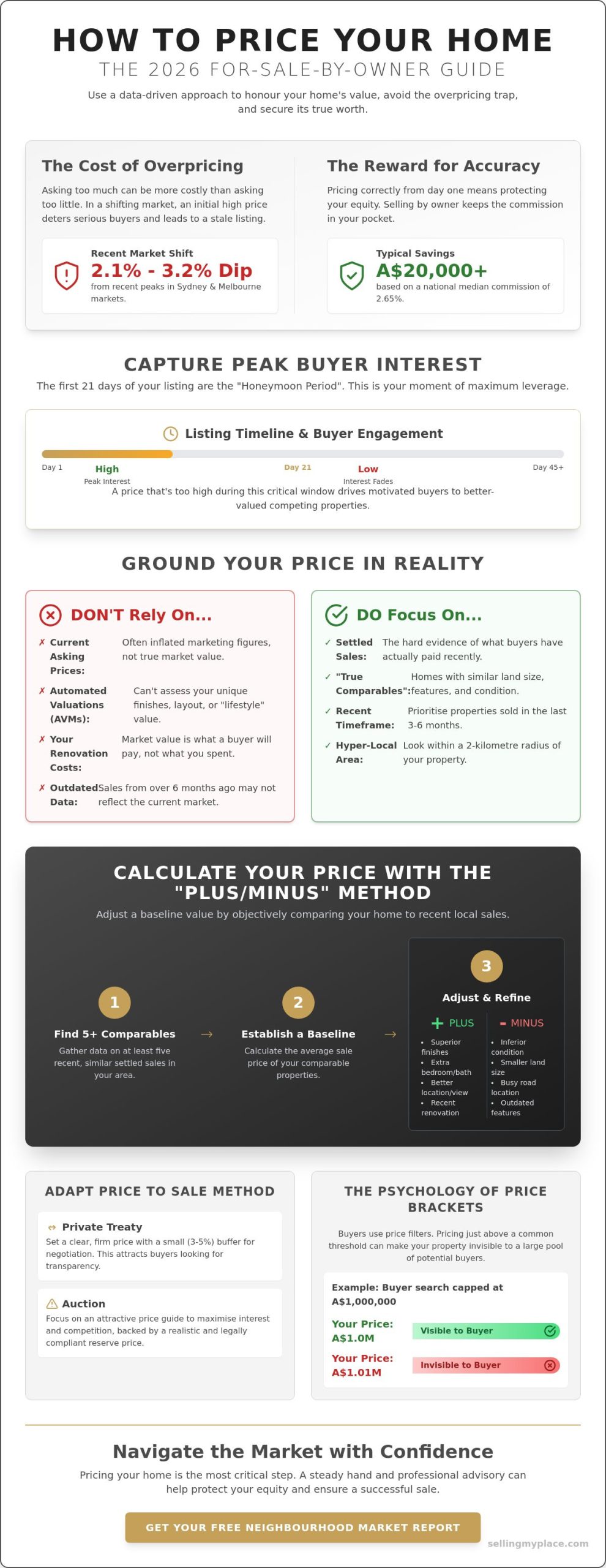
The first 21 days of your campaign represent the “Honeymoon Period”. This is when buyer excitement is at its absolute peak. New listings trigger immediate alerts for thousands of active house-hunters who are ready to act. If your price is too high during this window, you aren’t just “testing the market”; you’re actively driving motivated buyers into the arms of your competitors. They’ll use your overpriced home as a benchmark to justify buying the better-valued property just a few streets away. Positioning your home as the best value in your suburb doesn’t mean underselling; it means pricing with a steady hand to generate the competition that ultimately drives a record result.
The Psychology of the Australian Buyer
Australian buyers are savvy and time-poor. They use digital filters on major portals to scan specific price brackets. If you price your home at A$1,005,000, you’ll vanish from the searches of every buyer who has capped their limit at a round A$1,000,000. While “Offers Over” might seem like a clever way to spark interest, it can sometimes feel evasive to a buyer looking for transparency. A clear, grounded price invites an honest conversation and builds the trust necessary for a high-stakes negotiation.
The Cost of Getting it Wrong
When a listing sits on the market for too long, it becomes “stale” in the eyes of the public. Buyers start to wonder if there’s a hidden structural issue or perhaps a difficult settlement condition. This suspicion leads to low-ball offers that wouldn’t have dared surface during your first week. A price reduction often results in a lower final result than a correct initial price. By pricing accurately from the start, you protect your equity and avoid the exhausting cycle of chasing a cooling market downward. You deserve a sale that feels like a victory, not a compromise.
Data Over Guesswork: Using Comparative Market Analysis (CMA)
When you’re trying to figure out how to price your home for sale by owner, it’s tempting to scroll through Realestate.com.au and see what the neighbours are asking. This is a common trap. Asking prices are merely marketing signals, often inflated by hope or agent promises. Instead, you need to look at “Settled Sales”. These are the cold, hard figures of what has actually changed hands in the last six months. In a 2026 market where Sydney and Melbourne have seen values dip by over 2 percent, using data from a year ago could leave your property sitting idle while the market moves away from you.
Finding “True Comparables” is an art. It’s not enough to find a three-bedroom house in the same postcode. You must look for properties on similar land sizes, with comparable finishes, and ideally within a two-kilometre radius. For those in New South Wales, the NSW Government’s guide to selling property offers a helpful framework for the legal steps involved in these transactions. Identifying whether your specific pocket is rising, flat, or softening allows you to position your price with surgical precision. If you feel overwhelmed by the data, a quick Neighborhood Market Report can clarify the local landscape for you.
Beyond the Free Online Valuation
Automated valuation models, or AVMs, are helpful starting points, but they are limited by their algorithms. They can’t see the premium stone in your kitchen or the way the afternoon sun hits your deck. They miss “lifestyle” value; the emotional pull that makes a buyer pay a premium. Obtaining a Neighborhood Market Report provides the granular detail that a standard online estimate simply cannot reach. This helps you identify “outlier” sales, such as a property sold under duress or a family transfer, which might otherwise skew your data and lead to a pricing mistake.
Professional Appraisal vs. Agent Estimates
Mastering how to price your home for sale by owner requires moving past the “agent appraisal”. Some agents may “buy the listing” by quoting an unrealistically high price just to secure your signature. An independent advisory service offers a more objective view, focusing on your family’s needs rather than a commission. While a bank valuation is often conservative to protect the lender, a professional market appraisal considers the emotional appeal of your home. Investing in professional floorplans and photography further justifies a top-of-range price, showing buyers exactly why your property is worth their investment.
Auction vs. Private Treaty: Adapting Your Price to the Method
Choosing between an auction and a private treaty isn’t just about the date on the calendar. It’s about how you invite people into your home’s story. When you’re deciding how to price your home for sale by owner, the method you choose changes the psychology of every interaction with a potential buyer. A private treaty sale is often a thoughtful, one-on-one conversation, while an auction is a public display of competitive desire. Both require a different approach to your figures to ensure you don’t leave money on the table.
For unique or high-end Australian properties, you might even consider an “Expressions of Interest” (EOI) campaign. This approach keeps the price hidden and asks buyers to put forward their best offer by a certain date. It’s a sophisticated way to let the market define the value without the pressure of a public auction. Regardless of the method, your reserve price must reflect current market reality. With national home values showing zero growth in May 2026, setting a reserve based on last year’s records could see your property passed in, which is a stressful outcome for any family.
Pricing for Private Treaty
In a private treaty sale, setting a “buffer” is a standard part of the negotiation dance. We often recommend the “5% Rule”: your asking price should rarely be more than 5 percent above your target price. If you go higher, you risk scaring off the very people who would have fallen in love with your home. If a buyer asks, “What is your bottom line?”, you don’t need to give away your position. Instead, focus on the value you’ve built. A “steady hand” response might be: “We’re looking for a fair market result based on recent local sales; we’re happy to consider any serious offer you’d like to put in writing.”
The Auction Price Guide
Auctions rely on competitive tension. This is where the price guide strategy comes in, but you must be incredibly careful to avoid illegal underquoting. In Victoria, 2026 regulations now require reserve prices to be published earlier to increase transparency. A lower, attractive guide can lead to a higher finish by bringing more people to the front lawn on the day. However, your price guide must be a genuine representation of what you would actually accept. The reserve is your ultimate safety net. While it stays confidential until the auctioneer calls the property “on the market”, it should be grounded in the data we discussed in the previous section.
Step-by-Step: How to Calculate Your Final Listing Price
Now that we’ve moved past the theory, it’s time to get down to the actual arithmetic of how to price your home for sale by owner. Start by collating at least five settled sales from the last 180 days within a two-kilometre radius of your front door. These aren’t just addresses on a map. They’re the benchmarks for your success. Once you have these figures, look at what’s currently “active” on the market. Buyers are comparing your home to these listings right now, so you need to know exactly what they’re seeing at Saturday open homes to ensure your property stands out as the superior choice.
Applying the “Plus/Minus” method helps you account for the unique soul of your property compared to those recent sales. If a comparable house had a pool and yours doesn’t, you might subtract A$20,000 from their sale price to find your baseline. Conversely, if your home is on a quiet cul-de-sac while the neighbour’s is on a busy road, you might add A$10,000 to your estimate. This process ensures your figure isn’t a guess but a calculated reflection of the local landscape. Before you commit to a number, sense-check your findings with an independent Agent Advisory Service to ensure your logic holds up under scrutiny.
The Plus/Minus Adjustment Framework
Valuing an extra bedroom or a renovated kitchen requires a steady hand and an eye for current buyer trends. In 2026, a dedicated home office or a high-end kitchen renovation can significantly sway a buyer’s emotional needle. High-quality curb appeal and professional photography can add 2 to 3 percent to your perceived value by creating a powerful first impression before a buyer even steps inside. Don’t forget to distinguish between the land value; which is often the primary driver in capital cities; and the improvement value of the dwelling itself.
Finalising the “Sweet Spot”
Choosing your final listing price requires a bit of search engine savvy. While “charm pricing” like A$899,000 works in retail, real estate portals often use A$50,000 increments. Selecting a round number like A$900,000 ensures you appear in searches for both people looking up to that limit and those starting from it. We recommend preparing an “Evidence File” containing your research to show buyers exactly why your price is fair and defensible. For more on how to maximise your home’s appeal before you list, see our guide on Pre-Sale Property Consulting.
Ready to lock in a price that protects your family’s future? Our Real Estate Advisory Services provide the professional oversight you need to launch your campaign with total confidence.
The Expert Edge: Why Professional Advisory Beats a Generic Valuation
Selling your family home is one of the most emotional transitions you’ll ever undertake. It represents years of memories and a significant portion of your financial legacy. While you’ve now learned the mechanics of how to price your home for sale by owner, taking this journey alone can still feel daunting. Choosing a “sale by owner” path doesn’t mean you have to be isolated. In fact, the most successful sellers are those who pair their local knowledge with a professional support system. The Kincade Agent Advisory Service provides that essential “steady hand”, offering the calm confidence needed to navigate high-stakes pricing in a shifting 2026 market.
Accuracy in your initial figure does more than just attract buyers; it streamlines the entire back-end process. When your price is grounded in reality, the conveyance process often moves faster because bank valuations are more likely to align with the contract price. This reduces the risk of a sale falling through due to finance issues. Additionally, using professional floorplans and photography is vital for communicating value to the increasing number of interstate and overseas buyers looking at Australian property. These tools allow a buyer in Perth or London to walk through your home virtually, giving them the confidence to make a premium offer without a physical inspection.
Leveraging a Global Marketing Network
Many sellers worry that they’ll miss out on “premium” buyers by not using a traditional agency. The reality is that international exposure often finds the very buyers local agents overlook. By listing on major portals until your property is sold, you remove the artificial time pressure of a standard 90-day agency agreement. You can hold out for the price your home truly deserves. Best of all, the flat-fee advantage means you could keep A$20,000 or more in your pocket at settlement. Before committing to any selling arrangement, it’s worth reviewing a detailed flat fee vs commission real estate Australia comparison to understand exactly how much of your equity you stand to protect. That is a significant sum that can be better spent on your next chapter or your family’s future stability.
Your Next Steps to a Successful Sale
The path to a record-breaking result starts with preparation. Your first step is to gather the most current data available for your specific pocket of Australia. Don’t rely on guesswork when the stakes are this high. You can organise your Neighborhood Market Report today to see exactly how your property compares to recent settled sales. Once you have your data, booking professional photography will ensure your home’s true worth is showcased to the world from day one. Ready to take the lead? You can get started with a flat-fee marketing package right now and take full control of your sale with our expert guidance by your side.
Your Path to a Record Result Starts Today
You now have the clarity needed to navigate the shifting 2026 property landscape with total confidence. By prioritising settled sales over hopeful asking prices and aligning your figure with digital search brackets, you’ve mastered the most critical lessons on how to price your home for sale by owner. This data-driven approach protects your hard-earned equity and ensures your home stands out during that vital “Honeymoon Period” of the listing.
You deserve a sale process that respects your time and your family’s financial legacy. Our partnership model provides the professional tools and the steady hand of an expert advisor without the burden of traditional agency costs. Save thousands and sell smarter with our Flat-Fee Marketing Packages. You’ll benefit from an average saving of A$20,000 in commissions, a listing that stays active until sold with no time limits, and our comprehensive Agent Advisory Service included in every package.
Take the lead on your property journey today. We’re here to help you achieve the exceptional result your home deserves and your family’s future requires.
Frequently Asked Questions
Is a free online property valuation accurate enough to set my price?
Free online valuations use algorithms that often miss the specific lifestyle features and unique soul of your home. While they provide a helpful starting point, they can’t account for your recent high-end kitchen renovation or the quietness of your particular cul-de-sac. For a reliable result on how to price your home for sale by owner, you must combine these digital estimates with a deep dive into recent settled sales data from your immediate area.
What is the difference between a bank valuation and a market appraisal?
A bank valuation is a conservative assessment designed to protect a lender’s risk; it’s often significantly lower than what you’d expect. A market appraisal considers current buyer demand, emotional appeal, and the competitive nature of the local landscape. It reflects what a person is actually willing to pay on the open market today rather than just the asset’s “safe” value for a mortgage.
How do I avoid “underquoting” when selling my own home in Australia?
Underquoting occurs when a property is advertised for less than the seller’s true asking price or the estimated market value. To stay compliant with Australian state laws, ensure your advertised price guide is a genuine reflection of what you would accept at settlement. Keep a clear file of recent comparable sales to justify your figure if authorities or buyers ever query your pricing strategy during the campaign.
Should I price my home higher to leave room for negotiation?
While it’s tempting to add a large buffer, pricing too high often backfires by scaring off your best buyers during the vital first three weeks. We recommend the “5% Rule”, where your asking price is no more than 5 percent above your target. This leaves enough room for a healthy conversation without making your home look like poor value compared to other active listings in your suburb.
How often should I review my price if the property hasn’t sold?
You should review your price every 14 to 21 days if you aren’t seeing consistent enquiry or inspection numbers. The market speaks quickly. If the “Honeymoon Period” passes without a serious offer, it’s a clear signal that your initial figure might be slightly out of step with current buyer expectations. A quick adjustment can often reignite interest before the listing becomes stale.
Can I change my price once the property is listed on realestate.com.au?
Yes, you have the flexibility to update your price at any time through your listing dashboard. These changes typically flow through to major portals like realestate.com.au almost immediately. It’s often a smart move to adjust your figure if you notice you’re sitting just outside a popular search bracket, such as A$1,005,000 versus a round A$1,000,000, to capture a wider audience of house-hunters.
What is a CMA and why do I need one for a sale by owner?
A CMA stands for Comparative Market Analysis. It’s a detailed report that compares your property to similar homes that have actually changed hands nearby in the last six months. This is an essential tool for anyone learning how to price your home for sale by owner because it provides the hard evidence you need to negotiate firmly and confidently with potential buyers during the final stages of a sale.
How do I handle a buyer who says my home is overpriced?
When a buyer claims your home is overpriced, stay calm and ask them which recent settled sales they are using as a comparison. Often, buyers use “asking prices” of other homes rather than actual sale results. By presenting your own Evidence File of recent local transactions, you can steer the conversation back to the facts and protect your equity with a steady hand and quiet confidence.
