Using Property Market Reports to Price Smarter in 2026
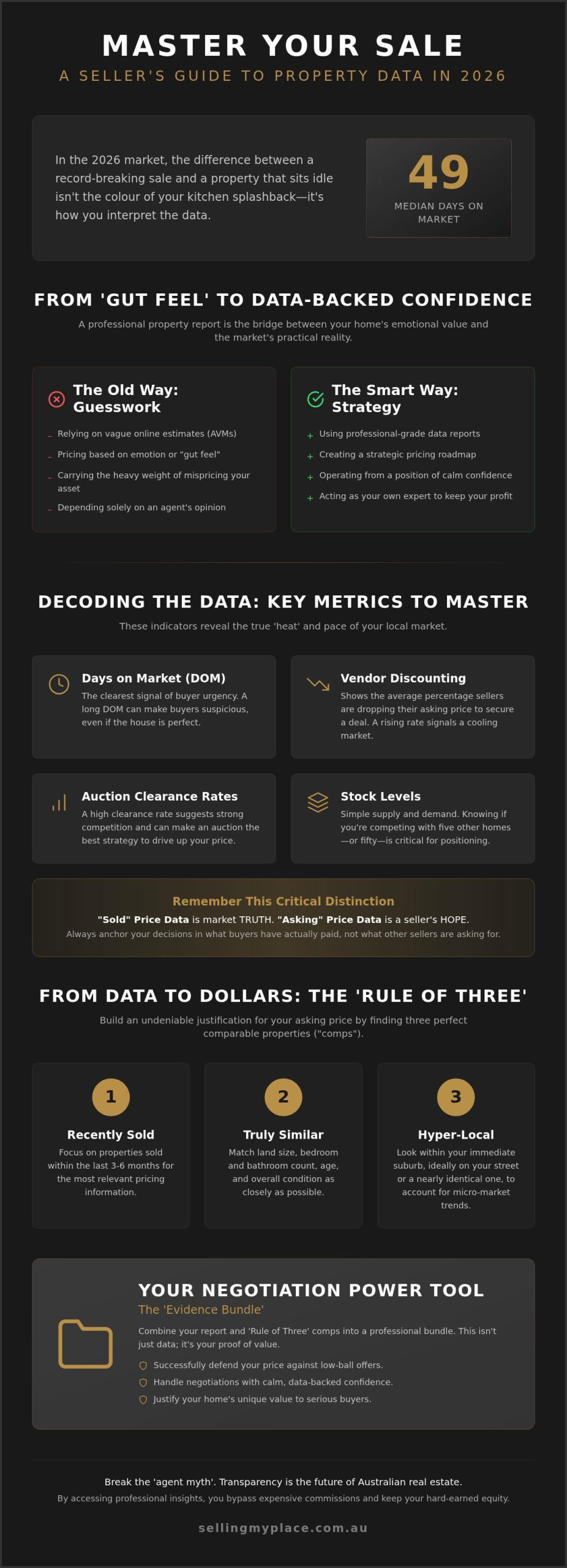
What if the difference between a record-breaking sale and a property that sits idle isn’t the colour of your kitchen splashback, but how you interpret a few lines of data? In 2026, the market is moving at a unique pace; with median days on market averaging 49 days, the sellers who succeed look beyond the glossy photos. It’s natural to feel overwhelmed when you first learn how to use a property market report, especially when faced with spreadsheets that feel more like homework than a helping hand. You want to honour your home’s history while making a savvy financial move, but the fear of mispricing your asset is a heavy weight to carry.
We understand that selling is a major life transition, not just a transaction. This article will help you turn raw data into a strategic pricing roadmap, giving you the confidence to set a competitive asking price. We’ll explore which data points truly drive value and how to use this evidence to justify your price to buyers. By the end, you’ll have the tools to be your own expert, ensuring you keep every cent of your profit. Whether you are looking for stability or a fresh start, we are here to provide the steady hand you need.
Key Takeaways
- Move beyond guesswork by learning how to anchor your sale in professional-grade data that reflects the actual state of the 2026 market.
- Discover exactly how to use a property market report to decode metrics like Days on Market, ensuring you set a price that attracts genuine interest from day one.
- Master the ‘Rule of Three’ to find perfect comparable properties, helping you build a data-backed justification for your home’s unique value.
- Learn to create an ‘Evidence Bundle’ that empowers you to handle negotiations with calm confidence and successfully defend your price against low-ball offers.
- Understand how to leverage professional neighbourhood insights to bypass expensive commissions and keep more of your hard-earned equity in your own pocket.
Understanding the Power of a Property Market Report
A property market report is a sophisticated synthesis of historical sales, current listings, and broader suburb trends. Think of it as a bridge between the emotional value you place on your family home and the practical reality of what a buyer is willing to pay. While many people think these documents are just for buyers looking for a bargain, sellers actually need this data far more in the current 2026 market. With the market often described as being in a “holding pattern” as we watch interest rate decisions, having a clear view of Understanding Real Estate Economics is vital to your success.
Data provides a “steady hand” during what is naturally an emotional process. It moves you away from the stress of “gut feel” and into a position of calm confidence. You might have seen Automated Valuation Models (AVMs) online; those quick, computer-generated estimates that often vary by tens of thousands of dollars. While they are a starting point, they lack the nuance of a professional report. A professional document provides a strategic roadmap rather than a random guess, ensuring you don’t leave money on the table or scare off buyers with an unrealistic figure.
The Anatomy of a Modern Property Report
A truly useful report goes beyond a simple price range. It breaks down the sales history of your immediate area, identifies comparable properties, and analyses suburb demographics. One of the most critical things to remember is that “Sold” data is significantly more valuable than “Asking Price” data. An asking price is often a reflection of a seller’s hope; a sold price is a reflection of market truth. Most high-quality reports draw from professional-grade digital infrastructure like RP Data or CoreLogic, which are the same tools used by the country’s top-tier agencies and official government records.
Breaking the ‘Agent Myth’
For a long time, there was a belief that only real estate agents held the “secret” keys to market data. That simply isn’t true anymore. Transparency is the future of Australian real estate. By accessing these same professional insights, you can accurately determine the market value of a home in Australia without needing a traditional agent. Learning how to use a property market report allows you to act as your own expert. It removes the need for expensive commissions and puts the power back into your hands, where it belongs. You aren’t just selling a house; you’re managing a major life transition with the best evidence available.
Decoding the Data: Key Metrics Every Seller Must Know
Looking at a spreadsheet for the first time can feel a bit like reading a different language. However, once you grasp the core metrics, the fog starts to lift. Learning how to use a property market report begins with the Median Suburb Price. It’s a helpful benchmark for your general area, but please don’t treat it as a bible for your specific home. Your property has its own soul and unique features; a median price doesn’t account for that stunning new deck or the quietness of your particular street.
Then we have Auction Clearance Rates and Vendor Discounting. These metrics reveal the “heat” of the local market. If clearance rates are high, an auction might be your best bet to drive competition. On the flip side, vendor discounting tells you how much other sellers are dropping their prices to get a deal across the line. If you notice discounting is on the rise, it’s a signal to be more realistic with your initial figure. It’s about being proactive rather than reactive. If you’re feeling stuck on these numbers, our team is always happy to discuss your specific report.
Reading Between the Lines of ‘Days on Market’
Days on Market (DOM) is perhaps the most telling indicator of buyer urgency. A short DOM suggests a “seller’s market” where buyers are tripping over themselves to sign a contract. A long DOM, perhaps approaching the 2026 average of 49 days seen in similar global markets, often points to a “cooling” phase. This metric carries a heavy psychological weight. When a property sits on the market for too long, buyers begin to wonder if something is wrong, even if the house is perfect. Knowing how to use a property market report allows you to identify these shifts before the evening news catches up.
Supply and Demand Indicators
You also need to look at stock levels. Are you competing with five other homes or fifty? High stock levels mean you need to work harder to stand out, perhaps through better photography or more flexible viewing times. Don’t forget about rental yields, either. Even if you’re selling to a family, high yields attract investors, which broadens your pool of potential buyers and adds another layer of demand. Sometimes, a “micro-market” trend might emerge where houses on one side of a park sell faster than the other. These tiny details are what turn a standard sale into a strategic success, helping you protect your family’s future wealth.
From Data to Dollars: Setting Your Asking Price
Now that you’ve grasped the core metrics, it’s time to translate those numbers into a figure that works for your family’s future. Selecting your “comps,” or comparable properties, is where the art meets the science. You aren’t just looking for any house that sold nearby; you are looking for three to five properties that mirror your own in land size, bedroom count, and the quality of the finish. This is the heart of how to use a property market report effectively. It allows you to move past the generic estimates of a computer and into a “Street-Smart” valuation that reflects the real world.
We often recommend the “Rule of Three” when analysing these comps. Look at three recently sold homes to see what buyers actually paid, three currently listed homes to see who you’re competing against, and three failed listings. Those failed listings are often the best teachers; they show you exactly where the market said “no” to a price. While it’s tempting to add a 5% “buffer” to your price for negotiation room, this can often lose you money. In a market where 24.5% of homes might sell above list price if priced correctly, an unrealistic starting point can make your home go stale, leading to a lower eventual sale price than if you’d been sharp from day one.
The Comparison Framework
When matching your home to others, be honest about the “X-Factor.” Does your neighbour have a better view? Is your kitchen renovation more modern? You must adjust your price up or down for these differences. It’s also vital to ignore “outlier” sales, such as a property sold to a developer at a massive premium that doesn’t fit the local pattern. By filtering this data accurately, you gain the upper hand to sell your own home with a genuine competitive edge. You become the most informed person in the room, which is a very powerful place to be.
The ‘Sweet Spot’ Strategy
Psychological pricing plays a huge role in how buyers search online. There is a significant difference between listing at $995,000 and $1,000,000, as it often places you in different search result brackets. Testing the market is a dynamic process; if your report feedback suggests buyer interest is low after the first two weeks, you must be prepared to review your position. Ultimately, true market value is the quiet intersection where hard data meets the emotional spark of a buyer who can finally see their future in your hallway.
Using Your Report as a Negotiation Tool with Buyers
Negotiation can often feel like a high-stakes standoff, particularly when it’s your own family home on the line. However, knowing how to use a property market report as a communication tool changes the dynamic entirely. Instead of a “he said, she said” scenario, you can present a serious buyer with what we call an Evidence Bundle. This is essentially a curated selection of the data you’ve already analysed, shared openly to build trust. When a buyer sees that your price isn’t just a hopeful number but is anchored in actual sold data, the conversation shifts from conflict to collaboration.
This transparency is your best defence against a low-ball offer. If a buyer suggests a figure well below your asking price, you don’t need to get defensive or emotional. You simply point to the “Sold” section of your report. You might say, “I understand you’re looking for a bargain, but the data shows three similar homes on this street sold for a higher price per square metre in the last quarter.” It’s about maintaining a steady hand and letting the evidence do the heavy lifting for you. If you need a hand preparing this data, you can always reach out to our advisory team for a chat.
Handling Objections with Facts
Buyers in 2026 are often cautious, sometimes citing headlines about “market crashes” to justify a lower bid. This is where your clearance rate data becomes invaluable. If your local clearance rates are holding steady, you can gently correct their assumption with local facts rather than opinions. Similarly, if you are justifying a premium price for a premium position, use the land value data in your report to show the scarcity of your block size. Combining these hard facts with proven property sale negotiation tips allows you to stay in control of the narrative without ever sounding pushy.
Creating a Transparent Sales Environment
There is a quiet power in being a “Smarter Seller” rather than a traditional salesperson. When you show a buyer the low stock levels in your neighbourhood market report, you aren’t manufacturing urgency; you are simply showing them the current reality of supply and demand. Buyers are far more likely to sign a contract when they feel they have all the information. By explaining how to use a property market report to them, you position yourself as a trusted guide. It’s a neighborly approach that says: “The data supports this price, and here is why.” This level of honesty often reduces the stress for both parties and leads to a much smoother transition for everyone involved.
Maximising Your Profit with Professional Neighbourhood Market Reports
While generic online estimates can provide a rough starting point, they are often a blunt instrument in a market that requires a scalpel. These automated tools use broad algorithms that simply cannot account for the subtle nuances of Australian residential homes, such as the quietness of a particular cul-de-sac or the bespoke quality of a recent renovation. This is where a professional neighbourhood market report proves its worth. By using the same professional-grade digital infrastructure as the country’s top agencies, you ensure your pricing strategy is built on solid ground rather than digital guesswork.
The KIDS Advantage
Our Residential Property Listing Services are designed to bridge the gap between high-level data and global marketing. By choosing a flat-fee model, the average seller saves $20,000 in commissions that would otherwise eat into their family’s equity. We believe this is the most protective way to sell; it allows you to keep 100% of your hard-earned profit while still accessing the professional tools usually reserved for traditional agencies. It’s about empowering you to be the expert of your own home, backed by a team that values your legacy as much as you do.
Data is a powerful map, but sometimes you need a guide to help you read the terrain. That’s why we include an Expert Agent Advisory Service to help you interpret your specific report. Whether you’re unsure about a particular comparable sale or need to refine your “sweet spot” price, having a seasoned professional to talk to provides that essential steady hand. Learning how to use a property market report becomes much simpler when you have a partner who can help you spot the micro-market trends that others might miss.
Your Next Steps to a Successful Sale
Before your property goes live on the global market, it’s helpful to run through a final check to ensure your data and presentation are perfectly aligned. Taking control of your equity means being prepared for every buyer interaction with confidence and clarity. Here is a brief roadmap for your next steps:
- Request your professional neighbourhood market report to get the most recent “Sold” data.
- Organise professional photography and floorplans that highlight the features your data-backed price reflects.
- Review your comparable sales once more to ensure they are within the last six months.
- Prepare your “Evidence Bundle” so you can show buyers exactly how to use a property market report to understand your home’s value.
By following this methodical approach, you aren’t just putting a sign in the ground. You are launching a strategic campaign that celebrates your home’s history while securing your financial future. It’s a celebratory moment, and we’re here to ensure you feel supported every step of the way.
Taking the Next Step Toward Your Successful Sale
Selling your home is more than a simple trade; it is the closing of one chapter and the hopeful start of another. By now, you understand that a successful sale in 2026 relies on more than just luck or a “gut feeling”. It requires a strategic alignment with the market truth found in your data. Mastering how to use a property market report gives you the upper hand, allowing you to defend your price with evidence and negotiate with a sense of calm authority. You’ve learned how to filter out the noise of generic estimates and focus on the “Sold” data that truly reflects your home’s worth.
You don’t have to walk this path alone. You can maximise your profit and sell smarter with a KIDS flat-fee package today. Our service ensures you keep 100% of your sale profit while providing the professional neighbourhood market reports and expert advisory support you need at every step. This is your opportunity to take control of your equity and move forward with total peace of mind. We are here to provide the steady hand you deserve as you step into your next adventure.
Frequently Asked Questions
How accurate are free online property valuation reports in Australia?
Free online reports, often called Automated Valuation Models, are general estimates based on broad algorithms. They can vary significantly because they don’t account for the “X-factor” of your specific home, such as a high-quality renovation or a quiet street position. A professional neighbourhood market report is much more reliable. It uses agency-grade digital infrastructure and historical sold data to give you a clearer picture of your home’s actual value in the 2026 market.
What is the difference between a market report and a bank valuation?
A market report reflects what a buyer might pay based on comparable sales and current trends. A bank valuation is a conservative assessment used for lending risk. Banks often value properties lower than the market price to protect their own mortgage interest. In contrast, a market report helps you set a strategic asking price to maximise your profit. It focuses on the potential sale price rather than just a minimum security value.
Should I share my property market report with potential buyers?
Sharing a report can build trust and transparency with serious buyers. It creates an “Evidence Bundle” that justifies your asking price. When buyers see the data you used, they feel more confident that your figure isn’t just a guess. Learning how to use a property market report as a negotiation tool helps you counter low-ball offers by showing the reality of recent local sales in a professional, non-confrontational way.
How often should I update my property market research during a sale?
You should update your research every 30 days or if a major economic shift occurs, such as an interest rate change. In 2026, the market can shift quickly. Keeping your data fresh ensures you aren’t basing your decisions on outdated sales that no longer reflect current buyer sentiment or stock levels. Regular updates allow you to stay proactive and maintain a “steady hand” throughout the entire sale process.
What are ‘comparable sales’ and how many do I need?
Comparable sales are properties similar to yours in land size, bedroom count, and quality that sold within the last six months. We recommend finding three to five properties that closely mirror your home. This gives you a statistically significant sample size to accurately determine your property’s value. It ensures your pricing isn’t skewed by a single outlier sale, providing a much more reliable foundation for your own sale by owner strategy.
Can a property report help me decide whether to sell by auction or private treaty?
Absolutely. By looking at auction clearance rates in your report, you can gauge the “heat” of the local market. High clearance rates suggest an auction might drive healthy competition. Conversely, if clearance rates are low, a private treaty allows more time for thoughtful negotiation. Your report provides the evidence needed to choose the most effective sale method for your specific circumstances, helping you feel supported and in control.
Why is the ‘median price’ in my report different from what I think my home is worth?
The median price is the middle point of all sales in an area, meaning it includes everything from unrenovated cottages to luxury builds. It is a benchmark for the suburb’s general performance, not a specific valuation of your home. Understanding how to use a property market report involves looking beyond the median to find the specific “comps” that match your home’s unique features, lifestyle appeal, and the legacy you have built there.
What happens if the report data contradicts my expectations?
If the data is lower than expected, it’s a signal to review your strategy before going live. It might mean the market has cooled or your expectations were based on outdated figures. Using a professional report allows you to adjust your price proactively. This prevents your home from sitting on the market too long and becoming “stale” in the eyes of buyers. It’s about making informed decisions that protect your family’s future equity.
Neighbourhood Market Reports: The Australian Seller’s Guide to Pricing with Confidence
What if the “expert” appraisal sitting on your kitchen bench is more about winning your signature than actually securing your family’s financial future? It is a daunting thought, especially as you try to make sense of neighborhood market reports while national house values have dipped by 1.1% throughout 2026. You likely feel the weight of this transition, perhaps even a bit of frustration at the conflicting data landing in your inbox. It is completely natural to worry about underpricing your most valuable asset or feeling pressured by agents who might be over-promising just to secure a listing.
We believe that local data is the ultimate equaliser for Australian homeowners. In this guide, you will learn how to interpret property data with the calm confidence of a seasoned pro. We are going to show you how to strip away agent bias, value your home accurately, and negotiate like an expert; all while keeping your hard-earned equity instead of paying it away in commissions. We will walk through the specific metrics that matter most in today’s market, giving you the tools to move toward your next chapter with total peace of mind.
Key Takeaways
- Learn why real-time data is more reliable than historical ‘gut feelings’ or outdated anecdotes in the shifting 2026 property market.
- Discover how neutral neighborhood market reports provide an objective truth, helping you avoid the common trap of over-inflated appraisals used to ‘buy’ your listing.
- Identify your property’s pricing ‘sweet spot’ by analysing actual sold prices rather than just the aspirational asking prices of your local competition.
- Master the art of timing your sale by using seasonal trend data to choose a listing date that maximises buyer interest and competition.
- Understand how a flat-fee model combined with professional advisory keeps your equity where it belongs, ensuring your strategy is always focused on your family’s bottom line.
Decoding Neighbourhood Market Reports: Why Data is Your Best Friend in 2026
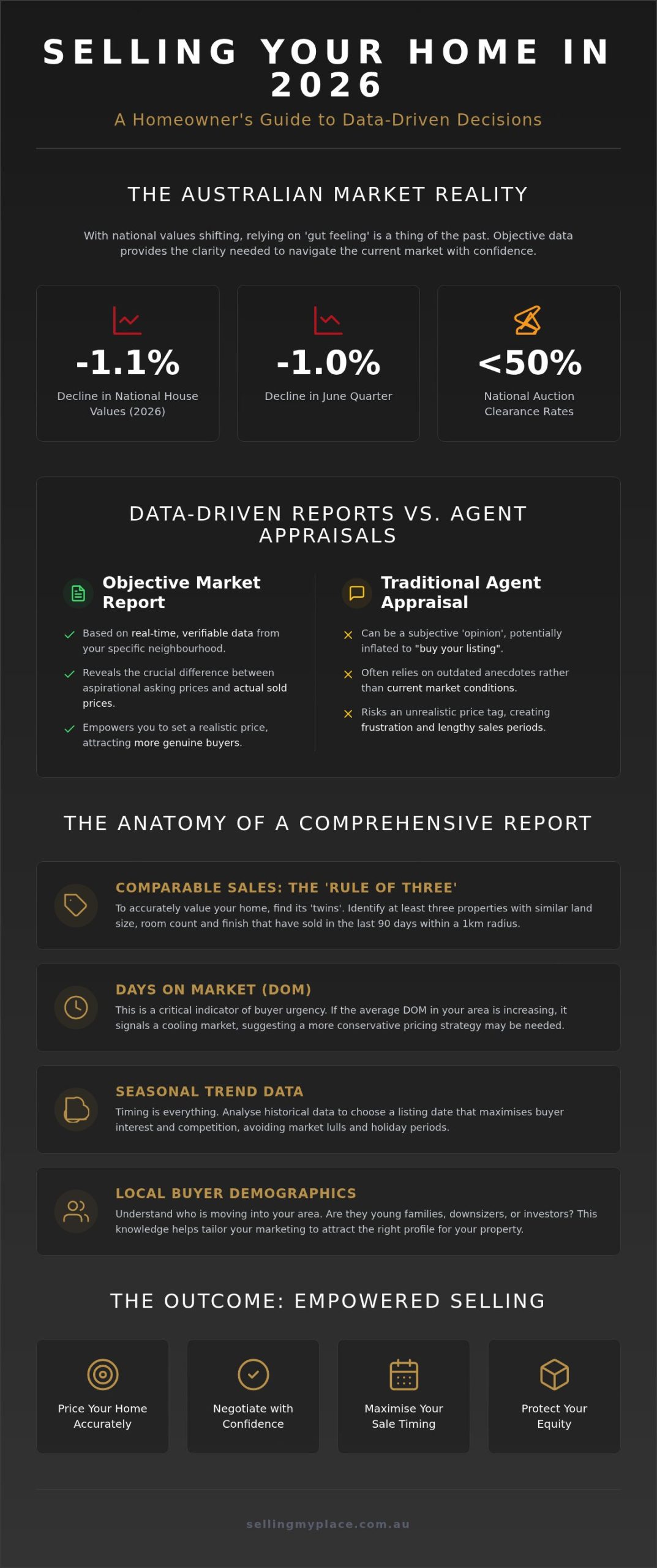
The Australian property landscape in 2026 feels remarkably different than the post-COVID boom years. With national house values falling by 1.1% over the calendar year and the June quarter recording a 1.0% decline, the “gut feeling” approach to pricing is officially a thing of the past. This is where neighborhood market reports become your most valuable asset. They offer a data-driven snapshot of local performance that cuts through the noise of conflicting news headlines and dinner party anecdotes. Think of it as a clinical pulse check for your specific street, providing the clarity you need to make big decisions with a calm heart.
It’s vital to distinguish these from the simple Automated Valuation Models (AVMs) you might find on a bank’s website or a quick online estimator. While an AVM provides a rough guess based on broad suburb trends, a comprehensive market activity report dives into the specific nuances of your exact pocket. For anyone embarking on a sale by owner journey, this data acts as your foundational “steady hand.” It ensures you aren’t leaving money on the table or scaring off genuine buyers with an unrealistic figure that doesn’t align with current market conditions.
The Shift from Agent ‘Opinions’ to Hard Data
For decades, real estate agents held the “black box” of property data, leaving owners to rely entirely on their professional word. Today, digital transparency has shifted that power back into your hands. Buyers in 2026 are incredibly savvy; they’ve done their homework and they expect you to have done yours. Relying on an objective report rather than a traditional real estate appraisal helps remove the emotional attachment we all naturally feel toward our family homes. It’s much easier to negotiate when you can point to hard evidence rather than just an agent’s optimistic opinion, which might be inflated to secure your listing.
Key Metrics Every Australian Seller Should Track
To price with confidence, you need to look beyond the broad suburb median. Street-level performance often tells a very different story, especially in suburbs with diverse housing styles. Keep a close eye on Days on Market (DOM). If the average DOM is creeping up, it signals that buyer urgency is cooling. Similarly, with national auction clearance rates dropping below 50% in June 2026 for the first time since the 2020 lockdowns, you need to understand how this affects private treaty expectations. High-quality neighborhood market reports track these shifts in real-time, allowing you to pivot your strategy before the first open home even begins.
The Anatomy of a Comprehensive Property Report: What Really Matters
A truly effective property report is far more than a simple list of addresses and numbers. It’s a narrative of your local community’s recent history and a roadmap for your financial future. While broad Australian Bureau of Statistics data provides a high-level view of national trends, your success depends on understanding the specific heartbeat of your street. In a market where national house prices have recently dipped, distinguishing between an aspirational “asking price” and the cold, hard reality of a “sold price” is the difference between a successful settlement and a listing that languishes for months.
Comprehensive neighborhood market reports should also shed light on who is actually moving into your area. Are young families snapping up unrenovated post-war homes, or are downsizers looking for low-maintenance units? Knowing these demographic shifts allows you to tailor your presentation and marketing to the exact buyer profile most likely to fall in love with your home. It’s about working smarter, not harder, to protect your family’s legacy.
Comparables (Comps): Finding Your Home’s ‘Twins’
To value your home accurately, you must find its “twins” in the local area. This process involves looking at properties with similar land size, room counts, and level of finish. We suggest following the “Rule of Three”: identify at least three homes within a one-kilometre radius that have sold in the last ninety days. This provides a statistically significant baseline. Of course, no two homes are identical. You’ll need to make honest adjustments for your own property’s unique features. A sparkling new magnesium pool or a high-end kitchen renovation might add a specific premium, while a lack of off-street parking could require a slight downward adjustment to stay competitive.
Market Velocity and Inventory Levels
Understanding market velocity helps you gauge your negotiation leverage. If the “Stock on Market” is low, you’re in a position of strength, as buyers have fewer choices and may be willing to pay a premium to secure a stable home. Conversely, when inventory is high, your pricing must be razor-sharp to stand out. The absorption rate determines how many months it would take to sell all current listings at the current rate of sales, providing a clear window into buyer demand. If the data feels a bit overwhelming, you can always reach out for local property guidance to help interpret these shifting numbers with total clarity.
Market Reports vs. Real Estate Agent Appraisals: Cutting Through the Noise
It’s a scenario many Australian families face: three different agents walk through your front door, and you receive three wildly different numbers. One might be exactly what you hoped for, while another feels like a bit of a low-ball. This is where the “Buying the Listing” trap often catches well-meaning sellers. Some agents intentionally over-inflate their initial appraisal to win your business, knowing full well they will need to “condition” you to accept a lower price a few weeks into the campaign. It’s a stressful cycle that can be avoided by looking at the objective facts found in neighborhood market reports.
When you rely on a neutral data source, you’re choosing to determine the market value of a home in Australia without the polished sales pitch. The cost of a wrong appraisal isn’t just a bruised ego; it’s a tangible financial hit. Overpricing often leads to a “stale” listing that sits on the market for months. Buyers begin to wonder what’s wrong with the property, eventually leading to low-ball offers that fall far below what you might have achieved with a sharp, data-backed opening price. By checking the latest Australian Bureau of Statistics property values, you can see how your local expectations align with the broader state-level shifts, keeping your strategy grounded in reality.
The Psychology of the ‘Appraisal’ Process
Agents are often masters of persuasion, focusing on the highest possible price during their initial presentation. However, their primary goal is to get your signature on a listing agreement. Once the property is on the market, the conversation often shifts toward “the market is speaking” as they push you to lower your expectations. Using a market report allows you to cross-examine these claims. If an agent suggests a price significantly above recent local sales, you can ask for the data to back it up. A flat-fee model removes this conflict of interest entirely, as the advisor has no incentive to misrepresent the data just to secure a higher commission later.
Objectivity: Your Secret Weapon in Negotiation
Staying grounded in the numbers is your best defence against the emotional roller coaster of selling a home. When a buyer makes an offer, you can present the data from your report to justify your price point. This builds a bridge of trust that a verbal estimate from an agent simply can’t match. Buyers respect a seller who has done their homework and can point to neighborhood market reports as the basis for their decision. It transforms the negotiation from a battle of wills into a professional conversation about value, helping you stand your ground with calm confidence.
How to Leverage Local Data to Maximise Your Sale Price
Having the data at your fingertips is one thing; knowing how to wield it is what separates a standard sale from a result that truly changes your family’s future. Once you have digested your neighborhood market reports, the focus shifts to execution. It is about more than just a number on a screen; it is about how you present that value to the world. By aligning your Residential Property Listing Services strategy with the hard facts of your suburb, you can command attention and justify a premium price point with total confidence.
Strategic timing is another lever you can pull. Your report might reveal that four-bedroom family homes in your specific pocket sell for a notable premium in the spring, or perhaps that buyer activity peaks just after the school holidays. Beyond timing, you should highlight local strengths that data-savvy buyers crave. If your home sits within a coveted school catchment or boasts a high “Walk Score” to local cafes, these are non-negotiable features for your listing description. These details transform a house into a lifestyle opportunity, making it much easier for a buyer to see the long-term value of the investment.
Strategic Pricing Brackets
Most Australian buyers start their journey on major property portals, using specific price filters to narrow their search. These engines typically operate in $50,000 or $100,000 increments. If you price your home at $1,005,000, you will completely disappear from the search results of anyone with a $1M cap. This is why the “Sweet Spot” is so vital. Pricing at $995,000 ensures you appear in the maximum number of relevant searches while remaining just below a significant psychological barrier. It is the “Goldilocks” price; high enough to reflect your home’s worth, yet accessible enough to ignite a competitive bidding environment.
Using Reports for Pre-Sale Improvements
Before you pick up a paintbrush or call a landscaper, look at the “sold” comps in your report. You might find that in your area, a modernised kitchen adds far more value than a new deck. This allows you to invest your pre-sale budget where it will actually move the needle on your final sale price. Value-Add potential is identified through comparative market analysis by isolating specific features in recently sold local homes that commanded a clear price premium over unrenovated counterparts. If you are ready to see how this data applies to your specific street, reach out for a tailored market breakdown today.
Empowered Selling: How Kincade International Direct Sales Backs Your Strategy
Selling your home is a major life transition, and we don’t think you should have to sacrifice your hard-earned equity just to get professional support. The Kincade International Direct Sales (KIDS) approach is built on a foundation of transparency and partnership. We provide the exact same professional-grade neighborhood market reports that the “big” franchise agencies use, but we do it without the traditional commission structure. This means you can keep more of your profit, often saving an average of $20,000, while still having access to the highest quality data available in 2026. It is about giving you the same tools as the experts, without the high marketing costs or the pressure of a percentage-based fee.
Integration is key to a successful sale. Once you have your data, we help you weave those findings into a comprehensive marketing package. This isn’t just about putting a price on a website; it’s about building a compelling case for your home’s value. By combining your report insights with professional photography and floorplans, you create a listing that reflects the true worth of your property. This professional presentation attracts serious buyers who respect your informed position, allowing you to move through the process with a sense of calm confidence. We believe that when you are better informed, you are better protected.
Beyond the Data: The Agent Advisory Service
While data is powerful, interpreting it correctly is what makes mastering the deal second nature. Our Real Estate Advisory Services act as the “steady hand” you need when the numbers feel complex or the market feels volatile. Our advisors provide personalised pre-sale consulting to bridge the gap between a PDF report and a “Sold” sticker on your front gate. You aren’t just getting a document; you’re getting a partnership that aims to reduce the stress of the negotiation process. This guidance ensures that every decision you make is grounded in reality and focused on your family’s long-term stability.
Your Next Steps to a Commission-Free Sale
Taking control of your sale starts with a single, informed step. You can access your comprehensive neighborhood market reports today to begin your journey toward a commission-free settlement. From there, we help you prepare a professional listing with high-end photography and accurate floorplans, ensuring your home is presented in its best possible light. It is your home, your legacy, and your equity; we are simply here to ensure you have the tools to protect it all while selling on your own terms. We invite you to step into this process with us, knowing you have the support of a seasoned team that values your results as much as you do.
Step Into Your Next Chapter with Confidence
The journey of selling a family home is about more than just a transaction; it’s about honouring your hard work and protecting your future. You now have the knowledge to look past the noise of inflated appraisals and trust the objective truth found in neighborhood market reports. By focusing on actual sold data and strategic pricing brackets, you can navigate the shifts of the 2026 market with the calm authority of a seasoned pro. It’s about being informed, staying grounded, and making decisions that truly serve your family’s best interests.
At Kincade International Direct Sales, we are here to ensure you don’t have to walk this path alone. Our approach combines professional-grade data with an expert Agent Advisory Service, allowing you to keep 100% of your sale profit. You can access high-end professional marketing and street-level insights without the burden of a traditional commission. Are you ready to take the lead in your property sale? Get Your Professional Neighbourhood Market Report and Save Thousands today. We look forward to being the steady hand that helps you secure the result your family deserves.
Frequently Asked Questions
What is the difference between a market report and a bank valuation?
A bank valuation is a conservative assessment focused on lender risk, whereas a market report identifies the price a willing buyer is likely to pay in the open market. Banks often value properties lower to protect themselves against potential market shifts. A market report provides a more optimistic yet realistic range based on actual buyer competition and recent local momentum.
How often should I update my neighbourhood market report before listing?
In the shifting landscape of 2026, we suggest updating your data every 30 days. With national house values experiencing a correction, prices can move quickly. Staying current ensures your strategy remains aligned with the latest settled sales rather than outdated figures from months ago. It’s about maintaining that steady hand throughout your campaign so you don’t miss a beat.
Can I get a neighbourhood market report for free in Australia?
You can find basic summaries for free through bank apps or property portals, but they often lack the street-level nuance of a professional report. Free versions usually provide a broad suburb median which can be misleading for specific pockets. For a high-stakes sale, a comprehensive report ensures you aren’t missing the specific details that justify a premium price for your unique home.
Are online property value estimates actually accurate in 2026?
Online estimates are helpful starting points but often miss the heart of a home. They can’t see your high-end kitchen renovation or the quietness of your specific cul-de-sac. This is why neighborhood market reports are superior; they allow for a human-led interpretation of the data that accounts for the unique lifestyle features an algorithm might overlook during a market correction.
Does a neighbourhood market report include ‘off-market’ sales data?
Most reports focus on settled sales data, which is the most reliable truth in property. While off-market sales are common, they aren’t always publicly recorded with the same level of detail immediately. A professional report will focus on the most transparent and verifiable data to ensure your pricing strategy is defensible during a tough negotiation with a savvy buyer.
How do I use a market report if there haven’t been any sales in my street recently?
If your specific street is quiet, we expand the search to comparable pockets within your suburb. We look for areas with similar land sizes, school catchments, and proximity to local centres. This broader view provides a statistically significant baseline, allowing you to price your home accurately even when immediate street-level data is sparse or outdated.
Will a market report help me decide between an auction or a private treaty sale?
Absolutely. By analysing local auction clearance rates, which fell below 50% nationally in mid-2026, neighborhood market reports help you gauge the current appetite for public bidding. If your area shows a high percentage of properties passing in, a private treaty sale with a clear price might be the more reassuring and effective path for your family.
How do I explain my data-driven price to a buyer who thinks it’s too high?
Lead with the data rather than emotion. When a buyer questions your price, you can physically show them the recent comparable sales of “twin” properties in the area. This shifts the conversation from a personal disagreement to an objective discussion about market reality. It builds trust, as the buyer can see you’ve based your expectations on verifiable facts rather than guesswork.
