Navigating the Australian Property Market: How to Negotiate with a Buyer’s Agent
What if the A$20,000 you saved on your property sale wasn’t just a number on a balance sheet, but the strategic “war chest” that secures your next family home? For many Australians, the thought of re-entering the market brings a wave of genuine anxiety, especially when faced with the aggressive auction culture that defines our local landscape. You might worry about being locked into a restrictive exclusive agreement or, worse, paying a double commission that eats into your hard-earned equity. It’s a lot to manage while you’re trying to imagine your new life in a different neighbourhood. Understanding how to negotiate with a buyer’s agent is the key to transforming this stress into a grounded, professional partnership.
We believe your property journey should feel like a supported transition, not a transactional battle. In this article, you’ll learn the professional tactics to negotiate terms with a buyer’s advocate so their expertise works solely for your benefit. We’ll show you how to move past the industry jargon and secure a transparent, flat-fee agreement that feels fair and protective. We will explore how to access those elusive “silent” off-market listings and use professional auction bidding to shield your savings. It’s about finding that steady hand to guide you home with total confidence (and perhaps a bit of well-deserved excitement, too).
Key Takeaways
- Understand the vital shift from being a “customer” of a selling agent to a “client” with a dedicated advocate who works exclusively in your corner.
- Learn how to negotiate with a buyer’s agent to secure a transparent, flat-fee agreement that prioritises your long-term stability over a quick transaction.
- Gain the upper hand in the competitive Australian market by accessing “silent” off-market listings and professional bidding strategies that protect your equity.
- Identify and avoid “Dual Agency” conflicts of interest to ensure your representative remains a truly independent, steady hand throughout the process.
- Discover how reinvesting the average A$20,000 saved through a commission-free sale can provide the “war chest” needed to hire expert representation for your next purchase.
What is Buyer Representation and Why is it Essential in 2026?
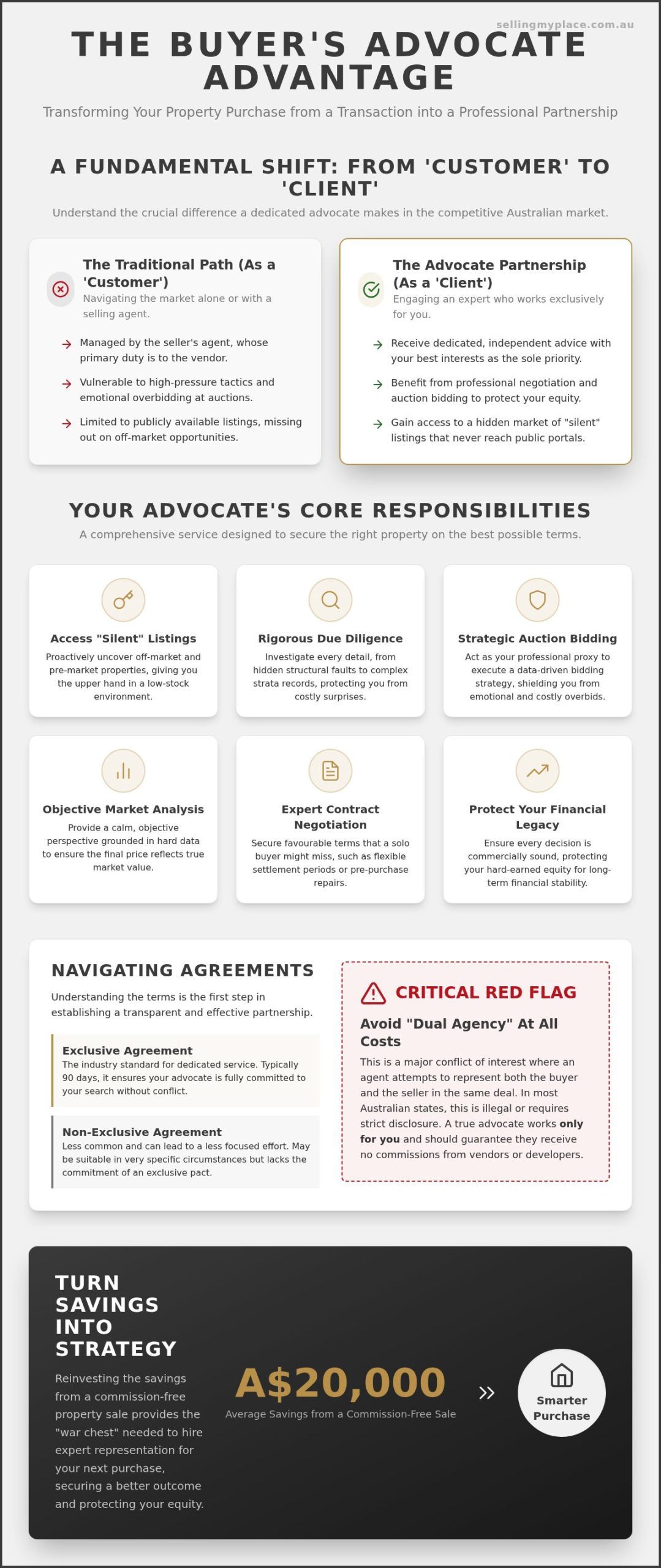
In the Australian property market of 2026, the traditional way of buying a home has fundamentally shifted. For decades, purchasers were often treated merely as “customers” of the selling agent; someone to be managed rather than truly served. Today, buyer representation has evolved into a professional partnership where your advocate works exclusively for you. It’s a fiduciary alliance that moves you from the outside looking in to having a seat at the professional table. Understanding What is a Buyer’s Agent? is the first step in reclaiming your power during a purchase. With property stock levels remaining stubbornly low across the country, having a professional in your corner isn’t just a luxury. It’s a strategic necessity to access “silent” listings that never reach the public portals. Buyer representation is the professional insulation between a buyer and the high-pressure tactics of selling agents.
The 2026 market demands a different approach. It’s no longer enough to wait for an alert on your phone. You need someone who can walk into a local agency and ask about the homes that aren’t on the market yet. This proactive stance is what separates a successful purchase from a missed opportunity. When you learn how to negotiate with a buyer’s agent, you’re essentially hiring a steady hand to guide you through these complexities with heart and expertise.
The Core Purpose of a Buyer Advocate
A skilled advocate does more than just browse listings. They act as your eyes and ears on the ground, identifying properties that match your specific lifestyle needs long before the “For Sale” sign goes up. This includes a deep dive into the bones of a building. They execute rigorous due diligence to uncover potential deal-breakers, such as hidden structural issues or complex strata records that could drain your superannuation later. By removing emotional bias, they ensure every decision is grounded in data. They provide a calm, objective perspective when the stakes feel highest. It’s about finding the right fit for your family’s future, not just any house that’s available.
How Representation Protects Your Financial Legacy
Protecting your equity is at the heart of this partnership. We’ve all seen the adrenaline-fuelled energy of a Saturday auction lead to emotional overbidding. An advocate prevents this by acting as your proxy, ensuring the final bid aligns with true market value rather than a vendor’s optimistic expectations. Beyond the price, they secure favourable contract terms that a solo buyer might miss. This might mean negotiating a flexible settlement period to align with your own house sale or ensuring specific repairs are completed before you pick up the keys. They protect your financial legacy through expert, level-headed negotiation.
The Different Types of Buyer Representation Agreements in Australia
Entering into a formal agreement with a professional advocate is a significant milestone in your property journey. In Australia, these documents are governed by state specific legislation, such as the Property and Stock Agents Act or the Estate Agents Act. These laws ensure that your interests are protected through a clear legal framework. However, the fine print is where the real partnership is defined. Understanding how to negotiate with a buyer’s agent starts with recognising that these agreements are not one size fits all. They are negotiable tools designed to align your advocate’s incentives with your long term lifestyle goals.
One of the most critical elements to verify is the absence of “Dual Agency.” This occurs when an agent attempts to represent both the buyer and the seller in the same transaction. In most Australian jurisdictions, this is a clear conflict of interest and often illegal without rigorous disclosure. To ensure your advocate is truly independent, look for a clause that guarantees they receive no kickbacks or commissions from vendors or developers. A “steady hand” guide should only have one master: you.
Exclusive vs. Non-Exclusive Agreements
Most reputable advocates prefer an exclusive agreement, typically lasting for 90 days as per 2026 REBAA standards. While “exclusive” might sound restrictive, it’s often the only way to secure high quality off-market listings. Why? Because an advocate won’t tap into their private network or “silent” neighbourhood contacts if they feel you might bypass them at the last minute. Conversely, non-exclusive or “open” agreements are often used for auction bidding only. These are useful if you’ve already found the home but need a professional to handle the high pressure environment of the auction floor without the emotional fog of war.
Standard Clauses You Must Understand
Before you sign a “Buyer’s Authority to Purchase,” pay close attention to the fee structure. You have the right to negotiate between a percentage-based fee and a transparent flat-fee model. Many families find that a flat-fee provides more peace of mind, as it removes any incentive for the agent to encourage a higher purchase price. You should also scrutinise the termination rights. Ensure there is a clear “sunset clause” that allows you to exit the partnership if the search isn’t progressing as expected. If you’re feeling unsure about the legalities, it’s always wise to reach out for professional advice before committing your signature.
Use this quick checklist before signing any representation document:
- Duration: Is the agreement capped at a reasonable timeframe, such as 60 or 90 days?
- Scope: Does it clearly define the specific property types and price ranges they are searching for?
- Fees: Is the total cost, including any engagement fees, clearly capped and documented?
- Termination: Can you end the agreement with a standard notice period if the relationship isn’t working?
How to Negotiate with a Buyer’s Agent: Strategy to Settlement
Once the paperwork is finalised, the real work begins with a deep-dive strategy session. This is your first opportunity to learn how to negotiate with a buyer’s agent regarding the actual search parameters. It’s about more than just the number of bedrooms; it’s about defining the lifestyle you’re building. Are you looking for a quiet cul-de-sac for the kids to play, or a vibrant urban centre close to work? By clearly separating your “must-haves” from “nice-to-haves”, you empower your advocate to filter out the noise. This ensures they only present properties that truly align with your family’s future, saving you from the exhaustion of endless, fruitless inspections.
During this phase, your advocate also takes the lead on coordinating essential due diligence. They’ll organise building, pest, and strata inspections, often using their own trusted network of professionals. This isn’t just about ticking boxes; it’s about having a seasoned expert interpret the reports for you. They can help you understand if a minor crack is just “settling” or a sign of something more serious. This level of professional oversight provides the peace of mind you need when making one of life’s biggest financial decisions.
Uncovering Off-Market Opportunities
The “hidden market” is where some of the best Australian properties change hands without ever appearing on a public website. These “silent listings” are often sold through private agent networks to avoid high marketing costs or maintain vendor privacy. When you’re figuring out how to negotiate with a buyer’s agent, ask specifically about their local relationships. A well-connected advocate should have their finger on the pulse of the neighbourhood, finding sellers before they’ve even chosen a listing agent. This first-mover advantage significantly reduces competition, allowing you to secure a home without the stress of a public bidding war.
Professional Negotiation and Auction Tactics
The auction floor is a high-stakes environment where adrenaline can easily cloud your judgement. Having a “steady hand” representative bid on your behalf is a massive tactical advantage. They know how to read the room, when to slow the pace, and exactly when to strike. They act as your emotional shield, ensuring you never reveal your limit to the selling agent. In private treaty scenarios, they use comparable sales data to counter the selling agent’s narrative, ensuring the price you pay is grounded in reality. Whether it’s handling a pre-auction offer or waiting for the hammer to fall, their professional distance protects your equity and your peace of mind.
Evaluating a Buyer Representative: Questions to Ask
Choosing a representative is about finding a steady hand who respects your family’s financial legacy and emotional well being. The most common hurdle families face is the perceived cost of the service. Is the fee truly worth it? When you look at the return on investment, a skilled advocate often pays for themselves by securing a purchase price significantly lower than what an unrepresented, emotional buyer might pay. It’s about protecting your equity from the start. Understanding the role of Professional Residential Property Listing Services can help you visualise the full property cycle, ensuring your transition from seller to buyer is seamless and supported.
Vetting for Experience and Empathy
You need to know if your advocate has the depth of experience to handle complex negotiations. Ask how many years they’ve operated as a dedicated buyer’s advocate compared to their time as a sales agent. This distinction is vital; you want someone who has fully transitioned into the mindset of a purchaser’s ally. Request testimonials from buyers who shared your lifestyle needs or financial aspirations. Did the agent find a home that genuinely improved that family’s daily rhythm? A background in real estate advisory allows them to provide holistic advice that looks beyond the four walls of a house.
Understanding Fee Transparency
This stage is where you learn how to negotiate with a buyer’s agent regarding their own professional costs. Start by negotiating the balance between the engagement fee, paid upfront, and the success fee, payable upon settlement. You should also ask for a written guarantee that they don’t receive kickbacks or “referral fees” from vendors or third party services. This ensures their loyalty remains solely with you. Finally, confirm exactly how the fee is calculated. You want to avoid “bracket creep,” where the agent’s commission increases simply because the property price did. A flat fee model is often the most transparent way to keep everyone’s incentives aligned.
Before committing, always verify your representative’s licensing and professional standing. In Australia, you can check their credentials through state based regulatory bodies or industry organisations like REBAA. It’s a simple step that provides immense peace of mind, ensuring your advocate is held to the highest ethical standards. If you’re ready to find a partner who values your property journey as much as you do, get in touch with our team for a grounded, confidential consultation.
The Kincade Advantage: Reinvesting Your Equity for a Smarter Purchase
At Kincade International Direct Sales, we believe that selling your home shouldn’t be treated as a separate battle from buying your next one. Our philosophy is rooted in the idea of a seamless transition, where selling smarter ensures you have the resources to buy better. When you choose a Sale by owner strategy through our commission-free model, you’re doing more than just saving on fees. You’re effectively creating a A$20,000 “war chest,” which is the average saving our clients experience. This capital provides the perfect foundation for hiring a professional advocate. It’s perhaps the most strategic way to look at how to negotiate with a buyer’s agent; you aren’t just haggling over a fee, you’re reinvesting your own equity to secure a superior future.
Our Agent Advisory Service acts as the vital bridge between your successful sale and your next front door. We act as the steady hand (the seasoned expert you can lean on) to manage the complexity of this life transition. By removing the burden of high marketing costs and traditional commissions, we empower you to focus on what truly matters: your family’s long-term stability and lifestyle legacy. It’s a partnership that values your peace of mind as much as the final result.
Integrated Real Estate Advisory
The journey begins long before the “Sold” sticker goes up. Our pre-sale consulting is designed to prepare you for the mindset of a savvy buyer, helping you understand market value from both sides of the fence. We also emphasise the importance of professional Conveyance Advice to ensure that every legal step is handled with precision, protecting you from settlement delays that can disrupt a purchase. By leveraging global marketing insights, we help you apply a broad perspective to your local neighbourhood decisions, ensuring your next home is a sound investment in every sense; for those exploring property options overseas, you can visit MaddisonV Properties to learn about their premier advisory and management services in London.
We’re not here for a single transaction; we’re here to help you build a legacy. A dedicated advisor who understands the nuances of both selling and buying provides a level of protection that a standard agent simply can’t match. It’s about more than just four walls and a roof. It’s about ensuring your equity is shielded at every turn. If you’re ready to see how this integrated approach can work for you, the next step is simple. You can integrate buyer representation into your 2026 property plan today by reaching out for a quiet, neighbourly chat about your goals. Let’s make your next move your best move.
Step into Your Next Chapter with Confidence
The journey from selling your family home to securing your next sanctuary is a major life transition that deserves a steady hand. By understanding how to negotiate with a buyer’s agent, you’ve moved from being a passive observer to a savvy market participant. You now know that professional advocacy isn’t just about the auction floor; it’s about finding those silent off-market gems and ensuring every clause in your agreement protects your financial legacy. It’s about turning the stress of low stock levels into a strategic advantage through clear, fee-transparent partnerships.
At Kincade, we’re here to help you bridge that gap. Our 0% commission structure on your sale allows you to save an average of A$20,000 in commissions, providing the perfect “war chest” to fund your purchase journey. Combined with our Expert Agent Advisory Service, we ensure your equity remains shielded while you focus on building your family’s future. Are you ready to move forward with a partner who values your long-term stability and lifestyle goals above all else?
Secure your next home with expert Buyer Representation from Kincade and let’s start this exciting new chapter together. Your ideal lifestyle is well within reach, and we’d be honoured to help you find it.
Frequently Asked Questions
What is the average cost of buyer representation in Australia in 2026?
In 2026, buyer representation fees across Australia vary based on the level of service required. In major capital cities, you might expect to pay between 1.5% and 3% of the purchase price, or a fixed fee ranging from A$8,000 to A$21,000. In other key regions, fees typically range between 1% and 2.7%. Learning how to negotiate with a buyer’s agent can help you find a structure that fits your budget, especially when reinvesting the A$20,000 saved on your commission-free sale. If you’re considering using those savings for a new vehicle, you can read more about Private Fleet to see how professional advocacy can also reduce the cost of your next car.
Yes, one of the primary advantages of professional representation is access to the “hidden market.” Many properties are sold as silent listings through private agent networks without ever being advertised on major portals. This allows you to avoid the high-pressure environment of a public campaign and reduces competition from other buyers. A well-connected advocate uses their local relationships to uncover these opportunities, giving you a distinct first-mover advantage in a low-stock market.
Is a buyer representation agreement legally binding in all Australian states?
Yes, buyer representation agreements are legally binding documents regulated by state-specific legislation. These frameworks are in place across Australia to protect both parties, defining the scope of service, fee structures, and the duration of the partnership. It’s essential to review the termination clauses and ensure the document reflects the specific terms you’ve discussed with your advocate before signing the authority.
How does a buyer advocate differ from a standard real estate agent?
The fundamental difference lies in who the agent represents. A standard real estate agent is a vendor’s advocate, legally bound to achieve the highest possible price for the seller. A buyer’s advocate, however, works exclusively for the purchaser. This shift turns you from a “customer” into a “client” with a fiduciary ally. Their role is to protect your interests, uncover property faults, and negotiate the lowest possible price while ensuring a smooth, supported transition into your new home.
What happens if I find a property myself while under an exclusive agreement?
Under a standard exclusive agreement, a fee is typically payable to the advocate regardless of who found the property during the contract period. This ensures the agent is motivated to dedicate their full resources and network to your search. However, when learning how to negotiate with a buyer’s agent, you can request a “carve-out” for specific properties you’ve already identified. Always clarify these terms upfront to maintain a transparent and harmonious partnership throughout your property journey.
Can I hire a buyer representative for auction bidding services only?
Many professionals offer a specific “Auction Bidding Only” service for a reduced flat fee. This is an excellent option if you’ve already found your dream home but feel anxious about the aggressive Australian auction culture. A representative will attend the auction on your behalf, using a steady hand to bid strategically without revealing your emotional limit. This service often costs around A$500 to A$1,100, depending on the state and the level of pre-auction due diligence required.
Do I need a buyer representative if I am a first-home buyer?
While not mandatory, first-home buyers often benefit most from professional guidance. Navigating the 5% Deposit Scheme or various stamp duty concessions in 2026 can be complex for those new to the market. An advocate provides the professional insulation needed to avoid overpaying due to inexperience. They help you understand the true market value of a property, ensuring your first step onto the property ladder is grounded in data rather than adrenaline and high-pressure sales tactics.
How long does a typical property search take with professional representation?
A professional property search typically takes between 30 and 90 days. This timeframe allows your advocate to thoroughly scan the market, perform due diligence on potential homes, and tap into their off-market networks. While some purchases happen much faster, a methodical approach ensures you don’t rush into a decision you might regret later. Most agreements are structured for a 90-day period, aligning with 2026 REBAA standards to give you ample time to find the right fit.
Mastering the Deal: Expert Property Sale Negotiation Tips for Australian Homeowners
What if the most powerful tool in your property sale isn’t a silver-tongued agent, but your own local knowledge and a calm, steady hand? Selling your family home is a massive life transition, and it’s entirely natural to feel a bit of a knot in your stomach when those first offers start landing on the kitchen table. With dwelling values in Sydney and Melbourne cooling as of June 2026, you might worry that savvy buyers hold all the cards. However, mastering a few key property sale negotiation tips can shift the balance back in your favour. It’s about more than just a price tag; it’s about protecting the heart and soul you’ve poured into your home.
We know that the fear of being lowballed or getting tangled in legal fine print can feel heavy, especially with the strict new identity verification laws that kicked in this July. You want to maximise your final sale price while keeping your hard-earned equity where it belongs. This guide will show you how to negotiate like a seasoned pro using proven strategies and expert advisory. We will walk you through how to handle offers directly, decode the contract essentials, and decide exactly when to say “yes” or “no” with complete confidence.
Key Takeaways
- Learn why the negotiation actually begins long before the first phone call and how your initial listing presentation dictates your bargaining power.
- Discover how to use Neighborhood Market Reports to anchor your value and implement essential property sale negotiation tips that justify your “walk-away” figure.
- Master the art of responding to lowball offers with calm confidence, using strategic silence to encourage buyers to refine their own position.
- Understand why the highest offer isn’t always the best deal and how expert conveyance advice ensures your contract terms protect your equity.
- See how a flat-fee advisory model removes traditional conflicts of interest, keeping the focus entirely on your family’s financial legacy.
Mastering the Art of the Deal: Why Property Sale Negotiation Starts Before the First Offer
Most people imagine property negotiation as a high-stakes phone call at the eleventh hour. In reality, it’s a thoughtful, multi-stage process that begins long before you greet your first visitor. If you wait until an offer is sitting on the kitchen bench to start considering negotiation theory and tactics, you have already missed the most critical opportunities to shape the narrative. Your home is a place of memories, but once it hits the market, it becomes a value proposition. Every interaction you have with a potential buyer is a brick in the wall of your eventual deal.
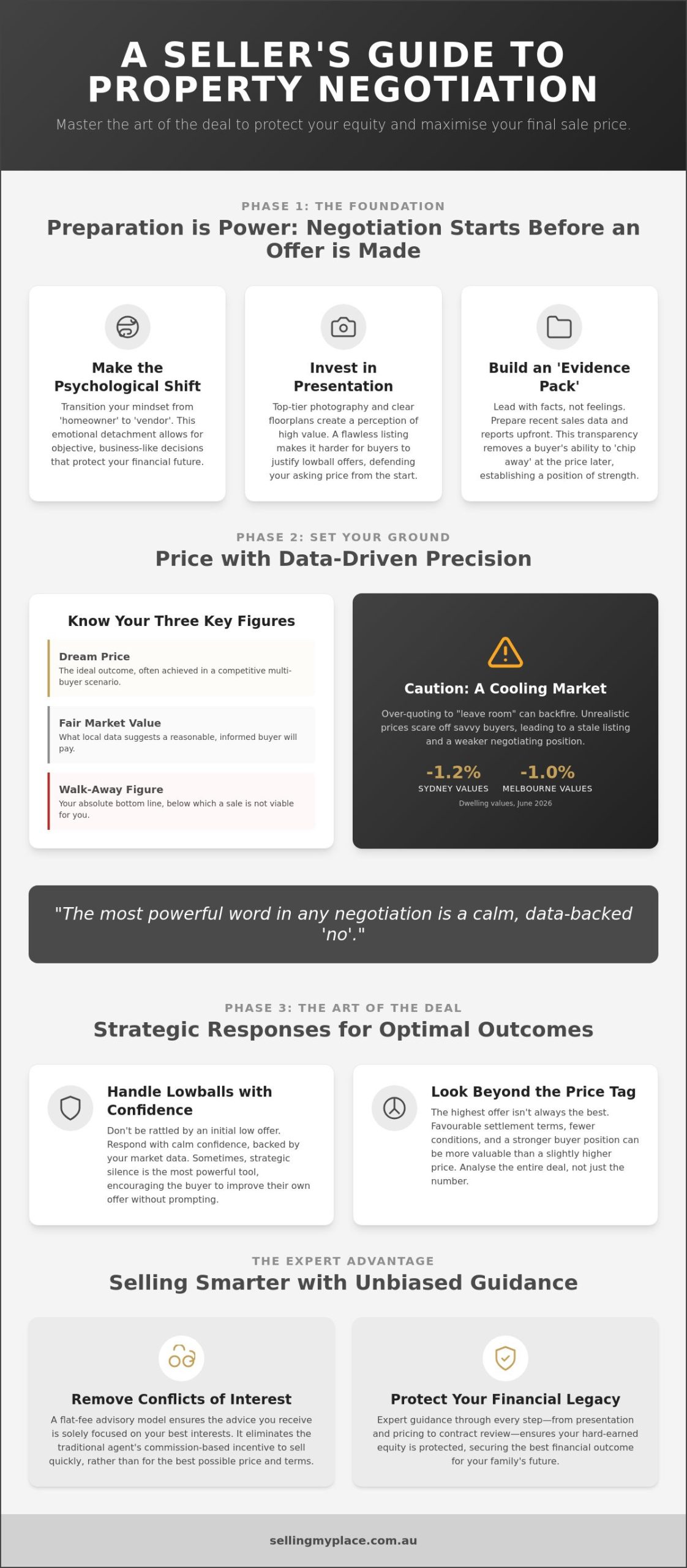
Your listing’s first impression sets the psychological ceiling for your entire campaign. When a buyer clicks through your photos, they are already deciding whether they are coming to “win” the home or “hunt” for a bargain. To protect your equity, you must make the psychological shift from “homeowner” to “vendor.” This detachment isn’t about loving your home less; it’s about respecting your financial future enough to remain objective. It’s much easier to hold your ground when you view the transaction as a partnership between your goals and the market’s reality.
Vendor authority is the grounded confidence gained when a seller replaces guesswork with professional preparation and verifiable market data.
The Power of Professional Presentation
Investing in top-tier Photography and clear Floorplans isn’t just about aesthetics. These tools act as your first line of defence against aggressive price-slashing. A polished listing signals that you are a serious, high-end seller who won’t be easily rattled. When a home is presented flawlessly, buyers find it much harder to “pick holes” or justify a lowball offer. It creates a perceived value that feels solid and non-negotiable, which is one of the most effective property sale negotiation tips for maintaining your asking price.
Establishing Your Position of Strength
Transparency is your best friend in a cooling market. By being open about the property’s condition from day one, you remove the buyer’s ability to “chip away” at the price during the cooling-off period. We recommend preparing an “evidence pack” including recent sales data and strata reports before your first open house. Engaging Real Estate Advisory Services early provides a steady hand to guide you through these initial steps. Using these property sale negotiation tips ensures you lead with facts rather than feelings, which is always the strongest position to hold during a sale.
Setting Your Ground: Data-Driven Pricing and the ‘Walk-Away’ Figure
Deciding on a price for your family home is one of the most emotionally charged moments of the selling process. It’s the point where your years of memories meet the cold reality of the current market. To navigate this successfully, you need to separate your pricing into three distinct categories. Your “dream price” is the ideal result if two buyers fall in love and start a bidding war; your “fair market value” is what the data suggests a reasonable buyer will pay; and your “walk-away figure” is the absolute bottom line where the sale no longer makes sense for your future. Having these figures clear in your mind before you even list the property provides a sense of calm that buyers will respect.
One of the most common mistakes we see is “over-quoting” to leave room for negotiation. In a cooling market, where Sydney dwelling values fell by 1.2% and Melbourne by 1.0% in June 2026, this strategy can backfire. Savvy buyers are often scared off by an unrealistic price tag, causing your property to languish on the market and lose its initial momentum. When a listing goes stale, you lose your leverage. Instead, use our Neighborhood Market Reports to justify your asking price with hard evidence. When you can show a buyer exactly why your home is valued at a certain level based on recent local sales, the conversation shifts from an emotional tug-of-war to a logical business discussion. Understanding how to determine market value of a home in Australia is the critical first step to anchoring your price with confidence in this changing landscape.
The most powerful word in any negotiation is a calm, data-backed “no.”
Understanding Local Market Dynamics
To set a firm ground, you must look closely at “Days on Market” (DOM) for similar properties in your street. If the average DOM is stretching out, you know you’ll need more patience. Similarly, keep a close eye on local auction clearance rates rather than national averages. While you are building your pricing strategy, it’s worth considering your broader Strategic Response Tactics to ensure you aren’t caught off guard by a quick offer. For those choosing a Sale by owner path, having this data at your fingertips is essential for commanding respect from buyers and their agents alike.
Defining Your Non-Negotiables
Negotiation is about more than just the final dollar amount. Before you open your doors, decide on your ideal settlement period and which chattels, like a specific designer light fitting or a custom outdoor kitchen, are included in the sale. Clearly identifying these non-negotiables early prevents them from becoming “deal-breakers” during the final heat of the deal. If you’re feeling unsure about how to balance your price expectations with the current market, you can always reach out for a chat about your goals with our advisory team.
Strategic Response Tactics: How to Handle Lowballs and Multiple Offers
Receiving a lowball offer can feel like a personal insult, especially when you’ve spent years maintaining your garden or raising a family within those walls. However, in the world of property, a low offer is often just a buyer “testing the waters” to see how you react. One of the most effective property sale negotiation tips is to never take the first number personally. It’s simply the opening line of a dialogue. By staying calm and grounded, you keep the power in your hands and signal that you aren’t easily rattled by aggressive tactics.
Sometimes, the best response is no response at all. When an offer is presented that doesn’t meet your expectations, try using the “Silence Technique.” After the buyer or their representative finishes speaking, wait for a few beats before responding. That brief, slightly uncomfortable silence often prompts the buyer to start justifying their price point or even hinting that they have “a bit more in the tank.” It shows you’re a serious seller who knows the true value of your home and won’t be pushed into a corner.
When it’s time to counter-offer, avoid round numbers. Proposing a specific figure like $952,500 instead of a flat $950,000 signals that you’ve performed a meticulous calculation of your equity, costs, and the current market. This “Power of 900” tactic makes your bottom line feel researched and firm, rather than plucked from thin air. It suggests to the buyer that there is very little “wiggle room” left because you’ve already done the hard maths.
Managing multiple offers requires a steady hand and absolute transparency to ensure you get a “fair go” from the market. Instead of playing buyers against each other in a way that feels “shonky,” invite all interested parties to submit their “best and final” offer by a set deadline. This creates a fair, competitive environment where the most committed buyer can step forward without feeling manipulated.
The Anatomy of a Counter-Offer
A successful counter-offer is a delicate balance of professional courtesy and firm boundaries. Start by acknowledging the buyer’s interest; everyone wants to feel heard. Then, apply the “Give and Get” rule. If you agree to lower your price slightly, ask for something in return, such as a shorter settlement period or a larger deposit. By applying these property sale negotiation tips, you ensure the transaction feels like a respectful partnership. For a deeper look at the legalities of this process, the Consumer Affairs Victoria negotiation guide offers excellent insights into making and receiving offers during a private sale.
Recognising a “Dud” Offer vs. a Serious Buyer
Not all offers are created equal, and some are best left on the table. A “dud” offer often comes with “strings attached” that can jeopardise your plans. Look out for these red flags in buyer behaviour:
- Vague or non-committal finance details that suggest they aren’t truly “ready to go.”
- Pushy, aggressive tactics designed to rattle your confidence.
- Unrealistic demands for immediate access or early possession before settlement.
A serious buyer usually presents a “clean” offer, meaning fewer conditions and a clear path to settlement. While a higher price tag is tempting, an offer subject to the sale of another property can often fall through. Sometimes, the bravest move is to walk away and wait for the person who truly values your home’s legacy.
Beyond the Price Tag: Negotiating Settlement Terms and Conveyance Advice
While it’s easy to get swept up in the excitement of a high dollar figure, the highest offer isn’t always the best deal for your family’s future. A slightly lower price with an unconditional contract and a 60-day settlement might actually leave you in a better financial position than a record-breaking price riddled with complex clauses. These property sale negotiation tips are about more than just the final number; they are about protecting your equity and ensuring a smooth transition to your next chapter. When you look at an offer, look at the whole picture, not just the bottom line.
A 10% deposit remains the gold standard for a reason. It provides you with a significant safety net and ensures the buyer has enough “skin in the game” to see the transaction through. If a buyer pushes for a smaller deposit, you are well within your rights to ask for more favourable settlement terms in return. Aligning your settlement date with your next move is a masterstroke that can save you a fortune in bridging finance and the sheer exhaustion of moving twice. It’s these small, practical details that turn a good sale into a great one.
The Role of Expert Conveyancing
You should always have your contract reviewed by a professional before any serious negotiation begins. This proactive step allows you to understand which “Special Conditions” you can use as bargaining chips. For instance, you might offer a slightly longer cooling-off period in exchange for a higher price. Many modern Residential Property Listing Services now recommend integrating legal support early to avoid nasty surprises. If you’re feeling overwhelmed by the legal jargon, you can get in touch for expert conveyance advice to ensure your contract is watertight.
Handling Building and Pest Results
This is often the stage where a deal can wobble. If a report comes back with minor issues, you have a choice: negotiate a small price reduction or agree to fix the repairs yourself. Generally, a price reduction is cleaner for your bottom line as it prevents you from managing tradespeople during a stressful move. You can also stand your ground on known minor defects by using an “as-is” clause, provided these were disclosed early in the campaign. Whatever you decide, ensure any agreed repairs or credits are documented precisely in the final contract to protect your interests.
Selling Smarter: How Expert Advisory Services Protect Your Profit
The traditional real estate model has long relied on a percentage-based commission, which can often lead to a subtle misalignment of goals. When an agent’s payday depends on a quick turnover, the pressure to “just sign” can feel overwhelming. By choosing a flat-fee advisory model, you remove this conflict of interest entirely. Your advisor isn’t chasing a commission; they are focused on ensuring you achieve the best possible result for your unique circumstances. This shift allows you to implement property sale negotiation tips with the backing of a professional who is truly in your corner, without the $20,000 price tag often associated with high-end agencies.
Having a professional negotiator by your side provides a vital buffer between your emotions and the buyer’s tactics. While you focus on the heart of the move, your advisor handles the strategic heavy lifting. They help you move from that initial verbal agreement to a binding exchange of contracts with total clarity. This final stage is where the “fine print” matters most, especially with the new identity verification requirements. A steady hand ensures that every T is crossed and every I is dotted, protecting your equity until the moment the keys change hands.
The KIDS Advantage
Kincade International Direct Sales (KIDS) offers a unique partnership that combines global reach with the personal touch of a local expert. Unlike the transactional feel of a standard agency, the KIDS model is built on the belief that you should keep 100% of your sale profit. This extra capital can be the difference between a modest downsized apartment and the dream coastal retreat you’ve been planning for years. You receive the professional polish and marketing power of a top-tier firm while remaining the primary decision-maker in your home’s legacy.
Your Negotiation Checklist
Before you sign on the dotted line, take a moment to breathe and run through this final summary of essentials. Trusting your gut is just as important as trusting the data. If something feels “off” about an offer, it usually is. Here are the five key steps for a successful finish:
- Confirm your walk-away figure: Ensure the offer genuinely meets your financial needs for the next chapter.
- Verify the terms: Double-check that the settlement date and deposit amount align with your moving plans.
- Review the evidence: Use your Neighborhood Market Reports one last time to confirm the price reflects current local trends.
- Consult your advisor: Run the final figures and conditions past your Real Estate Advisory Services team.
- Check the contract: Ensure all agreed repairs or special conditions are clearly written into the binding document.
Selling your home is a significant milestone, and you deserve to feel empowered throughout the entire journey. By combining these property sale negotiation tips with a supportive advisory model, you can navigate the market with confidence and grace. Discover how we empower you to sell smarter and keep your profit.
Take Control of Your Financial Legacy
Selling your home is about so much more than a transaction; it’s the bridge to your next big adventure. By embracing these property sale negotiation tips, you’ve moved from being a passive observer to a confident decision-maker. You now understand that a successful sale is built on the foundation of professional presentation, anchored by robust local data, and secured through a firm grasp of contract terms. Protecting your equity isn’t just about the final figure; it’s about making sure the transition is as smooth and stress-free as possible for your family.
You don’t have to walk this path alone. With our global marketing network reach and a dedicated Agent Advisory Service in your corner, you can achieve a premium result while keeping your hard-earned profit. Our partners save an average of $20,000 in commissions by choosing a smarter, modern way to sell. It’s time to step into your future with clarity and confidence. Start your commission-free selling journey with Kincade today and see how a partnership-based approach changes everything. You’ve got this, and we’re here to help you every step of the way.
Frequently Asked Questions
Do I really need an agent to negotiate for me?
No, you aren’t legally required to use a traditional agent to handle your sale. Many homeowners find that they are the most passionate advocates for their property’s unique history and value. By using our Real Estate Advisory Services, you gain the strategic advantage of a professional negotiator while maintaining direct control over the final decision. This partnership ensures you aren’t pressured into a quick sale that doesn’t serve your family’s long-term interests.
How do I handle a buyer who keeps pushing for a lower price?
When a buyer persists with lower offers, refocus the conversation on objective market evidence. Reference your Neighborhood Market Reports to show how your price aligns with recent local sales. If the pressure continues, a calm “no” backed by data is your most effective tool. You might also offer to adjust a settlement term instead of the price, which often satisfies a buyer’s need to feel they’ve “won” a concession.
What is the most important “Special Condition” to include in my contract?
While every sale is unique, a well-defined settlement date that aligns with your next move is often the most valuable condition for a seller. It prevents the stress and cost of bridging finance or moving into temporary accommodation. You should also ensure there is a clear “sunset clause” on any finance conditions. This prevents a buyer from tying up your property for weeks without a firm commitment to proceed.
Can I change my mind after I have verbally accepted an offer?
Yes, a verbal agreement is generally not legally binding in Australia until the written contracts are signed by both parties and formally exchanged. While it’s important to act with integrity to keep a serious buyer engaged, you aren’t locked in until that physical exchange happens. This is why moving quickly from a verbal “yes” to a binding contract is one of the most vital property sale negotiation tips for protecting your sale.
How do I know if a buyer is actually pre-approved for finance?
You should request a formal letter of “pre-approval in principle” from the buyer’s financial institution. Don’t rely on a buyer’s word alone, as their borrowing capacity may have changed with recent interest rate shifts. With the new AML/CTF regulations that began in July 2026, your legal representative will already be conducting more thorough financial checks. This added layer of scrutiny helps ensure you’re only dealing with genuine, qualified purchasers.
What should I do if the building and pest report comes back with issues?
Don’t panic if a report identifies minor defects; almost every home has them. The best approach is usually to offer a small, fair price reduction rather than attempting to organise repairs yourself while you’re busy packing. This keeps the process moving forward without you having to manage tradespeople. Ensure any agreement is documented as a specific “special condition” in the contract so there are no further disputes before settlement.
Is it better to sell at auction or via private treaty for negotiation?
Private treaty often provides a better environment for nuanced negotiation, especially in the cooling markets we saw in June 2026. Unlike the high-pressure environment of an auction, a private sale allows you to discuss settlement dates and specific conditions that might be more important to you than the final dollar amount. It gives you the time to build a rapport with the buyer and find a middle ground that respects your home’s legacy.
How much can I actually save by negotiating the sale myself?
Australian homeowners often save an average of $20,000 by choosing a commission-free model. When you remove the traditional percentage-based fee, that equity stays in your pocket to fund your next life transition. These property sale negotiation tips empower you to handle the process with professional polish while ensuring your family receives the full benefit of your home’s capital growth. It’s a significant financial win that provides a much smoother start to your next chapter.
