Off market property in Melbourne and Sydney: how to find one
An off-market property isn’t automatically a bargain. In Melbourne, buyers can uncover these homes through relationships with local selling agents, a wider personal network and professional buyer representation, with finance pre-approval helping them act when a suitable property appears.
It’s easy to assume “off market” and “pre-market” mean the same thing, or that a private sale must come with a lower price. The distinction matters: an off-market home is sold without public advertising, while a pre-market home is usually shown to a small group before an expected public launch.
This guide explains how buyers can find off-market homes in Melbourne and Sydney, what separates off-market from pre-market listings, and why a seller might prefer a private sale. You’ll also see how privacy, personal circumstances and the prospect of avoiding a public campaign can shape a seller’s decision, so you can approach the search with clearer expectations.
Key Takeaways
- A buyer’s agent can use relationships with selling agents and broader networks to hear about homes before they reach public listings.
- Pre-market usually means a short first opportunity to buy before a public launch; a private off-market campaign may remain private.
- Privacy, personal circumstances and a preference for a less public sale can influence a seller’s choice of approach.
- In Sydney, a private sale doesn’t automatically mean a lower price: competition and the seller’s expectations still matter.
- Neighbourhood Market Reports can help put local property choices in context, while Buyer Representation can support a more focused search.
How can a buyer’s agent help you find off-market properties in Melbourne?
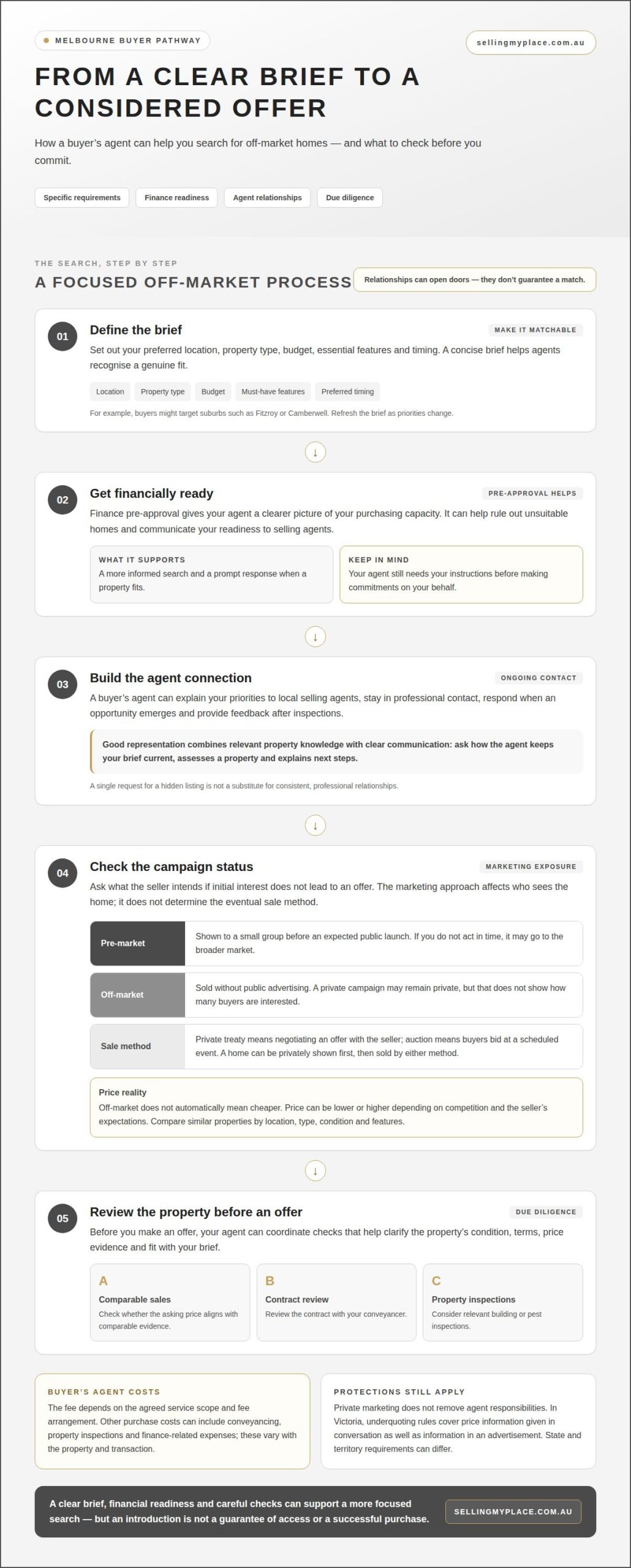
A buyer’s agent searches through selling-agent relationships and professional networks, then assesses whether each property suits your brief. For buyers targeting suburbs such as Fitzroy or Camberwell, that means sharing clear requirements, financial readiness and preferred timing with an advocate who can speak directly with local estate agents. An off-market property search is most useful when the brief is specific enough for agents to recognise a genuine match.
Relationships are built through regular, professional contact, not a single request for a hidden listing. A buyer’s agent can explain your priorities to selling agents, respond promptly when an opportunity emerges and give useful feedback after inspections. A concise brief covering location, property type, budget and essential features helps agents match a home to your needs. The agent can also refresh that brief as your priorities change.
When choosing representation, look for relevant property knowledge and clear communication with selling agents. Ask how the agent keeps your brief current, assesses a property and explains next steps. Strong relationships can lead to introductions, but they don’t guarantee access to a suitable home or a successful purchase. A sound process matters just as much as an introduction.
Finance pre-approval gives your buyer’s agent a clearer picture of your purchasing capacity. It can help them rule out unsuitable opportunities, communicate your readiness to selling agents and respond decisively when a property fits. Your agent still needs your instructions before making commitments on your behalf. Being prepared can help avoid delays when a seller is considering interest privately.
Consumer protections still apply when a home isn’t advertised. Australian state consumer laws apply to property agents whether or not a home is advertised. In Victoria, rules against underquoting cover price information given to a buyer in conversation, not just information in an advertisement. Private marketing doesn’t remove these responsibilities.
What fees and costs apply? A buyer’s agent’s fee depends on the agreed service scope and fee arrangement. Other purchase costs can include conveyancing, property inspections and finance-related expenses, which vary with the property and transaction.
What due diligence should the agent help complete? Before you make an offer, the agent can coordinate a review of comparable sales, the contract with your conveyancer, and relevant building or pest inspections. These checks help clarify the property’s condition, terms and fit with your brief, including whether the asking price aligns with comparable evidence.
Do practices differ between states and territories? Yes. Consumer laws apply across Australian states and territories, but specific requirements can differ. In Victoria, the rules also cover verbal price information. An agent working across state borders needs to understand the rules applying where each property is located. This matters when an off-market property search spans more than one jurisdiction.
Pre-market versus off-market properties
The difference is what happens after selected buyers see the home: a pre-market property is expected to reach public listings, while a private campaign stays off the public market. That distinction affects how buyers judge the time available and the likely audience for a sale.
Off-market and on-market sales
An on-market sale is publicly advertised, while an off-market sale proceeds without public advertising. Buyers can find public listings online, but private opportunities are introduced through agents or networks. The marketing method shapes who sees the property, not the legal form of the eventual sale.
A pre-market home is shown to a small group before an expected public launch. If a buyer doesn’t act in time, the property may go to the broader market. In a private campaign, the seller may keep marketing without moving to public listings. Ask what the seller intends if initial interest doesn’t lead to an offer.
This distinction can affect your decision. A pre-market viewing may provide an early opportunity, but waiting could mean competing with more buyers after launch. A private sale may have a smaller initial audience, but that doesn’t tell you how many buyers are interested or what the seller will accept.
Comparing sale methods
Off-market and on-market describe marketing exposure; private treaty and auction describe how the sale is conducted. In a private treaty, the buyer negotiates an offer with the seller. At auction, buyers bid against one another at a scheduled event.
These choices can occur at different stages. A seller may first show a home privately, then advertise it and proceed by private treaty or auction. The early marketing approach doesn’t determine the eventual sale method, so understand both before deciding how to proceed.
For example, if an advertised home is going to auction, your approach differs from negotiating directly with a seller. The sale method affects how an offer is made and when the seller considers it. Marketing status alone doesn’t answer those questions.
Prices of off-market properties
Privately marketed homes aren’t necessarily cheaper than publicly listed properties. Their prices can be lower or higher, depending on competition and the seller’s expectations. Limited exposure doesn’t automatically create a discount, and a pre-market price may not be the seller’s final position.
Compare similar properties by location, type, condition and features. A renovated home and one needing substantial work may be poor comparisons, even in the same area. Treat an asking price as a starting point for assessment, not proof of value.
For buyers and sellers weighing different approaches, discussing property sale options can help clarify which campaign suits their circumstances.
Why do sellers sell off-market?
For a seller, a private sale can offer more control over who sees the home and how it is presented. The reasons often reflect practical pressures or personal circumstances, rather than one preferred way to sell.
Reasons for choosing an off-market sale
An off-market sale lets a vendor test interest without starting with a public campaign. That can suit someone facing financial pressure, a change in personal circumstances or a preference to avoid the attention of a public sale.
Marketing costs can also influence the decision. A seller may weigh campaign spending against the chance of attracting more buyers through public advertising. A private approach may appeal if the vendor already has a likely buyer in mind or discretion matters more than broad exposure.
There’s no universal reason. One seller might want to manage a sale alongside a family change; another might prefer to avoid auction preparations and public competition. The choice reflects the vendor’s priorities, the property and the circumstances around the sale.
Reasons for choosing a quiet sale
A quiet sale limits public attention and can give a seller more control over access to the home. For example, a vendor who values privacy may prefer selected buyer enquiries over a publicly promoted campaign.
It can also reduce the disruption of preparing for open inspections. A public campaign may involve open inspections twice a week for six weeks, requiring the seller to keep the home ready for visitors. A private sale may help avoid that routine, which can matter for a busy household, family commitments or a home that’s difficult to prepare repeatedly.
Some sellers feel anxious about auctions, crowds or having neighbours and passers-by view their home. A quieter process can feel more manageable, particularly when the vendor wants conversations to focus on serious interest rather than public attention.
The trade-off is reach. A seller choosing privacy may expose the property to fewer buyers than a public campaign, which can affect competition. For a buyer, a quiet sale isn’t automatically a sign of urgency, a bargain or a seller willing to accept any asking price.
Seller circumstances can change. A vendor may begin privately, then decide to advertise if initial interest doesn’t lead to an acceptable offer. That possibility matters when buyers weigh whether to act promptly or wait for wider exposure. Each approach brings different considerations around privacy, preparation and buyer reach.
Ultimately, the vendor balances discretion and convenience against the potential benefits of a broader campaign. Understanding whether privacy, financial pressure or inspection demands are driving the choice helps buyers read the situation more clearly, without assuming the seller’s motivation or expected price.
Off-market and pre-market property listings in Sydney
Sydney buyers may encounter a home before its public launch or through a private campaign. Knowing how listings, price ranges and search bands work can help you judge opportunities without treating an early price as a final measure of value.
A selling agent may list a property before it’s ready to appear on public property websites. The period between listing and readiness can be about a week. During that window, an agent may speak with selected buyers. If the home is pre-market, it is expected to go to the broader market if a buyer doesn’t act in time. That timing gives interested buyers an early look, but doesn’t necessarily mean the seller will keep the sale private.
Sydney listings show how much prices vary by location and property type. These figures describe different sale contexts, so compare like with like rather than assuming every displayed range has the same meaning.
Search bands also appear across a mix of homes and apartments. Property type, location, size and condition all shape which comparisons are useful.
One concern is overpricing, sometimes associated with “buying the listing”: a seller chooses an agent based on an ambitious price estimate. A displayed range alone can’t establish that a home is fairly priced. The comparison matters more than the label attached to its marketing.
How can a buyer’s agent help estimate value? They can assess comparable sales, location, property type, size and condition, then weigh those against the seller’s asking price. For Sydney examples, that means treating a search band as a guide, not a substitute for property-specific analysis.
An off-market listing isn’t necessarily cheaper than a public listing. Its price may be lower or higher, depending on competition and the seller’s expectations. Whether considering a house in The Ponds or an apartment in Coogee, assess the evidence behind the asking price before deciding what the opportunity is worth. Beyond the property itself, researching neighbourhood amenities and local activities, such as pinnaclemartialarts.com.au, can help families determine whether a particular Sydney suburb suits their everyday lifestyle.
What an off-market property sale is
The phrase describes a marketing choice, not a separate kind of property ownership. For buyers, that distinction separates what an agent is doing to find an audience from the decisions involved in making an offer.
A private introduction can begin a conversation, but it doesn’t itself create an agreement to buy. The buyer and seller still need to settle the terms and proceed through the usual sale process. Treat an agent’s message as an invitation to consider the home, not as a substitute for written sale documents.
For example, a buyer may hear that a home could be available and ask to inspect it. That enquiry doesn’t mean the seller has accepted an offer or agreed to stop considering other interest. Clarify whether the seller is inviting offers, discussing a possible sale or simply gauging interest.
Marketing status can change. A seller who begins with private conversations may later choose broader advertising. Understand what the seller is currently considering and whether the opportunity remains private, rather than assuming an early approach guarantees exclusive access.
The label says nothing by itself about price, condition or competition. A buyer still needs to judge the home against relevant evidence and their own requirements. A quiet introduction may feel personal, but it shouldn’t replace a careful decision about the property and proposed terms.
For sellers, the choice is about how to introduce the home to potential buyers and how much public exposure to seek. Consider those priorities alongside the intended campaign to clarify which marketing approach fits the sale.
Sellers considering their next move can discuss property sale options before choosing how to present their home.
Kincade International Direct Sales: Neighborhood Market Reports
Kincade International Direct Sales offers Buyer Representation to support buyers searching for a home. Its Neighborhood Market Reports can help you put property choices in context when weighing a privately presented home against comparable properties.
For sellers, Pre-Sale Property Consulting can help clarify sale considerations before choosing an approach, while Residential Property Listing Services support owners preparing to market a home. The right next step depends on whether you’re buying, selling or still shaping your plans.
If you’d like to discuss your property goals, contact Kincade International Direct Sales.
Take the next step with a clear property plan
Before pursuing an off-market property, decide what matters most: the location, the features you can’t compromise on and the terms you’re prepared to consider. A clear brief gives a property professional a practical basis for assessing opportunities and keeping your search aligned with your plans.
If you’re buying, Kincade International Direct Sales offers Buyer Representation to support your search. If you’re preparing to sell, its Residential Property Listing Services and Pre-Sale Property Consulting can help you consider your options and plan the next stage. The right support depends on where you are in the property journey, whether you’re finding a home or preparing for a move.
You don’t need every detail settled before taking a first step. A conversation can help you clarify your priorities and decide what support would be useful.
Contact Kincade International Direct Sales to discuss your property goals and take the next step with confidence.
Frequently Asked Questions
What Does Off-Market Mean in Real Estate?
In real estate, off-market means a home is offered for sale without public advertising. A buyer might hear about it through a selling agent or buyer’s agent rather than an online listing. The term describes the marketing approach, not the property’s condition, contract or likely price. For example, a home discussed privately with selected buyers can still attract competing offers.
Do consumer protections still apply to off-market sales?
Yes. Australian state consumer laws apply to property agents whether or not a home is advertised. In Victoria, rules against underquoting cover price information given to a buyer in conversation, not just information in an advertisement. A private introduction doesn’t remove agent responsibilities. Buyers should still consider the price information, sale documents and property details carefully before deciding whether to proceed.
How can a buyer’s agent help you find off-market homes?
A buyer’s agent can share your property brief with selling agents and relevant professional contacts, then assess homes that match your requirements. A clear brief can distinguish a genuine fit from a property that misses an essential feature. The agent can also help coordinate inspections and discussions about an offer, so you can focus on whether the home suits your plans.
Off-Market vs On-Market: What’s the Difference?
An off-market home is offered without public advertising, while an on-market home is promoted to the broader public. That changes how buyers encounter the listing: one may come through an agent’s direct contact, while the other can be found through public advertisements. Neither approach establishes the home’s value or guarantees a particular level of buyer competition, so assess each property on its merits.
What Is an Off-Market Sale?
An off-market sale is a property sale conducted without publicly advertising the home. Private marketing does not by itself make a property purchase informal; buyers should review the sale documents and check who they are dealing with. For a buyer, the practical distinction is how the opportunity is introduced, not whether the transaction is informal. Review the property information and proposed contract terms as you would for any significant purchase.
What does off-market property mean in Australia?
In Australia, an off-market property is a home offered for sale without public advertising. It may be introduced directly to selected buyers, but “off market” doesn’t mean the property is unavailable to others or priced below market value. A seller can consider private interest while retaining the option of wider exposure. The phrase describes marketing status, not a special property category.
How do off-market property sales work in Australia?
A seller can authorise private marketing, and an agent may introduce the home to buyers who appear to fit. An interested buyer can arrange a viewing and discuss an offer with the seller. If they agree to proceed, the sale uses a normal contract of sale. Private marketing doesn’t remove the need to understand the property’s condition, price and contract terms.
Where can a buyer’s agent find off-market properties in Australia?
A buyer’s agent may hear about private opportunities through relationships with selling agents and wider professional networks. A buyer’s own connections can also surface a potential introduction, though the agent can help assess whether the property matches the search brief. In practice, a focused brief covering preferred locations, property type and essential features makes it easier to identify relevant opportunities across Australia.
Buyer’s agent fees, services and how to choose one
When buying property, the person negotiating for you should represent your interests, not the seller’s. If you’re wondering what a buyer’s agent is and whether you need one, the key distinction is simple: a buyer’s agent works for the buyer, while the seller’s agent represents the seller. You may value that support if you need help finding and assessing a property or negotiating with the selling agent.
A buyer’s agent can manage the search and purchase process or take on a focused task, such as bidding at auction. The right level of support depends on how much time and expertise you can bring to the search, and where you want professional help.
This guide explains what a buyer’s agent may do, common fee structures and how the role differs from a seller’s agent. It also covers what to consider when choosing representation, so you can decide whether it suits your plans for buying property in Australia.
Key Takeaways
- Define your property priorities and the support you need so the agent’s search and advice stay focused on your brief.
- Compare how fee structures work, what each engagement covers and whether the payment method could affect negotiation incentives.
- Assess an agent’s licence, potential conflicts of interest and experience handling the type of purchase you’re considering.
- Keep legal advice separate: a buyer’s agent can guide the property search and transaction process but can’t provide legal advice unless they’re a lawyer.
- Remember that a buyer’s agent negotiates for the buyer, while the seller’s agent represents the seller; that difference shapes whose interests each agent serves.
What is a buyer’s agent?
A buyer’s agent represents a property buyer, helping search for, assess and negotiate a purchase. The service may cover the full buying process or a specific task, such as bidding at auction. To decide whether you need one, consider which parts of the purchase you want professional support with.
In a full-service arrangement, the agent turns your brief into a property search, assesses potential matches and negotiates with selling agents on your behalf. They should understand the paperwork and steps involved in a property sale, while keeping the search aligned with your priorities, budget and intended use.
Services depend on the agreed engagement. They may include finding and evaluating properties, negotiating with the selling agent or representing you at auction. A search-only arrangement, an auction bid and end-to-end representation involve different tasks. Before appointing an agent, confirm in writing which work the fee covers.
Due diligence and negotiation support
Due diligence and negotiation support can help you assess a property and manage purchase discussions before committing. The agent may help evaluate whether a property fits your brief, understand sale paperwork and negotiate with the selling agent. The property’s appeal, price and sale terms all shape your decision, while the buyer’s agent’s role is to advocate for your interests.
When buyers use an agent
Buyers may engage an agent if they can’t search for or assess properties themselves, or want support negotiating with selling agents. A buyer’s agent can search for one property or an entire portfolio, depending on your needs. Investors may also use one to analyse rental yield and capital growth as part of deciding whether a property suits their investment aims.
Do you legally need a buyer’s agent to buy property in Australia? No. Buyers can manage a purchase themselves. A buyer’s agent is optional and can provide support with the search, evaluation or negotiation.
What are the pros and cons of using an agent instead of buying directly? An agent can take on property searching, evaluation and negotiation, which may help if you lack time or property knowledge. Managing the purchase yourself gives you control of those tasks, but means handling the search and discussions directly. Whether you need a buyer’s agent depends on the support you want during the purchase.
What services are included in a buyer’s agent’s fee? The scope depends on the engagement, which may cover a full property search and negotiation or a specific task such as auction bidding. Agreeing on the work in advance clarifies what support to expect.
What are the steps for working with an agent? You provide a brief describing the property you want and its intended use. The agent then searches, evaluates potential matches and negotiates or bids as agreed. For investors, the search may focus on one property or a portfolio.
For investors buying an investment property, a buyer’s agent’s cost is generally tax-deductible. The distinction between personal and investment purchases matters: investors may assess potential rental yield and capital growth, while a home buyer’s search is guided by their own needs and priorities.
Engagement fees and agent fee structures
Buyer’s agents may use different fee structures, and the engagement may also include separate expenses. The structure affects when you pay and how the fee relates to the purchase price.
Buyer’s agent fee structures
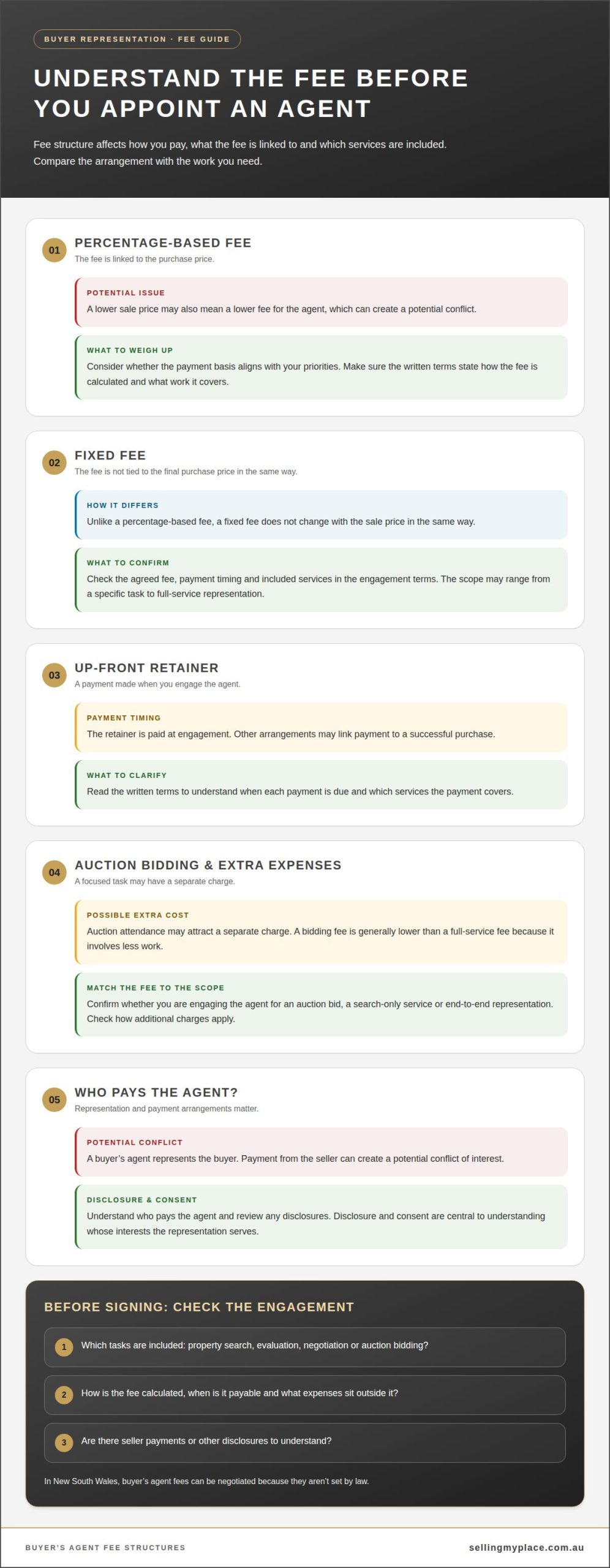
A fee structure sets how the buyer’s agent is paid for the agreed work. Common approaches include a fixed fee or a percentage of the purchase price; some agents also charge an up-front retainer when you engage them. In New South Wales, fees can be negotiated because they aren’t set by law. The structure determines the cost and payment terms.
With a percentage-based fee, the amount is linked to the purchase price. This can create a potential conflict: a lower sale price may also mean a lower fee for the agent. A fixed fee isn’t tied to the final price in the same way, while a retainer is paid at engagement. Consider how each arrangement aligns with your priorities and the agreed scope.
Payment timing and expenses
Payment timing is when the fee becomes due; expenses are costs that may sit outside it. An up-front retainer is paid when you engage the agent, while other arrangements may link payment to a successful purchase. The written terms should clarify payment timing and what’s included. Auction attendance may also attract a separate charge, so account for it.
Before signing, understand which tasks the fee covers and how any additional charges apply. An auction bid, for example, may be a narrower engagement than a full property search and negotiation service. A bidding fee is generally lower than a full-service fee because it involves less work. A clear scope distinguishes the agreed service from extra work.
Fees and commission
A fee is what the buyer pays for representation; commission is a payment calculated as a share of the purchase price. The distinction matters because a percentage-based fee can change with the sale price, whereas a fixed fee does not. In either case, the engagement terms should state the payment basis and services covered.
A buyer’s agent represents the buyer, so payment from the seller can raise a conflict of interest. Seller-paid fees can create a potential conflict of interest, so it is important to understand the payment arrangement and any disclosures. Disclosure and consent are therefore central to understanding who pays the agent and whose interests the representation serves.
To discuss how buyer representation with Kincade International Direct Sales can fit your purchase, consider the scope of support you need and the fee structure that matters to you.
Choosing and appointing a buyer’s agent
When choosing a buyer’s agent, assess their licence, any conflicts of interest and how well they fit your purchase brief. These checks help you appoint an advocate whose work matches the support you need.
Questions to ask an agent
Before appointing an agent, ask specific questions about representation, experience, conflicts and the agreed service. The answers help clarify who they act for and how their work will support your purchase.
- Who will the agent represent during negotiations?
- What services and tasks does the engagement cover?
- Does the agent have any conflicts of interest?
- How will they follow your property brief and keep you informed?
Clarify how the agent assesses properties and supports decisions about price. If your brief prioritises a particular location and property type, ask how those requirements guide the search and evaluation. Clear answers make it easier to judge whether the agent’s approach suits your needs.
Choosing a buyer’s agent
Choosing an agent involves checking their credentials and whether their approach aligns with your priorities. Licensing requirements differ across Australia, so check with the consumer protection agency for the state or territory where the property is located. In New South Wales, NSW Fair Trading says a buyer’s agent needs a real estate licence or Certificate of Registration to practise.
Check for conflicts of interest before appointing an agent. A buyer’s agent should represent the buyer, so raise any connection that could affect that role before the engagement begins. Because the agent may negotiate on your behalf, you need clarity about whose interests they serve.
Match the service scope to the work you want handled. A full search and negotiation engagement differs from hiring an agent only to bid at auction. Discussing your brief, the agent’s role and how they’ll communicate helps establish what you’re appointing them to do.
Before signing, read the engagement terms alongside the agreed property brief. Confirm the written scope reflects the service discussed, including the tasks covered and how decisions will be communicated. An investor’s brief may focus on one property or a portfolio; a home buyer’s can reflect their household’s priorities. This helps prevent mismatched expectations and gives the agent a clear basis for advocating for the purchase you want.
Choosing an agent is about fit, not simply the possibility of saving time or money. Questions about the work, licence checks and conflict disclosures help you decide who should represent you through the purchase.
Negotiation and following a client’s brief
A buyer’s agent uses your criteria to guide negotiations and any auction bidding. The brief defines which properties merit attention, what trade-offs matter and when you want to proceed. Clear instructions give the agent a practical basis for speaking with selling agents on your behalf.
For example, a brief might prioritise a particular property type, location and condition, whether you are searching in your local neighbourhood or researching distant markets such as homes for sale in Geneva IL. The agent can use those criteria to assess whether a listing is relevant, rather than pursuing every available property. If a home you like falls outside your agreed priorities, the agent can point out the difference before negotiations move forward.
Negotiation may involve communicating your position to the selling agent and discussing purchase terms. The buyer’s agent advocates for you, but doesn’t decide independently that you should buy a property. Your preferred terms and instructions remain central, including whether to continue negotiating if the seller’s position doesn’t suit.
Auction support can be engaged separately from a full property search. In that arrangement, the buyer’s agent bids for you at the auction, following your agreed criteria and instructions. Set your limit and discuss your bidding instructions with the agent beforehand. This gives them a clear boundary, rather than leaving decisions to the pressure of the auction room.
Your brief also helps distinguish firm requirements from preferences. A particular location might be essential, while a second living area is desirable but negotiable. That distinction gives the agent room to discuss suitable alternatives without losing sight of what matters most to you.
Communication matters when an offer or counteroffer could change your decision. The agent can explain the other party’s position and outline your options, so you can decide whether to proceed, change the terms or stop discussions. Your approval should guide decisions about an offer, rather than assumptions made during a fast-moving negotiation.
Fee arrangements and bidding instructions are separate parts of the engagement. A percentage-based fee may relate to the purchase price, but it doesn’t set your criteria or auction limit. Agreeing on the brief, the agent’s authority and how key updates will be handled helps keep negotiations aligned with your objectives.
For investors, the brief may focus on one property or a wider portfolio. The agent can keep the search and discussions tied to your stated aims, rather than treating every listing as a match. Specific criteria make the agent’s advocacy more focused and help you stay involved in important decisions.
Buyer’s agent role and how it differs from a seller’s agent
The key difference is who each agent represents: a buyer’s agent acts for the buyer, while the seller’s agent acts for the seller. That relationship determines whose interests guide their conversations about a property.
The buyer’s agent role
A buyer’s agent represents the purchaser and can make the search and purchase decisions more focused. For example, they can use your criteria to shortlist properties, discuss their suitability and communicate your position to the selling agent. This may suit a buyer with limited time or someone seeking professional support instead of managing every part of the search.
The agent’s role follows your agreed brief, not every opportunity in the public market. If you want a particular property type and location, those priorities guide which listings receive attention. If a property misses an important criterion, the agent can identify the gap before you spend time pursuing it.
A buyer’s agent also advocates for you during discussions with the seller’s agent. The two agents may discuss the same offer, but they have different clients and responsibilities. Your agent conveys your position; the seller’s agent communicates on behalf of the seller.
Differences from a seller’s agent
A seller’s agent represents the seller and works on that seller’s side of a transaction. A buyer’s agent represents the purchaser instead. This distinction matters because each agent’s advice and negotiation work serves their own client, even when both are discussing the same home. This principle of independent advocacy also extends to other major lifestyle acquisitions; for instance, yacht brokerages like Preferred Yachts provide dedicated buyer and seller representation to protect each party’s interests.
- Property search: A buyer’s agent can help the buyer identify and shortlist suitable properties. A seller’s agent represents the seller of a property being marketed.
- Negotiation: The buyer’s agent puts forward the buyer’s position. The seller’s agent represents the seller during discussions about the offer.
- Client interests: The buyer’s agent’s client is the purchaser. The seller’s agent’s client is the seller, not the buyer considering the listing.
When you speak directly with a seller’s agent, that agent doesn’t represent you. They may provide information about the property and sale, but their relationship is with the seller. A buyer’s agent gives you your own representative in the transaction.
This difference is especially useful to remember when one property attracts strong interest. The buyer’s agent can keep the buyer’s priorities at the centre of their decisions, while the seller’s agent represents the seller’s interests. To discuss representation for your purchase, get guidance on buyer representation.
Kincade International Direct Sales: Buyer Representation
Kincade International Direct Sales offers Buyer Representation for Australian property buyers seeking support with a purchase. If you want an agent to work to your brief and represent your interests, this can be a practical next step.
Buyer Representation can help bring your priorities into focus, from the properties considered to discussions with a selling agent. If you’re still shaping your plans, Pre-Sale Property Consulting and Neighborhood Market Reports can also inform your property decisions.
Whether you need help defining your search or want representation as you pursue a property, the next step is a conversation about your needs. Contact Kincade International Direct Sales to discuss buyer representation.
Make your next property move with clarity
A property decision should reflect the life you want to build, not just the details of a listing. If you’re still weighing what a buyer’s agent is and whether you need one, consider what support would help you move forward with confidence.
Kincade International Direct Sales offers Buyer Representation, Residential Property Listing Services and Pre-Sale Property Consulting. Whether you’re preparing to buy or planning a property sale, start by discussing your goals and identifying the support that fits. A clear starting point can make the decisions ahead feel more manageable.
Contact Kincade International Direct Sales to discuss your property plans. Take the next step when you’re ready, with your priorities guiding the conversation.
Frequently Asked Questions
How much does it cost?
Buyer’s agent fees depend on the agreed service and how payment is calculated. An agent may charge a fixed fee, a percentage of the purchase price or an initial retainer; auction bidding may be treated separately. Before engaging an agent, ask for the fee basis, payment timing and any separately charged work in writing. This makes it easier to compare the scope, not just the headline fee.
What does a buyer’s agent do in Australia?
A buyer’s agent can search for properties, assess how well they suit your brief and negotiate with the selling agent. The engagement may cover the whole search or one task, such as auction bidding. An investor buying a portfolio, for example, may want data analysis, while a time-poor home buyer may need help narrowing down listings. A buyer’s agent can’t give legal advice unless they’re a lawyer.
How much does a buyer’s agent cost in Australia, and how are fees charged?
Fee structures vary by engagement. The agreement may set a fixed fee or calculate payment as a percentage of the purchase price; some agents also request a retainer at the start. In New South Wales, fees can be negotiated because they aren’t set by law. Clarify whether the property search, negotiation and auction attendance are included before agreeing to the terms.
When is hiring a buyer’s agent worthwhile for Australian home buyers?
A buyer’s agent may be worthwhile if work, distance or limited property knowledge makes searching and assessing homes difficult. You might be able to attend inspections but want help negotiating, or need support finding suitable properties. The value depends on the tasks you want handled and the time you can give the search. If you’re comfortable managing those tasks yourself, full-service representation may not suit you.
How do I check a buyer’s agent’s licence, experience and conflicts of interest in my state?
Check licensing with the consumer protection agency in the state or territory where the property is located, and ask about potential conflicts. In New South Wales, NSW Fair Trading says a buyer’s agent needs a real estate licence or Certificate of Registration to practise. Assess experience against your purchase type by asking about relevant work, such as auction bidding or investment property searches.
What should I ask before signing a buyer’s agent agreement in Australia?
Ask what the engagement covers, how the fee is calculated, when payment is due and whether auction bidding or other work is charged separately. Clarify how the agent will follow your brief, communicate offers and seek your approval for decisions. Check how long the agreement runs and how either party can end it. The written terms should match the service discussed, so you know what you’re appointing the agent to do.
What risks or warning signs should I look for when choosing a buyer’s agent?
Pay attention to unclear fee terms, vague descriptions of the work or undisclosed interests connected to a property. A percentage-based fee can create a potential incentive issue because a lower purchase price may also reduce the agent’s fee. A buyer’s agent can’t receive payment from the seller while representing you unless both parties give fully informed consent beforehand. Make sure the agent’s role and any relevant interests are clearly explained.
How do buyer’s agents differ from selling agents and buyer’s advocates in Australia?
A buyer’s agent represents the purchaser; a selling agent represents the seller. Buyer’s advocate is another term for buyer-side representation. The important point is whose interests the person acts for. When you discuss an offer with a selling agent, for instance, that agent’s client is the seller. A buyer’s agent represents you, not the person selling the property.
Average conveyancing fees in Australia and what fixed-fee quotes include
A fixed-fee quote can make conveyancing costs easier to understand, but it may not include every expense. Conveyancing is the legal and administrative work involved in transferring property ownership. The total depends on whether you’re buying or selling, the property and the searches required.
It’s understandable to want a clear figure before making a major property decision. Buyers and sellers need different work, and government charges or third-party search costs may sit outside a quoted professional fee.
This guide explains what conveyancing covers, why costs vary for buyers and sellers, and how to compare fixed-fee quotes without overlooking possible extras. It also outlines what to look for in a quote to understand the costs before settlement.
Key Takeaways
- Separate the professional fee from disbursements and government charges to understand the full conveyancing cost.
- Compare the work required for a purchase with a sale, as the searches, documents and settlement tasks can differ.
- Look beyond the “fixed fee” label: identify which services are included and which third-party costs may be additional.
- Match your quote to the transaction, including whether the property is a house, unit or more complex sale.
- If you’re preparing to sell or buy, Kincade International Direct Sales offers residential property listing services, buyer representation and pre-sale property consulting.
Why Do Buyers and Sellers Pay Different Conveyancing Fees?
Buyers and sellers need different legal work, searches and settlement documents, so their quotes can differ. Separate the professional fee from third-party disbursements to see what each quote covers.
Professional Fees and Disbursements
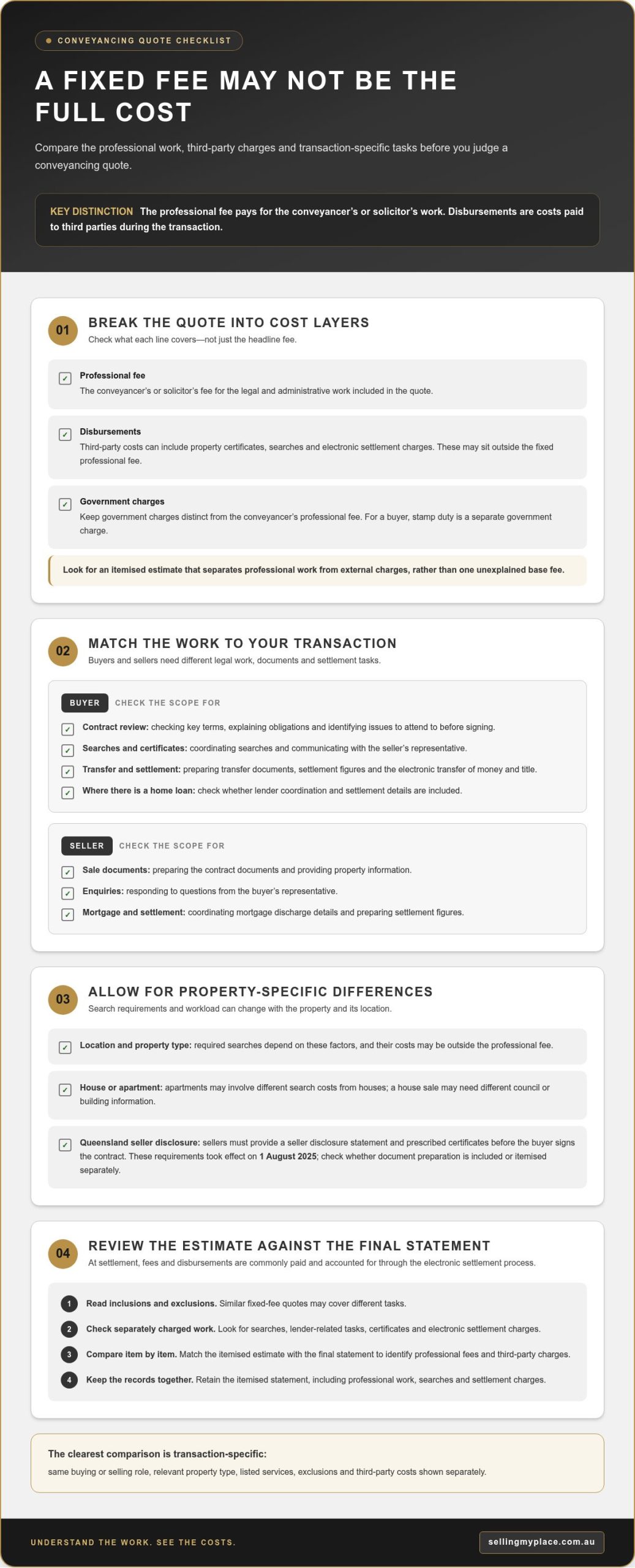
The professional fee pays for the conveyancer’s or solicitor’s work; disbursements are costs paid to third parties during the transaction. This distinction matters because a fixed professional fee may not include searches, certificates or electronic settlement charges.
The work varies depending on your role. A buyer’s conveyancer reviews the contract, coordinates title and property searches, works with the lender where relevant, and prepares for settlement. A seller’s conveyancer prepares sale documents, responds to enquiries and arranges discharge of existing mortgages.
Property type can change the workload. A house sale may require different council or building information. The quote should distinguish the conveyancer’s work from external charges, rather than presenting everything as one unexplained base fee.
Property Certificates and Search Fees
Property certificates and search fees are third-party disbursements that provide records about a property, its title or associated charges. Required searches depend on the property’s location and type, and their costs may sit outside the professional fee.
These charges help explain why apartments may involve different search costs from houses.
Are conveyancing fees tax deductible or included in the property’s cost base in Australia? Tax treatment depends on the property’s use and whether each cost is capital or relates to earning income. Keep the itemised statement, separating professional work, searches and settlement charges, so each amount can be assessed in the right context.
At settlement, conveyancing fees and disbursements are commonly paid and accounted for through the electronic settlement process. Compare the itemised estimate with the final statement to identify professional fees and third-party charges, such as certificates, searches or platform fees.
Services included in conveyancing fees
A conveyancer coordinates the legal and administrative work required to transfer property ownership. For a buyer, this can mean reviewing the contract and organising settlement; for a seller, it includes preparing sale documents and responding to enquiries.
Typical inclusions depend on the transaction and the quote’s scope. Read the service description alongside its exclusions, especially for searches, lender-related work and third-party charges. Similar fixed-fee quotes may cover different tasks, so check the listed services against whether you’re buying or selling.
What a Buyer’s Quote May Cover
For a purchase, conveyancing often starts with contract review. The conveyancer checks key terms, explains obligations and helps identify issues that need attention before signing. Once the contract is agreed, they coordinate searches and certificates, communicate with the seller’s representative and prepare transfer documents.
If a buyer has a home loan, the conveyancer also coordinates settlement details with the lender. They calculate the funds required, prepare settlement figures and arrange the electronic transfer of money and title. Stamp duty is a separate government charge, not the conveyancer’s professional fee, so the quote should distinguish legal work from the buyer’s wider purchase costs.
When reviewing a buyer’s quote, separate contract work from settlement coordination. Check whether the scope includes correspondence with the lender and preparation of transfer documents, or whether those tasks are charged separately. Property type can also affect which searches or certificates are needed.
What a Seller’s Quote May Cover
A seller’s conveyancer prepares the contract documents, provides property information and responds to questions from the buyer’s representative. They also coordinate mortgage discharge details where a loan is secured against the property, then prepare settlement figures showing adjustments and amounts payable.
In Queensland, sellers must provide a seller disclosure statement and prescribed certificates before the buyer signs the contract, under requirements effective from 1 August 2025. That work can affect what a seller’s quote includes. A Queensland seller can compare whether preparing those documents appears in the professional fee or as a separate item.
Third-Party and Settlement Charges
Some charges relate to the platform used to complete the transaction, rather than the conveyancer’s professional work. Check whether this amount is included in the quoted fee or listed separately as a disbursement, so it’s accounted for in your expected settlement costs.
Ask how the final statement separates professional work, certificates, searches and electronic settlement charges. This breakdown helps explain changes between the initial estimate and settlement, particularly if a lender, property type or required document adds work. Keep the quote and final statement together to make the transaction costs easier to review later.
If you’re preparing a property sale and need guidance alongside the legal process, conveyance advice for your sale can help you understand the roles involved.
Choosing a conveyancer or solicitor
The right professional depends on your state, transaction type and the legal work involved. Compare the service scope and total conveyancing costs, not just the headline charge.
Choosing a Conveyancer
A conveyancer focuses on the legal and administrative tasks involved in property transfers. Their experience with your state’s contracts, searches and settlement process matters because requirements and costs vary across Australia.
These figures are professional fees, not necessarily the total cost, which may also include searches, certificates and other disbursements.
Queensland has no separate licence for non-lawyer conveyancers, so conveyancing is handled by solicitors and law practices. Consider the professional’s legal practice and relevant property experience. In NSW, conveyancers must disclose costs upfront and transparently, helping you understand the stated scope and charges.
Compare quotes by checking the transaction covered, the work included and any exclusions. A straightforward house transfer may require different searches and documents from an apartment purchase. Where relevant, check whether the quote accounts for lender coordination, contract review, certificates and electronic settlement.
Online conveyancers in Australia typically charge professional fees 10-20% less than traditional practices. A lower fee alone doesn’t explain which services are included, so compare the scope alongside the price. The useful comparison is the work being done for your particular property and transaction.
Choosing a Solicitor
A solicitor can handle conveyancing as part of a broader legal practice. This may suit a transaction with additional legal issues, such as a complex contract or company involvement, where advice beyond routine transfer work is relevant.
Professional fees differ by state and practice.
These ranges help put quotes in context, but the transaction’s requirements influence the fee. A property with multiple titles, unusual contract terms or additional parties may need more review and coordination. Council and title searches also affect disbursements, which should be distinguished from the solicitor’s professional charge.
Read the quote for its named services, exclusions and likely third-party costs. Check whether it covers contract advice, lender communications, document preparation and settlement coordination. An itemised quote makes it easier to compare professional work with external charges, rather than judging conveyancing costs by one figure.
Choose a professional whose experience and quoted scope suit your transaction. A routine sale and a complex purchase require different work, so look for a clear outline of the legal tasks involved in your matter.
Comparing fixed-fee conveyancing quotes
A fixed fee sets out a defined professional charge, but the transaction’s full cost may include separate disbursements. Compare quotes for the same property type and service scope to see what each figure covers.
Factors Affecting Quotes
A conveyancing quote reflects the transaction’s complexity, required documents, property type and included work. A seller’s matter differs from a purchase, while an apartment may need strata information that a standard house does not. Multiple titles or lender coordination can add tasks, which is why similar-looking quotes may cover different work.
State-based charges affect the overall amount, even when the professional fee is fixed. In Victoria, transfer registration costs A$104.30 plus A$2.34 for every A$1,000 of the purchase price, capped at A$3,614. These government charges are separate from professional fees, so check whether a quote includes them or lists them separately.
Transaction timing and structure matter, too. Off-the-plan conveyancing can take months or years, depending on when construction is completed.
Comparing Quotes and Saving on Fees
Compare like with like: use the same transaction type, property details and requested services for each quote. Then separate the professional fee from searches, certificates, electronic settlement charges and government costs. This gives you a clearer estimate than comparing headline totals alone.
Check each inclusions list against the work your transaction needs. For a purchase, look for contract review, title searches, settlement coordination and lender communication where relevant. For a sale, check whether document preparation and mortgage discharge coordination are covered. A missing item can make a low initial fee difficult to compare.
Use an itemised quote to identify optional tasks and third-party charges. A search is not the same as professional work, and transfer registration is not the conveyancer’s fee. Comparing these categories separately helps you see where quotes differ and avoid paying for services your transaction doesn’t require.
Low-Cost Conveyancing Quotes
A low-cost quote may offer a narrower service scope or use an online process. Online conveyancers in Australia typically charge professional fees 10-20% less than traditional practices. That difference makes the listed services and exclusions especially important to compare, rather than assuming each quote covers the same work.
Check whether the quoted amount covers your actual transaction, including searches, titles and settlement tasks. If a seller’s quote excludes a required document, or a buyer’s leaves out lender coordination, the final total may differ from the initial fee. A clear breakdown shows what is included and charged separately.
Choose the quote that matches the work required, not simply the lowest amount. A standard purchase and an off-the-plan purchase involve different timeframes and coordination. Comparing quotes for the same transaction lets you assess professional fees and disbursements fairly.
Fixed conveyancing fees for buying and selling
Fixed-fee quotes can make the professional charge predictable, but buyers and sellers need different work. The quoted fee is only one part of the transaction’s total cost.
The total can include searches and statutory disbursements, while transfer registration, stamp duty and other government charges may sit outside the conveyancer’s fee. Check the quote’s inclusions before treating its fixed professional fee as the full amount required for settlement.
Why Buyer and Seller Quotes Differ
Buyers need contract review, title searches, transfer documents and coordination with their lender where a loan applies. A unit purchase may also require strata information. These tasks shape the quote, along with the property’s location and the number of titles involved.
Sellers have different responsibilities. Their conveyancer prepares sale documents, responds to buyer enquiries and coordinates discharge of an existing mortgage.
The difference between buying and selling estimates reflects different work and disbursements, not simply a different label on the quote. Sellers should check which documents and settlement tasks are included; buyers should look for searches and lender coordination where relevant.
What a Fixed Fee Covers
“Fixed fee” usually describes the professional charge for the work listed in the quote, rather than every cost associated with buying or selling. Search fees, certificates, registration charges and electronic settlement costs may be listed separately. For a fair comparison, match quotes for the same transaction type and property details.
Government charges can materially affect a buyer’s final budget. In Victoria, transfer registration costs A$104.30 plus A$2.34 for every A$1,000 of the purchase price, capped at A$3,614. Queensland transfer registration costs A$248.04 plus A$46.56 for every A$10,000 above A$180,000. These charges are distinct from professional fees.
For sellers, the fixed-fee scope may depend on the sale documents and settlement work required.
Before comparing totals, separate professional fees, disbursements and government charges in each quote. If you’re preparing to sell, get guidance on preparing your property sale alongside your conveyancing arrangements.
Kincade International Direct Sales: Residential Property Listing Services
Kincade International Direct Sales can help if you’re preparing to sell and want property marketing support alongside your conveyancing arrangements. Its Residential Property Listing Services use a flat-fee model and include professional photography. The packages also offer features such as floorplans and neighbourhood market reports to help owners present their home to buyers.
The service provides residential listings through a global marketing network, with no time limits and a 0% commission structure. Pre-Sale Property Consulting can help you plan the sale, while Buyer Representation supports people looking for guidance on a purchase. These services address marketing and property decisions, while legal transfer work remains part of conveyancing.
If you’re weighing up your next property move, you’re welcome to contact Kincade International Direct Sales or visit sellingmyplace.com.au.
Make your next property move with a clear plan
Use the average conveyancing fees in Australia in 2026 as a planning reference, then shape your next steps around your own property goals. A move is more than a transaction: it can mean choosing a home that fits your life or preparing a place that holds years of memories. Clarity about responsibilities and costs gives you more room to make those decisions thoughtfully.
If you’re preparing to sell, Kincade International Direct Sales offers Residential Property Listing Services and Pre-Sale Property Consulting to support your marketing decisions. Buyer Representation can help buyers approach their search with a clearer sense of what matters to them. These services complement, but do not replace, the legal work involved in conveyancing.
Take the next step at your pace. Contact Kincade International Direct Sales to discuss your property plans and find a considered way forward.
Frequently Asked Questions
What is conveyancing?
Conveyancing is the legal process of transferring property ownership from seller to buyer. It covers tasks such as reviewing the contract, preparing transfer documents and coordinating settlement. For example, a buyer’s conveyancer helps arrange registration of the transfer, while the seller’s representative handles documents needed to complete the sale. This work connects the contract, payment and title transfer so the change in ownership can be completed.
Are conveyancing fees paid upfront?
Conveyancing fees and disbursements are commonly paid at settlement and accounted for through the electronic settlement process. They’re often included in the settlement figures rather than paid as one upfront bill. Search costs or other arrangements may have different payment timing, so read the payment terms in the engagement documents. Keep the final statement with your property records for reference.
How do I get an accurate quote?
Give the conveyancer the details that shape the work: whether you’re buying or selling, the state, property type and transaction structure. Include relevant information about a loan, multiple titles or an owners corporation, as these can affect searches and settlement tasks. Ask for an itemised estimate that separates professional work from disbursements and government charges. A quote based on the actual contract is more useful than a generic estimate.
What goes wrong if I just pick the cheapest option?
The lowest headline fee may cover a narrower scope than another quote. Search fees, lender coordination or additional title work could be charged separately, making the final bill different from the initial comparison. A missing service can also leave you unsure who handles a task before settlement. Compare itemised inclusions and exclusions, not just the professional fee, and match each quote to the same transaction details.
What government fees do you pay on top in QLD?
Queensland buyers may pay transfer duty and Titles Queensland registration charges, separate from professional fees. Transfer registration is A$248.04 plus A$46.56 for every A$10,000 of the purchase price above A$180,000. From 1 July 2026, registering a new mortgage or releasing an existing mortgage costs A$248.04 each.
What are the average conveyancing fees in Australia in 2026 for sellers?
These Australia-wide estimates depend on the sale’s documents, searches and settlement work.
How much do conveyancers and property solicitors charge in each Australian state and territory?
Indicative professional-fee ranges vary by location and practitioner. These are professional fees, not total costs.
What is included in a fixed conveyancing fee, and what costs extra?
A fixed conveyancing fee generally covers the professional tasks listed in the quote, such as contract work, document preparation and settlement coordination. Search costs, certificates, government registration charges and electronic settlement platform fees may be additional. Check the itemised scope against your transaction, including whether lender-related work or property-specific searches are included or charged separately.
Navigating the Australian Property Market: How to Negotiate with a Buyer’s Agent
What if the A$20,000 you saved on your property sale wasn’t just a number on a balance sheet, but the strategic “war chest” that secures your next family home? For many Australians, the thought of re-entering the market brings a wave of genuine anxiety, especially when faced with the aggressive auction culture that defines our local landscape. You might worry about being locked into a restrictive exclusive agreement or, worse, paying a double commission that eats into your hard-earned equity. It’s a lot to manage while you’re trying to imagine your new life in a different neighbourhood. Understanding how to negotiate with a buyer’s agent is the key to transforming this stress into a grounded, professional partnership.
We believe your property journey should feel like a supported transition, not a transactional battle. In this article, you’ll learn the professional tactics to negotiate terms with a buyer’s advocate so their expertise works solely for your benefit. We’ll show you how to move past the industry jargon and secure a transparent, flat-fee agreement that feels fair and protective. We will explore how to access those elusive “silent” off-market listings and use professional auction bidding to shield your savings. It’s about finding that steady hand to guide you home with total confidence (and perhaps a bit of well-deserved excitement, too).
Key Takeaways
- Understand the vital shift from being a “customer” of a selling agent to a “client” with a dedicated advocate who works exclusively in your corner.
- Learn how to negotiate with a buyer’s agent to secure a transparent, flat-fee agreement that prioritises your long-term stability over a quick transaction.
- Gain the upper hand in the competitive Australian market by accessing “silent” off-market listings and professional bidding strategies that protect your equity.
- Identify and avoid “Dual Agency” conflicts of interest to ensure your representative remains a truly independent, steady hand throughout the process.
- Discover how reinvesting the average A$20,000 saved through a commission-free sale can provide the “war chest” needed to hire expert representation for your next purchase.
What is Buyer Representation and Why is it Essential in 2026?
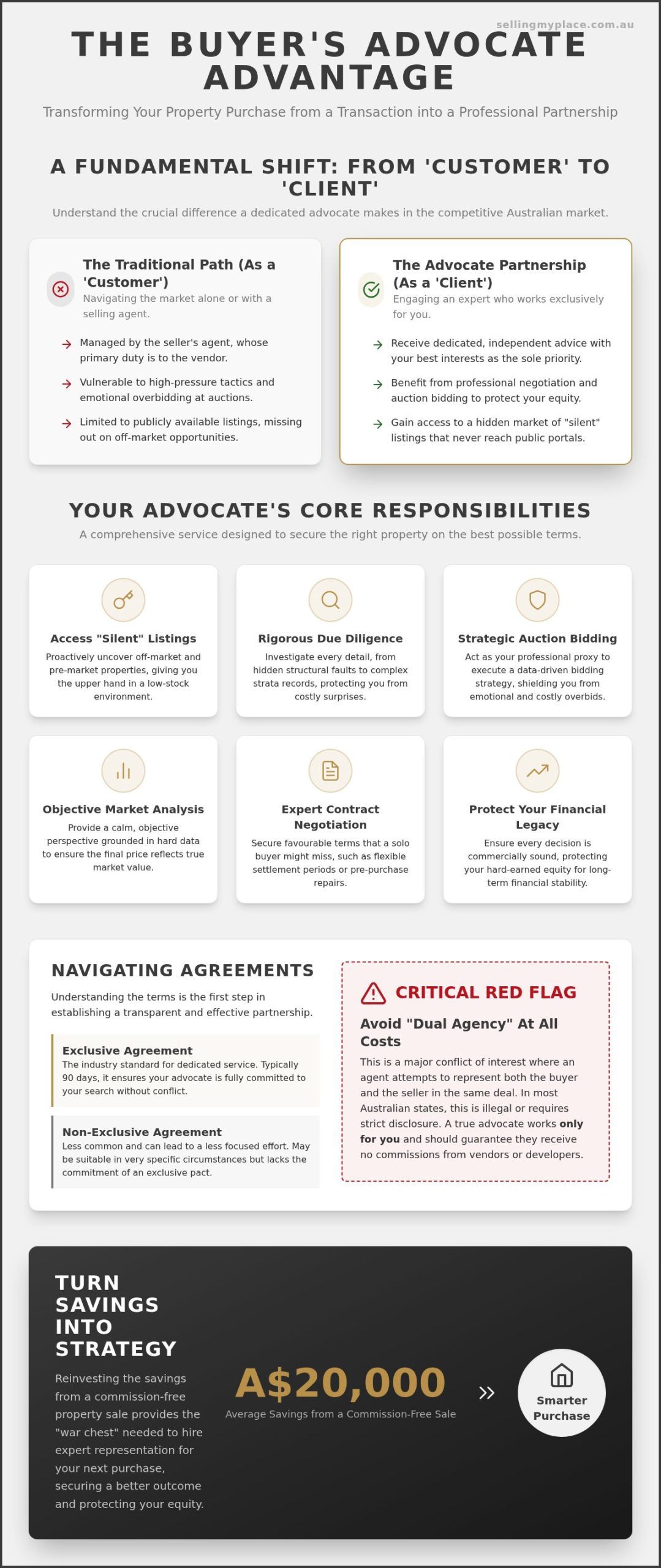
In the Australian property market of 2026, the traditional way of buying a home has fundamentally shifted. For decades, purchasers were often treated merely as “customers” of the selling agent; someone to be managed rather than truly served. Today, buyer representation has evolved into a professional partnership where your advocate works exclusively for you. It’s a fiduciary alliance that moves you from the outside looking in to having a seat at the professional table. Understanding What is a Buyer’s Agent? is the first step in reclaiming your power during a purchase. With property stock levels remaining stubbornly low across the country, having a professional in your corner isn’t just a luxury. It’s a strategic necessity to access “silent” listings that never reach the public portals. Buyer representation is the professional insulation between a buyer and the high-pressure tactics of selling agents.
The 2026 market demands a different approach. It’s no longer enough to wait for an alert on your phone. You need someone who can walk into a local agency and ask about the homes that aren’t on the market yet. This proactive stance is what separates a successful purchase from a missed opportunity. When you learn how to negotiate with a buyer’s agent, you’re essentially hiring a steady hand to guide you through these complexities with heart and expertise.
The Core Purpose of a Buyer Advocate
A skilled advocate does more than just browse listings. They act as your eyes and ears on the ground, identifying properties that match your specific lifestyle needs long before the “For Sale” sign goes up. This includes a deep dive into the bones of a building. They execute rigorous due diligence to uncover potential deal-breakers, such as hidden structural issues or complex strata records that could drain your superannuation later. By removing emotional bias, they ensure every decision is grounded in data. They provide a calm, objective perspective when the stakes feel highest. It’s about finding the right fit for your family’s future, not just any house that’s available.
How Representation Protects Your Financial Legacy
Protecting your equity is at the heart of this partnership. We’ve all seen the adrenaline-fuelled energy of a Saturday auction lead to emotional overbidding. An advocate prevents this by acting as your proxy, ensuring the final bid aligns with true market value rather than a vendor’s optimistic expectations. Beyond the price, they secure favourable contract terms that a solo buyer might miss. This might mean negotiating a flexible settlement period to align with your own house sale or ensuring specific repairs are completed before you pick up the keys. They protect your financial legacy through expert, level-headed negotiation.
The Different Types of Buyer Representation Agreements in Australia
Entering into a formal agreement with a professional advocate is a significant milestone in your property journey. In Australia, these documents are governed by state specific legislation, such as the Property and Stock Agents Act or the Estate Agents Act. These laws ensure that your interests are protected through a clear legal framework. However, the fine print is where the real partnership is defined. Understanding how to negotiate with a buyer’s agent starts with recognising that these agreements are not one size fits all. They are negotiable tools designed to align your advocate’s incentives with your long term lifestyle goals.
One of the most critical elements to verify is the absence of “Dual Agency.” This occurs when an agent attempts to represent both the buyer and the seller in the same transaction. In most Australian jurisdictions, this is a clear conflict of interest and often illegal without rigorous disclosure. To ensure your advocate is truly independent, look for a clause that guarantees they receive no kickbacks or commissions from vendors or developers. A “steady hand” guide should only have one master: you.
Exclusive vs. Non-Exclusive Agreements
Most reputable advocates prefer an exclusive agreement, typically lasting for 90 days as per 2026 REBAA standards. While “exclusive” might sound restrictive, it’s often the only way to secure high quality off-market listings. Why? Because an advocate won’t tap into their private network or “silent” neighbourhood contacts if they feel you might bypass them at the last minute. Conversely, non-exclusive or “open” agreements are often used for auction bidding only. These are useful if you’ve already found the home but need a professional to handle the high pressure environment of the auction floor without the emotional fog of war.
Standard Clauses You Must Understand
Before you sign a “Buyer’s Authority to Purchase,” pay close attention to the fee structure. You have the right to negotiate between a percentage-based fee and a transparent flat-fee model. Many families find that a flat-fee provides more peace of mind, as it removes any incentive for the agent to encourage a higher purchase price. You should also scrutinise the termination rights. Ensure there is a clear “sunset clause” that allows you to exit the partnership if the search isn’t progressing as expected. If you’re feeling unsure about the legalities, it’s always wise to reach out for professional advice before committing your signature.
Use this quick checklist before signing any representation document:
- Duration: Is the agreement capped at a reasonable timeframe, such as 60 or 90 days?
- Scope: Does it clearly define the specific property types and price ranges they are searching for?
- Fees: Is the total cost, including any engagement fees, clearly capped and documented?
- Termination: Can you end the agreement with a standard notice period if the relationship isn’t working?
How to Negotiate with a Buyer’s Agent: Strategy to Settlement
Once the paperwork is finalised, the real work begins with a deep-dive strategy session. This is your first opportunity to learn how to negotiate with a buyer’s agent regarding the actual search parameters. It’s about more than just the number of bedrooms; it’s about defining the lifestyle you’re building. Are you looking for a quiet cul-de-sac for the kids to play, or a vibrant urban centre close to work? By clearly separating your “must-haves” from “nice-to-haves”, you empower your advocate to filter out the noise. This ensures they only present properties that truly align with your family’s future, saving you from the exhaustion of endless, fruitless inspections.
During this phase, your advocate also takes the lead on coordinating essential due diligence. They’ll organise building, pest, and strata inspections, often using their own trusted network of professionals. This isn’t just about ticking boxes; it’s about having a seasoned expert interpret the reports for you. They can help you understand if a minor crack is just “settling” or a sign of something more serious. This level of professional oversight provides the peace of mind you need when making one of life’s biggest financial decisions.
Uncovering Off-Market Opportunities
The “hidden market” is where some of the best Australian properties change hands without ever appearing on a public website. These “silent listings” are often sold through private agent networks to avoid high marketing costs or maintain vendor privacy. When you’re figuring out how to negotiate with a buyer’s agent, ask specifically about their local relationships. A well-connected advocate should have their finger on the pulse of the neighbourhood, finding sellers before they’ve even chosen a listing agent. This first-mover advantage significantly reduces competition, allowing you to secure a home without the stress of a public bidding war.
Professional Negotiation and Auction Tactics
The auction floor is a high-stakes environment where adrenaline can easily cloud your judgement. Having a “steady hand” representative bid on your behalf is a massive tactical advantage. They know how to read the room, when to slow the pace, and exactly when to strike. They act as your emotional shield, ensuring you never reveal your limit to the selling agent. In private treaty scenarios, they use comparable sales data to counter the selling agent’s narrative, ensuring the price you pay is grounded in reality. Whether it’s handling a pre-auction offer or waiting for the hammer to fall, their professional distance protects your equity and your peace of mind.
Evaluating a Buyer Representative: Questions to Ask
Choosing a representative is about finding a steady hand who respects your family’s financial legacy and emotional well being. The most common hurdle families face is the perceived cost of the service. Is the fee truly worth it? When you look at the return on investment, a skilled advocate often pays for themselves by securing a purchase price significantly lower than what an unrepresented, emotional buyer might pay. It’s about protecting your equity from the start. Understanding the role of Professional Residential Property Listing Services can help you visualise the full property cycle, ensuring your transition from seller to buyer is seamless and supported.
Vetting for Experience and Empathy
You need to know if your advocate has the depth of experience to handle complex negotiations. Ask how many years they’ve operated as a dedicated buyer’s advocate compared to their time as a sales agent. This distinction is vital; you want someone who has fully transitioned into the mindset of a purchaser’s ally. Request testimonials from buyers who shared your lifestyle needs or financial aspirations. Did the agent find a home that genuinely improved that family’s daily rhythm? A background in real estate advisory allows them to provide holistic advice that looks beyond the four walls of a house.
Understanding Fee Transparency
This stage is where you learn how to negotiate with a buyer’s agent regarding their own professional costs. Start by negotiating the balance between the engagement fee, paid upfront, and the success fee, payable upon settlement. You should also ask for a written guarantee that they don’t receive kickbacks or “referral fees” from vendors or third party services. This ensures their loyalty remains solely with you. Finally, confirm exactly how the fee is calculated. You want to avoid “bracket creep,” where the agent’s commission increases simply because the property price did. A flat fee model is often the most transparent way to keep everyone’s incentives aligned.
Before committing, always verify your representative’s licensing and professional standing. In Australia, you can check their credentials through state based regulatory bodies or industry organisations like REBAA. It’s a simple step that provides immense peace of mind, ensuring your advocate is held to the highest ethical standards. If you’re ready to find a partner who values your property journey as much as you do, get in touch with our team for a grounded, confidential consultation.
The Kincade Advantage: Reinvesting Your Equity for a Smarter Purchase
At Kincade International Direct Sales, we believe that selling your home shouldn’t be treated as a separate battle from buying your next one. Our philosophy is rooted in the idea of a seamless transition, where selling smarter ensures you have the resources to buy better. When you choose a Sale by owner strategy through our commission-free model, you’re doing more than just saving on fees. You’re effectively creating a A$20,000 “war chest,” which is the average saving our clients experience. This capital provides the perfect foundation for hiring a professional advocate. It’s perhaps the most strategic way to look at how to negotiate with a buyer’s agent; you aren’t just haggling over a fee, you’re reinvesting your own equity to secure a superior future.
Our Agent Advisory Service acts as the vital bridge between your successful sale and your next front door. We act as the steady hand (the seasoned expert you can lean on) to manage the complexity of this life transition. By removing the burden of high marketing costs and traditional commissions, we empower you to focus on what truly matters: your family’s long-term stability and lifestyle legacy. It’s a partnership that values your peace of mind as much as the final result.
Integrated Real Estate Advisory
The journey begins long before the “Sold” sticker goes up. Our pre-sale consulting is designed to prepare you for the mindset of a savvy buyer, helping you understand market value from both sides of the fence. We also emphasise the importance of professional Conveyance Advice to ensure that every legal step is handled with precision, protecting you from settlement delays that can disrupt a purchase. By leveraging global marketing insights, we help you apply a broad perspective to your local neighbourhood decisions, ensuring your next home is a sound investment in every sense; for those exploring property options overseas, you can visit MaddisonV Properties to learn about their premier advisory and management services in London.
We’re not here for a single transaction; we’re here to help you build a legacy. A dedicated advisor who understands the nuances of both selling and buying provides a level of protection that a standard agent simply can’t match. It’s about more than just four walls and a roof. It’s about ensuring your equity is shielded at every turn. If you’re ready to see how this integrated approach can work for you, the next step is simple. You can integrate buyer representation into your 2026 property plan today by reaching out for a quiet, neighbourly chat about your goals. Let’s make your next move your best move.
Step into Your Next Chapter with Confidence
The journey from selling your family home to securing your next sanctuary is a major life transition that deserves a steady hand. By understanding how to negotiate with a buyer’s agent, you’ve moved from being a passive observer to a savvy market participant. You now know that professional advocacy isn’t just about the auction floor; it’s about finding those silent off-market gems and ensuring every clause in your agreement protects your financial legacy. It’s about turning the stress of low stock levels into a strategic advantage through clear, fee-transparent partnerships.
At Kincade, we’re here to help you bridge that gap. Our 0% commission structure on your sale allows you to save an average of A$20,000 in commissions, providing the perfect “war chest” to fund your purchase journey. Combined with our Expert Agent Advisory Service, we ensure your equity remains shielded while you focus on building your family’s future. Are you ready to move forward with a partner who values your long-term stability and lifestyle goals above all else?
Secure your next home with expert Buyer Representation from Kincade and let’s start this exciting new chapter together. Your ideal lifestyle is well within reach, and we’d be honoured to help you find it.
Frequently Asked Questions
What is the average cost of buyer representation in Australia in 2026?
In 2026, buyer representation fees across Australia vary based on the level of service required. In major capital cities, you might expect to pay between 1.5% and 3% of the purchase price, or a fixed fee ranging from A$8,000 to A$21,000. In other key regions, fees typically range between 1% and 2.7%. Learning how to negotiate with a buyer’s agent can help you find a structure that fits your budget, especially when reinvesting the A$20,000 saved on your commission-free sale. If you’re considering using those savings for a new vehicle, you can read more about Private Fleet to see how professional advocacy can also reduce the cost of your next car.
Yes, one of the primary advantages of professional representation is access to the “hidden market.” Many properties are sold as silent listings through private agent networks without ever being advertised on major portals. This allows you to avoid the high-pressure environment of a public campaign and reduces competition from other buyers. A well-connected advocate uses their local relationships to uncover these opportunities, giving you a distinct first-mover advantage in a low-stock market.
Is a buyer representation agreement legally binding in all Australian states?
Yes, buyer representation agreements are legally binding documents regulated by state-specific legislation. These frameworks are in place across Australia to protect both parties, defining the scope of service, fee structures, and the duration of the partnership. It’s essential to review the termination clauses and ensure the document reflects the specific terms you’ve discussed with your advocate before signing the authority.
How does a buyer advocate differ from a standard real estate agent?
The fundamental difference lies in who the agent represents. A standard real estate agent is a vendor’s advocate, legally bound to achieve the highest possible price for the seller. A buyer’s advocate, however, works exclusively for the purchaser. This shift turns you from a “customer” into a “client” with a fiduciary ally. Their role is to protect your interests, uncover property faults, and negotiate the lowest possible price while ensuring a smooth, supported transition into your new home.
What happens if I find a property myself while under an exclusive agreement?
Under a standard exclusive agreement, a fee is typically payable to the advocate regardless of who found the property during the contract period. This ensures the agent is motivated to dedicate their full resources and network to your search. However, when learning how to negotiate with a buyer’s agent, you can request a “carve-out” for specific properties you’ve already identified. Always clarify these terms upfront to maintain a transparent and harmonious partnership throughout your property journey.
Can I hire a buyer representative for auction bidding services only?
Many professionals offer a specific “Auction Bidding Only” service for a reduced flat fee. This is an excellent option if you’ve already found your dream home but feel anxious about the aggressive Australian auction culture. A representative will attend the auction on your behalf, using a steady hand to bid strategically without revealing your emotional limit. This service often costs around A$500 to A$1,100, depending on the state and the level of pre-auction due diligence required.
Do I need a buyer representative if I am a first-home buyer?
While not mandatory, first-home buyers often benefit most from professional guidance. Navigating the 5% Deposit Scheme or various stamp duty concessions in 2026 can be complex for those new to the market. An advocate provides the professional insulation needed to avoid overpaying due to inexperience. They help you understand the true market value of a property, ensuring your first step onto the property ladder is grounded in data rather than adrenaline and high-pressure sales tactics.
How long does a typical property search take with professional representation?
A professional property search typically takes between 30 and 90 days. This timeframe allows your advocate to thoroughly scan the market, perform due diligence on potential homes, and tap into their off-market networks. While some purchases happen much faster, a methodical approach ensures you don’t rush into a decision you might regret later. Most agreements are structured for a 90-day period, aligning with 2026 REBAA standards to give you ample time to find the right fit.
How to Make an Offer on a House in Australia: The 2026 Buyer’s Guide
Imagine standing on the nature strip of a sun-drenched Queenslander or a leafy Melbourne terrace; you have finally found “the one,” but the thought of the actual paperwork makes your stomach do a nervous flip. It’s a feeling many of us know well, especially when the national median house price has reached $1,274,503 as of June 2026. You want to move forward, yet the fear of being gazumped or trapped in a poorly drafted contract feels like a heavy weight. Learning how to make an offer on a house australia shouldn’t feel like a gamble, particularly as auction clearance rates have dipped below 50% recently, giving buyers a rare moment to breathe and negotiate with more leverage.
We’re here to help you master the art of the property offer with professional poise and a steady hand. This guide provides the expert strategies you need to secure your dream home while firmly protecting your financial future. We’ll explore the vital differences between conditional and unconditional offers, explain how to use the current cooling market to your advantage, and ensure you have the legal safeguards in place to sleep soundly at night. You’re about to gain the clarity needed to navigate negotiations with your heart and head in perfect balance, turning that “for sale” sign into a “sold” sticker on your own terms.
Key Takeaways
- Secure your footing by understanding why unconditional finance pre-approval is your strongest asset before you even step foot in a negotiation.
- Master the formal process of how to make an offer on a house australia, ensuring every condition is drafted to protect your interests and your financial future.
- Navigate the complexities of both traditional agent-led sales and direct vendor negotiations with the confidence and poise of a seasoned local.
- Protect yourself from the heartbreak of gazumping with strategic timelines that help you move from a verbal agreement to a binding contract without delay.
- Learn how professional buyer representation can unlock “off-market” gems and provide the expert advocacy needed to secure a fair price in a shifting market.
Essential Preparation: Getting Your Ducks in a Row Before the Offer
Buying a home is more than a financial transaction; it’s about finding where your family’s future will unfold. In a market where the national median house price sits at $1,274,503, “winging it” is a strategy that often leads to disappointment. If you want to know how to make an offer on a house australia that actually gets noticed, you have to start with a foundation of cold, hard facts. This preparation is what separates the dreamers from the homeowners in what many call The Great Australian Dream.
Before you even attend an inspection, you need your professional team ready. This includes a trusted conveyancer and access to detailed Neighbourhood Market Reports. These reports help you ground your expectations in reality, showing you exactly what similar properties in the area have sold for over the last few months. Relying on emotion alone can lead to overpaying. To get it right, you should determine your price based on a recent market report before you start bidding. Having data at your fingertips gives you the confidence to stand your ground during a high-stakes negotiation.
Finance Pre-Approval: Your Secret Weapon
There is a world of difference between a quick online “soft” check and a formal, unconditional pre-approval letter from your lender. A formal letter proves to agents and vendors that you are a serious contender with the financial backing to follow through. It also streamlines the negotiation process, particularly if you’re trying to reduce the length of a cooling-off period to make your bid more attractive. Most importantly, it helps you set an absolute “walk-away” price. Knowing your limit ensures you don’t get swept up in the heat of the moment and commit to a mortgage that strains your lifestyle.
The Legal Review: Understanding the Contract of Sale
Never sign anything until a professional has looked at the Section 32 or Contract of Sale. This is where you’ll find “red flags” like restrictive covenants or easements that might prevent you from building that deck or pool you’ve been dreaming about. Professional conveyance advice is essential here to decode the legal jargon. During this stage, you should also decide on your preferred settlement terms. Whether it’s 30, 60, or 90 days, having these details ready shows the seller you are organised and ready to move. This level of preparation is the first step in mastering how to make an offer on a house australia that stands out for all the right reasons.
The Anatomy of a Strong Offer: More Than Just the Price
A handshake on the front lawn feels great, but in the fast-paced Australian property landscape, a written offer is the only true gold standard. It signals to the vendor that you are prepared, professional, and ready to commit. This isn’t just about a single dollar figure; it’s about presenting a package that makes the seller feel secure. To master how to make an offer on a house australia, you need to structure your proposal with four key pillars that balance your aspirations with practical safeguards.
- Step 1: The Price. You should determine your price based on a recent market report to ensure your bid reflects the current 2026 cooling trend rather than outdated peak prices.
- Step 2: The Deposit. While a 10% deposit is the traditional expectation, a 5% deposit is often negotiable. This is particularly common for first home buyers using government guarantees to enter the market.
- Step 3: The Conditions. These are your protective layers. Always include clauses for finance approval and satisfactory building and pest inspections to avoid expensive surprises down the track.
- Step 4: The Expiry. Don’t leave your offer hanging indefinitely. Setting an expiry date, perhaps 48 or 72 hours, creates a gentle sense of urgency and prevents your bid from being used as leverage against other buyers.
Conditional vs. Unconditional Offers
An unconditional offer is a powerful tool because it removes all uncertainty for the seller, making your bid highly attractive in a crowded field. However, it is a high-stakes move. If your bank valuation comes back lower than your offer price, you must bridge the gap yourself. Most Australian buyers are better served by a conditional offer. This includes “Subject to Sale” clauses if you need to offload your current home first. If you’re feeling unsure about which path suits your family’s needs, it might be time to chat with a local expert who can help you weigh the risks and rewards.
The Holding Deposit (Expression of Interest)
In many states, you might be asked for an “Expression of Interest” (EOI) accompanied by a small holding deposit. Is this “fair dinkum” and legally binding? Usually, the answer is no; not until both parties have signed a formal contract. This initial payment, often a few thousand dollars, simply demonstrates your sincerity to the vendor. It shows you aren’t just window shopping. Always ensure these funds are held in a registered real estate trust account or by your conveyancer to keep your hard-earned money safe while negotiations continue.
Private Treaty vs. Private Sale: Navigating Different Purchase Paths
When you’re out there searching for your next chapter, you’ll likely encounter two distinct paths: the traditional agent-led private treaty and the increasingly common sale by owner. While most Australians are used to real estate agents acting as the gatekeepers of property, many are finding that dealing directly with a vendor can be a remarkably transparent experience. It’s often a breath of fresh air to speak with the person who has actually lived in the home, raised their family there, and knows every quirk of the floorplan. It removes the “middleman” filter that can sometimes lead to mixed messages.
Mastering how to make an offer on a house australia requires you to be adaptable. When dealing with an agent, you’re navigating a professional buffer designed to maximise the sale price. When dealing with a private seller, you’re engaging in a personal conversation about their legacy. It’s vital to keep your tone warm yet professional. A little neighborly respect goes a long way; after all, they want to know their home is going to someone who will cherish it as much as they have. This human connection can often be the “secret sauce” that gets your offer across the line over a higher, colder bid.
Buying from a Private Seller
The primary benefit of direct communication is the ability to get straight answers in real-time. You can ask about the history of the renovations or the local community vibes without waiting for an agent to “check with the owner.” When you’re ready to commit, present your offer formally in writing. This maintains the decorum of a high-stakes transaction while keeping the lines of communication open. Even without an agency involved, the legal heavy lifting stays the same. Both you and the seller must involve your own conveyancers to ensure the contract is sound and that your deposit is held securely in a trust account until settlement.
The Auction Alternative
While private negotiations offer room to move, auctions are a different beast entirely. With auction clearance rates sitting below 50% across major cities in mid-2026, many buyers are successfully making offers “prior to auction” to avoid the stress of a public bidding war. This is a high-stakes move, though. If you buy prior to the auction or on the day itself, you generally waive your right to a cooling-off period. It’s a moment for a steady hand; you must have your finance, building reports, and legal reviews completed before you raise your hand or sign that contract. If the market continues to cool as it has recently, waiting for the day might actually give you more leverage if competition is thin.
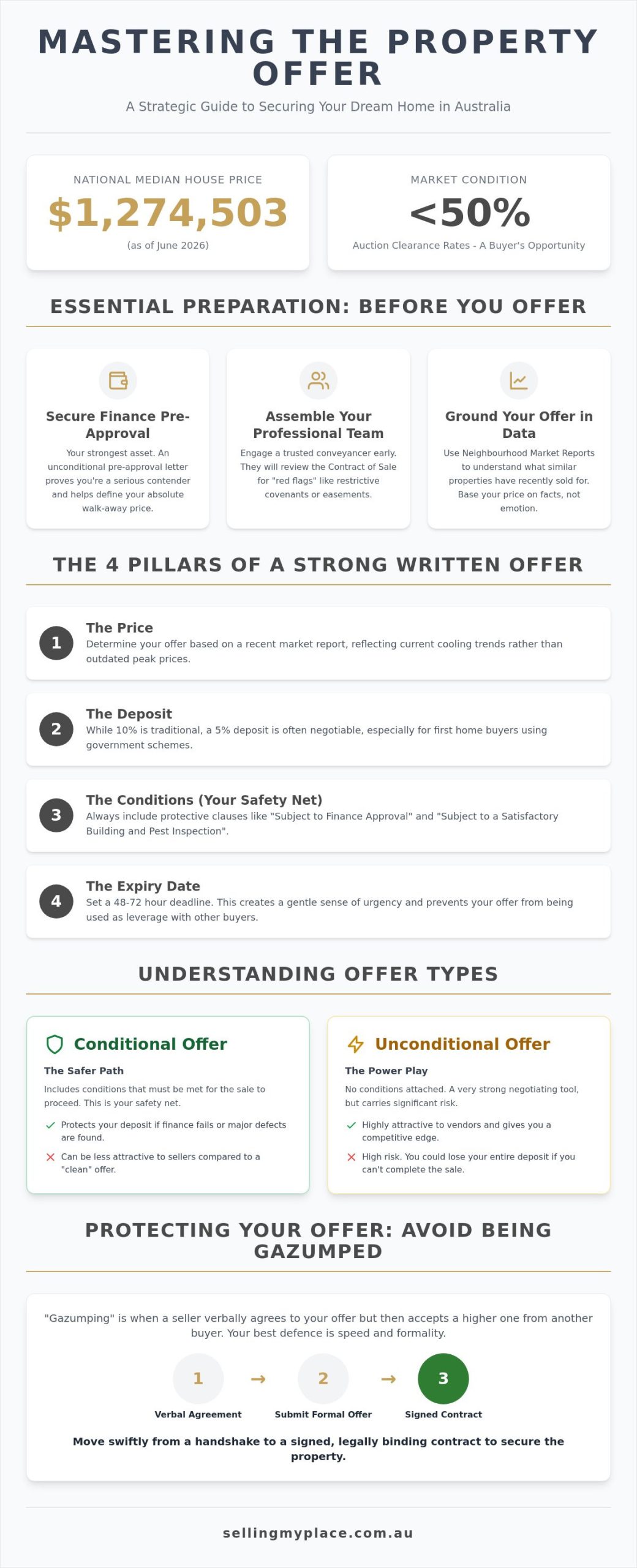
Negotiation Tactics: Avoiding Gazumping and Multiple-Offer Pitfalls
There is nothing quite as heart-wrenching as receiving a phone call to say someone else has outbid you after your offer was already verbally accepted. This is the reality of gazumping. In the Australian property market, a deal isn’t legally binding until both parties have signed and exchanged the final contract of sale. To protect your aspirations, you need to understand how to make an offer on a house australia that locks the door behind you quickly. Speed is your greatest ally. By having your conveyancer ready and your deposit funds accessible, you can move from a handshake to an exchange in record time, leaving less room for another buyer to swoop in.
When you find yourself in a multiple-offer situation, the pressure can feel immense. Should you put your absolute best and final price forward immediately? It depends on the property’s value relative to your market research. Sometimes, the best bargaining chip isn’t the price at all; it’s the settlement terms. If a seller is anxious to move before the new school year or needs a longer 90-day settlement to finish their own build, matching their timeline can make your offer more attractive than a slightly higher bid with rigid terms.
Winning the Negotiation Without Overpaying
Negotiating doesn’t always mean paying less; it means paying a fair price for what you’re actually getting. If your building report uncovers structural issues or pest activity, don’t be afraid to ask for a price adjustment to cover the repairs. A Sunset Clause is another clever tool to keep in your kit. By stating that your offer expires at 5:00 PM on Friday, you prevent the agent from using your bid to bait other buyers over the weekend. If you’re feeling overwhelmed by these tactical moves, get professional real estate advisory services to refine your approach.
The Cooling-Off Period
Most states provide a safety net known as the cooling-off period, typically five business days. It’s a vital window to conduct your final due diligence, but it isn’t free. If you decide to pull out of the deal during this time, you’ll usually forfeit 0.25% of the purchase price. Think of it as an insurance policy. It gives you the space to ensure the home is exactly what it seems before you’re fully committed to the long-term journey of home ownership. Use this time wisely to double-check your finance and ensure the contract truly reflects your needs.
Professional Buyer Representation: Your Shortcut to a Successful Purchase
When you’re standing at the threshold of such a significant life transition, you don’t have to walk the path alone. While the previous sections have equipped you with the mechanics of the market, the emotional weight of a property search can still be a lot to carry. This is why a growing number of Australians are choosing professional buyer representation. It’s about having a seasoned partner who does the heavy lifting, from scouring the streets to handling the final handshake. By understanding how to make an offer on a house australia with the backing of an expert, you move from a position of hope to a position of power.
The real magic happens behind the scenes. Many of the finest family homes never actually make it to the major real estate portals. They are sold quietly, through “off-market” channels and professional networks. A dedicated representative acts as your eyes and ears on the ground, finding these hidden gems before the rest of the world even knows they are for sale. This “steady hand” approach doesn’t just save you time; it removes the high-stakes emotion from the negotiation table, often saving you thousands of dollars by keeping the focus on logic and long-term value.
The Kincade Advantage for Buyers
Kincade International Direct Sales supports your journey through a blend of expert advisory and deep market insight. We provide detailed Neighborhood Market Reports that reveal the true value of a home, ensuring you never overbid in a cooling market. Our pre-sale property consulting helps you understand a vendor’s true motivations, giving you the upper hand in any negotiation. Because we champion a flat-fee model for our sellers, we create a more transparent and honest environment where buyers can feel protected and respected throughout the entire exchange.
Next Steps on Your Property Journey
Your search for a family home should be a time of excitement, not exhaustion. Integrating our real estate advisory services into your search allows you to focus on the lifestyle you’re building while we handle the technical complexities. Whether you’re a first-time buyer navigating government grants or a seasoned investor looking for your next legacy property, we are here to provide the clarity and confidence you deserve. Let us help you navigate your next purchase with confidence.
The 2026 market offers unique opportunities for those who are prepared and well-advised. By mastering how to make an offer on a house australia and partnering with experts who value community and heart as much as the bottom line, you’re not just buying a house. You’re securing your future. Book a consultation with our team today to discuss your specific buying criteria and let’s start the search for your dream home together.
Secure Your Place in the Australian Sun
The journey to owning your own home is one of life’s most significant milestones. It’s about more than just bricks and mortar; it’s about building a legacy and a sanctuary for your family. By now, you understand that mastering how to make an offer on a house australia is a strategic blend of data-driven confidence and robust legal protection. Whether you’re navigating the traditional agent-led path or a direct Private Sale, your strongest assets remain a clear head and a steady hand. You’ve learned how to use market reports to your advantage and why a well-timed Sunset Clause can be a game-changer.
Don’t let the fear of gazumping or the complexity of contract conditions hold you back from your goals. With our Expert Agent Advisory Service and over 25 years of experience, we provide the clarity you need to move forward with poise. From detailed Neighbourhood Market Reports that ensure you never overpay to dedicated support for both traditional and FSBO transactions, we are here to champion your interests. Secure your future with expert Buyer Representation and Advisory and let’s turn those aspirations into a reality together. You’re closer to that front door than you think, and we’re here to help you turn the key.
Frequently Asked Questions
Is a verbal offer legally binding in Australia?
No, a verbal offer is not legally binding in any Australian state or territory. For a property transaction to be enforceable, the contract must be in writing and signed by both the buyer and the seller. While a verbal agreement is a lovely start to the process, it’s essentially an “agreement in principle” that allows either party to change their mind without legal consequence until the paperwork is finalised.
What is the standard deposit when making an offer on a house?
The standard deposit is traditionally 10% of the purchase price, but this is often negotiable. Many buyers, particularly those entering the market for the first time, successfully negotiate a 5% deposit. You’ll typically pay a smaller initial holding deposit of a few thousand dollars to show you’re serious, with the remainder of the agreed percentage paid once the contract becomes unconditional or at the exchange of contracts.
Can I withdraw my offer after the seller has accepted it?
Yes, you can generally withdraw your offer at any time before both parties have signed and exchanged identical copies of the contract. Once exchange occurs, the agreement becomes legally binding. If you need to back out after exchange, you’ll usually have to rely on a statutory cooling-off period, which typically lasts five business days and involves a small financial penalty of 0.25% of the purchase price.
How long does a seller have to respond to my offer?
There is no set legal timeframe for a seller to respond, but you can take control by including an expiry date in your written proposal. Most buyers allow between 48 and 72 hours for a response. This creates a respectful sense of urgency and prevents the agent from using your bid as leverage to attract higher offers from other interested parties during a busy weekend of inspections.
What does “subject to finance” actually mean in a contract?
This is a protective clause that means the purchase only proceeds if your bank provides formal, written loan approval by a specific date. It’s a vital safety net that prevents you from being legally forced to buy a property if your funding falls through. Mastering how to make an offer on a house australia with these conditions ensures you’re looking after your family’s financial security while you pursue your dream home.
What is gazumping and how can I protect myself from it?
Gazumping happens when a seller accepts your offer but then signs a contract with another buyer who offers a higher price before you’ve reached the official exchange of contracts. To protect yourself, you must move with purpose. Have your finance pre-approval ready and your conveyancer on standby to review the contract immediately. The faster you move from a verbal “yes” to a signed contract, the less chance there is for someone else to swoop in.
Do I need a lawyer before I make an offer on a property?
While you don’t strictly need a lawyer to make the initial offer, it is incredibly wise to have a conveyancer or solicitor review the Contract of Sale or Section 32 before you sign anything. They can spot hidden “red flags” like restrictive covenants or easements that might interfere with your plans for the property. Having this professional review gives you the calm confidence that your interests are fully protected from the start.
What happens if there are multiple offers on the same house?
In a multiple-offer situation, the agent will usually ask all parties to submit their “best and final” offer by a specific deadline. This is a moment for a steady hand and clear thinking. You’ll need to decide on a price that is fair but also reflects your absolute limit. Learning how to make an offer on a house australia during these competitive moments often means balancing your emotional attachment to the home with the hard data of a market report.
