Unlimited length property listings, pricing and duration
A property listing doesn’t have to come with a countdown. An unlimited length property listing can stay advertised until the property is sold, with no preset time limit, when it’s offered on an unlimited-duration basis.
It’s understandable to focus on how long your home will be visible to buyers. But duration is only part of the picture: portal advertising, the flat-fee package and the details in your listing all affect how your property is presented.
This guide explains how listing periods work, what to consider about portal exposure and flat-fee packages, and which property details help buyers understand what’s on offer. You’ll get a clearer picture of the choices involved and how they fit into your sale.
Key Takeaways
- Check whether a listing has a set end date or can remain advertised until the property sells; different listing types can have different time limits.
- Consider how portal placement and useful visual details, such as a floorplan or video, may affect how buyers engage with your listing.
- Assess a flat-fee package by what it includes, such as photography, floorplans and market information, as well as how its terms suit your sale.
- Make your description practical and specific: highlight at least five property features, along with relevant details about the home and neighbourhood.
- Bring together your advertising choices, property information and sale goals to shape a listing plan that fits your circumstances.
Property advertising on major portals
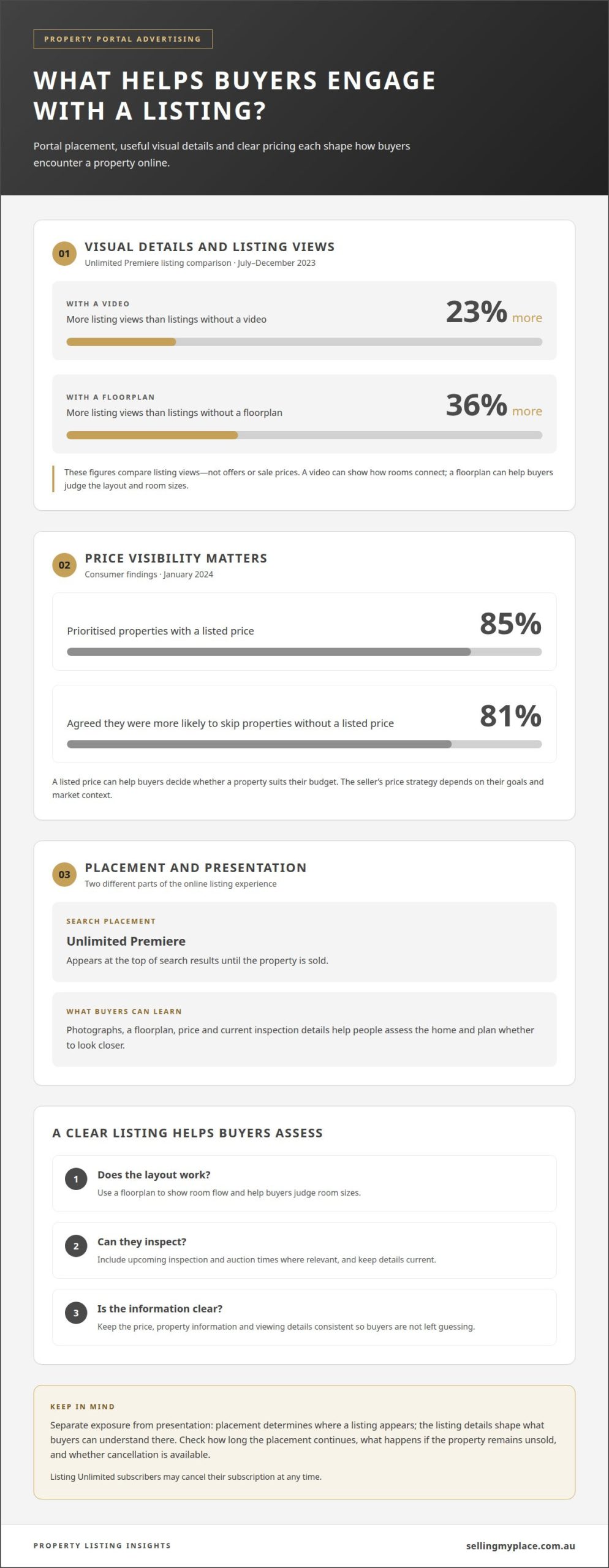
For an Australian home seller, portal advertising affects how buyers encounter a property online. A listing’s position, photographs, floorplan, price and inspection details each help people decide whether to look closer. An Unlimited Premiere listing appears at the top of search results until the property is sold. That placement can keep the listing visible in search results, while the property remains available for sale. It doesn’t replace clear information: buyers still need to understand what the home offers and how to arrange an inspection.
Visual material gives buyers another way to assess a home before visiting. For the period July 2023 to December 2023, Unlimited Premiere listings with a video achieved 23% more listing views than listings without a video. Listings with a floorplan achieved 36% more listing views than listings without one. These figures compare views, not offers or sale prices. A video can show how rooms connect, while a floorplan helps buyers judge the layout and room sizes. Both can make an online estate listing more informative.
Price visibility is another consideration. In January 2024, 85% of consumers said they prioritised properties with a listed price, while 81% agreed they were more likely to skip properties without one in search results. Those findings highlight how a price can help buyers decide whether a property suits their budget. However, choosing a price strategy depends on the seller’s goals and market context. A listing should present the chosen approach clearly, so buyers aren’t left guessing about the sale.
Useful inspection information can also make a listing easier to act on. Include upcoming inspection and auction times where relevant, so property seekers can plan ahead. For example, a buyer comparing homes after work can see whether an advertised inspection fits their schedule. Keep details consistent across the listing: an outdated time or unclear instruction can create avoidable confusion. Clear directions, accurate property information and current viewing details help turn online interest into a practical next step.
When reviewing portal advertising, separate exposure from presentation. Top placement concerns where a listing appears; images, plans, pricing and inspection times shape what buyers can learn there. Ask how long the chosen placement continues, what happens when a property remains unsold, and whether cancellation is available. Listing Unlimited subscribers may cancel their subscription at any time. These details matter when comparing advertising arrangements, because duration and presentation affect different parts of the selling experience through Kincade International Direct Sales.
Before publication, organise the listing around a buyer’s likely decisions: does the location suit them, does the layout work, and can they inspect? Match each question to a useful detail, such as a floorplan showing room flow or an inspection time for planning. Review the price and property information together rather than treating advertising placement as the whole strategy. This helps you see what buyers can learn and where the listing needs clearer information.
Flat-fee selling packages
A flat-fee package has a set charge rather than a charge calculated as a percentage of the sale price. For Australian sellers, the practical question is what the fee covers. Kincade International Direct Sales offers three fixed-fee packages, each with portal listings, enquiry forwarding, dashboard access and a Market Valuation Report. Compare the package inclusions with the marketing and support you need.
Start by comparing the package inclusions: the listing, marketing materials and support. A seller who already has polished photographs may value portal exposure most. Someone preparing the property may find professional photography or a floorplan more useful. Match the inclusions to your priorities rather than choosing by package name alone.
Duration deserves particular attention. If the property remains unsold, an end date or renewal arrangement can affect the overall cost and workload. An unlimited-duration arrangement means the listing can remain active until the sale, rather than ending after a preset period. Read the duration alongside cancellation terms and any conditions attached to continued advertising. These details explain how the arrangement works over time.
Then distinguish flat-fee from commission-based structures. A flat fee doesn’t describe the inclusions by itself. Check whether portal listings, photography, floorplans and market reports are included. Kincade International Direct Sales bundles its stated features into each package, so comparing those inclusions makes it easier to see what the service covers.
Use a simple comparison before deciding:
- Coverage: note whether listing preparation, photography, floorplans and advertising are included.
- Duration: identify the end date, renewal terms or until-sold arrangement.
- Support: distinguish marketing materials from advice about preparing or presenting the property.
- Conditions: understand cancellation terms and what happens if your sale plans change.
This comparison also clarifies the difference between packages with narrower and broader inclusions. A seller who already has accurate property information may need different support from someone still shaping their sale plan. Pre-sale property consulting can help owners prepare, while the package features determine the marketing provided. Understand the scope before choosing.
For a practical next step, set out your priorities, then match each one to an included service. If you want guidance connecting package options with your sale goals, discuss your property sale needs.
Listing descriptions and property features
A strong description helps buyers picture the home and decide whether it suits them. Include at least five features, such as a renovated kitchen, natural light, storage, outdoor space or a separate study. Choose details that are accurate and useful, rather than relying on broad praise like “stunning” without explaining what makes the property distinctive.
Yes. Australian property advertising should be accurate and not misleading, so avoid unsupported claims and make material information clear. Disclosure requirements depend on the property and circumstances, so don’t treat a general description as a complete account of every issue. Engage a qualified conveyancer or solicitor for legal matters.
Start with the property’s address, building size and land size where possible. Then focus on what a buyer needs to understand: the layout, standout features and how the spaces work. For example, “The open-plan kitchen and living area opens onto a covered deck” gives a clearer picture than “great for entertaining”. A floorplan can help buyers follow the layout.
Specific details make features more meaningful. Instead of saying “plenty of storage”, name the walk-in pantry or built-in wardrobes. Rather than “large backyard”, describe the usable lawn or established garden. Use measured, verifiable details where available; don’t imply a room’s use, renovation quality or property size beyond what the information supports.
Neighbourhood attractions can add useful context when relevant and described accurately. Mention nearby facilities or local features that matter to buyers, such as a park or transport connection. Focus on location facts, not promises about travel times or future changes. Buyers can then weigh the home and its surroundings together.
A high-resolution black-and-white floorplan with clear block fonts can make room labels easier to read; PNG is a suggested format. Keep the plan consistent with the written description. If the text calls a room a study, for instance, the floorplan should use the same label. A mismatch can leave buyers unsure which information to rely on.
What are the risks of writing an overly long property listing? Buyers may miss important details when key features are buried beneath repetition or lengthy descriptions. Keep each sentence focused on one useful point, and remove claims that add no clear information.
Before publication, check the copy against the property details and floorplan. Confirm that every feature is specific, relevant and accurate. A concise account of the layout, at least five standout features and nearby attractions gives buyers practical information without making them sift through unnecessary wording.
Listing duration and time limits
A property’s advertising period depends on its listing type and the terms attached to that listing. An unlimited-duration arrangement can keep a residential sale listing active until the property sells, rather than ending on a preset date. That gives the seller more time on market, but duration alone doesn’t determine how buyers respond.
The 60-day rule applies to rental listings, all realcommercial listings and Developer Project profile listings. This is a rule for those listing categories, not a universal time limit for every Australian residential sale listing. A standard home-for-sale advertisement should be understood through its own platform and package terms.
Can unlimited length property listings improve views or enquiries? They can keep a property advertised for longer, giving buyers more time to find it, but duration alone doesn’t determine how many views or enquiries it receives. Visibility, price, presentation and buyer demand also shape engagement.
Do property listing limits vary by Australian state or territory? The 60-day rule described here is tied to rental, realcommercial and Developer Project profile listings, rather than being a stated state or territory rule for residential sales. For a home sale, the relevant duration depends on the listing arrangement and applicable platform conditions.
When reviewing an end date, distinguish the listing’s duration from the portal advertising included in the package. Kincade International Direct Sales lists homes on Realestate.com.au and local portals such as Homely and Soho. Check the stated duration and which portals are included to understand where buyers may see the property and how long it remains advertised.
Look closely at the terms that define an active listing. Kincade International Direct Sales listings remain active until sold, withdrawn or two years from commencement, whichever comes first. Those endpoints explain what “until sold” means in practice and when the listing will no longer be active.
Longer exposure can be useful when a sale takes more time, but the listing should stay current. If the asking price, inspection arrangements or property details change, outdated information can confuse prospective buyers. Check the live listing after each change and make sure its details match your current sale plan.
Before choosing a duration, work through these points:
- Listing category: identify whether it’s a residential sale, rental, realcommercial or Developer Project profile listing.
- End date: note any expiry date, renewal process or ongoing arrangement.
- Conditions: understand cancellation terms and what keeps advertising active.
- Updates: plan how price, inspection and property-detail changes will appear.
These steps distinguish the listing duration from its portal and package features. For Australian home sellers, the key is to understand the duration terms and what advertising the chosen package includes.
How to create an unlimited property listing in Australia?
To create an unlimited-duration residential listing, choose an arrangement that keeps the property advertised until it sells, without a preset time limit. The listing’s terms should make clear which advertising is included and how changes are handled. This gives you a defined starting point before preparing the property information.
Use this sequence to build the listing:
- Set the sale plan. Decide your intended sale method, price approach and preferred inspection arrangements. For example, consider whether buyers will see a price or auction details.
- Choose the listing terms. Confirm that the arrangement has no preset end date and understand its cancellation conditions. An unlimited-duration listing is different from an advertisement that expires and needs renewal.
- Prepare the property information. Gather the address, building and land details where available, plus accurate descriptions of the home. Consistent facts make it easier to prepare the copy and supporting materials.
- Organise the presentation. Arrange photography and a floorplan, then align the written details with what those materials show. For example, use matching room names in the description and plan.
- Prepare buyer-facing details. Add the chosen price approach and upcoming inspection or auction times. Clear information helps buyers understand how to take the next step.
- Review and publish. Read the complete listing as a buyer would. Correct outdated details before publication, then keep important information current while the property remains advertised.
Each step has a practical purpose. Your sale plan guides how the listing presents the property; the terms define its duration; and accurate details help buyers assess the home. If an inspection time changes, updating the listing prevents prospective buyers from relying on an old schedule.
Portal advertising is a separate consideration from listing duration. Kincade International Direct Sales packages include listings on Realestate.com.au and local portals such as Homely and Soho, while the listing remains active until sold, withdrawn or two years from commencement. Review both the included advertising and duration terms, since ongoing exposure doesn’t mean every advertising feature is the same across packages.
After publication, keep a simple record of changes to the price, property details and viewing arrangements. For example, note when an inspection time changes, then check that the live listing reflects it. This creates a useful update process instead of relying on memory during a busy sale.
For help putting these steps together around your property and sale plan, discuss your listing requirements.
Kincade International Direct Sales: Residential Property Listing Services
Kincade International Direct Sales provides residential property listings with no time limit, keeping a property listed until it sells. Its commission-free property marketing service includes a global marketing network, professional photography and floorplans. Neighbourhood market reports can also help owners understand local sale conditions while preparing their listing.
This approach may suit Australian homeowners who want ongoing listing duration and a flat-fee model, rather than a commission-based arrangement. Pre-sale property consulting can help owners plan their sale, while Buyer Representation supports buyers seeking guidance in their property search.
If you’re weighing up an ongoing listing or preparing to sell, contact Kincade International Direct Sales to discuss your property sale.
Make your next move with confidence
Choosing an unlimited length property listing is one part of a broader sale plan. Your next step is to decide what you need from the package, including the marketing features and support that suit your sale. Consider what would make the process manageable, from preparing property information to understanding the listing terms.
Kincade International Direct Sales offers Residential Property Listing Services and Pre-Sale Property Consulting for homeowners planning a sale. Buyer Representation is available for people looking for support with a property search. Choose the service that fits where you are in your property journey.
A considered plan can help you move forward at your own pace, with a clearer sense of what comes next. Contact Kincade International Direct Sales to discuss your property goals and take the next step with confidence.
Frequently Asked Questions
How long will my property be listed?
For a Kincade International Direct Sales listing, advertising continues until the property is sold, withdrawn or reaches two years from its commencement date. This gives you an ongoing listing period, with a defined maximum duration. If your sale plans change, withdrawal is one of the stated endpoints. Keep a note of the commencement date so you can track the listing period and plan any next steps clearly.
What are the total fees?
The total depends on the package selected, and package prices are exclusive of GST. Kincade International Direct Sales uses a flat-fee model, rather than charging commission on the sale. The packages bundle their listed marketing features, so your choice affects which inclusions apply. For budgeting, consider the selected package and GST together, then review its inclusions against the support and marketing you want for your sale.
What support do you provide once I’m listed?
Support includes enquiry forwarding by SMS and email, plus access to a seller dashboard. Email expert support is included across the packages; phone expert support is included with Signature and Prestige. Prestige also includes a dedicated specialist. For example, the dashboard gives you a place to manage listing activity, while forwarded enquiries help you respond to prospective buyers and organise your next conversation.
Which Australian property websites offer unlimited-length listings?
Kincade International Direct Sales lists homes on major Australian property portals and local platforms, including Homely and Soho. It acts as a licensed intermediary for portal listings, as individuals can’t list directly on some major portals. Portal availability and the listing arrangement are separate considerations, so look at both the websites included and the duration terms. That helps you understand where buyers may see the property and how long it stays advertised.
How much do unlimited-length property listings cost in Australia?
Costs depend on the selected package, and all prices are ex GST. The flat-fee structure bundles the stated features rather than adding commission based on the sale price. Compare the package inclusions, such as photography, portal listings and support, with the marketing you need. This makes it easier to choose the package that fits your sale.
What listing limits apply to property descriptions on Australian real estate websites?
Description limits are set by each portal’s listing fields and publishing rules, so there isn’t one character limit for every Australian property website. Put essential facts near the beginning so buyers can quickly understand the home. If a portal restricts the description length, prioritise the layout, standout features and relevant location details, then remove repeated adjectives or claims that add little information.
How do unlimited-length listings compare with standard property listings?
An unlimited-duration listing stays active under its stated terms rather than ending at a preset date. For Kincade International Direct Sales, the listing remains active until sold, withdrawn or two years from commencement, whichever comes first. This describes the duration, not a promise of more enquiries or a sale. Review package inclusions separately when weighing the options.
What details should an Australian property listing include?
Include the property address, building and land sizes where available, and at least five accurate features that help buyers assess the home. Pair clear room descriptions with matching floorplan labels. Add relevant neighbourhood attractions and current inspection or auction details where applicable. Accurate, consistent information helps buyers understand the property and decide whether to arrange a viewing.
List Your Property on Domain.com.au: A Guide for Sellers
Want to sell privately but still reach buyers on Domain? The key to understanding how to get my property on domain.com.au is knowing that private owners can’t publish a residential sale listing directly. Domain requires a licensed intermediary to submit the listing, so it helps to understand the authorised route before preparing your advert.
Getting an authorised listing published and choosing how it appears in search results are separate steps. Kincade International Direct Sales (KIDS) acts as a licensed intermediary, giving private sellers a route to Domain exposure while they retain control of the sale. You manage your listing and enquiries, with enquiry forwarding and a 24/7 seller dashboard included in every package.
This guide explains the listing process, what information to organise and how portal listings differ from paid visibility products. It also covers the KIDS package options, including professional photography and, in some packages, a floorplan redraw and social media advertising. With accurate property details and a careful review of the advert, you can approach online exposure with more confidence and stay involved throughout.
Key Takeaways
- Separate the authorised listing route from any decision to pay for greater visibility.
- Prepare accurate property details, a clear description, quality images and information about inclusions before the listing is submitted.
- Organise relevant sale documents and engage a qualified conveyancer or solicitor for legal advice and documents.
- Kincade International Direct Sales (KIDS) provides private sellers with a licensed intermediary route to list on Domain.
- Compare the Classic, Signature and Prestige fixed-fee packages by their inclusions, support and presentation features.
Can a private owner get a property on Domain.com.au directly?
No. Private individuals can’t create and publish a residential sale listing directly on Domain.com.au. A licensed intermediary must submit it. The intermediary uses its authorised portal access to publish the listing, while the seller retains control of key decisions about the sale.
Owning a home and deciding to sell it doesn’t automatically provide the portal permissions needed to upload a listing. The route for how to get my property on domain.com.au as a private seller is to use a licensed intermediary, rather than trying to publish the advert through an individual account.
Why Domain listings use an authorised intermediary
Domain’s help resources describe listing tasks through an agent-facing system, including Agent Admin tools for creating and managing listings. These tools explain how a property advert can be managed once it is in the portal, but private owners can’t publish directly. Domain Group operates Domain Group’s real estate portal as part of its property platform. A seller’s authority to decide how a home is marketed is separate from the portal access needed to publish its listing.
Kincade International Direct Sales (KIDS) acts as a licensed intermediary for Domain listings. It provides the authorised portal route for a private seller’s listing without taking over decisions about the sale. You remain the owner and decision-maker, while KIDS submits the listing through its intermediary access.
What getting listed on Domain does, and does not, mean
A Domain listing is an advertisement that presents your property details to people browsing the portal. It gives prospective buyers a way to discover the property and make an enquiry. It is not an offer, a buyer commitment or a completed sale.
What happens after publication depends on the conversations between you and prospective buyers. Enquiries may lead to discussions and negotiations, but neither follows automatically from a listing. Publication also cannot guarantee a particular sale price or outcome. Portal exposure is one part of a private sale, not the whole process.
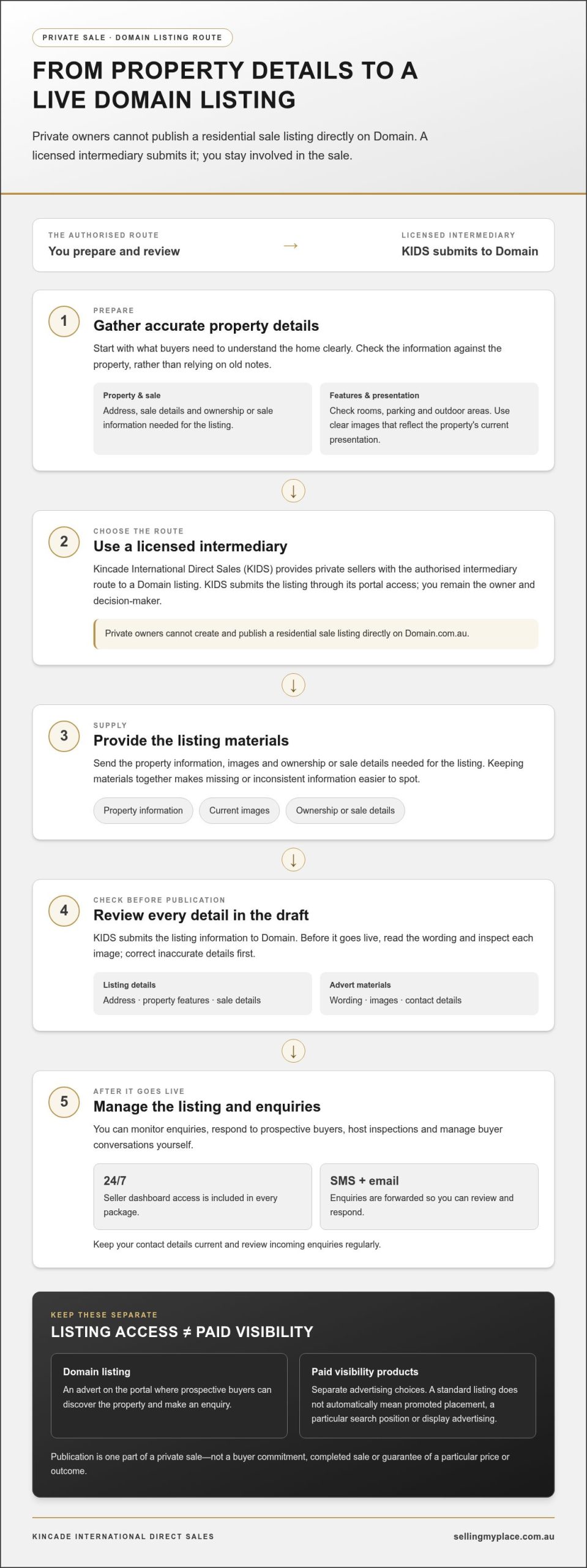
Listing access and paid visibility products are different things. A standard listing does not automatically mean promoted placement, a particular search position or display advertising. Those are separate advertising choices. Understand what the listing package includes and distinguish that from any separate visibility product. This helps you decide what you need without mistaking publication for an upgrade.
How to get your property on Domain.com.au: the private seller’s steps
For a private owner, the process is easier to manage when you separate preparing the advert from submitting it to the portal. If you’re asking how to get my property on domain.com.au, the practical steps are to organise accurate property information, use a licensed intermediary to submit the listing, review it carefully and then manage the listing and buyer enquiries.
- Prepare the property details. Gather the address, sale details and a clear description of the home. Check features such as rooms, parking and outdoor areas against the property itself, rather than relying on old notes.
- Choose the listing route. Kincade International Direct Sales (KIDS) provides a licensed intermediary route for private sellers who want a Domain listing.
- Supply the materials. Provide the property information, images and ownership or sale details needed for the listing. Keeping these together makes it easier to spot missing or inconsistent information.
- Review the draft. Check the wording, images and contact details before publication. Correct inaccurate details before the listing goes live.
- Manage the listing. Monitor enquiries and respond to prospective buyers in a way that suits your sale plans. You can also host inspections and manage buyer conversations yourself.
Prepare the property information before starting
Consider what a buyer needs to understand at a glance. A useful description presents the home’s features clearly and accurately, without overstating them. Images should show the property being marketed and reflect its current presentation. If a feature has changed, update the description or provide current images rather than leaving buyers with an outdated impression.
Gather the ownership and sale information needed for the listing process, too. Having it ready helps the intermediary prepare the submission and identify details that need your attention. This is a practical preparation step, not a replacement for sale documents or professional legal advice.
Submit, review and manage the listing
Once you’ve supplied the materials, KIDS submits the listing information to Domain through its licensed intermediary access. Before publication, read every line and inspect each image. Check the address, property features, sale details and contact information closely. Small errors can confuse buyers and create extra work later.
After publication, the 24/7 seller dashboard included in every package lets you manage your listing, while enquiries are forwarded by SMS and email. Keep your contact details current and review incoming enquiries regularly so you can respond thoughtfully and maintain an accurate picture of the property.
A private owner gets a Domain listing live by preparing accurate property information, supplying it to a licensed intermediary and reviewing the advert before publication. If you’d like support with the authorised submission route, discuss your Domain listing process with KIDS.
Domain listing versus upgrades: what private sellers should understand
Getting a property published on Domain and paying to promote it are separate decisions. The first is about having a listing on the portal. The second concerns advertising products that may affect how a listing is displayed or seen. Domain’s upgrade guidance describes products for agents and advertisers, so it is useful to understand the distinction between a listing and a promotional campaign.
That distinction matters when you’re working out how to get my property on domain.com.au. Start with the listing route and what your selected package includes. Treat promoted placement as a separate advertising choice, not a condition for appearing on the site or a promise of more buyer interest.
| Option | What it means | What to keep in mind |
|---|---|---|
| Standard listing presence | The property advert is published on Domain for users to view. | Publication alone doesn’t promise a promoted position or a particular place in search results. |
| Paid visibility products | Domain’s agent-focused guidance describes listing upgrades that can influence search-result order or presentation. Examples include Top Spot and other advertising tiers. | These are distinct from getting the property listed. A promoted position is not the same as a standard listing. |
| Display advertising | Separate advertising products can promote a property or reach potential buyers through digital channels. Domain’s materials include eBrochures and Audience Boost. | Display advertising is a campaign option, not the same thing as a standard listing, and doesn’t guarantee enquiries or a sale. |
What Domain upgrades and display products are for
Domain’s agent-focused help content describes upgrades as ways to change a listing’s position or presentation within the portal. It also outlines display products that promote property advertising through other digital placements. These descriptions help explain the difference between a listing and a campaign. They are not a promise of access, a guaranteed ranking or a requirement to upgrade.
Think about exposure without overpromising
A clear, complete listing helps buyers understand what’s being offered. Accurate details, considered wording and strong presentation give the advert a solid foundation, whether or not additional advertising is used. A promoted placement may create a visibility opportunity, but it can’t create buyer demand or determine what someone will offer.
No placement guarantees a sale or a particular sale price. Enquiries, negotiations and the final outcome depend on factors beyond where an advert appears. Focus first on getting the listing information right and understanding what your selected package includes. Any upgrade decision is separate and should be considered on its own merits.
What to prepare before your Domain property listing goes live
Preparation makes it easier to create an accurate, clear listing that is ready for buyer enquiries. If you’re working out how to get my property on domain.com.au, treat the pre-publication review as a chance to catch missing details before they reach prospective buyers. Gather your property information, images, contact preferences and relevant sale documents, then check them against one another.
Check listing details and presentation
Read the description as a buyer would. Does it explain the home clearly, and do the stated features match the property? Check every detail against what’s actually being offered, including fixtures and other inclusions. Choose clear, current photographs that accurately represent the property. The aim is an honest, helpful impression, not a presentation that leaves buyers expecting something different.
- Property details: Check the address, sale information and description for accuracy and consistency.
- Features and inclusions: Verify room details, parking, outdoor areas and anything else mentioned in the advert. Be precise about what stays with the property.
- Images: Review every photograph for clarity and make sure it shows the property being marketed as it is now.
- Contact preferences: Confirm the contact details and preferred way for enquiries to reach you. Decide who will monitor messages and respond to interested buyers.
- Supporting information: Keep relevant ownership and sale information organised, and note any questions to resolve before the advert is submitted.
Make one final pass through the draft once the wording and images are together. A room described as having a particular feature should be represented accurately, and an inclusion named in the description should match what you intend to offer. These checks help reduce avoidable misunderstandings later.
Keep legal documents with the right professional
Preparing advertising information and preparing legal sale documents are separate tasks. Requirements vary between Australian states and territories, so don’t treat a listing checklist as legal guidance or assume one process applies everywhere. Engage a qualified conveyancer or solicitor to advise on and prepare or review the contracts and other documents relevant to your sale.
Kincade International Direct Sales (KIDS) supports the listing process as a licensed intermediary, but doesn’t provide legal advice, contracts or conveyancing services. Keeping that distinction clear helps you organise the right support: KIDS can submit the listing, while your conveyancer or solicitor handles legal matters.
Before approving the advert, check that the property details, images and contact preferences are correct, and address document questions with your legal professional. Get support preparing your Domain property listing with KIDS.
Get your property on Domain through Kincade International Direct Sales
If you’re weighing up how to get your property listed on Domain as a private seller, Kincade International Direct Sales (KIDS) provides the licensed intermediary route. KIDS submits private property listings to Domain, while you retain control of your listing details and buyer enquiries. You handle the sale decisions and inspections; KIDS provides the portal access and marketing package.
KIDS offers three fixed-fee packages, each priced ex GST: Classic at $799, Signature at $999 and Prestige at $1,999. The listed features are bundled into the selected package, so compare the inclusions that matter to you, such as photography, signboard size, support and advertising. Every package includes listing on Domain, Realestate.com.au and local portals, enquiry forwarding by SMS and email, 24/7 seller dashboard access and a Market Valuation Report.
What the KIDS listing pathway provides
Classic includes professional photography, a 600 × 900 mm For Sale signboard, email expert support, a dedicated website and URL, and international network access. Signature includes everything in Classic, with a larger 1200 × 1800 mm signboard and email and phone expert support. Signature also includes a dedicated property website and URL.
Prestige includes everything in Signature, plus 15-20 professional photographs, a floorplan redraw, a Facebook and Instagram ad campaign, 50 premium A4 property brochures, a 1-on-1 dedicated specialist, a James Edition listing and a 1200 × 1800 mm photo signboard. It also includes priority access to the Kincade Global Network in the United Kingdom and the United States. These are package inclusions, not a promise of a particular search position or sale result.
KIDS acts as a licensed intermediary for listing purposes, not as a real estate agent. You retain control of your listing, enquiries and sale decisions through the 24/7 dashboard. Your listing remains active until sold, withdrawn or two years from the commencement date.
Choose a package and take the next step
Consider the presentation and support that suit your plans, then compare the package inclusions as a whole. Classic provides professional photography and email support; Signature adds phone support and a larger signboard; Prestige includes the broader marketing and specialist features listed above. All package prices are ex GST, with no commission payable to KIDS.
This route keeps you close to the process: KIDS provides licensed intermediary access, while you retain control of the listing and buyer conversations. A Domain listing can present your property to portal users, but it can’t guarantee a sale or a particular price.
If you’re ready to explore the listing route, talk with the team about getting your property on Domain. You can also select “Explore Packages” or “Get Started” on the KIDS website to review the fixed-fee options.
Take the next step towards your sale
Knowing how to get my property on domain.com.au helps make the first part of selling more manageable. Focus on what matters to you: how your home is presented, how you want to handle buyer conversations and what support you need. A clear plan gives you room to make informed decisions rather than feeling rushed.
You don’t need every detail settled before comparing package options. Review the inclusions, organise your property information and consider how you want to manage enquiries and inspections. The KIDS packages combine a fixed fee with portal listings and marketing features, while you remain in control of the sale.
Talk with the team about listing your property on Domain and take a clear, confident step towards putting your sale plans in motion.
Frequently Asked Questions
Can I list my property on Domain.com.au without an agent?
You can sell privately without appointing a traditional real estate agent, but you can’t publish a residential sale listing on Domain through an individual account. A licensed intermediary can submit it for you. Kincade International Direct Sales (KIDS) provides this route, so you can make your own sale decisions while using an authorised listing pathway. Selling privately and uploading directly to a property portal aren’t the same thing.
Is it legal to sell my property privately in Australia?
Yes. Australian property owners can sell privately in every state and territory. Selling without a traditional agent doesn’t remove your responsibilities as a vendor, and the paperwork can vary depending on where the property is located. Before marketing the home, speak with a qualified conveyancer or solicitor about the documents and steps that apply to your sale. They can advise on your circumstances.
Does getting listed on Domain guarantee that my property will sell?
No. A Domain listing advertises the property to portal users, but it can’t ensure that a buyer will enquire, make an offer or proceed to a completed sale. Listing views may not translate into an offer that suits you. Consider each enquiry on its merits, and seek appropriate professional advice for legal matters. Portal exposure is one part of selling, not a promised outcome.
Can I edit my property listing after it goes live?
Yes, sellers using KIDS can edit listing details through the 24/7 seller dashboard. If something changes, such as an inclusion or a contact preference, keeping the information current helps avoid confusion for prospective buyers. You can also use the dashboard to manage enquiries. Review edits carefully so the advert remains consistent across its description, features and images.
Do I need a Domain upgrade to have my property listed?
No. A paid visibility upgrade isn’t a prerequisite for a listing to appear on Domain. Upgrades and display advertising are separate choices from getting the property submitted and published. If you’re considering promoted placement, distinguish the advertising product from the standard listing and remember that it cannot guarantee a buyer or a particular sale price.
What documents should I have ready before listing my property?
Requirements depend on the state or territory. In NSW and the ACT, a Contract of Sale is required before listing. In Victoria, a Section 32 Vendor Statement must be provided before contracts are signed. These are examples, not a complete national checklist. Engage a qualified conveyancer or solicitor to identify and prepare the documents for your property.
The Power of Floorplans: Why Spatial Clarity Sells Australian Homes Faster
Imagine a potential buyer sitting on their lounge on a Tuesday night, scrolling through your listing. They love the kitchen’s stone benchtops and the sun-drenched deck, but they’re squinting at the screen trying to figure out if the third bedroom is close enough to the master for a nursery. Without professional floorplans, that uncertainty often turns into a skipped inspection. It’s a missed opportunity that happens more often than most sellers realise, especially when the national median dwelling value is sitting at $922,838 and every click counts.
We understand the frustration of listing fatigue when your home sits on the market while others seem to fly. It’s disheartening to host open homes only to see buyers walk out because the flow isn’t what they imagined from the photos. We’re here to help you move past the stress of high-stakes marketing and find a clearer path. In this guide, you’ll discover how a professional floorplan transforms your property listing from a simple gallery into a high-converting spatial narrative. We’ll explore the genuine ROI of spatial clarity, the essential details your plan must include to meet Australian Consumer Law standards, and how to present your home’s layout to attract truly serious buyers.
Key Takeaways
- Understand why professional floorplans act as the “rational logic” that bridges the gap between a beautiful photo and a firm offer.
- Learn how accurate dimensions and clear labelling of storage spaces help buyers visualise their life (and their furniture) in your home.
- Discover how providing spatial data can qualify potential buyers early, saving you from the frustration of wasted weekend inspections.
- Explore why professional measurements are vital for legal accuracy and how to achieve a high-end listing without the burden of traditional agency commissions.
Why Floorplans are the Secret Weapon of Successful Australian Property Listings
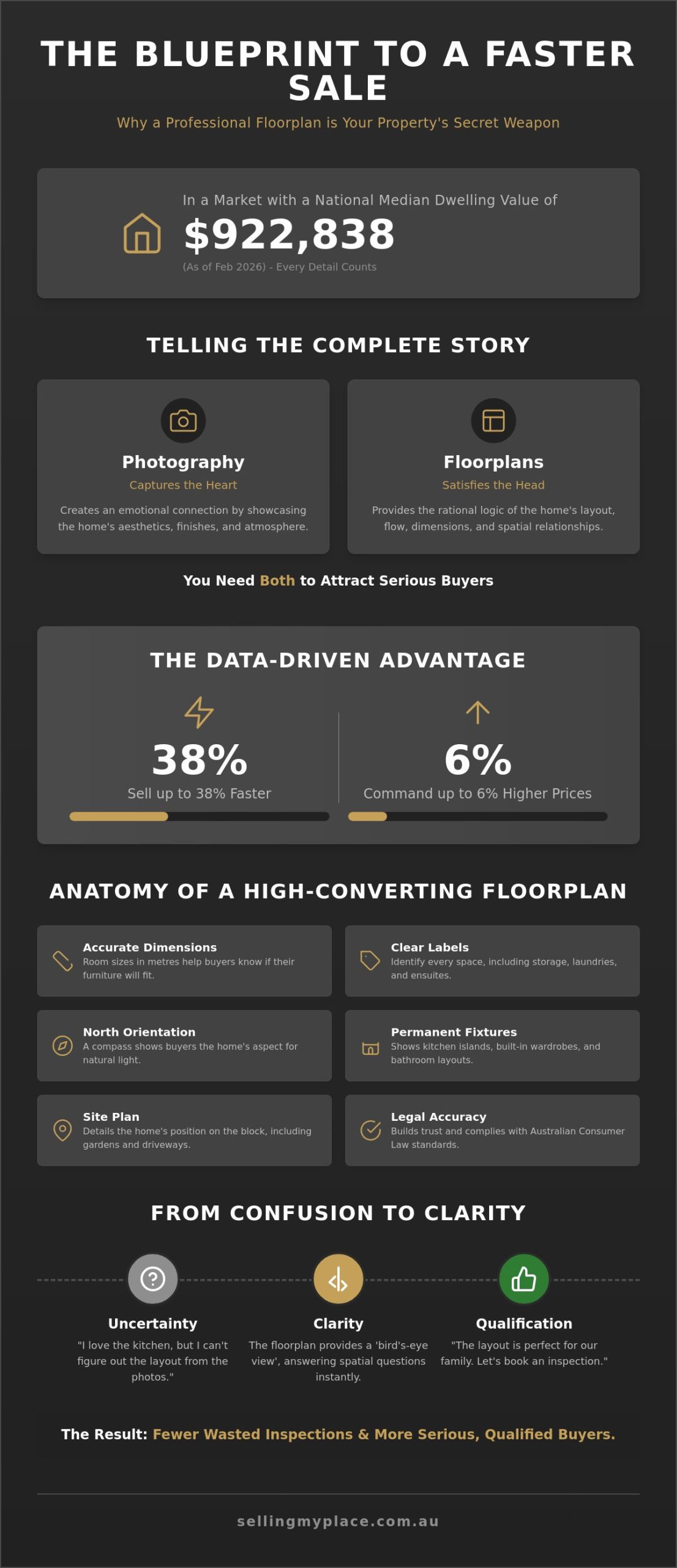
In the Australian property market, where the national median dwelling value reached $922,838 as of February 2026, every detail of a listing carries significant weight. While professional photography captures the heart, it’s the floorplan that satisfies the head. Essentially, What is a floor plan? It’s a scaled 2D or 3D bird’s-eye view that reveals the internal logic of a home, showing how rooms connect and where the boundaries of each space lie. For many local buyers, this is the most critical piece of information after the photos themselves. It provides a sense of transparency that photos alone can’t achieve, building an immediate bridge of trust between the seller and the purchaser.
Beyond just a simple drawing, a floorplan creates a spatial narrative. It tells the story of how a family will live, move, and grow within the walls. By offering this clarity, you’re not just selling a house; you’re providing the blueprint for a future lifestyle. This transparency is especially important given the strict Australian Consumer Law regulations regarding misleading advertising. Providing an accurate layout shows you’ve got nothing to hide and respect the buyer’s need for honest, practical data.
The Psychology of the Online Browser
When someone is scrolling through a listing, they’re doing more than just looking at colours and finishes. They’re trying to solve a puzzle. Without floorplans, the “cognitive load” of trying to piece together a kitchen’s relationship to the dining area based on separate photos can be exhausting. A clear layout allows a buyer to mentally “move in” before they’ve even stepped foot on the property. It turns a poetic description of a “sun-drenched living area” into a verifiable fact by showing the northern orientation and window placements. This clarity reduces anxiety and helps a family decide if their heavy heirloom dining table or that specific king-sized bed will actually fit.
Statistical Advantage in the 2026 Market
The 2026 market has seen a shift toward more cautious, data-driven buying. With interest rates for owner-occupiers averaging 5.50% in early 2026, purchasers aren’t likely to gamble their time on vague listings. Some industry reports suggest that properties featuring professional floorplans can sell up to 38% faster and may even command prices up to 6% higher than those without. In a cooling market where home values saw a 0.4% dip in June 2026, staying on a buyer’s shortlist is vital.
A well-executed layout ensures your home remains a contender long after the initial emotional spark of the photography has settled. It serves several practical purposes:
- It defines the flow between indoor and outdoor living spaces.
- It highlights the proximity of bedrooms to bathrooms for young families.
- It identifies “hidden” value like storage cupboards, laundries, or study nooks.
By providing this information upfront, you’re treating potential buyers as partners in the process. It’s the first step toward a successful, stress-free sale.
The Anatomy of a Perfect Floorplan: What Modern Buyers Expect to See
While we’ve established that floorplans are a vital part of your marketing toolkit, not all plans are created equal. A blurry, hand-drawn sketch scribbled on a napkin won’t cut it in today’s competitive market. Modern Australian buyers, particularly those looking at property values nearing the million-dollar mark, expect a level of technical precision that mirrors the quality of the home itself. They’re looking for a document that acts as a reliable reference point for their future life. This means including accurate room dimensions in metres or millimetres for every major living area and bedroom. It’s the difference between a buyer wondering if their king-sized bed will fit and them knowing for certain that it will.
Beyond simple wall placements, a high-quality plan must clearly label every space. Don’t leave people guessing. If there’s a tucked-away laundry, a walk-in linen cupboard, or a compact ensuite, mark it clearly. Buyers also look for permanent fixtures that dictate how they’ll use a room. Indicating the position of kitchen islands, baths, and built-in wardrobes helps them understand the functional flow of the house. To provide a truly complete picture, always include a site plan. This shows the home’s footprint in relation to the entire block, detailing driveways, garden spaces, and the distance to boundary lines.
Orientation and Natural Light
In our climate, the direction a house faces is everything. A professional floorplan must include a North-point indicator. This isn’t just a technicality; it’s a guide to how much sun will hit the living room in winter or how cool the bedrooms might stay in summer. By showing window placements and their relationship to alfresco areas, you highlight the home’s ventilation and light flow. It allows a buyer to visualise themselves enjoying a morning coffee in a sun-drenched nook or hosting a summer BBQ in a shaded outdoor zone. If you’re unsure how to best showcase your home’s unique layout, it’s often worth reaching out for a chat about your listing needs.
Gross Internal Area (GIA) vs. Total Area
Transparency is your best friend when it comes to square meterage. Buyers want to know exactly what they’re paying for, and being vague can lead to difficult conversations during the conveyance process. Gross Internal Area is the total floor space within the external walls. It’s important to distinguish this from the “total area,” which might include carports, open decking, or balconies. Providing these separate figures prevents any feeling of deception. With the Australian Consumer Law carrying heavy penalties for misleading conduct, including accurate spatial data isn’t just good marketing; it’s a necessary step to protect your sale and provide peace of mind to everyone involved.
Photography vs. Floorplans: Why You Need Both to Tell a Complete Story
If professional photography is the first spark of romance in a property search, the floorplan is the deep, meaningful conversation that follows. It’s a simple truth in the Australian market. Photos are designed to create an “emotional hook,” pulling a buyer in with beautiful light, polished floorboards, and the promise of a certain lifestyle. However, savvy purchasers are increasingly aware of the “wide-angle lens” trickery. They know a clever angle can make a modest study look like a grand master suite. To bridge this gap, floorplans provide the “rational logic” that validates those beautiful images with factual, indisputable data.
Think of your marketing as creating a digital twin of your home. When you pair high-quality images with an accurate layout, you’re providing a comprehensive view that respects the buyer’s intelligence. This synergy is more important than ever. In June 2025, New South Wales introduced legislation requiring mandatory disclosure when images in advertisements have been digitally altered to conceal faults. This reflects a broader national trend toward transparency. By providing a professional plan, you’re offering a grounding truth that reassures buyers your home is exactly what it claims to be. It turns a collection of pretty pictures into a cohesive, believable story.
Bridging the Gap Between Clicks and Inspections
A well-placed layout acts as a map for your photo gallery. Without it, a buyer might see a stunning parents’ retreat and then a separate shot of a kids’ wing, but have no idea how they relate to one another. Are they on opposite sides of the house? Is there a central lounge between them? When a buyer can reference the floorplan while scrolling through photos, they stay on your listing page significantly longer. This increased “time on page” is a key metric that property portals use to rank listings, potentially giving your home more visibility in a crowded market.
The Risk of Only Using Photos
Relying solely on photography is a gamble that often leads to high-volume but low-quality inspections. There is nothing more frustrating for a seller than hosting ten groups on a Saturday morning, only to find that half of them left disappointed because the layout didn’t suit their specific needs. Maybe they needed a home office far from the kitchen, or perhaps they required a ground-floor bathroom for an elderly relative. When you skip the spatial data, you’re inviting “tyre kickers” who could have been qualified earlier. To ensure your marketing strategy is as efficient as possible, it’s wise to look into Professional Residential Property Listing Services that prioritise this balance. Providing clarity upfront means the people walking through your front door are already half-convinced that your home is the right fit for their life.
Qualifying Buyers Early: How Spatial Data Reduces Wasted Inspections
One of the most draining parts of selling property is the “tyre-kicker” effect. These are lovely people who adore your photography but realise within moments of arriving that the house simply doesn’t fit their life. It’s a waste of their Saturday and, more importantly, your time and energy. Using floorplans as a pre-screening tool solves this problem before the first doorbell rings. It allows potential purchasers to check if their oversized modular sofa fits the lounge or if the third bedroom is actually large enough for a home office. By providing this data upfront, you’re essentially handing them a checklist to qualify themselves.
This creates a “Serious Buyer” filter. When someone books a viewing after studying the layout, they’ve already done the mental heavy lifting. They aren’t wondering if the flow works; they’re already imagining how they’ll style the space. During the open for inspection, the floorplan becomes a natural talking point. It gives you a structured way to point out the subtle benefits of the home, such as the separation between the master suite and the guest wing, which might be hard to appreciate while walking through a crowded room. If you want to ensure your listing is working as hard as possible for you, consider reaching out for a chat about your property presentation.
Saving Time for the Private Seller
For those taking the “Sale by Owner” route, efficiency isn’t just a preference; it’s a necessity. You’re likely balancing work, family, and the sale itself, so every lead needs to be high-quality. A professional layout answers those repetitive questions about room sizes and storage before they’re even asked. It reduces the number of “just looking” calls and ensures your weekends are spent with people who are genuinely interested in your home’s specific configuration. If you’re managing the process yourself, it pays to learn How to Sell Your Own Home with a focus on these time-saving tools.
Empowering the Buyer’s Decision
A floorplan’s value doesn’t end when the inspection does. It becomes a vital reference point for buyers as they discuss the property with architects or builders about potential future renovations or extensions. It even plays a role in securing finance, as valuers often use these documents to verify the property’s living area during their assessment. Providing this level of detail empowers the buyer to move forward with confidence, knowing they have all the facts at their fingertips. A professional floorplan acts as a permanent, tangible reference that keeps your home at the forefront of a buyer’s mind long after they’ve left the driveway.
Professional Marketing Without the Commission: The Kincade Advantage
By now, it’s clear that spatial clarity isn’t just a “nice to have” feature; it’s a fundamental pillar of a successful sale. However, many homeowners worry that accessing high-end assets like professional floorplans requires signing away a significant portion of their equity through a 2-3% agency commission. We believe you shouldn’t have to choose between professional quality and your family’s financial future. Through Kincade International Direct Sales (KIDS), we’ve designed a model that provides those same elite marketing tools within a transparent, flat-fee structure. It’s about giving you the “big agency” look while keeping your hard-earned results in your own pocket.
While some might be tempted to save a few dollars with a DIY sketch or a basic smartphone app, the risks are substantial. Under the Australian Consumer Law, misleading or deceptive conduct in property advertising can lead to staggering penalties, with corporations facing fines up to $100 million. A professional measurement ensures that your Gross Internal Area is recorded with pinpoint accuracy, protecting you from legal disputes during the conveyance process. When your property is uploaded to our global marketing network, these precise details ensure your home stands out to serious buyers across the country and overseas, presented with the authority it deserves.
A Partnership Approach to Selling
We don’t just hand you a marketing bundle and walk away. Our “Steady Hand” philosophy means we act as your nurturing guide through the entire process. This starts with expert pre-sale property consulting to identify which features of your layout will most appeal to your local market. We then integrate your professional photography and floorplans into a listing that competes directly with the biggest agencies on the major property portals. It’s a collaborative effort where we provide the professional framework and you provide the heart and history of the home.
Your Next Steps to a Commission-Free Sale
Getting your home ready for the market is a significant life transition, and we’re here to make it as calm and organised as possible. When you choose one of our marketing bundles, we arrange for a professional to visit your home for a comprehensive measure-up and photo session. To prepare, simply ensure all rooms are tidy and clear of clutter so the technician can easily access every corner and wall. This small bit of preparation ensures your floorplans are as detailed and inviting as possible. If you’re ready to take control of your sale and move toward your next chapter with confidence, Discover our commission-free marketing packages today.
Take the Next Step Toward Your Successful Sale
Selling your home is one of life’s most significant transitions, and it deserves a strategy that respects both your heart and your hip pocket. We’ve explored how floorplans do more than just show wall placements; they qualify your buyers, reduce the stress of wasted inspections, and provide the legal transparency required in the modern Australian market. It’s about giving purchasers the confidence to say “yes” before they’ve even walked through your front door.
You don’t have to navigate this process alone or pay high marketing costs to get professional results. Our partners save an average of $20,000 in commissions while still receiving high-end photography and professional measurement as part of their bundle. With your property listed until sold and no time limits to worry about, you can move at a pace that feels right for your family. Save thousands and sell smarter with our flat-fee marketing packages. We’re here to ensure your next chapter starts with a sense of calm and a very successful result.
Your Questions About Spatial Marketing Answered
Do I really need a professional floorplan for a small apartment?
Yes, spatial clarity is arguably more important in smaller homes where every square metre counts toward the final sale price. Buyers looking at apartments often worry about whether their existing furniture will fit without making the space feel cramped. Professional floorplans help them visualise the layout of studios or one-bedroom units that can sometimes look identical in photos, giving your listing a distinct competitive edge.
Can I draw my own floorplan for a real estate listing?
While you can technically create a sketch yourself, it is not recommended due to the legal risks involved in property marketing. Accuracy is a strict requirement under Australian Consumer Law, and professional services provide the precision needed to avoid claims of misleading conduct. A DIY version often lacks the authority and exact millimetre-perfect measurements that serious purchasers and their solicitors expect to see.
What is the difference between a 2D and a 3D floorplan for selling?
A 2D plan is a flat, bird’s-eye view showing dimensions and room connections, while a 3D version adds depth and furniture visualisations to the mix. 2D versions are excellent for technical clarity and helping buyers plan their furniture placement. 3D versions are a wonderful tool for buyers who struggle with spatial awareness, as they help them “feel” the volume and height of the rooms more effectively.
How long does it take to get a professional floorplan created?
Most professional measures take about 30 to 60 minutes on-site, with the final digital files usually delivered within 24 to 48 hours. This quick turnaround ensures your marketing campaign isn’t delayed while you wait for assets. It is a small time investment that pays off significantly by ensuring your listing is comprehensive and ready for the portals from the very first day.
Will a floorplan help with my property valuation?
Yes, providing a detailed layout can assist a valuer in accurately calculating the Gross Internal Area (GIA) of your home. Valuers rely on precise data to compare your property with recent sales in the local area. Having this information ready shows you are a prepared and transparent seller, and it helps ensure no living space or utility area is overlooked during the formal assessment.
Should I include the garden and outdoor areas in my floorplan?
Absolutely, as including a site plan that shows the house in relation to the block is highly beneficial for the Australian lifestyle. Our way of living revolves around the indoor-outdoor flow, so marking alfresco areas, decks, and garden boundaries is essential. It helps buyers understand the total utility of the land and how they might use the backyard for future entertaining or play.
How much do floorplans typically cost when not included in a package?
Industry rates vary depending on the size and complexity of the home, but they are generally considered a very low-cost investment relative to the property’s value. While we include floorplans in our flat-fee bundles to provide the best possible value, standalone costs usually reflect the time taken for a professional measure-up and digital rendering. It is a small price to pay for the peace of mind that comes with professional accuracy.
Is a floorplan legally required to sell a house in Australia?
No, there is no national law that mandates a floorplan for a residential sale, but you are legally bound to be accurate if you choose to use one. Under the Australian Consumer Law, any visual representation must be a truthful and accurate reflection of the property. Providing a professional plan is the most reliable way to meet these transparency standards and protect yourself from potential disputes during the settlement process.
