Free Online Property Valuation: How Accurate Are They in 2026?
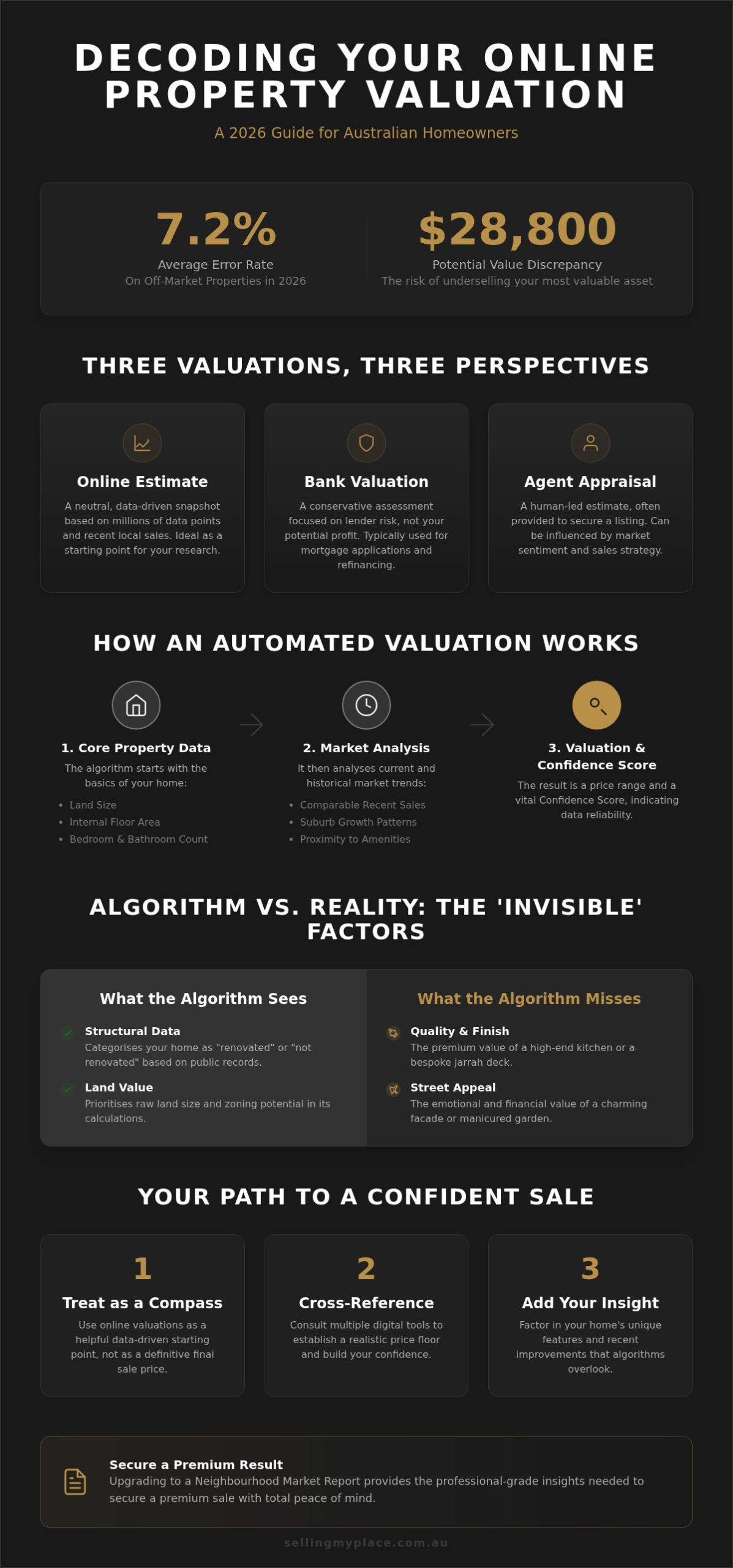
What if the number you just saw on a free online property valuation is actually $28,800 away from your home’s true worth? It’s a common scenario in 2026, where a 7.2% error rate on off-market properties can lead to significant confusion and the very real fear of underselling your most valuable asset. We understand the anxiety that comes with conflicting estimates; it’s hard to feel confident about your future when the digital data seems to change depending on which website you’re visiting.
You deserve to move forward with total clarity and a sense of calm. This guide will help you discover the truth behind automated property estimates and show you how to use that digital data to secure the best possible sale price for your Australian home. We’ll explore the latest 2026 accuracy benchmarks, explain why on-market data is more reliable than off-market guesses, and provide you with the tools to establish a realistic price range. By the end, you’ll have the confidence to manage your own sale and keep your hard-earned equity where it belongs.
Key Takeaways
- Learn how to treat a free online property valuation as a helpful data-driven compass rather than a definitive final sale price.
- Discover the specific “invisible factors” that algorithms often overlook, ensuring you don’t undervalue your home’s unique features or recent improvements.
- Master the technique of cross-referencing multiple digital tools to establish a realistic price floor and gain the confidence to lead your own sale journey.
- Understand how accurate market data allows you to sidestep traditional agent commissions and protect your family’s hard-earned equity.
- Explore how upgrading to a Neighborhood Market Report provides the professional-grade insights needed to secure a premium result with total peace of mind.
What is a Free Online Property Valuation?
When you’re standing in your kitchen, perhaps enjoying a morning flat white and thinking about the next chapter of your life, a free online property valuation is often the very first place your journey begins. It’s a digital starting line that offers a glimpse into your home’s potential without needing to tidy up for an unannounced visitor. While it feels like a simple search result, you’re actually interacting with a complex Automated Valuation Model (AVM). An AVM is a statistical tool that processes millions of data points to predict market value with mathematical precision.
It’s helpful to distinguish these estimates from other figures you might encounter. A bank valuation is typically conservative, focused on lender risk rather than your profit. A real estate appraisal is a human-led estimate, often influenced by the desire to secure a listing. An online estimate, however, acts as a neutral data-driven snapshot based on recent local sales and your property’s core characteristics. It provides a grounded starting point, helping you move from uncertainty toward a structured plan for your lifestyle transition.
The Role of Big Data in Australian Real Estate
Algorithms don’t just look at what happened yesterday; they analyse a decade of historical sales to identify long-term patterns in your suburb. In the Australian market, “Comparable Sales” (or “Comps”) are the lifeblood of these systems. The computer identifies properties similar to yours in land size, internal floor area, and bedroom count that have recently changed hands nearby. By weighing these “comps” against current market velocity, the algorithm calculates a price range. It’s a purely mathematical approach to a very personal asset, stripping away the noise to look at the cold, hard numbers.
Why Sellers Start with Online Estimates
The primary appeal of a free online property valuation is the lack of pressure. You can explore your options privately, without the intensity of a formal listing presentation or the feeling that you’re being pushed into a quick sale. Many homeowners use these tools to assess their equity, which is a vital step when deciding if you’re ready for a sea change or an investment upgrade. It’s about finding an objective figure to balance the deep emotional attachment we all have to our family homes. Having a realistic number in hand provides a sense of calm, allowing you to visualise your future state with confidence rather than guesswork.
The Science Behind the Screen: How Estimates are Calculated
Peering behind the digital curtain reveals a sophisticated engine room of data. When you request a free online property valuation, the algorithm begins by pulling the structural basics of your home: land size, internal floor area, and the all-important bedroom and bathroom count. These are the fixed variables, but the real intelligence lies in how the software weights recency. In our fast-moving 2026 market, a sale that settled yesterday carries significantly more weight than a similar property sold six months ago. This is because algorithms are programmed to track suburb-wide growth trends and “days on market” averages in real-time to sense the current heat of the local area.
However, these systems have a distinct blind spot. They see the box, but they don’t always see the beauty. While these models are highly advanced, research from the Brookings Institution highlights that automated systems can sometimes miss the mark when local nuances or unique architectural features aren’t perfectly captured in the raw data. If your home boasts a bespoke jarrah deck or a high-end kitchen renovation, the algorithm might categorise you simply as “renovated” without understanding the premium quality of the materials used.
Weighting Factors in the Algorithm
Software quantifies location proximity with ruthless efficiency. It measures the exact distance to amenities like train stations, parks, and schools, assigning a mathematical value to convenience. There’s often a tug-of-war between “Street Appeal” and “Land Value” in these calculations. While we might fall in love with a charming facade, the algorithm often prioritises the raw land size and zoning potential. Many tools now provide a “Confidence Score” alongside the estimate. This score is actually more important than the price itself; it tells you how much comparable data is available. A low score suggests the algorithm is guessing, while a high score means it has plenty of recent evidence to back its claim.
Data Sources: Where the Information Comes From
Most free online property valuation tools draw their power from government land registries and historical listing portals. This provides a solid foundation, but it’s not always instantaneous. There is often a lag time of several weeks between a sale occurring at auction and the official settlement data being processed by the state registry. To bridge this gap, some models incorporate user-submitted data. If you’ve recently updated your home, you can often “claim” your property on these portals to update the facts. If you’re feeling unsure about how your home’s specific upgrades are being weighed by the data, reaching out for a friendly chat can help provide the clarity you need to move forward.
Algorithm vs. Reality: Why Online Estimates Can Miss the Mark
While a free online property valuation provides a helpful ballpark, it fundamentally lacks the human eye required to judge quality. Algorithms are excellent at counting bricks and measuring land, but they’re terrible at feeling the atmosphere of a home. An Urban Institute study highlights how data-driven models can struggle with qualitative nuances, sometimes reinforcing local disparities because they cannot account for the tangible love and care poured into a property. We know your home is more than just a set of coordinates on a map; it’s a collection of memories and carefully chosen finishes that a computer simply cannot process.
Then there’s the “Outlier Effect.” If a neighbour sells their home in a desperate hurry, or if two emotional buyers get into a bidding war over a specific view, that single data point can skew the entire suburb average. A computer sees the price tag but doesn’t know the story behind it. Relying solely on a screen when setting your reserve price is a risky move. It doesn’t account for current buyer heat or the specific market sentiment on auction day. Without that human context, you might find yourself anchored to a number that doesn’t reflect the true competitive nature of the local market.
The Five Things an Algorithm Cannot See
The software often misses the sensory details that drive a buyer’s heart and ultimately their budget. These invisible factors often dictate whether a home sells for a standard price or a suburb record. They include:
- The specific orientation of the home and how natural light floods the living areas during a winter afternoon.
- Nuisance factors such as proximity to main roads or power lines which can dampen an otherwise strong valuation.
- The “wow factor” of high-end internal finishes and the quality of a professional renovation.
- The psychological pull created by expert Photography in attracting premium buyers to your listing.
- The functional flow and spatial clarity provided by accurate floorplans.
When Online Valuations are Most (and Least) Accurate
Accuracy is usually highest in “cookie-cutter” estates where every house is similar in age and style. In these areas, the algorithm has plenty of identical data points to work with. However, accuracy drops significantly for unique heritage homes or properties in rural areas with low transaction volumes. If the data is thin, the algorithm might “hallucinate,” generating a number that has completely lost touch with the ground reality. Recognising when the data is unreliable is the first step in protecting your equity and ensuring you don’t leave money on the table during your sale.
Using Your Valuation to Maximise Your Sale Price
Once you’ve received your free online property valuation, the real strategy begins. It’s helpful to view this number as your “floor” rather than your “ceiling.” It represents the minimum value the market expects based on raw data, but your goal is to build upon that foundation through smart presentation and timing. By cross-referencing estimates from three or four different digital tools, you can find a reliable median that filters out any single algorithm’s quirks. This balanced approach is a core part of how to determine the market value of a home in Australia, blending digital efficiency with a sensible reality check.
When you’re ready to list, consider whether a “Price Guide” or a “Fixed Price” better suits your suburb’s current energy. A guide often invites more conversation and competition, while a fixed price offers clarity for buyers who want to move quickly. The choice often depends on how much “buyer heat” is currently present in your specific street.
Bridging the Gap with a Neighborhood Market Report
A basic web search only tells you what has happened in the past. A Neighborhood Market Report acts as the “pro version” of a free online property valuation, telling you what is happening right now. It allows you to look closely at active competitor listings to see exactly what features buyers are prioritising this week. By identifying these “sweet spots” where demand is high but supply is low, you can position your home to stand out as the obvious choice for a premium buyer.
Pre-Sale Consulting: The Human Advantage
Data can’t tell you that a $500 tin of paint and a weekend of garden mulching might add $5,000 to your final result. Our Pre-Sale Property Consulting focuses on these high-return minor repairs that often yield a 10x return on investment. De-cluttering and staging also play a huge role in the psychological “buy-in” for visitors, making the space feel like their future home rather than someone else’s history. Professional advice transforms a static data point into a dynamic, profitable sale strategy.
Ready to see how your digital data stacks up against a professional sale strategy? Get in touch with our team today to start your commission-free journey with confidence.
The KIDS Approach: From Valuation to Commission-Free Success
Most websites treat a free online property valuation as a digital hook, designed to reel you in and hand you over to a traditional real estate agent. These agents then ask for a 2-3% commission, which can feel like a heavy price to pay for a service you’re increasingly equipped to handle yourself. We believe that once you have the data, you have the power. By choosing Residential Property Listing Services, you’re opting for a modern, commission-free alternative that puts you back in the driver’s seat of your own sale. It’s a partnership where we provide the tools and you keep the reward.
On average, our clients save $20,000 in commissions. That’s a significant sum that stays in your pocket, perhaps to fund your next deposit or simply to secure your family’s future. We also remove the ticking clock often associated with real estate listings. Our “Listed Until Sold” promise means you can test the market and wait for the right buyer without the stress of expiring contracts or mounting marketing fees. It’s a calmer, more methodical way to achieve a premium result. You shouldn’t feel rushed when making such a major life transition.
Keeping Your Equity Safe
The maths of a sale by owner is refreshingly simple: 0% commission equals 100% of the profit for you. While the idea of managing your own sale might seem daunting at first, you aren’t doing it alone. You’ll have access to professional advisory services to help you navigate the legalities, including essential Conveyance Advice to ensure the settlement process is smooth and secure. There’s a deep sense of peace that comes from being in total control of your financial legacy. You know your home better than anyone, so why not be the one to tell its story? It’s about protecting your equity and your family’s future with a steady hand.
Taking the Next Step
If you’ve spent time researching your free online property valuation and feel ready for something more substantial, it’s time to request a Neighborhood Market Report. This report moves you beyond the “just curious” phase and makes you truly market-ready. It provides the granular, local insights that algorithms often miss, giving you the professional edge needed to negotiate with confidence. We’re here to act as your seasoned guides, helping you translate data into a successful sale. Don’t just settle for a generic online number. Take the lead, secure your profit, and start your next chapter with the financial freedom you deserve.
Take Control of Your Next Chapter
Your home is likely your greatest financial asset, and moving on to your next adventure should be a time of excitement rather than anxiety. While a free online property valuation provides a useful digital compass, it’s the refined strategy and local expertise that ultimately lead you home. By combining the latest market data with professional pre-sale consulting, you ensure that no dollar of your hard-earned equity is left on the table. You’ve worked hard for your home; you deserve to keep the reward.
Choosing a commission-free path doesn’t mean going it alone. With our global marketing network and Expert Agent Advisory included in every package, you have a steady hand guiding you through every step of the process. Owners who partner with us save an average of $20,000 in commissions; money that belongs in your pocket for your future. It’s about more than just a sale; it’s about honouring your legacy and transitioning with total peace of mind. Are you ready to see what’s truly possible for your property?
Secure your equity and sell commission-free with Kincade International Direct Sales today and move forward with the confidence you deserve.
Frequently Asked Questions
How accurate are free online property valuations in Australia?
Accuracy depends on whether your home is currently listed. For properties on the market in 2026, the median error rate is often under 2%. However, for off-market homes, the discrepancy can climb significantly higher. These tools rely on “comparable sales” and public data, meaning they work best in suburbs with high turnover and many similar houses. In rural areas or for unique builds, the accuracy naturally starts to drop.
Why is there such a big difference between different online estimates?
Discrepancies exist because every platform uses a unique algorithm that weights data points differently. One website might prioritise government land registry data, while another focuses more on recent listing prices from real estate portals. These varied “recipes” for calculation mean you’ll often see a range of prices. It’s best to look at multiple sources to find a realistic median for your home’s potential value.
Can a bank valuation be lower than an online property estimate?
It’s very common for a bank valuation to come in lower than a digital estimate. This happens because banks are focused on risk mitigation rather than achieving a premium sale price. They want to know what the property would sell for in a forced sale scenario. An online estimate, by contrast, is trying to predict what a motivated buyer might pay in an open, competitive market.
How do I update the information used in my online property valuation?
You can usually update your property’s details by “claiming” the home on the specific website providing the estimate. This allows you to correct the number of bedrooms or bathrooms and add details about recent renovations. Updating these facts helps the free online property valuation tool refine its calculation. It ensures the algorithm isn’t working with outdated information from ten years ago when you first bought the place.
Do I still need a professional appraisal if I have an online estimate?
Yes, you should still seek expert advice before making a final decision on your sale price. An online tool can’t see the quality of your new stone benchtops or feel the natural light in your living room. A professional appraisal provides the human context that data misses. It helps you understand the “buyer heat” in your street and how to position your home for a premium result.
Will a free online valuation affect my credit score?
No, checking your property’s estimated value online will not affect your credit score in any way. These searches are considered “soft” enquiries that don’t involve a credit application. You can check as many different sites as you like without worrying about your financial standing. Only “hard” enquiries, which happen when a lender reviews your credit file for a loan, will show up on your report.
How often should I check my property value estimate?
Checking your estimate once every three months is usually enough to keep an eye on your equity. Property is a long-term asset, so watching the numbers too closely can be stressful. Suburb trends often take months to show up clearly in the data. A quarterly check-in gives you a grounded view of how your local market is performing without getting caught up in minor weekly fluctuations.
What is the best way to get a formal property valuation for a sale?
The most effective way to get a formal, actionable valuation for a sale is to request a Neighborhood Market Report. This provides a much deeper level of insight than a basic free online property valuation. It combines digital data with a detailed analysis of active competitors in your area. This professional approach gives you the confidence to manage your own sale and keep your hard-earned equity for yourself.
How Much Can You Save with a Flat Fee Agent? The 2026 Australian Guide
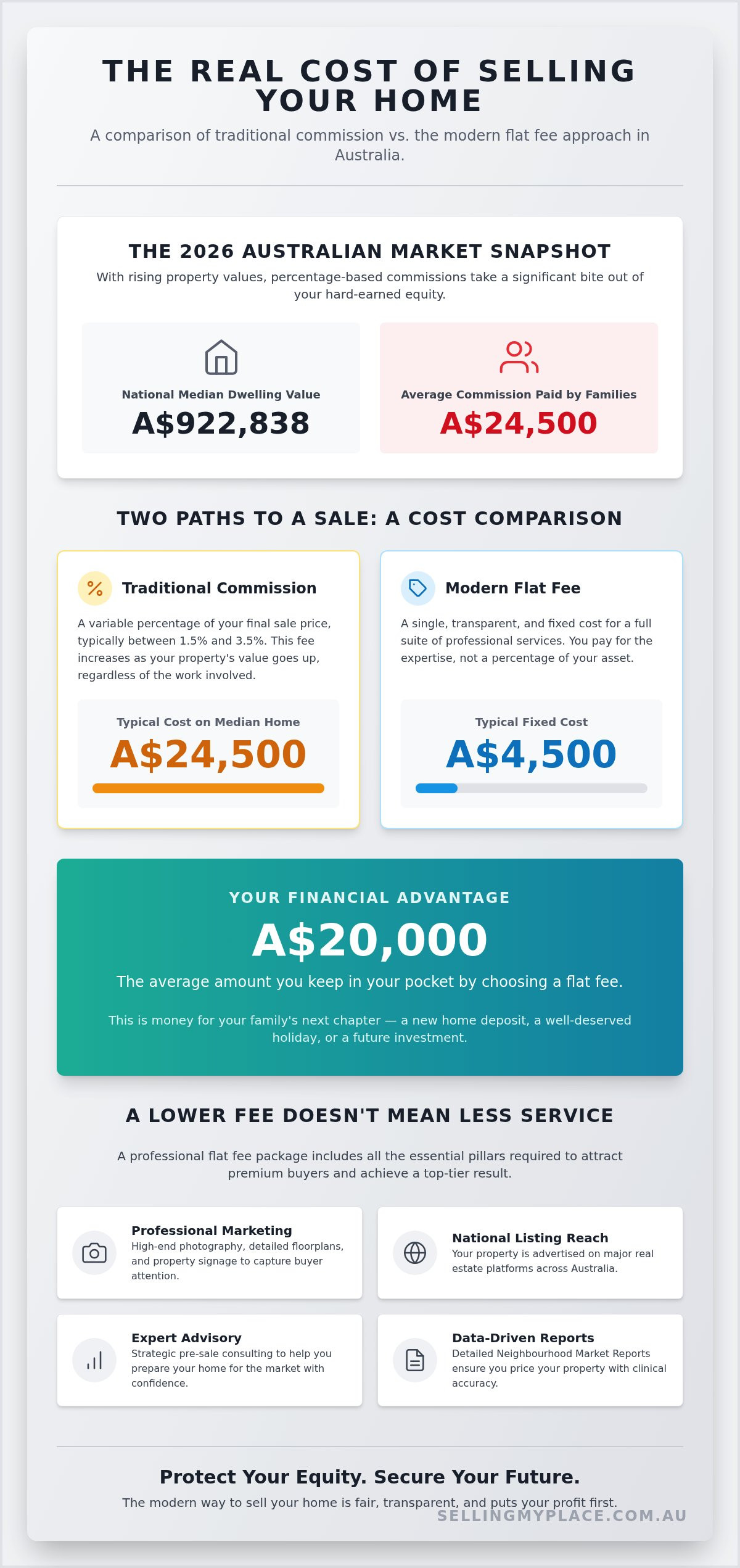
With the national median dwelling value reaching A$922,838 in early 2026, the average Australian family is now handing over roughly A$24,500 in commission alone just to move house. It is a staggering figure that often feels like an unfair tax on the years you have spent building equity and memories. You have likely found yourself wondering how much can you save with a flat fee agent while still ensuring your property gets the premium attention it deserves. It is natural to feel a bit of anxiety about stepping away from the traditional model, especially with new 2026 AML/CTF identity laws and shifting market conditions making the process feel more complex than ever.
At Kincade International Direct Sales, we firmly believe your hard-earned profit belongs in your pocket, not an agency’s overhead. This comprehensive guide will show you how to protect your legacy by detailing the exact mathematics of commission-free selling. You will learn how to secure professional marketing, including high-end photography and floorplans, without the burden of percentage-based fees. We will walk you through the current Australian real estate landscape, helping you visualise a sale where you retain an extra A$20,000 or more to put toward your family’s next chapter.
Key Takeaways
- Learn how the flat fee model decouples your home’s value from the cost of selling, ensuring you pay for professional service rather than a percentage of your hard-earned equity.
- Discover how much can you save with a flat fee agent by reviewing the mathematics of a commission-free sale, which typically keeps an extra A$20,000 in your pocket.
- Understand why a lower fee doesn’t mean sacrificing quality, as professional photography and floorplans are essential to attracting premium buyers in the current Australian market.
- Explore how expert advisory services and detailed Neighbourhood Market Reports help you price your property with clinical accuracy to maximise your final result.
- See how a partnership-based approach with no listing time limits can reduce the emotional stress of selling while protecting your family’s financial legacy.
What is a Flat Fee Real Estate Agent and How Does it Work?
A flat fee real estate agent is a professional who provides comprehensive listing and advisory services for a single, transparent cost rather than a percentage-based commission. This model is specifically designed to decouple the actual labour of selling a property from the final value of your home. Think of it as paying for the service provided, not giving away a portion of your asset. In the current Australian market, traditional commissions often fluctuate between 1.5% and 3.5%, which can represent a massive chunk of your equity once you add marketing costs into the mix. Ultimately, the flat fee model acts as a sophisticated equity-protection strategy for modern Australian homeowners who value transparency and fairness.
When you start exploring What is a Real Estate Agent?, you’ll see the role is fundamentally about connecting buyers and sellers. However, the traditional “success fee” model often feels like an outdated tax on your hard work. By choosing a flat fee, you’re entering a partnership where the goal is a premium result, but the costs are fixed and known from the outset. You might wonder how much can you save with a flat fee agent if the services are essentially the same? The answer lies in the removal of the agency’s high-street overheads and the high profit margins typical of traditional commission structures.
The Evolution of Commission-Free Selling
The property market has changed. Digital platforms have significantly reduced the operational overheads that traditional agencies used to pass directly to sellers. We’ve seen a clear shift from the old “For Sale By Owner” DIY methods, which often lacked professional polish, to a new era of “Expert-Assisted Direct Sales.” This hybrid model provides the “steady hand” of an advisor while letting you remain the primary decision-maker. As we move through 2026, more homeowners are taking control of their property legacy, refusing to pay for unnecessary agency branding and instead focusing on what actually sells a home.
Core Services Included in a Professional Flat Fee Package
Choosing a flat fee doesn’t mean you’re going it alone or settling for a subpar listing. A professional package is built on essential pillars designed to attract the right buyers and secure a top-tier price. It’s a comprehensive suite of tools that mirrors the output of a high-end agency. When you calculate how much can you save with a flat fee agent, the difference often covers a significant portion of a deposit for a new home or a well-deserved family holiday, such as an all-inclusive adventure with Discover Kokoda Treks.
- Marketing Essentials: This includes professional photography and floorplans that highlight your home’s best features, along with physical signage and national listing reach.
- Strategic Support: You’ll receive Real Estate Advisory Services and pre-sale consulting to help you prepare your home for the market with confidence.
- Administrative Backing: From conveyance advice to detailed Neighbourhood Market Reports, the process is supported by data and professional expertise at every step.
By focusing on these core elements, you ensure your property is centred in the market without the friction of a 3% commission check at settlement. It’s a practical, logical way to manage one of life’s biggest transitions.
The Mathematics of Savings: Calculating Your Profit Margin
When you look at the final settlement figure on a home sale, the commission often feels less like a fee for service and more like a tax on your home’s appreciation. Because traditional agents charge a percentage, they receive a pay rise every time the market goes up, regardless of whether the work involved has actually changed. It’s a structure that can feel quite heavy for families who have worked hard to build their home’s value. By switching to a fixed model, the average Australian homeowner saves approximately A$20,000. That is money that stays in your bank account to fund your retirement, your children’s education, or your next property investment.
Unlike traditional agents, flat fee models are designed to be predictable. You aren’t just saving on the commission; you’re keeping 100% of the sale profit to fund your next move. This transparency allows you to plan your future with a sense of calm confidence, knowing exactly what your walk-away figure will be.
Traditional Commission vs. Flat Fee Comparison
Let’s look at the numbers. On a A$1,000,000 sale, a standard 2.5% commission takes A$25,000 out of your pocket. If you’re selling a family home in a capital city for A$2,000,000, that “success fee” doubles to A$50,000. Does it really take twice as much effort to sell a house just because it has an extra bedroom or a better view? Probably not. You might be asking how much can you save with a flat fee agent in these scenarios? The answer is simple: you keep everything above the fixed fee. This ensures that the capital growth you’ve nurtured over the years remains yours. To see how these numbers apply to your specific suburb, it’s worth connecting with an advisor to map out your potential equity protection.
The Hidden Costs of Traditional Agency Agreements
It isn’t just the commission that bites. Many traditional agency agreements include “marketing contributions” that are billed separately. You could find yourself paying A$5,000 to A$10,000 for photography, floorplans, and premium portal listings on top of the percentage fee. Then there are auctioneer fees and administrative charges that quietly eat away at your bottom line. A professional flat fee structure typically includes these marketing essentials as part of the package. Another often-overlooked benefit is the “no time limit” listing. If the market shifts and your home takes a little longer to sell, you won’t face the stress of paying to re-list or being pressured to drop your price just to close a deal quickly. When considering how much can you save with a flat fee agent, remember that avoiding these compounding costs is just as vital as the commission itself.
Beyond the Bottom Line: Why a Flat Fee Doesn’t Mean “Less Service”
One of the most common concerns homeowners share with us is the fear that a lower fee might translate to a lower sale price. It’s a reasonable question; after all, your home is likely your most significant asset. However, the idea that a high commission is the only way to motivate a professional is a bit of a myth. While you’re calculating how much can you save with a flat fee agent, it’s vital to look at what actually drives a premium result. It isn’t the size of the commission cheque, but the quality of the listing and the strategic advice behind it. Our partnership model empowers you with professional tools while we provide a steady hand through the complex negotiation and settlement phases.
We treat every sale as a shared journey. Instead of a purely transactional relationship, we focus on a partnership that respects your local knowledge and your home’s unique story. You aren’t being ignored or left to “go it alone”; you’re being supported by a team that values your equity as much as you do. This collaborative approach ensures that you remain in control of the process while benefiting from the same level of professional advocacy you’d expect from a traditional agency.
Quality Marketing That Drives Competition
Visual storytelling is the heartbeat of modern property sales. When a buyer scrolls through a portal, they aren’t looking at the agent’s fee structure; they’re looking at your home’s potential. High-intent buyers are attracted by professional photography that captures the right light and floorplans that help them visualise their life in the space. In Australia, a professional floorplan is a non-negotiable tool for serious listings. It provides the spatial clarity buyers need before making a high-stakes decision. By leveraging global listing networks, we ensure your property reaches beyond your local neighbourhood to find the perfect buyer, regardless of where they’re currently living.
The Agent Advisory Advantage
Saving on fees doesn’t mean sacrificing expertise. Our Agent Advisory Services are designed to give you a competitive edge before the first open home even takes place. We offer pre-sale consulting to help you identify high-ROI improvements, ensuring you don’t over-capitalise on renovations that won’t move the needle on your sale price. Navigating the conveyance advice and settlement process requires professional support to reduce stress and protect your interests. To price your home accurately from day one, you should also understand how to determine market value of a home in australia. This data-driven approach, combined with knowing how much can you save with a flat fee agent, ensures you walk away with the best possible financial outcome.
Maximising Your Sale Price with Expert Advisory and Marketing
Saving on commission is a fantastic start, but it’s only half the battle. To truly protect your equity, you need to achieve a premium sale price. This is where many DIY models fall short, but a partnership approach provides the “expert advisor” middle ground that bridges the gap between low cost and high performance. By combining low fixed costs with high-level strategy, you ensure that when you calculate how much can you save with a flat fee agent, the answer includes both the fee savings and a top-tier settlement figure. It’s about having a steady hand to guide you through the noise of the market.
Step 1: Data-Driven Pricing Strategies
Pricing a home is part science and part intuition. It’s easy to fall into the “emotional pricing” trap, where you set a figure based on what you need for your next move rather than what the current market will actually pay. This often leads to stale listings that buyers eventually ignore. We provide detailed Neighborhood Market Reports to help you price with clinical accuracy. By analysing recent local sales data from early 2026, you can set a competitive yet ambitious price that generates genuine competition. If you want to dive deeper into the psychology of the closing phase, explore our Mastering the Deal: Expert Property Sale Negotiation Tips. Knowing how much can you save with a flat fee agent gives you the financial breathing room to hold out for the right offer.
Step 2: Presentation and Visual Appeal
First impressions are often the only impressions in a digital-first market. Professional photography isn’t just an “extra” service; it’s a fundamental investment that pays for itself ten times over by driving higher inspection numbers. Our pre-sale property consulting helps you identify which decluttering and styling choices will resonate most with the 2026 Australian lifestyle. Whether it’s highlighting a dedicated home office or a seamless indoor-outdoor flow, we help you organise your home for maximum emotional impact during inspections. This level of preparation ensures that buyers aren’t just looking at a house, but a future home they’re willing to pay a premium for.
Negotiating with confidence is much easier when you know you have a dedicated advisory service in your corner. If you’re ready to see how this strategic support can protect your home’s equity while you move onto your next chapter, book a consultation with our team today.
Securing Your Future: The Path to a Commission-Free Sale
Choosing to sell your home is one of the most significant life transitions you will ever undertake. It is a moment where your family’s hard-earned equity is finally realised, and the financial decisions you make now will ripple through your next decade. When you weigh up how much can you save with a flat fee agent, the emotional freedom is often as valuable as the bank balance. Saving that average of A$20,000 isn’t just about the money; it is about the options it creates. It represents a smoother transition into your next dream home, a significant boost to your retirement nest egg, or a head start on an investment portfolio that secures your children’s future.
Your home is likely your greatest asset, and it deserves a “steady hand” to guide it through to settlement. This isn’t about cutting corners or taking risks. It’s about choosing a modern, transparent path that respects the significance of your property legacy. By removing the burden of percentage-based commissions, you’re able to focus on what matters: finding the right buyer and achieving a premium price. The transition from seller to buyer becomes far less daunting when you have an extra A$20,000 in your pocket to cover stamp duty, moving costs, or new furniture for your next chapter.
Is a Flat Fee Agent Right for You?
This model isn’t just a financial choice; it’s a mindset shift toward a more empowered way of selling property. If you identify with the following, a partnership-based approach is likely the perfect fit for your sale:
- You believe that paying a “success fee” based on your home’s value is an outdated and unfair tax on your equity.
- You want the support of professional photography, floorplans, and expert advisory services without the high-street agency price tag.
- You value transparency and want to know exactly what your selling costs are from the very beginning.
- You are looking for a collaborative partnership where your local knowledge is respected and supported by a professional team.
For a deeper dive into how these elements come together to create a premium result, our Professional Residential Property Listing Services: The Modern Australian Seller’s Guide provides a comprehensive roadmap for the contemporary market.
Start Your Journey Today
The first step toward protecting your equity is gaining a clear understanding of your local market. Accessing your first Neighborhood Market Report provides the clinical data you need to set an ambitious but realistic price. From there, the process is simple and methodical. We help you get your professional photography and floorplans organised, ensuring your home is presented with the polish it deserves from day one. You don’t have to navigate this alone. If you’re ready to explore how much can you save with a flat fee agent while receiving the expert guidance your home sale requires, we invite you to reach out to our Agent Advisory team for a confidential chat. Let’s work together to ensure your property’s legacy remains in your hands.
Take Control of Your Property Legacy
Selling your home is a profound milestone, and the financial choices you make today will shape your family’s next decade. We have explored how the flat fee model protects your hard-earned equity by replacing outdated percentage-based commissions with transparency and professional support. By now, the answer to how much can you save with a flat fee agent is clear; an average saving of A$20,000 per sale means significantly more resources for your next chapter. With 0% commission, no time limits on your listing, and high-end marketing like professional photography and floorplans included, you can move forward with absolute confidence. You’ve worked hard to build your home’s value; you deserve a partner who values that legacy as much as you do. Protect your equity and save thousands-contact our expert advisory team today. It is time to step into your future with the “steady hand” of an expert guide by your side. We are here to ensure your transition is as rewarding and celebratory as it should be.
Frequently Asked Questions
How much exactly can I save with a flat fee agent compared to a traditional one?
You can save an average of A$20,000 per property sale by choosing a flat fee model over a traditional commission-based structure. While standard agents often charge between 1.5% and 3.5% of the final sale price, a flat fee keeps that equity in your pocket. This transparency allows you to calculate exactly how much can you save with a flat fee agent before you even list your home.
Does a flat fee model include professional photography and marketing?
Yes, professional photography and floorplans are essential components of our residential property listing services. We believe that a lower fee should never result in a lower-quality presentation. By including high-end visual storytelling as part of the package, we ensure your home attracts premium buyers without the hidden marketing costs often found in traditional agency agreements.
Will my property get the same exposure on major real estate portals?
Your property will receive comprehensive exposure on all major national and global real estate portals. We ensure your listing reaches a wide audience of high-intent buyers, just as it would with a traditional agency. Our global marketing network reach means your home isn’t just visible to the local neighbourhood but to potential buyers across Australia and overseas.
Is the Agent Advisory Service included in the flat fee?
Our dedicated Agent Advisory Service is a core part of the partnership, providing you with expert guidance from pre-sale to settlement. This isn’t an “add-on” but a fundamental support system designed to help you navigate negotiations and complex processes with a steady hand. You’ll have access to professional advice that ensures you’re never going it alone during this major life transition.
What happens if my property doesn’t sell within a certain timeframe?
We offer a no time limit listing policy to significantly reduce the stress often associated with selling. If the market shifts or your property takes longer to find the right buyer, you won’t face the pressure of paying to re-list or being forced into a quick, low-value sale. This flexibility allows you to wait for the premium offer your home deserves without financial penalty.
Can a flat fee agent help with the legal aspects and conveyance?
We provide professional conveyance advice to help you manage the legal transition of your property sale. While we are not a law firm, our advisory services ensure you understand the requirements and timelines involved in a successful settlement. This administrative backing is designed to project a sense of calm confidence throughout the high-stakes decision-making process.
Why do traditional agents still charge a percentage commission?
Traditional agencies often maintain percentage-based commissions to cover high-street overheads and branding costs that don’t always benefit the individual seller. In the 2026 market, many homeowners are questioning how much can you save with a flat fee agent because digital platforms have reduced the actual cost of reaching buyers. The flat fee model simply reflects this modern efficiency and fairness.
How do I handle negotiations if I’m not using a traditional commission-based agent?
You handle negotiations with the full backing of our Real Estate Advisory Services. We provide you with the data, such as Neighborhood Market Reports, and strategic guidance needed to negotiate with absolute confidence. This partnership model ensures you are the primary decision-maker while having an expert advisor ready to help you secure the highest possible sale price for your asset.
Flat Fee Real Estate Agent Sydney: Save Thousands on Your Sale in 2026
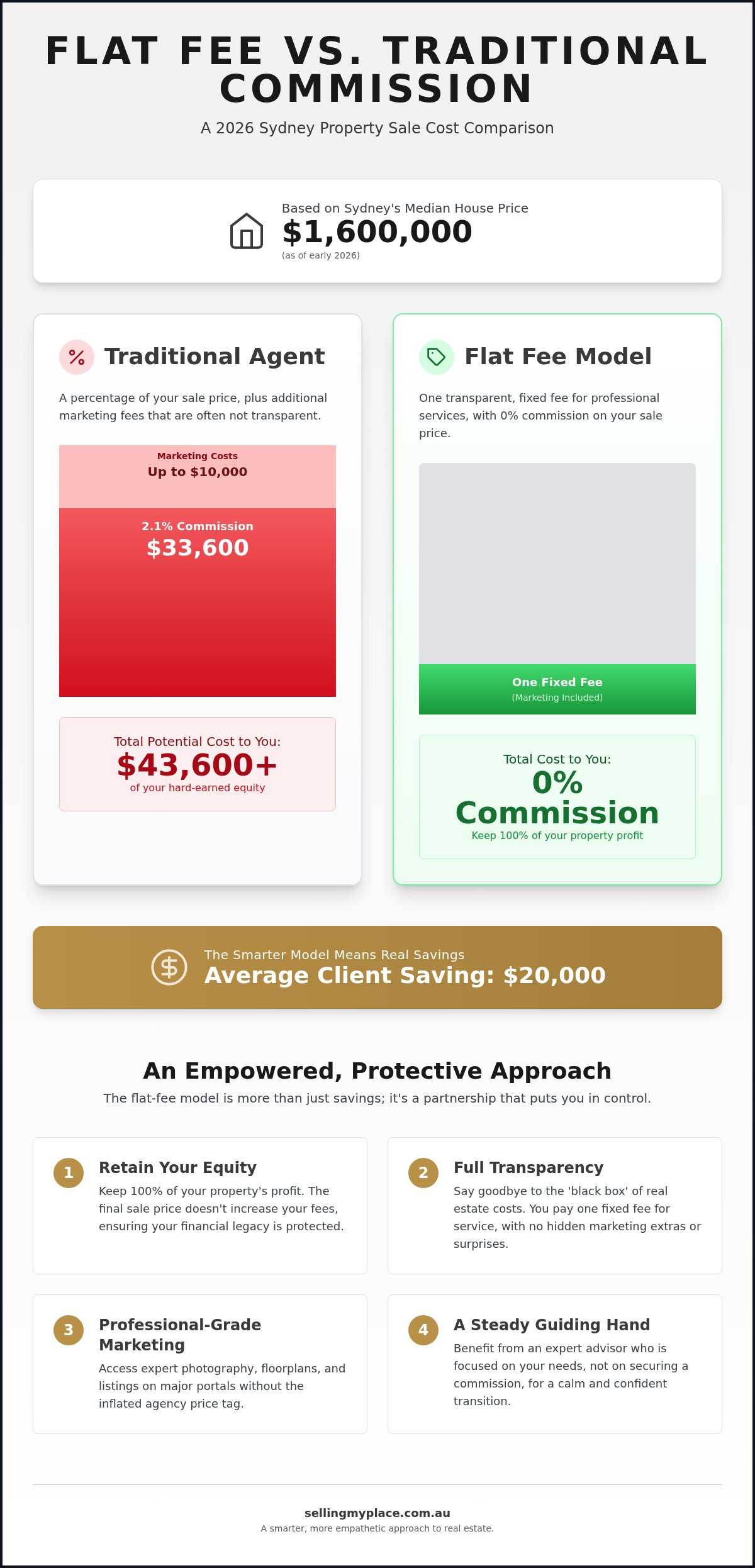
Why should a few weeks of marketing and a handful of open homes cost you more than a year’s worth of your hard-earned salary? With the median house price in Sydney sitting at $1.6 million as of early 2026, a traditional 2.1% commission means handing over more than $33,000 of your equity just for the privilege of selling. It’s a staggering figure that often feels more like a penalty than a service fee. If you’re looking for a more transparent way to move forward, partnering with a flat fee real estate agent in Sydney allows you to bypass these traditional structures and keep 100% of your property profit.
We understand that selling your family home isn’t just a transaction; it’s the bridge to your next chapter, whether that’s a comfortable retirement or a much-needed upgrade for a growing family. You deserve a steady hand to guide you through the process without the pressure of mounting costs or hidden marketing extras. In this guide, we’ll explain how the flat-fee model works in 2026 and how you can access professional-grade listings, including expert photography and floorplans, without the commission price tag. You’ll discover a smarter, more empathetic approach to real estate that puts your financial legacy and family needs first.
Key Takeaways
- Understand why the rise in Sydney property values has turned the standard 2% commission into an unnecessary tax on your family’s financial future.
- Discover how a flat fee real estate agent sydney offers a fixed, transparent alternative that allows you to bypass traditional commission structures entirely.
- Learn how to access professional-grade marketing, including photography and floorplans, while retaining 100% of your property’s sale profit.
- See how expert pre-sale consulting and a global marketing network can help you find the right buyer without the pressure to sell quickly.
- Uncover the “steady hand” approach to selling that provides professional authority and heartfelt support throughout your entire transition.
Why Sydney Sellers are Moving Away from Commission-Based Agents
For decades, the process of selling a home in Sydney has followed a predictable, albeit expensive, script. You hire an agent, agree to a percentage, and hope the final result justifies the massive slice of equity you’re handing over. However, as we move through 2026, the script is changing. With the median house price in our harbour city reaching $1.6 million, a standard 2.1% commission is no longer just a fee; it’s a significant financial burden. Many families are realising that $33,000 or more is simply too much to pay for a service that hasn’t fundamentally changed in years. This shift has led savvy homeowners to seek out a flat fee real estate agent sydney to protect their property profits and maintain control over their financial legacy.
The Australian real estate landscape is undergoing a quiet revolution. We’re seeing a move away from opaque commission structures toward a more transparent, fee-for-service model. This isn’t just about saving money, although that is a primary driver. It’s about a desire for transparency and a more honest exchange of value. People are tired of the “black box” of real estate costs where they aren’t quite sure what their money is actually buying. By choosing to take control, homeowners are ensuring that the profit from their years of mortgage repayments stays in their own pockets rather than being absorbed by agency overheads.
The True Cost of a Traditional Sale
When you sit down to calculate the impact of a traditional commission on your next home deposit, the numbers can be quite confronting. In the current Sydney market, the total cost of selling a property at the median price often ranges between $37,000 and $65,000 once you account for everything. Traditional agencies typically bill for marketing “extras” on top of their commission, with costs for photography and portal listings often reaching up to $10,000. Before you commit to these costs, it’s helpful to understand the foundational role of What is a Real Estate Agent? and how their historical fee structures were designed for a very different market. By moving to a smarter model, the average Kincade client enjoys a saving of $20,000 per sale, which is a substantial amount to put toward your next chapter.
A Partnership Approach to Selling
Choosing to sell your home with the support of a flat fee real estate agent sydney doesn’t mean you’re left to navigate the process alone. Instead, it transforms the experience from a transactional relationship into an empowered partnership. You remain the primary decision-maker, while an expert advisor acts as a steady hand to guide you through the complexities of the Sydney market. There is an immense emotional benefit to being the one who calls the shots. It reduces the stress of high-stakes transitions because you know your advisor is focused on your needs, not just on closing a deal to secure a commission. This protective, personal approach ensures that your family’s best interests are always the priority, providing a sense of calm confidence during what can otherwise be a very hectic time.
What is a Flat Fee Real Estate Agent and How Does it Work?
Put simply, a flat fee real estate agent sydney replaces the traditional percentage-based commission with a single, transparent fee for professional listing and advisory services. Instead of the agent’s pay cheque growing alongside your property’s value, you pay for the specific work required to market and sell your home. This 0% commission structure is the cornerstone of the model; it ensures that every extra dollar a buyer offers stays exactly where it belongs: in your bank account. It’s a shift from a transactional “success fee” to a professional “fee for service” that respects the equity you’ve built over many years.
While the concept might sound like “selling it yourself,” there is a world of difference between a lonely DIY sale and a supported direct sales model. You aren’t just sticking a sign in the front garden and hoping for the best. You’re accessing the same professional tools and digital infrastructure that top-tier agencies use, but without the high marketing costs or the conflict of interest that commissions can create. According to the official regulations on agent fees, commissions are entirely negotiable in NSW, yet many sellers feel pressured into standard rates. A flat-fee partnership empowers you to break that cycle while still having a seasoned expert by your side to provide neighbourhood market reports and strategic advice.
The Components of a Professional Listing
To achieve a premium price in a competitive market like Sydney, your property must look exceptional. This is why professional photography and detailed floorplans are non-negotiable components of the service. We don’t just list your home locally; we utilise global marketing networks to reach expatriates and international investors who might be looking for a foothold in the Australian market. Throughout this process, an Agent Advisory Service acts as your steady hand, providing guidance on pricing strategies and negotiation tactics. If you’re curious about how this might look for your specific suburb, you can always reach out for a chat about your property’s potential.
Digital Infrastructure for the Modern Seller
The digital age has truly levelled the playing field for homeowners. You now have access to a centralised system that allows you to track interest, manage enquiries, and view feedback in real time. This level of transparency is often missing in traditional sales, where you’re reliant on an agent’s filtered reports. By using a modern digital platform, you ensure your property remains highly visible on major portals until the “Sold” sticker finally goes up. There are no arbitrary time limits or pressure to accept a low offer just because a listing agreement is nearing its end; your home stays on the market until you achieve the result your family deserves.
Flat Fee vs. Traditional Commission: A Cost Comparison
To understand the true benefit of a flat fee real estate agent sydney, we need to look at the cold, hard numbers. Imagine you’re selling a lovely family home in a suburb like Marrickville or Ryde for $1.5 million. At a standard 2.1% commission, you’re looking at a bill of $31,500 before you’ve even paid for marketing. If you’re selling a premium $3 million property in the Eastern Suburbs, that commission fee doubles to a massive $63,000. It’s a significant amount of your equity that simply vanishes at the settlement table. When you partner with a flat fee real estate agent sydney, you’re opting for a transparent structure where the cost of the service doesn’t skyrocket just because your home is valuable.
The idea that a higher commission tier leads to a higher sale price is one of the most persistent myths in the industry. The market determines the price, supported by high-quality presentation and broad digital reach. A local agent’s window display is no match for a global digital network that puts your home in front of buyers across the country and overseas. You’re paying for the reach and the expertise, not for a promise of ‘extra effort’ that is hard to quantify. Traditional 90-day agreements can often work against you. As the expiry date approaches, the pressure to ‘just get it sold’ can be immense. This can lead to hasty decisions that don’t reflect the true value of your property. By removing the ticking clock, you stay in control of the narrative.
Protecting Your Home Equity
A successful sale starts with a realistic understanding of what your home is worth in the current market. Too often, agents provide inflated appraisals just to win your business. To get an honest, data-driven perspective, we recommend reading our guide on how to determine the market value of a home in Australia: The 2026 Seller’s Guide. Remember, ‘no commission’ doesn’t mean you’re going it alone. You still receive professional photography, floorplans, and the advisory support you need to protect your equity and negotiate with confidence. It’s about having all the professional tools at your disposal without the heavy financial penalty at the end.
The listed until sold advantage
One of the most reassuring aspects of a flat-fee partnership is the ‘listed until sold’ guarantee. You aren’t bound by a restrictive 90-day agency agreement that forces your hand. This freedom allows you to wait for the buyer who truly sees the emotional heart of your home, rather than rushing to accept the first offer that comes along just to meet an agent’s deadline. It effectively removes the risk of forfeiting fees if the market fluctuates or if you simply decide the timing isn’t right. You have a steady hand by your side for as long as it takes to achieve the result your family needs.
Preparing Your Home for a Successful Flat-Fee Sale
Success in the Sydney market isn’t just about listing your property; it’s about the thoughtful preparation that happens before the first buyer walks through the door. When you work with a flat fee real estate agent sydney, you aren’t just saving on commission; you’re gaining access to pre-sale property consulting designed to maximise your final price. This initial phase is crucial. It’s where we look at your home through the eyes of a potential buyer, identifying small changes that can lead to significant gains. Whether it’s a fresh coat of paint in a neutral tone or simply decluttering the living area, these details matter more than you might think.
Setting a realistic and competitive price is equally vital. We provide detailed neighbourhood market reports that strip away the guesswork, allowing you to see exactly what similar properties have sold for in your specific pocket of Sydney. This data-driven approach ensures you aren’t flying blind or relying on an agent’s “gut feeling.” Alongside this, we help you navigate the legal essentials, including providing conveyance advice to ensure the settlement process is as smooth as possible. It’s about building a solid foundation so you can move forward with confidence. If you’re ready to get started on your property journey, get in touch with our advisory team today for a personalised consultation.
Visual Storytelling and Presentation
In a digital-first market, your online presence is your most important asset. Visual storytelling is the key to high-click listings, turning a simple search result into an emotional connection. We organise professional photography that captures the emotional heart of your home, highlighting the features that make it special. Accurate floorplans are also essential, as they help buyers visualise their future lifestyle in your space before they even arrive. Simple staging tips, like adding fresh flowers or opening the blinds to let in that beautiful Sydney sunlight, make a massive difference in how your property is perceived online.
Mastering the Negotiation
Once the enquiries start rolling in, it’s time to handle buyer interest with confidence and professional decorum. You don’t need to be a seasoned salesperson to succeed; you just need the right tools and a bit of guidance. For a deeper dive into this part of the process, we recommend reading our guide on Mastering the Deal: Expert Property Sale Negotiation Tips for Australian Homeowners. There will be times when you need a second opinion or a strategic sounding board. This is exactly when you should seek advice from your dedicated property advisor. They act as your steady hand, ensuring you never feel pressured and always stay focused on achieving the best possible outcome for your family.
Selling Smarter with Kincade International Direct Sales
Kincade International Direct Sales (KIDS) represents a fundamental shift in how Sydney homeowners approach the market. We don’t believe your success should be measured by the size of an agent’s commission. Instead, we offer a 0% commission model that acts as a steady hand through every stage of your sale. This partnership is built on the idea that you, as the owner, are the best person to showcase your home’s story. We simply provide the professional tools and global reach to ensure that story finds the right audience. It’s a protective, supportive way to sell that prioritises your family’s financial future over agency profits.
One of the most significant concerns with traditional fixed-fee models is the risk of paying a fee and then being left unsupported if the property doesn’t sell immediately. We’ve removed that anxiety. Our “listed until sold” commitment means there are no hidden time limits and no pressure to accept a low offer just to close a file. You have the security of knowing your home remains visible on major portals until the result you want is achieved. Unlike local agencies that might rely on a shopfront window, we plug your property into a global marketing network that reaches buyers from all corners of the world. From professional photography to essential conveyance advice, we provide a comprehensive suite of services that traditional agents simply cannot match without charging a premium.
The Kincade Advantage for Sydney Homeowners
Our national reach and expert backing empower you to sell like a pro while feeling completely supported. We’ve designed our flat-fee packages to be the most comprehensive in the Australian market, ensuring you have everything you need to succeed. By choosing a flat fee real estate agent sydney, you’re taking a stand for transparency and value. If you’d like to see how our systems compare to the old-fashioned way of doing things, our Professional Residential Property Listing Services: The Modern Australian Seller’s Guide offers a clear look at the modern alternative. It’s about giving you the authority to manage your sale with a seasoned expert by your side.
Take the First Step Toward a Commission-Free Sale
The journey toward a smarter sale starts with a single, confident step. You don’t need years of industry experience to achieve a great result; you just need a proven framework and the right data. A great place to begin is by reading our How to Sell Your Own Home: A Step-by-Step Guide to Sale by Owner in Australia. This resource walks you through the practicalities of the process, ensuring you feel prepared for every enquiry. When you’re ready to see how your property stacks up in the current market, requesting your neighbourhood market report is the perfect way to kickstart your journey. It provides the clarity and confidence you need to make the best decisions for your family’s next big transition.
Secure Your Family’s Financial Future
Selling your home is one of the most significant life transitions you’ll ever navigate. It’s about more than just a property transaction; it’s about protecting the hard-earned equity that will fund your next chapter. By choosing a flat fee real estate agent sydney, you’re opting for transparency and a partnership that respects your financial goals. We’ve seen how moving away from traditional commissions allows homeowners to save an average of $20,000, providing vital extra funds for a comfortable retirement or a much-needed family upgrade.
With professional photography, floorplans, and a “listed until sold” commitment included, you have all the tools of a top-tier agency at your fingertips. There is no pressure to rush and no hidden time limits, just a steady hand to guide you toward the result you deserve. You’ve worked hard to build the value in your home; now it’s time to ensure you keep it. We invite you to keep 100% of your profit—explore Kincade’s flat-fee listing packages today. We are here to help you move forward with confidence, clarity, and a sense of calm.
Frequently Asked Questions
What is the difference between a flat fee and a commission-based agent?
A flat fee agent charges a single, transparent price for specific services regardless of your property’s final sale price, whereas a commission agent takes a percentage of the total. In a high-value market like Sydney, where commissions often range between 1.8% and 2.5%, this difference can represent tens of thousands of dollars. Choosing a flat fee real estate agent sydney allows you to pay for professional marketing and advisory work rather than a “success tax” on your home equity.
Do I still get my property listed on major real estate websites with a flat fee?
Yes, your property is listed on all major Australian real estate portals, ensuring it receives the same digital visibility as any traditional agency listing. We believe that digital reach is the great equaliser in the modern market. Your home will be visible to local buyers and our global marketing network until it is sold, ensuring you never miss out on the right enquiry because of where the listing is hosted.
Is it legal to sell my own home in Australia without a traditional agent?
It is completely legal to sell your own home in Australia, and many homeowners are choosing this path to maintain control over their sale. While the process involves specific legal requirements, such as the mandatory 2026 edition of the Contract for Sale in NSW, you aren’t required to hire a traditional commission-based agent. We provide the professional framework and advisory support to ensure you stay compliant while managing your own property journey.
How much can I realistically save by using a flat-fee real estate service?
Sellers can realistically save an average of $20,000 by bypassing traditional commission structures. With the median Sydney house price reaching $1.6 million in early 2026, a standard 2.1% commission would cost you over $33,000. By opting for a flat fee real estate agent sydney, you keep that equity in your pocket, which can be a life-changing amount when you’re planning for retirement or looking to upgrade your family’s lifestyle.
What happens if my property doesn’t sell within the first few months?
Your property remains listed until it is sold, with no arbitrary time limits or hidden fees to worry about. Traditional 90-day agency agreements often create unnecessary pressure to accept a lower offer just before the contract expires. Our “listed until sold” approach provides a sense of calm confidence, allowing you to wait for the buyer who truly values your home’s unique story and emotional heart.
Do I need to be a professional negotiator to sell my own home?
You don’t need to be a professional negotiator because you have a dedicated property advisor to guide you through every enquiry. While you are the primary decision-maker, we provide the strategic advice and market data needed to handle discussions with confidence and decorum. This partnership ensures you feel empowered during negotiations without the stress of going it entirely alone against seasoned buyers.
Are professional photography and floorplans included in the flat fee?
Professional photography and detailed floorplans are absolutely included as part of our comprehensive marketing package. We know that visual storytelling is essential for capturing interest in a competitive market like Sydney. High-quality imagery and accurate layouts help potential buyers visualise their future life in your space, which is the key to driving enquiries and achieving a premium result for your family.
How does Kincade support me during the legal settlement process?
Kincade provides expert conveyance advice to help you navigate the complexities of the legal settlement process with ease. From understanding the latest 2026 contract updates to ensuring identity verification requirements are met, we act as a steady hand during this final stage. This support reduces the stress of high-stakes paperwork, ensuring that the transition from “Sold” to settlement is as smooth and celebratory as possible.
Is it Worth Selling Your Own Home in Australia? The 2026 Seller’s Perspective
If you could keep an extra $20,000 of your home’s equity without the soul-crushing stress of doing it all yourself, would you take the leap? With the national median dwelling value sitting at $922,838 as of early 2026, the question of whether is it worth selling your own home has never been more relevant for Australian families. You’ve worked hard to build your life within those walls; it’s only natural to feel a bit protective of the final result. You probably love the idea of saving on hefty commissions, yet the thought of complex legal paperwork and managing endless enquiries feels like a mountain you aren’t quite ready to climb alone.
We understand that this isn’t just a transaction; it’s a major life transition that deserves a steady, expert hand. This guide will show you how to secure your equity and maximise your final sale price by blending the control of a private sale with the infrastructure of a professional advisory model. We’ll explore the current 2026 market trends, the essential legal requirements for every state, and a smarter way to manage inspections without losing your weekends or your peace of mind.
Key Takeaways
- Evaluate if is it worth selling your own home by comparing the significant commission savings with the modern infrastructure required to protect your equity.
- Understand why 95% of buyers starting their search online makes professional photography and floorplans more vital than a traditional shopfront.
- Discover the “Professional Advisory” path, which provides expert guidance to navigate legal paperwork and enquiries without the high cost of commissions.
- Learn how to reach a broader pool of buyers through a global marketing network that extends far beyond your local neighbourhood.
- Find out how to maintain 100% of your sale profit while using data-driven market reports to ensure you never undersell.
The Real Value of Selling Your Own Home in the 2026 Property Market
For decades, selling a house without an agent meant sticking a hand-painted sign on the front fence and hoping for the best. Today, the concept of For Sale By Owner (FSBO) has evolved into a sophisticated, tech-driven strategy. It’s about taking the reins of your own financial future. When you ask yourself, is it worth selling your own home, you’re really asking if you can represent your property’s value better than a stranger could. In 2026, the answer is increasingly yes. The market has matured, and the tools available to everyday Australians have never been more powerful.
Research indicates that 95% of Australian buyers now begin their property search online. They aren’t walking past shopfront windows in the local village; they’re scrolling through portals on their phones at midnight. This shift has levelled the playing field. If your listing looks professional and reaches the right digital audience, it doesn’t matter whose logo is in the corner of the screen. Modern buyers also value direct communication. They appreciate hearing about the neighbourhood’s best coffee spot or the way the morning sun hits the kitchen directly from the person who actually lives there. This transparency builds a unique layer of trust that a third party often struggles to provide.
Why Australians are Choosing to Sell Smarter
With the national median dwelling value reaching $922,838, the stakes are incredibly high. Every percentage point of commission represents months, if not years, of mortgage repayments. As cost-of-living pressures continue to bite, homeowners are shifting toward an “Equity Protection” mindset. Technology has democratised the process. You now have access to the same high-level property data and marketing portals once reserved for industry insiders. There’s also a profound emotional benefit. You are the expert on your home’s legacy. Sharing that story personally creates a sense of connection and community that a transactional agent simply can’t replicate. It’s about keeping your hard-earned profit where it belongs: in your pocket.
Dispelling the ‘Lower Price’ Myth
The biggest fear for most families is that they might accidentally undersell. However, data suggests that a home’s final price is driven by professional presentation and strategic exposure, not the brand of the person holding the clipboard. If your photography is crisp and your floorplans are clear, you attract the same pool of competitive buyers. The key is starting from a position of strength. Knowing how to determine market value of a home in australia allows you to set a realistic baseline. When you remove the pressure of a looming commission, you can focus on finding the right buyer who truly values your home’s unique features. So, is it worth selling your own home? When you have the right tools and a steady hand to guide you, the financial rewards are often too significant to ignore.
Calculating the Savings: Is the Commission-Free Model Financially Viable?
Numbers don’t lie, but they can certainly be overwhelming when you’re staring at a property contract. When weighing up whether is it worth selling your own home, the most compelling argument is usually found at the bottom of a spreadsheet. In 2026, the national median agent commission rate sits at approximately 2.65%. While that might sound like a small slice of the pie, let’s look at the reality for an average Australian property. On a home valued at $1,000,000, that commission equals $26,500 plus GST. That is nearly $30,000 of your hard-earned equity handed over in a single transaction. It’s a significant sum that could otherwise fund a renovation, a deposit on a next property, or a much-needed family holiday.
Beyond the headline commission, traditional agencies often include “hidden” costs that can quietly erode your profit. Many sellers are surprised to find that high-end marketing levies, professional auctioneer fees, and even administrative charges are frequently billed on top of the commission. When you consider the financial pros and cons of selling your own home, the flat-fee model offers a refreshing level of clarity. By removing the percentage-based incentive, the relationship becomes a true partnership. You aren’t just a number in a high-volume sales funnel; you’re a homeowner protecting your legacy. This financial viability is further bolstered by no-limit listings. Unlike traditional three-month agency agreements that might pressure you into a lower “quick sale” price, private listings remain active until the right buyer arrives. This patience often secures a far better result than a rushed auction.
The True Cost of a Traditional Real Estate Agent
The gap between a traditional agent and a professional advisory service is wider than most realise. While an agent might justify their fee by promising a “premium” service, many of those features, like high-quality digital floorplans and professional photography, are now standard in a modern flat-fee package. If you’re curious about how these models differ in practice, explore our guide on Professional Residential Property Listing Services Simplified. It’s about ensuring every dollar you spend actually adds value to your sale price rather than just padding an agency’s overheads.
Allocating Your Savings for a Better Result
One of the smartest moves a private seller can make is reinvesting a small fraction of their commission savings back into the home. Spending $3,000 on high-impact staging or minor cosmetic repairs can often add $30,000 to the final sale price. This creates a powerful psychological advantage during negotiations. Because you aren’t worried about losing a massive chunk of the sale to fees, you have more “room to move” and can remain calm and grounded when discussing offers with potential buyers. If you’d like to see how much equity you could personally protect, feel free to reach out for a friendly chat with our team.
The Three Paths: Traditional Agents, DIY, and Professional Advisory
Most Australians believe they only have two choices when it’s time to move: pay a traditional agent a small fortune or try to go it alone with a “For Sale” sign from the local hardware store. In the 2026 market, this binary thinking is outdated. Choosing the right path depends on how much of your home’s equity you want to protect and how much support you need to feel confident. When you ask is it worth selling your own home, you need to weigh up the three distinct routes available to modern sellers.
The traditional agent model is the “hands-off” choice. It’s convenient, certainly, but it comes with a high price tag. For many families, the trade-off for this convenience is losing tens of thousands of dollars that could have been their profit. On the other end of the spectrum is pure DIY. This path is often fraught with risk because it lacks the professional infrastructure required to attract serious buyers. The fastest-growing segment in today’s market is the “Assisted Selling” or Professional Advisory model. This is the Kincade approach. It provides the high-end tools of a top-tier agency, such as 0% commission structures and expert backing, while keeping you in the driver’s seat. It’s the “steady hand” approach that bridges the gap between high-cost agencies and high-stress solo selling.
Why Pure DIY Often Fails
The biggest hurdle for solo sellers isn’t a lack of passion; it’s a lack of professional polish. Listings without high-quality photography and professionally drafted floorplans often look “cheap” next to polished agency ads, causing buyers to scroll right past. Furthermore, getting your home onto major real estate portals is nearly impossible without an authorised subscriber. Many DIYers also hit a wall of burnout. Managing a flood of enquiries and organising inspections while juggling a full-time job and family life can quickly become overwhelming without a system to filter the “tyre-kickers” from the serious contenders.
The ‘Agent Advisory’ Advantage
This is where a professional advisory service changes the game. By using pre-sale property consulting, you can prepare your home to meet the market’s highest expectations before the first photo is even taken. You aren’t just guessing your value; you’re using detailed neighbourhood market reports to back up your asking price with cold, hard data. This model gives your home the professional “look” of a luxury listing while maintaining the authentic, personal touch that only a homeowner can provide. It’s a smarter way to ensure that when you decide is it worth selling your own home, the answer is a resounding yes, supported by both your bank balance and your peace of mind.
Essential Steps to Ensure Your Private Sale is a Success
Deciding is it worth selling your own home is often the first step in a journey toward financial freedom. However, the success of that journey relies on a methodical approach that replaces guesswork with professional standards. You don’t need a traditional agency’s storefront, but you do need their level of polish. By following a structured path, you can manage the process with confidence and keep your equity exactly where it belongs. Success in the 2026 market generally follows these five milestones:
- Step 1: Professional preparation. This involves more than just a quick tidy up; it means investing in high-end photography and floorplans that make your listing stand out.
- Step 2: Strategic pricing. Use neighbourhood market reports to set a price based on cold, hard data rather than emotional attachment.
- Step 3: Mastering the enquiry. Learn to screen potential buyers effectively to ensure you only spend time on those with genuine interest and finance pre-approval.
- Step 4: Negotiation and closing. Use a professional advisory service to handle the complex “money talk” and ensure you don’t leave money on the table.
- Step 5: Legal finalisation. Secure a qualified conveyancer to manage the contract of sale and handle the legal transfer of your property.
Visual Marketing: Your Digital Front Door
In a market where almost every buyer starts their journey on a smartphone, your digital listing is your new front door. Professional photography is the single best investment you can make. It captures the crisp lines of your living room and the warmth of your kitchen in a way that a mobile phone camera simply cannot. Equally important are professional floorplans. These help buyers “live” in the house online, allowing them to visualise where their furniture will go before they even book a viewing. For a deeper dive into these requirements, our How to Sell Your Own Home: A Step-by-Step Guide provides a comprehensive roadmap for Australian homeowners.
Negotiation Tactics for the Private Seller
Negotiation is often the part of the process that causes the most anxiety, but it doesn’t have to be a battle. The key is to remain objective. When a buyer critiques a feature of your family home, try not to take it personally; they are simply looking for a reason to justify their offer. Practice the power of silence during walkthroughs. Often, less is more. Let the buyers discover the home’s charm for themselves at their own pace. If you want to sharpen your skills and win the best price, explore our guide on mastering the deal: expert property sale negotiation tips. If you’re ready to start this process with a steady hand by your side, enquire about our Agent Advisory Service today.
Why the Kincade Partnership is the Smarter Way to Sell Privately
If you’ve been wondering is it worth selling your own home, the Kincade International Direct Sales (KIDS) model provides a clear, affirmative answer. It’s designed to be the “steady hand” during a time that can often feel turbulent. By choosing this partnership, you aren’t just opting for a commission-free alternative; you’re choosing a more sophisticated way to trade. You gain access to a global marketing network that reaches potential buyers traditional local agents often miss. In a property market where interstate migration and international interest are key drivers, having your home visible to the widest possible audience is a non-negotiable advantage.
The Agent Advisory Service is the heart of this approach. It’s the difference between feeling like you’re navigating a complex journey alone and having a seasoned expert standing right beside you. From the moment your listing goes live until the keys are handed over at settlement, you have professional support to guide your decisions. This ensures you achieve a professional result that protects your family’s interests, all while avoiding the $20,000 commission price tag that typically accompanies a traditional agency sale. It’s about keeping your hard-earned equity where it belongs: in your bank account.
Professional Infrastructure, Personal Profit
Kincade provides the high-end tools that ensure your home looks like a premium listing from day one. You’ll receive professional photography, detailed floorplans, and comprehensive neighbourhood market reports that allow you to stand toe-to-toe with any agency in the country. One of the most reassuring features of this model is the “Listed Until Sold” guarantee. It removes the artificial pressure of a standard 90-day agency agreement, giving you the breathing room to wait for the offer your home truly deserves. Additionally, having access to conveyance advice means you can move through the legal requirements of contracts and disclosures with total confidence and clarity.
Your Next Chapter Starts Here
There is a unique emotional satisfaction that comes from successfully managing your own sale. It’s about more than just the financial result; it’s about the pride of knowing you took control of your family’s transition. Think about what that extra $20,000 in your pocket could do for your next chapter. It might be the deposit for an investment property, a significant head start on your next mortgage, or the fund for a well-deserved family adventure. By taking the reins now, you’re securing a brighter financial legacy. Your move doesn’t have to be a stressful solo mission when you have a partner who values your home’s story as much as you do. So, when asking if is it worth selling your own home, remember that with the right support, the rewards extend far beyond the final sale price.
Secure Your Equity and Step into Your Next Chapter
You’ve seen the data and the clear shift in the 2026 property market. When you sit down at the kitchen table to decide if is it worth selling your own home, the answer lies in the balance between professional polish and personal profit. By choosing a partnership that provides high-end marketing tools and expert guidance, you aren’t just saving on fees; you’re actively protecting the financial legacy you’ve built within your walls. You don’t have to choose between a high-cost agency and the overwhelming stress of going it alone.
The “steady hand” of an advisory model ensures your listing stands out on global portals while keeping you firmly in the driver’s seat. With an average saving of $20,000 per sale and a 0% commission structure, your hard-earned equity stays in your pocket where it belongs. Plus, having a professional Agent Advisory Service included means every enquiry and negotiation is handled with calm, grounded confidence. See how Kincade can help you save $20,000 on your home sale today. It’s time to take control of your future and start your next journey with total peace of mind. You’ve got this, and we’re here to guide you home.
Common Questions About Selling Privately in Australia
Is it legal to sell my own home in Australia without a real estate agent?
Yes, it is completely legal to sell your own property in every Australian state and territory. You’ll simply need to provide the correct disclosure documents required by your specific state, such as a Section 32 in Victoria or a disclosure statement in Queensland. While you handle the marketing and enquiries, a professional conveyancer or solicitor still manages the legal transfer of title to ensure everything is above board.
How much can I actually save by selling my home privately?
Most Australian families find they save a significant amount, with an average saving of $20,000 per sale by avoiding traditional commissions and high marketing levies. Since you aren’t paying a percentage of your final sale price to an agency, those funds remain entirely yours to put toward your next move. This significant financial boost often helps homeowners decide that is it worth selling your own home when they look at the true cost of traditional fees.
Will my property be listed on major real estate websites if I sell it myself?
Yes, your property can appear on Australia’s leading property portals when you use an authorised subscriber service. These platforms generally don’t allow direct listings from private individuals to maintain professional standards. By partnering with Kincade, your home gains the same digital visibility as any traditional agency listing, reaching the vast majority of active buyers who start their search online.
Do I still need a solicitor or conveyancer if I sell the house myself?
You definitely need a solicitor or conveyancer to handle the legal aspects of the transaction. While you manage the “heart” of the sale, such as showing the home and sharing its story with buyers, they manage the technical requirements. This includes drafting the contract of sale and ensuring the settlement process meets all current Australian regulations and tax requirements.
How do I handle negotiations with buyers without an agent in the middle?
Negotiations are best handled by remaining objective and focusing on local sales data. You don’t have to manage the “money talk” alone if you use an Agent Advisory Service. This provides a professional buffer, allowing you to review offers calmly and grounded in facts, which helps reduce the emotional pressure often felt during face-to-face bargaining.
Can I sell my home privately if I have a mortgage on it?
You can certainly sell a home with an existing mortgage, as the process is the same as a traditional sale. Your conveyancer will coordinate with your bank to “discharge” the mortgage at settlement. The sale proceeds are used to pay off your remaining loan balance, and the leftover equity is then transferred directly to you to fund your next chapter.
What happens if my home doesn’t sell within the first month?
Your listing remains active until a successful sale is achieved, regardless of how long it takes. Unlike traditional agency agreements that often expire after 90 days, our model has no time limits. This removes the stress of a “ticking clock,” allowing you to wait for the right buyer who truly values your home without the pressure of a looming deadline.
How do I determine the right asking price for my property?
The most accurate way to set a price is by using professional Neighbourhood Market Reports. These reports provide recent, local sales data that reflects the current 2026 market conditions in your specific suburb. Setting a price based on evidence rather than emotion is a key factor in determining if is it worth selling your own home while ensuring you don’t leave money on the table.
Selling and Buying a House at the Same Time in Australia: The 2026 Strategy Guide
What if you didn’t have to choose between the heartache of losing your dream home and the financial weight of two mortgages? For most families, selling and buying a house at the same time australia feels like walking a high-stakes tightrope. It’s completely natural to feel a bit of “settlement anxiety” when you’re trying to time the market perfectly while the RBA cash rate sits at 4.35%. You’re not just moving boxes; you’re moving your entire life, and the fear of being caught between properties or facing bridging loan rates that can climb over 10% p.a. is enough to keep anyone awake at night.
We’re here to tell you that a seamless transition isn’t just a lucky break; it’s the result of a steady, well-prepared strategy. This guide will help you master the art of the simultaneous settlement, ensuring you don’t miss out on your next chapter just because your current place hasn’t sold yet. By protecting your equity and saving an average of $20,000 in commissions, you can create the financial breathing room needed to bid with confidence. We’ll walk you through the essential 2026 timeline for listing and bidding, helping you coordinate your next move with total peace of mind.
Key Takeaways
- Understand the mechanics of a simultaneous settlement to avoid the logistical nightmare of moving twice or paying for short-term rentals.
- Compare the “buy first” and “sell first” strategies to find the right balance between financial certainty and securing your next dream home.
- Master the practical tools, like bridging finance and “subject to sale” clauses, to navigate selling and buying a house at the same time australia with total confidence.
- Discover why organising your marketing assets early, including floorplans and photography, is the secret to a fast and profitable transition.
- Learn how a commission-free model can save you an average of $20,000, giving you the extra equity needed to outbid the competition.
The Great Australian Property Dilemma: Simultaneous Settlement Explained
Imagine the perfect moving day. You hand over the keys to your old place at 11:00 am, and by 2:00 pm, you’re unlocking the front door of your new home. This is a simultaneous settlement. It’s the process of settling both your sale and your purchase on the exact same day, often within hours of each other. While it sounds like a dream, managing the logistics of selling and buying a house at the same time australia requires a steady hand and a very clear plan.
In the broader Australian property market, most buyers aren’t just starting out; they’re trading up or downsizing. This creates a “chain” where your purchase depends on your sale, which might depend on someone else’s sale. If one bank is five minutes late or one signature is missing three houses down the line, the whole chain can stall. It’s a domino effect that can leave families sitting in a loaded removalist truck on a Friday afternoon with nowhere to go. It’s stressful, but it’s manageable with the right guidance.
You’re essentially balancing two major risks. If you buy first, you face the anxiety of paying two mortgages or high-interest bridging loans. If you sell first, you might find yourself in temporary rentals, moving your life twice and watching the market rise while you’re effectively homeless. Neither is ideal, which is why “marrying” your contracts through a skilled legal expert is the preferred path for many.
Why Timing is Everything in 2026
With the RBA cash rate holding at 4.35% as of July 2026, the stakes for your timing have never been higher. Market heat varies wildly between suburbs. Before you even think about listing, you must determine the market value of a home in Australia relative to your specific local area. Knowing your numbers gives you the confidence to negotiate settlement periods that suit your timeline, rather than being at the mercy of the buyer’s whims. The psychological shift from being a proud seller to a hungry buyer happens fast. Staying grounded in data helps keep that stress at bay.
The Role of the Conveyancer
Your conveyancer is the unsung hero of this process. They don’t just push paper; they coordinate with both your outgoing and incoming banks to ensure funds flow from one property to the next. To make this work, they look for consistent “Special Conditions” across both contracts. They’re on the lookout for common pitfalls, such as mismatched settlement times or incorrectly entered PEXA details, which can cause frustrating 24-hour delays. Getting professional conveyance advice early ensures your two separate transactions behave like one single, fluid move.
Buying First vs. Selling First: Which Strategy Suits You?
Choosing whether to buy your next home before you’ve sold your current one is perhaps the biggest fork in the road you’ll face. In the current 2026 climate, where the RBA cash rate remains steady at 4.35%, the financial implications of a wrong turn are significant. It’s a bit of a balancing act, really. Do you prioritise the peace of mind that comes with cash in the bank, or do you leap at that rare sun-drenched terrace before someone else snaps it up? For most families selling and buying a house at the same time australia, the answer depends on your local market’s temperature and your own appetite for risk.
One way to lower the heat is the “Off-Market” test. Before you commit to a purchase, you can float your property to a database of motivated buyers to gauge interest levels. This gives you a “real world” indication of what your home might fetch without the pressure of a full public campaign. By establishing a clear coordination plan early, you can align these initial feelers with your buying search, ensuring you aren’t flying blind when you start making offers.
Pros and Cons of the “Sell First” Method
Selling first is the gold standard for financial certainty. You’ll know exactly how much equity you’ve unlocked, which is vital when variable mortgage rates are hovering around 5.94% p.a. as of July 2026. The main drawback is the ticking clock. If you haven’t found a new home by settlement day, you might face the cost and hassle of temporary rentals and moving your furniture twice. To mitigate this, we often suggest negotiating a longer settlement of 90 or even 120 days. This gives you a generous three to four month window to shop as a “cash buyer,” which puts you in a much stronger position to negotiate on your next purchase.
Pros and Cons of the “Buy First” Method
The “Buy First” approach is for those who have found “the one” and simply cannot let it go. It removes the fear of being left out of the market, but it introduces the risk of the “fire sale.” If your current home doesn’t sell quickly, you might be forced to accept a lower price to meet your buying obligations. You’ll also likely need bridging finance, with interest rates starting in the mid-6% range but sometimes climbing over 10% p.a. To avoid this stress, it’s wise to utilise professional residential property listing services to ensure your home is presented perfectly and ready to hit the market the second your offer is accepted.
If you’re feeling a bit stuck on which path suits your family best, reaching out for personalised real estate advisory services can help clear the fog and help you move with confidence.
Financial and Legal Tools for a Smooth Transition
Navigating the paperwork while selling and buying a house at the same time australia can feel like learning a new language. You aren’t just signing a contract; you’re building a financial bridge between your past and your future. To do this safely, you need a toolkit that protects your equity and your sanity. While the theory of moving sounds simple, the legal reality involves specific clauses and financial instruments that ensure you aren’t left stranded if a settlement date shifts. It’s about creating a safety net that allows you to act decisively when the right opportunity appears.
If your cash is locked in your current home’s walls, a deposit bond is a clever alternative to a cash deposit. It is essentially a guarantee from an insurer to the seller that the 10% deposit will be paid at settlement. This saves you from having to liquidate other assets or take out a high-interest personal loan just to sign a contract. For many Australian upgraders, it’s a small fee for a significant amount of flexibility during those few weeks between contracts.
Mastering the “Subject to Sale” Offer
Many sellers are wary of “subject to sale” offers because they don’t want their property tied up indefinitely. To sweeten the deal, consider offering a slightly higher purchase price. This acts as a “waiting fee” for the seller, acknowledging the risk they take by pausing their campaign. You should also include a short “Sunset Clause,” typically 21 to 28 days. This allows the seller to keep their home on the market and gives them an “out” if they find an unconditional buyer, but it gives you the right of first refusal to go unconditional yourself. Showing the seller you have a property marketing plan in Australia already in place makes your offer far more credible. It proves you’re proactive and that your home is ready to sell at a moment’s notice.
Bridging Loans: The Costs You Need to Know
Bridging finance is often the only way to secure a new home before the old one sells. It works by calculating your “peak debt,” which is the total of both mortgages, and your “end debt,” which is what remains after your sale. Most lenders offer an interest-only period, which is your best friend during the transition because it keeps your monthly outgoings manageable while you wait for a buyer. However, with bridging rates starting around the mid-6% mark and some lenders charging over 10% p.a. as of July 2026, you need a solid “Plan B.” If your home doesn’t sell within the typical 6 to 12 month bridging window, the interest can compound quickly. Always factor these potential costs into your buying budget from day one to ensure your “steady hand” remains on the wheel.
The Step-by-Step Coordination Checklist
Think of this checklist as your flight plan. When you’re selling and buying a house at the same time australia, you can’t afford to wing it. Each step needs to be calculated to ensure you don’t end up grounded between properties. It’s about creating a sequence that builds momentum while protecting your financial interests at every turn.
- Step 1: Realism over optimism. Get a realistic market appraisal and “Subject to Sale” advice from an expert advisor. You need to know your “walk-away” price before you start dreaming about the next one.
- Step 2: Prepare your assets early. Organise your professional photography and floorplans before you even start looking at open homes. If you find your dream home on a Saturday, you want to be able to list your current place by Monday morning.
- Step 3: Secure dual pre-approval. Ensure you have pre-approval for both your long-term mortgage and any potential bridging finance. With the average mortgage rate sitting at 6.20% as of May 2026, knowing your borrowing capacity is vital.
- Step 4: Signal serious intent. List your property for sale. Vendors are much more likely to take your offer seriously if they can see your current home is already live on the market.
- Step 5: Build in a buffer. Work with your conveyancer to synchronise settlement dates, but try to negotiate a 2 to 3 day buffer. This gives you a safety net if there’s a minor technical delay with bank transfers or paperwork.
Pre-Sale Preparation
In 2026, buyers are savvy and visual. Professional photography is non-negotiable; it’s the digital front door to your home. Focus on the “low-cost, high-impact” rule by decluttering and tackling minor repairs that might catch a building inspector’s eye. This is also the perfect time to explore sale by owner strategies. By taking control of the process, you keep that average $20,000 commission saving in your own pocket, which can be a massive help when you’re trying to outbid competitors for your next home.
Negotiation Tactics for Simultaneous Moves
Don’t be afraid to ask for flexible terms. A “Licence to Occupy” can be a lifesaver if your sale settles a few days before your purchase, allowing you to stay put for a small fee. Alternatively, a “Rent-Back” agreement lets you become a temporary tenant in your old home while you finalise the new one. In Victoria, your legal rep might suggest a “Section 27” to release your deposit early, providing the cash flow needed for your new purchase. These are the “steady hand” moves that turn a stressful move into a managed transition.
If you’re ready to start your journey with a clear strategy and expert support, get in touch with our advisory team today for a personalised market report.
Maximising Your Equity: The KIDS Commission-Free Advantage
Most traditional real estate models assume you’ll part with a significant slice of your hard-earned equity as a matter of course. When you’re managing the complex dance of selling and buying a house at the same time australia, that 2% or 3% commission can feel like a heavy weight on your upgrade budget. On an average Australian home, this “commission sting” often reaches $20,000 or more. By choosing a flat-fee model, you’re essentially reclaiming that money and putting it back where it belongs. It’s not just a saving; it’s a strategic tool that gives you more leverage in a competitive market.
Reclaiming your equity allows you to approach your next purchase with a sense of calm confidence. Instead of worrying about how to bridge the gap between your sale price and your new purchase price, you have a tangible financial buffer. This is particularly vital in a market where every dollar counts toward outbidding the competition or securing a property in a preferred school zone. It turns a transactional process into a partnership where your family’s future is the priority.
Where Does the $20,000 Saving Go?
Upgrading is expensive, and the hidden costs can add up quickly. Stamp duty remains a major hurdle for many Australian families, often requiring tens of thousands of dollars in upfront cash. Having an extra $20,000 in your pocket can cover a substantial portion of this tax, making the jump to a larger home feel much more accessible. Alternatively, if you’ve decided to buy first, this saving acts as a perfect safety net for bridging finance. With bridging interest rates starting around the mid-6% mark as of July 2026, $20,000 can comfortably cover the interest costs for a full year while you wait for the right buyer. If your transition is smooth and settlement dates align, that money becomes an instant renovation fund, allowing you to paint, carpet, or landscape your new sanctuary the moment you get the keys.
Support Without the High Cost
One of the biggest fears of selling without a traditional commission-based agent is the feeling of being alone in a high-stakes environment. However, professional residential property listing services provide the expert advisory you need without the accompanying sales pressure. You get access to contract reviews and negotiation tips from seasoned pros who value your long-term stability over a quick result. This partnership approach ensures you stay in total control of your timeline. You won’t have an agent pushing you to accept a “cheap” offer just so they can move on to their next commission. Plus, a “list until sold” policy is a massive advantage for simultaneous buyers. It removes the pressure of a ticking clock, allowing you to wait for the price your home truly deserves while you focus on your next move. You still benefit from high-end photography and floorplans, ensuring your home has a global listing reach that attracts motivated buyers. It’s a steady, proactive way to move, led by heart and backed by expert competence.
Your Path to a Stress-Free Move
Moving house is one of life’s most significant transitions. It’s about finding a place where your family can grow and flourish, not just a change of address. While selling and buying a house at the same time australia involves many moving parts, it doesn’t have to be a source of constant anxiety. By synchronising your settlement dates and utilising smart financial tools like bridging finance or deposit bonds, you can navigate the 2026 market with total confidence. The secret lies in thorough preparation and protecting your hard-earned equity at every stage of the journey.
Why lose a large portion of your profit to traditional commission fees when you could be putting that money toward your new life? Our commission-free model helps sellers keep an average of $20,000 more of their profit. We provide an Expert Agent Advisory Service to guide your negotiations and offer no time limits on your listing, so you never feel rushed into a “fire sale” by a ticking clock. See how much equity you can save for your next move with our commission-free model and take the first step toward your dream home today. You’ve got this, and we’re here to help you every step of the way.
Frequently Asked Questions
Is it better to buy or sell first in Australia?
The “better” option depends entirely on your financial buffer and the current temperature of your local market. Selling first provides the ultimate peace of mind because you’ll know exactly how much cash you have for your next purchase, though you might need to budget for temporary accommodation. Buying first ensures you don’t miss out on a rare find, but it requires the stomach for potential bridging finance costs if your current home doesn’t sell as quickly as expected.
What is a simultaneous settlement?
A simultaneous settlement is when the sale of your existing property and the purchase of your new home occur on the exact same day. Your conveyancer coordinates with the banks so that the funds from your buyer flow directly toward your new purchase. It’s a popular strategy for families selling and buying a house at the same time australia because it avoids the need for double mortgages or moving into a rental between homes.
How does a bridging loan work when buying a second house?
A bridging loan is a short-term financial gap-filler that covers the “peak debt” of both your current and new mortgages. You generally pay interest-only on this loan until your first home sells, at which point the sale proceeds pay down the debt. With bridging rates starting in the mid-6% range and reaching over 10% p.a. in July 2026, it’s a tool that works best when you have a clear plan to sell quickly.
Can I make an offer “subject to the sale of my own home”?
You certainly can, though these offers are often viewed as less competitive in a hot market. To make your offer stand out, you might consider offering a slightly higher price or including a short “sunset clause” of 21 to 28 days. This gives the seller a timeframe they can count on while allowing you the chance to secure your dream home before your own sale is finalised.
What happens if my house doesn’t sell before the settlement of my new one?
If your sale falls through or stalls, you may need to rely on bridging finance to avoid defaulting on your purchase contract. This can be a stressful period, which is why we advocate for a realistic market appraisal before you start bidding. Having a “list until sold” feature on your listing provides a safety net, ensuring you aren’t pressured into a “fire sale” price just to meet a ticking clock.
How much can I save by selling my own home without a commission-based agent?
Sellers typically save an average of $20,000 by opting for a flat-fee model instead of a traditional percentage-based commission. When you’re selling and buying a house at the same time australia, this extra equity is a massive advantage. It can be used to cover your stamp duty, pay for a year’s worth of bridging interest, or even fund a kitchen renovation in your new place the moment you move in.
What are the risks of buying and selling at the same time?
The primary risks include the “chain effect,” where a delay in someone else’s settlement impacts your own, and the financial strain of managing two properties at once. There’s also the risk of “buyer’s remorse” if you feel forced to purchase a less-than-ideal home because your current one has already settled. Working with a dedicated advisory service helps manage these risks by aligning your timelines and contract conditions early in the piece.
How do I coordinate the moving day for two properties?
The best way to coordinate is to negotiate a 2 to 3 day buffer between settlements or use a “Licence to Occupy” agreement. This allows you to move your belongings out of your old home and into the new one without the frantic pressure of a four-hour window on a Friday afternoon. Your conveyancer can help draft these special conditions into your contracts to ensure a much smoother handover for your family.
