Calculating the Total Cost of Selling Property in Australia (2026 Guide)
What if your sale price looks strong, but the amount left after settlement is much lower than you expected? When calculating total cost of selling property, the difference often comes down to expenses that vary with your approach, from agent fees and marketing to conveyancing and mortgage discharge costs.
It can be hard to tell which charges are essential, which are optional and whether a commission-based service or flat-fee approach offers better value. Comparing headline fees alone can be misleading. A more useful comparison includes everything each option covers and how the full set of costs affects your estimated proceeds.
This guide will help you build a property-specific estimate, compare selling approaches on equal terms and work out what may remain after settlement. It covers common expenses, less obvious items to check and costs that apply only in certain circumstances. You’ll also find out what to confirm with your conveyancer, lender, tax adviser or service provider, so you can plan with fewer surprises.
Key Takeaways
- When calculating total cost of selling property, group expenses by when they’re paid: before marketing, during the sale and at settlement.
- Use an itemised checklist and mark each cost as applicable, not applicable or awaiting a written quote.
- Compare commission and flat-fee options using the same sale scenario. Check inclusions, exclusions, payment timing and contract terms.
- Estimate potential proceeds by starting with your expected sale price, then subtracting relevant expenses and settlement deductions.
- Keep optional preparation spending separate from transaction costs, and verify unclear items with the relevant professional or provider.
How to approach calculating total cost of selling property
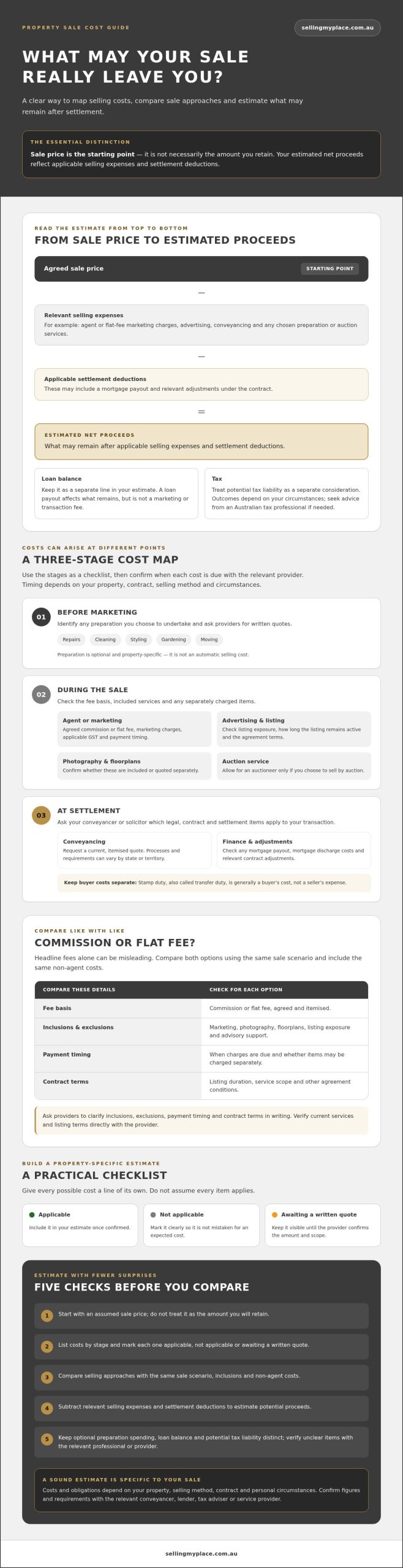
Start by separating the amount your property sells for from the costs and deductions associated with the sale. The sale price is the agreed amount, not necessarily what you retain. Your estimated net proceeds are what remains after applicable selling expenses and settlement deductions, including any loan payout. Tax outcomes depend on your circumstances, so treat tax as a separate consideration and seek advice from an Australian tax professional if needed.
Costs also fall due at different stages. You might pay some expenses before the property is listed, incur others during marketing, then have certain amounts accounted for at settlement. Timing and costs depend on your property, contract, selling method and personal circumstances. First identify what may apply, then confirm the figures and obligations with the relevant professionals and providers.
Selling costs versus sale price and net proceeds
Think of the sale price as the starting point for your estimate, not the final result. Sale-related expenses may include agent or flat-fee marketing charges, advertising, conveyancing, property preparation or an auctioneer if you choose to sell by auction. At completion, settlement may also involve paying out a mortgage and accounting for relevant adjustments under the contract.
For a working estimate, subtract expected selling costs and applicable settlement deductions from your assumed sale price. Keep the loan balance and any potential tax liability on separate lines. Both can affect what remains, but neither is the same as a marketing or transaction fee.
Which costs vary between Australian property sales?
Some costs are common to many sales, while others depend on the property and the approach you choose. Marketing inclusions can differ, for example. Check whether photography and floorplans are included or quoted separately. Styling, repairs, auction services and mortgage discharge costs may apply only in particular circumstances. Stamp duty, also called transfer duty, is generally a buyer’s cost, not a seller’s expense.
Conveyancing helps manage the transfer of property title. You can read more about the legal process of conveyancing, but the work and requirements for an Australian sale can vary by state or territory. Don’t rely on a single national fee schedule. Ask a conveyancer or solicitor for a current, itemised quote, and check the settlement terminology and requirements that apply to your transaction.
Make a property-specific list and mark each line as applicable, not applicable or awaiting a written quote. Ask providers to clarify inclusions, exclusions, payment timing and contract terms. You can compare a flat-fee marketing option with other sale approaches, but use the same assumptions and include the same non-agent costs. This gives you a fairer view of likely expenses and potential proceeds.
Which property-selling costs should you include in your estimate?
A reliable estimate reflects the costs that apply to your sale, not a standard list where every item is assumed. For calculating total cost of selling property, create a line for each category below and mark it applicable, not applicable or awaiting a written quote. Ask providers what’s included, what may be charged separately and when payment is due.
Marketing, preparation and professional support
Start with the sale method and the services you plan to use. If you’re comparing an agent with a flat-fee marketing option, check the fee basis and service scope side by side. Confirm whether photography, floorplans, listing exposure and advisory support are included or charged separately. Ask how long the listing remains active under the agreement, and verify the current inclusions and listing terms directly with the provider.
- Agent or marketing: Record the agreed commission or flat fee, any marketing charges, applicable GST and payment timing. Don’t compare headline fees without checking what’s included.
- Property preparation: Consider repairs, cleaning, styling, gardening or moving only if they suit the property and your plans. These are choices to assess after inspecting the home, not automatic selling costs.
- Professional support: Note any separate advice or services you intend to use. Request a written quote that sets out the scope.
Conveyancing, finance, tax and settlement items
Ask a conveyancer or solicitor to identify likely legal, contract and settlement charges for your transaction. Processes and requirements can vary by state or territory, so request a current, itemised estimate rather than relying on a general figure.
- Finance: If there’s a mortgage, ask your lender for a current payout figure and whether any discharge-related amounts apply. Use a figure that reflects your expected settlement timeframe.
- Settlement: Ask your conveyancer which adjustments or deductions may apply under your contract and how they’ll appear in the settlement statement.
- Tax: Don’t guess a potential capital gains tax amount. Your circumstances matter. Speak with a qualified tax adviser and consult the ATO’s guidance on calculating Capital Gains Tax.
Once you’ve gathered the relevant quotes and figures, you’ll have a more useful estimate for your property. If you’re considering a flat-fee marketing approach, you can ask about property marketing options and confirm which inclusions and terms apply to your sale.
How do commission and flat-fee selling approaches compare?
For a fair comparison, hold the sale scenario constant. Use the same property and estimated sale price, then keep conveyancing, finance, preparation and other applicable expenses identical for each option. Change only the selling service and the costs that genuinely differ. This makes calculating total cost of selling property more useful than comparing two headline fees in isolation.
With a commission-based arrangement, the fee is generally calculated as a percentage of the agreed sale price, so the amount changes if the final price changes. A flat fee is a set service charge under the provider’s written terms. For either option, confirm the fee basis, additional charges and payment timing in the agreement.
Compare the complete service, not just the headline fee
Ask what each option includes, such as professional photography, floorplans, listing exposure and advisory support. Check for exclusions and extra charges, as well as cancellation terms, listing duration and any conditions that could affect the final bill. Request the details in writing so you can compare like with like. A lower fee doesn’t automatically mean weaker service or better value. The right fit depends on the support and inclusions you need.
| Comparison point | Commission-based arrangement | Flat-fee arrangement |
|---|---|---|
| Fee basis | Percentage of the agreed sale price. Confirm how it’s calculated. | Set service charge. Confirm what the written terms cover. |
| Inclusions and exclusions | Record photography, floorplans, listing exposure and advice, plus anything charged separately. | Record the same items and note any exclusions or optional extras. |
| Payment timing | Check when the fee becomes payable and how payment is arranged. | Confirm payment timing and any conditions in the agreement. |
| Contract terms | Check cancellation provisions, listing duration and other conditions. | Check the same terms, including how long the listing remains active. |
How a flat-fee model fits into the calculation
Kincade International Direct Sales is one example of commission-free, flat-fee property marketing. Its service includes professional photography, floorplans, global property listings and advisory support. Confirm current inclusions and listing terms with the provider before using them in your estimate.
To compare estimated net proceeds, start with the same assumed sale price for both approaches. Subtract each option’s service and marketing charges, then deduct the same conveyancing, finance, preparation and settlement items that apply to your property. If the final sale price differs from your estimate, recalculate any percentage-based fee using the actual agreement terms. This is an informed comparison, not a guarantee of what you’ll retain.
How to calculate your estimated selling costs step by step
A worksheet brings quotes and settlement details together in one estimate you can update as the sale progresses. Keep the assumed sale price separate from expenses, and label each figure as confirmed, estimated or unknown. Use A$ placeholders until you have figures for your property.
Gather the figures needed for a property-specific estimate
Collect written quotes and check what each covers, including marketing inclusions, conveyancing, any preparation work and your lender’s current payout information. Base your sale-price assumption on relevant market evidence rather than an unsupported online estimate. For help developing that assumption, see this guide to determining a home’s market value.
Build your worksheet
- Estimated sale price: A$[amount] | Status: [estimated/unknown]. Note the evidence and date behind your assumption.
- Agent or flat-fee service: A$[amount] | Status: [confirmed/estimated/unknown]. Record the fee basis and written agreement terms.
- Marketing and listing expenses: A$[amount] | Status: [confirmed/estimated/unknown]. List photography, floorplans, listing exposure and any separately quoted items.
- Conveyancing and transaction charges: A$[amount] | Status: [confirmed/estimated/unknown]. Use an itemised estimate for your state or territory and transaction.
- Property preparation: A$[amount] | Status: [confirmed/estimated/unknown]. Include only work you’ve decided is worthwhile, such as cleaning, repairs or styling.
- Finance payout and discharge items: A$[amount] | Status: [confirmed/estimated/unknown]. Enter the lender’s current payout figure and note any applicable charges.
- Settlement adjustments or other deductions: A$[amount] | Status: [confirmed/estimated/unknown]. Confirm relevant items with your conveyancer.
- Potential tax liability: A$[amount] | Status: [adviser to confirm]. Don’t treat this as a generic estimate. Ask a qualified tax adviser about your circumstances.
Estimated net proceeds = assumed sale price − selling expenses − applicable settlement deductions. Keep tax and loan figures clearly identified so you can see what’s confirmed and what still needs checking. Don’t treat an unknown as a confirmed charge. Flag it and follow up with the relevant provider.
To stress-test your estimate, repeat the calculation with more than one plausible sale-price assumption. Apply the same non-agent expenses to each scenario, changing only figures that genuinely depend on the sale price or agreed terms. These are planning scenarios, not promises of a result. The agreed sale terms can also affect the final outcome, so review these property sale negotiation tips.
Update the worksheet when quotes, the lender payout figure or sale assumptions change. For help reviewing property marketing options and inclusions, contact Kincade International Direct Sales.
How to manage selling costs and choose your next step
Once your worksheet is taking shape, make each line clear and verifiable. A low headline fee can look appealing, but it’s difficult to judge until you know what’s included, what may cost extra and when payment is due. Ask providers for written details, then update your estimate rather than relying on verbal assurances.
Reduce uncertainty without overlooking essential support
Request an itemised quote that identifies inclusions, exclusions, additional charges, payment timing and relevant contract terms. For marketing services, check the scope of professional photography, floorplans, listing exposure and advisory support. A clear comparison helps you decide whether the service suits your needs, rather than simply choosing the lowest quoted fee. For a closer look at what listing services can cover, read this residential property listing services guide.
Keep optional preparation spending separate in your worksheet. Cleaning, repairs or styling may be useful for your property, but they’re not automatic costs for every seller. Transaction and settlement items also need checking with the relevant professionals. Ask your conveyancer about the sale process and settlement figures, your lender for current payout information, and a qualified tax adviser about any tax questions that apply to your circumstances.
Choose a selling approach that fits your cost plan
Use the same worksheet to compare a commission-based arrangement with a flat-fee option. Keep your sale-price assumptions and non-agent expenses consistent, then compare the service fee, inclusions, exclusions, payment timing and contract terms. This gives you a more grounded view of estimated net proceeds than comparing headline charges alone. The aim of calculating total cost of selling property is to understand the whole picture, not to assume one method will suit every owner.
Kincade International Direct Sales is an option for owners considering commission-free marketing through a flat-fee model. Its service includes professional photography, floorplans, property listings and advisory support. Confirm current inclusions and listing terms directly before adding them to your estimate.
If you’d like to explore whether commission-free marketing fits your plans, discuss your property sale. Ask about the service scope and terms so you can assess the option without assuming a particular sale price or saving.
Make your next property-sale decision with confidence
Calculating total cost of selling property is easier with a property-specific estimate than with a headline fee or broad rule of thumb. List each expense and settlement deduction, mark what’s confirmed and what still needs a quote, then check relevant figures with your conveyancer, lender or tax adviser.
Before choosing a selling approach, compare the full service scope and written terms. Commission-free, flat-fee marketing may suit some sellers, but value depends on the inclusions and support you need. Kincade International Direct Sales describes professional photography, floorplans and advisory support as service inclusions. Confirm current inclusions and listing terms directly before comparing them with other options.
A clear estimate and a considered comparison can help you decide what to do next. The questions and answers below cover common points sellers may need to check.
Frequently Asked Questions
Is the agent commission the only major cost when selling a property?
No. Depending on your sale, the estimate may also include marketing, conveyancing, property preparation, finance-related amounts and settlement deductions. Some items may be included in a provider’s fee, while others are charged separately or are optional. Ask for written, itemised terms so you can see what each service covers. Then check which expenses actually apply to your property before comparing selling approaches or estimating your proceeds.
What costs should I include when calculating the total cost of selling property?
Start with the selling service and marketing, then check conveyancing, property preparation, moving, lender-related amounts and any tax questions that may apply. Not every seller will incur every cost, and some services may be bundled. Create an itemised list and label each figure as confirmed, estimated or not applicable. Verify transaction-specific charges with the relevant provider or professional instead of treating a general checklist as a final quote.
How do I calculate how much money I may keep after selling?
Begin with a realistic sale-price assumption, then subtract your selling expenses and relevant settlement deductions. Use verified figures where possible, and clearly mark estimates or unknowns. The result is an estimate, not a guaranteed amount. Your final proceeds may depend on the contract, lender’s payout information, transaction costs and personal tax circumstances. Confirm the final figures with your conveyancer and lender as settlement approaches.
Is a flat-fee property service cheaper than a commission-based agent?
It depends on the agreed fee, sale circumstances, service inclusions and any extra charges. Compare both approaches using the same sale-price assumption and identical non-agent expenses. Check the written terms for marketing, photography, floorplans, advisory support, listing duration and payment timing. Kincade International Direct Sales offers commission-free property marketing through a flat-fee model, with service inclusions to verify. A headline fee alone can’t establish overall value.
Can I deduct property selling costs from capital gains tax?
Tax treatment depends on the property, your ownership history and individual circumstances. Don’t assume every selling expense can be deducted or estimate your tax outcome from a general guide. Keep invoices and transaction records, then ask a qualified Australian tax adviser which costs may be relevant to your situation and what evidence you’ll need. This helps you avoid treating a general explanation as personal tax advice.
What happens if my selling-cost estimate changes before settlement?
Update your worksheet when you receive a revised quote, agree to additional work or obtain current lender or conveyancing information. Keep earlier figures and assumptions so you can track what changed and why. Before settlement, ask the relevant professionals to confirm outstanding amounts and explain any adjustments. An estimate is a planning tool, not a final proceeds statement, so don’t rely on an older version as the settlement figure.
Do selling costs vary between Australian states and territories?
Yes. Some conveyancing steps, transaction requirements and related charges may vary by state or territory, while other costs depend on your property and chosen services. A national guide can help you identify cost categories, but it can’t confirm every local requirement or charge. Ask a conveyancer familiar with the property’s jurisdiction to check which costs apply and when they’re payable. Request a current, itemised estimate for your transaction.
Ready to compare flat-fee marketing with your other selling options? Discuss your property-selling options with Kincade International Direct Sales and confirm the service inclusions and terms for your sale.
The Real Cost of Selling a House in 2026: An Australian Homeowner’s Guide
What if the biggest expense in your property sale wasn’t the marketing that finds the buyer, but an outdated commission fee that takes a massive chunk of your hard-earned equity? When planning your move, understanding the total cost of selling a house 2026 is essential to protecting your financial future. Selling a home is one of life’s most significant transitions, and it’s natural to feel anxious about hidden extras or the thought of losing $20,000 or more in commission when you should be celebrating your next chapter.
We believe you deserve a clear path forward, free from the stress of unexpected bills. In this guide, we’ll provide a complete breakdown of property sale expenses, showing you exactly where every dollar goes. You’ll discover how a professional flat-fee model can save you tens of thousands in equity while still providing the expert tools and photography you need to succeed.
We’ll walk through the difference between mandatory legal fees and optional marketing spend, helping you create a transparent budget. By the end, you’ll have the confidence to manage your sale with a steady hand, ensuring you walk away with the maximum profit to fund your next adventure.
Key Takeaways
- Learn how to deconstruct your settlement statement to identify mandatory legal fees versus optional marketing costs for a clearer budget.
- Discover why the total cost of selling a house 2026 is often inflated by commission structures and how to protect your family’s equity.
- Shift your strategy toward a transparent flat-fee model that ensures you pay for professional services rather than a percentage of your home’s value.
- Understand the importance of investing in high-impact visual marketing, including professional photography and floorplans, to attract the right buyers.
- Gain confidence in your selling journey with a “listed until sold” approach that removes the pressure of time limits and hidden fees.
The Shifting Landscape: Property Sale Costs in 2026
The Australian property climate in 2026 is defined by a renewed sense of ownership. With house prices in major metropolitan areas reaching significant peaks in early 2026, homeowners are becoming fiercely protective of their equity. It makes sense. After years of mortgage repayments and weekend renovations, you want that value to fund your next chapter rather than seeing it swallowed by fees. When calculating the total cost of selling a house 2026, we need to separate the non-negotiable “hard costs” from the variables. Hard costs include essential legal requirements governed by Australian property law, such as conveyancing and title searches, which provide the necessary framework for a secure transaction.
Variable costs are where most sellers lose their footing. Traditional commissions can fluctuate wildly, often feeling disconnected from the actual effort required to move a property in a digital-first market. We believe in a more transparent, partnership-based selling experience. This approach replaces high-pressure tactics with grounded, professional support, ensuring you remain in the driver’s seat of your own sale.
Why Traditional Models are Feeling the Pressure
Digital listing technology has fundamentally altered how we connect with buyers. Today, your future buyer is likely scrolling through a social media feed or a global property portal rather than walking past a local office. Because these platforms do the heavy lifting of visibility, the traditional percentage-based commission model feels increasingly outdated. It’s difficult to justify why selling a more expensive home should cost tens of thousands more in fees when the marketing process remains largely the same. This shift toward digital efficiency is driving a massive demand for fairer, service-based pricing that reflects the modern world.
The “Hidden” Emotional Cost of Selling
Beyond the financial figures, the emotional weight behind the cost of selling a house 2026 is often the most challenging part for families. Selling a home is rarely just a financial transaction; it’s a deeply personal milestone. The stress of managing open homes and legal paperwork can be taxing if you feel like just another number. Instead of a high-pressure environment, we see the value in a steady hand approach. A guide who provides professional tools and calm expertise helps reduce the anxiety of the unknown. When costs are transparent from the start, the path to settlement becomes much smoother, allowing you to focus on the legacy you’re building for your family.
Deconstructing the Bill: Where Your Money Goes
When you sit down to calculate the total cost of selling a house 2026, the list of expenses can feel overwhelming. It’s not just about the final number on the contract; it’s about the various steps required to get there safely and professionally. A typical Australian home sale involves several layers of spending, from the initial marketing push to the final legal sign-off. Understanding these costs upfront allows you to maintain control over your equity and prevents those stressful “hidden” surprises during settlement.
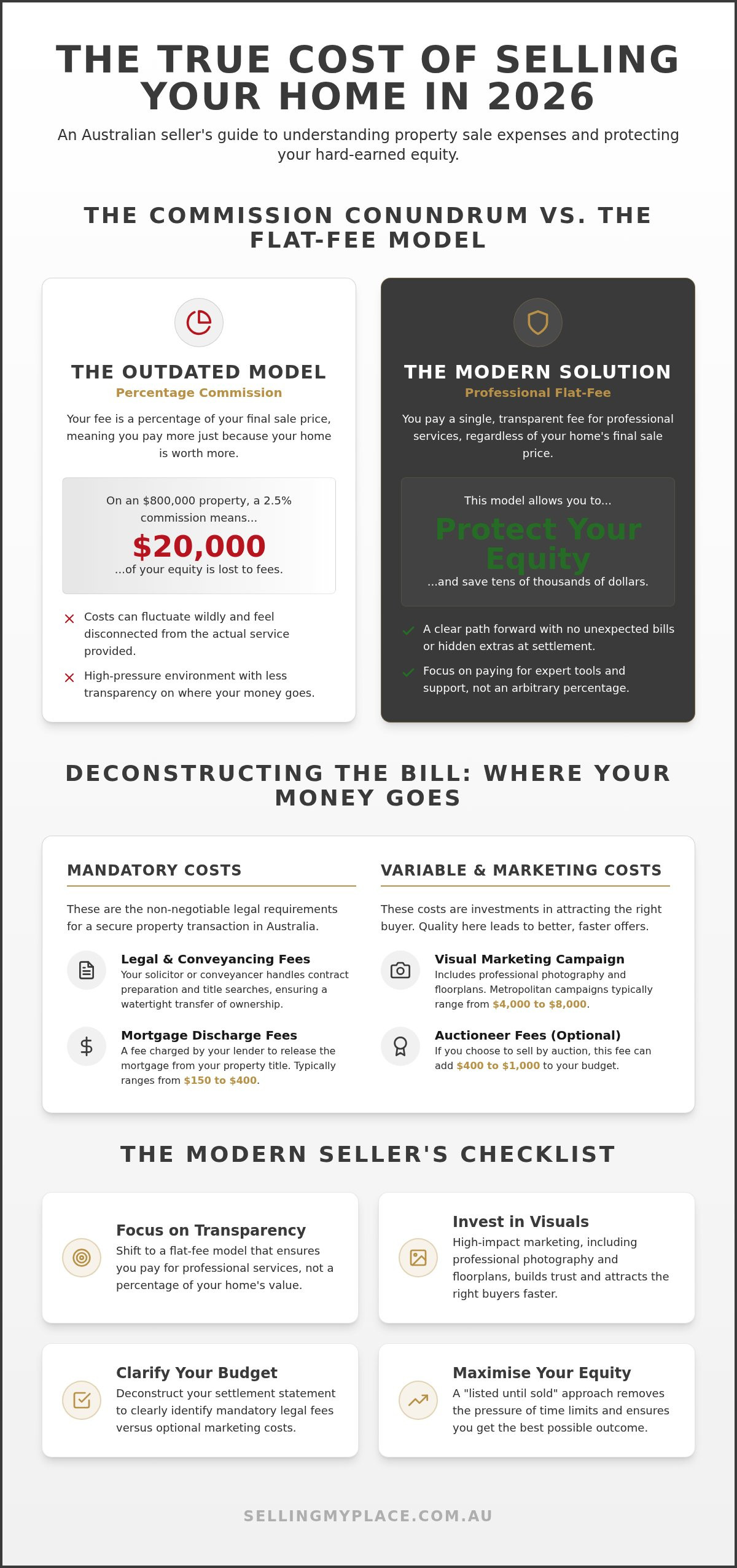
The first step in any successful sale is grounding your expectations in reality. Using Neighborhood Market Reports helps you set a realistic price based on current local data. This prevents the costly mistake of overpricing, which often leads to a property languishing on the market. Beyond pricing, you’ll need to account for mortgage discharge fees, which typically range from $150 to $400, and potentially auctioneer fees if you choose that path, which can add another $400 to $1,000 to your bill.
Visual Marketing: Photography and Floorplans
In 2026, your digital presence is your primary open home. Research indicates that metropolitan marketing campaigns now typically range from $4,000 to $8,000. While that sounds like a lot, the quality of your visual assets is where you shouldn’t cut corners. Professional photography captures the emotional heart of your home, while a clear floorplan provides the logical blueprint buyers need to visualise their future life in the space. High-quality imagery doesn’t just look nice; it builds immediate trust and significantly reduces the time your property spends on the market, often resulting in stronger final offers.
The Legal Essentials: Conveyancing and Advice
The legal side of selling is your protective shield. A solicitor or conveyancer handles the complex task of contract preparation and title searches, ensuring the transfer of ownership is watertight. In Australia, these fees generally fall between $700 and $2,500. Seeking expert Conveyance Advice early in the piece is a smart move to avoid common settlement pitfalls that can delay your move or cost you money. This professional oversight ensures that every box is ticked according to current regulations, giving you the peace of mind that your transition will be as smooth as possible. If you’re feeling unsure about where to start your budget, feel free to reach out for a chat about your specific situation.
The Commission Conundrum vs. The Flat-Fee Model
Many homeowners view the real estate agent’s commission as an unavoidable tax on their hard-earned equity. It’s a significant burden. When we look closely at the cost of selling a house 2026, it’s clear that these fees are actually a strategic choice rather than a fixed rule. Traditional commissions, which typically sit between 1.5% and 3.5% plus GST, might have been justifiable in an era of print newspapers and physical shopfronts. Today, with property prices reaching new heights, that percentage translates into a staggering amount of money. For a home valued at $1.5 million, a 2% commission means handing over $30,000 of your wealth at the settlement table.
We call this the Equity Gap. It represents the difference between a traditional sale and a more modern, efficient approach. On average, owners who step away from the commission model save approximately $20,000. Think about what that amount could do for your family’s next transition. It could fund a significant renovation on your next property, clear a substantial portion of debt, or simply provide a safety net for your retirement. There’s a persistent myth that paying a lower fee results in a lower sale price. In reality, the final figure is driven by market demand and the quality of your presentation, not the size of the agent’s final cheque.
Comparing the Incentives
Traditional agents often operate on a high-volume model. Their goal is to close the deal quickly to move on to the next listing, which can sometimes lead to pressure on the seller to accept a lower offer as an agency agreement nears its end. Our flat-fee advisory service flips this dynamic. We believe in empowering you to be the best advocate for your home. By removing the ticking clock of an expiring contract, the “listed until sold” model provides a sense of calm. You have the luxury of time to wait for the buyer who truly understands the value of your property’s legacy, without the stress of mounting fees or pressuring phone calls.
The Global Reach Advantage
You don’t need a local shopfront to achieve a premium sale. In 2026, the physical office has been replaced by a sophisticated global marketing network. Modern digital platforms connect Australian homes to buyers across the country and around the world. These buyers aren’t walking past windows; they’re searching online for community and stability. By leveraging this digital reach, you can attract high-value interest from international networks while keeping your costs grounded. To further expand your reach, you can discover HomesGoFast and see how international property advertising connects sellers with global opportunities. This direct-to-consumer efficiency ensures your home is seen by the right eyes, regardless of where they are located, driving up competition and your final result.
Creating a financial roadmap is about more than just tracking numbers; it’s about giving yourself the control to manage a major life transition with confidence. When calculating the cost of selling a house 2026, a structured approach ensures you aren’t caught off guard by the small details that often accumulate during settlement. We’ve found that a clear plan reduces the emotional weight of the process, allowing you to focus on the future.
Your first step is obtaining an accurate market appraisal. This provides the grounded foundation for your entire strategy. Next, allocate your budget toward high-impact visual marketing. As we’ve discussed, professional photography and floorplans are the tools that actually move the needle in a digital-first market. Third, secure professional Sale by owner advisory. Having an expert guide to handle negotiations ensures you don’t leave your hard-earned equity on the table. Finally, remember to factor in “exit costs.” These include mortgage discharge fees, which typically range from $150 to $400, alongside your moving expenses and any minor repairs needed to present the home at its best.
Prioritising Your Marketing Spend
In 2026, digital infrastructure is far more powerful than traditional print advertising. While a glossy brochure might feel like a nice keepsake, it’s your online reach that finds the buyer. Investing in Pre-Sale Property Consulting can help you identify high-ROI fixes that actually add value to your final offer. Be wary of “premium listing” traps on major property portals. These often come with significant price tags but don’t always result in more genuine interest. Focus your resources on quality content and professional presentation instead.
The Importance of Accurate Market Data
Relying solely on automated online valuations can be a risky move. These tools often miss the nuances of your home’s unique character or the subtle shifts in local community demand. Comprehensive market reports provide the granular data you need to avoid the stress of underpricing or overpricing. When a buyer begins to negotiate, having this data at your fingertips allows you to justify your price with logic and evidence. This transparency builds a sense of trust and leads to a much calmer settlement process for everyone involved. If you’re ready to build your custom roadmap, book a consultation with our advisory team to discuss your goals.
Maximising Your Equity with Kincade International Direct Sales
We’ve explored the various layers involved in the cost of selling a house 2026, but the most empowering part of this journey is choosing a model that puts your family’s future first. At Kincade International Direct Sales (KIDS), our approach is built on a simple, transparent foundation. We’ve removed the single largest obstacle to your profit: the agency commission. By operating on a commission-free, flat-fee basis, we ensure that the equity you’ve built through years of mortgage repayments and weekend renovations stays exactly where it belongs. In your pocket.
Our “Listed Until Sold” guarantee is designed specifically to reduce the anxiety that often accompanies traditional real estate agreements. There are no ticking clocks or expiring contracts here. We provide you with the same professional tools used by the country’s top agencies, including high-end photography and detailed floorplans, as standard. This partnership ensures your home is presented with the polish it deserves while you maintain complete control over the process and the final result.
A Steady Hand through the Selling Journey
You don’t have to navigate this transition alone. Our Expert Agent Advisory Service acts as your steady hand, providing professional guidance whenever you need it. We believe that you are the best person to tell the story of your home’s legacy. After all, you’re the one who knows which corner gets the best morning sun and which local cafe serves the best coffee. We provide the professional framework and digital reach, while you provide the authentic heart that buyers in 2026 are looking for. It’s a collaborative way to sell that balances expert support with personal advocacy.
Taking the Next Step
Moving from the “thinking about it” stage to having an active listing is a significant emotional step. We’ve made our process as straightforward as possible to help reduce that initial friction. Our flat-fee structure is clear from the outset, allowing you to budget with absolute certainty. There are no hidden marketing “add-ons” or surprise fees at settlement. If you’re ready to move toward your next life chapter with confidence and a protected bottom line, we’re here to help you get started. You can protect your equity and start your commission-free journey today by joining a community of homeowners who are changing the way Australia sells property.
Securing Your Equity for the Next Chapter
Selling your home is a monumental life transition, and you deserve to walk away with every cent of equity you’ve worked so hard to build. By deconstructing the total cost of selling a house 2026, you’ve seen that high commissions are no longer an inevitable part of the process. Instead, you can choose a path that prioritises your family’s financial legacy through transparent, flat-fee services and grounded, professional support.
A successful sale relies on professional presentation and a steady hand during negotiations. With our Dedicated Agent Advisory Service and professional photography included, you don’t have to sacrifice quality to achieve significant savings. On average, our partners save $20,000 in commissions, allowing them to fund their next adventure with confidence. Your future is waiting, and we’re here to help you reach it with ease.
Keep 100% of your profit with Kincade International Direct Sales
Frequently Asked Questions
What is the average real estate commission in Australia in 2026?
Real estate commissions generally range between 1.5% and 3.5% of the final sale price. Rates tend to be lower in metropolitan areas where property values are higher, while regional areas often see rates exceeding 3%. You must also factor in a 10% GST on top of the quoted percentage. For a home valued at $1 million, these fees can represent a significant portion of your equity, often reaching $25,000 or more.
Are there hidden costs when selling a house by owner?
While you avoid traditional commissions, you must budget for professional essentials to ensure a successful result. These include high-quality photography, floorplans, and digital listing fees. Some homeowners also overlook mandatory legal costs like title searches. We bundle these professional tools into a transparent flat fee, providing a clear roadmap that eliminates surprise bills at settlement and ensures you have everything needed to attract the right buyer.
How much should I spend on marketing my property?
A standard metropolitan marketing campaign in 2026 typically ranges from $4,000 to $8,000. This investment covers professional imagery, floorplans, and digital reach across major property portals. While some platforms offer premium tiers that cost significantly more, we recommend focusing on high-quality content that builds genuine buyer trust. Our model includes professional photography and floorplans as standard to help you achieve a premium result without the burden of high marketing costs.
Is a flat-fee real estate model legally safe in Australia?
Yes, the flat-fee model is completely legal and increasingly popular across the country. It provides a structured alternative to the traditional commission system while still utilising professional legal frameworks. You still engage a solicitor or conveyancer for the formal transfer of title, ensuring your sale complies with all national property laws. It’s a safe, modern way to manage your cost of selling a house 2026 while protecting your hard-earned equity.
What is the cost of conveyancing when selling a house?
You should expect to pay between $700 and $2,500 for professional conveyancing or legal fees. This amount covers contract preparation, title searches, and the formal legal transfer of the property. Costs vary depending on the complexity of the sale and any specific requirements of the transaction. We provide expert conveyance advice to help you navigate this essential step, ensuring your legal interests are protected throughout the entire settlement process.
Do I need to pay for a property appraisal in 2026?
Many digital platforms offer automated valuations for free, but these can be inaccurate as they miss the nuances of your home. We provide comprehensive Neighborhood Market Reports as part of our service. These reports use granular local data to give you a realistic and grounded starting point for your sale price. Having accurate data is essential for justifying your price to buyers during negotiations and ensuring you don’t leave money on the table.
Can I sell my home to an international buyer through a flat-fee service?
Absolutely. Our digital infrastructure and global marketing network ensure your home is visible to buyers across the country and overseas. Modern buyers aren’t limited by geography; they look for community and stability through international property portals. For instance, savvy investors often explore New Launch to discover premier residential developments in Singapore, demonstrating how digital platforms connect global buyers with local opportunities. By using a flat-fee service with global reach, you can attract high-value interest from international networks without needing a physical local shopfront or paying an agency commission that scales with the sale price.
This model removes the financial pressure of expiring agency agreements. Traditional agents often sign you for a fixed period, which can lead to stress or the cost of a second campaign if the property doesn’t move quickly. With our “listed until sold” guarantee, you have the luxury of time to wait for the right offer that respects your home’s legacy. It provides peace of mind and ensures your initial investment covers the entire journey.
