The Most Profitable Way to Sell a House in Australia: A 2026 Net-Wealth Guide
Did you know that the highest offer on your property doesn’t always result in the biggest deposit into your bank account? It’s a bit of a hard pill to swallow, isn’t it? When you’ve spent years building equity and making memories, the thought of losing tens of thousands in commission fees can feel like a personal blow to your family’s future. Finding the most profitable way to sell a house in Australia isn’t just about chasing the biggest number on a contract; it’s about being protective of what you keep once the legal settlement is finalised. With the national median commission sitting at roughly 2.65 percent in 2026, many homeowners are rightfully questioning if there’s a more transparent, supportive way to move forward.
We understand that this is one of the most significant transitions you’ll ever make, and you deserve a partner who values your legacy. You’re likely looking for a way to achieve a premium result without the pressure of traditional agency models. In this guide, we’ll show you how to maximise your final takeaway by pairing professional marketing with a commission-free approach that keeps your equity where it belongs. We’ll explore the strategic shifts and expert advisory tools that allow you to retain your full sale profit while still enjoying a polished, high-end presentation.
Key Takeaways
- Understand why the headline sale price is only half the story and how focusing on your net profit helps you keep more of your hard-earned wealth.
- Discover why a commission-free approach is the most profitable way to sell a house in Australia, helping you avoid the tens of thousands usually lost to traditional agent fees.
- Learn how high-quality visual assets, such as professional photography and detailed floorplans, underpin the most profitable way to sell a house in Australia by creating a strong emotional connection with potential buyers.
- Explore how a partnership-based model that values your local insight is the most profitable way to sell a house in Australia while safeguarding your family’s equity.
- Get a practical, step-by-step roadmap to organise your sale, from securing a market report to finalising your listing with confidence.
Redefining Profitability: Why Sale Price is Only Half the Story
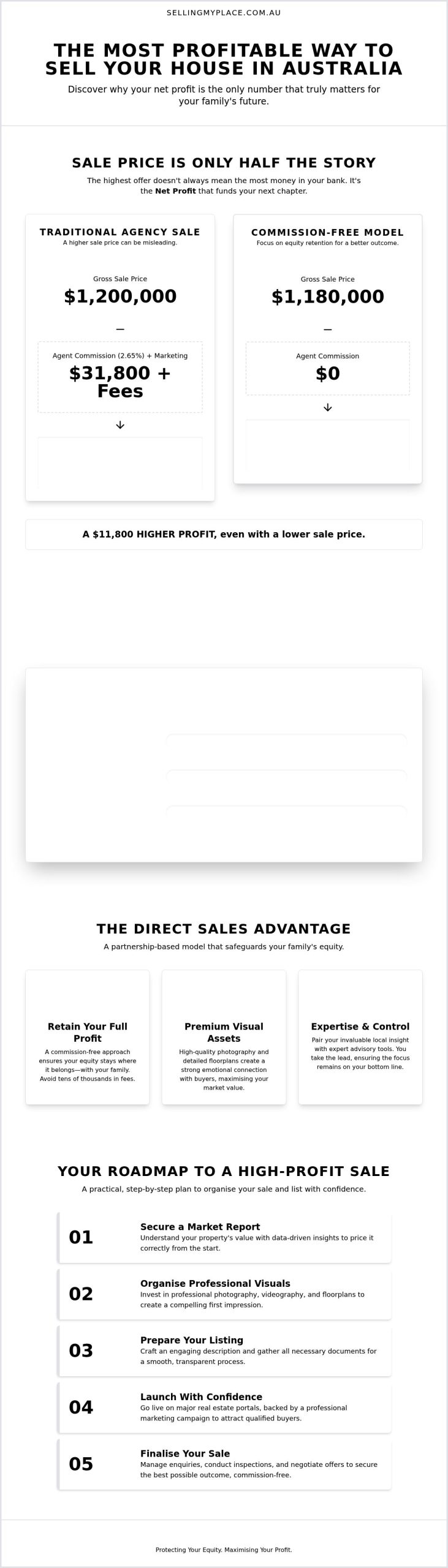
When you decide to sell your family home, it’s easy to get swept up in the glamour of a record-breaking headline price. We see those big numbers on the evening news and think that’s the ultimate goal. However, focusing solely on the gross sale price is a bit like judging a book by its cover; it doesn’t tell the whole story of what actually ends up in your pocket. For many Australian families, the “Gross Sale Price” is a vanity metric, while the “Net Profit” is the reality that funds your next chapter. Net Sale Profit is the final amount cleared after all marketing, legal, and commission costs have been deducted from the gross purchase price.
Think of it this way. If you achieve a $1.2 million sale but pay a $30,000 commission, your takeaway is $1.17 million. Conversely, a $1.18 million sale through a commission-free model leaves you with $10,000 more in actual wealth. This subtle shift in perspective is the most profitable way to sell a house australia because it prioritises your equity over an agent’s bonus. Savvy sellers in 2026 are moving toward “Equity Retention” as their primary goal, ensuring that the years of hard work they’ve poured into their mortgage stay with their family.
The Mathematics of a Modern Australian Sale
Selling a property involves a series of financial layers that can quickly erode your hard-earned equity. Beyond the standard conveyancing fees, the “commission sting” is often the largest single expense. With the national median real estate commission in Australia sitting at approximately 2.65 percent in late 2026, a million-dollar sale could cost you $26,500 in fees alone. To truly grasp the context of your transaction, an Australian property market overview can provide the necessary historical perspective on how equity has grown across different cycles. When you factor in additional marketing levies, the “opportunity cost” becomes significant; that’s money that could have been your next deposit or a substantial boost to your retirement fund.
Why Traditional Models Often Favour the Agent Over the Owner
There’s often a quiet misalignment of interests in traditional real estate. While you want the highest possible price, an agent’s primary incentive is often just to secure a sale quickly so they can move on to the next listing. High-pressure auction environments are a classic example; they can create urgency, but they can also lead to suboptimal net outcomes if the final bid doesn’t quite cover the heavy marketing and commission costs. As homeowners become more digitally literate, there is a clear trend towards “Direct Sales.” This model empowers you to take the lead, supported by expert advice, ensuring the most profitable way to sell a house australia remains focused on your bottom line rather than a corporate commission structure.
The Commission Trap: How Traditional Fees Erase Your Equity
Traditional agencies often frame their commission as a performance incentive. In reality, it is a significant portion of your family wealth being redirected. With the 2026 national median commission at approximately 2.65 per cent, the numbers add up fast. On a $1.5 million property, that is nearly $40,000. Many sellers also fall for the “tiered commission” trap, where an agent might take a standard rate up to a certain point and then a much higher percentage (sometimes up to 10 or 20 per cent) on the “bonus” amount. While it sounds like they’re working harder for you, it often just means you’re paying a premium for the market doing its job. This is why many are realising that a flat-fee model is the most profitable way to sell a house australia.
Commission vs. Flat-Fee: A Side-by-Side Comparison
Let’s look at the numbers plainly. A traditional 2.5 per cent commission on a $1 million home costs you $25,000. Often, this doesn’t even include the “marketing levy” for things like photography or portal listings, which can add several thousand more to the bill. By contrast, a professional flat-fee service provides these essential tools (including high-definition floorplans and professional photography) for a single, transparent amount. Moving to this model allows the average owner to save around $20,000. It’s important to remember that “cheap” DIY options without professional-grade marketing can be a false economy, as poor presentation often leads to lower offers from buyers.
The Hidden Costs of Traditional Agency Agreements
Beyond the headline rate, traditional contracts often contain “vulture clauses” that can haunt you long after the initial signing. These might include long “exclusive authority” periods, locking you into a relationship with an agent even if they aren’t delivering results. You might also find yourself paying “advertising contributions” that seem more about promoting the agency’s brand than your specific property. When calculating your final takeaway, you also need to consider capital gains tax implications and how these costs affect your net position. Understanding these fine-print details is vital for protecting your equity. If you’re feeling overwhelmed by the complexity of these agreements, reaching out for a friendly chat can help clarify the most profitable way to sell a house australia for your specific situation.
Maximising Market Value: Pre-Sale Consulting and Visual Storytelling
Driving a premium result is rarely about luck; it’s a calculated blend of high-end presentation and data-led decision-making. Once you’ve secured your equity by avoiding traditional commissions, the next step in the most profitable way to sell a house australia is to ensure your home stands out in a crowded digital marketplace. This isn’t about expensive renovations that eat into your profit. Instead, it’s about surgical improvements and professional-grade marketing that capture the heart of the right buyer from the very first click.
The Power of First Impressions: Photography and Floorplans
In 2026, the first “open home” happens on a smartphone screen. High-end visual marketing acts as the great equaliser, allowing direct sellers to present their homes with the same polish as the largest national franchises. Professional photography is non-negotiable; it creates the emotional hook that stops the scroll. Just as importantly, a professional floorplan provides the structural clarity serious buyers crave. It allows them to mentally move in, measuring their lifestyle against your walls before they’ve even stepped through the front door. To ensure maximum click-through on portals, focus on a simple “less is more” approach. Declutter surfaces, open the curtains to invite natural light, and ensure every room has a clear, singular purpose before the photographer arrives.
Expert Advisory: The Secret Weapon of Profitable Sellers
One of the biggest risks for sellers is over-capitalising on pre-sale work. You don’t want to spend $20,000 on a bathroom refresh only to see a $10,000 return. This is where pre-sale property consulting becomes your secret weapon. By identifying high-ROI minor improvements, such as modernising light fittings or refreshing garden mulch, you can lift the perceived value of your home without draining your bank account. These small, thoughtful touches often resonate most with the “emotional buyer” who is willing to pay a premium for a move-in-ready lifestyle.
Equally vital is the use of Neighbourhood Market Reports to establish a price floor based on real-time data. The Real Estate Institute of Australia emphasises that understanding market standards is fundamental to a fair and successful sale. By combining this data with an Agent Advisory Service to help vet enquiries, you can focus your energy on genuine prospects. For a deeper look at establishing your home’s worth with surgical precision, explore our guide on How to Determine the Market Value of a Home in Australia: The 2026 Seller’s Guide. This layer of professional support ensures you remain the “steady hand” throughout the negotiation process.
The Direct Sales Advantage: Retaining Control and 100% of Profit
Transitioning from the preparation phase to the actual transaction requires a different kind of support. While traditional agencies offer a service, the Kincade International Direct Sales (KIDS) model is designed as a genuine partnership. This approach recognises that you are the best person to tell your home’s story. You provide the local heart and the intimate knowledge of the property, while we provide the global infrastructure and professional polish. By choosing this path, you are embracing the most profitable way to sell a house australia, ensuring that every cent of the final sale price stays within your family’s wealth portfolio.
Operating within a 0% commission structure changes the entire dynamic of a negotiation. When you aren’t worried about losing a massive percentage of your equity to an agent, you gain a level of flexibility that traditional sellers simply don’t have. You can hold firm on your price with confidence or negotiate with a clearer head, knowing exactly what your “walk-away” figure is. If you’re curious about the practicalities of managing the process yourself, our guide on How to Sell Your Own Home: A Step-by-Step Guide to Sale by Owner in Australia offers a detailed look at the journey ahead.
Global Reach Without the Global Price Tag
The digital age has removed the need for expensive physical shopfronts and large corporate overheads. Through our digital infrastructure, your property reaches the same international buyer pools as any major franchise, but without the high marketing costs. One of the most reassuring aspects of this model is the “listed until sold” guarantee. Unlike traditional 90-day authority periods that create a ticking clock and mounting pressure, you have the freedom to wait for the right offer. Direct communication between you and the buyer often leads to faster deals, as there’s no middleman to misinterpret feedback or delay the flow of information. It’s a cleaner, more transparent way to do business.
Legal Security: Conveyance and Settlement Support
A common myth is that selling directly is legally “risky” or complicated. In reality, the legal transfer of property is handled by qualified professionals regardless of whether an agent is involved. To ensure a smooth transition of title, expert conveyance advice is a core part of the process. This professional advisory protects you from common contract pitfalls and ensures all documentation is handled with surgical precision. Having a “steady hand” to guide you through the legal settlement provides the calm confidence needed during such a major life transition. To see how this partnership can protect your equity, feel free to contact our advisory team for a confidential chat.
Your Roadmap to a High-Profit Sale in 2026
Success in the Australian property market is rarely an accident; it’s the result of a deliberate, step-by-step strategy. When you’re looking for the most profitable way to sell a house australia, you need a plan that balances professional-grade marketing with a fierce protection of your equity. By following this clear roadmap, you can transition from homeowner to successful seller with calm confidence.
- Step 1: Secure a comprehensive Neighborhood Market Report. This data-led approach ensures you aren’t guessing your property’s value but are instead establishing a realistic price floor based on recent local sales.
- Step 2: Engage a professional flat-fee service. This allows you to handle your photography, high-definition floorplans, and portal listings for a single, transparent fee rather than a percentage of your home’s value.
- Step 3: Utilise pre-sale consulting. Use expert advice to “de-clutter” and style your home specifically for your target demographic. Small, high-ROI improvements can significantly lift the perceived value without eating into your final profit.
- Step 4: Manage enquiries directly. You know your home best. By handling enquiries yourself with the backing of an expert advisory service, you can filter out “tyre-kickers” and focus on serious buyers.
- Step 5: Finalise the sale. Use professional conveyance advice to ensure the legal settlement is handled perfectly, securing your 100% profit as it moves into your bank account.
Avoiding the “Cheap DIY” Pitfall
It’s tempting to think that simply putting a sign in the yard or using “free” listing sites is enough. However, these platforms often fail to attract the high-intent buyers who live on the major Australian property portals. Maintaining professional decorum and “brand quality” in your listing is essential for driving a premium price. You want buyers to feel they are dealing with a sophisticated partner, not just a casual seller. Using buyer representation data to your advantage during negotiations also allows you to understand the market’s pulse better than any traditional agent could. This refined approach is what makes this the most profitable way to sell a house australia.
Take the Next Step Toward an Empowered Sale
Take a moment to visualise your financial future. What would an extra $20,000 in your pocket mean for your family? Whether it’s a larger deposit for your next home or a more comfortable retirement, that money belongs to you, not an agency. The KIDS model is designed to provide that “steady hand” support, ensuring you never feel alone during this major life transition. You have the local knowledge; we have the global tools to make it happen. Contact our expert advisors today to start your commission-free journey and reclaim your home equity.
Securing Your Family’s Financial Future
The journey to a successful property sale is about more than just the final figure on the contract. It’s about protecting the equity you’ve built through years of hard work and ensuring your family’s legacy remains intact. By shifting your focus from the gross sale price to your net profit, you’ve already taken the first step in discovering the most profitable way to sell a house australia. You don’t have to sacrifice quality for savings; with professional photography and floorplans included as standard, your home can shine on the national stage without the burden of a traditional commission.
Transitioning to a new lifestyle should be a time of celebration, not stress. With an average saving of $20,000 per sale and the constant support of an Expert Agent Advisory Service, you can navigate the market with the calm confidence of a seasoned professional. You have the local heart and the intimate knowledge of your home; we provide the global infrastructure to help you succeed. Secure your 100% profit-enquire about our commission-free marketing packages today and take the lead in your property journey. Your future self will thank you for being so protective of your hard-earned wealth.
Frequently Asked Questions
Is it really possible to sell a house in Australia without a traditional agent?
It is absolutely possible and legally sound to sell your property without a traditional agent. Many homeowners are choosing this path to protect their hard-earned equity from unnecessary fees. With Kincade International Direct Sales, you aren’t alone in the process. We provide the digital infrastructure and global networking needed to find the right buyer. You retain full control of the sale while enjoying professional tools and expert advisory support to ensure a premium result.
How much can I actually save by using a flat-fee real estate model?
Australian homeowners save an average of $20,000 by choosing a flat-fee model over a traditional commission-based structure. When you consider the national median commission in 2026 is approximately 2.65 per cent, the savings on a million-dollar home are significant. By avoiding the “commission sting,” you keep more of your family’s wealth. This approach is the most profitable way to sell a house australia because it ensures every dollar of the final price stays in your pocket.
Will my property get the same exposure on major websites if I sell it myself?
Your property will receive the same high-level exposure on major Australian property websites as any home listed by a big-brand agency. Our digital infrastructure ensures your listing reaches high-intent buyers across the country and even internationally. You aren’t just listing your home in a vacuum; you’re using a professional network that keeps your property active until it’s sold. This strategy maximises your reach while helping you avoid high marketing costs and traditional agency commissions.
What happens if my property doesn’t sell within the first few weeks?
We offer a “listed until sold” guarantee, so there’s no pressure if your property doesn’t sell in the first few weeks. Unlike traditional 90-day agency agreements that can feel like a ticking clock, our model has no time limits. This allows you to remain a “steady hand” during negotiations, waiting for the offer that truly reflects your home’s value. You can adjust your strategy with our advisory team’s support without the stress of an expiring contract.
Do I need a lawyer or conveyancer if I am not using a real estate agent?
You will still need a qualified conveyancer or solicitor to handle the legal transfer of your property. Whether you use a traditional agent or a direct sales model, professional legal support is essential for a successful settlement. We provide expert conveyance advice to ensure your contracts are sound and the transition of title is handled with surgical precision. This protects your 100 per cent profit and ensures the entire process is legally compliant and stress-free.
Can I still have professional photography and floorplans if I don’t pay commission?
Professional photography and floorplans are included as standard in our flat-fee marketing packages. We believe high-end visual storytelling is the “great equaliser” in the modern property market. These tools allow your home to stand out on digital portals, attracting serious buyers with the same polish as a luxury agency listing. You don’t have to sacrifice professional presentation just because you aren’t paying a traditional commission. It’s about achieving a premium look for a fair price.
How do I handle the actual price negotiations with potential buyers?
You handle the enquiries directly, but our Expert Agent Advisory Service is there to guide you through the process. We help you vet potential buyers and filter out “tyre-kickers,” allowing you to focus on genuine prospects. This partnership is the most profitable way to sell a house australia because it combines your local heart with our professional negotiation support. Direct communication often leads to faster, more transparent deals where both parties feel heard and respected.
What is the most profitable month to sell a house in Australia in 2026?
Spring and autumn remain the most profitable seasons to sell a house in Australia in 2026. Months such as October and March typically see the highest levels of buyer activity, which can drive more competitive offers. However, a successful sale is less about the calendar and more about meticulous preparation. By using our pre-sale consulting to style your home and address minor repairs, you can achieve a record-breaking result in any month of the year.
Floor Plan Costs: A Guide for Australian Sellers
Would you buy a car without looking under the bonnet, or a book with half the pages missing? For many Australian buyers, a property listing without a floor plan feels just as incomplete. When you’re weighing up the cost of floor plan for selling house, it’s easy to view it as just another line item in a mounting list of marketing expenses. We know it’s stressful to manage a sale on your own; you want to look professional and attract the right people without feeling like you’re being overcharged at every turn.
It’s a common worry, but providing a clear layout is actually one of the kindest things you can do for a potential buyer. You’ll learn how these drawings serve as a vital spatial narrative that helps high-value families “move in” mentally before they ever step through your front door. This guide explores current market expectations, the psychological impact of layout on buyer confidence, and why a professional floor plan is a non-negotiable part of keeping more of your hard-earned equity during a smart, commission-free sale.
Key Takeaways
- Learn why a floor plan acts as the essential spatial bridge for buyers, correcting the visual distortions often found in wide-angle real estate photography.
- Identify which layout style-2D, 3D, or a full site plan-best suits your property’s unique features and appeals most to your target demographic.
- Understand the legal and financial risks of DIY drawings and how the cost of floor plan for selling house is a minor investment compared to protecting your professional reputation.
- Master the art of listing placement to ensure your layout appears exactly when a buyer needs to see it, turning casual scrollers into highly qualified leads.
- Explore how leveraging a flat-fee service provides you with top-tier marketing assets and expert guidance without the burden of traditional agency commissions.
Beyond the Photos: Why Floor Plans are Essential for a Successful Sale
A marketing floor plan is a scaled, simplified diagram of a residential property’s layout and spatial flow. It serves as the essential spatial map that turns a house into a relatable home for a prospective buyer. While professional photography captures the emotion and light of your home, it can sometimes be misleading. Wide-angle lenses, while great for showing off a renovated kitchen or a spacious alfresco area, often distort the actual distance between rooms. The floor plan provides the spatial narrative that anchors these images in reality, giving buyers the context they crave. It bridges the gap between simply seeing a house and truly understanding how it functions as a home.
When you’re calculating the cost of floor plan for selling house, it’s helpful to view it as a tool for efficiency. It significantly reduces inspection fatigue by allowing buyers to qualify the property before they commit to a physical visit. This means the people who attend your open home aren’t just tyre-kickers; they are individuals who already know the layout suits their lifestyle, making your sale process much more streamlined.
The Buyer’s Mental Move-In
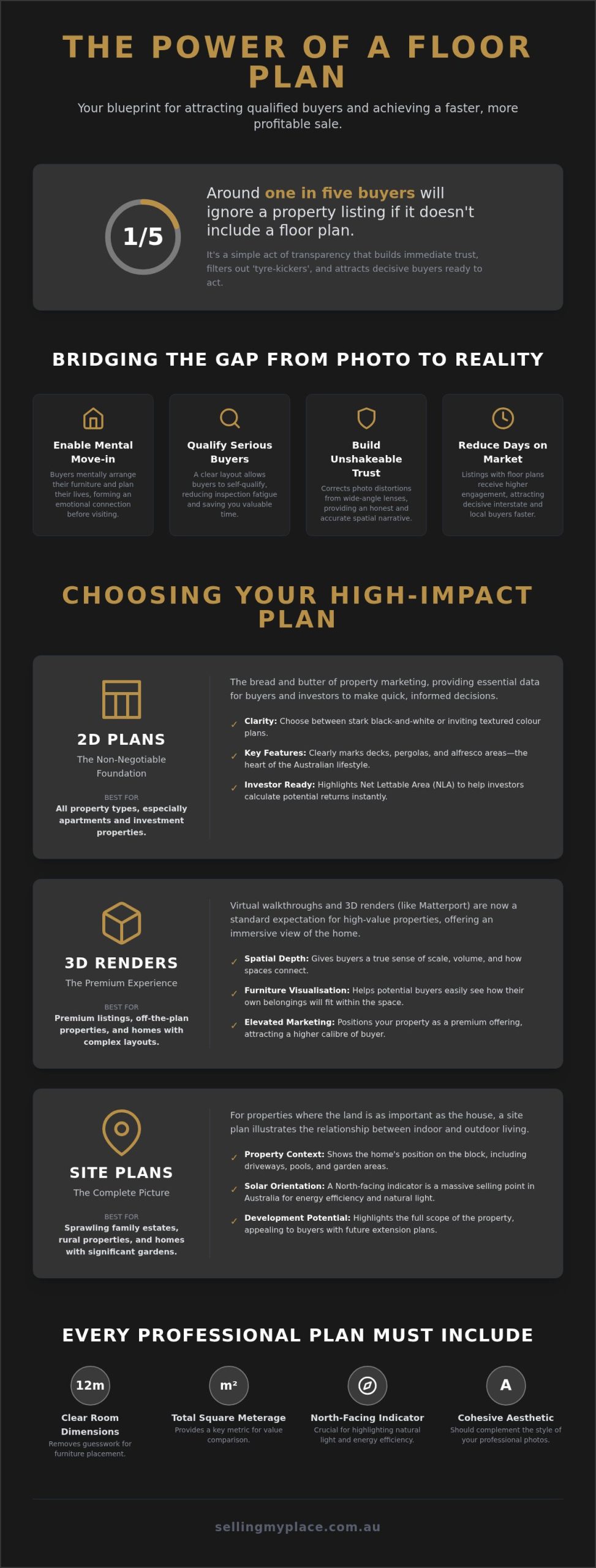
Australian families use floor plans to begin the emotional process of moving in. They look at the dimensions to see if their heirloom dining table fits or if the work-from-home nook is sufficiently separated from the noise of the living area. This is particularly crucial for multi-generational households where privacy and flow are top priorities. Statistics suggest that roughly 1 in 5 buyers will skip a listing entirely if it doesn’t include a clear layout. Providing this information is a gesture of transparency that builds immediate trust with your audience. It allows them to measure the distance between bedrooms in metres and plan their daily routines before they’ve even picked up the keys.
The Statistics of Spatial Marketing
To truly understand What is a Floor Plan? in the context of a modern sale, we have to look at how buyers behave online. Listings with floor plans receive significantly higher engagement on major Australian property portals. There is a documented correlation between high-quality spatial marketing and a reduction in “days on market.” For interstate buyers or those moving across the country, a professional layout is the primary tool that gives them the confidence to make a serious offer. When you consider the cost of floor plan for selling house, the value lies in attracting those high-quality, decisive buyers who are ready to act quickly. By removing the guesswork, you’re not just selling a structure; you’re offering a clear vision of a future lifestyle. This clarity is what drives higher offers and leads to a more certain result.
The Anatomy of a High-Impact Floor Plan: 2D, 3D, and Site Plans
Choosing the right visual format is about understanding who your buyer is and what they value most in a home. For a compact apartment, a clean 2D plan might be all you need to show the flow. For a sprawling family estate, you likely need a site plan to explain the garden’s relationship to the house. When you’re weighing up the cost of floor plan for selling house, remember that these assets are foundational marketing investments that establish the professional standard of your listing. Transparency is your greatest ally here. Every plan should include clear room dimensions, total square meterage, and a North-facing indicator. In Australia, solar orientation is a massive selling point for energy efficiency and natural light. It’s also vital that the aesthetic of your plan complements your professional photography to maintain a cohesive, premium brand for your listing.
Standard 2D Plans: The Non-Negotiable Foundation
A high-quality 2D plan is the bread and butter of property marketing. You can choose between the stark clarity of black-and-white lines or the inviting warmth of textured colour plans. For Australian homes, it’s essential to clearly mark the “Great Australian Dream” features. This includes decks, pergolas, and alfresco areas where buyers imagine spending their summer evenings. If you’re selling to an investor, highlighting the Net Lettable Area (NLA) helps them calculate potential returns immediately. It’s about providing the data they need to say “yes” faster without any ambiguity.
3D Renders and Virtual Walkthroughs
As we move through 2026, technology like Matterport has become a standard expectation for premium listings. 3D renders are perfect for properties with complex layouts, such as mezzanine levels or high-pitched ceilings that a flat drawing just can’t capture. These interactive tools allow buyers to “walk through” the home on their smartphones, which is a game-changer for qualifying leads before they ever book an inspection. If you’re unsure which tech fits your specific property, you can always reach out to our advisory team for a quick chat about your marketing strategy.
The Site Plan: Context is Everything
A site plan shows the home in relation to its boundaries, driveways, and easements. This context is vital for larger suburban blocks or regional properties where land use is a primary concern. It allows buyers to see the room for a future pool or perhaps a secondary dwelling (Subject to Council Approval). Showing the “bones” of the land helps a buyer justify the price and see the long-term potential of the legacy they’re buying into. When you provide this level of detail, you aren’t just selling a house; you’re selling the future possibilities of the entire block.
Professional Drafting vs DIY: Protecting Your Equity and Reputation
While it’s tempting to try and trim the upfront cost of floor plan for selling house by sketching it yourself, the risks to your reputation and equity are substantial. A floor plan isn’t just a drawing; it’s a legal representation of your property’s dimensions. Misleading spatial information can lead to disputes or even legal challenges if a buyer feels they’ve been misinformed about the total living area. By aligning your marketing materials with expert Conveyance Advice, you ensure that every detail of your listing is transparent and defensible. Laser measurements provided by professionals build immediate trust, eliminating those nagging doubts that can stall a sale during an open home. It’s about providing a clear, honest foundation that allows buyers to commit with their hearts and their heads.
The Pitfalls of DIY Measurement
Most homeowners don’t account for wall thicknesses, chimney breasts, or the exact depth of built-in alcoves. These small errors add up, resulting in a total square metreage that doesn’t match reality. Beyond the numbers, hand-drawn sketches often use non-standard symbols for wet areas, windows, and doors. This “unprofessional” look can subtly signal to a buyer that the entire sale process might be amateurish. When a buyer arrives and finds the master suite is significantly smaller than your sketch suggested, trust is lost instantly. It’s much harder to negotiate a premium price once a prospect feels they have to double-check your claims. We want your buyers to feel they’re in safe hands from the very first click.
The Value of CAD Precision
Computer-Aided Design (CAD) ensures every centimetre is accounted for with mathematical precision. This level of detail allows you to compete directly with top-tier boutique agencies that never settle for “near enough.” Digital plans are also incredibly flexible. If you decide to perform a minor pre-sale renovation, such as removing a non-load-bearing wall to create an open-plan kitchen, a digital file is easily updated without needing a full redraw. This precision is a vital part of the cost of floor plan for selling house because it prevents the “valuation gap” that occurs when buyers perceive a property as smaller than advertised. Investing in professional drafting means your listing looks polished and reliable, reflecting the care you’ve put into your home over the years.
Strategic Marketing: Floor Plans for Higher Offers
How do you transform a casual scroller into a committed buyer? It’s often about where you place the map. While your hero image captures the heart, the floor plan captures the logic, and in the digital carousel, timing is everything. We recommend making your floor plan the second or third image in your online gallery. This allows a buyer to orient themselves immediately after seeing the facade or the main living area. When assessing the cost of floor plan for selling house, it’s vital to look at it through the lens of strategic asset placement. If you’re managing a Sale by owner, this professional touch is exactly what signals to buyers that they’re dealing with a serious, well-prepared seller.
Social media offers another brilliant stage for your layout. You can use cropped sections of your plan to highlight specific lifestyle features, such as a secluded “parent’s retreat” or an integrated home office. It turns a flat drawing into a story about how your home supports a modern life. The modest cost of floor plan for selling house pays dividends when your listing achieves a higher quality score on property portals, keeping you at the top of the search results for longer.
Digital Integration and Mobile Optimisation
With 80% of property searches now occurring on smartphones, your floor plan must be legible on a small screen. A cluttered or low-resolution DIY sketch will simply be ignored. Professional plans ensure that room names and dimensions remain clear even when pinched and zoomed. By linking these interactive plans to your Neighborhood Market Reports, you provide a data-rich experience that helps buyers justify their offer based on both the home’s layout and the local area’s value. It’s about building a narrative of stability and worth.
Physical Marketing and Signboards
Including a floor plan on your street-front signboard is a clever way to filter out “tyre-kickers” before they even ring your doorbell. It ensures that those who do request an inspection are already satisfied with the basic flow of the home. Inside the house, provide high-quality “printable” floor plans for buyers to take away. After a long day of looking at half a dozen properties, your home can easily blur into the next. A clear, physical layout acts as a memory anchor, helping your property stand out when the family sits down at their kitchen table to discuss their options. If you’re ready to elevate your property’s presence, you can start planning your marketing strategy with our team today.
Selling Smarter: Professional Floor Plans in a Commission-Free Model
Many sellers worry that by stepping away from a traditional real estate agent, they’ll lose access to the high-end marketing tools that drive premium results. That simply isn’t the case. In fact, a flat-fee model allows you to secure the exact same world-class collateral, including professional photography and laser-accurate drafting, without sacrificing a massive chunk of your home’s value to a commission. When you look at the cost of floor plan for selling house through this lens, it’s not just a marketing expense; it’s a strategic investment in your financial independence. We’ve seen that Australians can save an average of $20,000 by taking this path, keeping 100% of their sale profit while still presenting a listing that competes with the country’s top-tier agencies.
The “Kincade International Direct Sales” approach is built on a partnership. We combine these professional floor plans with our expert advisory services to ensure you’re never navigating the process alone. You get the steady hand of a seasoned expert who understands the local landscape, paired with the practical tools needed to attract high-value buyers. It’s a way to sell with heart and intelligence, focusing on your family’s future rather than a transactional fee. You don’t need a traditional agent to access premium marketing; you just need the right support system to help you tell your home’s story.
Protecting Your Equity through Strategic Marketing
Calculating your return on investment is a powerful way to reduce the stress of selling. A small upfront cost of floor plan for selling house is a minor fraction of the typical 2% to 3% commission an agent might charge. By investing in superior marketing yourself, you often attract more competitive offers because your property is presented with total transparency and professional polish. This empowered sale process gives you peace of mind, knowing you’ve done everything possible to showcase your home’s legacy while protecting your hard-earned equity. It turns a complex life transition into a celebratory milestone where you remain in control of the outcome.
Next Steps for Your Empowered Sale
Getting started is simpler than you might think. You can easily organise your professional photography and floor plan session through our established network of experts. To prepare your home, we recommend ensuring all rooms are accessible so the drafting accurately reflects your property’s best features, from the sun-drenched alfresco area to the quiet study nook. Once your floor plan is ready, our advisory support helps you transition from a prepared seller to a successful closer. Professional floor plans are a cornerstone of modern Residential Property Listing Services, providing the clarity buyers need to make their move with confidence.
Your Path to a Successful, Empowered Sale
Selling your home is a significant life transition, and we believe you deserve to feel supported every step of the way. We’ve seen how a professional layout serves as the vital spatial bridge for your buyers, helping them visualise their future within your walls. By opting for a high-impact 2D or 3D plan, you don’t just provide data; you build the trust and clarity that leads to higher offers. While the upfront cost of floor plan for selling house is a minor investment, its role in protecting your equity and professional reputation is truly immense.
You don’t have to sacrifice your hard-earned profit to traditional commissions to get world-class results. Our flat-fee bundles include professional floor plans and photography, paired with our Expert Agent Advisory Service, helping Australians save an average of $20,000. You have the power to present a premium listing while keeping your legacy intact. We’re here to provide the steady hand and expert tools you need to move forward with confidence and peace of mind.
Start Selling Smarter with a Professional Marketing Package
Frequently Asked Questions
Do I really need a floor plan if my house has a very simple layout?
Yes, you definitely do. Even a simple layout needs a professional drawing to confirm exact room dimensions and the relationship between spaces. Buyers use these plans to determine if their existing furniture will fit, which is a major part of the mental “move-in” process. When you consider the cost of floor plan for selling house, remember that providing this clarity reduces inspection fatigue and attracts more qualified leads to your door.
What is the difference between an architectural blueprint and a marketing floor plan?
Architectural blueprints are complex technical documents used for construction, showing structural elements, plumbing, and electrical wiring. In contrast, a marketing floor plan is a simplified, scaled diagram designed for buyers. It focuses on the lifestyle flow, room names, and key features like alfresco decks or sunrooms. It’s meant to be easily readable on a smartphone screen while still providing accurate measurements for potential residents who want to understand the home’s daily function.
Can I draw my own floor plan to save on marketing costs when selling my home?
While you could draw your own, it’s generally not recommended for a premium sale. DIY sketches often lack laser precision, which can lead to awkward questions if a buyer finds a room is smaller than you claimed. Professional drafting provides the polished, authoritative look that buyers expect from a high-value listing. It’s a small investment that protects your reputation and ensures you don’t undermine the perceived value of your home during negotiations.
How long does it typically take to get a professional floor plan drafted for a listing?
You can usually expect your final digital files within 24 to 48 hours of the site visit. A professional technician will typically spend 30 to 60 minutes onsite using laser measuring tools to capture every nook and cranny. The data is then processed through CAD software to create a clean, accurate layout. This quick turnaround ensures your marketing campaign can launch without unnecessary delays, keeping your sale momentum high and your stress levels low.
Will a floor plan help sell a property that is in need of major renovations?
Yes, a floor plan is arguably more important for a “fixer-upper.” It allows builders and renovators to see the structural potential without being distracted by cosmetic issues. While they consider the cost of floor plan for selling house, they are actually looking for the layout’s potential for future growth. It turns a daunting renovation into a manageable project with a clear, logical starting point for their vision of a dream home.
Should I include furniture in my floor plan or keep it as a clean “blank canvas”?
We generally suggest a clean, “blank canvas” approach for most Australian listings. This allows buyers to visualise their own lives and furniture within the space without distraction. If you do include furniture, keep it minimal and use it only to demonstrate the scale of particularly large or unusually shaped rooms. The goal is to provide enough detail to be helpful without cluttering the spatial narrative you’re trying to tell to your potential buyers.
Are floor plans a legal requirement for real estate listings in Australia?
Floor plans aren’t a strict legal requirement in Australia, but they are effectively a standard industry expectation. Providing one is a proactive step toward total transparency. It helps protect you from potential disputes regarding room sizes or property features later in the settlement process. In a competitive market, omitting a plan can make buyers suspicious or lead them to skip your listing in favour of one that provides more detail about the home’s layout.
What is the most popular floor plan format for Australian buyers in 2026?
In 2026, the 2D full-colour plan remains the gold standard for most Australian residential sales. It offers a warm, inviting aesthetic while maintaining the mathematical clarity of a black-and-white drawing. Many sellers are now pairing these with a basic site plan to show the home’s position on the block. This combination provides the “full picture” that today’s energy-conscious and lifestyle-focused buyers are looking for during their initial property search on major portals.
